




Abstract
This article argues that habitus is the basis for Scandinavian cooperation. The article makes two contributions. First, it endeavours to contribute to the literature on Scandinavian cooperation by demonstrating, through the article’s empirical data, that shared habitus provides the structural framework for Scandinavian cooperation. Habitus drives together the bureaucratic, diplomatic, and political personnel of Denmark, Norway, and Sweden, including those who work within, or as state representatives, at International Organisations (IOs), despite them being members of differing communities of practice. Habitus also shapes Scandinavian approaches to practices within IOs and global politics. The second contribution the article makes is a theoretical one, to International Relations practice theory literature, through demonstrating the usefulness of habitus as a conceptual tool in examining the basis for close bonds and cooperation between groups of states.
Keywords
Introduction
When a senior Danish diplomat was asked what would change in his practices if he hypothetically overnight became a representative for either Norway or Sweden, he stated categorically that he could not imagine that he would have to change anything as the three states’ practices are so similar (Interviewee 16, 8 April 2021). Despite key differences at the inter-government level, Scandinavian representatives and officials worked closely together at one International Organisation (IO) during the height of the coronavirus disease 2019 (COVID-19) pandemic and together they overcame the day-to-day difficulties associated with the pandemic (Hedlund, 2021; Interviewee 14, 29 March 2021). Both the illustrations above show the commonality that exists among Scandinavian practitioners. The key puzzle for this article is why are globally focused practitioners from the three Scandinavian states of Denmark, Norway, and Sweden able to work together so seamlessly, despite divergent policy trajectories; what is the framework 1 for Scandinavian cooperation? I argue that it is habitus which ultimately drives Scandinavian cooperation.
Rational choice theory literature has traditionally posited that states are rational actors, and that interstate cooperation is driven by conditions of shared economic interests, and strategic and logical actions (Axelrod and Keohane, 1985; Keohane, 1984; Martin, 2007: 112). This view on interstate cooperation is typified by Robert Keohane’s (1989) assertion that: ‘Cooperation is not automatic but requires planning and negotiation (p. 11)’. I argue instead that Scandinavian cooperation is more all-encompassing than simply shared interest; there are also cultural, historic, and social links that bind Scandinavian practitioners together; ties that can best be described through Pierre Bourdieu’s concept of ‘habitus’.
Habitus posits the view that individuals, perform acts of practical knowledge, based on the identification and recognition of conditional stimuli to which they are predisposed to react; and without any explicit definition of ends or rational calculation of means, to generate appropriate and endlessly renewed strategies. (Bourdieu, 2008: 138)
Habitus enables the conceptualisation of all the cultural and social values, and history, that drives together Scandinavian practitioners formulating their self-identity and can thus be seen as the generator of shared Scandinavian practices.
Habitus is also linked to another idea introduced by Bourdieu, capital. Habitus, in some cases, has the potential to enhance an actor’s role and influence, but this can depend on how they are connected to different forms and degrees of capital associated with different ‘symbolic effects’ (Bourdieu, 2008: 242). How habitus and capital interact, can strongly impact roles, role perceptions, and importantly, how much actors cooperate.
Regional cooperation is at the forefront of how the three states act within global politics, and especially how they operate within IOs. That the Scandinavian states might be aligned by historic ties is not a new idea. Karl W. Deutsch (1957) claimed that, from the early 20th century, the Scandinavian states became a ‘pluralistic security community’ (p. 65). That is, independent states aligned by geography, common values, and interests that have internalised peaceful cooperation. Norman Judson Padelford (1957) also saw Scandinavian cooperation through the lens of ethnic and cultural links. More recently, Laust Schouenborg (2013 (2012)), while employing English School International Relations theory, conceptualises the idea that a Scandinavian international society developed from the early 19th century onwards. Membership of this Scandinavian international society, Schouenborg argues, eventually became dependent on the adherence to the idea of the welfare state, which came to fruition in Scandinavia from the 1930s onwards. Pål Røren (2019), however, envisages cooperation in the region as being centred on friendship and trust in a ‘friendly Nordic neighbourhood’.
The distinctive feature of Scandinavian cooperation, unlike most interstate cooperation that it is led from the top, is that it is centred around informal networks working from the bottom (Stie and Trondal, 2020: 4–5). The driving force for cooperation has always been ‘informal consultation and concertation’ (Götz and Haggrén, 2009: 6). I acknowledge the importance of trust as a component for cooperation among the three states and their practitioners and not just calculated self-interests, which also leads to informal networks – both are further evidenced for a Scandinavian habitus. The Scandinavian case is an example of close relations between individuals driving cooperation, habitus drives Scandinavian practitioners to work together not shared interests (although they undoubtedly do exist) and is also the root of the informality of the relationship between the three states.
In summary, the empirical evidence gathered for this article demonstrates, that the links that exist among Scandinavian practitioners are driven by habitus that, in turn, has resulted in a similar Scandinavian approach to practice in global politics and, ultimately, close cooperation between the three states.
The rest of the article is spilt into four parts and is structured as follows: the first part discusses Bourdieu’s idea of habitus and the concept of communities of practice and lays out the article’s theoretical approach. Following this, the second part examines the methods that were used to construct its empirical contribution. Next, the third part demonstrates the existence of a common Scandinavian habitus by exploring the commonalities that tie together leading Scandinavian IO officials and the attributes that Scandinavians commonly bring to IOs and global politics, whether as international civil servants, or as state representatives. It also shows where Scandinavian international civil servants and Scandinavian diplomats intersect within IOs. Finally, Part 4 explores three aspects that shape Scandinavian practices: straightforwardness, informality, and pragmatism, and ends with a discussion on the social links between Scandinavians.
In terms of geographic scope, this article is limited to ‘Scandinavia’, which I narrowly define as Denmark, Norway, and Sweden. These three countries with their ethnic, linguistic, and traditional religious ties represent the ‘cultural–political core area’ of Scandinavia, as opposed to ‘Norden’, or the Nordic countries, which includes Finland and Iceland (Archer, 2015: 47).
Habitus
This article takes the theoretical standpoint that identity comes first in the Scandinavian case and that the practices of Scandinavian diplomats and officials are driven by the factors that have evolved from a shared habitus. The Scandinavian case demonstrates that habitus is a powerful force in driving interstate cooperation and alignment among practitioners working within global politics.
Bourdieu (2008) defined his concept of the habitus, as the ‘necessity internalized and converted into a disposition that generates meaningful practices and meaning-giving perceptions; it is a general, transposable disposition which carries out systematic universal application (p. 166)’. Furthermore, Bourdieu (2008) argued that an agent can become enveloped in a practice, contending that ‘he inhibits it like a garment (an habit) or a familiar habitat (p. 143)’. The upshot is that habitus is the organiser of practices, and the source of their perception. Bourdieu (1990) also explained how a common habitus can lead to a convergence of practices: ‘The objective homogenizing of group or class habitus that results from homogeneity of conditions of existence is what enables practices to be objectively harmonized without any calculation or conscious references to a fortiori, explicit co-ordination (pp. 58–59)’. This is what makes the approach of Scandinavian practitioners, as seen in this article ’s introduction, so similar – their practices are driven by the same shared habitus.
Bourdieu’s concept of capital can also be further broken down into cultural capital (education and knowledge), economic capital (wealth), and social capital defined as ‘the sum of all resources, actual or virtual, belonging to an individual or group’ (quoted from Neveu, 2018: 356–357). Capital, like habitus, can be connected to the practices of individual practitioners.
Vincent Pouliot (2010) argues, that ‘When a practice is so fully part of everyday routine that it is commonsensically enacted, it forms the background knowledge against which all social interactions take place (p. 50)’. Leaning on Bourdieu, Pouliot is explicitly merging the background knowledge of practitioners to habitus, which leads to practitioners acting in the way that they do. In other words, an individual practitioner’s background knowledge or habitus can shape their practices (Pouliot, 2008: 272–273). Background knowledge is an important component of habitus. An existence of a common background knowledge means that individual practitioners share a similar historical and cultural outlook, self-evident in the Scandinavian case, which may also govern the evolution of practices (Wenger, 2008: 76). Using the example of architects, Ann Swidler (2001) notes the importance of a common background knowledge, lying behind the architect’s drawings are yet other practices, so taken-for-granted as to be nearly invisible. One, of course is the implicit knowledge of what a house is and how people use one, including such `normal’ practices as whether people sleep alone or collectively, whether sleep should occur in a room different from that reserved for eating or bathing, etc. (p. 89)
The point being, that practices can be so intrinsic to the background knowledge of practitioners, that they sometimes barely recognise them as such. This ‘invisible’ background knowledge leads to similar ideas on what constitutes the practice and its ‘social meaning’ (Adler and Pouliot, 2011: 15).
Even if a common background knowledge exists, there are still boundaries between practitioners within habitus. These boundaries can be delineated through Étienne Wenger’s (Lave and Wenger, 1991) concept, alongside Jean Lave, of ‘communities of practice’. Communities of practice are defined by Emanuel Adler and Vincent Pouliot (2011) as ‘Intersubjective social structures that constitute the normative and epistemic ground for action’ (p. 18). Membership does not have to be explicit, for instance, individuals do not have to be in the same geographical location and some communities of practice may operate more loosely than others (Wenger, 2008: 6–7). Looking through the lens of practice communities, the boundaries that exist between Scandinavian practitioners are many. For instance, Scandinavians that have made a bottom-up career within an IO as an international civil servant are undoubtedly from a different practice community than a Scandinavian politician or diplomat, even if either of the two gets appointed to a senior IO position.
Communities of practice, however, do not operate in isolation, they can be interconnected with other practice communities, organisations, or groupings and exist in larger ‘social systems’ (Wenger, 2010: 183). Indeed, there are multiple Danish, Norwegian, and Swedish globally focused communities of practice centred around government and diplomacy; while some Scandinavian practitioners may be members of practice communities related to international civil service, and others may be members of multiple communities. All these different Scandinavian communities of practices may share similar practices, (or at least similar approaches to practices), but as their preferences and outlooks may vastly differ, it would be impossible to argue that there is one overarching Scandinavian community of practice for globally focused Scandinavian practitioners, even if they are all tied together by the shared habitus.
Nevertheless, this is not to claim that all globally focused Scandinavian practitioners share the same specific repertoire or level of mutual engagement. Still, it is reasonable to expect that diplomats, officials, and politicians from similar historic backgrounds, with the same cultural and social preferences and practices, could be drawn to working with each other and to developing similar practices.
In a counterargument to this, Pouliot (2010: 237) states that practices can also be the source of identity (rather than identity being the root of practices) while Jason Ralph and Jess Gifkins (2017: 631–632) place practices in the context of the normative positions of the practitioners themselves. Silviya Lechner and Mervyn Frost (2018), however, claim that a practice ‘is not a type of action but an institution which constitutes a meaningful framework for interaction (p. 3)’. Christian Bueger (2014: 5), however, argues that the background (implicit or tacit) knowledge can give meaning to a practice. To reemphasise, it is the position of this article that habitus is the source of practices, meaning identity comes first.
Even so, this does not mean that all practices are the same, as Rogers Brubaker (1993) notes ‘All sorts of specialized practices are regulated by incorporated dispositions (p. 214)’. For example, just as a novice soldier will have to learn the practice of weapon handling and marksmanship to pass out of basic training, a Scandinavian newcomer to an IO will have to learn the rules and practices intrinsic to that institution to be successful. Habitus is the framework for the inclinations of practitioners and the generation of practices; however, how the former manifest as actions will also be shaped by the field that they are operating in (Pouliot, 2010: 33). Every field has its own history, logics, and structures (Calhoun et al., 1993: 5). For instance, a Norwegian working in a senior position within the international oil industry may share habitus with a Swede who works as a diplomat, but their practices will also be driven by the parameters that they operate within. At the same time, shared habitus, according to Bourdieu (2008), can also be a key source for what he calls an ‘implicit collusion’ among actors who are the product of ‘similar conditions and conditioning’ (p. 145). Thus, habitus can be linked to the closeness of Scandinavian cooperation. Following the Bourdieusian tradition, this article attempts to join the empirical with the theoretical (Bourdieu, 2010).
Methods
Researching and recognising practices as an empirical task can be a difficult and complex endeavour and is itself, as Kristin Anabel Eggeling (2021) demonstrates, ‘a social practice in its own right’ (p. 172). Lechner and Frost (2018) argue that to understand a practice and thus gain an internal point of view of it, the researcher must learn what the practitioners have learnt so that they can become ‘bonafide participants’ (p. 49). How easy this is to do for most researchers, particularly for PhD researchers and early years academics with limited funding and access, is questionable and sticking to a strict internalist approach may by default benefit those who have privileged access to elite practitioners in global politics (Holthaus, 2020: 331).
There is the danger as Nora Stappert (2020) notes, of this approach turning IR theory ‘into a rather inward-looking and uncritical exercise (p. 197)’, with researchers attempting internalist-led practice research having to be practitioners themselves (Stappert, 2020: 184). It is true that more than one former diplomat has successfully transformed into a practice scholar and has made productive use of their firsthand knowledge of diplomatic practices (e.g. Ekengren, 2018; Neumann, 2012). It is not always possible to observe a practice from the inside and one may need to gain analytical knowledge of practices through interviewing practitioners, although the interviewing process needs to be structured correctly (Pouliot, 2010: 68–69).
The empirical contribution of this article has been constructed using a multimethod approach, combining both qualitative and quantitative methods (Knappertsbusch et al., 2021: 262). These methods are, as Anthony Giddens (1984) argues, ‘complementary rather than antagonistic aspects of social research’ (p. 344). Furthermore, Joseph A. Maxwell (2016) states that the old concept of different methodological paradigms being incompatible with each other was rooted in the social context of when such claims were made, meaning that that idea itself was a ‘social construction’ (p. 20).
The quantitative part of the project has included both the analysis of biographical statistical data and the production of survey data. The analysis of the biographical data has been conducted through the method of prosopography, which studies the links between individuals within a group and comes from the Greek word for person (Coles et al., 2017: 86; Pouliot, 2016: 52). The aim ultimately is to look beyond the individual and find the commonalities within a group (Verboven et al., 2021 (2007): 41). Prosopography has been used to analyse what possible educational, occupational, political, and social links there are between 94 elite Danish, Norwegian, and Swedish practitioners, with the data laid out in several descriptive tables. This follows the advice of Jacob Aagaard Lunding et al. (2020), that when assessing the ties within elite groups ‘Simple descriptive tables of gender, nationality, education or social background of an elite group is often telling in their own right (p. 59)’.
The specific parameters of the group selected are those who have held senior roles within IOs from 1970 to 2020. The IOs were limited to the Council of Europe, the European Union (EU), the North Atlantic Treaty Organisation (NATO), the Organisation for Economic Cooperation and Development (OECD), the Organisation for Security and Cooperation in Europe (OSCE), and the United Nations (UN). The positions that these individual Scandinavians serve in or have served in include Special Representatives, Assistant (or Deputy) Secretary Generals, Commissioners, and above. The data have been gathered from the online biographical databases of several IOs, from the government websites of the Scandinavian states, the websites of NGOs and from the personal websites of several Scandinavian practitioners.
These sources were also crucial in finding participants for the survey questionnaire, although access to practitioners was gained through the snowball method, that is through the recommendations of some of the initial survey participants (Parker et al., 2019). The survey was sent to 68 current or former Scandinavian IO officials or permanent representatives based at or formerly based at an IO, some of whom had also been politicians throughout their careers. In total, 52, or 76%, of the total participants competed the survey, with a rough equilibrium achieved among the three nationalities at 17 Danes, 18 Norwegians, and 17 Swedes. Out of the 52 respondents, 27 work or have worked as state representatives at IOs, while 25 work or have worked as IO officials. The survey included not just numerical data but also qualitative open-ended questions, an important link to the interview questions.
From the survey pool, 20 individuals were invited to take part in semi-structured interviews. The 20 Scandinavians interviewed included 8 Danes, 5 Norwegians, and 7 Swedes. The interviewees were selected on the basis that they currently, or previously held, either a prominent role with an IO or a senior position within one the three state government ministries. There was a roughly equal split between those who held or formerly held senior IO roles that had previously served in government or domestic politics, and those who had risen up the ranks of an IO.
All the interviewees were selected on the basis that they would have participated in and observed Scandinavian practices at a high level in global politics. The interviews were conducted to help gauge the habitus and the factors that make up the practices of globally focused Scandinavian practitioners. Gauging an individual’s habitus through an interview is recognisably difficult and to reconstruct it requires a degree of ‘interpretation’ (Bueger, 2014: 6). This difficulty arises because, as Pouliot (2010) notes, ‘habitus tends to generate commonsensical or reasonable practices whose principle agents many find difficult to explain’ (p. 32). In other words, it is very hard for any individual to be reflective about their own practices, as many of these may have internalised to such an extent that they are natural as breathing. To enhance the prospects for gathering interview data on practices, I followed Pouliot’s (2010: 68–69) recommendations and asked a few of the interviewees to respond to a hypothetical scenario (exemplified in the first sentence of this article) and answer how they would act in a specific situation. This method I believe helped many of the interviewees to be more reflexive over their practices, as they had to stop and reflect on their practices in comparison to their fellow practitioners from the other two Scandinavian states. Another method I used was to ask Scandinavian interviewees what they believed distinguishes them from non-Scandinavians.
Christian Bueger (2014) has split interviews about practices into two categories: ‘(1) someone is or has been participating in the practice on an everyday basis; (2) or someone who has spent a considerable amount of time in observing a practice (p. 18)’. The Scandinavian interviewees are Category 1, while non-Scandinavian interviewees belong to Category 2. There were nine interviews conducted with non-Scandinavian individuals, who were either retired or still working as diplomats or IO officials. All nine interviewees, at some point in their careers, have interacted with individuals from at least one or more of the Scandinavian states in global politics and IOs, and were in leading position to observe Scandinavian practitioners in practice. The nationalities interviewed included two North Americans, five Europeans, and two from the Global South. Out of the nine, seven had held, or still held at the time of the interview, very senior positions within the EU, OECD, and UN (two which had previously headed UN agencies), while the remaining two were formally their states’ permanent representatives to the UN. 2
Many of the interviewees, both Scandinavian and non-Scandinavian, wished to remain anonymous; henceforth, to differentiate between them, they have been numbered from 1 to 29. More specifically, 1 to 20 for Scandinavian interviewees and 21 to 29 for non-Scandinavian interviewees. The interviews were conducted, owing to the restrictions caused by the COVID-19 pandemic, via email, Skype, and Zoom. Conversely, though, this was an aid to the interview process as it led to greater interviewee availability and enabled me to conduct the interviews electronically without the expense of travel.
Finally, the autobiographies and biographies of several prominent Scandinavian diplomats and politicians (although remaining aware of the ego-driven nature of some of these works) were another useful source I used to gauge the habitus and practices of Scandinavian practitioners. For instance, the importance of international solidarity and the desire to be pragmatic, or at least appear pragmatic, is very evident in the works by and on Gro Harlem Brundtland, Jan Egeland, and Jan Eliasson, which provide a useful correlation to the semi-structured interviews.
Scandinavian habitus
At the level of those individual Danes, Norwegians, and Swedes who work in organisations with an global outlook, there are deep-rooted ties that have evolved from the shared habitus, which forms the basis of the background knowledge and identity of Scandinavian practitioners, and the trust that exists between them (Røren, 2019: 5). The upshot is, that the identities of Scandinavian practitioners who operate in their own specific globally focused communities of practice are tied together by a common background knowledge that is driven by a shared habitus.
The milieu of Scandinavian IO officials
This section briefly summarises the common origins of Scandinavian high-ranking IO officials through the method of prosopography and statistical data. Diplomats are the largest single source of Scandinavian senior IO officials. Out of 94 Scandinavians who have served in senior positions within IOs from 1970 to 2020, 37 have come from one of the three state Ministry of Foreign Affairs (MFAs), 31 from politics, 22 have worked up the ranks of an IO, while 4 have come from a military background. Interestingly, rarely have individuals moved from being a lifetime IO official to becoming a state representative or politician, with vice versa being much more common. Many Scandinavians who have worked in senior IO positions have had a previous career in politics, a few even with a background in political activism (e.g. Pierre Schori). The UN is overwhelmingly the dominant IO that these Scandinavian officials have worked for (see Table 1). In terms of nationality, the configuration is as follows: 32 Danes, 24 Norwegians, and 38 Swedes. By sex, the ratio is roughly 2:1 in favour of men over women.
Number of Scandinavians in Senior IO Positions, 1970-2020.

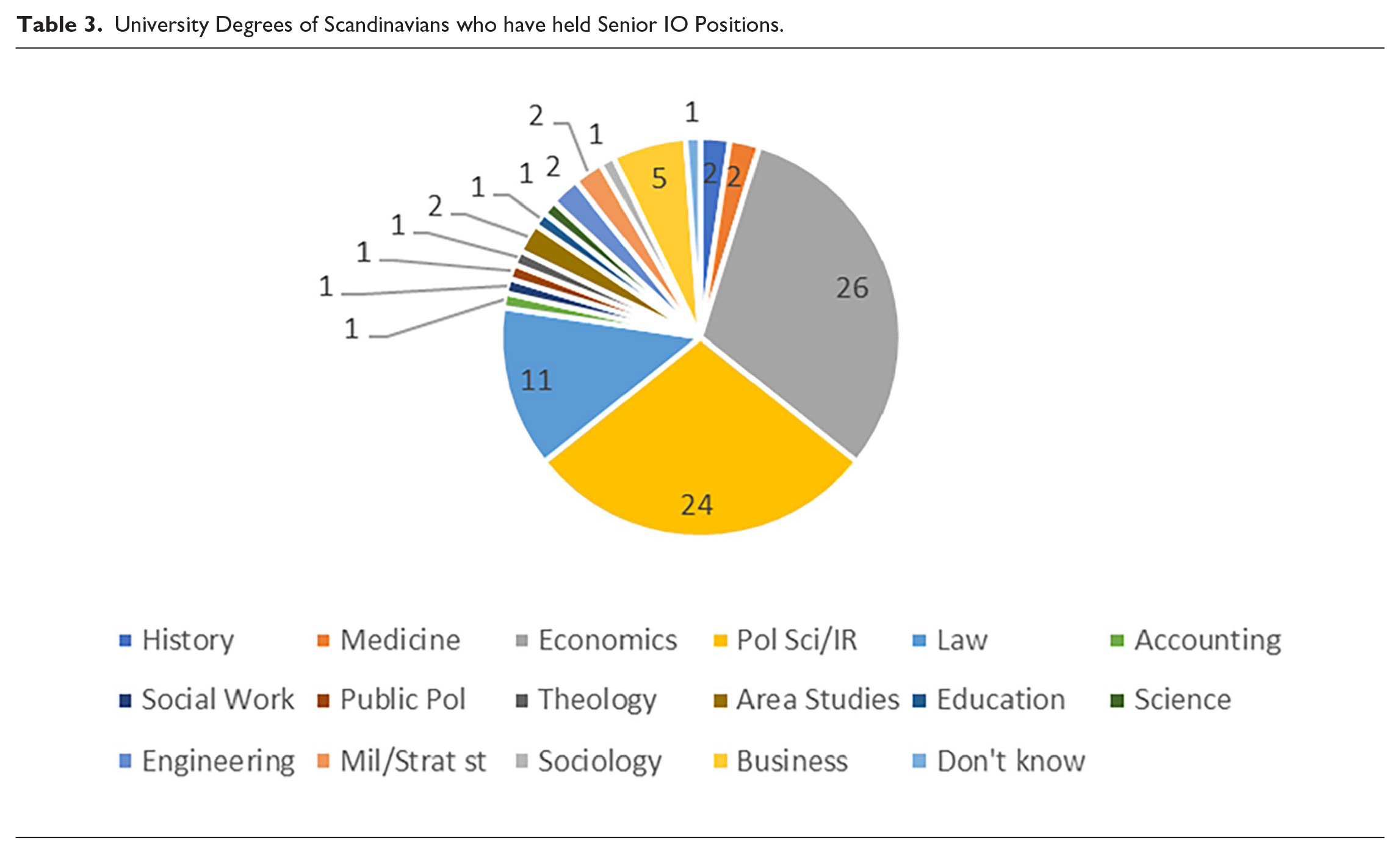
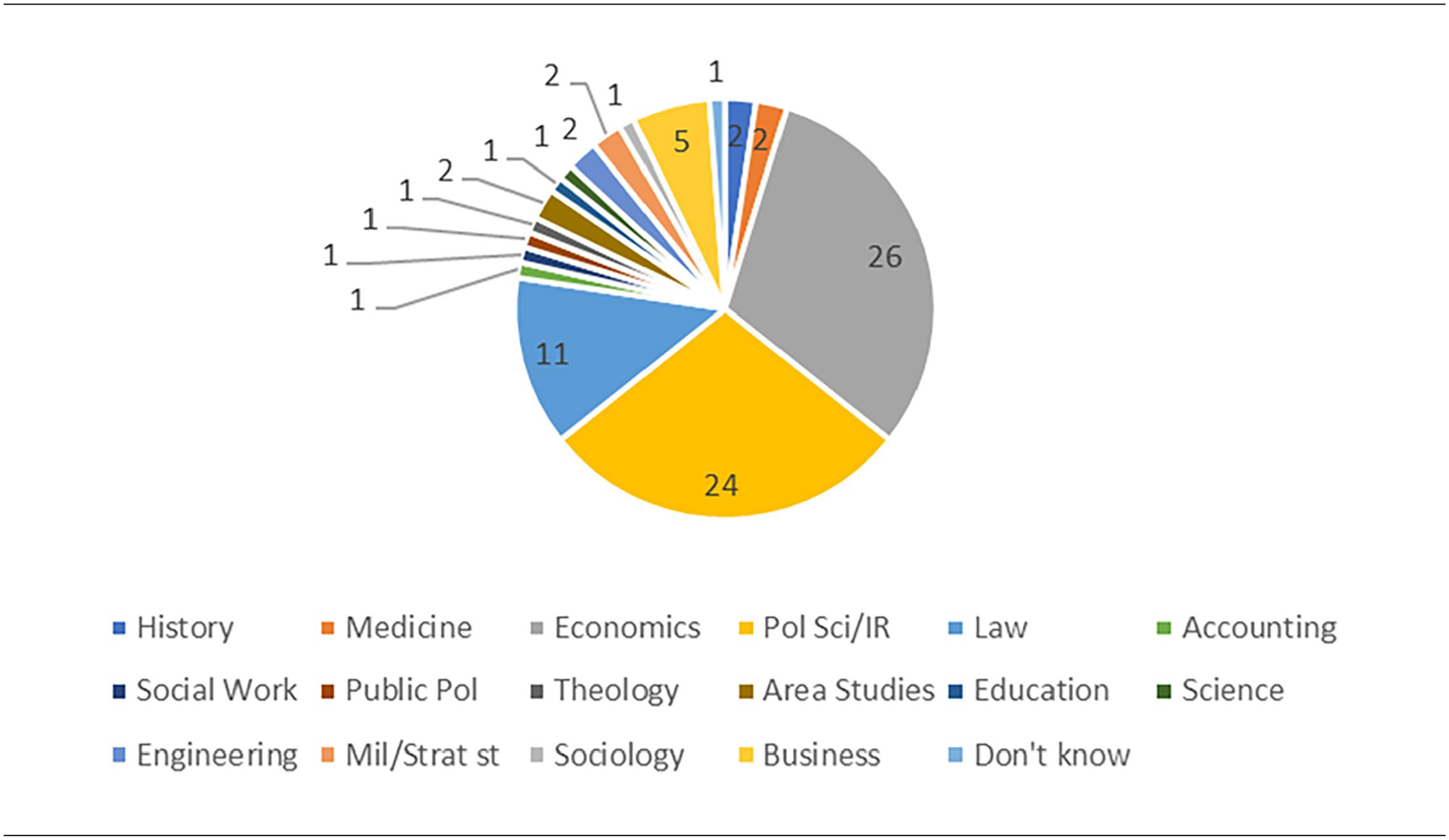
Nearly, all the Scandinavians who have held a senior role in an IO have some form of higher education, with more than a third having postgraduate degrees or PhDs (see Table 2). More than two-thirds of the Scandinavian individuals hold graduate degrees centred around economics, law or political science (see Table 3). This demonstrates a certain level of similarity in not just educational attainment and educational background but also likely a commonality in socialisation between Scandinavian IO officials; thus, it provides evidence for a shared habitus between Scandinavian globally focused practitioners, with further evidence visible in the common values they hold.
Educational Attainment of Scandinavian Senior IO Officials.

University Degrees of Scandinavians who have held Senior IO Positions
The values of Scandinavian practitioners
The ideals of internationalism and international solidarity that have influenced the foreign policies of Scandinavian states have been well documented (Jakobsen, 2020; Pratt, 1989). Internationalism in Scandinavia is an old value that predates even the rise of the social democratic parties (Gram-Skjoldager et al., 2019). Traditional social democratic values like solidarity still form the basis for the internationalism of many Scandinavian practitioners (it would perhaps be better to label social democratic internationalism as international solidarity to distinguish it from its older more liberal predecessor
3
), even if social democracy has lost the dominance, it once had in Scandinavia. These ideas have their roots in the traditional political pre-eminence of the social democratic parties in Sweden and Norway and to a lesser extent in Denmark. Scandinavian practitioners who work within IOs share these common values. Prevalent among them is a sense of duty to the international body politics, something that former Swedish diplomat and senior IO official Nils Kastberg, lays out, most countries consider that by having a national of their country in the UN, such staff should be there to push their national interests. Swedes and Nordics don’t think so. They think that international civil servants in the UN should stand for general humanitarian and international Human Rights principles that our Nordic countries stand for, but not work for our specific national interests. (22 February 2021)
This idealised vision of an international civil service goes back to the interwar period and the League of Nations (Dubin, 1983: 471–472). In the League, the Scandinavian states garnered a reputation as the main opposition at its headquarters in Geneva, as if they were the ‘conscience of the Great Powers’ (Götz, 2011: 109). The three states’ personnel had a strong presence within the league’s secretariat (Gram-Skjoldager et al., 2019). The high esteem that Scandinavian attributes were held in the early 20th century was illustrated by writer Michael Arlen’s claim that only they would be trusted to be the officers in an ‘International Police Force’ (Hambro, 1936: 175).
The internalisation of an internationalist outlook may have been fully completed within the three states’ elites and Scandinavian society by the first two Secretary Generals of the League’s successor organisation, the United Nations, being the Norwegian Trygve Lie and the Swede Dag Hammarskjöld (Götz, 2011: 114). Hammarskjöld, because of his martyrdom in a plane crash in the Congo in 1961, has since become an emblematic figure in UN history, and an inspiration to Swedish diplomats and IO officials (Luard, 1982: 194; Newman, 2008: 180–181). It was with Hammarskjöld, according to one British diplomat from the era, that ‘the full potentialities of the post of secretary-general were displayed’ (Mackenzie, 2002: 58).
Notwithstanding, that internationalism is not something that is exclusive to Scandinavian officials. For example, being an internationalist is an important part of being a UN official and any official that joins the UN must swear an oath not to follow any instructions from an authority or government external to it (Weiss, 1982: 291). Yet historically, this has not always been the case, with many UN officials remaining influenced by the government of their country of origin (Weiss, 1982: 303). At the very least, many states attempt to retain influence over their nationals when they work within IOs. Illustrated by Winston Churchill’s address to Lord Ismay on becoming the first Secretary General of NATO, ‘I realise you’re now about to be an international man! You have to be impartial between countries! I realize that – but there’s NO reason why you should be opposed to British policy!’ (Carrington, 1988: 382).
Nonetheless, internationalism is prevalent in all ranks of Scandinavian society (Anderfuhren-Biget et al., 2013). One former Norwegian minister and senior UN official argues ‘if you’re a UN official, you are not supposed to have any national affiliations in terms of using networks or anything that’s the neutrality expectation of the institution’ (Interviewee 15, 31 March 2021). Also in Norway, the only flag other than the Norwegian and Sami ones, which is allowed to be raised on National Day celebrations on 17 May every year, is the UN flag (Buxrud and Fangen, 2017: 772).
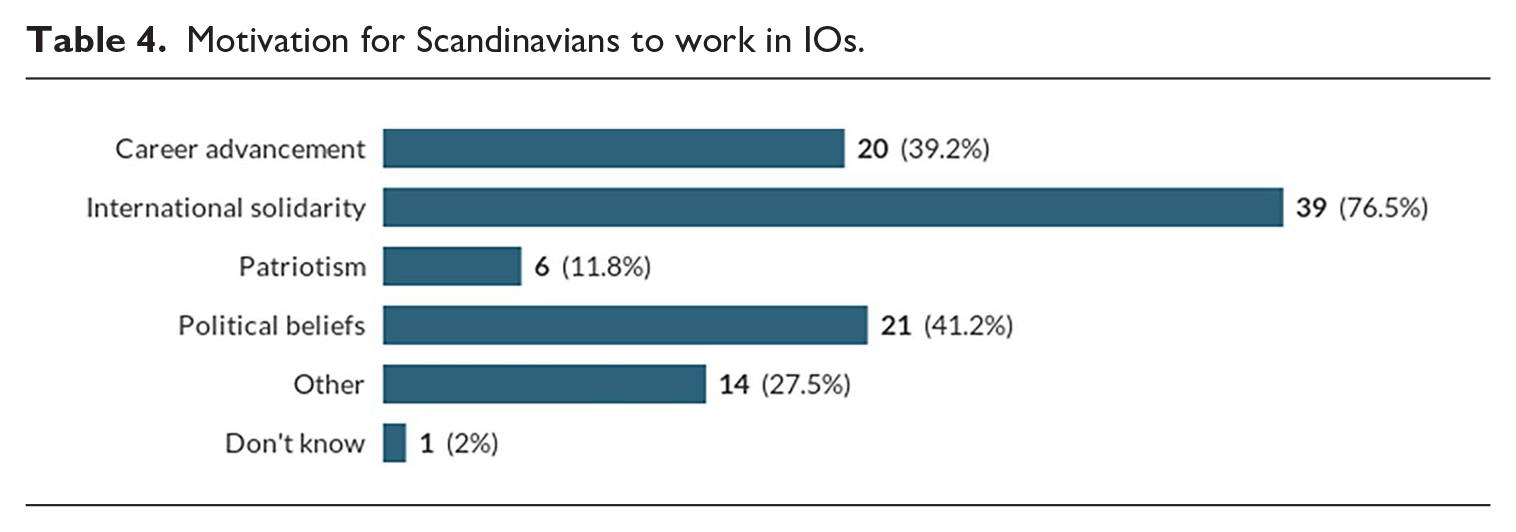
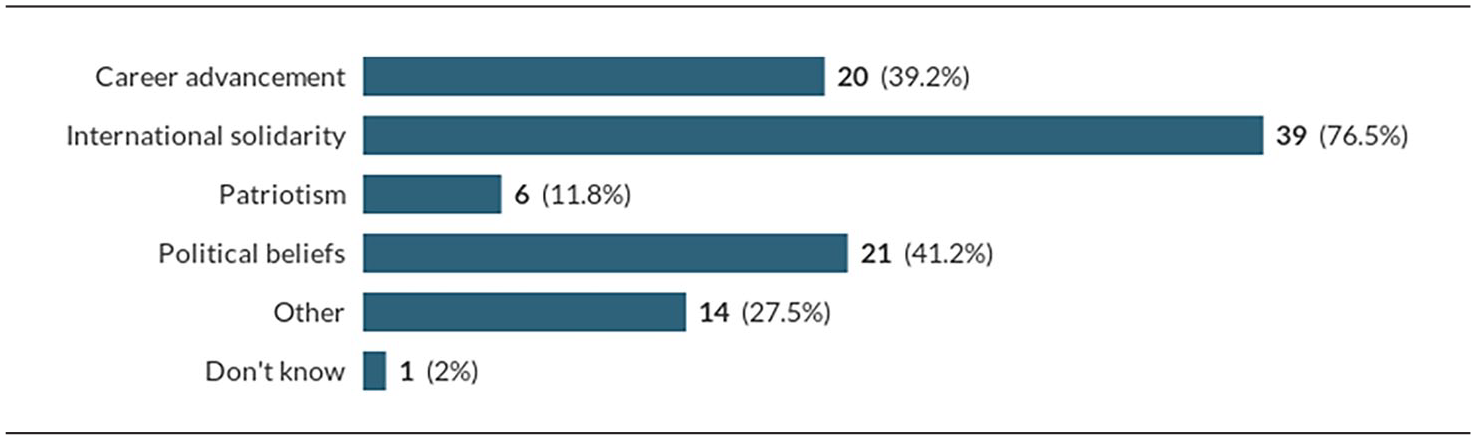
The belief in international solidarity is still strong among Scandinavians who work at or in IOs. Survey questionnaire participants were asked the question When you first started working for an IO or became engaged with your state’s national foreign policy, what were your main motivations for doing so? With the option of multiple answers, international solidarity came on top (see Table 4). There was nearly an equal split between state representatives and IO officials in those who stated international solidarity as a key motivation, but of the six individuals who stated patriotism, only one had worked as an IO official. Under the answer ‘other’, one Swedish diplomat stated that they were motivated to embark on a career in diplomacy because ‘Serving as a foreign service officer and pursuing values and objectives of Swedish foreign policy, such as democracy, respect for international law, human rights, and international cooperation, seemed like an honourable profession’. At the same time, a former UN official from Norway states, ‘I was motivated also by an opportunity to contribute toward advancing human development and promoting ideals and solutions offered in this regard by and through the UN’.
Motivation for Scandinavians to work in IOs.
It is not an overreach to suggest that Scandinavians have embraced internationalism more than most and that this is driven by habitus. If many countries do use their nationals who are IO officials to pursue their own interests, many Scandinavian officials claim they try to avoid doing so. A retired Swedish diplomat comments on working with Scandinavian IO officials: Yes of course there were several Scandinavians around mostly at the leadership level and in the various agencies in the UN, I wouldn’t say, we saw it practically as handy that we could speak the same languages, but we also knew that they were international civil servants that is very important of course we are all steeped in the Dag Hammarskjold ideas of the international civil servant that once you work for that organization you are serving the organization according to the UN Charter, of course it was very practical to have Swedes, or Danes or Norwegians running organizations because we could keep very informal ties with them. (Interviewee 17, 13 September 2021)
Swedish poet Lars Gustafsson declared in 1964 that, ‘the politics of internationalism has replaced earlier notions of national identity in Sweden, growing into an ideology shared by almost every Swede’ (Ruth, 1984: 68). To a former Swedish UN official, this sense of internationalism is similar in all the Scandinavian countries and comes not just from being small states dependent on the outside world, but has been internalised from ‘older generations, your parents, or from school’ (Interviewee 2, 14 February 2021). In effect, Scandinavian practitioners have a shared habitus, which produces similar values, and thus common Scandinavian ideals such as internationalism. Scandinavian practitioners, however, do not all operate within the same practice communities.
How Scandinavian international civil servants and Scandinavian diplomats intersect
IO officials, it is claimed, have between themselves, ‘a sense of kinship’ (Spies, 2013: 210). More aptly, IO officials could be described as belonging to their own IO-based practice community, with its own specific rules and practices. Even permanent state representatives to IOs can get socialised into aligning with its bureaucracy, despite ostensibly being there to represent state interests (Gray and Baturo, 2021). Still, many IO officials have been seconded from diplomatic or government practice communities and retain the same values, and many of the practices of their diplomatic and government compatriots. In fact, the individuals who initially staffed the League of Nations’ secretariat and the UN for several years after the inception of these IOs were mostly seconded foreign office officials (Sending, 2015: 265). Eventually, these officials became their own separate community of practice and over time developed their own unique identity as international civil servants. Nevertheless, their approach to practices within IOs will still be shaped by habitus.
Scandinavian IO officials may operate outside political networks, but they share the same habitus with Scandinavian diplomats and government officials. This makes interactions among Scandinavian IO officials and Scandinavian diplomats almost unavoidable. Interactions that could also be conceptualised as individuals from two different communities of practice having ‘boundary encounters’ (Wenger, 2008: 112). An illustration of these encounters across the boundaries of practice communities is that Scandinavian IO officials often hold informal meetings with all the Scandinavian or Nordic Ambassadors in the same room and brief them on their own, and the IO or subagency they work for, current activities (Interviewee 3, 15 February 2021).
If a Scandinavian IO official is a former civil servant, diplomat, or politician, then the overlap between communities of practice may become even more conspicuous. A practitioner might also consciously pivot across the boundaries of different practice communities and link them together (Wenger, 2008: 128). An individual who leaves one community for another, is likely to carry the knowledge, and practices, installed in them in the initial community (Strathern, 2003: 23).
An example of how individual practitioners can criss-cross between different types of practice communities (in this case between the development policy field, international civil service, and politics) is former European and Swedish parliamentarian Anders Wijkman. At various stages of his career, and being formerly both a member of Sweden’s parliament, the Riksdag, and the European Parliament, Wijkman has also been head of the Swedish Red Cross, Director General of the Swedish Agency for Research Cooperation with Developing Countries (SAREC), and an Assistant Secretary General of the UN and the Policy Director of the United Nations Development Programme (UNDP). Wijkman is now a member on the board of Swedish International Development Cooperation Agency (Sida) (About Wijkman, 2022).
Internationalist principles may help to generate an almost neglectful attitude by Scandinavian governments to Scandinavian individuals who have become successful IO officials – habitus is not always a guarantor for close association. One very senior Scandinavian IO official was struck by the consistent lack of substantive interest and engagement that his home country’s government had with him throughout his career, while also observing that this was the opposite of how the Americans, British, and French engaged with their own nationals within the same IO (Interviewee 3, 15 February 2021). The lack of home government interest in the senior official was confirmed by a fellow senior compatriot IO official (Interviewee 9, 2 March 2021). The latter noted that, during a meeting with officials from his home country’s MFA, when he asked a senior MFA official if they were in touch with his more senior colleague, ‘she looked at me and she said who? So, she didn’t know who he was’. This was despite his colleague holding a very senior position within the IO they both worked for. The Scandinavian IO official elaborates on this incident further: that’s probably indicative of, you know, the government’s approach to these issues, and some foreign affairs people I have talked to subsequently did say, yeah, well, in those days we also took the UN, you know, the reporting to the Secretary-General very seriously and we did not want to do what other countries did and still do try to push for their own people to be hired. (Interviewee 9, 2 March 2021)
A former head of a UN agency from a different Scandinavian country, recounts a similar attitude by his own country’s MFA (Interviewee 2, 14 February 2021). When the official was asked to step into a particular role for the IO they worked for, someone at the IO’s headquarters contacted their home country’s MFA to enquire about them but were met with the response of ‘who the hell is that?’
These two Scandinavian IO officials both admit, however, that their respective MFAs were keen to get their nationals working within IOs, but it was their own personnel that they wanted to place there and sometimes, it was just individuals that they wanted to move on. The ex-UN agency head notes that there was no government support in any of his promotions but that ‘if you are an external candidate, you will have more government backing’ (Interviewee 2, 14 February 2021). For example, when he was overseeing the recruitment for a specific UN job role, his home country’s MFA rang him and attempted to get their preferred candidates placed up the pecking order ahead of 155 co-patriots, most of whom had no government links. Illustrating the importance of habitus for Scandinavian cooperation, the very senior Scandinavian IO official admits that it was easier to work with fellow Scandinavians rather than with ‘somebody who was from another continent where you will have had to spend more time convincing’. He argues that Scandinavians share not just practices ‘but also a set of values’ (Interviewee 3, 15 February 2021).
Scandinavian practitioners would not be able to cooperate so closely without the trust that is evident among diplomats and government officials in the Nordic region, a trust built up ‘through years of inter-cultural state and non-state practices, rooted itself in the societies of the Nordic countries’ (Røren, 2019: 5). The trust generated from habitus has been crucial for the longevity and success of Scandinavian cooperation. A joint statement by Nordic ministers for cooperation made in 2014 illustrates their own belief in the importance of shared knowledge and experience: ‘The Nordic countries have a long tradition of trust-based co-operation stemming from our common historical, cultural and geographical heritage. Our national societies are also based on the same fundamental values, such as democracy, human rights and sustainability’ (The Nordic Region - together we are stronger, 2014).
Trust between Scandinavian practitioners also overcome national differences when they do rise up. As seen previously, despite the different responses of the three states’ governments to the COVID-19 pandemic, the actual practices of Scandinavian practitioners remained aligned.
The make-up of Scandinavian practices
Habitus produces practices that are like the social structures that developed them (Wacquant, 2018: 530). Therefore, it is habitus that leads to Scandinavian practitioners who work at IOs as either officials or as state representatives, having recognisably similar characteristically Scandinavian practices – a commonality that is well known (Marcussen, 2020: 240). In essence, a common Scandinavian identity leads to similar practices. This part will first in turn analyse three elements that shape Scandinavian approaches to practices: straightforwardness, informality and pragmatism, before finishing with a discussion on the social ties between Scandinavian practitioners.
Straightforwardness
By straightforwardness, I mean to signify being honest or direct in communications with others as opposed to being deceitful or disingenuous. Scandinavian practitioners are renowned for their straightforwardness within IOs. Indian former UN Assistant Secretary General Satya Tripathi (21 April 2021) claims that Scandinavians are ‘very blunt, let’s put it that way, they’re not subtle and they speak their minds. I think that’s a good thing, I see that as a strength because I am not guessing where they are coming from’. Scandinavian diplomats share, what a Danish diplomat describes as a ‘common detection’, an aversion to ‘bullshit’ (Interviewee 16, 8 April 2021). A retired North American former senior diplomat and IO official describes the Scandinavian tendency for bluntness: ‘They were like I’m going to say my piece and give you the benefit of my advice but if you guys decide to do something different, that’s your problem’ (Interviewee 28, 26 August 2021).
Scandinavian straightforwardness is illustrated by the words of Jan Egeland, the former Norwegian UN Undersecretary General for Humanitarian Affairs. Egeland (2008) firmly lectured local notables in a town in Côte d’Ivoire on their culpability following a recent attack on UN peacekeepers in the area ‘I am the envoy of your fellow West African, the United Nations secretary-general, and I have come from the other end of the world to speak the truth and to seek justice’ (p. 3). This type of performative idealism can be traced back to Egeland’s fellow Norwegian Halvdan Koht, who declared in 1901 that: ‘The small peoples are the ones who carry the idea of justice forwards. They have no political power to maintain, they quite simply have to be peoples of peace’ (Leira, 2013: 343).
The honesty of Scandinavian officials is not always a beneficial trait and sometimes the Scandinavian habitus can clash with the habitus of others. A former senior EU civil servant recalls one of the difficulties that individual Scandinavian practitioners have come up against in the EU: They are much more straightforward but also a lot less subtle than some of the others, they tend to think this is how we see it so this is how it should be, the answer is obvious. It’s not obvious to countries who come from a different background or tradition, that is why everything takes so long . . . there is a tendency to stubbornly keep repeating things, but then the institutions have to take them to one side and explain a few facts of life. (Interviewee 29, 7 September 2021)
Whether successful or not, straightforwardness is a clear element in Scandinavian practice global politics that is not just conducted by the odd solitary practitioner, it is a normative position that can be traced back to the transparency of Scandinavian domestic politics (Götz and Marklund, 2015). Scandinavians when carrying out practices in IOs related to negotiations are very blunt and honest in their approach, and this also helps to explain their ability to cooperate and make decisions informally.
Informality
Describing informality as a practice would admittedly be stretching the term. It should be better conceptualised as a heading for how practices are conducted by Scandinavian practitioners, their decision-making processes and interactions with both each other and with non-Scandinavians, which all involve a high degree of informality. Nevertheless, informality is not only a distinguishable Scandinavian practice but it is also, in fact, used within many IOs.
In the UN, informal meetings that preempt public debates, often in the form of private sessions and consultations, have become common practices (Berridge, 2002: 161). Similar informal processes also take place at NATO’s headquarters in Brussels (Pouliot, 2016: 88). An informal practice could be a breakfast meeting between Scandinavian diplomats in relation to a joint policy proposal, or more simply a brief telephone call or email asking a counterpart’s stance on a contentious issue or even just a conversation in a corridor. As one senior Danish embassy official states, they can at any time ‘just pick up the phone and talk to Nordic colleagues’ (Interviewee 6, 23 February 2021). While according to one former Swedish diplomat to the UN, informal meetings between Scandinavian representatives over breakfast or lunch are so commonplace that they were, ‘a standing feature’ (Interviewee 13, 12 March 2021).
The Scandinavian states share the belief that their influence in global affairs, including on specific policy issues, often depends on their preferences and actions being aligned very closely. Scandinavian officials will often consult first with their Scandinavian counterparts informally about any given issue, and if they have differences, will attempt to form a consensus through face-to-face meetings. The shared habitus means that Scandinavian practitioners already have a good idea of where each other is coming from. A Norwegian diplomat explains the relevant processes, We compare notes if there is an issue coming up, we would reach out to them (fellow Nordics) to discuss to kind of flag things, some positive, some negative and we consult a lot before we make statements and much of the dialogue before is on the basis of informal consultation. (Interviewee 8, 1 March 2021).
Scandinavian practitioners can be seen to be operating the practice of peer review among themselves.
Another example of Scandinavian informality is the way the high-profile Swedish diplomat Jan Eliasson ran Sweden’s embassy in Washington D.C., when he was an ambassador to the United States in the early 2000s: ‘The ambassador had an open-door policy and his staff were encouraged to drop by to discuss an issue, review a cable, or bring visitors by for a brief chat’ (Shaw, 2006: 59). Eliasson had also integrated informal practices into a mediation technique when working as the UN Secretary General’s Personal Representative on the Iran–Iraq issue in the late 1980s (Svensson and Wallensteen, 2010: 55).
In reference to informal working practices, a Norwegian delegate to the UN speaks (albeit glowingly) of Norway’s experience on the UNSC in 2001–2002: Norway’s great advantage is that we have an informal system. This has to do with the character of the instructions, they cannot be too detail orientated. Norway is at its best when we (the Norwegian delegates) have broad instructions, when we can clear things very quickly with the top. (Quoted from Schia, 2013: 149)
In connections between Scandinavian diplomats and officials, the lines between formal and informal meetings are blurred. One survey participant states that most formal meetings are ‘actually only formal in an informal way’. Furthermore, a senior Norwegian diplomat describes the indiscernible lines between formality and informality within the framework of Scandinavian cooperation: You would talk a lot on the phone, zoom, or on teams and you know you would consult before big meetings and there are regular meeting places . . . Many of these contexts are really much more informal than formal, they’re not formalized in a strict sense with minutes or an agenda and so on, it can be that but very often it is not. Then you would meet on travels, you would meet before, during and after big meetings and big conferences. We compare notes if there is an issue coming up, we would reach out to them (fellow Scandinavians) to discuss or to flag things, some positive, some negative and we consult a lot before we make statements and much of this dialogue is on the basis of informal consultation. I wouldn’t call it formal even though its formal in the sense that it is binding, its serious, but the style of it is much more informal. (Interviewee 8, 1 March 2021).
Informal practices are at the heart of Scandinavian cooperation, it is what distinguishes it within global politics. As most individuals know, it is much easier (generally) to be informal within the shared habitus of your own family than it is with others, who have had their ideas and perception shaped by a different habitus, it is also more common for family members to help each other.
For example, a Danish representative to an IO attending an important meeting, which their Norwegian and Swedish counterparts are unable to attend, with the Danish representative then writing an extensive post-meeting report for their Scandinavian colleagues to look at. This relates to, as noted by a Danish diplomat, the trust Scandinavian practitioners have in each other’s practices of ‘assessment and way of reporting’ (Interviewee 14, 29 March 2021). A different Danish representative gives an additional practical example of the benefits of Scandinavian cooperation, let’s say we don’t have a defence attaché, or it could be a trade attaché in say Canberra, then we could go to one of the other (Nordic) countries and ask if they can help us in terms of providing us information on a certain matter. (Interviewee 6, 23 February 2021).
The sharing of information is also observable to non-Scandinavians. A senior representative at UN Geneva from a western European state describes both their own and their colleagues’ perceptions of this (in this case, they are referring to just the actions of Norway and Sweden specifically): If one or the other is not there, then we usually take into account the other is there, if you understand what I mean. I do think they really share knowledge, knowledge, and information a lot and so if one of the two was in a meeting and the other one was not, usually when you meet the other one, they know. So, to us at least it seems so, well we work under the hypothesis that they do share a lot of information. (Interviewee 22, 16 October 2020)
It has been noted that Scandinavian and Nordic practitioners look out for each other in IOs and ‘often act as each other’s eyes and ears’ (Hagemann and Bramsen, 2019: 36).
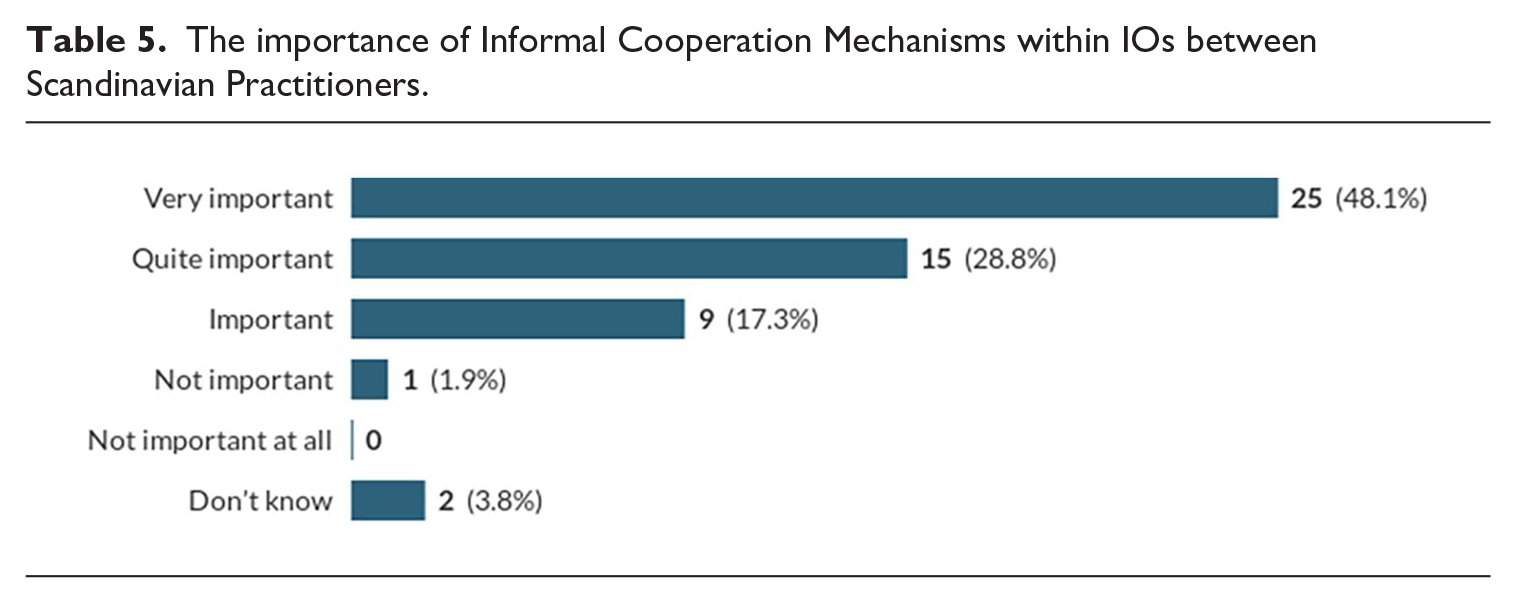
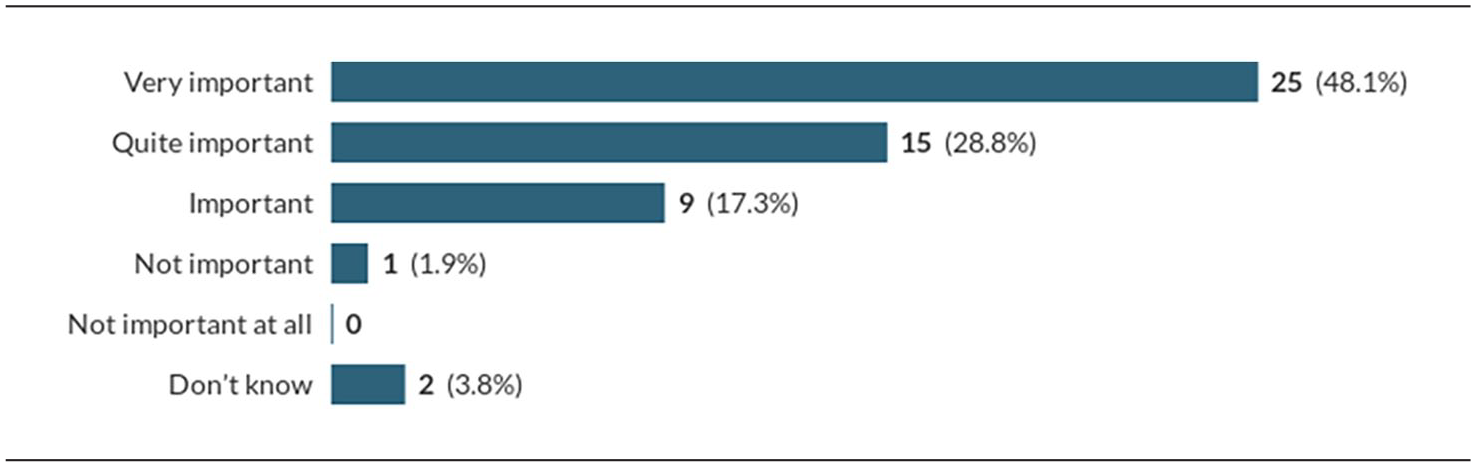
To gauge the importance of informal practices for Scandinavian practitioners themselves, the survey questionnaire participants were asked how important (the scale being from very important to not important at all) in their experience, were any informal cooperation mechanisms between diplomats/officials/politicians from Denmark, Norway, and Sweden for exchanging information and seeking advice within IOs (see Table 5). More than 94% of the survey participants stated that informal mechanisms were important, quite important, or very important for exchanging information and seeking advice. More specifically, nearly 50% of participants claimed that informal mechanisms were very important, with less than 2% stating they are not important. The survey participants were also given the option to elaborate what informal cooperation mechanisms they rated highly. Crucial is the regularity of informal meetings between Scandinavian officials, often just consisting of coffee or lunch meetings. Another important factor mentioned by the survey participants, is that a lot of the time they are working with colleagues that they already have good personal relations with; people that they have met before and have teamed up with at different forums to the one they work at now. Informal meetings also take place among Scandinavian diplomats, officials, and politicians at various regional and nationally organised conference retreats, which are pan-Nordic in theme. The main thrust is those informal meetings between Scandinavian (and more broadly Nordic) diplomats and officials take place daily (Elgström, 2016: 231).
The importance of Informal Cooperation Mechanisms within IOs between Scandinavian Practitioners.
The most prominent formal platforms for regional cooperation, the Nordic Council (NC) and Nordic Council of Ministers (NCM), are valuable in helping Scandinavian practitioners (alongside their Finnish and Icelandic colleges) get to know each other. Former Danish Social Democrats Party leader and foreign minister, Mogens Lykketoft, hints at this value: The Nordic Council is a good occasion to meet and learn, to get to know, your opposite number in different positions, but it is very seldom that really operational decisions are taken in the Nordic Council. It’s more a club for knowing each other better personally and also for knowing each other’s positions on issues and the different challenges facing the governments and showing the parliamentarians in the five countries. (18 February 2021)
They are also useful venues for Scandinavian practitioners to discuss issues before they are raised in larger IOs such as the EU and NATO. One Danish diplomat describes the NC ‘as a benchmark for what we go and say in other organizations . . . it’s kind of a pre-vetting of ideas or a kind of testing off, of them before entering them into big organizations’ (Interviewee 6, 23 February 2021). Informal meetings are a crucial element of cooperation between the three states, with informality been driven by the shared Scandinavian habitus.
Pragmatism
Scandinavian practitioners are also renowned for being pragmatists. A retired Swedish diplomat and former senior IO official summarises the Scandinavian working model, we are normally quite pragmatic and hands on in our way of working, result-orientated, rather concise in our presentations, we don’t deliver long speeches, we are known for having concise points. I think that reflects the Scandinavian character, if I may say so, hands on and related to the ground and the problems of people. (Interviewee 17, 13 September 2021)
Scandinavian views on hierarchical working environments are recapitulated aptly by Pierre Schori (2008), a politician and former UN Special Representative to Côte d’Ivoire (while also a former advisor to the late Swedish Social Democratic Party (SAP) leader and Swedish Prime Minister Olof Palme), in his description of his own leadership style, Organizations with strong, centralised power are often weak on transparency, and thus run the risk of being weak on developing fair staff policy and promoting a positive team spirit. I saw it in my own mission, and I tried to combat those leadership excesses by being flexible, egalitarian, transparent, and in a constant listening mode, while leading by example. (p. 29)
The large, slow-moving bureaucracies that are present in some IOs can be frustrating for many Scandinavians and are something that they wish to reform and upload pragmatic practices into, or rather attune to their own habitus. For instance, Sweden influenced the EU’s practices in the policy areas of development and the environment after becoming a member in 1995, despite the clash in habitus described earlier (Danielson and Wohlgemuth, 2002: 11; Kronsell, 2002: 7). In a further illustration, the former Norwegian prime minister Gro Harlem Brundtland (2002: 451–452) sought to streamline the leadership structure of the World Health Organisation, after she was elected its Director General. Another Norwegian, a diplomat and former UN official, explained some of the vexation with the working model of IOs: from the time you push the button to you seeing something coming out of the other side, can be a considerable lag. And so, it can be very frustrating place to work for us because we come from a different tradition, and we really value certain aspects of this tradition. (Interviewee 8, 1 March 2021).
The diplomat also argues that many UN agencies would benefit from, a more pragmatic approach to leadership . . . what I mean is that sometimes it is better to get things through. Sometimes, it’s just blocked for no obvious reason that I can think of except for politics and that is very frustrating. (Interviewee 8, 1 March 2021).
Nevertheless, the diplomat quoted did not state that these organisations needed Scandinavian leadership; they did hint at the potential viability of pragmatic Scandinavian practices and how they might improve the top-level management of many IOs (Interviewee 8, 1 March 2021). Even if Scandinavian officials get frustrated by the workings of IOs, they are pragmatic at pushing through the policies they support. A retired Swedish senior UN official recounts that in the UN agency, they worked in when Swedish representatives want to pursue a particular agenda ‘they did it rather cleverly working with others who thought in a similar way, so as not to present directly an agenda as a Swedish one, but more as something that others would support’ (Interviewee 2, 14 February 2021).
It should be noted that, for non-Scandinavian practitioners, their perception of Scandinavian identity comes from what they see in the practices of Scandinavian practitioners. Scandinavian IO officials and state representatives are esteemed among non-Scandinavians for being hardworking. A former high-ranking UN official from the Middle East states that her senior Scandinavian underlings were ‘very hard workers. In other words, I’ve never had to, for example, I never felt that there was an assignment they didn’t do and do well to the best of their abilities’ (Interviewee 23, 26 February 2021). However, though, a Scandinavian self-image of competence and hard work can lead to arrogance and hubris. Within the EU, this has led to dismissive Scandinavian (excepting Norway) attitude to the practices of non-northern Europeans, such as Greek or Italian practitioners (Kuus, 2014: 150).
Although there are national differences, to many outside observers, the variations between Scandinavians are less obvious. Two IO-based diplomats, who are from a small European country, note that Scandinavian state representatives sometimes work so close together that ‘it is sometimes difficult to distinguish which one is which in any case because they say more or less the same things’ (Interviewee 25–26, 23 March 2021). This type of perception can even be traced back to the League of Nations where individual representatives from the three states were often called ‘Scandinavian representatives’ and their proposals ‘Scandinavian proposals’ (Jones, 1939: 3). The two diplomats make clear, that they were impressed by the level of cooperation between all three of the Scandinavian states. They state that they have ‘never seen as much solidarity than between them, to be honest, and the fact that some are members of the EU and others are not doesn’t really effect their cooperation all that much’ (Interviewees 25–26, 23 March 2021).
Ties born out of habitus drive Scandinavian practitioners to cooperate instinctively. Several Scandinavian practitioners acknowledge that they impulsively tend to socialise more with fellow Scandinavians, than with non-Scandinavians. A Norwegian former IO official acknowledges that, ‘I’m almost ashamed to admit this but yes, it is almost like a natural thing to do’ (Interviewee 12, 5 March 2021). A former Norwegian government minister and senior IO official states that, when you come across fellow Scandinavians, ‘You don’t need to start with the entire life story, you don’t need to start from a in the alphabet, you know each other. At least you believe you know each other quite a lot just from the background’ (Interviewee 11, 4 March 2021). In addition, a Danish IO official observes that, ‘if you are abroad you will see in many countries that the Nordics will always have their own little groups coming together sharing their views and experiences and lessons learnt, also within International Organisations’ (Interviewee 1, 6 January 2021). Finally, a Swedish government official that is based at an IO claims that with Scandinavians ‘The further we get away from our own countries, the better we work together’ (Interviewee 18, 14 September 2021). It is the shared habitus that drives Scandinavian practitioners to work and socialise together and not just calculated interests.
Conclusion
The world and global politics may be best conceptualised as a series of different habitus that overlap from individual families to tribes, to entire countries. The Scandinavian case may be seen as an exemplary case of habitus that crosses national boundaries, but I would not claim that it is the only regional one. Even so, I argue that a shared habitus provides the framework for Scandinavian cooperation as it enables globally focused Scandinavian practitioners to work together effortlessly and informally. Scandinavian practitioners share similarities in culture, history, and values that drive them to work, and socialise together. Sharing habitus makes trust easier to generate, leading increasingly more socialisation and thus cooperation. The extent of cooperation between Scandinavian practitioners, whether at the state or non-state level, cannot be explained by traditional concepts of cooperation shaped by ideas like self-interest.
The values and practices of Scandinavian practitioners are driven by a shared habitus, which in turn also influences the policies and preferences of the three states. Therefore, it is not power or rational self-interest that drives Scandinavian cooperation, it is a shared habitus. The shared habitus leads to similar values and approaches to practices that, in turn, leads to the ease with which Scandinavian practitioners are able to work together and it is that this is perhaps the basis for the strength of Scandinavian cooperation. In a nutshell, the identity of the shared Scandinavian habitus comes first, and then, in turn, leads to similar approaches to practices that then, in turn, transforms into Scandinavian cooperation.
This article, however, has been limited by the lack of a study of a control group of comparable diplomats and officials from other countries as part of a broader comparative study. Further research needs to be done on whether habitus exists in other cultural entities or regions of Europe, such as the Anglosphere and the Benelux countries, or even further afield, among the Arab Gulf states. That has been beyond the remit of this article and remains to be seen. The boundaries of different habitus should also be investigated, although this may require time-consuming methods, such as participant observation, in conjunction with semi-structured interviews.
Finally, more research is needed on whether the existence of habitus leads to the forging of regional networks between individual practitioners, including among Scandinavian diplomats and IO officials, whether separately or together, as this article hints it does. Crucially, it could be explored if these networks can be empirically linked to policy discussions within both formal and informal Scandinavian cooperation and to lead to an enhancement of the three states’ influence within IOs. Moreover, the question is posed, does the shared habitus help the Scandinavian states to punch above their weight in global politics?
Footnotes
Funding
The author(s) received no financial support for the research, authorship, and/or publication of this article.
