




Abstract
This article examines how international summits are produced as status symbols, arguing that a host’s successful management of the event maintains summitry as a high-status practice, while hosting itself serves as a means to acquire status, owing to the complexity and risk involved. Drawing on elements of practice and performance theories, it articulates how and why status symbols can be understood as performative practices, reworking how Veblen is predominantly used in International Relations (IR), shifting from a focus on conspicuous consumption to conspicuous performance, while adopting a more expansive conceptualisation of status symbols, as one finds in Goffman. Exploring the manipulability of summitry as a status symbol, the article draws on an ethnography of the 2018 Charlevoix G7 summit, offering a ‘behind the scenes’ look at how a host produces a summit’s constitutive ‘showpiece moments’, zeroing-in on three key elements: a host’s scenario handbook, command centre and media centre. In addition to proposing theoretical and conceptual innovation in the study of international status, the article expands the scope of summit studies beyond a traditional focus on statespeople negotiating agreements, inviting exploration of summitry’s performative and symbolic dimensions.
Introduction
Summits are the stuff of status. Typified by fancy dinners, extended motorcades and the trappings of state, they are a prime site for the spotting and flaunting of status symbols (Danielson and Hedling, 2022; Larson, 2018; Matwick and Matwick, 2022; Naylor, 2020). Moreover, membership in the exclusive groups that sit around the top international tables is itself a marker of high status (Ekengren et al., 2020; Hill, 2016; Larson, 2018, 2019). In the past year alone, leaders of rising powers have particularly used hosting summits to signal ascendant status. Prime Minister Narendra Modi used India’s 2023 presidency of the G20 to boast India’s status not just as sitting at the top of the global governance table, but to be leading at its head. The Indian Prime Minister spared no expense or opportunity to flaunt his New Delhi G20 summit as a turning point in India’s position and identity on the world’s stage (Cooper, 2023; Jagtiani et al., 2022). The same is true of Xi Jinping’s China-Asia Summit and the UAE’s hosting of COP28, both also held in 2023.
What follows interrogates this summit–status nexus, examining the (re)production of summits as sites of status politics. Conceptually, the term ‘summit’ captures two dimensions that render them high-status things: altitude and difficulty. The first is rather intuitive – summits are meetings at the commanding heights of international politics between leaders at the apex of their respective domestic political hierarchies. It is this sense of the term that Winston Churchill evoked when appropriating the term for use in politics (Dunn, 1996; Hamilton and Langhorne, 1995). In this sense, summits are exalted and rare. It is, however, decreasingly the case that summits are uncommon, owing to travel being easier, faster, safer, and cheaper. Accelerated by the COVID-19 pandemic, this is all the more with moves to virtual and hybrid summitry, allowing leaders to meet online from the comfort of their own capitals. The routinisation and normalisation of summitry – particularly in the case of the annual G7 and G20 summits – render them more ordinary and therefore less obviously status-related phenomena. It is the second figurative sense of the term that summitry is a difficult endeavour – not all mountaineers make it to the top – that, even despite normalisation, remains true. This is the focus of what follows, not solely because it endures, but because it is otherwise undocumented in the literature and as its analysis yields significant insight into the practice of summitry and the politics of status. Moreover, it is important to ascertain how summits are actively produced and managed as sites of high-status approbation. It is not an automatic or easy thing to do – like scaling Mount Everest, it takes incredible effort and skill. Indeed, hosting a poorly run summit likely confers no status at all or, worse, casts a negative pallor on its host, as Egypt learned with COP27 where ‘food ran out, water supplies ran dry, and sewage at one point ran down the streets’ (Sky News, 2022). Before we can make this assumption, then, it is thus necessary to ask, ‘Why is hosting a summit a marker of status and how is summitry itself (re)produced as a status good?’
I argue that the managed curation of a summit by its host government is necessary to (1) maintain the practice of summitry as a status symbol and that (2) hosting a summit is a status symbol because of the complexity and risk involved in the undertaking. Examining a G7 summit, I demonstrate how the close direction of a summit preserves the prestige associated with summitry’s performative practices, allowing them to serve as intermediary mechanisms through which participants’ status as members of an exclusive club is affirmed. This dimension of status politics socially differentiates included participants from excluded outsiders, attributing a superior status to the former over the latter. It is a summit’s performative, protocol-laden moments – from arrival ceremonies to family photos – that conspicuously flaunt summit participation as a signal of status and confer corresponding prestige.
Concurrently, the practice of hosting is itself a valued status marker. What makes it so is that these events involve not only incredible complexity, but that there is always a looming prospect of embarrassment for the host and the potential failure of the summit. Because summits are difficult, risky endeavours, the host stands to gain prestige and esteem from its successful execution. In the case of G-summitry, the host stands to increase its social position within an already exclusive club. This status dimension thus concerns the relative standing of members in a status group, a topic which has received much recent attention in International Relations (IR) (Danielson and Hedling, 2022; Larson, 2019; Naylor, 2019; Pouliot, 2016; Wohlforth et al., 2018). What follows adds to this work by focusing on the host and the otherwise unobserved means by which they manage the summit as a status-seeking opportunity for themselves and as a status maintenance opportunity for the club as a whole.
Two things are worthy of note about these twin status dimensions. The first concerns the means by which status is signalled. While typically written off as inconsequential diplomatic niceties that detract or distract from the real business of a summit, what is advanced here takes such hallmark summit moments to be pivotal to the articulation of summitry as a status good. Moreover, this prompts a shift in how protocol is typically conceived. While usually understood as a means of ‘levelling the playing field’ in diplomatic settings to prioritise formal, sovereign equality over substantive power asymmetries, protocol here plays a role in reproducing broader status hierarchies (Constantinou, 1996). Equality of standing is afforded to those who are included, while, by implication, denied to the excluded who do not get to take part in summit rites. While protocol might erase distinctions in power, it affirms discrepancies in status.
Second, a host stands to benefit from the instrumentalisation of the summit. It is an opportunity to flaunt desirable attributes – themselves status goods – and garner esteem as a competent welcoming host – in the eyes of attendees and public onlookers alike – as well as prestige as a world leader (Adler and Pouliot, 2011: 4–5). For the duration of the summit, the host’s domestic audiences see their political leadership not merely at the pinnacle of international politics, but as the leader at the top. The host is uniquely positioned at the centre of all of a summit’s performative moments and the actor able to plan and produce a summit in such a way that casts them in the best possible light. This invites a shift in how status competition is understood in IR. While the temporary centrality of the host does not much matter to other governments, included and excluded alike, it does matter a great deal to the host and its domestic population, particularly for lower status or more status-insecure actors, as it affords a chance for them to achieve a status boost vis-à-vis their higher status peers (de Carvalho and Neumann, 2014; Wohlforth et al., 2018). This is an opportunity to demonstrate or affirm that they have the expertise and skill to play in the diplomatic big leagues, a key reason why hosting a summit is particularly attractive to states in the ascendancy. Paul Beaumont’s call to understand international status competition as being as much about domestic audiences as international ones is instructive (Beaumont, 2020; see also: Pu and Schweller, 2014; Ward, 2017). The flaunting of status symbols by the host – and, indeed, as the host – is a performance primarily for their own populations. The import that governments place on hosting cannot be understood without conceiving of status in this way, a solely system-level theorisation is insufficient.
What follows makes theoretical, conceptual, and empirical contributions to understandings of both international status and international summitry. Theoretically and conceptually, the primary aim here is to demonstrate how elements of performance theory can improve IR’s account of international status. In doing so, I pick up two of Røren and Beaumont’s assertions about status symbols – (1) that status symbols can be understood as practices and (2) that ‘manipulability’ is a key dimension of status symbols worthy of interrogation. Summits do not just happen. They take months of detailed planning and an army of individuals to manage their execution, particularly if they are to successfully serve as status symbols. Empirically, as far as I am aware, this is the first detailed ‘behind the scenes’ look at the production of an international summit.
To do so, I draw on knowledge generated as part of an embedded ethnographic study, conducted between February and June 2018, with the Canadian government during their G7 presidency, culminating in the 2018 Charlevoix G7 summit. I substantiate the argument by zeroing-in on one ‘showpiece’ moment of a summit – the arrival of a leader’s aircraft. For reasons justified below, I do not focus on the actions of any particular leader or their entourage, but rather on three key, hidden elements that work together to produce this moment as one of symbolic significance. These are (1) the Canadian government’s ‘scenario handbook’ for the summit, colloquially referred to as ‘The Bible’; (2) the Summit Integrated Command Centre (SICC); and (3) the International Media Centre (IMC). A close examination of how these hidden dimensions of a summit’s management allows us to trace the nested practices that (re)produce a summit as a high-status context and the hosting of a summit itself as status symbols.
I use an arrival because of the significance ascribed to this summit moment. A leader’s arrival is a constitutive, liminal moment – marking the elevation of a political leader to be imbued with powers that mark them out as standing for their state (Cohen, 1987; Constantinou, 1998, 2016; McConnell, 2016, 2018; Naylor, 2020; Neumann, 2013; Shimazu, 2014; Sidaway, 2001). Leaders’ arrivals are concurrently constitutive of a summit, demarcating it as an extraordinary diplomatic site (Naylor, 2020; Neumann, 2013), framing it so as to set it ‘off from the surrounding context’ (Ringmar, 2012: 7). Leaders’ arrivals, in other words, do nothing less than fundamentally and performatively render a summit as a special, exalted phenomenon beyond quotidian politics. Quite how central and important this moment is to the practice of summitry and quite how complex, difficult, and risky its execution is reflected in the countless hours and resources directed by the host to the planning and execution of each arrival, as well as the conspicuous, continuous circulation of the arrival via international media after the fact.
The purposive look away from the typically studied elements of summitry affords an opportunity to move summit studies – and studies of G-summitry in particular – in new directions beyond the traditional focus on leaders, negotiations, and policy. As Alexandroff and Brean have asserted, summits are like icebergs, and most scholarship to date has been limited to what is visible above the waterline (Alexandroff and Brean, 2015). While helpfully calling for an expanded analytic gaze, Alexandroff and Brean remain concerned with the policy-making functions of summitry, albeit with a shift in focus below the leaders’ level, as is congruent with new liberalism’s focus on networked governance (Slaughter, 2004). The aim here is to push things further, shifting our understanding of summitry to be more than a mere policy-making mechanism. By ethnographically going ‘behind the scenes’, the methodological and empirical goals are to demonstrate that we can study summitry differently and that doing so reveals the practice of summitry to play a far more substantive role in the constitution and maintenance of international status order(s) than a narrow focus on statespeople negotiating policies otherwise affords.
Performing status
The aim here is to nudge work on international status forward on three fronts. Most significantly, I demonstrate how placing performances centrally in analysis can yield insight into status symbols and their manipulability that would otherwise remain obscured from view. In addition, I suggest two further conceptual moves, the necessity for which is highlighted by the empirical study below. First, I suggest that we draw a distinction between status seeking and status maintenance and, second, demonstrate that entry to status groups alone is insufficient to achieve or affirm status.
Status symbols are typically understood as material phenomena – the things an actor flaunts in an attempt to garner esteem (Schor, 1999; Veblen, 1899). The work of Erving Goffman, which inspired early constructivist scholarship and has more recently received fruitful attention in IR, can move us beyond this narrow understanding, as Goffman’s definition of status symbols is more expansive and not limited to materiality (Adler-Nissen, 2014a, 2014b; Barnett, 1998; Braun et al., 2019; Mor, 2009; Schimmelfennig, 2002; Steele, 2007, 2012, 2021; Wendt, 1999; Zarakol, 2010; see also: Baele and Balzacq, 2022; Graeber, 2014). 1 For Goffman, status symbols are ‘sign vehicles’ that act as ‘cues which select for a person the status that is to be imputed to him and the way in which others are to treat him’ (Goffman, 1951: 294). In performing this function, they ‘visibly divide the social world into categories’, denoting who belongs to which social groups (Goffman, 1951: 294). An upper-class critique of the nouveau riche is illustrative of how and why status symbols ought to be understood as practices, rather than more narrowly understood as material things. While the newly monied might be able to buy status goods that denote a higher social position, their full acceptance into the upper echelons of high society is denied for not ‘acting the part’, failing to enact the subtleties and unwritten rules that govern belonging (Sherman, 2017). As Goffman puts it, such subtleties are ‘restrictive mechanisms’ that guard status groups from entrants by actors whom they do not wish to admit (Goffman, 1951: 296–297, 300). Moreover, the extent to which status and its attribution is a group or collective phenomenon is also illustrated – denial of recognised standing is also often made on grounds of not belonging to the ‘right set’, thus further guarding against entry by those ascribes as not being ‘one of our kind’ (Goffman, 1951: 300). Status symbols thus involve more than the conspicuous consumption of things to successfully serve their desired function. With whom status symbols are flaunted and how they are done so is critical.
While Veblen is predominantly associated with the idea of conspicuous consumption, performance does have a central place in his work, particularly his examination of the upper classes’ activities, displays of status goods, manners of speech and exhibition of what is intersubjectively defined as ‘elegant’ or ‘refined’ (Veblen, 1899). While key in Veblen’s theorisation, it is nonetheless the dimension of his work that focuses on the consumption of material goods that receives the bulk of attention. The way in which Veblen has been imported into IR’s status literature is no exception. Most notably, the pathbreaking work of Lilach Gilady as well as Schweller and Pu has done well demonstrating Veblen’s use in IR, but has done so emphasising the materiality of status symbols, particularly their acquisition (Gilady, 2018; Pu and Schweller, 2014; see also: Murray, 2019). The cost of marginalising the performance dimensions for Veblen’s work is not insignificant, though, as it forces us to miss salient dimensions of the international status game.
For this reason, I shift emphasis in Veblen’s theorisation of the flaunting of status from a focus on conspicuous consumption to an emphasis on conspicuous performance. Visibility – and therefore visuality – remains central, but what this conceptual move affords is the ability to focus analytically on what is being displayed/seen in a status game, as well as – critically, as I argue below – what is deliberately and necessarily kept hidden from view. This shift in emphasis to performance and visuality is especially useful when examining the international context. In one respect, the international field is one in which symbolic forms of capital are of greater import and centrality than economic capital for determining social position, as opposed to a domestic, consumer capitalist context. States are more like clergy than consumers, wherein social position is claimed and affirmed, recognised, and maintained more through symbolic ritual than the conspicuous consumption of goods. Performative practices govern such a social context more than the objects of economic exchange. Moreover, recent sociological work on status competition has likewise found it necessary to give greater weight to the performative dimensions of conspicuous consumption. As Ashley Mears relays in her study of the world of elite clubs and parties as site of status competition, it is not just the consumption of expensive bottles of alcohol that matters in status signalling, but the entire ritual involved in the presentation of the liquor (i.e. a ‘bottle train’) and in how it is consumed (i.e. much like a potlatch) that matter (Mears, 2020). While conspicuous consumption captures part of the dynamic in play, an account of ostentatious performance is also required for a comprehensive explanation.
The empirical dimension of this study demonstrates how a thus expanded and refocused understanding of status symbols can be used to improve our accounts of status in IR. It is first necessary to foreground how and why summitry is especially suitable as a practice for this work and in so doing articulate the added value of understanding summits as performances – as a particular form of practice – into the study of international status. First, as Adler and Pouliot argue, summits are sites at which multiple, nested orders of practices are in place at once (Adler and Pouliot, 2011: 8; Baele and Balzacq, 2022). There is, in more macro-order terms, the summit itself. The routine holding and attending of summits and their use as a means of diplomacy and governance renders themselves an international practice (Neumann, 2002, 2012; Sending et al., 2015; Wiseman, 2015). A summit is, in turn, filled with more micro-order practices, which, while not exclusive to this context, nonetheless typify it in popular imagination – be it with handshakes, photo-ops, press conferences, negotiations, briefings and all else (Adler and Pouliot, 2011; Bueger and Gadinger, 2018: 106–108; Cooper and Pouliot, 2015; Pouliot and Cornut, 2015). In one respect, the argument here is that both orders play roles in international status competition. The practice of summitry itself is a status symbol, while the practices that in the aggregate constitute a summit concurrently constitute summitry as such. More than this, though, we need to look backstage of a summit to comprehensively and satisfactorily understand why summits and their hosting are valued as high-status symbols. This is elaborated below.
The relationship between performance and status is well established in the sociological literature, most notably including that which IR has heavily drawn upon in Goffman, for whom performance is the means by which actors seek to shape others’ impressions of them (Goffman, 1956). Indeed, Goffman explicitly uses the analogy of the assemblage of a play, its performers and its audience in developing his theory of status symbols (Goffman, 1951: 300). In anthropology, Clifford Geertz’s landmark study of the pre-colonial Balinese court, Negara, ties this understanding of performance and status to politics (Geertz, 1980). For Geertz, performance is more than merely central to politics, theatrical performance is nothing less than what the state fundamentally is and how it fundamentally works to maintain a particular hierarchical order (Geertz, 1980). More recent scholarship, while less absolute in its claims, nonetheless holds that an account of performance is necessary to understand contemporary politics, as Rai et al. (2021) have comprehensively outlined. Jeffrey Alexander’s contribution is especially instructive (Alexander, 2011). Despite his theorisation being developed for a domestic context, his assertion that the more complex a society, the more important the cultivation of authority, power and status is for an actor by way of performance transfers well to the international domain (Naylor, 2020).
In IR, Erik Ringmar understands performance as constituting a ‘pragmatics of discourse’, through which ‘social actors are able to put their society’s shared meanings into action’, reminding an audience ‘how their society works and which rules aid and constrain their actions’ (Ringmar, 2012: 2–3). Yoked with Alexander, such articulations are especially critical given the complexity of the international domain. Indeed, Ringmar, recalling Bull’s assertion that rituals in part establish social order, characterises performance as ‘providing order and structure to international relations . . . in the absence of a central authority’ (Ringmar, 2012: 19; see also: Bull, 1977: 57–62). Like Geertz, performance is key to the setting and maintenance of order; departing from him, though, IR scholarship articulates how this is possible within the structure of anarchy.
Other IR scholars have also made significant interventions at the intersection of politics and performance. For Richard Ashley, foreign policy is inherently theatrical, a position shared by Raymond Cohen, who notes that diplomatic events are deliberately staged for visual and so it is necessary to see diplomats and politics leaders as dramatists (Ashley, 1987; Cohen, 1987), while Day and Wedderburn characterise performance as forms of policy-making (Day and Wedderburn, 2022). Looking at summitry specifically, Carl Death argues that they are stages upon which ‘sublime governance’ may be performed (Death, 2011; see also: Ding, 2020), while Naylor, Neumann, McConnell, Constantinou, Shimazu and Sidaway all highlight how a summit’s performative rituals play ‘essential roles in the production of a summit as a break from normal politics, elevating the event to the figurative heights of international diplomacy, and in so doing transforming its participants from mere political actors to the exalted status of ‘statesperson’ (Constantinou, 1998: 24, 2016; McConnell, 2018; Naylor, 2020: 586–587; Neumann, 2013: 5; Shimazu, 2014: 232; Sidaway, 2001). Day and Wedderburn assert that the audience is key in this process, as the observation of a successful performance acclaims who has the status to govern by way of summitry (Day and Wedderburn, 2022; see also: Ku, 2022). What limits these contributions, though, is that they too narrowly circumscribe the salient dimensions of a performance for analysis, focusing only on what audiences see on the figurative stage. Examining actors and props is necessary but insufficient for a robust account of a performance, particularly one that is generative of status.
Summitry is especially appropriate as a practice with which to study international status because it is a clear instance of narrating the state (Ringmar, 1996). This particular mode of performance is a distinct feature of Westphalian order or, at least, a legacy thereof. As Ringmar argues, what sets the Westphalian system apart from East Asian alternatives is that the system’s actors’ performances of their identities, roles and positions ‘did not involve movement toward a centre but instead the performances took place on a confined stage. This stage, however, was itself mobile and was often in fact transferred from one physical location to another. . . The Westphalian stage belonged to a travelling theatre company, as it were’ (Ringmar, 2012: 13; see also: Constantinou, 1998; Ku, 2022). The metaphor is almost perfect. What travels across both time and space, however, is not the theatre troupe per se, but the script based on which they ply their trade. Like a work of Shakespeare, it is a script rehearsed and performed repeatedly by different actors in different places at different times; one that leaves room for creativity and flourish, but within certain limits – a troupe might toy with costumes or setting, but without Yorick’s skull or the Prince’s existential dread, it is not Hamlet. As is detailed below, the summitry script leaves all-important room for actors – the host in particular – to lend their individual twist to a performance while nonetheless necessitating certain constituent elements that make a summit recognisable as such – from flags to honour guards to press conferences.
Where I depart from extant literature is by expanding upon what is analysed in a performance. A performance is not limited to the ‘stage, performers, and audience’ (Shimazu, 2014). Cohen is right to understand diplomacy as theatre and, like Alexander, political actors as dramatists, but it is insufficient to only examine the visible elements of a piece of theatre (Alexander, 2011; Cohen, 1987). To do so is like trying to study stage plays without regard for writers, directors, producers, stagehands, set designers and lighting technicians. To continue the Shakespeare analogy, it is akin to studying a piece of Shakespeare without even a mention of Shakespeare. Examining political actors’ practices is important and necessary to understand how their performances feature in status competition, but doing so yields only a partial account – there is more to theatre than what is visible on stage.
Manipulability is key to such an understanding of status symbols as performances. There are two particularly salient dimensions of the term. The first concerns how a status symbol is produced and managed. As above, there is no a priori reason why summitry ought to be considered a symbol of high status; it is actively curated as such. The symbolic value of a status good needs to be managed to maintain its discursive worth. This is true of all status phenomena, being fundamentally intersubjective constructions. The empirical substantiation that follows details how this is achieved in summitry, an essential task that is done hidden, behind the scenes. The second relevant dimension concerns the marshalling of a status good as a social good (Wohlforth et al., 2018). As Røren and Beaumont assert, status goods can be directed to pro-social ends. The global governance function of the G7 – indeed, G-summitry writ large – exemplifies this nicely, given the group’s focus on issues ranging from the environment, to women’s rights, to international development. Moreover, such perennial topics for the group seek to benefit not just the club members, but have effects across the international system. It is beyond the scope of enquiry to investigate this normative dimension of the club, but what matters here is to note the necessary role that summit management plays in maintaining the pro-sociability of the status symbol. By maintaining the lustre of the summit through meticulous planning in advance and close direction in execution, participation affirms a sort of great power standing, implying an obligation of responsibility (Bukovansky et al., 2012). Not unlike how charitable giving features as a means of elite status signalling in domestic contexts, pro-sociability is tied to the ascription of the group as being exclusive and, in turn, its members having an elite status that holds so long as the club’s discursive value as a social good is maintained.
The added value of such a ‘behind the scenes’ look to understand how summits function as status symbols – and how status symbols in international politics more generally work – is that we gain more substantive insight into the international status game by conceptualising status symbols as being practices that are performed. If we fail to open up the ‘black box’ of a summit to understand how it is produced as a status symbol and continue to otherwise simply assume that they are, we are left unable to say why they are so. A cursory look at summits makes them appear as simple and straightforward affairs, but such a characterisation of them does not actually make sense within status theory, as status is not typically derived from easy, achievable things. It is because they are complex, difficult, risky undertakings that they have value as status symbols. Summitry is thus a skilful practice and the status derived and affirmed from its performance cuts across multiple levels of analysis – for the summit participants, the host state, the host government, senior civil servants and all the way down the line.
A further way in which extant international status literature might be ameliorated is by disaggregating status maintenance from status seeking. The established literature overwhelmingly is concerned with status seeking. The bias towards it is likely in part owing to the actions of those desiring ascendancy in a status hierarchy being most readily observable. It is also more interesting to study a phenomenon involving change – or, at least, its potential – rather than maintenance, wherein the desired outcome of an action is no change at all. While the distinction between seeking and maintenance is typically glossed over (Wohlforth et al., 2018), the distinction is important for two reasons. First, maintaining the distinction allows us to see that two different status games might be in play at once in the same context by different actors. For all G7 members, the annual practice of summitry is an exercise in status maintenance, while for the host it is additionally an opportunity for status seeking. The second reason for maintaining the distinction is that maintenance requires less work, owing to status being ‘sticky’ – it is harder to lose status than it is to gain it (Naylor, 2019). As such, the character of moves made by actors in the ascendancy – or, who aspire to be so – are different from those guarding against decline.
Finally, as is implied in all that follows, the mere fact of entry to an exclusive group is insufficient as a means of acquiring or maintaining status. For membership to have value as a status symbol, belonging must be regularly, conspicuously affirmed. Here again the value of conceiving some status symbols as practices rather than possessions is evident. Membership may be understood as something that is held, but membership as a meaningful social fact in a status discourse is something that is performed. Extant IR scholarship has treated inclusion in exclusive groups as status markers, as Larson states, ‘clubs provide recognition and status to members’ (Larson, 2018: 247). Indeed, the summitry literature has done so with particular zeal (Baciu and Kotzé, 2022; Cooper, 2021; Danielson and Hedling, 2022; Grincheva and Lu, 2016; Naylor, 2019; Stuenkel, 2014). This is okay as a shorthand, but it fails to capture status competition, particularly exercised by way of status symbols, as a dynamic, recurrent process. The digital, ‘in or out’ conceptualisation of membership makes the status game appear more straightforward than it is. This essentialist understanding particularly forces an elision between status seeking and status maintenance, as it leaves no room to even consider maintenance as a salient dimension of the status game – once an actor is in the club, the status of the club is transferred to them. This misses the effort that must go towards maintaining that club’s status and the labour involved in repeatedly affirming membership as a socially meaningful status symbol.
Behind the scenes
Summits are monumental undertakings. On the surface, they appear straightforward – some political leaders getting together for a meeting. A summit’s showpiece moments appear equally so, being seemingly little more than a brief photo opportunity. Summits, however, are extremely difficult to stage and very easy to fumble. This is one key reason for why they have the symbolic value that they do, and particularly explains why, as below, such an emphasis is placed on hospitality and competence. Those who engage in the practice of summitry know how hard it is to pull off, let alone do so in an exemplary way. Analogising this, the ‘summiteers’, what the public servants who work in Canada’s Summit Management Office (SMO) colloquially dubbed themselves, referred to the summit as ‘the ballet’. The analogy emphasises the contrast between what is seen in the performance and what is hidden from the audience to make that performance possible. Observable on stage is what appears as effortless, natural grace, while hidden from view is all that underpins it, including countless hours of meticulous planning, constant rehearsals and the often painful overcoming of innumerable challenges. As the SMO Director responsible for aircraft arrivals asserted, ‘if we do our jobs well, no one will know what it took to pull it off’ (Larocque N, interview with author, 2018). The analogy of a wedding was also regularly offered, ‘it’s the only way to explain to my friends and family what it takes to pull something like this off’ (Lévèque A, interview with author, 2018). Irrespective of the chosen analogy, the planning and execution of the leaders’ summit, which, for the 2018 Charlevoix G7 Summit, amounted to ten and a half hours of meetings over 2 days, was years in the making and took thousands of people to accomplish.
Summiteers are who Goffman would label as a ‘curator group’, the people whose ‘task it is to build and service [the] machinery of status’ (Goffman, 1951: 302). While these individuals are the those who are experts in the manipulation of status symbols, they sell their skills in the service of someone else while remaining tucked away, hidden from view. Goffman offers examples including domestic servants, interior decorators, architects, and teachers (Goffman, 1951: 303). The sketch below distils the complexity of manipulating summitry as a status symbol and focuses attention on the unseen dimensions that render the performance of summitry possible. Three ‘behind the scenes’ elements are detailed and outlined in relation to one another, using one showpiece moment – a leader’s airport arrival – to illustrate how they work together to produce summitry as a status symbol. These elements are the Government of Canada’s (1) SICC; (2) G7 Scenario Handbook, or ‘Bible’; and (3) IMC.
Being seen as a competent, welcoming host is of paramount importance, both in maintaining the practice of summitry as a status symbol and as a means of boosting the host’s particular status within the club (Adler and Pouliot, 2011: 6–7). As a senior SICC official relayed, ‘we always want to ensure participants feel welcome to share their views and achieve their objectives’ (Paquette S, interview with author, 2018). To be known for hospitality is a point of pride for Canada. As the Director of Protocol said, ‘There are times you hear “this is not what Canada gets abroad”, but Canada has a reputation of particular hospitality’ (Morgan K, interview with author, 2018). Having attended 15 G-summits, I have observed a trend in the standard of hosting. Actors perceived to be lower in the status hierarchy put greater emphasis on the quality of hospitality. It is the hosts who perceive their status to be precarious who tend to pull out all the stops for the assembled media. Like the aspirant upper middle class, it is those precariously positioned in a status hierarchy who most ardently and conspicuously flaunt status symbols to achieve or confirm their desired social position.
Nonetheless, quite how a government host is conditioned by the precedence set by previous hosts. In the early planning stages, summiteers ask, ‘what was done in the past? What worked well?’ (Paquette S, interview with author, 2018). Indeed, the first task of the SMO’s Liaison Division is a to look at the previous few summits to ‘see what has been implemented and has become precedent. This will serve as the basis for what [we’ll] do’(Morgan K, interview with author, 2018). However, at the same time, there is a drive to differentiate, ‘you want to have the Canadian touch, Canadian flavour’ (Paquette S, interview with author, 2018). Though there are limits to how much any host can add to or deviate from the established summit script, ‘you can’t innovate much, the other countries will hate you’ (Morgan K, interview with author, 2018). The diplomatic norm of precedence thus limits the degree to which the host government can boost status through differentiation in the staging of the summit while concurrently serving as the baseline for what will be scripted in the bible, directed by the SICC and broadcast via the IMC.
The summit’s nerve centre is the SICC, which is operational around the clock starting 2 days before the summit until the last leader’s plane clears Canadian airspace after its conclusion. The room is among the most secure at the summit, continuously guarded and requiring a special ‘over badge’ to access. 2 Only those who strictly need to be in the SICC are allowed inside. Given the critical import of the SICC, those posted to it who are on break or off-shift need to remain positioned to take their seat within 30 minutes in case of an incident that would throw the script off course and jeopardise the summit. Inside, the SICC is set up like one imagines NASA’s Mission Control. Three long tables are arranged in a large u-shape, with the focal point of the room being large screens. One screen details the ‘LOCSTAT [location status]’ of each leader and delegation; the other is trained to rolling news coverage of the summit. Around the table sit individuals representing each division critical to the production of the summit. At the centre sits the SICC’s Chief, to their left sits the liaison for the Canadian federal police force, the Royal Canadian Mounted Police (RCMP), and to their right sits the Protocol division’s representative. Around the bend to the table’s left sits the Quebec provincial police, the Sûreté, a liaison for the Quebec government, a representative from Shared Service Canada, in charge of IT, and individuals responsible for Accreditation, Media and Communications. To the right is Transport and Accommodation, Logistics and Sites, Procurement and Contracts, Public Service Canada, also managing contracts, Justice Canada, to manage legal issues, and Health Canada, who are responsible for the health and safety of leaders and in charge of food security. Behind the Chief sits the SICC scribe, responsible for keeping track of every piece of information, principally relayed by the Canadian Liaison Officers (LOs) assigned to every delegation, coming in and out of the SICC. As an example of volume, when the Canadians hosted the summit in 2010, 20,000 pieces of information were logged by the scribe (Bouvier M, interview with author, 2018). The LOs use a pre-set app to inform the SICC of their delegation’s movements, allowing the SICC to track progress through the bible’s script while simultaneously updating relevant LOs about the departure or arrival of a delegation to a summit location.
The bible itself is a 132-page, ring bound, handbook that contains the script for every showpiece moment of the summit. It details the programme for the leaders, their spouses, and the invited ‘outreach’ guests. It details essentials of diplomatic protocol – instructions for the presentation of flags and the orders of precedence for the leaders, their spouses and the outreach leaders. Taking the 22 pages dedicated to arrivals as an example, the bible details the script for leaders’ airport arrivals, their transfer to the summit site, Le Manoir Richelieu via a Chinook helicopter, bird’s eye maps of the arrival airport, Canadian Forces Base Bagotville, overlaid with labels of key buildings and diagrams indicating the positions of the arrival aircraft, the Chinook, and the delegation motorcade. In addition to a detailed blueprint of what was transformed into the protocol hangar, it details the seating plan for 28 individuals flying to Le Manoir in the Chinook. The bible details the same for the outreach leaders’ arrivals at Jean Lesage Airport in Quebec City, likewise including photos with superimposed details and blueprints. This section of the bible also provides a bird’s eye view of the summit site, superimposing five possible helicopter landing sites, a larger map of the summit area, detailing the tiered security zones, the most secure being the ‘red zone’, and a detailed schematic of the summit site, colour-coding the security levels of each room, those exclusively for leaders being coded in red. The remainder of the bible continues much the same, detailing minute-by-minute the summit script, accompanied by diagrams including what paths the leaders would walk during showpiece moments, seating plans for every meeting and meal, and positions of leaders in the family photos. The bible concludes with scenarios for the departures, with contingencies for whether leaders would hold press conferences before leaving the summit.
When asked what constituted success, summiteers regularly responded that it was for the summit to unfold according to what was planned in the bible, ‘having nothing happen’ or, more precisely, nothing happen that was not scripted to happen (Robinson C, interview with author, 2018). As the SICC’s Chief relayed, ‘success is no one knowing I exist’ (Bouvier M, interview with author, 2018). One of his deputies echoed, ‘behind the scenes we know things have glitches, but our job is to make sure no one knows. . . . A summit is successful if no one in the [summit] room knows there is a problem’ (Paquette S, interview with author, 2018). The ideal summit for the SMO is a non-event event; that is, it occurs as a diplomatic spectacle, but one in which unplanned, unscripted incidents either do not happen or do not happen in such a way that they disturb the production and management of the summit as a status symbol. Maintaining the integrity of the summit (as an event) as a perfectly performed expression of summitry (as a practice) is what is of paramount importance. There is thus a pseudo-paradox here: to produce a spectacle the host needs to avoid a spectacle. Any error could risk the production of the desired performance, putting at risk the status of both the host and the group.
Thorough planning is how the SMO ensures, to the fullest extent possible, that the summit will be a non-event event. The SICC’s Operational Readiness Working Group began meeting 5 months before the summit to craft what would eventually become the bible. The Working Group’s first meeting focused on the template for the leaders’ arrivals. Senior representatives from every SMO division sat around a conference table to scrutinise the bible’s draft pages and troubleshoot potential problems. The arrival scenario has 46 lines, each line marking one movement over a six-and-a-half-hour period. Scrutiny of the first three lines alone took half an hour. As painstaking as the process is, it produces a document for which all divisions have buy-in and potential problems that could undermine the production of showpiece moments are eliminated as best as possible. Planning, though, extended beyond meetings. Most notably, the Canadians ran two crisis management exercises, codenamed Sentinels I and II, to prepare those who would be manning the SICC and the Canadians’ security apparatus, consisting of multiple police forces and the armed forces. While Sentinel I was a table-top exercise, Sentinel II was a real-world exercise designed to test communication and cooperation between the security and operations dimensions of the summit and train those posted to the SICC how to operate within it.
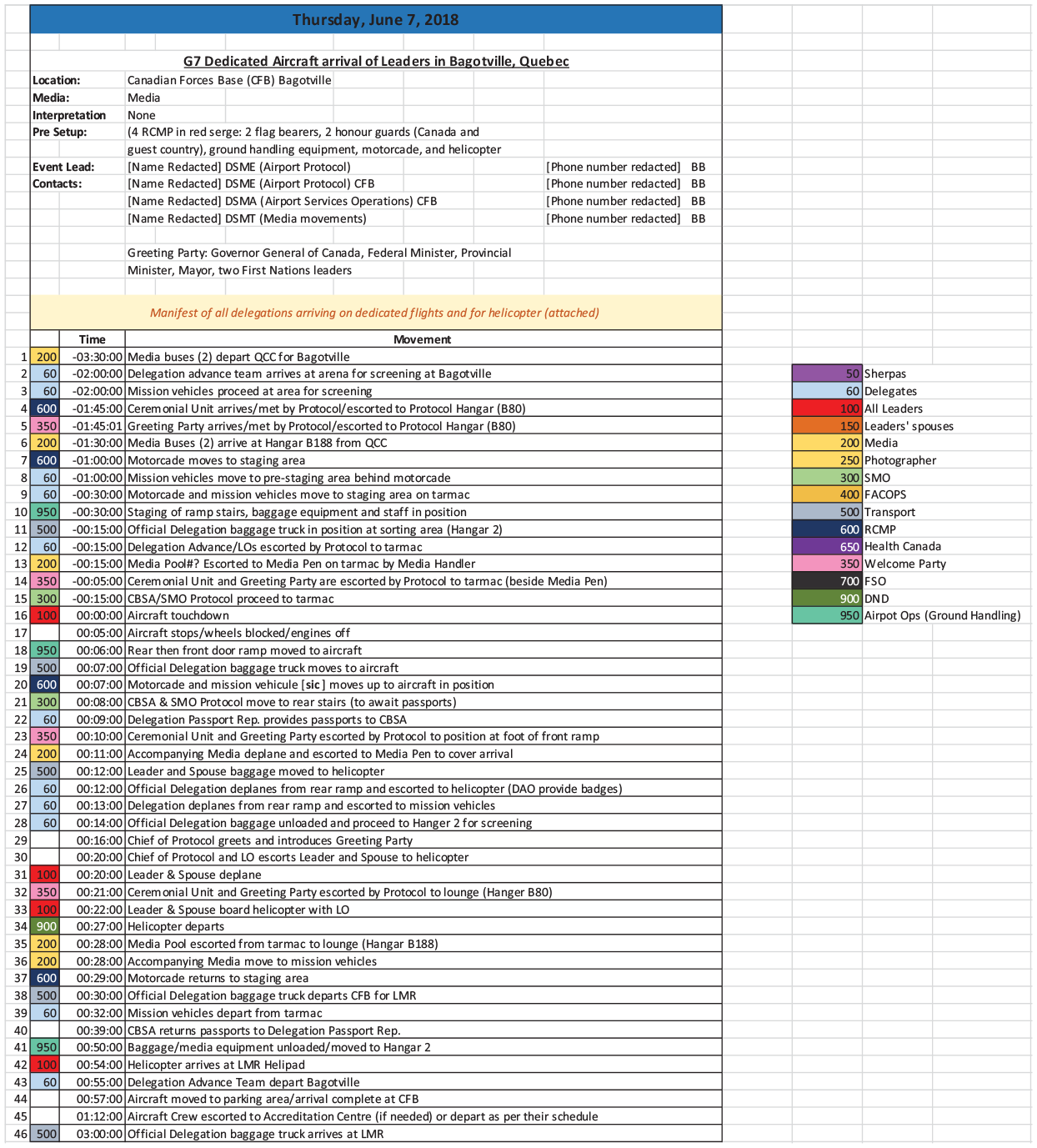
Mock of ‘Bible’ script for leaders’ aircraft arrivals.
Preparatory meetings and exercises are key, given how precise the script is and how high the cost of error is. ‘We run a tight ship on a minute-by-minute basis. It’s why we do rehearsals. We don’t build in a lot of flex. If you can’t take stuff on the fly, you’re not doing your job’ (Paquette S, interview with author, 2018). ‘Every curveball has a huge knock-on effect on logistics, catering, accommodation, and so on’, the SICC Deputy Chief, whose background was in crisis management, relayed (Paquette S, interview with author, 2018). If something does deviate from what is set out in the bible, the SICC moves to get things back as seamlessly as possible. Notably, the imperative driving the SICC is not to get back to the script as quickly as possible – what is of vital importance is to act in way that does not there signal that there is a problem and does not reveal the massive – and necessarily hidden – behind-the-scenes operation that keeps the summit unfolding as intended (Duah M, interview with author, 2018; Morgan K, interview with author, 2018). As a summiteer who was a veteran of three Canadian-hosted G7s said, ‘if you screw up, you’re on the front page of the newspapers. There’s no margin for error’ (Thomsen L, interview with author, 2018). Given these stakes, the SMO ethos is that ‘you don’t let anyone fail. . . the [overall] risk of failure is too high’ (Morgan K, interview with author, 2018). The SICC thus executes the tightly scripted bible in such a way to guard against this, ‘the biggest thing is preventing the bad news stories before they happen’ (Bouvier M, interview with author, 2018), ensuring that what is broadcast to the world via the IMC is the summit spectacle in exactly the way it was envisaged to be conspicuously performed. Status is always on the line for a host, particularly one like Canada whose status position is less assured than its fellow club members (Naylor, 2019). Beaumont’s move to account for domestic political audiences is key here – as the stakes are high not just for the state in the international pecking order, but for the government of day, who would take a hit at the ballot box for any embarrassment or perceived loss in status or reputation (Beaumont, 2020).
While each line in the bible might on its own seem trivial and the close stage management of the summit by the SICC might seem over the top, any slipup could have a cascade effect with serious consequences for the summit and, by extension, the status politics at play. While the media is always poised to catch a trivial slipup, a bigger risk for the host and draw for the media are protests, which can easily either get out of hand or be mishandled – or, in the worst case, both – such that they end up overshadowing a summit. Indeed, protests were repeatedly flagged as the largest worry of those in the SICCs (Bouvier B, interview with author, 2018, Bouvier M, interview with author, 2018; Paquette S, interview with author, 2018). The layout of the SICC and protocol for its operations were specifically designed to ensure that the security and operations teams could operate with as little friction as possible if protests did disrupt the summit. This was a particular concern given that the IMC was in Quebec City, a city known for a tradition of disruptive political protest, most significantly the 2001 Summit of the Americas, which involved protestors breaching the summit’s security barrier and police responding with over 5000 cans of tear gas. David Graeber, no wallflower when it comes to protest, described Quebec City as having gone ‘into a kind of insurrection mode’ (Hanes, 2018), while a prominent Canadian MP described the event as Canada’s ‘Summit of Shame’ (CBC News, 2001). On the minds of the summiteers was also the last G8 and G20 summits that they hosted in 2010, now likewise infamously remembered for protests and police responses, including the largest mass arrest in Canadian history (Fonseca, 2020). Such spectacles easily eclipse any intended summit spectacle, and come with considerable domestic political cost (Morrow, 2011).
If the SICC is the central site for management of the summit and its showpiece moments, the IMC is the central site for the communication of those moments. Working in tandem, the SICC produces a status flaunting moment while the IMC renders it conspicuous. As the main communications node of the summit, it is where the media are hosted, where press conferences are mostly held and where the host can exhibit its national brand. The IMC is thus critical for the constitution of the summit and essential for the practice of summitry as a status performance. As the Canadian Prime Minister’s Sherpa, the person ultimately responsible for the summit emphasised, ‘You have to have a press conference to get the message out. Without it, the summit doesn’t exist. . . This is an important dimension, if not the key dimension to the summit’ (McGovern P, interview with author, 2018). While thus essential to summitry, this element is a particular vulnerability for the host, as they have little control over the other leaders’ press conferences. The bible can script the existence of a conference, but not its content. No amount of planning or stage management can ever fully eliminate risk.
Across summits, IMCs are essentially all the same, offering the media a predictable environment in which to carry out their work. As the director in charge of the media relayed, ‘we don’t want to really break the mould in the media centre. We want to give journalist what they need to do their job’ (Skinner P, interview with author, 2018). IMCs typically have one or two large rooms for print media. These rooms are filled with rows of tables – kitted out with an abundance of power outlets to keep laptops, phones and all else charged – at which print media base themselves for the duration of the summit. These are matched with a barracks of editing booths for broadcast media to work. Photocopiers and printers are scattered throughout, as are large screens showing footage of the summit’s showpiece moments. For the 2 days of the summit, media in the IMC are treated to a near-endless loop of leaders’ arrivals, welcoming ceremonies and family photos on the many and massive HD screens.
It is how a host set dresses an IMC that differentiates them. The Canadian IMC showcased several dimensions of Canada, ranging from traditional clichés to elements less well associated with the country; elements, though, that Canada wanted to be associated with a national brand. Mounties in their iconic red serge dress uniforms roamed the halls, while maple syrup rained down from on high onto a custom-made dessert table in the dining hall (seriously). Less stereotypically, the Canadians chose to showcase innovative technologies in the IMC, ranging from virtual reality headsets to meditation aids. The IMC was also used to promote the Charlevoix region, featuring its cuisine in the dining hall, and adorning the entrance hall with large, scenic images of the region. A focus on the Charlevoix landscape was a key part of the Canadian’s vision of – and strategy for – the summit, using the scenic backdrop to emphasise their priorities of environmental protection and combatting climate change (McGovern P, interview with author, 2018). The Canadians used every opportunity to flaunt the country’s natural beauty as a status attribute – from the leaders’ summit room overlooking the St Lawrence Seaway, through the logo of the summit itself, to the halls of the IMC (McGovern P, interview with author, 2018). Such flaunting instrumentalises the summit, using it to promote national branding and advance economic interests. The Canadians’ skill at doing this speaks to their particular talents as summit hosts, marshalling the symbolic dimensions of summitry for instrumental gain. While Canada may not be a great power, they are a top-tier practitioner of summitry.
The IMC is also the site that controls the media’s physical access to the summit’s showpiece moments. The IMC is the sole departure point for media to travel to the most secure areas of the summit to capture footage of the performative, status-marking practices that typify summits in popular imagination, be it the leaders’ arrivals, the group’s family photo or any other photo opportunity that the host has scheduled to flaunt desirable attributes and conspicuously perform summitry as a status symbol. While media have already been through security screening to access the IMC, they go through an enhanced screening process before being taken to the leaders via secure, police escorted shuttles. This begins a process wherein the host exercises maximum control over the media at the summit, and, by extension, the image of the summit that is broadcast to the world. It is when the media have proximity to leaders that the summit’s integrity as a high-status symbol is most vulnerable. Covering non-event events is not the way to make a journalistic career, and so the media are always on the lookout to catch anything that deviates from the intended summit performance. The host needs the media to broadcast the summit and thereby serve as the channel through which it is conspicuously performed, but at the same time the media’s gaze is a major liability. From the moment the press are corralled into their designated shuttles, their movements are tightly controlled. This ensures, as best as possible, that despite closer proximity to the leaders and an increased ability to catch something unscripted and newsworthy, the media are only able to capture showpiece moments as intended, from a defined vantage point and usually still at considerable distance from the leaders. Controlling the reception of the performance is further assured by the hosts as typically only photographers and cameramen are allowed to go, leaving the journalists in the IMC.
Conclusion
Donald Trump left the 2010 Charlevoix G7 summit early. Any sighs of relief that the American President had not sullied the summit script before doing so were short lived. Soon after his departure, he tweeted that he no longer supported the summit’s outcome communiqué that he had only just endorsed and called the summit’s host, Canadian Prime Minister Justin Trudeau, ‘dishonest and weak’ (Borger and Perkins, 2018; Tasker, 2018). Canada’s summiteers had always identified the American President as a wildcard factor, about whom there was little they could do – no lines in the bible, management in the SICC, or finesse in the IMC could mitigate the risk posed by the predictably unpredictable President. It was exactly the sort of incident the media were waiting for and they characteristically capitalised on it. The response from the rest of the G7 club was to shrug it off. Like dealing with a toddler in a tantrum, they simply ignored the American President and carried on according to the summit script, holding their press conferences, heralding a successful meeting, and then departing according to the bible’s plan. The leaders performed their parts and the summit’s hidden machinery performed its role to minimise the threat, maintaining the practice of summitry and the integrity of the summit.
Nonetheless, despite best efforts to ignore the American President and stick to the summit script, Trump’s churlishness overshadowed the Charlevoix G7. A photo that apparently shows Angela Merkel scowling at a cantankerous Trump has become synonymous with the summit, circulating as a wildly successful Internet meme (Watson, 2018). By playing into preestablished beliefs, the image has achieved discursive success, visually representing an antagonism that became the defining narrative of the summit. However, the event and circumstances that the photo is meant to capture, however, never happened. The photo, taken by the German Chancellor’s photographer, appears to capture a tense moment, but as all the other photos taken at the same time at the same meeting demonstrate, it was actually a moment of levity among the leaders (Barnes, 2018; BBC News, 2018; Beswick, 2018; Wingrove et al., 2018). Trump’s disruption of the summit and the discursive success of the image that has come to represent his crass antagonism – irrespective that the image does not actually capture what it is purported to – reveal two things: first, it lends credence to embedded ethnographic approach taken in here to study summitry – analysing from the outside leaves one more vulnerable to spurious observations. 3 Second, it also lends credence to the overall argument – summits are status opportunities because they are risky undertakings that are always ultimately beyond the hosts’ control. It does not matter that the infamous and iconic moment for which the summit is now popularly remembered did not happen, and no amount of meticulous planning or tight execution could have avoided this outcome. Ultimately, hosting a summit is always a bit of a gamble – wildcard risks cannot ever be definitively eliminated.
While it is debatable whether the American President’s petulance ultimately undercut Canada’s status is beyond the bounds of what has been presented here. Rather, the aim has been to interrogate why international summits are sites of high-status approbation and how they are produced as such. Arguing that it is necessary to conceive of status symbols as performances and that it is necessary to understand performances as constituting more than what appears on stage, I have demonstrated how such conceptual amendments can improve our understanding of the international status game in general, and the function of summitry within that game in particular. In addition, while such ethnographic work as that presented here is methodologically challenging, this too opens new avenues for research in IR, both for status-oriented work and for summit studies.
All told, there is more to the summit status game than the conspicuous presentation of objects – be they flags, meticulously set dinner tables, or even political leaders themselves. Indeed, it is not especially difficult to flaunt the material trappings of state, any country can do it. It is likewise far from extraordinary to hold the routine banality of meetings that comprise a summit’s programme. If we stick to observing only what is presented, we can intuit that summits are status phenomena, but we fail to capture beyond a superficial reading what substantively makes them so. An amateur theatre troupe can stage a production, and they can flub their lines and miss their cues, but it is much ado about nothing. For those seeking the limelight at the top of their craft, however, the standard required is that they hit every line, nail every cue and never miss their mark. This requires preparation, practice and experience. Moreover, this is required not just – or even mostly – of those on stage, but of the entire backstage apparatus that produces the spectacle. Whether an amateur troupe or a professional company, both are ultimately hostage to fortune, though. What sets the latter apart from the former is not only in executing the complexity and difficulty of the performance to perfection, but in assuming risk and handling whatever curveball might be thrown. This is what confers and affirms status in summitry – performing the practice with the grace of a ballet while maintaining the illusion that all there is to the spectacle is what is intended to be seen on stage.
Footnotes
Author’s note
This article is part of the special issue ‘Status symbols in World Politics’, which was accepted on 6 February 2023 by the previous editorial team of Cooperation and Conflict, with Annika Björkdahl as Editor in Chief. The article was submitted to the Journal on 1 May 2023, before the tenure of the current editorial team began (1 June 2023). To avoid conflicts of interest, all editorial decisions relating to this special issue have been handled by the former Editor in Chief.
Funding
The author received no financial support for the research, authorship, and/or publication of this article.
