




Abstract
This article traces the effects of European Union (EU) normative power on security sector reform in Ukraine. We argue that to get a better grasp of how normative power works in practice, we need to scrutinize more closely the domestic journey of EU norms. This local lens allows us to uncover the inherent contestation involved in the transnational travel of norms, emphasizing the importance of local agency and local conceptions of normativity. We reveal the internal struggle between liberal democratic norms and deeply ingrained attitudes, institutions and behaviours linked to the Soviet legacy. We show how EU democratic norms gradually empower domestic constituencies and overcome domestic structural resistance to change, leading to democratic advances in a sector least likely to reform.
Introduction
The European Union’s (EU) support for democracy in Eastern Europe has been the subject of intense academic and policy debates ever since communism collapsed and opened the door for democratic transformation of the polities at the EU’s doorstep. Most of the attention has gone into teasing out the mechanisms and tools of EU support for democracy (Börzel and Risse, 2012; Schimmelfennig and Sedelmeier, 2004) and their effects on the political regimes in the region at the macro-institutional level (Börzel and Schimmelfennig, 2017; Vachudova, 2008). Security governance has not been an explicit focus of the EU’s democratization agenda, and the EU’s security role has mostly been examined in the context of state building and post-conflict interventions in the region (Keil and Arkan, 2015; Popescu, 2011). While both debates recognize the linkages between democracy building and security building (Schröder and Kode, 2012), the tendency has been to examine them separately, falling short of capturing the interplay between the two in the EU’s actorness ‘on the ground’. The EU’s democratization role through security sector reform (SSR), in particular, has gone unnoticed in discussions about external democracy promotion.
The EU’s democratization impact in Eastern Europe has mostly been seen through the prism of its material power (Börzel et al., 2017; Schimmelfennig and Sedelmeier, 2020). The EU’s normative appeal as a political model worthy of emulation and the democratic aspirations of eastern European societies have not been recognized as equal drivers of political change in the region (Dandashly and Noutcheva, 2022; Noutcheva, 2018). Yet, the Security Service of Ukraine (SBU) (the heir to the Soviet-era KGB) is going through important democracy-enhancing reforms under the EU’s watch and without explicit material incentives or disincentives at play. Even more puzzling, the EU has assumed a central role in steering the transformation of the security service in the country, without a clear set of rules for security governance agreed among its member states. Nevertheless, by mobilizing its democratic acquis and linking the reform of the security sector to its core democratic norms, the EU has manoeuvred itself to the centre stage of security service reform in Ukraine, overtaking NATO as an external interlocutor on this matter. The domain in which these democratic advances have occurred is also surprising, given the lingering coercive instincts of the state security agencies vis-à-vis society at large as well as the elites’ propensity to use their services for political and/or clientelistic ends.
To understand this triple puzzle of democratic change against all odds, we turn to the concept of Normative Power Europe (Manners, 2002) and demonstrate how the EU’s democratic norms and actorness have progressively elicited support for reform among (some) domestic actors, notwithstanding the structural resistance to change that renders the security service least prone to reform. We argue that to get a better grasp of how normative power works in practice, we need to scrutinize more closely the process through which EU norms take root domestically. This local lens allows us to go beyond the initial conceptualization of the EU’s normative power, which has been criticized for its Eurocentrism and hegemonic traits (Diez, 2013). We show the inherent contestation involved in the transnational travel of norms (Wiener, 2014), bringing to light the importance of local agency and local conceptions of normativity in discussions about the EU’s normative impact. Drawing on the norm contestation literature (Deitelhoff and Zimmermann, 2018; Zimmermann, 2016), we trace the local contestation of EU norms in discourse, law and implementation, emphasizing the normative clash arising from the mismatch between democratic ideals and Soviet-era habits, practices and routines. Our approach thus shows how the EU’s normative power operates on the ground by fits and starts, how it coexists with local norms and how it progressively empowers local agents to overcome domestic resistance to it.
To illustrate the argument, we focus on Ukraine, which is an atypical case of political resilience under conditions of proxy insecurity and as such an illustration of the broader planetary organic crisis (Manners, 2022). Fighting Russian aggression since 2014, Ukraine has made democratic advances irrespective of the ongoing and persistent attack on its security and in a sector that belongs to the core of the state’s sovereignty tools as a part of the national security apparatus. Our case study demonstrates two key points: first, that an EU normative approach to boosting political resilience intersects with the process of addressing ontological insecurity; and, second, that understanding this interlinkage and addressing simultaneously the two interrelated crises of the planetary organic crisis offers a better chance for resolving both (Manners, 2024).
We begin by presenting an overview of the existing literature on democratic change in Eastern Europe, to justify why a normative approach is necessary to address the puzzle of democratic reform in Ukraine’s security service. This is followed by a discussion of our conceptual approach, bringing insights from the norm contestation literature. We then turn to the case study by (1) outlining the mismatch between the EU norms and the Soviet legacy in security governance, (2) unpacking the EU’s agency in security service reform in Ukraine and (3) detailing the domestic struggle of local actors over security service reform. We show how EU normative power gradually empowers domestic constituencies and overcomes domestic structural resistance to change, leading to democratic advances in a sector least likely to reform. We finally conclude by assessing our findings and their implications for the study of normative power and political change.
Explaining democratic change in Eastern Europe
The dominant explanation of the democratic transformation of post-communist states credits external actors – the EU, in particular – for the push towards liberal democracy in the aftermath of the collapse of communism in Eastern Europe. By incentivizing democratic reform via its various offers for integration (from membership to association and loose partnership), the EU has been asserted as the main driver of democratic change in Eastern Europe (Börzel and Schimmelfennig 2017; Schimmelfennig and Sedelmeier, 2020). In line with this view, the EU is more likely to generate deep and fast democratization in polities seeking accession to the EU, and less likely to succeed in countries where the carrot of EU membership is not on offer (Sasse, 2008; Schimmelfennig and Scholtz, 2008). In this line of thought, Ukraine’s patchy democratic transformation is a function of the country’s place on the outer circle of the EU’s political periphery and the weaker reform incentives coming from Brussels. Furthermore, the security sector in the country is only partially subject to EU reform pressure, owing to the bloc’s weak competences in security-related domains. EU conditionality, therefore, cannot convincingly account for democracy-enhancing reforms in this sector.
The majority of studies employing a domestic lens emphasize political agency and focus on domestic elites as agents of democratic change in the post-Soviet countries. One of the domestic explanations of the initial surge towards liberal democracy in Eastern Europe, which has operated in combination with the EU external incentives model, focuses on the development and transformation of domestic political parties in the post-communist context. Scholars have demonstrated how parties across the political spectrum have adapted their party platforms to the EU integration agenda, thus providing a powerful impetus for the advance of the democratization process across the region (Noutcheva and Aydin-Düzgit, 2012; Vachudova, 2008). The political scene in Ukraine, however, has been divided on the necessity to reform the security services in the country, with some preferring the status quo, others supporting the reform in principle but doing little to advance it in practice and yet others pushing for real change.
Both external and domestic explanations of democratic change in Eastern Europe consistently overlook the normative aspect of both external and domestic drivers of political change. The EU’s ability to set standards of legitimate political authority in the European neighbourhood has remained in the shadow of the primary scholarly debates centred on the EU’s ability to incentivize democratic reform through its material power. The ability of the EU to inspire democratic change through the appeal of its democratic model has not been studied seriously, even though recent research suggests that democratic norms associated with the EU resonate in societies across the Eastern Neighbourhood and beyond (Dandashly and Noutcheva, 2022). Likewise, the domestic normative environment in Eastern Europe, conditioned by pre-existing legacies, has been important in accounting for cross-country variation in the progress towards democracy (Magyar and Madlovics, 2019; Pop-Eleches and Tucker, 2011), but its role has been relegated to secondary status as enabling or constraining the primary democratizing role of the EU, as enacted through EU incentive packages.
We propose a closer conceptual engagement with the normative dimension of the EU’s power and the domestic normative environment in Eastern Europe, which is characterized by an uneasy coexistence of liberal democratic norms and Soviet-era norms deeply ingrained in local attitudes, institutions and behaviour. In this context, we expect a tense encounter between external and domestic norms, as well as a domestic struggle defined both by acceptance and contestation of the externally proposed reform templates. We turn now to a discussion of this dynamic.
EU normative power meets the Soviet legacy
The debate about the EU’s normative power has two important implications for the study of democratization in Eastern Europe. The first has to do with the original conception of normative power as put forward by Ian Manners (2002) in his seminal piece as the EU’s ability to ‘define what is normal’ in international politics by being what it is – a community of values. It relates to the structural dimension of normative power or the EU’s capacity to influence others by being an attractive polity. The EU’s definition of what is normal in political governance is well encoded in Article 2 of the EU Treaty and permeates its enlargement and neighbourhood policies. The EU’s democratic identity can in this sense be seen as an attempt to mark the international milieu by setting an example and leading the way in political standard setting.
The second implication has to do with the EU’s democratic actorness, or how the EU promotes its democratic values. This agency dimension is linked to the exercise of normative power and Manner’s (2002) initial conceptualization of the pathways through which normative power can be put to work via EU policy. It implies a transformative agenda (Börzel and Risse, 2012), or a desire to expand the EU’s normative space through intentional external action. Scholars of political change have conceptualized this particular angle of democracy promotion through the prism of socialization, whereby the EU actively encourages non-EU states to follow the democratic rules, and actors on the receiving end of EU policies progressively learn to play the democratic game, owing to their desire to belong to the community of democracies (Checkel, 2000; Schimmelfennig and Sedelmeier, 2004).
This classical reading of the EU’s normative power in the area of democratization can be criticized for its Eurocentric vision of what a legitimate political order is and what it implies for state–society relations. Scholars have already pointed to the ‘EU-centrism’ entailed in the concept of ‘normative power Europe’ (Fisher Onar and Nicolaidis, 2013) and to the hegemonic features of this EU-centred narrative (Diez, 2013). The very idea that Central and Eastern Europe are being ‘Europeanized’ via the EU enlargement and neighbourhood policies tries to disguise the implicit hierarchical pattern of engagement between the West and the East and the lack of sovereign choice in the Eastern European democratization trajectory (Mälksoo, 2021). The notion of Western imposition of norms permeates the SSR scholarship too, which considers SSR to be ‘exclusionary for those on the receiving end of the reform’ (Donais, 2009: 118; Zarembo, 2017). The political agency of Central and Eastern European (CEE) countries is seriously constrained, if at all recognized, in this view of the EU’s normative impact in the region (Mälksoo, 2022).
While conceptualizations of the EU as an ‘empire’ exist (Del Sarto, 2016), what is often overlooked is the parallel Russian imperial project and its expansionary dynamics vis-à-vis Eastern Europe, dating back centuries. The region is in this sense simultaneously torn between two hegemons, one respecting the sovereign choice of states and supporting the democratic emancipation of societies and one openly seeking domination and denying the sovereign rights of nations, including the choice of democracy as a domestic system of governance. In the eyes of Eastern Europeans, the EU no doubt appears a ‘benign empire’ (Zelonka, 2006) and a ‘regional normative hegemon’ (Haukkala, 2008) compared to Russia’s ‘imperial polity’ (Lieven, 1995), whose hegemonic ambitions in Eastern Europe have often been described through a zero-sum lens (Kappeler, 2014; Riabchuk, 2016). In this context, EU-centred integration has become a decolonization tool for the region, through which its agency is reinstated and its sovereign choice is protected. This space for exercising agency is what makes the EU project emancipating for Eastern European societies.
Importantly, the Soviet legacy in this context should not be perceived as a relic of the past but rather as a tool for the institutional weakening of countries in the region and the subsequent subjugation of their sovereignty to Russia, as an heir to the Soviet Union (Morozov, 2015). This point was especially brought to light by the full-scale Russian invasion of Ukraine in February 2022, in which Russia has negated Ukraine’s right to be an independent state (Putin, 2022) and waged a war effectively to restore the Soviet Empire.
Yet, the EU’s discourse and policy have been questioned by critical scholars, who have called for a decentered approach in EU foreign policy that is conscious of its own assumptions, sensitive to alternative views and claims and open to reconstructing relations on the basis of mutual recognition (Fisher Onar and Nicolaidis, 2013; Keukeleire and Lecocq, 2018; Keukeleire et al., 2021). Applied to the practice of EU policy vis-à-vis its neighbours, this entails an approach that is ‘other-empowering’ rather than reinforcing deep-seated hierarchical patterns of engagement (Manners, 2010: 42). Applied to the study of EU democracy promotion, this perspective implies taking seriously domestic norms about legitimate political authority and zooming in on domestic actors who can enact political change in a local setting. This is to say recognizing, respecting and engaging with local agency and local structures. The SSR literature denotes these processes as ‘local ownership’ – ‘the extent to which local actors (however defined) exercise control or influence over the initiation, design and implementation of the reform process’ (Donais, 2009: 118). While local ownership is assumed to be key to a reform’s success, domestic power structures can be as much hindrance as help, as they also have the most to lose from the reform (Hansen, 2008: 44).
To understand why the domestic normative environment in Eastern Europe presents challenges for the spread of liberal democratic norms, we turn to the scholarship on the Soviet legacy, which has traced durable effects of communist-era policies and practices on the political, economic and societal spheres in the region (LaPorte and Lussier, 2011). Not only is the very idea of liberal democracy the antithesis of the political order that societies in Eastern Europe experienced under communism, but also, and more importantly, ‘the stubborn structures’ rooted in the communist dictatorship have persisted until today (Magyar and Madlovics, 2019) and underpin present-day elite and societal attitudes, behaviours and reactions to the Western ideal of democratic rule (Pop-Eleches and Tucker, 2011, 2017). In particular, the Soviet legacy continues to linger on in those post-communist polities that have formally adopted liberal democratic institutions through the continued power of ‘informal patronal networks’, ‘the merger of political and economic resources’ and ‘the appropriation of public authority for private interests’, all resulting in ‘a systemic distortion’ manifested in various forms of corruption (Magyar and Madlovics, 2019: 130–133). And while corruption is a phenomenon not exclusively characteristic of post-Soviet polities, its manifestation is on full display in the post-Soviet space. Undoubtedly, such domestic socio-political structures stand in contrast to a political system based on transparent, accountable and responsible governance aiming to further the will of the people. Even when domestic will to transform the system exists, the structural obstacles to change can be expected to be formidable.
To understand how EU norms can nevertheless make inroads in this difficult domestic context, we unpack both EU and local agency and show the normative struggle that a plurality of actors engage in when external norms clash with domestic norms. Instead of focusing on the ‘cultural match’ (Checkel, 1999) or the degree of compatibility between external and domestic norms, we are interested in uncovering local resistance to external norms, as we expect some local actors to align with the external normative content while others inevitably misalign with it – inter alia by sticking to local notions of appropriateness. We claim that this scenario is commonplace when norms travel across borders, as this often involves a normative change in a local setting that some actors are willing to embrace while others refuse. In other words, to get a better grasp of the EU’s normative impact, we propose to study how local actors challenge the normative prescriptions coming from Brussels and how they battle over accommodating external normative content into local understandings of rightness. This approach echoes a long tradition of research on the legitimacy foundations of foreign policy by looking at its contestation or lack thereof by local players experiencing its effects (Aydin-Düzgit and Noutcheva, 2022; Noutcheva, 2012).
Following Zimmermann (2016), we propose to study the normative clash arising from the cultural mismatch between external and domestic norms at the level of discourse, law and implementation. This lens allows us to unveil the arguments and actions of all stakeholders involved in the domestic struggle over redefining the normative contours of a polity. By examining the changing boundaries of the space for normative resistance in the domestic context, we get a dynamic picture of how EU norms penetrate the socio-political space and become localized in a domestic setting initially reluctant to accept normative change. At all three stages of the process, which are outlined below, we expect local actors to contest, fight back and even sabotage normative prescriptions that challenge their conception of what is appropriate in the local context. In that, our approach is aligned with earlier scholarship on institutional transfer in post-communist countries that emphasizes the key role of local actors and the winding road of external institutional import in domestic settings characterized by diverse societal preferences and power constellations (Jacoby, 2000).
Discursive contestation is the first stage of resistance to external norms (Dandashly and Noutcheva, 2022) and the most visible manifestation of contestation as a practice (Wiener, 2014). It involves interpreting external norms through local frames and may entail challenging the validity or the applicability of the external normative standards to the local context (Deitelhoff and Zimmermann, 2018).
Contestation in law is the second stage of defying external norms and may occur when (some) local actors have accepted rhetorically the normative adaptation required yet continue resisting (openly or covertly) its behavioural consequences. Political elites take the leading role in codifying external norms into domestic law, and the process may lead to a watered-down or an altogether modified version of the external template, adjusting the normative content to the local specificities (Zimmermann, 2016).
Contestation in implementation is the third and final line of defence against external norms, whereby domestic institutions and/or societal actors may de facto sabotage domestically approved normative change through practice, thus continuing to negotiate and re-negotiate the local normative order. The ultimate outcome of this dynamic process of ‘norm localization’ is often very different from what norms research has neatly labelled norm compliance or non-compliance (Acharya, 2004).
This tripartite lens on norm contestation allows us to examine the local pathway of external norms and to analyse closely how domestic actors grapple with the normative content coming from outside, bargain over normative change in the local context and adjust and develop new understandings of what is appropriate in the domestic setting. We expect a dynamic process with ups and down, U-turns and deviations from the linear progression implied by the norm compliance literature. To illustrate how this domestic struggle unfolds, we turn to the security service reform in Ukraine.
We use the security service reform in Ukraine as a single case study of a scenario where domestic acceptance of EU norms and EU actorness is least likely, yet we observe both EU presence and partial EU norm acceptance. While there have been a number of reform attempts, we focus specifically on the case of the draft law 3196-d, as it is the only bill that has passed first reading in the Ukrainian Parliament. The methods employed are discourse analysis of speeches and statements of officials and civil society actors in Ukraine, found in open access popular media and official Facebook pages; legal analysis of the draft law 3196-d on the SBU; and interviews conducted on condition of anonymity through the course of 2021 with representatives of the NATO Representation in Ukraine, the European Union Advisory Mission (EUAM) Ukraine, the SBU and the Verkhovna Rada. The time frame of the research is 2020 to 2021. Russia’s full-scale invasion of Ukraine put the reform on hold in 2022, so we analyse the work-in-progress – the process rather than the result. This approach allows us to illustrate the dynamic process of norm adoption and contestation as well as to observe how it is evolving under the new war-time demands.
EU democratic norms at odds with Ukraine’s Security Service
There is a general consensus in the literature that EU-driven SSR, to which the reform of intelligence belongs (European Commission, High Representative of the Union for Foreign Affairs and Security Policy, 2016), is normative in nature, and that it is precisely these democratic norms that shape the philosophy and the direction of the EU’s SSR efforts in third countries (Juncos, 2018). Connecting security and democracy has a straightforward logic: ‘[d]emocracy provides the political foundation necessary to sustaining all other dimensions of security’ (Youngs, 2013: 115). The norms themselves are quite broadly defined along ‘good governance’ lines: security for individuals and the state, legitimacy, good governance, integrity and sustainability (European Commission, High Representative of the Union for Foreign Affairs and Security Policy, 2016: 4). These norms, however, are likely to be contested in a variety of local contexts.
Good governance stands not only for democratic oversight over the security of citizens and the state but also for the efficiency of its provision: ‘[the security institutions] must be capable of delivering security professionally and at a reasonable cost, and in a way that helps to ensure that the security needs of all individuals and groups are served’ (Schnabel, 2009: 6). This reflects the dilemma between efficiency in security provision and the rule of law, observed by Schröder and Kode (2012): ‘Rationales behind security and rule of law support diverge: the former aims to strengthen a state’s enforcement capacities, while the latter seeks to restrict them’ (p. 31). This dilemma has been especially salient for Ukraine as a country at war against an external aggressor since 2014, with its Security Service (in Ukrainian Sluzhba bezpeky Ukrainy or SBU) epitomizing the controversies.
It is a truism to say that Ukraine’s SBU is an heir to the Soviet-era KGB. After being established by law in 1992 (4 years before the adoption of the Ukrainian Constitution), it has remained unreformed ever since. The Ukrainian SBU is primarily criticized for accumulating a number of powers ‘that in a Western European country would be divided across several separate agencies’ (Gressel, 2019: 13). The 1992 law that established the service, as well as the Ukrainian Constitution, define the SBU as a military agency with law enforcement functions, embracing intelligence work, counterintelligence and counter-terrorism operations, and fighting organized crime and economic crime, including corruption and smuggling. In no European country would all of these functions be concentrated under the same mandate and under the direct authority of the head of the state, as this can (and in Ukraine’s case does) result in power abuse and malfunctioning (EUAM, 2021).
Second, the SBU has on many occasions failed to provide security for citizens (human security), concentrating instead on providing security to specific state institutions and structures and indulging human rights abuses rather than protection. With the head of the SBU being proposed to Parliament by the president and with its deputy and regional heads being appointed by the president, the SBU is directly accountable to the head of state. At various periods in Ukraine’s history, the SBU has been used to harass political and civil opponents of the ruling elite, including arrest and harassment of activists, protesters and journalists (Kaul, 2021: 10), to the point of being suspected of involvement in the shooting of protesters during the Revolution of Dignity (Gressel, 2019; Kaul, 2021). Moreover, the SBU has a record of systemic human rights abuse. Experts have criticized the agency for keeping informal (not officially authorized) detention centres, where detainees have been kept illegally and potentially tortured (Jarabik and Shapovalova, 2018; Pechonchyk, 2016). According to human rights non-governmental organizations (NGOs), in 2014–2020, the SBU was the biggest violator of human rights among all state institutions in Ukraine (Zakharov, 2021b).
Third, the SBU has consistently failed to ensure integrity. The ‘new oligarchy’ of which SBU was a part (Anderson and Albini, 1999: 314) was widely known for its abuse of power, interfering in business enterprises and extracting bribes using threats of criminal investigation (Roslycky and Tregub, 2018). Its most notorious department, called Directorate K, is tasked with fighting corruption. However, it is no secret that ‘Directorate K does not fight corruption; it runs corruption’ (EU top official quoted by Gressel, 2019: 14), targeting reformers and anti-corruption activists in its smear campaigns.
Fourth, given the reasons outlined above, the SBU has lacked legitimacy. It is unsurprising that the Ukrainian public has consistently distrusted the SBU. In 2021, only 25.5% of the Ukrainian population trusted the SBU, while 56.1% did not (Ilko Kucheriv Democratic Initiatives Foundation, 2021). It should, however, be acknowledged that the SBU has at the same time played a pivotal role in defending Ukraine against Russian aggression. For example, SBU’s success in surveillance and wiretapping of the occupiers, alongside the arrest of Vladimir Tsemakh, a terrorist of the Russia-controlled ‘Donetsk People’s Republic’ (‘DNR’) and crucial witness for the international investigation into the downing of the MH17 plane, was widely admired (Gressel, 2019). After the start of the full-scale invasion, the SBU performed several successful counterintelligence operations and took part in frontline defence. As the invasion unfolded, public trust for the Service more than doubled: as of January, 2023, 63% of the population trusted the SBU (Kyiv International Institute of Sociology, 2023). Thus, the Service gained public legitimacy as a result of its perceived successful performance under altered external circumstances and irrespective of its lack of internal democratic change.
EU agency in SBU reform in Ukraine
The weakness of Ukraine’s security sector spurred the EU to dispatch a Common Security and Defence Policy (CSDP) mission to Ukraine in 2014, in the aftermath of Russian aggression. While SBU reform was in the EUAM mandate from the onset, it was only in 2016 that an International Advisory Group (IAG) was formed, comprising the EU Delegation to Ukraine, the EU Advisory Mission to Ukraine, the NATO Representation Office to Ukraine and the US Embassy, to streamline Western efforts in assisting SBU reform (Interview D, 2021).
In Ukrainian public discourse, SBU reform was primarily tied to Ukraine’s NATO obligations (Sydorenko, 2020, 2021), but NATO’s role in SBU reform was limited in comparison to other international actors. In fact, neither the EU nor NATO has formal standards for reform of the security service; hence, both partners relied primarily on ‘best practices’ rather than strict guidelines. However, in communication with domestic actors, the EU overtook NATO for several reasons. First, NATO’s advice was mostly limited to best practices in counterintelligence, whereas the reform was much wider in scope (Interview B, 2021). Second, the EU had more expertise on the ground and human capacity: while there was only one advisor on SBU reform in the NATO Representation Office in Kyiv, a whole section was tasked with the SBU reform portfolio in the EUAM (Interviews B, D, 2021). EU experts on the ground were in fact instrumental in engaging local stakeholders in a dialogue about the substance of the reform (Interview D, 2021). Third, the EU was also hypothetically better fit to assist the reform financially. For example, staff cutting would have incurred massive compensations that the Ukrainian state was not ready to pay, while the EU considered establishing some kind of a support fund (Interview B, 2021). Finally, the reform was not only about the central apparatus but also about changes in the regional offices. NATO did not have any regional offices in Ukraine, whereas the EU and the EUAM did (Interview B, 2021).
In concrete terms, the EU requested first that Ukraine delineate powers between the respective agencies. This would mean removing (1) investigation of financial crimes and (2) pre-trial investigations (i.e. law enforcement powers) from the SBU mandate, in order to make the SBU a ‘pure’ counterintelligence service, in line with most security services in the EU. The IAG argued that counterintelligence and law enforcement cannot go hand in hand (Bezugla, 2020; EUAM, 2021). Ironically, it was precisely because of its law enforcement functions, considered redundant by the EU, that the SBU had been put on the EUAM mandate (which covered other law enforcement agencies) (Interview A, 2021). The umbrella term ‘delineation of powers’ thus speaks to the norms of good governance, integrity and legitimacy of the security sector institution.
Second, the EU argued for demilitarizing the SBU (i.e. making it a civilian institution), since the intelligence tasks performed require no military training or competences. Third, the EU recommended SBU staff reduction. Ukraine’s SBU staff amounts to 24,000 personnel, with a possibility of expanding it to 31,000. According to EU practices, this is an overblown apparatus that entails excessive bureaucracy and reduced effectiveness (EUAM, 2021). These recommendations aimed at increasing efficiency in counterintelligence to ward off external threats. With the progression of Russia’s full-scale invasion and Ukraine’s counteroffensive, demilitarization has been de-emphasized, taking into account the evolving context of the ongoing war.
Finally, the EU recommended establishing parliamentary democratic oversight of the SBU. The 1992 law envisaged no civilian democratic control over intelligence. The Law on the National Security of Ukraine, adopted in 2018, made a provision for parliamentary control of the security sector to be elaborated in further legislation. This would enhance both good governance and the legitimacy of the SBU, since it would make it directly accountable to the democratically elected parliament.
Domestic agents caught between EU norms and local counter-norms
Discourse: acceptance by some, contestation by others
The reform vision promoted by the IAG received the full support of Ukraine’s active civil society. The reform, especially in terms of power separation, has also long been advocated by local experts and civil society (Holubov, 2017; Sydorenko, 2020, 2021).
At the elite level, there has been relative acceptance of the reform by key elite stakeholders. The SBU reform was part of Volodymyr Zelenskyi’s presidential campaign (notably, ‘stripping the SBU of inappropriate functions in the sphere of economy and anticorruption’), of Zelenskyi’s corruption-fighting agenda (Komanda Zelenskoho, 2019) and of his political party’s agenda for the 2019 parliamentary elections. Ukrainian NGOs were actually responsible for pushing the ‘Servant of the People’ party to commit itself publicly to the reform, in addition to other parties represented in Parliament (Justice Agenda, 2019). However, immediately after appointing the SBU head in 2019, President Zelenskyi tasked him with fighting corruption, thus contradicting his earlier commitments (Unian, 2019).
The rhetorical contestation of the reform emanated first and foremost from the SBU itself (Interviews B, C, 2021). The SBU arguments went as follows. First, it argued for keeping the pre-trial investigation function, claiming to have unique expertise in the field (Sydorenko, 2021). It also argued that investigating economic crimes is reasonable because ‘once you detect suspicious cargo on the border, you don’t know if it smuggles chicken or weapons’ (Interview C, 2021). The SBU also spoke up against the logic of demilitarization. The ‘official’ reason was that the operatives who took part in operations in the East needed military ranks to be admitted to the war zone. However, in private, SBU officials would admit that it was not the military rank per se that was important but the social and financial privileges which came with it (i.e. bonuses and pensions) (Interview C, 2021).
The staff reduction advice was also not well accepted in the SBU. The argument the Service invoked was that the Russian FSB and the Belarussian KGB (also products of Soviet heritage) have 220,000 personnel combined, so a staff 10 times smaller would not be effective in countering their subversive actions against Ukraine, especially in times of war (Interview C, 2021; Novynarnia, 2020). Informally, though, SBU employees admitted to being afraid of losing their jobs in the aftermath of staff reduction.
Finally, the recommendation for parliamentary and civic oversight was criticized by the SBU for two reasons: (1) it would ruin the SBU culture of secrecy (‘counterintelligence should be clandestine and not accountable to the public’, Interview C, 2021), and (2) in the case of the creation of a special parliamentary oversight committee, MPs representing the interests of the adversary (i.e. ‘The Opposition Platform for Life’, known to be Russia-friendly) would be part of the committee and thus would gain access to classified information (Interview C, 2021).
Law: partial acceptance and contestation
The draft law 3196-d ‘On the Security Service of Ukraine’, introduced to Parliament in March 2020, is the first ever draft law on SBU reform that has passed first reading and several rounds of amendments (Maasikas et al., 2021). The law was voted on in Ukraine’s Parliament on 28 January, 2021, with 248 votes in favour – 200 votes coming from the ‘Servant of the People’ faction and the rest of the votes coming mainly from pro-European ‘European Solidarity’ and ‘Holos’ parties. In fact, with 254 deputies out of a total of 424 in the 9th Verkhovna Rada, the ‘Servant of the People’ party is the biggest in Parliament and enjoys a so-called ‘monomajority’ sufficient to pass a strong bill in line with its pro-European rhetoric and stated political goals. Yet, resistance to real change emanates from the ranks of rhetorical supporters of the reform, who claim to espouse European values but, in essence, continue to cling to old habits and established practices. Table 1 illustrates how local forces fight back against attempts at introducing EU norms in two ways: either by diluting the specific norm itself or by introducing Soviet-style provisions which run counter to broader democratic norms and thus ruin the philosophy of the reform.
EU norms, local counter-norms and SBU reform.
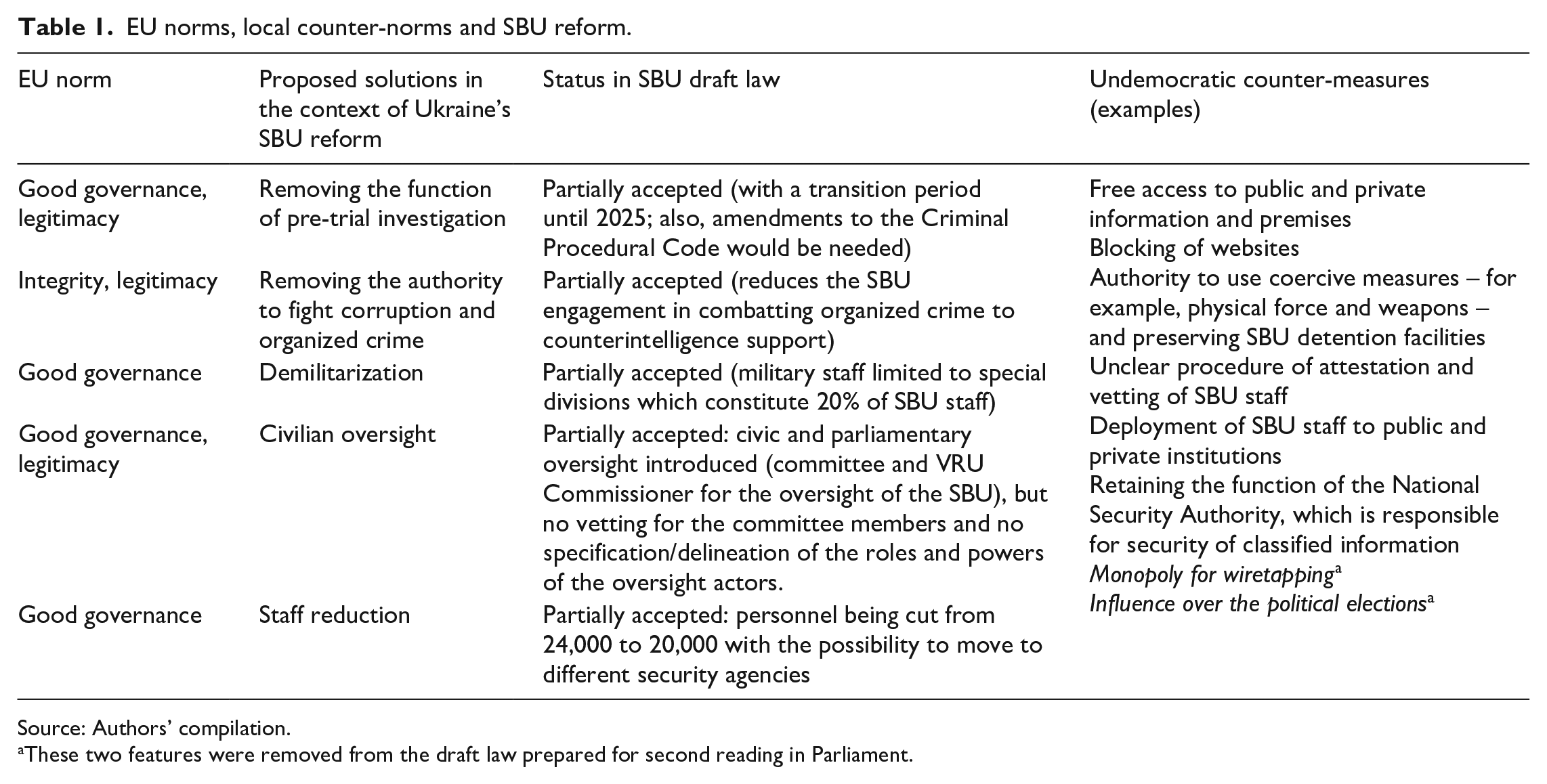
Source: Authors’ compilation.
These two features were removed from the draft law prepared for second reading in Parliament.
The draft law has become a controversial piece of potential legislation that has accommodated all Western recommendations (albeit partially) but at the same time introduced a number of clauses that contradict the normative prescriptions of these recommendations and prolong the legacy of Soviet-era counter-norms. One of the provisions most contested by the SBU itself has been the removal of the pre-trial investigation function (see Table 1). Above all, removal of the pre-trial investigation function would require changes to the Ukrainian Constitution and the Criminal Procedure Code. The draft law envisages a transition period (2022–2025), during which the SBU can investigate crimes pertaining to state security, terrorism and state secrets, pending amendments to the Constitution and the Criminal Procedure Code. According to the draft law, corruption- and organized crime–fighting functions would be removed from the SBU portfolio, with some limited provisions for counterintelligence support (see Table 1). Since 2014, a wide anti-corruption institutional infrastructure has been created in Ukraine (Kalitenko, 2023), which was supposed to overtake the SBU’s corruption-fighting function. The draft law limited military ranks to 20% of the SBU staff. However, special ranks have been created so that SBU staff can retain the welfare privileges to which they were entitled under the old law. The SBU staff numbers have been reduced moderately by the draft law to 20,000 instead of the recommended 17,000. Finally, civic oversight (in the form of a civic council) and parliamentary oversight (in the form of a parliamentary committee) have been introduced by the draft law (see Table 1 for details).
However, the draft law also introduced or retained several Soviet-style provisions that were criticized by Ukrainian civil society and Western interlocutors. The draft law allows the SBU to obtain information of any kind from public and private organizations, to enter private premises and to access public and private information systems and databases. It will also be able to block websites at its own discretion (Ukraine Crisis Media Center, 2021). In addition, the SBU would be allowed to use coercive measures, such as physical force and weapons, without limitations, and to preserve its detention facilities, which would be redundant if the SBU were stripped of pre-trial investigation authority. Another Soviet-style practice introduced by the draft law is the deployment of SBU staff to public and private institutions for ‘supervision’, which in fact opens up opportunities for corruption (Ukraine Crisis Media Center, 2021). Above all, SBU activities, as well as the assets of the SBU staff, will remain classified information under the draft law, which also allows the SBU to define any information as classified at its own discretion and without any defined criteria, inviting opportunities for abuse of responsibility, human rights violations and corruption (Nesterenko and Rud, 2021). It is noteworthy that the competition between European norms and Soviet practices led to their uneasy coexistence in the draft law, regardless of the overall endorsement of the reform at a rhetorical level by the majority pro-European parties in Parliament. This incomplete and fragmentary enactment of European norms in the local legislation is a strong signal of possible further contestation and even backtracking of the reform at a later stage of the legislative process or during implementation.
Practice
On a practical level, we identify points of possible contestation where the draft law in its current version allows for loopholes and ambiguities, which, if adopted, can be used for contestation at the level of implementation in the future. We expect local contestation to continue even after the normative change has been introduced as a law. This can occur through the legislative process whereby accompanying legislation crucial for genuine normative endorsement can be sabotaged or obstructed by political forces in Parliament. In this vein, the effective delineation of competences would require the adoption of a so-called ‘satellite law’, with changes to the Criminal Code (Maasikas et al., 2021). However, this law can be delayed indefinitely or ruin the spirit of the reform (Ukraine Crisis Media Center, 2021), while the reform can be rolled back during the transition period (Interview F, 2021; Ustinova, 2021).
Likewise, local contestation can persist in the practices of SBU itself. Because investigation of corruption and economic crimes have remained in the draft law in relation to the SBU’s counterintelligence activities, some MPs and human rights defenders argue that the SBU will continue to abuse its powers in order to put pressure on business enterprises and extract illicit revenues (Ustinova, 2021; Zakharov, 2021a). While the size of SBU in terms of personnel is reduced, the draft law offers an unclear procedure for re-attestation and vetting of the SBU staff, thus allowing discredited employees to remain on the job (Interview F, 2021; Ustinova, 2021). Finally, the SBU will have the power to vet candidates for the SBU civic council, thus allowing only ‘comfortable’ candidates to take part in it (Nesterenko and Rud, 2021; Zakharov, 2021b). There is in this sense sufficient ground to posit that the battle between European norms and Soviet practices will continue beyond the legislative process and into the implementation stage. This expectation is confirmed by Shea and Jaroszewicz (2021: 171), who anticipate that the SBU will ‘remain highly resistant to change’ and will push back against attempts at reforming it and aligning it with European practice.
Finally, the dramatically changed domestic political context in Ukraine after Russia’s full-scale invasion has disrupted the reform agenda of the country and brought new sensitivities to the reform process. In this new political environment, the ‘philosophy of efficiency’ is expected to prevail over the ‘philosophy of the rule of law’ in the reform of Ukraine’s security service. Demilitarization, for example, has come off the table, and existing reform proposals have yet again offered to enhance and expand SBU functions rather than cut them in the areas of law enforcement or anti-corruption (Shcherban, 2022). All setbacks that may occur will nevertheless take place in the context of increasing normative pressure from Brussels in the framework of Ukraine’s accession process. In this sense, local contesters will face a powerful counterforce in the form of the pro-EU constituencies in the country.
Conclusion: normative power at its unlikeliest on the ground
This study has aimed at demonstrating the EU’s impact on political change through the power of its democratic norms. At a time when democracy within the EU is contested and the EU’s external democratic legitimacy is under pressure, we find that the EU continues to play a positive role in democratization in the most unexpected places. That is not to say that the EU’s democratic impact is easily brought about. In fact, the EU’s democratic norms can be expected to meet resistance and contestation as they venture out into the EU borderlands. Rather than aiming for a full embrace of its democratic script, the EU should take seriously the local normative environment and work patiently to empower local actors who can turn the tide and open the door to democratic change, even halfway.
In conceptual terms, we show how normative power works in practice by examining the operation of EU democratic norms and the EU’s democratic actorness on the ground. Importantly, EU democratic norms can gain ground where EU incentives have little role to play. Yet, any headway is conditioned by how local actors play the domestic game, battle over normative change, and succeed – or not – in overcoming resistance to change rooted in alternative conceptions of normativity.
Respect for local agency is what legitimizes EU’s democracy promotion and distinguishes it from Russia’s imperial project in Eastern Europe. Because democracy is what a sizable segment of citizens in the region aspire to and because there are local actors ready to fight for democratization in the local context, the EU’s democratic demands appear credible in the eyes of local liberal constituencies. This stands in contrast to Russia’s political agenda in the region, which is based on submission and denial of local agency. The EU’s normative power is in this sense enabled by the democratic script that is at its core – that is, by its respect for nations’ freedom of choice.
In analytical terms, we use an unintuitive angle to trace the progressive empowerment of EU norms on the ground. We show how the effects of normative power can be studied through a contestation framework focusing on the space for normative resistance captured through discourse, law and practice. Through an examination of local challenges to external norms and how they evolve, persist or diminish, we offer a dynamic and nuanced view of how normative power works in practice.
In empirical terms, we demonstrate that democratic advances are possible, even in difficult sectors. The reform of Ukraine’s security service has made some progress, even if its democratic governance continues to be challenged by counternarratives and practices rooted in the old system. The full-scale invasion has also changed the priorities of the day and empowered local voices emphasizing short-term efficiency over long-term democratization. The domestic struggle for good governance will nevertheless continue, as will the attempts at undermining it.
Footnotes
Acknowledgements
The authors would like to thank Fredrik Wesslau, Oksana Osadcha and the anonymous reviewers for their valuable comments on earlier drafts of this paper. The usual disclaimers apply.
Funding
The author(s) disclosed receipt of the following financial support for the research, authorship and/or publication of this article: G.N. would like to acknowledge the support of the Erasmus + programme of the European Union, project N 620443-EPP-1-2020-1-NL-EPPJMO-CHAIR. K.Z. would like to acknowledge the support of COST Action ENTER (EU Foreign Policy Facing New Realities, CA17119), COST (European Cooperation in Science and Technology),  . She would also like to thank Professor Michèle Knodt and the Technical University of Darmstadt for the opportunity to work on this project in 2022–2023.