




Abstract
Although the need for local ownership of peacebuilding is routinely emphasized, the importance and the modalities of engaging with local cultures and traditions are not adequately understood, and the peacebuilding potential of local customs remains largely unharnessed. Drawing on extensive interviews with community leaders (n94) and farmers and villagers (n107), and using a conceptual framework that combines notions of the everyday and events that mark a rupture with the everyday, this article explores the opportunities that local people’s everyday interactions, culture, and traditions offer for peacebuilding in post-Islamic State Ninewa Plains, Iraq. In doing so, the article makes a theoretical contribution to the everyday peace literature by further developing existing typologies of everyday acts and attitudes of everyday peace. Demonstrating how everyday acts and attitudes of peace sit on a scale with negative peace on the one end and positive peace on the other, the article introduces the concept of ‘affinity’ on the positive peace side of the scale, to refer to an affective engagement with the other and to acts of getting to know, understand, and participate in what is important to the other community.
Introduction
Recent years have witnessed a growing emphasis on local peacebuilding among scholars and practitioners as part of what has come to be known as the ‘local turn’ in peacebuilding (Campbell, 2018; Firchow, 2018; Leonardsson and Rudd, 2015; Mac Ginty and Richmond, 2013; Paffenholz, 2015; Simangan, 2020). This interest in local dynamics came as a critique of the dominant ‘liberal peace’ model as a one-size-fits-all package of top-down interventions broadly geared towards state-building, democratization, and economic liberalization (Finkenbusch, 2021). However, despite a markedly stronger interest in local dynamics, local approaches continue to be relegated to the margins of peacebuilding efforts. International peacebuilding actors largely remain reluctant to genuinely engage with local actors and allow them to drive and shape peacebuilding processes according to their own visions and needs. Although many international actors routinely emphasize the need for local participation in and ownership of peacebuilding processes, oftentimes this fails to go beyond rhetoric, reflecting an instrumental use of the discourse of localism (Campbell, 2018). There seems to be a limited understanding of what the ‘local’ really means and what it entails on the ground (Paffenholz, 2014). The importance and the modalities of engaging with local cultures and traditions, in particular, are not adequately understood, and the peacebuilding potential of traditional knowledge and local customs remains largely unharnessed (Boege, 2011).
This article explores the opportunities that local people’s everyday interactions, culture, and traditions offer for building peaceful relations and strengthening social cohesion between ethnic and religious communities in post-Islamic State (IS) Ninewa Plains in northwestern Iraq. In particular, the article examines the peacebuilding potential of local commercial exchanges and farming practices, local produce and cooking traditions, as well as local ethnic and religious celebrations and rituals. For this purpose, the article adopts a conceptual framework that considers both everyday interactions and events (such as rituals) that often are experienced as a break with the everyday, inasmuch as both are part of the concrete lives of ordinary people, and both offer important opportunities for peacebuilding. The article builds on existing typologies of acts and attitudes of everyday peace, but also adds to these by introducing the concept of affinity to refer to an affective engagement with the other and to acts of getting to know, understand, and participate in what is important to the other community. This allows for a better account of how everyday interactions, culture and traditions can contribute to positive peace, and how peacebuilders can draw on this in developing more locally attuned peacebuilding initiatives. In doing so, this article makes a theoretical contribution to the everyday, and broader, peace literature, specifically on understandings of positive everyday peace.
The article proceeds as follows. It first describes the methodology and discusses ethnic and cultural diversity in Ninewa and the history of violence and persecution that minorities have endured. Next, the article engages with the debates on local peacebuilding and the intricacies of mobilizing culture and traditions in peacebuilding processes. It then constructs the conceptual framework, which incorporates both everyday interactions and what marks a rupture with the everyday, as well as introduces the concept of affinity as a supplement to existing typologies of acts and attitudes of everyday peace. The article then presents the empirical findings of cultural and traditional practices in Ninewa and uses the typology developed to discuss how these practices can contribute to inter-community relations and positive peace. Finally, the article concludes by summarizing empirical and theoretical findings and highlighting their practical relevance for peacebuilding.
Methods
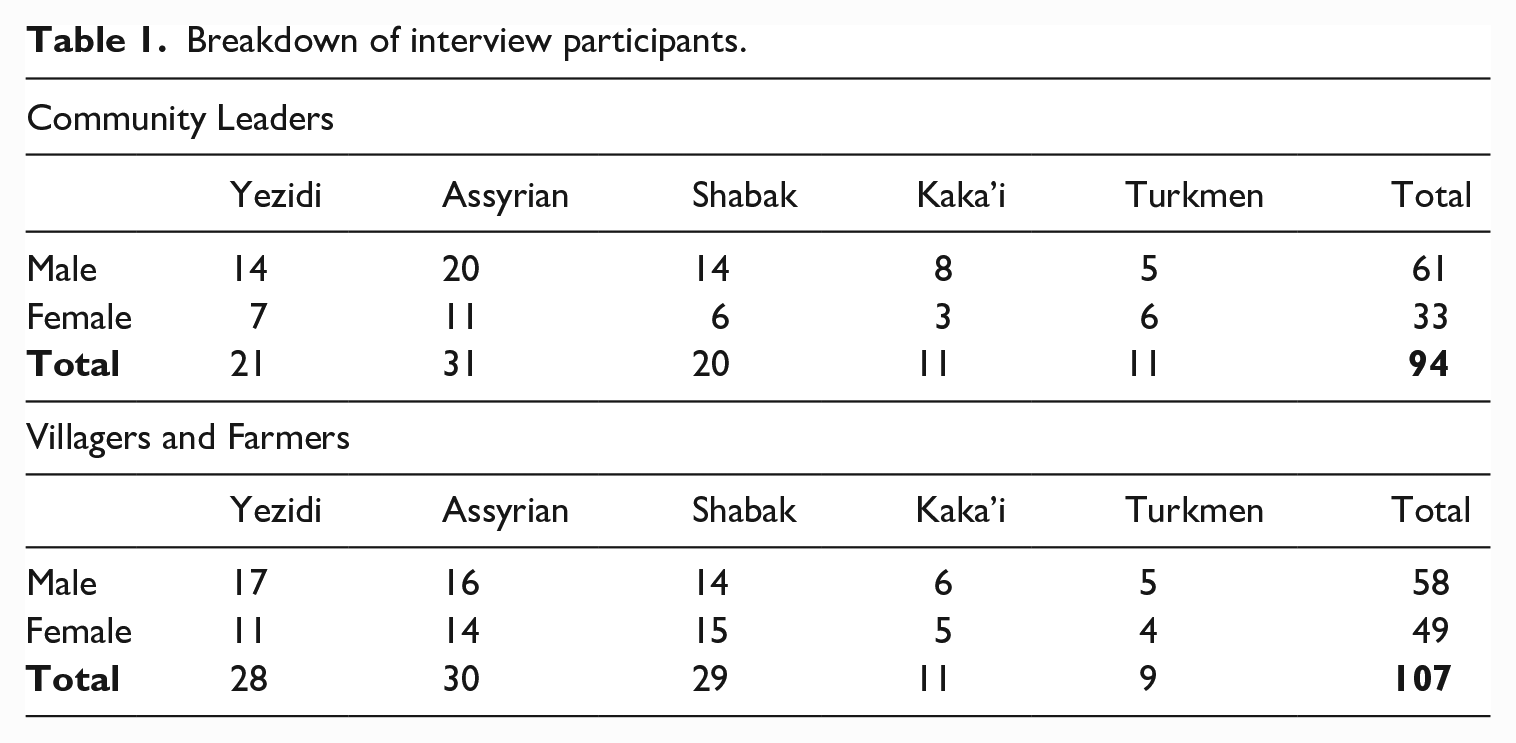
This article draws on extensive semi-structured interviews with community leaders (n94) and farmers and villagers (n107) conducted between May 2020 and April 2021. 1 The participants received a detailed information sheet about the project, and the consent form guaranteed their anonymity. Interviews with community leaders were conducted first, and due to COVID-19 travel restrictions, they were conducted online. Interviews with farmers and community members were conducted after travel restrictions in Iraq were lifted, as it was important that these interviews be in person and in the places (farms and villages) at the centre of this research. This connects to Elwood and Martin’s (2000) understanding that the interview site itself is inscribed in the social spaces that we seek to learn about. In addition, these interviews allowed for interviewees to communicate their narrative and individual understandings of the everyday of the past, present, and future (Björkdahl et al., 2018). Interviews lasted between 30 and 45 minutes and were conducted in the localities of Tal Keif, Hamdaniya, and Bashiqa in the Ninewa Plains. Community leaders were approached through the project teams’ wider network using the snowballing technique, and community members were contacted in the field while conducting a large household survey for the same project. The ethnosectarian distribution of the respondents is representative of the estimated demographic composition of the area. It includes Assyrians 2 (Christians), Kaka’i, Shabak (Sunni and Shi’a), Turkmen (Shi’a), and Yazidis (see Table 1 for breakdown). The interviews were translated from Arabic and Kurdish to English, and the translations were checked and open coded thematically using MAXQDA software by two team members who met regularly to ensure the codes’ consistent use. This initial thematic coding became the basis for more integrated and interpretative analysis by the authors.
Breakdown of interview participants.
Ethnic and religious communities in Ninewa: between diversity and persecution
Located in northwestern Iraq, the Ninewa Plains is a highly diverse area that is home to Assyrian, Kaka’i, Shabak, Turkmen, Yazidi, Kurdish, and Arab communities. Relations between these ethnic and religious communities have historically been relatively peaceful. In recent times, however, the situation of minorities in Ninewa has been marked by recurring persecution, expulsion, and displacement, and tensions between communities have emerged (Minority Rights Group International, 2014). With the 2003 US-led invasion and occupation of Iraq, Ninewa witnessed an escalation of violence and conflict. As disputed territories, some parts of Ninewa became entangled in the struggle for authority and power between the central government in Baghdad and the Kurdistan Regional Government (KRG) in Erbil (Meier, 2020). Ninewa’s ethnic and religious minorities became caught up in the tug of war between the central government and the KRG, each attempting to gain their support using a combination of incentives and intimidation. This competition for support created both intra- and inter- community tensions that exist to this day (Fazil, 2022). Failure to activate Article 140 of the Iraqi Constitution on the status of the disputed territories, including parts of Ninewa, and the lack of clarity on administrative authority in many of these areas have contributed to poor investment in infrastructure and service provision, especially in rural areas. At the same time, the tensions between Baghdad and Erbil have undermined minorities’ rights by denying minorities adequate political representation and protection from persecution (Costantini and O’Driscoll, 2020).
In 2014, IS occupied large parts of Ninewa. People from ethnic and religious minorities were killed, kidnapped, enslaved, and sexually abused (Amnesty International, 2014). Yazidis in particular were brutally targeted for their religious beliefs, and Yazidi women and girls were reduced to sexual slavery (Isakhan and Shahab, 2020; Vale, 2020). The atrocities caused many people to leave their homes and ancestral lands to escape the violence, resulting in large numbers of refugees and internally displaced persons. IS also targeted cultural heritage locations and violated sites held sacred by minority groups (Isakhan and Akbar, 2022). It sought to prevent communities from engaging in their cultural and religious practices, in an effort to eliminate the cultural plurality, while also stealing or destroying agricultural lands, crops, and livestock (Fazil and O’Driscoll, 2020; Isakhan and Shahab, 2022).
In the wake of the IS atrocities, many displaced populations have returned home to a different reality. Tensions over land ownership and demographic shifts (particularly between Shabaks and Assyrians) have arisen, as well as competition over aid, resources, and livelihood opportunities. At the same time, there has been an increase in militias connected to individual ethnosectarian groups, under the wider Popular Mobilization Forces umbrella, increasing the risk of tensions turning violent (Bourhrous et al., 2022). Building peace and restoring inter-community relations are therefore pressing tasks. Next, we turn to the role that local cultures, traditions, and every day practices in Ninewa can play in these processes.
Local dimensions of peace: culture, tradition, and the everyday
Mainstream peacebuilding efforts have disproportionately focused on state-building and strengthening central government authority, often through top-down approaches lacking sufficient grounding in the local context. However, conflict-affected societies, where state authority is weak or absent, often resort to informal systems of governance and local customary methods to manage conflict and regulate social interactions (Menkhaus, 2006). Peacebuilding processes do not occur in a vacuum but are always situated in a particular society with its own social norms and structures, local cultures, knowledge, and customs. A better understanding of the dynamics of local context is, therefore, crucial for any peacebuilding effort.
The increasing emphasis on the local dimensions of peacebuilding reflects the recognition that local actors are best positioned to build and sustain peace in their communities (Funk, 2012). It constitutes an attempt to move away from merely securing the ‘buy-in’ of the local populations in pre-determined peace frameworks. Instead, it calls for peacebuilding processes that allow the communities concerned to envision their own future through developing their own strategies and initiatives for peace. It represents a repudiation of the notion that the liberal peace model – which, despite its claims to universalism, is itself still only a particular interpretation of universal and liberal norms – is the only conceivable version of peace (Mac Ginty, 2010). This has given rise to a stronger interest in approaches drawing on local people’s everyday lives in peacebuilding. Thus, local people’s everyday encounters and interactions, their culture, traditions, and customary practices are considered a fundamental part of peacebuilding, both in theory and in practice (Kulnazarova, 2020; Mac Ginty and Richmond, 2013; Zartman, 2000).
The local turn in peacebuilding has been intimately connected to an elaborate exploration of the everyday. Mac Ginty (2021: 7), for example, highlights . . . everyday peace is forged and maintained at the local level. The local level is embodied and enacted and thus takes form in the home and immediate vicinity of the home, the commuting routes one might take, and the habitual and convenient spaces that one might frequent such as particular cafes, shops, or places of worship.
The notion of the everyday sheds light on those activities, practices, and routines that we engage in our daily lives, and on the interactions we have with others, which ultimately create and shape both our personal experiences and our social worlds. Despite being the domain of the familiar, the repetitive, and the seemingly banal, the everyday is strikingly also the site of change and transformation. The everyday is, however, an exceptionally difficult concept to define and theorize, and its complexity lies in that it ‘reveals the extraordinary in the ordinary’ (Lefebvre, 1987: 9). Its fluidity and indistinctness make it impossible to capture as it is infinitely diverse. Yet it is precisely this diversity, fluidity, and malleability of the everyday that has attracted the attention of peace and conflict scholars as they attempt to understand how ordinary people’s everyday actions, attitudes, and behaviours can contain both small acts of conflict and small acts of peace, whether they engage with others in activities that generate income, connect with them by speaking their language, or simply socialize with them in public spaces (O’Driscoll and Bourhrous, 2022). Using the lenses of the local and the everyday, it thus also becomes clear that conflict and peace are not mutually exclusive but entangled processes, with both acts of everyday peace and everyday conflict often occurring together (O’Driscoll, 2021).
Culture is very much part of the everyday, and it plays an important role in shaping it (Bräuchler, 2018). Cultural rituals and practices are an important part of a community’s identity, informing their values and connection to the place they live in (Isakhan and Shahab, 2020). Culture and traditions often constitute ‘the most immediate local sources of sustenance, resilience, stability, and peace’ (Richmond, 2009: 158), and their importance in peacebuilding has been widely documented (Bräuchler, 2018; Dinnen and Peake, 2013; McAllister and Wright, 2019; Zartman, 2000).
Although culture and traditions are part of people’s everyday lives, rituals and celebrations are, however, often experienced and felt as a break with the everyday, as they often have a certain character and are accompanied by an ambiance or emotional content that separate them from day-to-day life. A strand of peacebuilding literature focuses on the peace potential of rituals and celebrations precisely because of the impression of the break with everyday life they tend to give. In this line of research, the temporary ‘suspension’ of the everyday is what enables the creation of spaces conducive to peace. Schirch (1999: 47), for example, defines rituals as actions that create a ‘unique social space, set aside from normal life’. As the moment of ritual or celebration is demarcated in time and separated from other processes, it has the potential to transcend – even if only momentarily – the tensions and conflictual relations that may prevail. Rituals and celebrations can take a variety of forms, ranging from routinized to improvised, and from formal to informal social expressions and practices (Schirch, 1999). Moreover, these ruptures with the everyday – and the interactions they enable – have the potential to alter the everyday that comes after them through changing relationships, habits and so on, thereby increasing their peacebuilding potential.
Any analysis of the role of everyday life and local culture and traditions in peacebuilding must, however, resist the temptation to construct local dynamics as inherently peaceful, and local values and norms as essentially better or superior (Isakhan and Akbar, 2022). Furthermore, one must avoid misconceptions of cultural purity when thinking about local culture as being somehow insulated from processes of globalization and cross-cultural encounters and interactions (Mac Ginty, 2010).
Towards positive peace in the everyday
In one of the key works conceptualizing acts of everyday peace, Mac Ginty (2014) puts forward five acts: avoidance, ambiguity, ritualized politeness, telling, and blame deferral. There have been criticisms that these acts and attitudes (Ware and Ware, 2022), and everyday peace more generally (Williams, 2015), are essentially a form of negative peace. However, Mac Ginty (2021) argues that they build the foundations for positive peace and can lead towards solidarity between communities. Ware and Ware (2022) further develop these categorisations to include elements that lean more towards positive peace, namely, avoidance, reading, ambiguity, shielding, civility, reciprocity, solidarity, and compromise. 3 While acknowledging the importance of all these acts and the role that many play in avoiding conflict from emerging, we are particularly interested in ‘civility’, ‘reciprocity’, and ‘solidarity’, and the role they play in building positive peace. 4 We consider Mac Ginty’s avoidance, ambiguity, telling, and blame deferral and Ware and Ware’s avoidance, reading, ambiguity, and shielding as foundational acts of everyday peace that are more on the side of avoiding conflict. The other acts build on these foundations towards solidarity and positive peace (see Figure 1).

Acts of everyday peace.
Civility involves positive engagement in public spaces. This can be in the form of economic interactions and often involve routine politeness. Reciprocity, the next level in building towards solidarity, involves reciprocal (rather than financial) exchange – essentially doing a favour for the other (Ware and Ware, 2022). However, for us, and as our research demonstrates, there is a step missing between reciprocity and solidarity (standing with the ‘other’). 5 Correspondingly, we introduce the category of ‘affinity’ to refer to an affective engagement with the other and to acts of getting to know, understand, and participate in what is important to the other community. While affinity can contain a connotation of a natural liking for or a spontaneous predisposition to engage with the other, 6 we are primarily interested in affinity as a movement towards the other – a rapprochement – whereby a stronger rapport and a closer relationship with others are built. By drawing closer to other communities, having sympathy for them and their cultures, and participating in the events that are important to them, the distance separating individuals and communities is gradually reduced, compared to interactions only involving acts of civility and reciprocity. Acts and attitudes that indicate a movement towards the other and decrease estrangement from them are what the term affinity attempts to capture.
It is important to note, however, that affinity with one group may be achieved at the detriment of other groups, which at the macro level can undermine rather than strengthen positive peace. In other words, affinity with a group can also imply a process of ‘othering’ and excluding other groups. Mac Ginty (2021: 67–68) discusses similar dynamics in relation to the difference between solidarity that crosses group boundaries and in-group solidarity, or ‘negative solidarity’, which stresses in-group cohesion and unity and can be used as a mobilization tool against out-group members. Nonetheless, what, in our view, is crucial about affinity is that similarity and commonality can constitute the point of departure of a movement towards the other that has the potential of divesting itself of the focus on similarity and likeness. Affinity can centre on culture and/or religion, for example through participating in an event of cultural or religious importance to the other, honouring their traditions, and so on. It might build on commonality, but at its core it is an affective engagement with the other that has the potential to go beyond the particularism of identity and culture and beyond processes of identification with the other, to discover what is universal in the other – their humanity. Viewed in this light, acts and attitudes that indicate or reinforce affinity can be considered as a kind of affective preparation of individuals by virtue of which undertaking acts of solidarity becomes more and more likely.
Affinity usually builds over time. Acts of everyday peace under this category can thus either be the result of existing affinity or reflect emerging affinity between communities. Both everyday interactions and rituals and celebrations that mark a break with the everyday can provide opportunities to develop affinity. Rituals and celebrations, however, can arguably be particularly conducive to developing and reinforcing affinity, as they enclose systems of meaning and norms that speak to the people who practice them (Schirch, 2005). In practicing them, people engage with each other in a context of shared values and a common understanding of the meaning of symbols. Moreover, people’s worldviews become aligned, and the shared experience creates a space of commonality, which can be important in cementing affinity in a movement towards solidarity.
Negative and positive peace should thus not be viewed as binary, but rather as a scale. Conflict avoidance offers the foundations for peace, civility and reciprocity take it further along this scale, and the missing element is affinity, which then takes it that one step further towards solidarity (see Figure 1). It is important to note that these acts and attitudes are not mutually exclusive. An act of everyday peace can, for example, be guided by a combination of civility and reciprocity. It could also be that civility and reciprocity are possible because of existing affinity with the other person or community. Recognizing the fluidity and the interpenetrating nature of acts of everyday peace challenges temporal and sequential assumptions about conflict and peace, about positive and negative peace, and so forth (Söderström and Olivius, 2022). The scale is thus meant as an ideal-type of acts and attitudes that can contribute to the transformation of negative peace into positive peace.
In summary, we argue that everyday peace is not just negative peace, but a tiered process that may or may not result in solidarity. The acts and attitudes that prevent everyday conflict from emerging form the foundations of this process, and those that encourage positive interactions build further towards the positive side. Affinity sits firmly within positive peace, which can be further cemented through solidarity. As discussed, developing and showing affinity can occur in the everyday routine, but also in rituals and celebrations experienced as a break with the everyday. We now turn to what these theoretical considerations mean in practice.
Findings
Local commercial exchanges and farming practices
Agriculture constitutes the main economic activity in the Ninewa Plains and the main source of subsistence for many households. After each harvest, farmers take their wheat and barley (the largest crops in the locality) to the local mills in Karamles, Bashiqa, and Bartella to be ground into flour and bulgur. Traditionally, many mills in the region belonged to Assyrians, making the seemingly trivial everyday act of going to the mill an opportunity for inter-community encounters (Bourhrous et al., 2022). As a Shabak respondent explains, . . . the mills that existed were owned by Christians. There used to be commercial exchange, and there was a strong relationship between Christians and Shabaks in the Ninewa Plains before. Because of this, we went to their mills to grind the grains. They benefited as they bought our wheat, and we also benefited from using their mills and selling wheat to them.
7
Commercial exchanges have played an important part in inter-community relations in everyday life in the Ninewa Plains and have driven interactions between communities. They initiate interactions between communities and set a baseline for further, deeper relationships. The civility and the social interaction between the farmers and the millers that occur during these commercial exchanges is an important step towards consolidating inter-community relations in the everyday. Interpreted according to the typology of acts and attitudes that form our scale from negative to positive peace, commercial exchanges would be typical instances of civility.
Farmers from different communities also cooperate when it comes to sharing equipment. Many respondents indicated that farmers from neighbouring villages often help each other by lending agricultural equipment such as tractors, harvesters, and sprinklers. Asked about cooperation within and between ethnic groups in sharing farming equipment, a female Yazidi farmer from Tal Keif stated ‘Yes, we are brothers, whether Muslim, Yazidi or Christian. There is no difference based on religion’.
8
A male Yazidi farmer from Tal Keif also asserts ‘We have Christian neighbours. They help us and we help them with agricultural equipment and other materials’.
9
This is corroborated by farmers from other communities as well. A Shabak farmer from Bashiqa, for example, reported Whatever we need, we most likely can find it in the village. I do not think I need something outside the village, but it is possible. Sometimes people from outside the village come to us for their needs or we go to them for some of our needs. We do help each other.
10
A Kaka’i villager from Hamdaniya stated, ‘We cooperate . . . We share our things with Shabaks and Arabs. So, yes, we help each other’. 11 In addition to sharing agricultural equipment, sharing information is also very common among farmers from different communities. They exchange information and advice on virtually all aspects of farming. Respondents indicated that they often consult with other farmers, not only from their own group, but also from other groups, on how to use seeds, fertilizers, and pesticides; on how to irrigate their crops; and on which crops to cultivate and when. When asked about information sharing with farmers from other communities, a Turkmen villager from Hamdaniya responded ‘Yes, there is [information sharing]. We ask each other and we teach each other how to use things’. 12 An Assyrian farmer from Tal Keif reports ‘we exchange information about the agricultural pesticides and how they are used. We need to ask each other. A person should know how to use things before starting to do things’. 13 A female Shabak in Hamdaniya concurred, saying ‘sometimes a person will advise you what to plant and what not to plant depending on the quality of the soil, sometimes we plant rice and sometimes potatoes’. 14 Another Shabak farmer from Bashiqa said, ‘Yes, we exchange information. We talk to each other about last year’s way of growing the crops and advise each other on how to do things better’. 15 These responses show that there is a tradition of cooperation between communities.
Following our typology of everyday peace, this cooperation among farmers from different communities can be viewed as an instance of reciprocity. Inasmuch as it reflects a concerted effort to help each other, the reciprocity involved in these relations and interactions is not conflict avoidance, but rather a form of positive peace. Moreover, respondents’ narratives of the strong relations and positive interactions they often experience in commercial exchanges and farming already suggest the existence of a degree of affinity, engendered and/or expressed through reciprocity. The tradition of cooperation in farming thus provides an opportunity for peacebuilding, as the return to agricultural livelihoods is a key aspect of the reconstruction efforts of national and international actors (Bourhrous et al., 2022).
Nonetheless, while most respondents said that cooperation existed between ethnic and religious communities in farming and agriculture, some respondents expressed doubts about the strength of inter-community cooperation in the region. For them, farmers could only rely on themselves, their closest relatives, or people from their community. As a female Shabak farmer from Hamdaniya put it: ‘No one helps, everyone depends only on themselves, and when we returned, all the things were looted and stolen’. 16 There are also variations regarding which communities one is more likely to cooperate with. As a Turkmen villager from Hamdaniya put it, ‘there is a cooperation between us. With Sunnis not that much, but with Christian there is’. 17 One can also view these preferences on who to cooperate with as an expression of an already existing affinity. This illustrates the fluidity of everyday peace and the fact that acts and attitudes of everyday peace are often not mutually exclusive. It also illustrates the point about the double-edged nature of affinity and the potentially negative aspects if it becomes a basis for excluding others. Lack of affinity can also point to ingrained mistrust in one community, in this case Sunnis and the tendency of some communities to associate them with IS.
Regardless of variations in perceptions of the degree of existing reciprocity and/or affinity between communities in farming and agriculture, nearly all respondents considered cooperation to be desirable and expressed a need for, and an openness to, greater cooperation between farmers from different ethnic and religious groups. When asked whether they would like to see more cooperation between farmers, an Assyrian farmer from Hamdaniya highlighted the sense of interdependence between farming communities in the area, stating ‘Yes, I’d like to see better cooperation because we need each other’. 18 For another farmer, a Shabak from Bashiqa, greater cooperation in farming is needed ‘because when there is cooperation things get better’. 19
Respondents also underlined how cooperation to enhance livelihoods has the potential to improve relationships and produce positive outcomes beyond agricultural activities. For example, a Shabak farmer from Hamdaniya asserted ‘Of course, God willing, all Christians, Yazidis, and Muslims will become like brothers and sisters’. 20 Similarly, a Turkmen from Bashiqa expressed the hope that with more interactions and cooperation, ‘hopefully, relations will become better, like before and even better’. 21 Inasmuch as it strengthens the spirit of brotherhood and friendship between communities in general, cooperation in farming, and the reciprocity it involves, illustrates the tiered nature of everyday practices towards more and more positive peace.
Local cuisine and traditional dishes
Local food and traditional dishes constitute an important element of commonality and shared experience for people across ethnic and religious groups in Ninewa. Many households traditionally prepare a spelt wheat-based dish called gamjilan also known as saliga. The preparation process requires cooperation in terms of washing, boiling, drying, and grinding spelt to make bulgur. Preparing the saliga takes place during the harvest season and it involves several rituals that bring people from neighbouring communities together to help each other. Another local traditional meal that families across ethnicities and religions in Ninewa commonly prepare is hareesa, a meat and barley dish cooked to a pudding texture. It is very popular among all communities and is often prepared on special occasions and distributed to neighbours. Yazidis traditionally prepare hareesa for the religious celebrations of the Fortieth of Summer and the Fortieth of Winter, and Kaka’is often prepare it for weddings. Among Turkmen Shia, hareesa is also known as shilan, and it is typically made during Muharram for Ashura and Arba’een. 22 Households often take turns in cooking the dish, which is then distributed as an act of charity. As a female Yazidi respondent explained ‘We make hareesa, just like Muslims and Christians. Hareesa is cooked in the temples and distributed during the Fortieth of Summer, the Fortieth of Winter, and other holidays. It is a staple food’. 23
Despite some small differences concerning ingredients, cooking, and occasions, study participants generally saw traditional dishes as an aspect of day-to-day life in Ninewa shared by people from all ethnic and religious backgrounds. Culinary practices and food traditions are an important part of local heritage and culture and they often have deep cultural significance for individuals and communities. Precisely because local food traditions are an aspect of everyday life that is widely and naturally shared, they encompass a clear sense of commonality that is not based on interdependence and mutual interests that often drive acts and relations of reciprocity as in farming. The sense of commonality in shared food traditions provides clear opportunities for developing affinity. A shared meal can create moments of conviviality, which in turn can contribute to reinforcing a sense of community that both transcends religious and ethnic differences and brings them together into an integrated, yet diverse, whole. Preparing traditional dishes such as hareesa is also an integral part of rituals, celebrations and life events such as weddings and funerals in which affinity with others is expressed and/or engendered. In our typology of everyday peace, acts that engage these shared food traditions in a manner that underscores conviviality would fall under the category of affinity. Local cuisine, the practices and rituals involved in the preparation of meals, and the values of sharing associated with them, can serve as vehicles for peacebuilding grounded in the local and the everyday.
Rituals and cultural practices
Religious celebrations provide an opportunity for people from different communities in Ninewa to engage with and understand each other regardless of their religious affiliation. As a Shabak respondent from Hamdaniya put it, Yazidis and Christians and other communities would come and attend during funerals and during the Muharram and Ashura commemorations. Same for other social occasions, always all the communities participate. This is considered a point of strength and gathering for all communities and in return the Shabak also participate in rituals with other communities.
24
People from different ethnic and religious groups often pay visits to each other on important religious and cultural occasions to extend congratulations and best wishes. As another Shabak respondent put it, ‘We sometimes participate with Christians in their celebrations. We go to churches, we go to Yazidi shrines. As Yazidis, Muslims, and Christians, we used to take part in each other’s joys, in religious occasions and traditions’. 25
Other occasions such as weddings, funerals, and births also provide unique opportunities for social gathering and interaction between people from different ethnic and religious communities. Religious figures and community leaders often attend the condolences service in each other’s places of worship. As an Assyrian respondent from Bashiqa explains, Religious leaders play an important role in maintaining inter-community relations. If someone from the Muslims or the Yazidis has a condolences service, the priest goes to the mosque or to the Yazidi shrine. Same for condolences service when a Christian passes away. They come to us, and we go to them. This is really important.
26
These quotes show how in a diverse and multicultural society like Ninewa, where groups regularly interact and are interdependent, religious ceremonies have played an important role in bringing communities together to share aspects of their customs and traditions. They create opportunities for developing affinity as they allow members of the different communities to learn about, understand, show respect for, and take part in what is culturally and religiously important to others. Peacebuilders can engage with these practices and build on them, as they constitute important local entry points to reinforce intergroup understanding and build towards solidarity.
The practice known as kerāfat or blood brotherhood is another example of how rituals can be viewed as an occasion for developing and expressing affinity between individuals and communities in the Ninewa Plains. It is practised mainly by Yazidis and has contributed to creating social relations between Yazidis and other communities. The practice consists in selecting a male adult, usually from another community, to hold a child on his lap for circumcision. By doing so, the person becomes the child’s krif – his blood brother – thus pledging to support and defend the child no matter the circumstances. Similarly, the child becomes the blood brother of the adult on whose lap he was circumcised. The practice thus creates mutual social obligations that both sides are expected to honour. It also creates kinship ties between both families, with the same restrictions between biological relatives being applicable (Nicolaus, 2016). The adult selected to be the child’s krif is more than just a godfather. As a blood brother, he becomes part of the family, connected to it by the strong bond of blood. As one interviewee put it, your blood krif is like your brother. You defend him with all means when he comes to your home and he has troubles. If his enemies brandish weapons, you defend him. The only thing forbidden between you and him is what God has forbidden.
27
Blood brotherhood has strong social and symbolic dimensions. The practice has commonly been used by Yazidis to build relations with other communities, primarily with Muslims, and to a lesser extent with Christians. Some see the practice as a social protection mechanism used by the Yazidi community to build relationships with other communities, acquire protection and avoid persecution for what others consider as heterodox religious beliefs. As a Yazidi respondent from Bashiqa put it ‘We are weak Yazidis who live in an environment where we never know at what moment they will come and kill us and take our families, so what do we all do? We use methods and means to survive’. 28
The system of blood brotherhood involves a willingness to engage with the others’ culture, to understand them and create an affective bond with them. It shows the openness of the Yazidi community to establishing and maintaining relations with other communities, while also showing that other communities have been willing to understand, engage, and participate in what is important to Yazidis. The practice shows a movement towards the other and a desire to bring them closer. 29 As such, it can be seen to provide an opportunity to express and develop affinity with the other, while honouring the obligations implies acts of solidarity. In our typology of everyday peace, celebrations and rituals that bring different communities together would fall under the category of affinity, while the ritual of blood brotherhood in particular could also be said to imply a connection to the category of solidarity, as it already in its intention implies acts of solidarity. To the extent that it aspires to transform strangers into friends and allies, the kerāfat system can change relationships in the everyday and may therefore be pertinent to efforts to build everyday peace in Ninewa. However, it is important to keep in mind that the kerāfat system can also develop affinity and solidarity to the detriment of other groups.
IS attacked the very fabric of society in the Ninewa Plains. It threatened local patterns of coming together, and the practice of blood brotherhood was no exception. Many Yazidis feel that they have been betrayed by some of the closest people to them, including neighbours and blood brothers. Many respondents bitterly deplored the increasing shallowness – even meaninglessness – of the practice of blood brotherhood. As a male Yazidi respondent put it: We have blood krif. It is considered sacred. For example, now you are a Muslim and I am Yazidi. When you come to my house, I circumcise my son on your lap, and then I am ready to sacrifice my life for you. But now, after Daesh, this relationship did not remain even at 1%.
30
For another respondent, the blood krif relationship was severed with people who wronged and betrayed Yazidis under IS, but it has strengthened with people who did not.
31
The genocide of Yazidis by IS, sometimes with the complicity of their blood brothers, has made many Yazidis question the continuity and the future of blood brotherhood: Of course, krif is over . . . If someone asks, ‘Come be my krif’ and the other says ‘I do not want to’ and does not accept the Yazidi to be his krif, the Yazidi considers it a humiliation . . . We will not cancel existing relationships, but it is unlikely that new relationships will be established.
32
However, the above quote also indicates that affinity in this case is often built beforehand. A conscious decision is made to select someone who would agree to become a blood brother, meaning bonds often already exist.
The perception of the gradual disappearance of blood brotherhood among some respondents also illustrates one of the difficulties of mobilizing traditions and customs to build peace, namely that such traditions need to still be vibrantly meaningful for the people concerned. If this is not the case, such traditions may have only a limited or even superficial value for peacebuilding. Nonetheless, in the case of the practice of blood brotherhood, most of those that showed reluctance to continue the tradition did so due to the breakdown of trust following the atrocities committed against the Yazidi community, rather than as a move away from the tradition itself. This indicates that the kerāfat relationship still has a meaning for people and that the norms and sentiments attached to it can constitute the basis for developing affinity between communities and can thus be mobilized in reconciliation processes.
It is important, however, to underline that a tradition can be in the process of disappearing yet continue to have relevance for everyday peace. In the case of blood brotherhood, for example, the values and the moral norms that the practice encloses may be appealed to in building peace even if the actual ritual ceases to be performed. While the rituals may lose their relevance in practice, the values they contain can retain their meaning for people. Inasmuch as they are part of the local collective imaginary, these values and norms are of interest for building positive peace. This also connects to the bearing that memory and reminiscences of past coexistence have on the present and the importance of this for building peace in the everyday (Björkdahl et al., 2018). What the example of blood brotherhood thus underlines, is the crucial importance of having a thorough understanding of the local and its dynamics as well as the conditions under which traditions and rituals can offer opportunities for people from different communities to get to know, understand, affectively engage with the other and take part in what is important to them.
The examples discussed throughout the article have all been interpreted according to the typology of acts and attitudes that form our scale from negative to positive peace. Local commerce has been connected to civility, cooperation in farming has been connected to reciprocity, while both local cuisine and celebrations and rituals, such as krif, have been connected to affinity, with the krif ritual (at least on the individual level) perhaps also even implying a connection to solidarity. What the respondents say in these examples, however, also suggest that there is a fluidity in the experiences of these interactions. Civility and reciprocity, for example, are not static, but often already the beginning of a positive movement towards the other which can develop into affinity and potentially even become solidarity. Acts of civility and reciprocity can engender affinity even though this affinity does not yet show itself through acts such as getting to know the other or participate in what is important to them. Conversely, acts of civility and reciprocity can also presuppose affinity and thus be said to express affinity, while also potentially contributing to deepening affinity. The same can be said of the ritual of krif, but it is also possible, at least formally, to interpret kerāfat in its intention as reciprocity, all the while in practice it will rather tend towards developing affinity and solidarity. While the examples are interpreted according to the ideal-types on the scale, real life is of course more fluid and more complex.
A similar point can be made concerning the possibilities of engaging the local in peacebuilding efforts. Although each of the examples discussed throughout the article offers possibilities for everyday positive peace on its own, in practice engaging the local can often involve mobilizing multiple elements and aspects of the lives of local people simultaneously. For example, as local food traditions usually form an important part of celebrations and rituals, peacebuilding efforts can draw on both at the same time, building on the sense of commonality and shared experience that they tend to foster. However, a particularly poignant example of the intersection of different dimensions is the olive tree. The olive tree carries deep significance across ethnic and religious communities in the Ninewa Plains, known for its olive groves and olive oil production. As an important local crop, olives are a product around which agricultural cooperation can be envisaged. At the same time, olives and olive oil are an integral part of local food cuisine and thus constitute a point of commonality between communities. Finally, the olive tree has symbolic value for communities in Ninewa. The olive branch is a symbol of peace and hope across the Abrahamic faiths. Yazidis consider the olive tree to be sacred, and they use olive oil in their rituals and celebrations. As a Yazidi respondent put it, ‘Olive trees are sacred to us, so they are used to illuminate temples on Wednesday and Friday evenings. On the Yazidi New Year’s Eve, 366 candle wicks are lit in the Lalish Temple’. 33 Other communities also consider the olive tree to be blessed. In the words of a Shabak respondent, ‘For us, as for other communities, we consider the olive tree to be a blessed tree mentioned in the Qur’an, and all religions are proud of this tree’. 34 The intersection of economic, cultural, spiritual and symbolic dimensions thus make the olive tree an important resource for peacebuilding in Ninewa.
Conclusion
Based on over 200 interviews with local actors in Ninewa – and using a conceptual framework that considers both everyday interactions and events such as rituals and celebrations that often are experienced as a break with the everyday – this article demonstrates the opportunities that engaging with the local and mobilizing the everyday lives of local people, their cultures, and their traditions present to peacebuilding. In doing so, the article also makes a theoretical contribution to the everyday, and broader, peace literature by further developing existing typologies of everyday acts and attitudes of everyday peace. We argue that acts and attitudes of everyday peace form a scale from negative to positive peace and introduce the concept of affinity on this scale, to refer to an affective engagement with the other and to acts of getting to know, understand, and participate in what is important to the other. Beginning with conflict avoidance as negative peace, the scale thus moves towards positive peace through four steps: civility, reciprocity, affinity, and solidarity. Through our theoretical framework and empirical findings, we therefore push back against the negative-positive peace binary and we make the case that everyday peace is not just negative peace.
On the practical level, the examples discussed throughout the article show that peacebuilders can engage with the local in a variety of ways, harnessing the peacebuilding potential of the richness of everyday life. Sometimes it may make sense to engage with aspects of everyday life and culture and traditions separately, but often there will be opportunities to engage with multiple elements and dimensions at the same time, as the example of the intersection of local food traditions and local celebrations and rituals show, and the example of the olive tree epitomizes. The intersection of these dimensions can provide unique opportunities for everyday peace. In addition, the framework we put forward, and our negative/positive everyday peace scale, can be utilized by peacebuilders to harness local understandings in developing programmes that build towards positive peace.
It is important to note that, while we see peacebuilding opportunities in cultural and traditional practices, we are not suggesting that they are inherently positive and lead to peace, but rather that it is necessary to understand the sentiments of local communities (Isakhan and Shahab, 2022). In the Ninewa Plains, reinstating cultural and traditional practices with a strong connection to peaceful relations is crucial. This article has demonstrated the important role that culture and tradition have played in building everyday peace. By anchoring peacebuilding in the local, peacebuilding actors can discover a multitude of ways in which everyday life, local culture, and traditions create spaces of commonality between individuals and groups. What is invariably fundamental, however, is having a thorough understanding of the local context, sentiments, and dynamics to develop more sustainable peacebuilding aligned with local norms and practices.
Footnotes
Acknowledgements
The authors would like to thank all researchers for their contributions to the wider research design and fieldwork, and would like to particularly acknowledge the work of the University of Duhok in implementing the wider research findings. The authors would also like to thank the two anonymous reviewers for their thoughtful comments that immensely improved the article.
Authors’ note
While the authors led the social cohesion work package, over 30 researchers from the University of Duhok, Notre Dame, Purdue University, Indiana University, and Stockholm International Peace Research Institute (SIPRI) contributed to the larger project with a particular focus on agriculture and culture.
Funding
The author(s) disclosed receipt of the following financial support for the research, authorship, and/or publication of this article: This publication was made possible through support provided by the Innovation, Technology and Research Hub of the U.S. Agency for International Development, through the LASER PULSE Programme under the terms of Cooperative Agreement No. 7200AA18CA00009. The opinions expressed herein are those of the authors and do not necessarily reflect the views of the U.S. Agency for International Development.
