




Abstract
This article pushes the work of Bourdieu to more ethnographic directions within international social sciences, particularly studies of everyday (in)security. Thematically, it looks at how transformations in global politics towards increased xenophobia and the normalisation of ‘far-right’ politics can be examined through mobilising ‘Bourdieu the ethnographer’ (Blommaert, 2005). Using the example of Sweden, and an ethnography of everyday life around a refugee resettlement facility in 2013 and 2014, the article argues that Bourdieu the ethnographer provides important conceptual tools for understanding the way in which logics of (in)security shifted ever further into everyday life. This thus offers an interesting way to think about the normalisation of far-right and xenophobic politics more broadly. Through conducting this specific type of Bourdieu-inspired ethnography, the article empirically grounds the ‘habitus’ of the so-called ‘far-right’ voter. Taking seriously the temporal dimension of habitus, Bourdieu the ethnographer orients analysis towards transformation, evolution and flux, allowing ‘far-right’ to be conceived relationally. In the Swedish case, we are thus able to trace the shift from a ‘welcoming’ to an ‘exclusionary’ type of politics.
Prologue
The barbecue to welcome the new Syrian residents of Oreby took place on the village green on an icy February evening. Most of the village turned out for the occasion, never shy to relay to me, a foreign researcher, at the pleasure Oreby-dwellers took in showing solidarity to fellow humans fleeing a war zone. The chair of the resident’s association even learnt a few words of Arabic and was eager to share his knowledge with his fellow villagers.
Around a year and a half later, Oreby had turned on the Syrians. I was sitting on a bench on the same green with Susanne, the kind woman from the Swedish Church. This time it wasn’t snowing, and the Syrians were no longer seen as saintly sufferers: ‘I want you to write this down’, Susanne urged me, ‘So that outsiders can read about how much of a burden we are under here’. For Susanne, who fashioned herself as speaking for the entire village, if not nation, drastic measures were needed to stop more Syrians arriving. Not only for the supposed drain they placed on schools, healthcare and other public services, but also to protect the Syrians already here from the backlash which would certainly ensue if a harder line was not taken.
Introduction
This article pushes the work of Bourdieu to more ethnographic directions within international social sciences, particularly studies of everyday (in)security. Thematically, it looks at how transformations in global politics towards increased xenophobia and the normalisation of ‘far-right’ politics can be examined through mobilising ‘Bourdieu the ethnographer’ (Blommaert, 2005). Using the example of Sweden, and an ethnography of everyday life around a refugee resettlement facility in 2013 and 2014, the article argues that Bourdieu the ethnographer provides important conceptual tools for understanding the way in which logics of (in)security shifted ever further into everyday life. This thus offers an interesting way to think about the normalisation of far-right and xenophobic politics more broadly.
Through conducting this specific type of Bourdieu-inspired ethnography, the article empirically grounds the ‘habitus’ of the so-called ‘far-right’ voter. Taking seriously the temporal dimension of habitus, Bourdieu the ethnographer orients analysis towards transformation, evolution and flux, allowing ‘far-right’ to be conceived relationally. In the Swedish case, we are thus able to trace the shift from a ‘welcoming’ to an ‘exclusionary’ type of politics which took place around the refugee centre. Lived (in)security as a limit-making practice is shown to be both situated and emergent, avoiding essentialising or depoliticising explanations of xenophobia and far-right politics.
The article proceeds in the following way. First, it introduces my ethnographic research in a small village in southern Sweden, situating the normalisation of far-right logics which took place there as speaking to the wider phenomenon of the mainstreaming of previously marginalised extreme right and xenophobic politics across Europe over the last decade. Next, I introduce the instrumentarium of Bourdieu the ethnographer, namely, the ethnographic grounding of habitus, to de-essentialise the image of a far-right lifeworld as pre-constituted or centred around certain identity markers. The second half of the article anchors the transformations that took place in the Swedish story around Bourdieu’s own thinking on an ethnographic understanding of ‘habitus’. This is most vividly demonstrated in the scholar’s reflections on his early fieldwork in Kabyle, and also woven into his work on his native farming community of Bearn, the French educational system and his research within the sociology of art and cultural fields. Finally, the article reaches out to both linguistic ethnography (LE) and Bourdieu’s own discussions on reflexivity to re-invigorate discussions about the effect of our own situatedness as researchers in the production of knowledge within international politics.
The normalisation of right-wing xenophobia: the case of Oreby, Sweden
The refugee crisis of 2015 and 2016 in Europe cast doubt upon some of taken-for-granted political assumptions. Even the comparative ‘openness’ of Sweden and Germany turned rather quickly to resentment towards refugees with borders being closed to asylum-seekers. Across Europe more broadly, far-right parties made significant gains in the late half of the last decade, and political constellations shifted in quite unexpected ways. Xenophobic discourses, once confined to the fringes of society, became mainstream and are considered as legitimate positions in day-to-day debate (see Antonsich, 2017 for an overview).
Sweden is an interesting case to study; labelled a ‘humanitarian superpower’ during Europe’s so-called ‘refugee crisis’ for its relatively open policy and high standard of care provided to people arriving to claim asylum, the Swedish government subsequently adopted some of the strictest asylum policies at the midst of the ‘crisis’, reintroducing border controls along the southern border with Denmark. With the failure of Europe to formulate any sort of coordinated response to the ‘crisis’, these moves were articulated in terms of burden sharing and already having done one’s fair share, and also in starker security terms, linked with anti-terrorist measures and public order. The anti-immigration Sweden Democrats (SD) party also made great gains during the same time period, increasing their proportion of votes from 13% in September 2014 to 19% in September 2018, making them the nation’s third largest political party. At the time of writing, in 2022, SD has been completely absorbed into normal politics as the third biggest party, forming a centre-right oppositional bloc with the centre-right Moderate Party, the Christian Democrats and the Liberal Party (Dagens Nyheter (DN), 2022).
A re-reading of the Swedish story during this re-ordering of socio-political terrain is also particularly significant in light of the situation for Ukrainian refugees in Europe, in the summer of 2022. The outpouring of hospitality for Ukrainian people – and the triggering of the temporary protection directive by the European Commission for the first time – has largely been framed in terms of uneven solidarities and racialised politics. This so-called generous response has been compared to exclusionary and punitive policies towards Syrian people, among others, and analysed using the analytical schemas of Black–White racism (for an overview and critique of this framework, see Labuda, 2022). Indeed, racism as a logic of practice in international law certainly cannot be understated in any analysis. Yet, overlooking the processes through which Syrian people were produced as racialised subjects in Europe, and the normalisation of an exclusionary and xenophobic politics towards them, risks an essentialising and ahistorical analysis (see especially Tazzioli, 2021). It was not always the case that Syrians were framed as undesirable and unwelcome. Attention to the processes of hardening of stances – in the context of hospitality and ‘generosity’ – is thus an imperative.
It was just before what has been called the ‘long summer of migration’ in 2015, that I left Sweden, having spent around a year and a half conducting fieldwork for my PhD on the changing dynamics between refugees and villagers in a small enclave called Oreby (Mc Cluskey, 2019). During this time, I came to find myself forming relationships with volunteers and members of informal refugee solidarity groups, who became drawn to far-right politics for the first time. Oreby, where I based myself, was a picturesque little village in the county of Skåne, southern Sweden and was home to around 1600 inhabitants. A largely middle-class place, Oreby’s main road was bordered on either side with large, well-groomed bungalows complete with generous front gardens housing all manner of children’s play equipment. Though a rather tiny place, the village was well served with a good school, a library, a small supermarket and a pizzeria. On one February morning in 2013, however, Oreby’s population increased by 70 when, without much notice, a few dozen Syrian refugee families were resettled by the Swedish Migration board in an apartment complex just off the main road. A small volunteer group mobilised quickly to provide the refugees with the material goods they needed for life in Sweden – bicycles, warm clothes and toys – as well as offering Swedish lessons to complement the official Swedish-for-immigrants (SFI) policy. My role, as both a researcher and a volunteer, was that of translator between Arabic and Swedish, or Arabic and English, as all communication from government agencies was in Swedish, and the Migration Board declared themselves too overwhelmed to offer translation services.
How can we think about the transformations that took place in Oreby towards a normalisation of ‘far-right’ politics, and the shifts in politics of acceptability around being associated with ‘the far right’ more broadly? A lot of these changes have been presented as the effects of neo-liberal policies finally manifesting in an inevitable backlash – those who are left behind by globalisation expressing their unhappiness and anger with an uncertain world (Burns and Gimpel, 2000; Goodwin and Heath, 2016). Other studies, however, which investigate voters who identify themselves as ‘far-right’, have found that the only thread which in fact unites these vastly different people throughout Europe is hostility to immigration, particularly regarding migrants from Muslim majority or Arab countries (Norris and Inglehart, 2019). Though successful in illuminating and hierarchising the different factors that could determine voting for extreme right-wing parties, analysis in this literature has tended to be quantitative, and based on survey data and opinion polls. Ethnographic perspectives on far-right voters and the life-worlds these voters inhabit have been noticeably lacking.
In noticing this absence, Hugh Gusterson (2017) has called for anthropologists to devote research to groups of people attracted to the far-right, who he claims are populations usually widely ignored by anthropology. For Gusterson, these ethnographies would shed light on what makes the particular demographics of people likely to support Brexit, Le Pen, Brothers of Italy and so on become attracted to what were once deemed quite extreme positions. Challenging anthropology to examine ‘bad’ civil society as intellectually within reach, especially in a time of Manichean interpretations of world politics, Gusterson argues, is extremely important. Holbraad (2017) pushes this research call even further, arguing that researchers should ‘take seriously’ stances we would otherwise think of as ‘preposterous’.
My ethnographic research, which charted the disbanding of relations between villagers in Oreby and the refugees who were resettled there, and which forms the core of this article, demonstrates, however, that any homogenising or essentialising narrative around ‘populations’ most likely to support far-right politics – be it social class, age, race, geographical location – is misplaced. Indeed, the same people who welcomed the refugees into their village – organised donations and meaningful support – later went on to admit voting for the SD, articulating the party as the only solution to the situation in Sweden, though they still found the party’s principles abhorrent.
Seeing ‘far-right’ relationally: shifting the limits of (in)security deeper into everyday life
This article argues that a specific type of ethnographic research, namely, mobilising ‘Bourdieu the ethnographer’ and capturing the ethnographic grounding of habitus, provides a fruitful instrumentarium for understanding the normalisation of far-right politics, avoiding the reification of ‘far-right’ voters, or in Bourdieusian language, a (pre-Latourian) black-boxed ‘far-right’ habitus. Grounding the habitus in granular, inductive and embedded fieldwork moves away from essentialising narratives around social class, age, ethnicity, geographical location and so on, and establishes temporality and temporal contextualisation as central to analysis.
As opposed to empirically capturing a certain ‘lifeworld’ of an already established ‘far-right voter’, what is more useful is to capture the much smaller shifts taking place that diffuse this xenophobic politics more widely, attaching a security logic to everyday practice around other, seemingly unrelated phenomena. A relational ontology, therefore, is well placed in its capacity to shed light on these behaviours and situated subjectivities, rather than unifying them with one singular narrative. Instead of focusing on ‘far-right’ or ‘xenophobic’ as an object of study or as already constituted agents, it becomes possible to focus on the practices and relations that produce these individuals as identifying themselves as such; how these become lived in categories and allow for ‘wiggle room’.
In this way, somebody identifying themselves with far-right movements may indeed be very ordinary and not see themselves as ‘racist’ or ‘xenophobic’. They may not embody this political subjectivity whatsoever, and ‘live in’ the category of anti-migrant or right-wing subjectivity in interesting and unanticipated ways. Here, the logic of (in)security as a limit-making practice is helpful to turn to. How does an exclusionary, security-based logic (in its multiplicity of forms) make deeper inroads into everyday strategies of justification among large swathes of people (not just particular ‘types’ of people’) as they go about their day-to-day life? In which ways do people come to enact these limits themselves?
‘Security’ in itself has no essence, as has been demonstrated numerous times. These actors who invoke notions of security and insecurity impose a vast array of different significations on the term, in many cases not mobilising the thick terminology of threat or security at all, but its offshoots of risk, resilience or vulnerability (Bigo and Mc Cluskey, 2018). At its core, however, the process of (in)securitisation is recognisable by the way in which it always sets limits and boundaries. Its strategies of justification are of sacrifice and governing of others using violence (broadly defined). The limits placed are multifarious, but security logics create boundaries between what others may label freedom, privacy or equality. It is for this reason that Bigo refers to (in)securitisation practices as a process of ‘unfreedomization’ or ‘inequalisation’. In the example I give below, I also show how this logic draws boundaries on the legal right to claim asylum and the notion of solidarity, both with refugees and with other European Union (EU) member states.
What unites the normalisation of xenophobic politics can be seen to be the shifting of these limits ever further into everyday life. Huysmans (2014) speaks of the unbinding of security in relation to its limiting of democracy, but security logic as imposing limits to solidarity (Tazzioli and Walters, 2019), limits to privacy (Bigo et al., 2020) and limits to freedom of movement (Guild, 2017) can also be seen in terms of an increasing encroachment of the logics of security.
How is security, understood as a practice of setting limits, then taken up in people’s everyday practices? From this perspective, it makes sense to think about ‘good’ and ‘bad’ civil society in relation and in terms of a transformation of the rules of the game, as an alternative to exceptional or extreme ‘far-right’ groups divided by ideology from the outset (De Orellana and Michelsen, 2019). As Bigo and Mc Cluskey (2018) have argued in setting out their PARIS approach to studying practices of (in)security, 1 necessary to objectivise are the sets of relations, in which people are embedded, which make them feel as though they are (in)secure and threatened and to which a xenophobic and exclusionary politics is ‘the answer’. Here, inductive, granular research from ‘the field’ is essential to ground understandings of the relational and enacted subjectivities of ‘far-right’ voters.
Placing ontological primacy firmly on lived experiences, as in Bigo and Mc Cluskey’s ‘PARIS’ approach of course owes a debt of gratitude to long-standing feminist interventions to International Relations (IR) that make clear that ‘the personal is political’ and bring visibility to spaces, actors and processes previously marginalised, and kept invisible as ‘apolitical’ (Enloe, 1990, 2011; Sylvester, 1994; Tickner and Sjoberg, 2011). Many of these feminist studies use(d) autoethnography as a way to speak about liveable lives and to navigate to theory/practice divide in novel ways. By rooting social worlds as contexts and privileging flows and processes, a PARIS approach to studying (in)securitisation partly builds on these advances, however, stresses much more a temporal dimension; regimes of historicity and the situatedness of everyday practices are central, thus sensitising and orienting analysis towards change and transformation.
Such an approach also stands on the shoulders of a long tradition of putting to work a more political reading of Bourdieu around questions of (in)security within IR more broadly. Hoffmann (in press) has recently taken stock of this body of scholarship, which centred Bourdieu’s notion of ‘symbolic violence’ in empirical studies of security actors and their everyday practices. These studies illuminate the concealment of violence by showing how certain representations of security threats are sustained as legitimate by misrecognising ‘their fundamentally arbitrary character’ (see Hoffmann, in press; Swartz, 2013: 81). Williams (2007) is a trailblazer in this regard, using the notion of symbolic power to analyse the relationship between culture, security and strategy within NATO. Bigo et al. (2007) used Bourdieusian field analyses to map the multiplicity of security actors within the EU, rendering visible different logics of security and their effect on rights. And in her study of private security actors, Leander (2005) shows how Private Military Companies (PMCs) construct new understandings of security expertise which reinforce the logic of the market. Later generations also invoked the fighting spirit of Bourdieu’s scholarship as a ‘combat sport’ to study how symbolic violence is enacted around (in)security problems in less obvious spaces. EU research and development into border technologies (Martin-Mazé, 2020; Martin-Mazé and Perret, 2021), the academic discipline of Intelligence Studies (Ben Jaffel and Larsson, 2022; Ben Jaffel et al., 2020), and the field of humanitarian professionals (Beerli, 2018) are some of the most striking examples of new social spaces and protagonists being studied, whereby a specific meaning of security is imposed and deemed legitimate.
It is in this context of drawing on Bourdieu’s more activist stance in IR that I bring in my contribution, inspired by the work of linguistic ethnographer Jan Blommaert (2005), of ‘Bourdieu the ethnographer’ to account for the specific type of ethnography I employed to engage with the normalisation of xenophobic and far-right politics.
2
This type of ethnography, subtly different from autoethnographic approaches, stresses the importance of temporality in any form of social scientific analysis of actors and their practices. The notion of ‘’habitus’ is key in such a form of ethnography, empirically capturing and objectivising relational processual beings situated in relational processes that attract them to ‘far-right’ parties. Though Bourdieu (1990a) famously refused to fetishise theoretical concepts, it is nonetheless helpful to unpack ‘habitus’ for the purpose of this article, with this refection in The Logic of Practice most noteworthy: [T]he structures characterizing a determinate class of conditions of existence produce the structures of the habitus, which in their turn are the basis of the perception and appreciation of all subsequent experiences. The habitus, product of history, produces individual and collective practices – more history – in accordance with the schemes generated by history. (p. 54)
Through mobilising this notion of habitus and grounding analysis in temporality (or ‘temporalisation’ as I will go on to discuss) and thus transformation, I show that a point of departure that reifies ‘far-right voters’ is fundamentally misplaced. Worse still, it is guilty of both depoliticising and fetishising the far-right, estranging ‘our’ involvement in any way and placing the problem of far-right and xenophobic politics as something exotic to be studied ‘over there’. Returning to the Swedish story, the second part of the article, through three empirically grounded vignettes, goes on to put this notion of Bourdieu the ethnographer into practice, ethnographically grounding the idea of the ‘far-right’ habitus in transformation, creativity and security as emergence.
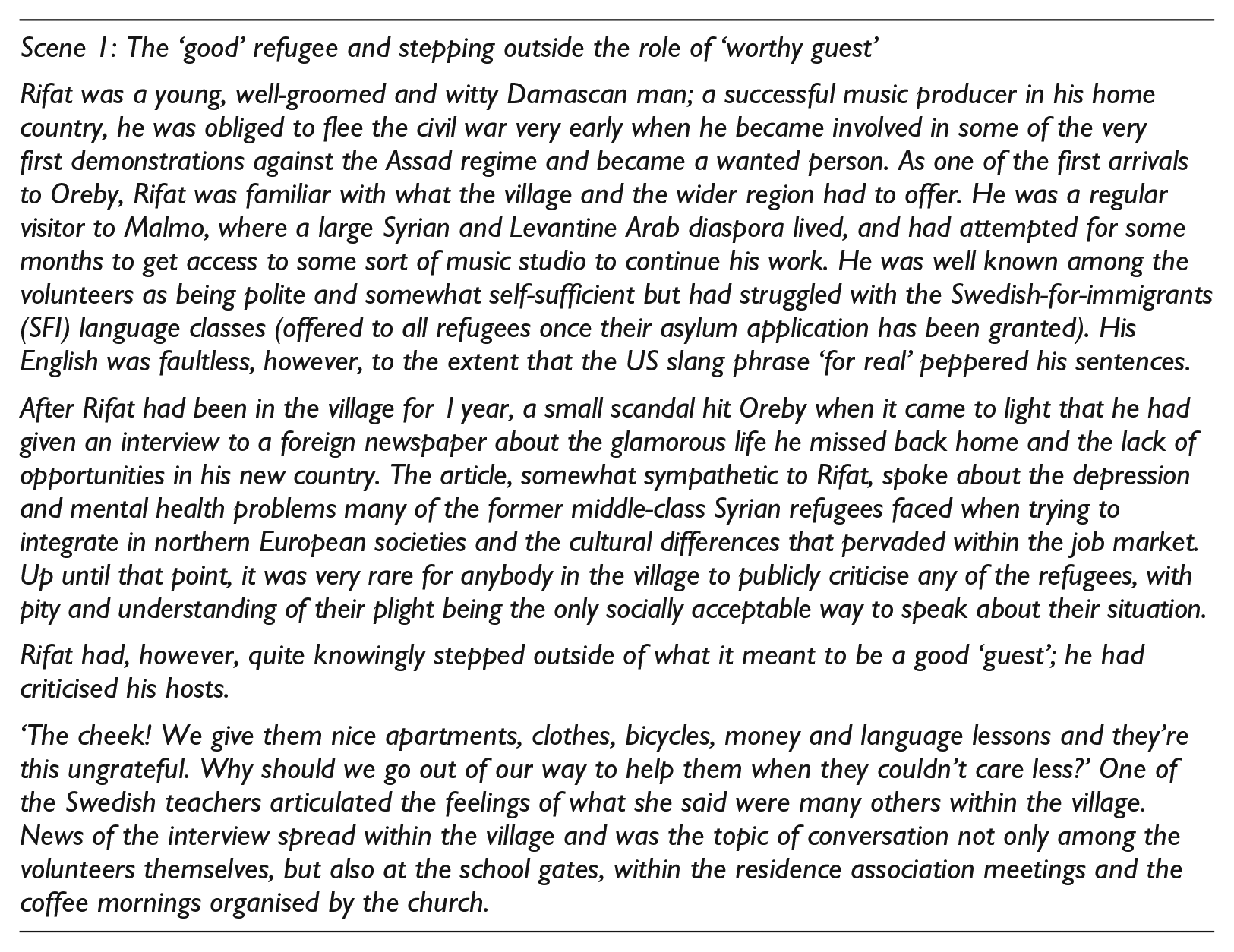
The framing of the refugees as ‘ungrateful’ was thus not directed only at Rifat. He was seen simply as the visible manifestation of what the other refugees were saying in private. Instead, ‘refugees’ as a collective were deemed to be unworthy and undeserving.
In terms of the shifting of limits, Rifat’s story is just one example of the way this logic of security attached itself to a related practice – the rules around hospitality. A tiny, seemingly insignificant act – the telling of one refugee’s story to a foreign newspaper – thus permitted limits to shift and what was previously defined as socially unacceptable to break through. A conditionality had been placed on the right to asylum.
The so-called ‘refugee crisis’ generated some fascinating studies on how ‘civil society’ groups, including humanitarians, scholars and sometimes activists reproduced the European border regime by enacting hierarchies of life between the saviour and the saved (see especially Picozza, 2021). This discussion has been particularly pronounced in the German context, where Merkel’s Wir Schaffen Das policy saw the deployment of an unparalleled number of volunteers (see especially Fleischmann and Steinhilper, 2017; Vandevoordt and Verschraegen, 2019). Although these discussions have been fruitful in pointing to the ways in which the depoliticisation of refugee solidarity – what Fleischmann and Steinhilper (2017) label the ‘myth of apolitical volunteering’ – took place at the same time as the introduction of several pieces of legislation that posed unprecedented restrictions on the right to claim asylum in Germany, the possibility of a correlation is only tentatively explored. Furthermore, humanitarian practices are seen as a separate phenomenon to the rise in anti-migrant sentiment, with ‘good’ civil society still neatly delimited from ‘bad’ civil society.
Consequently, a more relational and dynamic analysis that is able to consider the transformation from one type of political actor to another is crucial. In the Swedish story, we see the shift from ‘good’ to ‘bad’, welcoming to exclusionary, as a continuation of the hierarchisation of lives brought into being through humanitarian logics, in addition to being a consequence of the EU’s failure of solidarity among its member states.
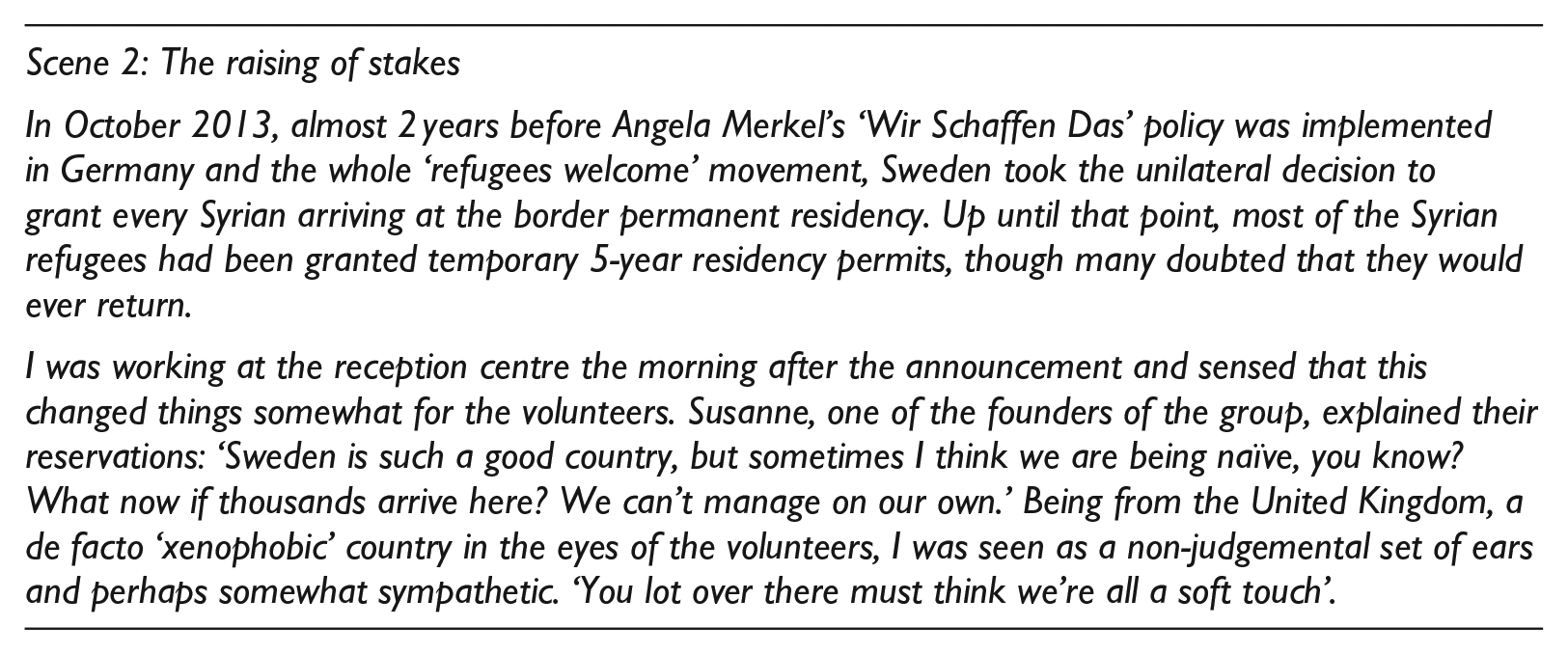
The move to grant permanent residency to the Syrians was defined by then minister for migration Tobias Billström as being one of rationalism and legal obligations. If other EU member states were not living up to their legal responsibilities, it was not up to Sweden to lower its standards or abandon its commitment to the right of asylum. Nonetheless, in Oreby, the volunteers interpreted this move (and the failure of other EU member states to live up to the standard) as one of generosity, which demanded reciprocation.
Here, it is helpful to unpack ‘solidarity’ a little in relation to both disinterested rationalism (how the decision was framed by the Swedish government), and as a system of reciprocity (how it was interpreted by the people of Oreby). Turning briefly to Bourdieu, for the scholar’s early fieldwork in Kabyle, ‘solidarity’ was conceived as emanating from the cycle of gift exchange, a notion of solidarity that he explicitly inherited from both Mauss and Levi-Strauss – the gift as experienced and the gift as situated in an objective cycle of human reciprocity (see especially Bourdieu, 2000a). This play between the lived truth of the gift (generosity) and the objective truth (the expectation of counter-gift) led Bourdieu to root his theory of practice in this ‘double truth’ of the gift.
‘The gift is expressed in the language of obligation. It is obligatory, it creates obligations, it obliges; it sets up a legitimate domination’ (Bourdieu, 2000a: 198). At the same time, Bourdieu (2000a) reminds us that the gift is experienced as a gratuitous and generous, as there is always the possibility that it will not be paid back.
The scholar’s (Bourdieu, 1977: 5) intervention into this debate was to famously root this ‘double truth’ of the gift in the interval or lag between the giving of the gift and counter-gift – an element of temporality or ‘lived time’, which I go on to discuss in the second half of the article. Later in his life, however, and with his increasing disenchantment with the expansion of neo-liberalism, Bourdieu also became interested in questions around how best to foster the conditions that lead to the civic virtues of disinterestedness. In Pascalian Meditations, he wonders about The purely speculative and typical scholastic question of whether generosity and disinterestedness are possible should give way to the political question of the means that have to be implemented in order to create universes in which, as in the economies, agents and groups would have an interest in disinterestedness and generosity. (Bourdieu, 2000a: 201–202, emphasis my own)
This double truth of the gift animates the Swedish story – the shift from disinterestedness, that is, ‘solidarity’ as ‘rational’ and ‘legalistic’, to solidarity as the expectation of reciprocity. Bourdieu’s typical scholastic question around the ‘social conditions for virtue’ (Bourdieu, 2000a: 201) is palpable and concrete, as the volunteers (and villagers more generally) perceive the social conditions to have changed.
In his essay on the gift, Mauss (2002: 31–37) speaks about changing stakes in specific systems of gift exchange, when a competitive approach to gift-giving demands greater reciprocity. It is helpful to think about this agonistic understanding of gift-giving in relation to the shift in the Swedish story. At play in Oreby is what could be called a type of changing of stakes – a break in the social conditions for virtue. Perceptions that, with this decision taken by the Swedish government, something tangible had now changed. Although for many of the villagers, and indeed the volunteers, this move by the Swedish government was largely unrelated to the day-to-day goings on in Oreby (once the Syrians had been granted asylum, they were technically supposed to have been placed into alternative accommodation under the care of a separate government agency), this changing of the stakes permitted different demands to be placed on the refugees in terms of repaying the symbolic debt.
How did this move contribute towards the shifting of the limits of (in)security deeper into everyday life? The changing of the stakes made way for a small chink – a slight shifting in the norms of acceptable behaviour. The right to asylum was placed into a new relation and the move to grant permanent residency was instead seen as ‘generous’. New demands could be legitimately placed on the refugees to adhere to a certain standard and the rules on what it was to be a worthy guest, more vigorously enforced. At play was a crystallisation; the volunteers, as well as others in the village, became more certain of the ‘rightness’ of the demands they placed on the refugees – the need to be stoic, the need to mend their ways and more forcefully integrate into the Swedish way of life, the need to demonstrate gratitude towards the ‘host country’. A space for hierarchisation of refugees was also created from the mobilisation of this gift economy; those who were deemed to adhere to this set of behaviours were branded more worthy of the ‘gift’ of asylum than those who stepped outside.
Let us now go back to the instrumentarium of Bourdieu, to draw out how the ‘thinking tools’ (Leander, 2008) of habitus and sociological reflexivity can be of use of thinking about the transformation from a politics of welcoming to a politics of exclusion, and the normalisation of far-right sentiment more broadly. Through orienting analysis on habitus, more specifically the ethnographic grounding of habitus (Blommaert, 2005), a particular type of ethnography is being engaged with. Somewhat distinct from the more narrative-based and autoethnographic accounts familiar to feminist IR and security studies literature, directing enquiry into ethnographic grounding of habitus allows temporality, specifically the notion of ‘lived time’ to be central to the conceptualising of a situated, performed subjectivity. The move from ‘welcoming’ to ‘exclusionary’ politics and the normalisation of xenophobia more broadly can be pictured and objectivised in its making.
Grounding the ‘far-right’ habitus: lived time and xenophobia in-the-making
Ethnographic research formed the backbone of Bourdieu’s research throughout his career, from his early work with the Kabyle in Algeria, through to his later research on the working classes in urban France, the French academic and educational systems, and the farming communities of his native Bearn. Consistently throughout this work, Bourdieu explicitly maintained that attention to the microscopic details of human activity – and the sense of situated, lived experience – forms the basis to his subsequent theorising. From this point of departure, Bourdieu is able to build up to particular ecologies, multiple layers and more generalisable patterns of behaviour that comprise everyday life-worlds.
The essence of this temporal dimension to the ethnographic grounding of habitus can be seen most prominently in Bourdieu’s (2000b) work on Making the economic habitus where he revisits some of his early fieldwork in Algeria. Studying the transformation in this rural society from a system based around a ‘niya’ or a gift economy to that of what Bourdieu (2000b: 8) labels a ‘shopkeeper’ economy enabled him to comprehend not a form of ‘adaption’, but instead more of a ‘conversion’. This new economy of wage labour, he noted, formed a clear break from the relations of solidarity, which were characteristic of the old system.
Here, Bourdieu the ethnographer enables us to comprehend the nature of habitus as a ‘sediment of structure in agency’ (Blommaert, 2005: 222) – in a way which is specifically grounded in this particular historical context. Habitus as rooted in particular temporal and historical conditions, as opposed to an ageless or static framing, allows for the habitus to evolve. This ‘transformation in social and mental structures’ (Bourdieu, 2000b: 12) is rooted in rich, situated empirical vignettes of the tension inherent in these ruptures – older informants in Kabyle, for example, being horrified at the codification of shopkeeping as a metier or occupation (‘one puts two boxes of sugar and three packets of coffee on a shelf and [now] calls himself a grocer!)’ (Bourdieu, 2000b: 22). Bourdieu admits being terribly destabilised by being confronted by this understanding of the economy, such a taken-for-granted arrangement – as a ‘system of embodied beliefs’ (Bourdieu, 2000b: 8).
The ethnographic grounding of habitus is also wonderfully palpable in Bourdieu’s work in the Bearn. A particularly frank and gritty interview with an elderly farmer in A life lost demonstrates the slow death of farming as a sustainable livelihood with the continual neo-liberalisation of farming practices – through one father’s reflection of his son rejecting his inheritance of the family farm (Bourdieu et al., 1999). In this sense, the misery of the father’s situation is expressed in generic terms (‘the land is finished’), a logic perfectly captured by Bourdieu’s assertion that [T]he most impersonal is so appropriate to express the most personal only because most personal is often, as it is here, the most impersonal. (Bourdieu et al., 1999: 236)
When going back to our case at hand, the normalisation of xenophobic and far-right politics around a Swedish refugee facility, it becomes clear that the transformation from ‘welcoming’ to ‘exclusionary’ logics is contingent on the transformations in situated subjectivity brought about by Sweden’s unilateral offer to grant permanent residence to every Syrian arriving at the border.
If we think of ‘habitus’ as ethnographically grounded, as with Bourdieu’s approach, we are able to build upwards and outwards from this seemingly ‘personal’ or intimate encounter. As with Bourdieu’s reflections from Kabyle, whereby a transformation from gift to market economy took place, in the Swedish story, the logics of more exclusionary practices can also be seen to be a ‘transformation in social and mental structures’ from a more rationalist, ‘solidarity’ understanding of the right to asylum to that of asylum (now permanent) as a ‘gift’ and within a logic of generosity. Wacquant (2014: 121), in pushing this notion of habitus to answer superficial critics that the concept is deterministic or leads only to reproduction, points out how habitus can produce practices that are ‘different, even opposite . . . depending on the solicitations, and possibilities of the social space it encounters’. We can see in the Swedish case the way in which we have a shift from a rational, rights-based frame towards the Syrian asylum-seekers to that of asylum as a ‘gift’, from solidarity (in the rational sense) to xenophobia (‘You lot must think we’re all a soft touch in Sweden’).
Nancy Munn (1992) in her excellent analysis of Bourdieu’s approach to a cultural anthropology of time has also fleshed out this notion of agent-centred time in an empirically grounded framework around ideas of ‘the gift’ – her move from temporality to ‘temporalization’ to emphasise the dynamic nature of how individuals, in their relations, conceive of time. For Munn, it is ‘the conscious and tacit embodied experience of time is the product of concrete, temporalising practices whereby the inherent temporal character of social life is brought out’. It is thus worth quoting her in some length here: ‘[T]emporalization’ . . . views time as a symbolic process continually being produced in everyday practices. People are ‘in’ a sociocultural time of multiple dimensions (sequencing, timing, past-present-future relations, etc) that they are forming in their ‘projects’. In any given instance, particular temporal dimensions may be foci of attention or only tacitly known. Either way, these dimensions are lived or apprehended concretely via the various meaningful connectivities among persons, objects, and space continually being made in and through the everyday world. (Munn, 1992: 117)
One can easily make sense of this idea in relations to how agents, through their everyday lives, think of the past. For Munn, the temporalisation of the lived present always takes place through shared perceptions of the past, which are continuously permeating the way in which people operate in the ‘now’. This is also true for future orientations and expectations, with a myriad of imagined possible futures entailed in the present moment.
In the example of the normalisation of ‘far-right’ sentiment in Sweden, the expansion of exclusionary politics and subsequent attraction to voting for a far-right party was made possible by the change in agents’ intersubjective understanding of national myths that informed a temporal understanding of what it meant in the present to be part of ‘good’ civil society. The actors formed ‘meaningful connectivites’ based on shared understandings of their nation’s past as a beacon of openness and protection for people fleeing war. This understanding informed the way people went about their everyday life – their interactions with neighbours and friends, what could and could not be said about migration and refugee policy.
A failure of any collective action at the EU level, and interpretations of solidarity as ‘burden sharing’, however, quickly brought into play a logic of asylum as a ‘gift’, with obligations of a ‘counter-gift’ and rules of the game, enabling a transformation of the logics of practice – from welcoming to exclusionary. With the passage of time and exclusionary or xenophobic politics becoming more widespread in everyday life, this same shared understanding of the past began to be read differently, charged with the particularities of the present ‘now’. Collective framings of the past were viewed more cynically – the idea of Sweden as a ‘soft touch’ or sharing too much of the refugee ‘burden’. Perceptions of the future, which infused the now, were more catastrophic, ridden with greater angst and unease, particularly at the expense of other European member states, which had much more restrictive and unwelcoming policies towards asylum at this point. Here was a change from ‘good to ‘bad’ civil society, the emergence of a security logic where it perhaps had not originally been, the way in which agents think of and conceive of a collective past, present and future became ways that demand reciprocity and hence legitimise exclusion.
As discussed above, Bourdieu, in his ethnographies, conceived of such transformations as a process of culture contact that broke the ‘fit between the subjective structures and the objective structures’ and thus enable the condition of possibility for agents to question the taken-for-granted everyday order (Bourdieu, 1977; Bourdieu and Sayad, 1964). The habitus is thus a great source of creativity when it is composed of these incongruent dispositions in tension with each other (Wacquant, 2014: 121). Bourdieu (2018) himself best demonstrated this creative element in the case of Édouard Manet’s ‘symbolic revolution’ in painting, revealing that such a revolution is inextricable from the situational context that enables fields of cultural production to emerge.
If we go back to thinking of security as a limit-making practice, a practice that is shifting further into everyday life, an ethnographic grounding of ‘far-right’ habitus that pays attention to temporal situatedness, evolution and flux can inform discussions within Critical Security Studies and IR that conceive temporality as fleeting and emergent (see especially Huysmans and Guillaume, 2019). This framework moves away from counting everyday politics as merely ‘an institutionalised reproduction of a fixed order of politics’ and invests temporality with a logic of invention (De Certeau, 1984). Beginning with an agent-centred approach to time, it is not politics per se, but (in)security understood as a practice of setting limits, which we invest with emergence. What is being created is not politics, broadly defined, but ‘a scene of (in)security’ (Bigo, 2014), a normalisation of (in)security logics, a shifting of (in)security into everyday life. This is something necessarily creative and inventive, however, cannot be read only through the fleeting or ‘ephemeral’ (Huysmans and Guillaume, 2019). Instead, creativity, as with Bourdieu’s reading of Manet, is invested in the capacity for each agent to view differently what was once common-sensical, allowing something new to emerge. This ethnographic grounding of habitus also removes the ‘whiff of optimism’ that theories of emergence are often saddled with (Hom, 2018). The type of politics which comes into being is not necessarily more inclusive or democratic; things can always get worse – a return to ‘legitimate domination’ in Bourdieu’s (2000a) words.
Centring reflexivity as a collective enterprise: lessons from LE
Both Hugh Gusterson (2017) and Rob Walker et al. (2018) were astute in arguing early on that any analysis of the rise of xenophobic politics needs to take into account our own positions as academics within these sets of practices and processes. Anti-intellectualism or anti-sociologism more specifically is inherently intertwined with the rise of xenophobia – Brexiteer’s disdain for ‘experts’ in the UK debate or French prime minister’s dismissal of the ‘culture of the excuse’ (Fassin, 2017). Here, a second (and related) feature of mobilising ‘Bourdieu the ethnographer’ to engage with the ethnographic grounding of (‘xenophobic’ or ‘far right’) habitus is useful, namely, Bourdieu’s particular take on reflexivity to think about the effects of the researcher’s situatedness in knowledge production. This is especially pertinent when studying a so-called ‘far-right’ habitus as a reflexive scholarly stance further guards against essentialising or reifying our interlocutors as ‘extremists’, belonging to a specific ideologically driven group and so forth. As I have stated, this static analysis can have serious depoliticising effects, placing the problem of the rise of xenophobic and exclusionary politics as ‘over there’ and nothing to do with ‘us’, limiting academic research on the subject to denunciation and deploring (see Jeandesboz, 2018 for a similar argument relating to EU-funded security research). In my ethnographic fieldwork, I have shown how xenophobic politics came to be owned by people who, like Susanne in the vignette above, considered themselves far from SD’s ‘base’ through an evolution in habitus from ‘welcoming’ to ‘exclusionary’. As a foreign researcher immersed in these entanglements, I was trusted by Susanne to empathise with her predicament and her desire to stop further refugees arriving.
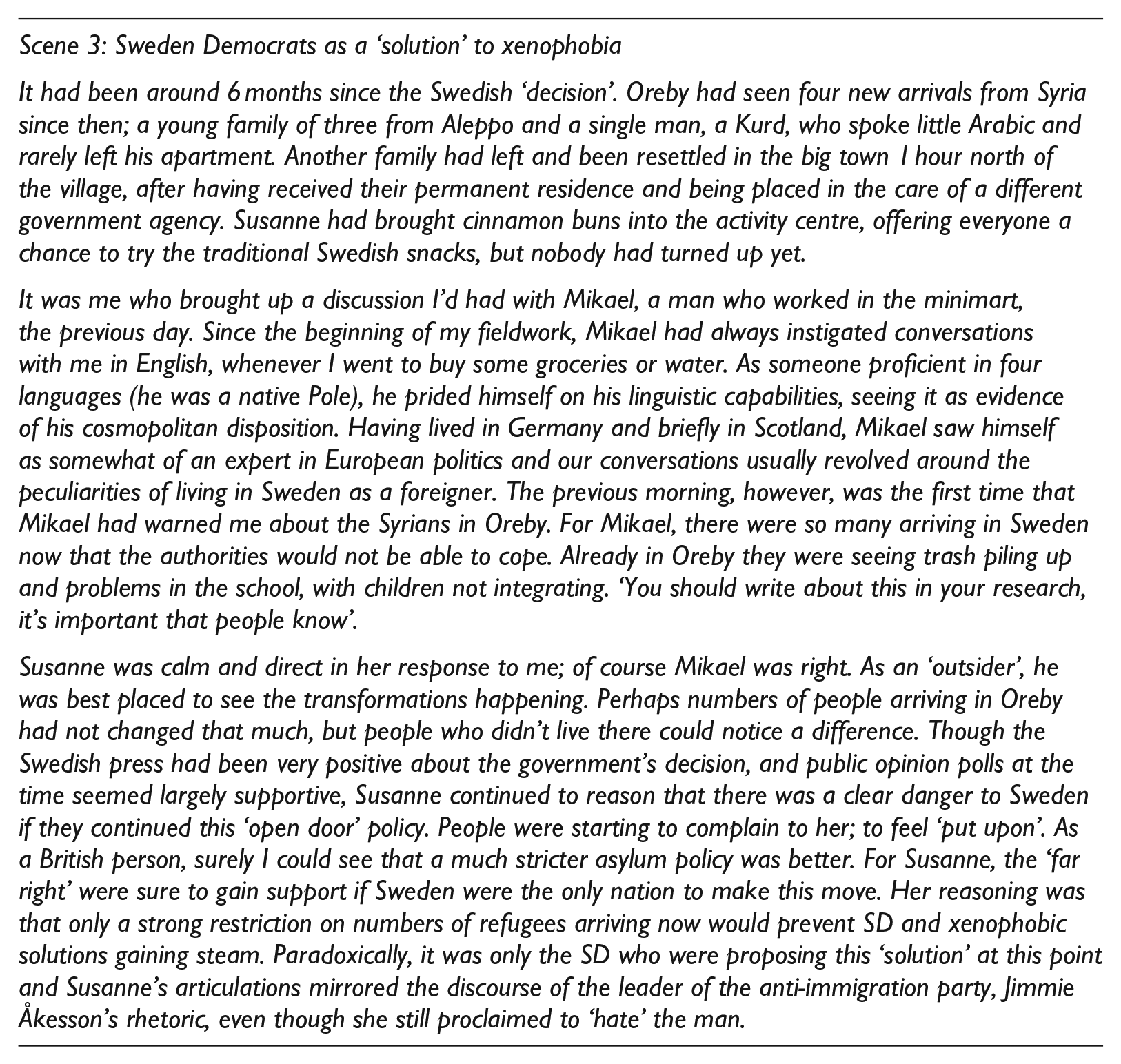
A helpful point of departure to think about the effects of our own situatedness in knowledge is to return once again to Bourdieu’s own reflections on his ethnographic research in the Kabyle. As fellow sociologist and collaborator Remi Lenoir (2006: 4) remarked, ‘What does it mean to observe?’ was a question that Bourdieu continually asked himself throughout his career. Some background context is necessary here, however. Important to remember is that Bourdieu had approached his early fieldwork from a Levi-Straussian tradition of anthropology that separated ‘ethnography’ as method, from the supposedly more scientific and rigorous ‘ethnology’. The latter, in the Levi-Straussian vein, sought to find objectivity through distance from the field and the search for some sort of transcendental and mechanical social structures. Bourdieu’s (2000b) own experiences in the field, however, led him to reject this presumption as ‘methodologically provoked anamnesis’ (p. 24). This is evident in the long preface to The Logic of Practice, where Bourdieu contends that his entry into the field and the framing of his research could never be separated from his identity as a French native entering Algeria in the immediate aftermath of a traumatic war of liberation against colonial rule. In a later article on Colonialism and Ethnography, Bourdieu (2003) reflects at length about the performative effects of an interview conducted by a ‘native’ Kabyle as opposed to a French scholar, after being scolded by an informant for having his ‘ideas already formed’. This move away from ethnology to what Bourdieu labelled a ‘reflexive sociology’ was also more forcefully articulated in his work on The Scholastic Point of View whereby he wholeheartedly rejected the model of (Levi-Straussian) anthropology: ‘The fundamental anthropological fallacy consists of injecting meta – into practices . . . Where Levi-Strauss sees an algebra, we must see a symbolic economy’ (Bourdieu, 1990b: 383).
Bourdieu et al. (1999) unpack their own unique approach to reflexive sociology by speaking about a ‘reflex reflexivity’ – a means to render scientific the social effects exercised within research relations. The scholars expand on this in the final chapter of The Weight of the World: Only the reflexivity synonymous with method, but a reflex reflexivity based on a craft, on a sociological ‘feel’ or ‘eye’, perceive and monitor on the spot, as the interview is actually taking place, the effects of the social structure within which it is occurring. (Bourdieu et al. 1999: 608)
Also illuminating are Bourdieu’s (2003) long reflections on conducting fieldwork in Algeria, where he spoke about the ways in which his research team dealt with the performative effects of their speech, appearance, framing of questions on the interviewee – concluding that ‘the best’ permutation was an Algerian and a French scholar conducting an interview together.
Fashioning reflexive scholarly practice as a fundamental epistemological component of sociological enquiry, one that lends itself therefore to a practical systemisation, prevents reflexivity becoming an exercise in self-flagellation (Wacquant, 1989) or a vague ‘ethical’ issue (see Hamati-Ataya, 2011 for this critique of understandings of reflexivity in IR). Reflexive sociology instead recognises the contingency and openness of the ethnographic encounter and our place within it and objectivises it – a move Wacquant (2004) has articulated as a move from ‘participant observation’ to ‘participant objectification’.
Within International Political Sociology (IPS), scholars such as Leander, Bigo and Madsen have been successful in reframing scripts of ‘the international’ through reflexive sociology. For Madsen (2011), a Bourdieusian reflexivity is primarily a means to think relationally about the ‘object’ (in his case international human rights), with a focus on regimes of historicity. Somewhat more against the grain and avoiding this slip to a more ontological understanding of reflexivity, Leander (2002, 2011) is pioneering in re-centring a more ethnographic mobilisation of Bourdieu within IR, against a (superficially) structuralist reading. In dialogue with broader ethnographic interventions into Critical Security Studies (CSS), Leander (2016) makes a strong argument for viewing reflexivity as ‘strong objectivity’. Likewise, Bigo (2011, 2016) grounds a reflexive approach to IPS in the heavy, empirical work of fieldwork and inductive reasoning, taking inspiration from Lahire and Boltanski to argue for a somewhat more flexible and plural understanding of habitus.
In line with Leander and Bigo, my final intervention builds on this more flexible, empirically grounded reading of Bourdieusian reflexivity, however, injects this with the systematic way in which this type of reflexivity is practised within the neighbouring disciplinary space of LE. Here, I turn back to an often overlooked (in IR at least) element of the way in which Bourdieu carried out research – that of the collective. In the final lectures before his death at the college de France, Bourdieu (2004: 91) revisited reflexivity in relation to the collective, stating that ‘reflexivity is not something done by one person alone and that it can exert its full effect only if it is incumbent upon all the agents engaged in the field’. Reflexive practice, therefore, denotes working against the self, collectively to deconstruct each other’s assumptions and points of view.
So how can we think about this empirically grounded notion of a ‘reflex reflexivity’ in relation to the collective? Before I continue, a few caveats are necessary. Understanding what our knowledge excludes and performs politically has of course been the topic of a lively and important discussion in Critical IR. Relationality in knowledge production is not an issue, which can be resolved through one specific approach alone. Narrative analysis, in centring the embodied and the affective, has also done significant work in highlighting the relational and ethical aspects of doing fieldwork, showing how discomfort, dissonance and unease can itself be informative (see especially Åhäll, 2019; Chisholm and Ketola, 2020; Closs Stephens, 2022; Poopuu and Van den Berg, 2021). Central in these accounts is an understanding that many entanglements and interactions with others remain opaque to us, or beyond our grasp (Klein Schaarsberg, 2021; Kurowska, 2020; Pin-Fat, 2019). Important work that grounds reflexive scholarly engagement in concrete empirical struggles (Lorenzini and Tazzioli, 2020) or even as actively engaged in the praxis of ‘material, aesthetic and technological making’ which intervenes in and reshapes the contours of the socio-political (Austin and Leander, 2021; emphasis added) has also wrestled with this problem of situatedness, complicity and ethics in ‘doing’ fieldwork.
My (modest) incursion into this terrain is not intended to serve as a manual for reflexive scholarly practice, but instead aims to debunk the imaginary of a ‘reflex reflexivity’ in the Bourdieusian sense as necessarily involving transcendence of one’s entanglements in order to be able to objectivise one’s own subjectivity (Knafo, 2016; Kurowska, 2020). My hope is that the treatment of narratives and ethnographic encounters by Bourdieusian-inflected LE could be of interest to narrativists or activist scholars, as opposed to being seen as a lonely, bureaucratic exercise to be dreaded (cf. Dauphinee, 2015).
This article takes inspiration from the late Belgian linguistic ethnographer, Jan Blommaert, who pioneered research into the ethnographic grounding of habitus, using the types of collective, practical reflexive agenda that I have spoken about. Many studies within this disciplinary space can offer a great deal to this debate on reflexivity and have already enriched Critical IR in fascinating ways (Charalambous et al., 2015, 2018, 2021). Taking the cue from Bourdieu et al.’s (1999: 617) bid that ‘true submission to the data requires an act of construction based on practical mastery of the social logic by which these data are constructed’, this practical mastery is not determined by the judgement of the (singular) researcher. Instead, any analysis of ‘the ethnographic encounter’ is always carried out collectively; data sessions often involve over a dozen scholars from varying backgrounds, fields and trajectories – studying a short, ethnographic (recorded) encounter for several hours. Analysis involves some kind of agreement on intersubjective meanings, there is never a perfect interpretation, but some interpretations are more plausible and defensible than others (see Mc Cluskey et al., 2021; Rampton et al., 2015: 45).
A reflexive analysis in this sense points to the process through which one can attune to the exact activations of particular situated subjectivities as they play out in moment-to-moment interactions. Having other people draw attention to your awkward laugh, interruptions and silences in specific encounters with interlocutors, though uncomfortable and time-consuming, offers a more tenable interpretation of the effects of the researcher’s situatedness in the data than the researcher’s own introspection alone. Through negotiating these intersubjective understandings, researchers can tap into the ecosystems in which specific encounters are situated. The discipline then provides us with interesting and useful tools to ‘scale up’ and build outwards from the analysed encounter to ‘ground’ the habitus (Jacquemet, 2011: 475). Drawing on a rich set of conceptual instruments, large-scale sociological effects – such as the normalisation of xenophobic and far-right ideas within Western societies – can be understood from very ‘micro’ encounters. 3
Surrendering control of interpretation to a scholarly collective naturally faces limits, and admittedly constrains the thought which is made possible to those of a similar ‘scholastic disposition’ (Bourdieu, 2000a: 49). In their own work, linguistic ethnographers have given this careful consideration, acknowledging the tendency to act as a ‘poet’, privileging their own ways of knowing, and tempering this through working collaboratively with stakeholders and research subjects such as teachers and general practitioners (GPs), where possible, using interactional data analysis as a starting point for reflection in professional development work, for example (Rampton et al., 2015; Lefstein and Snell, 2011; Rampton and Charalambous, 2016).
Instead of seeing a strict demarcation between narrative and reflexive sociological approaches to reflexivity then, as is the case in IR, LE shows us that there is instead always ‘open movement between theoretical, descriptive and interventionist work’ (Rampton et al., 2015: 21). As with a narrativist stance, Bourdieusian LE embraces the ‘mess’ of human encounters, and locates meanings in the responses triggered (see, e.g. both Kurowska, 2020 and Leppänen et al., 2021). For Blommaert et al., however, this mess need not be appraised merely as fragmentary or inconsistent. Mess can indeed lend itself to systematisation, at least to some extent, as every synchronic social act is seen as a container of a process of ‘genesis, development, transformation’ (Blommaert and Rampton, 2011: 37).
Of course, when one is conducting ethnographic fieldwork, recording encounters is not always possible or desirable. However, the premise of opening up fieldnotes and diaries to a more systemised scrutiny by colleagues and peers is a premise that still stands. Fassin (2015) has pointed to this in his ‘public afterlife’ of ethnography, whereby encounters with various ‘publics’, and the various misunderstandings and alternative interpretations this produces, are as much a part of the anthropological venture as is conducting fieldwork. In this sense, ethnography is not simply a method, but can certainly also be an ethos, as explicitly called for within political anthropology, which calls for a specific politicised reflexivity.
Only through understanding reflexive scholarly practice as a collective enterprise, through sharing my data, opening it to other people’s interpretations and intersubjective understandings, could I think more rigorously about what exactly was being enacted and excluded in how I told the story of Oreby. In a similar vein, spontaneous and unplanned responses towards and rearticulations of one’s ‘data’, what Lee-Ann Fujii (2015) called the ‘accidental moments’, can also prove instructive. Indeed, being personally insulted by a fellow (Swedish, more senior) academic while presenting my research at an international conference revealed far more about my assumptions, disciplinary baggage and what was at stake with my research – than introspection ever could.
Conclusion
This article has argued for reclaiming ‘Bourdieu the Ethnographer’ in IR and CSS to shed light on the normalisation of xenophobic and ‘far-right’ politics. Inspired by the way in which Bourdieu’s anthropological inflection is put to work in the disciplinary space of LE, the article seeks to engage with the ethnographic grounding of a ‘far-right’ habitus.
Instead of conceiving of far-right voters as a pre-constituted or ready-made group, an ethnographic grounding of habitus allows for the centring of temporality and temporalisation, allowing ‘far-right’ to be conceived relationally. In this way, the normalisation of far-right politics can be studied through engaging with lived (in)security as an everyday limit-making practice, whereby solutions offered by ‘far-right’ become the only acceptable ones to suppress this insecurity.
To that end, the article has made two theoretical contributions. Anchoring an ethnographic grounding of habitus in Bourdieu’s reflections on his rich body of fieldwork throughout his career, we can orient analysis towards the notion of ‘lived time’ as central conceptualising of a situated, performed subjectivity. The move from ‘welcoming’ to ‘exclusionary’ politics and the normalisation of xenophobia more broadly can thus be pictured and objectivised in its making. Here, (in)security and xenophobia can therefore be seen as emergent and becoming.
Second, the article takes seriously Bourdieu’s claim that ‘reflexivity is not something done by one person alone’, and once again reaches both simultaneously into LE and Bourdieu’s own discussions on reflexive sociology to enrich discussions on the effect on our own situatedness as researchers in the production of knowledge in international politics. This intervention into the reflexivity debate is neither intended to serve as a manual nor pose a ‘solution’ to the difficult issue of grappling with the political and social worlds that our knowledge enacts. However, it does provide an example of how the spirit of collective reflexivity has been practised in a neighbouring discipline, offering the possibility of some interesting cross-fertilisation.
Finally, (re)deploying Bourdieu the ethnographer allows us to remove authors from the boxes they have been placed in and reflect anew upon how certain scholars are applied within the disciplinary space of Critical IR more broadly. The close-up, ethnographic grounding of habitus that I have developed here in relation to the normalisation of far-right politics re-invigorates calls for mobilising Bourdieu’s work in a more anthropological vein in IR and will hopefully re-open discussions that seek to engage Bourdieu the ethnographer in much more open and against-the-grain ways.
Footnotes
Author Note
This title is inspired by an article of a very similar name by the late Belgian sociolinguist, Jan Blommaert, entitled Bourdieu the Ethnographer The Ethnographic Grounding of Habitus and Voice. Blommaert (in addition to the work of Loïc Wacquant) was responsible for pioneering a reading of Bourdieu that grounds habitus in situational social inquiry.
Declaration of conflicting interests
The author(s) declared no potential conflicts of interest with respect to the research, authorship and/or publication of this article.
Funding
The author(s) disclosed receipt of the following financial support for the research, authorship, and/or publication of this article: This study received financial support for the research which contributed to this article from The Economic and Social Research Council of the United Kingdom (grant number es/i017992/1).
