




Abstract
This article makes the case for integrating informal, social and minilateral dynamics in analyses of ‘differentiated integration’ in the European Union (EU) context. In EU studies, differentiated integration has mainly served as an analytical lens for studying variation in states’ degree of formalized commitment to the European integration project or in organizational decision-making procedures across policy areas. While this focus has generated important analytical and empirical insights, three dimensions tend to be lost when limiting the study of differentiated integration to negotiated outcomes manifest in legal documents and decision-making procedures. First, informal processes of integration precede and concur with formal ones. Second, European integration is an inherently social process, and member states integrate with the EU identity-building project in different ways and to different degrees. Third, member states enjoy heterogeneous social ties with one another, routinely forming informal bi- and minilateral coalitions in everyday decision-shaping processes. More knowledge about these informal and social dynamics can give us a better understanding of how differentiated integration manifests itself in practice and where the European integration process is heading. The theoretical argument is buttressed by data from the 2020 European Council of Foreign Relations’ ‘Coalition Explorer’ survey, showing how partner preferences within the EU continue to reflect stable social sub-orders.
Introduction
Recent alterations in the European political and security landscape have spurred a new wave of scholarly interest in ‘differentiated integration’ – whether understood as a concept, a theory, a process or a model (Bàtora and Fossum, 2019; Gänzle et al., 2019; Leruth and Lord, 2015) or as a type of practice unfolding ‘in the everyday social negotiation of meaning’ among European experts and practitioners (Svendsen and Adler-Nissen, 2019). This renewed academic interest has dovetailed with intensified debate at the policy level. Faced with the prospects of an increasingly heterogeneous European Union (EU) with an expanded working portfolio, even the European Commission (2017) – the professed ‘engine’ of European integration – has signalled openness to the idea of member states committing to integration at different speeds and to varying degrees. At the heart of both the academic and policy debates stands the question of how increased tolerance for flexible solutions affects not only individual member states’ loyalty to the integration project but also the EU’s effectiveness as a political system and international actor (Pirozzi and Bonomi, 2021).
In EU studies, the term ‘differentiated integration’ has served mainly as an analytical lens for studying formal variation, either in states’ degree of legal commitment to (parts of) the integration project or in organizational decision-making procedures across policy areas (Schimmelfennig et al., 2015; Schimmelfennig and Winzen, 2019; see also Fossum, 2019; Lavenex and Križić, 2019). Such a ‘thin’ analytical conception makes sense in the context of both canon theories on European integration foregrounding how state preferences drive or hamper cooperation and decision-making (Moravcsik, 1998), and theories emphasizing how path-dependent institutional processes over time curb member states’ individual room for manoeuvre (Pierson, 1996). However, in this article, I argue that three important aspects are lost if we confine the study of differentiated integration to negotiated outcomes manifest in legal documents and decision-making procedures. First, formal processes of differentiated integration tend to be preceded by and concur with informal ones (Andersen and Sitter, 2006; Lavenex and Križić, 2019; Rieker, 2021). The many actors involved in shaping EU policies interact informally at different levels, across different sites and policy areas, on a day-to-day basis. If we routinely bracket the informal in analyses of differentiated integration, we lose an important part of the picture as to why and how differentiated outcomes transpire. Second, European integration is an inherently social process involving continuous relational identity-building efforts (Christiansen et al., 1999; Risse, 2018), yet there are important variations in the ways in and degree to which member states invest in and integrate with the larger EU identity-building project (Adler-Nissen, 2014; Börzel, 2002; Hansen and Wæver, 2002). When making the analytical transition from ‘integration’ to ‘differentiated integration’, this dimension is often lost on the way. Finally, member states enjoy heterogeneous social ties with one another within the EU complex and order, and routinely engage in informal sub-groupings articulating both short-term overlapping interests and long-term identity treats. While this insight features prominently in scholarly work on intra-EU negotiations and diplomacy (Christiansen and Neuhold, 2013; Elgström, 2017; Kaeding and Selck, 2005), it has remained largely absent in leading work on differentiated integration in the EU context.
In what follows, I make the case for a ‘thick’ definition of differentiated integration, one which accounts for informal dynamics, for variations in degree of social identification with the EU identity-building project and for heterogeneous bi- and minilateral ties between member states. Doing so, I build on recent work highlighting informal aspects of differentiated integration (Andersen and Sitter, 2006; Lavenex and Križić, 2019; Rieker, 2021) and add insights from work accentuating logics of social differentiation practices (Buzan and Albert, 2010) and work tracing informal coalition patterns in intra-EU diplomacy (Christiansen and Neuhold, 2013; Elgström, 2017; Kaeding and Selck, 2005). I also unpack ‘minilateralism’ – the informal gathering of selected stakeholders to address specific issues – as an analytical sub-category of differentiated integration in the EU context. In the second half of the article, I illustrate my theoretical argument by drawing on data from the European Council of Foreign Relations’ ‘EU Coalition Explorer’ (ECFR, 2020). Ordering individual member states’ partner preferences, policy priorities and views on integration according to sub-regional location, I observe that informal bi- and minilateralist diplomacy is key to understanding the nuts and bolts of differentiated integration in today’s EU.
Informal social differentiation: the tacit choice for Europe?
Since the beginning of the European integration process, European states have had divergent – and often explicitly stated – views and positions as to how far the ambitions for political integration should go. Whereas some states have wished to move faster and commit more profoundly to the integration project, overall or in specific policy areas, others have had reservations or constraints preventing them from (fully) partaking in certain initiatives. When European states split into groups informally known as ‘The Inner Six’ and ‘The Outer Seven’ in the late 1950s – formally the European Economic Community (EEC) and the European Free Trade Agreement (EFTA) – the key dividing line was precisely how far the respective states were willing to go in terms of pooling their resources and transferring authority to a supranational level. By 1973, three of the original EFTA states – Denmark, Ireland, and the United Kingdom – had reconsidered their original choices and left EFTA for the benefit of EEC membership. 1 From now on, policy debates about ‘multi-speed’ integration and a ‘multi-layered’ system, ‘opt-ins’, ‘opt-outs’, ‘variable geometry’ and integration ‘à la carte’ accelerated also within the institutional framework of the EEC. Two of the new member states, Denmark and the United Kingdom, soon acquired reputations as reluctant integrationists – generally sceptical of federalist tendencies and with a steadfast ‘Atlanticist first’ security orientation (Adler-Nissen, 2014; George, 1998). In the ensuing decades, the scope and degree of European cooperation expanded multiple times, with new member states, new cooperation areas and new institutional procedures added to the fore. This has (inevitably) made the EU a more heterogeneous club in terms of self-identities, values, preferences and action repertoires. And, it has spurred demands for flexibility in association models as well as in institutional set-ups and policy-making procedures (Lavenex and Križić, 2019).
The scholarly interest in differentiated integration as a negotiated outcome, process and ideal-typical model in the context of the EU has both followed from and paralleled with these real-life developments and expansions. Scholars have sought to shed light on why differentiated integration occurs, how it manifests itself among member states and across different policy areas, and what the short- and long-term implications are for intra-EU dynamics and the EU’s future development as a political system and international power (Bàtora and Fossum, 2019; Rieker, 2021; Schimmelfennig et al., 2015; Schimmelfennig and Winzen, 2019). In the conventional understanding, differentiated integration may refer both to differences in formalized decision-making procedures across EU policy domains (vertical differentiation) and to variations in individual states’ formal degree of participation in EU cooperation in specific policy areas (horizontal differentiation). A further specification along the latter axis can be drawn between internal horizontal differentiation (where EU member states are excepted or self-exclude from collaborative initiatives) and external horizontal differentiation (where non-EU members are formally invited into, or granted access to, the same collaboration structures) (Eriksen, 2018; Rieker, 2021; Schimmelfennig and Winzen, 2019; see also Martill and Sus, 2021). A key question arising in prolongation of these categorizations has been how increased (or reduced) tolerance for flexible and tailor-made association models at the EU level affects individual states’ room for manoeuvring between autonomy and integration – whether they are EU members or associated states like the European Economic Area (EEA) countries, Switzerland, the United Kingdom and Turkey (Haugevik and Rieker, 2017). A complexifying factor is that states’ appetite for ‘opt-outs’, ‘opt-ins’ and tailored solutions tends to vary not only over time and with changes in the international or domestic political context, but also contemporarily across policy issues and between EU and national settings. A state’s reputation as ‘leader’ or ‘laggard’, or as ‘foot-dragger’, ‘pace-setter’ or ‘fence-sitter’ in the EU context (Börzel, 2002), needs neither to be fixed in time nor be consistent across policy domains. For example, while Denmark until 2022 maintained the most extensive formal opt-outs from EU security and defence cooperation, it has been portrayed as a ‘pace-setter’ in the formulation and implementation of EU environmental policy (Bursens, 2002). By a similar token, a member state which comes across as a ‘footdragger’ in the process of policy formulation can be an effective and compliant implementer of EU directives and policies at the other end (see, for example, Andersen and Sitter, 2006; Börzel, 2002). Non-member Norway is perhaps the best example of this idiosyncrasy – its effective implementation of EU laws and directives and alignment with the EU policy beyond the EEA agreement has earned the country a reputation as an ‘adaptive outsider’ (Hillion, 2011; Kux and Sverdrup, 2000).
The canon literature on differentiated integration has generated helpful typologies and models for categorizing and discussing differences in member states’ degree of formal commitment to the whole or parts of the European integration process, in non-members’ formal opt-ins to the same process and in decision-making procedures across policy areas. However, in parallel with the EU becoming a larger and more heterogeneous polity, involving decision-making in different forms and at multiple levels, scholars have called for widening the definition of what both ‘differentiated’ and ‘integration’ may entail. Within EU studies, one strand of scholarship has, for example, advocated a shift in scholarly focus from ‘differentiated integration’ to the more open-ended ‘differentiation’ (Fossum, 2019; Lavenex and Križić, 2019). This conceptual move, it is argued, makes it possible not only to study disintegrative aspects of differentiation but also to observe polity differentiation as part of EU governance structures. As put by Fossum (2019), The study of differentiated integration in the EU conflates EU outputs and EU structure in the sense of paying inadequate attention to polity differentiation, or the macroscopic pattern of territorial-functional differentiation that marks the multilevel EU, in other words the EU with its member states and their regions (including how the member states have put their mark on and control the EU). (Fossum, 2019: 9)
Similarly, Lavenex and Križić (2019) approach differentiation as a mode of governance which is not limited to (but still includes) integration in the form of formalized outputs and structures. To them, relevant objects of analysis include ‘any modality of integration or cooperation that allows states (members and non-members) and sub-state entities to work together in non-homogeneous, flexible ways’ (Lavenex and Križić, 2019: 3). In addition to looking at differentiation in member states and non-members’ degree of legal integration with or beyond existing acquis communautaire, Lavenex and Križić make the case for also looking at the role of sub-state actors and for including a focus on differentiation practices at the organizational level in the form of ‘non-homogeneous participation in the institutional venues where EU-related policies are designed and implemented’ (Lavenex and Križić, 2019: 3).
Other contributions have stuck with the analytical category ‘differentiated integration’ but called for a similar conceptual broadening. For example, drawing on insights from organizational theory, Andersen and Sitter (2006: 39) see differentiated integration as involving also more informal processes ‘of combining or adding parts or elements into a systematic whole’. While their specific concern is with variations in how member states implement EU policies at the national level, their more general call for assuming a wide(r) scholarly approach to differentiated integration is clearly relevant beyond that context. Similarly, Rieker (2021) proposes a multifaceted typology of differentiated integration/disintegration in the foreign and security domain, one which also encompasses informal processes of integration within and beyond the EU27. Starting out from a broad definition of integration as ‘a process or a continuum with full disintegration at the one end and full integration (federation) at the other’, she identifies ‘non-compliance’ with EU legislation, ‘constructive ambiguity’ in policy statements and documents, ad hoc policy opt-ins by non-members and collaborative efforts beyond the EU context as examples of informal differentiation practices (Rieker, 2021: 8–9).
These scholarly contributions are important, as they help open up the analytical space for what differentiated integration may entail and specifically call for incorporating also informal processes and dynamics in the definition. However, what remains subordinate also in these contributions are the core insights from constructivist literature that – first – integration is an inherently social process involving continuous relational identity-building (Christiansen et al., 1999; Risse, 2018), and – second – there is variation in the ways in and degree to which member states commit to, invest in and integrate with the EU identity-building project (Börzel, 2002; Hansen and Wæver, 2002). When making the analytical transition from ‘integration’ to ‘differentiated integration’ or even ‘differentiation’, this insight is often bracketed on the way. Like spokes in a wheel, member states enjoy individualized ties with the EU hub, varying not only in their formal and material scope and content but also in the ways in which they play out informally and socially. A chief task for the analyst is therefore to also identify and compare the differentiated nature of each agent’s degree and type of social integration with the overarching structure. Europeanization is in this sense also a process of social differentiation – with the capacity to generate ‘diversity and contingency’ as well as ‘new cleavages and exclusions’ in the integration process (Trenz, 2013: 213).
This brings us to a third dimension of key relevance in the present context, namely, differentiation in the form of heterogeneity in bi- and minilateral social ties between European states – underneath, beyond and parallel to the EU structure and social order. Adapting work by sociologist Niklas Luhmann (1977) to an International Relations (IR) context, Buzan and Albert (2010: 319) argue that all societies and social orders are ‘characterized by the co-presence of different forms of differentiation’. They further distinguish between three core types of social differentiation, each constitutive of specific – but not necessarily separate – social sub-systems and orders. Segmentary differentiation occurs when a set of ‘social subsystems’ exist within a larger social structure and when each of these subsystems ‘is the equal of, and functionally similar to, every other social subsystem’ (Buzan and Albert, 2010: 318; see also Eriksen, 2018; Bátora and Fossum, 2019). Stratificatory differentiation arises when hierarchical social orders emerge beyond the main structure, where some units ‘raise themselves above others’ by way of ‘coercive capability, access to resources, authority, status’ (Buzan and Albert, 2010: 318). Finally, functional differentiation is the state of play when the units within a system agree on practices of burden-sharing, allowing for specialization and the reduction of unnecessary duplication. The three types of informal, social differentiation will in most cases co-exist within a social system, and so the question is rather which is more dominant in ‘shaping the social structure as a whole’ (Buzan and Albert, 2010: 319). The chief take-away point in the present context is that social orders are likely to involve a mosaic of social sub-systems, each system with its own organizational logic. Differentiated integration can thus be approached also as informal, social processes through which smaller units within a larger polity (dis)connect and (dis)integrate not only with an overarching structure but also with one another. While all member states formally belong to the overarching EU structure and are in principle equally committed to the ambitions and values expressed in treaties and policy documents, they seek, maintain and signal stronger social ties with some states and groups of states within the EU family (Kaeding and Selck, 2005; Elgström, 2017). Such social sub-systems and sub-orders not only reflect or co-exist with vertical and horizontal dimensions of (differentiated) integration, but they arguably also shape, build and restrict the EU as a social system and order more broadly. Following Jackson and Nexon (1999), we may go even further and say that these bi- and minilateral social relations can be conceived of analytically ‘before states’, that is, that ‘instead of agents and structures, configurations themselves become the focus of analysis’ (Jackson and Nexon, 1999: 318). By conceptualizing differentiated integration as informal and social ‘“ties” between entities’ (Jackson and Nexon, 1999: 304), we may acquire a better understanding of the social sub-orders present in today’s EU. The next section expands on the logic of such relational ties, as informal bi- and minilateralist practices inside the EU.
Minilateralism as differentiated integration
While informal, social configurations have been subject to little systematic scrutiny in the rapidly growing scholarly literature on differentiated integration in the EU, there is a relevant – if mostly separate – scholarly literature on the drivers, logic, and implications of bi- and minilateral groupings in international institutions. As an analytical category, ‘minilateralism’ may be broadly defined as informal processes where agreement is reached ‘by a select sub-grouping of a larger multilateral organization or regime’ (Jørgensen, 2011: 1635) or when groups of states join forces ‘to supplement or complement the activities of international organizations in tackling subjects deemed too complicated to be addressed appropriately at the multilateral level’ (Moret, 2016). Varying in rationale, scope, format and intensity, such informal, minilateral coalitions may manifest themselves on an ad hoc or recurring basis and interaction practices may be more or less organized. Consultation and cooperation in smaller ‘clubs’, ‘camps’ and coalitions are well-known in international organizations like North Atlantic Treaty Organization (NATO), the United Nations (UN)/the United Nations Security Council (UNSC), and the World Trade Organization (WTO) (see, for example, Græger and Haugevik, 2009; Karlsrud and Reykers, 2020; Tirkey, 2021). The presence of such configurations is not a new phenomenon in intra-European diplomacy either – it has been an integral part of the EU machinery and existed also before the formal process of European integration began in the 1950s. However, an expanding policy agenda and a larger, more heterogeneous EU have given these practices renewed diplomatic and analytical relevance. Since the early 2000s, scholars have noted a general increase in informal bi- and minilateral interactions on the European diplomatic scene (Christiansen and Neuhold, 2013; Mattelaer, 2019; Smith and Tsatsas, 2002). Many European states openly state their ambition to form and use such informal diplomatic coalitions as part of their foreign policy strategy (Haugevik, 2017). In recent years, there have been recurring media and policy reports about their increased presence in and impact on EU decision-shaping processes (de Gruyter, 2018; FT, 2018; Janning and Zunneberg, 2017).
In prolongation, studies have found that rather than scaling down diplomatic representation in the capitals of fellow member states, EU member states ‘continue to maintain a significant diplomatic focus within the EU’s territory, where most of their overall diplomatic footprint is located’ (Bicchi and Schade, 2021: 3). This suggests that bilateral channels continue to be an important part of the diplomatic strategy of EU member states. Also in Brussels, many member states, and especially smaller ones, have scaled up their permanent representations to leave a stronger imprint on the intra-EU diplomatic scene (Sørensen, 2019). Both in the EU and in the wider European context, informal social differentiation may to some extent be observed through the relative distribution of diplomatic time and resources (Bicchi and Schade, 2021). First, member states prioritize some member states over others in terms of time and diplomatic resources allocated to EU capitals. Second, they routinely seek bi- and minilateral coalitions with selected member states as part of EU decision-shaping processes in Brussels. In either case, the stated rationale is likely to be a sense of ‘likemindedness’, either more generally or in response to a specific situation or development (Elgström, 2017; see also Haugevik, 2017).
On the EU diplomatic scene, recurring informal coalitions typically reflect steady, relative attributes such as small/big and old/new member states (Grabbe, 2004), rough geographical divisions like northern/southern/eastern members (Kaeding and Selck, 2005) and/or sub-regional specifications such as ‘Benelux’, ‘the Baltics’, ‘the Visegrád Group’ and ‘the EU Club Med’ (Kirch, 2021). However, there are also broader, more cross-cutting performance- or reputation-based representations such as ‘integrationists’, ‘laggards’, ‘pragmatists’, ‘Atlanticists’, ‘norm entrepreneurs’, ‘net contributors/beneficiaries’ and ‘frugals’ (see, for example, Börzel, 2002; Grabbe, 2004; Ingebritsen, 2002). Oftentimes, the underlying drivers – history, geographical location, resources, policy priorities and acquired reputations – pull in the same direction. For example, challenges resulting from the 2015 migration crisis were felt more urgently at the EU’s southern borders, whereas escalating tensions between Russia and the West have been felt most urgently in Northeastern Europe. This is reflected in both policy priorities and coalition preferences in those domains. The net contributors to the EU budget have for some time been Germany, France, the United Kingdom and Italy, along with the Netherlands, Austria and the Nordic states. In recent years, some of these states have joined forces in EU budget negotiations (FT, 2018; Kurz et al., 2020; Lövfen et al., 2020). When seeking to understand informal, social differentiation, our analytical starting point could also be these relational dynamics. Where an EU member state or non-member stands on a policy matter, how it assesses its own action repertoire and room for manoeuvre can also be understood in the context of its relational ties with other member states and sense of belonging in social sub-systems and orders. To illustrate: In the Brexit negotiations, the EU27 mostly communicated in public with one voice. However, behind the scenes, member states expressed more differentiated preferences as to the negotiation process and outcome (Oliver, 2016). These differences, it could be argued, reflected not only material self-interests in the negotiation outcome or broader positions on EU integration, but also member states’ individual historical ties with the United Kingdom inside and outside of the EU context (Janning and Zunneberg, 2017).
Informal coalition patterns in EU27 decision-shaping
So far, this article has made the case for a ‘thick’ definition of differentiated integration in the EU context, one which also takes into account informal and social interaction dynamics, and heterogeneous ties between member states. It has further proposed to couple insights from scholarship on differentiated integration, with insights from work on intra-European diplomacy and bi- and minilateral coalition patterns inside and outside of the EU context. On the one hand, shared policy priorities and views on integration may generate strategic coalitions in the EU, as in the case of the ‘frugal’ member states seeking to leave their footprint on the EU budget. On the other hand, stable bi- and minilateralist configurations could also be seen as constitutive of state interests and action repertoires – they represent inner concentric circles where shared identities are formulated, confirmed, challenged and put on display.
In what follows, I offer an empirical illustration to back up this theoretical argument. While processes of informal, social differentiated integration can be difficult to pin down and observe directly as they play out, they can be traced indirectly, including through the accounts of actors involved in or closely observing them. To this end, the section draws on data from the ECFR ‘EU Coalition Explorer’ (ECFR, 2020). Conducted annually since 2015, this survey maps informal coalition-building efforts in the EU through structured interviews with a high number of ‘professionals working on European policy in governments, think-tanks, academia, the media, and elsewhere’ in all the EU’s member states (ECFR, 2020). Based on these interview data, the ECFR researchers have provided rankings of all 27 member states’ partner preferences, as well as their overarching policy priorities, and their preferred procedures for EU decision-making overall and in specific policy areas. In the ECFR’s online explorer tool, data can be sorted alphabetically or according to the relative share of scores given by self and others. The survey data can thus tell us something about which EU member states are most frequently contacted by others and which are seen as the most responsive or influential inside the larger network of states (ECFR, 2020).
In Tables 1–3, I have organized data from the ECFR survey so that partner preferences, policy priorities and preferred decision-making procedures are presented according to geographical and sub-regional location. I begin with the three Nordic states and then move via the Baltic region to the Visegrád states and alongside the EU’s eastern borders. I end with Ireland in Northwestern Europe. In Table 1, each member state’s five most contacted partners are identified with blue marking; the most contacted state is accentuated in dark blue. The colour coding helps display the distinct patterns in which informal, social coalitions manifest themselves on the diplomatic scene inside the EU.
Five most contacted European Union partners.
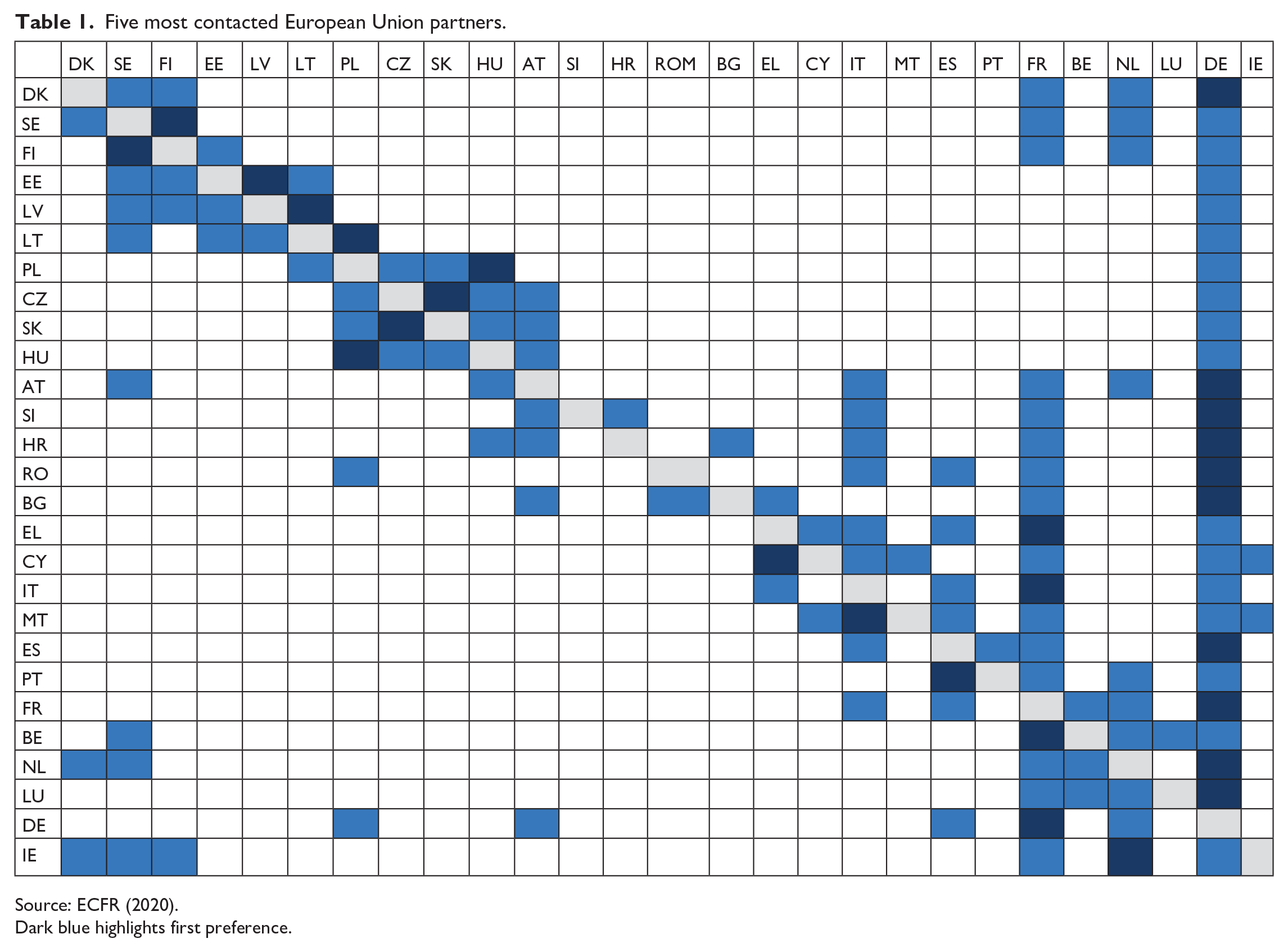
Source: ECFR (2020).
Dark blue highlights first preference.
Top-five policy priorities in the European Union.
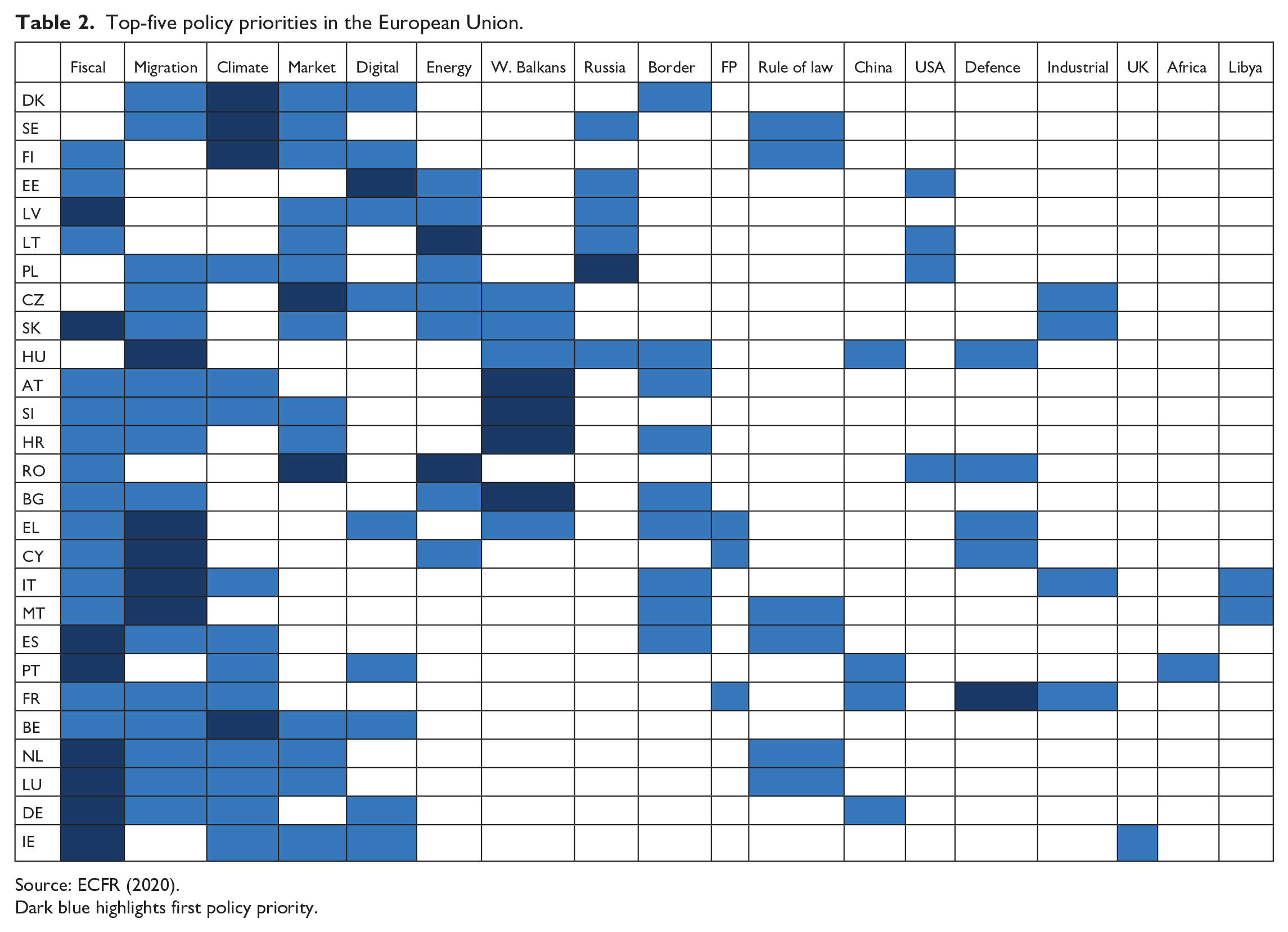
Source: ECFR (2020).
Dark blue highlights first policy priority.
Member states’ general preference for European Union decision-making.
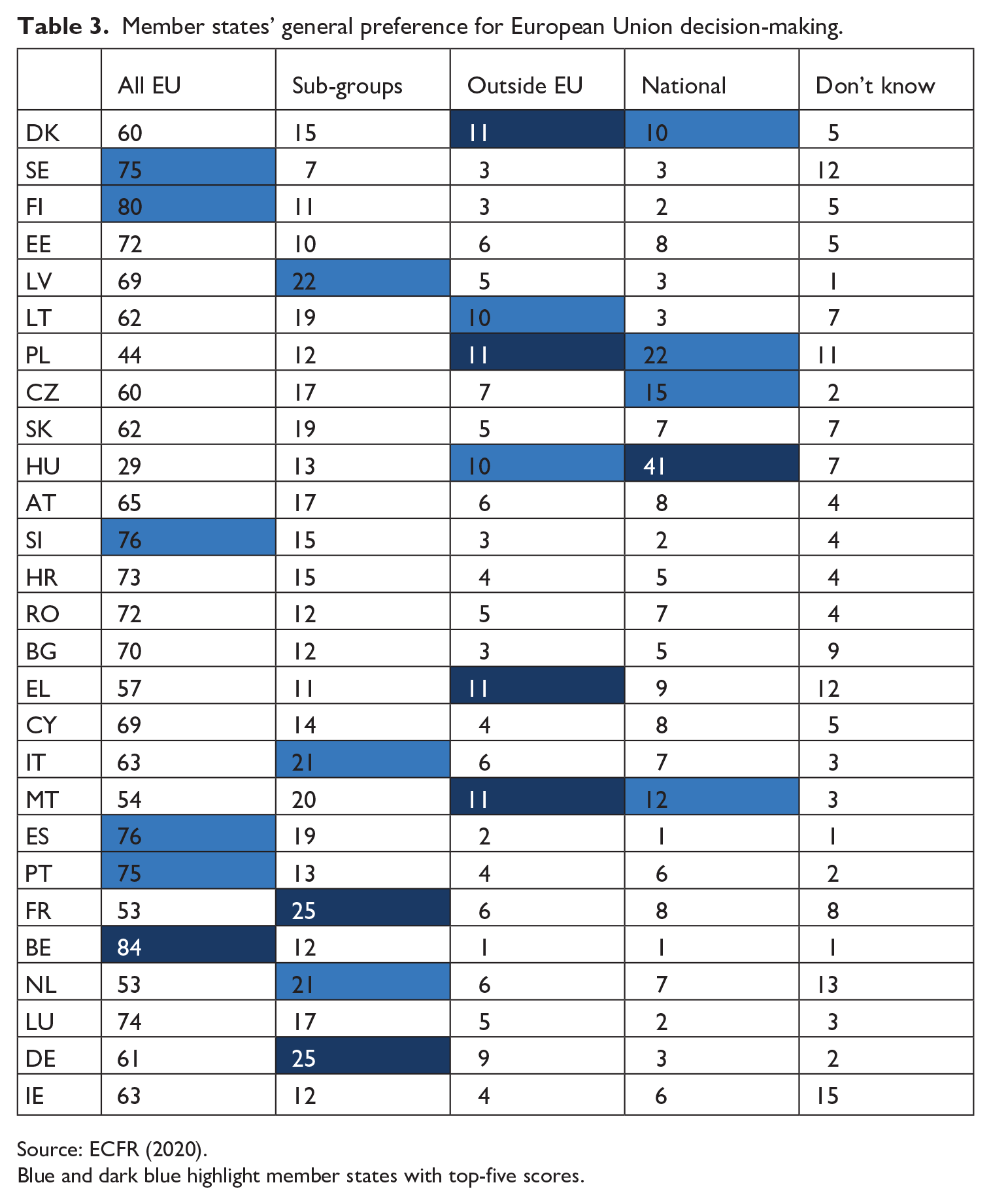
Source: ECFR (2020).
Blue and dark blue highlight member states with top-five scores.
First, and at the most general level, the ECFR data suggest that relative size continues to matter in terms of how and where diplomatic resources are invested. When respondents were asked to identify their state’s most contacted partners in the EU, Germany featured on the top-five list of all the remaining 26 member states. As many as 10 states identified Germany as their No. 1 contacted partner. France, in second place, was on the top-five list of 19 member states, but only 4 of these identified France as the most contacted partner for their state (ECFR, 2020). As ECFR researchers Franke and Puglierin conclude in a policy brief summarizing the 2020 findings, Germany is firmly embedded at the centre of a web of connections, relationships, and alliances that stretches across the EU. In 2020 Germany is once again not only the most-contacted country (82 per cent), receiving votes from every EU member state, but is also perceived as the most responsive and the easiest to work with (55 per cent) (. . . .). If there was a beauty contest for EU coalition-building, Germany would be its winner. (Franke and Puglierin, 2020)
Germany’s unique position in intra-EU diplomacy, also relative to other great powers, is reflected also in previous editions of the ECFR survey, from 2015 and onwards, and it was apparent also while the United Kingdom was still a member (see ECFR, 2015; Janning and Zunneberg, 2017).
While many member states ranked Germany high on their list also when it comes to perceptions of shared interests, member states’ degree of preference for Germany and/or France as partners in 2020 was closely tied to geographical location. Nearly all the 10 states which identified Germany as their most contacted partner in 2020 were also its neighbouring states. The same observation rings true for France – three out of the four states which identified France as their most contacted partner were also its neighbouring states. In France’s case, an additional, interesting observation is that the seven states which did not include France on their top-five list of most contacted partners were all Baltic or Visegrád states (ECFR, 2020). Furthermore, while the EU’s five largest states to some extent prioritized contact with one another, also for them, geographical proximity and sub-regional identification provide strong pointers as to where they invested their chief diplomatic efforts. In 2020, German respondents answered that their state invested most diplomatic efforts in France, the Netherlands, Austria, Spain and Poland. France’s top-five list included Germany, Spain, Italy, the Netherlands and Belgium. Italy prioritized France, Germany, Spain, Greece and Austria, whereas Spain looked mainly to Germany, France, Portugal, Italy and Greece. Only Poland’s top-five list deviated somewhat from the others, prioritizing smaller neighbours over other EU great powers. Poland placed Hungary on top of its list, followed by Germany and then its smaller Visegrád and Baltic neighbours: The Czech Republic, Slovakia and Lithuania (ECFR, 2020).
Second, as Table 1 shows, medium- and small-sized member states in the EU typically invested their diplomatic resources in one other large state in addition to Germany, usually a geographically close one. The remaining states on their top-five list were, in most cases, smaller, geographically close states with whom they have cooperated closely in the past (ECFR, 2020). If we zoom in on the three Nordic EU member states, Denmark, Finland and Sweden, their lists of top-five most contacted states in 2020 were very similar. Germany was identified as the most contacted partner for Denmark and the second-most contacted partner for both Finland and Sweden. Besides Germany, all three states also had a diplomatic preference for Nordic neighbours, with Finland and Sweden also identifying one another as their most contacted partner. (However, Finland’s top-five list included Estonia, thereby pushing Nordic neighbour Denmark down to sixth place.) All three Nordic states also had the Netherlands and France on their top-five lists. In the Baltic region, we see a similar pattern. The three Baltic states – Estonia, Latvia and Lithuania – also had a near-identical list of preferred partners. The ECFR data indicate that besides Germany, they had a preference for one another and for their Nordic neighbours. Both Lithuanian and Latvian respondents also included Poland on their top-five list (in Lithuania’s case, Poland was on the very top) (ECFR, 2020). As noted above, France was not a top-five partner choice for any of the Baltic states. Similar coalition patterns are found also in other sub-regions. The four Visegrád states – the Czech Republic, Hungary, Poland and Slovakia – also had conforming partner preferences. Besides Germany, all ranked one another among their top-five most contacted partners. Three out of four also ranked Austria in the fifth place – the exception being Poland which included Lithuania instead. Like the Baltic states, neither of the Visegrád states had France among their top-five partners. Meanwhile, all three Benelux states – Belgium, the Netherlands and Luxembourg – had a diplomatic preference for the two Central European great powers – Germany and France – as well as for each other and for selected Nordic states (ECFR, 2020).
The reciprocal diplomatic ties between the Nordics and the Benelux states – and especially the Netherlands – is reflected in coalitions between fiscally conservative states such as ‘the frugal four’, ‘the affluent seven’ and, to some extent, ‘the new Hanseatic League’ (FT, 2018; Janning and Zunneberg, 2017). The Nordic and Benelux states often refer to one another as ‘likeminded’, which suggests an ‘extended’ sub-regional identification in terms of informal, social differentiation.
Third, if we zoom in on policy priorities among the EU27 as identified in the ECFR survey, Table 2 indicates that some policy priorities are unique to sub-regional clusters of states. For example, in 2020, respondents from the Nordic states and Belgium were alone in identifying ‘climate policies’ as their country’s number one priority in the EU (ECFR, 2020). As Table 2 shows, only around half of the EU member states had climate policies as a top-five priority. Similarly, the Baltic and Visegrád states – Hungary excluded – constituted a majority of the member states ranking ‘energy’ as a top-five policy priority (ECFR, 2020). That said, Table 2 presents us with a less striking, less consistent pattern than Table 1 – the linkage between preferred coalition partners and shared policy priorities is not as clear-cut as the linkage between sub-regional location and preferred coalition partners. For example, while France was among the top-five most contacted partners for multiple member states, its list of policy priorities diverged from most others. France was, for example, alone in ranking defence as its number one policy priority in the EU, and indeed one of very few member states to have both foreign policy and defence among its top-five priorities (ECFR, 2020). Of course, shared priorities need not mean shared positions. Fiscal policies were, for example, on the top-five list for a large number of member states, but many of these had different positions as to the contents of these policies and how they should be organized. The five member states which did not identify fiscal policies among their top-five priorities included two Nordic and three Visegrád states: Denmark, Sweden, Poland, the Czech Republic and Hungary (ECFR, 2020). These states have in common that they are all outside of the Eurozone, yet they are not alone in being outsiders, and they do not identify each other as prioritized coalition partners beyond their primary sub-regional constellations. For example, Danish respondents identified Sweden and Germany as Denmark’s chief collaboration partners on fiscal policies, followed by France and the Netherlands (ECFR, 2020).
By a similar token, general preferences regarding the form of EU decision-making seem to have a limited impact on informal coalition partner preferences in 2020. For example, the ECFR survey suggests that the three Nordic states had diverging views on the degree to which EU decision-making generally should take place at the EU level. In Finland and Sweden, 80% and 75% of the respondents, respectively, said they generally preferred EU decisions to be taken at the ‘all-EU’ level (ECFR, 2020). This effectively places the two states among the five most ‘integrationist’ EU member states in the ECFR survey. By contrast, fellow Nordic state Denmark was firmly positioned at the other end of the scale, with only 60% of respondents generally preferring ‘all-EU’ decision-making. The Visegrád states were more aligned on these questions, at least in relative terms within the EU27, but there were notable in-group differences also here. Hungary topped the list of member states which would prefer more national decision-making (41%), followed by fellow Visegrád states Poland (22%) and the Czech Republic (15%) (ECFR, 2020).
In sum, the 2020 ECFR survey data give us an indication of how EU member states have a preference for consulting and collaborating informally with geographically close great powers and with states belonging to the same long-standing sub-regional sub-clusters. When it comes to reciprocity, larger states are more sought-after and will not be able to ‘match’ the diplomatic interest it is given from all other states. Most larger member states prioritize other larger member states. Meanwhile, diplomatic partner priorities between medium-sized and smaller states will often be reciprocal. As we have seen, these coalition preferences sometimes reflect, but they are not necessarily constituted by, shared policy priorities or shared views on preferred form of decision-making as they appear in the ECFR 2020 survey. Indeed, if we were to predicate on the basis of overlaps in policy priorities and integration preferences, other coalitions of states would have been equally logical. Instead, the survey data suggest that some states and groups of states consider themselves to be part of the same informal, social in-group – inner concentric circles consisting of ‘metaphorically kindred’ or ‘likeminded’ states. Thus, we see not only distinct social integration in segments, but also distinct practices for informal diplomacy within these segments.
Conclusion: minilateralism as informal, social differentiation
This article has made the case for widening the analytical concept ‘differentiated integration’, to account also for informal dynamics, social integration with the EU structure and order, and heterogeneous bi- and minilateral ties between states. If we envisage the EU as a rotating wheel, then scholarly work on differentiated integration has explored important variations in the strength and nature of each spoke’s formal relation with the EU hub, as well as in organizational decision-making procedures across policy areas within the hub. More recent scholarly work has pointed out the need for also including informal and social processes in studies of differentiated integration, arguing that informal procedures tend to precede and accompany formal ones, and that integration was always also a question of social identification. Differentiated integration is also about differences in member states’ identification with and integration into the collective EU identity and social order. In addition, there is important variation in the strength and quality of social and diplomatic relations between member states within the EU complex. On paper, all EU states are ‘likeminded’. In practice, some groups of member states consider themselves more likeminded than others.
While the emergence of closed or flexible ‘sub-systems’ organized around shared interests, social ties or notions of ‘likemindedness’ is not a novel phenomenon in the history of European integration, the presence of and tolerance for such constellations seem to be on the rise in a changing and more heterogeneous European political context. Increased use of informal arrangements and tailored crisis management tools may be seen to reflect a broader trend of ‘renationalization’, ‘disintegration’ or ‘de-Europeanization’ (Müller et al., 2021) and of inter-state relations gradually becoming more ‘deinstitutionalized’ (White, 2021). If informal bi- and minilateral coalitions become too dominant or influential inside the EU, this could result in internal friction, producing rival coalitions and undermining the legitimacy and effectiveness of the EU as a political system and international actor (Patrick, 2015: 130). It could also lead to increased segmentation or encourage the emergence of competing, hegemonic structures beyond or outside of the EU (Eriksen, 2018). However, in and by themselves, bi- and minilateral initiatives need not be in conflict with or undermine broader organizational compromises or unity – they can also serve to support such structures or simply exist in parallel with them (Moret, 2016). The social preference for some states and sub-groups over others, and increased tolerance for informal diplomatic consultations in these groups need not point in the direction of the EU becoming more ‘disintegrated’ or ‘intergovernmental’ in nature. These practices could also be seen as an in-built and natural part of the (differentiated) integration process. In everyday decision-shaping diplomacy in the EU, even the most integrationist states will at times resort to pragmatic minilateralism.
Footnotes
Acknowledgements
I would like to thank Morten S. Andersen, John Karlsrud, Marianne Riddervold, Pernille Rieker, Øyvind Svendsen and Richard Whitman for helpful comments on and exchanges about earlier versions of this manuscript. Special thanks to Cooperation and Conflict’s anonymous reviewers for constructive feedback and suggestions, and to the Editorial team for a professional process. The research behind this article was made possible by a research grant from the Research Council of Norway, grant no. 287131.
Funding
The author(s) disclosed receipt of the following financial support for the research, authorship, and/or publication of this article: The research behind this article was made possible by a research grant from the Research Council of Norway, grant no. 287131.
