




Abstract
In many circumstances where multiple, autonomous actors exist, cooperation is only a viable strategy if other actors also pursue a strategy of cooperation. Such situations can be characterised in terms of the Stag Hunt, based on a parable told by Rousseau. Although traditionally interpreted as a device for understanding how mutually beneficial cooperation can emerge, Harrison Wagner points out that would-be exploiters must overcome similar problems to succeed at subjugating others. Successful cooperation may have the ironic consequence of enabling deeper conflict within and between a multiplicity of societies. Despite its canonical status, the importance of the Stag Hunt for understanding the interaction between multiple societies may have been underestimated.
Nonetheless, rational choice theory alone cannot explain how cooperation-for-predation became established, while historical sociology’s conventional ‘materialist metanarrative’ of the origin of war and the state may have unduly neglected the role of gender relations. The phenomenon of men’s secret societies, found in many stateless societies, indicates that fraternal solidarity within coalitions of men competing to control women’s labour and bodies may provide a path to the nucleation of warlike states. If this is correct, it becomes clear that in many societies, men and women experience multiplicity in qualitatively different ways.
Introduction
The classical social contract theorists sought to imagine how free individuals might come together to establish legitimate civil government. Harrison Wagner (2007) instead invites us to consider the consequences that arise from individuals forming groups to oppress others, in competition with one another. Subverting the usual preoccupations of social contract theory, Wagner also inverts the realpolitik tradition’s concern with anarchy. Instead of emphasising the implications of the absence of a world government, Wagner argues that the problem of human insecurity arises from the positive existence of multiple groups wielding deadly force. Wagner’s attempt to redefine the problem addressed by theories of realpolitik therefore has a great deal in common with Rosenberg’s multiplicity research programme, which examines the consequences of the fact that human society is not singular but multiple. As the multiplicity research programme is an outgrowth of historical materialist research in International Relations, the affinity between Wagner and Rosenberg’s projects suggests that a compelling synthesis between political economy and realpolitik accounts of International Relations might be possible (Lees, 2020). But what happens if we take a further step and acknowledge the feminist political theorist Carol Pateman’s (1988) argument that, as far as there have ever been social contracts establishing political communities, they have been social contracts among men?
To investigate this question, this article examines a formalised version of Rousseau’s parable of the Stag Hunt, in which a group of hunters struggle to catch a stag because individual members of the group are tempted to temporarily satisfy their hunger by snatching a hare. This scenario is similar to situations where cooperation is only a viable strategy if other actors pursue a strategy of cooperation. The Stag Hunt is important for understanding not only cooperation within and between societies, but also for explaining organised patterns of predation and exploitation, as would-be predators must overcome similar problems to subjugate others. Successful cooperation may have the ironic consequence of enabling much deeper conflict within and between societies, giving rise to political multiplicity driven by competition between predatory groups.
The philosopher Brian Skyrms argues such scenarios are of fundamental importance for understanding the evolution of the social contract. Drawing on both game theoretic and feminist accounts of the origin of states and social cooperation, this article argues that despite its canonical status, the importance of the Stag Hunt for understanding the interaction between multiple societies has been underestimated in International Relations research. However, rational choice theory cannot by itself provide a sufficient explanation of why cooperation emerges, and materialist accounts of the origin of war and the state may have unduly neglected the role of gender. Marital and fraternal relations can be a source of social power, as such ties can enable groups to cooperate and dominate others. The phenomena of men’s secret societies, clandestine groups of initiated men that exclude and even terrorise women, suggest that fraternal solidarity is a widespread means of overcoming the collective action problems involved in dominating others. Competition among coalitions of men to control women’s labour and bodies may itself have been an important condition for the nucleation of groups organised for warfare. If this is correct, it may be necessary to incorporate an analysis of gendered sources of social power into theorising about multiplicity, as it indicates that in many societies, men and women experience multiplicity in qualitatively different ways.
The Stag Hunt and multiplicity
Game theoretic accounts of politics start from the assumption that multiple distinct decision-makers exist, their actions influenced by the strategies they believe other actors will pursue. Wagner’s attempt to rethink traditional International Relations theory through contemporary game-theoretic reasoning is therefore of great relevance for the multiplicity project (Wagner, 2007). For Wagner, it is not the absence of a central state which gives rise to the conditions for war, but the existence of armies. This departs from some of the traditional preoccupations of International Relations theory, especially traditions influenced by the social contract theories of Hobbes and Locke. The discipline’s central debates have been framed in terms of questions over the viability of cooperation as an alternative to conflict. In the standard debates rehearsed within the discipline, cooperation is desirable yet difficult to attain in an uncertain world where power politics can be a useful instrument. Carr and Tate made compelling early arguments that international peace and cooperation are difficult to maintain due to incompatible interests among states (Carr, 2001 (1945) Tate, 1942). Yet cooperation is not always normatively desirable (Axelrod, 1984: 180). The Sykes-Picot agreement of 1916 establishing spheres of colonial control in the lands of the Ottoman Empire was an act of cooperation, as was the Berlin Conference of 1884 dividing up Africa.
Indeed, cooperation may create the preconditions for conflict, as organised violence is an activity that requires a high degree of cooperation. If collective action problems were almost impossible to overcome, then the problem of large-scale war would never arise in the first place (Wagner, 2007: 106). The context in which the insecurity of world politics arises is not the mythical ‘state of nature’ composed of atomic individuals, but predation by rival groups of organised exploiters.
Assuming that would-be exploiters will fail unless they coordinate, Wagner characterises the challenge of organising for war and predation as a Stag Hunt. Based on Rousseau’s parable, the Stag Hunt is a two player scenario in which mutual cooperation generates the greatest benefits for each actor, but attempting to Cooperate when the other Defects results in a worse payoff than Defecting (CC > DC ⩾ DD > CD). Stag Hunt differs from the Prisoner’s Dilemma because non-cooperation does not dominate: it is not always the most advantageous option, as the best response to the other player’s Cooperate move is to reciprocate. However, if the other player does not Cooperate, the best response is to Defect. Cooperation, therefore, is only viable when it is coordinated (Figure 1).
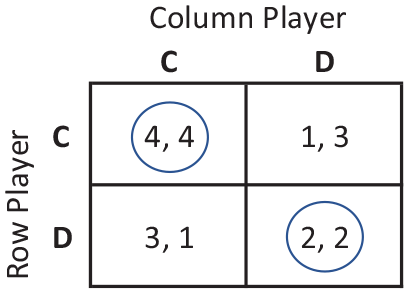
The Stag Hunt with ordinal (ranked) payoffs. Nash equilibria are circled.
Although subsequent debates between liberals and realists in International Relations theory focused on other game-theoretic scenarios such as the Prisoner’s Dilemma and Chicken, Waltz (2018 [1959]) emphasises the relevance of the parable in Man, the State, and War, arguing that Rousseau’s ‘story is simple; the implications are tremendous’ (p. 168). For Waltz, however, the scenario illustrates the challenges of achieving cooperation, whereas for Wagner cooperation itself allows for the possibility of organised conflict. Wagner’s reasoning seems to be that if a single individual attempts to prey on others through violence, they will most likely be defeated. But if would-be exploiters cooperate, they can subjugate others and potentially live off the surplus they can extract (Wagner, 2007: 114). Thus, Wagner agrees with Rousseau’s claim that, prior to large-scale cooperation, human beings were strangers to war, as war is an organised activity not an inter-personal interaction between individuals (Rousseau, 1968 (1762)P. 1, S. 4, 2009 (1755) P. 1, S. 2).
Although the Prisoner’s Dilemma has received enormous attention, the philosopher Brian Skyrms (2004) has argued that the Stag Hunt is central for understanding the emergence of human social organisation. In the Stag Hunt there are two Nash equilibria, situations that are stable because each player’s moves are best responses to the other’s. Cooperation is preferable if the other player Cooperates, but if a player believes that the other will not Cooperate, then it is rational to Defect. But how does each player know whether the other will Cooperate or Defect, if each player’s best response depends on what the other will do? How does cooperation ever get started in a world of multiple independent decision-makers?
The Stag Hunt and other dilemmas
The problem of selection between multiple equilibria has been central to the development of game theory due to the desire to make clear predictions and the guiding belief that rationality must be univocal. It is not immediately obvious whether a rational player would Cooperate or Defect when faced with the Stag Hunt. For Waltz (2018 [1959]), this is the genius of Rousseau’s original parable, as it indicates that reason can endorse both cooperation and non-cooperation in the same situation, depending on one player’s expectations about the other’s actions (p. 169). One possibility is that each player could randomise between Cooperate and Defect at ratios that depend on the payoffs of each outcome, the mixed-strategy Nash equilibrium. This seems unsatisfying. Gintis (2014) is critical of the whole concept of mixed strategies outside of zero-sum games where the goal is to outfox the other player rather than achieve cooperation (p. 132). Another approach is to acknowledge that the two pure equilibria are distinct and that the players are ‘pulled in one direction by considerations of mutual benefit and in the other by considerations of personal risk’ (Skyrms, 2004: 3). In Harsanyi and Selten’s (1988) framework for equilibrium selection, the CC equilibrium is payoff dominant while the DD equilibrium is risk dominant because one player’s deviations from this equilibrium are less costly for the other than in the other equilibrium. Harsanyi changed his mind about which criterion had priority, ultimately emphasising risk dominance (Harsanyi, 1995). If there is some probability of either player making an error and failing to Cooperate when they intended to, it is easy to see how this ‘inhibiting fear’ could discourage players from moving from the non-cooperative equilibrium (Aggarwal and Dupont, 2008: 88). Alternatively, if in all realistic scenarios there exists some uncertainty about the preferences of others, then the Defect strategy does seem less risky.
Indeed, this gives an indication of how important the Stag Hunt is to International Relations more generally. One of the International Relations discipline’s most important concepts, the security dilemma, can be represented very simply as an imperfect information game in which at least one player has a Stag Hunt preference ordering but does not know if the other player has a Stag Hunt or a Prisoner’s Dilemma preference ordering. 1 But when the Prisoner’s Dilemma itself is played repeatedly, alternative strategies involving conditional cooperation such as Tit-for-Tat may offer higher payoffs than repeated defection. 2 Cooperating when others are expected to do likewise becomes a viable strategy and, in this respect, iterated Prisoner’s Dilemma-style problems come to resemble the Stag Hunt.
A world of political units facing Stag Hunt-type scenarios could plausibly, with clear communication, transparency and some degree of risk, establish enduring peace among one another. Yet, as Wagner notes, there is an irony to this conclusion because, if forming a predatory organisation is a challenge similar to the Stag Hunt, then the possibility of cooperation is what makes organised, violent predation on others possible in the first place (Wagner, 2007: 115, note 14). Restraining multiple predatory groups may be a harder problem than establishing peace among security-seekers.
Rivalry between multiple groups of predatory cooperators
Unfortunately, scarcity of resources and the possibility of exploiting other humans provide a potential motivation to prefer domination to coexistence. This might plausibly create a Stag Hunt game among would-be predators trying to organise themselves and a sharper Prisoner’s Dilemma game among the resulting predatory organisations as they vie with one another for the proceeds of exploitation. Wagner does not fully explore why a multiplicity of such predatory organisations form, however. Two possibilities stand out. First, the conditions that favour cooperation might be parochial. Ethnocentrism may be an evolved human trait, because when individuals assist genetically related kin, they may increase their own ‘inclusive fitness’ (Hamilton, 1964). So cooperating dominators might have at their nucleus a core group of related individuals. Second, even without assuming relatedness, the logic of coalition-formation might limit the size of predator organisations. More exploiters means more people between whom to divide the proceeds of exploitation. If each additional exploiter after a certain threshold makes a diminishing contribution to the surplus to be shared out, then the predatory group might limit its size to something approximating a ‘minimum winning coalition’ (Riker, 1962). The pressure might be especially strong if recruits to the group might alternatively be put to work and exploited as labourers: every palace guard could be a serf tilling the fields.
This attempt to elaborate Wagner’s (2007) argument has similarities with Pateman and Mills’ analysis of ‘domination contracts’. Their concept reworks social contract theory to acknowledge that the agreements that institute a social order are not freely made agreements among individuals, but rather social agreements that establish one group as superior to others. Such arrangements depend on lateral solidarity and coordination among members of the dominant group, such as white male property owners. An example of norm enforcement provided by Axelrod (1986: 1100) is of a man hit in the face with a bottle for failing to support a lynching in the Jim Crow South. To be sustained, a regime of racial oppression requires cooperation.
If the benefits from exploiting others are large, but the incentives to limit the size of the dominant group are strong, this might encourage rebellion by those seeking to set up their own system of domination. Better to be an exploiter than one of the exploited. The alternative would be for the exploited to join together to overthrow the exploiters. However, the risks are borne by those who dare to participate in such a revolution, while the benefits of victory would be shared widely among all the exploited (Wagner, 2007: 115–116). Hence, the exploited find themselves in a situation similar to a collective Prisoner’s Dilemma. Scholars of revolution point out that such collective action problems are not insurmountable (Goldstone, 2001: 163). Yet if the dominant group is cohesive it can intensify the difficulties through techniques of divide and conquer, extending differential threats and inducements to subsections of the subordinate group (Posner et al., 2010). The dominant group might further take steps to prevent contact and communication among the exploited. Maintaining such information asymmetries might involve clandestine secrecy among the dominant group, and close surveillance of the subordinated – explored further below.
Even if a revolution is successful, the victorious leaders may set themselves up as a new group of exploiters. In her analysis of ideology and ruling class power in the classical world, Meiksins Wood (2008) makes much of the Spartacus Revolt. But it is impossible to know whether Spartacus and his followers would have established an egalitarian society if they had struck north and settled outside of Italy. Rather than social revolution, the overthrow of a group of exploiters might simply lead to their replacement by a new dominant group. Thus aspirant would-be predators might be more of a threat to a dominant group than an uprising of the oppressed (Wagner, 2007: 115–116). A situation in which a multiplicity of rival predator groups coexists, each attempting to assemble a minimum winning coalition to maximise exploitation over the most extensive geographical area possible, might therefore be stable for long stretches of historical time.
Cooperation and early warfare
Cooperation may enable warfare and organised exploitation as much as it enables benign mutual assistance. It remains unclear, however, how cooperation-for-predation first emerged, spread and became institutionalised. Explaining the emergence of social norms governing cooperation has been a major concern of game theorists (Axelrod, 1986: 1100; Gintis, 2014: 142–146). One reason this puzzle is challenging is because, in scenarios such as Stag Hunt, cooperation is only rational if others can be expected to cooperate. This raises the difficult question of how the belief that others will cooperate emerged. Gintis (2014) suggests that game-theoretic concepts of rationality are insufficient to resolve this problem, and that it is necessary to examine the intersubjective beliefs shared by socially situated human beings to explain the emergence of norms of social cooperation (pp. 154–145). 3 Unfortunately, reconstructing the belief-systems of social actors during the period when organised cooperation for war emerged and political multiplicity crystallised is challenging.
Nonetheless, some aspects of the spread of cooperation-for-predation and the formation of war-like states can be sketched out. Wagner suggests that Rousseau’s parable of the Stag Hunt was very apt ‘since the skills humans developed for hunting and herding large animals may well have facilitated the hunting and capture of other humans’ (Wagner, 2007: 114). This is consistent with the influential argument of Ferrill (1997) that the techniques of organised warfare developed out of weaponry and tactics developed for hunting. Kim and Kissel (2018) and Kissel and Kim (2019: 156) also emphasise human cooperation in their account of how planned warfare, as opposed to spontaneous primate violence, emerged 200,000–300,000 years ago. In Otterbein’s (2004) multi-stage account, war developed out of the practice of hunting after scarcity of game led to inter-group conflict, went into abeyance during the initial development of agriculture, and then re-emerged among stratified agrarian societies. Debates over the origin of war are, however, stymied by the problem of whether it is possible to distinguish war before recorded history from homicide, small-scale raids and skirmishes.
War proper, however, should be distinguished from interpersonal violence in terms of its scale, organisation and lethality. Within the debate over the origins and implications of political multiplicity, what matters is the conditions under which warfare became institutionalised, a permanent possibility that was anticipated and prepared for, associated with certain social roles and dedicated violence-specialists such as soldiers, mercenaries and warrior-elites. Using similar criteria, a review by Levy and Thompson leads them to the conclusion that there is some archaeological evidence for warfare between 10,000 and 13,000 years ago, with unambiguous evidence dating from 4000 to 6000 years ago (Levy and Thompson, 2011: 22–23). Most explanations emphasise the shift to sedentary agriculture in ancient West Asia that occurred during this period. Recent research, however, indicates that similar transformations also occurred in complex foraging societies controlling rich aquatic resources (Fry et al., 2020).
Various forms of resource abundance and concentration, therefore, seem to have resulted in larger, denser populations, social stratification, territorialism and war. This shift has been explained in terms of social ‘circumscription’ or ‘caging’ (Carneiro, 1970; Mann, 1986), where sedentary populations lost the power of exit and fell under the control of chiefdoms and states. Reversing this causal arrow, Ferrill (1997) credits a revolution in weapon technology with the adoption of fortifications and sedentary ways of life. Cioffi-Revilla’s (2000) account of the transition from hunting to large-scale imperial warfare between 7500 and 3000 BCE emphasises the role of organisational factors. ‘Protowarfare’ may have led to the development of enlarged, stratified polities, which were able to erect permanent defences and prosecute large-scale military campaigns using infantry shock-tactics. This could be seen in terms of the build-up of the generalised ability to solve collective action problems such as the Stag Hunt, making cooperation-for-predation viable at larger and larger scales.
Because evidence is fragmentary and these shifts took place during the same time period, it is difficult to resolve the disagreements and establish a causal sequence. However, it seems consistent with the empirical evidence to suppose that a combination of changes in ancient West Asia resulted in a new equilibrium in which preparation for war, social stratification and political centralisation became near-universal features of a multiplicity of strongly differentiated societies. If the benefits of coercion and exploitation must exceed the costs for warfare to be a permanent institutionalised feature of societies (Boix, 2015), an increase in the value of territory and the possibility of putting others to work in agriculture creates incentives towards conflict. Deadly weaponry and tactics may decrease the costs of coercing subject populations. They also increase the dangers of being underprepared for war – intensifying the security dilemma (Jervis, 1978) and reinforcing the tendency towards institutionalisation of organised violence.
The account above emphasises the role of military, organisation and economic factors in the emergence of a world in which a multiplicity of predatory rackets compete with one another for the ability to exploit subject populations. It builds on what has been described as a ‘materialist metanarrative’ (Kinnvall, 2019: 154). Yet the gendered nature of this process may have been overlooked. Hunting is, after all, a prototypically masculine activity that women are excluded from in many societies. In discussing game theoretic scenarios such as the Stag Hunt, we may have been focussing on the strategic situations that men have found themselves in, without reflecting on the situation of women and the processes that give rise to gendered social roles.
Gender, conflict, multiplicity
Although few scholars have examined the relationship between multiplicity and gender relations so far, 4 Rosenberg (2010) acknowledges the importance of sex and reproduction for understanding multiplicity when he notes that exogamy is an important reason why separate social groups exist (p. 172). Kurki argues that there can be a productive conversation between feminist perspectives and multiplicity research so long as the theoretical investigation does not ‘displace gender as a central analytical category’ (Kurki, 2020: 556). Indeed, maintaining a focus on gender provides new insights into the origins and consequences of political multiplicity. Gendered forms of power and fraternal solidarity within coalitions of related men may have facilitated the cooperation necessary for both the subordination of women and predation against other groups.
There is an established tradition of materials feminist historical sociology that examines the dual origins of female subordination and the state. Mies develops and extends Engels’ (2004) account of the ‘world-historic defeat of the female sex’ and the establishment of patriarchal social systems. She agrees with others surveyed that groups of hunters were precursors to the emergence of stratified political communities (Mies, 2014: 4). Modifying Marx’s labour theory of value, Mies argues that production conventionally understood always rests on social reproduction (Mies, 2014: 47–48), which comprises reproduction in the biological sense but also ‘production of all forms of subsistence goods and use values necessary to meet basic human needs’ (Ebert, 1996: 79). Agriculture, one of the primary means of generating storable surplus, developed out of gathering activities performed by women to meet immediate needs (Mies, 1986: 55). Groups of male hunters, however, although originally dependent on women’s activities, were able to appropriate the labour of others by capturing them and put them to work in agriculture. Thus, Mies (2014) claims, ‘the first forms of private property were not cattle or other foods, but female slaves who had been kidnapped’ (p. 62, emphasis original). Many verses of The Illiad detail the valuable skills of women captured as spoils in the Trojan War, which according to the myth began with an elopement or act of bridal kidnap. Mies argues that enslavement of women and later men facilitated the accumulation of wealth and necessitated preparatory self-defence against ambush. This led towards stratified, centralised states, which feminist scholars in International Relations have argued resulted in the further exclusion of women from the emerging male-dominated public spheres (Peterson, 2010: 191; Runyan and Peterson, 1991: 91–93). 5
This analysis enriches the existing materialist accounts of the uneven and combined development of a multiplicity of rivalrous states, but it does not fundamentally transform it. To do so, we need to investigate what makes it possible for male-dominated coalitions to overcome collective action problems and pursue shared goals. Analysing the Netherlands in the early modern period, Adams argues that the Dutch state was a particular form of patrimonial state dominated by patriciate families. The ‘ebb and flow of their dynastic power cannot be understood without reference to the rhythms of family life’ (Adams, 1994: 514), as the manner in which these families maintained their position within society and the state depended on marital alliances, patrilineal inheritance and nepotism. Although power and wealth were primarily passed on to sons, with the expectation they would pass it to their sons in turn, daughters played an important role in maintaining elite cohesion via intermarriage among families (Adams, 1994: 510–511).
Adams demonstrates that the family was a source of social power in early modern Netherlands. Control over marriage and the formation of families has been neglected within much of historical sociology. Mann acknowledges that humans have a variety of needs and drives, but only some areas of life are organised by large-scale networks of power. His four canonical sources of power are ideological, economic, military and political (Mann, 1986). Yet what Adams demonstrates is that control over marriage and inheritance enabled patriciate families to wield gendered forms of familial power in an emerging capitalist state. To return to the language of game theory, this allowed ruling class families to maintain their positions by solving problems of coordination and cooperation. The early modern Netherlands is surely not a unique idiosyncratic case. The House of Hapsburg was able to rule territories across Europe and attain a position of pre-eminence in the Holy Roman Empire through skilful use of the techniques of dynastic marriage, such that its motto was ‘Let others wage war, but thou, happy Austria, marry; for those kingdoms that Mars gives to others, Venus gives to thee’. Yet Maria Theresa was compelled to fight the War of Austrian Succession of 1740 because her father Charles VI could not prevent challenges to royal inheritance by his daughter under the Salic law. The sources of social power were gendered for much of European history: collective action problems that bedevil political coalitions were solved by drawing on familial networks of power.
Gender and the origins of competitive multiplicity
Could gendered sources of social power have played a role in the emergence of multiple rival groups of organised predators? Mies suggests a causal sequence from the original gender-based division of labour, to hunting-slaving parties, to patriarchal states. Within the International Relations discipline, there have been several attempts to theorise the relationship between gender roles and the conditions for organised violence. Goldstein argues that the cross-societal consistency of gender roles in war arises from the ‘cultural modelling of tough, brave men, who feminize their enemies to encode domination’, which institutionalises and amplifies small gender differences ‘transforming overlapping distributions into non-overlapping gender categories’ (Goldstein, 2001: 406). He notes that many of the peoples that do not make war – such as Malaysia’s Semai – lack harsh coming-of-age rituals for making men and may have weaker norms for controlling and redirecting male violence, with the result that it remains inter-personal rather than organised (Goldstein, 2001: 213, 282). In warlike societies, women are represented as polluting and harmful. Gender roles are ‘a tool with which societies induce men to fight’ (Goldstein, 2001: 252) and, therefore, a potential source of social power. However, Goldstein’s explanation for these cultural regularities is the functional imperative that the possibility of war imposes on all societies. Every society must produce warriors because the possibility of war is ever-present. A gendered division of labour emerges, resulting in the socialisation of men for war. Although Goldstein acknowledges the arrow of causation is bidirectional, his argument primarily emphasises the social consequences of the ever-present insecurities of an anarchical system. It does not explain why societies exist in a situation of armed multiplicity in the first place.
More recent feminist research in security studies provides powerful new insights into gender roles and the conditions for organised violence, however. A network of feminist researchers have investigated the relationship between the harms experienced by women and other forms of insecurity, such as militarism, terrorism, civil war and international disputes (Caprioli, 2000; Caprioli and Boyer, 2001; Hudson et al., 2008/2009; Hudson and Hodgson, 2020) and developed the WomanStats dataset to collate information on the security of women in societies across the world (Caprioli et al., 2009).
Like Goldstein, the scholars involved with the WomanStats project also emphasise cultural modelling in patriarchal societies, focussing on the role of domestic violence in establishing a template of gender relations that young boys emulate (Hudson et al., 2008/2009: 23–24). Their explanation departs from his, however, in that they draw on evolutionary psychology as well as arguments about social learning. Drawing on Peterson and Wrangham’s (1996) Demonic Males, they argue that human evolutionary heritage may have predisposed us to the dangers of patriarchy. Some, but not all, of our great ape cousins also organise themselves into exogamous patrilocal groups, create male dominance hierarchies and feature male coalitions that attack and raid the territories of other groups.
Hudson et al. draw on research in developmental psychology that indicates that boys but not girls have strong preference for same-gender play, which results in greater prosocial activity in groups of children composed exclusively of boys. They argue this form of early bonding results in the formation of men-only groups in adulthood. Prosocial, cooperative behaviour within such groups is cemented by the disparagement and even dehumanisation of women and out-group men (Hudson et al., 2008/2009: 25). This facilitates coalitional violence for the purpose of seizing resources from out-groups, ‘and these resources include women’ (Hudson et al., 2008/2009: 16). The most effective antidote to the formation of such coalitions might be coalition-building by women, but many historical societies have been patrilocal. This makes female coalition-building difficult as women must leave the community they are born into, while men remain continue to live near other men they are related to and grew up with. Thus, in many societies, the experience of multiplicity is very different for men and for women. Patrilocality makes male coalitions easy to form, while it weakens the social bonds between women (Hudson et al., 2008/2009: 20).
This maps directly onto Wagner’s argument that the formation of predatory groups is much like the Stag Hunt, whereas the oppressed face the steeper challenge of overcoming the Prisoner’s Dilemma under conditions of divide and rule. Male coalitions presumably emerged before the state, which itself might be an outgrowth of millennia of competition among a multiplicity of such coalitions, interaction between which may have eventually resulted in increasingly stratified, militaristic and patriarchal societies. 6
Secret societies
Organising for war and maintaining ‘domination contract’ require coordination and perhaps even clandestine activity on the part of a dominant male coalition. Insights into the formation of male coalitions might be provided by examining a social institution that is widely found among stateless societies: men’s secret societies. These cultic organisations are found across Amazonia, Melanesia and West Africa. 7 Their governing norms and rituals share important similarities despite the geographical diversity of the societies in which they are found. Hayden (2020) argues that secret societies were common as far back as the Upper Palaeolithic and may have been responsible for the earliest social inequalities. Typically, men who have been initiated into the secret society congregate in the men’s house, which may be the largest or best-decorated structure in the community. The men’s house provides initiates with location for feasts, communion with spirits and planning for organised violence.
Women are excluded from the men’s house and its rites. In several societies, men who participate in the cult play sacred musical instruments such as flutes and bullroarers, which they claim are the voices of the spirits that the cult venerates. Men may also wear sacred masks and costumes with motifs that represent the spirits. In some cases, men wearing these outfits may leave the men’s house, walking in the guise of one of the spirits. Maintenance of the cult apparently involves an attempt by men to deceive their wives, yet men nonetheless believe in the spirits (Isichei, 1988: 66). Many of the features of the cult seem attempts to intimidate women and to mystify and sacralise men’s power over them. Mead describes the New Guinea tamberan cult as ‘a system directed against the women and children, designed to keep them in their ignominious places and punish them if they try to emerge’ (Mead, 1935: 67). Women are typically not allowed to see the sacred instruments or masks and are forbidden from knowing the cult’s secrets. The Barasana people of the Amazon are recorded as believing that if women saw the flutes, there would follow ‘chaos during which men would fight and kill each other’ (Hugh-Jones, 1979: 128). Anthropologists have recorded cases of severe sexual violence against women who have violated these edicts, with fear acting as a deterrent against other women attempting to encroach on the men’s house and its activities (Gregor and Tuzin, 2001: 323).
As well as excluding of women, men’s secret societies impose strictures on boys and young men. Initiation into the secret society may require participation in harsh man-making rituals such as bloodletting and scarification. Undergoing such rituals might establish solidarity among members of the cult and demonstrate that a man is willing to bear suffering as part of a group of male peers. They may therefore help groups of men to commit themselves to risky, dangerous collaborative activities such as organised violence (Sosis et al., 2007). In some societies, initiation rites have a strong sexual component, with boys compelled to perform sexual acts on older men (Herdt, 2005). These rituals are legitimated as being necessary for turning boys into strong men, a theme present in many male cults in the Amazon and Melanesia, in which part of the cycle of reproduction and procreation is represented as being under exclusive male control (Biersack, 2001). In conjunction with norms against adultery by unmarried men and the practice of polygamy by older men, these forms of sexual coercion of male adolescents might be interpreted as ways of regulating sexual competition among men, controlling a source of conflict among members of a community and aligning the interests of individual men with the male coalition embodied in the secret society. Not all men benefit equally: an inner coalition of older, more politically powerful men may reap the largest share of rewards.
The men’s house provides a setting away from women where ambushes and raids can be planned. In patrilocal stateless societies, women may be related to the men and women of nearby villages and so opposed to violence that could harm their mothers, fathers and siblings. Exclusion and intimidation prevent women from learning of or preventing the initiation of attacks on other groups. Solidarity within the secret society directs competition between men outwards towards other groups of men. As well as revenge, research has found that much of the conflict in stateless societies appears to originate in sexual jealousy and bridal kidnap (Walker and Bailey, 2013). Organised conflict advances the material and sexual interests of a male coalition at the expense of the interests of other male coalitions. To a large extent, it seems, secret societies are involved in the extension of control over women, in competition with the men of other societies.
Men’s secret societies therefore seem to ‘solve’ many of the collective action problems involved in the pursuit of the shared material interests of coalitions of men: they establish a norm of cooperation necessary for risky collective activities, they limit or regulate sexual competition among men, they prevent women from organising to disrupt their activities, and they restrict the benefits of male cooperation to something approximating a minimum winning coalition.
The study of organised violence in stateless societies is riven with controversy within anthropology, as colonialism, the encroachment of states and the expansion of the world economy fundamentally disrupted these societies in ways that gave rise to specific patterns of conflict (Ferguson, 2015). Men’s secret societies in Amazonia and Melanesia have gone into decline or been abandoned. They are not timeless features of a pre-political state of nature: the tambaran cult spread through Papua New Guinea in the 1880s; the Mbue cult arose in Kagoro, Nigeria, in 1930 during a period of Christian proselytisation (Gregor and Tuzin, 2001: 327; Isichei, 1988: 52). Nonetheless, archaeological evidence and the similarity of men’s secret societies in different parts of the world indicate that their institutional features arise from common challenges faced by male coalitions in the context of societal multiplicity. The costs of ‘solving’ these challenges are borne by women, adolescent boys and men outside the group. 8 Secret societies provide suggestions about the role of patriarchy and gendered power in the emergence of armies and states from rival coalitions of men. It does not seem implausible to suggest that men’s secret societies may have been the original cooperative schemes for the organised, violent exploitation of others.
Moreover, the secret societies of stateless peoples bear a resemblance to real and fictive brotherhoods that have existed in contemporary nation-states. Mann (2004) argues that fascism emerged out of the shared experiences of belonging to a squad of male comrades in World War One. Theweleit’s (1989 [1978]) study of the fantasies of Freikorps militiamen emphasises desire for segregation from women, due to fears of polluting femininity and ‘contagious lust’. The Muslim Brotherhood openly advertises its fraternal character. US college fraternities often initiate members through unpleasant hazing rituals and have been implicated in the problem of sexual assault on American university campuses. George W Bush and presidential candidate John Kerry were both members of Yale’s Skull and Bones society, a secretive and elitist group that did not admit women until 1991. Similarly, two recent British Prime Ministers were members of the all-male Bullingdon Club. Cecil Rhodes seriously entertained a plan to create a secret society of individuals from the Britain and the white dominions to promote the further expansion of the British Empire, eventually settling for the creation of a scholarship programme. The contemporary alt-right in the United States emerged out of aggressively misogynistic web forums whose users were united in contempt for uninitiated ‘normies’ (Nagle, 2017). Secret cults formed by men are not merely an interesting quirk of some stateless societies, but one instance of a more general pattern.
If Hudson et al. are correct about the spontaneous predisposition of men to form coalitions that have the potential to dominate others, then the emergence of such groups may be a perennial feature of human societies. For Pateman (1988), fraternal power has outlived the decline of paternal authority in capitalist societies, and solidarity among men continues to facilitate harm against women.
Conclusion
As the original social contract theorists argued, cooperation may help human beings survive and achieve greater levels of social complexity. Unfortunately, cooperation also allows for the organised subjugation of others and so facilitates the emergence of armies, warfare and statehood. Predation and the organised exploitation of others require coordination; the challenge for would-be exploiters resembles Rousseau’s parable of the Stag Hunt. Game theory sharpens our understanding of the challenges that actors face in a world of multiple decision-makers. But to explain why actors opt for either cooperative or non-cooperative strategies, it is also necessary to try to reconstruct the situations in which these decisions were made using archaeological and ethnographic evidence. Much of this evidence echoes the arguments of Pateman and Mills’ (2007), in that early social institutions do not necessarily establish conditions for cooperation while preserving equality and freedom, but instead enable dominance of one group and subordination of others.
Rather than the social contract providing a means to escape the war of all against all, the formation of male coalitions may have created the conditions in which war was a permanent possibility. Gendered social institutions and sources of social power may have allowed for the emergence of forms of cooperation that facilitated predation. The cross-cultural phenomena of men’s secret societies among stateless peoples provide indications of how male coalitions can solve their collective action problems even without any kind of state. These cults seem to facilitate the subordination of women and the social control of boys, while promoting solidarity among men in preparation for conflict with other male coalitions. Secrecy, ritualisation and the elaboration of masculinist cosmologies may therefore be part of the explanation for how some male coalitions solved the Stag Hunt and organised for exploitation of others.
The exogamous nature of human kin groups means that the general condition of interactive multiplicity has existed throughout and prior to recorded human history (cf. Rosenberg, 2010: 172). As Wagner argues, the insecurities of world politics primarily arise from the ability of groups to prey on others. But human social groups are composed of men and women, and their character and their relations with other social groups are shaped by the relations within and between the sexes. It may seem bleak to suggest that all-male groups place societies on a path to war, slavery and stratification. Such brotherhoods can embody noble ideals such as loyalty, camaraderie and self-sacrifice. But by asking questions and gathering data on issues that have been overlooked and ignored, feminist research has made a compelling case that where women are prevented from forming their own countervailing coalitions, a competitive form of multiplicity emerges at enormous cost to both men and women.
Footnotes
Acknowledgements
Thanks to the reviewers and to Antje Wiener for their helpful and constructive comments. Any flaws in the article remain my own.
Funding
The author(s) received no financial support for the research, authorship and/or publication of this article.
