




Abstract
The aim of this article is to explore the establishment of diplomatic representation as a measure of de facto recognition by other state units and to explain its causes in the “long 19th century” (1817–1914) and the post–World War II (WWII) era (1950–2000). Drawing on the Correlates of War diplomatic exchange data, the article explores the underlying drivers of dyadic acts of recognition in two series of logistic regression analyses, one for each time period. The results indicate that, also when taking alternative explanations into account, recognition of other states in the international system was in the 19th century at least based on one general principle: that of recognizing other de facto states. In the post-WWII era, contrary to expectations, this principle was still in effect. De facto statehood can thus be argued to constitute a rather stable norm for recognition in the international system.
Introduction
The decision to dispatch a permanent diplomatic representative to another country is an act of wider significance. Symbolic or superficial at face value, it conveys the status of recognition. Without such status, a state cannot carry out International Relations, will suffer economically, and stand the constant risk of being eradicated or extinguished from the map (Coggins, 2014; Fazal and Griffiths, 2014). In one of the very few empirical studies on this, Strang (1991) looks at the ways in which non-European polities entered and exited the international state system from 1415 to 1987. Quite strikingly, he finds that non-European polities that were recognized, on account of having established diplomatic ties with at least two European states, were significantly less likely to become extinct or being subordinated by other states at a later time point. Along the same lines, Fazal (2007: 83) finds that international recognition prolongs state survival, and Florea (2017: 346) finds that it can be considered “a ticket for survival” among de facto states in the post–World War II (WWII) world order.
The extent to which a state is recognized by other states thus reflects the degree to which that state enjoys the status of external sovereignty in the international system (Krasner, 1999). Being recognized is in this sense a dimension of state making; it is constitutive of what it means to be or become a state (Fabry, 2010; Jönsson and Hall, 2005; Tilly, 1990). However, unlike the “constitutive” theory of recognition advocated by certain scholars of international law (e.g. Crawford, 2006: 19–22), I shall in this article argue that recognition is not granted in a vacuum. Nor is it, as Coggins (2014) has it, only based on great power politics. More in line with the “declaratory” theory, I will instead attempt to show that recognition is also based on certain principles or criteria. Following Fabry (2010), I will attempt to empirically uncover such principles by studying recognition as a practice evolving over time but, unlike Fabry (2010), by drawing on statistical methods, looking at the determinants of recognition during two different eras in modern world history: the long 19th century (1817–1914) and the post-WWII era (1950–2000). This empirical investigation primarily draws on Kinne (2014), but extends his analysis back in time and also includes this critically important but hitherto unstudied determinant: the role of principles, or ideas, which in this context can be defined as beliefs held by state officials deciding on whether to grant recognition. 1
Following Strang (1991), I will purport to measure recognition by looking at diplomatic representation at the dyadic level. This is not to argue that dispatching diplomatic envoys is (or was) the sole mode of international recognition. According to Coggins (2014), “Explicit formal recognition … can be granted by means of formal public statement or through formal documentation transmitted to the government of a new state” (p. 40). It is thus possible for a state to recognize another without yet having dispatched a formal diplomatic envoy. Since, to the best of my knowledge, no systematic evidence exists on either all “formal public statements” or “formal documentation transmitted” from a large number of states going back in time, I will here rely on the more easily observable implication of such acts of recognition: the establishment of diplomatic representation (at a certain threshold). Although not a necessary condition, it does arguably work as a sufficient condition for recognition. That is, recognition can be granted without diplomatic representation, but once a diplomatic mission has been dispatched to another entity in the system, that entity has been formally recognized by the sending party.
In brief, I find that recognition of other states in the international system was in the 19th century, as argued by Fabry (2010), at least based on one general principle: that of recognizing other de facto states, here defined—following Weber (1978 [1921])—as a state that claims a monopoly of force over a territory. In other words, the more a state was in control over its own territory, the larger the probability that it would be recognized by other states, also taking alternative explanations based on strategic and self-interested behavior into account. However, in the post-WWII era, quite contrary to expectations, the same relationship holds. “De facto statehood,” which in this article will be used interchangeably with “control over territory,” can thus be argued to constitute a rather stable norm for recognition in the international system.
The article is organized as follows. I start by stating my hypotheses as to what might affect why a state recognizes another (section “What explains recognition?”), followed by data and research design (section “Data and research design”) and the empirical results (section “Empirical results”). I end by summarizing my argument in relation to the existing literature and discussing some avenues for future research (section “Concluding remarks”).
What explains recognition?
In theorizing the act of extending recognition to another state, I will here make the simplifying assumption that the ultimate decision of whether to recognize another state can only be made at the apex of the state’s decision-making machinery. In other words, I will assume that the decision is up to the state’s executive branch. My primary concern is whether such a decision can be based on a principle, or international norm, but I will also discuss alternative strategic and self-interested explanations. To base the decision on principle is to refer to some formal or informal criterion according to which a state believes that another as yet unrecognized entity might be deemed worthy of recognition as a state. In terms of Goldstein and Keohane’s (1993) typology of the role ideas in foreign policy, these principles come closest to roadmaps that “serve the purpose of guiding behavior under conditions of uncertainty by stipulating causal patterns or by providing compelling ethical or moral motivations for action” (p. 16). As should be clear, such roadmaps also come close to what in the literature is called international norms (Barkin and Cronin, 1994; Finnemore and Sikkink, 1998; Goertz and Diehl, 1992).
But what, more specifically, are these norms of recognition? I am here fortunate enough to be able to draw directly on Fabry’s (2010) excellent treatment of the ideas or criteria adhered to in the practice of state recognition since the American and French revolutions. At around the turn of the 19th century, Fabry argues, “[t]he only acceptable method of transferring sovereignty or territory was by freely given consent of the legitimate crown.” What Fabry then convincingly shows is that this traditional principle of recognition, which he calls “dynastic legitimism,” during the course of the 19th century gave way to a new principle based on the idea of de facto statehood of the state in question. This principle was crafted by England and the United States in relation to demands for recognition by the newly formed Latin American states. It then took hold also among the old monarchies in the recognition of newly formed European states, such as Belgium, Greece, and on parts of the Balkans. What the principle claimed, in essence, was that a state acquired a natural right of recognition to the extent that it was able to effectively act like a state. This in particular implied the existence of an effective government in control of its own territory, in terms of having been able to successfully cast off both former (colonial) forces and other potential domestic parties claiming right of possession to substantial parts of that territory (Fabry, 2010: 10, 30–31, 68–69).
Österud (1997: 172) points in the same direction when writing that “The fact of territorial control,” in the 19th century, “was transformed into international law through recognition.” Along the same lines, Griffiths (2017: 182) notes that state leaders in the United Kingdom and the United States after the Napoleonic wars “operated from a position of principle” (apart from one on strategy) when granting recognition based on de facto statehood. More generally, Coggins (2014: 21–22) argues that ever since the Peace of Westphalia, International Relations scholars have debated whether “internationally sovereign de facto states” preceded the modern states system or whether external recognition was constitutive of that system. She goes on to note that the normative discussion among international law scholars advocating the declaratory versus the constitutive theory of recognition nicely dovetails this debate within International Relations (Coggins, 2014: 30–31). An additional fact supporting Fabry (2010) is thus that the principle of de facto statehood as a basis for a declaratory theory of recognition was enshrined in the Montevideo Convention signed in 1933 (e.g. Crawford, 2006: 45–72). Although only signed by members of the Organization of American States, this encodement lends additional support to the notion that a new principle for recognition had by this time reached the status of a new international norm.
I may thus, based on this principle and the case study evidence in the extant literature, form my first hypothesis:
H1. During the long 19th century, states were more likely to be recognized, the more they were in control of their own territory.
Despite US president Wilson’s groundbreaking effort after World War I (WWI) to develop the principle of self-determination from a negative to a positive international right, the practice of recognizing new states did not change substantively in the interwar period (Fabry, 2010: chap. 4; Österud, 1997: 174). After WWII, however, the literature seems to be in close to complete agreement on the point that the standard of de facto statehood was abandoned in favor of the principle that an entity needed to establish a prior right to independence (Österud, 1997: 176–179; Griffiths, 2017: 182–184). In Fabry’s (2010: 147–148) words, The process of decolonization, which overwhelmingly consisted of accession of territories with colonial to sovereign status, made a wholesale change to the long-standing recognition practice. Unlike the past, these territories staked their request for foreign acknowledgment not on the basis of having attained de facto statehood, but on the inadmissibility of their second-class rank in the family of nations. By the same token, and also breaking with the past, existing states conditioned their acknowledgement neither by demanding prior evidence of de facto statehood nor by seeking fulfillment of conditions that might be in the general interest of international society.
The processes of decolonization are also what Philpott (2001) terms the second revolution in sovereignty, the first being the shaping of the early modern state system after the Peace of Westphalia. According to Jackson and Rosberg (1982), the abandoning of an “empirical” (de facto) for a “juridical” norm of statehood, for example, explains why Africa’s state system has remained more or less intact after decolonization, despite the de facto weakness of individual African states. Similarly, Kreijen (2004) argues that decolonization of sub-Saharan Africa in particular required a revolution in legal thought, in essence the abandonment of what he calls the principle of “effectiveness”—essentially synonymous with what is elsewhere called the de facto principle for statehood.
Despite the Montevideo Convention, then, this is my second hypothesis:
H2. After WWII, states were not more likely to be recognized, the more they were in control of their own territory.
Aside from principle, the extant literature on state recognition have discussed alternative explanations based on strategic or self-interested behavior that also need to be considered. The first, drawing on Kinne (2014), pertains to strategic adaptation, or more precisely, signaling and prestige in the state system. To begin with, states should prefer to recognize other states that are more prestigious, and a simple way of determining prestige in the international system is to assess how widely recognized the other state is. According to a closely related bandwagon dynamic, states should also directly pick up the cues of the great powers. As Coggins (2014) demonstrates, great powers seem to coordinate their behavior and hence are more likely to grant recognition to states that other great powers have recognized—but this could apply to all recognizing parties in the system (not just to the great powers themselves). Moreover, recognition works as a signal in the state system. By extending recognition to a newly formed state, for example, you thereby signal to your partners (those with whom you already experience mutual recognition) that this is a preferred cause of action. By implication, the more states that recognize a state, the more likely that other partner states will also extend recognition to that state.
Finally, a pertinent reason to recognize another country could be to further economic interactions with that country. As stated by Neumayer (2008: 230), referring to the post-WWII order, “trade follows the flag” (Pollins, 1989). But if the general expectation is that trade follows the flag, this also creates a forward-looking economic incentive to recognize countries with whom one is already trading.
Neumayer (2008), Kinne (2014), Coggins (2014), and Duque (2018) find that these mechanisms operate in the 20th-century setting for explaining diplomatic representation, but there are good reasons to expect that states were likely to pick up cues from the behavior of other states, or act from economic self-interest, in determining whom to recognize also in the long 19th century. If these alternative explanations are not taken into account, a recognition decision based on strategic or self-interested grounds might thus masquerade as one based on principle. This leads to the question of how these different explanations might be disentangled empirically, which is the issue to which I now turn.
Data and research design
The core measurement idea underlying this article is that recognition in the international system can be proxied by the sending of diplomatic envoys. Succinctly put, state a is assumed to recognize state b if state a dispatches a diplomatic envoy at the level of chargé d’affaires or higher to state b. The data are based on the Correlates of War (COW) “Diplomatic Exchange Data Set” (Bayer, 2006), but the 20th-century sample draws on Kinne (2014), which implies it only covers 1950–2000. For the 19th-century sample, moreover, I have extended the COW data to other state units and back in time.
The COW data capture diplomatic representation at the level of chargé d’affaires, minister, ambassador, and “other” between members of the COW interstate system from 1817 to 2005 at roughly 5-year intervals. 2 The basic coding unit is state dyads, so the COW data record, for example, at what level France is represented by a diplomatic mission in Brazil and vice versa, at each given time point. This was one of the very first empirical COW projects, initially designed as a way of measuring status order in the international system. As a direct result of this coding project, COW settled on a rule for what counts as “system membership”: a population larger than 500,000 and to have diplomatic representation at the level of chargé d’affaires or higher from London and Paris, from 1920 complemented with the criterion of membership in either the League of Nations or United Nations (Singer and Small, 1966; Small and Singer, 1973). This at times produces some odd results historically. Argentina, for example, grew out of the United Provinces of Rio de La Plata, established in 1810, first declaring independence in 1816. But since both France and England did not establish diplomatic representation in Buenos Aires until 1841, Argentina does not “exist” according to the COW rules before that year. The first rationale for extending these data for the long 19th century is thus to complete the dyadic data on diplomatic representation also among state units who had not yet received a diplomatic mission from London and Paris. The extended sample covers state units chosen so as to include all those that were (a) sizable (population >250,000), (b) sovereign in the pre-1900 era (either in the formal-juridical or the de facto sense), and (c) that match present-day state units, using Gleditsch and Ward (1999) as the point of departure but with the addition of a large number of states that attained minimal levels of domestic statehood but were excluded by Gleditsch and Ward for not controlling their foreign policies. 3
The underlying data on diplomatic representation are, as was primarily the case for COW, drawn on the Almanach de Gotha, which includes lists of all diplomatic missions, in principle covering the globe but in practice most likely dependent on sources or correspondents in major European languages. Since the COW data at times were also based on other sources not included in my extension of the data back in time, I will for consistency reasons present results from a version of the data where the years also covered by COW are only based on the Almanach. 4 As long as one of the two parties are of European or American origin, the Almanach is probably fairly accurate. But the extent to which “non-Western” (in a wider sense) state units recognized each other is probably underreported. This is an issue that should be born in mind when interpreting the results for the long 19th century: the results may not travel well to practices of recognition between states not located in Europe and the Americas. The bias this may introduce would, however, arguably go against finding any systematic relationships with other determinants. For example, since pre-colonial states as a rule did not possess de facto control over their territories (see, for example, Griffiths and Butcher, 2013), their omission from the data biases against finding empirical support for H1.
Since de facto statehood, as Levi (2002) argues, is a feature which can be fulfilled to varying degrees, not a categorical either/or condition, I need a measure of the extent to which a state can claim control over its entire territory in order to test H1 and H2. I base this measure on the Varieties of Democracy (V-Dem) project (Coppedge et al., 2020), where the following question was posed to a large sample of country experts going all the way back to 1789: “Over what percentage (%) of the territory does the state have effective control?” Of critical importance is also the further clarification provided as coding instruction to the V-Dem country experts: With this question we seek to judge the extent of recognition of the preeminent authority of the state over its territory. We are not interested here in perfect control by the state, or whether it is relatively effective in comparison to other states, but an assessment of the areas over which it is hegemonic, e.g., where it is recognized as the preeminent authority and in a contest of wills it can assert its control over political forces that reject its authority.
Where there are multiple country experts, I simply take the mean of their response to this question (in percentages) for each year. As should be obvious, this measurement strategy is based on the assumption that how country experts today assess the degree of control over territory also taps into the extent to which state leaders in the historical context held such beliefs. Although there is no way of establishing this directly, it should be noted that the V-Dem country experts are not just general experts but recruited based on their field expertise. In the historical sample, for example, they are mostly either historians or historically oriented political scientists (Knutsen et al., 2019: 442). There is thus good reason to expect that their assessment of de facto control over territory is based on historical sources that should be close to the views of contemporary state leaders.
I also include a set of control variables to take alternative explanations into account. To begin with, the occurrence of civil wars could in themselves be expected to signal the lack of de facto statehood, but—more importantly—they should also reduce a state’s control over its territory, resulting in omitted variable bias if not controlled for. I therefore include a civil war dummy, with data taken from Wimmer and Min (2009). 5
Moreover, in testing for strategic adaptation, I will first adhere closely to Kinne (2014) in developing three measures of network relationships. The first is simply the degree to which the recipient state is already being recognized, as measured by the number of other states already recognizing the country in question; this indicator is supposed to capture the effect of prestige or bandwagoning. The second is the number of other states, which a state already recognizes, that in turn already recognize the recipient state in question; this indicator is designed to capture signaling. The third is whether the state in question is already being recognized by the other state, that is, reciprocity. A fourth measure of strategic adaptation is based on Coggins’ (2014) notion that prior recognition by great powers, all else equal, should be particularly important for other states to take into account when they themselves make a decision on recognition. Data on great power status are from COW. Since all four indicators of strategic adaptation are potentially highly endogenous to the dependent variable (by including it in their measurement in various ways), 6 and since they also by logic implies a temporal dimension, I have lagged them one time period.
My proxy for economic interest is bilateral trade: the sum of imports and exports between the two countries in question expressed as the log of its value in current British pounds (Fouqin and Hugot, 2016). To avoid endogeneity concerns (that trade follows the flag rather than vice versa), I again lag this variable one period.
A final set of control variables are related to costs and resources, particularly when considering the empirical indicator of recognition at hand, that is, the sending of diplomatic envoys. First, to separate interstate recognition practices from the importance of the United Nations as an international organization signaling recognition, I include a time-varying dummy for UN membership in the post-WWII sample (with data from Supplemental Appendix 1 of Crawford, 2006). Second, as argued by Neumayer (2008), geographic proximity both raises the benefits from diplomatic representation and lowers the costs. I therefore also take this constraint into account (with data from Gleditsch and Ward, 2001). Third, state power in the international system is both a reflection of and reflects upon the decision to dispatch diplomatic envoys. To get broader coverage than the conventional Composite Index of National Capability (CINC) scores from COW, particularly for the historical sample, I have proxied for power through the size of a country’s economy, as measured by the log of its gross domestic product (GDP) (with data from Fariss et al., 2022). 7 Fourth, to control for regime affinity, I also include the degree of polyarchy (Dahl, 1971) in both parties to the dyad, indicating the extent to which multiparty elections with universal suffrage are held, in combination with freedoms of organization and expression, again drawing on the V-Dem data (Teorell et al., 2019). 8
To sum up, I have two directed dyadic datasets so that each pair of states in the system is entered twice at each time point: whether a recognizes b and whether b recognizes a. Not counting missing data, the historical dataset consists of 93 country units (as mentioned in footnote 3) at 21 time points between 1817 and 1914, amounting to 119,438 dyadic observations; the contemporary covers 172 country units at 11 time points between 1950 and 2000, for a total of 258,270 observations. 9 The list of states as well as their first year of recognition by any other state is reported in Supplemental Appendix Table A1. Descriptive statistics for all key variables are presented in online Supplemental Appendix Table A2.
It should be noted that this research design differs from Coggins (2014), who studied a sample of secessionist movements between 1931 and 2000 and used as her dependent variable whether these movements at some time point become recognized or not by one of the great powers. By contrast, I do not only study great powers but the recognition practices of all entities in the system. Even more importantly, my sample only includes entities that at some time point, sooner or later, became recognized (although, as Supplemental Appendix Table A1 makes clear, some of the long 19th-century entities were first recognized only after 1914). What I am trying to explain is, thus, not whether a given entity ever becomes recognized or not, but the likelihood of being recognized by another country unit at a particular point in time. Since I am, thus, interested in the timing of recognition, the dependent variable is recognition onset, coded as 0 from the year a dyadic pair enters the data and 1 in the year when a first recognizes b, after which the pair drops out of the data. 10 Since the states system both in the historical and in the contemporary samples also have a pre-history, I leave out all dyads of states already recognized (by any other state) at the start of each time period (1817 and 1950, respectively). The recognition practices among signatories of the Congress of Vienna, for example, much as among the victors of WWII, are thus in the main analyses left unexplored. 11
My research design also differs from that of Florea (2017), who attempts to explain the survival and mode of disappearance of a sample of 34 “de facto states” in 1945–2011—a set of units that only to a very limited degree are included in the COW data my post-WWII sample is based on. Since these states by definition hold at least some “military control over a territory” (Florea, 2017: 338), but only in a few cases gained international recognition, one might worry that their absence from my sample would bias the result in the direction of not finding support for H2. Although I cannot disprove this concern since my data on control over territory only cover a handful of these de facto states, two arguments can be made against it. First, the nature of my empirical endeavor—to explain the timing of recognition among states that were finally recognized—means that another type of case is also excluded from my sample: the secessionist movements, for example, those in Coggins’ (2014) sample, that were hardly in control of their territory and also never recognized. Second, Florea interestingly finds that among de facto states, speaking against my H2, the ones with a stronger state presence (presumably also more control over territory, in my terms) were also more likely to emerge with internationally recognized statehood. “In fact,” Florea (2017) writes, “by acting like a ‘real’ country, de facto states may have some chance of eventually becoming one” p. 349). In sum, these two arguments imply that the exclusion of the de facto states from my sample might actually not bias neither for nor against H2. 12 I leave it for future research to collect data on recognition and control over territory for a fuller sample of cases.
Since my dependent variable is a binary outcome, I will rely on logistic regression analysis. Although this approach has been questioned lately (Cranmer and Desmarais, 2016), my reading of this critique with respect to my specific application is that it can be countered by explicitly modeling interdependence between dyads (Diel and Wright, 2016; Post, 2016). By incorporating the strategic adaption variables, my models do exactly that. Temporal dependence within dyads is explicitly modeled through the inclusion of cubic time polynomials (Carter and Signorino, 2010). Finally, to correct for the possible remaining extent to which a country’s decision to recognize another country is time-dependent, I have also in the main specifications estimated standard errors clustered on state dyads.
Empirical results
Figure 1 provides descriptive evidence, at the country-year level for both time periods, of the relationship between the degree of control over territory and the number of countries that has recognized the unit at a given time point. The figure shows, first, that there is ample variation in both variables. In the historical sample, the number of other states from which one receives diplomatic representation varies from 0 in many Latin American countries at entry, or in Japan and China prior to the 1860s, to over 40 in countries like France and the United Kingdom in the beginning of the 20th century, whereas control over territory ranges within a country such as Bolivia from 10% in its history to over 75% at the outbreak of WWI. In the contemporary period, the extent of recognition varies from 0 in colonies prior to independence, or states occupied by the victors of WWII, to over 150 in states like Belgium and the United States. State control over its territory, meanwhile, varies from below 40% in civil war–ravaged Liberia in 1990 or Somalia in 1995 to up to 100% in most Western states today.
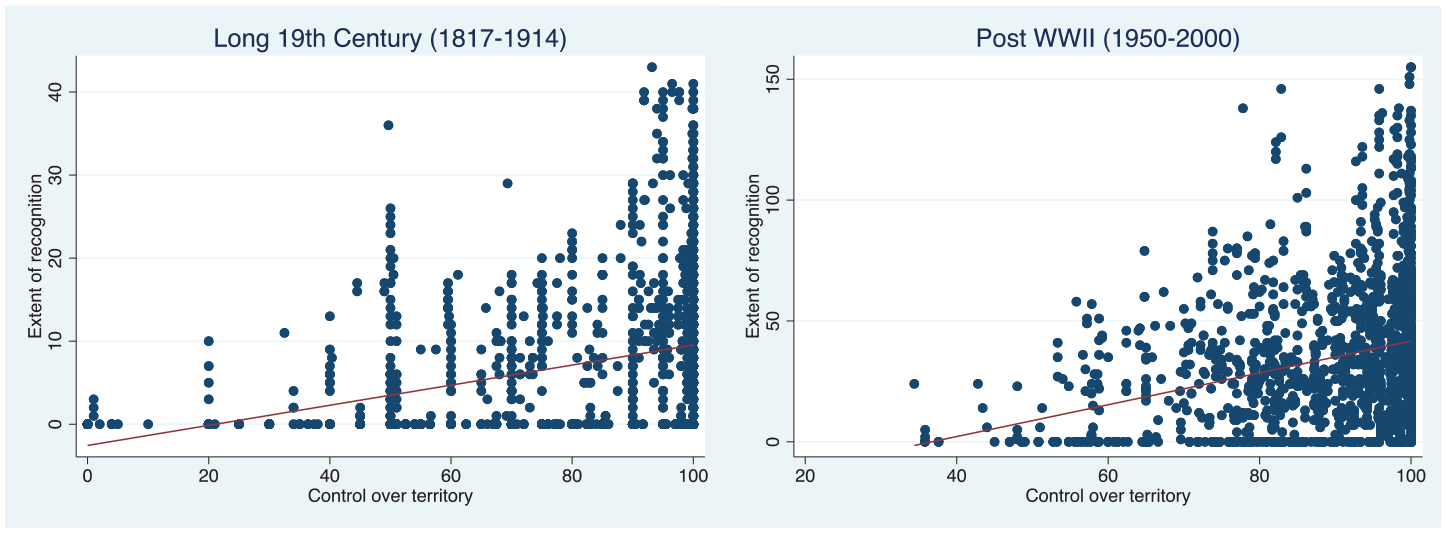
The extent of recognition and control over territory.
Second, both graphs show a clear positive relationship between control over territory and the extent of recognition. The former almost seems to be a necessary condition for the latter, in that very few states that do not control their territory receive wide recognition (in both graphs, the upper-left quadrant is generally empty). These descriptive patterns speak in favor of H1, but, quite surprisingly, against H2.
Tests based on logistic regression analysis are presented in Table 1. To sensitize the presentation to missing data problems, I first present a model which only tests the effect of control over territory in the two time periods. I then add all control variables save for trade, which due to data scarcity leads to a huge loss of observations in both samples (see Supplemental Appendix Table A2). Since the extent of recognition by other states and GDP are empirically correlated proxies for prestige (or power), the third model drops the control for GDP (in the state being recognized). Finally, I also control for trade dependence among dyads.
Determinants of recognition.
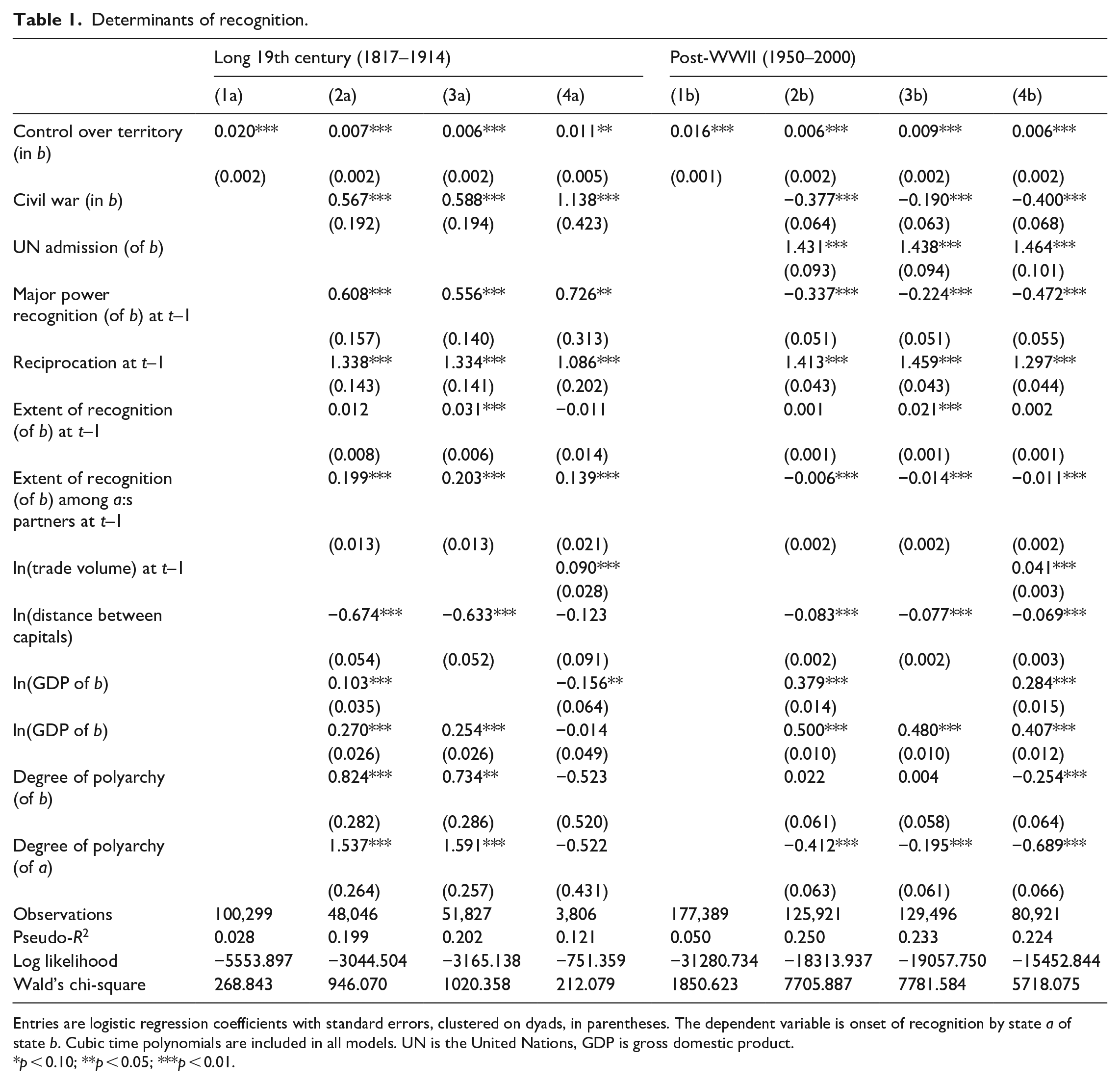
Entries are logistic regression coefficients with standard errors, clustered on dyads, in parentheses. The dependent variable is onset of recognition by state a of state b. Cubic time polynomials are included in all models. UN is the United Nations, GDP is gross domestic product.
p < 0.10; **p < 0.05; ***p < 0.01.
The first model for the historical sample (model 1a) shows that, as argued by Fabry (2010), recognition in the 19th century was at least in part based on having acquired the status of de facto independence. As indicated already by Figure 1, the larger share of its territory a state controls, the more likely that it was to be recognized by other states. This effect is substantively reduced but still remains positive and significant in the presence of all controls, even in the reduced sample controlling for trade (models 2a–4a). States ravaged by civil war were not less but more likely to become recognized in the historical sample, a somewhat surprising result that, however, in itself does not challenge the notion that de facto statehood was the norm underlying recognition practices in the long 19th century.
By and large then, I find support for H1. As an illustrative example of this logic in action, consider the US stance toward recognition of the newly independent states in Latin America. In 1811, Secretary of State James Monroe did not receive a representative from the general captaincy of Venezuela, which had just declared independence from Spain, due to the fact that Venezuelan independence was not “firmly established.” The same happened to the envoy dispatched from the United Provinces of the Rio de La Plata in 1817, but only a year later Speaker of the House of Representatives Henry Clay argued in congress that La Plata should now be recognized on account of having established “a firm government.” “Not a Spanish bayonet,” argued Clay, remained within the Provinces “to contest the authority of the actual government.” A few years later, both Venezuela (now framed as “Great Colombia”) and La Plata, together with three other fledgling Latin American States (Mexico, Chile, and Peru), were for the first time recognized by the United States based on the argument that this “is the mere acknowledgement of existing facts.” To expediate the decision, congress appropriated the required sum to the president in order to dispatch diplomatic missions to the newly independent states (Robertson, 1918: 243–262).
In the contemporary sample, the surprise delivered already in Figure 1 holds water: control over territory does seem to be a significant predictor of recognition also after WWII, when introduced both with and without control variables—and even once recognition by the UN (through membership) is taken into account. Figure 2 plots the probability of recognition, all else equal, across a range of values for control over territory for the two samples based on models 2a and 2b. In the long 19th century, a move from 20% to 100% control over territory increases the probability of recognition by around 1.6, taking control variables into account. The corresponding figure for the post-WWII period is around 1.5. In terms of both the magnitude of the logit coefficient (0.007 vs 0.006) and predicted probabilities, the pattern is thus similar across the two samples (the upward shift of the line in the later period just reflects the fact that recognition became much more common). In other words, H2 is not supported.
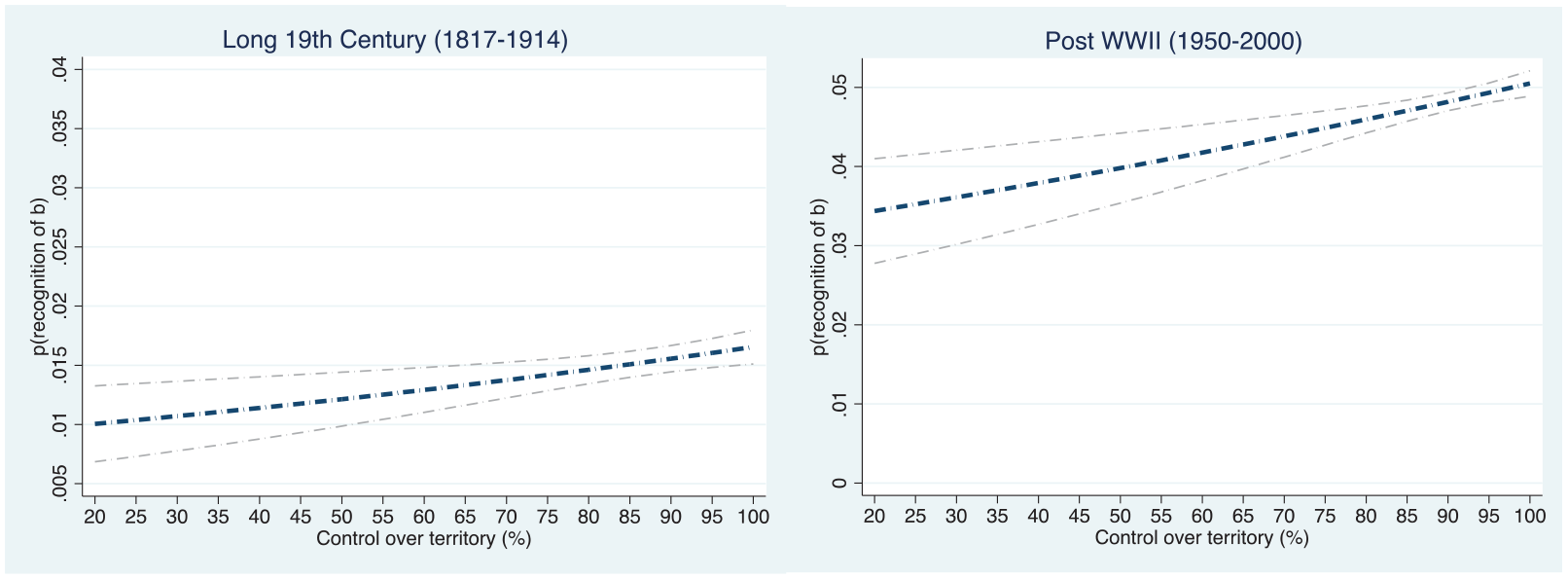
Comparing the effects of control over territory.
How can this finding be reconciled with previous scholarship on the matter? Let us again use the United States as an illustrative example. It has been argued repeatedly that the United States during the period of decolonization meted out recognition as an almost automatic response to declarations of independence, without any inquiry into the status of de facto statehood in the receiving country (Fabry, 2010; Kreijen, 2004; Myers, 1961; O’Brien and Goebel, 1965). While there is no reason to deny that this did mark the birth of a new principle for recognition based on the positive right to self-determination, I still contend that some kind of de facto statehood also undergirded these decisions—or, at least, that this possibility cannot be excluded. What the previous literature has not taken into account, most importantly, is that declarations of independence often followed after anti-colonial insurgencies were put to a rest, and larger control over territory had been reestablished. In Indonesia, for example, a war of independence was fought against Dutch colonial rule resulting in intermittent warfare in 1945–1946 ending with a Round Table Conference at The Hague, which worked out a series of documents which culminated in the transfer of sovereignty. The United States, also a party to the talks, recognized Indonesia in 1949 “by commissioning its representative at the Round Table Conference as ambassador to Indonesia” (Myers, 1961: 714). A similar story can be told about the US recognition of Morocco and Tunisia in 1956, as well as Malaysia in 1957, after the former colonial state (i.e. France and Britain, respectively) granted these states independence in the wake of armed struggles or insurgencies that had by then been put to a rest (Myers, 1961: 715–718; O’Brien and Goebel, 1965). 13 True, there is to the best of my knowledge no positive evidence showing that the US decisions to grant recognition in these cases were based on some observation of de facto statehood. Equally important, however, nor is there any evidence that they were not based on some such observation. Neither Myers (1961) nor O’Brien and Goebel (1965) base their conclusions on any documents attesting to the rationale for the US recognition; this literature merely asserts that it cannot have been based on the de facto principle because it was so speedy. However, the timing of the decisions, that is, the fact that they were taken after the colonial insurgencies, is very much in line with the principle that states should have control over their territory before they can be recognized.
In Supplemental Appendix (Table A3), I show that the positive effect of control over territory on the probability of recognition is robust to several alternative specifications. The result holds, to begin with, also if all state entities are included in the analysis, including those already recognized at the beginning of each time period (1817/1950), as well as, second, if allowing for multiple instances of recognition within each dyad (then also controlling for the number of previous such instances). Third, it is robust to the inclusion of country-fixed effects (for both state a and b). This is an important additional control since it (apart from dropping units that never were recognized or never themselves recognized any other state) takes into account all time-invariant unobservable differences across types of states, such as between former colonies and colonizers. Fourth, and even more importantly, it holds after controlling for (conditional) dyad-fixed effects. What this means is that support for the principle of de facto statehood, both in the long 19th century and in the post-WWII era, also holds when exclusively focusing on variation within dyads over time.
Although not the main concern of this article, a brief discussion of the alternative explanations based on strategic and self-interested motives is in place. States are in both time periods more likely to become recognized, as Coggins (2014) theorize, when at least one major power has already recognized them, although the result for the post-WWII only holds up with country- or dyad-fixed effects in place (see Supplemental Appendix Table A3). Reciprocation is also a mechanism of strategic adaptation that remains stably positive and significant across both time periods. Once multicollinearity due to the control for GDP is avoided (models 3a and 3b), the same goes for bandwagoning (or prestige). Trade, finally, has a consistently positive and significant effect, despite data scarcity.
However, there appears to be a structural shift in the importance of signaling not anticipated by previous work. In the long 19th century, the more a state was recognized by a state’s diplomatic partners (those whom it already recognizes) at time t−1, the more likely it will be further recognized at time t. Contrary to Kinne (2014), however, this is not what I find in the contemporary era, where the coefficient for the extent of prior recognition among a:s partners is negative (and significant). As shown in Supplemental Appendix (Table A3), this seems to be a result of the exclusion from the analysis of all acts of recognition among states already recognized in 1950. Signaling in the post-WWII world order is, thus, primarily a mechanism explaining (re)recognition among the states that were already members of the state system.
Concluding remarks
There seems to be broad agreement in the literature that there is both an internal and external side to state making. States do manifest themselves internally in the extent to which they establish a clear presence and project power over a territory. But in order to fully operate as such, states also need external recognition from other states. In this article, I have even gone further by arguing that the relationship between the internal and external aspect of state making may even be causal in nature, in that international recognition is oftentimes granted or withheld on the basis of an assessment of domestic statehood.
This principle of de facto statehood, as argued by Fabry (2010), was established in the practice of recognition following the Congress of Vienna and then onward during the long 19th century. More precisely, in a large sample of countries between 1817 and 1914, my statistical evidence shows that de facto control over territory can be systematically linked to recognition as proxied by diplomatic representation, when also taking other rival explanations into account. Yet, in the world order that grew out of WWII, my second set of empirical analyses shows that the principle of de facto statehood for granting recognition was still present, contrary to what has been argued in the literature. In another large sample of even more countries between 1950 and 2000, de facto control over territory is still positively linked to recognition proxied by diplomatic representation, all else being equal.
This latter finding is not consistent with Fabry (2010), according to whom the post-WWII (and post-cold war) practice of recognition in the state system completely displaced the principle of de facto statehood in favor of self-determination as a positive international right. To be clear, lacking any empirical proxies for it, my statistical results do not disprove the existence of this new principle for recognition. What they do suggest, however, is that the old principle lingered under the surface. States were still granted recognition to a larger extent when they controlled their own territories (or avoided civil war) in the post-WWII period. Although one should be careful with comparisons across studies using very different research designs and exact conceptualizations, this finding also goes against the grain of Philpott’s (2001) argument for the post-WWII settlement as a revolutionary break with the past; against Jackson and Rosberg’s (1982) and Kreijen’s (2004) argument for a complete disjunction between juridical and empirical statehood (although in their case only with respect to sub-Saharan Africa); against Österud’s (1997: 168) conclusion from a long historical exposé that “no consistent pattern of rules for entry to the state system has emerged”; and against Griffiths’ (2017: 185) claim that “the age of de facto statehood was . . . a unique moment in international life.”
Barkin and Cronin (1994) make an argument more compatible with my finding that the post-Napoleonic and post-WWII world orders are more similar than usually expected. In their terminology, the concept of sovereignty should be seen as a variable norm in the international community that sometimes link the legitimacy of statehood to a defined territory, sometimes to a demarcated nation. The former were in their view predominant in the Treaty of Vienna of 1815 as well as in the Charter of the United Nations of 1945, whereas the latter were predominant at the Conference of Versailles in 1919 (and, although more speculatively so, in the post–Cold War era). Future research should seek to test empirically their posited similarity in recognition practices between the other time periods not covered in this article.
Another fruitful avenue for future research would be to inquire into the mechanisms undergirding the principle of de facto statehood as a relatively stable recognition norm, as well as the reasons why it has gone unnoticed in the extant literature. Largely I agree with Miller et al. (2015) in their definition of a social norm as “a standard of appropriate behavior… that is universally recognized and that can include some form of reward for compliance or sanction for violating the standard” (p. 784). My empirical strategy is, however, one which cannot clearly evidence the presence of any sanctioning mechanisms for behavior not consistent with the principle. Similarly, what my evidence shows is that states, or state leaders, since the Congress of Vienna have acted in a way that is consistent with a belief that recognition should be granted based on de facto statehood and that cannot easily be accounted for by any alternative interpretation. However, I have not been able to evidence that states or state leaders in fact do hold, or has held, this belief. This would require a different research design based on case studies and qualitative evidence.
Supplemental Material
sj-docx-1-cac-10.1177_00108367221093151 – Supplemental material for Rules of recognition? Explaining diplomatic representation since the Congress of Vienna
Supplemental material, sj-docx-1-cac-10.1177_00108367221093151 for Rules of recognition? Explaining diplomatic representation since the Congress of Vienna by Jan Teorell in Cooperation and Conflict
Footnotes
Acknowledgements
I would like to thank Linda Eitrem Holmgren for excellent research assistance in collecting the diplomatic representation data for the long 19th century and to Jens Bartelson, Charles Butcher, Agustín Goenaga, Martin Hall, Johannes Lindvall, Thorsteinn Kristinsson, the STANCE research group at Lund University, participants of the VIP seminar at Norwegian University of Technology and Science, and three anonymous reviewers for very useful comments on previous versions of this article. All remaining mistakes are my own responsibility.
Funding
The author(s) disclosed receipt of the following financial support for the research, authorship, and/or publication of this article: Research for this article was made possible through funding from Riksbankens Jubileumsfond, grant no. M14-0087:1.

Supplemental material
Supplemental material for this article is available online.
Notes
Author biography
References
Supplementary Material
Please find the following supplemental material available below.
For Open Access articles published under a Creative Commons License, all supplemental material carries the same license as the article it is associated with.
For non-Open Access articles published, all supplemental material carries a non-exclusive license, and permission requests for re-use of supplemental material or any part of supplemental material shall be sent directly to the copyright owner as specified in the copyright notice associated with the article.
