




Abstract
Transitional justice is premised on participation that allows local publics to construct, critique and have some ownership over the process. The current scholarship assumes that individuals openly express their views of the process, or that they remain silent. The scholarship has neglected a third, significant form of participation: active withholding of views by saying ‘I don’t know’. This article examines such claims to ignorance and argues that they can provide insight into participation. While both qualitative and quantitative researchers of transitional justice have observed a pervasive pattern of high ‘don’t know’ responses, such claims to ignorance have not been studied. This article develops a theoretical framework that shows that ‘don’t know’ responses are a valuable source of information and argues that they are often an expression of a lack of willingness to respond, rather than genuine ignorance. Drawing on an original corpus of data collected through inter-ethnic focus groups and surveys conducted in four former Yugoslav countries, the study demonstrates how claims to ignorance are constructed as novel manifestations of resistance, restraint or disentitlement. These point to a rejection of transitional justice, which needs to be addressed if individuals are to feel like legitimate participants in the process.
Keywords
Meaningful participation in transitional justice by local publics is crucial to making the process more democratic, more legitimate and more accountable to the public (Vinck and Pham, 2008). Such participation is premised on local publics helping construct and critique transitional justice and its mechanisms, thus integrating public feedback into the work of transitional justice. 1 Scholars of transitional justice have for this reason written extensively about how individuals participate in the process by examining the views they express (in other words, what they say). Now, there is a growing scholarship on participation in transitional justice through silence (in other words, when they say nothing at all). I propose that there is a third, thus far ignored form of participation: claims to ignorance. This participation is an active withholding of views, but not through silence, instead by saying ‘I don’t know’ outright.
This article examines claims to ignorance, such as ‘don’t know’ statements, as a form of participation that has so far been ignored in studies of transitional justice. These responses sometimes make up a significant proportion of answers to questions, but their meaning and implication remain neglected and little understood. I argue that much like expressions of views or silence, claims to ignorance actually display knowledge, awareness and opinion. What we lack is an appropriate framework within which to analyse such responses. This article asks, what do claims to ignorance in transitional justice, such as ‘don’t know’ statements, mean? And, what do claims to ignorance tell us about how individuals participate in transitional justice?
The article regards post-conflict transitional justice as a broad social, cultural and political process (Gready and Robins, 2014: 340). The participation of ordinary individuals at the local level is crucial to its success, since ‘in transitional justice, as elsewhere, all politics is local’ (Arriaza and Roht-Arriaza, 2008: 153). Researchers studying political participation have long recognised the significance of ‘don’t know’ answers and their broader implication for understanding political processes (Gilljam and Granberg, 1993: 348). Most importantly, they show that ‘don’t know’ responses should be treated as sources of information, rather than simply challenges to overcome. The responses can be a question of willingness, rather than skill, and may indicate political abstention (Laurison, 2015: 930). ‘Don’t know’ responses therefore conceal a good deal of knowledge about transitional justice.
The article next discusses the prevalence of claims to ignorance in transitional justice research. This is followed by a discussion of the theoretical basis on which to interpret claims to ignorance. The subsequent analysis is based on survey and focus group data from Croatia, Bosnia-Herzegovina, Kosovo and Serbia. These show how claims to ignorance can be interpreted as a form of participation in transitional justice.
The prevalence of ‘don’t know’ responses in transitional justice research
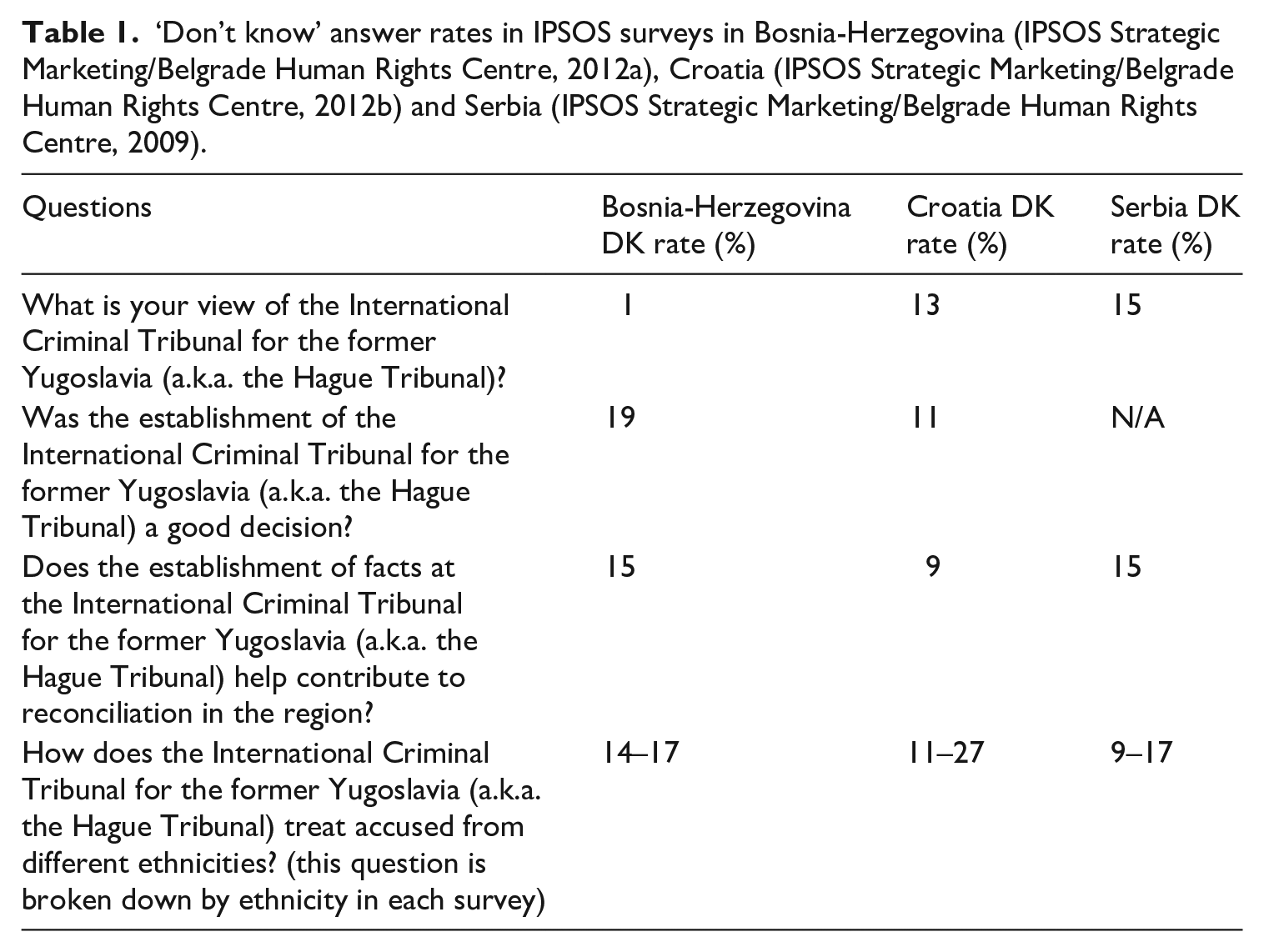
High rates of ‘don’t know’ responses are prevalent across much of transitional justice research. Surveys consistently find that particular questions or particular groups of respondents give a high proportion of ‘don’t know’ or ‘no response’ answers, even when it seems reasonable that everyone may have an opinion on the topic (see, for example, Aguilar et al., 2011; De Juan and Koos, 2021; Gibson, 2005; UNDP, 2012). A series of surveys conducted by IPSOS in Bosnia-Herzegovina (IPSOS Strategic Marketing/Belgrade Human Rights Centre, 2012a), Croatia (IPSOS Strategic Marketing/Belgrade Human Rights Centre, 2012b) and Serbia (IPSOS Strategic Marketing/Belgrade Human Rights Centre, 2009), which are also replicated in this study, illustrate this (Table 1).
‘Don’t know’ answer rates in IPSOS surveys in Bosnia-Herzegovina (IPSOS Strategic Marketing/Belgrade Human Rights Centre, 2012a), Croatia (IPSOS Strategic Marketing/Belgrade Human Rights Centre, 2012b) and Serbia (IPSOS Strategic Marketing/Belgrade Human Rights Centre, 2009).
Scholars ignore or under-theorise these responses. For example, De Juan and Koos (2021), in their analysis of survey participation effects in conflict research, hypothesise that individuals who have been surveyed more than once should have lower ‘don’t know’ response rates, but they find no significant change to these rates. Gibson (2005) notes the lack of opinion on numerous questions in his research on the South African transitional justice process. Aguilar et al. (2011: 1408) interpret high rates of ‘don’t know’ answers as hesitancy, but do not expand on this. These studies are a good example of how these types of responses are identified as significant response categories, but they are not theorised as being significant to transitional justice. This study addresses this gap and argues that claims to ignorance do in fact reveal knowledge and opinion about transitional justice.
It is fair to assume that a certain proportion of ‘don’t know’ responses are given due to a genuine lack of knowledge. However, researchers have consistently shown that lack of knowledge is not the sole reason for ‘don’t know’ responses (Laurison, 2015: 929). For example, respondents to surveys often express opinions even when they may prefer not to: when questions explicitly include ‘don’t know’ as a response option, an additional 20%–25% of respondents choose that response, compared with an identical question without a ‘don’t know’ answer (Schuman and Presser, 1979). In other words, individuals are prepared to express an opinion when a ‘don’t know’ answer is not available, rather than leave the question unanswered.
The lack of a clear relationship between actual and reported lack of knowledge means that something other than technical competence can generate claims to ignorance (Laurison, 2015: 930). What all claims to ignorance have in common is that they are an abstention from entering an opinion or an unwillingness to express an opinion. The reasons for the abstention are important for transitional justice, since they tell us something about how and why individuals participate in the process. They point to a lack of meaningful participation that involves integrating feedback received from individuals into transitional justice mechanisms, since individuals do not want to provide direct feedback (Triponel and Pearson, 2010: 107).
Interpreting ‘don’t know’ responses in transitional justice
Scholarship on political participation shows that ‘don’t know’ responses often do not occur due to a genuine lack of knowledge, but what is hiding behind these responses in transitional justice is little understood. I draw on the literatures on silence in transitional justice, restraint in peacebuilding and social competence to interpret these responses.
‘Don’t know’ as resistance
‘Don’t know’ responses can be interpreted as resistance, if using a conceptual framework drawn from the scholarship on silence in transitional justice. Transitional justice focuses on voice, truth-telling and coming to terms with the past, and silence has often been equated with denial (Nagy, 2013: 64; Obradović-Wochnik, 2013: 330). Silence and claims to ignorance are seen as antithetical to the process. They can be interpreted as implicatory denial, where an individual fails to recognise or acknowledge the significance of what one knows (Cohen, 2001). But, silence in transitional justice has been shown to be more nuanced and important to the process than initially thought, in great part because it is agential (Clair, 1998). This approach can also be applied to claims to ignorance.
Silence can be a fully agential act that can help create and re-create social realities as much as voice and language (Clair, 1998: 162). Claims to ignorance are relevant for similar reasons. They can express agency, including discontent and opposition. Like silence, these responses can be used as a form of resistance (Clark, 2020: 368). They can be enabling, because they can make claims and exercise individual authority in the face of power (Mannergren Selimovic, 2020: 11). For example, in the context of memory, the responses can be a way to retain control over a memory which the narrator does not want to share with others (Mannergren Selimovic, 2020: 12).
Such resistance can be constructive for transitional justice. For example, victims or local publics may not agree with transitional justice’s focus on legalistic language and legal concepts, which frames transitional justice only in legal terms (Hinton, 2018: 195). Resistance is perhaps then desirable in transitional justice processes, since it shows that conceptions are never shared by all and it can thus be an engine for change (Lilja et al., 2017: 41). Claims to ignorance as a refusal to speak allows individuals to retain control of their narratives, but not through silence, instead through an active refusal to say something. They are silence through words. This can be resistance towards an expectation for them to share memories, to tell the truth or to come to terms with the past. For example, individuals can challenge a dominant narrative, not through verbal articulations, but through the act of ‘just being there’ (Mannergren Selimovic, 2020: 12). The implication is that if we conceptualise claims to ignorance as resistance and treat them as valid objects of inquiry, rather than dismissing them as a form of denial or deviance, then we can reveal an alternative form of participation that is currently being ignored (Jones, 2016: 80).
‘Don’t know’ as restraint
‘Don’t know’ responses can also be interpreted as a form of restraint if drawing on the scholarship on restraint in peacebuilding. People may use claims to ignorance to steer clear of negative judgements, to avoid alienating people around them, to maintain harmonious social relations, to show mutual respect when it is obvious that there is no common ground to sustain a civil discussion and to adhere to social norms (Conover and Searing, 2005: 272). For example, individuals who hold unpopular beliefs can give ‘don’t know’ responses on sensitive topics, such as those of racial equality, since they may find them to be socially, rather than cognitively, difficult (Berinsky, 1999: 1212). Claims to ignorance, as a form of abstention, can be seen as a way of holding back to avoid provocation and conflict, which rational people can use to navigate post-conflict societies (Eastmond and Selimovic, 2014: 524).
Claims to ignorance can thus be a strategy for coping with insecurity in the aftermath of conflict, when routine interaction with the opposing group is challenging (Mannergren Selimovic, 2020: 10). They can be a strategy to maintain civility, based on tolerance, ambiguity and ritual politeness (Mac Ginty, 2014; Ware and Ware, 2021). It is a way for individuals to participate in day-to-day life following conflict, which translates into how they participate in the process of transitional justice. The strategy can be beneficial to individuals in precarious situations, since it can help them survive, maintain dignity and rebuild a sense of normality (Eastmond, 2010: 12). This practice requires individuals to follow the same ground rules and to operate within a shared framework of understanding (Mac Ginty, 2014: 554). They maintain peace by actively disengaging from interactions (Ring, 2006: 163). Restraint can thus enable post-conflict communities to function without further bloodshed (Clark, 2020: 369). Individuals maintain a peaceful status quo by avoiding, abstaining and restraining from attempts at transitional justice and they can be viewed as potential agents of change (Shaw and Waldorf, 2010: 13).
‘Don’t know’ as disentitlement
Finally, ‘don’t know’ responses can also highlight a broader indifference that ordinary citizens feel about the political systems they inhabit, as the scholarship on social competence has shown. This indifference is caused by a lack of subjective or social competence to deal with political affairs, to express an opinion about them or to modify their course (Bourdieu, 1984: 399). ‘Don’t know’ responses are common when questions are removed from everyday experience, abstract and detached from ordinary realities (Bourdieu, 1984: 401). Bourdieu (1984: 406–412) shows that ‘don’t know’ rates therefore increase when questions are constructed without direct reference to the experiences or interests of the groups concerned (in transitional justice, this could be a specific ethnic group or victims more generally); ‘don’t know’ rates increase when questions appear to be scientific, since they reinforce a sense of incompetence in respondents (in transitional justice, this could take the shape of legalistic language); and, ‘don’t know’ rates decrease when individuals feel a sense legitimacy in speaking about a topic and when there is apparent self-interest involved (in transitional justice, this could mean questions are too far removed from respondents’ lived experiences). Politics generally, but this also holds true for transitional justice specifically, is thus constructed as restricted to a closed elite, rather than open to individuals across society (Laurison, 2015: 944).
This indifference can be conceptualised as disentitlement in transitional justice: that the intended beneficiaries of transitional justice efforts feel that transitional justice is dominated by and intended for someone else. The key institutions that govern transitional justice are seen as alien to local publics and ‘don’t know’ responses can be a way for individuals to show they feel disentitled and it can even be interpreted as an attempt to subvert the process (De Certeau, 1984). Such disentitlement is implicit in some writings on transitional justice that examine the marginalisation it has caused with victims (Aguirre and Pietropaoli, 2008; Madlingozi, 2010). It is also reflected in studies that show how the predominantly legal discourses of transitional justice can alienate the very people they are meant to help (Gready and Robins, 2014: 343). Claims to ignorance as disentitlement have significant implications for transitional justice, since individuals’ sense of competence, rather than actual skills and knowledge, becomes key for any kind of engagement with the process. If ordinary citizens see transitional justice as something only for other types of people, then no amount of barrier-lowering will increase participation.
Methods and data
The data in this study are drawn from focus groups and surveys conducted in Croatia, Bosnia-Herzegovina, Kosovo and Serbia in 2019 and 2020. The conflicts that followed the breakup of the Socialist Federal Republic of Yugoslavia began in 1991 and continued, with intermittent breaks, until 2001. The four states being studied were most intensely involved in the fighting. In the countries being studied, the fighting can be summarised as: in Croatia, Croats against Serbs and Montenegrins (1991–1995); in Bosnia and Herzegovina, between Croats, Bosniaks (Bosnian Muslims) and Serbs and Montenegrins (1992–1995); and, in Kosovo, Albanians against Serbs and Montenegrins (1998–2001). This was particularly complex in Bosnia-Herzegovina, where Croats and Bosniaks were first allied, but then fought each other after this alliance broke down. In response to the violence and to mass atrocities, the United Nations set up the International Criminal Tribunal for the former Yugoslavia (ICTY). This ad hoc court operated from 1993 to 2017 and it was the most visible mechanism of transitional justice in the region. States also held and continue to hold domestic war crimes trials dealing with the conflict. Less visible, but present, have been civil society initiatives and a variety of truth-seeking efforts.
One of the lasting effects of the conflict has been the change in ethnic composition of the region. Political and societal interaction in all states of the former Yugoslavia is defined by identity politics and structural segregation that limit and prohibit positive routine contact between members of different ethnicities. Transitional justice initiatives remain controversial in the region. States see verdicts against their own ethnicity as a condemnation of their state and nation building projects (see, for example, Pavlaković, 2010); war veterans are highly influential and opposed to many facets of the process (see, for example, Fisher, 2003); local publics generally reject the process (see, for example, Subotić, 2009); and nationalist politicians have also been able to hijack the process in order to use their appearances in trials as pulpits for their politics (see, for example, Steflja, 2018).
The four countries were selected as typical cases of post-conflict transitional justice (as has been argued elsewhere, see, for example, Kostovicova and Paskhalis, 2021: 267). The cases can explain both the theory more generally and the processes in the countries specifically (Gerring and Cojocaru, 2016: 408). The conflicts occurred along identity lines, based on ethnicity, and these divisions have resulted in structural segregation that persists today. The conflicts also featured a typical transitional justice response, which included international (the ICTY) and domestic legal responses (both domestic and hybrid war crimes tribunals in the states), as well as civil society efforts (e.g. attempts to set up truth commissions). These efforts at transitional justice were also often rejected by local publics. The cases were thus typical in that they help contribute to contingent generalisations and theory development that can explain some, although not all, cases (George and Bennett, 2005: 32).
Focus groups
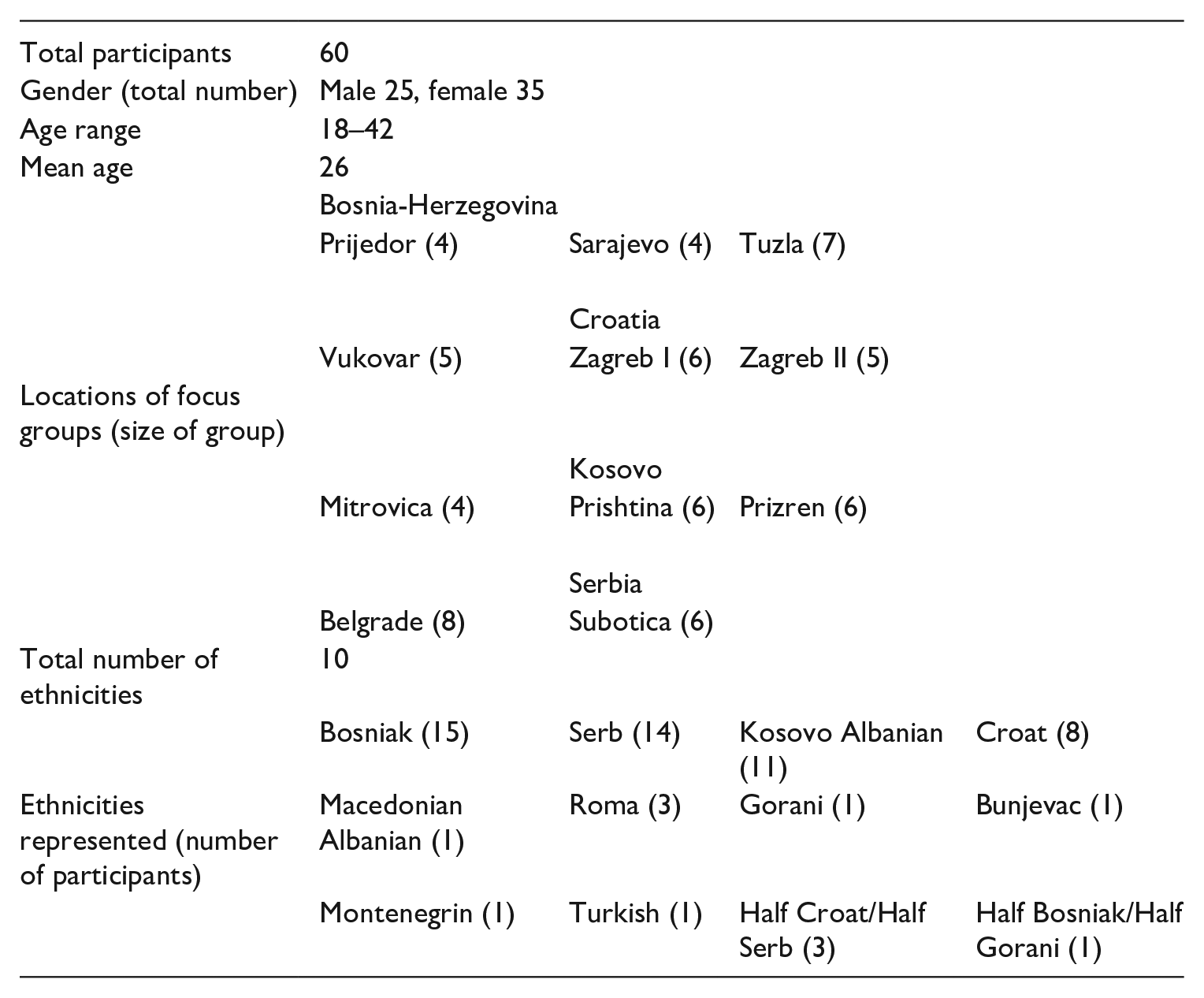
Focus groups are well-suited to this type of research since they reveal how people construct, oppose and re-evaluate concepts through interaction (Cyr, 2017: 1038). A total of 11 focus groups were conducted involving 60 individuals in total. Snowball sampling – one of the most popular methods of sampling in qualitative research, based on networking and referrals – was used for participant recruitment (Parker et al., 2019). Three groups were held in each country, with the exception of Serbia. 2
The use of focus groups to discuss topics that are otherwise avoided in everyday life raises ethical concerns, since it may be asking individuals to break silence they would otherwise keep. Participants were made aware of the topics to be discussed and consented to taking part. The recruitment process itself also involved some brief informal discussions about transitional justice. In this sense, the recruitment process itself and participants’ willingness to participate in the groups was a further control for a genuine lack of knowledge, since participants were at least likely to know something about these topics in order to agree to take part. In addition, focus groups are particularly well-suited to this context, since they provide a respectful, safe and humane environment for emotionally charged discussion (Morgan and Krueger, 1993: 16–18). Appropriately run, they can become empowering and transformational (Magill, 1993). Especially in the context of young individuals, they can treat individuals as part of a solution rather than as a part of the problem (McEvoy, 2000: 91).
All groups were composed of young individuals (35 years of age or younger) of different ethnicities. 3 The focus on young individuals biases the data since this is a segment of the population that is less interested in politics generally, as well as transitional justice specifically. However, the reasons behind this lack of interest warrant investigation and young people in Yugoslavia are crucial to the success of transitional justice. At the policy level, young people are increasingly seen as crucial to transitional justice processes. 4 Young people’s voices are crucial to gaining a complete understanding of the effects of conflict on a society, even though judicial institutions often overlook youth interests and perspectives. This can leave them disempowered from the process of transitional justice. Theoretically, young people are crucial to transitional justice since transformation occurs across generations. Young people are often the catalysts for the resistance of divisive politics, and they can envision improvements in a society due to their unique perspectives. Comparatively, it also makes sense to look at young people in the former Yugoslavia since we are reaching a point similar to Germany in the 1960s, when younger generations began to challenge silence about the crimes of National Socialism (Moeller, 2005). Understanding the perspectives and needs of the next generation is thus key to ending cycles of impunity.
Such inter-ethnic focus groups are first of a kind in a regional study of the Balkans, since levels of segregation make recruitment difficult. The constant across the groups was their inter-ethnic composition. This enabled me to test claims to ignorance in the context that matters most for transitional justice: in discussions between ethnic others. This also potentially skews the data, but it is a key goal of transitional justice to allow individuals to discuss the past across ethnic lines. Much of the work of transitional justice is thus meant to happen in the inter-ethnic context. Key studies on resistance, restraint and disentitlement, which this study cites, use inter-ethic interactions and contexts as the focus of their analysis. Mannergren Selimovic (2020: 12) writes about how returnees use silence in interactions with their ethnic ‘Others’; Mac Ginty (2014: 549) starts his article on restraint with an outline of interactions in ethnically mixed company; and Gready and Robins (2014: 347) write on disentitlement in the context of collective identities that fuel conflict between groups. The inter-ethnic setting is central to these studies, and is a crucial context within which to examine processes of transitional justice.
The group discussions were semi-structured and lasted between 1 and 2 hours. 5 All groups were conducted in the local language (Albanian/Bosnian/Croatian/Serbian), apart from the group in Mitrovica, Kosovo, that was conducted in English. This was because Serb and Albanian youths do not speak each other’s languages and instead communicate in English. Discussions began with broad questions about transitional justice institutions and processes in the region and then moved on to a discussion of one of the best-known cases at the ICTY, that of Radovan Karadžić. Karadžić was the President of Republika Srpska, in Bosnia-Herzegovina, during the conflict. He was a fugitive from the ICTY from 1996 until 2008, when he was captured in Belgrade, Serbia. In 2016, he was found guilty of war crimes and crimes against humanity, as well as genocide in Srebrenica specifically. The crimes targeted Bosniaks and Croats in Bosnia-Herzegovina. In 2019, the Tribunal rejected his appeal against the conviction and sentenced him to life in imprisonment. Second only to Slobodan Milošević, Karadžić was the most powerful political figure on trial at the ICTY.
The case was first discussed in the group, then participants were given a prop: a Case Information Sheet that provided an overview of the case. 6 After reading about the case for 5 minutes, participants then further discussed the case. After discussing the case, each group discussed the work of the ICTY overall and was then given a final prop: a document produced by the ICTY to summarise its work graphically. 7 These sheets formed part of the ICTY’s outreach effort. The props were used to provide factual knowledge to participants, in order to control for a genuine lack of knowledge. This allowed me to show that ‘don’t know’ responses were a question of willingness, rather than a lack of factual knowledge and that they should be treated as sources of information and as a form of participation.
Ideally, the props would have been provided for longer, but this was not possible given the time constraints of focus groups. However, respondents continued to read parts of the case information sheet throughout the session and continued to refer to it. The ICTY summary sheet, however, is only a one-page visual illustration that does not require much time to digest. Since individuals likely had opinions on and knowledge of transitional justice – because they agreed to take part in focus groups on the topic in the first place – the props were actually prompts as much as they were material to learn from.
Surveys
I conducted a survey of all focus group participants, both before and after the discussions (see Appendix 2). The survey was composed of six demographic questions (only asked in the first survey) and five questions about transitional justice (asked both before and after). I could, therefore, compare how ‘don’t know’ rates changed after I introduced information on the ICTY to participants. The five questions on transitional justice were drawn from nationally representative surveys on transitional justice and the ICTY that had high rates of ‘don’t know’ answers (outlined above in Table 1). They were chosen because they do not require much knowledge, since they deal with transitional justice generally rather than with specific cases or events.
The first survey with 11 questions was handed out to participants prior to the commencement of the focus group, but only after they read the study information sheet and signed the consent form. Participants then handed the surveys to the researcher. Once the focus group was over, participants were handed the second survey composed of five questions, which they filled in and handed back to the researcher. The questions and answers can thus be compared to generalisable findings from representative surveys. This research design allows me to track changes in ‘don’t know’ rates after individuals have had a chance to discuss the topic of transitional justice. This is crucial for the research design, since it allows me to discount genuine ignorance from responses.
Discourse analysis
I analyse the focus group transcripts qualitatively to understand how claims to ignorance are constructed and what purpose they serve in discussions. The analysis encompassed segments of focus group discussions that began before the introduction of the Karadžić case information and ended after the introduction of the ICTY summary sheet. The questions asked before and after each prop was handed out were replicated across all groups in order to produce more structured and comparable data (see Appendix 3 for an outline of the questions). These segments from the focus group discussions were then conceptually coded to begin creating links between the data and the theoretical framework (Coffey and Atkinson, 1996). Using the theoretical framework, I coded statements related to a lack of knowledge and an unwillingness to answer questions, as well as broad comments about knowledge (e.g. about gaining knowledge), into the three categories outlined earlier. I then used discourse analysis to analyse how the construction of claims to ignorance constitutes an expression of resistance, restraint or disentitlement in transitional justice.
In the following section, I first present the results from the survey element of the study to compare the change in ‘don’t know’ rates after information on the topic has been introduced. I then present the focus group data and the results of the discourse analysis to show how claims to ignorance can be interpreted as resistance, restraint or entitlement.
Analysis
Survey results
The survey results show the frequency of ‘don’t know’ responses among focus group participants. Both the pre-focus group and post-focus group survey questions featured high rates of ‘don’t know’ responses (Figure 1). These same questions received high ‘don’t know’ rates in nationally representative surveys conducted across the region (Table 1). Two points are worth noting from the survey results. First, rates of ‘don’t know’ responses are high even when a question is not skill- or knowledge-based and it is reasonable to expect most people to have an opinion on the topic. For example, whether an individual has a positive or negative view of the ICTY does not necessarily require deep knowledge of the institution, since it was such a high-profile project. Second, although ‘don’t know’ response rates go down in the post-survey, they still remain high. This occurs despite introduction of information on transitional justice and the ICTY, and despite that individuals had an opportunity to discuss the topics. This shows that genuine lack of knowledge is unlikely to be the cause of the responses.
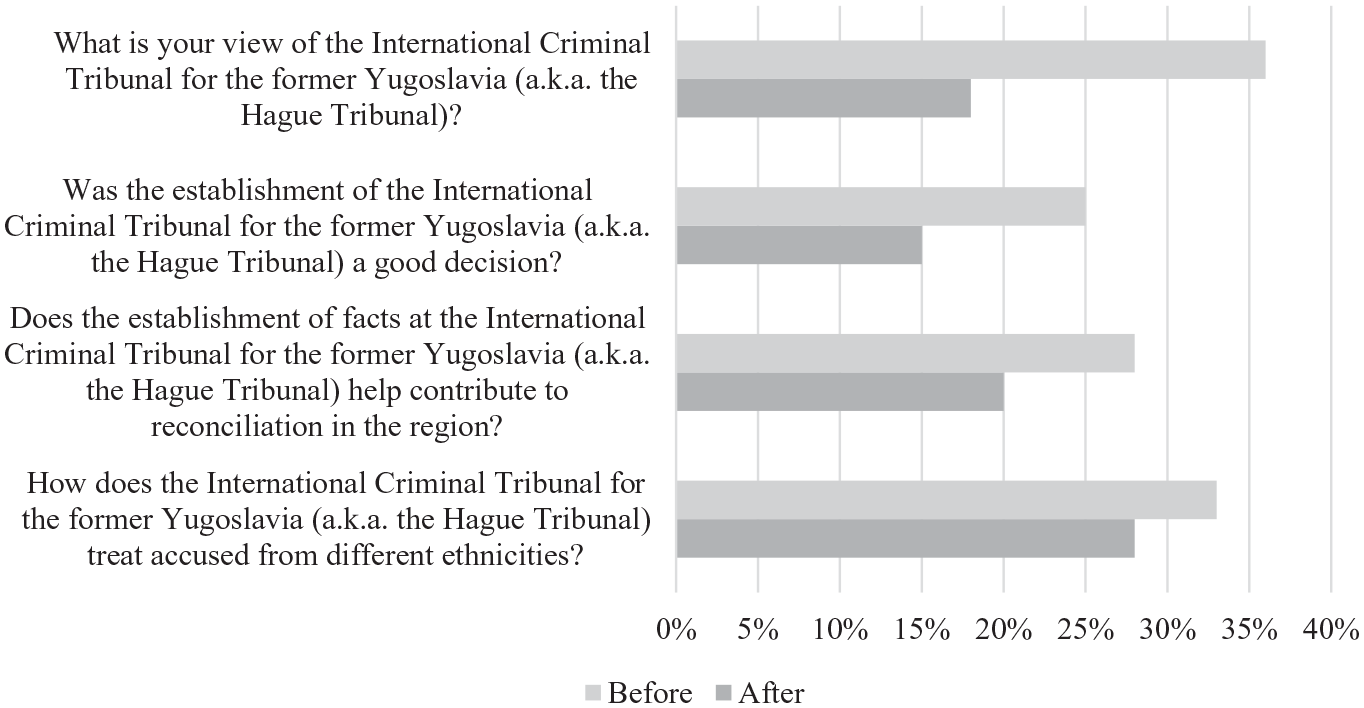
Rates of ‘don’t know’ responses in pre-focus group and post-focus group survey results (n = 60).
To further show that ‘don’t know’ responses are used to express opinions, rather than a lack of knowledge, I traced how many individuals expressed an opinion in the pre-survey, but then changed their response to ‘don’t know’ to the same question in the post-survey (Table 2). This would imply that they were initially willing to offer an opinion, but following the introduction of the information sheets and a group discussion, they no longer were. A lack of skill or knowledge is thus unlikely to be the cause of these ‘don’t know’ responses (Laurison, 2015: 930).
Number of individuals who changed answer from an opinion to a ‘don’t know’ answer.
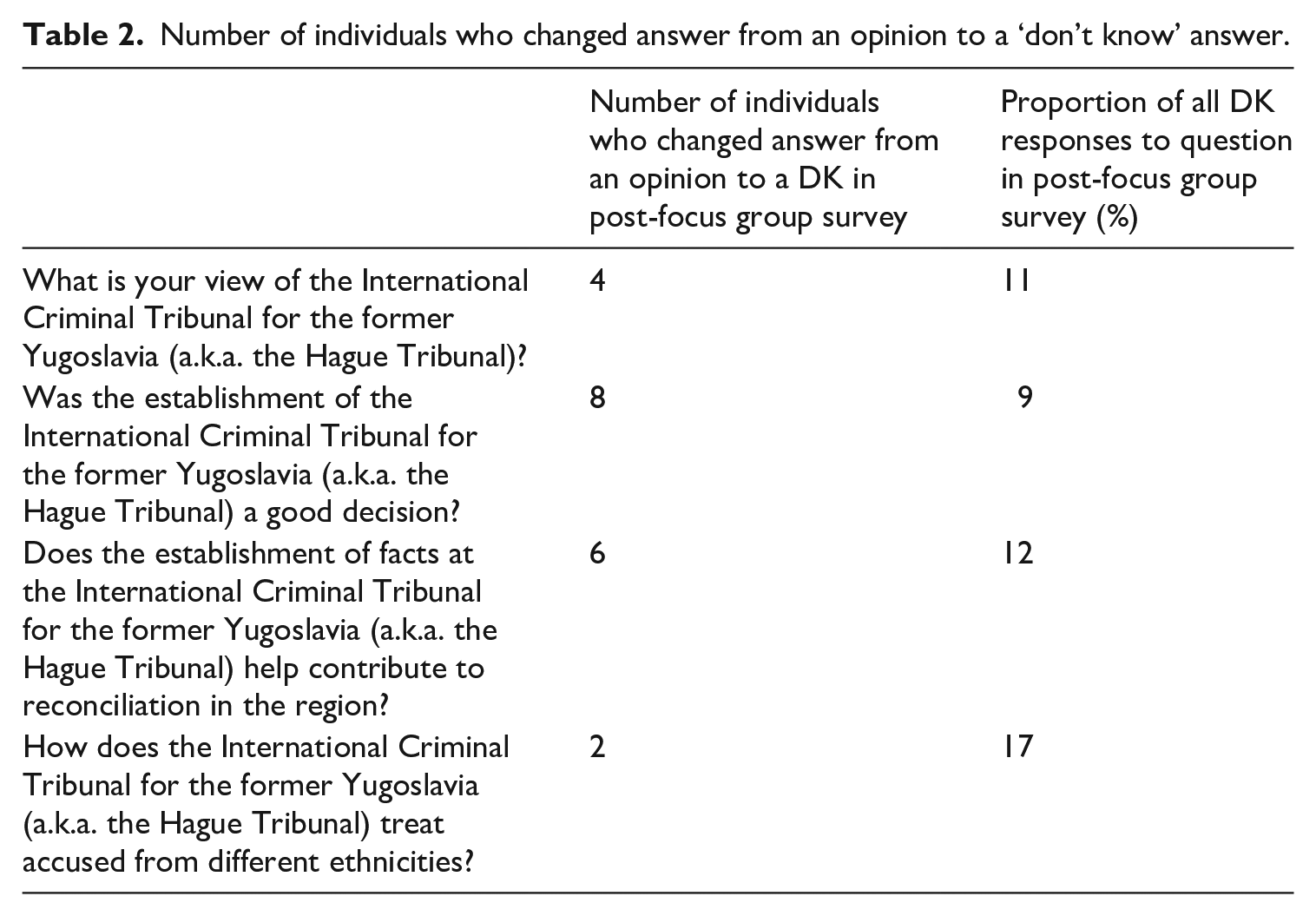
The general trend in these results is that ‘don’t know’ responses are being used to abstain from answering, rather than expressing a genuine lack of knowledge. The variation in ‘don’t know’ rates and changes in rates show how genuine lack of knowledge, normative expectations and identity can influence participation. The first question may reflect genuine ignorance, since it had the biggest drop in ‘don’t know’ responses. If a person was genuinely ignorant about the ICTY, but after receiving information on it and discussing it they formed an opinion, then a large drop in ‘don’t know’ answers is to be expected. This question also saw a large change in positive opinions about the ICTY, from 26% to 40%. Most of these additional responses came from respondents who previously answered ‘don’t know’, thus indicating that they may have gained knowledge about the institution and then formed an opinion.
The second and third questions have a strong normative element, since much of the public in the Balkans, other than in Serb-dominated areas, does believe it was the right decision to establish the ICTY, but they do not believe it was implemented well (Sokolić, 2019: 102). Likewise, most individuals support fact-finding and reconciliation, but may disagree over how it is being done or what facts need to be unearthed. The high ‘don’t know’ rates here more likely point to abstention, since they are normatively loaded and there is a risk of expressing a social undesirable opinion (Berinsky, 1999: 1212). The fourth question, which had a high rate of ‘don’t know’ responses and little change, is also the most closely connected to ethnic identity constructions, since individuals consistently find the ICTY biased against their own ethnicity in the above mentioned nationally representative surveys. We can thus expect individuals to have an opinion on this, but for this opinion to be difficult to change. The results support this assumption, since the ‘don’t know’ rate remained high for the question.
The survey data show that a lack of information does not necessarily result in ‘don’t know’ responses. However, these data do not show us the further meaning in claims to ignorance. I use discourse analysis to explore this, by examining focus group discussions. Only by following what happens in a conversation beyond and around the claim to ignorance does it become apparent how a claim to ignorance can acquire a different meaning.
Resistance, restraint and disentitlement in ‘don’t know’ responses
The segments presented below are ideal types of resistance, restraint or disentitlement in transitional justice. 8 All of the segments have three components: a claim to ignorance, an observable statement that the individual has at least some knowledge of the topic, and, a statement or several statements that indicate the meaning behind the claim to ignorance. This structure allows me to first rule out genuine ignorance and to then interpret the claim to ignorance as something else. To a certain extent, genuine ignorance may be present in all of the statements. However, this should not preclude individuals from having an opinion on something that does not require expert knowledge.
Resistance
In the focus groups, individuals used ‘don’t know’ expressions even when it was apparent, they did know something or had an opinion on a topic. This opinion, which they went on to express, was one of discontent, opposition and resistance. In the example from Prishtina (Kosovo) below, after being shown the ICTY summary sheet, participants move on to discuss domestic war crimes trials. The participants repeatedly use variations of ‘don’t know’ statements (in bold). However, they also appear to have knowledge of the topic and they work together to offer opinions on it. For example, Gezim follows his ‘don’t know’ statement with an opinion. Later, when prompted by the moderator, he goes as far as interjecting into Ndrita’s speech with his own opinion regarding ‘Vasfije’. 9 By following the conversation beyond the claim to ignorance, it is possible to rule out genuine ignorance:
I have heard of a case, but I still
We are talking about the administration of UNMIK and EULEX, but there were other initiatives by. 10
Do they also count for example those who have been victims of rape? OK, but what they have is very few, meaning there is a disproportion with what really happened but there are cases, for example where they have denounced those rapists which have committed wartime sexual violence.
What do you remember?
Pardon?
I’m asking what do you remember most?
The case of.
Vasfije.
I
No.
But there is one initiative.
She presented her case to the EULEX and the police, but [they ignored it.]
The participants in this passage are constructing a criticism. This is evidenced by statements such as ‘if she has got justice yet’ and ‘they ignored it’, which are criticisms of transitional justice institutions that did not provide justice and ignored the plight of a victim. This type of criticism is a form of ‘infrapolitics’, or everyday resistance (Clark, 2020: 369). It is muffled and indirect resistance that is made up of many small acts, such as the statements earlier (Scott, 2005: 65). These small acts construct transcripts that individuals can use to construct their everyday resistance (Lilja et al., 2017: 51). Such resistance is cooperative, unlike confrontational resistance, and it can be constructive for transitional justice (Lilja, 2022). Individuals can be inspired by such resistance; it can encourage others to take part and to innovate with new forms of resistance (Lilja et al., 2017: 52).
This resistance to transitional justice stems from dissatisfaction and disappointment with the process and its institutions. The respondents claim they ‘don’t know’, but they go on to express views concerning transitional justice that can be interpreted as resistance. The resistance can be muffled and indirect (see Appendix 4 for such an example), but it can have an aggregate effect given the prevalence of ‘don’t know’ responses in transitional justice research. These small-scale changes may look trivial, but they can have a significant impact on the process and can construct new vision of it (Lilja, 2022: 7). Thus, by further exploring these types of claims to ignorance, we can reveal how individuals are expressing agency and resisting transitional justice.
Restraint
Participants used claims to ignorance as restraint to avoid negative judgements, to maintain social relations, to show mutual respect or to adhere to social norms (Conover and Searing, 2005: 272). Again, it is apparent in these statements that individuals have knowledge about a topic, but they are using various forms of ‘don’t know’ statements to abstain from the discussion. Below in two examples from Mitrovica, a segregated city in Kosovo, participants repeatedly abstained in this way as a form of restraint.
The focus group in Mitrovica was at times contentious. It consisted of three Kosovar Albanians and one Kosovar Serb. The participants disagreed over many issues related to Kosovo’s statehood and the conflict. However, the majority of the discussion was broken up by repeated attempts to maintain harmonious relations and ‘don’t know’ statements regularly featured in these attempts. Below, before the Karadžić case information sheet is introduced, Jelena (the Serb participant) exhibits knowledge about Karadžić, but does not immediately offer it and follows each contribution with a claim to ignorance. She knows Karadžić is Serbian, but follows that with an ‘or’; she knows he has been hiding, but follows that with ‘or something like that’; and she knows he was involved in military actions, but she says she ‘doesn’t know’. Repeatedly, she is exhibiting knowledge and simultaneously making claims to ignorance (in bold):
Anybody else? Has any opinion on ICTY work? So we can move on to a different set of questions. Have you ever heard of the name Radovan Karadzic?
Yes (Jelena agrees).
What do you know about him?
(Murmur amongst the group)
Can you tell us what you know?
He is Serbian right?
Whatever you know, can you please tell it?
I think he has been hiding for a long time. In order not to be found,
I mean, he is the killer of . . .
Where did you hear the name Radovan Karadzic?
We learned about his name, nothing more. But we know because he was, he was a killer.
Actually, a soldier.
Jelena’s final comment is perhaps the best of evidence of restraint. Valon and Afrim referred to Karadžić as a killer, but Jelena interjects with a correction, ‘actually, a soldier’. She then follows this with another ‘don’t know’, which does not necessarily indicate lack of knowledge (although Karadžić was a politician, rather than a member of the military), but instead, it shows restraint. Jelena’s knowledge and views on the sensitive topic may be unpopular in the group and she thus repeatedly provides ‘don’t know’ responses to avoid this social, rather than cognitive, hindrance (Berinsky, 1999: 1212). Her statements are constructed to hold back to avoid provocation and to navigate this sensitive post-conflict and inter-ethnic context (Eastmond and Selimovic, 2014: 524).
What is not happening in this passage is as indicative of restraint, as what is happening. Participants make no attempt to resolve any lack of knowledge, by for example brainstorming (the example in Appendix 4 is a further example of this). This restraint is enabling, since it allows the individuals to avoid conflict and thus to continue their exchange, however limited it might be. This is a coping strategy in an insecure post-conflict context, where interactions with the formerly opposed ethnic group can be difficult (Clark, 2020: 369). It is actively making a claim by saying nothing. Jelena’s repetition in the segment is also indicative of restraint. The repetition shows that the participants have found, or perhaps already had, a mutually accepted repertoire of responses in such situations. The participants are paying careful attention to the actions and manners of the Other; they are being quiet and gentle; and, using a constructed, semi-scripted ritualised system of interaction (Ware and Ware, 2021: 12). They understand the ground rules of interaction and share a repertoire that enables them to maintain peaceful relations and civility (Mac Ginty, 2014: 554).
The example from Mitrovica illustrates how claims to ignorance, understood as restraint, can show us how individuals build a sense of normality in a precarious context. Claims to ignorance enable this. They can form part of a ‘repertoire of conflict avoidance and conflict-minimizing skills’ that people in deeply divided societies employ (Mac Ginty, 2014: 554). This is not passive silence or avoidance, it is an intense and laborious effort to disavow knowledge and thus actively disengage (Ring, 2006: 163). This type of abstention in transitional justice is a way of maintaining a peaceful status quo and of transforming conflictual relationships (Shaw and Waldorf, 2010: 13).
Disentitlement
Finally, participants used claims to ignorance to show disentitlement from the process of transitional justice. The disentitlement is caused by a feeling of a lack of competence to deal with political affairs (Bourdieu, 1984: 399). At the core of this is the question of who can legitimately take part in and comment on transitional justice. This can take several formats, but all share the same structure. Individuals make a claim to ignorance based on the grounds that they do not have competence to legitimately comment on a topic, but they then go on to comment on it nonetheless.
By far, the most prevalent claim to ignorance in the focus groups was based on the law. Participants would state that they ‘don’t know’ or that they cannot comment, because they are not lawyers or because they do not have the required legal knowledge. The example below from Belgrade is typical. This group was composed of eight individuals from several ethnic backgrounds, but more importantly, there were two individuals who mentioned they had a legal education. Adela makes a claim to ignorance by stating that she is not a lawyer and that she does not have an opinion on the topic (in bold). She then, however, shows some knowledge by offering an opinion on the ICTY. This opinion is constructed around a juxtaposition between lawyers and ordinary people:
I am not a lawyer. I am from a totally different sphere. But I watch, I follow the media, of course. I am not blind to what is happening. And I honestly
Adela feels she cannot comment on the process because she is not a lawyer, despite that she holds a valuable and critical opinion of the ICTY (in this sense, her statement also exhibits resistance). These comments reflect that the legalistic understanding of transitional justice is far removed from everyday experience and detached from ordinary realities. Similar opinions were expressed across most groups and can be found in other transitional justice research (Sokolić, 2019). They reflect the dominance of legal discourses in transitional justice, which is often alien to local publics (Gready and Robins, 2014: 343).
Research in political participation has shown that under such circumstances, ‘don’t know’ responses become common (Bourdieu, 1984: 401). To these individuals, transitional justice is constructed in a way that does not connect directly with their experiences or interests and the language of transitional justice is too legalistic for them to feel competent to comment on it. They express this disentitlement through ‘don’t know’ statements and abstention. These individuals feel that transitional justice is restricted to a closed group of individuals, rather than all of society (Laurison, 2015: 944). Participants’ comments reflected that this sense of disentitlement is not limited only to the legal sphere. Claims to ignorance as disentitlement were also used frequently in relation to war veterans and victims, who were seen as more legitimate contributors to and representatives of transitional justice. This is to be expected, since post-conflict societies feature stratifications of victimhood. These prescribe who is a more legitimate actor in transitional justice processes, often with war veterans sitting on top of this stratification (Ströhle, 2013).
‘Don’t know’ comments understood as disentitlement can show that voices are silenced in transitional justice. This illustrates who is seen and unseen in the process (Killean, 2018). These divisions can occur along lines of victimhood and participation, as above, but it can include other divisions. Most notable in the focus group discussions was disentitlement based on age. For example, in Vukovar (Croatia), a participant discussing the conflict generally commented, ‘I don’t know, but I could ask my grandmother’. This shows that young people may feel that transitional justice is dominated by and intended for someone else, even though they are seen as a crucial element in the success of transitional justice processes (Ladisch, 2013). Such displays of disentitlement not only reflect alienation from the process, but they simultaneously allow individuals to regain some autonomy by not making themselves part of the process.
Understanding how individuals are expressing disentitlement results in a better understanding of marginalisation in transitional justice (Aguirre and Pietropaoli, 2008; Madlingozi, 2010). It shows that individuals feel that only certain members of society can legitimately participate and comment, and thus shape, transitional justice. Addressing this can result in a more holistic process that effectively involves a much broader range of stakeholders (Gready and Robins, 2014: 340).
Conclusion
Our understanding of how individuals take part in transitional justice is based on what is said and on silences, but what is actively left unsaid is equally important. Claims to ignorance are an active withholding of views, in which a claim is made, but that claim does not directly say anything. Such claims to ignorance display knowledge, awareness and opinion, which can be interpreted as resistance, restraint or disentitlement. Resistance shows that these statements can be an expression of agency and opposition to current conceptualisation of transitional justice, for example, as imposed (Jones, 2016). Restraint can show how individuals avoid conflict to navigate post-conflict societies (Shaw and Waldorf, 2010). Finally, claims to ignorance can show that individuals do not feel they are legitimate participants in the transitional justice process and thus feel disentitled from it. This article shows that claims to ignorance are valid sources of information, rather than only barriers that require removal.
The analysis of claims to ignorance presented in this article critiques a prescriptive and mechanistic understanding of transitional justice that expects effective and broad participation to result from top-down, legalistic interventions (Gordy, 2014: 271). The novel manifestations of resistance, restraint and disentitlement in transitional justice presented earlier show how the process is often not embraced by local publics since it can be exclusive, rather than inclusive. It can be disempowering, rather than empowering (Madlingozi, 2010). The interpretations thus reveal alternative visions of transitional justice that include localised understandings of peace and justice built from below (Rajagopal, 2003: 11). These new understandings encourage meaningful participation in which individuals can help critique and construct the transitional justice process. They can feel like they own the process.
This analysis shows that, in order to better interrogate the reasons for why so many individuals use claims to ignorance to express an opinion, transitional justice needs to have a more nuanced understanding of data and needs to tailor responses accordingly. This will require a reframing of transitional justice as context specific, bottom-up and elicitive, rather than generalised, top-down and prescribed (Gready and Robins, 2014: 355). Such an approach would be particularly well-suited to young people, where breaking this pattern of claims to ignorance represents an investment not just in tackling injustice, but in building societies where egregious violations will not be seen as acceptable. Our policy response should thus look different, not focused only education of young people, but also on legitimation.
A better understanding of claims to ignorance in transitional justice can result in three practical and policy relevant improvements to participation. First, the focus of transitional justice should shift to different types of responses that work in tandem with traditional legal ones. This can show us how to calibrate and broaden top-down efforts, so that transitional justice can become a process that reaches deeper into the lives of ordinary people (Arriaza and Roht-Arriaza, 2008: 172). Socio-political interventions – such as truth commissions, civil society efforts and educational efforts – have the potential to reframe transitional justice that makes it more accessible and attuned to the socio-political plights of a society. There is evidence that these types of mechanisms can allow for alternative models of justice to be explored. For example, it has been argued that the Peruvian Truth and Reconciliation Commission, as an officially sanctioned form of truth-telling that linked truth-telling with human rights, was the first step in breaking down entrenched silence and distrust among victims and the public (Laplante, 2007: 435). Shifting the focus to communities where violations took place is also likely to allow for alternative models of the process to be proposed. This allows policy makers to make better policy choices that encourage local participation and reflect local needs (Triponel and Pearson, 2010: 109). This also shows respect for the citizens who inform policy and helps further engage the public in the process of transitional justice.
Second, a more complete understanding of claims to ignorance helps us conceptualise the complexity and varieties of participation. Transitional justice mechanisms can then be reframed as a forum for debate about the meaning of justice, where disagreement is allowed and even encouraged (Gready and Robins, 2014: 356). Drawing a line under the past does not then necessarily mean denying the opportunity for resistance and opposition (Gready and Robins, 2014: 356). We can thus encourage meaningful participation that promotes a sense of ownership in the process (Arriaza and Roht-Arriaza, 2008: 170). Third, there needs to be a reframing from events to processes. Societies need to be engaged with over time. The aim of mechanisms should be to engage with citizens, rather than to pursue specific outcomes, such as convictions. This engagement can occur around legal proceedings and many other types of mechanisms, but crucially, it should foster a sense of ownership that can improve participation by making individuals feel like legitimate participants in the transitional justice process. This makes the process more democratic and more accountable to the public; an effect that can reverberate across all mechanisms involved in the process (Vinck and Pham, 2008: 399). Official, top-down mechanisms, such as courts, can spark the transitional justice process, but a better understanding of participation can result in a more holistic process from that point on (Arriaza and Roht-Arriaza, 2008: 170). This allows for flexible, spontaneous and context specific forms of participation that make transitional justice sustainable over a longer time horizon.
Footnotes
Appendix 1
| Total participants | 60 | |||
| Gender (total number) | Male 25, female 35 | |||
| Age range | 18–42 | |||
| Mean age | 26 | |||
| Bosnia-Herzegovina | ||||
| Prijedor (4) | Sarajevo (4) | Tuzla (7) | ||
| Croatia | ||||
| Vukovar (5) | Zagreb I (6) | Zagreb II (5) | ||
| Locations of focus groups (size of group) | ||||
| Kosovo | ||||
| Mitrovica (4) | Prishtina (6) | Prizren (6) | ||
| Serbia | ||||
| Belgrade (8) | Subotica (6) | |||
| Total number of ethnicities | 10 | |||
| Bosniak (15) | Serb (14) | Kosovo Albanian (11) | Croat (8) | |
| Ethnicities represented (number of participants) | Macedonian Albanian (1) | Roma (3) | Gorani (1) | Bunjevac (1) |
| Montenegrin (1) | Turkish (1) | Half Croat/Half Serb (3) | Half Bosniak/Half Gorani (1) | |
Appendix 2
Appendix 3
Appendix 4
Funding
The author(s) disclosed receipt of the following financial support for the research, authorship and/or publication of this article: This research was funded by the European Research Council (ERC) Consolidator Grant ‘Justice Interactions and Peacebuilding: From Static to Dynamic Discourses across National, Ethnic, Gender and Age Groups’ (JUSTINT), No. 772354.
