




Abstract
This article draws on identity construction, emotions and a notion of productive power to address the question of why Swedish policymakers and public opinion are becoming increasingly supportive of NATO membership. It contributes theoretically by arguing that such textual phenomena intertwine with ‘disciplinary power’, which operates on the bodies of the subjects of power, exposing them to verbal and physical sanctions, a host of complex feelings and enhanced levels of self-disciplining. The article analyses 354 editorials and op-eds related to Sweden and NATO, published in the four biggest Swedish newspapers in 2014–2018; 1408 tweets, with a focus on 14 selected NATO campaigners and their advocacy; and semi-structured interviews with 12 such influencers. It concludes that Swedish NATO campaigners produce and negotiate emotional discourses in a way that targets other influencers and potential influencers by exposing them to ridicule and allegations of treason. While tendencies are similar on both sides of the debate, the article demonstrates that productive power currently intertwines with disciplinary power in a way that makes anti-NATO advocacy seem more fraught with personal risk than pro-NATO campaigning, and joining NATO appear to be the most normal, realistic and responsible policy option.
Introduction
In a 2012 opinion poll of Swedes, 18% of respondents believed their country should apply for membership of the North Atlantic Treaty Organization (NATO), while 44% disagreed. In the same poll in 2015, 38% agreed that Sweden should join NATO, compared to 31% who did not (Berndtsson et al., 2019: 483). While more recent numbers are less conclusive (Karlsson, 2018), there is stronger domestic support for Swedish NATO membership than before – with a peak in 2015. All four centre-right parties now back this fundamental change in Sweden’s security orientation.
The existing research has a straightforward explanation for this ongoing change: the deterioration of Sweden’s security environment after Russia’s unlawful annexation of Crimea in 2014 (Gyllensporre, 2016; Pezard et al., 2017; Westberg, 2016). The Swedish government certainly also portrays the country’s security situation as ‘deteriorating’ (Statsrådsberedningen, 2017: 9).
From a balance-of-power perspective, joining NATO would seem to make sense for Sweden if Russia were becoming stronger than NATO. While there was close to military parity during the Cold War, however, the USA currently spends 700–800% more on its military than Russia. In addition, while the Warsaw Pact dissolved in 1991, NATO now extends close to Russia’s borders and includes both former-Soviet republics, notably the Baltic states, and several former allies (Mearsheimer, 2014). So why – despite Russia’s obvious material weakness relative to both its Soviet incarnation and present-day USA and its allies – is Swedish NATO membership increasingly conceivable for Swedish policymakers and the wider public?
This article contributes to the scholarship that analyses Sweden’s security policy as a product of social and discursive construction. The existing research has investigated how Sweden’s erstwhile ‘neutral’ self was discursively constructed in opposition not merely to a threatening Russian other, but to the danger of great power politics more generally – making the USA and NATO additional others (e.g. Agius, 2006, 2011; Bjereld and Möller, 2016; Lödén, 2012). Following the end of the Cold War and Sweden’s 1995 entry into the European Union, however, the discursive construction of neutral states as ‘weak’, ‘passive’ and ‘amoral’ became more dominant at the expense of the notion that they are particularly ‘non-violent’, ‘peaceful’ and hence ‘moral’ (Agius, 2011: 372–374). In this vein, most existing international relations (IR) scholarship treats collective identity construction as a predominantly discursive process, and collective identities as relationally constituted by differentiating the ‘good’ self from the ‘bad’ other (Epstein, 2011; Herschinger, 2012; Milliken, 1999). This article contributes to the constructivist literature on Swedish security policy by explicitly engaging with Foucault’s concept of ‘productive power’ and the ‘emotional turn’ in IR.
However, the article does not just show how Sweden’s NATO debate constructs identity by discursively differentiating between self and other. It also contributes to the IR literature on identity construction by demonstrating that ‘disciplinary power’ targets participants in the debate by subjecting them to verbal and physical sanctions, enhanced levels of self-disciplining and a host of difficult feelings. Building on Michel Foucault (1977), I argue that this disciplinary aspect of identity construction affects how Swedes think and feel about their country’s involvement with NATO.
Section 2 theorises on how identity construction and productive power intertwine with disciplinary power, and the role of and relationship between emotions and feelings. Section 3 discusses the selection and delimitation of the empirical materials: 354 editorials and op-eds related to Sweden and NATO published in Sweden’s four biggest newspapers in 2014–2018; 1408 tweets, with a focus on 14 select NATO influencers and their advocacy; and semi-structured interviews with 12 such opinion formers. Section 4 traces how productive and disciplinary forms of power intertwine in the two textual materials. Section 5 goes on to investigate the extent to which and how pro- and anti-NATO campaigners have experienced discipline, self-censorship and complicated bodily feelings as part of their advocacy. Section 6 draws together the conclusions, arguing that productive power currently intertwines with disciplinary power in a way that makes anti-NATO advocacy seem more fraught with personal risk than pro-NATO campaigning, and joining NATO appear the most normal, realistic and responsible policy option.
Productive and disciplinary power
Identity construction and its entanglement with action can be seen to epitomise what, based on Foucault (1977, 2000), IR scholars have called ‘discursive power’ or ‘productive power’ (Barnett and Duvall, 2005). According to Foucault (1977: 194), productive power produces ‘reality’ – both knowledge/meaning and subject positions. Discourses exercise productive power by defining problems and their solutions, and by designating heroes and villains – the former typically associated with the self and the latter with the other. Discourses do this by emphasising and beautifying certain ways of being and acting in the world, while excluding or denouncing others. They juxtapose positively loaded terms, such as ‘normal’, ‘realistic’ and ‘responsible’, with their negatively loaded opposites (Hagström, 2015). Through this kind of ordering of language and narratives, productive power sets the boundaries for the realm of politically possible action (Weldes and Saco, 1996; Wilhelmsen, 2017). Productive power is non-agential as it denotes the capacity of intersubjective practices to produce effects (Guzzini, 1993: 471). Speaking and acting subjects are one such effect. However, while they may therefore be construed as the instruments of productive power, they sometimes also become agents for its subversion.
In the case of Sweden, scholars argue that the identity change discussed in the introduction has been made possible by appealing to dominant discourses of ‘idealism’ and ‘active internationalism’. Once integral to Sweden’s ‘neutral’ state identity, these discourses have since come to justify the continued existence and expansion of NATO in the post-Cold War period (Lödén, 2012). A ‘solidarity’ signifier was central to the internationalist discourse – notably, solidarity with developing countries (Agius, 2006: 6–7). It has now been reconfigured to imply that states that care about peace should not act as ‘free-riders’ but be prepared to act in solidarity with other European and democratic states against tyrants and terrorists (Möller and Bjereld, 2010: 366). This exemplifies the exercise of productive power, although the concept is missing from the existing research on Swedish security policy.
By clarifying that ‘affective investments’ and emotional resonance can help explain why some identity discourses become dominant and exercise productive power while others do not, the identity literature in IR has taken an ‘emotional turn’ in recent years (Solomon in Koschut et al., 2017). Understood in this light, emotions play into discourses, reinforcing the boundary between what is considered normal/abnormal, realistic/unrealistic and responsible/irresponsible (Hagström and Hanssen, 2015). The existing literature on Swedish security policy has not engaged much in this debate either, but a number of emotions are implied, such as pride in non-alignment and fear of Russia. Whether being ‘non-aligned’ is discursively construed as ‘realistic’ and ‘responsible’ or ‘unrealistic’ and ‘irresponsible’ therefore depends on how this master signifier is juxtaposed with other emotionally loaded signifiers, and how meaning is negotiated and temporarily fixed – not least by making affective investments.
To understand how discourses and emotions acquire social resonance and affect the subjects of power, this article proposes additional theoretical assumptions largely absent from the IR literature on identity construction. In Discipline and Punish: The Birth of the Prison, Foucault (1977) coined the term ‘disciplinary power’. His main interest was to show how subjects in industrialising societies were disciplined in prisons, but also in schools, hospitals and factories, and by the police and the military. According to Foucault, disciplinary power operates ‘on the very bodies of individuals’ (1980: 55). As such, it is manifest in the concrete instruments, techniques and procedures that are used to punish, exclude, suppress, censure, categorise, diagnose and monitor subjects, but also in measures taken to train, treat and reward them. In this understanding, discipline ‘makes’ individuals (Foucault, 1977: 170). As the subjects of power internalise the discipline, moreover, they are expected to engage in self-disciplining and to participate in the disciplining of others. By imposing what are considered normal, realistic and responsible behaviours on subjects, disciplinary power further enforces compliance with dominant identity constructions.
Since disciplinary power can be understood as the ‘coercive assignment’ of binary oppositions normalised through the operation of productive power (Foucault, (1977: 199), however, it should not have to be based on tangible social institutions such as prisons or schools. Instead, I conjecture that the exercise of productive power in the form of any dominant discourse can intertwine with disciplinary power ‘to act upon the actions of others’ (Foucault, 2000: 344). Notably, political struggles around security policy revolve not just around external friends and enemies, but also around those who are involved in the debate. As such, disciplinary power targets and seeks to control distinct bodies that inhabit what can be construed as the national self (Agius and Edenborg, 2019: 58), punishing the bodies of those who do not side with the emerging construction of the self or who fail to disavow the other clearly enough (Hoffman, 2011: 28). I expect such people to be lumped together and made abnormal along with the other, but they may also be subjected to verbal or physical sanctions such as direct threats, phyical violence or forced resignation (Hagström and Pan, 2020). For instance, the scholars and journalists who did not clearly support the dominant self/other representations mobilised in support of the US ‘war on terror’ were exposed to various types of discipline (Bruneau and Turk, 2004). Chernobrov’s (2019) analysis of ‘traitor’ and ‘fifth columnist’ discourses in democratic and authoritarian states alike is relevant here. He rightly notes that such labels are ‘part of collective identity securitization’ (2019: 350; emphasis in original) but does not investigate how dissenters and potential dissenters are silenced and brought into the fold (for an autobiographical account of what it may feel like to be called a traitor, see Hagström, forthcoming).
At the same time, disciplinary effects do not require the imposition of sanctions. Rigorous surveillance – or ‘a system that exhaustively maps and monitors those that it disciplines’ (Herbert, 1996: 49) – plus the latent threat of sanctions can suffice to induce self-censorship. Disciplinary power can also be exercised through the advice and friendly warnings that close relatives and friends issue out of concern for one another. Notwithstanding, the manifest and latent exercise of disciplinary power does not necessarily result in exhaustive control over the conduct of others, in part because there is ‘no power without potential refusal or revolt’ (Foucault, 2000: 324).
The article assumes that disciplinary power operates by eliciting distinct feelings in the subjects of power. Van Rythoven (2015) argues that people learn to feel and to fear, and Ross (2006: 210) explains that this leads them to internalise identities ‘below the level of consciousness’. There is thus a relationship between the way in which emotions circulate in discourses and dominant discourses resonate emotionally with audiences, and the feelings that reverberate in the subjects of power. This process might be called ‘emotional disciplining’ (Hutchison, 2016: 144). Emotion, understood as the ‘projection/display of feeling’ (Shouse, 2005), is detectable in discourse (Solomon in Koschut et al., 2017: 498): but where can a feeling, or ‘a sensation checked against previous experiences and labelled’ (Shouse, 2005), be found? Recent scholarship again suggests a focus on the body. In Hutchison’s succinct formulation, ‘(o)ur bodies are the very site of politics; they are the place where political subjectivities, allegiances, attachments and also political resistance and transgressions are enacted and performed’ (2019: 289). In this understanding, the body not only tells us about our own feelings, but because discourses are embodied it can also tell us about public ‘moods’ (Hall and Ross, 2015: 853). However, since it is difficult to represent feelings without the influence of emotion and, indeed, without transforming them into emotions, the former are quite elusive.
In sum, this article’s main theoretical contribution is to argue that identity construction is not just a discursive or textual process, but also a social and physical one that targets bodies as textually detectable emotions translate into distinct bodily feelings on the part of the subjects of power.
The Swedish NATO debate: methods and materials
The first analytical step was to examine how productive power intertwines with disciplinary power in empirical material consisting of 354 editorials, op-eds and columns, arguing for or against Swedish NATO membership, published in Sweden’s four biggest national newspapers in 2014–2018 (see Table 1). The fact that the editorial pages of three newspapers (Dagens Nyheter, Expressen, Svenska Dagbladet) support Swedish NATO membership, while only one (Aftonbladet) opposes it, might help to explain why pro-NATO articles exceed anti-NATO ones by a ratio of nearly 2:1. All these articles present arguments, but in doing so they also differentiate self from other in a way that revolves not only around Sweden, NATO and Russia, but also around the participants in the debate. The content of all the newspaper articles was hand-coded in Excel.
Number of editorials, op-eds and columns arguing for or against Swedish NATO membership published in Sweden’s four national newspapers, 2014–2018.
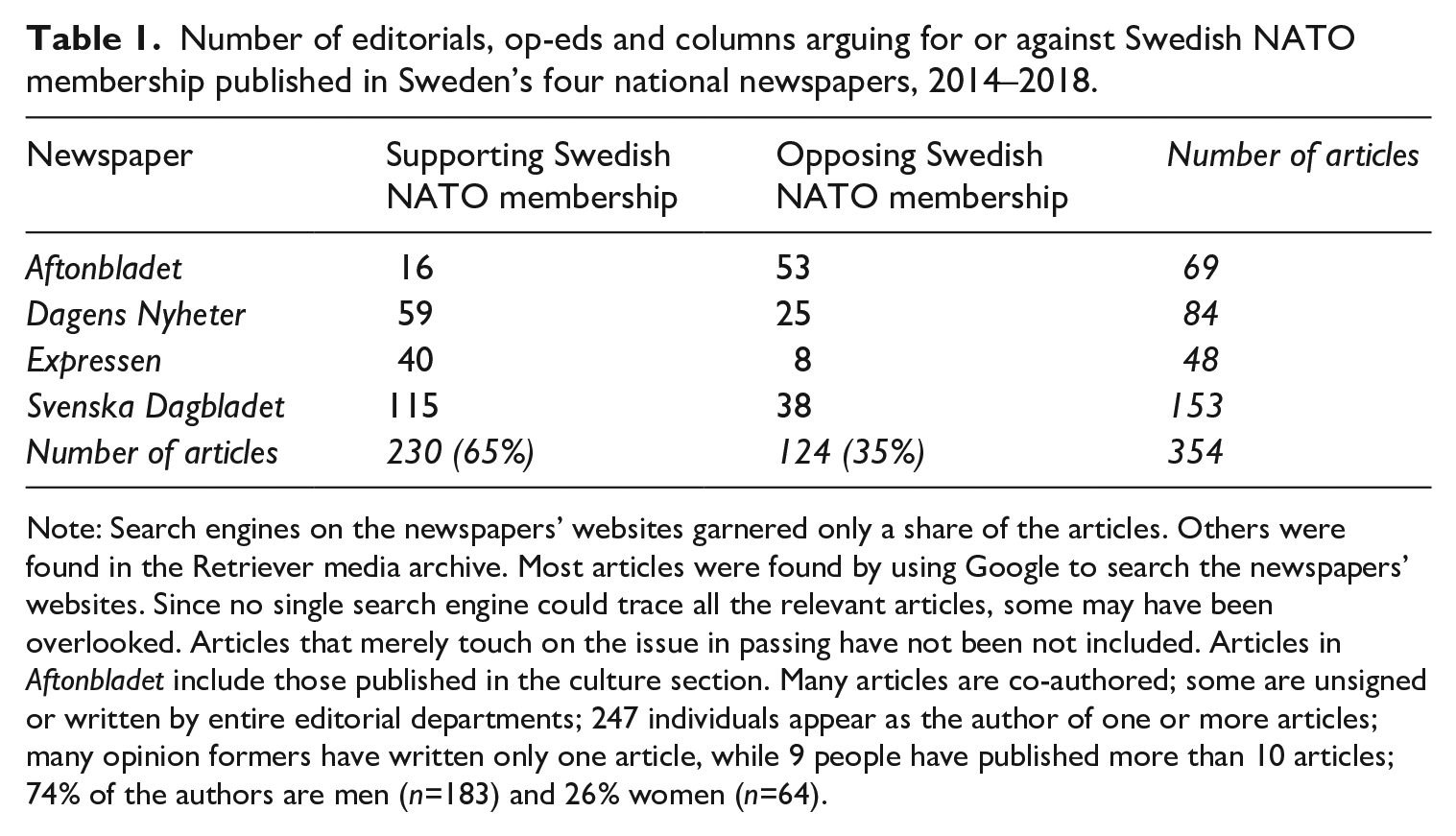
Note: Search engines on the newspapers’ websites garnered only a share of the articles. Others were found in the Retriever media archive. Most articles were found by using Google to search the newspapers’ websites. Since no single search engine could trace all the relevant articles, some may have been overlooked. Articles that merely touch on the issue in passing have not been not included. Articles in Aftonbladet include those published in the culture section. Many articles are co-authored; some are unsigned or written by entire editorial departments; 247 individuals appear as the author of one or more articles; many opinion formers have written only one article, while 9 people have published more than 10 articles; 74% of the authors are men (n=183) and 26% women (n=64).
The second step was to conduct a similar analysis of the Twitter debate. Here, the focus was almost entirely on the opinion formers themselves, and the arguments related to possible Swedish NATO membership were more implicit. Focusing specifically on 14 active NATO campaigners, 3 women and 4 men on each side, I gathered 1408 tweets by searching for each influencer’s ‘surname/full name + NATO’ (see Table 2). Table 2 provides some initial findings, which were again produced through hand-coding. These numbers can be represented in different ways. First, 72.2% of all tweets revolve around anti-NATO articles/influencers, while 27.8% discuss a pro-NATO article/campaigner. Second, 50.1% of all the tweets that revolve around a pro-NATO article/influencer are coded as ‘positive’, whereas 18.4% are interpreted as ‘negative’. In contrast, 66.4% of all tweets that revolve around an anti-NATO article/campaigner are coded as ‘negative’ while 16.4% are coded as ‘positive’. Third, 10 times as many tweets are critical of an anti-NATO influencer than tweets critical of a pro-NATO figure, while the absolute number of supportive tweets is similar. Many tweets express opinions that are more extreme and divisive than those found in the articles, confirming findings on increased polarisation on Twitter (Garimella and Weber, 2017).
NATO campaigners in focus of the Twitter analysis and initial coding of tweets.
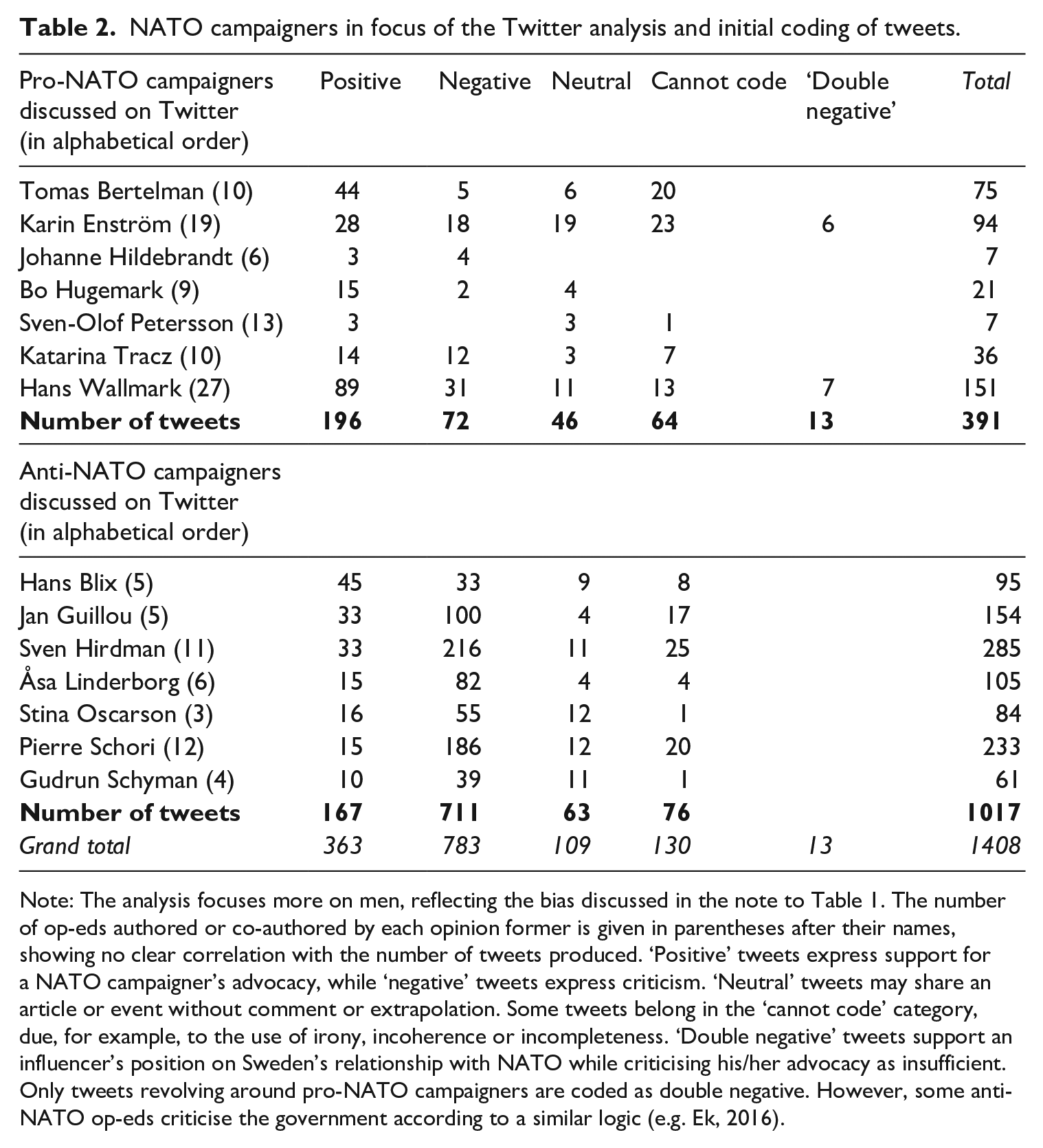
Note: The analysis focuses more on men, reflecting the bias discussed in the note to Table 1. The number of op-eds authored or co-authored by each opinion former is given in parentheses after their names, showing no clear correlation with the number of tweets produced. ‘Positive’ tweets express support for a NATO campaigner’s advocacy, while ‘negative’ tweets express criticism. ‘Neutral’ tweets may share an article or event without comment or extrapolation. Some tweets belong in the ‘cannot code’ category, due, for example, to the use of irony, incoherence or incompleteness. ‘Double negative’ tweets support an influencer’s position on Sweden’s relationship with NATO while criticising his/her advocacy as insufficient. Only tweets revolving around pro-NATO campaigners are coded as double negative. However, some anti-NATO op-eds criticise the government according to a similar logic (e.g. Ek, 2016).
The third step was to analyse the semi-structured interviews with 12 NATO campaigners, which were conducted in 2016–2019 (see Table 3) (on semi-structured interviews, see Kvale, 2007: 51–53). All the interviewees agreed to speak on the record and all but one without a condition of anonymity. However, because I wish to keep the focus on bodily experiences and feelings, and do not want readers to become distracted by the often well-known individuals and their circumstances, I have nonetheless decided to anonymise all the interviews. Each interview lasted between 20 and 80 minutes, and several interviewees subsequently clarified aspects by email or telephone. Each interview was recorded, transcribed and hand-coded.
NATO campaigners interviewed.
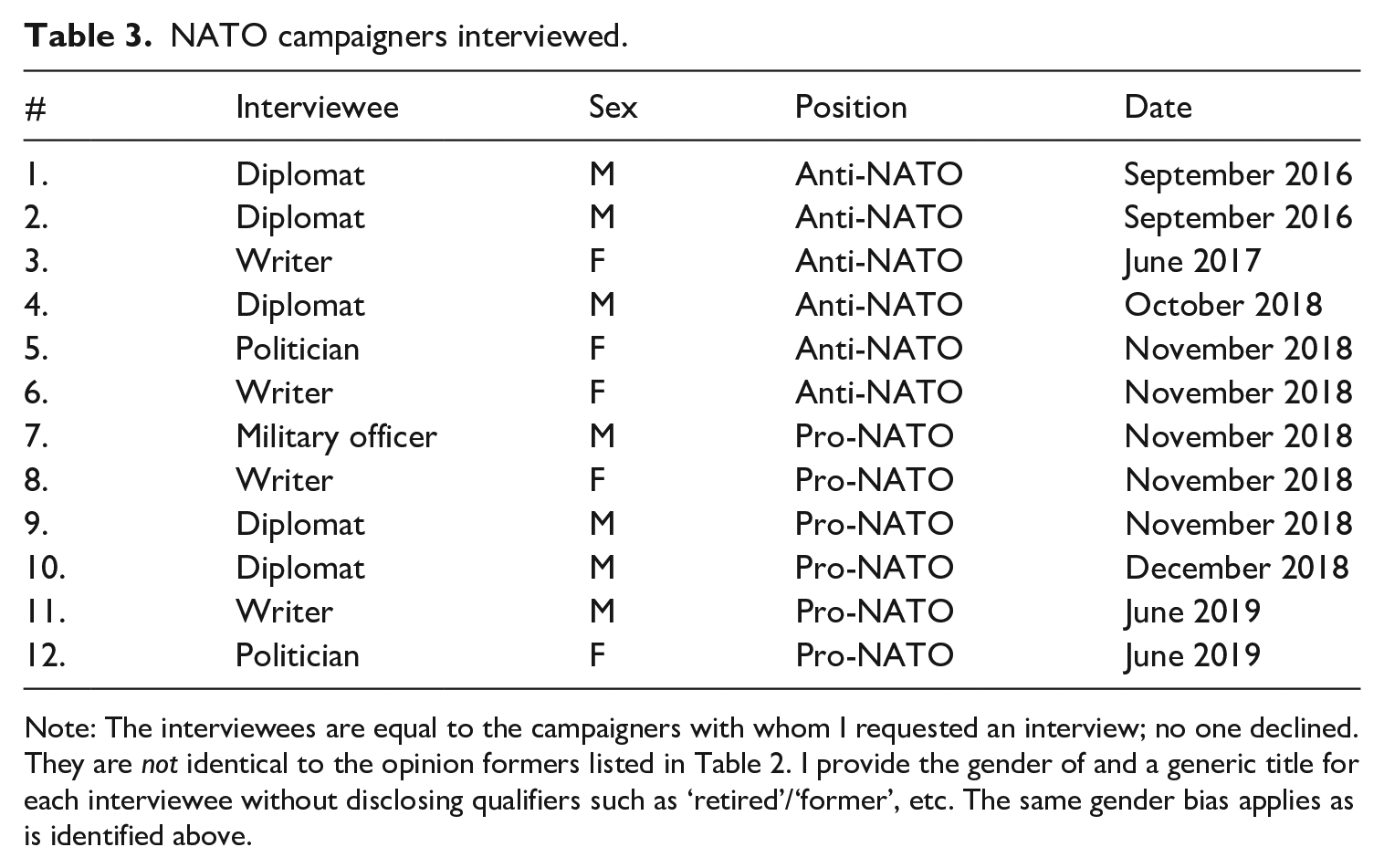
Note: The interviewees are equal to the campaigners with whom I requested an interview; no one declined. They are not identical to the opinion formers listed in Table 2. I provide the gender of and a generic title for each interviewee without disclosing qualifiers such as ‘retired’/‘former’, etc. The same gender bias applies as is identified above.
Text: productive and disciplinary power
The analysis separates newspaper articles from Twitter contributions, and pro-NATO articles and tweets from anti-NATO ones. I have aggregated self/other constructions in like-minded tweets, regardless of whether they are written in response to an opinion former they agree with.
The pro-NATO newspaper debate
All the pro-NATO articles single out Sweden’s deteriorating security environment as the other, and most associate it with an ‘unpredictable’, ‘aggressive’ and ‘revanchist’ Russia. These observers mention Russia’s unlawful annexation of Crimea and worry that Russia might annex territory in the Baltic states too. Some also express the fear that Russia might pre-emptively attack the Swedish island of Gotland to deter NATO from using it to defend the Baltic states. The self in pro-NATO articles is the West, NATO, Europe/the EU and the Nordic region. These actors are in turn associated with signifiers in which the pro-NATO campaigners take pride, such as ‘democracy’, ‘freedom’, ‘human rights’ and ‘the rule of law’. According to these articles, to join NATO would help Sweden realise an identity premised on solidarity and collaboration with like-minded states. These findings largely confirm the exiting literature’s analysis of how identity is constructed in Swedish pro-NATO material.
However, Russia is not the only other in pro-NATO articles. The Swedish policy of ‘alienation’ or distancing from the West and NATO is also portrayed as a source of shame, and indeed a threat to Swedish security (e.g. Tracz, 2015). Sweden is represented as the ‘weak link in NATO’s security system’ (Hugemark, 2014) and its policy of non-alignment as creating a ‘security vacuum’ in the region (e.g. Frändberg, 2015). According to pro-NATO campaigners, this policy leaves Sweden in a ‘grey zone’ (e.g. Agrell, 2015) and without ‘insurance’ (e.g. Olsson, 2014). These opinion formers moreover claim that neutrality has just been a ‘chimera’ and a ‘fetish’ (e.g. Expressen, 2015b). Instead, they call Sweden a ‘coward’ (e.g. Helmerson, 2016) and a ‘free-rider’ (e.g. Ekeman, 2018) that has not been neutral in practice but adopted ‘double standards’ (e.g. Helmerson, 2016).
Pro-NATO articles moreover argue that Sweden should not refrain from becoming a NATO member just because it might upset Russia and could reduce Swedish security. Such abstemiousness is tantamount to ‘wearing Russian glasses’ (Dagens Nyheter, 2014a) and would give ‘Putin a veto over Swedish security policy’ (Eriksson et al., 2016a). Some draw parallels between Sweden’s current Russia policy and the country’s ‘shameful’ compliance vis-à-vis Nazi Germany in the 1930s and 1940s (e.g. Askeljung, 2015): ‘They say you cannot provoke Putin. Well they said that about Hitler too’ (Frändberg, 2015). Others use the tainted term ‘appeasement’ (e.g. Belfrage et al., 2016) or compare Sweden to a ‘battered wife who tries to avoid the next assault by an unpredictable husband by changing herself’ (Arpi, 2016).
Several opinion formers also complain that the debate is characterised by a ‘thought ban’ (e.g. Eriksson et al., 2016b) or that joining NATO is ‘taboo’ (e.g. Dagens Nyheter, 2015). The pro-NATO articles recurrently describe Sweden’s failure to join NATO as ‘naive’, ‘short-sighted’, ‘in denial’, ‘ignorant’, ‘wrong-headed’, ‘delusional’, ‘absurd’, ‘hypocritical’ or ‘nostalgic’. These articles express resentment, accusing Swedish security policy of ‘loose and incomprehensible babble’ (Widman, 2015). Claes Arvidsson (2017), a Svenska Dagbladet columnist, likens the government to a child who believes in Santa Claus and tells it to ‘grow up!’.
Third, the people who have kept Sweden out of NATO are also portrayed as the other, along with those who continue to argue against NATO membership. This is the point at which productive power clearly begins to intertwine with disciplinary power. Swedish opponents of NATO membership are narrated as embodying Sweden’s wrongheaded and shameful policy and become the targets of ridicule, suspicion and anger. They are shamed as ‘getting bogged down in dogma’ (Eriksson et al., 2016b), ‘doing logical somersaults’ (Winnerstig, 2014), ‘nurturing life lies’ (Dagens Nyheter, 2014b), adhering to the ‘logic of an upside-down world’ (Johansson, 2015), ‘coming from a different universe of wishful thinking and daydreaming’ (Petersson and Eriksson, 2017) and having an ‘abysmal lack of understanding’ (Dahlberg, 2016).
Moreover, the defence policy spokespersons of the four Swedish centre-right parties argue that ‘(t)o air suspicions about cooperation with NATO is only in the interests of power holders in Moscow’ (Widman et al., 2016). It is why the Moderate Party’s defence policy spokesperson, Hans Wallmark (2017), calls one opponent of Swedish NATO membership ‘a megaphone for excusing Russian expansionism’. Anti-NATO campaigners are often denounced as spreading ‘myths’, ‘disinformation’ (e.g. Expressen, 2015a; Johansson, 2015; Wallmark, 2017) and ‘left wing extremism’ (Widman, 2015). Gunnar Hökmark (2016), then Moderate Party member of the European Parliament, describes Aftonbladet’s culture section as ‘the voice of the Kremlin in Sweden’. The Aftonbladet columnist Staffan Heimerson (2016) and others also suggest that the former state secretary, Sven Hirdman, has ‘changed sides’. His opposition to Swedish NATO membership ‘is only logical for a person who is a board member of the Moscow State Institute for International Relations’ (Wolodarski, 2015). Dagens Nyheter (2016), finally, condemns unnamed people who resist Swedish NATO membership – one later identified as the former foreign minister, Hans Blix (Göransson, 2016) – as ‘a small but persistent support brigade for Putin’, ‘a support battalion’ for Putin and ‘Putin’s Swedish friends’.
In addition to the democratic western self discussed above, another self emerges in these articles – the ‘realistic’, ‘rational’, ‘experienced’ and ‘responsible’ self of the individuals who argue in favour of Swedish NATO membership.
The pro-NATO Twitter debate
Most of the pro-NATO tweets construct identity by discussing people rather than the issue at hand. The tendency is clearest in commentary on anti-NATO articles and campaigners. Those who publicly oppose Swedish NATO membership are thus denounced as either incompetent or treacherous. Exemplifying the first tendency, we find such terms as ‘naive’, ‘crazy’, ‘completely lost’, ‘blind and unreasonable’, ‘idiots’, ‘a parody’ and ‘clowns’. Tweeters moreover say they ‘have a black belt in contradictions’, ‘get the facts all wrong’, ‘carry out security analysis at the middle school level’, ‘discuss like kindergarteners’ and ‘need a legal guardian’. Tweets targeting the then head of Aftonbladet’s culture section, Åsa Linderborg, theatre director Stina Oscarson and the former leader of the Feminist Initiative Party, Gudrun Schyman, moreover, question their qualifications for participating in the security debate in the first place. Their advocacy is ridiculed as ‘pathetic ladies’ babble’: ‘They don’t ask shoemakers about medicine or farmers about quantum physics’; ‘It is like asking a parking attendant about brain surgery’; or ‘It is like discussing childbirth with a man.’ While much of the pro-NATO advocacy can be interpreted as reproducing gendered understandings of subjectivity (see also Agius and Edenborg, 2019; Åse, 2016) – the portrayal of Sweden as ‘weak’ and the comparison with a ‘battered wife’ being cases in point – it becomes highly explicit here as these influencers’ incompetence is constructed as inherent to their sex.
In the second category are numerous tweets branding anti-NATO campaigners as ‘useful idiots’, ‘disinformants’, ‘agents of influence’, ‘Russian agents’, ‘Putin trolls’, ‘Putinists’, ‘Putin huggers’, ‘fifth columnists’, ‘the enemy within’ and ‘communists’. These tweets claim that anti-NATO influencers spread ‘lies’, ‘the Kremlin’s narrative’ and ‘Russian propaganda’; accuse them of being ‘nostalgic for the Soviet Union and ador(ing) Putin’, ‘paid by Putin’ or ‘Moscow’, ‘politruks for the Kremlin’, ‘KGB spies’ or ‘Soviet agents’; or label them as ‘traitors’.
Pro-NATO tweets focus mostly on the other, but this construction clarifies that the self is ‘intellectual’, ‘insightful’ and ‘reasonable’.
The anti-NATO newspaper debate
Almost all the articles arguing against Swedish NATO membership agree with the pro-NATO articles that Sweden’s security situation has deteriorated, singling out developments surrounding Russia as an important factor. However, they frequently relegate the USA to the position of the other along with Russia. Great powers do not just pose a direct threat to their enemies, but polarisation through alliance building can pull allies into wars or make them targets. These articles construct a ‘non-aligned’ – sometimes ‘neutral’ – and ‘independent’ self that is able to help out in foreign conflicts without being obliged to do so. There is pride in this policy but also some nostalgia, to the extent that Sweden is represented as having successfully pursued a policy of non-alignment for 200 years (e.g. Peterson, 2015). Moreover, anti-NATO articles also tend to emphasise Sweden’s special relationship and collaboration with other Nordic and Baltic states, its EU membership and the importance of the United Nations. Regardless of whether Sweden joins NATO, it is ‘solidly anchored in the West European community’ (Blix et al., 2014).
The current coalition government, led by the Social Democratic Party, also opposes Swedish NATO membership, but its representatives construct the other in a way similar to the pro-NATO articles. There is talk in general terms about a ‘deterioration in the security situation in the Baltic Sea region’ and Russia is singled out as the main problem (Wallström and Hultqvist, 2018). The self is ‘non-aligned’ but continues to engage ‘pragmatically’ in collaboration with NATO (Wallström and Hultqvist, 2018). The logic of this identity construction is thus less clear-cut than in other anti-NATO articles. These findings again largely overlap with what is already known.
Several articles opposing Swedish NATO membership moreover portray a ‘politics of small steps’ as hollowing out Sweden’s policy of non-alignment and as a source of shame and a second other (e.g. Oscarson and Schori, 2016). Only a few articles opposing Swedish NATO membership, however, denounce pro-NATO campaigners as a threatening third other. Aftonbladet’s political editor, Anders Lindberg (2016), states: ‘Paradoxically, the NATO lobby’s campaign is now the biggest problem for the credibility of our (policy of) military non-alignment’. The Left Party’s defence policy spokesperson, Stig Henriksson, moreover, attempts to turn the tables on the pro-NATO campaigners by aligning them with Putin: ‘The pro-NATO people would abandon 200 years of military non-alignment with reference to Putin, (but) our answer is that Putin should not get to dictate Swedish security policy’ (2015). For this reason, pro-NATO influencers are also called ‘useful idiots’ (Mutt, 2015). Moreover, those who wish Sweden to join NATO are accused of spreading disinformation and mistrust, and of scaring the Swedish people (e.g. Linderborg, 2016). This is again the point where textual content begins to target individual influencers and productive power intertwines with disciplinary power. Statements resemble those used to characterise anti-NATO campaigners above, but the number of examples is significantly smaller.
It is slightly more common for the pro-NATO stance to be denounced as ‘naive’, ‘untrustworthy’ and ‘irresponsible’ (e.g. Hirdman, 2015a) – as based on ‘Russia panic’ (e.g. Peterson, 2015) and being ‘unattuned with reality’ (e.g. Wallström and Hultqvist, 2018). Guillou (2016a), moreover, ridicules the arguments of pro-NATO campaigners – calling them ‘bomb liberals’, ‘laughable’ and ‘too stupid to take seriously’.
The policy of ‘non-alignment’, by contrast, is frequently associated with ‘realism’, ‘rationality’ and ‘responsibility’ – traits associated with pride and the self (e.g. Hirdman, 2015a; Peterson, 2015). These signifiers can moreover be connected with a penchant for diplomacy, mediation, conflict prevention and adherence to international law (e.g. Schyman, 2015). Since neutrality means that jurisdiction over Swedish security policy stays with the Swedish people, some articles also represent the self as ‘democratic’ (e.g. Lindberg, 2016; Schori and Oscarson, 2016). At the same time, several opinion formers argue that the democratic self that is constructed in the pro-NATO articles is false. One NATO member, Turkey, is hardly living up to the ideal (e.g. Guillou, 2016b) while the quality of democracy is deteriorating in Poland and Hungary (e.g. Schori, 2017).
Finally, a few anti-NATO articles openly criticise pro-NATO campaigners for implying that their opposition to NATO membership is somehow linked to disloyalty, thereby openly trying to resist the operation of disciplinary power. Hirdman (2015b) condemns the ‘inaccurate and insinuating allegation that I run errands for Russia’. The journalist Agnes Hellström and the former state minister Pierre Schori (2017) write about the ‘untenable assumption’ that criticism of NATO is ‘tied up with Russian disinformation campaigns’. Guillou (2016b), moreover, states that it is clearly desperate of liberals to ‘brand their opponents as traitors’. Linderborg (2017), finally, notes that the pages she edits have been accused of ‘threatening Swedish security’ because ‘anything that diverges from the dominant discourse must be planted by Putin’. She writes: ‘The fear of Russia ironically motivates a Putinisation of the media.’
The anti-NATO Twitter debate
Only around 12 anti-NATO tweets brand opponents as either incompetent or treacherous. Several pro-NATO campaigners escape criticism altogether, although the former defence minister, Karin Enström, is accused of being ‘lost’ and of ‘lining up clichés’ while Wallmark is described as a ‘kindergarten politician’ and ‘ridiculous’. When it comes to accusations of treachery, one tweet accuses the think tank analyst Katarina Tracz of being ‘an agent for the late US Senator John McCain’ while another implies that she wants to ‘trick Sweden into joining NATO’. The journalist Joanne Hildebrandt, moreover, is called a ‘warmongering NATO freak’. There are only a few tweets to extrapolate from, but the self in the anti-NATO Twitter debate is presented as ‘sharp’, ‘reasonable’ and ‘knowledgeable’.
Body: experiences and feelings
Emotions play a role in the debate in that pro-NATO articles and tweets express fear of Russia, pride in the notion of being morally aligned with the EU and the West, and shame about not being sufficiently aligned with the EU and the West in military terms. Similarly, in anti-NATO articles and tweets there is fear of great power politics, pride in Swedish non-alignment, and shame about policies that pull Sweden closer to the USA/NATO. Nonetheless, anti-NATO identity constructions clearly face more of an uphill struggle.
However, the debate does not just construct an external threat and a failed policy as the other. Individuals are also shamed as embodying a policy that is deemed erroneous and even dangerous. Pro-NATO campaigners express resentment towards successive governments that kept Sweden out of NATO, and anger and suspicion vis-à-vis influencers who oppose Swedish NATO membership. Anti-NATO influencers, in contrast, express resentment towards leaders who have pulled Sweden closer to NATO, and anger and suspicion vis-à-vis pro-NATO campaigners. This tendency is far more pronounced in pro-NATO articles, however, meaning that disciplinary power operates more forcefully to get Swedes to support NATO membership. Identity construction in the Twitter debate is even more tilted in the direction of pro-NATO campaigners. The logic is that anyone with sufficient understanding must conclude that Sweden should join NATO. Those who draw another conclusion must be incompetent. Any competent person who believes that Sweden should stay out of NATO, moreover, must be a traitor.
How do such attempts to shame and discipline participants in the debate affect them? This section analyses the bodily experiences and feelings narrated by 12 NATO opinion formers – 6 on each side.
The experiences and feelings of anti-NATO campaigners
Four of the six anti-NATO campaigners spoke of facing verbal abuse as part of their advocacy. A diplomat told how he has ‘been exposed to all sorts of insults’: ‘they say . . . I’m paid by Putin, that I’m a Putin lackey, that I’m a traitor’. He called himself ‘thick skinned’ but said his wife ‘is more sensitive’: ‘She thinks it’s unpleasant (that I’m) assaulted like this’ (interviewee 1). Another diplomat felt personally targeted and ‘upset’ by a speech given by Defence Minister Peter Hultqvist (2016), in which he labelled criticism of the Memorandum of Understanding between Sweden and NATO, signed in September 2014, as ‘myths’ and ‘disinformation’ (interviewee 4). A third diplomat has not been personally criticised but said he was aware of the phenomenon: ‘I’m not sure how I would react to being attacked all the time.’ He noted that a like-minded friend was particularly ‘saddened’ by ‘ad hominem attacks’ of the kind exemplified above (interviewee 2).
A writer explained that it ‘hurts’ ‘to be accused or suspected of being a traitor’. Whenever she writes an article on Sweden and NATO, she receives ‘furious’, ‘extremely threatening and unpleasant’ emails from people calling her a ‘communist’ and sometimes making physical and strongly misogynist threats, such as ‘to cut up’ her genitals. She is involved in other debates too but characterises the Swedish security debate as particularly ‘difficult’ and ‘hostile’ (interviewee 6). Another writer says that ‘strong powers’ are seeking to ‘undermine confidence’ in her arguments related to Sweden’s relationship with NATO, ‘using all the classical suppression techniques’ (interviewee 3). These two writers and the woman politician note that being a woman is an additional liability in the NATO debate: ‘(I’m) either ignored or patted on the head because women are not supposed to discuss defence-related issues’: ‘It’s like I’m arguing with my uterus’ (interviewee 6). These experiences further emphasise the gendered nature of the Swedish NATO debate, referred to above, as women influencers feel they are taken to embody a lack of realism and expertise.
Three anti-NATO influencers mentioned even more tangible social sanctions. One writer told how she might have lost job opportunities due to her advocacy: ‘If one takes sides the label tends to stick’ (interviewee 3). Another said she was afraid she would have to leave her job: ‘I don’t think I should be here if I’m accused of running Putin’s errands . . . I was wondering “how the hell can I prove my innocence?” ’ (interviewee 6). A diplomat mentioned he has been slandered at social gatherings for his standpoint, and that he now receives far fewer invitations to comment on television and give public lectures. A journalist once asked: ‘But can we talk to you? Aren’t you Putin’s representative in Sweden?’ (interviewee 1).
While several opinion formers also mentioned that they have received support, several protect themselves from criticism by engaging in self-censorship. A politician who opposed her party’s change of policy on NATO years before explained that it would have been difficult to debate the matter in public not only because elected representatives should adhere to party decisions, but also because she would be ‘in bad company’ with alleged ‘Putin-huggers’ – ‘a position that is more difficult to argue from’ (interviewee 5). One writer told how it is possible to ‘feel ashamed’ of writing things that are ‘obviously absurd’ to a majority of the population, and that ‘someone who is ashamed goes away and keeps quiet’ (interviewee 6). Others told stories of friends or colleagues who have chosen not to take part in the debate for fear of being ‘smeared’ (interviewee 1), ‘ostracised’ or ‘betrayed’ (interviewee 3).
These interviewees construct identity vis-à-vis the pro-NATO collective in a way that resembles the constructions found in the textual materials. However, four participants also constructed identity by differentiating themselves from fellow anti-NATO campaigners. Their attempts to dissociate their individual selves from the allegation that anti-NATO influencers are naive ironically serves to demonstrate that they have internalised their opponents’ view of themselves as a collective. One diplomat said he ‘refuses to take part in different kinds of campaigns’ and ‘does not go on demonstrations’ like some others (interviewee 1). Another diplomat explained that fellow anti-NATO campaigners too often resort to ‘politically charged’, ‘emotional and nostalgic’ arguments, which he considers ‘largely irrelevant’: ‘people have great difficulty making strategic arguments’ (interviewee 2). A writer explained that she does not want to get into ‘this swamp . . . where anti-NATO campaigners also start to exaggerate’. She juxtaposed her own factual approach with that of another well-known woman influencer, which she labelled ‘more emotional’ (interviewee 3). The other writer, meanwhile, compared her own ‘dialectical reasoning approach’ with that of another woman anti-NATO campaigner, ‘who has the wide-eyed gaze of a child on certain matters’ (interviewee 6). Women influencers are again seen as embodying the kind of naivety that debaters do not wish to be associated with and, indeed, that is seen as harmful to the cause of keeping Sweden out of NATO.
The experiences and feelings of pro-NATO campaigners
Two of the pro-NATO influencers critiqued the parameters of this study. One explained that ‘the NATO debate often blends together with the security policy debate’ and ‘it can be very unpleasant for pro-NATO campaigners in that broader context on Twitter’ (interviewee 8). Moreover, what happens in the broader security policy debate can ‘affect one’s chances of influencing the NATO debate’ (interviewee 11). I return to this matter below but note first that only one pro-NATO campaigner shared an example of verbal abuse in the narrower NATO debate: A writer had been called an ‘agent’ of a US member of Congress. On the surface, this resembles the common allegation that anti-NATO campaigners are ‘Russian agents’ or similar. However, in contrast to the anti-NATO influencers, she did not take offence but called it a ‘badge of honour’. She was more concerned with some misogynist comments she had also been exposed to (interviewee 8).
The two diplomats are loosely affiliated with the Social Democratic Party, and I asked them how it has felt to contradict the party line. To his surprise, one diplomat had not received any negative reactions to his pro-NATO advocacy from within the party: ‘It’s supposed to be quiet, you know. No debate.’ At the same time, he explained that the party is quite tolerant towards diverging opinions because ‘defence and security policy issues are at the bottom of (most members’ lists of) interests’ (interviewee 9). The other diplomat, by contrast, said it ‘was not popular’ when he ‘came out as an advocate of (Sweden’s membership of) NATO’. The coalition government led by the Social Democratic Party had just appointed him to an important position and he ‘had the feeling’ that leading government representatives thought the timing was bad: ‘They never said anything but I didn’t want it to affect (my organisation) in any way, so after three years . . . (I said) “I resign” ’ (interviewee 10). Apart from this episode, no pro-NATO interviewees recalled being exposed to social sanctions as part of their advocacy.
The military officer has been arguing in favour of Swedish NATO membership for decades and explained that it was impossible during the Cold War to discuss in what circumstances ‘Sweden might be forced to rescind its policy of non-alignment’ (interviewee 7). Those who had switched to a pro-NATO stance in the post-Cold War period agreed that long-term pro-NATO advocates had been perceived as ‘a group of oddballs’ (interviewee 9) or ‘fools’ (interviewee 10). The politician concurred that a pro-NATO stance used to be seen as ‘weird’ but explained it was now ‘a very popular issue’ in her centre-right party (interviewee 12). This was the only way in which pro-NATO campaigners differentiated themselves within the group.
The pro-NATO interviewees constructed identity in a way similar to the textual materials. They strongly associated the self with expertise and the ability to understand international politics (interviewees 7, 8 and 9), while representing anti-NATO influencers and their arguments as ‘outdated’, ‘unfounded’ and ‘dumb’ (interviewee 7), ‘naive and ignorant’ (interviewee 9), saying no to everything ‘almost like an allergy’ (interviewee 12), suffering from a ‘NATO allergy’, and living ‘in an outdated view of the world (interviewee 9), or as ‘pronounced pacifists who refuse to accept facts’ (interviewee 10).
Much like the textual analysis, the interviewees also expressed some hostile and suspicious views of anti-NATO campaigners. As the interviewees might not want to be associated with these statements, even anonymously, I have left out the references from this paragraph. One interviewee said s/he had ‘enjoyed seeing’ the op-ed in Dagens Nyheter that had called Hans Blix and others ‘a small but persistent support brigade for Putin’ (see above) and argued that ‘it is only natural to say they echo Putin’. Another told how s/he and others refer to anti-NATO influencer Sven Hirdman as ‘Sven Vladimir’ and ‘the Russian ambassador to Sweden’. Yet another interviewee said that ‘to argue that Gotland should be declared neutral’, as Pierre Schori had allegedly done, ‘verges on treason’. The fact that pro-NATO figures are comfortable enough to make statements like these in a research interview could indicate that they believe that their views represent common sense.
Finally, as stated above, two opinion formers said that they had experienced both verbal and physical sanctions not as part of their pro-NATO advocacy, but because they have spoken and written on Russian disinformation. In that context, a writer told how she was physically pushed during a debate (interviewee 8), while another writer has been ridiculed and called a ‘CIA agent’ and a ‘NATO agent’, and exposed to false accusations and physical threats (interviewee 11). Both have received abusive telephone calls, such as from right-wing extremists posing as ‘citizen journalists’. The male writer argued that while ‘useful idiots’ participate in various hate crimes and threatening campaigns, there is no doubt that the Russian Federation initiates many of them. To avoid being targeted, he said that he has had to move to a new house and that he subjects himself to a degree of ‘self-censorship’ (interviewee 11).
Conclusions
It is beyond the scope of this article to comment on whether, how and with what consequences foreign intervention has affected the Swedish security debate by disciplining participants and potential participants. The article provides plenty of evidence, however, that Swedish participants in the debate themselves produce, reproduce and sometimes contest and renegotiate discourses in a way that is not only productive of social reality, but also targets other campaigners and potential campaigners by exposing them to ridicule and allegations of treason.
At the same time, it can be hypothesised that a public debate where such discursive practices already abound is easier for foreign agents to exploit in attemps to spread disinformation and sow distrust.
In any case, the main contribution of the article is to demonstrate how productive power intertwines with disciplinary power in the Swedish NATO debate. Allegations of naivety and treason delegitimise campaigners and their arguments, but treason is also a serious crime that is traditionally punishable by death or by life imprisonment. As a pro-NATO interviewee put it half-jokingly: ‘When things heat up, they (traitors) will be lined up against the wall and shot.’ There are similar tendencies on both sides of the debate, but pro-NATO articles and tweets not only outnumber anti-NATO ones, but also more consistently represent their opponents as suspect and treacherous. Even two seemingly similar accusations – that of being a ‘US agent’ and a ‘Russian agent’ – do not necessarily mean the same thing, as Sweden maintains cordial relations with the USA while most Swedes consider Russia to be a threat or even an enemy.
It was arguably more stigmatising to be represented as a ‘US agent’ in the 1970s and 1980s, when the identity of neutrality was more dominant, although ‘Soviet agent’ was probably still worse in most quarters. While it is reasonable to hypothesise that real and potential pro-NATO campaigners were disciplined into self-censorship a few decades ago, the tendency now seems more emphatic with anti-NATO influencers. While some anti-NATO campaigners clearly try to resist the exercise of disciplinary power, this article construes a connection between Sweden’s changing security orientation and the fact that those opposed to Swedish NATO membership are more likely to be exposed to sanctions or to censor themselves. Future research will have to investigate further how Swedish citizens are affected more generally by the combined operation of productive and disciplinary power in the NATO debate.
Several interviewees, especially on the anti-NATO side, strongly object to the notion that emotions should have anything to do with the security debate, but this article indicates that the use of emotional language to describe the subject matter translates on both sides of the debate into the use of emotional language to describe other participants in the debate, friends as well as foes. The interviews, moreover, show that such emotional language is accompanied by distinct bodily feelings of pain, fear, sadness, anxiety and shame on the part of the participants – especially the anti-NATO camp. Such feelings are understood here as part of what keeps them and potential anti-NATO campaigners in the fold.
Finally, these findings help to illustrate the theoretical contribution that identity construction is not just a discursive or textual process infused by emotion and the operation of productive power. Instead, productive power intertwines with disciplinary power that targets the bodies of those who participate in the debate, as well as everyone who decides not to take part in it due to the fear of stigmatisation, verbal and physical sanctions and a host of difficult feelings, but who unfortunately are excluded from this study’s target group. The way in which productive and disciplinary forms of power intertwine helps explain why joining NATO is now more conceivable to Swedish policymakers and the public: the position is less fraught with personal risk, and has come to be seen in many quarters as the most normal, realistic and responsible policy option.
Footnotes
Acknowledgements
I am grateful to two anonymous reviewers and to Ulf Bjereld, Ted Svensson and Charlotte Wagnsson for their helpful comments on previous drafts. I presented a very early, rough draft at the IR and Language panel of the European International Studies Association (EISA) Conference in Prague in September 2018 and wish to thank Birsen Erdogan and other participants for their feedback. I am also grateful to Malin Ahl for excellent research assistance. Finally, I wish to extend my sincere gratitude to the people who agreed to be interviewed for this study.
Funding
The author received no financial support for the research, authorship and/or publication of this article.
