




Abstract
In this article, we aim to contribute to two contemporary debates within the English School. The debate about how to observe primary institutions and the debate concerning hierarchy between primary institutions. Specifically, we analyse references to primary institutions in United Nations General Assembly disarmament resolutions in the decade 1989–1998 and their distribution using descriptive statistics. In this way, the article offers a novel approach to identifying primary institutions empirically, and provides some insight into the hierarchy-question in the sense of documenting the relative numerical presence of references to different primary institutions in a specific issue area and temporal context. With respect to the latter, the key finding is that great power management, diplomacy and international law are by far the most prominent primary institutions in the analysed material. This is an intriguing finding, not least given the importance attached to them by Hedley Bull in his classic work The Anarchical Society: A Study of Order in World Politics. The main contribution of the article is thus to spell out a new approach to how the aforementioned debates might proceed empirically.
Introduction
Since Buzan’s (2001) call to reconvene the English School (ES), this approach to the study of international relations has firmly established itself as a contender amongst the other core approaches in the International Relations (IR) discipline. This is reflected in a consistently high research output in the form of monographs with distinguished publishers (e.g. Buzan and Schouenborg, 2018; Linklater, 2016; Williams, 2015), articles in prominent journals (e.g. Falkner and Buzan, 2019; Spandler, 2015; Zala, 2017) and whole sections at major international conferences (International Studies Association, European International Studies Association and World International Studies Committee). Moreover, it is reflected in dedicated chapters in IR textbooks, including some that deal with more specialised topics such as international organisations (Karns et al., 2015). Arguably, the so-called ‘primary institutions’ of international society constitute one of the school’s main distinctive contributions to our understanding of international relations. These were the conceptual centrepiece of the probably best known ES work, The Anarchical Society: A Study of Order in World Politics (Bull, 1977), in which Bull argued that five such institutions sustained international order: the balance of power; international law; diplomacy; war; and the great powers. Primary institutions capture evolved and enduring social practices between states, and are conceptually distinguished from so-called ‘secondary institutions’. The latter concept refers to the designed and physical international organisations that are the main focus of some strands of liberal IR theory. At root, the concept of primary institutions suggests a deeper, sociological and historical appreciation of the social forces shaping international relations (Buzan, 2014: 16–17).
However, this is also the point at which agreement on institutions stops within the ES. Scholars disagree on the number of institutions present in international society, how to organise them into a typology, whether they change over time and how, what exactly characterises them or the question of how to observe them, how they influence each other, whether there is hierarchy between them, and how they relate to the secondary institutions of international society (Buzan, 2004: 161–204; Costa-Buranelli, 2015; Friedner Parrat, 2017; Holsti, 2004; Knudsen and Navari, 2019; Schouenborg, 2011, 2017; Terradas, 2018; see also Wilson, 2012 for a critique of some of these efforts).
In this article, we aim to add to two of these debates: the debate on how to observe primary institutions; and the debate concerning hierarchy between primary institutions. Specifically, we analyse references to primary institutions in United Nations General Assembly (UNGA) disarmament resolutions in the first post-Cold War decade 1989–1998 and their distribution using descriptive statistics. In total, we have analysed 216 resolutions. In this way, the article offers a novel approach to identifying primary institutions empirically. It is thus mainly a proof of concept piece. However, the article also provides a fascinating insight into the hierarchy-question in the sense of documenting the relative numerical presence of references to different primary institutions in a specific issue area and temporal context. With respect to the latter, the key finding is that great power management (GPM), diplomacy and international law are by far the most prominent primary institutions in the analysed material. This is an intriguing finding that we did not hypothesise at the outset. It is especially intriguing because all three institutions feature in Bull’s (1977) list of the institutions of international society, thus provisionally suggesting that he was right in considering them central or important.
Let us stress a few caveats at the outset. Our claim is not that this method is a straightforward and unproblematic approach to identifying primary institutions in international society nor that it should replace the prevailing method of qualitative macro-historical analysis in the ES (e.g. Bull, 1977; Holsti, 2004; Mayall, 2000; Schouenborg, 2017). Rather, it should be seen as a supplement to the qualitative macro-historical method and be applied carefully. We aim to demonstrate the viability of this new approach, not to challenge what has been done in the past. That is why this is mainly a proof of concept article, which is meant to spur new debate – for and against – as well as applications. Furthermore, in the same way it is not our claim either that numerical dominance in textual references is a simple and direct reflection of the importance of a specific primary institution or its place in a hierarchy of primary institutions – only that it is one piece of evidence pointing in that direction. Moreover, ours is an analysis of hierarchy in relation to a specific issue area (disarmament) and temporal context (UNGA disarmament resolutions in the decade 1989–1998). These particular findings should by no means be read as a direct reflection of a or the hierarchy of primary institutions in international society as a whole. We provide more on these considerations below.
The rest of the article will be structured as follows. In the next section, we will outline the debates about primary institutions in the ES in more detail, and particularly the two issues central to this article: (a) the empirical identification of primary institutions; and (b) the issue of hierarchy between primary institutions. This will lead into a discussion of research design and the quite unconventional application of quantitative methods from an ES perspective. In the remaining sections, we will present the results of the analysis and then discuss them. First, in relation to the specific document genre and context that UNGA resolutions represent, and second, in relation to hierarchy between primary institutions in international society. In the final section, we will draw together the findings and discuss their implications.
The primary institutions of international society
The ontological status of the primary institutions of international society is a much-debated topic within the ES. Bull (1977) and his set of five primary institutions have become a common reference point, sometimes denoted the P5, but he has hardly been alone in formulating lists. Wight, Mayall, Holsti, James and Jackson have also engaged in this exercise (see the overview in Buzan, 2004: 174). More recently, Buzan (2004: 161–204) and Schouenborg (2011, 2017) have added additional candidates, as well as discussed principles for differentiating between primary institutions. Some of the more prominent additional candidates are, for example, sovereignty, nationalism and the market.
What explains this discrepancy between lists is no doubt partly the subjective qualitative assessments made by individual scholars. But it is also a consequence of not always discussing the same phenomenon or temporal scope: some focus on contemporary international society (say, the past 50 years), some on modern international society (say, the past 500 years) and yet others on ancient international societies (say, the past several thousand years). Add to this the sometimes explicit, sometimes implicit, assumption that institutions are malleable and change over time, and one will inevitably end up with different sets of primary institutions.
A related question is the one concerning potential hierarchy between primary institutions: are some primary institutions more important than others? Mayall posed this very question some 20 years ago: ‘do all these institutions and principles have equal weight, or are they arranged in a hierarchy?’(Mayall, 2000: 150). Mayall (2000: 94) himself thinks that international law is the bedrock institution – a position he shares with Manning (1975: 103) who saw it as the core element in setting up the game of let’s-play-sovereign-states in the first place. However, Holsti, James and Jackson appear to come to the very opposite conclusion: that sovereignty, and not international law, is the key primary institution (again see the overview in Buzan, 2004: 174). One way to approach the question of hierarchy between these two particular institutions could be historically – by tracing which one of the two institutions emerged first. Benton’s (2002, 2010) work is probably a good place to start. However, ‘seniority’ is not necessarily a sign of importance, and logically the possibility also exists that the two institutions could exchange places in the hierarchy over time. Schmidt (2016) offers another solution, suggesting that certain sociological-legal logics in international society elevate certain norms, making them peremptory and non-derogable. In developing this argument, he draws on Reus-Smit’s (1997, 1999) distinction between ‘constitutional structures’ and ‘fundamental institutions’, which is another way of historically identifying normative hierarchy in international society.
For the purposes of this article, we are not interested in resolving these historical and theoretical questions, but rather seek to demonstrate a new approach to the hierarchy-question in a specific snapshot in time, the post-Cold War decade 1989–1998, and in the specific context of UNGA disarmament resolutions. We specifically ask: are some primary institutions invoked more than others in these resolutions? Our analytical wager is that this can tell us something, albeit imperfectly, about what the actors socially and politically prioritise in this particular context. By prioritise we do not mean what they deem ‘good’ or ‘bad’. Positive and negative views of, for example, the balance of power abound in the historical record of international relations. So ‘priority’, in our view, only refers to how much a given institution is singled out for mention by the actors, not whether they normatively endorse it or challenge it.
That immediately leads us to another much-debated topic in the literature, namely how to define and observe primary institutions. And this might in fact be considered the more important question. As Buzan notes in his thorough introduction to the ES, ‘Given the centrality of primary institutions to the English School’s work, this is an area in which more work urgently needs to be done’ (Buzan, 2014: 176). Nevertheless, we do not fully share Buzan’s sense of urgency. Yes, we can always hone our concepts and improve our methods of empirical investigation, but we also hold the view that we presently stand on fairly firm ground. This is in no small part due to Holsti’s (2004) important book in which he spelled out the constituent elements of primary institutions and applied these in a comprehensive empirical analysis of the institutional structure of international society spanning the past several hundred years. According to his analytical framework, primary institutions are made up of: (a) patterned practices; (b) coherent sets of ideas and/or beliefs; and (c) norms, including rules and etiquette (Holsti, 2004: 21–22). These three elements are fairly clear. Ideas and beliefs denote the ideational content that propel social action. Norms (and rules) are the signposts and red lines for the actors involved in this social system. Finally, patterned practices, consistent with these ideas and norms, give a quasi-material expression to any given primary institution. 1
This latter issue of consistency between idea and action is very important, because a standard objection is that words not matched by deeds are empty – and can in the final instance disprove the very existence of specific primary institutions or primary institutions in general (and by extension the very existence of international society). A variation on this objection is the realist claim that states only pay lip-service to supposedly ‘nice’ ideas in order to further their own self-interested agendas. ES scholars are obviously aware of this potential problem, and Holsti meets it head on: his 2004 book is about primary institutions, but it is also about change in primary institutions, and change in international relations more generally. And one of his metrics for understanding institutional change is precisely the unravelling of practices and their detachment from ideas to an extent where it no longer makes sense to talk about the presence of a primary institution. An example is his conclusion that colonialism became obsolete as a primary institution following the Second World War (Holsti, 2004: 239–274).
Other ES scholars have similarly touched upon this issue of disconnect, focusing however more on the increasing complexity of both ideas and practices as they are embedded in different regional contexts (Costa-Buranelli, 2015; Lasmar et al., 2015). A parallel may also be drawn to constructivist scholarship, and particularly the research on ‘norm localisation’ (Acharya, 2004) and ‘norm antipreneurs’ (Bloomfield, 2016; Bloomfield and Scott, 2017). The insight of the latter is that actors can promote alternative ideas and practices to that of the prevailing normative consensus in international society, and, if successful, change that very consensus. A core implication of all of this research, both ES and constructivist, is that normative arguments are themselves actions, speech acts, and hence the neat separation between quasi-material practices and immaterial ideas partly breaks down. This is an important conclusion, which means that we should never readily dismiss verbal utterings, or representations (Der Derian, 2003: 69–72), as empty or merely declaratory; they are also acts in and of themselves (see also Searle, 1969, 1995).
Returning to the central question of how to observe primary institutions, this suggests that Holsti’s (2004) distinction between quasi-material practices and immaterial ideas/beliefs is a useful starting point, but that it should not blind us to viewing speech acts as practices. This is important for the research design and the theoretical claims of this article, which we will now turn to.
Studying hierarchy between primary institutions in UNGA resolutions
That war and disarmament is at the top of the political agenda of international society seems to be an uncontroversial assumption given the prominence of the Security Council in the UN and the fact that the First Committee of the UNGA is dedicated to disarmament and international security. That was why we initially found disarmament interesting to research. 2 Some might object that war and disarmament reflect the 1945 context and concerns, but we tend to agree with scholars such as Karns et al. (2015: 282–283), Phillips (2019) and Wight (2019) who, while stressing important changes in war over the past century, still hold that it is central to international politics. We chose to focus on the UNGA over the Security Council to give priority to the universal representation of views, rather than the privileged sub-section of international society represented by the council. Consequently, we attempted to identify references to primary institutions in the 216 UNGA disarmament resolutions in the decade 1989–1998 (sessions 44–53). 3 1989, or the end of the Cold War circa 1989, was chosen because it is often acknowledged as the most recent major turning point in the evolution of international society (e.g. Bobbitt, 2002; Clark, 2005; although see also Buzan and Lawson’s, 2014 critique of 1989 and other common benchmark dates in IR). We pragmatically decided to limit our snapshot to one full UN decade, that is, 10 UNGA sessions. 4 With these reflections we merely want to suggest that this is one good place to start an investigation of hierarchy between primary institutions in international society; not that this is the only or the best place to start. In the future, we hope to be able to supplement this investigation with studies of other issues (thematic contexts), international organisations (secondary institutions) and time periods.
Our baseline for investigating primary institutions in this period was Buzan’s list of classical primary institutions in his authoritative 2014 introduction to the ES. The list of classical institutions includes sovereignty, territoriality, diplomacy, international law, nationalism, human equality, development, the market, GPM, war and the balance of power. Moreover, in the spirit of openness and inclusiveness, we added Buzan’s three emerging/contested institutions: democracy; human rights; and environmental stewardship (Buzan, 2014: 16–17, 158–163). 5 There are other lists of the primary institutions out there in the scholarly debate, as noted above. Yet, Buzan’s list is, to the best of our knowledge, the only one that seeks to distil the findings of the larger ES body of literature. It is a reasonable baseline to start from.
The concrete operational method was to count textual references to these different primary institutions. The software used for this quantitative analysis was NVivo 12 Pro. The dataset, the pdf files containing the 216 resolutions, were optical character recognition-treated with Adobe Acrobat Pro DC to make the text machine-readable. Subsequently, the individual files were manually cleared of irrelevant text passages, that is, only text referring to the respective resolution remained in the file and not text of other resolutions, seeing that resolutions are published in flow style within a larger document.
We created a coding manual with keywords representing each institution based on our reading of the ES literature, mainly Buzan, 2004 and 2014 the key scholars he draws on in his discussions: Wight, Bull, Mayall, Holsti, James and Jackson (Buzan, 2004: 174). In selecting keywords, we aimed for those relevant to the 20th century overall and to the specific context of our case study: UNGA disarmament resolutions 1989–1998. That meant, for example, that we excluded ‘mercantilism’ as a keyword under the market, because it belonged to a previous era of history. It also meant that we included keywords such as ‘climate change’ and ‘greenhouse’ under environmental stewardship, because we deemed them relevant to the specifc context. The full list of keywords is given in the endnote below. 6 In general, we aimed for keywords as close as possible in meaning to the overall institution ‘label’. To give one example, use of the word ‘war’ or ‘use of force’ in a resolution was counted as one reference to the primary institution of war. However, we also chose to exclude some words and phrases that might be interpreted as proxies for the war primary institution by other scholars, because, in our view, these were not directly related to the institution. For example, words and phrases such as ‘conflict’, ‘hindrance to peace’ and ‘destabilising’. Other primary institutions required more conceptual translation, because the ES theoretical labels seldom appear directly in the concrete diplomatic language of practitioners and hence UN resolutions. For example, GPM, in line with ES scholarship, was interpreted as the special responsibilities of powerful states, notably the recognised nuclear powers who occupy permanent seats on the UN Security Council. The word ‘nuclear’ was hence used as proxy for GPM, and that had a significant impact on the results, as we shall discuss below. Moreover, endnote 6 also includes all those keywords that we deemed relevant, but which nevertheless did not yield any results in the machine-coding.
In selecting keywords, we relied on our expert judgement, which at the end of the day comes down to a subjective qualitative assessment. We therefore wholeheartedly welcome more debate on this significant aspect of the research design. We see our current list as one that is broadly relevant to the 20th century and to the specific context of our case study. We hope that ES scholars will use this list as a baseline going forward, and add additional keywords relevant to the specific contexts that they are studying or subtract some keywords or reassign them to other institutions. In this way, we will incrementally and collectively be building a framework that is generally applicable, while also fine-grained enough to handle specific contexts.
Since some keywords, say ‘balance’ or ‘development’, are generic and can have multiple meanings, they pose some challenges. A strict quantitative machine-reading will not be able to establish whether ‘balance’ refers to the ‘balance of power’ or whether the word is used in the more generic meaning of, for example, the ‘balance between two objectives’. In the same way, ‘development’ can refer to the ES primary institution, meaning material, human and social progress, but it can also be used in the more generic meaning of, for example, ‘a new development in international relations’. To accommodate this obvious problem, we devised a sampling method to establish the potential error margin in the dataset. We will explain this method below in connection with the presentation of the results.
It moreover needs to be stressed that the inclusion of more keywords under each primary institution might have influenced the results. The current list of keywords represents our best attempt to translate primary institutions into concrete empirical markers. However, it is entirely possible that other scholars might arrive at different lists of keywords. We should also stress that such lists, in our view, will never be fixed, for all time frameworks. Primary institutions change over time (individually and collectively), and our interpretative frameworks must gradually change with them – again relying on expert judgement. Therefore, we welcome further reviews and application. 7
Our approach in this article builds on an earlier ES attempt to identify references to primary institutions in the founding documents of a large sample of international organisations. This dataset was compiled by Altin Naz Sunay and Barry Buzan in 2007 and presented and analysed by Costa Buranelli (2019). However, these scholars make no effort to quantify the presence of primary institutions in the respective documents, but rather limit themselves to qualitative assessments of the relative prominence of primary institutions.
It should be stressed how unconventional it is to use descriptive statistics in an ES context (although see Costa-Buranelli, 2014 for an exception). The ES has always been associated with thick and interpretive inside accounts of international society, giving priority to the complex self-understanding of the participants (statesmen and others) in this great game of let-us-play-sovereign-states (Dunne, 1998; Manning, 1975; Navari, 2009; Vigezzi, 2005). Indeed, Bull (1966) is widely known in IR for his opposition to the behaviouralist and numbers-driven mode of social science in what is conventionally labelled the second great debate in our discipline. 8 In this article, we are not disowning that tradition. What we are merely suggesting is that quantification can act as a supplement to reaching the interpretative goals of the ES, and to arriving at provisional answers to the two questions at the core of this article: how to observe primary institutions; and how to investigate potential hierarchy between primary institutions. We see our attempt here as, at best, a form of triangulation that can never exhaust nor replace the interpretative findings coming out of a more traditional ES approach to the topic – be that based on interviews with diplomats, archival research or in-depth study of the ideational content of concrete resolutions or documents.
The descriptive statistics approach did pay dividends in this article. It added something. Concretely, the numbers indicated, as we shall detail below, that three primary institutions seemed to occupy an elevated position in the UNGA disarmament resolutions. This was not something we had expected nor a specific hypothesis that we initially wanted to test. It is thus a clear example of an empirical investigation yielding a novel insight. Intriguingly, it is an insight consistent with some previous research: all three institutions feature in Bull’s (1977) P5 list, provisionally suggesting some degree of centrality. 9 Following the presentation of the data below, we shall discuss the extent to which the numbers shed light on this question concerning hierarchy between primary institutions, and the extent to which we have actually been able to observe these primary institutions in the first place.
Results of the analysis
The overall distribution of references to primary institutions in the UNGA disarmament resolutions in the decade 1989–1998 is presented in Figure 1. Three institutions clearly stand out: GPM with 35.12%; diplomacy with 21.47%; and international law with 28.43%. All remaining institutions each account for between 0.21% (nationalism) and 4.37% (war) of the total number of references.
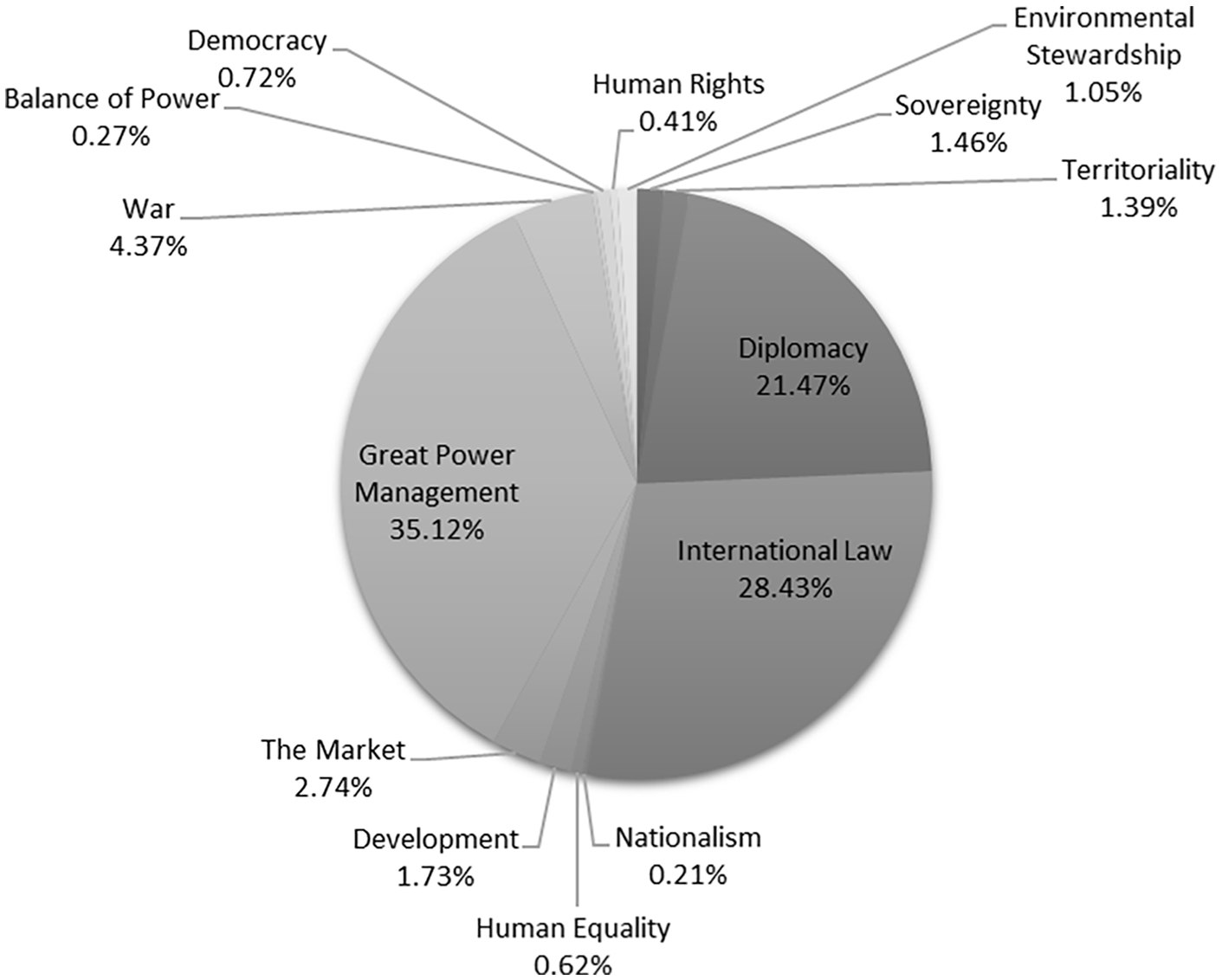
Primary institutions 1989–1998: aggregate view.
Figure 2 presents the development of references to primary institutions over time. GPM drops significantly at the start of the period until 1991, and then generally follows an upwards trajectory. International law is characterised by general ascent, and diplomacy remains relatively stable over the period.
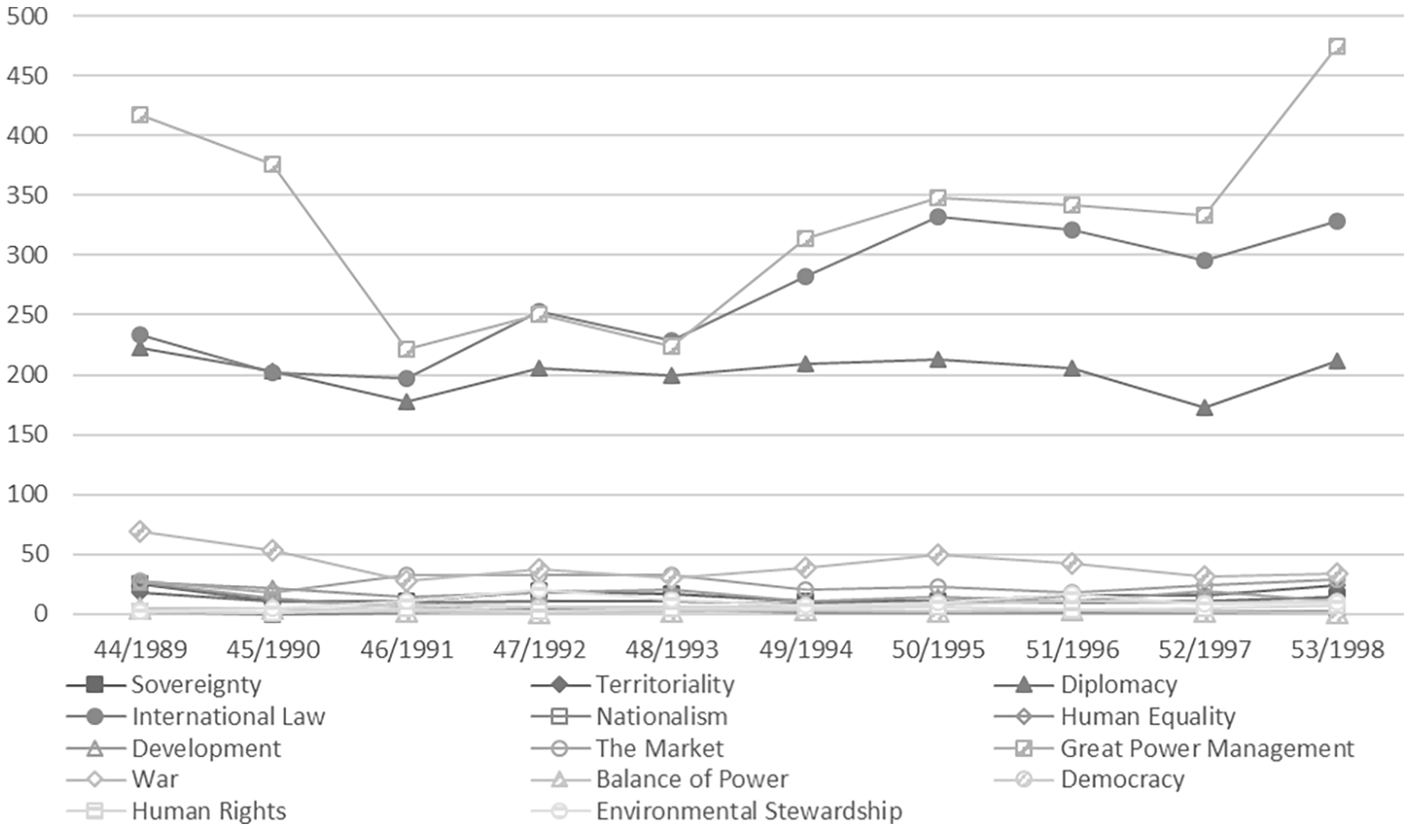
Primary institutions 1989–1998: development over time.
Each of these three institutions accounted for between 21% and 35% of the total number of references. By comparison, none of the remaining 11 primary institutions scored above 5%. That means that, on average, these three institutions were invoked about 21 times more often than the rest. For quantitative scholars used to operating with large numbers, this represents more than one order of magnitude, meaning a multiple of 10. That is quite a lot. The largest difference was the one between GPM and nationalism. The former was invoked 167 times more than the latter. That represents more than two orders of magnitude (a multiple of 100).
As mentioned above, we were concerned that keywords with a generic meaning such as ‘balance’ or ‘development’ might distort our findings. Therefore, we devised a sampling method to establish the potential error margin in the results. It involved the following steps. First, we excluded all primary institutions that made up less than 5% of the total number of references. Our logic here was that any errors in these figures would be inconsequential for the overall assessment of hierarchy between the different primary institutions. That left us with the three institutions scoring above 5%: GPM; international law; and diplomacy. The second step was to qualitatively review 10% of the references to each keyword under each of these three institutions. This review was carried out chronologically, starting in 1989 and continuing until the 10% threshold had been reached. Keywords with less than 200 references were excluded, again based on the logic that they were inconsequential for an overall assessment of hierarchy between institutions. The qualitative review was based on a narrow context reading of the relevant resolutions, meaning the five words before and after the actual keyword. This exercise produced the error margins detailed in Table 1.
Sample error margins.
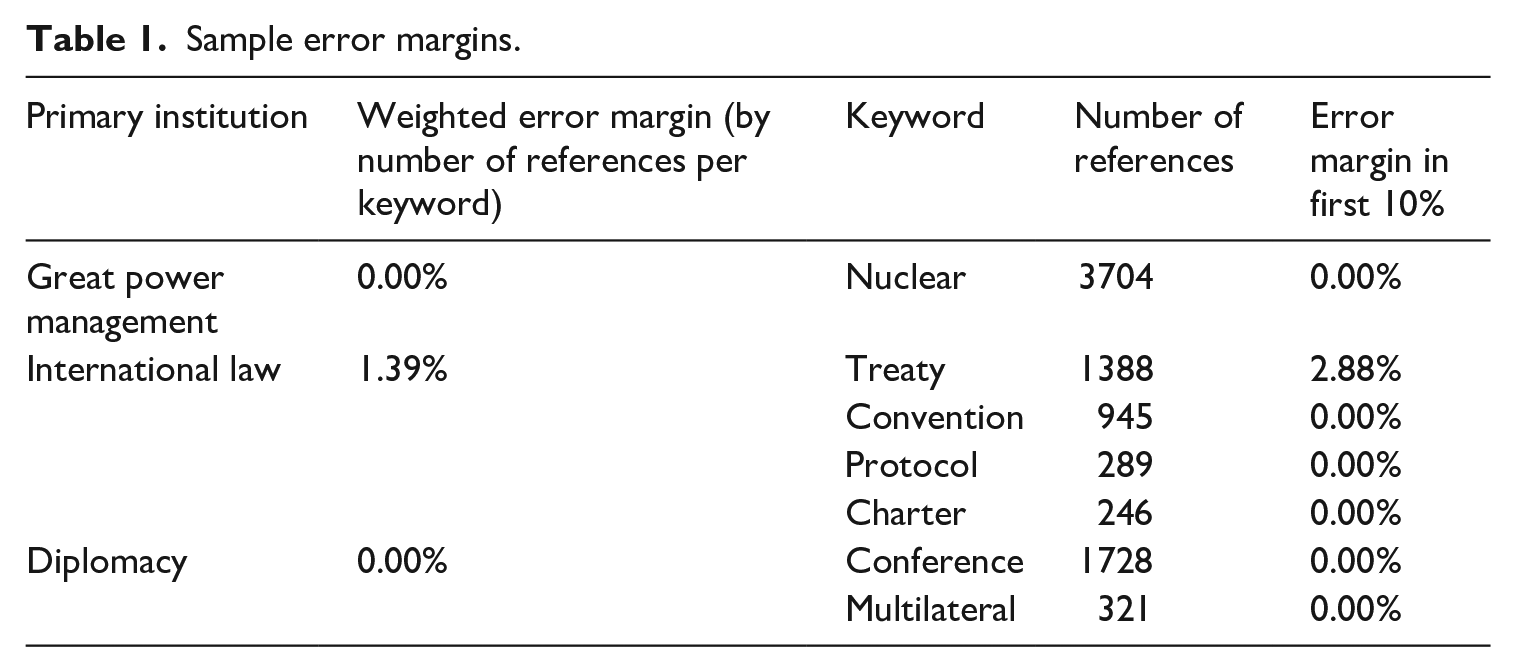
Generally speaking, we found that the references identified in the machine-coding were consistently aligned with the meaning of the relevant primary institutions as we interpreted them. The only error (representing 2.88% of one keyword) was in relation to the word ‘treaty’. Here the problem was references in a resolution that basically constituted bibliographic information about a number of UN treaty series. In this case, it was not so much a question of meaning, but of whether the references were part of the actual substantive text of the resolution. Overall, we thus consider our findings very robust, of course accepting our initial premises and assumptions.
One final thought on the ‘nuclear’ keyword. Following the analysis, we were somewhat surprised that it turned out to be so dominant in the findings with respect to GPM, accounting for 99.33% of the total number of references. We anticipated from the start that it would be a prominent keyword, but not that it would be that dominant. It is hence appropriate to briefly elucidate why we included it as a proxy for GPM. Bull (1977: 194–222) did use nuclear weapons management as the recurrent empirical example when he discussed the different roles played by the great powers, including the most advanced role of condominium/concert. He also listed the possession of nuclear weapons as one of the defining characteristics of great powers, although he stressed that possession alone did not determine great power status (Bull, 1977: 195, 197). Cui and Buzan (2016: 191, 197) seem to offer support when they discuss nuclear weapons as the primary, really only, example of GPM between the US and the Soviet Union during the Cold War, as well as how GPM continued in respect to nuclear weapons into the post-Cold War era. Moreover, Bukovansky et al. (2012: 81–121), in their landmark book, analyse nuclear weapons as the first and prominent case of special responsibilities in international relations, of which GPM appears to be a part, and the social hierarchy of rights and duties attached to the nuclear weapons states and non-nuclear weapons states in the Non-Proliferation Treaty which entered into force in 1970. They argue that these roles were contested, but nevertheless carried forward into the post-Cold War period (see Walker, 2018 for a similar argument).
The conclusion this leaves us with is that when nuclear is mentioned in the UN disarmament context, it will necessarily imply GPM, although often not articulated explicitly. GPM roles will strongly be there in the background, shaping behaviour and assumptions, perhaps especially when we talk about those states who challenge the accepted nuclear social hierarchy: India; Pakistan; Iran; and North Korea. As the historical record shows, the recognised nuclear great powers have actively tried to manage and contain these cases of proliferation, albeit partly reversing their position in respect to India and Pakistan. We think that this is a reasonable conclusion to reach regarding the link between GPM and the nuclear keyword. However, we fully acknowledge that other scholars may weigh up the evidence and come to a different conclusion. Moreover, it means that the link is only relevant post-1945 and that it might become untenable in a hypothetical future in which widespread proliferation has severed the close connection to GPM. In those circumstances, it should be removed from the baseline list of keywords.
Interpretations
This section will be divided into two parts. In the first part, we will discuss a range of contextual factors that might have influenced (note we do not mean distorted) the observed distribution of references. These are factors such as the particular textual genre that UN resolutions represent; or the customs regarding what could be called ‘polite conversation’ at the UN and in international society more generally; or the characteristics of this particular issue area (disarmament); or particular important political events in this period. In the second part, we will evaluate the limitations of empirically observing primary institutions through document references and the extent to which this method can actually tell us something about hierarchy between primary institutions.
United Nations resolutions do represent a particular textual genre. These are legal documents, using legal language, and hence it seems entirely reasonable to expect that the keywords we associate with the international law primary institution will feature prominently in these resolutions, that is, references to charter, convention, court, law, legally binding instrument, protocol, and treaty (while of course UN resolutions are not legally binding themselves). Similarly, seeing that the UN is an organisation almost defined by diplomacy, it also seems reasonable to expect a strong presence of those keywords: bilateral; conference; diplomacy; diplomatic; messenger; and multilateral. We obviously cannot assess the scale of the influence of these contextual factors on our findings, but it is there and it is something future scholarship could try to address; for example, by investigating other time periods or other types of textual artefacts from the UN.
Moreover, diplomacy might be the very reason why references to other primary institutions feature less prominently. As one scholar has put it, ‘The aim of diplomatic wording is to avoid direct, brutal, primary and unproductive confrontation at all cost. A conflict cannot be solved by another conflict’ (D’Acquisto, 2017: 42). To bring up the potential positive contribution of war or the balance of power to the maintenance of order in international society, might not be considered polite or smart diplomacy in many cases – although these primary institutions have of course been invoked in some UN debates and resolutions in the past. War, the balance of power and GPM are probably more likely to come up in the informal discussions that, according to Peterson (2006: ch.3), have over time increasingly come to define UNGA deliberation and decision-making. It would be interesting to have direct access to records of these informal meetings and conduct a similar quantitative analysis, but for now this appears to be a closed avenue. There are records, however, of the public proceedings: the UNGA plenary debate; and the debate in the First Committee. These could be interesting alternative data points to explore in the future. Nevertheless, resolutions do seem to have one advantage over plenary and committee debates in that the former represent the final authoritative consensus or majority position in international society.
There is, of course, also the world of politics beyond the UN. What states say and do outside of the halls of the UN in respect to disarmament is obviously of interest. This could be accessed, for example, through media analysis. To go even further, one might shift the focus away from states and look at the other ‘two UNs’: civil society (non-governmental organisations); and the UN bureaucracy (Weiss et al., 2009). We suspect that doing so would produce quite different findings. The UN bureaucracy would probably be even more diplomatic than states; civil society organisations less so.
From the perspective of the issue area analysed in this article – disarmament – we suppose that it is somewhat surprising that there are not more references to war and the balance of power in the dataset. Although these primary institutions perhaps became less important following the end of the Cold War, they arguably remained in place. States, and the great powers in particular, still appeared to be planning for potential war and their force structures reflected elements of traditional balancing, particularly in the area of nuclear weapons. Staying with the nuclear topic, this is the one element in our dataset that shows significant historical variation over the analysed time period. Recall that the ‘nuclear’ keyword was tied to GPM, and that references to it dropped rapidly at the start of the period and then generally increased following 1993 (see Figure 2). We do not know why that it is, but suspect that it has something to do with the timing of different arms control initiatives in the nuclear area. A sustained qualitative analysis of the relevant resolutions could shed light on this, as well as the potential impact of important political events.
These were our basic reflections on contextual factors related to UN resolutions and the specific disarmament issue. Now we shall turn to the two core questions of this article. Whether the adopted method allows us to identify primary institutions, and secondly, the extent to which this method permits us to draw conclusions regarding potential hierarchy between primary institutions. On the first question, we tend to be in broad agreement with Costa Buranelli (2019: 250) who terms textual references in the charters of different international organisations ‘a collection of public values rather than of institutions per se’ (emphasis in original). Observing or counting such references does not give us access to the state practices that go together with these values, or to the constant negotiation of values that form a part of such practices. Using a metaphor, Costa Buranelli (2019: 252) talks about the ‘flesh and blood’ of political international society being hidden when only looking at textual representations in the charters of international organizations. However, he does at the same time acknowledge that the dataset produced by Sunay and Buzan ‘provides a rough indication of. . .institutionalization’ (Costa Buranelli, 2019: 258).
That is also our position, namely that the quantitative analysis of references in charters or resolutions offers one imperfect angle of observation on the elusive phenomenon of primary institutions. It cannot stand alone, and should ideally be used together with in-depth ‘inside’ investigations of practices and/or with qualitative macro-historical analysis in a form of triangulation. We are not arguing that triangulation should always be pursued. There should be space for a division of labour between qualitative and quantitative scholars within the ES. But any overall assessment of the institutional structure of international society could fruitfully combine the two. One of the distinct advantages of the quantitative method elaborated in this article is that it is transparent and replicable. Each analytical step is clearly specified. Another advantage is precision: the presence of a given institution is assigned an exact number. The latter, of course, presupposes an acceptance of all the assumptions and analytical decisions built into the concrete research design. This precision, in principle, allows us to have a more informed debate about potential hierarchy between institutions in international society, which is the question we will end on.
How many references are required to make the claim that a given primary institution enjoys an elevated position in international society? There appear to be no good answers to this question, and in fact we sidestep it altogether in the concrete analysis in this article by only doing relative comparisons: we do not argue that one particular absolute number indicates importance – that that there is a kind of universal threshold. From our perspective, hierarchy can only be approached relationally, by addressing the balance between primary institutions in a given context. That is why it makes sense, to us, to talk about multiple hierarchies of institutions as indicated in the title of this article. Hierarchy is the overall phenomenon we are intererested in; hierarchies in time, space and issue area are the concrete and contextual manifestations of this phenomenon.
Readers familiar with the use of ‘word clouds’ to indicate the relative prominence of certain words or phrases in articles, speeches or on websites will intuitively grasp the logic of this approach. Word clouds provide a visual representation of word contents by making the font size of a given word in the cloud dependent on the frequency with which it is used in the text. In the specific context addressed in this article – UN disarmament resolutions – the relative numbers showed that three primary institutions (GPM, international law and diplomacy) surpassed all the others by, on average, more than one order of magnitude. That is what we view as a rough indication of hierarchy or importance in this particular context. And as we noted previously, the numbers intriguingly provide some support for three of the five institutions originally identified in Bull’s (1977) classic book with reference to international society as a whole. This is an interesting finding, which we did not hypothesise initially. Future studies could try to investigate whether similar orders of magnitude can be identified in respect to other issue areas, spatial contexts or time periods. This connects to a current prominent research agenda within the ES, namely the one pursued by scholars who argue that there exist multiple regional international societies within the composite global international society (e.g. Buzan, 2004; Buzan and Gonzalez-Pelaez, 2009; Buzan and Schouenborg, 2018; Buzan and Zhang, 2014; Merke, 2015; Schouenborg, 2013; Stivachtis, 2015). Our working assumption is that each of these regional international socieities displays discrete institutional hierarchies, and that these hierarchies, together and relationally, form one element in a global hierarchy of primary institutions.
It is beyond the scope of this article to provide an abstract defence of orders of magnitude as a principle for assessing hierarchy. We rely on the principle being intuitively compelling as it is used as an argumentative device across the sciences. However, we cannot stress enough that we only see our findings as indicative of hierarchy. Again, they cannot stand alone, but need to be debated in relation to the qualitative macro-historical findings produced by, for example Bull (1977), as well as in-depth ‘inside’ studies of practices. And then, of course, the findings should also be interrogated on their own terms, including the analytical procedure which produced them. For example, in our case we chose, for good reasons in our view, to code ‘nuclear’ as a proxy for GPM. That had a big impact on the results. Another very valid objection is the critical discourse analysis argument that it is precisely the powerful taken for granted beliefs that do not appear overtly in the actual text. One has to read between the lines. Examples could be ‘territoriality’ and ‘nationalism’, which do not feature prominently in our dataset, but which could arguably be viewed as the unspoken assumptions on top of which the whole edifice of international society is built. We do not have a good response to this objection, but leave it as an important issue for future scholarship to address.
For now, we hope that we have made a modest contribution to spelling out how some of this debate might proceed empirically. It seems to us that the underlying question addressed in this article is intrinsically interesting to all IR scholars. It is essentially the question about what is socially and politically prioritised by the members of international society and what makes this community hang together. The question arguably touches upon the debate about international constitutional orders (e.g. Philpott, 2001), principles of legitimacy in international society (e.g. Clark, 2005) and the wider question about different hierarchies in world politics (e.g. Spanu, 2019; Zarakol, 2017). Our hope is that future scholarship will attempt to connect these questions and debates, and in doing so make use of some of the tools proposed in this article: keywords; sampling; and orders of magnitude.
Footnotes
Acknowledgements
The authors thank Filippo Costa Buranelli, Thomas Davies, Cian O’Driscoll and the two anonymous reviewers for their constructive comments on earlier versions of this article.
Funding
The authors received no financial support for the research, authorship, and/or publication of this article.
