




Abstract
The European Union has seen the rise of informal groups of states as an increasingly important governance mechanism within its formal structures. Such groups can make decision-making processes more efficient, but they also suffer from a substantial lack of legitimacy in the eyes of the non-members. In this article, we examine how informal groups overcome this fundamental dilemma between efficiency and legitimacy and sustain themselves at the forefront of important policy areas. To this end, we trace the development of what we argue to be a particularly useful case: the E3 directoire in the nuclear negotiations with Iran. The empirical results point to new insights into how directoires – and informal groups in general – can use different types of legitimation strategies to gain and maintain legitimacy. More specifically, the E3 implemented three successive legitimation strategies – detachment, co-optation and integration – using different types of legitimacy sources, in particular problem-solving, institutional adjustments and fostering institutional and policy congruence.
Keywords
Introduction
Informal groups of states have emerged as a widely studied phenomenon in the European Union (EU) and other international organizations (Christiansen and Neuhold, 2013; Stone, 2011). In foreign and security affairs, however, research is still trailing behind. Although pioneering work has been published on different aspects (Aggestam and Bicchi, 2019; Elgström, 2017; Gegout, 2002; Prantl, 2005), the phenomenon of informal groups in foreign and security policy cooperation appears to be more widespread than is currently recognized in the literature, particularly in highly institutionalized settings such as the EU (Justaert and Keukeleire, 2012).
Informal groups are a particularly controversial phenomenon in the EU, as they challenge and blur the already contested and complex nature of European leadership in foreign and security policy (Aggestam and Johansson, 2017: 1205). At the heart of the controversy of informal groups is the relationship between groups of EU member states as leaders and the other EU member states as followers. As will be shown in this article, directoires, that is, self-appointed ad hoc groups of a small number of usually the most influential states within an international organization, are the most controversial type of informal group, as they establish a hierarchical relationship between powerful and less powerful EU member states and, thus, undermine the basic idea of European integration transcending hierarchies between large and small member states. Surprisingly, one of the most prominent cases of a directoire in European foreign and security policy has attracted scant attention from an explicitly institutional design perspective that problematizes the relationship between the informal group and the wider EU: the E3 format consisting of France, Germany and the UK, which led the nuclear negotiations with Iran (2003–2015). 1 Although Harnisch (2007) offers insights on ‘minilateral cooperation’ between the E3 and the USA and Alcaro (2018) and Hill (2011) examine the E3’s policies, most works on the E3 consider questions of institutional design and organizational behaviour of informal groups only in the margins. Sauer (2019), for his part, considers institutional design by analysing the choice of ad hoc informal groups as tools to resolve the Iranian nuclear crisis through diplomatic means.
In contrast, this article argues that the E3 format is a particularly useful case to examine crucial issues of institutional design and organizational behaviour regarding the leadership of informal groups within international organizations. As a directoire consisting of the three most powerful member states in the EU, it brings to the fore the controversial hierarchical relationship between members and non-members of the directoire (Lake, 2009). It is a particularly clear-cut reflection of the fundamental dilemma between efficiency and legitimacy that can be found in all forms of informal groups of states (Delreux and Keukeleire, 2017). On the one hand, a directoire is an effective way of organizing and implementing common policies, as it circumvents the structural constraints of an international organization’s formal decision-making process, while bringing to bear the combined resources and expertise of the most influential members of an organization. On the other hand, however, the existence of a closed group of influential states usually provokes the fear, resentment and resistance from those member states that are bound to accept the authority of the directoire. More specifically, following Reus-Smit’s (2007: 157) definition of political legitimacy, their ‘decisions and actions’ are not readily ‘socially sanctioned’ by the non-members. That is, directoires always suffer from a substantial lack of legitimacy.
Given this inherent shortcoming, the existence of a directoire can be generally considered to be a rare phenomenon in EU foreign and security policy. Yet, if a directoire comes into existence and persists for a longer period of time, it is likely to have a significant impact on EU foreign and security policy due to its high degree of efficiency. It is, therefore, important to examine how directoires – and informal groups of states more generally – manage to resolve the intrinsic dilemma between efficiency and legitimacy and sustain themselves as leaders of an important policy area. In this regard, due to its particularly deep gap between efficiency and legitimacy, the E3 constitute a least-likely case for overcoming the efficiency–legitimacy dilemma and, thus, can offer new insights into how informal groups, especially directoires, manage to gain legitimacy. The article argues that the E3 have been able to implement three successive and increasingly effective legitimation strategies using different types of legitimacy sources, in particular problem-solving, institutional adjustments and fostering the institutional and policy congruence between the E3 and the other EU member states: firstly, ‘detachment’ was prevalent in the first year of the negotiations, between 2003 and early 2004. That is, the E3 tried to separate their activities from the wider EU during this time. Secondly, the ‘co-optation’ of a formal EU representative in the form of the High Representative took centre stage between 2004 and 2009. Thirdly, the period between 2010 and 2015 was characterized by the ‘integration’ of the E3’s policies within those of the wider EU. In this last phase of the negotiations, E3 and EU leadership have become almost undistinguishable.
In the remainder of the article, this argument will be examined in depth following a twofold structure: firstly, drawing on various strands of literature on informal governance, legitimation processes and the legitimacy of international institutions, the article establishes the conceptual basis for both the particularly controversial nature of directoires as informal leadership groups and for the possible sources and strategies of legitimation of directoires and their impact. Secondly, the article will trace how the E3 has made use of the different sources of legitimacy to justify their authority in the EU and outline the three legitimation strategies mentioned above. The article will conclude with the wider implications of its main research findings.
The legitimacy problem of directoires
Informal groups of states can take many different forms. What they have in common is that they offer informal decision-making arenas, which were not foreseen in the treaty or agreement that established or regulates the organizations in which they are embedded (Christiansen and Neuhold, 2013: 1197), and that exercise a leadership role regarding certain issues (Aggestam and Bicchi, 2019). However, no typology of distinct designs of informal groups of states has emerged. This article argues that informal groups of states can be found in a multidimensional space that reflects the variation in the features of different informal groups of states that are most controversial for non-members. Building on the dimensions of informal division of labour in EU foreign policy-making by Delreux and Keukeleire (2017: 8), these are (a) the degree of exclusiveness of an informal group’s membership; (b) the extent to which the relationship between group and non-group members is organized hierarchically; and (c) the duration of a group’s existence.
The first two dimensions are particularly problematic because they undermine two fundamental principles of international relations in general, namely fairness and equality amongst nation states (Zaum, 2013), and key ‘behavioural rules’ in EU foreign and security policy, for example the co-ordination reflex and consensus building (Juncos and Pomorska, 2006). The third dimension is challenging because the prolonged existence of an informal group will foster the long-term institutionalization of what is in the eyes of the non-members an illegitimate group of states. However, the degree to which these challenges manifest themselves can vary in each of the three dimensions. Consequently, they should be seen as continuums that range from largely uncontroversial to highly controversial. More specifically, this means that (a) an informal group’s exclusiveness can range from being open to any member state that is willing and capable to participate to being closed to any state that does not form part of an exclusive group of self-selected states; (b) the degree of hierarchy between a group’s members and non-members can range from entirely flat, where an informal group is merely a policy consultation mechanism, to high, where a group does not only discuss and prepare policies, but also implements and enforces them; and (c) the duration of a group’s existence can vary from being just short to being prolonged over several years.
If these three dimensions are used to create a multidimensional space (see Figure 1), informal groups of states can be located anywhere within this space depending on their specific characteristics. The most controversial informal groups – in the top-right corner in the rear – are long-standing, self-selected groups that implement policies hierarchically in the sense of ‘one actor possess[ing] authority over a second’ (Lake, 2009: 38). So, they are essentially directoires as defined in this article. As they are located at the extreme end of each of the three controversial aspects of informal groups, their legitimacy problem is particularly pronounced.
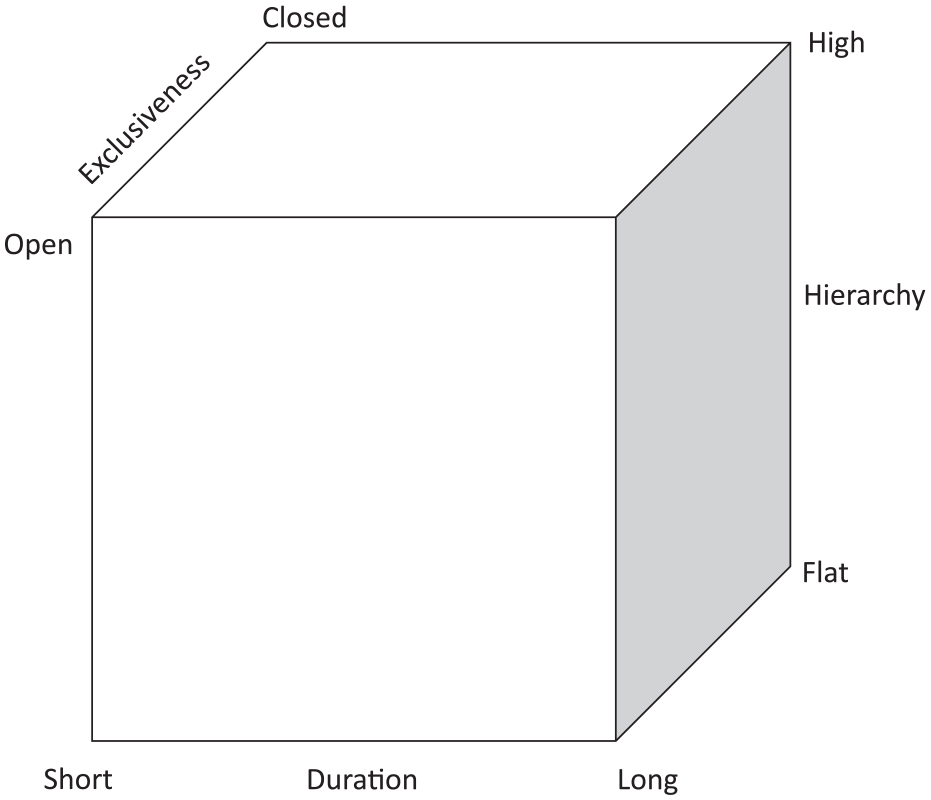
Informal groups of states in a multidimensional space.
Arguably, however, the members of directoires could use their power to overcome the group’s inherent legitimacy problem. It is conceivable, for example, that they use coercion or bribery to compensate for the directoire’s lack of legitimacy (Reus-Smit, 2007: 167). In this regard, directoire members have important power sources: firstly, they may have superior technical expertise, intelligence information, military hardware or diplomatic clout to implement and enforce a directoire’s policies. Secondly, they have the ability to establish a directoire as a credible alternative group outside a formal international organization if their push for the establishment of a directoire within the organization is rejected (Stone, 2011). In the long term, however, it is unlikely that directoires are able to exercise their authority based merely on their power base. As Aggestam and Bicchi (2019: 519) argue, leadership is ‘a social, relational role between a leader and its followers (. . .). In this sense, leadership is an activity that is co-constitutive and only possible if it is perceived as legitimate by the followers’. In fact, having legitimacy in the eyes of others is widely seen as a crucial factor for any actor that exercises leadership, including in international affairs (Clark, 2003; Hurd, 2007; Reus-Smit, 2007). This legitimacy needs to be earned and maintained over time (Suchman, 1995: 574).
Sources and strategies of legitimation
A wide variety of actors are known to seek actively legitimacy in the eyes of other actors through so-called ‘legitimation strategies’ (Gronau and Schmidtke, 2016). Although very little attention has been paid to the legitimation strategies by informal groups of states, they can be expected to try to gain and maintain legitimacy as any other political actor with leadership ambitions would. In the words of Reus-Smit (2007: 159), ‘Political actors are constantly seeking legitimacy for themselves or their preferred institutions and in doing so they engage in practices of legitimation’. As the existing literature has shown, legitimation processes are inherently interactive, that is, while political actors may foster legitimacy in top-down processes, gaining legitimacy depends ultimately on bottom-up processes through which actors recognize the legitimacy of others (Bernstein, 2011; Gronau and Schmidtke, 2016; Lake, 2009). As the literature on political leadership has shown, leaders depend ultimately on their followers (Parker and Karlsson, 2014). This article will consider both processes in its case study of the E3. In other words, it will analyse how the E3 used different types of legitimation sources in their effort to gain and maintain legitimacy and how this affected the support they received from the other member states. The main focus is on legitimation at the intergovernmental level within the EU, where a small, informal group of nation states forms the ‘legitimacy object’ (Wimmel, 2009: 185) and other EU member states form the relevant constituency (Clark, 2003). 2 The leadership focus is, thus, on the vertical dimension between EU member states inside and outside the E3 (see Aggestam and Johansson, 2017: 1206). Building on the three key criteria of state legitimacy by Beetham (1991), political actors can have three generic sources of legitimation at their disposal: (a) pragmatic problem-solving; (b) adjustments in institutional design; and (c) institutional and policy congruence building.
As mentioned in the introduction, the key advantage of informal arrangements such as directoires is usually considered to be their more efficient problem-solving capability in comparison with formal international organizations. More specifically, informal arrangements improve the efficiency and speed of decision-making by lowering short-term transaction costs and overcoming the structural constraints and stumbling blocks of formal institutions, such as veto players or cumbersome procedures (Prantl, 2005; Vabulas and Snidal, 2013). Consequently, directoires are able to offer efficient solutions to issues that may not only be in the interest of the directoire members but also of a wider community of states, in particular the states that are not members of the directoire but of the international organization in which it is embedded (Biermann et al., 2009). So, directoire members can use their problem-solving capability to justify their authority vis-à-vis non-members, although the success of such a strategy depends eventually on the recognition of that capability by the non-members. If successful, a directoire gains what is known in the literature on democratic legitimacy as ‘output-oriented legitimacy’ (Scharpf, 1999). As Suchman (1995: 581) suggests, this type of legitimacy could go so far as to become ‘structurally legitimate’ in the sense that the non-members recognize the directoire as the ‘right organization for the job’.
When it comes to the participation of other states in the decision-making procedure of the directoire, the members of the directoire have – by definition – little leeway. Their efficiency depends on a low number of participants. So, what Scharpf (1999) calls ‘input-oriented legitimacy’ is difficult to achieve. It is even more complicated to reconcile the practice of directoires with the norms and principles of ‘democratic legitimacy’ that has emerged, especially in the literature on EU foreign and security policy (Sjursen, 2011). Yet, at the very least, directoires can resort to the selective use of informal groups within international organizations (Stone, 2011). That is, they can limit the role of the directoire to exceptional situations, where directoire members have a particularly strong interest in efficient problem-solving. At the same time, non-members can be compensated with equal participation in decision- and policy-making during ‘ordinary times’ (Stone, 2011: 18–19; see also Delreux and Keukeleire, 2017: 10). Furthermore, directoires can adjust their decision-making processes. As in the case of Schmidt’s (2013) concept of ‘throughput legitimacy’ or Biermann et al.’s (2009) concept of consultative and cooperative leadership, this may include procedural changes that increase the accountability, inclusiveness and transparency of the decisions taken by the directoire. In this regard, increased information-sharing and improved deliberation processes may also increase the legitimacy of a closed group of states, as Hurd’s (2007) research on non-members of the United Nations (UN) Security Council suggests. Even the institutional set-up of a directoire could be adapted to make it more legitimate (Gronau and Schmidtke, 2016). In short, directoire members have various options to establish a legitimation strategy based on adjustments in their institutional design. Whether these adjustments are sufficient will depend, once more, on the acceptance by the non-members. The latter will be influenced by the degree of intergovernmental accountability; that is, the degree to which the decisions and actions of an informal group can be scrutinized, in how far it can be held responsible for them and if it accepts any kind of input from the non-members (see Schmidt, 2013: 6).
Finally, legitimacy is related to the congruence between the actions and policies of the political actor that seeks legitimacy and the basic values and shared beliefs of its constituency (Gronau and Schmidtke, 2016; Zaum, 2013). If a political actor wants to lead, it needs to take into consideration the concrete context and the needs and demands of its followers (Nye, 2009). More generally, the legitimacy of an actor or institution depends on the need to be ‘perceived as desirable, proper, and appropriate within any given cultural context’ (Suchman, 1995: 586; see also Bernstein, 2011: 24). In other words, a directoire and its policies should reflect the broader identity of the international organization in which it is embedded (Gronau and Schmidtke, 2016: 541–542). More specifically, the non-members of the directoire need to accept a directoire and its policies not only out of a narrow self-interest in getting common problems solved but also because they can identify with them. To this end, a directoire can make sure that its actions and communications are embedded in the values and principles of the international organization in question. It can also signal specifically its support for them.
E3 legitimation strategies
Since its inception in 2003, the E3 has been the arguably most salient example of a directoire in EU foreign and security policy. It had an exclusive membership limited to France, Germany and the UK and exercised a leadership role for the whole of the EU’s Iran policies (Alcaro, 2018: 5), lasting for an extraordinarily long time of more than 15 years (Adebahr, 2017: 162). As such, it had a particularly pronounced legitimacy problem in relation with the other EU member states. Building upon the systematic analysis of key documents from the EU and its member states, news outlets, WikiLeaks sources and 25 semi-structured elite interviews with key participants in the nuclear negotiations with Iran, including E3 political directors and ambassadors, EU officials, representatives from 10 EU member states and various Iranian and US sources, this section will carry out a longitudinal case study that traces the patterns of the E3 efforts to gain legitimacy from other EU member states between 2003 and 2015. In this regard, it will pay special attention to the possible legitimation sources and strategies outlined above and the impact they had on EU non-members.
The E3 diplomatic engagement with Iran has been divided into three phases on the basis of the group’s institutional relationship with the EU itself. During Phase One (October 2003 to October 2004), the E3 acted outside of EU formal institutions. Phase Two (November 2004 to December 2009) saw the inclusion of the EU High Representative into the E3 format. The final stage, from January 2010 to July 2015, represented a period where EU foreign and security policy was subject to institutional reforms as a consequence of the 2009 Lisbon Treaty.
Phase One: The E3 outside the EU
Through a set of informal conversations in October 2003, the foreign ministers of France, Germany and the UK decided to take action on the Iranian nuclear dossier once the risk of a referral to the UN Security Council or of military escalation of the crisis became a real possibility. According to those involved in these talks, in shaping their initiative, the E3 swiftly opted for an informal group instead of relying on the foreign and security policy tools provided by EU institutions as they perceived that, in order to avoid an escalation of the Iranian nuclear crisis, they had to circumvent the potential deadlocks in the EU formal decision-making process (Interviews 2, 21 and 22). In the eyes of E3 diplomats, a Union of then 15 member states, with different views and national interests, was ill-equipped to act diplomatically in a fast and united way (Interviews 2 and 8). In other words, the justification of the choice of the E3 format focused heavily on the E3’s enhanced problem-solving capacity in terms of efficiency and speed in comparison with the formal EU mechanisms. To this end, the E3 was set up as a ‘competing informal institution’ (Christiansen and Neuhold, 2013: 1200).
As a consequence, throughout Phase One, the E3 acted outside the EU legal framework, without seeking a formal mandate before they launched the initiative, thus presenting those member states not involved in the talks with a fait accompli (Interviews 5 and 8). The E3 did not even consult with or inform the then High Representative, Javier Solana, about the three foreign ministers’ first trip to Tehran in October 2003 and did not search for a mandate from formal EU institutions (Interviews 5 and 14). Even the much-heralded Tehran Declaration between Iran and the E3 – the main negotiation outcome during Phase One – was signed in October 2003 without any formal EU role or support (Ahlström, 2005: 27). At the same time, however, the E3 declared to act in line with the overall directives and goals of EU policy towards Iran, emphasizing the European dimension of their efforts (Interviews 4 and 13).
During Phase One the E3 thus tried to dissociate their initiative from the formal EU institutions, operating outside them while downplaying the hierarchical nature of their approach and emphasizing their problem-solving abilities. Yet, this legitimation strategy showed little success. The General Affairs and External Relations Council refrained from publicly acknowledging the E3 initiative during Phase One, praising instead the efforts of the International Atomic Energy Agency (Harnisch, 2007: 9). Furthermore, a wide variety of EU member states were very outspoken in their criticism of the E3 (Interview 3, 8 and 22). Dutch and Belgian officials, for instance, declared their outrage about the role the E3 assumed and, soon after the signature of the Tehran Declaration, they stated that the initiative breached European principles of multilateralism (Interviews 5 and 6). They also complained in closed-door meetings that the E3 were keeping their discussions on Iran from other EU members (US Embassy in The Hague, 2003). Dissatisfaction within the Union over the E3 framework intensified in February 2004, when the E3 held a meeting in Berlin prior to an EU summit. Spain, Italy and the Netherlands expressed their disapproval about ‘a divisive nucleus which would threaten European unity’ and through which they were ‘not even being informed of the issues or decisions made’, whilst their apprehensiveness over their exclusion and the circumvention of EU formal institutions increased (Powell, 2004).
Phase Two: The inclusion of the High Representative
In the second half of 2004, faced with the potential collapse of talks with Iran, the E3 realized it needed to increase its leverage in the negotiations with Tehran, offering financial and economic incentives that would convince the country to curb its nuclear activities. Throughout Phase One of the initiative, the E3 operated outside the EU institutions and could thus not rely on instruments that fell under the competences of the Union. To be able to offer appealing incentives to Tehran, such as talks on a Trade and Cooperation Agreement (TCA), the E3 needed to commit the EU as a whole, thus changing the group’s relationship with the EU legal framework and gaining the legitimacy of the excluded EU members (Interviews 4 and 22).
During the EU Council meeting of October 2004, the E3 thus decided that the best way to operate within the Union was to change the institutional design of the group and to formally involve High Representative Javier Solana in the talks (Council of the European Union, 2004a). Enforcement, either through coercion or via operating outside the institutions, would not have achieved the intended results, as Phase One demonstrated. Shortly after, the E3, which from November 2004 on came to be known as the E3/EU (to indicate the involvement of the Union), was recognized explicitly in dealing with the Iranian dossier by official documents issued by the EU. The Presidency conclusions of the European Council placed the initiative within the EU legal framework (Council of the European Union, 2004b). This recognition was confirmed through the 2004 Paris Agreement, the main negotiation achievement during Phase Two, which diverged from the Tehran Declaration in that the governments of the E3 and Iran signed it explicitly ‘with the support of the High Representative of the European Union’, therefore co-opting the whole EU as part of the process (Solana, 2004). In March 2005, the Council also made explicit references to the E3/EU, acknowledging that the group was acting on behalf of the Union (Council of the European Union, 2005).
Although initially the involvement of the High Representative in the negotiations changed very little in terms of the dynamics and the E3 centrality in the decision-making process within the group (Interviews 2 and 16), the EU was increasingly represented in talks with Iran by the High Representative. Over time, the institutional change of the informal group through the co-optation of an actor formally established in the Treaties played a constructive role in overcoming the concerns of the member states excluded from the E3. In this regard, information-sharing, a fundamental process in Council working groups (Juncos and Pomorska, 2006), was particularly relevant (Interviews 11, 17, 18 and 19). During the first year of the E3 initiative, deliberations were secretive and lacked co-ordination with other member states (Interview 3). However, the co-optation of the High Representative strengthened the communication channel between those inside and those outside the E3. The EU Council was informed of any progress in the talks, with briefings and consultations taking place on a monthly basis before the General Affairs and External Relations Council meetings (Interviews 1 and 11). This facilitated the exchange and access to sensitive information that would have been otherwise withheld, thus increasing the E3’s transparency, inclusiveness and accountability. It even laid the groundwork for a growing implementation of the policies on Iran in Brussels, where unanimous decisions were to be taken on the use of EU instruments, such as talks on a TCA or, later on, the adoption of sanctions. In other words, the co-optation of the High Representative triggered a process of partial ‘Brusselization’ (Allen, 1998) or even of partial Europeanization, as a senior EU official argued (Interview 9). However, the E3 still remained firmly in the driver’s seat when it came to the formulation of the policies (Interviews 1 and 3).
Due to the co-optation of the High Representative, all EU member states, particularly those who did not want to take a backseat in the initiative, could ensure that their interests were represented (Hanau Santini, 2010: 475). The intense level of information-sharing through the E3/EU format remained ‘key in keeping the non-E3 member states happy’, easing tensions and removing discontent and concerns of a directoire acting in competition with the Union’s common foreign and security policy (Interviews 1 and 5). Even though the E3 maintained the leadership in terms of policy-making on Iran (Interview 3), Solana – acting as ‘an advisor and bridge between the E3 and the EU-25’ – managed to bring enough political momentum to effectively transform the E3/EU initiative into a European venture (US Embassy in Brussels, 2004). Once the High Representative was associated with the talks, EU member states – including those that were previously critical of the E3 – accepted the role of the trio, recognizing that an informal group was the best formula to have the flexibility and intra-EU co-ordination needed to deal with the issue (Interviews 11, 12, 17, 18, 19 and 20; Mazzucelli, 2009: 333), as long as the E3 did not turn into a widespread foreign and security policy mechanism (Interviews 8 and 9). Although tensions over the EU’s Iran policy re-emerged occasionally amongst the member states (Onderco, 2015), the E3 were able to maintain their legitimacy through the new E3/EU format.
In fact, the legitimacy of the group further increased once the Iran dossier was referred to the UN Security Council in late 2005, after Iran stopped complying with its obligations under the Paris Agreement, and as a result China, Russia and the USA joined forces with the E3/EU. The efforts of the group, which since early 2006 became known as the E3/EU+3 (or informally as the P5+1), were explicitly recognized by the UN Security Council. All parties involved agreed that the E3/EU should act as a co-ordinator for the whole group (Cronberg, 2017: 253), being delegated the role of ‘important player and bridge-builder, both globally and regionally’ (Solana and Moeller, 2006). For convenience, and in order to have one man speaking for all, the High Representative acted as spokesperson for the whole group (Interviews 4 and 5) and also represented all those EU states excluded from the group.
Phase Three: The integration of the E3 and the EU
Following the implementation of the Lisbon Treaty in December 2009, Catherine Ashton took over from Javier Solana in chairing the E3/EU+3 as chief negotiator on the Iranian nuclear dossier. Through the institutional reforms introduced by the Lisbon Treaty, the High Representative was also assigned significant representative and participatory roles in EU foreign and security policy matters, de facto becoming the external representative of the Union. Furthermore, the High Representative was provided with a diplomatic service: the European External Action Service (EEAS), which was formally launched in December 2010. Most notably, Catherine Ashton centralized the EEAS Iran experts in a new strategic planning division, which ‘facilitate[d] the direct and less bureaucratic coordination of the High Representative’s negotiations with Iran’ (Kienzle, 2013). In practice, this meant that the High Representative and her team assumed an even more central role in relation with the E3 than was originally envisioned by the E3 when they co-opted Javier Solana at the beginning of Phase Two. Far from having just a co-ordination role among the E3/EU+3 and Iran, both Catherine Ashton and Federica Mogherini (who took over as EU High Representative in December 2014), managed, through their teams, to control the agenda, set the process and negotiate the content of the agreement and of its annexes (De La Baume, 2015). Although the E3 remained centrally involved in the policy formulation and implementation processes of the E3/EU (Interviews 1 and 3), E3 leadership became less pronounced than in Phases One and Two. However, the leading role assumed by EU diplomats during the expert-level discussions with Iran during Phase Three also led to a further increase of the legitimacy of the E3/EU within the EU and to a progressive convergence of the positions of the E3 and the rest of the EU (Interviews 3 and 7).
This growing convergence eased the adoption of unilateral EU sanctions against Iran – a key tool in the international two-track approach based on negotiations and sanctions (Interview 16). Sanctions against Iran constituted one of the most sensitive and controversial issues amongst EU member states, occasionally raising tensions between the E3/EU and a number of EU countries not directly involved in the talks but with strong economic ties with Tehran. Talks on the introduction of unilateral restrictive measures started already in 2007 and were led by France and the UK, which advocated for the need to adopt ‘tougher sanctions both at the UN and in the European Union, including on oil and gas investment and the financial sector’ against Tehran (US Embassy in London, 2007). Because of the additional powers granted to the High Representative and the assistance of the EEAS, once Catherine Ashton became in charge of the talks in December 2009, she managed for the first time to translate the two countries’ designed policy into reality, convincing all sceptical EU member states to dovetail their economic efforts in the interests of the E3/EU+3 negotiations with Iran (Interview 10). Even the countries more critical of unilateral sanctions, such as Austria and Spain, ‘shifted from insisting on UNSC sanctions only to accepting that [they had] to consider EU sanctions’ (US Embassy in Vienna, 2010).
Eventually, in 2010, European hesitations on targeting the Iranian economy came to an end. In January 2012 the EU even agreed to impose an oil embargo against Iran, which eventually increased substantially the economic pressure on Iran. During this phase, the impression was that, for the first time, the conversation about the need to implement specific measures on Iran was taking place directly in Brussels (Interview 25). So, at this stage it is possible to observe a significant convergence of the positions of the E3 and the wider EU. Although there is little evidence to suggest that this was the result of the socialization of sceptical EU states into the E3/EU approach to deal with Iran, it can be seen as ‘strategic socialisation’, where social pressure by the E3/EU motivated the sceptical EU states to comply ‘as part of their long-term interest calculation’ (Juncos and Pomorska, 2006).
In Phase Three, as Helga Schmid, then the EEAS’s Deputy Secretary General for Political Affairs, pointed out, ‘the co-ordination of the EU with the support of the E3 has proven to be effective in the E3/EU+3 negotiations with Iran’ (Interview 23). Iranian officials argued there was a clearer ‘feeling of Europeanization’ and co-ordination with all other countries within the E3/EU+3 (Interview 24). In practice, the E3/EU turned from a ‘competing’ into a ‘complementary informal institution’, not unlike other high-level groups in EU integration (Christiansen and Neuhold, 2013: 1199). Therefore, particularly once the interim agreement and the comprehensive deal were reached in November 2013 and July 2015, respectively, the success of the E3/EU format reflected positively on the EU as a whole. The agreements with Iran were, in essence, proof of the problem-solving ability of the E3/EU in the name of the whole of the EU. After 12 years of negotiations, during which an immense political capital had been invested in order to achieve a peaceful resolution of the Iranian nuclear issue, the E3/EU, and the Union with it, was given a large share of the credit for the outcome of the negotiations and emerged ‘as the actor whose role was indispensable for the process’ (Interview 15). More generally, the initiative resulted in the perception of greater actorness for the EU as a whole, while also affecting the identity of the Union as an international actor (Alcaro, 2018: 212–213).
Conclusions
The existence of directoires raises important issues about the organizational behaviour of informal groups of states concerning non-members and about the institutional design of their relationship with the international organization in which they are embedded. This article has shed light on a hitherto under-researched yet crucial issue in informal governance, namely how informal groups may overcome their inherent dilemma between efficiency and legitimacy and exercise leadership vis-à-vis the non-members. To this end, it has focused on the legitimation sources and strategies of directoires, that is, small groups of states that have a particularly pronounced legitimacy problem within the international organization in which they operate. More specifically, the analysis of the legitimation of the E3 and, from late 2004 on, the E3/EU in the nuclear negotiations with Iran, has shown that it is very difficult, but not impossible, to overcome the inherent legitimacy deficit of directoires in the eyes of the non-members. As a least-likely case for overcoming the efficiency–legitimacy dilemma, the E3 case study offers strong support for the importance of sustained legitimation strategies by directoires to gain internal legitimacy within the international organization in which they are embedded. In the case of other less controversial formats of informal groups of states (see, for example, Elgström, 2017), it is arguably even more likely that legitimation strategies can resolve a groups’ legitimacy dilemma, underpinning recent arguments about the increasing leadership role of informal groups in EU foreign and security policy (Aggestam and Bicchi, 2019; Delreux and Keukeleire, 2017). However, further research on informal groups in different locations within the three-dimensional space in Figure 1 is needed to explain how and to what extent non-directoires are able to gain legitimacy from non-members and, thus, to lead on certain foreign and security policy issues.
Furthermore, the longitudinal case study of the internal legitimacy of the E3 in three different phases between 2003 and 2015 suggests that some legitimation strategies can be more effective in creating legitimacy than others, offering new avenues for future research to explore the variation in impact of legitimation strategies. The E3’s first approach was largely unsuccessful in fostering the group’s legitimacy vis-à-vis the other EU member states. In essence, they adopted a ‘detachment strategy’ that established the E3 as a largely separate entity from the EU. There were no institutional links between the E3, the other EU member states and the EU as an international organization. The E3 alluded to the consistency between their actions on Iran and the broader European values and principles only in some of their declarations. Despite overcoming the structural constraints of the EU and offering pragmatic problem-solving, which, through engagement with Iran, led to the 2003 Tehran Declaration, the E3 mostly lacked legitimacy amongst the EU member states not involved in the initiative. In other words, even though the E3 were firmly in the driving seat, they were unable to exercise vertical leadership, that is, in relation with the other member states. This highlights Aggestam and Johansson’s (2017) argument about ‘a paradox at the heart of EU foreign policy between the demand for leadership effectiveness (strategic action) and perceptions of legitimate leadership (appropriate behaviour)’. In practical terms, it suggests that the key advantage of a directoire, that is, its high degree of efficiency as problem-solver in comparison with the formal international organization in which it is embedded, cannot make up for its substantial legitimacy deficit due to its exclusive and hierarchical nature. Generally speaking, output legitimacy may not always compensate for the lack of input legitimacy.
After roughly one year, the E3 abandoned the ‘detachment strategy’ and adopted what can be called a ‘co-optation strategy’ in the hope to become more effective in negotiations with Tehran, indirectly addressing the legitimacy gap. This strategy focused on an adjustment in institutional design that involved ‘co-opting’ the High Representative, while also improving the information exchange with other EU member states. While this approach hardly increased the E3’s input legitimacy – the E3 remained essentially an exclusive group taking decisions hierarchically – it did alleviate key concerns among the large majority of EU member states by increasing the accountability, inclusiveness and transparency of the decisions taken by the group. This shows how minor institutional adjustments akin to the ideas of ‘throughput legitimacy’ and consultative and cooperative organizational leadership can have a significant impact in terms of legitimacy gains and the ability to lead other nation states. As Hurd (2007) has already shown in the case of the 1945 UN Conference in San Francisco, small states tend to put a lot of value on the simple fact that they are being heard. The ability of the ‘co-optation’ strategy to foster legitimacy is also a reflection of the legitimacy-enhancing role representatives of international organizations can play, in particular in directoires but potentially also in other types of informal groups.
After the 2009 Lisbon Treaty, the originally rather pragmatic inclusion of the High Representative in the E3 out of strategic and instrumental considerations became over time a much more integrated relationship, blurring the distinction between informal and formal Treaties-based elements. In essence, the E3/EU and the EU as a whole converged in their approach to Iran, with overt E3 leadership shifting to a more diffuse ‘European’ leadership. This is a reflection of what can be called an ‘integration strategy’, where a directoire’s inherent legitimacy problem is overcome by the increasing congruence between the directoire’s policies and the policies of the non-members. That is, a directoire becomes virtually indistinguishable from the larger international organizations in terms of institutions, policies and, ultimately, identity. In more general terms, the E3 have moved from pragmatic legitimacy to cognitive legitimacy, where a political actor is basically taken for granted by the others (Suchman, 1995: 584). This, in turn, has strengthened the E3/EU’s problem-solving capabilities in the negotiations with Iran, as reflected, for example, in the EU’s unusually strict sanctions against Iran or the E3/EU’s leadership role in the context of the UN Security Council in form of the E3/EU+3. As Prantl (2005: 584–585) has argued already regarding informal groups in the UN, a small group’s increased problem-solving ability may eventually feed back into the strengthened legitimacy of the larger international organization. In other words, the legitimacy and, eventually, the leadership capability of the whole of the EU may have benefited as a result of the E3/EU’s problem-solving abilities, confirming a ‘new set of interactions in which cooperation among small groups of member states can help to address shortcomings in the EU foreign policy system’ (Aggestam and Bicchi, 2019). Arguably, ‘integration strategies’ may work particularly well for informal groups that are less controversial according to their location in the three-dimensional space in Figure 1.
In summary, the sustained use of legitimation strategies is crucial to overcome the efficiency–legitimacy dilemma of directoires and – potentially – other, less controversial types of informal groups in international organizations, if these groups want to exercise leadership over non-members. However, more research is needed to examine the varying impact of different legitimation strategies in distinct types of informal groups and their leadership ambitions. Gaining legitimacy is a complex and difficult endeavour in international affairs.
Footnotes
Acknowledgements
The authors are happy to acknowledge the valuable input and support from Karolina Pomorska and the other participants of panels at the 12th Pan-European Conference on International Relations and the 2018 ISA Annual Convention, where earlier versions of this article were presented. They would also like to thank the reviewers for very constructive feedback. Finally, they would like to thank the interviewees for taking their time to participate in the research for this article.
Funding
The authors disclosed receipt of the following financial support for the research, authorship and/or publication of this article: This work falls within the EU-NormCon research project (Normative contestation in Europe: Implications for the EU in a changing global order) funded by the National R+D Plan of the Spanish Ministry of Economy and Competiveness (CSO2016-79205-P).

Notes
Interviewees
Giancarlo Aragona (Italian Foreign Ministry’s political director), via email, May 2015. Richard Dalton (former UK Ambassador to Tehran, 2003–2006), London, February 2015. Franco Frattini (former Italian Foreign Minister, 2002–2004 and 2008–2011), over the phone, May 2015. Annalisa Giannella (former Personal Representative of the High Representative on Non-Proliferation of Weapons of Mass Destruction), Brussels, December 2014. Stanislas de Laboulaye (former French Foreign Ministry’s political director), March 2015. Paul von Maltzahn (former German Ambassador to Tehran, 2003–2006), over the phone, May 2015. Nasser Hadian (professor of political science at the University of Tehran), over the phone, August 2015. François Nicoullaud (former French Ambassador to Tehran, 2001–2005), over the phone, February 2015. Senior EU official C (involved in talks), Brussels, November 2015. Senior Belgian official (based at the Permanent Representation of the EU), Brussels, April 2014. Senior Belgian official (involved in non-proliferation policies), over the phone, March 2009. Estonian official (Permanent Representation to the EU), Brussels, January 2009. Senior EU official A (involved in the talks), Brussels, April 2014. Senior EU official B (previously involved in the nuclear talks), London, November 2014 and May 2015. Cyrus Nasseri (member of the Iranian negotiating team on the nuclear issue, 2003–2005), London, October 2015. Former senior EU official (previously involved in the negotiations), Brussels, December 2014. Senior Irish official (involved in non-proliferation policies), over the phone, June 2009. Senior Lithuanian official (Permanent Representation to the EU), Brussels, February 2009. Senior Spanish official (Permanent Representation to the EU), Brussels, December 2008. Swedish official (Permanent Representation to the EU), Brussels, January 2009. Senior UK official (previously involved in the negotiations), London, June 2015. Michael Schaefer (former German foreign ministry’s political director), over the phone, February 2015. Helga Schmid (Deputy Secretary General of the EEAS), via email, October 2015. Mohammad Javad Zarif (former Iranian Ambassador to the UN, 2002–2007, and Iranian foreign minister and chief nuclear negotiator, 2013–present), August 2015. Jofi Joseph (Director for Nonproliferation, White House National Security Council, 2011–2013), over the phone, June 2015.