




Abstract
International organizations continuously deploy civilian capabilities as part of their peacekeeping and crisis management operations. This presents them with significant challenges. Not only are civilian deployments rapidly increasing in quantity, but civilian missions are also very diverse in nature. This article analyses how international organizations have learned to deploy their civilian capabilities to deal with a growing number and fast evolving types of operations. Whereas the previous literature has addressed this question for individual international organizations, this article uniquely compares developments in the United Nations (UN), European Union (EU) and Organization for Security and Co-operation in Europe (OSCE), three of the largest civilian actors. Drawing on the concept of organizational learning, it shows that all three organizations have made significant changes over the last decade in their civilian capabilities. The extent of these changes, however, varies across these organizations. The article highlights that the EU, despite its more homogeneous and wealthier membership, has not been able to better learn to deploy its civilian capabilities than the UN or OSCE. We show that the ability of these organizations to learn is, instead, highly dependent on institutional factors.
Keywords
Introduction
International organizations increasingly deploy civilian capabilities as part of their peacekeeping and crisis management operations. While there were, for example, only 44 civilian police officers involved in United Nations (UN) missions in 1990, their number averaged over 10,000 in 2018 (United Nations, 1990, 2018). Regional organizations also deploy significant civilian capabilities. The European Union (EU), for instance, deployed more than 1600 civilian experts to Kosovo in 2008 as part of its Common Security and Defence Policy (CSDP) (Stockholm International Peace Research Institute, 2009, Appendix 3A). This policy now includes 10 ongoing civilian missions. The Organization for Security and Co-operation in Europe (OSCE) similarly has a wide range of civilian missions, including a large-scale monitoring mission in Ukraine consisting of over 850 international staff (OSCE Special Monitoring Mission to Ukraine, 2018).
Because deploying civilian capabilities is a relatively new activity for international organizations and their member states, it poses significant challenges. For instance, while soldiers are recruited for expeditionary missions, the career path of an average police agent or judge does not include a stint abroad (Korski and Gowan, 2009: 44). Furthermore, civilian officials are normally deployed on the basis of their individual expertise, which requires thorough selection procedures. It is not always clear what type of equipment civilians require to do their job. Finally, the mandates of civilian missions vary widely, from riot control to monitoring peace agreements.
This article asks how international organizations have learned to deploy their civilian capabilities to deal with a growing number and fast evolving types of operations. It draws on the concept of organizational learning (Argyris and Schön, 1978; Levitt and March, 1988; Levy, 1994), which can be defined as institutional change resulting from new information, observation and experience with the objective of increasing performance (cf. Smith, 2017). The article compares changes in the UN, OSCE and the EU, three of the largest civilian actors, since the late 2000s. 1 It shows that these organizations have made significant changes. Yet, surprisingly, despite its more homogeneous and wealthier membership, the EU has not been able to deploy its civilian capabilities more easily than the UN or OSCE. We argue, therefore, that it is critical to consider the institutional context – particularly the number of veto points and the involvement of member states in everyday management – to understand how learning takes place. The less-institutionalized context in the UN and OSCE has provided staff with more opportunities to learn.
This is not the first article on learning in international organizations. Yet, both the comparative focus and the empirical study of civilian capabilities make it unique. Much of the existing literature tends to address this research question for individual international organizations engaged in military tasks (e.g. Benner et al., 2011; Faleg, 2017; Hardt, 2018; Junk et al., 2017; Smith, 2017). The advantage of a comparative approach is that it provides a benchmark (Smith, 2017: 40) to measure the extent to which international organizations have changed their civilian capabilities. We thus explicitly focus on external validity in this article – how international organizations in the area of crisis management fare in comparison to others. The contribution of this article, however, goes further. Through the comparative approach, we show the theoretical significance of the institutional context.
The article starts with a review of the literature on organizational learning. We notice that, despite a considerable degree of theoretical sophistication and empirical testing, the emphasis has remained on individual international organizations. By extending the analysis to the UN, OSCE and EU, this article contributes to an emerging comparative literature on international organizations (Dijkstra, 2016; Eckhard and Ege, 2016; Hardt, 2014; Hooghe and Marks, 2015; Knill and Bauer, 2016). The article subsequently analyses, for each organization, how they have made changes with respect to the financing, staff and equipment of civilian missions. The article concludes with a comparison of the findings.
Changing international organizations based on experience
Organizational learning has been a focal concept in several disciplines (Aldrich, 1999; Argyris, 1982; Easterby-Smith and Lyles, 2011; Sabatier, 1988). Yet, with the exception of Ernst B Haas (1990; Haas and Haas, 1995), students of international organizations have largely ignored learning perspectives. Recent studies have, however, gradually addressed this gap. Various scholars have focused on UN peacekeeping (Benner et al., 2011; Hirschmann, 2012; Howard, 2008; Junk et al., 2017), the North Atlantic Treaty Organization (NATO) (Hardt, 2018), global environmental governance (Siebenhüner, 2008) and the EU (Sabel and Zeitlin, 2008; Zito and Schout, 2009). Noteworthy is research on learning in the area of EU security policy (Adebahr, 2009; Bossong, 2013; Faleg, 2017; Smith, 2017).
Organizational learning is a difficult concept to define (Adebahr, 2009: 85; Benner et al., 2011: 53; Levy, 1994: 280). It is thus important that we clarify what we mean with the concept of learning and how we identify it empirically. Despite definitional discussions, we witness a convergence around common elements in the most recent studies on organizational learning. Adebahr (2009: 97) defines organizational learning as the rewriting of rules as a result of reflection. For Benner et al. (2011: 55, 56), organizational learning is similarly a knowledge-based process of questioning the existing organizational rules with the aim of changing them and ultimately changing the organizational practice. Finally, Smith defines experiential institutional learning as ‘changes in institutions’ functions, procedures and capabilities as a result of new information, observation, or experience’ (2017: 40). For this article, we take inspiration from Smith’s succinct definition to link (1) new information, observation and particularly experience to (2) institutional change with the objective of improving performance (see Illustration 1). This explicit linkage is where learning differs from alternative explanations of change, such as the changing political preferences of states, competition and survival, organizational routines, new ideologies and major historical events (e.g. Barnett and Coleman, 2005; Feldman, 2000; Hannan and Freeman, 1984; Jupille et al., 2013; Mahoney and Thelen, 2009; Nielson and Tierney, 2003). While the institutional changes may not have the desired effect, the objective of organizational learning is to ultimately improve performance.
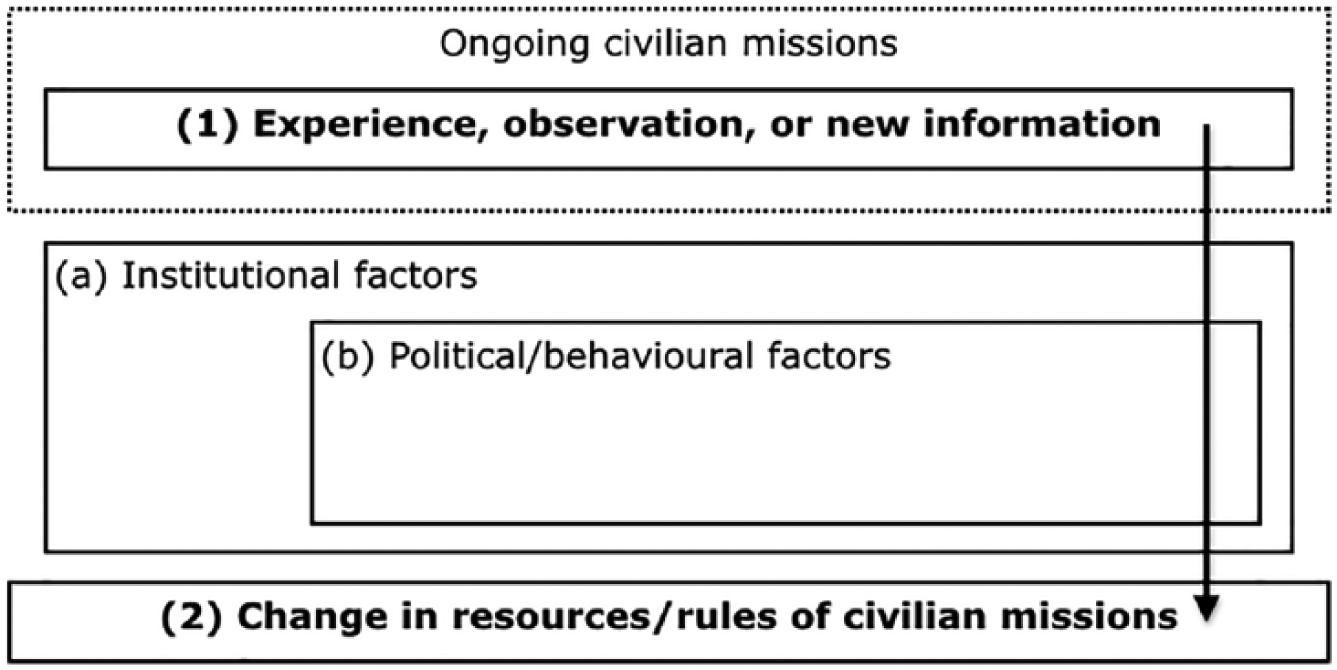
Learning in international organizations.
A key question is how to measure institutional change resulting from experience. Scholars provide us with ambitious standards by seeking to understand how learning affects ideas, beliefs and norms. Thus, Levy (1994: 286) distinguishes between ‘simple’ learning that is expressed by delineating what works and where changes need to be made, and ‘complex learning’, which appears once a full set of stable beliefs, attitudes and norms develops. Similarly, Bossong (2013: 97) adopts the terminology of ‘single-loop learning’ – understood as a simple adjustment of organizational processes to improve task performance – and ‘double-loop learning’ – denoting a ‘deeper’ engagement with organizational objectives or values. This article has a more modest goal: to trace the nature of institutional change in three international organizations in civilian crisis management. As such we use a broad concept, including simple learning and processes of trial-and-error.
To operationalize our concept of learning we follow Smith (2017), who observes that changes across specific institutional dimensions can be seen as an indicator for learning. We focus, in this respect, on changes in the resources and rules related to deploying civilian capabilities. 2 Changes in the resources are about the accumulation of finance, personnel and equipment in support of civilian deployments. For instance, if member states decide to collectively fund a warehouse for equipment or a training centre for staff, this would count as changes in resources. Changes in rules are understood as modifications of existing institutional structures, procedures and routines, or the creation of entirely new ones, with respect to the deployment of resources. For instance, if procurement procedures are made more flexible this is an example of changes to the rules regarding finance. Similarly, if as a result of changing doctrines, resources are used in a different way, this also is evidence of changing rules.
Establishing the link between (1) new information, observation or experience and (2) institutional change presents another challenge. Benner et al. (2013: Table 27.1) provide a useful list of possible intervening variables that help us explain why certain international organizations may be better at learning than others. Their list includes formal design, resources for knowledge management, reporting procedures, incentive systems, culture, leadership, political pressure and bureaucratic politics. They subsequently group these variables by distinguishing between (a) institutional factors and (b) political factors that may facilitate or obstruct learning in international organizations (Benner et al. 2013: Table 27.2). 3 These factors help us to understand how information, observation or experiences from previous planning, deployment and mission implementation processes ‘travels’ to relevant officials in international organizations (both secretariats and member states), whether such officials propose change and whether such change is adopted and institutionalized. In other words, there are many potential institutional and political obstacles preventing international organizations from learning.
Our three empirical cases of organizational learning in the UN, OSCE and EU provide significant variation across these institutional and political factors. While all three are formal international governmental organizations (e.g. Vabulas and Snidal, 2013), the EU is considered more institutionalized than the UN and OSCE (see Table 1). The EU is known for the significant degree of centralization in Brussels and oversight by its member states in terms of the day-to-day management of civilian crisis management (e.g. Eckhard and Dijkstra, 2017; Mattelaer, 2013). In other words, the EU has a high number of institutional veto points, which are ‘all stages in the decision-making process on which agreement is legally required’ for change (Haverland, 2000: 85; Immergut, 1990; Tsebelis, 1995). This also creates an institutional practice in which the member states are actively involved and where proposed technical changes rapidly become politicized. In contrast, in the UN and OSCE the veto points are more limited and concern mission mandates and budgets rather than day-to-day management (Dijkstra et al., 2016; Karlsrud, 2013; Mattelaer, 2013). In the UN, for instance, the Security Council takes great care in negotiating the mandating resolution, but once the mission gets implemented, the Special Representative of the Secretary-General (SRSG) on the ground takes the lead with support from the UN Secretariat (Dijkstra et al., 2016; Karlsrud, 2013). The role of member states is subsequently limited to the budget and mandate renewal. The situation in the OSCE is similar, but the headquarters plays an even smaller role. The OSCE is largely decentralized with the large majority of staff located in missions.
Variation in institutional context and membership in the UN, OSCE and EU.
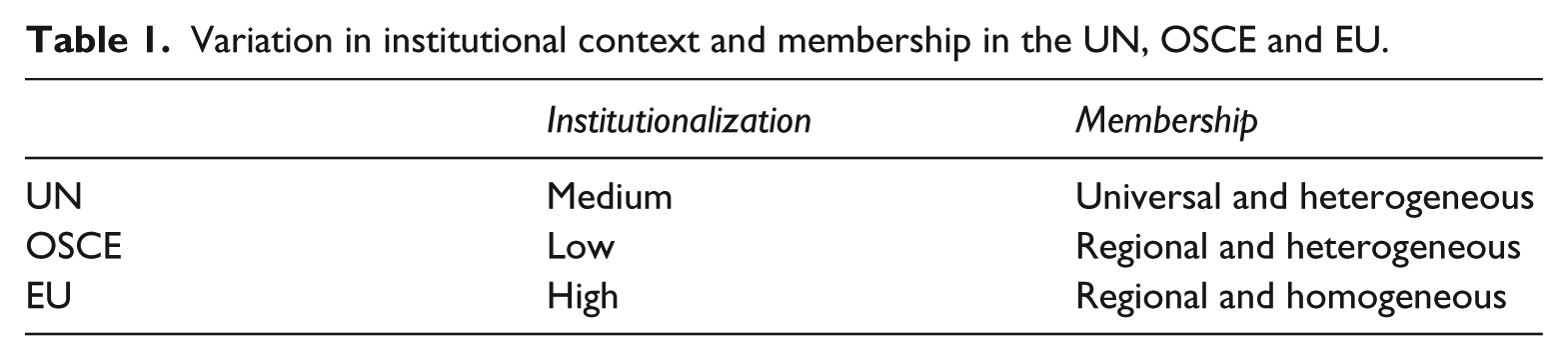
At the same time, these organizations also have very different types of membership. Whereas the UN and OSCE have a heterogeneous membership, including the USA and Russia, the EU has a relatively homogeneous one. The extent to which the membership is politically divided is potentially significant, since this not only undermines the consensus on experiences (Faleg, 2017), but also lowers the chance that the membership can agree on change. In other words, by empirically comparing these three organizations, we can better understand the importance of the intervening variables in the organizational learning process.
Improving civilian capabilities: lessons learned in the UN, OSCE and EU
This article has discussed conceptually how international organizations learn. In what follows, it analyses how experience, observation and new information have resulted in institutional change in the UN, OSCE and EU. By providing a comparative perspective, we can make a better judgement about the significance of learning in individual cases. We find that while learning has taken place in all three organizations, these organizations have attached priorities to different aspects of civilian capabilities. We show that the EU has not been able to learn to deploy civilian capabilities more significantly than the UN or OSCE. This is surprising considering the EU’s more homogeneous and wealthier membership. We argue, therefore, that it is critical to consider the institutional factors to understand how learning takes place.
While the UN, OSCE and EU deploy civilian missions, it is not straightforward to compare them. For instance, UN peacekeeping missions often have civilian and military components, while the EU makes a distinction between civilian and military missions. 4 Furthermore, while the EU Special Representatives are not part of the EU missions, similar roles in the UN and OSCE are often precisely labelled as (political) missions. For our article, we take a narrow definition, because analysing all civilian actions would not allow us to go sufficiently in depth. Because the civilian deployments of the UN, OSCE and EU are not entirely similar, and because the institutional context differs, we discuss them one-by-one. For each organization we focus on how experience, observation and new information result in changes to the resources and the rules governing those resources.
UN: Coping with numbers
While the UN sent police officers to Congo as part of its peacekeeping operation as early as 1960, civilian deployments were limited during the Cold War (Bellamy and Williams, 2010: 377–396; Hansen, 2002). Currently it has 10,000+ civilian police officers deployed (United Nations, 2018). The UN gained serious experience with the establishment of the UN Transitional Authority in Cambodia (UNTAC) and the UN Protection Force (UNPROFOR) in former Yugoslavia in 1992. In 1995, the UN established its police-only mission in Bosnia and Herzegovina (UNMIBH). The next step came with the transitional administration missions in Kosovo and East Timor in 1999. Civilian components in peacekeeping operations further developed during the 2000s and almost all new operations now include civilian deployments.
The UN has also established a wide range of political and peacebuilding missions. For instance, the Secretary-General has a mandate for the pacific settlement of disputes (Article 99 of the UN Charter), which has resulted in the appointment of numerous special envoys (Mani, 2007: 309–310). The UN has also long placed emphasis on conflict prevention and peacebuilding (United Nations Secretary-General, 1992), which has triggered the deployment of peacebuilding missions (Paris, 2007: 406–410). Finally, in several countries there is no need for blue helmets, such as Iraq and Afghanistan, with the UN concentrating on civilian tasks (Paris, 2007: 410–411). For the UN, we focus particularly on changes in the context of the Global Field Support Strategy (2010–2015), based on the experience of the increasing civilian deployments. We do not address headquarters reforms under Secretary-General António Guterres in 2018-2019.
When it comes to the deployment of civilian capabilities, it is useful to distinguish between finance, staff and equipment and mission support. The Global Field Support Strategy, for instance, addressed these issues (United Nations Department of Field Support, 2015; United Nations Secretary-General, 2010). This reform process was informed by the surge in deployments during the 2000s following the landmark Brahimi report (United Nations, 2000) and the establishment of the Department of Field Support (DFS) in 2007. Its overall intention was ‘to transform service delivery to field missions. It [was] designed as an integrated comprehensive programme that [drew] on the lessons learned from several decades of operational experience’ (United Nations Secretary-General, 2010: 3, emphasis added). It focused on rapid deployment, the recruitment of staff and addressing vacancy levels and optimizing procedures, including in the global and regional services centres (United Nations Secretary-General, 2010). Because the Global Field Support Strategy was a learning exercise par excellence, it is important to consider how it affected civilian capabilities.
To start with funding, significant is that political missions fall under the biennial general UN budget, whereas peacekeeping missions each have their own separate budgets. Member states thus pay for political missions on the basis of their gross national income (GNI) and population size. Political missions take about a fifth of the total UN budget of US$3 billion per year (United Nations Secretariat, 2014). This includes all regular UN staff, the headquarters and operational expenditure. Finance is a source of tension between the Security Council, which authorizes political missions, and the General Assembly, which authorizes the budget. 5 An important lesson is that the budgetary cycle creates deployment problems, as ‘mission start-up, expansion or transition’ require considerable ‘flexibility’ (United Nations General Assembly, 2011: paragraph 4). Member states approve peacekeeping budgets (US$6.7 billion over 2018–2019, United Nations General Assembly, 2018), on the other hand, on an annual basis. There is frustration that peacekeeping is still being treated as an extra-budgetary activity, despite the fact that it is bigger than the regular budget (United Nations, 2015b: 15). Even though funding is extraordinary, temporary and thus insecure, these arrangements provide flexibility: the UN has been able to increase its peacekeeping resources in light of the increasing deployment demands. It has not been able to change the rules about the organization of the political and peacekeeping budgets due to opposition from the membership (Dijkstra, 2012; United Nations, 2000: xiii, 2015b: 33). We have thus witnessed changes in the resources, but not the rules, on the basis of previous experience. Furthermore, the institutional context (the way in which funding is organized in the UN) has been a critical determining factor for the increase in peacekeeping resources.
When it comes to personnel, there is an important difference between deployed uniformed personnel (soldiers and police) by the Troop Contributing Countries (TCCs) and contracted civilian personnel by missions themselves (Coleman, 2014: 8–12). The UN compensates TCCs with a flat-rate reimbursement of US$1428 for each deployed person per month. Civilian contracted international and local personnel are paid for by the missions themselves and are therefore considerably more expensive. We furthermore need to distinguish between Formed Police Units (FPUs), individual officers/experts and standing capacities. FPUs are self-sustained units of about 140 deployed police (United Nations Department of Peacekeeping Operations and Department of Field Support, 2010: paragraphs 20–21). They are a relatively recent phenomenon, but there has been a rapid increase in their use (Durch and Ker, 2013: Table 1 and Figure 2). In 2016, there were 71 authorized FPUs in UN missions with 8723 police officers as opposed to 3362 individual police officers (United Nations, 2016, n.d.). Their key functions are public order management, the protection of personnel and facilities and high-visibility patrols (United Nations Department of Peacekeeping Operations and Department of Field Support, 2010: paragraphs 12–15). Because they are self-sustained, the force generation process is easier than with individual police. The increase in FPUs (civilian resources) is mainly the result of the observation that more police were needed, vacancy rates for individual police were high and that mandates increasingly require robustness (Durch and Ker, 2013).
For the selection of individual staff, the UN Secretariat draws up the job profiles, which are circulated to the member states (Durch and Ker, 2013: 13–14). While the UN has long struggled with a high vacancy rate, which the EU and OSCE also experience, it has made a strong effort to reduce it (from 20% to 15%) as part of its Global Field Support Strategy (Durch and Ker, 2013: 15–16, Table 2, Figures 3a and 3b; United Nations Secretary-General, 2014: paragraph 12(e); United Nations Department of Field Support, 2015: 3). This is an achievement, given that at the same time total deployments have also increased. It does not imply, however, that the problem is solved. Several missions still have considerable vacancy rates and it is also a question of the quality of personnel or the required niche capacities.
Changes to the resources and rules of civilian capacities in the UN, OSCE and EU.
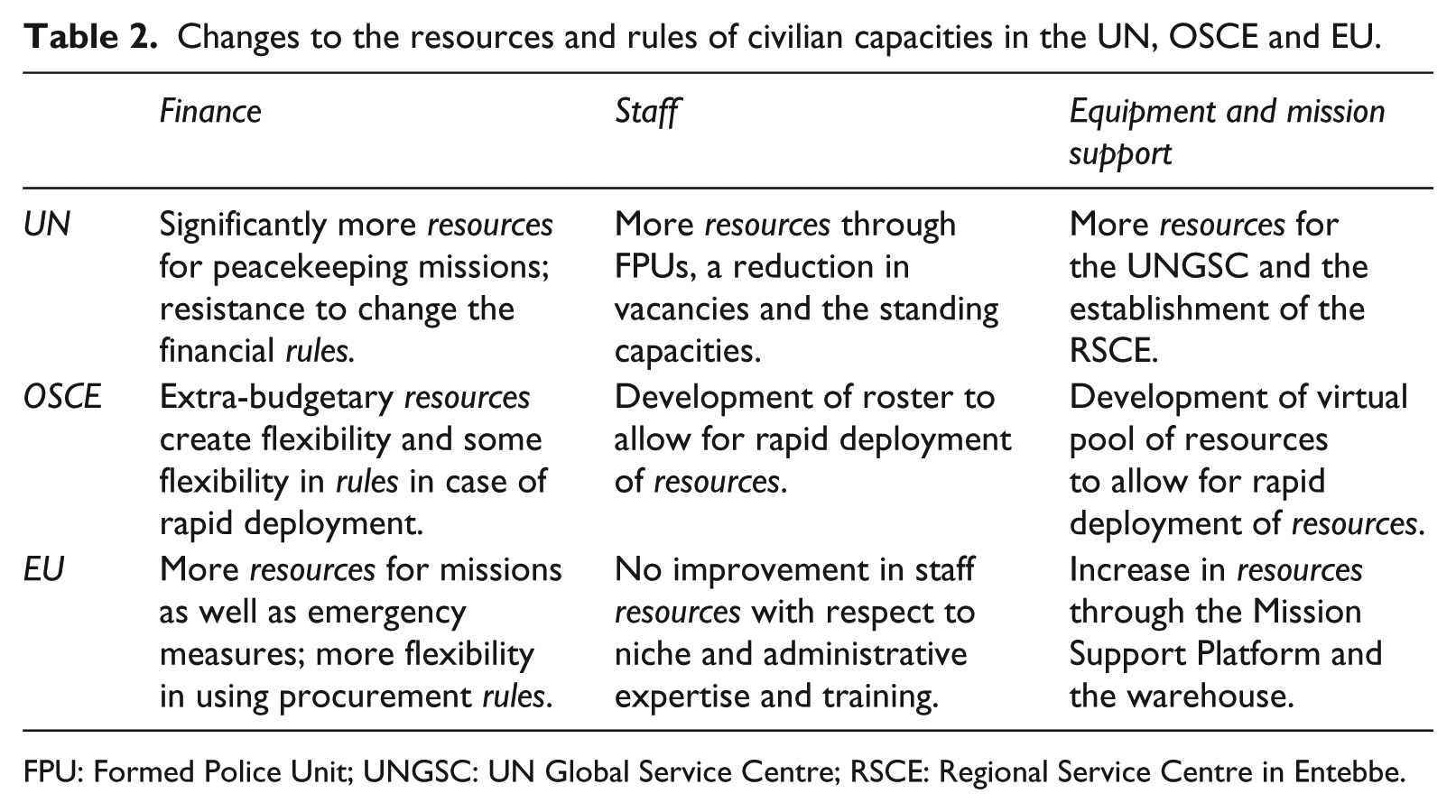
FPU: Formed Police Unit; UNGSC: UN Global Service Centre; RSCE: Regional Service Centre in Entebbe.
Because the UN experienced a struggle to get staff in theatre rapidly, it established a Standing Police Capacity (SPC) in 2006 (see Weinlich, 2014). With a capacity of almost 40 officers, this capability is modest, but it proved helpful during the start-up phase of new missions. The SPC can also provide assistance to existing peacekeeping missions (Durch and Ker, 2013: 7–8). It is based at the UN Global Service Centre (UNGSC) in Brindisi, Italy. In 2010, the SPC was complemented by a modest Justice and Correction Standing Capacity (JCSC) of five persons (United Nations Department of Peacekeeping Operations, 2014: 48–50). These are niche capacities that help the UN to more rapidly launch missions and an example of learning: changes to the resources for rapid response were made based on previous experience.
The UN has set up an elaborate mission support structure. Aside from New York, the UNGSC plays a central role. It is the logistical base for all UN entities. It includes a warehouse with direct access to Brindisi airport. The UNGSC also provides expert teams for the start-up phase of missions. In addition, the UN established the Regional Service Centre in Entebbe (RSCE), Uganda, in 2010. Since many UN missions are deployed in insecure regions, the rationale is to pool all non-essential administrative tasks in a more secure location. The RSCE, for example, does payroll, information and communications technology (ICT) and training for the peacekeeping operations in East and Central Africa. The establishment of the RSCE and the reform of the UNGSC are key deliverables of the Global Field Support Strategy and are directly based on previous learning experience.
When looking back at institutional developments regarding civilian capabilities, we can identify change with the objective to improve performance. The UN system has used previous mission experience, particularly in the Global Field Support Strategy, to optimize resources for civilian deployments. The pressure to learn and improve performance has come simultaneously from the extraordinary deployment numbers and the membership being cautious of spending additional money on these increased deployments. The UN has at times struggled to keep up with the demands (e.g. for a detailed analysis, United Nations, 2015b). It is furthermore striking that despite significant increases in resources and improvements in day-to-day management, the membership has been reluctant to change many of the rules governing the deployment of capabilities (see Table 2). For instance, the high-level report of 2015 (United Nations, 2015b) repeated many of the lessons concerning the stringent institutional rules already identified in the Brahimi report (United Nations, 2000). It is also not a surprise that, under the pressure of the growing deployment numbers and in light of an assertive Trump administration, the new Secretary-General is actively reorganizing peacekeeping and field support.
OSCE: Learning by stealth
OSCE missions were initially a reaction to the dissolution of the Soviet Union in 1991 and the wars in former Yugoslavia. In 1992, the OSCE launched ‘missions of long duration’ to Kosovo, Sandjak and Vojvodina as well as the Spillover Monitor Mission to Skopje (Commission on Security and Cooperation in Europe, 1992: Annex 1). 6 In addition, it deployed missions to Estonia, Latvia, Moldova and Georgia to help with the political transition, and minority and human rights. Following the wars in former Yugoslavia, the OSCE became active in peacebuilding. The Kosovo Verification Mission, which was withdrawn in March 1999 due to the NATO airstrikes, was the largest mission with 1500 staff (Organization for Security and Co-operation in Europe, n.d.). The deployment of the Special Monitoring Mission (SMM) in Ukraine in 2014 has resulted in a revival of OSCE missions. It consists of 850+ international staff (OSCE Special Monitoring Mission to Ukraine, 2018). For the OSCE, we study the main changes since the late 2000s and particularly with the deployment of the SMM in 2014.
To understand how the OSCE has changed based on this experience, it is important to start again with the budget. The Unified Budget is negotiated on an annual basis on the basis of consensus by the 57 participating states. In 2018, the Unified Budget was €137 million, which included Secretariat expenditure and field operations (Organization for Security and Co-operation in Europe, 2018). Individual mission budgets range from €17.4 million for Kosovo to €1.7 million for the Centre in Ashgabat. The SMM is exceptionally not included in the Unified Budget, because its budget is €85 million. Furthermore, it was created as an urgent response to the escalating crisis. The SMM shows that despite the general rigidity of the OSCE budget, with a consensus rules, there is flexibility in terms of resources when required. In this respect, the OSCE is a less-institutionalized organization.
Exceptionally, every single post is mentioned in the Unified Budget (Organization for Security and Co-operation in Europe, 2018: Annex II). The Secretariat is relatively small, with 346 positions apart from so-called augmentations. Most staff members (around 2000 posts), largely secondments and local staff, are serving in field missions. For secondments, the OSCE pay only the Board and Lodging Allowance (Organization for Security and Co-operation in Europe, 2016). Internationally contracted staff members, in the Secretariat and the missions, are limited to a 7-year term of employment and there is a general time limitation of maximum 10-year terms of employment for the OSCE. The OSCE has some flexibility in finding ways to respond to unforeseen circumstances. This is accomplished by either achieving savings within existing operations, or by utilizing previously established contingency funds. For instance, in the absence of both an approved mission budget and an agreed crisis response facility for the SMM, the OSCE used a contingency fund previously set aside for financing responses to unforeseen circumstances, augmented by cash savings from previous years. This helped finance the initial set up and daily running of the mission for the first month (Neukirch, 2014b). Missions can also be funded through ‘extra-budgetary projects’: missions staff can devise a project and do their own fundraising in Vienna. Such flexible funding regimes we do not see, for instance, in the more institutionalized EU. Without downplaying the great difficulty of getting sufficient financial resources, amidst the 57 heterogeneous participating states, such flexibility is noteworthy.
In terms of personnel, the OSCE developed, prior to the launch of the SSM in 2014, based on previous mission experience, an internal roster for rapid deployment. This roster provides information on available staff and their core competencies. The concept is based on two steps. Firstly, staff from the Secretariat and other field missions are designated as ‘first responders’ to form the core of a new mission. Secondly, this initial nucleus is replaced under the standard procedures (Neukirch, 2014a). The SSM showed how the system works in practice. The roster was opened to all staff members who were willing to be temporarily deployed. Four days after the decision to establish the mission, 31 first responders from the Secretariat and nine from existing missions were deployed in Kiev. Five days later, the first monitors recruited via the regular secondment system arrived as well. Within a month all first responder monitors were replaced by regular seconded staff (Neukirch, 2014b). For an organization under severe budgetary constraints, with a split membership, this was a considerable achievement. It is an example of how key staff members mostly in the Secretariat, based on previous experience, are trying to increase OSCE performance through institutional change.
We see a similar development in terms of equipment. The OSCE has developed a ‘virtual pool’. This removes the need to store large amounts of physical equipment and yet enables a timely and reliable access to essential material resources – from armoured vehicles to computers – when required. When the OSCE develops a mission it normally asks for in-kind contributions from the host authorities, but otherwise does its own procurement. For the countries where the OSCE deploys it has ‘window contracts’ with certain companies. As such, the OSCE does not need to go through a vetting process and can purchase equipment without delay. In the case of the SMM, the Secretariat made all necessary arrangements within days so that when the personnel arrived in the field, they already had access to everything required (Neukirch, 2014a, 2014b). This is yet again an example of pragmatic steps taken by OSCE staff in terms of civilian capabilities.
In conclusion, the OSCE presents a different model of organizational learning from the UN. Despite the stringent budgetary procedures, the general lack of funding and the need for consensus among its varied membership, we have witnessed important steps towards professionalization of field support. The roster and the virtual pool of equipment are practical, and extra-budgetary funding allows the OSCE to pursue specific projects. These changes to the resources and the rules were made prior to the deployment of the large-scale SSM, and therefore in the absence of real functional pressures or major crises. This can only be explained due to the specific institutional context, which apart from the budget is less institutionalized than the UN and EU, and is small-scale in character (see also Eckhard and Dijkstra, 2017). This has allowed senior staff at headquarters to pursue practical reforms with only a limited amount of obstruction from the membership. This difference with the UN in terms of learning processes cannot be explained by referring to the (equally) heterogeneous membership.
EU: Flexibility in the rules
The EU established its first civilian crisis management mission in 2003. The EU Police Mission in Bosnia and Herzegovina took over the responsibility for police training and reform from the UN. Since 2003, the EU has established a wide range of civilian missions. Some of the most significant include police training in Afghanistan (2007–2016), monitoring in Georgia (2008–present) and the rule of law mission in Kosovo (2008–present) (see Howorth, 2014, for an overview). Civilian missions are kept mostly separate from military operations. For the EU, we focus on the changes since the late 2000s on the basis of the experience from Afghanistan, Georgia, Kosovo and more recent missions.
Funding is a critical resource for EU missions and it displays the difficulty of translating experience into institutional change. Civilian missions fall under the EU budget. While the member states continue to pay the salaries of seconded personnel, per diems are paid for by the EU. The EU also pays for contracted staff, equipment, mission infrastructure and security. The 7-year Multiannual Financial Framework sets the key parameters of the annual budgets. This budgeting procedure is inherently problematic, as it is impossible to predict crises over such a long period (cf. UN political missions). Budgets for civilian CSDP are also difficult to amend when a crisis hits, as the European Parliament sets budgetary ceilings. During the first years of the CSDP, funds were always in short supply precisely because missions had not been anticipated. In 2005, for example, the budget for all missions was €59 million, which could not cover the unexpected mission in Aceh (Dijkstra, 2013; European Union Institute for Security Studies, 2013: 268). While the budget went up to €251 million in 2008, this proved insufficient for the new missions in Kosovo, Afghanistan and Georgia. Currently, however, the total amount of funding (€235–280 million, European Commission 2015: III/905) is generally considered sufficient. 7
Problems remain with crises that suddenly arise, for example in Ukraine. The launch of the EU mission there was, for example, ‘possible only because of the transfer of funds from other budget headings’ (High Representative, 2015: 9). In response to such experiences, the EU has developed mechanisms for flexibility. Most importantly, the EU now has a budget heading for ‘emergency measures’ of tens of millions of euros. Another concern has been the difficulty to spend money prior to the formal decision to deploy. Based on negative experiences, two improvements have been made. Firstly, the EU established so-called ‘preparatory measures’ (European Parliament and Council of Ministers, 2012). Secondly, since 2013, the EU now adopts two Council Decisions during the planning process: the first to release funding and appoint key staff; the second to approve the mission (Tardy, 2015: 25–26). Learning processes have therefore resulted both in significantly increased resources for the civilian CSDP and increased flexibility in the rules.
Procurement is an area where traditionally many problems occur. Firstly, EU procurement rules are not tailor-made to the local situation in conflict countries. Following corruption scandals in the 1990s, the EU now has very strict rules and the European Commission applies them strictly, keen to avoid future scandals. Secondly, they are complex and require specialized administrative expertise. The EU has made significant changes in terms of procurement rules following negative experiences, such as in Afghanistan. These include framework contracts and the establishment of a warehouse and provisions in crisis situations. Framework contracts are established prior to a mission and allow the EU to select preferred suppliers. To further speed up procurement, missions can order supplies through the new warehouse, currently run by a private partner in Sweden, which replenishes stocks through the framework contracts and makes sure that equipment is available prior to the deployment (European Commission, 2018). Therefore, missions no longer have to go through the procurement process themselves. Another method to create flexibility is to apply the exceptions for ‘crisis situations’, which allows for procurement without a call for tenders (European Commission, 2012: article 190(1)(a)). The increased flexibility in procurement rules is a direct result of previous lessons.
In terms of personnel, the EU established a Civilian Headline Goal in 2004 and a Civilian Capability Development Plan in 2012 (updated in 2018), both with the aim of clarifying the required number of staff as well as their profiles. Member states have, however, been reluctant to a priori commit personnel to EU missions. As such, these efforts have largely failed and most EU personnel are recruited on an individual basis when the missions have vacancies. This is a major administrative process. In 2014, for example, there were 1269 vacancies, for which 807 candidates were eventually selected. 8 While only two out of three vacancies were filled, there are large discrepancies between missions and across profiles. New missions tend to be popular. Recruiting staff gets more difficult once the mission has been running for a while. Furthermore, missions have different profiles. A monitoring mission is about having a presence on the ground, while capacity-building missions require specialized expertise. For example, it has proved difficult to recruit judges for Kosovo. While these shortfalls are well-known, member states have barely made changes to the available human resources for EU missions. They have not sufficiently increased the number of individual candidates they sent on mission, nor have they developed civilian teams (cf. the increase in FPU units in the UN).
Following recruitment, mission staff take part in pre-deployment training. The member states have the responsibility for organizing pre-deployment training for seconded staff (CIVCOM, 2009: paragraph 9). The quality of training varies (CIVCOM, 2011: paragraphs 7–18). For contracted staff, there is often no pre-deployment training. In response, several initiatives have been developed. Most ambitious was the ENTRi project, run by a pan-European consortium of training institutes, until 2016. An advantage was that it fully funded participants, allowing contracted staff to take part. 9 The European Security and Defence College (ESDC) started to offer pre-deployment training in 2015. 10 The challenge is mostly financial due to the fact that the member states have to cover travel and accommodation. As such, pre-deployment training remains uneven and contracted staff go to missions often untrained (European External Action Service, 2015: 7–8). This is yet another case of problems formally identified, but not addressed as a result of a lack of willingness by the member states to provide the resources or change the rules.
With a view to the more challenging missions in Kosovo and Afghanistan, the EU established the Civilian Planning and Conduct Capability (CPCC) in Brussels in 2007 to provide civilian missions with permanent operational command (Bossong, 2013: 104; Dijkstra, 2013: 70). Due to the specific financial rules, however, many administrative functions have been decentralized by delegating them to the missions. This includes support functions such as human resource management (HRM), finance, logistics and ICT. Decentralization has two related problems. Firstly, as missions are temporary, qualified staff members leave when the mission ends. Secondly, as missions are deployed in difficult environments, administrative staff may not be interested in long-term deployments. The net result is that it is challenging to recruit well-trained administrative staff and to retain their expertise long-term. The EU looked into the possibility of a Shared Services Centre as early as 2010 (Council of Ministers, 2010). A European Parliament motion noted that a Shared Services Centre ‘would guarantee greater efficiency both by pooling administrative functions, starting with the selection and recruitment of personnel, and by centralising procurement and equipment management’ (European Parliament, 2011: paragraph 21(c)). The negotiations have, however, been difficult and the ambitions have been watered down: in April 2016, the Council agreed to establish the Mission Support Platform with a total of around eight staff members (down from the original 30). 11 The number of staff has increased modestly since. Most recently, a Core Responsiveness Capability was added in 2018 (on the model of the OSCE roster), which strengthens the Mission Support Platform. This final example highlights how protracted some of the learning processes are in the EU, despite the relatively homogeneous and wealthy membership.
Learning in the EU differs from that in the UN and OSCE. The EU has put in place procedures for learning with annual reports discussing experiences and proposing new measures to optimize performance. In fact, it produces a tremendous number of documents, including Council conclusions and reports for the Political and Security Committee and the Committee for the Civilian Aspects of Crisis Management. Yet, because of the institutionalized nature of the EU, which importantly goes beyond the immediate domain of the CSDP, nearly everything needs to be discussed with the member states in committees. Even practical solutions, such as a Shared Services Centre, prove difficult. Member states have hardly been forthcoming with additional resources, even if the efficiency gains are apparent. Furthermore, staff and budgetary rules often get in the way. EU officials therefore have tried to ensure maximum flexibility within the existing rules. This is particularly clear in the financial domain, where budgetary officials have relaxed the EU rules. Furthermore, some new resources have been made available, such as the emergency measures and the warehouse. The striking conclusion remains that the EU is not doing better than the UN and OSCE, despite its homogeneous and wealthy membership.
Conclusion
This article has analysed how the UN, OSCE and EU learned to deploy their civilian capabilities to deal with a growing number and fast evolving types of operations. It has focused on changes in institutional characteristics within each of the three organizations to point out if learning is taking place. In particular, it has examined how experience, observation and new information have resulted in changes to the resources (finance, personnel and equipment) and the rules governing those resources. In providing an analysis across the UN, OSCE and EU, we have shown that these international organizations have very different institutional features and different types of membership, which both facilitate and provide obstacles for learning.
The empirical results, summarized in Table 2, provide us with a number of surprising insights. It is clear that all three organizations have made significant changes in how they deploy civilian capabilities. The processes of change have differed – from the comprehensive Global Field Support Strategy in the UN, to practical solutions in the OSCE and incremental and institutional change in the EU – but all three organizations have focused on changes based on previous experience. In addition, it is also clear that it has been easier to change and increase the resources for the civilian missions than the rules governing the use of resources. The member states of the UN, OSCE and EU have indeed substantially increased the financial resources for civilian missions. They have also made efforts regarding staff resources, equipment and mission support. There has been less change in the financial, personnel and procurement rules. Despite some flexibility with respect to funding, there has been little actual reform.
Our comparative research design has also resulted in surprising variation across the organizations. As our findings in Table 2 show, the EU has not done better than the UN and OSCE. It lags behind in terms of meaningful staff reform as well as mission support. It has a relatively high vacancy rate, does not provide all staff with pre-deployment training and has struggled to establish a modest Mission Support Platform. This cannot be explained by pointing out political factors, such as the composition of the membership. The EU has a more homogeneous and wealthier membership than the UN and OSCE. Instead it is important to consider variation across the institutional factors. Due to the highly institutionalized nature of the EU, proposals for change need to be discussed by the member states in their specialized committees. This creates many veto points and obstacles even for pragmatic solutions. Getting consent is not only a formal requirement; the EU also has an institutional practice in which everything gets checked with the member states.
The importance of institutional context becomes further apparent in the UN and OSCE. The drive to improve performance in the UN can be explained by the high demand for missions since the publication of the Brahimi report in 2000, which has been accompanied by a push for optimizing the use of the available resources. These pressures have focused attention on mission support and have allowed for a considerable professionalization. In the OSCE, the analysis uncovered the importance of lower degrees of institutionalization, stringent budgetary procedures and the need for consensus among the diverse membership. These factors pushed the OSCE staff to suggest several pragmatic reforms as well. The large-scale SMM in Ukraine has furthermore focused attention in the OSCE. Despite political heterogeneity, the UN and OSCE have thus managed to adopt a less-politicalized and more pragmatic approach to civilian missions.
The findings of this article merit further research into how the institutional context constraints and facilitates learning in international organizations. Through the explicit comparative context on international organizations, it complements the institutional findings of Benner et al. (2011), who show how the UN has established dedicated learning units within the Secretariat, and Hardt (2018), who analyses the importance of informal sharing processes in NATO. This article strengthens, in this regard, the case for further research on the institutional context. Furthermore, this article has focused on institutional change resulting from new information, experience and observation, but it has not analysed whether learning processes eventually result in better performance. In line with the expanding literature on the performance of international organizations (Gutner and Thompson, 2010; Lall, 2017; Tallberg et al., 2016; Young, 2001), future research could focus on the role of learning when it comes to actual performance.
Footnotes
Acknowledgements
This empirical section of this article builds on a previous policy report (Dijkstra et al., 2016). The article was previously presented at the conference of the European Union Studies Association in Miami, 4–6 May 2017.
Funding
Research for this article has received funding from the EU’s Horizon 2020 research and innovation programme (grant agreement no.: 653227). The content of this article reflects only the authors’ views, and the European Commission is not responsible for any use that may be made of the information it contains.
