




Abstract
In November 2014, Frontex started its Southern Mediterranean border monitoring operation Triton, followed in June 2015 by the Common Security and Defence Policy anti-smuggling mission EU Naval Force Mediterranean (EUNAVFOR Med) ‘Sophia’. Both operations’ outward communication has placed considerable emphasis on the conduct of maritime search and rescue. Still, this commitment was not matched by consistent action. Triton and EUNAVFOR Med have conducted a relatively limited number of search and rescue operations, prioritizing border control and anti-smuggling tasks. This article explains the gap between the European Union missions’ humanitarian rhetoric and an operational conduct primarily focusing on curbing irregular migration as a form of organized hypocrisy. Decoupling talk and action allowed Triton and EUNAVFOR Med to reconcile the conflicting expectations arising from European governments’ willingness to reduce migrant arrivals and the normative imperative to act against the loss of life at sea. However, the European Union missions’ organized hypocrisy had several negative externalities, hindering effective management of the humanitarian crisis offshore Libya.
Introduction
Between January 2014 and November 2017, at least 13,000 migrants died at sea while trying to reach Italy, making Europe’s maritime Southern borders the deadliest in the world (International Organization for Migration, 2017; UNHCR, 2017). European states and European Union (EU) approaches to large-scale migration across the Southern Mediterranean have stemmed from a combination of security concerns and humanitarian imperatives. In October 2013, in response to several tragedies at sea, the Italian Navy started the large-scale search and rescue (SAR) operation Mare Nostrum (Patalano, 2015). In November 2014, after the interruption of Mare Nostrum, Frontex (now European Border and Coast Guard) launched the border monitoring operation Triton (Frontex, 2014a). In June 2015, Triton was complemented with the Common Security and Defence Policy (CSDP) military operation EU Naval Force Mediterranean (EUNAVFOR Med) ‘Sophia’, aimed at countering illegal migrations by disrupting smuggling networks (European External Action Service (EEAS), 2017a; 2017b).
Existing scholarship forcefully criticized these missions as attempts to curb irregular entries and reinforce control over EU maritime borders, thinly veiled by a humanitarian fig leaf (Andersson, 2016; Pallister-Wilkins, 2017; Tazzioli, 2016). Neither the public communication strategies nor the operational conduct of Triton and EUNAVFOR, however, have been examined, compared and explained systematically. How do EU maritime missions seek to reconcile the contradictions arising from the coexistence of border control mandates and humanitarian imperatives?
Triton and EUNAVFOR’s outward communication has placed considerable emphasis on the provision of SAR. This commitment to rescue migrants, however, was not fully reflected by the two missions’ operational conduct. Both Triton and EUNAVFOR have conducted a relatively limited number of SAR operations, prioritizing border control and anti-smuggling tasks. This article explains the gap between EU missions’ rhetoric and action as a form of organized hypocrisy. Organizations facing contradictory demands from their political masters often respond to these conflicting pressures by decoupling talk and action. This should especially be the case for the agencies tasked with conducting EU external policies, which suffer from the uneasy coexistence of the normative commitment to be a ‘force for good in the world’ and the diverse material interests of its member states (MSs).
This article introduces the concept of organized hypocrisy in the study of the EU’s external action by conducting a structured, focused comparison (George and Bennett, 2005: 67–72) between the rhetoric and operational conduct of operations Triton and EUNAVFOR from their inception until June 2017. These missions are not just cases of intrinsic importance in studying EU responses to maritime migrations. The high politicization and increasing securitization of migrations, the very different positions adopted by MSs and the high media salience of deaths at sea make Triton and EUNAVFOR an ideal source of insights into the role of organized hypocrisy in EU external relations. Moreover, this case selection helps explore the conditions under which organized hypocrisy is more likely to occur. Although they were both launched in response to large-scale migration from Libya, Triton and EUNAVFOR are conducted by different actors and belong to two different EU policy areas. Frontex operations such as Triton are civilian border policing missions pertaining to the Justice and Home Affairs (JHA) policy area, where Council decisions are based on qualified majority voting (QMV). EUNAVFOR Med, by contrast, is a CSDP military operation launched in accordance with the intergovernmental method, requiring Council unanimity. Hence, examining these two cases provides preliminary insights into whether organized hypocrisy is influenced by the involvement of certain types of actors and the resort to specific decision-making systems, or primarily derives from the contentiousness of policy issues such as maritime migrations.
Different methods and sources are used. Triton and EUNAVFOR outward communication is studied through a content analysis of the press releases and public engagement documents produced by each mission between its inception and June 2017, coded through the software Atlas.ti. Leaked confidential documents allow for examining the discrepancy between both missions’ outward communication and their internal discourses. The mismatch between rhetoric and action is then illustrated through figures on rescued migrants obtained from the Italian Maritime Rescue Coordination Centre (MRCC), which kept track of all SAR operations conducted over that period. Anonymous, semi-structured interviews with 18 personnel from EUNAVFOR, Frontex, the Italian Coast Guard, and non-governmental organizations (NGOs) were also conducted (see appendix 2). In addition, the article relies on the author’s participation in three SHared Awareness and DEconfliction in the Mediterranean (SHADE Med) stakeholder meetings organized by EUNAVFOR Med between 2016 and 2017 and the direct observation of SAR operations offshore Libya during two weeks of fieldwork aboard an NGO ship in August 2016.
This multi-method analysis pursues two goals. First, the article contributes to the study of migration across the Mediterranean by investigating the role played by EU maritime missions in managing the crisis. Second, it makes a theoretical contribution to maritime security and European studies alike by conceptualizing maritime rescue as an international norm and introducing organized hypocrisy as a source of insights into how EU institutions balance the contradictory expectations arising from the coexistence of incompatible norms and interests. By doing so, the article also advances the study of organized hypocrisy by showing the utility of content analysis in systematically mapping the gap between organizations’ rhetorical adherence to prevailing norms and their actual behaviour.
To this end, the article is divided as follows. The first section introduces the concept of organized hypocrisy, explaining its usefulness in EU external relations and introducing quantitative content analysis as a novel tool to operationalize the mismatch between talk and action. The second section examines Triton and EUNAVFOR, comparing each mission’s rhetoric and behaviour. The last two sections and ensuing conclusions unravel the theoretical and policy implications of this study, outlining avenues for future research.
Organized hypocrisy and EU external relations
International organizations are frequently accused of hypocrisy. The EU is no exception. However, existing scholarship has resorted to the notion of hypocrisy in an atheoretical, colloquial fashion, using it to criticize EU policies rather than to shed light on the reasons underlying their contradictions. This section briefly reviews the concept of organized hypocrisy in international relations, applies it to EU external relations, and operationalizes it through content analysis.
Organized hypocrisy in international relations
Institutionalists have long acknowledged that organizations’ structures and behaviour are shaped by both material constraints and societal expectations of conformity with existing normative standards (DiMaggio and Powell, 1983). All political organizations owe their survival to their external environment, from which they draw authority, legitimacy and resources. As they are informed by different norms and interests, however, the demands imposed on public bureaucracies by their external constituencies are far from consistent (Brunsson, 1989; Weaver, 2007).
As first noted by Nils Brunsson (1989), organizations develop separate, ‘decoupled’ responses to conflicting pressures. When asked to satisfy contradictory demands, organizations tend to decouple talk and action, rhetorically espousing publicly accepted norms even if such norms are inconsistent with their behaviour. Consequently, what organizations ‘say’ frequently diverges from what they actually ‘do’. This systematic mismatch between the words and deeds of organizations is referred to as organized hypocrisy (Brunsson, 1989, 2007).
As they have ‘multiple masters’ with different demands and expectations (Weaver, 2008: 4–5) and are large, complex bureaucracies where public relations and policy implementation are conducted by different departments and individuals, international organizations are especially prone to hypocrisy. Organized hypocrisy, however, was first used in international relations by Stephen Krasner (1999) to examine the institution of sovereignty, often rhetorically affirmed but in fact systematically violated by powerful states in the international system. Michael Lipson (2007) refocused the study of organized hypocrisy on international bureaucracies by highlighting the gap between talk and action in United Nations (UN) peacekeeping. Because its legitimacy rests on the ability to reflect the diverse preferences of its constituencies, the UN is frequently expected to simultaneously uphold contradictory goals. For instance, the anticipation that the UN should act upon large-scale human rights violations by launching peacekeeping missions inevitably clashes with both the principle of state sovereignty and member states’ unwillingness to sustain effective crisis management operations. Consequently, organized hypocrisy has been pervasive in UN peacekeeping (Lipson, 2007).
The EU as a hypocritical actor
Since Krasner’s seminal work, the concept of organized hypocrisy has been repeatedly applied to peacekeeping (Hirshmann, 2012) and the behaviour of organizations such as the World Bank (Lipson and Weaver, 2008; Waever, 2007). European studies, however, made scant reference to this concept.
Still, the array of bureaucracies constituting the EU constantly struggle to reconcile the diverse normative commitments and material interests of MSs, EU institutions and European civil society. Reconciling these conflicting preferences is especially problematic in the field of EU external relations for at least two reasons. First, Common Foreign and Security Policy (CFSP) and CSDP decisions are enacted according to the inter-governmental method. The inception and renewal of CSDP missions is therefore conditional upon their ability to obtain and retain MSs’ support. Failing to secure all council members’ approval may cause the termination of a mission or translate into a chronic shortage of personnel and assets, provided by MSs on a voluntary basis (Biscop and Whitman, 2013; Smith, 2017). Although Frontex missions belong to the JHA policy area, where decisions are based on QMV, they too still display strong intergovernmental features (Maricut, 2016).
Second, EU external policies are laden with strong normative expectations. The CFSP and CSDP have been imbued with a strong moral commitment to ‘protecting human rights’ and ‘upholding international law’ (European Security Strategy, 2003). Consequently, the EU has frequently been referred to as a ‘normative’ (Manners, 2002) and ‘ethical’ power (Aggestam, 2008). These conceptualizations are not without criticism. Several scholars have noted that EU external action is marred with inconsistencies, double standards and failures to follow suit to normative commitments. Hence, EU external action has frequently been accused of being ‘hypocritical’ (Hyde-Price, 2008: 32).
Although labelled as hypocritical, EU external policies have never been studied through the theoretical lens of organized hypocrisy. As the next sections demonstrate, organized hypocrisy offers key insights into the inconsistencies and suboptimal record of EU maritime missions.
Operationalizing organized hypocrisy through content analysis
Existing scholarship on organized hypocrisy has not only neglected EU policies, but also relinquished any attempt to operationalize the mismatch between talk and action in a systematic, quantifiable fashion. This article addresses this gap by resorting to content analysis. As ‘a technique for making inferences by systematically and objectively identifying characteristics of specified messages’ (Holsti, 1969: 25), content analysis provides an ideal tool for examining organizations’ rhetoric and assessing the extent to which it is decoupled from behaviour.
Specifically, this study relies on a fully integrated content analysis (Pashakhanlou, 2017) combining quantitative, qualitative, computer-assisted and manual examination of Triton and EUNAVFOR’s outward communication. Two conceptual categories are identified: a humanitarian category, consisting of words associated with activities aimed at relieving migrants’ suffering, and a border control category, encompassing all terms associated with security and anti-smuggling tasks. A frequency list of 45 words per category (see Appendix 1) is then used to assess the relative prominence of each category vis-a-vis the other. This technique allows for measuring the relative importance of humanitarian and border-control vocabularies into the two organizations’ rhetoric regardless of the varying size and number of documents available per year and mission. As some terms may be associated with either humanitarian or border-control activities, those were examined in context before being included in either category.
The results of the quantitative content analysis are then compared with the operational behaviour of Triton and EUNAVFOR. Italian MRCC figures on the number of migrants rescued by each organization offer a quantitative indicator of the relative involvement of Triton and EUNAVFOR in humanitarian activities.
EU response to migration across the Central Mediterranean
As epitomized by the EU Global Strategy (2016), where the terms ‘migration’ and ‘migrant’ are iterated 28 times, managing migratory flows effectively and in accordance with European values is identified as a key priority of EU external policies. Consequently, EU maritime operations in the Southern Mediterranean faced strong conflicting pressures from their external environment. On the one hand, Triton and EUNAVFOR were launched in response to tragedies at sea and expected to comply with the legal and moral imperative to rescue migrants; on the other, they were tasked with reducing illegal crossing into the Southern borders of the Schengen area. As conducting proactive SAR operations was seen as in danger of facilitating human smuggling and incentivizing irregular migrations, accomplishing these two objectives simultaneously proved problematic.
Consistent with organized hypocrisy scholarship, Triton and EUNAVFOR have coped with these contradictory demands by decoupling rhetoric and action. Specifically, both missions developed communication strategies placing strong emphasis on rescuing migrants from drowning. A systematic examination of their operational conduct, however, shows that Triton and EUNAVFOR have been involved in a relatively low number of SAR operations and conducted activities that caused severe humanitarian externalities.
This section examines the decoupling between rhetoric and action displayed by both operations. In each case, a qualitative and quantitative content analysis of the mission’s rhetoric is followed by an overview of its mandate, internal discourses and operational record. First, however, a short examination of maritime migrant rescue, its normative underpinnings and its political disincentives is provided.
The maritime rescue norm and its disincentives
Although never conceptualized as one by existing scholarship, maritime rescue displays all the features of strong international norms. Like all strong norms (Finnemore and Sikkink, 1998), the obligation to aid those in distress at sea has long established a standard of appropriate behaviour for seafarers and consistently generated widespread stigma when violated. Long enshrined in customary international law, such an obligation was codified in the 1974 Convention for the Safety of Life at Sea, the 1978 SAR Convention, and the UN Convention on the Law of the Sea (Aalberts and Gammeltoft-Hansen, 2014; Mann, 2017).
According to these conventions, all seafarers have a legal duty to assist those in distress at sea under the coordination of responsible MRCCs. However, private vessels may be reluctant to comply with this duty, which could entail additional costs or trigger prosecution for abetting illegal immigration (Basaran, 2015; Cuttitta, 2017; Moreno-Lax, 2017). Political disincentives against the involvement of the military and border police vessels of EU MSs also exist. Most notably, the EU Dublin Regulations oblige migrants to apply for asylum in the first European country of entry. The overlapping obligations arising from maritime, refugee and EU law impose a heavy burden on countries of first entry (Moreno-Lax, 2017; Scipioni, 2017), disincentivizing coastal states from conducting rescue missions. This is especially the case for small states such as Malta (Aalberts and Gammeltoft-Hansen, 2014).
Moreover, SAR operations are frequently considered a ‘pull factor’ of migrations and therefore as incompatible with reducing irregular entries. Academic literature has forcefully criticized this argument, showing that no correlation exists between the presence of SAR operations and the magnitude of migratory flows (Crawley et al., 2016; Heller and Pezzani, 2017; Toaldo, 2015). Regardless of its factual contentiousness, the pull factor argument has widespread currency in European policy circles. The United Kingdom (UK) and Germany, for instance, criticized Mare Nostrum as ‘encouraging more migrants to attempt the dangerous sea crossing’ (United Kingdom Parliament, 2014) and ‘a bridge to Europe’ (Riddervold and Bosilca, 2017: 9). As stressed by interviewees from Frontex and EUNAVFOR, European decision makers’ concerns that rescuing operations are at cross-purposes with the political imperative to reduce migratory flows imposed severe constraints on EU maritime missions (interviews 1, 2, 4 and 6).
Operation Triton
Since its inception in November 2014, Frontex’s operation Triton was shrouded in ambiguity and conflicting expectations over its purpose and operational conduct.
In October 2013, after several widely publicized tragedies at sea, Italy started to conduct proactive SAR by launching the Navy operation Mare Nostrum, which involved 34 warships and 900 sailors and rescued over 150,000 migrants (Patalano, 2015: 17). The Italian cabinet, then chaired by Enrico Letta, hoped to use Mare Nostrum to lead the way for other MSs’ involvement, leveraging on the upcoming Italian European Council presidency to obtain EU-wide support. Far from backing Italy, however, other MSs criticized Mare Nostrum as a pull factor (Carrera and Den Hartog, 2015). Criticism that the mission incentivized illegal crossings and Rome’s frustration with lack of EU burden sharing led to the termination of the Italian Navy mission. At the end of October 2014, when Mare Nostrum was interrupted, Frontex Joint Operation Triton was launched (Carrera and Den Hartog, 2015; Rittberger et al., 2017).
Triton’s timing, in combination with the EU institutions’ strong rhetorical commitment to act upon maritime tragedies (European Commission, 2014; Frontex, 2014a), informed a mistaken belief that Frontex’s mission would replace Mare Nostrum. Triton, however, was never endowed with the mandate and assets required to substitute the Italian Navy operation. Unlike Mare Nostrum, Triton was primarily a border control mission, which initially operated within 30 nautical miles of the Italian and Maltese coast, comprised fewer vessels and was run on a third of Mare Nostrum’s budget (Frontex 2014c). The subsequent shortage of SAR assets offshore Libya resulted in a larger number of people drowning. As anticipated by Frontex itself, ‘the withdrawal of naval assets … would likely result in a higher number of casualties’ (Frontex, 2014a: 6; Heller and Pezzani, 2016).
The European media frequently considered Frontex responsible for these casualties (Rittberger et al., 2017: 917). Academics and activists argued that ‘because they decided to retreat their SAR assets in all knowledge of the deadly consequences … EU agencies carry a strong degree of responsibility for these deaths’ (Heller and Pezzani, 2016: 7). These accusations echoed in the European Parliament, which criticized Frontex (European Parliamentary Research Service, 2015: 3), calling for more proactive SAR (European Parliament, 2015). In April 2015, the Joint Foreign and Home Affairs Council tripled Triton’s budget and expanded its operational area to a maximum of 138 miles off the Italian coast. The mission, however, remained primarily focused on border control (interview 8). In 2017, Frontex was rebranded the European Border and Coast Guard, a name suggesting greater emphasis on rescue. Triton’s tasks and operational area, however, remained the same (interviews 7 and 8, Carrera et al., 2017).
As illustrated above, Triton has taken place in the midst of widely conflicting pressures. Its mandate and available assets were those of a border control mission designed to assist Italian authorities in identifying irregular migrants and prosecuting human smugglers. At the same time, the normative obligation to rescue migrants and the pressure of a vocal part of European civil society compelled the mission to conduct more proactive SAR. Rescuing operations, however, were considered as a pull factor in danger of increasing irregular migrations.
Triton’s rhetoric
As organized hypocrisy scholarship would expect from organizations facing conflicting and ultimately irreconcilable demands, the dilemma outlined above resulted in a clear decoupling of Triton’s rhetoric and action.
The factsheets on operation Triton available on the Frontex website place considerable stress on its involvement in SAR, stating that ‘search and rescue remains a priority for the agency’ (Frontex, 2016) and that ‘to reinforce its capacity to save lives at sea, the EU significantly enhanced its maritime presence’ (European Commission, 2016). A video describing Frontex activities further explains that ‘Italy’s MRCC dispatches the closest or most capable vessel to come to the rescue. These are often those deployed by Frontex’ (Frontex, 2015). A factsheet available on Frontex’s website also explains that ‘On numerous occasions, Frontex vessels and aircraft have also been redirected by the Italian Coast Guard to assist migrants in distress in areas far away from the operational area of Triton’ (Frontex, 2016).
The emphasis on humanitarian tasks illustrated by these excerpts is confirmed by a quantitative content analysis of Triton’s outward communication. As illustrated by Figure 1 below, Triton opted for a rhetoric stressing humanitarian commitments. Terms such as save, assist and help figure prominently in Triton’s press releases and factsheets. Most notably, the noun and verb rescue were iterated 148 times. Throughout the period examined, words from the humanitarian category prevail over those from the border control category by 67 to 33 percent.
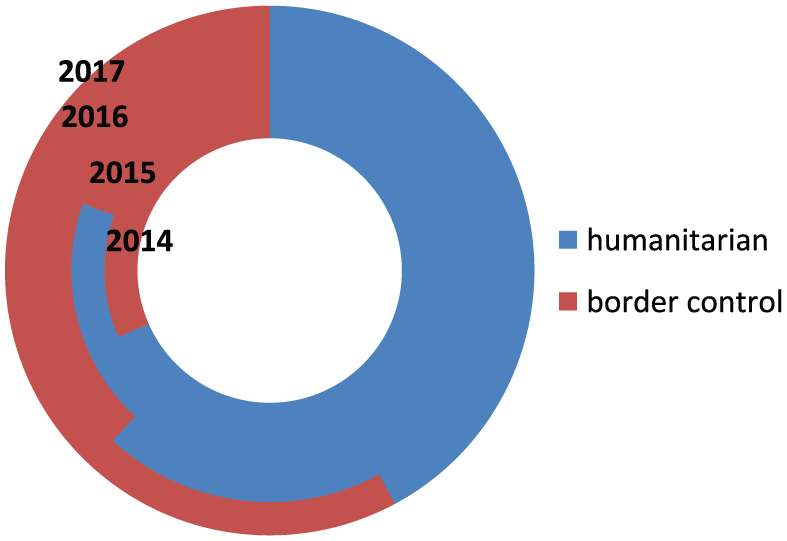
Triton’s rhetoric until June 2017.
Triton’s operational conduct
An examination of Triton’s asset behaviour shows the existence of a gap between rhetoric and action. Contrary to what the statements above suggest, Figure 2 shows that Triton’s involvement in SAR peaked to a maximum of 24 percent of total rescues in 2015, decreasing to only 13 percent in 2016 and the first six months of 2017.
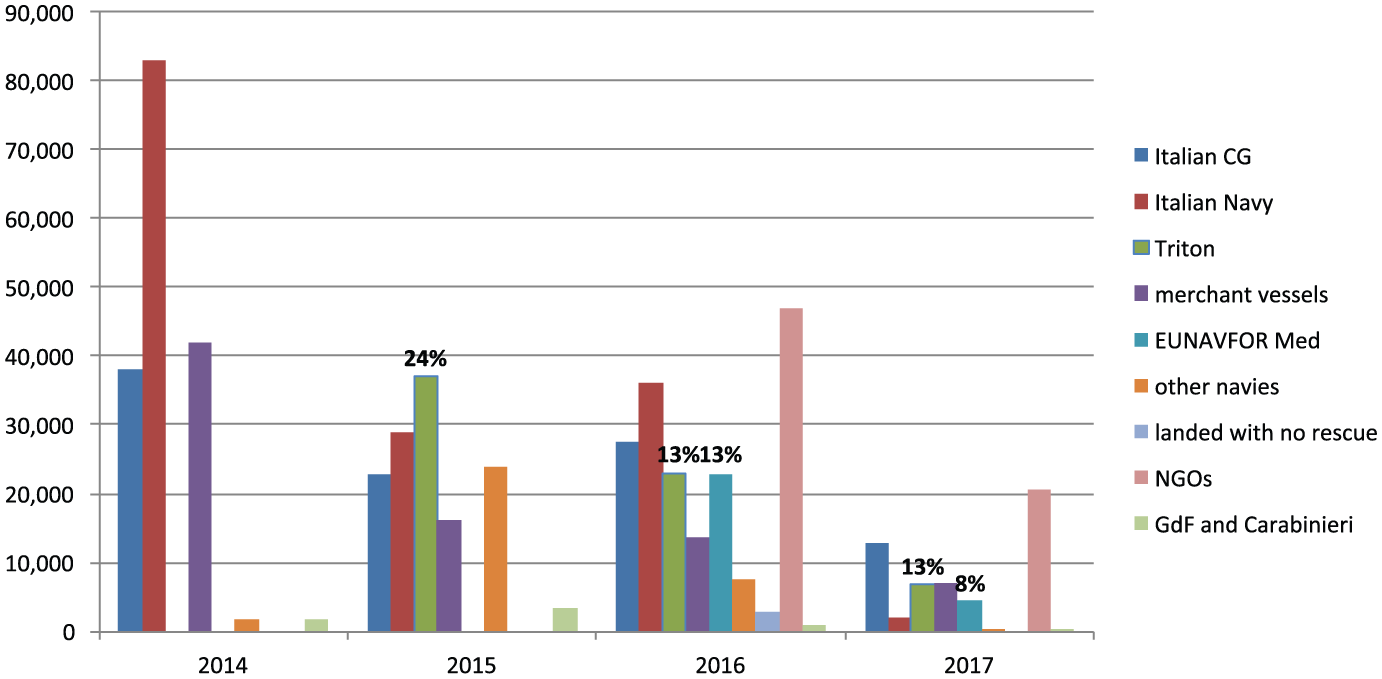
Migrants rescued between January 2014 and June 2017.
Different factors account for Triton’s shrinking share of SAR operations in 2016 and the first half of 2017. Most notably, the increasing presence of NGO ships offshore Libya relieved EU assets of part of the burden of rescuing missions (Cusumano, 2017a, 2017c; Cuttitta, 2017). Triton’s limited role in SAR, however, was also shaped by operational choices. As indirectly acknowledged by the factsheet stating that Frontex’s assets were often ‘redirected outside of their operational area’ (Frontex, 2016), the zone patrolled by Triton is too far north to allow for a systematic, proactive involvement in SAR. This operational behaviour is partly motivated by the concern that ‘SAR missions close to, or within, the 12-mile territorial waters of Libya … act as a pull factor’ (Frontex, 2017: 32) and enrich ‘smugglers who could cut on travel costs and advertise to susceptible migrants that rescue operations make the journey safer, thus increasing the demand for crossings’ (Frontex, 2016: 20).
Internal Frontex documents leaked to the press further suggest a willingness to stay aloof from proactive SAR. During the first phase of operations in late 2014, then Frontex operations director Roesler issued a confidential letter asking Italian authorities to limit Triton’s involvement in migrant rescue. The letter criticizes the use of Triton assets to search for boats issuing SOS requests by phone, arguing that ‘Frontex is of the opinion that a satellite phone call is not per se a SAR event’, and stresses that ‘instructions to move … outside Triton operational area are not coherent with the operational plan and unfortunately will not be considered for the future’ (Frontex, 2014b). Even after April 2015, when Triton’s assets and mandate were expanded, activists maintained that Frontex willingly reduced its involvement in SAR operations by ‘deliberately patrolling the wrong area and quibbling with definitions of distress’ (Campbell, 2017; Heller and Pezzani, 2017). Triton did not just conduct a relatively limited number of SAR operations. Since late 2016, Frontex also accused NGOs of being a pull factor of migrations and a catalyst of human smuggling, triggering a process of delegitimization of non-governmental rescuing operations that has translated into decreasing funding, additional limitations, and growing risks of criminalization for charities rescuing migrants offshore Libya (Cusumano, 2017b).
As explained above, operation Triton shows a glaring decoupling between rhetoric and behaviour. Owing to the resistance of some EU MSs and the concern that SAR operations are a pull factor of migration, Frontex’s rhetorical emphasis on rescuing migrants was not matched by consistent action.
Operation EUNAVFOR Med ‘Sophia’
In April 2015, after another shipwreck causing over 800 deaths offshore Lampedusa, the Joint Foreign and Home Affairs Council decided to complement Triton with a CSDP military mission. Although launched in response to the perceived worsening of the humanitarian crisis, EUNAVFOR Med was primarily designed as an anti-smuggling operation (Carrera et al., 2017; Riddervold and Bosilca, 2017) addressing the second point of the EU Action Plan on Migration (European Commission, 2015). Consequently, the core mandate established for EUNAVFOR Med is to: undertake systematic efforts to identify, capture and dispose of vessels … used by migrant smugglers or traffickers, in order to contribute to wider EU efforts to disrupt the business model of human smuggling … and prevent the further loss of life at sea. (EEAS, 2017)
The mission was divided into four phases. The first entailed dispatching naval and air assets in the operational area, roughly comprising the international waters offshore Italian, Maltese, Tunisian and Libyan coasts, and gathering intelligence on smugglers’ business models. The second and third phases consisted primarily in destroying smuggling boats and arresting suspect smugglers. As a UN Security Council resolution authorizing entry into Libyan territorial waters was never issued, these activities only took place in international waters, where EUNAVFOR Med destroyed or confiscated 444 boats and arrested 109 suspect smugglers as of May 2017 (interview 1). Starting in September 2016, EUNAVFOR Med was assigned two supporting tasks, namely enforcing the UN arms embargo on Libya at sea and training the Libyan Navy and Coast Guard (EEAS, 2016; 2017; Riddervold and Bosilca, 2017).
EUNAVFOR rhetoric
Although saving lives at sea is only mentioned indirectly in EUNAVFOR’s mandate, the mission’s outward communication consistently stressed the humanitarian aspects of the operation, presented as an effort to ‘save lives by reducing crossings’ (EEAS, 2016a). The attempt to present the operation as a humanitarian mission is epitomized by the rebranding of EUNAVFOR as operation ‘Sophia’, named after a Somali baby born aboard the German frigate Schleswig-Holstein after a rescue operation (EEAS, 2016a; 2017a).
Quantitative content analysis shows that EUNAVFOR has also opted for a rhetoric placing strong emphasis on humanitarian tasks. Accordingly, the mission’s press releases are disseminated with nouns and verbs such as rescue (194 iterations) and save (122). In 2015 especially, EUNAVFOR’s communication heavily focused on humanitarian tasks. As Figure 3 shows, emphasis on border control increased in 2016 and 2017 due to the new tasks the mission was assigned. Over the period examined, however, words from the humanitarian category were iterated almost as frequently (48 percent) as those associated with security tasks (52 percent).
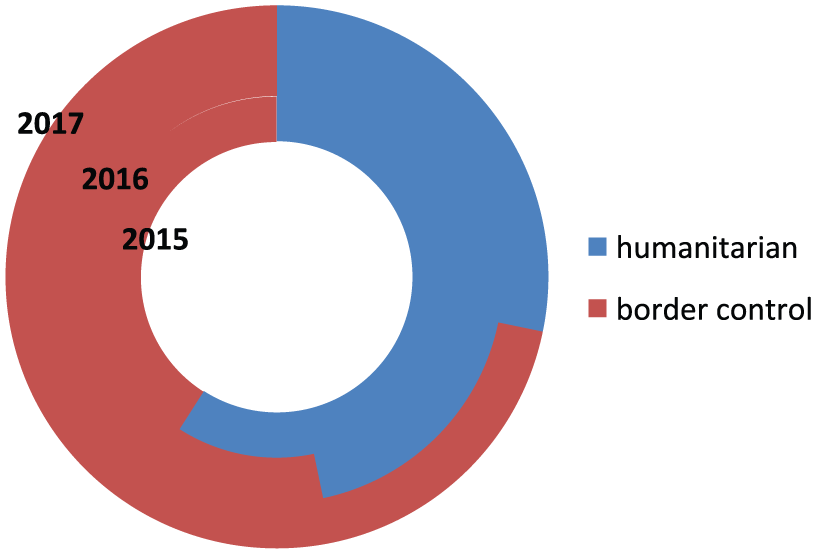
EUNAVFOR’s rhetoric until June 2017.
EUNAVFOR operational conduct
This rhetorical emphasis on humanitarian tasks is not fully reflective of EUNAVFOR’s assets operational behaviour. From its inception until June 2017 (see Figure 2) the operation rescued around 50,000 migrants. Although these figures are not negligible, a comparative examination clearly shows that operation Sophia played a relatively minor role in the provision of SAR. In 2015 and 2016, EUNAVFOR rescued between 16 and 13 percent of the total number of assisted migrants. Involvement in SAR further decreased in the first six months of 2017, when its assets rescued 4,606 people in distress.
EUNAVFOR ships have been deployed further south than Triton’s. As the mission’s assets are military vessels, however, their position is classified for security reasons (interviews 2, 4, 5 and 9). Consequently, EUNAVFOR’s ships are not visible in the geolocalization system used by the Italian MRCC to identify the closest suitable vessel to be tasked with a rescuing operation. As acknowledged by an Italian Coast Guard officer (interview 9), this inevitably reduced EUNAVFOR’s involvement in SAR. According to maritime NGO activists, not disclosing their position frequently allowed EUNAVFOR vessels operating close to migrant boats to stay aloof from rescuing operations (interview 13, 14 and 17).
The awareness that EUNAVFOR was involved in a relatively low number of rescues is clearly illustrated by a confidential EEAS report to the Council leaked by StateWatch. In this report, the commander of the operation, Admiral Credentino, states that (emphasis mine) ‘the number of persons rescued by our assets accounts for
EUNAVFOR did not only get involved in SAR to a limited extent. As first noted by a UK House of Lords report (2016) and later demonstrated by scholars, the destruction of boats carried out by operation Sophia contributed to smugglers’ use of increasingly unseaworthy and overloaded dinghies (Andersson, 2016; Cusumano, 2017c; Heller and Pezzani, 2017). The abovementioned confidential report also stressed that the mission forced smugglers to adopt a new modus operandi that ‘entails a skiff towing a rubber boat without an engine, which is then left adrift’ (EEAS, 2016b: 7). Although migrants left adrift on a dinghy with no engine obviously face higher risks, the report remains silent on the unintended humanitarian consequences of EUNAVFOR’s crackdown on smugglers. Furthermore, activists contend that one of the accessory tasks conducted by EUNAVFOR, the training of the Libyan Coast Guard and Navy, also entails severe humanitarian externalities. The Libyan Coast Guard has focused primarily on migrant interdiction rather than SAR, repeatedly hindering NGO rescue operations and using violence against migrants (Cusumano, 2017b), and is presently under investigation by the International Criminal Court (ICC) (Reuters, 2017).
Three interviews with EUNAVFOR Med personnel shed further light on the rationale behind the inconsistencies between talk and action displayed by the mission. As an operation to be unanimously renewed by the council and relying on voluntary contributions from MSs’ armed forces, EUNAVFOR Med needs to comply as far as possible with the expectations of all EU MSs. Some MSs representatives within the Political and Security Committee and the Council consistently expressed the belief that proactive SAR operations are to be avoided as a pull factor of migration. Hence, the survival of the mission required a complex diplomatic exercise mediating between different and partly contradictory expectations (interviews 1, 2, 3).
Organized hypocrisy can be read as an attempt to reconcile these inconsistent demands. The need to show adherence to legal and moral duties while fulfilling its core mandate of combatting smuggling led to a clear decoupling of EUNAVFOR’s talk and action. This rhetorical emphasis placed on humanitarian activities stands in stark contrast to the operational prioritization of border control tasks, which may in fact have caused severe humanitarian externalities.
Analysis
A comparison between Triton’s and EUNAVFOR’s outward communication, their internal documents and their operational conduct shows that both operations decoupled talk and action. To be sure, rhetoric and behaviour were not completely disjointed. Triton’s emphasis on migrant rescue, for instance, grew in 2015, after the expansion of Triton’s mandate resulted in a meaningful increase in its assets’ involvement in SAR operations, which was closely covered by Frontex press releases. Likewise, EUNAVFOR’s reduced stress on humanitarian tasks in 2017 resonates with their decreasing involvement in rescue operations and the inclusion in their mandate of new tasks such as the training of the Libyan Coast Guard and the enforcement of the UN arms embargo.
Overall, however, a clear mismatch exists between the rhetorical prominence placed on the commitment to save migrants and the behaviour of both missions. Triton’s and EUNAVFOR’s contribution to SAR, amounting to almost 120,000 migrants between 2014 and mid-2017, is far from negligible. Although most of the vessels used by both missions are not primarily designed for maritime rescue, they are nevertheless large, fast ships that can rely on air support and are manned by large crews of professional sailors. Still, the two missions together saved a smaller number of migrants than did NGOs, usually relying on volunteers operating from small, slow reconverted fishing ships (Cusumano, 2017a, 2017c; Cuttitta, 2017). Triton’s and EUNAVFOR’s contribution to SAR also appears relatively modest when compared with a naval military mission such as Mare Nostrum. In spite of being discontinued after one year, Mare Nostrum rescued over 150,000 people (Patalano, 2015), 30,000 more than the number of migrants saved by Triton and EUNAVFOR together over a much longer timeframe. Moreover, glaring discrepancies exist between Triton’s and EUNAVFOR’s outward communication and the leaked internal documents highlighting both missions’ limited involvement in SAR, seen as a pull factor of migration. Consistent with the expectations of organized hypocrisy scholarship, the conflicting demands imposed upon both operations resulted into a decoupling of talk and action.
But what is the added value of organized hypocrisy in European studies? Existing scholarship already provides insights into the suboptimal record of EU external policies. Most notably, the EU’s failures to live by its normative commitments have long been explained as the outcome of a capabilities-expectations gap (Hill, 1993). The main problem suffered by Triton and EUNAVFOR, however, was not simply the mismatch between the instruments and resources available to EU missions and the goals they were expected to fulfil, but a clash between conflicting normative expectations and security interests. These different expectations certainly hindered MSs’ ability to agree, thereby creating a consensus-expectations gap (Toje, 2008). Neither the capability-expectations nor the consensus-expectations gap alone, however, can account for the mismatch between EU missions’ outward communication and their actions. Disproportionate rhetorical emphasis on tasks that cannot be conducted in full due to a lack of consensus between MSs entraps the EU in a predicament of its own making, widening the gap between what EU external action is expected to accomplish and what it can realistically deliver while simultaneously increasing the risks of defacing and rhetorical entrapment (Schimmelfennig, 2001). For this reason, the discourses underlying the integration process have frequently been based on constructive ambiguity (Jegen and Mérand, 2014).
Why do EU bureaucracies pursue communication strategies that may ultimately be counterproductive for the credibility of EU external action? By maintaining that decoupling talk and action allows missions like Triton and EUNAVFOR to cope with conflicting expectations, organized hypocrisy can explain this puzzle, thereby complementing the notion of a capabilities-expectations (or consensus-expectations) gap. The mismatch between rhetoric and action does not merely arise from the fact that the EU lacks the capabilities to live by its pre-existing normative commitments. Sometimes, as organized hypocrisy scholarship contends, these commitments may be rhetorically reiterated precisely to compensate for the lack of consistent action, thereby addressing external demands to tackle an issue without really acting upon it (Brunsson, 2007: 116; Lipson, 2007). The argument that talk and actions are often decoupled because rhetoric is used as a surrogate for the lack of consistent action may help explain the persisting disconnect between rhetoric and action in various EU policies, such as development (Hurt, 2003), the Neighbourhood Policy (Barbé and Johansson-Nogué, 2008) and armaments cooperation (Hansen and Marsh, 2015).
Implications
Organized hypocrisy also provides new insights into the mixed record and unintended consequences of EU missions and therefore has important policy implications.
The finding that EU maritime operations display organized hypocrisy should not be read as a normative assessment or an accusation against Triton and EUNAVFOR, whose personnel have displayed dedication and professionalism in fulfilling their mandate and a genuine commitment to addressing migrants’ plight. Although hypocrisy has a value-laden meaning in everyday parlance, scholars consider the decoupling between rhetoric and action as inevitable for organizations facing inconsistent demands (Brunsson, 1989). Because decoupling talk and action is often an indispensable survival tool for organizations in need of appeasing multiple masters, organized hypocrisy is an empirical phenomenon that does not entail the moral condemnation attached to hypocrisy at the individual level. In complex organizations, those who talk are often not the same as those who act, and perfectly coordinating discourse and action may ultimately be impossible. Consequently, attaching moral connotations to organized hypocrisy makes no more sense than labelling an individual ‘afflicted with multiple personalities disorder’ as hypocritical (Lipson and Weaver, 2008: 16).
This caveat applies to EU maritime missions too, where those in charge of operational planning were not tasked with developing public communication. In the case of Triton, outward communication is delivered by the press office of the organization in Warsaw, in accordance with the agency’s multiannual planning and in coordination with DG Home and Migrations and the EEAS (interview 6). For operation Sophia (interviews 1 and 3), strategic communication is not conducted by EUNAVFOR officers, but by the EEAS directly.
As decoupling talk and action is a predictable response to inconsistent demands, existing scholarship is divided on whether hypocrisy should be considered a physiological survival tool or labelled a bureaucratic pathology conducive to dysfunctional performance. This is also true for EU maritime missions. Without hypocrisy, it is unlikely that Triton and EUNAVFOR could withstand criticism and be renewed over the years. Humanitarian discourse was an important source of legitimacy for both missions, justifying their existence before European public opinion and the European and national parliaments. Conducting the proactive SAR operations required for Triton and EUNAVFOR to fully match their rhetoric, however, would have arguably undermined support for those missions within the Council, where several MSs felt that large-scale rescue operations had to be avoided. A subsequent, complete lack of any EU assets in the area would have arguably translated into an even larger number of casualties, worsening the death toll offshore Libya.
At the same time, however, organized hypocrisy often translates to suboptimal outcomes. First, decoupling rhetoric and action may create commitment gaps and moral hazard, epitomized by infamous peacekeeping failures like Srebrenica (Lipson, 2007). The same objection applies to EU maritime missions. Indeed, Triton’s and EUNAVFOR’s emphasis on rescuing people may contribute to creating the very pull factor they seek to avoid. If ‘migrants conduct the dangerous crossing since they are aware of … humanitarian assistance to reach the EU’ (Frontex, 2017: 32), a rhetoric presenting EU missions as rescue operations may only incentivize moral hazard from smugglers and migrants alike. The risk of commitment gaps is especially apparent when looking at the period following the end of Mare Nostrum. The ambiguity surrounding Triton’s objectives and the mistaken belief that Frontex’s mission would replace Mare Nostrum in conducting proactive SAR resulted in a shortage of rescue assets and a dramatic increase in casualties at sea (Carrera and Den Hartog, 2015; Heller and Pezzani, 2016).
Second, organized hypocrisy hinders an objective assessment of the failures of existing policies and delays their revision (Brunsson, 2007; Lipson, 2007; Waever, 2008). Scholars forcefully argued that EU maritime missions’ involvement in humanitarian tasks concealed the true human costs of EU border protection (Pallister-Wilkins, 2017; Tazzioli, 2016). Humanitarian narratives portraying these missions as sufficient responses to tragedies offshore Libya arguably reduced the perceived need to reform EU migration and asylum policies by expanding the possibility for refugees to apply for asylum without entering European countries’ illegally, ensuring greater burden sharing between MSs, and taking proactive action in countries of migrants’ departure and transit (Carrera et al., 2017; Scipioni, 2017).
Third, the ambiguity surrounding the goals of each operation and the extent to which those were attainable through maritime border control missions resulted in a suboptimal operational record. Triton and EUNAVFOR have not only conducted relatively few rescue missions. Both operations’ effectiveness in reducing illegal crossings is also questionable. Even if EU maritime missions arrested many suspect smugglers and disposed of hundreds of boats, these activities did not impact on the number of crossings, which increased from 156,000 to over 180,000 in 2016. Between January and June 2017, arrivals to Italy amounted to 83,752, growing by 13,000 compared to the previous year (International Organization for Migration, 2017; UNHCR, 2017). Seaborne migration across the Central Mediterranean only shrank after July 2017 due to developments that occurred on land, most notably instability in the smuggling hub of Sabratha and an agreement between Italy and Libyan militias (Kingsley, 2017). Expected to simultaneously curb migratory flows and mitigate migrants’ suffering at sea, Triton and EUNAVFOR alone could accomplish neither objective.
Last, although hypocrisy may help organizations appease different constituencies with incompatible preferences, decoupling talk and action entails a risk of defacing. If uncovered, hypocrisy may severely undermine the credibility of an organization (Waever, 2007). NGOs operating offshore Libya have forcefully sought to disprove EU missions’ rhetoric. Sea-Watch, for instance, used airplane footage to document the frequent absence of EU assets from distress situations (Sea-Watch, 2017, interviews 16 and 18) and handed over evidence on Libyan Coast Guard abuses to the ICC (Reuters, 2017, interview 17). Activists also created the website frontexit.org to document human rights violations during Frontex missions such as Triton (interviews 17 and 18). Such critiques found ample resonance in media and parliamentary debates, calling into question Triton’s and EUNAVFOR’s humanitarian narratives.
Conclusions
By systematically examining the mismatch between talk and action in two EU missions through content analysis, this article contributed to the study of organized hypocrisy and European studies alike. Moreover, this article provides new insights into the conditions where organized hypocrisy is most likely to occur. The fact that a large gap between talk and action can be found both in a CSDP military mission and a JHA civilian border management operation suggests that organized hypocrisy is not informed primarily by the decision-making system underlying each operation or the type of actor conducting it. The mismatch between rhetoric and behaviour characterizing both Triton and EUNAVFOR has been primarily shaped by the clash between strong international norms like maritime rescuing and EU MSs’ security interests underlying a contentious, highly salient policy issue such as irregular maritime migrations.
However, further research is needed to corroborate this finding. Although now conducted under QMV, JHA policies still display strong intergovernmental features. This is especially the case for Frontex missions, which require MSs’ contributions in assets and personnel (Maricut, 2016). To shed more light on the sources of organized hypocrisy in EU external action, future research should therefore examine a larger range of policies, including areas where QMV is consolidated practice. Longitudinal studies of different CSDP and Frontex operations are also warranted. Comparing talk and action in other operations such as Poseidon in the Aegean Sea and Hera in the Atlantic Ocean would allow for assessing whether hypocrisy is a recurring feature of Frontex missions, and whether it is magnified by the size of migratory flows, the salience of migrant deaths in the public discourse, and the extent to which maritime migrations are securitized. Likewise, comparing the discourse and behaviour of more CSDP missions would provide insights into whether organized hypocrisy is an unavoidable feature of EU crisis management or especially characterizes certain types of missions. Closer attention should be given to military missions with an explicitly coercive mandate, where MSs’ diverging expectations regarding the use of lethal force are likely to emerge, or operations displaying glaring inconsistencies between the EU’s normative identity and MSs’ material interests.
Scholars of international norms should also make greater use of organized hypocrisy to better understand the behaviour of organizations confronted with reconciling conflicting norms and interests. To escape overly dichotomous understandings of norm adherence and violation, scholarship on the life cycle and compliance pull of international norms should pay greater attention to those cases when even strong norms such as maritime rescue elicit only limited, largely rhetorical compliance, and more carefully map the circumstances when a decoupling between talk and action is more likely to occur.
As this article illustrates, organized hypocrisy can provide novel insights into the tension between norms and interests characterizing EU external action, thereby offering an important contribution to European studies and international relations at large.
Footnotes
Appendix 1
Words per category
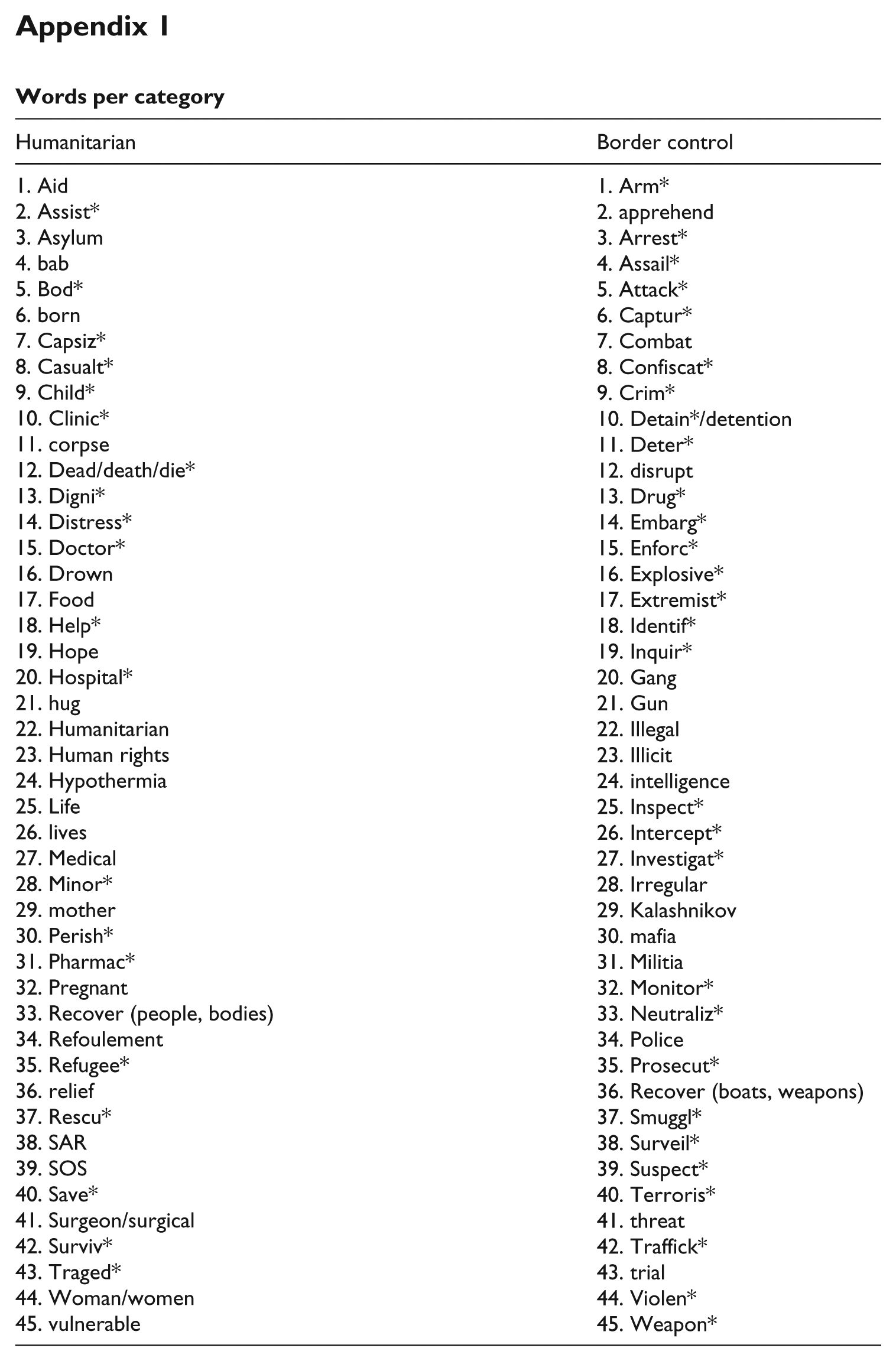
| Humanitarian | Border control |
|---|---|
| 1. Aid 2. Assist* 3. Asylum 4. bab 5. Bod* 6. born 7. Capsiz* 8. Casualt* 9. Child* 10. Clinic* 11. corpse 12. Dead/death/die* 13. Digni* 14. Distress* 15. Doctor* 16. Drown 17. Food 18. Help* 19. Hope 20. Hospital* 21. hug 22. Humanitarian 23. Human rights 24. Hypothermia 25. Life 26. lives 27. Medical 28. Minor* 29. mother 30. Perish* 31. Pharmac* 32. Pregnant 33. Recover (people, bodies) 34. Refoulement 35. Refugee* 36. relief 37. Rescu* 38. SAR 39. SOS 40. Save* 41. Surgeon/surgical 42. Surviv* 43. Traged* 44. Woman/women 45. vulnerable |
1. Arm* 2. apprehend 3. Arrest* 4. Assail* 5. Attack* 6. Captur* 7. Combat 8. Confiscat* 9. Crim* 10. Detain*/detention 11. Deter* 12. disrupt 13. Drug* 14. Embarg* 15. Enforc* 16. Explosive* 17. Extremist* 18. Identif* 19. Inquir* 20. Gang 21. Gun 22. Illegal 23. Illicit 24. intelligence 25. Inspect* 26. Intercept* 27. Investigat* 28. Irregular 29. Kalashnikov 30. mafia 31. Militia 32. Monitor* 33. Neutraliz* 34. Police 35. Prosecut* 36. Recover (boats, weapons) 37. Smuggl* 38. Surveil* 39. Suspect* 40. Terroris* 41. threat 42. Traffick* 43. trial 44. Violen* 45. Weapon* |
Appendix 2
Funding
The author received no financial support for the research, authorship, and/or publication of this article.