




Abstract
Why do governments include parliamentarians in the delegations to international negotiations? Conduct of the diplomatic negotiations is among the most tightly controlled prerogatives of the executive, and executives have been historically dominant in the conduct of foreign policy. This article draws on the participation of members of parliaments in national delegations to the Review Conferences of the Non-Proliferation Treaty over the past 40 years. The emerging patterns show that legitimation through oversight is unlikely to be the reason for participation. Drawing on literature on institutional variation in legislative–executive relations, the data indicate that executives are more interested in co-opting the parliamentarians, in order to make them less opposed to the government’s policy.
Keywords
Introduction
In 1969, Peter Baehr published an article titled ‘Members of Parliament and Government Delegations: An Old Problem Revisited.’ 1 In this article, Baehr studies the practice of including Members of Parliament (MPs) in the government delegations to international negotiations. While the practice has persisted over time, curiously, little attention has been given to it.
Participation of MPs in government delegations is unusual. Foreign policy, in general, has been seen as the area where the executive dominates (Huff, 2015). Diplomacy, specifically, has also been traditionally the focus of the government (Weisglas and De Boer, 2007). The inclusion of MPs to such delegations therefore warrants further attention as it represents neither trivial nor commonplace activity. Yet, MPs’ participation in government delegations to international negotiations has been explicitly addressed only by a handful of authors (Biedenkopf, 2015; Götz, 2005, 2011; Riggs, 1977). The existing scholarly focus on MPs’ involvement in foreign policy focuses on the phenomenon of parliamentary diplomacy, defined as a
[f]ull range of international activities undertaken by parliamentarians in order to increase mutual understanding between countries, to assist each other in improving the control of governments, and the representation of a people and to increase the democratic legitimacy of inter-governmental institutions. (Weisglas and De Boer, 2007: 94)
This translated into a lively research agenda focusing on the role of parliaments in the scrutiny of foreign policy, and on studying interparliamentary bodies (Alger, 2010): conference diplomacy, practised by national MPs (Götz, 2005; Rittberger, 1983). In the former stream, attention was given to the involvement of the parliaments in their country’s foreign policy in general (Raunio and Wagner, 2017; Stavridis and Jančić, 2017), with a special focus on the parliamentary scrutiny of European Union (EU) affairs (Auel and Christiansen, 2015; Gattermann et al., 2016; Raunio, 2009). In the latter stream, scholars analysed bodies such as the North Atlantic Treaty Organization (NATO) Parliamentary Assembly (Flockhart, 2004; Wagner, 2013), the Organization for Security and Co-operation in Europe (OSCE) Parliamentary Assembly (Gawrich, 2017; Habegger, 2006) and the Parliamentary Assembly of the Mediterranean (Cofelice, 2017). In opposition to such studies, this article looks at parliamentarians’ participation in government delegations, that is ‘delegations which fall expressly under the responsibility of government’ (Baehr, 1969: 4). This focus allows looking at the inclusion of MPs in what is traditionally a domain of the executive. By doing so, I shed new light on the politics of parliamentary participation in crafting the foreign policy. In this article, I aim to explain the inclusion of MPs in national delegations to the Review Conferences of the Treaty on Non-Proliferation of Nuclear Weapons (NPT RevCons). To do so, the article triangulates data from multiple sources – oral history interviews, country case studies using document research and quantitative tests. I look at the NPT Review Process because it provides a recurring process of active negotiations in an area of high politics (see Hoffmann, 1966, for a distinction between high and low politics), which sets it apart from the other alternatives, such as the United Nations General Assembly (UN GA).
The rest of the article is organized as follows: in the next section, I will review the existing scholarship on the parliamentary scrutiny of foreign policy. The subsequent section will outline my argument about the logic of involving the parliaments in government delegations. In the third section, I will present the empirical findings of the research. The fourth section concludes.
Parliaments and foreign policy
With two notable exceptions, legislative–executive relations in the realm of foreign and security policy have attracted remarkably little scholarly attention. The first exception is the vast number of studies on the United States Congress […] [t]he other exception is the recent wave of studies on the parliamentary control of military missions.
So starts the introductory article to a recent special issue of a prominent journal dedicated to the issue of parliamentary oversight of foreign policy (Raunio and Wagner, 2017: 1). Parliaments’ involvement in foreign and security policy is generally lacking compared to the scrutiny afforded to other areas, such as EU affairs among EU members (Malamud and Stavridis, 2013).
Traditionally, public scrutiny, in general, has been absent from the conduct of foreign policy (Bátora, 2010). Parliamentary oversight in foreign and security matters was limited in order to keep governments’ scope of action in defending national interests unhindered (Peters and Wagner, 2011; Wagner et al., 2010). In turn, executives have been held relatively unaccountable for their actions by the legislatures (Born and Hänggi, 2005).
The research has extensively studied governments’ accountability in the case of the use of force. Born and Hänggi (2005), in their work on the use of military force, distinguish between three criteria for discussing parliamentary involvement: authority, ability and attitude. These three criteria can be further dichotomized, and we can think about the parliamentary involvement in terms of capacity (authority and ability) and motivation (attitude) (see Auel and Christiansen, 2015; Huff, 2015). The vast majority of research focuses on capacity, mainly looking at the rules allowing parliaments to scrutinize the governments’ actions in the field of security policy, the so-called ‘war powers’ of parliaments (Dieterich et al., 2015, 2010; Peters et al., 2010; Wagner et al., 2010), including their developments over time (Strong, 2015). The research on attitude has been most prominently present in the work on the determinants of the support for military missions. This stream of research looked extensively at how (and whether) partisanship matters for the likelihood to be involved in military disputes (Arena and Palmer, 2009; Clare, 2010; Mello, 2014; Rathbun, 2004). Scholarship frequently focused on country-specific factors, such as constitutional traditions (Peters and Wagner, 2014). Recently, it has been extended to the analysis of the partisan parliamentary scrutiny of the EU’s Common Foreign and Security Policy (Herbel, 2017; Wagner et al., 2017).
Parliamentarians’ involvement in the exercise of the foreign policy is, however, a different kettle of fish compared to the oversight of governments’ action. While the participation of experts in government delegations has received some attention recently (Auer, 1998; Kaufmann, 1996; Rietig, 2014), the participation of the elected representatives of the people is much more scarce. Baehr’s early work (1969) looks at the practice of embedding the MPs in delegations to the UN GA within the Dutch setting. Riggs (1977), in his work, studied how participation in the UN GA changes the attitude towards the organization among US senators; while Biedenkopf (2015) in her study on the European Parliament’s engagement in climate diplomacy also discussed the participation of Members of the European Parliament (MEPs) in international climate negotiations. Norbert Götz (2005) looked at the origins of the practice in Scandinavia. His later book (Götz, 2011) analyses the participation of Scandinavian MPs in the national delegations to the UN GA within the framework of societal involvement. In this work, he also observes the changing role of MPs in national delegations; from being full-fledged members, MPs have, over time, become observers to the national delegations.
Yet, none of these articles attempted to explain the reason why parliamentarians are included in government delegations at all. While parliaments (and parliamentarians) can make at least a legal claim to co-decide about military deployments and security policy, their legal claim to take part in diplomatic negotiations is very limited (if any). As will be shown later in the article, there is an important variation among the countries, which tells us a lot about how parliament’s position within the country’s political system influences its involvement in foreign policy, an overlooked subject in research on parliaments and foreign policy.
The logic of involving Members of Parliament in delegations
In the absence of a formal legal obligation to include parliamentarians in government delegations, there are two possible explanations as to why governments would want to include MPs in their delegations. While these are not strictly opposed to one another, they do function according to different logics.
Legitimation through oversight
In ancient Greece, diplomacy was a matter of deliberations of the polis (Bajtay, 2015). In modern diplomacy, the governments are responsible for the majority of negotiations, whether bilateral or multilateral (Meerts, 2015). However, the governments have faced increasing pressure to respect the broader norms of democratic arrangements, and to take into account the multiple societal stakeholders in forming the foreign policy (Krotz and Maher, 2011). Simultaneously, the growing politicization of international politics (Zürn, 2014) leads to growing fractionalization of domestic discourse regarding foreign affairs.
Given the increasing influence that international politics has on regular citizens’ lives, the oversight of diplomatic practices is increasingly called for (Bajtay, 2015). This prompts governments to consider more popular legitimation of their foreign policy, and this is where parliaments have a special overseeing role. The Memorandum on Parliamentary Diplomacy, adopted by the Dutch Senate in 2010, for example, states ‘In parliamentary democracies[…], parliament has traditionally played a scrutinizing role’ (Hamilton, 2010: 3). Parliaments frequently use tools of parliamentary procedure – such as asking questions, participating in formulation of documents and inviting ministers – to exercise oversight over the executive (Krause, 2001; Proksch and Slapin, 2011; Raunio, 2016). Parliaments act as intermediaries, which aggregate the popular preferences and moderate the executive action through oversight (Dieterich et al., 2015; Mello, 2012). Parliaments are therefore seen as a transmission belt between societal attitudes and the executive; parliamentarians reflect the preferences of their citizens (Ihalainen and Matikainen, 2016).
The executive has, however, a strong advantage over the legislative: expertise. The lack of expertise can be a serious drawback on the parliament’s ability to control the executive. Whereas the executive can rely on the civil service and expertise housed within various agencies, parliamentarians have rarely the equivalent at their disposal (Raunio and Wagner, 2017). The availability of information (or lack thereof) structures how parliaments are able engage the executive in foreign policy decisions in important ways. Given the pressure to maintain legitimacy of their foreign policy, governments may encourage parliamentary participation in diplomacy to increase oversight. Expertise is key to the maintenance of the appearance of oversight, and hence we might expect that the executive would be interested in actively involving parliamentarians with the expertise and experience who can then provide the oversight necessary for it to be more than just mere ‘window dressing’. In the existing literature, the existence (and size) of dedicated parliamentary committees (and appropriate expertise) is considered a chief indicator of a legislature’s ability to conduct effective oversight (Born and Hänggi, 2005; Karlas, 2011). Similarly, parliamentarians from these committees are more likely to benefit from participation in conferences, as they would then be able to use the acquired knowledge in their subsequent scrutiny of their government’s action.
Co-optation
An alternative to improving the legitimacy through oversight is through co-optation of the parliament. Co-optation is the term frequently used to discuss competitive dictatorships: countries where parliaments exist to draw opposition into the political process and to give it a possibility to air grievances (Gandhi, 2008; Gandhi and Przeworski, 2006). By doing so, the expectation is that the rulers are more likely to maintain control without relying excessively on coercion (Malesky and Schuler, 2010). A similar mechanism can be expected in parliamentary democracies – if MPs are drawn to the executive’s policy, it is less likely that they would be interested in overturning it completely. Co-optation is aimed at making parliamentarians more aware of the executive’s policy, making them less likely to disagree with it.
Executives, with the expertise and the support of the bureaucracy, may be interested in attuning the parliamentarians to the government’s policy. Levy (1994) argued that learning accounts for much of policy continuity, and hence it is not inconceivable that executives would try to ‘teach’ the MPs about the policy. Götz (2005) argues that policy continuation was an important reason for including MPs in diplomatic delegations prior to World War II in Scandinavia. Peter van Raalte, a Dutch journalist, highlighted that participation of MPs in government delegations strengthens the cooperation between the government and the legislature (Van Raalte, 1966 in Baehr, 1969). Biedenkopf (2015) argues that MEPs are included in the EU’s delegation to climate negotiations precisely to make them familiar with the negotiating process in order to avoid having the negotiated agreement be vetoed by the European Parliament.
On the most basic level, participation in international negotiations may increase MPs’ awareness. For example, when the UN GA was a fairly new body, a number of countries sent their legislators to learn about it (Baehr, 1969). Parliamentarians participating in the UN GA in turn developed not only a more positive view of the organization, but also a sense of belonging. By doing so, they developed a sense of responsibility beyond their national borders (Alger, 1963; Riggs, 1977).
Executives are more likely to attempt to co-opt parliaments in political systems where parliaments have a strong position vis-a-vis the executive. The position of parliament vis-à-vis the executive is a function of a particular constitutional arrangement and varies from country to country. Even among the democracies, there is a significant variation in how much power legislatures have vis-a-vis the executive. The executive–legislative balance is a long-standing topic of research in comparative politics. Coined by Anthony King (1976), the executive–legislative balance looks at how much (and to whom) of a ‘give-and-take’ relationship there is between the legislature and the executive. In some situations (for example, in the USA or France), the executive is elected separately from the legislature, which has a profound impact on democratic accountability when it comes to foreign policy (Auerswald, 1999; Reiter and Tillman, 2002). The most elementary way of distinguishing those different relations is to look at the differences between presidential and parliamentary systems (Strøm, 2000). However, important variations exist also among the parliamentary democracies in terms of the powers they hold vis-a-vis the executive. Especially in what Lijphart called consensus systems (Lijphart, 2012), cabinets have to work with the parliaments, because they frequently have to navigate multi-party coalitions in the government. This also includes the necessity to work with the opposition MPs, leading to the adoption of strategies where the executive shares the responsibility for policy with other actors (König and Wenzelburger, 2014), partially to offset possibilities of blame (de Ruiter, 2016). Bergman (2000) argues that part of the strength of national parliaments may be conditioned by national culture. In Protestant countries, for example, parliaments may be expected to keep a closer eye on the executive. 2
Executives faced with strong parliaments are more likely to take the parliaments on board in crafting of foreign policy, in an attempt to co-opt the MPs before they stage a revolt against the government’s policy in the parliament. 3 On the other hand, an executive facing a weak parliament is less likely to include MPs because there is no need to worry about the parliament trying to overturn the government’s policy.
At the same time, the executive is likely to co-opt the parliamentarians only on the issues it considers important. It would be too costly for the executive to attempt to co-opt parliamentarians on unimportant issues, or issues of only tangential relevance. On the other hand, on issues that the executive cares about deeply, it may be worth-while incorporating the parliamentarians, either to increase their awareness of the issues, or to attune parliamentarians to a given policy. Parliamentarians are then more likely to be socialized to think along the same lines that are present in the executive regarding foreign policy issues for which they care the most.
Parliaments in disarmament and non-proliferation
To study the inclusion of parliamentarians in multilateral discussions, I will look at the participation of MPs in the quinquennial NPT RevCon. Countries determine the composition and size of their delegation themselves. The NPT RevCon represents a particularly suitable issue area because it combines a highly sensitive security topic 4 with political salience and public attention. It also represents an area that is more plausibly within the exclusive remit of the executive (review of treaty performance, technically speaking). This sets the RevCons apart from the UN GA, or large conferences such as COP21 (where parliamentarians also took part).
The data for this research was hand-coded from the official lists of delegations published as a part of the Final Document of each NPT RevCon. 5 Figure 1 represents the main trends in sending MPs as a part of the delegation to the NPT RevCon. To date, 128 MPs took part in the NPT RevCons, present in 32 delegations representing 12 countries. Except for the NPT RevCon in 2005, MPs were part of at least one delegation to every RevCon, with Sweden being most active in their inclusion. Only three countries – Sweden, the Netherlands and Germany – send MPs to the conferences on a regular basis. On average, if countries include MPs, they include about four in a delegation, although there are two modes in the data – one MP and four MPs.
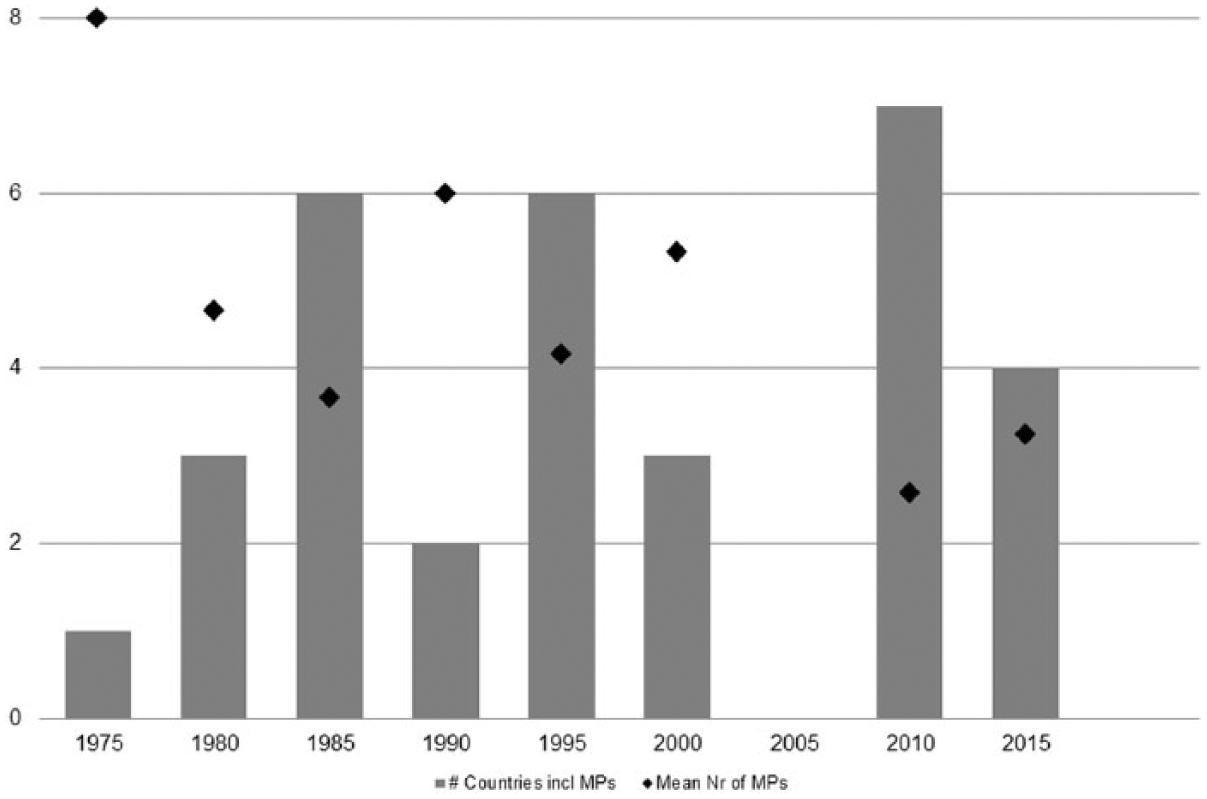
Inclusion of Members of Parliament (MPs) in delegations to Review Conferences of the Treaty on Non-Proliferation of Nuclear Weapons.
Oversight
It is expected that if oversight is the reason then these MPs would be from a relevant background. Membership in the existing parliamentary committees does not automatically translate into interest. 6 However, it can be taken for a rough proxy for expertise; members of the foreign affairs committee can be expected to know more about international politics than members of the rural development committee. I coded whether a MP participating in a delegation was a regular member of the committee on foreign affairs or of the committee on defence at the time of the participation in the conference. 7
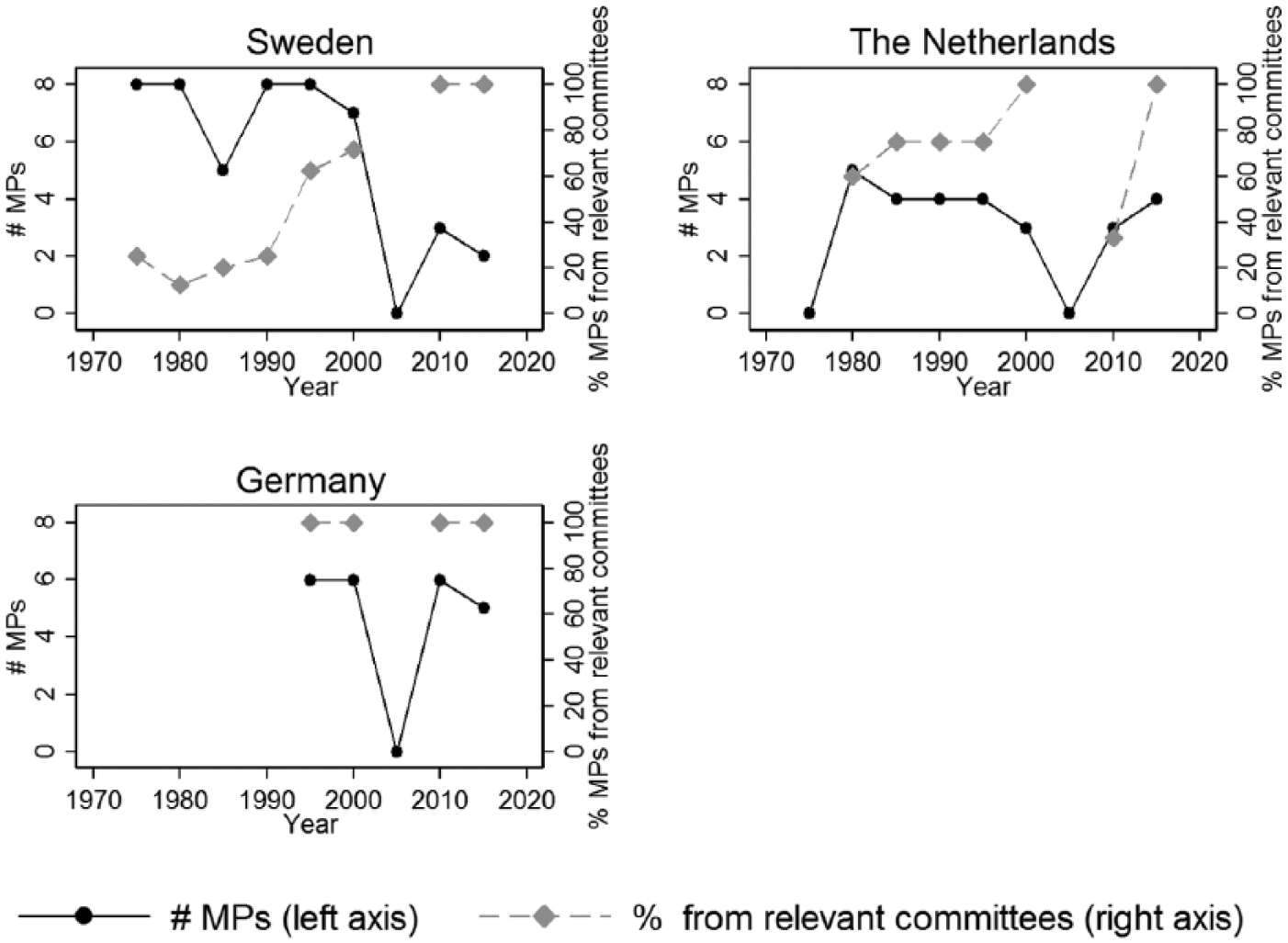
The data shows that, at least in the early days, having a relevant background was no precondition for being included in the conference delegation. Sweden, the only country to include MPs to the first NPT RevCon, sent eight MPs to the conference in 1975. This was in line with the country’s policy to include parliament and the opposition in the discussions on nuclear affairs since 1960s. At the time, the discussion about the Swedish nuclear weapons was under way, and the government tried to shield itself from criticism in the case of any policy decision (Jonter and Rosengren, 2014). In 1975, only two of the eight participating MPs came from the Foreign Affairs or Defence committee. 8 In 1980, when the Netherlands included MPs in its delegation to the NPT RevCon, only three out of five came from either Defence or Foreign Affairs. As one of the members of the delegation explained, members of neither the Foreign Affairs nor the Defence committee were too interested in travelling to Geneva, where the conference took place. 9
Figure 2 looks more closely at the composition of the delegations of the three countries that regularly included MPs in their delegations – Germany (since reunification), the Netherlands and Sweden. It becomes clear that, for a long time, MPs taking part in international delegations did not necessarily have an expert background. For example, it was not until 1995 that more than half of the Swedish MPs attending NPT RevCon came from the Foreign Affairs or the Defence Committee.
Members of Parliament (MPs) in selected delegations.
The number of MPs in delegations tends to be modest, but in all of these countries, it tends to represent the political spectrum more than the expertise. In 2010, for example, the Dutch delegation carried representatives of the three largest parties; in 2015, the representatives of the four largest parties (including Geert Wilders’ PVV) were present. 10 In Sweden and Germany too, all major parliamentary parties tend to be represented (although in Germany, all participating MPs come from a specialist subcommittee). This means that the opposition, too, is frequently participating in such delegations.
The Dutch debate prior to sending the first group of MPs to the NPT RevCon is illustrative of the pitfalls of parliamentary oversight. On 28 February 1980, the Standing Committee on Foreign Affairs sent a letter to the Minister of Foreign Affairs, noting that two relevant conferences would be taking place in that year – the Commission on Security and Cooperation in Europe (CSCE) Conference in Madrid and the NPT RevCon.
The Committee would kindly like to know when and how the instructions for the Netherlands’ delegation for both conferences would be determined. Would these be determined by you, or is the whole Cabinet involved? In either case, the committee would like to, prior to completing the text, hold a verbal consultation
11
on the draft instructions.
The committee continued that it had determined that ‘some countries, such as the United States, include Members of Parliament in delegations to such conferences’ 12 and requested inclusion of MPs as ‘special advisors’ in the delegation. The Minister of Foreign Affairs, Chris van der Klaauw, responded on 1 April and rejected the invitation to hold a verbal consultation, ‘for a number of reasons, mainly of practical nature – the instructions for the Review Conference will be determined during the summer recess of the Chamber’. To the other request of including MPs, the Minister agreed with including some members of the House of Representatives (under a budgetary proviso) in the delegation to the NPT RevCon. However, the Minister flatly denied participation of MPs in the CSCE conference, because of the ‘nature of closed negotiations’, closing out the possibility of oversight. In the follow-up letter of 9 July 1980, the Minister stressed that all members of the delegation to the NPT RevCon, including MPs, will be ‘strictly bound by the Government’s instructions’ (Tweede Kamer der Staten-Generaal, 1980–1981: 1–2 [all citations]).
In the end, the delegation, composed of a mix of members of the Senate and of the House of Representatives, travelled to Geneva. As one of them mentioned, while Minister van der Klaauw was fairly welcoming towards the MPs, other diplomats were much less so. The delegation was able to attend the morning briefings, and to listen to the speeches in the plenary, but there was no other activity prepared for them. Parliamentarians were also not allowed to join the bilateral negotiations or closed meetings, 13 limiting thus the possibility of oversight. 14
Reviewing the programme of the Dutch MPs at the 2010 NPT RevCon, one notices that the content is more varied, but there is little oversight of the direct negotiations. The Dutch MPs taking part in the 2010 NPT RevCon were attending for only the first three days of the conference. Prior to the conference, the MPs prepared for them a busy agenda of meetings with Dutch diplomats, US policy makers, fellow parliamentarians, civil society and experts from the Middlebury Institute of International Studies, as well as participation in a large policy conference (Concept-programma Kamerleden NPV-Toetsingsconferentie 2010, 2010). However, MPs’ participation in the conference itself was very limited, and the programme did not include any meetings during the conference, outside the plenary meetings and open events. The letter inviting the MPs to the 2015 NPT RevCon provides a similar picture. In this letter, the Minister of Foreign Affairs Bert Koenders explicitly stated that MPs would be able to attend the plenary sessions, ‘but not closed sessions or confidential meetings’ (Ministerie van Buitenlandse Zaken, 2015).
The situation in Germany has been similar. The reunited Germany sent the first delegation to the NPT RevCon in 1995, composed of the members of the subcommittee on Arms Control and Disarmament (all the MPs attending NPT RevCons since have been members of this subcommittee). As Uta Zapf, the later long-time chair of the subcommittee and attendee of three NPT RevCons, told the author in an oral history interview, prior to conferences it was not always straightforward to find the documents related to the German negotiating position. This was the case even for the members of the Parliamentary oversight subcommittee, particularly when it came to more sensitive topics. The situation was similar in the case of serious negotiations: ‘when the diplomats needed to change the minds of others, they wouldn’t allow us in.’ 15
The results suggest that increasing oversight is not likely to be the reason for including the Parliamentarians. While it would be beyond the scope of this article to study the motivation to include MPs in every country that ever included parliamentarians, the study of the three countries – those being the three countries that most actively send MPs: Sweden, the Netherlands and Germany – demonstrates that parliamentarians continue to face difficulties with oversight when participating in such conferences. Increasing the oversight is unlikely to be the motivation for including them in the delegations.
Co-optation
It was expected that if co-optation were the motivation for including MPs in delegations, inclusion of MPs would be most likely in countries where the government is faced with a strong legislature and the country cares deeply about non-proliferation.
As discussed above, the parliamentary ‘war powers’ are a frequent topic of research in the area of foreign affairs and security. However, a strong position of parliament is not limited to the parliamentary war powers. In a broader area of executive–legislative relations, the Parliamentary Powers Index (PPI) is a widely acknowledged measure of parliaments’ position vis-a-vis the executive (Fish and Kroenig, 2011). The PPI looks at an index of parliamentary powers, such as the power to investigate the executive and institutional autonomy. The PPI is measured on a scale from 0 to 1, with a score of 0 denoting a weaker influence of the parliament on the executive. The advantage of the PPI is that it covers almost all the countries of the world above a half-million inhabitants. The downside is that it is time-invariant, capturing the situation at a single point in time.
Capturing the states’ ‘interest’ in NPT is a tricky matter. Countries’ statements may be an expression of what they think about NPT’s process, but they are probably not too helpful in trying to ascertain the treaty’s importance within any country’s foreign policy. It may be reasonable to assume that countries that attach great importance to the treaty attempt to act in a sizeable role at the conference. Given the fact that such a conference frequently requires multiple simultaneous negotiations and attendance of multiple events, larger delegations are more likely to be successful. Hence, delegation size can be a rough proxy for how much countries care about the outcome of the conference (Schroeder et al., 2012; Weiler, 2012). Therefore, I have calculated the size of each country’s delegation at each of the conferences.
Given that the data on parliamentary powers is time-invariant, I do not plot the development of the relationship between the PPI and delegation size over time. Instead, Figure 3 plots the PPI against the mean delegation size – looking at the average size of the delegation a country sent to the NPT RevCon. Small hollow circles denote countries that never sent a MP as a part of their delegation; small black triangles denote countries that sent a MP at least once.
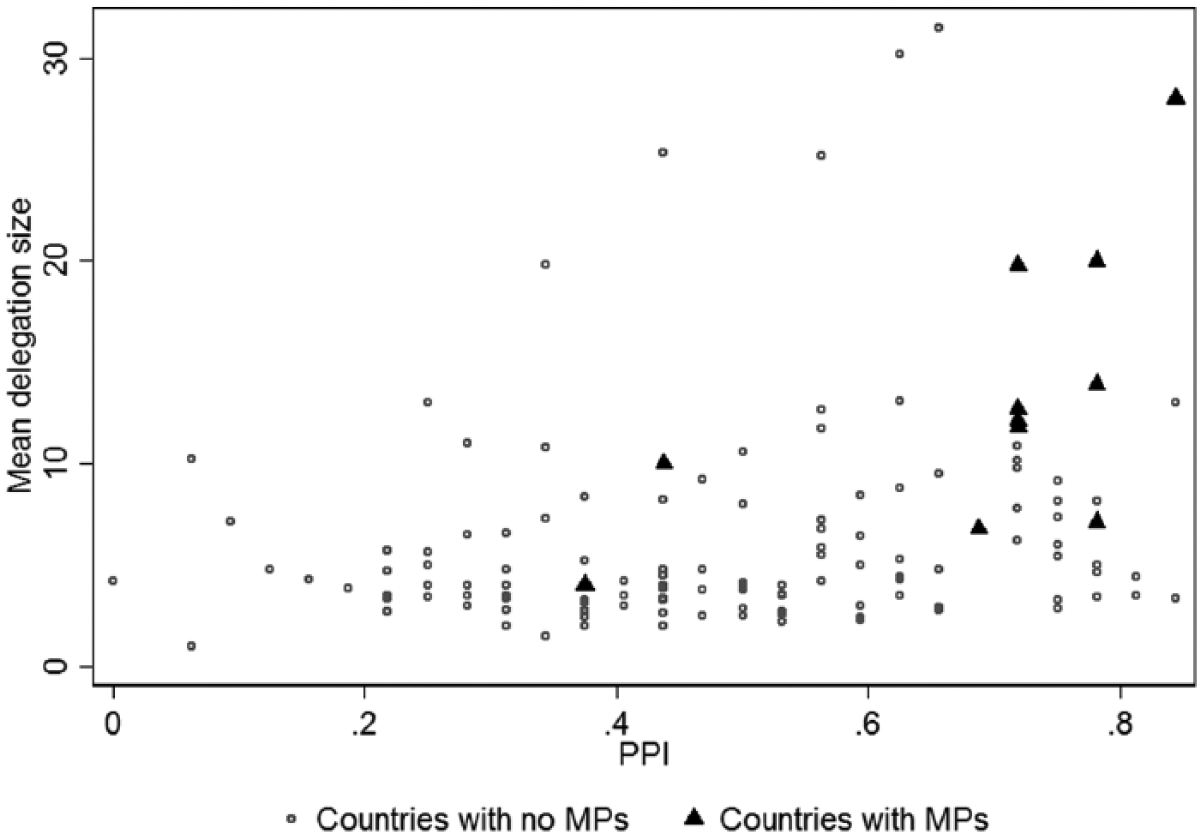
Parliamentary powers and participation in Review Conferences of the Treaty on Non-Proliferation of Nuclear Weapons. MPs: Members of Parliament.
It is obvious that the pattern of inclusion of MPs to the delegation copies that of strong parliaments in countries that care about non-proliferation matters. In the small part of the graph with a PPI above 0.6 and more than a 10 member-strong delegation on average, we find all the countries that regularly send MPs (Sweden, the Netherlands, Germany). The countries that are in this part but have never sent MPs frequently have country-specific reasons. In the case of the USA, for example, it is the special role of the country as one of the depositaries of the treaty and a recognized nuclear weapons state. Furthermore, the five nuclear weapons states (NWS) usually act in line with one another and as a general rule do not adopt contradictory practices – it is therefore unlikely that one of them would invite MPs if others did not. Japan, which has strong interest in disarmament due to its historical experience, is widely recognized as a country where bureaucracy has an extraordinary hold on foreign policy (Van Wolferen, 1990), and that trend has only recently started to change (Cooney, 2007). Australia is a country with a Westminster system with a weak position of the parliament (Lijphart, 2012) that rarely intervenes on the issues of foreign policy (Gyngell and Wesley, 2007). The three other European countries – Switzerland, Spain and Italy – are all known for having foreign policy heavily dominated by the executive (Coticchia and Moro, 2017; Malamud and Stavridis, 2013).
Co-optation therefore works often as a means of an educational activity. In the above-mentioned oral history interview, Uta Zapf mentioned that at NPT RevCon in 1995 (as in other RevCons she attended), German MPs were introduced to other delegations by the Head of Delegation, and had meetings (lunches and dinners) with them, always in the presence of diplomats. 16 Jaap Ramaker, the head of the Dutch delegation to the 1995 NPT RevCon, mentioned that for the parliamentarians taking part in the delegation ‘it was also an educational experience, […] both in as far as the substance was concerned and in the manner in which we, as diplomats, operated in such an environment.’ 17 The long list of educational activities the Dutch MPs attended while attending the 2010 NPT RevCon testifies to such educational goals. In 2015, in the letter inviting MPs to attend as special advisors, the Minister of Foreign Affairs explicitly mentioned the possibility to attend the academic symposium and a High Level Panel organized by the Netherlands (Ministerie van Buitenlandse Zaken, 2015). Han ten Broeke, one of the Dutch MPs taking part in the 2015 NPT RevCon, told the author that, in his view, while the participation in the conference did not change the MPs’ opinions, it ‘clarified a lot’ and ‘educated us’. 18
In summary, countries are most likely to include MPs if they consider non-proliferation to be an important subject, and if they are faced with a strong parliament. Executives in such countries are more likely to face legislatures that are both able and willing to complicate the executive’s policy. The inclusion of MPs in the delegations is also more likely to constitute a co-optation, in an attempt to show the MPs how the government’s policy works and what the logic behind it is. Examples from Germany and the Netherlands confirm that MPs usually broaden their horizons, and learn more about the setting for the government’s activity. Inclusion of MPs from the opposition further supports the argument that the inclusion of MPs is likely to be motivated by the need for co-optation.
Conclusion
This article looked at the phenomenon of the inclusion of MPs in government delegations to international conferences, by looking at the patterns of participation of MPs in the NPT RevCons. While participation of MPs in international conferences is not a new phenomenon, earlier research has rarely focused on MPs’ participation in government delegations. The article looked at two potential rationales for inclusion of MPs – increasing oversight and co-opting the MPs from a strong legislature and giving them insights into the government’s policy and the framework within which it works.
Looking at quantitative evidence, oral history interviews and patterns from the three countries most active in sending MPs as part of their delegations – Sweden, Germany and the Netherlands – it emerges that oversight is only partially exercised by MPs. MPs taking part in national delegations are frequently not from the relevant committees of national legislatures, and even if they are, their powers are circumscribed. One form of this is seen in the obligation of parliaments to follow the participating governments’ instructions given prior to the conference (this is not unique to the NPT setting, cf. Baehr, 1969; Götz, 2005). MPs, unable to attend any closed or confidential meetings, depend on the executive for the information (similar to the situation in the Parliament). The executive continues to exploit the information imbalance by involving MPs only indirectly in diplomatic information streams. Even when attending conferences, MPs are not able to exercise any oversight over foreign policy. This is not to say that Parliaments in these countries do not pronounce themselves on the issues related to non-proliferation; it is simply an expression of the fact that inclusion of MPs in a delegation does not strengthen the parliamentary oversight of the government’s activities.
On the other hand, there is strong evidence showing that the inclusion of MPs in delegations is an expression of an attempt to co-opt the parliamentarians. Countries including MPs tend to be those with the most powerful legislatures and those paying the most attention to NPT matters. Governments in such countries are likely to be pushed to take MPs on board in order to prevent future difficulties in the legislature in relation to the government’s non-proliferation policy. However, this may not always be successful – of the four Dutch MPs participating in the 2015 NPT RevCon, two were prominent in pushing for a national ban on nuclear weapons in the Netherlands.
These results suggest that the position of parliament in the constitutional system of the country matters for the understanding of how the parliament becomes involved in the country’s foreign policy. Given the increasing interest in the role of parliaments in foreign policy, this article provides a new avenue to think in comparative terms about the executive–legislative relations of foreign policy, and opens avenues for possible future research.
Footnotes
Acknowledgements
An earlier version of this article was presented at the Diplomacy and Global Affairs Research Seminar of Leiden University (Campus The Hague), and at the 2017 Politicologenetmaal in Leiden. The author thanks the journal reviewers, Marjolein Hosli, Jaroslaw Kantorowicz, Wolfgang Wagner, Tapio Raunio, Daan Fonck and Jan Pieter Beetz, for excellent comments on earlier drafts. Josh Watts provided research assistance in collecting the data and Ashley Longman and Katherine Senneville proofread the text with much care. The oral history interviews referenced in this article were conducted with the support of the Nuclear Proliferation International History Project, and will be publicly available in mid-2018.
Funding
The author received no financial support for the research, authorship and/or publication of this article.