



Abstract
The literature on Political Business Cycles (PBCs) has suffered from two limitations, namely a dominant focus on government policies rather than outcomes that could influence voter behaviour, and a lack of attention to the relationship between PBCs and democratization. Using multiple fine-grained data on objective and subjective outcomes we examine the nature of PBCs in Sub-Saharan Africa, a region which has experienced substantial levels of democratization in recent decades. We demonstrate clear evidence for the existence of PBCs in Sub-Saharan Africa and that the nature of the PBC changes with democratization. Specifically, we show that PBCs in non-democracies focus more on the provision of private goods and less on public goods, with this reversing as countries democratize. These findings, which hold across data sources and are robust to various specifications, have important implications for our understanding of the link between elections and development outcomes in Sub-Saharan Africa and beyond.
Keywords
Introduction
The idea that politicians manipulate the economy to win elections has a long history. 1 The work of Nordhaus (1975) introduced the idea that politicians time fluctuations in macroeconomic outcomes to court voters in what is known as the Political Business Cycle (PBC). 2 Despite the intuitive appeal of the argument, empirical studies found limited evidence for political cycles in macroeconomic outcomes such as unemployment and inflation (Brender & Drazen, 2005). Acknowledging politicians’ limited ability to control macroeconomic outcomes, this led to a shift in focus instead on policy instruments rather than outcomes (Dubois, 2016). Empirical work directed to this end has proved more fruitful, with various studies finding evidence of political cycles in fiscal and monetary policy instruments. 3
Arguably the PBC literature has suffered from two limitations. First, it has focused too much on inputs and government policies, rather than outputs and the actual outcomes of these policies that could affect voters’ behaviour. More specifically, within the PBC literature there has been a relative lack of interest in the relationship between elections and measures of public goods and individual well-being, especially in developing countries. Indeed, while the PBC literature historically arose in the study of American politics, there is strong reason to expect larger and more prominent PBCs in the developing world given the greater political importance of elections in poorer countries (Przeworski, 2004).
A second limitation in the PBC literature has been to assume that PBCs will be identical across countries regardless of their degree of democracy. Indeed, despite growing evidence on how autocrats spend large amounts of energy and resources on winning elections by large margins (Blaydes, 2011; Magaloni, 2008; Simpser, 2013), much of the literature on elections in non-democracies has focused more on the role of sticks than carrots in generating electoral support for incumbent regimes. For instance, much of the recent PBC literature has suggested that PBCs have either a linear (Jäger, 2016; Lokshin and Torre, 2024; Mandon & Cazals, 2019; Philips, 2016) or an inverted U relationship with democracy (Aidt et al., 2020; Eibl & Lynge, 2017; Shmuel, 2020), and do not examine the possibility that different types of regimes will have different types of PBCs.
In this paper we move to correct these two oversights by examining the existence of PBCs in Sub-Saharan Africa using multiple sources of fine-grained data on economic outcomes across different types of political regimes. 4 We focus on Sub-Saharan Africa because of the availability of multiple types of data over a period of substantial democratization. We first use annual nighttime luminosity data to show that there is more economic activity in election years, but the crude nature of the luminosity data does not allow us to assess the differential nature of PBCs across regimes. As such we turn to three different sources of firm and individual/household survey data - World Bank Enterprise Surveys, Demographic and Health Surveys and Afrobarometer surveys - that allow us to examine how PBCs differ across regimes. Consistent with our theoretical expectations, we show that PBCs in non-democracies effectively consist of vote-buying, with elections associated with increases in subjective and objective individual well-being and economic output, but with lower levels of access to infrastructural public goods such as electricity. However, as countries democratize these outcomes reverse, with elections no longer associated with increasing levels of well-being and investment while they are associated with higher levels of access to public goods. Moreover, we do not find consistent evidence for the existence of “sine wave” PBCs, whereby increased access to goods before elections are countered by lower access to such goods afterwards. Our results thus suggest that democratization in Sub-Saharan Africa has generated more public goods provision during election years, which contributes to scholarship on the positive effects of democratization on human welfare. This paper also adds to the literature on PBCs and suggests that future literature on the topic should both focus more on actual outcomes as well as investigate how democratization can alter the relationship between elections and goods provision.
The rest of the paper is organized as follows. First, we begin with an overview of the last half-century of literature on PBCs and generate our hypotheses. Second, we describe the data sets and their construction, and explain our empirical strategy. Third, we discuss our results. Finally, we conclude with broader thoughts on how our work speaks to broader issues in the study of PBCs and African politics.
Political Manipulations of Economic Policy
Theoretical Arguments
Theoretical models formulated to explain PBCs have differed over their assumptions about politicians and voters. The foundational work in this field started with the simplistic ideas that politicians are identical and opportunistic, and voters are naïve and myopic (Block, 2002). This permitted politicians to be modeled as making macroeconomic policy decisions purely on the basis of electoral concerns. It also allowed models to ignore the possibility that voters might observe and punish such opportunistic behaviour. Later work adapted both assumptions, accommodating ideological/partisan differences in policy concerns on the part of politicians (Alesina, 1987; Hibbs, 1977), and acknowledging rational expectations of voters (Marin et al., 1990; Rogoff, 1990).
In response to the acknowledgment of rational expectations, models overcame the challenges these posed to the PBCs literature by incorporating information asymmetries between voters and politicians. Adverse selection models of this type posited that voters have incomplete information about government competence and are misled by the government’s pre-election expansionary economic activity. Later models relaxed this assumption about information asymmetry but maintained the expectation of PBCs by suggesting a moral hazard problem, whereby incumbents affect an appearance of greater competence prior to elections (Dubois, 2016).
The key take-away from these models is the recognition that where voters are aware of manipulative behaviour by politicians, they will not reward pre-election boons. Adapting the arguments to accommodate this recognition created expectations about the conditional likelihood of PBCs occurring. Some models in this vein have focused on the role of transparency and information. For example, Shi and Svensson (2006) argue that the size of PBCs should depend on the share of informed voters in the electorate. Similarly, Alt and Lassen (2006) suggest that the occurrence of PBCs is conditional on the level of institutional fiscal transparency. A related but slightly different approach has suggested that PBCs should be greater in new democracies, where voters have less experience with pre-electoral fiscal manipulations, and where the media are less experienced at identifying and reporting on such activities (Brender & Drazen, 2005; Mandon & Cazals, 2019).
Relatedly, conditional expectations over the occurrence of PBCs have also emerged from recognition of factors affecting the ability of governments to control fiscal policy instruments (Dubois, 2016). For example, Block (2002) has highlighted the advantage that African incumbents typically face due to the centralization of fiscal policy authority and the lack of independent monetary authorities in many African presidential systems. More generally, PBCs may be more likely in institutional contexts where policymaking power is subject to fewer veto points, such as parliamentary regimes (Chang, 2008; Persson & Tabellini, 2005). And in the same way, while political competition may create the incentives for politicians to generate PBCs, the ability of governments to manipulate fiscal and monetary policy is likely to be limited by a variety of executive constraints present in more strongly democratic states (Shmuel, 2020), and may even lead to a reverse PBC in democracies as investment declines before elections due to uncertainty around future government policies (Canes-Wrone & Park, 2012).
Evidence
While there is limited evidence for political manipulations of macroeconomic outcomes, numerous studies have demonstrated political cycles in the use of fiscal policy instruments. 5 In line with the conditional expectations highlighted above, Alt and Lassen (2006) find heterogeneity over degrees of fiscal transparency. Moreover, several studies have found stronger evidence for PBCs in less-developed economies, and in newer democracies (Aidt et al., 2020; Brender & Drazen, 2005; Ebeke & Ölcer, 2013; Shi & Svensson, 2006).
In recent work, Veiga et al. (2017) provide evidence that the occurrence of PBCs is conditional on media freedom, which they argue underpins the informational constraint. This fits with evidence of an electoral cycle in social protection spending in authoritarian regimes provided by Han (2022), who argues that opportunistic policy manipulation is facilitated by the information asymmetries present in autocracies. Also focusing on differences in regime types, Shmuel (2020) demonstrates a non-linear relationship between PBCs and the level of democracy. This is argued to follow from the different incentives to engage in political fiscal manipulation faced by autocrats and democrats, as well as the differences in their ability to effectively undertake such manipulation.
Contributions of This Research
While existing work provides compelling support for the existence of PBCs, in particular in lower income countries (Kyriacou & Roca-Sagalés, 2022; Shi & Svensson, 2006), we argue that this work remains somewhat limited by the focus on economic policy instruments rather than outcomes. There is by now good evidence that voters in Africa care about macroeconomic outcomes. 6 But there is also substantial and compelling evidence that many voters in Africa (as elsewhere) condition their electoral support on their own personal economic situation, and on their access to essential goods and services. 7 While individual or “pocketbook” economic outcomes may be linked to fiscal policy instruments, if the theoretical argument underpinning PBCs is that economic policies are manipulated to win electoral support, then we should expect to see an impact of the electoral cycle on factors at the individual level that affect such support.
This logic suggests that we should expect to observe higher levels of individual-level measures of well-being, in terms of both pocketbook outcomes as well as access to goods and services, during electoral periods than at other times. However, it seems likely that the nature of these PBCs will vary across different types of political regimes. In particular there are strong theoretical reasons to assume that the level of democracy will influence the nature of PBCs due to incentives on the part of both governments and voters. As regards the former, an older literature assumed that democratic institutions in non-democracies was “mere window dressing” that dictators used to pretend that they had democratic legitimacy (Gandhi & Przweworski, 2006, p. 3), but more recent scholarship has instead argued that many non-democratic regimes actively use democratic institutions as a means to perpetuate their rule. In particular, elections serve multiple functions in non-democratic or hybrid regimes, including by generating information as to the popularity of the regime and allowing governments to divide, demobilize and demoralize opposition movements through large margins of victory (Blaydes, 2011; Gandhi & Lust-Okar, 2009; Magaloni, 2008; Simpser, 2013), which in the long run can perpetuate regime survival (Knutsen et al., 2017).
While much of this literature has focused on the ways in which non-democratic regimes use fraud, oppression, harassment and violence to win elections, such tactics can lead to a public backlash which could be politically costly for the regime while also institutionalizing a security structure that has the potential to overthrow the regime (Haber, 2006). In contrast, however, by increasing public expenditure during election campaigns non-democratic governments can generate more support for the regime at a relatively low cost. It is thus not surprising to find substantial evidence for higher levels of public spending during elections in non-democracies in case studies such as Egypt (Blaydes, 2011), Malaysia (Pepinsky, 2007) and Mexico (Magaloni, 2008) as well as a broader set of non-democracies (Higashijima, 2016; Wright, 2011). Indeed, and as noted above, the strong information asymmetries often present in authoritarian regimes may actually facilitate and encourage the opportunistic manipulation of public spending around electoral cycles (Han, 2022).
We would thus expect increases in public expenditure during election campaigns in both democracies and non-democracies to generate an increase in economic output, consistent with the existence of a PBC. However, it is not clear that regimes of either kind would be incentivized to focus spending on the provision of public goods, for two reasons. First, the complexity of many public good projects can generate challenges in timing their completion to coincide with elections, which in many cases can lead to a lack of investment in long-term infrastructure projects that will not complete until after elections (Bonfiglioli & Gancia, 2013; Thomas & Darsey, 2024). Second, the non-excludable nature of many public goods and services makes it harder to target their benefits towards specific voters. Instead, we would expect governments to focus public expenditure during electoral periods on the allocation of private goods, including doling out public sector jobs and handing out cash and cheap assets to voters that can be both timed and targeted to maximize electoral benefits. Indeed, as noted by Kramon (2018, p. 4), there is evidence that such practices are widespread in contemporary sub-Saharan Africa across both democracies and non-democracies.
However, as countries democratize we should expect to observe a shift in government spending during electoral cycles, with less emphasis on private goods and more focus towards public goods provision. More specifically, we would expect that, as non-elite citizens acquire more political power and the size of the (s)electorate grows, the private provision of goods becomes increasingly inefficient in favor of the economies of scale public goods provision can generate in serving larger numbers of voters (Bueno De Mesquita et al., 2005; Deacon, 2016; Lake & Baum, 2001). 8 In fact, there is therefore now a substantial amount of evidence linking democratization to a broader and more equitable provision of public goods in health (Kudamatsu, 2012; Wang et al., 2019), infrastructure (Burgess et al., 2015) and education (Harding & Stasavage, 2014).
Moreover, while the aforementioned advantages in terms of timing and targeting generate incentives for democratic rulers to distribute private transfers in election periods, these rulers are likely to be more constrained in doing so than their authoritarian counterparts. Such constraints follow in part from the greater transparency and media freedoms present in democracies (Veiga et al., 2017), as well as from the institutionalization of rules and norms that limit the use of non-programmatic forms of distribution in more democratic contexts (Brun & Diamond, 2014). As a result, the more even electoral playing fields that democrats compete on are likely to constrain the use of clientelist strategies and create incentives for governments to pay the higher costs of constructing electoral majorities through the provision of public goods and services (Harding, 2020b). Nevertheless, to the extent that the provision of public goods and services can be timed to coincide with electoral periods, democratic governments will face incentives to do so.
As with our discussion so far, most of the PBC literature has focused on the actions of governments rather than voters. Yet there is reason to believe that elections can generate incentives for voters as well. More specifically, as countries democratize we would expect elections to be increasingly competitive, thereby generating real uncertainty as to who the winners will be and what government policies they will enact. This uncertainty can cause both voters and international investors to withhold investments and postpone large, irreversible purchases during election years, which can have the effect of reducing economic output and thereby generating negative or reverse PBCs within the private sector (Canes-Wrone & Park, 2012, 2016; Julio & Yook, 2012). This effect is possibly even stronger in presidential systems, where elections are regular and predictable (Bak, 2016). Given the overwhelming preponderance of presidential systems in Africa, we would thus expect to observe the existence of reverse PBCs for private sector economic outcomes in more democratic countries across the continent.
We can thus generate our central hypotheses: • Access to private goods, measures of individual well-being and private sector economic outputs should be greater in election years in less democratic contexts, and this effect should decline as countries become more democratic. • Access to public goods should be greater in election years in more democratic contexts, and this effect should decline as countries become less democratic.
Before we turn to our quantitative data, we turn to qualitative evidence from Africa on the existence of PBCs across different political regimes. As with the broader literature, previous scholarship on African PBCs has largely focused on demonstrating evidence for PBCs without examining how PBCs differ across regimes. Thus in their overview of African electoral politics since 1990, Bleck and van de Walle (2018, p. 96) note that governments “increase public sector employment and developmental spending in the run up to the election,” such that “in the run up to the election government ministers tour the countryside and take credit for rural infrastructure and new clinics, schools and roads.” Arguing that African presidents operate in an institutional environment that is particularly conducive to PBCs, Block (2002) provides evidence of electoral interventions across a variety of fiscal and monetary policy instruments in 44 countries in Africa between 1980 and 1995. 9 Subsequent work updates and corroborates this finding in samples covering more recent time periods (Bobbo & Bate, 2022; Neumann & Ssozi, 2016; Strong, 2023, 2024), while evidence from Marx (2018) finds that there is a PBC in the completion of World-Bank funded projects in Africa - but not in their inception, and only for basic infrastructure and social service projects (and not for agriculture, finance, industry and governance projects). Finally, Higashijima and Kerr (2023) use Afrobarometer data to show that electoral cycles generate higher levels of citizen satisfaction with democracy.
If we turn to case study evidence, however, it becomes clearer how PBCs differ across political regimes in the African context. Here we focus on how PBCs have unfolded in two countries with different levels of democracy. In Ghana President Jerry Rawlings oversaw a period of substantial democratization in the 1990s, with an increase in press freedom and space for opposition parties to function fully. The result has been multiple alterations of power in Ghana since 2000, making it one of the most democratic countries in Africa. However, this period has also seen governments engaged in “uncontrolled spending during election years” comprising an average of 1.1% of GDP, according to Bank of Ghana economists Asiama et al. (2014, p. 5). As such the Ghanaian parliament passed a law in 2018 that capped the annual fiscal deficit at 5% of GDP in each fiscal year to limit election year spending. However, in July 2020 the Finance Minister received parliamentary permission to temporarily suspend the law due to the COVID-19 pandemic, a move which coincidentally took place five months before a national election (Abdul-Gafaru & Sackeyfio, 2022).
Qualitative evidence suggests that successive Ghanaian governments have focused their election year spending on public infrastructure. President Jerry Rawlings arguably timed the completion of electrification projects and roads to occur just before elections in 1992 and 1996, which in the latter case included campaign advertisements with pictures of paved roads and electrical poles (Briggs, 2012, pp. 605–606). In fact, as MacLean et al. (2016, p. 121) point out, the connection between electoral politics and electricity in Ghana goes all the way back to the post-independence period of the 1950s, and has continued to the present day, with problems over load shedding and power cuts arguably responsible for President John Mahama’s loss in his 2016 presidential re-election campaign. Moreover, a focus on electricity in election years has not been limited to one part of the country: “in the run-up to the [2012] elections, electrification projects sped up” in Northern Ghana, one of the poorest regions of the country, with the “months prior to the election in December a time of frenetic infrastructural activity” (Fernández, 2017, p. 76).
In contrast to Ghana, Uganda is one of the less democratic countries in Africa, with no peaceful transitions of executive power since independence. President Yoweri Museveni has been in power since 1986, and has allowed national elections since 1996 and multi-party elections since 2006, which has nonetheless meant severe restrictions on campaign activities by opposition politicians with constant levels of harassment, arrests and threats of violence. Despite the continued electoral dominance of Museveni and his political party, the National Resistance Movement, Museveni’s government has nonetheless focused a great deal of attention on winning national elections by large margins. Thus, for example, his government not only passed an unusually large budget in the year of the 2011 Presidential election but also passed an additional Supplementary Budget a month before the election and withdrew some USD 740 million from the Bank of Uganda during the campaign (Conroy-Krutz & Logan, 2012, p. 633). Instead of spending this money on infrastructure Museveni instead “handed out wads of cash to various associations, fundraisings, churches and mosques throughout the election period” (Vokes & Wilkins, 2016, p. 589).
The high levels of spending in the 2011 campaign generated an increase in inflation after the polls, which led to a more decentralized form of campaign spending in the next election in 2016, when much of the money spent in the campaign was instead raised by MP candidates themselves, especially in the form of loans and remortgages which left many candidates in debt after the election (Vokes & Wilkins, 2016, p. 590). 10 Here again election year spending in Uganda focused on putting cash in the hands of voters, with one study finding that 40% of respondents acknowledged receiving cash for their votes, 83% of which came from incumbent politicians (Blattman et al., 2019, p. 7). Other reports from the 2016 election record the distribution of hoes to voters during campaign rallies, as well as the formation of a new voluntary group of civilians recruited before the elections called Crime Preventers, whose membership numbers ran as high as 11 million people (or over 28% of the total population of Uganda) and whose official task was to report local electoral crimes but who unofficially acted as NRM cadres and in turn received cash payments, bicycles and access to a government-run income scheme (Abrahamsen & Bareebe, 2016). In contrast, however, electrification remains relatively untouched by electoral politics in Uganda and is not a major focus of discussion during election campaigns (MacLean et al., 2016).
Data & Empirical Strategy
In our analysis we used panel datasets from four sources, namely nighttime luminosity measures, World Bank Enterprise Surveys, Demographic and Health Surveys and Afrobarometer survey data. Here we describe each data set in turn. In the first case we have annual country-district-year observations for all countries in Africa between 1992 and 2013, which is drawn from Hodler and Raschky (2014) as originally compiled from the US National Oceanic and Atmospheric Administration (NOAA). Luminosity data has been shown to be a useful measures of GDP and economic activity more broadly, especially in countries where fine-grained data on GDP and economic growth is unavailable or unreliable, making it particularly useful in our analysis (Chen & Nordhaus, 2011; Henderson et al., 2012). However, more recent evidence suggests that satellite data is not very accurate in reflecting economic activity in rural areas, in part because it does not capture agricultural growth very well (Gibson et al., 2021; Keola et al., 2015). Indeed, Gibson et al. (2021, p. 11) conclude their recent review of different types of remote sensing data with the suggestion that researchers interested in well-being among rural populations in developing countries “persevere with their traditional survey-based methods of measuring living standards.”
The second data set used in our paper is the World Bank Enterprise Survey (WBES), which has surveyed firms across the developing world since the early 2000s. The surveys consist of a variety of questions about the firms’ economic activities in the fiscal year prior to the survey, including questions on annual sales, purchases and wage costs. As with the other three survey data sets in our analysis, only recently has the WBES produced enough rounds to use it to examine temporal variation in outcomes, as also seen in two recent papers on the existence of ethno-regional favouritism (Asatryan et al., 2022; Osei-Tutu & Weill, 2023). While the number of surveys in the WBES data set is thus relatively low - with 66 surveys spread across 27 countries - the advantage of the WBES data set is that it is a panel at the firm level.
Our third source, the Demographic and Health Surveys (DHS), consists of survey data for up to eight rounds dating back to the late 1980s across the developing world. As per its name the DHS focuses on demographic and health issues, with its main target being women of reproductive age (aged 15–49); it consists of several data sets per survey, with our focus on household-level data on access to public goods. While the DHS does not consist of longitudinal data, its coverage across Sub-Saharan Africa is substantial, as is its size (with an average of over 10,000 households per country-survey), especially when we supplement the DHS with the UNICEF Multiple Indicator Cluster Surveys (MICS) household data which uses a similar structure with nearly identical questions. As such we take district (or ADM2) level averages from each survey to generate a country-district-survey panel data set by collapsing the data using the provided survey weights, which allows for variation in sampling across rural and urban areas and non-responses.
Our fourth and last data source, the Afrobarometer surveys, consists of up to eight rounds per country of individual-level survey data dating from the late 1990s to the present. The Afrobarometer regularly asks questions about individual well-being and access to public services as well as political attitudes, which has led it to avoid conducting surveys during elections. 11 The Afrobarometer surveys are smaller than the DHS - with a maximum of 2400 respondents - and include adult women and men of all ages. As with the DHS we collapse the Afrobarometer data down to the country-district-year in order to generate a panel data set, again by using provided survey weights.
For the DHS and Afrobarometer data we chose to focus on country-district-surveys rather than country-region-surveys or country-surveys as our units of observation as the surveys often take months to complete, which leads to in-survey variation in the length of time to an election, as well as uneven geographical coverage across time due to fieldwork constraints, such as the decision not to survey districts in northern Mali in 2012/2013 due to regional conflict. For most countries we used ADM2 or the second-highest administrative (aka district) level data, with the caveat that in some cases the number of observations per district per survey was too small to generate an accurate panel (such as in Nigeria, with its 774 Local Government Areas). In the two cases of Kenya and Madagascar the whole system of local administration was overhauled during our period of study, which led us to choose units that were comparable in observations per unit to other countries in the data set despite the fact that the units were at one point the highest rather than the second-highest level administrative units. 12 Our ultimate goal in each case was to use the level of administrative unit that was most comparable to units in other countries as regards the number of individual survey observations per unit per round, as can be seen in appendix tables A1 and A2 in the Supplemental Material. As we note below, our results are robust to using ADM1 data instead, with the caveat that there is more variation in coverage within each region across surveys.
Our election variable across all four data sets is a dummy variable that takes the value of 1 when the data pertains to a year in which the country in question had a national election (for the luminosity and WBES data) or the survey was held up to twelve months before a national election (for the Afrobarometer and DHS data), and 0 otherwise. (For the sake of simplicity we henceforth call both measures the election year variable.) Our use of an election-year dummy is limited by the structure of the data in the case of the luminosity and WBES data; for the Afrobarometer and DHS we use the twelve months before the election as our basic measure not only as it is comparable in length of time to the luminosity measure as well as in frequency but also because it matches the length of time of an annual budget and it strikes the right balance between proximity to the election and frequency. 13 We do, however, include robustness measures using different lengths of time.
In our basic specifications we also include a dummy variable for the year after an election year for the luminosity data, the year of the survey for the WBES data (i.e., the year after the previous fiscal year) and the twelve months after an election for the Afrobarometer and DHS data for two reasons: first, we wish to test the existence of a “sine wave” PBC, whereby increased levels of well-being before an election are countered by decreased levels after an election, 14 and second, we wish to control for the possibility that governments are calling elections in boom periods, which would be consistent with a positive sign on both the pre-election and post-election dummy variables. We code an election as a national election if the election is for either the President and/or Parliament; municipal or local elections that are held across the country thus do not form part of our data set.
Our measure of democracy in all four data sets is the the V-Dem polyarchy democracy measure (at the country-survey level), which is useful for our purposes in several ways. First, it captures a broad understanding of democracy inasmuch as it is based on both weighted and multiplicative averages of measures of freedom of association, clean elections, freedom of expression, elected officials and suffrage, all of which are generated by expert coding. Second, it is a fine-grained measure on an interval scale, which, unlike with binary measures of democracy or even the Polity IV’s 21 point scale, allows for annual variation, which is an important point especially considering the temporal proximity of many of the Afrobarometer surveys. Third, it extends well back in time and up to the present, thus making its coverage broader than both the Polity IV index (which ends in 2018) and the Freedom House Aggregate Scores (which we use as a robustness measure below).
In our specification we interact the democracy measure with the election year variable to capture the changing relationship between democracy and elections over time. 15 We also include both round/year and district fixed effects as well as a country-specific time trend to control for long-term trends in welfare, except in the case of the WBES data set due to the low number of observations per country. For the Afrobarometer and DHS data sets we add a control for proportion urban (at the country-district-survey level), and in all cases we weight all observations equally by country-round. 16 A full list of all surveys included in our analyses can be found in appendix Tables A1 through A3 and the summary statistics are given in Table A4.
Results
We use these four data sets to test our hypotheses in multiple ways. First, we use the luminosity data to check for the existence of PBCs in Africa as regards economic output. We then examine the relationship between elections, democracy and private good provision. We begin with WBES firm-level data on sales, wages, number of employees, wages per worker and asset and equipment purchases (all logged), all in the previous fiscal year. We then turn to the Afrobarometer for both objective and subjective outcomes: we measure the former through an asset index (from an arithmetic mean of respondent answers on radio, television and car ownership), and the latter through questions on respondents’ self-assessed current living conditions, living conditions relative to others and their current assessment of the country’s economy, whether the country is headed in the right direction, their current living conditions compared to 12 months ago and the country’s current conditions compared to 12 months ago.
We then turn to our examination of the relationship between elections, democracy and public goods. In this case our focus is not on the existence of public goods per se but rather on respondents’ access to such goods, on the assumption that only the latter should generate electoral support for the regime. Our measures of public goods provision here are the provision of and access to both piped water and electricity, with a particular focus on the latter for several reasons. First, electricity is an important public good that has significant impacts on broad measures of economic and human development (Cole et al., 2018; Lipscomb et al., 2013; Rud, 2012). Second, there is evidence from multiple countries like India (Baskaran et al., 2015; Min, 2015) and South Africa (Kroth et al., 2016) - as well as the Ghanaian case discussed above - that electricity provision is in part determined by electoral considerations. Indeed, within Africa there is evidence for a robust correlation between democratization and electricity provision (Ahlborg et al., 2015; Trotter, 2016). Third, while we have data on water provision/access from two of our three datasets, we have data from all three data sources on access to electricity. We should note here that we do not use nighttime luminosity as a measure of electricity, as it is now well-established that luminosity best represents a measure of economic activity rather than access to electricity (Chen & Nordhaus, 2011; Henderson et al., 2012). Indeed, as noted by Kroth et al. (2016) in the South African context, luminosity is often generated by factors unrelated to household access to electricity, in particular street lights and industrial estates, which is the reason why they, like us, focus their attention on individual-level data on electrification.
In our analysis we begin with WBES firm-level data on the cost of electricity (logged), a dummy variable measuring whether the firm had any electricity outages, and the average number of outages per month, all in the previous fiscal year. We then turn to DHS data on household access to electricity and piped water, and then examine Afrobarometer data on respondents’ subjective assessment of how the government is doing in the provision of electricity and piped water.
Electoral Cycles in Economic Output and Private Goods

Note. OLS models with unit (district/firm) and survey round fixed effects and country-specific time trends (for columns 1 and 7–14). Robust standard errors clustered by district/firm in parentheses. †p < .1, *p < .05, **p < .01.
Electoral Cycles in Economic Output/Private Goods – Conditional Effects

Note. OLS models with unit (district/firm) and survey round fixed effects and country-specific time trends (for columns 1 and 7-14). Robust standard errors clustered by district/firm in parentheses. †p < .1, *p < .05, **p < .01.
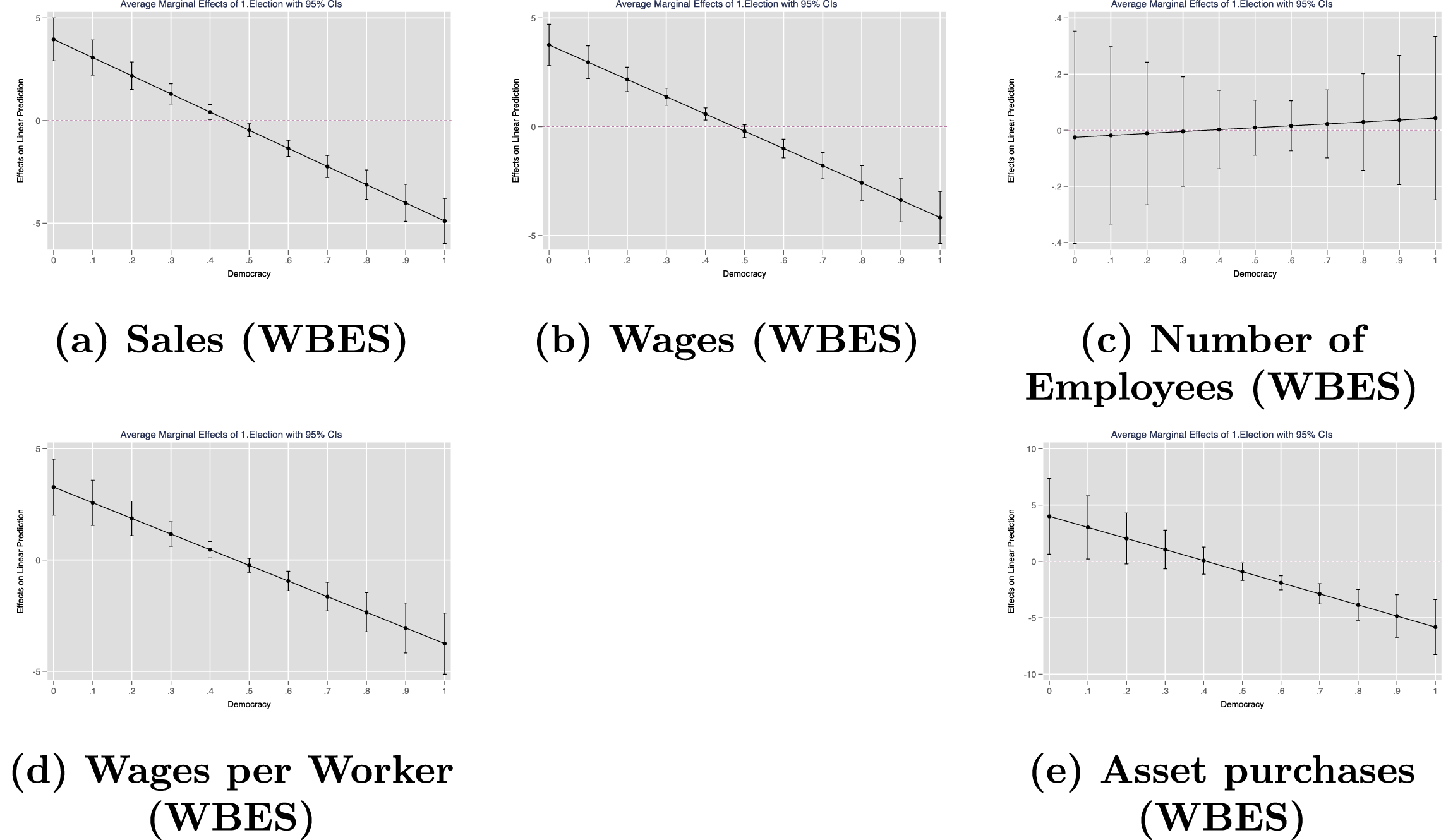
Electoral Cycles in Economic Output – Conditional Effects.

Electoral Cycles in Private Goods – Conditional Effects.
Electoral Cycles in Public Goods

Note. OLS models with unit (firm/district) and survey round fixed effects and country-specific time trends (for columns 4-7). Robust standard errors clustered by district/firm in parentheses. †p < .1, *p < .05, **p < .01.
Electoral Cycles in Public Goods – Conditional Effects

Note. OLS models with unit (firm/district) and survey round fixed effects and country-specific time trends (for columns 4-7). Robust standard errors clustered by district/firm in parentheses. †p < .1, *p < .05, **p < .01.

Electoral Cycles in Public Goods – Conditional Effects.
We conducted a number of additional robustness tests. First, we generated region-level rather than district-level panel data for the Afrobarometer and DHS data, which meant a smaller number of observations and a potentially cruder and less accurate measure of goods provision, which are nonetheless useful as it captures some more DHS and Afrobarometer surveys which have not been geocoded. As indicated in Tables A6 and A7, the results are largely identical. Second, we turn to an alternative measure of democracy, namely the Freedom House Aggregate (FHA) score, which, like the polyarchy index, similarly captures a broad measure of democracy that is based on both political rights and civil liberties. The FHA is also a fine-grained measure, with a 100-point scale, and its coverage extends from 2005 to 2022, which is ideal for the WBES and Afrobarometer data but means a loss of 30% of the DHS observations. 19 The results, which can viewed in Tables A8 and A9, are almost identical to our main results. Third, we also changed our twelve-month pre- and post-election windows for the Afrobarometer and DHS data sets to fifteen months, with no changes in our results (see Tables A10 and A11).
In other robustness tests we added additional controls to our Afrobarometer analysis, namely a set of individual controls for age and gender and then a district-round level control for the proportion of the respondents who identify with the President’s ethnic group, with no changes in any case. We then broke down the election year variable into parliamentary and presidential elections separately, with the caveats that some countries that do not have presidential elections like Botswana and Ethiopia drop out of the data set in the latter case, and that most countries in the data set hold parliamentary and presidential elections simultaneously. Here our results are largely consistent with our main set of results, indicating that both parliamentary and presidential elections are important in generating incentives for governments to provide more goods in election years. Finally, we interacted a variety of other factors that could play intermediary roles in the provision of private and public goods, namely GDP per capita, district-level urbanization, the district-level proportion of the respondents who identified with ethnic group(s) identified by the Ethnic Power Relations dataset as a Senior Partner in government, and the adoption of a balanced budget rule (Strong, 2023); in all cases the interaction terms were inconsistent across the various outcomes while our main results held. 20
Conclusion
In this paper we used multiple types of data to investigate political business cycles across different types of political regimes in Sub-Saharan Africa. We found clear evidence that PBCs exist across multiple regimes but that the nature of PBCs change with democratization, such that less democratic regimes focus more on the provision of private goods that stimulate the economy during election years, while more democratic regimes are focused instead on the provision of public goods such as electricity. Our work represents the first attempt to demonstrate the changing nature of PBCs across different political regimes, whether in Sub-Saharan Africa or elsewhere.
Our results have multiple implications within political science. First and foremost, our results suggest that democratization has a profound effect on the nature of PBCs in Sub-Saharan Africa by providing incentives for governments to focus more on the provision of public rather than private goods. While it is easy to remain cynical about the effects of election campaigns in developing countries as regards a focus on short-term benefits with longer-term costs such as sub-national governmental unit creation or deforestation (Green, 2010; Sanford, 2023), our analysis suggests that democratization can instead spur governments to provide goods that have both short and long term benefits to governments and citizens. Our results thus add to recent literature that provides some optimism to those who remain concerned that elections and democratization in Africa and elsewhere fail to generate incentives for public goods provision (Harding, 2020; Kao & Rakner, 2022).
Second, our results add to the literature on the relationship between democracy and goods provision. As noted above, a substantial body of literature has already focused on how and why democratization can lead to better public goods provision (Deacon, 2016; Harding & Stasavage, 2014; Kudamatsu, 2012; Lake & Baum, 2001), but, with the exception of Min (2015)’s work on electricity, did not focus attention on the timing of these interventions. In other words, there remains much more scope to examine not just the ‘what’ and ‘where’ of the relationship between democracy and the provision of private and public goods, but also the ‘when’ as regards their timing in relation to elections.
A third implication of our work is that electoral politics in Africa is perhaps more similar to other parts of the world than it is often described in the literature. A strong focus in recent years on how ethnic favouritism determines the location of public spending in Africa (Burgess et al., 2015; Franck & Rainer, 2012) has arguably led to a neglect of more basic concerns about the timing of private and public goods provision. Here we show that PBCs not only exist in Africa but follow a logic that is unrelated to ethnicity, and that may be applicable across other parts of the world.
There are at least two avenues of future research which could build upon our results. First, it would be interesting to see if our results hold for local elections, for which there is substantial evidence from single case studies from the developed and developing world on the existence of PBCs (Aidt et al., 2011; Foremny & Riedel, 2014; Labonne, 2016; Veiga & Veiga, 2007). Compiling a data set on local elections in Africa is challenging, not least because local governments differ widely in the powers they hold over the provision of public and private goods, but such an exercise has potential to enhance our understanding of how different types of elections have differential effects on goods provision.
A second such avenue is by using similar types of survey data from other parts of the world that cover periods of substantial variation in the level of democracy to see if our results hold elsewhere. Other PBC literature which has used survey data includes Bhattacharjee (2022), who finds evidence for a decline in neonatal mortality in India in the year before state legislative assembly elections, while Aidt et al. (2020) examine the relationship between elections and food consumption in Armenia. A useful next step would be to extend studies such as these to cover cases that offer variation in regime type. The Latinobarometer and Asiabarometer are two of many potential data sources that could be used to this effect, allowing for a broader understanding of the relationship between PBCs and democratization across the developing world.
Supplemental Material
Supplemental Material - Political Business Cycles and Democratization: Evidence From Sub-Saharan Africa
Supplemental Material for Political Business Cycles and Democratization: Evidence From Sub-Saharan Africa by Elliott Green and Robin Harding in Comparative Political Studies
Footnotes
Acknowledgments
We thank seminar participants at the LSE and the University of Oxford and panel attendees of the Annual Meeting of the European Political Science Association in Glasgow for comments and suggestions. All errors remain our own.

Funding
The authors received no financial support for the research, authorship, and/or publication of this article.
Declaration of Conflicting Interests
The authors declared no potential conflicts of interest with respect to the research, authorship, and/or publication of this article.
Supplemental Material
Supplemental material for this article is available online.
Notes
Author Biographies
References
Supplementary Material
Please find the following supplemental material available below.
For Open Access articles published under a Creative Commons License, all supplemental material carries the same license as the article it is associated with.
For non-Open Access articles published, all supplemental material carries a non-exclusive license, and permission requests for re-use of supplemental material or any part of supplemental material shall be sent directly to the copyright owner as specified in the copyright notice associated with the article.
