




Abstract
Why do some rebel groups defeat the government while so many others fail? Scholars of civil wars note that rebels must often reach the capital to defeat the government. Yet, history is replete with rebels who have lost the war, despite reaching the capital. I offer a theory of rebel capital approach that helps explain why only some rebels are victorious. Introducing novel data on rebel approaches, and accounting for selection dynamics, I find that groups which lay siege to the capital are more likely to achieve victory than those that either blitz the capital from the periphery or form in the city and attempt to divide the government’s power from within. These findings underscore that both strength and wartime decision making are important to the outcome of war.
Introduction
Why do some rebel groups defeat the government while so many others fail? Rebels rarely win in civil wars. While incumbent victory has declined significantly beginning in the mid-1900s (Lyall & Wilson, 2009; MacDonald, 2013), rebel victory has declined from 13% of all war outcomes during the Cold War to only 4% today—remaining the least common outcome (Kreutz, 2010). 1 Yet, rebel victory has dramatic influence on both a country’s domestic and international politics. In some cases, ousting the incumbent results in democracy and the formation of new political parties (e.g., Schrader-Rashidkhan, 2021; Toft, 2010), while elsewhere we see recurrent civil and interstate war (e.g., Day & Woldemariam, 2021). Thus, rebel victory is important for both the people of the war-torn country, as well as for the international order.
And previous scholars have taken note, trying to better understand when and where rebels are likely to win. Often, their focus has been on rebel strength in allowing a group to move through the country and eventually attack the capital (e.g., Akcinaroglu, 2012; Cunningham et al., 2009; Holtermann, 2016). Reaching the capital allows the group to inflict direct costs upon the regime, its stronghold, and its core supporters (e.g., Greig, 2015; Ruhe, 2015). This is, for example, the story of Charles Taylor’s National Patriotic Front of Liberia (NPFL), which sacked Monrovia in 1996 and took firm control of the country by the following year. But consider the Justice and Equality Movement (JEM), a Darfurian rebel group that formed a few years later. While JEM attacked Khartoum in 2008, they were rebuffed in the suburbs and chased back to the desert where they remained stuck for years to come. Importantly, JEM is not alone in reaching the capital but failing to win the war. For example, South Yemen attacked Sana’a in 1994, the LTTE attacked Colombo in 2009, and al-Shabaab has attacked Mogadishu repeatedly since 2013. Why are some rebels able to achieve this crucial step and capture the capital, while others are not?
Strength is certainly important to these dynamics. However, I highlight that rebel groups approach the capital in various ways. I identify and define four “ideal type” approaches to capital conflict—siege, blitz, camp, and divide—before theorizing on the advantages and disadvantages of each. Coding all instances of civil war violence since 1989 (Davies et al., 2024), I differentiate capital attacks from other fighting. I then code each incident for the approach the rebels took towards fighting in the capital. Using this novel dataset, and accounting for relative strength and selection dynamics, I find that only sieges consistently increase the probability of rebel victory. This project thus contributes to the political violence and civil war literatures in three ways. First, I highlight that while strength and approach are related, rebels can mix and match along these dimensions to counter the government. This insight provides nuance to our understanding of rebel opportunity for war (e.g., Cunningham et al., 2009). Second, by decoupling strength from approach, I build on recent work that underscores the effects of battlefield tactics on the processes of war (e.g., Balcells & Kalyvas, 2014). Third, I build on a burgeoning research agenda highlighting that a group’s origins influence how it fights during a war (e.g., Braithwaite & Cunningham, 2020; Larson & Lewis, 2017; Staniland, 2014).
Capital City Approaches and Rebel Victory During Civil War
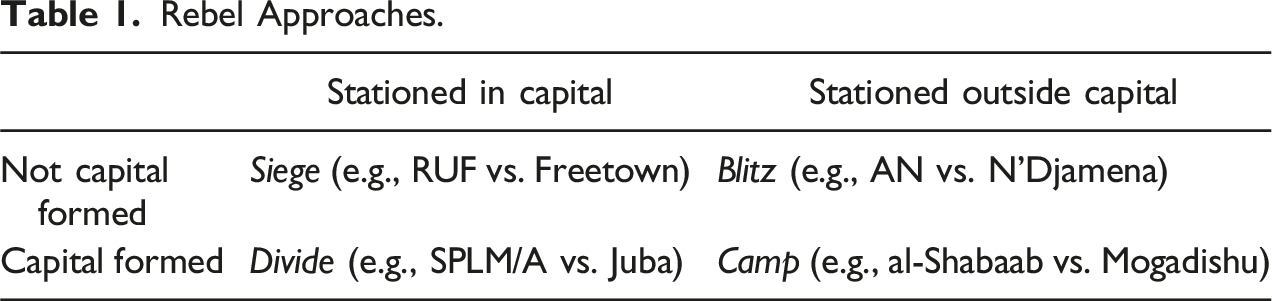
Rebel Approaches.
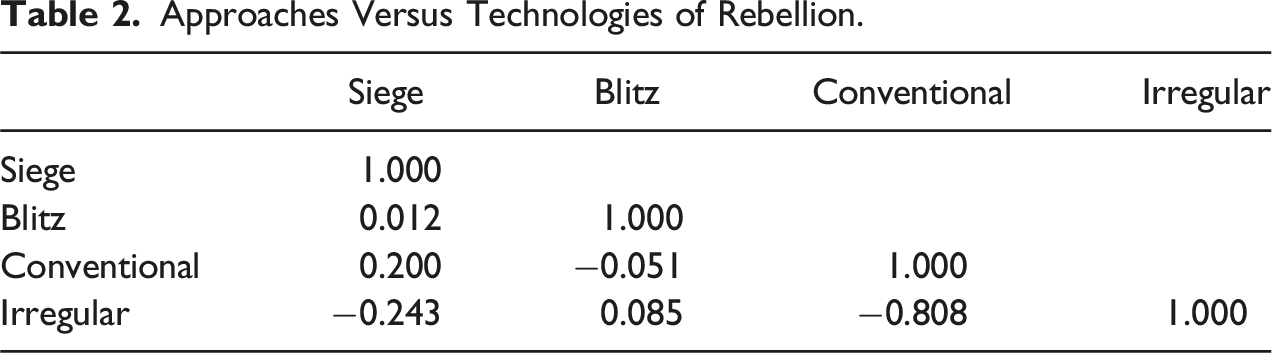
These approaches are theoretically distinct from what Balcells and Kalyvas (2014) call the “technology of rebellion.” The technology of rebellion refers to both the type of armaments that a faction uses and whether they develop a front line. “Conventional warfare” occurs when the government and rebels are of equal strength, both have large armaments, and fight with defined front lines. Conversely, “irregular warfare,” or guerrilla warfare, occurs when the rebels are weaker than the government and rely on hit and run tactics. There is great merit in disaggregating the technologies of rebellion, as these tactics have been shown to influence the severity and duration of fighting. Yet, there is also a bundling of concepts within these categories, as each refers to a party’s relative strength, armament type, and warfighting strategies. Importantly, there is variation in how rebel groups of equal strength and similar armament-type move throughout a country. From example, both the Alliance National in Chad (AN) and Rwandan Patriotic Front (FPR) are considered strong rebel groups (see Cunningham et al., 2009), yet each attacked their country’s capital through very different approaches. The AN employed a rapid attack against N’Djamena in 2008, while the FPR surrounded and then dug in against Kigali in 1994. Similarly, both LURD in Liberia and the Palipehutu-FNL in Burundi were weak groups. Yet, while LURD laid siege to Monrovia in 2003, Palipehutu engaged in a series of quick blitzes against Bujumbura in the early 2000s.
Various rebel biographies and case studies highlight that rebels choose their approach for a wide variety of reasons (e.g., Goodson, 2001; Mahabir, 2013; Pham, 2004; Sarbahi, 2014; Searle, 1991; UNCE, 1994; Waugh, 2011). These various factors highlight that the rebels’ approach is a partially constrained choice. As highlighted in Table 1 and discussed in more detail below, whether the group formed in the capital or periphery helps define the approach it uses and thus constrains its options. For example, forming in the capital excludes a group for using a “siege” or “blitz” approach. A group’s strength then partially, but not fully (see Figure 2), shapes its choice of approach by influencing how willing and able the rebels are to fight the government in a confined space versus spreading out and striking across multiple locations. However, a group’s preferences are also partially influenced by their previous experiences with these approaches and impatience with how the war is unfolding. As either boldness or impatience grows, the rebel leadership may be willing to rush the regime, rather than try to dig-in and fight a longer-term battle (e.g., Silverman et al., 2024). This calculation is influenced by regional and global trends. For example, in Afghanistan, several rebel groups chose to attempt sieges around Kabul, despite various levels of relative strength, because of their past experiences fighting the Soviets and each other (e.g., Coll, 2004; Goodson, 2001).
Addressing whether this constrained choice ultimately influences the outcome of the civil war will be addressed in the research design. In the remainer of this section, though, I will now focus on how the advantages and disadvantages of each approach are associated with the primary research question of this study—why some rebels achieve victory while others do not.
Siege
The first approach a group may take is the Siege. In the 2 × 2, the siege is defined along two dimensions: (1) the group forms outside the capital and (2) eventually positions itself to dig-in against the capital, rather than rushing the government’s forces. This approach is designed to allow the rebels to squeeze the city from the outside in. By stationing their forces nearby the capital—where the government tends to station its military headquarters and possess its key supporters (e.g., Uzonyi & Koren, 2024)—the rebels reduce their loss-of-strength gradient in waging war against these key targets (e.g., Holtermann, 2016). The siege then provides the rebels a stable offensive base from which to launch consistent attacks against the regime’s forces while also engaging in acts of sabotage, such as cutting off electric or water lines. For example, in beginning its siege on Monrovia, the NPFL cut off the capital’s water and electric supplies before launching its armed assault on the capital (Pham, 2004, p. 101). Some rebels may also use this offensive position to engage in attacks against civilians or other civilian infrastructure within their lines of operations (e.g., UNCE, 1994). This stable base allows the rebels to systematically inflict costs upon the regime, its forces, and their supporters (e.g., Koren, 2017). Importantly, because the rebels did not form in the capital, and have dug in outside the city, the siege also provides the rebels a defensive bulwark between their constituents and the government’s forces within the capital. If these forces attempt to leave the city and attack the rebels’ population, the rebels are in good position to make a defensive stand, further inflicting costs upon the regime and degrading the government’s military capacity (see Dowdall & Horne, 2017). Between this proximate offensive striking position and defensive bulwark, sieges position rebels to reduce government opportunity for continuing the war through the two key pathways previous scholars have highlighted for ending wars (e.g., Cunningham et al., 2009).
Consider the case of the Taliban in Afghanistan from 1994–1996. The Taliban emerged from Afghanistan’s Kandahar province in 1994, roughly 500 km away from Kabul, far out of the government’s reach in an area that even the Soviets had failed to control. Billing itself as a set of religious students determined to oust the new corrupt government from Kabul, the Taliban did not drive straight north to the capital in a blitz. Instead, the group moved slowly out of the periphery. By October, they took Spin Buldak and Kandahar in November. From there, the Taliban pushed on to Lashkargah. By March 1995, the group was nearly to Kabul. There, on the outskirts of the city, the Taliban defeated the Shia Hezb-i-Wahdat rebels before the Rabbani-Massoud government’s forces eventually pushed the group back. Rebuffed, the Taliban once more fought a series of battles in the south and central provinces of Afghanistan. By September, though, they eventually captured Herat and advanced on Kabul again by November. Here, the Taliban were able to dig-in and lay siege to the capital from the south. However, they were not the lone contender in this area, as Abdul Rashid Dostum’s forces moved in to siege Kabul from the north. Yet, the government was able to once more push the rebels back (see Goodson, 2001).
With Pakistan beginning to support the Taliban more fervently, the other rebel groups joined with the Rabbani-Massoud regime to consolidate power into the new Supreme Coordination Council. In September 1996, the Taliban then defeated the Council’s forces just east of Kabul in Jalalabad and moved swiftly into position, surrounding Kabul from the south and east this time. Fearful of what lay in store, the regime elites fled into the mountains north of Kabul, leaving their forces to battle the Taliban. These remaining fighters provided little obstacle for the warfighting machine the Taliban had constructed by this point. Sweeping away all remaining forces of the Supreme Coordination Council, the Taliban took Kabul by the next day (see Coll, 2004).
Blitz
The second approach a group may take is the Blitz. In the 2 × 2, the blitz is defined along two dimensions: (1) the group forms outside the capital and (2) does not dig-in against the city but decides to eventually rush it. In this approach, the rebels remain far from the capital in the periphery. When based in the periphery, the rebels face lower operating costs because government capacity decreases as distance to the capital increases (e.g., Buhaug et al., 2008; Cederman et al., 2009). This time away from the government’s forces better allows the rebels to mobilize, train, and plan for their attack against the capital. The idea is to allow this distance to play defence for the group. This allows the rebels to reinvest their material resources away from defensive posturing—and the battles it requires to move towards the capital and hold territory and population (e.g., Oswald et al., 2020)—and double-down on their offensive capacity. The strategy behind the blitz is to rush the government and hope to catch it off-guard. With all the rebels’ resources backing one large offensive punch, the group may be able to knockout the government with a well-timed surprise attack. The problem with the blitz, however, is if the rebels do not hit the government hard enough, and the government is able to rebound from this strike, then the rebels have already used most—if not all—of their warfighting capacity on their first big swing. Having surrendered the advantage of distance by blitzing their forces into the capital, the rebels now have little defensive capacity on which to fall back. This leaves them highly vulnerable to the government’s counterstrike. The blitz is thus a high risk, high reward strategy. If the rebels can catch the government off-guard, it may work to destabilize or overthrow the regime quickly. However, if the strike fails to go smoothly, the rebels are often trapped in the capital by regime forces and gunned down, ending the rebellion.
Consider the case of the Alliance National in Chad 2008. In January 2008, Chad’s three largest rebel groups merged into the Alliance National (AN) but remained stationed in the deserts of Darfur. Then, on the first of February, the rebels raced across the nearly 800 km of Chad’s interior to blitz N’Djamena. As they neared the capital, the rebels split into several columns to avoid detection by the Chadian army. By the next morning (February 2), thousands of rebels poured into the capital, surprising government forces and driving them back from several directions. The rebels captured neighborhood after neighborhood, and sealed off key bridges out of the city, as they closed in on the presidential palace. By the next day, fighting reached the presidential palace where Preside Deby had taken shelter. There, though, the Armed Forces of Chad made a stand and began pushing the rebels back. The army deployed tanks to key locations throughout the city and scrambled helicopters to begin mowing down the rebels’ rear flanks. Sandwiched between the army’s tanks and its helicopters, the rebels finally retreated late on the evening of February 3. While this blitz initially caught Chadian forces off-guard and provided the rebels the advantage of a first strike, the rebels were unable to sustain the offensive and retreated towards Darfur (see Africa Research, 2008).
The Alliance National’s attack on N’Djamena highlights the features—and shortcoming—of a blitz well. AN is a strong rebel group. It possessed thousands of fighters, heavy artillery, and the backing of Sudan. Despite its strength, AN believed a blitz would be a quick and effective way to oust Deby, since the regime seemed unstable and French backed-EU forces had yet to reach Chad to calm the situation. Part of the strategy worked. The rebels were able to catch the Armed Forces off guard, as was their plan in choosing this approach. The quick strike also allowed the rebels to initially control the course of fighting and bring the war directly to the presidential palace. However, when the rebels were unable to rapidly take the palace, they became trapped and forced to retreat. Having deployed the bulk of their fighters and envisioning a successful capturing of the palace thanks to the element of surprise, the rebels had little plan for what to do if the attack failed. Here, we see the weakness of the blitz. Without a quick knockout of the president, the rebels were not in position for a strategic retreat behind front lines from which they could continue to inflict pain on the capital. Instead, the rebels retreated to the Darfurian border region to regroup out of the government’s reach. Unfortunately for AN, the failed blitz placed Deby, his regional neighbors, and the United Nations on high alert for another attack—making one harder to materialize.
Camp
The third approach a group may take is the Camp. In the 2 × 2, the camp is defined along two dimensions: (1) the group forms in the capital, but (2) it decides to move outside the city to rush the regime from a distance later. For example, al-Shabaab departed Mogadishu in 2011, and the forces of Hadi left Sana’a in 2014 to the northern Houthi. Like the blitz, the camp approach is used by rebels who seek to allow geography to play defence for them. This allows them to focus their resources on their offensive capacity in striking against the government. Problematically, though, rebels who choose to camp are unable to fully invest in this strategy for two reasons. First, the core of their constituents tends to remain in the location in which the group originally formed—the capital city. Moving far outside the capital may provide the armed fighters of the group more safety, but it increases the vulnerability of their support population (e.g., Kalyvas & Kocher, 2007). If the government decides to destroy this core group, the rebellion will likely crumble (e.g., Uzonyi, 2022). So, the group often must remain at a distance at which it can provide shelter to its population or at least the threat of retaliation if they are attacked (e.g., Wood, 2010). Second, the further the group moves outside the capital, the more ground it cedes to the government. As moving towards the capital is often difficult (e.g., Greig, 2015; Holtermann, 2016; Butcher, 2015; Hammond, 2018), groups are hesitant to move far away from this valuable territory. These incentives to stay nearer to the city result in the “Camp” often presenting as a mid-distance approach in which the rebels do not fully enjoy the strategic benefits that distance can provide. Instead, they remain within the range of the government’s reach and are often unable to invest in a high-capacity assault back into the capital.
Consider the case of al-Shabaab in Somalia since 2006. Al-Shabaab formed in Mogadishu in 2006 as the extremist youth wing of the ruling Islamic Court Union (ICU). While the Ethiopian invasion of 2006 overthrew the ICU and installed the Transitional Federal Government (TFG) of Somalia, al-Shabaab maintained control of territory throughout Mogadishu. From these strongholds, the insurgents routinely attacked government forces and attempted to breach the presidential palace. Within a year, the African Union deployed the AMISOM peacekeepers to the city in hopes of stabilizing the situation in Mogadishu. However, al-Shabaab maintained a stronghold in the capital and spread its reach throughout southern and central Somalia. Sensing a weakness surrounding the TFG and AMISOM, al-Shabaab began a push to drive the TFG out of Mogadishu for good in 2009. The fighting was intense and would last unabated for days at a time. By May, the rebels were almost successful. However, infighting between factions of the Islamic opposition movement foiled the advance. From this point, until 2011, the situation in Mogadishu developed into a stalemate as the rebels were unable to capture the rest of the capital and the TFG/AU forces were unable to dislodge the opposition (see Williams, 2018).
By October 2011, with Ethiopian forces reinforcing the TFG/AMISOM counteroffensive, the government was able to push al-Shabaab out of Mogadishu and into a camping approach just south of the city. In this new position, the rebels began relying more heavily on civilian targeting as they lacked the capacity to more directly confront the government (see Sheikh & Omar, 2012). While al-Shabaab will directly confront government forces within or nearby its remaining zones of control in the southern and central portions of Somalia, the group has demonstrated a much more limited ability to commit similar attacks against TFG/AU forces and locations within Mogadishu. Instead, when targeting the capital, the group now tends to employ motorbike drive-by attacks, the detonation of car bombs, and mortar bombardments of the city’s outlying areas. Such tactics tend to prove ineffective as they do not help the group degrade the government’s capacity or take territory (Fortna, 2015). Thus, once pushed into a camping position, al-Shabaab’s inability to fully confront the government highlights the limitations of this approach. While camping helps a group avoid the high costs of continuing to base in the capital, they have limited ability to inflict pain upon the government.
Divide
The fourth approach a group may take is the Divide. In the 2 × 2, the divide is defined along two dimensions: (1) the group forms in the capital and (2) decides to remain and dig-in from within the city. Here, the rebels are forming in some section of the capital in which their supporters tend to control or occupy in significant numbers—perhaps in an ethnically or religious segregated city—or through established military presence. Akin to the Siege, rebels who dig-in during the Divide approach foresee the ability to establish a stable base of operations from which to launch a sustained offensive barrage against the regime. Being located within the capital, these rebels have largely eliminated the loss-of-strength gradient (e.g., Boulding, 1963). This allows the rebels easy access to attack government locations through a range of tactics, such as mortar launches, quick raids, and even motorbike attacks (e.g., Bazenguissa-Ganga, 1999). However, because these rebels are dug-in amongst their constituents within the capital, there is no defensive bulwark or geographic distance between them, the government, and their supporters. This means that while they have eliminated the loss-of-strength gradient, so has the government. Often, the regime’s forces can pin the rebels down amongst their constituents, forcing them into a defensive posture. When the government is better able to identify the opposition and corral them, it is better able to squeeze and squash the population in that area (e.g. Davenport, 2005; Kalyvas, 2006). Having to focus on protecting their constituents means that the rebels become trapped using their capacity for defence rather than mobilizing and being able to strike consistently on offense to drain the government’s capacity to continue to the war.
Consider the Jamaat al-Muslimeen of Trinidad and Tobago. The Muslimeen were an Islamist group founded in the capital of Trinidad, Port-au-Spain, in the 1980s. There, in the Mucurapo locality of the capital, the group built its commune and called for the purification of Trinidad’s government (Mahabir, 2013). The Muslimeen, however, were squatting on the Mucurapo land and frequently came into conflict with the capital police. By 1990, the conflict came to a head and the Muslimeen launched an attack on parliament, while simultaneously bombing the main police headquarters and radio station. The attack came as a surprise to the government, who underestimated the Muslimeen’s forces, and the rebels were able to capture the Prime Minister. The group’s leader, Imam Yasim Abu Bakr, announced from the radio station that he was forming a new government and intended to bring justice to the country. However, the army, now alerted to the attack, moved into position around the parliament house and cut the rebels off from their supporters and supplies. After five days, the rebels surrendered, and the government once more took full control of the country (see Searle, 1991).
The case of the Jamaat al-Muslimeen highlights both the strengths and weaknesses of the divide approach well. Given their location within the capital, the Muslimeen had good information about the movement of the regime’s forces. Seeing a weakness in the government’s preparedness, the Muslimeen were initially able to overwhelm those forces guarding parliament. The group had estimated that once captured, Prime Minister Robinson would quickly surrender. However, he did not. The time elapse then allowed the army to surround the rebels and squeeze them into defeat.
Expectation
Drawing from an opportunity-logic of civil war (see Cederman & Vogt, 2017; Fearon & Laitin, 2003), I have theorized on how each rebel approach to attacking the capital influences the group’s ability to inflict and absorb pain upon the government through both offensive and defensive means to capture the city and sever the incumbent’s military capacity over the institutional control of the country’s policy levers. Considering the advantages and disadvantages of each of these approaches suggests that, compared to the other three, Sieges, should be associated with a higher likelihood of rebel victory because they allow the rebels to consistently degrade the government’s capacity through both offensive and defensive means. By digging-in and engaging in a war of attrition with the government for the country’s seat of power, such groups are more likely to capture the capital and the key institutions of policy control, while systematically degrading the incumbent’s military control of the state. Each of the other approaches allows the rebels to degrade the government’s capacity through these means less reliably and often leave the rebels or their supporters more vulnerable to government counterstrike.
Sieges increase the likelihood of rebel victory.
Research Design
To test my hypothesis, I need to analyze the influence of each rebel approach on the probability of rebel victory. 2 The unit of analysis for this research design will be the rebel-government-dyad-year for all civil wars from 1989–2019. The start date of this study is limited by my use of the UCDP Georeferenced Event Dataset (GED) Global version 24.1 (Davies et al., 2024) to identify episodes of civil war violence that occur within the capital city, compared to civil war violence elsewhere. The end date of this study is set by my use of the UCDP Conflict Termination Dataset version 3-2021 (Kreutz, 2010).
The dependent variable in this study is
The key independent variables are each form of Rebel approaches.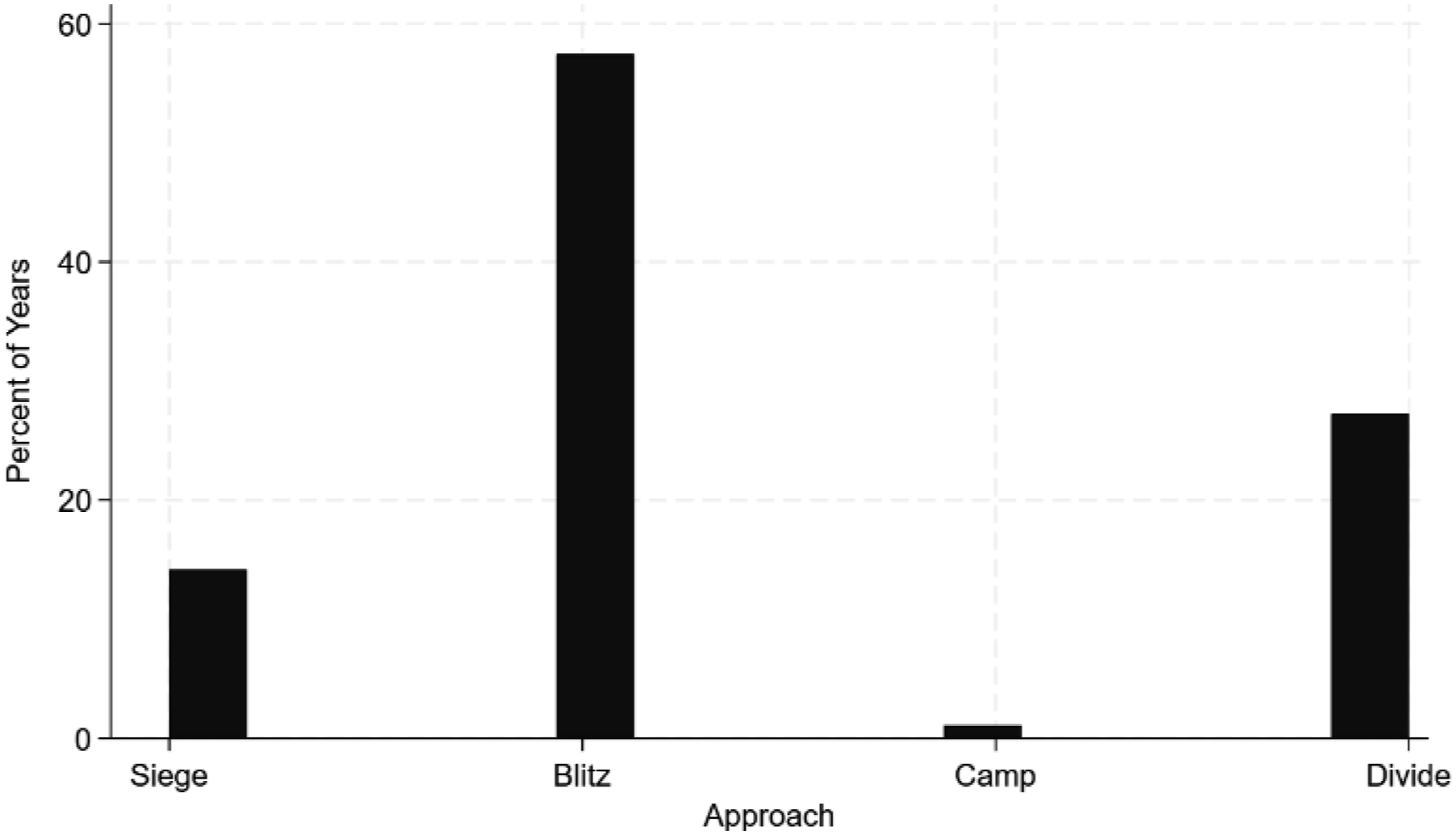
Approaches Versus Technologies of Rebellion.
While I begin with a parsimonious model that only includes my variables of interest and the time polynomial, I then include additional independent variables to capture alternative explanations and possible confounders. Previous scholars focus on Siege years by Rebel group strength.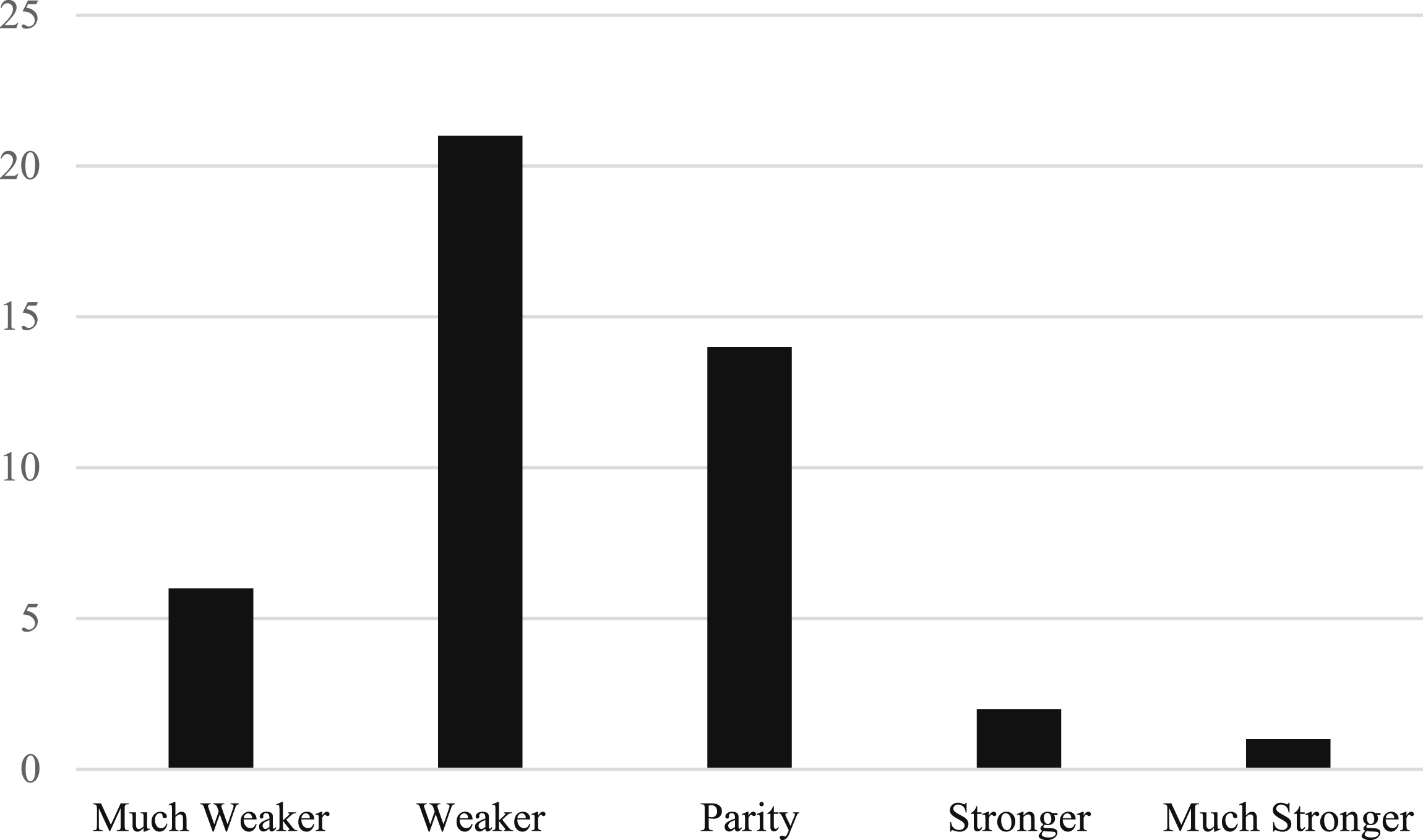
Not all rebels are equally interested in capturing or attacking the capital. Some may be intent to govern their population and territory if left alone by the government (e.g., Florea, 2017, 2020). Therefore, I include an indicator of 1 to capture those rebels who possess a
The supplemental materials provide descriptive statistics and Variance Inflation Factors for all variables in each stage of my model (A1, p. 1).
Analysis
Crosstabs.
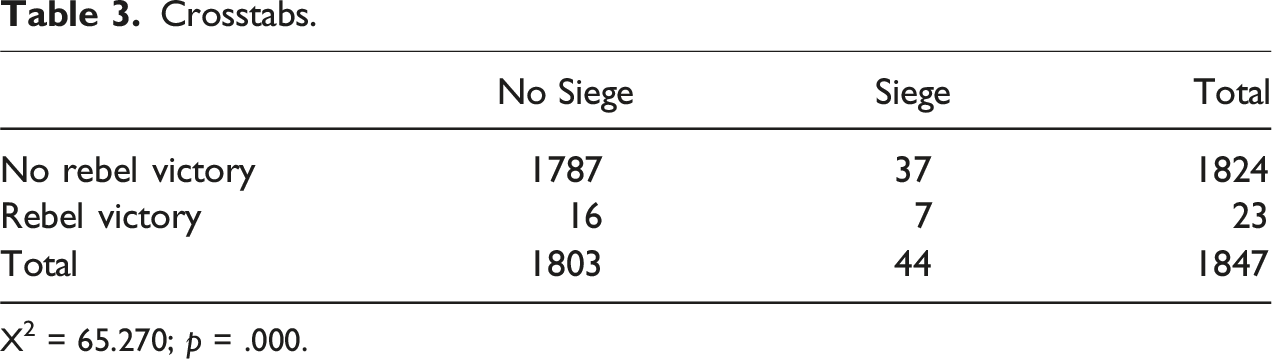
X2 = 65.270; p = .000.
Second, I take a non-parametric look at the data using a LOWESS smoother. The LOWESS smoother plots the estimated probability of rebel victory conditional on siege use. As depicted in Figure 3, when rebels do not use siege (siege = 0) to when they do use a siege approach (siege = 1) moves the LOWESS line from zero to nearly 0.2. This result, based on the smoothed local trend, means that rebel groups that use a siege in a given year have an estimated 20 percentage point higher probability of victory that year compared to those groups that did not employ this approach. This is a substantively important jump in the probability of victory, given its rarity in the data. Together, these patterns in the raw data provide confidence that the expected relationship between Siege and Rebel Victory holds outside the econometric modeling. Lowess.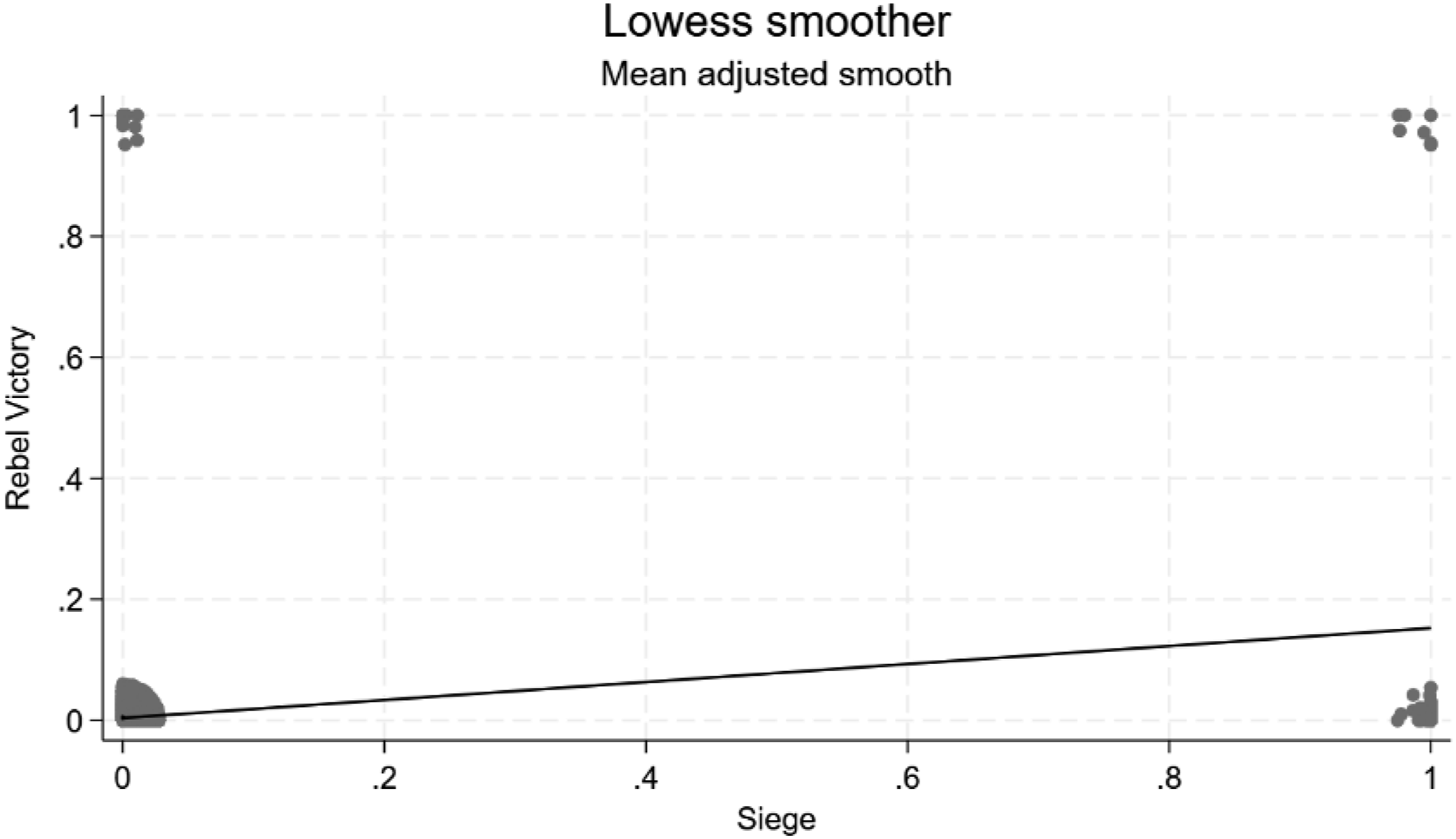
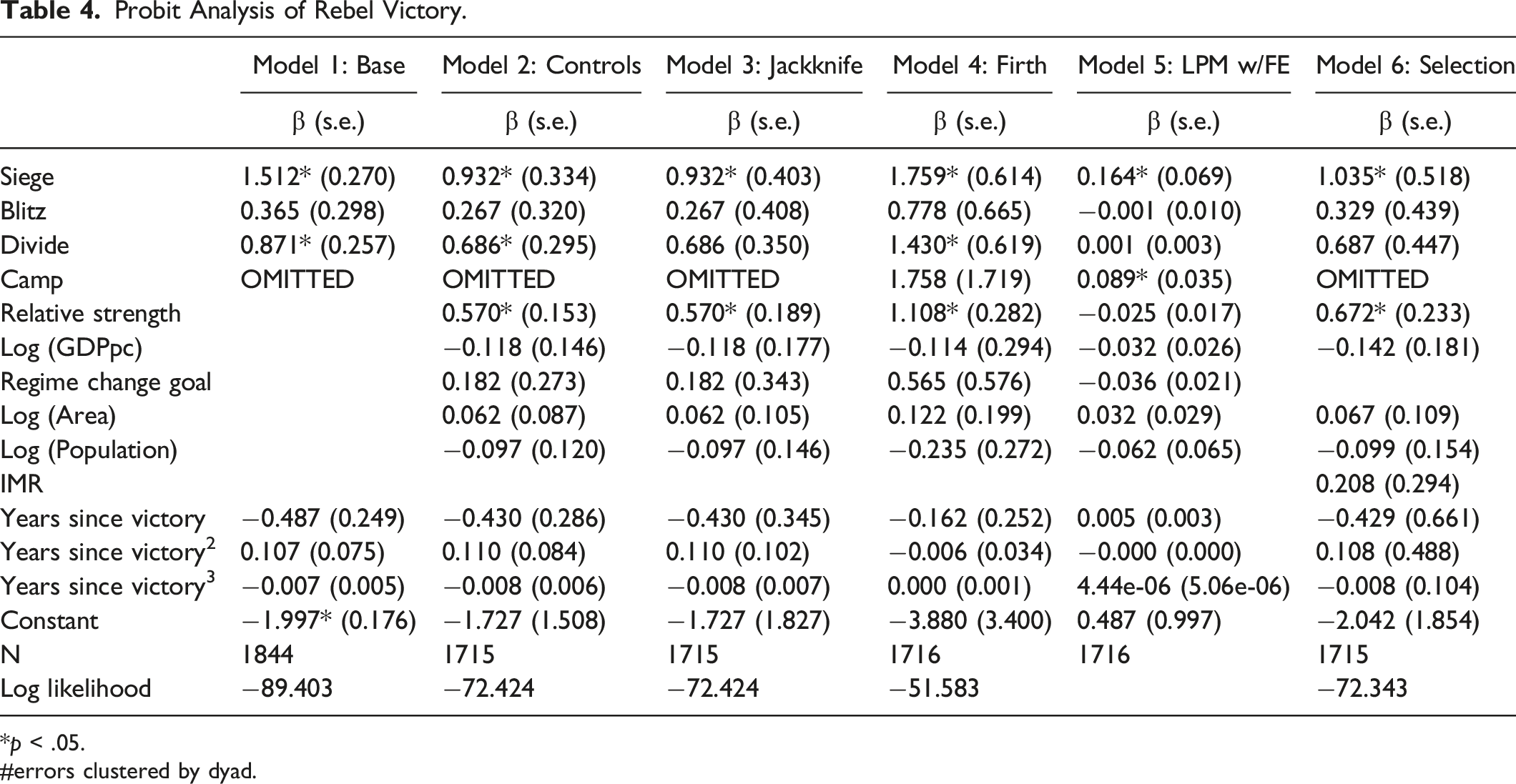
Probit Analysis of Rebel Victory.
*p < .05.
#errors clustered by dyad.
Model 3 performs a jackknife procedure in which each rebel-government-dyad is systematically dropped, and the model is re-estimated to determine if any one dyad is driving the results. Most of the results remain stable. However, I find here that Divide is no longer statistically significant. Only Siege, as expected, remains robustly associated with Rebel Victory. Since Camp is dropped in Models 1–3, this suggests there is over-separation in the data around this type of rebel approach to fighting in the capital city. Therefore, Model 4 is a firth logistic regression to assess whether addressing this issue in the data changes the robustness of the previous results. It does not—Siege and Divide are each associated with an increased probability of Rebel Victory, while Blitz remains statistically insignificant. However, the firth logit now provides an estimate on Camp, which has a statistically insignificant relationship with Rebel Victory.
Finally, Model 5 is a linear probability model that includes dyad fixed effects. In this model, Siege remains a statistically significant covariate of Rebel Victory. This relationship is robust across all main models, as expected. However, once the dyad fixed effects are accounted for, Divide is again no longer statistically significant. Furthermore, I now find that Camp is associated with an increased likelihood of Rebel Victory and Relative Strength is not. All other relationships remain as they were across the previous models.
Selection?
Patterns in the raw data and the main econometric analysis provide strong support for my expectation that sieges are robustly associated with an increased likelihood of rebel victory. However, these models—and the theorizing I provide around each of the approaches—do not account for the selection process leading up to the rebels attacking the capital. To account for this selection process, and to determine whether it alters the results presented in Models 1–5, I estimate a two-stage probit model as Model 6.
Using the same UCDP data (Davies et al., 2024), the first stage of this model accounts for the probability that a group selects Siege in a given year. In this stage, the unit of analysis remains the rebel-government-dyad-year. The dependent variable, though, is
The second-stage of this model estimates an adjusted form of Model 2 in which Regime Change Goal is removed from the equation since it is now the excluded variable, and the IMR is included as the selection parameter. Since the IMR is bringing estimated values into the second-stage from the first, I correct the standard errors through 1000 bootstrap simulations. The results of this second-stage probit model are presented as Model 6 in Table 4. Here, there are two things to note. First, Siege is once more associated with an increased likelihood of Rebel Victory, as expected. It is the one approach that remained robust to all the various modelling strategies employed throughout these analyses. Second, the IMR is statistically insignificant, suggesting that selection effects are not of serious concern for this analysis of the effect of rebel approach style on the outcome of civil war.
Additional Analysis
To further gauge the robustness of these results, I estimate a series of additional models. All results are presented in the supplemental materials. First, I use a least absolute shrinkage and selection operator (LASSO) to estimate a double-selection logit to analyze whether Siege is robust to all possible combinations of the control variables. It is (A3, p. 3). Second, I use the LASSO to determine whether Siege is among those variables selected for the model that minimizes the cross-validation function in predicting Rebel Victory. It is (A3, p. 3). Third, I attempt to probe the relationship between Relative Strength and Siege further by considering the interactive effect between these two variables. I find that while Relative Strength does not modify the effect of Siege on Rebel Victory, Relative Strength is only statistically significant when the rebels do not use a Siege approach. This suggests that strength and approach may be substitutes for the strongest of rebels (A4, p. 4).
Fourth, I probe the relationship between the technologies of rebellion and the approaches to capital warfare further by including Guerilla Warfare into the model because guerrillas are unlikely to dig-in against the regime. I find that while Siege remains robust, Guerrilla Warfare is statistically insignificant (A4, p. 4). Fifth, I note that different types of groups form in the capital city to create the Divide approach. While some are military actors, others—like the Jamaat al-Muslimeen of Trinidad and Tobago—are not. To determine if either type of capital-born actor drives the results, I separate the groups into these two types and re-estimate the above models. I find that the Non-Military Groups are those most robustly associated with Rebel Victory when using the Divide approach (A4, p. 4). Sixth, I re-estimate the model by employing a nearest neighbor matching technique on Siege and achieving balance by including the full set of variables from Model 2 (A5, p. 5). Again, I find that Siege is associated with an increased likelihood of Rebel Victory.
I also explore the relationship between each of the approaches and the range of civil war outcomes—war continues, government victory, settlement, or rebel victory (A6, p. 6). Since each possible outcome of the civil war is clearly related, I estimate a multivariate probit to account for the correlations between the outcomes. Using war continuing as the base category, I find that Siege is associated with a decreased likelihood of government victory, has no relationship with settlements, and increases the likelihood of rebel victory, as expected. Blitz is statistically insignificant for all. Camp decreases the likelihood of each type of victory relative to continuing the war but increases the likelihood of peace. Divide, though, increases both the likelihood of government and rebel victory while having no relationship with settlements. This suggests that groups that form in the capital must fight to the end, regardless of final victor, given the inherent commitment problem of claiming constituency in the government’s heart.
Lastly, I consider several additional features of the civil war that may influence the course of fighting, a group’s choice of approach, and/or the outcome of the conflict and thus may be alternative explanations or confounders for the patterns displayed throughout these analyses (A7, p. 7). I find that my primary results remain robust to controlling for conflict duration, battle deaths, multiparty conflicts, external support, third-party intervention, group ideology, and group cohesion.
Discussion and Conclusion
Rebel victories in civil war have the potential to transform a country and the international system. Yet, they rarely occur. I identify four unique, though non-exclusive, approaches that rebels use to challenge the government in its own stronghold. Of these, I find that sieges provide rebels with the highest probability of success in civil war. Importantly, sieges—and each of the other approaches—are not simply a proxy for strength. Instead, these approaches have an important and individual influence on the outcome of civil war, even after accounting for the potential effects of a selection process.
This project contributes to the political violence literature in three ways and suggests several avenues for future research. First, while strength and each approach are related, rebels can mix and match along these dimensions to counter the government. There are instances of weak rebels attempting sieges and strong rebels engaging in blitzes. The decision making behind whether to engage in any of the four approaches at a given time, or to mix across them, provides fruitful avenues for future scholars to explore as most previous work assumes that rebels tend to follow a linear trajectory from guerrilla warfare in the periphery to conventional warfare and frontlines as they reach the capital (e.g., Butler & Gates, 2009). Yet, both the novel data I present here and the brief case illustrations I provide demonstrate that there is significant variation in which groups choose which approach when in a war. I encourage future scholars to more fully explore rebel choices under fire.
Second, by decoupling strength from these approaches, I build on recent work that underscores the effects of battlefield tactics on the processes of war (e.g., Balcells & Kalyvas, 2014). In doing so, I demonstrate that strength and rebel approach have independent effects on the outcome of war, which to this point has been neglected in the broader literature on civil war. Indeed, this insight provides nuance to our understanding of rebel opportunity for war (e.g., Cunningham et al., 2009), as physical ability is only one factor that influences whether a group chooses a given approach to capital warfare. This project, though, focuses specifically on the outcome of war. It leaves open questions regarding the severity or duration of fighting, for example. It is possible that these various approaches play an important role in these processes, as well. For instance, as the al-Shabaab case demonstrated, the lethality of rebel violence appears to shift as the group moved from a divide approach to one of camping. Similarly, the Alliance National in Chad was unable to sustain their assault on N’Djamena as the blitz approach did not allow the group to pull back and regroup for a prolonged battle as the government was able to surround the group and decimate their forces from behind. I suggest that future scholars more fully explore how rebel approaches influence the conflict process more wholly.
Third, I focus on how each approach allows rebels to inflict costs on or absorb costs from the government. However, future scholars will likely find it fruitful to consider how this “opportunity-based” logic can be integrated with bargaining theories of conflict to provide a more holistic understanding of the civil war process (see Cederman & Vogt, 2017). Given the importance of rebel victory in the international system, I encourage future scholars to continue work on better understanding the conflict process and how these approaches influence the trajectory of war.
Finally, it is important to note that this project focused on the connection between capital capture and rebel victory. However, capital capture does not guarantee rebel victory. The incumbent may attempt to govern from exile, the rebels may splinter, and other pre-existing groups may continue to vie for power. While there is certainly a close connection between capital capture and rebel victory, as demonstrated here, future scholars may find it fruitful to explore the full range of outcomes that result from the fall of both capital cities and other key urban locations during a civil war. This is of importance, as siege groups vary in their geographic control and national legitimacy at the time of capturing the capital. These features of the civil war and group likely influence the extent to which the group can consolidate power and govern post-victory.
Supplemental Material
Supplemental Material - Capitals Under Siege: Why Some Rebel Groups Achieve Victory While Others Fail
Supplemental Material for Capitals Under Siege: Why Some Rebel Groups Achieve Victory While Others Fail by Gary Uzonyi in Comparative Political Studies.
Footnotes
Acknowledgments
I thank Laia Balcells, Christopher Butler, J. Michael Greig, Kerim Can Kavaklı, and participants at the Eurasian Peace Science Conference for helpful comments on previous drafts of this manuscript. I also thank the editors and reviewers at CPS, whose suggestions improved the manuscript throughout the review process.
Declaration of Conflicting Interests
The author(s) declared no potential conflicts of interest with respect to the research, authorship, and/or publication of this article.
Funding
The author(s) received no financial support for the research, authorship, and/or publication of this article.
Data Availability Statement
Replication files available at: Uzonyi (2025), “Replication Data for Capitals Under Siege: Why Some Rebel Groups Achieve Victory While Others Fail,”  , Harvard Dataverse.
Supplemental Material
Supplemental material for this article is available online.
Notes
Author Biography
References
Supplementary Material
Please find the following supplemental material available below.
For Open Access articles published under a Creative Commons License, all supplemental material carries the same license as the article it is associated with.
For non-Open Access articles published, all supplemental material carries a non-exclusive license, and permission requests for re-use of supplemental material or any part of supplemental material shall be sent directly to the copyright owner as specified in the copyright notice associated with the article.
