



Abstract
Divisions among regime elites in autocracies are often an important step toward political liberalization. However, we know little about when such divisions contribute to initiating democratic reforms. We argue that whether elite divisions lead to liberalization depends on the historical origins of ruling parties. Using panel matching analyses, we show that the positive effects of elite divisions on political liberalization are significantly reduced when ruling parties originate from national struggles such as revolutions, insurgencies, and independence movements. Specifically, dictators arising from such origins can prevent elite divisions from sparking democratic reforms by providing “carrots” to the military and applying “sticks” to citizens and political opponents. These results hold after multiple robustness tests and additional analyses for causal mechanisms. Our findings suggest that party origins are critical junctures that significantly shape regime prospects more than regime origins suggested by the literature.
Keywords
Introduction
The Carnation Revolution in Portugal and the Tiananmen Square protests in China are two watershed events in the modern history of political regimes, albeit with starkly contrasting outcomes. The 1974 Carnation Revolution initiated political liberalization in Portugal, which is now seen as the first mover in the third wave of democratization. Due to significant divisions within the National Union government dominated by António Salazar until 1968, his successor, Marcelo Caetano, faced a political gridlock by the early 1970s (Wiarda, 1994, p. 170). Furthermore, tensions rose sharply within both the government and military over ending Portugal’s colonial wars in Africa, the costs of which were mounting steeply (Bermeo, 2007). Aiming to institute political reforms, middle-ranking military officers organized the Armed Forces Movement (MFA), which toppled Caetano’s regime in a bloodless coup in April 1974. This revolution initiated processes of political liberalization over the next couple of years, which was accompanied by power struggles between radical leftists and moderates across parties and within the military. The democratic transition was completed in April 1976, when the country held free and fair presidential elections under the new constitution; moderates won, and the military accepted the results.
The 1989 Tiananmen Square protests also followed internal divisions between “hard-liners” (including Deng Xiaoping) and “reformers” (such as Zhao Ziyang) within the government of the Chinese Communist Party (CCP) over political reforms. The death of the reformist Hu Yaobang in April 1989 provoked large-scale mass protests demanding further democratic reforms to CCP rule. However, despite the favorable international environment and the emergence of reformers aiming to advance political liberalization, elite divisions resulted in strengthening autocratic rule rather than deepening democratic reforms (Slater & Wong, 2022). Concerned with growing public discontent and Zhao’s conciliatory approach to protesters, Deng, the holder of absolute party authority, decided to introduce martial law, mobilizing the military to repress the pro-democracy movement. Thereafter, the CCP government strengthened the armed forces and offered important government positions to military officers, facilitating the violent crackdown on the mass protests as well as Zhao’s removal as General Secretary of the CCP (Jencks, 1991). These decisions led to tightening autocratic control in China in the subsequent years.
These two contrasting episodes motivate the article’s central question: When do elite divisions within authoritarian regimes lead to political liberalization? In this paper, political liberalization refers to movements toward electoral democracy that do not necessarily achieve a high and enduring level of democracy, namely democratic transition or democratization (Treisman, 2015, p. 928), whereas democratic reforms encompass political leaders’ efforts to advance political liberalization. Political liberalization entails a progressive movement toward the core principles of electoral democracy, beginning with declining oppression and censorship, then a gradual extension of freedom of expression and association, and finally, free and fair elections of public officials. This process can ultimately lead to opposition victories through elections.
Comparative political scientists have long studied the sources of political liberalization (e.g., Boix, 2003; Haggard & Kaufman, 2016; Miller, 2021; Moore, 1966; Przeworski et al., 2000; Slater & Wong, 2022). Among the various explanations for political liberalization, scholars have regarded elite divisions as an important driving force toward initiating democratic reform (Collier, 1999; O’Donnell & Schmitter, 1986; Przeworski, 1991). By elite divisions, we mean disagreements between the dictator’s group(s) and other regime elites over leadership, resource distribution, and policies, expressed as within-regime dissent and the organization of distinct groups within the ruling coalition to challenge a ruling strategy. Ultimately, dissent may take the form of defections to the opposition camp. 1
Despite the prevailing view that elite divisions are an important prerequisite for political liberalization, we know little about when such divisions result in advancing democratic reform, as in the case of Portugal. As the Chinese case indicates, once elite divisions occur, autocrats may also attempt to isolate such threats through purges and personnel reshuffling (Hassan, 2017; Sudduth, 2017) and by marginalizing dissenters through repression. Indeed, according to the Varieties of Party Organization and Identity (V-Party) Data (Lührmann et al., 2020), of 138 country-election cases of major elite splits from the authoritarian ruling party, only 40% led to political liberalization thereafter.
This paper focuses on one factor pertinent to exploring the puzzle of elite divisions and democratic reforms in autocracies: the historical legacies of ruling parties. When divisions among regime elites arise, the potential for democratic change hinges on the autocrat’s ability to marginalize dissenters. Autocratic ruling parties founded through national struggles are particularly adept at controlling coercive apparatuses, thereby bolstering the dictator’s ability to repress opponents and the masses. In such cases, even when elite divisions occur, they do not foster strong alliances between regime opponents and the masses, thus failing to advance democratic reforms.
To test these theoretical expectations, we conducted cross-national statistical analyses. 2 Identifying the causal effects of elite divisions on democratic reforms is an elusive task. Determinants of elite divisions might be correlated with those of political liberalization that do not occur through elite divisions (i.e., omitted variables). Also, ruling elites are most likely to challenge the dictator when the regime has become weak and is thus likely to democratize (e.g., reverse causality). To mitigate these endogeneity concerns, we apply a panel matching estimator (Imai et al., 2023). This statistical technique allows us to make fair comparisons between the treatment and control group after the treatment takes effect because these groups share similar regime trajectories of political liberalization, and other (observable and unobservable) differences between these groups will likely be constant over time in the pre-treatment periods. Any post-treatment differences are suggestive of a causal effect, although we should always remain cautious in making inferences from observational data.
We find that the origins of autocratic parties moderate the effects of elite divisions. As in the Carnation Revolution in Portugal, elite divisions increase the prospects for political liberalization when autocratic parties do not originate from national struggles such as revolutions, independence movements, or insurgencies. Conversely, as seen in the Tiananmen Square protests, the impact of elite divisions on initiating democratic reforms vanishes when the autocratic party has emerged from national struggles. These findings remain robust after matching various characteristics of ruling parties considered crucial in explaining political liberalization, as well as through multiple robustness tests and additional analyses for causal mechanisms. In the conclusion, we discuss the implications of these findings for the study of democratization, autocratic politics, political parties, and elite divisions in authoritarian regimes.
Elite Divisions as a Driver of Political Liberalization
Our theory starts with the assumption that dictators aspire to stay in power. To do so, they need a stable ruling coalition with other elites, such as cabinet members, legislators, and party cadres. These regime elites have organizational, financial, and other forms of capital that allow the dictator to govern the country effectively. However, ruling coalitions often become unstable when such powerful regime elites use their resources to challenge the dictator’s decisions on policies, leadership, and resource distribution.
In fact, divisions within the ruling coalition represent one of the most prominent threats to authoritarian rule (Djuve et al., 2019; Svolik, 2012). For instance, significant disagreements between the dictator’s faction and other groups of regime insiders may make the regime vulnerable, which opposition elites could exploit for “democratization from below” (Haggard & Kaufman, 2016, p. 18). The autocrat may also face pressures from within the security apparatus due to differing views on policy or governance, potentially increasing the risk of a coup attempt. Ultimately, regime elites may defect to the opposition, using their resources to cement anti-regime alliances or making regime weaknesses a self-fulfilling prophecy. 3
In this context, the transitology school of democratization studies has long suggested that divisions among regime elites lead the dictator to initiate democratic reforms (e.g., Casper & Taylor, 1996; Haggard & Kaufman, 2016; Przeworski, 1991). As O’Donnell and Schmitter (1986) put it starkly: “There is no transition whose beginning is not the consequence—direct or indirect— of important divisions within the authoritarian regime itself” (19). In many examples of the third wave of democratic transitions, elite divisions within the government and military preceded democratic reform. In the process, regime soft-liners who aligned with opposition moderates and the masses embarked on undertaking democratic reform, leading subsequently to democratic transitions (O’Donnell & Schmitter, 1986). Even if mass mobilization leads to liberalization processes from below, subsequent elite splits ushered in the deepening of democratic reforms (Collier, 1999; Teorell, 2010).
In our view, dictators have at least two options when faced with growing threats arising from elite divisions. The first option, which the transitory school once emphasized, is that dictators make democratic concessions, advancing political liberalization to incorporate dissent coming from within and outside the regime. By introducing a more level-playing field, dictators could integrate dissent within the existing (albeit liberalized) regime, thereby increasing their prospects of staying in power (Higashijima, 2022; Miller, 2021; Slater & Wong, 2022). Liberalization could take the form of permitting opposition parties to participate in elections, partially allowing freedom of association and expression, and/or lifting martial law. 4 For instance, facing growing opposition, President Benjedid of Algeria revised the constitution to allow opposition parties to compete with the ruling National Liberation Front and then held the first competitive elections in 1991 (Mortimer, 1991). By refraining from manipulating electoral institutions, dictators thwart violent threats from political opponents and try to win less fraudulent elections to credibly signal their resilience (Chernykh & Svolik, 2015; Rozenas, 2016). Under the pressure of economic decline and periodic violent confrontations with the opposition, President Abdou Diouf of Senegal revised the electoral code to improve the fairness of electoral competition (Villalón, 1994). By winning liberalized elections in 1993, Diouf and his Socialist Party could stay in office without violent turnover until 2000, when he lost the presidential election to his long-time rival Abdoulaye Wade.
Although divisions among regime elites often induce political liberalization due to the strategic action taken by the autocrats for political survival, dictators also have a second option: repressing elite dissent by force. Indeed, not all autocrats necessarily make democratic concessions and co-opt dissidents when facing internal divisions. As the case of the Tiananmen Square protests in the introduction showed, elite divisions can lead to the strengthening of state repression and tightening of autocratic control by dictators, instead of paving the way for initiating democratic reforms. Why do some elite divisions successfully lead to political liberalization while others do not? The next section theorizes the relationship between elite divisions and political liberalization by focusing on the historical legacies of ruling parties.
Party Origins as a Moderator of Elite Divisions and Political Liberalization
In illuminating when elite divisions lead to political liberalization, we must consider the military’s responses to such elite dissent. 5 In the face of regime divisions, key military officers could defect, taking sides with reformers and citizens and, therefore, becoming reluctant about using bullets to thwart pro-democracy forces (Paine, 2022). A case in point is Egypt and Tunisia during the Arab Spring (Bellin, 2012; Brooks, 2017). In the face of a large number of protesters gathered in Egypt’s Tahrir Square, the military refused to follow Mubarak’s orders to fire against citizens. In Tunisia as well, the military’s decision to ignore orders to shoot protesters amid violent confrontations between the police and citizens was pivotal to Ben Ali’s ouster. These forms of military dissent enable defected ruling elites and opposition figures to organize their actions and intensify pressure on the government, forcing it to guarantee political rights and civil liberties and to hold free elections.
In contrast, if the military continues to support the autocrat at this critical moment, the autocrat can use coercive measures to repress regime opponents (Greitens, 2016). The cases of Syria and Bahrain during the Arab Spring illustrate this point very well (Brooks, 2017). Even in the face of a popular uprising against the regime in Syria, the military was highly cohesive and remained loyal to Asad. The robust coalition with the military enabled him to fight the civil war against rebel groups (Khaddour, 2015). Similarly, in Bahrain, King Hamad and his security forces were tightly aligned. His military, aided by the Peninsula Shield Force deployed by neighboring Saudi Arabia and the United Arab Emirates, blatantly repressed growing protests. The crackdown prevented the diffusion of the Arab Spring into the country.
Several factors explain why militaries disobey the autocrat during regime crises. Low levels of military hierarchy and specialization exacerbate principal-agent problems between the dictator and the armed forces (Albrecht & Ohl, 2016; Dworscha, 2020). Also, the security apparatus becomes hesitant to suppress dissent when they perceive using such measures in support of the dictator as a losing prospect that will endanger military survival as an organization (Geddes et al., 2018).
Beyond these mechanisms, we argue that if the dictator sits atop a ruling party born out of national struggles, the prospects of forming a robust political coalition with the military are increased. Ruling parties with origins in national struggles are those that emerged out of conflict processes in which political leaders were either supported by the armed forces, or themselves engaged directly in violent nation-building conflicts, such as social revolutions (Huntington, 1968; Levitsky & Way, 2022), insurgencies (Meng & Paine, 2022), and independence movements (García-Ponce & Wantchekon, 2024). 6 Some examples include the Islamic Republican Party in Iran, United Malays National Organization in Malaysia (UMNO), and the Liberation Front of Mozambique. A ruling party with such origins can effectively overcome the guardianship dilemma: a strong military helps the dictator to govern the country but can also pose an imminent coup threat as well (Svolik, 2012). If ruling parties were forged during national struggles, high-ranking military officers may become empowered and thus engage in credible power-sharing deals with autocrats, compared to ruling parties created outside of such struggles (Meng & Paine, 2022).
When dictators sit atop ruling parties with origins in national struggles, they can effectively minimize the threat of democratic challenge from other ruling elites. Specifically, such party origins link elite divisions and the prevention of political liberalization through two channels: “carrots” to the military and “sticks” to dissenters.
First, autocrats can credibly co-opt powerful elites such as high-ranking military officers by offering them important governmental positions (Chen et al., 2024; Meng & Paine, 2022). Such power-sharing provides high-ranking military officers with access points to policy-making and state resources (Arriola, 2012). With such access, the military is reassured that the autocrat will protect its organizational interests today and understands that military defection will be costly tomorrow. Specifically, when threats to authoritarian rule emerge, it is unlikely that the armed forces will ally with dissenters because it is unclear how they will be treated under a liberalized regime due to their close relationship with the preceding regime and their record of violent repression in support of that regime. Conversely, if power-sharing is not well-established due to the absence of ruling parties with origins in national struggles, the military is more likely to bet on joining the camp of the opposition because they do not enjoy privileged positions in the extant regime and may think that dissenters may offer a better deal to them, especially if political liberalization leads to a new democratic regime.
Second, credible power-sharing with the military enables the blatant use of repressive measures against dissenters and citizens. In a stable alliance with the military, autocrats become less hesitant to use repressive means. Even if an internal division occurs, the dictator does not need to compromise with opponents. Instead, dictators increase the levels of repression against dissent and further reduce the political space for the opposition. By resorting to these coercive measures, internal divisions are less likely to pave the way for initiating democratic reforms. In other words, dictators armed with legacies of national struggles can maintain regime strength through a robust political alliance with security apparatuses by providing “carrots” to the military and applying “sticks” toward dissenters.
The preceding discussion suggests three empirical implications, which we illustrate through key events in China, Zimbabwe, and Portugal. Beyond the case anecdotes, we conduct cross-national statistical analyses to systematically test our hypotheses in the next section. Hypothesis 1 (Political Liberalization): When dictators are (not) buttressed by ruling parties emerging from national struggles, elite divisions are unlikely (likely) to induce political liberalization. Hypothesis 2 (Mechanism 1-Power-Sharing): When dictators are buttressed by ruling parties emerging from national struggles, they are more likely to co-opt military officers. Hypothesis 3 (Mechanism 2-Blatant Repression): When dictators are buttressed by ruling parties emerging from national struggles, they are more likely to use repression and contain the opposition.
China’s Tiananmen Square Massacre
The 1989 Tiananmen Square protests in China are an illustrative case wherein a ruling party with origins of national struggles prevented divisions among regime elites from developing into political liberalization. The relationship between the CCP and the People’s Liberation Army (PLA) was “symbio [tic]…Sometimes, this symbiosis is reflected in party attempts to assert greater control over the military, while at other times, communist militaries have become more politically assertive vis-à-vis the ruling party” (Shambaugh, 2002, p. 12). On one hand, building upon the Maoist paradigm that “the party controls the gun,” the Communist Party, whose foundation was heavily inspired by the May Fourth Movement, a nationalistic, independence protest against the imperialist powers in 1919, and emerged victorious in a war of resistance against Japan and a civil war against the Kuomintang, was highly penetrated into the leadership of the Red Army, the predecessor of the PLA. This means that the memberships of the military and party apparatus were virtually indistinguishable after the period of violent struggles in China (Kau, 1979). On the other hand, leveraging its entrenched roles in society as well as the high proportions of PLA membership in the CCP Central Committee, Politburo, and other party organs, the military also exercised considerable influence as a political actor to advance its programmatic interests throughout CCP rule until the Tiananmen Square incident, although its influence varied over time (Shambaugh, 2002).
Without considering this symbiotic relationship between the CCP and the PLA during Communist rule, we cannot understand Deng Xiaoping’s decision to blatantly repress protesters with loyal military forces amid the internal division between hard-liners and soft-liners within the party. After the massacre at the Square, Deng expressed gratitude to the troops that had carried out the crackdown, while another hard-liner, Premier Li Peng, severely criticized the reformer Zhao Ziyang (Nathan, 2019, p. 82), who was then dismissed as the General Secretary of the CCP. The chief of the PLA General Staff also implied that “certain members of the PLA had been ‘confused’ by the corrosive influence of liberalization” (Gregor, 1991, p. 20), implying they took sides with the party hard-liners.
Movement for Democratic Change and State Repression in Mugabe’s Zimbabwe
Mugabe’s Zimbabwe is another case where a ruling party forged in national struggles prevented divisions among regime elites from initiating democratic reform. Emerging from a multi-decade war of liberation (1964–1980), the Zimbabwe African National Union-Patriotic Front (ZANU–PF) had co-opted military officers of the Zimbabwean National Army (ZNA) by offering them important positions within the government (Ndlovu-Gatsheni, 2006, pp. 56–7). The ZANU–PF also allowed ZNA generals to benefit from a land reform program that redistributed large portions of productive land that was violently seized from white farmers (Maringira, 2017). As the war progressed, militants became indispensable actors for civilian politicians to win violent struggles, further bolstering the military’s political heft. While the army capitalized on credit earned during the fighting, the constitution conferred ZANU-PF leader Robert Mugabe with the position of the commander-in-chief of the defense forces, thereby cementing a robust political coalition between the military and the ZANU–PF (e.g., Alao, 2012).
In the early 1990s, elite divisions erupted within the Mugabe regime. An important political ally and major support base of the ZANU–PF, the Zimbabwe Congress of Trade Unions (ZCTU), alongside the politicians it backed, started criticizing the neoliberal economic policies Mugabe introduced to carry out structural adjustments imposed by the International Monetary Fund (IMF). Following the effects of austerity, Morgan Tsvangirai, a former ZANU-PF senior official and the ZCTU’s president, defected from the regime, creating the Movement for Democratic Change (MDC) in 1999, which rapidly gained popularity (Dansereau, 2001).
However, this schism did not motivate Mugabe to advance democratic reform. Furthermore, senior ZNA officers signaled firm support for Mugabe and the ZANU-PU by openly airing their partisan and unequivocal allegiance to the regime (Ndlovu-Gatsheni, 2006, p. 52). The military was also highly concerned that the opposition party was advocating a security sector reform that would undermine military influence in politics and do away with its privileges, including those derived from the land reform (Maringira, 2017, p. 102). With the solid alliance between Mugabe and the army, Mugabe systematically brought military units under ZANU-PF control. He blatantly repressed opposition movements and intimidated opposition voters throughout the 2000s. Elections held in this period were marred by violence, fear, and various electoral malpractices (Bratton, 2014). Mugabe’s hawkish stance meant political freedom and civil rights failed to expand during his rule and the MDC was prevented from taking office via elections despite its growing popularity.
Portugal’s Carnation Revolution
Conversely, Portugal’s Carnation Revolution in April 1974 was a case in which elite divisions in a ruling party that did not originate from national struggles led to political liberalization. Throughout the Estado Novo regime, the most durable period of autocracy in Europe (1932–1974), two dictators– António de Oliveira Salazar (1932–1968) and Marcelo Caetano (1968–1974) failed to institutionalize a close relationship between the ruling party and Portugal’s military. Founded by Salazar, the National Union, the only legally valid party during the dictatorship, was a mere “window dressing” because it played no meaningful role beyond formally supporting the regime and failed to forge a strong alliance with the military (Pinto, 2000). According to Maxwell (1986, p. 112), “the Portuguese dictatorship was preeminently civilian and legalistic,…despite the fact that Salazar’s authoritarian and corporatist ‘New State,’ established in the early 1930s, had its origins in a military coup in 1926.”
Within the National Union government, there was a significant division between Caetano and the regime’s kingmaker, Admiral Américo Tomás (who served as the country’s president), senior military officers, and key civilian industrialists (Wiarda, 1994, p. 170), which led to a serious political gridlock within the government. Furthermore, despite its minimal political influence within the Caetano regime, the military was paying dearly for Portugal’s colonial wars, which induced widespread discontent, especially among the young military officers serving on the front lines. Before the revolution, one in four men of military age in Portugal was under arms, a share of the population in military service only exceeded at the time by Israel and South and North Vietnam. Furthermore, despite the meager pay of officers and troops alike, the military budget comprised at least 7% of the country’s GNP, higher even than the United States (Maxwell, 1986, p. 110).
Against this backdrop, junior and middle-ranking officers, organized as the Armed Forces Movement (MFA), launched a coup d’état on April 25, 1974. Soon after the coup, citizens organized street demonstrations to support the coup by the MFA. The coercive apparatus of the Caetano regime, such as the secret police, the ruling party, and censorship, was then abolished, initiating the phase of political liberalization in the country.
Although the MFA was gradually dominated by radical leftists aligned with communists, a free election for the provincial Constituent Assembly in April 1975 brought a surprise victory to social democrats (i.e., the Socialist Party [SP] and the Social Democratic Party [SDP]), revealing strong public support for moderate political forces. Most members of the military accepted the election results and welcomed the beginning of a transition to democracy (Wiarda, 1994, p. 174). After a failed coup attempt by a small group of radical left-wing soldiers within the military in November 1975, the first presidential election was held in April 1976 under the new constitution. Supported by the SP and SDP, António Ramalho Eanes, a former military officer with a moderate political stance, defeated a radical left candidate and military officer, Otelo Saraiva de Carvalho, by a large electoral margin, and the military accepted the election results. This result completed the process of democratic transition in Portugal.
Cross-National Statistical Analysis
Outcome Variable
As our primary interest is in the relationship between divisions among regime elites and incremental changes in political regimes (i.e., political liberalization rather than democratic transitions; Haggard & Kaufman, 2016, p. 5), we rely on V-Dem’s polyarchy index to measure continuous changes in political regimes (Coppedge et al., 2022, p. 43). 7 The polyarchy index measures the extent to which countries achieve core values, formal rules, and procedures for the ideal of electoral democracy by aggregating the following subcomponents: freedom of expression (v2x_freexp), freedom of association (v2x_frassoc_thick), share of the population with suffrage (v2x_suffr), clean elections (v2xel_frefair), and the presence of elected officials (v2xel_elecoff).
To identify a sample of autocracies, we first follow V-Dem’s v2reginfo indicator to establish the starting and ending dates of each political regime (Djuve et al., 2019, p. 6). 8 We then use the mode of V-Dem’s “regime of the world scores” (v2x_regime) to classify each political regime as democracy or autocracy. In this indicator, values 0-1 denote authoritarian regimes, and 2–3 are democracies. Therefore, political regimes whose mode values range from zero to 1 are included in the sample as authoritarian regimes.
By adopting this procedure, we can capture authoritarian governments that initiate substantive democratic reforms but are able to maintain autocratic rule due to the absence of government alternation via free and fair elections. Mexico under the PRI illustrates this point. According to the “regimes of the world scores” (v2x_regime), Mexico was considered democratic in 1997 due to significant electoral reforms that leveled the playing field. However, the PRI regime did not see its end until the party lost the 2000 presidential elections, as Djuve et al.’s (2019) ending dates of regimes indicate. Using both indicators, we can identify 1999 as the last observation of the PRI’s authoritarian regime in our sample. Appendix Figure A7 depicts the standard deviation of polyarchy levels across countries, showing a substantial variation to explore. 9
Party Origins
We examine whether the effect of elite divisions on political liberalization may differ depending upon the origins of ruling parties. A ruling party denotes a political party that is either the supreme ruling power or is the regime’s significant vehicle of power and preeminent among all parties (Miller, 2020, p. 762). Our sample of autocracies includes meaningful ruling parties of any autocratic regime type (e.g., military or personalist) beyond party-based autocracies, which focus on autocracies where the dominant party controls leadership selection and policies (Geddes et al., 2014). Appendixes A7 proves this point.
To classify party origins, we use Miller’s (2020) party origin data, which we updated to cover 1945–2020. National struggle origins of ruling parties refer to parties originally organized as either revolutionary organizations or non-revolutionary but pro-independence ones. When party origins fall into either of these two categories, we coded the variable “origins in national struggles” as 1 and otherwise 0.
Elite Divisions
“Elite division” is a binary variable that we created by re-scaling the V-Party’s internal cohesion index (v2padisa_ord), which time span is 1970-2020. 10 The value 1 means “divided elite coalition.” It captures a situation in which “elites display visible and major disagreements over party strategies,” which ranges in values from zero (major divisions) to 2 (visible divisions) in v2padisa_ord. In contrast, the value zero means “united elite coalition,” denoting meaningless or no disagreements among elites (i.e., 3 [negligible divisions] and 4 [no elite divisions] in v2padisa_ord). As the V-party codes the presence of internal divisions before each election, we fill the values of non-election years by using those of the last election.
The elites represented in this measure are prominent and influential party members such as current and former ministers, members of parliament or the party leadership, regional and municipal leaders, and opinion leaders. They do not necessarily have to be part of the official party leadership (Lührmann et al., 2020). This broad definition of party elites makes the measure of elite divisions a suitable proxy for studying divisions among regime elites in our sample of dictatorships that command ruling parties. This type of dictatorship represents 70% of autocracies during the period under study, and usually, a broad range of regime elites belong to the ruling party (at least nominally). Moreover, recent scholarship shows that intra-executive conflicts tend to spill over to other political institutions, such as parties and legislatures (Gandhi et al., 2020). We refer to Appendixes A.3 for an in-depth inspection and reliability of the elite division index.
Of course, our measure of elite divisions may work better in some contexts than others. For example, we might expect some shortcomings when examining autocratic regimes with strong influence from military officers outside the regime party, such as Myanmar. To account for this potential issue, we control for several regime-related variables (see the Covariates for Matching Pre-processing section) and elaborate on this point in the conclusion.
Our argument assumes that, irrespective of party origins, elite divisions do occur. However, one may wonder whether such divisions could occur in the first place when ruling parties support autocrats as an outcome of violent origins. Indeed, Lachapelle et al.’s (2020) and Levisky and Way’s (2022) theory of social revolution and autocratic stability suggests that revolutionary regimes are less likely to experience elite divisions. However, they do not directly test this mechanism with a cross-national data set.
Party Origins and Elite Divisions.
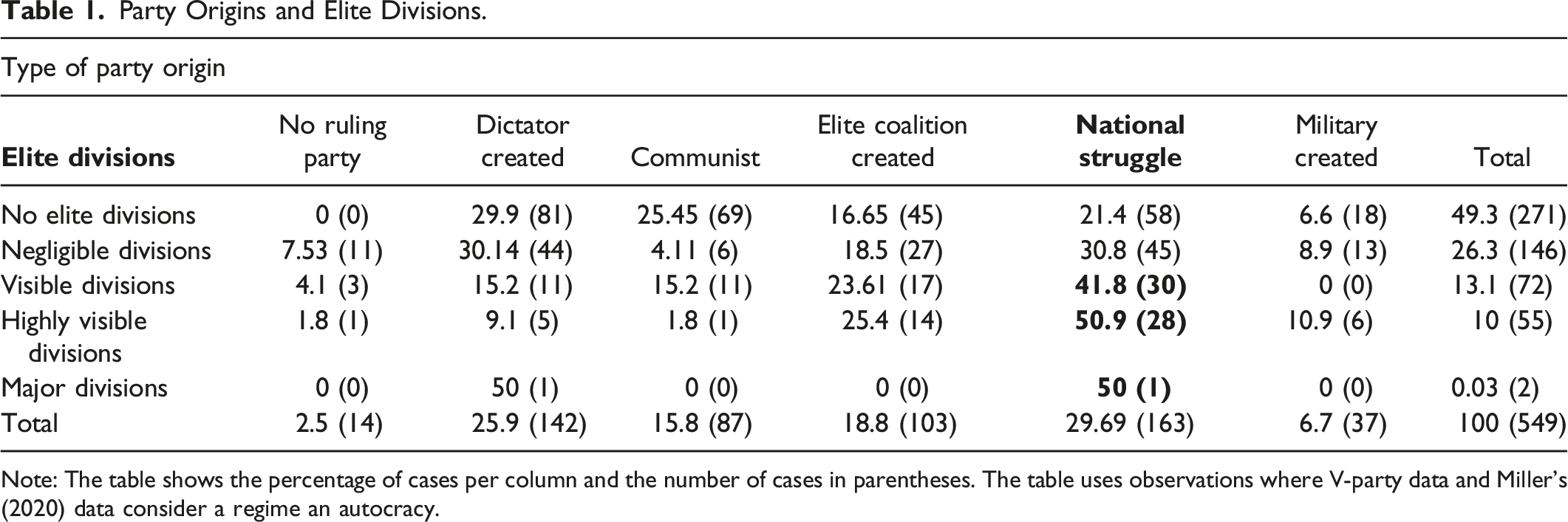
Note: The table shows the percentage of cases per column and the number of cases in parentheses. The table uses observations where V-party data and Miller’s (2020) data consider a regime an autocracy.
Research Design
One of the major challenges in testing the relationship between elite divisions and political liberalization is that such divisions are not necessarily randomly assigned. For example, when a new autocratic regime emerges, its leader may be expected to employ co-optation and/or repression strategies against elite rivals. The dictator’s strategy may influence the calculations of ruling elites over internal divisions. In so doing, some ruling parties may be better able to maintain unified coalitions than others (Brownlee, 2006). Similarly, elite divisions might be endogenous to expectations about the incumbents’ ability to survive conflicts within the regime and electoral contests. This may also serve as a factor confounding the causal relationship between elite divisions and political liberalization.
To mitigate these endogeneity concerns, we use a panel-matching design that exploits within- and across-country variation over time to ensure fair comparisons (Imai et al., 2023). 11 The quantity of interest is the average treatment effect of elite divisions on political liberalization among the treated (ATT). The standard model is as follows:

Our main analyses specify combinations of F and L up to four prospective time units each. 12 Greater values of L improve the credibility of estimates as changes in political liberalization, observable and unobservable factors (e.g., regime’s structural characteristics and socio-political trajectories) are more likely to be equal across treatment and control groups over time in the absence of the treatment. To satisfy this parallel trends assumption, we created a more comparable control group based on Covariate Balancing Propensity Scores (CPBS, Imai & Ratkovic, 2013). 13
Using a weighting scheme on “united elite coalition” results in a control group that is a more appropriate comparison to “elite divided coalition” (the treatment), with similar trends in previous democracy levels and other covariates described in the next section. In particular, we specify a set of moment conditions that are constant across the treatment and control groups. The algorithm searches for weights for different observations in the control group, achieving full balance across covariates between the treatment and control groups L time units (i.e., pre-treatment). This procedure guarantees that ruling coalitions under the treatment and control group will have identical trends in the pre-treatment period and will be balanced on other important observable and unobservable factors. 14
In using this modeling strategy, the remaining pitfalls to estimating the effect of elite divisions on political liberalization are factors that change over the analysis period, co-vary with such divisions, and are causal prior to the time the treatment occurs. One possible candidate emerges in the form of spillover effects. Regime instability in proximate countries might open opportunities for disgruntled elites to push the government and change its ruling strategy. Such neighboring effects might attract portions of regime elites to express disagreements and challenge the extant regime to achieve their political goals thereafter. The other candidate is associated with bandwagon processes. For instance, as more elites defect, the opportunity costs of joining the opposition become lower.
We account for these threats in three ways. We include year and regional dummies to account for time-related (e.g., economic shocks, the fall of the Soviet Union) and region-specific confounding factors. Second, we consider potential regime fragility by including an indicator that captures the years since the last regime change and its square and cubed terms. Young regimes are often more fragile than older ones, which is a nonlinear function of regime duration (Carter & Curtis, 2010; Svolik, 2012). Finally, we allow the treatment status to return to the control condition before the outcome is measured (treatment reversal). Our estimates thus relax the assumption of stable treatment status.
Covariates for Matching Preprocessing
Treatment and control groups are balanced across a set of political and economic variables a year before the treatment occurs. 15 In addition to party origins, how autocratic parties gained power (i.e., regime origins) is likely to affect the manner in which autocrats deal with elite divisions and the prospect of regime change. For example, autocracies are durable when insurgent groups win an intra- or extra-state war and oust the previous government (Meng & Paine, 2022). We thus add a categorical variable measuring regime origins. We use a re-coded and updated version of the Miller’s (2020) party’s road to power variable, where we distinguish between “dictator-supported,” “communist-imposed,” “coup,” popular takeover of the state (“revolution”), “military-imposed,” “elections” and “others.” 16
To consider other important party characteristics mentioned in the regime change literature, we include the ruling party’s levels of personalization (v2paind_gov) as well as the strength of mass-based organizations, which is the average of the ruling party’s connections with social organizations (v2_pasoctie) and the presence of local party activists and personnel (v2_paactcom). These indicators are based on the V-Party dataset (Lührmann et al., 2020).
Authoritarian regime types are also another relevant factor. To capture this, we include V-Dem’s five indices of executive power sources. Each index is an interval scale ranging between zero and 1 and denotes the extent to which the appointment and dismissal of the chief executive are based on hereditary succession, military force, the ruling party, direct elections, and legislatures (Teorell & Lindberg, 2019).
We also account for contextual factors. We included a dummy variable to account for the year in which national elections occurred. We match for the log of GDP per capita and long-term economic fluctuations (5 years moving average of economic growth) using the Fariss et al. (2021) dataset. Moreover, we use the V-Dem’s civil liberties index (v2x_civilb) 17 to capture general levels of repression in a given country. Finally, we include an indicator of democracy levels in proximate countries, 18 which helps mitigate problems associated with spillover effects. All time-varying covariates for the matching procedure precede the treatment as they are lagged by one year to reduce the presence of post-treatment biases (Dworschak, 2024).
Results
Panel Matching Results.
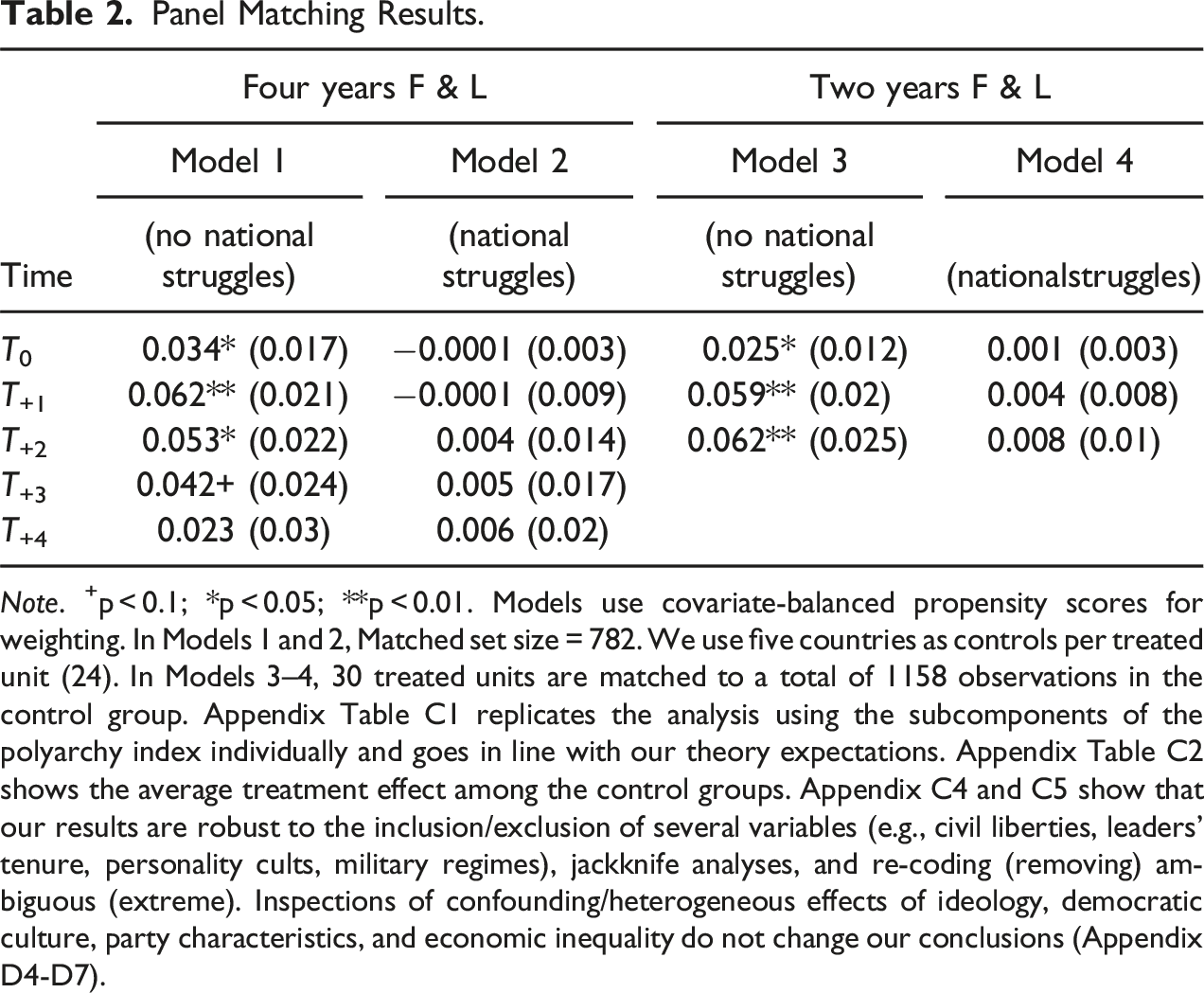
Note. +p
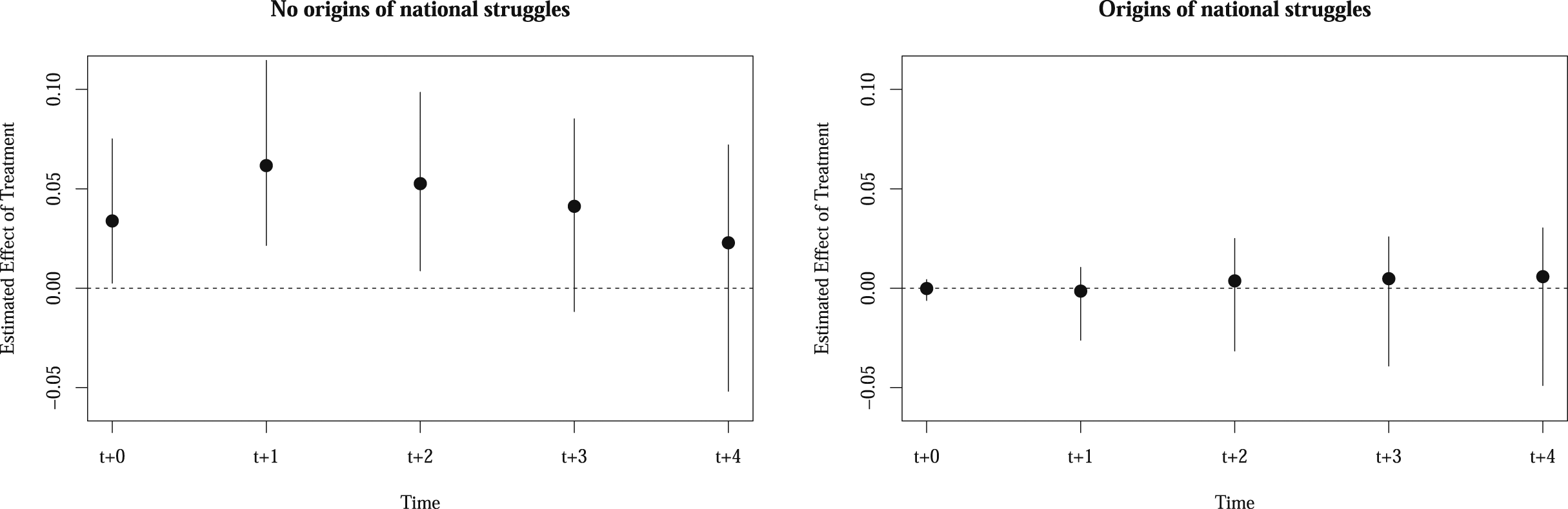
Elite divisions, party origins, and political liberalization. Note: The bars are the 95% confidence intervals. The graphs are based on Models 1 and 2.
After the second year, the effect of elite division weakens and does not satisfy the conventional statistical significance threshold – even though the direction of the coefficient is stable. Note that our theory did not necessarily specify if elite divisions have a long- or short-term effect. Our results suggest that elite divisions have only a short-term effect on political liberalization: As time passes, the effect of an elite division on political liberalization diminishes.
In contrast, the right panel of Figure 1 shows that the effect size of elite divisions becomes statistically indistinguishable from zero when ruling parties have their origins in national struggles (See also Models 4 and 8 in Table 2). 19 Indeed, point estimates of the coefficients of elite divisions are almost zero throughout the following four years after major elite divisions. The results indicate that when national struggles forge ruling parties, internal divisions do not lead to political liberalization in the short- and long-term.
Exploring Causal Mechanisms
Direct Effects of Party Origins
We demonstrated that elite divisions do not result in political liberalization when the ruling party emerges from national struggles. As mechanisms behind the relationship between these variables, we pointed to two pathways: (1) effective power-sharing between the autocrat and the military (Hypothesis (2) and (2) repression as a major tool for ruling the country (Hypothesis 3). By establishing credible power-sharing, autocrats can resort to using repression against dissent. To examine these mechanisms, we test the effects of party origins on two outcome variables: (1) the co-optation of military officers through cabinet positions and (2) levels of repression. We expect autocracies with party origins in national struggles to strengthen links with the military through political appointments and thus be able to have higher levels of state repression compared to those without such origins.
For the first outcome variable, the co-optation of the military, we measure whether the leader appoints high-ranking military officers to important cabinet positions. When the military occupies these positions, the leader underpins the institutional links between the executive branch and the military (Meng & Paine, 2022). We rely on Nyrup and Bramwell’s (2020) WhoGov data set to create a dummy variable where 1 indicates that high-ranking military officers occupy ministries categorized as “Government, Interior and Home Affairs” or “Defense, Military and National Security” and zero if otherwise.
To measure the second outcome variable, levels of repression, we use V-Dem’s physical violence index (v2x_clphy, Coppedge et al., 2022). This measure operationalizes the extent to which the government resorts to high-intensity state repression by aggregating two variables, freedom from torture (v2cltort) and freedom from political killings (v2clkill) through a bayesian item response theory technique. Higher values indicate that freedom from state repression is guaranteed.
The key explanatory variable is the party’s national struggle origin dummy. As the party origins variable does not change over time within each regime, we are unable to apply the panel-matching method. Therefore, as an alternative estimator, we use linear probability models (Ordinary Least Squares, OLS) with standard errors clustered by regime to consider the error correlation within regimes. As control variables, we include the matched covariates introduced in the panel-matching models presented in the previous section. 20
Direct Effects of Party Origins.
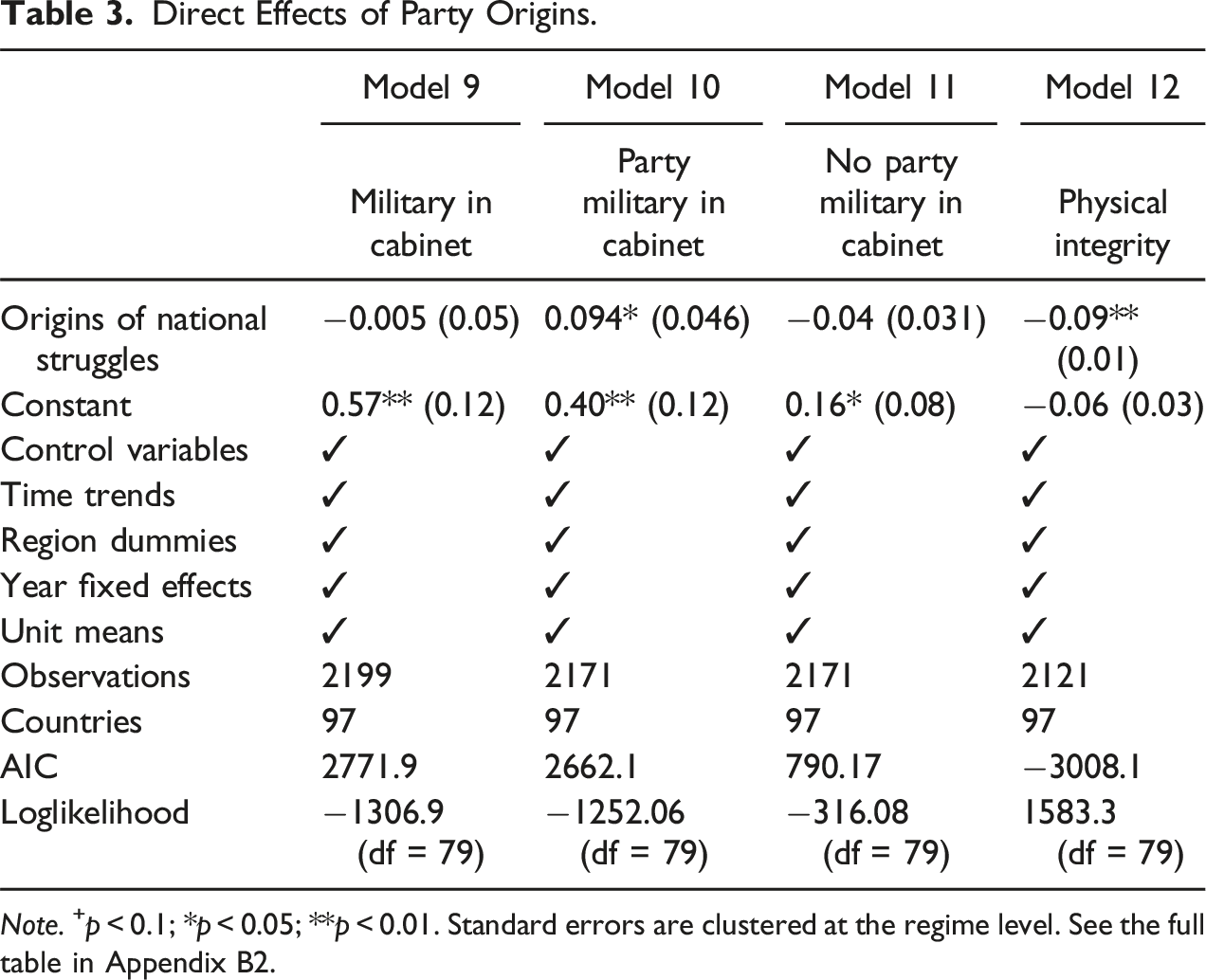
Note. +p
Second, Model 12 presents the results for repression (Hypothesis 3). They indicate that party origins in national struggles worsen physical security and thus increase the use of state repression against regime opponents. For example, parties, including the ZANU–PF, the Kuomintang under the Chiang Kai-Shek regime, and the People’s Movement for the Liberation of Angola originated from national struggles and exhibited higher levels of state repression. Overall, the models offer strong evidence supporting our theoretical expectations for the mechanisms.
Moderation Effects of Party Origins
We also show evidence for an additional implication of our theory: once internal divisions occur, autocrats with ruling parties originating from national struggles can use the military to repress regime opponents and marginalize opposition groups. Taking advantage of internal divisions, the dictator signals their strengths by using organized violence against dissenters and citizens and sidelined opposition parties. Consequently, citizens and the opposition become unable or reluctant to challenge the regime even if internal divisions occur.
To test these implications concerning Hypothesis 3, we again employ the panel-matching estimator and focus on the following three indicators: (1) barriers to parties, 21 (2) opposition parties’ autonomy (v2psoppaut from the V-Dem project), and (3) the physical violence index as a proxy for blatant repression. Appendix 3 to 5 show the results in which we use party origins in national struggles as a moderator. 22
The upper and middle panels of Figure 2 plot the effect of elite divisions on manipulating the playing field to undermine the opposition. The results indicate that, after elite divisions take place, governments with party origins in national struggles progressively increase barriers to forming parties (upper left panel) and reduce opposition parties’ autonomy (middle left panel), compared to autocratic regimes without such party origins (upper and middle right panels). This suggests that in autocracies with party origins in national struggles, financial and organizational requirements of party registration and harassment of the opposition increase in accordance with internal divisions, and the ruling party also deprives opposition parties of financial and political autonomy. Manipulating the playing field is a major change in the ruling party’s strategy. These results suggest that the occurrence of widespread internal divisions further tightens the government’s repressive strategies to prevent dissenters from becoming credible challengers. Effects of elite divisions on opposition party restrictions and repression, moderated by party origins. Note: The dots are point estimates, and the bars are the 95% confidence intervals. See the results in Appendixes B3.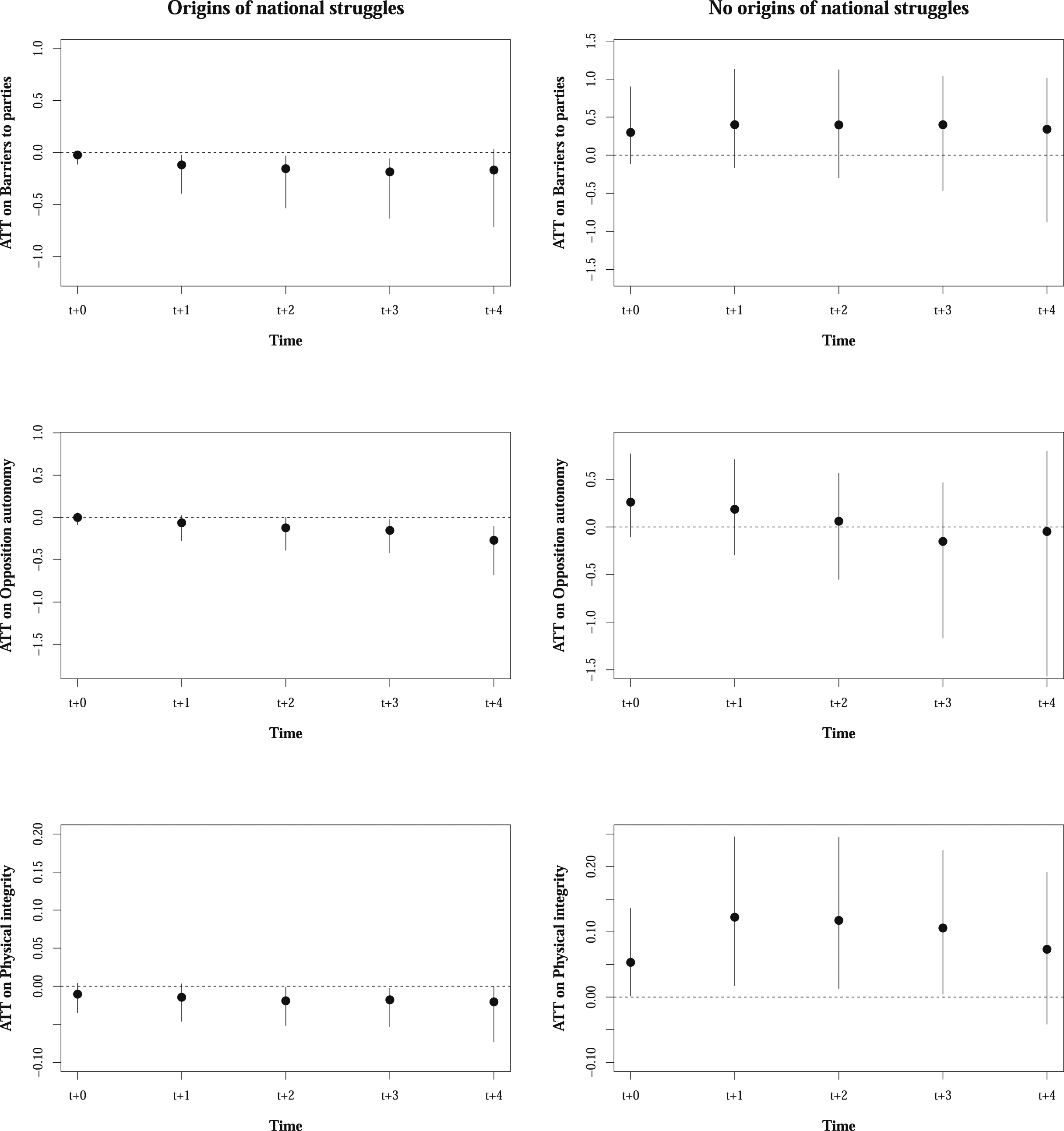
Similarly, the lower left panel of Figure 2 shows that, in regimes whose ruling party originated from national struggles, elite divisions generate a wave of repression over the following four years. In contrast, when the ruling party does not possess origins in national struggles, the government responds to elite divisions by respecting the physical integrity of citizens (lower right panel). Given the aforementioned findings that party origins in national struggles are directly associated with military co-optation and repression, the results here indicate that authoritarian leaders with national struggle party legacies often rely on repressive measures since they have already established the support of repressive agents before elite divisions occur. In sum, the results show that party origins in national struggles significantly shape how leaders respond to divisions among regime elites.
Alternative Explanations
Our findings suggest the origins of ruling parties relate to levels of political liberalization, primarily through the mechanisms of military co-optation and state repression. Other scholars, however, have assumed slightly different mechanisms on how autocratic regimes with some form of violent origins influence regime stability. Due to space constraints, we briefly comment on our assessments of the most important alternative explanations (For further information, see Appendixes D.1 - D.7).
Regime Origins
One explanation suggests that social revolutions foster regime survival due to four mechanisms (Lachapelle et al., 2020; Levitsky & Way, 2022). Namely, such regimes (1) do not experience major elite divisions, (2) possess strong coercive capacities (measured by military size), (3) create loyal security apparatuses (measured by coup attempts), and (4) destroy civil society (V’Dem’s civil society index (v2xcs_ccsi)). For the first mechanism, Levitsky and Way (2022) provide no cross-national evidence. However, as shown earlier in Table 1, the legacies of national struggles are not necessarily correlated with the likelihood of elite divisions. Furthermore, regressing elite divisions on party origins also does not have statistically significant associations (Model 4 in Appendix D1). To empirically examine the remaining three mechanisms, we follow Lachapelle et al.’s (2020) operationalizations and test these alternative mechanisms (Appendix Tables D1 and D2). The results indicate that none of these mechanisms work when we focus on the party origins in national struggles.
To explain political liberalization, we argued that the focus should be on party origins and divisions rather than regime origins such as revolutionary and rebel regimes (Levitsky & Way, 2022; Meng & Paine, 2022). To examine this empirical implication, we replicated all of our analyses by using the measures of social revolutionary regimes (Lachapelle et al., 2020), rebel regimes for African countries (Meng & Paine, 2022), and rebel regimes for a global sample coded by ourselves (Appendixes D.2). We found that these measures do not have statistically significant associations in ways expected by the regime origin arguments. These analyses suggest that party origins better explain political liberalization than regime origins brought about by revolutions and civil wars.
Party Characteristics
Another set of alternative mechanisms suggests that the ruling party’s origins in national struggles configure the party organization and formal and informal rules within it in a way conducive to maintaining regime stability. For example, such a party origin may produce a generation of leaders with unquestionable authority through which elites obey, policy guidelines are directed, and state resources are distributed (Levitsky & Way, 2013; Mitchell, 2022). Another mechanism that stems from such a party origin may be factionalism, a pattern of sharply polarized competition between blocs over the government to dominate state resources and power (Goldstone et al., 2010), leading to strengthening autocratic rule. Besides the party personalization and factionalism mechanisms, another explanation relates to party mass organization. National struggles generate a polarized society around which the ruler can cement stable, popular support bases (Levitsky & Way, 2013). Through such well-developed mass organizations, the autocrat can mobilize mass support to display his electoral dominance or respond to political threats. In Appendix D4, our analyses suggest that these mechanisms deriving from the above-mentioned party characteristics have no systematic effect on elite divisions and political liberalization. Thus, we have reasons to suspect that these mechanisms do not confound our findings.
Ideology
The roles of ideological affinities, such as elites’ motivations, geographical proximity, or ideologies imported from other governments (e.g., communism), could be important in shaping the prospect of elite divisions as well as affecting political liberalization. Examining this issue requires a separate study, and new data on party ideology as well as ruling elites’ ideological motivations is needed to empirically examine their effects on regime change (e.g., see Grewal’s [2023] interviews with elites and surveys on military personnel). That said, to consider this, we controlled for these effects by including geographical clusters, geographical proximity to democracies, and whether the government is communist or imposed by a communist foreign government. In addition, in Appendixes D.5, we examined two prominent alternative mechanisms: the effects of government partisanship and the Cold War.
On the one hand, party origins in national struggles might be associated with some government’s left-wing ideological orientation, and the divisions that emerge from such left-wing movements could be more supportive of democratic rule than others. Alternatively, we may also think that communist autocracies may be reluctant to embrace principles of representative democracy, so they are not willing to liberalize their regimes even if they face elite divisions. Our results suggest that left-wing ruling parties with origins in national struggle tend to be more cohesive than others (see Appendix Table D20). However, the elite divisions resulting from this interaction are not associated with levels of political liberalization in statistically significant ways. Importantly, our main results in Table 2 are robust to the inclusion of this variable.
On the other hand, the end of the Cold War undermined the legitimacy of communism and thus accompanied a drastic ideological shift toward admiring democracy and capitalism worldwide. Along this line, Marinov and Goemans (2014) show that, after the end of the Cold War, coups have tended to result in competitive elections, particularly compared to the Cold War period. They argued that international pressure and foreign aid from Western countries for democratization brought strong incentives for coup-prone countries to hold competitive elections. With this mechanism in mind, we examined whether the relationship between elite divisions, party origins, and political liberalization is confounded by the end of the Cold War. Our main results are robust after controlling for this confounder (see Appendix Table D21). Intriguingly, we also find that party origins in national struggles increase the chances of elite divisions and have a direct effect on political liberalization in the post-Cold War era. This finding may require further scrutiny, but we do not find that elite divisions are the mechanism connecting party origins and the Cold War with political liberalization.
Democratic Capital
Lastly, democratic values and norms among citizens and elites may confound the relationship between party origins, elite divisions, and political liberalization. Democratic capital can be accumulated even in the absence of democratic rule. It might shape the repression capabilities of autocratic parties and make citizens more intolerant of authoritarian practices. Therefore, citizens are more likely to revolt and support elite dissenters who push for democratic reforms (Andrews & Honig, 2019).
To examine the confounding effect of democratic capital, we relied on three measures: Gerring et al.’s (2012) measure of democratic stock, and del Río et al. (2024) global data set on education systems (1789–2020), which offers two variables to measure sources of democratic capital via the cumulative years of compulsory education and years of mandatory civic education for democratic norms, values, and institutions. Appendixes D.6 shows that democratic capital does not seem to confound our findings, although the weak effect at T3 in Table 2 became statistically indistinguishable from zero.
Conclusions
This paper has explored the conditions under which elite divisions in authoritarian regimes contribute to political liberalization. Elite divisions have been long considered an important first step in achieving democratic transitions. However, along with the lack of cross-national evidence, extant studies failed to theoretically identify when elite divisions lead the government to initiate democratic reforms by deepening political liberalization.
We argued that whether elite divisions lead to political liberalization depends upon the extent to which autocrats have incentives to refrain from using repressive measures to quell growing public dissent. This paper has focused on the historical origins of ruling parties as a factor encouraging the dictators’ use of state repression to respond to elite divisions. We suggested that ruling parties emerging from national struggles are more likely to use repressive measures because they effectively co-opt the military and thus incur fewer costs in resorting to violence. Through these mechanisms, elite divisions do not necessarily lead to political liberalization under regime parties with origins in national struggles. The panel-matching estimator has demonstrated that such divisions are more likely to lead to political liberalization under autocratic regimes without such party origins, but these effects diminish in the presence of ruling parties with such legacies. Our additional analyses also support our hypotheses: autocracies with ruling parties that emerge from national struggles tend to co-opt the military effectively and, therefore, can blatantly use repression against opponents and marginalize the opposition.
This article contributes to the study of autocratic politics, elite divisions, and political liberalization. To the best of our knowledge, this is the first study that identifies when elite divisions lead to political liberalization in autocracies. While elite divisions have long been seen as an important first step for regime change, extant research has focused primarily on the causes of elite defections (del Río, 2022; Reuter & Gandhi, 2011; Reuter & Szakonyi, 2019). Meanwhile, democratization studies have long noted the importance of elite divisions and the dictator’s and military’s reactions to them as pertinent mechanisms inducing political liberalization (Casper & Taylor, 1996; Haggard & Kaufman, 2016; Neptsad, 2013; O’Donnell & Schmitter, 1986; Przeworski, 1991). Building upon these two strands of research, we have brought agency back into the study of democratization and also connected the actor-centric approach to the effect of historical legacies that constrain actors’ choices.
By emphasizing the importance of ruling parties’ historical origins, we also contribute to the literature on autocratic political institutions (Geddes et al., 2018; Magaloni, 2006; Svolik, 2012). In particular, by focusing on how the ruling party developed at its inception and the lingering legacies of these origins on the relationship between the dictator and military, we have gone beyond the literature on autocratic parties, which tends to emphasize functions of party institutions like collective decision-making and grassroots party organizations (Bodea et al., 2019; Brownlee, 2006; Smith, 2005).
Furthermore, we challenged and extended the argument of revolutionary regimes (Huntington, 1968; Levitsky & Way, 2013). Social revolutions are characterized by extreme forms of violence leading to a fusing of the ruling party and military and destroying civil society, contributing to increasing autocratic stability. However, there have been few cases of social revolutions throughout history, and violent conflicts also occur in independence movements and civil wars. Indeed, only 7.6% of the social revolution cases in Lachapelle et al.’s (2020) data apply to our analysis as cases of party origins through national struggles. 23 Extending our scope to other forms of national struggles and carefully untangling mechanisms, we demonstrated that the conflict origin of ruling parties leads to the prevention of democratic reform by providing “carrots” to the military and applying “sticks” toward citizens and political opponents. We also conducted additional analyses to test the proposed mechanisms by the extant studies, finding that party origins are not necessarily correlated with weak civil society and strong military.
We believe our findings open several pertinent avenues for further research. Although our theory focuses on major elite divisions, party elites may adopt different strategies to express disagreements over governmental decisions. These might have a different effect on the government’s ruling strategies. Our study treats voicing policy disagreements, rebellions, resignations, and defections to the opposition as instances of elite divisions, as there is no data to disentangle these. Future data collection efforts will enable comparativists to disentangle these distinct types of elite divisions. In so doing, we can explore how different modes of elite divisions may pose dissimilar costs and benefits for regime elites as well as threats to authoritarian rule. For example, defection may differ from voicing disagreements (i.e., rebellion) because regime elites who resign risk losing significant privileges derived from (formal or informal) affiliation with the ruling party. This extreme form of elite division can also endanger authoritarian governments as the leader loses the resources and skills that the dissenters possess. Defected elites may then employ these resources to challenge the regime directly (del Río, 2022). Future research may benefit from exploring these hypotheses.
Another remaining question is which types of regime elites are most decisive in inducing democratic reforms. In our analysis, we did not distinguish among a broad set of elites affiliated with the ruling party, ranging from local party leaders to current and former ministers, the military, opinion leaders, and legislators. On the one hand, one might expect that high-ranking political elites (e.g., ministers) have more mobilization power to challenge executive leaders’ policy proposals compared to local party elites. For example, former Malaysian Prime Minister Mahathir Mohamad firmly opposed the ruling UMNO party’s policy direction and corruption scandals. He called for mass mobilization and encouraged politicians and bureaucrats to defect to his political party, leading to the creation of an opposition alliance and a historic electoral victory in 2018, ending more than six decades of the ruling party’s hegemony. On the other hand, high-ranking officials also have more incentives to remain loyal. For example, ministers might follow the party line because cabinet posts give direct access to patronage and policy influence (Arriola, 2012).
At this point, we are unable to test such heterogeneous effects of party elite division on political liberalization because we lack cross-national data on different types of elites (and beyond party elites, broadly speaking) and dissent strategies that are fine-grained enough to test these theoretical expectations. But also, the research community would benefit from examining other regime elites not captured in the V-party’s elite division measure and in regimes that do not hold a ruling party such as some traditional military regimes or monarchies. Therefore, we leave this as a promising question for future research. Our research strongly suggests that theorizing and testing the relationships between autocratic party characteristics, forms of elite division, and political liberalization is an intriguing avenue of research for comparative political scientists.
Supplemental Material
Supplemental Material - Democratic Reforms in Dictatorships: Elite Divisions, Party Origins, and the Prospects of Political Liberalization
Supplemental Material for Democratic Reforms in Dictatorships: Elite Divisions, Party Origins, and the Prospects of Political Liberalization by Adrián del Río, and Masaaki Higashijima in Comparative Political Studies
Footnotes
Acknowledgments
The authors thank the CPS editors and the anonymous reviewers for generous feedback. We also appreciate Anne Meng, Lucan Way, Matthew Charles Wilson, John Ora Reuter, Elvin Ong, Erik Wang, Jonas Willibald Schmid, Austin M. Mitchell, Sharan Grewal, Naosuke Mukoyama, Fabio Angiolillo, Vanessa Boese-Schlosser, Sebastian Hellmeier, Kyosuke Kikuta, Carl Henrik Knutsen, Jean Hong, Simon Watmough, Yujin Woo, Wen-Chin Wu, and Daniel Ziblatt for their helpful comments and suggestions. Earlier versions of this paper was presented at the 2022 annual meeting of the American Political Science Association, the 2022 summer meeting of the Japanese Society for Quantitative Political Science, the Authoritarian Political Systems Group (2022), the 2023 Tohoku Workshop on Authoritarian Politics, the WZB Berlin Social Science Center’s Transformations of Democracy Research Unit and Department of Government at Uppsala University (2022).
Declaration of Conflicting Interests
The author(s) declared no potential conflicts of interest with respect to the research, authorship, and/or publication of this article.
Funding
The author(s) disclosed receipt of the following financial support for the research, authorship, and/or publication of this article: This work was supported by the Alexander von Humboldt-Stiftung, HORIZON EUROPE Marie Sklodowska-Curie Actions (Grant agreement ID: 101109669) and JSPS Grant-in-Aid (21H00678).

Data Availability Statement
The dataset, documentation, replication code for the analyses of this paper are publicly available on the Dataverse page (del Río & Higashijima, 2024) related to this article.
Supplemental Material
Supplemental material for this article is available online.
Notes
Author Biographies
References
Supplementary Material
Please find the following supplemental material available below.
For Open Access articles published under a Creative Commons License, all supplemental material carries the same license as the article it is associated with.
For non-Open Access articles published, all supplemental material carries a non-exclusive license, and permission requests for re-use of supplemental material or any part of supplemental material shall be sent directly to the copyright owner as specified in the copyright notice associated with the article.
