




Abstract
While conventional wisdom often equates liberalization with deregulation, theoretical arguments from different scientific backgrounds suggest that states tend to increase their rule stock when they adopt more liberal policies. This article studies the case of abortion policy to better understand the liberalization-rule nexus. By examining data from 25 countries over 50years, we empirically assess the dynamics between liberalization events and corresponding regulatory changes. Our findings reveal that while the majority of countries does indeed introduce more rules upon liberalizing abortion, the extent of these regulatory changes varies considerably. The analysis suggests that the extent of rule growth depends on the conflicts that characterize liberalization processes in particular countries and time periods. Right-leaning governments, religious groups and institutional veto players are shown to have a positive influence on rule growth. On the contrary, higher levels of liberalization reduce the necessity for additional rules. By illuminating a contested empirical relationship, the article helps to better understand the implications of liberalization in modern democracies.
Introduction
Conventional wisdom has it that liberalization equals deregulation. The Oxford English Dictionary, for example, defines liberalization as the “removal or reduction of restrictions placed upon (a particular sphere of) economic activity.” States that liberalize “retreat,” and hence shed rules as certain behaviors no longer have to be regulated and policed. However, there are a number of theoretical arguments from different scientific backgrounds suggesting that the relationship is actually the other way around: states generally add rules when they liberalize because liberalization usually means that a simple prohibition is replaced by a qualified permission that then needs to be flanked by additional rules that detail the newly permitted behavior. In this telling, liberalization would be a driver of rule growth.
Rule growth, i.e., the addition of new rules, policies and regulations to existing rule stocks, is a widespread phenomenon in contemporary democracies (Gratton et al., 2021; Hinterleitner et al., 2024; Kaufmann & van Witteloostuijn, 2018). For example, the average number of articles in new European Union (EU) legal acts grew more than twofold from 25 in the early 1990s to more than 75 in 2021 (Hurka et al., 2022). The existing literature frequently depicts rule growth as a byproduct of modernization and liberalization processes (e.g., Adam et al., 2019). As states advance economically and liberalize behaviors and practices that were once forbidden, more rules are needed to govern social and economic interactions. Rule growth can thus be considered as the price to pay for upholding the democratic capitalist order in rapidly modernizing societies.
The relationship between liberalization and the proliferation of rules matters because the implementation and enforcement of rules entail substantial costs. These costs are not only a burden for bureaucracies, which must allocate resources to their implementation, but also to the individuals who are subject to these rules and need to comply with them. As Herd and Moynihan (2018) demonstrate, administrative burdens often disproportionately affect disadvantaged citizens who lack the resources to deal with the financial and psychological costs involved in navigating complex rule sets. If there is a (strong) link between liberalization and rule growth, “less state” might ultimately mean “more burden” for citizens. Liberalization may thus carry hidden costs that existing research has not yet systematically accounted for.
Large-scale empirical investigations of the liberalization-rule nexus are far and few between, however. While there are very insightful case studies and qualitative comparisons especially in the area of economic liberalization (see esp. Vogel, 1996; Graeber, 2015) but also with regard to social issues (Orren & Skowronek, 2017), we lack empirical studies that analyze and compare numerous liberalization events and their rule implications. Perhaps most crucially, we lack theories and empirical analyses to make sense of variations in the extent of liberalization-induced rule growth. This article presents a first attempt at examining the liberalization-rule nexus on a wider scale. Our focus is on the case of abortion, for which we can draw on data that spans 25 countries and 50 years. Abortion policy is a typical case of social liberalization and provides us with several analytical advantages to study the liberalization-rule nexus empirically: First, abortion policy is one of the few domains in which “paradigmatic” changes (i.e., changes in the degree of liberalization) can be meaningfully separated from the overall rule set addressing abortion. Second, contrary to areas of economic and financial liberalization, abortion policy is a case where we can analyze the rule implications of liberalization events in purely domestic settings; i.e., without having to account for potentially confounding international influences emerging from regulatory competition or international rule harmonization. Third, abortion is a policy issue that has experienced a more or less global trend toward liberalization during our investigation period. This enables us to examine the impact of liberalization on regulatory growth—or its absence—and to analyze the relationship across a range of different countries and institutional setups.
Our data and analysis suggest that while moves toward increased liberalization of abortion practices often coincide with more rules on abortion, there is also substantial variation in the degree of rule growth. Moreover, we detect multiple instances where liberalization reforms actually go hand in hand with a reduced number of abortion rules. We explain these differences by analyzing the conflicts that usually accompany any liberalization event: who seeks (or is pushed) to liberalize, and whose opposition to liberalization does the government need to overcome? While functional pressures can account for the generally positive association between liberalization and rule growth, we also find that a focus on political conflicts can account for differences in the extent of rule growth. Specifically, parties from the political right tend to add more rules when liberalizing abortion. Likewise, we see rule increases coinciding with liberalization when there is a relatively strong influence of religious groups on the government. In addition, our findings suggest that the strong link between liberalization and rule growth particularly applies to the early stages of liberalization. Later on, with overall greater abortion permissiveness, the relationship reverses, as further liberalization efforts coincide with rule reductions. By illuminating a contested empirical relationship, our findings contribute to a better understanding of liberalization and its implications in modern democracies.
The article continues as follows. The next part discusses the existing literature that defies the conventional belief that liberalization means fewer state action, zooming in on central contributions from political science and related disciplines. The third part presents our case and data to show that the liberalization-rule nexus warrants empirical investigation as the liberalization of abortion not always coincides with rule growth (but sometimes even rule reduction). The fourth part develops a theory to make sense of the observed empirical differences, capturing liberalization as a conflictual political process whose exact shape determines liberalization’s rule implications. The fifth part describes the research design, the sixth part presents the empirical analysis and the sevenths part conducts various robustness checks. The eights part concludes.
The Liberalization-Rule Nexus in the Existing Literature
The argument that liberalization increases rather than decreases the size of national rule stocks can be found in several scholarly contributions from various analytical and disciplinary backgrounds. In political science, Orren and Skowronek’s (2017) conception of the contemporary American polity as a “policy state” provides important insights on the relationship between liberalization and rule growth. The policy state describes the organization of a state in which policy has become the preferred problem-solving tool of the government. As governments undertake more over a broader range of issues, policy infrastructure thickens and permeates almost all areas of social, political, and economic life.
A central observation of research conducted on the policy state is that there has not always been a ubiquity of policy. Instead, it is the result of a peculiar historical trajectory that has its roots in the 19th century and which only culminated in the second part of the 20th century (Higgs, 1987; Jones et al., 2019). Historically, different “forms of rule” govern democratic polities. The most important forms of rule are constitutionally or socially entrenched rights, the formal arrangement of institutions (“structure”), and policy. Rights, structure, and policy work together to govern a democratic polity. However, they also mutually contain and equilibrate each other. Rights, in particular, have traditionally constrained the expansion of policy. As rights form the basis of most policy interventions, they preset the space in which political or private actors can propose policy initiatives.
By this logic, the policy state is the result of the gradual dilution of the nature of rights. Orren and Skowronek (2017, p. 29) define rights as absolute claims of persons against other entities that constrain political discretion and foreclose programmatic goals. However, as rights multiplied over the course of the 20th century, they gradually lost their absolute character. The more rights there are, the more contingent each right becomes, because ever more competing claims must be balanced out. Contingent rights are less able to keep policy (and hence the proliferation of rules) at bay because the space they protect from policy interventions is much more permeable than the space protected by more absolute rights. Moreover, “new” rights usually require the support of policy interventions in order to become more than a formality (Pierson, 2007). Hence, liberalization (understood as the endowment of rights to persons) is conducive of rule growth because it provides actors in favor of state expansion with the legal basis to adopt regulations in formerly unregulated areas. The more an area gets liberalized (i.e., the more rights exist in a given social realm), the more this realm can be permeated by governmental interventions.
Orren and Skowronek (2017, pp. 43–52) illustrate the relationship between liberalization and the advance of policy with the help of several case studies such as the relationship between company owners and their employees or the traditional family. In the US, a father’s right to rule the family was almost absolute until well into the 19th century. Over time, however, mothers and children obtained individual rights that were separate from those of the father, diluting the latter’s absolute control over the family. In order for the rights of mothers and children to escape the realm of mere formalities, advocates proposed policy plans intended to enforce those rights. Over time, several policies and regulations, from “restraining orders to husbands on behalf of wives and children” (Orren & Skowronek, 2017, p. 48) to a full-fledged child custody policy, permeated the space formerly protected by a father’s right to rule the family.
The argument that liberalization leads to rule growth can also be found in political economy research, which suggests that a liberal state is characterized by free markets, and that free markets require a great number of rules to work properly. As Polanyi (1944, p. 140) describes it, the “introduction of free markets, far from doing away with the need for control, regulation, and intervention, enormously increased their range.” There are several reasons for why markets need rules to function, and why hence economic liberalization can be expected to produce additional rules. For one, counteracting the oligopolistic and monopolistic tendencies that characterize many markets requires governments to constantly interfere through regulations (Kanter, 2023). Moreover, market creation often implies that profit-oriented interests enter areas that were previously characterized by public-good orientations. Since profit-oriented interests are frequently at odds with public good orientations, governments need to step in to make them align (or to reduce the negative repercussions of profit-oriented interests). In the case of education privatization in the US, for example, the profit-oriented interests of private school operators have sometimes led to worse education outcomes. As a consequence, regulations had to be drafted to secure certain minimum standards (Hanauer, 2008).
Also the work by Vogel (1996), which zooms in on the political interactions and conflicts that characterized the liberalization of telecommunication and financial services in the United Kingdom, Japan, the United States, France, and Germany during the 1980s and 1990s, suggests that the move to freer markets usually coincided with an increase in government regulation. In “most cases of ‘deregulation,’ governments have combined liberalization with reregulation, the reformulation of old rules and the creation of new ones” (Vogel, 1996, p. 3). Vogel attributes this pattern to the interests of the government engaging in liberalization and, to a lesser extent, to those of private actors affected by its consequences. Specifically, governments are often reluctant to relinquish their influence over a certain issue and hence try to find alternative ways to control private actors. And while governments typically manage liberalization processes and seek to mold politically acceptable bargains, they are “not in a position to ignore the demands of private groups” (Vogel, 1996, p. 5), which do not necessarily always argue for rule reduction but rule adaptation, for example when rules help to keep their competitors at bay.
The work by Graeber (2015) in the field of anthropology draws on several of the above-described political economy arguments, but starts from a more fundamental premise to argue that liberalization increases the number of government regulations: As markets are government creations, they cannot function without constant government intervention. Because this is such a fundamental insight, Graeber (2015, p. 9) presents it in the form of a law. This “iron law of liberalism” states “that any market reform, any government initiative intended to reduce red tape and promote market forces will have the ultimate effect of increasing the total number of regulations, the total amount of paperwork, and the total number of bureaucrats the government employs.”
Taken together, it is interesting to see that the existing literature on the liberalization-rule nexus makes the same argument – liberalization leads to rule growth – with regard to both social and economic liberalization processes. In fact, the literature suggests that irrespective of the domain in question, liberalization processes exhibit two important commonalities that are conducive of rule growth. For one, liberalization exerts “functionalist” pressures for rule growth in the sense that liberalization creates problems that governments can hardly leave unaddressed; be it the regulation of previously prohibited practices or the correction of market failures and negative externalities. Moreover, the existing research suggests that liberalization-induced rule growth is not only the result of functionalist pressures but also of political conflicts about (the extent of) liberalization. Be it a social or an economic issue, there are usually private or political actors that favor liberalizing the issue, others that are against it, and still others that support liberalization but only if certain conditions are met, or restrictions are applied. By this logic, the outcomes of conflicts about liberalization are codified in certain rule sets. While previous research hence suggests that liberalization is generally an important driver of rule growth in contemporary democracies, the strength of its influence is likely to be conditioned by political conflicts.
In conclusion, the existing literature provides several arguments for why liberalization processes generally coincide with increased government regulation. Yet, this relationship has not been examined on a wider scale so far. While there are insightful (comparative) case studies of liberalization processes and their rule implications both in economic (Vogel, 1996) and social policy (Hanauer, 2008; Orren & Skowronek, 2017), we do not know how strong the relationship between liberalization and rule growth actually is, nor do we have comprehensive knowledge on the factors that account for potential variation in the strength of this linkage. While there are contributions which present the liberalization-rule nexus as a rather functionalist relationship (Graeber, 2015; Orren & Skowronek, 2017), other contributions suggest that there should indeed be variation between liberalization and the extent and direction of rule changes (Vogel, 1996). Potential reasons for this contradiction are that the existing research thus far has solely relied on (comparative) case studies and examined the liberalization-rule nexus in a relatively small number of instances and country contexts.
The Case of Abortion
In order to study the link between liberalization and rule growth, one can potentially focus on a broad array of policy areas that have been characterized by a reduction of state involvement and governmental regulation, including areas of financial, economic, as well as social liberalization. In this paper, we examine the liberalization-rule nexus in the case of abortion for several reasons. First, abortion is in many ways a typical case of liberalization in that it constitutes a social practice almost universally forbidden for a long time but which many countries have liberalized during the second half of the 20th century, endowing women with more or less extensive rights to seek an abortion. Analyzing the case of abortion comes with the major benefit that it enables an examination of the full “spectrum” of liberalization—from total prohibition, through various degrees of liberalization, to a state of near or complete permission. This allows to observe the evolution of liberalization alongside the changes of rules over time. Second, and very importantly, in the case of abortion, we can clearly distinguish the paradigmatic “level” of liberalization (the abortion permissiveness) from the number of rules introduced to accompany or secure a certain level of liberalization. Third, the case of abortion allows us to study the impact of political factors on the liberalization-rule nexus in national settings that can be considered to be largely unaffected by international influences emerging from trade competition or international harmonization.
Our data 1 comes from the MORAPOL project and covers 25 countries over 50 years (1960–2010). The countries under analysis are Austria, Belgium, Brazil, Chile, Denmark, Finland, France, Germany, Greece, India, Ireland, Israel, Italy, Japan, the Netherlands, Norway, Poland, Portugal, Russia, South Africa, Spain, Sweden, Switzerland, Turkey, and the United Kingdom. The countries under analysis represent “diverse” cases (Seawright & Gerring, 2008), providing a varied range of analytical dimensions such as political system characteristics, economic development levels, and cultural influences. Such a broad spectrum allows for a comprehensive comparative analysis of the liberalization-rule nexus across different governance and societal contexts.
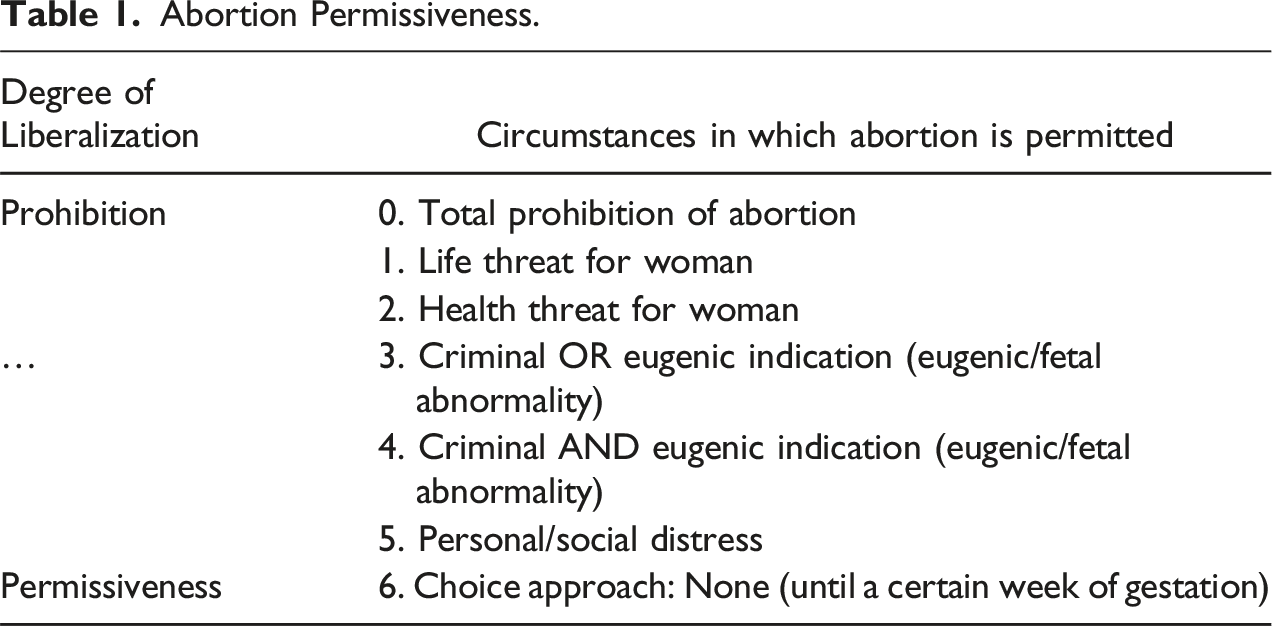
Abortion Permissiveness.
Abortion Rules.
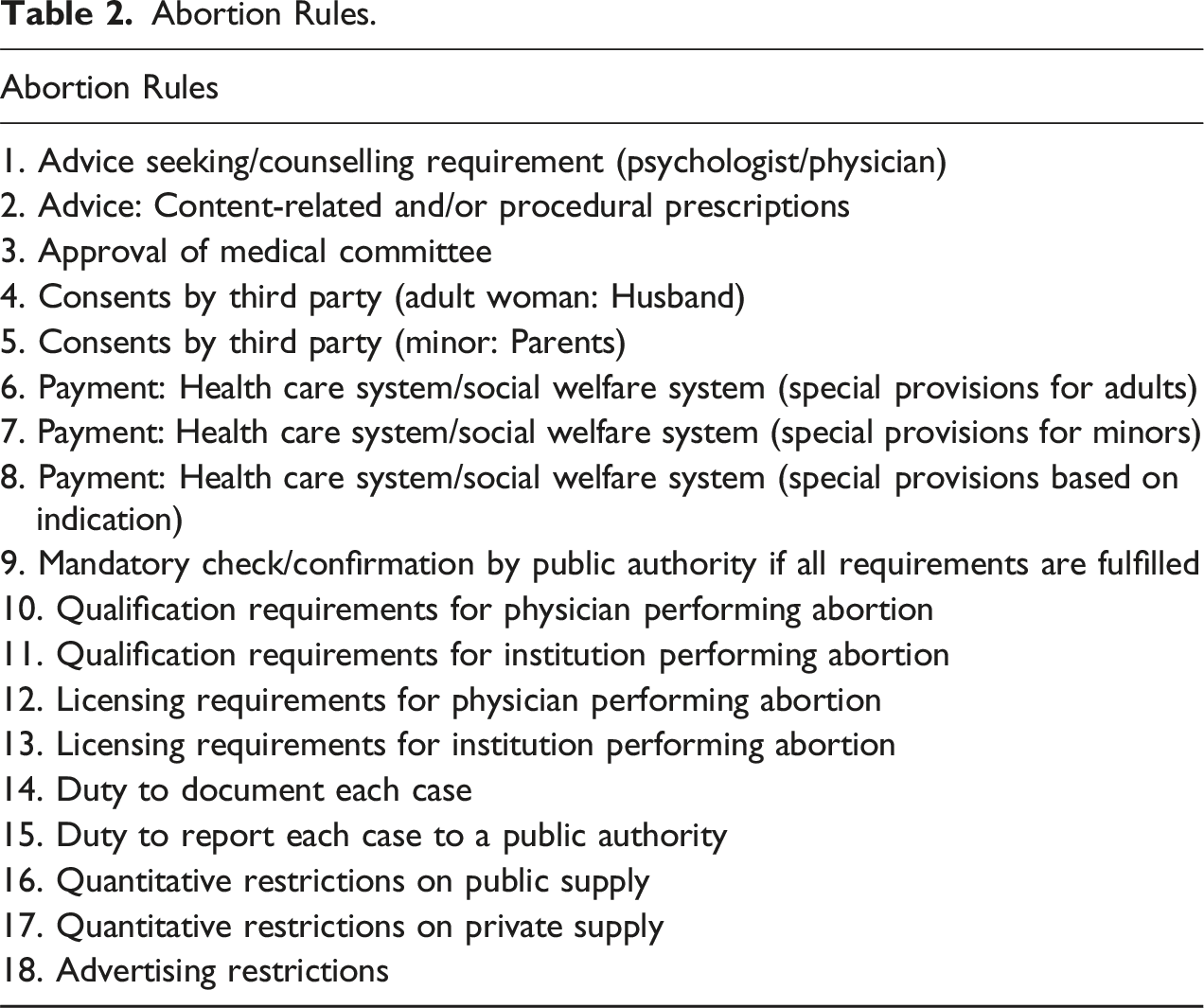
It is crucial to emphasize that while these rules can accompany liberalization efforts, they are not inherently tied to them. In other words, all the liberalization steps in Table 1 can de facto occur with or without the rules outlined in Table 2. This allows us to study whether and when liberalization goes hand in hand with rule changes.3, 4
Figure 1 presents the year-to-year changes in the abortion permissiveness score (see horizontal axis) and the number of abortion rules in place (see vertical axis) for the 25 countries and the 50 years under scrutiny. We quantify abortion permissiveness via an index that ranges from zero (indicating prohibition) to six (indicating choice).
5
The rules are enumerated using a count variable, with each provision being either present (1) or absent (0), and a maximum of 18 rules that can be put in place. Years without changes in liberalization and rules are not displayed in the figure (or represented by the zero point). Abortion liberalization and rule changes in 25 OECD countries (1960–2010).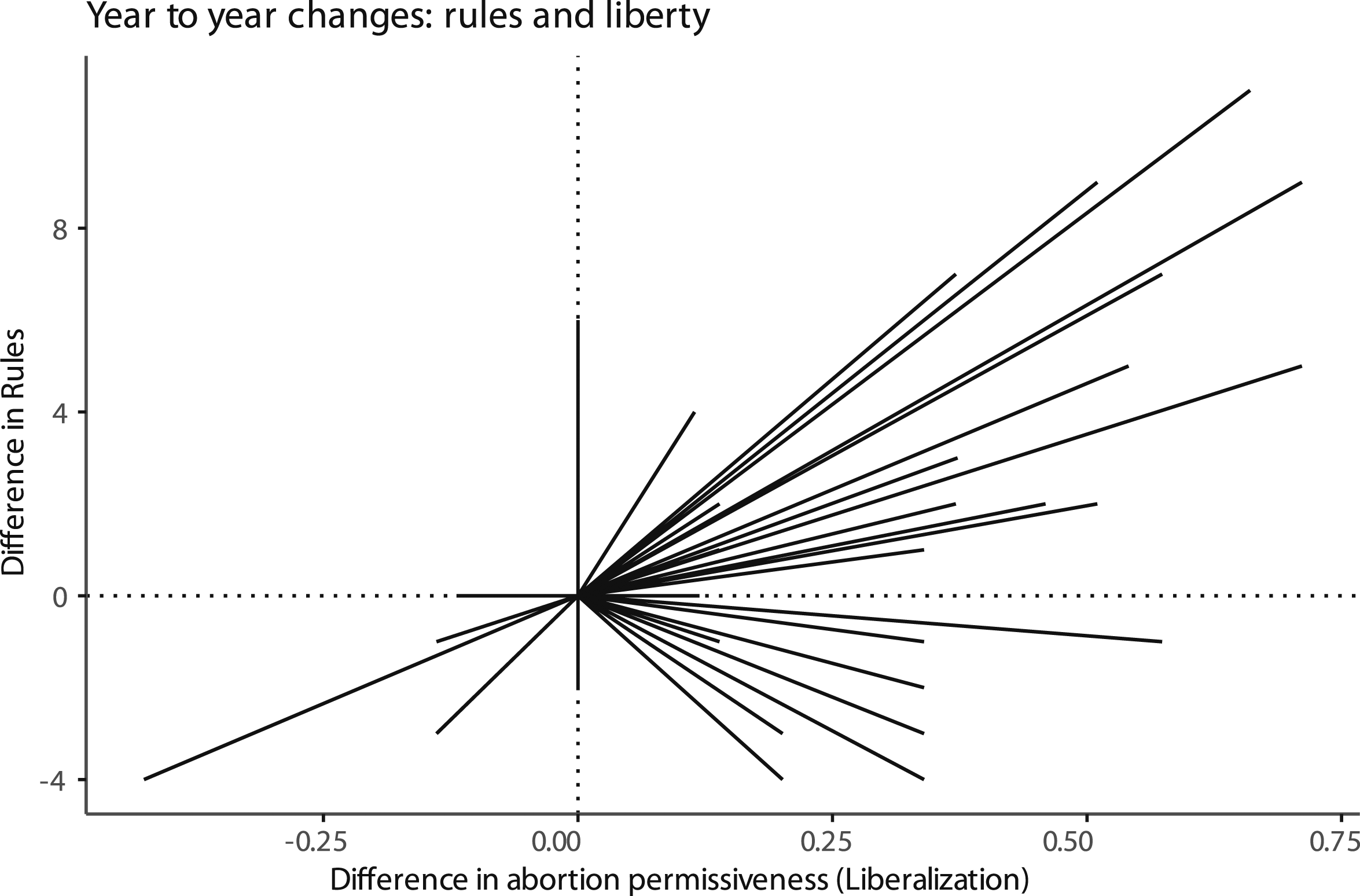
The figure presents several important takeaways. First, it demonstrates that our underlying assumption that liberalization and rule changes can occur independently is indeed valid. There are several instances where rule changes happen without concurrent liberalization (evidenced by movement along the vertical axis), and there are instances where liberalization occurs without accompanying rule changes (evidenced by movement along the horizontal axis). An illustrative example of rule change without liberalization change is Sweden in 1974, which had already established a relatively liberal abortion law in the early 1960s. Initially, however, the right to an abortion was contingent upon case-by-case approval from a committee investigating whether the conditions were met (see rule 3 in Table 2). The 1974 reform eliminated the need for committee confirmation, requiring only the involvement of a committee for abortions after the 22nd week of pregnancy. The opposite example, liberalization without concurrent rule changes, can be found in Greece in 1978, when the government provided the first ground for the legal termination of a pregnancy in the event of a threat to the health or life of the woman (with no time limitation). Additional rules, however, were introduced only later. Second, we see that most liberalization events contained in our data coincided with rule increases (upper right quadrant). At the same, however, there is also a significant number of instances that seemingly contradict the dominant view in the literature, i.e., cases where countries liberalize abortion while shedding rules in the process (lower right quadrant). Lastly, as indicated by the length of the lines, we see a quite strong variation in the degree to which governments alter the rule set when liberalizing.
These patterns observed in our data thus beg for investigating why liberalization processes have different rule implications. In the following, we present our theory, the expectations we derive therefrom, and how we measure the variables supposed to moderate the relationship between liberalization and rule change.
Accounting for Variations in the Liberalization-Rule Nexus
Based on the existing literature, we generally assume liberalization-induced rule growth to depend on both functionalist pressures and political conflicts. With regard to functionalist pressures, the expectation is that the liberalization of abortion “automatically” creates certain challenges and problems that governments can only address by adopting new rules. For instance, governments that liberalize abortion may be prompted to specify the conditions under which an abortion can be pursued, to ensure certain minimum standards for the quality of service provision (who is allowed to carry out abortions and under which conditions), or to regulate the costs for having an abortion (so that access to abortion is not factually prevented by prohibitively high prices). These “functionalist” pressures are captured by our first expectation:
The liberalization of abortion comes with additional rules.
Next to this general trend, we assume that the extent of liberalization-induced rule growth primarily depends on the conflict that characterizes the liberalization of abortion in a particular country and during a given time period. We try to capture conflicts about liberalization in a fundamental manner by concentrating on two primary actors: (i) the government, which manages the liberalization process, and (ii) the influence of entities opposing this liberalization whose support must be gained. The (relative) prominence and influence of these actors are likely to dictate the number and nature of rules that emerge from liberalization processes.
When it comes to conflicts about liberalization, governments can be expected to play an absolutely central role, as they are the ones who manage the liberalization process and have to mold politically acceptable bargains (Vogel, 1996). We can hence expect it to matter whether the government is really in favor of liberalizing a certain issue and thus has no problem with relinquishing control and influence, or whether the government is a rather “reluctant” liberalizer. For instance, even if a (conservative) party’s stance towards abortion is generally restrictive, key voter groups, coalition allies, or interest groups (Carmines & Woods, 2002) may exert pressure to liberalize abortion. A notable catalyst for change is often the increased visibility and activism of women’s rights groups, who may raise awareness of the health and social implications of restrictive abortion laws. Should public opinion polls indicate a significant shift among the electorate, right-leaning parties may feel compelled to reconsider their position to maintain voter support. In Ireland, a historically Catholic country with conservative views on abortion, decades of activism and societal change led to the 2018 referendum. The weight of public opinion was such that the conservative government could no longer ignore calls for change and finally agreed to liberalize abortion laws. In addition, also judicial decisions may prompt governments to liberalize abortion policy (Casillas et al., 2011; Ura, 2013). Courts have the power to interpret laws, and they may rule that restrictive abortion laws are unconstitutional, thus forcing governments to address the issue. A famous example is the Canadian Supreme court case against Henry Morgentaler, who was prosecuted for performing unauthorized abortions. The Supreme court ruled that the provision in the Criminal Code concerning abortion infringed upon a woman’s right to “life, liberty, and security of the person” as ensured by Section 7 of the Canadian Charter of Rights and Freedoms. This pivotal ruling compelled the conservative government under Prime Minister Brian Mulroney to come up with a new, revised legal framework for abortion.
In the case of abortion, liberalization without major rule additions comes more naturally for liberal and left-leaning parties. These parties frequently emphasize the removal of societal barriers that restrict personal freedom and growth. The emphasis of individual security and freedom inherently aligns with the left’s goals of fostering inclusivity, ensuring equality for all, amplifying opportunities for participation, and advancing gender equality (Fernández & Lutter, 2013). Moreover, left parties have been shown to push for gender policies in the field of social protection (e.g., leave policies) because this aligns with their interest in class politics (Htun & Weldon, 2010). On the other hand, conservative parties on the political right traditionally venerate societal norms that uphold traditional values and prioritize the collective over the individual. As a result, even if they opt for liberalization, they still might retain a stronger incentive to exert control over the issue. The respective expectation can be formulated as follows:
The liberalization of abortion is accompanied by fewer additional rules when left-leaning/liberal parties are in power compared to when right-leaning/conservative parties govern.
As we emphasized, governments are subject to the influence of interest groups when managing liberalization processes. While some interest groups may be in favor of liberalization, others may be against it and hence push governments to maintain government control over an issue and retain or add rules that they care about. In the case of abortion, we can expect that especially religious groups play an important role (O’Connor & Berkman, 1995). While various religions have differing views on the subject of abortion, religious groups generally tend to be critical of abortion policies, as they often see it as human intervention in “divine” creation (Fink, 2008, p. 1646). When liberalization of abortion seems inevitable, these groups may exert influence to curtail the liberalization by introducing more rules. Therefore, the prominence of religious organizations is likely to influence whether fewer or more regulations accompany abortion liberalization. This expectation can be summarized as follows:
The liberalization of abortion is accompanied by more additional rules the stronger the influence of religious groups on the government.
Next to considering the preferences and strength of the actors involved in a conflict about the liberalization of abortion, we deem it important to also consider the institutional context in which the conflict plays out and its current “state,” i.e., whether a country is about to move from absolute prohibition to a more liberal paradigm, or whether it moves from an already quite liberal paradigm to absolute permissiveness.
With regard to the first point, we expect that the presence of institutional veto players is generally conducive to liberalization-induced rule growth. While we already consider religious groups as particularly important (informal) veto players for the case of abortion, also other veto points can be expected to have a positive influence on the number of rules produced during liberalization events. While one could expect that by exacerbating policy adoption, veto points actually work against policy growth, a plurality of veto points may also have the exact opposite effect. Previous research has shown that institutionally fragmented political systems are particularly likely to exhibit rule growth over time in diverse areas such as environmental or social policy (Fernández-i-Marín et al., 2024). As Teles (2013) has argued, veto points can be conceived as “toll booths” — with the toll taker demanding additional provisions or exceptions to legislative proposals. For instance, in the Swiss federal system, a majority of the cantons (lower-level government units) must agree to many legislative proposals by the central government; an aspect that increases the complexity of the laws that are ultimately adopted. Veto points thus often result in a multitude of provisions and components that are attached to an original legislative proposal to appease opponents and secure legislative passage. The expectation that conflicts about abortion tend to produce more rules when they play out in institutionally fragmented systems can be formulated as follows:
The liberalization of abortion is accompanied by more additional rules the more veto players are involved in the decision-making process.
With regard to the second point, namely that the rule implications of conflicts about liberalization also depend on their current “state,” one can expect that the level of liberalization negatively influences the amount of rules in a certain area. This is because when countries start to liberalize an issue that previously was completely prohibited, it can be assumed that opposition and reservations among different actors are still strong, and the government may be intent on signaling that it is not completely giving up government control over the issue. On the contrary, when governments “completely” liberalize an issue, they automatically relinquish control over it; an aspect that can be expected to imply fewer rules overall. This expectation can be formulated as follows:
The liberalization of abortion is accompanied by fewer additional rules the more a country already progressed on the path to total permissiveness.
In the following, we test these expectations in a quantitative and comparative setup.
Research Design
As delineated in Section 3, our analysis requires the use of two measures: one quantifying liberalization trends with respect to abortion permissiveness (or the extensiveness of abortion rights); and the other tracking specific regulatory changes. We gauge abortion permissiveness using an index ranging from zero, denoting complete prohibition, to six, reflecting full reproductive autonomy. Abortion rules are measured by a simple count variable that ranges between 0 to 18 possible regulations. Recognizing that abortion permissiveness actually represents an ordinal variable where individual liberalization steps do not simply add up, we test for different “logics of aggregation” in the subsequent analysis. Based on our theoretical discussion, we expect that the liberalization-rule-nexus depends on (i) government party ideology, (ii) the relative influence of religious groups on the government; (iii) the number of veto players; and (iv) the state of liberalization (level of permissiveness).
To understand the potential impacts of political parties, we utilized data from the PARFAM dataset by Heichel et al. (2015). We focus on the strength of left and liberal parties in government, gauged by their cabinet seat share within the coalition.
To examine the role of religious groups, we employed the “religious organization consultation” variable from the V-Dem dataset. This metric reveals the frequency with which religious organizations are consulted by governments on policies pertinent to their congregations. The scale spans from complete isolation by the government to more or less institutionalized (corporatist) ties between the government and the representatives of religious groups. We “adapt” this measure to capture the influence of religious organizations on abortion policy as precisely as possible. While religious organizations can be said to generally oppose abortion, their exact stance on the matter varies significantly (Jelen, 2014). To address this issue, we identified the predominant religious denomination in each country within our sample and took into account how strongly they oppose abortion.
6
The leading denominations identified include Catholicism, Orthodox Christianity, Hinduism, Judaism, Islam, and various forms of Protestantism such as the Church of England, the Church of Norway, the Lutheran Church of Denmark, the Evangelical Lutheran Church of Finland, the Church of Sweden, and the Dutch Reformed Church in South Africa. Whereas denominations such as Catholicism have a centralized hierarchy leading to uniform policy positions across countries, others, especially within Protestantism, demonstrate significant cross-country diversity. In a second step, we identified the central organs of doctrinal interpretation of the dominant denomination (e.g., Congregation for the Doctrine of the Faith in the case of the Catholic Church). Official documents by those organs, such as catechisms, press releases, and websites were coded according to the policy positions of the denomination on abortion. For certain religious organizations, we had to include political leaders’ speeches in our coding process alongside the available official documents. Each denomination’s policy stance was coded as “0” for indifferent, “1” for weak opposition, and “2” for strongly against liberalization. We subsequently weighted the initial “religious organization consultation” variable coming from the V-dem dataset (see again above) according to the degree of opposition to liberalization. This adjustment yields a composite variable that considers both the influence of religious groups in policy-making and their specific stance on abortion. Figure 2 illustrates the initial variable for religious organization consultation, the abortion policy stance of a country’s predominant group, and the combination of these elements. Religious organizations and their stance on abortion. Note. The figure displays average values (1960–2010) over time. Hence, some values may appear too small (or big) from today’s perspective. For instance, Russia and Poland display a relatively lower score due to the limited influence of the church during Soviet rule. Similarly, in the case of Turkey, it is important to highlight that the influence of religious organizations has traditionally been relatively low, and it only increased from the early 2000s onwards under the leadership of Recep Erdoğan.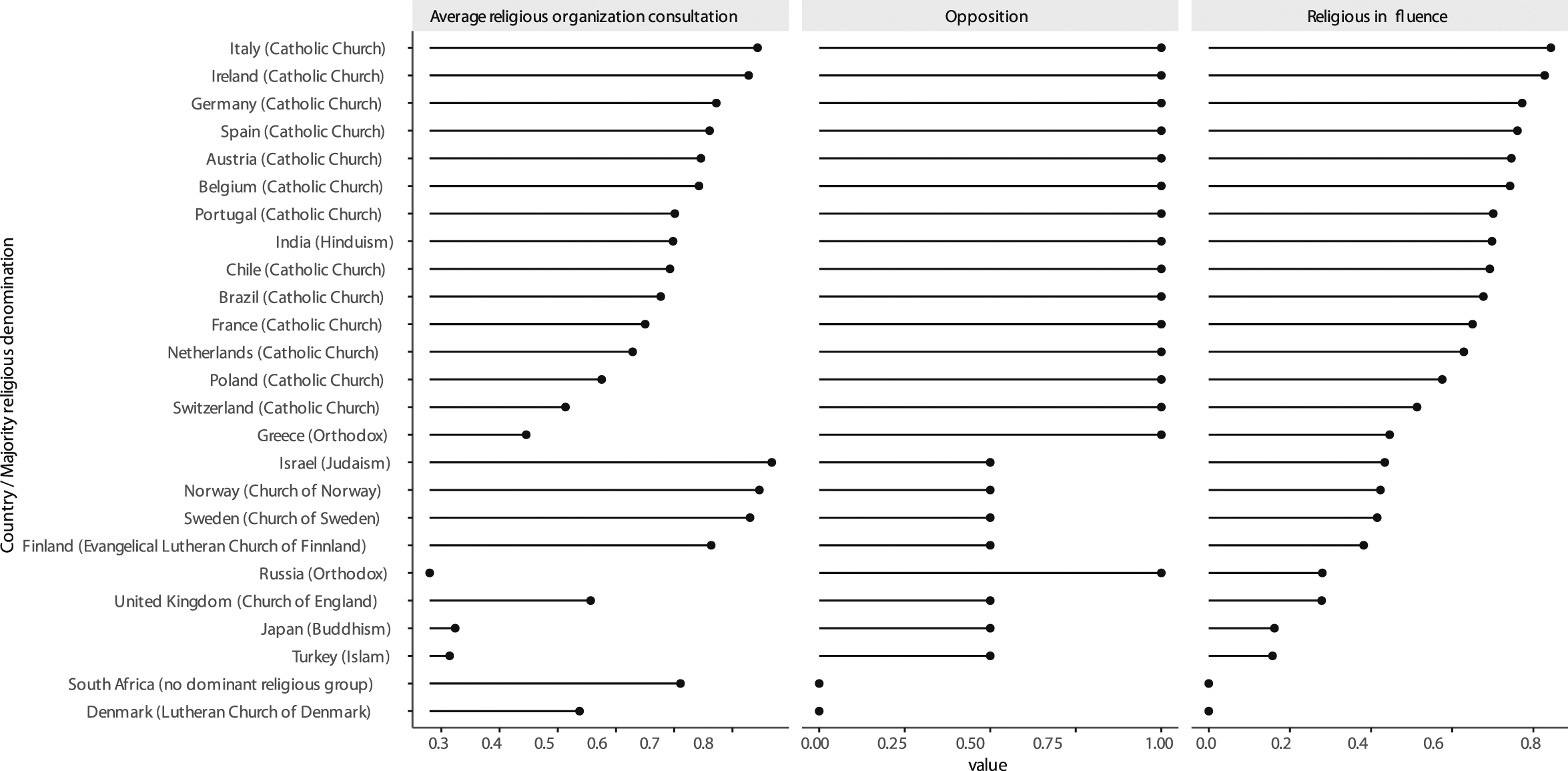
To gauge the institutional hurdles (veto players) for policy change in different national political systems, we draw upon the measure of institutional constraints provided by Henisz (2002). The indicator captures the “number of independent veto points over policy outcomes and the distribution of preferences of the actors that inhabit them” (Henisz, 2002, p. 380). The first aspect of this indicator simply captures the number of veto points derived from the constitutional setup in a given polity. The second aspect, in turn, captures whether the various actors possessing veto power have the same or different policy preferences from the government. Higher values represent systems with higher institutional constraints.
Finally, to assess the “state” of conflict about abortion in a country, we consider the level of our abortion permissiveness score rather than its changes.
Beyond these central theoretical variables, we also consider a range of additional variables that might simultaneously shape trends in liberalization and changes in abortion rules. GDP per capita is included as an indicator, based on the assumption that socio-economic progress often triggers shifts in societal values and secularization, which may affect the liberalization of moral policies (Boyle et al., 2015; Hildebrandt, 2015). Furthermore, the trajectory towards liberalization is often associated with broader political development, such as the move towards democratization and the strengthening of civil society, particularly in the area of women’s rights (Budde et al., 2018; Knill et al., 2020). These dimensions are quantified using the V-Dem dataset’s liberal democracy index, civil society participation index, and women’s political empowerment index (Coppedge et al., 2021). The civil society participation index reflects the extent to which civil society actors are engaged in policy-making, while the women’s political empowerment index measures various aspects of women’s political influence, including representation and civil liberties (Coppedge et al., 2021). In alternative analyses, we consider the proportion of parliamentary seats held by women as an additional metric. To account for religious influences on the attitudes toward abortion, we employ the World Values Survey data on the prominence of religion (god) in people’s lives (Inglehart et al., 2014).
Predicting Variation in the Liberalization-Rule Nexus
We explain the variation in the year-to-year changes in the abortion permissiveness score and the number of abortion rules using a Bayesian linear model that controls for unequal variances by country. Technically, our dependent variable is abortion rule changes. Our key independent variable is liberalization. Yet, it is important to note that we are not primarily trying to identify whether the causal arrow runs from liberalization to rule changes (or vice versa). Instead, we are interested in explaining the variation in the liberalization-rule-nexus. This implies that the government’s party ideology, religious organization consultation, veto players, and level of permissiveness are integrated into the model as moderating variables. Based on this, the exact model description can be specified as follows: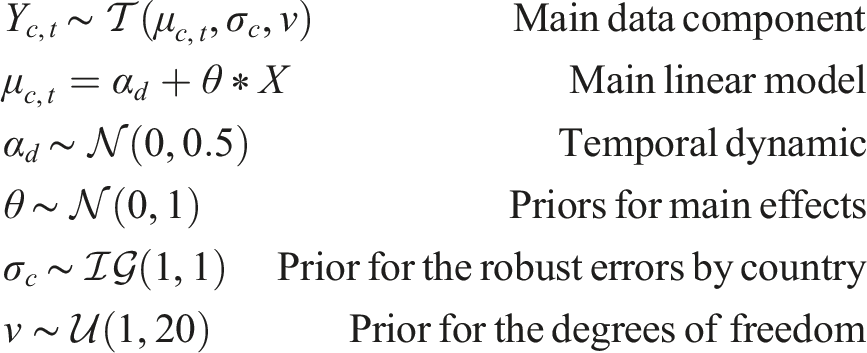
•
•
•
•
•
•
•
•
•
The first column in Figure 3 presents the results of the empirical analysis without any interaction. A first important insight is that liberalization is in fact the only variable included in our analysis that is associated with rule growth. No other variable in the model can account for rule growth. This aligns with our first expectation that liberalization-induced rule growth is to a certain extent the immediate result of functional reform pressures. Main results. Determinants of changes in abortion rules. Note. Highest posterior densities (HPD) of the main parameters of interest (β) (95% credible interval). All parameters are standardized to two standard deviations and can therefore be roughly interpreted as the effect of an increase in one interquartile range. See B.1 in the Online Appendix for tabular presentation.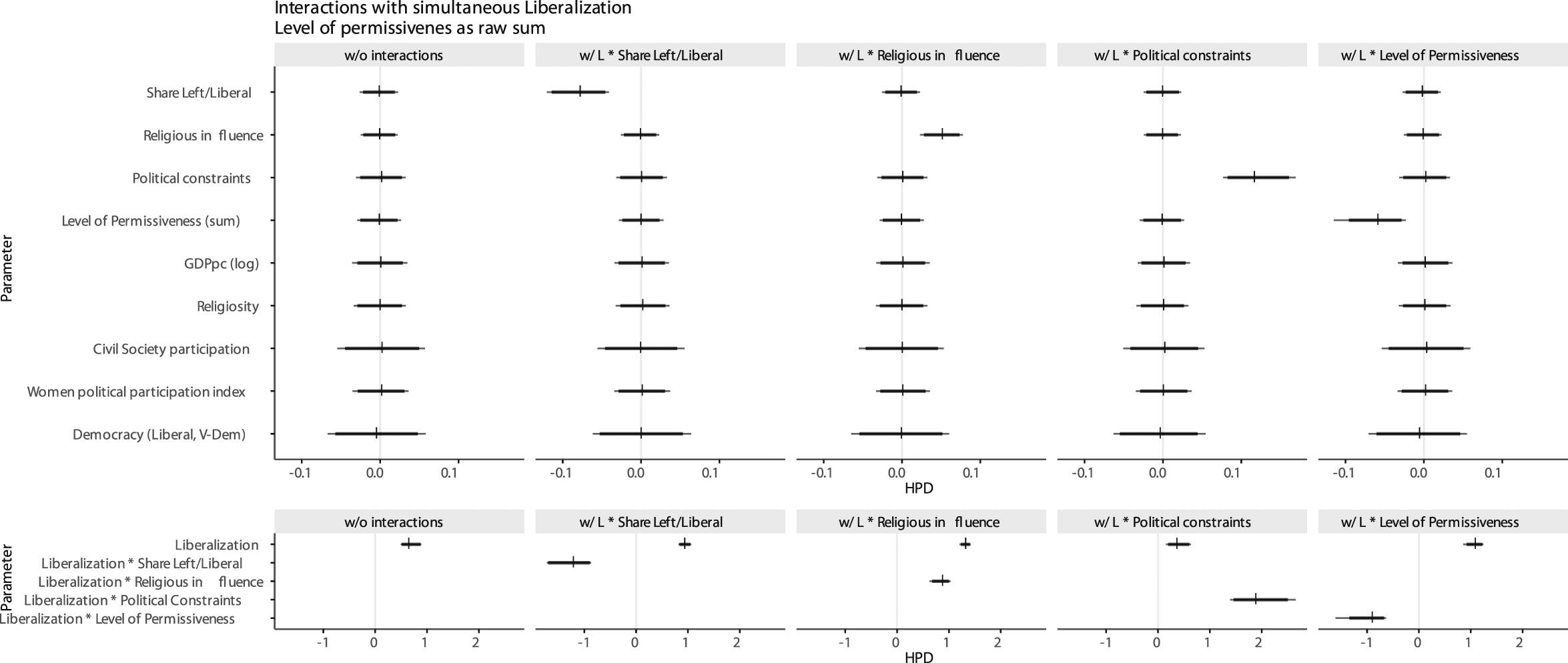
In the subsequent phase of our analysis, we introduce four distinct interaction terms. Each term combines our liberalization variable with one of the four theorized variables which we expect to influence the extent of liberalization-induced rule changes. The first interaction model (Figure 3, second column) reveals that liberalization comes with fewer rules when there is a higher proportion of liberal/left parties in government. This finding supports our second hypothesis (H2), which posits that the rule implications of liberalization reforms significantly depend on the political preferences of the liberalizing actor. In Section C.5 in the Online Appendix, we replicate the analysis by focusing on the share of confessional parties in government. In this case, we observe a significant opposite effect. Consistent with our theoretical framework, the stronger the presence of confessional parties in government, the more pronounced the rule growth becomes in the case of liberalization.
The second interaction model, shown in Figure 3, column 3, indicates that the extent of liberalization-induced rule growth is larger when there is a stronger influence of religious groups on the government. This finding corroborates our third hypothesis (H3), which proposes that governments, in seeking compromises with influential religious organizations, tend to accompany liberalization steps with supplementary rules. According to this interpretation, these rules are designed to define the scope of the newly permitted activities, balancing liberalization with the concerns of these religious groups.
The third interaction model (Figure 3, column 4) supports the expectation that increased rule growth primarily stems from governmental efforts to garner support for their reform initiatives. In line with hypothesis four (H4), this model reveals that a higher number of veto players (political constraints) is associated with more rule growth. This suggests that governments that are more dependent on the support of others during the liberalization process tend to introduce additional rules to secure the necessary backing for their reforms.
Finally, our analysis reveals that also the state of permissiveness (i.e., the degree of liberalization) influences the liberalization-rule-nexus. In the fourth interaction model (Figure 3, column 5), we observe that in contexts where permissiveness is already high, subsequent efforts towards further liberalization tend to be associated with a reduced rate of new rule creation compared to situations with lower levels of permissiveness. In other words, liberalization comes with fewer rules once the underlying conflict becomes more settled. This confirms our fifth hypothesis (H5).
As it is difficult to interpret interaction terms by strictly examining coefficients, we further unpack these relationships using marginal effect plots. Figure 4 illustrates how liberalization impacts rule growth at various levels of the other key independent variables. The upper-left graph in Figure 4 shows a negative slope, which suggests that there is an inverse relationship between the share of left/liberal parties in government and the expected rule growth. Specifically, the graph indicates that an increase in the share of left/liberal parties in government leads to a decrease in the rate at which new rules are created. Moving from a government with no left/liberal representation (the minimum) to a government fully composed of left/liberal parties (the maximum) corresponds to changing from four to (only) one additional rule. Average marginal effect of liberalization on rule growth conditional on key explanatory variables. Note. The gray areas define 95% credible intervals.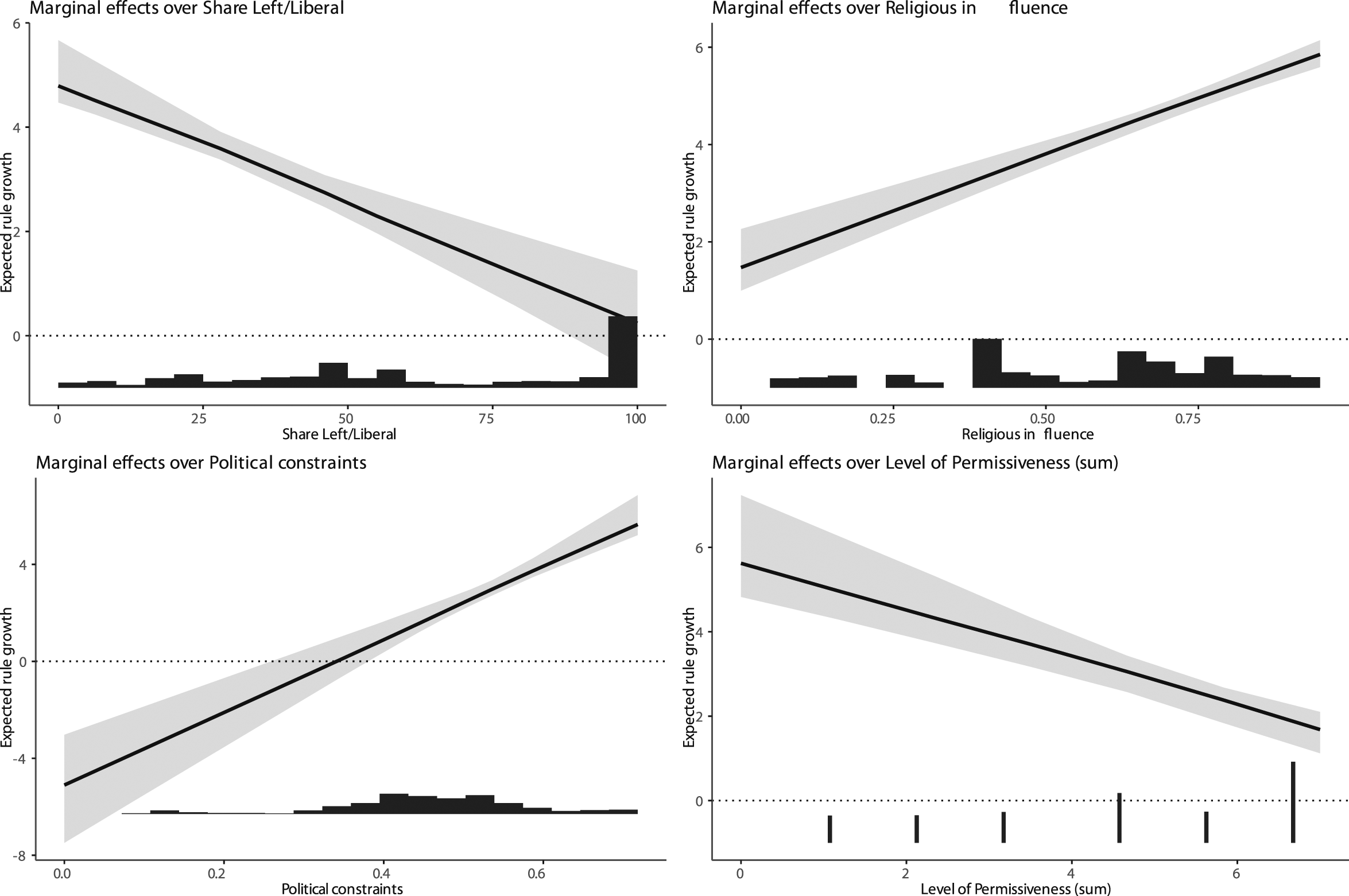
The upper-right graph in Figure 4 shows that rule growth jumps from about two to six when the level of religious influence moves from the lowest to the highest value. A similar trend is evident in the context of institutional constraints (lower left graph), tough with a significant difference: here, the “starting point” is negative. In environments characterized by few political constraints, liberalization can actually be accompanied by a decrease in the overall number of rules. Here, any liberalization “step” comes with a decrease of about four abortion rules. This aligns precisely with our assertion that rule growth is not solely a response to functional pressures but also results from the need to balance competing demands. Taken together, transitioning from the institutional arrangement with the lowest to the highest level of political constraints results in a difference of eight abortion rules.
The lower right graph in Figure 4 demonstrates a decreasing trend in expected rule growth in correlation with the resolution of underlying conflicts. Specifically, at the most restrictive level of abortion permissiveness, which entails a total prohibition of abortion, steps toward liberalization are generally associated with the introduction of approximately six additional rules. This number gradually decreases to around two additional rules at the most liberal end of the spectrum.
Refinements and Robustness
In the previous section, we found that the government’s party ideology, the relative influence of religious groups on the government, veto players and the level of permissiveness from which further liberalization begins make a difference for the liberalization-rule-nexus. However, one might argue that our empirical results depend on how exactly we operationalize our key variables, particularly the degree of liberalization reforms. Initially, we adopted a straightforward methodology, transforming the ordinal scale of abortion permissiveness into a continuous measure via simple additive aggregation. However, this approach may not accurately reflect the varying degrees of change between different categories. For instance, the transition from permitting abortion in the case of health threats to allowing it for eugenic indications might represent a more (or less) radical shift than the change from permitting abortion in cases of personal or social distress to a model of full pro-choice. To take account of these aspects, we revised our abortion permissiveness score via a partial credit model (PCM), also known as Polytomous Rasch model. The PCM approach enables us to generate a standard normal variable as an output from ordinal inputs, thereby circumventing the assumption of equidistant intervals between the categories of the indices. Put simply, the PCM evaluates how likely it is to achieve a certain level of abortion permissiveness. A level of abortion permissiveness that is reached by fewer countries is considered to represent a more substantial liberalization step than one that many countries have implemented. As shown in Section C.1 in the Online Appendix, this transformation of our key independent variable does not affect our results.
Second, a potential critique could be that liberalization events do not occur randomly but are instead influenced by various (unobserved) factors that may also impact our dependent variables and other explanatory variables, such as the dominance of religious groups. We employ propensity score matching to tackle this potential shortcoming of our analysis. This technique involves estimating the probability of a “treatment” (here: liberalization reforms) based on observable covariates and matching treated and control units with similar propensity scores. As shown in Section C.2 in the Online Appendix, our key findings persist even when accounting for such confounding factors.
Third, one might argue that both liberalization and rule change might be driven by (unobserved) modernization dynamics that affect the two variables simultaneously and that there accordingly is no link between them. To ascertain whether modernization dynamics drive the results—namely, changes in both our dependent and independent variables—we have conducted an additional analysis in the Online Appendix (Section C.6). We operationalize the concept of modernization as suggested by Stockemer and Sundström (2016), who measure modernization based on GDP per capita, the percentage of citizens employed in agriculture, industry, and the service sector, women’s participation in the labor force and population density. By combining different data sources by the World Bank and by Vanhanen (2003), we are able to replicate this modernization measure for our country sample and investigation period. Our findings persist even when controlling for this expanded measure of modernization.
Fourth, one might argue that religious organizations do not operate in a vacuum but actually compete for government influence with other groups and interests. It may hence not be appropriate to quantify the influence of religious groups in absolute terms. Instead, it might be more accurate to assess religious influence in relation to the strength and prominence of other groups in politics that are generally in favor of liberalizing abortion. Among these groups, female legislators can be expected to play a particularly significant role (Jenkins, 2012). Female legislators tend to give greater consideration to the demands of their female constituents and often collaborate closely with interest groups promoting women’s interests. 7 The core idea is that religious organizations should have a harder time influencing the government when important political positions are held by women rather than men. To implement this idea, we divide our (weighted) measure of religious organizations’ influence by the women’s political participation index from the V-Dem dataset. This ratio provides a good indication of the relative strength of anti-liberalization forces and pro-liberalization proponents. Again, as shown in Section C.3 in the Online Appendix, our results stay robust.
Last, it is intriguing to consider whether the effects we have observed apply uniformly across all rule types, or if there are differences between various categories of rules. By and large, the rules considered in our analysis can be subdivided into two larger groups: rules targeting those seeking an abortion (demand side) and those offering abortion services (supply side) (Medoff, 2010). One might expect that rules intended to factually restrict access to abortion primarily relate to the demand side, i.e., target women. This would imply that the identified effects especially for the influence of government ideology (H2) and religious interest groups (H3) should be stronger for demand-than for supply-side rules. In essence, rules 1 to 9 can be classified as demand-side regulation, while rules 10 to 18 target the supply side. Section C.4 in the Online Appendix shows that the effects observed are particularly present for rules addressing the demand side. Among the different factors considered, it is only the influence of religious groups that propels regulatory growth on both the demand and supply sides of abortion, yet the effect is stronger for demand-than for supply-side rules.
Conclusion
This article examined the contested relationship between liberalization and (de)regulation in the area of abortion policy, relying on data spanning 25 countries and 50 years. This data clearly suggests that liberalization is usually associated with rule growth, even though there is considerable variation in its extent and there is also a considerable number of instances in which liberalization coincided with rule reductions.
We explained these different associations by analyzing the political conflicts that characterize liberalization processes, focusing on their specific actor constellation, the institutional context in which they play out, and their “state”, i.e., whether countries move from prohibition to careful liberalization, or from an already more liberal paradigm to total permission. We found that the liberalization of abortion is likely to come with additional rules when the government managing the liberalization process is a reluctant liberalizer, when groups opposing liberalization exert a relatively strong influence, when political decision-making is characterized by high institutional constraints, and when the liberalization process is in its early stages (and the political conflict accordingly still intense).
We expect the generalizability of these findings to primarily depend on two aspects. For one, the extent of liberalization-induced rule growth should be influenced by the conflict intensity that characterizes liberalization processes. The stronger the conflict about liberalization, the more rule growth can be expected because rule additions are a means to forging a compromise over the extent and form of liberalization. This also implies that liberalization might coincide with smaller rule additions when it is largely uncontested. Moreover, it can be expected that liberalization leads to more rule growth when the liberalized issue requires the development of new rules (such as in the case of gun control) than when existing rules can simply be extended to new groups of individuals (such as when same-sex couples receive the right to marry and already existing marriage laws are extended to them). But even for these cases it needs to be empirically determined whether they indeed come with fewer rule growth, as rights extensions to “new” individuals might also come with restrictions. For instance, in some countries same-sex couples are allowed to marry but they are not allowed to adopt children.
Provided our findings can travel to other issues and areas, they have important implications for our understanding of liberalization and its implications in contemporary democracies. Our paper confirms existing research in that liberalization is indeed an important driver of increased government regulation (Adam et al., 2019; Benish & Levi-Faur, 2020; Fernández-i-Marín et al., 2024, 2024c; Gratton et al., 2021; Hinterleitner et al., 2024; Hurka et al., 2022; Jones et al., 2019; Kaufmann & van Witteloostuijn, 2018). At the same time, the paper goes beyond the existing literature by proposing a nuanced explanation for why this is the case. As the presented findings suggest, functionalist pressures seem to be important, but the extent of liberalization-induced rule growth depends on the shape and outcome of conflicts that characterize liberalization processes. If rule growth is indeed the price to pay for upholding the democratic capitalist order in modernizing societies, then the exact amount to pay is determined by politics.
Supplemental Material
Supplemental Material - More Liberty, More Rules? Abortion Policy and the Liberalization-Rule Nexus
Supplemental Material for More Liberty, More Rules? Abortion Policy and the Liberalization-Rule Nexus by Christoph Knill, Markus Hinterleitner, Xavier Fernández-i-Marín, and Yves Steinebach in Comparative Political Studies
Footnotes
Acknowledgments
The authors would like to express their gratitude to the participants of the IDHEAP-LAGAPE Research in Progress Seminar in Lausanne, the 2024 SPSA Annual Congress in St Gallen, and the 2024 Policy, Bureaucracy, and Organization (PBO) and the Quality of Governance (QoG) Workshop in Oslo. Special thanks are also due to Nicholas Charon and the three anonymous reviewers for their valuable advice and suggestions.
Declaration of Conflicting Interests
The author(s) declared no potential conflicts of interest with respect to the research, authorship, and/or publication of this article.
Funding
The author(s) disclosed receipt of the following financial support for the research, authorship, and/or publication of this article: This work was supported by ERC Advanced Grant 788941.
Data Availability Statement
Data and replication materials can be found at: https://doi.org/10.7910/DVN/UCYUBN. ( ).
).
Supplemental Material
Supplemental material for this article is available online.
Notes
Author Biographies
References
Supplementary Material
Please find the following supplemental material available below.
For Open Access articles published under a Creative Commons License, all supplemental material carries the same license as the article it is associated with.
For non-Open Access articles published, all supplemental material carries a non-exclusive license, and permission requests for re-use of supplemental material or any part of supplemental material shall be sent directly to the copyright owner as specified in the copyright notice associated with the article.
