




Abstract
Why do judges sometimes act against autocrats’ will, even without judicial independence and tenure security? Contrary to the theory of strategic defection under weak governments, we argue that this behavior can also emerge under strong governments with lax monitoring. When autocrats primarily monitor severe political cases, judges can strategically downplay case severity to avoid oversight, thereby increasing judicial autonomy and the rule of law. Yet, these adjustments will be carefully calibrated–sufficient to evade scrutiny but not too drastic to trigger autocrats’ suspicions and incur sanctions against judges. We test this expectation with new data on Taiwan’s military trials during authoritarian rule, finding that judges tend not to issue sentences above a review threshold after its introduction. Sentence reductions are mostly moderate, affecting cases where sentences can fall slightly above or below the threshold under judges’ discretion. These findings have implications for understanding state repression and judicial agency in nondemocracies.
“Judges do not hide the fact that their judgments are often serious compromises, in which they try to balance the political needs of the rulers against constitutional values...judges have learned how to read the signals and pick their battles.”
– Kathryn Hendley, Legal Dualism as a Framework for Analyzing the Role of Law under Authoritarianism (2022)
One of the most striking trends in modern authoritarianism is the frequent use of legal institutions to consolidate power. Across the globe, autocrats have routinely invoked legal procedures to legitimize their rule and suppress opposition. For example, in the wake of the 2019 mass pro-democracy protests in Hong Kong, the government leveraged courts to convict thousands of protesters under the charge of conspiring with foreign powers and subverting the state under the National Security Law. 1 Similarly, in Myanmar following the 2021 military coup, the military junta sent approximately 1700 activists to military tribunals, convicting them of treason and insurrection under the Counter-Terrorism Law. 2 While many assume that courts are unwelcome in dictatorships as they check executive power, their widespread use in nondemocracies deserves more scholarly attention and investigation (Moustafa, 2014; Shen-Bayh, 2022).
Research exploring the judicialization of repression in authoritarian regimes suggests that it helps foster an image of accountability and self-restraint by having courts, rather than rulers themselves, administer punishment (Pereira, 2005; Shriver and Adams, 2018). Courts also function as platforms for propaganda and political messaging to deter future threats (Shen-Bayh, 2018; Solomon, 1996) and as tools to monitor and discipline bureaucratic misbehavior (Ginsburg & Moustafa, 2008; Shapiro, 1981). For these functions to work, however, jurists must comply and not challenge the will of the rulers. Yet, even casual observations of judicial behavior in autocracies reveal examples of disobedience, such as judges occasionally expressing dissenting views, as seen during authoritarian Spain under General Franco, Peruvian justices refusing to legitimize President Fujimori’s self-organized coup, and the Hong Kong Court of Final Appeal enacting laws to protect detained dissidents and LGBTQ rights that the Chinese Communist Party disfavors. These behaviors seem contrary to the common belief that judges in authoritarian regimes typically conform to dictators’ rule due to the risk of repression. So why do judges sometimes act against the rulers’ interests, even in the absence of independence and amid job insecurity?
This research presents a new explanation for judicial behavior in autocracies. Building on rationalist judicial theories, we view authoritarian judges as strategic actors who navigate dual roles: as legalists, committed to upholding the rule of law and pursuing judicial independence, and as bureaucrats, concerned with their careers and job security (Baum, 1997; Helmke, 2002). Contrary to existing theories that suggest judges only challenge authoritarian rule and defend rights when the executive is weak (Helmke, 2005), we propose that judges may also resist when regime monitoring of courts is lax, even if the executive remains strong. This can happen when autocrats, influenced by domestic or international pressures, scale back their monitoring to concentrate only on severe political cases. In such scenarios, judges can strategically downplay case severity and issue lighter sentences to avoid scrutiny, thereby increasing their autonomy in legal rulings and avoiding pressure to impose excessively harsh penalties on dissidents. However, reductions in sentencing will be moderate–just enough to avoid oversight, but not so lenient as to attract suspicion and potential sanctions against their behavior. This cautious approach highlights judges’ efforts to balance their commitment to legal principles with the desire to safeguard their careers. The concept of strategic sentencing introduces a critical yet underexplored form of strategic defection, shedding new light on judicial behavior under dictatorships and sometimes even in democracies.
We test this argument using newly declassified data on military trials of political dissenters during Taiwan’s White Terror period (1949–1991). The data provide a comprehensive record of trial verdicts and represent by far the most extensive dataset on political prisoners from Taiwan’s authoritarian era. This era was marked by a highly repressive regime seeking to maintain control over its remaining territory after losing the civil war to Mao’s communist party, thus offering a useful context to study how regimes leverage repression to govern society. The declassified data offer a rare opportunity to examine how executive intervention shapes judicial outcomes at the individual level–a challenging task in many authoritarian contexts due to data limitations (Liu, 2022). This is especially valuable in the context of military tribunals, which typically occur behind closed doors under the name of national security, making it hard for researchers to trace marks of intervention by executive or military commanders. The detailed records of executive intervention in Taiwan’s military trials reveal how political sentencing is affected by the interplay between the autocrat and supervised judges. Taiwan’s experience can provide insights into other authoritarian regimes that conduct military trials under similar oversight structures. To the best of our knowledge, this is the first attempt to systemically explore how executive oversight shapes judicial outcomes in military tribunals, using statistical evidence.
We empirically test the notion that changes in oversight standards affect judges’ sentencing patterns. A simple approach to test this argument would involve comparing judicial outcomes before and after the standard change. However, this design would be problematic due to numerous factors that could occur and influence both the standard change and sentencing patterns over time. To address this issue, we employ a regression discontinuity design. It allows us to closely compare cases tried just before and just after the implementation of the new standard, within a narrow time window where case attributes are likely similar and other potential confounders are likely stable around the time cutoff. We find that following the relaxation of oversight standards in October 1956, which limited presidential reviews to only major crimes (defined as cases resulting in sentences over 15 years), judges were less likely to impose sentences exceeding the 15-year threshold. We also find that this reduction effect is more pronounced for mid-range offenses, where sentences could fall slightly above or below the 15-year threshold based on judges’ discretion, compared to major or minor offenses, where sentences clearly exceed or fall short of this threshold as regulated by laws. This supports our expectation that judges modify sentences just enough to avoid oversight, yet not too much to raise suspicions. Results hold consistently across various robustness checks and placebo tests.
Our findings contribute to several lines of literature on authoritarian judiciaries, state repression of dissent, and dictatorships. First, our work speaks to the burgeoning literature on authoritarian courts. While the literature debates whether judges check or serve dictators’ power when judges’ lives are threatened and jobs are insecure (Ginsburg & Moustafa, 2008; Helmke & Rosenbluth, 2009; Moustafa, 2014), our findings suggest that judicial decision-making is intricately influenced by both legal principles and career considerations. Unlike the mainstream theory arguing that judges only assert themselves when regimes weaken, we show that judges may strategically disobey when oversight is lax, even if the executive remains strong. This disobedience can range from overt challenges to subtle adjustments in legal rulings, underscoring the importance of understanding the diverse methods that judges can pursue to expand influence under authoritarian rule.
Second, this paper highlights the importance of investigating a broader set of judicial institutions in nondemocracies. Existing research has largely focused on high courts (e.g., supreme or constitutional courts) in high-stakes constitutional conflicts between judges and autocrats. However, there are fewer discussions on judicial behavior in special tribunals, such as military, religious, and administrative tribunals, despite their prevalence in authoritarian regimes (Ríos-Figueroa & Aguilar, 2018). These specialized tribunals often feature less formal procedures and weaker independence, which helps autocrats bypass regular judiciary systems and facilitate control. We direct research to consider judicial behavior in these special auxiliary courts and provide a theoretical framework to explain how judges within these tightly controlled environments strategically evade the autocrat’s monitor and expand the de facto judiciary independence.
Lastly, our work contributes to recent efforts in human rights and repression literature seeking to investigate principal-agent dynamics in state repression. While scholars have analyzed the roles of various agents (e.g., military, militias, and police) and the associated agency problems (Eck et al., 2021; Liu & Sullivan, 2021; Mitchell et al., 2014), courts have largely been sidelined in the discussion due to the underlying assumption that courts are independent institutions separate from the government. Our research shows that courts, particularly in regimes seeking to judicialize repression, can be integrated into the government and become a tool of repression. By exploring the ruler-judges relationship and studying how jurists balance political pressures with the rule of law, we provide new insights into why some dissidents experience more or less severe repression than others.
Rethinking Judicial-Executive Relations and Judicial Involvement in Repression
In discussing judicial involvement in state repression, two largely disconnected literatures are involved: the literature on state repression of human rights and the comparative judicial studies. In this section, we comb through these two bodies of literature and show existing theories that form the basis of our argument.
The Role of Judiciaries in the Repression Literature
One core question in the study of repression concerns the protection of citizens from state oppression. Answering this question inevitably requires researchers to understand how states violate human rights and who the perpetrators are exercising repression on behalf of the state. This endeavor has led to rich discussions on repression targets, methods, and agents (H.R. DeMeritt, 2016; Earl & Braithwaite, 2022). In particular, the recent “agency turn” in the literature starts exploring various state agents (i.e., the military, militias, and police) and associated agency problems, including mass killing and sexual violence against civilians (Mitchell et al., 2014; Cohen & Nordås, 2015; Carey et al., 2015). However, these discussions largely overlook judicial institutions and their involvement in repression, even though they are delegated to determine guilt and imprison dissidents, either following or disregarding executive orders. 3
The lack of attention to judges and courts to some extent stems from prevailing assumptions in the field. Scholars of repression often view courts as apolitical entities that check executive power based on constitutions (Hill & Jones, 2014; Hu & Conrad, 2020; Keith, 2012; Kitagawa & Bell, 2022; Powell & Staton, 2009). This view is primarily based on the American model of separation of powers, where courts are independent, judges enjoy secure tenure, and are professionally motivated to uphold the rule of law. While this model may help understand interactions between the judicial and executive branches in general, it becomes limited in explaining judicial-executive relations in countries with weak judicial independence and tenure protections for judges. In fact, such institutional protections are scarce in many parts of the world. Since the literature typically portrays courts as independent institutions acting as counterforces to state repression, it often neglects the pressure judges face in nondemocracies and conditions under which judges choose to comply with or defy autocrats.
Authoritarian Courts and Comparative Judicial Studies
By contrast, comparative studies on authoritarian courts have increasingly explored how dependent judiciaries enhance state power within unstable democracies or autocracies (Hou & Truex, 2022; Shen-Bayh, 2022; Wang, 2014). These studies often view autocratic courts as instruments of dictatorship, rather than independent institutions that check executive power (Ginsburg & Moustafa, 2008). Autocratic courts administer the rule of regimes when rulers control (re)appointments and promotions of judges (Hilbink, 2008; Pereira, 2005). Judicial decisions are further depreciated when the Supreme Court, controlled and appointed by the dictator, can overturn lower court decisions (e.g., in authoritarian Chile), or when special tribunals are established to bypass ordinary judicial processes (e.g., in authoritarian Argentina). While this line of research offers useful explanations for judicial behavior in nondemocracies, the focus has been largely on how authoritarian institutions control courts and incentivize judicial self-restraint. Less discussion is made on why courts sometimes go along with the executive but other times act against the ruler’s interests.
Recent developments in comparative judicial studies have started to tackle this question. One notable explanation for judicial disobedience to authoritarian rule is judicial ideology. It suggests that judges’ behavior is influenced by their training and socialization within the legal community. Such experiences shape their identities, leading judges to view themselves as protectors of constitutions, thereby acting more assertively against authoritarian rulers (Ellett, 2013; Hilbink, 2012). This ideational transformation may stem from domestic judicial reforms or norm diffusion from overseas (Hilbink, 2007). While this approach, by highlighting judges’ commitment to legal principles, provides useful insight into gradual ideological shifts in the judiciary, it cannot explain more drastic changes in judicial behavior and underplays the political structure within which judges and rulers interact that influences judicial decisions.
Of greater relevance to our research is the work on judges’ strategic defection under dictatorship. This literature transcends the purely legalistic view of judges, recognizing them as both legal professionals and political actors. Judges will seek to base their decisions on their sincere legal preferences; yet research shows that this typically occurs only under favorable conditions, especially in the context of dictatorships where judges do not have independence and jobs are not secured. Helmke (2002, 2005) pioneers in this rationalist approach, showing that institutionally insecure judges will only challenge regimes and defend rights when the government begins losing power. This provides valuable insight into the conditions dependent judges might check overreaching governments.
However, some important puzzles remain unanswered. If overt challenges against the regime are risky, what alternative avenues can judges leverage their legal authority and advocate for the rule of law through less overt means? Can judges resist demands of the ruling government in a manner that is subtle, or“covert,” thereby ensuring their personal safety and job security? We extend and refine previous arguments on strategic defection by judges in authoritarian regimes, showing that judicial disobedience is not solely a function of weakened executives. It can also arise when regimes’ monitoring of certain judicial actions is relaxed, even when the executive remains strong in office. These conditions allow judges to cautiously widen the scope of their independent decision-making and resist excessive punishment against dissidents, though in a tempered manner that avoids an outright confrontation with the state.
Judicial Strategy Under Institutional Constraints
Judges occupy a strategic position in the interpretation and application of laws in authoritarian regimes. As agents of the state, judges generally administer the will of the authoritarian leaders, but their compliance is neither unambiguous nor automatic (Moustafa, 2014). Authoritarian judges, like their democratic counterparts, pursue multiple goals (Baum, 1997). Judges, on the one hand, are legal professionals (Helmke, 2002; Hilbink, 2007). Their training molds their identities, motivating them to provide precise, coherent, and consistent legal interpretations. As a legal authority, they also strive for independent decision-making and minimal interference from other governmental branches (Vanberg, 2015). On the other hand, they are political actors concerned with securing their positions and advancing through the judicial hierarchy. Their desire for a steady job makes them averse to decisions that risk jeopardizing their career. The quest for job security is especially pronounced in authoritarian contexts, where judges often lack institutional protections. This dual nature of their motivations—balancing their sincere legal preference against the desire to avoid governmental sanctions—underpins our understanding of judicial behavior in autocratic environments (Helmke, 2005).
While the judicial agency is often constrained by authoritarian rule, judges are not merely passive recipients of external pressures but will actively seek to extend their influence (Ellett, 2013). In institutionally insecure environments, judges learn how to read the signals and pick their battles (Hendley, 2022). They may widen their jurisdiction over less politically sensitive issues to incrementally strengthen their authority without challenging regimes’ core interests. For instance, during Mubarak’s rule in Egypt, the Supreme Constitutional Court routinely deferred jurisdiction over politically charged cases to military courts which were under strict governmental oversight. Meanwhile, it cautiously sought to expand its review powers in non-political matters and pushed for the enhancement of socio-economic rights (Moustafa, 2003). Similarly, in Putin’s Russia during early 2000s, the Russian Constitutional Court consistently upheld Putin’s major reforms in areas such as federalism and taxation. Meanwhile, judges used Putin’s support to broaden their jurisdiction and promote human rights protection in low-profile cases and civil litigation (Trochev, 2008). These examples show how judges work to push the envelope of institutional constraints while keeping their jobs and personal safety. Yet, these instances of judicial activism often occur in settings where courts maintain at least a nominal institutional separation from the government, especially at the constitutional and supreme court levels. How would judges assert power in judicial institutions that lack basic separation of powers and nominal judicial autonomy? We argue that judges need to act more cautiously when their decisions are subject to executives’ direct oversight. They may strategically expand their judicial autonomy in areas where oversight is less stringent, especially in cases that do not pose serious threats to the government. However, such expansion is likely to be subtle, undertaken in a discreet manner to avoid negative consequences for their positions. We elaborate on this logic in the following section.
Executive’s Oversight in Trials and Strategic Sentencing by Judges
In autocracies, maintaining order and societal control is crucial for regime survival. Governments often resort to violence as a means to enforce authoritarian rule. The use of violence usually intensifies during periods of significant social upheavals, such as widespread unrest or civil wars, where severe violence and heavy-handed repression are used to suppress dissent and prevent the rise of rebellions (Davenport, 2007; Rozenas & Zhukov, 2019). Yet, autocrats also recognize that reliance solely on coercion is unsustainable and risks provoking long-term backlashes. To mitigate these risks, they frequently involve the judiciary in their rule, using legal procedures to legitimize their power and justify acts of violence. Meanwhile, they manipulate the justice system to ensure it enforces their directives and provides legal cover for their actions (Sajó, 2021). This tactic, commonly known as the judicialization of repression or judicial repression, allows regimes to maintain a facade of legality and order while stifling opposition through laws (Kitagawa & Bell, 2022; Shen-Bayh, 2022).
A common approach to manipulating the justice system is the creation of fragmented judicial systems (Moustafa, 2014). These systems feature one or more exceptional courts that operate parallel to ordinary courts, circumventing the standard legal procedures and institutional protections typically afforded to judges in regular judicial settings. These courts are usually established and justified under the name of national security or states of emergency and are common in many authoritarian regimes. Notable examples include Mubarak’s Egypt, Franco’s Spain, and the military dictatorships in Brazil, Chile, and Argentina during the 1970s–80s. These regimes relied on specialized or auxiliary courts—such as state security courts, military tribunals, and public order courts—to crack down on dissent. By sidestepping the procedural safeguards of the regular judiciary, these courts were able to administer swift “justice,” often leading to rapid convictions and, in many instances, executions (Moustafa, 2007). Moreover, these legal systems are typically integrated into the executive branch, enabling authoritarian leaders to control judicial outcomes by appointing loyalists to oversee trials or by directly intervening in trials, leveraging their authority as heads of state or military commanders.
However, for regimes that use judicial systems as a means to legitimize their repression, it is essential to grant these legal systems some degree of real autonomy. This semblance of autonomy is necessary to cultivate the perception that the regime is administering actual justice. Without at least some judicial autonomy, legal institutions will mask nothing and legitimize nothing (Moustafa, 2014). The push for greater judicial independence, either within these parallel systems or the broader judiciary, often arises from internal and external pressures. Domestically, regimes may offer some judicial autonomy in exchange for public support. Internationally, support from allies—especially western democracies—may hinge on commitments to improve judicial independence and the rule of law. In balancing the pressure for judicial autonomy and regimes’ need to maintain control, autocratic leaders typically allow some level of judicial autonomy and independent trials in cases posing minimal political threat, while closely monitoring cases that present significant threats to ensure regime stability and their hold on power (Ellett, 2019; Hendley, 2022).
Despite the overarching executive control over politically salient cases, relaxed oversight for less severe threats presents an opportunity for judges to interpret what constitutes a greater or lesser threat and adjudicate based on their sincere interpretations of the law. Given that it is difficult for leaders to assess a case’s severity beforehand, rulers often rely on some tangible indicators as criteria for review. In the judicial context, the length of imprisonment constitutes a convenient indicator of severity, with the assumption that more severe crimes warrant longer sentences. A review threshold based on the number of years sentenced (e.g., fifteen years in jail) therefore conveniently categorizes cases into major and minor threats. Since rulers rely on judges for case information without direct investigation, judges can exploit this by issuing milder sentences for cases that would otherwise ‘qualify’ for review. This strategic leniency reduces the frequency of reviews, thereby lessening executive interference and enhancing judicial autonomy. Additionally, fewer reviews and less executive interference give judges more freedom to make rulings based on their genuine interpretation of the law. This reduces the likelihood of them being pressured to impose undue harsh sentences or base convictions on insufficient evidence.
This dynamic mirrors classic moral hazards in principal-agent relationships, where agents choose to engage in behavior different from those they are explicitly ordered, primarily due to information asymmetry and misaligned preferences between the principal and the agents. Examples include law enforcement in the US manipulating crime statistics to present a more favorable performance picture (Eckhouse, 2022), and Chinese local officials adjusting GDP records when their evaluations hinge on economic indicators (Rawski, 2001). In our case, the asymmetric information (differences in knowledge about the true nature of cases between the ruler and judges) coupled with misaligned preferences (the ruler’s preference for intervention and harsh punishment vs. judges’ desire for judicial autonomy and the rule of law) drives judges to maneuver around the review criteria. While sanctions may discourage non-compliance to a degree, the inherent challenges in monitoring judicial activities allow judges to downplay the severity of cases they handle, thus evading oversight and expanding the space of independent decision-making. Based on this logic, we derive the following hypothesis:
H1 (sentence reduction): When the ruler only oversees dissent cases exceeding a certain imprisonment threshold, judges will strategically move cases from above to below the threshold by lowering years of imprisonment.
However, sentence reduction, if caught, remains a risky behavior and judges must tread very carefully in balancing the risks of sanctions and their preference for autonomy and legal rulings. Judges will make efforts to minimize governmental intervention by reducing sentences below the review threshold, but not to a point where the ruler becomes suspicious and feels the need to increase scrutiny and exercise sanctions against them. Judges must ensure that any sentence modifications are justifiable if questioned. Cases that are severe and clearly above the review threshold, particularly those with indisputable evidence of subversion warranting death penalties, will not be candidates for sentence reductions, due to the difficulty in justifying such adjustments. Giving overly lenient sentences for high-profile dissidents can also be easily noticed when main dissent figures keep getting away from severe penalties. Cases of minor offenses, such as failing to report subversive activities, will not be adjusted either, as they fall well below the review threshold and are already under judges’ realm of independent decision-making. Strategic sentence reduction should only affect cases with mid-range severity where punishment can fall either above or below the review threshold based on judges’ discretion. By moving cases that would have been sentenced just above the review bar to slightly below the bar, judges can reduce oversight and executive interference while preventing suspicion and risking their careers. This balanced approach not only creates space for more independence and legal rulings but also ensures the adjustments are minor enough to be either unnoticed or, if asked, remain defensible without significant risk of repercussions. Accordingly, we posit the following hypothesis:
H2 (targeted sentence reduction): When the ruler only oversees dissent cases exceeding a certain imprisonment threshold, judges will strategically lower the imprisonment terms for mid-range offenses where sentences could fall near the threshold, but not for major or minor offenses where sentences are far from the threshold.
Empirical Context: Judicial Involvement in Repression During Taiwan’s Authoritarian Period (1949–1991)
The period under investigation was extremely repressive in Taiwanese history. Historians commonly mentioned it as “Taiwan’s White Terror,” when Taiwan was ruled under a single-party regime of the Nationalist Party (or the Kuomintang, KMT). Chiang Kai-shek, the leader of KMT, was defeated by Mao’s communist party and retreated to Taiwan in December 1949. In the same year, Chiang announced the Martial Law Act, aiming to immediately control the island and avoid infiltration by mainland communists.
Underground Dissent Movements
Underground communist movements formed the primary dissent activities against Chiang’s regime in Taiwan. After 1945 when the civil war between KMT and Mao’s communist party escalated, mainland communists sent delegates to Taiwan to mobilize supporters. The iconic organization, the Taiwan Operation Committee (臺灣省工作委員會), was then created by Chinese communists who smuggled into Taiwan, seeking to grow local organizations and expand membership. At the time, Taiwan had just returned to China after decades of Japanese colonization. Yet, Taiwanese dissatisfaction with the corrupt KMT rule and economic hardships fueled the sentiment to support communism and opposition to Chiang. Official documents show that over 250 branches with more than 2000 members were established island-wide by 1949 (Lin, 2009). Despite initial growth, heavy-handed repression largely dismantled these movements by the 1960s. Oppositions afterward were mostly sporadic dissent movements seeking independence and democratization, which were also suppressed under the name of national security until the Betrayers Punishment Act was formally abolished in 1991. Figure A.9 in the Appendix shows a gradual decline in dissent cases over time, particularly during the 1960s.
The Involvement of Military Tribunals in Repression
The implementation of martial law authorized the government to subject political dissidents, both civilians and military personnel, to military trials during wartime or states of emergency. These trials were designed to swiftly adjudicate offenses related to national security, facilitating rapid prosecution in an effort to control society and deter crimes. The authority granted to the military commander, specifically President Chiang, to review verdicts and modify court-martial sentences underlines the hierarchical nature of military commands. It ensures that the highest authority can correct any sentences deemed inappropriate, reinforcing the central role of military discipline and authority in maintaining order during martial law (Huang, 2015; Su, 2012). Notably, Chiang directly mandated penalty increases in 72% among all cases he reviewed, with over 38% resulting in death sentences. It shows Chiang’s direct influence on judicial outcomes and his tendency towards heavy-handed punishments (Shen, 2021; Transitional Justice Commission, 2022). 4
Military judges presiding over military trials were required to possess a legal education and relevant judicial experience, as per the Military Judges Appointment Standards (軍法官任用標準). These standards, established in 1930, stipulate that a candidate must either hold a legal professional degree or have substantial experience adjudicating cases in either civilian or military courts to qualify for the position. Regarding the legal bases for prosecution, military judges were empowered to levy charges under specific statutes, such as Article 100 of the Criminal Law (刑法100條), the Betrayers Punishment Act (懲治叛亂條例), and the Espionage Punishment Act (戡亂時期檢肅匪諜條例). These laws were designed to address and counteract subversion and espionage, ensuring that military tribunals can effectively prosecute offenses threatening national security.
Military Trial Reform in 1956
Since retreating to Taiwan, Chiang faced increasing pressure for legal reforms to strengthen the rule of law. Reformists within the regime expressed concerns that the extensive jurisdiction of military courts undermined the legitimacy of the ‘Free China’ represented in Taiwan in their fight against the ‘Communist China’ in the mainland (Lin, 2021; Lin & Tseng, 2021). They also feared that severe military sentences handed down to civilians could provoke societal backlash and fuel more dissent, thus advocating for a reduction in the military court jurisdiction.
More importantly, the Korean War (1950–1953) altered U.S. foreign policy in Asia and its attitude towards the regime in Taiwan. President Truman’s aim to prevent the Korean conflict from spreading south led to the US policy of protecting Taiwan, including providing substantial economic and military aid to bolster Taiwan’s defenses and stimulate economic growth. This massive aid, roughly $1.4 billion over the period 1951–1965, 5 came with expectations and pressures for Chiang to overhaul its political, economic, and military institutions to address the issues of corruption that had plagued the KMT on the mainland and contributed to its civil war failures (Wang, 2015). The U.S. Military Assistance Advisory Group (MAAG) also pushed for reforms in the military sector, including increased judicial independence of military justices and institutionalization of court-martial processes (Wang, 2015).
Under these domestic and international pressures, Chiang initiated a reform in military trials, leading to the enactment of the Military Trial Law (軍事審判法) in 1956, similar to the US Uniform Code of Military Justice (UCMJ). This legislation focused on procedural reform rather than substantive changes, meaning that substantive laws under which defendants were charged, such as the Criminal Law, the Betrayers Punishment Act, and the Espionage Punishment Act, remained unchanged. The law formalized the military tribunals originally set up during the civil war against regional warlords in mainland China (1926–28) and later expanded in the war against Japan (1937–45). It also introduced some procedural protections for defendants, such as arrest procedures, rights to appeal, and rights to legal representation. More importantly, the law institutionalized the President’s role in the judicial process, outlining the procedures and boundaries of executive intervention. It confirmed that the commander-in-chief, namely the President, had the authority to review trial verdicts before case finalization and announcement. The review process mandated that severe political cases tried at the first instance court be sent to a second instance court for the President’s review and approval. While cases involving military personnel were considered severe threats to the regime and hence remained tightly controlled by the President, civilian cases only required presidential review if the sentence exceeded 15 years, permitting judges to independently adjudicate minor cases with sentences below 15 years without further review. 6
Empirical Strategy: Data, Measurements, and Research Design
Data
We utilize newly declassified archives and data collected by the Taiwanese Transitional Justice Commission (TJC). The dataset documents the legal proceedings of over ten thousand victims tried by military courts under authoritarian rule from 1949 to 1991. Compiled following transitional justice initiatives since democratization in the 1990s, it includes comprehensive records from judicial branches and various non-governmental organizations, making it the most extensive dataset on political prisoners from Taiwan’s authoritarian era. The dataset counts a victim who is charged in one case as one observation, totaling 13,683 observations. 7 The dataset includes details such as names and positions of judges and officials involved in trials, crime descriptions, court verdicts, and dissidents’ demographic information. Importantly, it allows us to explore the conditions under which the president reviewed and potentially overruled judges’ decisions.
It is worth noting that undocumented extra-judicial means of repression were uncommon in Taiwan. As existing literature has indicated, human rights violations in Taiwan were mostly ‘administrative atrocities’ conducted by the state through military tribunals with clear rules and records (Wu, 2005). Intra-judicial repression was prioritized because Chiang Kai-Shek’s regime enjoyed strong control over the executive and judiciaries (especially military courts) under the decree of martial law. He didn’t need to bypass courts to execute repression, which echoes the findings that judicial repression is more prevalent in regimes with strong military-judiciary collaboration (Pereira, 2005). Martial law allowed Chiang to vastly expand the jurisdiction of military courts, extending it to civilians accused of treason and subverting the state, acts that were broadly defined at the time. Although extra-judicial repression beyond the official record may still exist, it likely represents a fairly small fraction of political victims in Taiwan.
Design
Our theory suggests a shift in sentencing patterns following the 1956 reform. However, simply comparing sentencing changes before and after 1956 across the entire sample could be problematic, as the nature of dissident cases and the socio-political-economic environments likely varied over time. For instance, the regime may have tightened its control over society, and underground dissent could have become less threatening. These evolving factors could complicate our analysis.
We address this challenge by employing a regression discontinuity design (RDD). This design allows us to closely compare cases tried just before and just after the reform within a narrow time window where case characteristics and other potential confounders remain stable around the cutoff. By focusing on estimating the local average treatment effect (LATE), RDD targets the immediate impact of the reform, thereby isolating it from confounding effects of broader or more gradual trends over time. This approach helps ensure our estimates are not influenced by general shifts in sentencing severity unrelated to the reform.
As has been well established in the literature, RDD leverages as-good-as-random variation in treatment and continuity in potential outcomes around the cutoff (e.g. Calonico et al., 2014; de la Cuesta & Imai, 2016). The design assumes that near the cutoff, dissidents and judges cannot sort themselves based on the impending reform, ensuring that any significant differences between cases before and after the reform are solely attributable to their treatment status. Given that the precise timing of the reform’s enactment was unanticipated by the public, dissidents’ actions were orthogonal to the judicial reform. Furthermore, although judges might foresee the reform coming, Chiang and the ruling elites were aware of the possibility that judges may manipulate the timing of when they try cases and therefore formally forbade judges to delay any trials. 8 Based on these regulations, we believe the model assumptions are reasonably held.
To further validate the no-endogenous-sorting assumptions empirically, we examine whether dissidents or judges intentionally delay dissent or trials relative to the time cutoff. Specifically, we investigate if there are any significant shifts in case volumes immediately before or after the cutoff. Appendix Figure A.1 plots the monthly frequency of all civilian cases around the October 1st, 1956 cutoff. It shows a stable overall case distribution with no significant changes. The distribution remains consistent even after we break down cases by crime types–major, medium, or minor–categorized according to legal statutes applied by courts, further confirming the no-sorting assumption. We also conduct the density test introduced by McCrary (2008) to test the assumption of no sorting. The estimate is 0.31 with a p-value of 0.75, suggesting no apparent discontinuity in the number of observations around the cutoff. 9
Furthermore, for the treatment status–being tried before or after the reform–to be considered as-if random, there should be no discontinuities in the distribution of covariates across the cutoff. To verify this, Appendix Table A.2 provides RDD estimates for various covariates among civilian dissidents. These covariates include offense-related characteristics, such as the number of codefendants, charges of subversion, leaking military intelligence, or possession of weapons as documented by court descriptions, and offense categorizations based on legal statutes applied by courts. Dissidents’ demographic details, including gender, age, and origin, are also considered. 10 We observe no significant imbalances between the pre and post-reform groups. The covariate balance test confirms that cases on either side of the cutoff are largely similar, thus offering additional confidence in our design.
Dependent Variable
We use trial decisions from the court of first instance in military trials, an appropriate measure since the review requirement is based on decisions at this stage. The scope of sentencing ranges from no penalty to death. Given that we predict a sentence reduction below the review threshold of 15 years after 1956, we create a binary variable, sentence severity, with a value of 1 indicating sentences greater or equal to 15 years (including life and death sentences), and zero otherwise. We only focus on sentences for civilian defendants because the cases involving military personnel were considered major threats and under strict oversight. Among all cases, 72% of defendants were civilians.
The Running Variable and the Treatment
In RDD, the running variable is a continuous variable assigning units to treatment based on a time cutoff. Units occurring after the cutoff are placed into the treatment group, while those occurring before are not. Specifically, our running variable, trial date, is the date of the first instance trial for each defendant. The time cutoff is October 1st, 1956 when the reform took place. The treatment condition is an individual being sentenced in the first instance court after the cutoff. That is, the treatment condition, post reform, gets 1 if the trial date of an individual occurred after the cutoff, and zero otherwise.
Covariates
We include several potential confounders. We include the number of codefendants, as cases involving more dissidents often result in harsher charges. We also code whether the dissidents were charged with committing subversion, leaking military intelligence, or having weapons based on crime descriptions. Specifically, committing subversion refers to substantial involvement in treasonous activities; leaking military intelligence pertains to providing sensitive military information to communists that could facilitate invasions; and possession of weapons covers the use, acquisition, sale, or delivery of firearms or ammunition. These charges are severe and often lead to death penalties.
Additionally, for dissidents’ demographics, we control for gender and age. Given the potential influence of ethnicity on sentencing, we include a dummy variable to distinguish between Taiwanese, Islander, and mainland Chinese who moved to Taiwan after 1949. Furthermore, judges’ decisions may be affected by the President’s responses to previously submitted cases. When the President repeatedly disapproved cases, it indicated the President’s dissatisfaction with sentences, potentially influencing judges’ subsequent decisions. To account for this, we create an indicator for the proportion of cases returned to judges due to Presidential dissatisfaction in his review in the previous year (t − 1). Variable descriptive statistics are documented in Table A.1.
Results
Graphical Evidence
We begin by graphically assessing the effect of the oversight reform. Figure 1 displays the probabilities of receiving sentences of more than fifteen years for civilian dissidents around the cutoff date. Linear regressions are fitted separately on both sides of the cutoff. A pronounced discontinuity is evident between sentences issued immediately before and after the reform’s implementation, demonstrating the impact of the reform. The 1956 reform and the severity of sentences.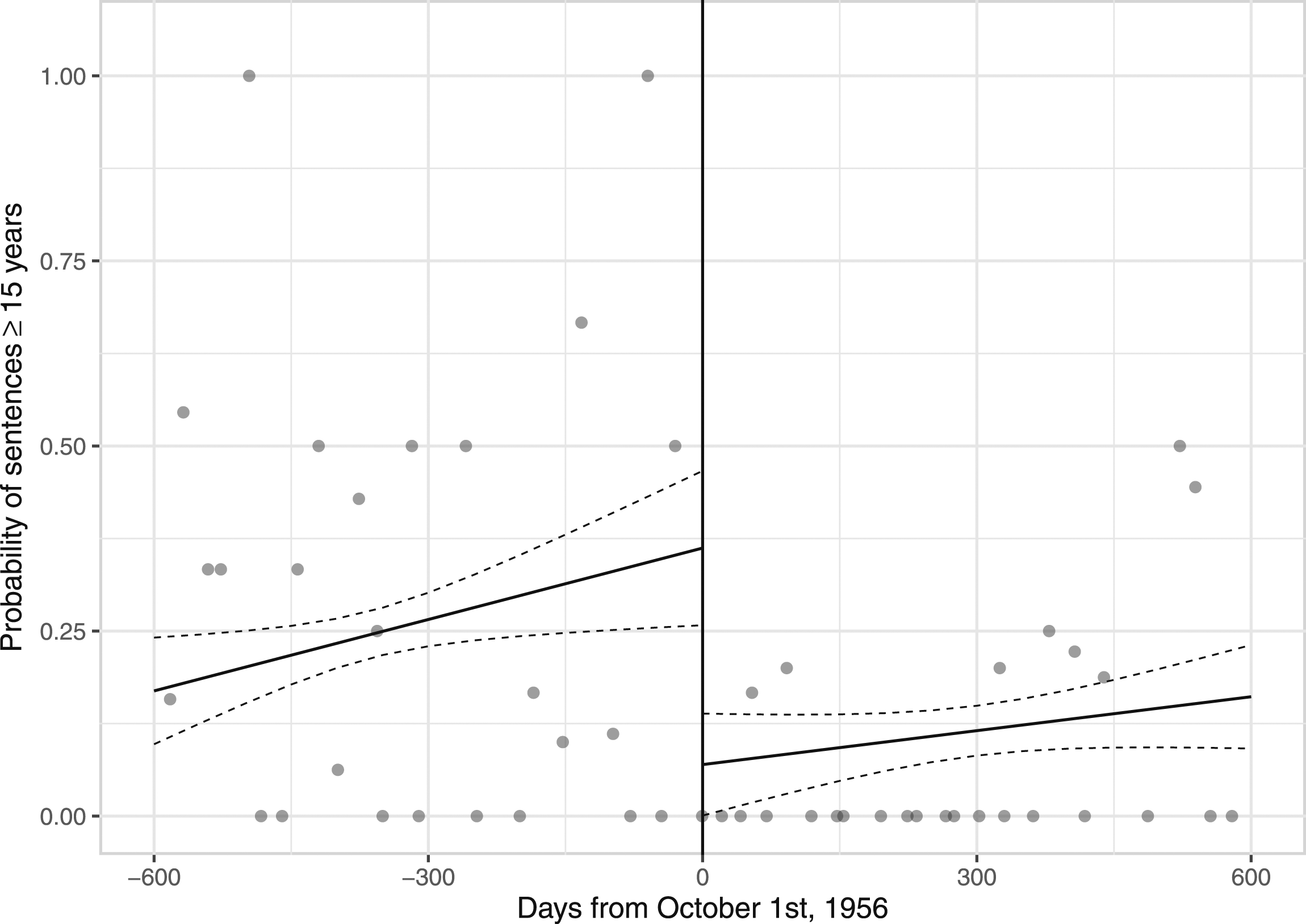
Local Regression Results
To formally interrogate the preliminary inferences suggested by the plot, we next present RDD estimates by the following regression formula in equation (1):
11


Figure 2 presents our estimates of the local average treatment effect using various polynomial fits and weighting methods. First, we employ different polynomial orders in the regression (linear and quadratic). This approach enables the model to capture more complex relationships between the running variable and the outcome, which is particularly useful when the true relationship is not linear or smoothly varying.
12
Second, we apply different kernel weighting methods to give more weight to observations near the cutoff under the notion that RDD estimates are most robust when based on data points close to this cutoff. The results are highly consistent across different combinations of polynomials and kernel weights: civilian defendants convicted after the reform were significantly less likely to receive sentences above fifteen years, compared to those convicted prior to the reform. The effect is both statistically significant and substantively meaningful, reflecting an approximate 25%–30% decrease in the probability of receiving a sentence above the 15-year threshold. The 1956 reform and the severity of sentences.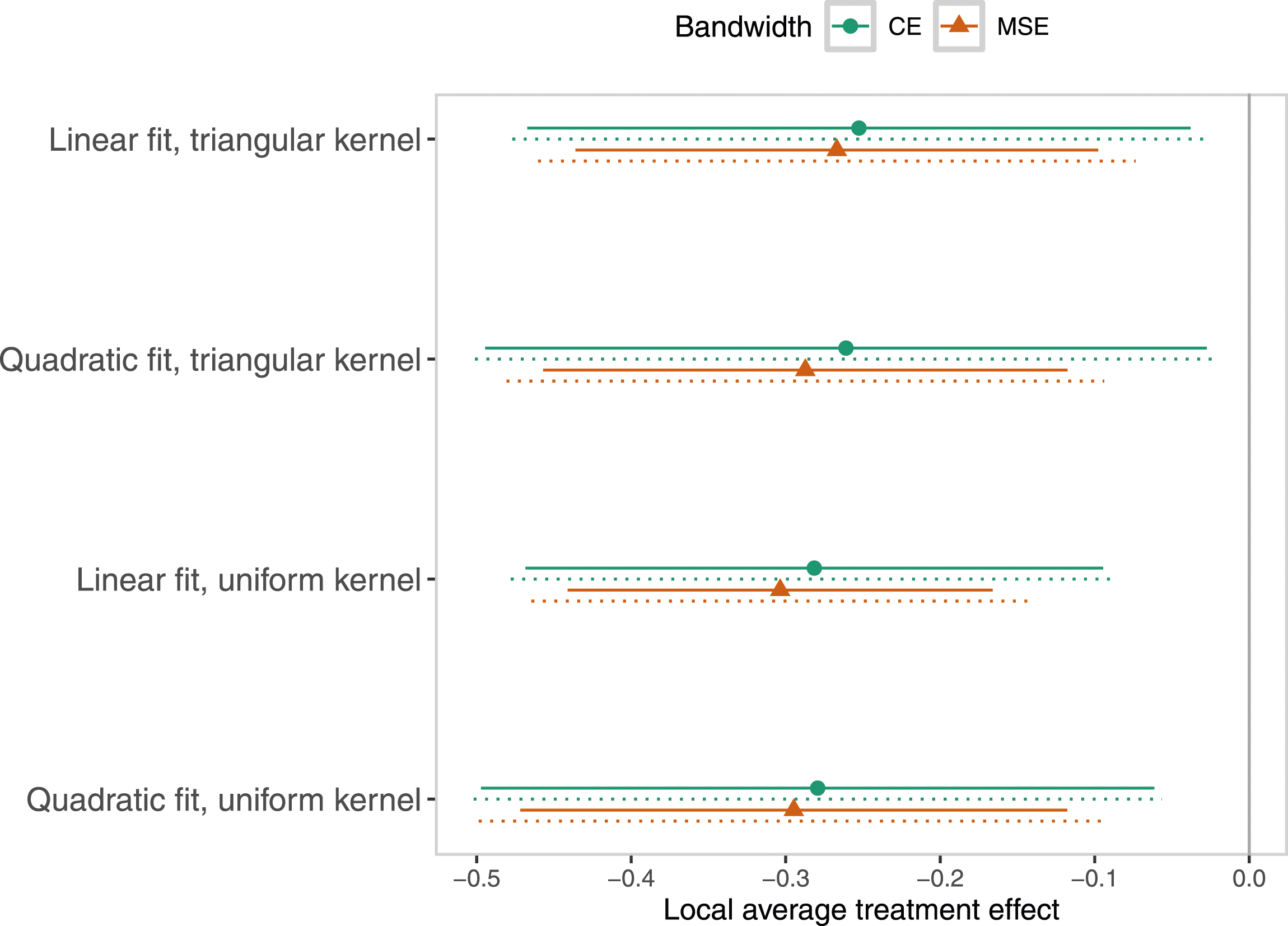
With regard to the choice of optimal bandwidths, we use a data-driven approach recommended by Cattaneo et al. (2019). We employ two types of recommended bandwidths: MSE-optimal bandwidths, which minimize the mean-squared errors (MSE) by balancing bias and variance, thus reducing overall estimation error, and CE-optimal bandwidths, which minimize coverage errors (CE), ensuring that confidence intervals reliably cover the true treatment effect and generally select the narrowest bandwidths for estimations (Calonico et al., 2020). Additionally, we utilize bias-corrected and robust confidence intervals as outlined by Calonico et al. (2014). Again, results in Figure 2 display consistent effects across different bandwidth choices and confidence interval calculations. 13
We then test our second hypothesis on targeted reduction. We expect that after introducing the review threshold, judges will focus on reducing sentences for middle-range offenses where punishment could fall somewhat above or below the 15-year mark, but not for major or minor offenses where sentences are far from the threshold as regulated by law. To test this hypothesis, we need to classify cases into different levels of offenses. However, using sentence decisions for classification could introduce post-treatment bias. Instead, we use the substantive nature of crimes to break down cases into three categories: Major offenses refer to severe crimes that should be punished very harshly under the law. They typically involve actual execution to overthrow the government and, as stipulated by the Betrayers Punishment Act, Article 2.1, are mandatorily sentenced to death. Medium offenses encompass crimes that are neither extremely severe nor trivial in nature. They typically include acts such as participating, organizing, or attempting subversion without actual execution, regulated under Article 2.3, Article 4.1, and Article 5 of the same Act. Sentences for these offenses can range from 10 years to life or death as regulated by law, aligning with our goal of classification for mid-range punishments that could exceed or fall below the 15-year mark. Minor offenses are less significant acts and usually result in lenient punishment. Common examples include failing to report subversive activities, with penalties not exceeding 7 years as outlined in Article 9 of the Espionage Punishment Act. 14
Given that minor offenses are sentenced below 7 years, using a binary outcome variable to indicate whether a sentence falls above or below 15 years will offer no variation. Thus, we created another dependent variable by converting sentences into a continuous outcome representing the sentence length in months to facilitate comparison across three categories. We follow the literature by converting a life sentence to 264 months and a death sentence to 360 months (Hou & Truex, 2022).
The same formula is used to fit the local regressions and estimate LATE as specified in equation (1). The results are presented in Figure 3. The left panel, with a binary outcome, shows that the reform effect is statistically significant only for mid-range but not for major offenses. The effect size in mid-range offenses is more than doubled (from 0.253 to 0.637) in the likelihood compared to estimates using the full sample in Figure 2. It suggests the effect is primarily driven by the reduction in mid-range offenses. The right panel, with a continuous outcome, shows a similar pattern. The effect is most salient in the mid-range and shows a roughly 150-month reduction in sentences, while changes in major and minor crimes are not significant. These results hold across different bandwidths and confidence interval specifications, supporting our expectation of sentence reduction targeting mid-range crimes. The 1956 reform and the severity of sentences across different types of offenses.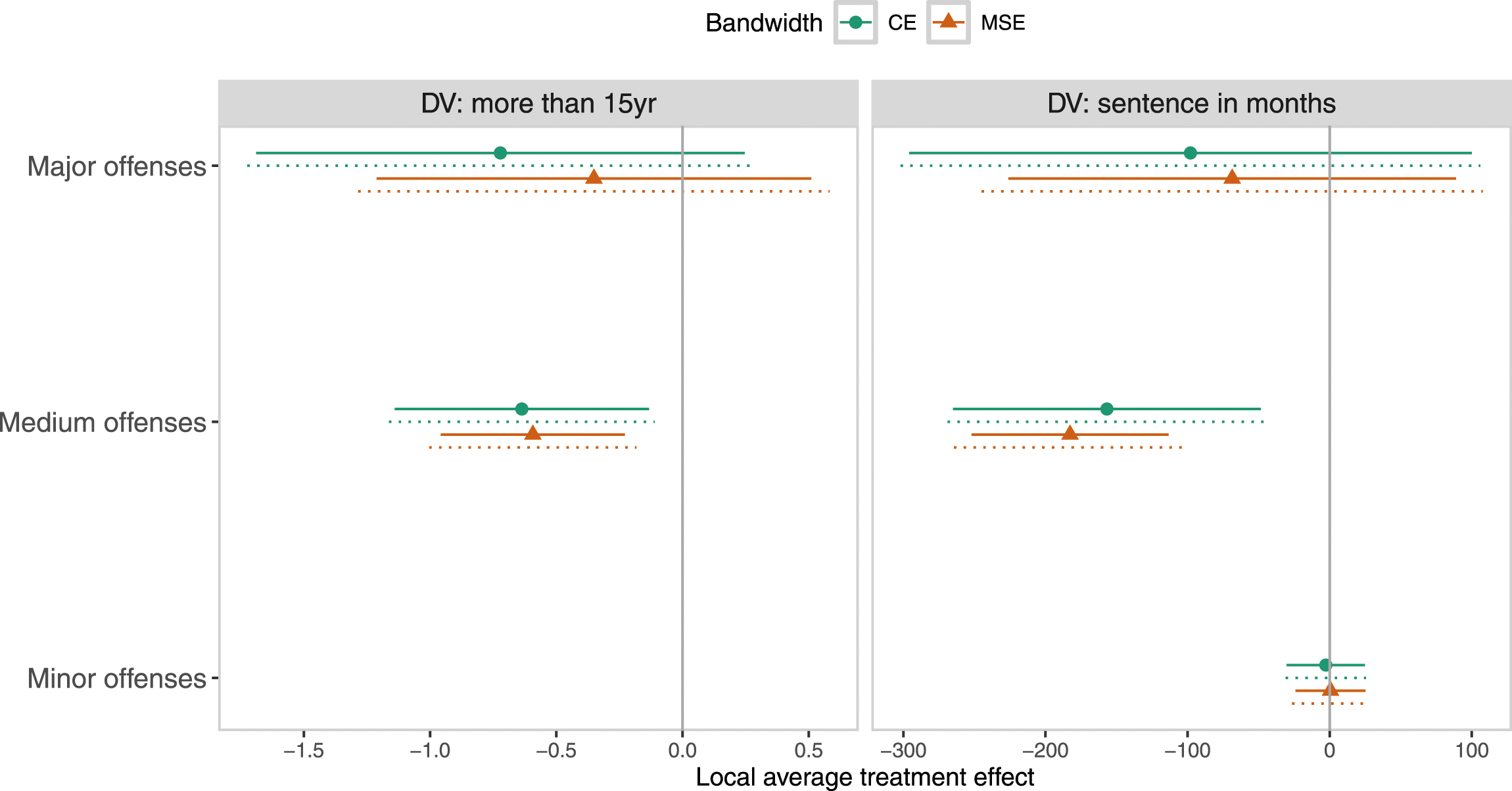
Robustness and Placebo Tests
To demonstrate the robustness of our findings, we conducted a series of robustness analyses recommended for RDD using time as the running variable (Hausman & Rapson, 2018). They include plotting data to identify discontinuities at the cutoff, testing the effects of different polynomials and bandwidths, checking covariate balance, conducting a donut RDD to mitigate concerns about short-run sorting and anticipation, a placebo test with fake cutoffs to inspect alternative treatment times, and accounting for temporal autoregression in the outcome. We have visualized discontinuities in Figure 1, evaluated the robustness of polynomials and bandwidths in Figures 2 and 3, and confirmed covariate continuity in Table A.2. We further conducted a donut-hole RDD by excluding observations within one or three months of the cutoff in Table A.8, showing that our results are not driven by short-term sorting or anticipation of the reform. Furthermore, we checked our results across different time windows, from 200 to 2500 days around the cutoff in Figure A.3, showing that the observed effects are not influenced by bandwidth choices. Additionally, placebo tests using fake cutoffs between 1950 and 1963, shown in Figure A.4, revealed no significant negative effects except at the actual cutoff. To address potential temporal dependence, we incorporated a monthly-lagged dependent variable in Table A.9, and the results remained consistent. Finally, by including judges fixed effects in Table A.10, we further validated that our findings persist when judge-specific characteristics are accounted for. 15
While these analyses bolster our confidence in the findings, concerns may still arise about unobservable changes that could have occurred in 1956, potentially explaining variations in the outcome. We acknowledge these challenges in inference but address them through additional placebo tests as suggested in the literature. We conducted a placebo test focusing on military cases involving high-ranking military officers such as generals, who under new regulations were perceived as major threats to the regime and remained strictly supervised, requiring review regardless of judicial decisions. 16 If our argument is true–the review threshold only impacts judicial outcomes in civilian cases where the threshold is applied– then no changes should be observed in military cases, as they were not subject to the review threshold treatment. We therefore performed a separate RDD analysis on military cases involving generals. Indeed, the result in Table A.11 revealed no significant sentence reduction below the threshold post-1956, suggesting that our findings are more likely driven by the review standard targeting civilian cases and less likely by other potential changes such as directives to judges, career incentive changes for judges, case composition changes, or other trial procedural changes post-1956 as they cannot explain the heterogeneous effect between groups.
We also expanded this placebo test into a difference-in-differences (DiD) analysis. The DiD framework tackles the endogeneity issue (especially the omitted variable bias) by comparing changes in outcomes before and after the intervention for the treatment and control groups. The first difference provides a before-and-after comparison within the units, thus removing unit-specific fixed effects. The second difference cancels out time-based unobserved effects on the outcome by comparing differences between the treated and control groups. This two-way comparison helps neutralize the effect of potential omitted variables that are either constant over time or consistent across groups but may vary between them in different contexts.
To conduct the analysis, we aggregated individual sentencing outcomes by group (military/civilian) and time (1950–1972) 17 to create a panel data structure for DiD. The dependent variable is the percentage of cases sentenced above 15 years in each month and group. Covariates were also aggregated by month and group. Results in Table A.12 show that post-1956, civilian cases are significantly less likely to receive sentences above 15 years compared to military cases. Figure A.6 further demonstrates the substantive effect under this conventional two-group, two-period DiD analysis. It shows a notable 25% decrease in cases sentenced above 15 years for civilian cases post-1956, while military cases exhibit no significant change, supporting the expectation that the reduction effect only exists in the treated group where the review standard applies. The event study plot in Figure A.7 confirms the absence of pre-treatment trend differences between the treated and control groups, supporting the parallel trend assumption. It also reveals a decreasing trend in the likelihood of receiving sentences above 15 years for civilian cases in the post-treatment period, compared to military cases. Though we recommend interpreting this multi-period post-treatment effect plot with caution due to the limited annual observations for military general cases.
Qualitative Evidence
One might suspect that judges in authoritarian regimes may be purely bureaucratic, caring little about the law and only about their careers. They reduce sentences below the review threshold merely because they want to avoid making ‘wrong’ decisions and facing sanctions. However, if it were true, we should expect judges to endeavor to make ‘right’ decisions in the President’s eyes and impose sentences as harshly as possible, given that the President rarely mandated sentence decreases during his review (Shen, 2021). More importantly, if judges were merely following orders, they should immediately increase penalties when required, rather than defending their original decisions when overruled. By combing through declassified trial documents, we find little support for this pure bureaucratic view. Numerous instances show judges trying to hold their ground and defend their decisions by laying out available evidence and reasoning against the applicability of certain laws and penalties preferred by the President. This is not to suggest that judges are willing to risk their positions or safety for defendants’ rights at any cost, but rather that they try to uphold justice as far as they can without severe repercussions. Here, we present two qualitative cases—with three additional cases detailed in the Appendix—where judges resisted mandated increases in penalties, underscoring their dedication to just practices. Qualitative interviews with judges further support their desire to uphold the rule of law to the extent of their capabilities.
The Case of Zhou Rui-Xun
In April 1954, judges acquitted the defendant Zhou Rui-Xun (周瑞勳), citing insufficient evidence. Yet, the President overruled the decision. He questioned Zhou’s innocence since he often interacted with the key fugitive, Xie Qing-Feng, and was present at one of the organizational meetings, thus demanding a retrial and punishing Zhou more severely.
18
Yet, judges defended their decision during the first
19
and the second retrials
20
, citing insufficient evidence to prove that Zhou was guilty: The defendant Zhou was accused of frequently listening to reactionary propaganda from the criminal Xie Qing-Feng in August 1939 and, knowing Xie to be a communist spy, failed to report him, thereby being charged with the crime of failing to report traitors. During the trial, the defendant strongly denied that Xie had ever said anything to him. While previous investigations at the security bureau had indicated that Zhou admitted that Xie often talked with him about the communist party and hinted at his joining the party, he maintained that he did not join. During the same investigations, Xie stated that he never explicitly mentioned the communist party and that he never implied in his conversations with Zhou that he encouraged Zhou to join the party...Considering these conflicting accounts, the defense provided by Zhou is not without basis. Without other substantial evidence, it is difficult to hastily conclude that the defendant had joined the party or was aware that Xie was a traitor. – By Judge Fan Ming (范明), Judge Yin Jingwen (殷敬文), Judge Peng Guoxun (彭國壎) (Original untranslated text in Appendix Section 6).
21
In the second re-trial, judges further added the in-applicability of the law in punishing Zhou: Furthermore, the Espionage Punishment Act had not yet been implemented in August of 1949. Even if Zhou knew that Xie was a traitor, he could not be legally expected to bear the responsibility of failing to report traitors when the law was not in effect. After Xie began to flee in 1949, Zhou never met him again, nor was he aware of his whereabouts or residence, and thus had no means to report him. It is therefore difficult to charge him with the crime of failing to report traitors. – By Judge Zhou Xianqing (周咸慶), Judge Wang Mingxun (王名馴), Judge Peng Guoxun (彭國壎) (Original untranslated text in Appendix Section 6).
22
The President eventually approved the decision after these re-trials.
The Case of Li Jin-Lai
In April 1955, judges sentenced Li Jin-Lai (李進來) to five years imprisonment under the Espionage Punishment Act for failing to report traitors. However, the President overturned the decision. He suspected Li had a deeper engagement with communist organizations and demanded harsher penalties.
23
Judges defended their decision in the first six re-trials but eventually conceded at the seventh after the President directly mandated a death penalty. In the first re-trial, judges wrote in Li’s defense, citing insufficient evidence for charging him with a harsher crime (e.g., supplying money to traitors): While the indictment charges the defendant Li Jin-Lai with supplying money to Wang Zhongxian, who is alleged to be a traitor, it does not present concrete evidence supporting this claim. Moreover, in Li’s initial confession to the security bureau during the investigation, he did not admit to transferring money to Wang. During the trial, it was clarified that the defendant and Wang simply worked together and shared the earnings, and Li consistently denied providing Wang with any money. Given the lack of substantial evidence, it is difficult to charge Li for the crime of providing financial support to a traitor with insufficient proof. – By Judge Fan Ming (范明), Judge Wang Mingxun (王名馴), Judge Peng Guoxun (彭國壎) (Original untranslated text in Appendix Section 6).
24
In the sixth re-trial, judges in their defense even cited a Supreme Court precedent that emphasized the need for more substantial evidence before a conviction for harsher crimes can be issued: According to the Supreme Court precedent established in 1942: “The incriminating statements made by other co-defendants, while admissible as evidence, must still be corroborated by additional and necessary evidence pursuant to Article 270, Paragraph 2, of the Criminal Procedure Law. This is to verify whether the statements align with the facts. It is insufficient to rely solely on verbal incriminating statements made by others to determine whether criminal acts of the defendant exist.” Consequently, the court cannot solely base charges against the defendant on Wang’s confession. – By Judge Yin Jingwen (殷敬文), Judge Zhang Qibin (張齊斌), Judge Nie Kaiguo (聶開國) (Original untranslated text in Appendix Section 6).
25
Despite this, the President remained unsatisfied and ordered the death penalty. Under presidential pressure, the judges ultimately conceded and sentenced Li to death. However, in their final retrial statement, they cautiously noted that rushing to close a case without a thorough examination might not fully comply with the law. 26 We detail three more cases in Appendix Section 5, showing judges’ efforts to uphold the rule of law even though the President held a conflicting opinion.
Interviews
We leverage interviews of judges as supporting evidence to show judges’ inclination to preserve the rule of law and resist arbitrary over-punishment imposed by the ruler in their trials. While we cannot interview judges serving in 1950s due to their passing, interviews featuring military judges who served in the 1970-80s conducted by the TJC still shed light on their stance. 27 Interviewees stressed their commitment to legal principles, noting the systemic constraints they faced, particularly the President’s overarching power to veto judicial decisions. One judge remarked, “From our standpoint, as long as martial law persisted, we were legally bound to process cases under the Martial Law Act. But we adjudicated them with professionalism and adhered to legal principles.” These interview reports show that, unlike Chiang’s inclination for harsher sentences, judges felt an obligation to adhere to laws but often found their hands tied by presidential interference and intimidation.
External Validity
Given that our results stem from a single-country study, readers may question the extent to which our findings generalize. Many authoritarian regimes use special tribunals, rather than ordinary courts, to prosecute political dissidents (Moustafa, 2014), so we expect our findings to be widely applicable. These special tribunals allow rulers to exert direct control over courts and bypass the ordinary judiciary to facilitate swift justice against regime adversaries. Military courts, the focus of our research, are a common form of these special tribunals in military regimes (Ríos-Figueroa & Aguilar, 2018). These regimes typically suspend the constitution by declaring a state of emergency and implementing martial law, under which military courts are granted extensive jurisdiction to try both military personnel and civilians, and are typically more punitive than the ordinary judiciary. For instance, military courts were extensively used for repression in military dictatorships such as Francoist Spain (1939–1975), as well as in Brazil, Chile, and Argentina during the 1960s–1990s, and recently in Myanmar since 2021. A key feature of military justices is that commanders-in-chief usually have the authority to overturn or amend decisions from military courts due to the hierarchical structure within the military. 28 This structure allows the ruler to influence trial outcomes directly and intervene in judicial processes more easily than in the regular judiciary. Given the widespread use of military courts in authoritarian repression, we anticipate that our findings from the case of Taiwan will be illustrative of the principal-agent problem common in many regimes that use military tribunals to suppress dissent.
However, we do not expect that the strategic sentencing behavior of judges will be universally present in all regimes that use military courts for repression. It is more probable in regimes where military court judges have legal training, as opposed to merely being military officers without legal backgrounds. More importantly, these judges should be permitted with some degree of autonomous decision-making, similar to the relaxation of the review threshold observed in our study. Some early evidence has resonated with our findings. For example, research indicates that greater autonomy in Brazilian military courts during its military dictatorship (1964–1985), as opposed to Chilean military courts, provided judges with increased latitude in interpreting national security laws. This led to more lenient sentences and reduced instances of excessive violence against defendants. The involvement of civilian judges with legal backgrounds in Brazilian courts also fostered a greater commitment to the rule of law (Pereira, 2008). Given that military trials often involve politically sensitive cases and are conducted in secrecy, additional research is necessary to fully understand judicial behavior in these military justice systems and special tribunals across different regimes.
Conclusion
This research analyzes how the executive-judiciary relationship shapes judges’ sentencing patterns in institutionally insecure environments. We argue that authoritarian judges seek to enhance autonomy and legal rulings but also fear sanctions if caught reducing defendants’ sentences. This tension leads judges to adopt a more cautious strategy when adjusting sentences: They downplay case severity to autocrats’ oversight, thereby increasing their autonomy in legal rulings. But they will do so in a tempered manner that reduction is only moderate–just enough to avoid oversight, yet not too much to raise the dictator’s suspicions and incur sanctions. We find support for this expectation using newly declassified data on military trials under authoritarian rule in Taiwan.
Our findings bear several implications for future research. First, it speaks to the need to reconsider the conventional distinction between courts in democracies and nondemocracies frequently drawn in comparative politics and judicial studies. This hard-and-fast distinction becomes less relevant when we consider how judges’ behavior is influenced by politics. In democracies, even tenure-secured judges may be swayed by powerful executives, especially when the nomination and appointment of judges hinge on these executive figures. In autocracies, judges may uphold the rule of law and protect some rights of defendants, even without tenure security. Looking beyond macro-level political structures and nominal independence of the judiciaries becomes increasingly important for us to understand judicial behavior in many political contexts. Judicial processes (e.g., review standards and scopes) matter for substantive judicial autonomy, as shown in our research. Studying judiciaries outside western democracies can bring useful lessons for democratic governance to improve the rule of law and protection of rights.
The second implication relates to the practices of transitional justice. When seeking redress for victims of political injustices, there’s a tendency to identify and blame the perpetrators, with judges frequently criticized for their lack of apparent resistance against executive power. However, our research indicates that judicial behavior in authoritarian contexts is complex and involves a delicate balance between the political demands of rulers and the judges’ views of law. Therefore, focusing solely on overt assertiveness might not adequately assess judicial behavior under authoritarian regimes. It is crucial to also consider less obvious behavior, such as sentence modifications. These adjustments, though less visible, can represent a significant form of resistance—potentially the first step in challenging the executive’s unlawful increases in penalties, particularly in situations where the executive has the ultimate authority to override judicial decisions.
Supplemental Material
Supplemental Material - The Law or the Career? Autocratic Judiciaries, Strategic Sentencing, and Political Repression
Supplemental Material for The Law or the Career? Autocratic Judiciaries, Strategic Sentencing, and Political Repression by Howard Liu, Ching-Hsuan Su, and Yi-Ting Wang in Comparative Political Studies
Footnotes
Acknowledgments
We are grateful to Fiona Shen Bayh, Brett L. Carter, Matt Nanes, and Charles Crabtree, as well as the participants in the Asian Politics Online Seminar Series (APOSS). We also extend our thanks to Kirk Randazzo, Robert H. Cox, Chelsea Estancona, and the attendees of the 2023 Taiwan conference at the University of South Carolina. Comments shared by Emily Ritter, Reed Wood, and Ching-Hsing Wang are also particularly helpful in our initial revisions. Finally, we thank three anonymous reviewers and the editors for their constructive and helpful feedback.
Declaration of Conflicting Interests
The author(s) declared no potential conflicts of interest with respect to the research, authorship, and/or publication of this article.
Funding
The author(s) received no financial support for the research, authorship, and/or publication of this article.

Data Availability Statement
Replication materials, data, and code are available in the Dataverse (Liu et al., 2024).
Supplemental Material
Supplemental material for this article is available online.
Notes
Author Biographies
References
Supplementary Material
Please find the following supplemental material available below.
For Open Access articles published under a Creative Commons License, all supplemental material carries the same license as the article it is associated with.
For non-Open Access articles published, all supplemental material carries a non-exclusive license, and permission requests for re-use of supplemental material or any part of supplemental material shall be sent directly to the copyright owner as specified in the copyright notice associated with the article.
