



Abstract
How do political outsiders in autocratic legislatures use institutional authorities? I argue that legislative authorities tailored to offering constituency service help to level the playing field between regime and opposition candidates competing for the crucial resource of public support. Though regime candidates may have the ear of those in power through backdoor channels and personal connections, opposition politicians can use ‘by the book’ politics – the legitimate authorities that accompany their office – to supply the constituency goods voters expect. I construct a database of activity from recent legislative terms in Morocco, including more than 27,000 unique queries submitted by elected members of parliament to government ministers, and find systematic evidence that voters reward parties and MPs that engage in more constituency service via institutionalized action. Yet the relationship between activity and voteshare is exclusive to opposition parties: regime-linked parties do not see electoral gains from increased legislative activity, but neither are they punished for shirking in office.
Keywords
Introduction
Do legislatures in authoritarian polities matter for representation and political competition? An emerging literature addresses the internal workings of autocratic legislatures (Gandhi et al., 2020) and challenges the idea that these are simple “rubber stamp” institutions. Yet much of this ground-breaking scholarship comes from single and dominant-party regimes and thus illustrates how the regime uses institutions to resolve intra-executive conflicts over policy (Lü et al., 2020; Noble, 2020; Truex, 2020). Considerably less has been revealed about the behavior of opposition actors in office.
Leveraging a range of data sources from Morocco – including politician interviews, administrative records of legislative activity, and electoral returns from local and national contests – I argue that legislative authorities of executive oversight, specifically those tailored to addressing constituent interests, create opportunities for members of the political opposition. Opposition groups, otherwise excluded from regime channels of influence and patronage, are able to use official authorities to provide the constituency service voters expect. This institutional strategy produces electoral dividends for disadvantaged political groups, adding an important dynamic in political competition. Ultimately, constitutionally-allocated institutional authorities help to level the electoral playing field between regime-backed and opposition candidates.
These findings reveal how opposition parties seeking changes to the policy status quo (Lust-Okar, 2005) capitalize on legislative authorities of executive oversight to offset their systematic disadvantages in elections. Malesky and Schuler (2010) demonstrate that queries are used for public criticism of the regime. The results here highlight a new utility of these authorities for political outsiders: they can also be employed constructively in pursuit of constituency representation in office, with positive electoral consequences. They further illustrate how executive constraints can facilitate power shifts (Meng, 2020) in the important arena of public support.
Theories of cooptation hold that autocrats use minor political concessions to incentivize the cooperation of the opposition (Gandhi & Przeworski, 2006). As a result, though the balance of power remains heavily weighted in favor of the executive, there are nevertheless a set of authorities that give legislative actors oversight over policy and its implementation. I show that these formal concessions to the legislature, however slight, are politically meaningful. Because opposition parties compete with regime-affiliated candidates for voter support, and voters care about the delivery of constituency-focused services, 1 opposition groups benefit from using constitutionally-enshrined – and therefore hard to remove 2 – institutional features that grant them influence over government ministries and the bureaucracy to provide for constituents and increase their political support.
I demonstrate the relative ability of opposition and regime-affiliated legislators to address constituency needs and translate their effort into political support in the context of the Moroccan legislature, a case that offers substantial electoral participation and legislative representation of both regime-linked and opposition parties. 3 This crucial variation allows for a comparison of elite behavior both across and within party types; the latter is particularly important to explore the puzzle of how some opposition groups succeed in an environment designed to disadvantage them. The case also offers rich, systematic data on different forms of political activity in office at the legislator and party level. I supplement these data with qualitative evidence from interviews with active MPs. 4 Their insights help to motivate theory-building about the usage and electoral significance of legislative activity and inform the subsequent quantitative analysis. Finally, and importantly, I am able to access administrative data on competitive, non-fraudulent electoral outcomes in order to evaluate the hypothesized link between legislative activity – institutional constituency service – and electoral response.
In Morocco, as in many polities both democratic and authoritarian, 5 bureaucratic oversight occurs through querying of cabinet ministers, which allows elected representatives to formally request information or explanation directly from the executive branch (Rozenberg & Martin, 2011). I draw on both qualitative evidence from MP interviews as well as content analysis of the queries they submit to show that these legislative authorities facilitate constituency service in crucial ways. They allow MPs to access bureaucratic information relevant to their districts, to pressure government agencies on local issues, and to convey this information to the constituents concerned. Notably, though MPs from both royalist and non-royalist parties agree that written questions are an important component of their duties as elected politicians, I find evidence that this authority is used vastly more – nearly ten times as often – by non-royalists, consistent with the claim that this ‘by the book’ action can substitute for other avenues of service provision such as patronage activity.
These queries also matter for electoral performance. Linking electoral outcomes to query submission reveals that party-level voteshare is strongly and positively associated with the legislative performance of its MPs. Voters support parties and MPs that engage in more constituency service via institutionalized action – evidence of electoral accountability distinct from patronage. Yet the relationship between institutionalized constituency service and voteshare is specific to opposition parties, which experienced substantively meaningful electoral gains in districts where their MPs were more active. Royalist parties do not see electoral gains from increased legislative activity, but neither are they punished for failing to engage in this action.
Overall, the results of this study offer novel insights into the relevance of institutional rules under autocracy. They demonstrate how political outsiders are able to leverage legislative authorities to provide for their constituents and cultivate citizen support in ways that regime-affiliated legislators are relatively less incentized to do. While perhaps insufficient to generate an existential challenge to the regime – whose actions would presumably differ if so – the relationships I document are nonetheless important for characterizing how opposition parties may still provide valuable benefits for constituents and compete in a space designed to favor regime candidates. 6
The insights here are derived from the case of Morocco, due in part to the relevant administrative data and politician insights I am able to obtain. Like all authoritarian regimes, Morocco has a set of distinctive institutional attributes, including a monarchic system of government and multi-party electoral competition. But the specific legislative authority I examine is broadly distributed across autocracies globally, present in around half of regimes today. Moreover, in Appendix A1.1, I show that its presence is correlated with increased legislative competition within regimes: the existence of query power predicts an 8–10 percentage point decline in ruling party seatshare, even when controlling for other institutional features. This is consistent with the claim that querying executive ministers can be used by the opposition to increase electoral support, plausibly in settings beyond the one under study. The theoretical argument advanced requires that the elected officials have access to institutionalized authorities of executive oversight; this scope condition is applicable to a range of competitive autocracies as well as developing democracies – environments in which one actor has a competitive advantage in attracting support through the use of patronage. In such contexts, these institutional authorities help to level the playing field for under-resourced candidates, allowing them to counter their opponents’ deeper pockets and personal connections to the regime with above-board effort.
Vote Choice Under Autocracy
What motivates voters in autocratic settings? Other scholars have addressed this question, largely in the context of explaining voter support for regime representatives (Greene, 2007; Magaloni, 2006). The general academic consensus is that vote choice in autocratic settings is primarily the result of competition over localized or private goods: voters are motivated to support those politicians that they expect are best able to deliver to their constituency (Gandhi & Lust-Okar, 2009). Elections are thus seen as a contest not over policy, but rather over patronage and how and to whom it is distributed (Lust, 2009).
This explanation of voter demands makes it clear why, in such a context, citizens often support regime-backed candidates. Individuals with close connections to the regime have insider access (Lust-Okar, 2006; Magaloni, 2006) or personal wealth (Blaydes, 2010) that enables them to deliver goods directly to their supporters. Citizens anxious to avoid exclusion from state resources will therefore seek to ensure that their district is represented by politicians with the capacity to deliver. But if patronage is the normal mechanism of service delivery, opposition candidates lacking regime connections should be at a disadvantage.
A corresponding implication of this argument is that the electorate is less motivated by policy promises. That is to say, voter utility is based primarily on expected private or group-level redistribution, and individuals ascribe comparatively low weight to candidate ideology. This argument is particularly plausible in light of the challenges in delivering on policy-based campaign promises in autocratic contexts. Many such legislatures are seen as ‘rubber stamp’ institutions with little agency over the policy that is produced (Blaydes, 2010; Malesky & Schuler, 2009). This is attributable in part to regime efforts to stack the electoral deck and to fragment potential opposition (Pripstein Posusney, 2002). A divided legislature will struggle to implement major policy changes, even where it has the authority to do so: in the qualitative data collection for this project, several MPs noted that it is a challenging and slow undertaking to advance individual bill proposals through the legislative process. 7 This observation is borne out by an examination of passage rates for legislator-initiated bills: though MPs initiated hundreds of bills during the 2011–2016 term, the number enacted into law was very small. During the 2014-2015 legislative year, for example, only four member bills were enacted out of 177 under consideration (2%). Six more were rejected or withdrawn from consideration, but the remaining 166 bills simply languished in proceedings. 8 In other words, practical voters should not expect policy-focused campaign promises to directly translate into new laws, even if the candidate in question wins office. This does not imply that opposition parties lack ideological objectives; in fact, that is what distinguishes them from regime-affiliated politicians (Lust-Okar, 2005). 9 But an overemphasis on policy limits such parties to occupying ‘niche’ segments of the political spectrum due to their narrow appeal (Greene, 2007).
There may be more complexity to voter interests, but there is substantial evidence that they desire constituency-level goods and services 10 and that regime-affiliated candidates seek to attract votes through the promise of patronage (Liddell, 2010). To compete within the broader electorate and avoid ‘niche’ status, then, the opposition must also be able to deliver local or even personal benefits. But the existing literature suggests few avenues for them to do so, given their status as regime outsiders. 11 And our understanding of opposition support is relatively limited: researchers have identified the demographic characteristics of those voters hardest for the regime to buy off (the middle class), but generally find that turnout is low for this bloc of the electorate (Magaloni, 2006; Malesky & Schuler, 2009).
Yet opposition parties are represented in a large number of autocratic legislatures globally, and in some cases achieve substantial successes. In addition to the rare yet prominent events in which political outsiders upset a ruling party or win out in transitional periods (such as the Egyptian Muslim Brotherhood or Mexican PAN), there is evidence that autocratic legislatures have become increasingly competitive in recent years. Figure 1 plots the ruling party’s average legislative seatshare in autocratic regimes from 1975–2017.
12
As we might expect, the average regime controls the majority of the legislature – and yet its share has fallen over time, from nearly 90% of seats in the 1970s to less than 65% in 2017. This suggests that legislative representation has diversified to include more political outsiders. There are a number of possible reasons for the increasing political competition, perhaps including changing international norms and scrutiny that have prompted structural changes to electoral competition. Yet the evidence suggests that, today, there are more electoral opportunities for opposition parties than in past years. In Singapore, for example, the oppositional Worker’s Party has grown from winning a single legislative seat in a 1981 by-election to a total of ten (11% of elected seats) in the 2020 national elections. In Morocco, the case examined here, successive opposition parties have won a plurality (though never a majority) of seats in five legislative elections since 1997, surpassing regime-linked parties. How have they achieved such success despite their comparative disadvantage in regime connections? In the next section, I develop an explanation that draws on the relevance of institutions for satisfying voter demands. Ruling Party Legislative Seatshare, 1975–2017. Plots average legislative seatshare and 5% and 95% quantiles for executive’s party in ruling party autocratic regimes annually. Data from the Database of Political Institutions and Varieties of Democracy project.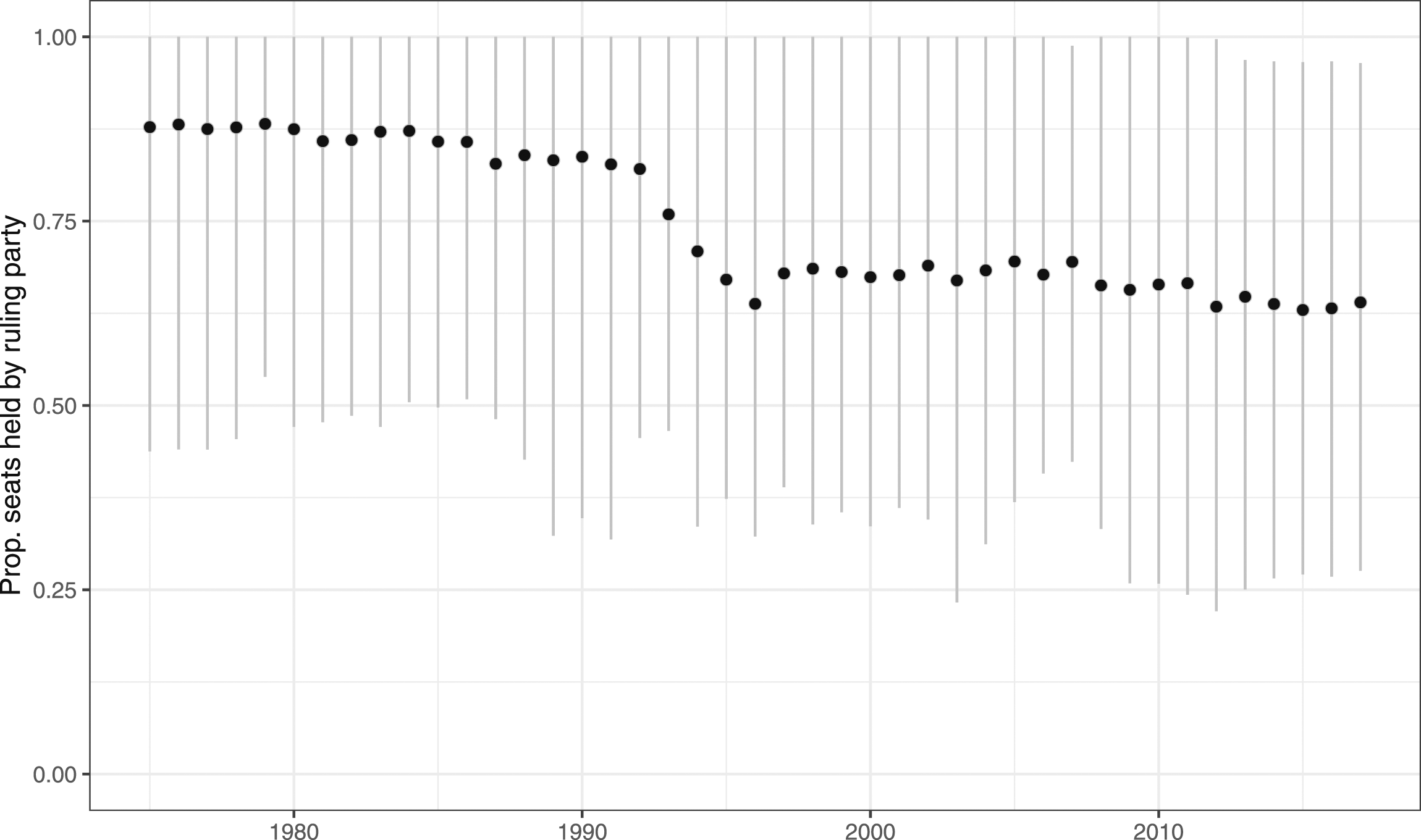
Institutional Authorities and Opposition Vote Mobilization
Elected legislatures in autocratic settings often appear to be rubber stamp bodies that simply enact the regime’s preferred policies and lack independent authority. And yet, there is growing evidence that they are not entirely trivial. Competition for legislative seats is often fierce, suggesting that there are, at the least, personal returns to office and perhaps more at stake (Blaydes, 2010; Lust-Okar, 2006; Reuter & Robertson, 2015). And, importantly, such bodies are typically granted a set of constitutional authorities, including the ability to query or interpellate government ministers, propose legislation, and control their own finances. 13 Finally, recent research using data from dominant and single-party regimes has uncovered evidence that, at a minimum, legislative procedures are used to hash out internal policy disputes within the ruling party (Lü et al., 2020; Noble, 2020).
Once having established legislative privileges through constitutional commitment, it is difficult for autocrats to remove them entirely. 14 Indeed, the extensive literature on why such bodies exist stresses the importance of institutions in tying the hands of the autocrat in order to induce cooperation from other members of the political elite (Gandhi & Przeworski, 2006). Institutions serve as the credible commitment required for such a bargain (Boix & Svolik, 2013; Meng, 2019) and should therefore be costly to alter.
So in autocracies with cooptative institutions, how do opposition parties use legislative authorities? And should we expect this to matter for electoral competition? As discussed above, with a minority of seats, the opposition may struggle to enact policy changes. Bills are often drafted by executive ministries and transmitted to parliament simply for ratification (Blaydes, 2010), and policy implementation is also controlled by the executive via the bureaucracy (Jensen et al., 2014). But constitutionally-established legislative authorities include provisions for interaction with and oversight of this bureaucracy.
Elected office comes with perks: this helps to explain the competitiveness of these elections. The enhanced status acquired with office can then be used to expropriate state resources for legislators themselves (Truex, 2014), but it might also be used to force bureaucrats to do their jobs – in other words, to oversee policy implementation. This is a related argument to that put forth by Lust (2009), in which she argues that elected politicians in Jordan use their office to direct goods to supporters. But instead of doing so through exploitation of their position (that is, by using their influence in a corrupt or illegitimate manner), I suggest that they may achieve similar effects through regularized, ‘by the book’ activities. Legislators may not be able to immediately and directly translate electoral wins into policy advancements that favor their constituents, but they can influence the implementation of existing policy to ensure that their district is not overlooked by the regime. This type of action thus blurs the line between non-programmatic and programmatic politics: the reality in these settings is that implementation of policy can occur selectively but through institutionalized channels.
Though a number of legislative authorities might serve this purpose, I focus in this paper on query power – the ability of MPs to question government ministers both orally, in regularly-scheduled sessions, and in written form at any time. Query authority is a common mechanism of horizontal accountability in both democratic and autocratic settings (Martin, 2011); in 2015, this authority was present in 46% of autocratic regimes. 15 In autocracies, oral queries have been shown to offer an avenue for public criticism of the regime (Malesky & Schuler, 2010). Written queries – less public and with the potential for a high level of detail – are used instead as a mechanism of constituency service (Rozenberg & Martin, 2011; Russo, 2014; Wegmann & Evequoz, 2019). Though the questions do not themselves create policy, legislators see them as a necessary, and usually successful, interface with government ministries, allowing them to gather information, extract public promises, and pressure ministers into action. 16 In that sense, then, they offer elected representatives a lever for influencing policy implementation.
The argument is thus as follows: in order to buy cooperation, the autocrat offers political concessions in the form of institutional authorities granted to the elected legislature, including oversight of the executive-controlled bureaucracy. These authorities of executive oversight create opportunities to provide constituency service via ‘by the book’ political activity. This is especially important for members of the political opposition with reduced access to regime resources, and they make correspondingly greater use of these institutional authorities. Voters then evaluate incumbent parties on the basis of the constituency service they received during the preceding term, regardless of the means by which it was provided. This implies a link between politicians’ use of institutional authorities aimed at constituent issues and their level of electoral support, particularly for members of the political opposition.
In the sections that follow, I use evidence from interviews with Moroccan legislators as well as data on written queries submitted to demonstrate first that this legislative action is largely used to address constituency issues. I then identify a striking disparity in submission patterns: opposition MPs submit far more queries than their royalist counterparts. Finally, I quantify an association between use of this institution and subsequent electoral support – again, primarily for opposition parties. I conclude with a discussion of interpretation, applicability, and robustness of the findings presented.
Institutional Constituency Service in Morocco
How do opposition actors use these legislative authorities of executive oversight in practice? I explore legislative activity and electoral accountability in the context of the Moroccan parliament, with an emphasis on written questions which, I will show, play an important role in the provision of institutionalized constituency service. Note that in this paper, I use ‘opposition’ in the autocratic rather than parliamentary sense, to refer to political outsiders lacking regime connections and advocating for policies that deviate from the status quo; I use ‘government’ and ‘non-government’ where necessary to indicate whether or not a party is a participant in the governing coalition.
Moroccan parliamentary elections are held every five years, and a majority of seats (305 out of 395) are filled via closed-list proportional representation within districts of between two and six seats. The remaining seats are filled via national lists reserved for female and youth candidates. Electoral competition is party-based and highly competitive; in many cases, a voteshare in the single digits is sufficient to earn a seat. 17 Though in the years post-independence, elections were occasionally marred by allegations of fraudulent behavior, the past few decades have seen voting conducted in a generally free and fair manner. Independent election observers assessed the 2011 parliamentary elections positively, describing them as “procedurally sound and transparent” and generally free from concerns about “tampering or systematic procedural violations” (National Democratic Institute, 2011).
Morocco is a monarchy, and no party represents the palace in an official capacity in electoral competition. Yet other scholars have noted that a key cleavage in Moroccan politics is between parties that support the monarchy and institutional status quo (termed ‘royalist’ or pro-regime) and those that seek changes to the political system (Willis, 2002). The former were historically cultivated by the monarchy in order to undercut the electoral success of opposition movements and contribute to greater legislative fractionalization (Lust-Okar & Jamal, 2002; Willis, 2002). They also typically have close, personal ties to the regime, established through party leaders’ membership in the historical class of notables (makhzen) first established during the French protectorate and further cultivated by the palace during the early stages of independence (Waterbury, 1970), or through their individual connections to the royal family. For example, the Party of Authenticity and Modernity was created in 2008 by a close friend of the current monarch. These royalist parties are thus characterized by their palace linkages as well as a general lack of ideological orientation for other than the policy status quo (Lust-Okar, 2005).
A set of opposition (or ‘non-royalist’) parties also regularly competes in elections. Unlike royalist groups, opposition parties typically have a more cohesive ideological stance and advocate for specific changes to the status quo. For example, the Party of Justice and Development advocated for judicial independence and controlling government corruption during the 2011–2016 term (Fakir, 2018). The Moroccan opposition is quite fragmented, comprising a variety of secular and Islamist parties that compete independently in elections (Szmolka, 2010). 18 They are also distinguished by what they apparently lack: proximity to existing power structures and a resulting ability to deliver non-programmatic patronage benefits to their supporters.
For the purposes of this study, I restrict attention to the eight largest parties, which together held 96% of seats in the 2011 parliament. Parties are categorized as ‘royalist’ (loyal to or linked to the regime) or ‘opposition’ on the basis of a number of factors, including the historical roots and genesis of the party, the identities of past and current leadership and their ties to the monarchy, and the ideological orientation of the party and degree to which it advocates for changes to the policy status quo. The coding I adopt is consistent with that used by a number of other scholars (Buehler, 2015; Lust-Okar, 2005; Willis, 2002); further notes on this classification and on each party are included in Appendix A2. Royalist parties include the Party of Authenticity and Modernity (PAM), the National Rally of Independents (RNI), the Constitutional Union (UC), and the Popular Movement (MP). 19 The opposition includes leftists (the Socialist Union of Popular Forces, or USFP, and the Party of Progress and Socialism, or PPS), centrists (the Istiqlal party), and Islamists (the Party of Justice and Development, or PJD).
Addressing Constituency Issues With Written Questions
Like legislators elsewhere, MPs in Morocco have a range of authorities at their disposal, including the ability to propose and vote on legislation and to question government ministers in oral sessions and via formal written request. Yet this last authority – the ability to query government ministers via written request – holds particular utility in the provision of constituency service. Query power is common in both democratic and autocratic settings (Martin, 2011), 20 and has been shown to serve as a meaningful mechanism of horizontal accountability between branches of government in mature and developing democracies (Herron & Boyko, 2015). In this and the following sections, I draw on both qualitative evidence from interviews with MPs as well as content analysis of queries submitted to demonstrate that the usage in Morocco bears a number of similarities to these other contexts: namely, that they address constituency (district-level) issues and facilitate accountability in interacting with the bureaucracy. Interviews were conducted with thirteen active MPs. They were recruited based on their availability and willingness to participate, but with an emphasis on recruiting across parties and ensuring representation from both royalist and non-royalist groups. 21 Participants were asked questions about their political and professional background as well as their activity and perspective on their time in office. Though the interview sample is not random, the qualitative insights provided help to elucidate MPs’ motivation for using written queries, particularly when paired with content analysis of the query dataset. 22
In interviews, Moroccan MPs describe using written queries primarily to address “local rather than national” issues, 23 consistent with usage in other polities (Rozenberg & Martin, 2011; Russo, 2014; Wegmann & Evequoz, 2019). This function is facilitated by the format, which allows MPs to ask complex questions and obtain “detailed answers,” making these questions a critical information-gathering tool. 24 MPs also use them to pressure the bureaucracy to fix local service issues, often highlighting lapses at the municipal level such as road condition or problems with health facilities. While oral queries can only be asked during time-delimited scheduled sessions, written queries can be submitted to ministries at any time, and there is no cap on the number of queries submitted – some MPs produce thousands of questions in a single term. As such, they provide an opportunity for MPs to channel constituency concerns directly to ministries: in a scenario analogous to traditional conceptions of wasta (mediation through cronyism) elsewhere in the Arab world (Lust-Okar, 2006), Moroccan MPs serve as intermediaries between citizens and the government. By submitting written queries to ministers, however, they do so via a formalized institutional mechanism rather than personal connections.
Queries submitted are constitutionally entitled to a formal, written response from the ministry concerned; the tangible nature (“a material documentation of the MP’s work” 25 ) offers utility from both an enforcement and credit-claiming perspective (Fenno, 1978). 26 A written commitment to fix a problem is a record to which MPs can hold ministers accountable if the ministry fails to take the promised action; an unsatisfactory response allows them to blame the bureaucracy for service failures. One deputy explained the role these play in supporting a sense of government accountability among the electorate: “[written queries] allow the deputy to answer her constituents with a written answer from the ministry concerned.” 27 Results can be shared with constituents via district fieldwork or, for the more tech-savvy, social media.
In practice, MPs describe written queries as one of the most effective tools available for constituency service, used for gathering necessary data to inform their own fieldwork or pressuring the bureaucracy to shore up areas of poor performance locally. 28 And as a constitutionally-specified authority, it is not easy for the regime to remove this ability, meaning that opposition parties that earn seats in parliament have an established institutional vehicle through which to address district-level concerns. The regime might seek to reduce the utility of this mechanism through obstruction: a lack of constitutionalized enforcement mechanism means that ministries may respond slowly or not at all. 29 And yet, even where ministries are unresponsive, savvy MPs find ways to strategically deploy this authority, either by following up with additional queries 30 or publicizing the nonresponse to place pressure on the regime. 31 Though queries are not a perfect tool, MPs generally find them to be a useful one: as one MP put it, they are “a successful method for solving local problems.” 32
Ultimately, then, written questions provide MPs with an institutional channel through which to serve constituent interests. This is not the only tool at their disposal for serving constituents; in interviews, MPs characterized their work as encompassing a range of activities including legislative duties (committee work), executive oversight, and constituent engagement through fieldwork in the district. Yet written queries in particular offer an effective way to corral the government apparatus into better local performance – and one for which systematic measures of activity are available. 33 Perhaps the best evidence of written questions’ utility is the frequency with which MPs employ them: collectively, MPs submitted 27,196 unique written queries during the 2011–2016 term.
Questions Submitted During the 2011–2016 Legislative Term
The qualitative evidence from politician interviews makes it clear that MPs view written questions as a useful tool for constituency service. I validate this characterization by examining the content of queries submitted, using data on all written questions submitted during the 2011–2016 parliamentary term. 34 The data were gathered via a database hosted on the official parliamentary website and include information on the type and subject of questions submitted, as well as to which ministry they were directed and whether or not they received a response. 35
Consistent with deputy characterizations, written questions are often used to address constituency problems. Table A4 in the Appendix characterizes the distribution of queries across cabinet portfolios and provides examples. Service-oriented ministries received the bulk of queries, often addressing specific issues of service provision within a locality (e.g. “Connecting the residents of Imzelane neighborhood in Tinghir municipality to the drinking water network”).
I conduct content analysis of the full dataset of question texts; descriptive statistics are shown in Figure 2.
36
The majority of written questions (77%) include a georeference of some kind. Most such references are to provinces (60% of all questions) or communes (23%), both units at the district or subdistrict level.
37
More rarely, written questions address regional (3%) or national (7%) considerations.
38
Roughly 3% of written questions specifically reference an individual issue (e.g. “Pension adjustment for Mrs. X” or “Suspension of monthly salary for Mr. Y”).
39
A small fraction of queries (2%) included complaint words.
40
Query Content. Plot shows the proportion of written questions with references to the specified category.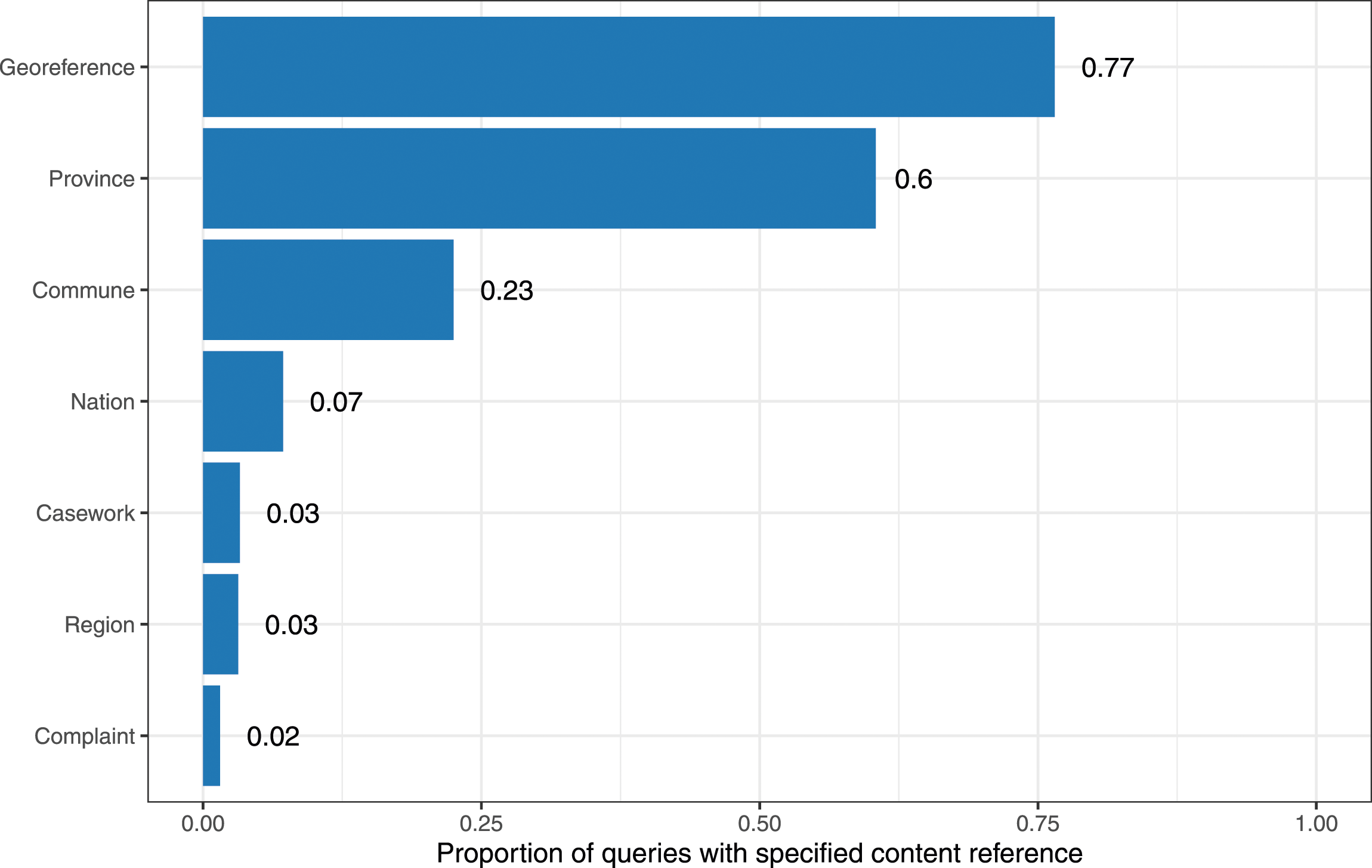
Most questions addressed locations within a politician’s constituency: among written questions with georeferences, 59% were local to a politician’s district. That MPs sometimes use queries to address issues in other constituencies may reflect their national-level stature. When asked about her constituency, one female MP said that while she felt closest to her direct constituents, she simultaneously “felt a responsibility” to represent women in general; other interviewees expressed similar sentiments. 41
Deputy Activity
There are no restrictions on the submission of written questions, and thus this action is equally accessible to all MPs. Yet the exercise of this legislative authority varies hugely among individuals. Some MPs submitted thousands of queries over the course of the term, while approximately 15% submitted none at all. Clarifying the nature of this disparity and identifying which politicians submit more questions sheds light on the purpose and political utility of written questions.
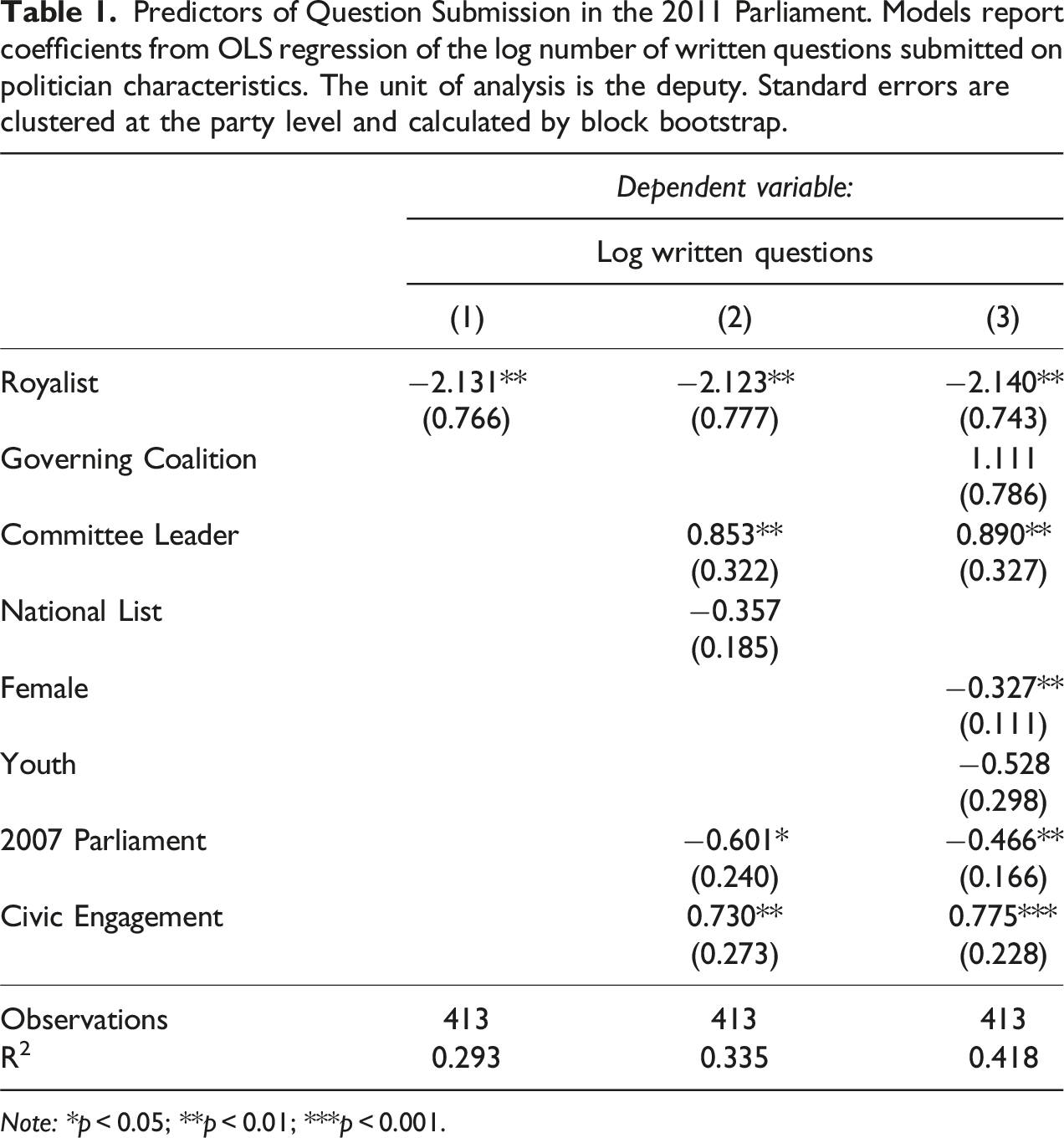
I combine data on query submission with MP characteristics, obtained via the parliamentary website, to analyze the number of queries submitted as a function of MP characteristics. I categorize MPs based on their party characteristics: first, whether it is royalist or opposition. Scholars in other contexts have explored the relevance of participation in the government for query submission (Dandoy, 2014), so I also code whether the party was a member of the governing coalition from 2013–2016. 42 Studies of query submission in democratic settings have identified political experience and leadership roles as predictors of query submission (Russo, 2021). I thus also include binary indicators for whether or not a deputy was a committee leader, elected as part of the youth or women’s national list, or incumbent from the preceding 2007 parliament. Finally, I include an indicator for civic engagement, which I measure based on whether or not a deputy chose to activate a profile on a web-based platform run by a local NGO to facilitate communication between politicians and their constituents. 43 Summary statistics are shown in Appendix Table A.5.
Predictors of Question Submission in the 2011 Parliament. Models report coefficients from OLS regression of the log number of written questions submitted on politician characteristics. The unit of analysis is the deputy. Standard errors are clustered at the party level and calculated by block bootstrap.
Note: *p
Most striking is the fact that royalist MPs submit far fewer questions on average – more than two log-units, or roughly an order of magnitude fewer – than politicians from non-royalist parties. The coefficient on the royalist indicator changes very little with the inclusion of controls and is significant to the 0.01 level with errors are clustered at the party level, providing strong evidence that opposition parties make substantially greater use of this authority. This is consistent with the argument that this institutional activity might substitute for other means of providing constituency service: if MPs from royalist parties already have alternative avenues through which to satisfy voter demands, they do not need to avail themselves of this legislative privilege in order to be effective. Politicians from parties without connections to the regime, however, find this to be an activity worth investing in.
The predictors for question submission provide additional suggestive evidence that written questions are used to address constituency concerns. Individuals from the national list – MPs without obvious constituencies – submit fewer questions (significant at the 0.1 level), while those MPs who engage with constituents via the NGO website submit significantly more questions on average. Other predictors include parliamentary leadership, which is associated with more questions, and incumbency, which is associated with fewer.
Effort and Electoral Accountability
The preceding section presents evidence that elected politicians make ample use of constitutionally granted authorities to address local, district-level issues, and that this is most utilized by opposition MPs. But do voters reward these efforts? Per the theoretical predictions outlined above, I expect institutionalized constituency service to translate into electoral support: all else equal, voters in a district with a responsive, service-focused incumbent should prefer to reelect that candidate or their party.
Because Morocco uses a closed-list PR system, I examine electoral accountability at the party level, analyzing party-district electoral results within a district as a function of the performance of the party’s MPs from that district during the 2011–2016 term. This approach relies on the assumption that the electoral benefits of deputy performance are not exclusive to the individual and can also accrue to the party they represent. However, it allows for identification of effects across the entire population of incumbents, given that parties in 2016 ran lists in nearly all districts where they held seats. 45
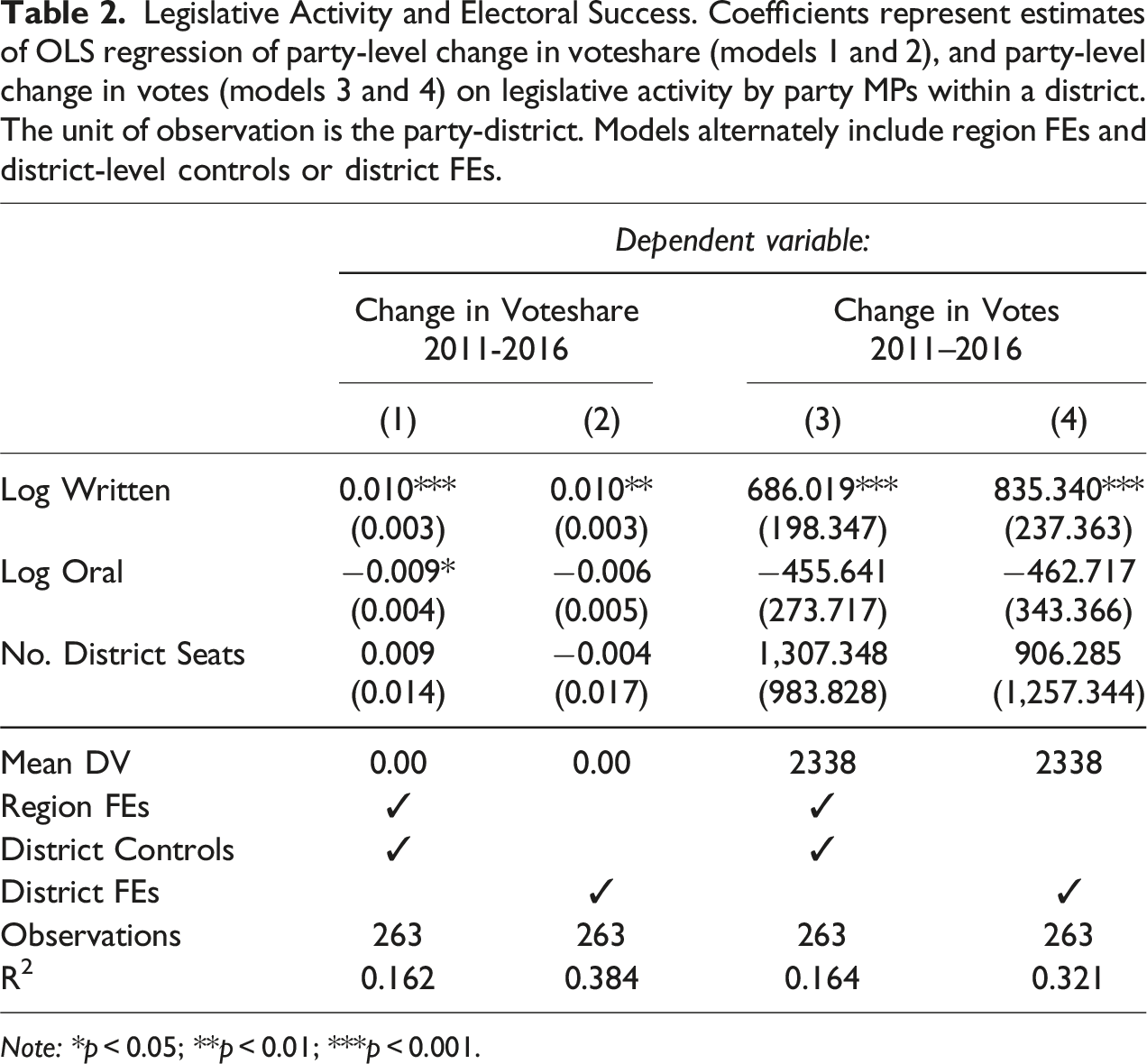
To measure activity at the party level, I generate a continuous variable for the number of written questions submitted, pooling queries submitted by all representatives of the same party within the given district. This is again log-transformed to account for the high level of dispersion. I construct two outcome measures of electoral performance at the party-district level: the change in voteshare and the change in raw votes between 2011 and 2016. These outcomes are designed to account for the party’s performance in the preceding election. 46 To account for the fact that the number of queries may reflect the number of MPs in office, I control for the number of party MPs representing each district. To distinguish between constituency-focused effort and other political activity, I also include a log-transformed metric of the number of oral queries submitted by party deputies. Finally, I include region FEs and a number of district-level controls to account for other factors that may predict incumbency success. 47 I alternately estimate models with district FEs.
Legislative Activity and Electoral Success. Coefficients represent estimates of OLS regression of party-level change in voteshare (models 1 and 2), and party-level change in votes (models 3 and 4) on legislative activity by party MPs within a district. The unit of observation is the party-district. Models alternately include region FEs and district-level controls or district FEs.
Note: *p
The argument presented here stipulates that voters reward constituency service provided by their representatives. To that end, it is important to note that the evidence of electoral accountability in Table 2 does not extend to any form of institutional activity: oral queries are associated with lower voteshare (though this is statistically significant in only one of the specifications). 49 Per deputy interviews and content analysis, oral queries are used primarily to address broader policy priorities and were far less likely than written queries to reference a constituency unit (7% of oral queries compared to 63% of written queries). That this activity is not associated with electoral improvement implies that voters are not rewarding political effort in general but, specifically, constituency-focused effort. 50
Opposition-Specific Electoral Benefits
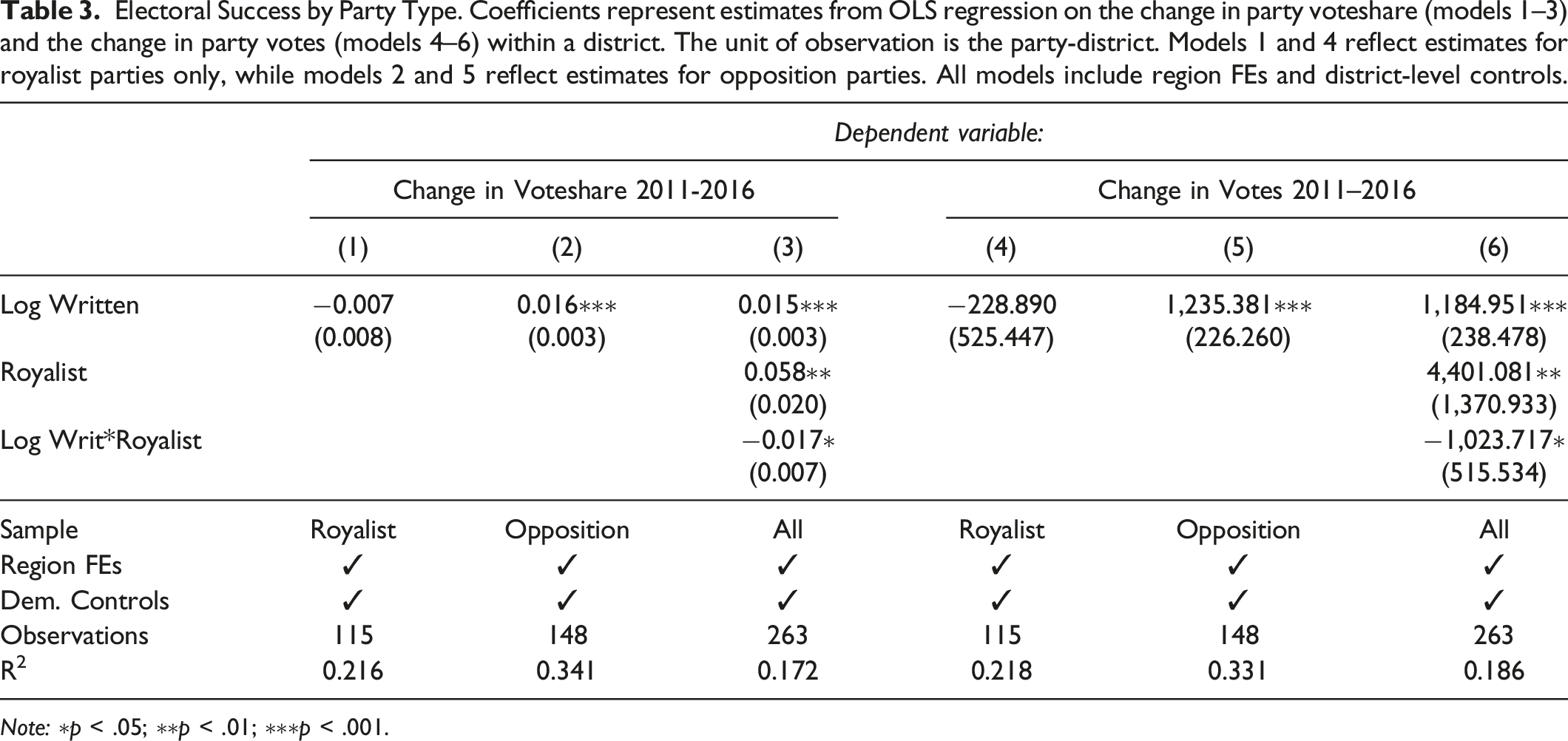
Electoral Success by Party Type. Coefficients represent estimates from OLS regression on the change in party voteshare (models 1–3) and the change in party votes (models 4–6) within a district. The unit of observation is the party-district. Models 1 and 4 reflect estimates for royalist parties only, while models 2 and 5 reflect estimates for opposition parties. All models include region FEs and district-level controls.
Note: ∗p < .05; ∗∗p < .01; ∗∗∗p < .001.
For regime-affiliated parties (models 1 and 4), constituency service via written questions does not predict improved electoral prospects in 2016: the coefficients on activity are small and insignificant in both models. In contrast, there is a strong, positive association between legislative activity and votes for opposition parties (models 2 and 5). A log-unit increase in the number of written questions submitted is linked to a 1.6 percentage point increase in voteshare and more than 1000 additional votes for the relevant party. The results of institutional activity are very different for the two types of parties, as confirmed by the negative and significant interaction terms in models 3 and 6.
The results support the assertion that opposition parties’ use of institutional authorities plays a role in generating electoral support. For the opposition, taking advantage of written queries’ role in service provision predicts increased electoral success. Failing to do so is associated with electoral losses: in districts where their MPs submitted no written questions, opposition parties did worse in 2016 relative to 2011.
But how should we interpret the null relationship for regime-affiliated parties? For royalist parties, there is no link between written queries and electoral gains – though it is important to keep in mind that they engage in less query submission overall (Table 1). But it is noteworthy that while such parties do not benefit from submitting more written questions, neither are they punished for submitting fewer. This is consistent with evidence from the literature that regime-affiliated candidates can draw on other resources to attract support (Liddell, 2010); as a result, the institutional methods of providing constituency service identified here are not a strong proxy for service provision for these candidates. On the other hand, if written queries are the primary means for opposition MPs to address district concerns, then we would expect them to be very closely linked to electoral support. In other words, the broad consensus in the literature that regime-backed candidates win support through non-programmatic, under-the-table distribution of favors remains unchallenged by the results shown here. However, Table 3 offers new evidence that opposition candidates’ use of institutionalized action is rewarded by the electorate.
Localized Support for Local Effort
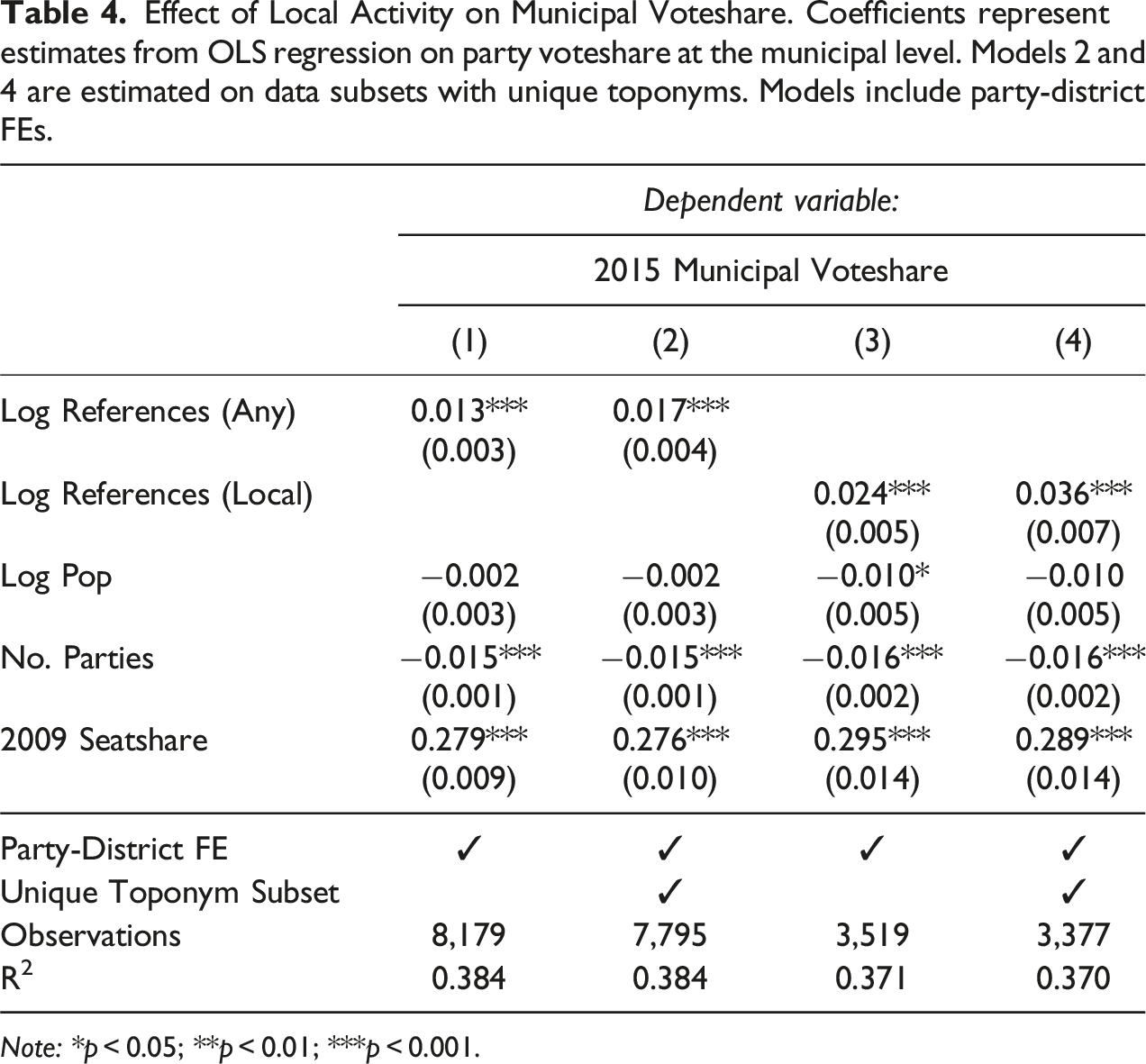
I have argued that written queries proxy for deputy effort on behalf of their constituency: voters observe and reward politicians that perform more constituency service, and the written query measure captures this trait especially well (at least for opposition parties). In other words, it is not that voters reward good, hard-working politicians, but, more specifically, good politicians that expend their effort to provide locally-focused service. In this section, I provide further evidence for this claim by linking municipal-level references within queries to local electoral outcomes. Legislative districts in Morocco typically comprise multiple municipalities across a large geographical area, and busy MPs may not divide their efforts evenly across their constituency. I expect that the more institutionalized attention a community receives from party MPs, the more motivated it will be to support that party in elections. 51
I construct a measure of local attention using municipal references in written questions. This new independent variable, constructed at the party-municipality level, summarizes the number of questions containing references to the municipality concerned, submitted alternately by any of the party’s MPs (References - Any) or only those representing the municipality in parliament (References - Local). 52 As before, I use the log transformation of these variables as predictors in the specifications that follow.
Some municipalities share toponyms with higher level administrative units. 53 This generates some ambiguity as to whether a question is referencing the subdistrict or district entitiy. To ensure that results are not driven by mis-attributed references, I report specifications with all municipalities and subsetted to include only municipalities with unique toponyms.
The dependent variable is party voteshare at the municipal level. An ideal analysis would use municipal voteshare from the 2016 legislative elections; however, the Moroccan government does not release subdistrict electoral results. Instead, I use outcomes from the midterm municipal elections of September 2015. 54 This party-level analysis again requires the assumption that voters evaluate and support political parties on the basis of the performance of their legislative deputies. In all specifications, I include controls for population and the number of parties competing. I also include party-district fixed effects to absorb other activity by local deputies; the model comparison is thus across localities within a district. Finally, to address concerns regarding reverse causality, such as the possibility that parties might direct the majority of resources and effort to core supporters, I include a control for the party’s seatshare in the 2009 municipal elections. 55
Effect of Local Activity on Municipal Voteshare. Coefficients represent estimates from OLS regression on party voteshare at the municipal level. Models 2 and 4 are estimated on data subsets with unique toponyms. Models include party-district FEs.
Note: *p
Discussion
The preceding empirics provide evidence that, in Morocco, service-focused legislative activity is linked to voter support, and that this is especially significant for opposition parties. I provide evidence in support of the proposed mechanism of constituency service: within a given district, sub-district units that received more query-based attention from a party were more supportive in the subsequent election. In Appendix A4.2, I conduct additional robustness checks to validate that the relationship identified is not driven by anti-regime sentiment.
But is the query metric a measure of quality or performance? Put differently, are voters rewarding politician effort or results? It is plausible that voters make choices based on both considerations, and that politician quality is an important factor. Per Fearon (1999), in scenarios where voters have a limited ability to monitor politicians, as in autocracies where information is limited, selecting based on ‘type’ becomes a more optimal strategy. Yet there is reason to believe that these legislative requests are in most cases linked to bureaucratic action. First, 67% of queries received a formal response; the response rate was closer to 90% for queries submitted early in the term. As a robustness check, I replicate the analysis from Table 2 including only queries that received a response in the IV (Appendix A4.4) and find that outcomes are largely unchanged. And though it is challenging to assess the impact in a comprehensive manner given the diversity of queries submitted and paucity of subnational indicators, there is evidence from specific cases (see below) as well as testimony from MPs themselves that queries prompt ministries to commit to improving outcomes.
How do prospective voters learn about their representatives’ bureaucratic requests and the resulting government response? It is here that political credit-claiming plays a role, whether through in-person fieldwork in the district, press releases, or publication via social media.
56
As an example, Figure 3 depicts a publicly-accessible Facebook post from a PJD deputy. In it, he has shared a photo of the official response to a query submitted to the Ministry of Transportation concerning the geographic isolation of a community within his district due to infrastructural problems. The original query highlighted the difficulty for residents to access medical services. In its response, the ministry committed to address this issue through a combination of repairing existing roads and building a new road and access across the wadi. The MP stated in his post that he was publicizing the ministry’s commitment to pressure it to speed up the remaining aspect of the intervention – the construction of the wadi access bridge. The screenshot was taken about one week after the response was posted; in that time, it had garnered 63 likes, 24 comments, and 18 shares.
57
This illustrates the utility of written queries in holding ministries accountable for their promises. Public shaming can create reputational costs for the bureaucracy and the regime unless they address the issue in question. Additionally, this shows how politicians can engage in credit-claiming and inform constituents about their accomplishments: the physical records of the request and corresponding ministry commitment are used to demonstrate the chain of accountability generated by the MP’s efforts. Screenshot of a social media post by an MP sharing the response to his query.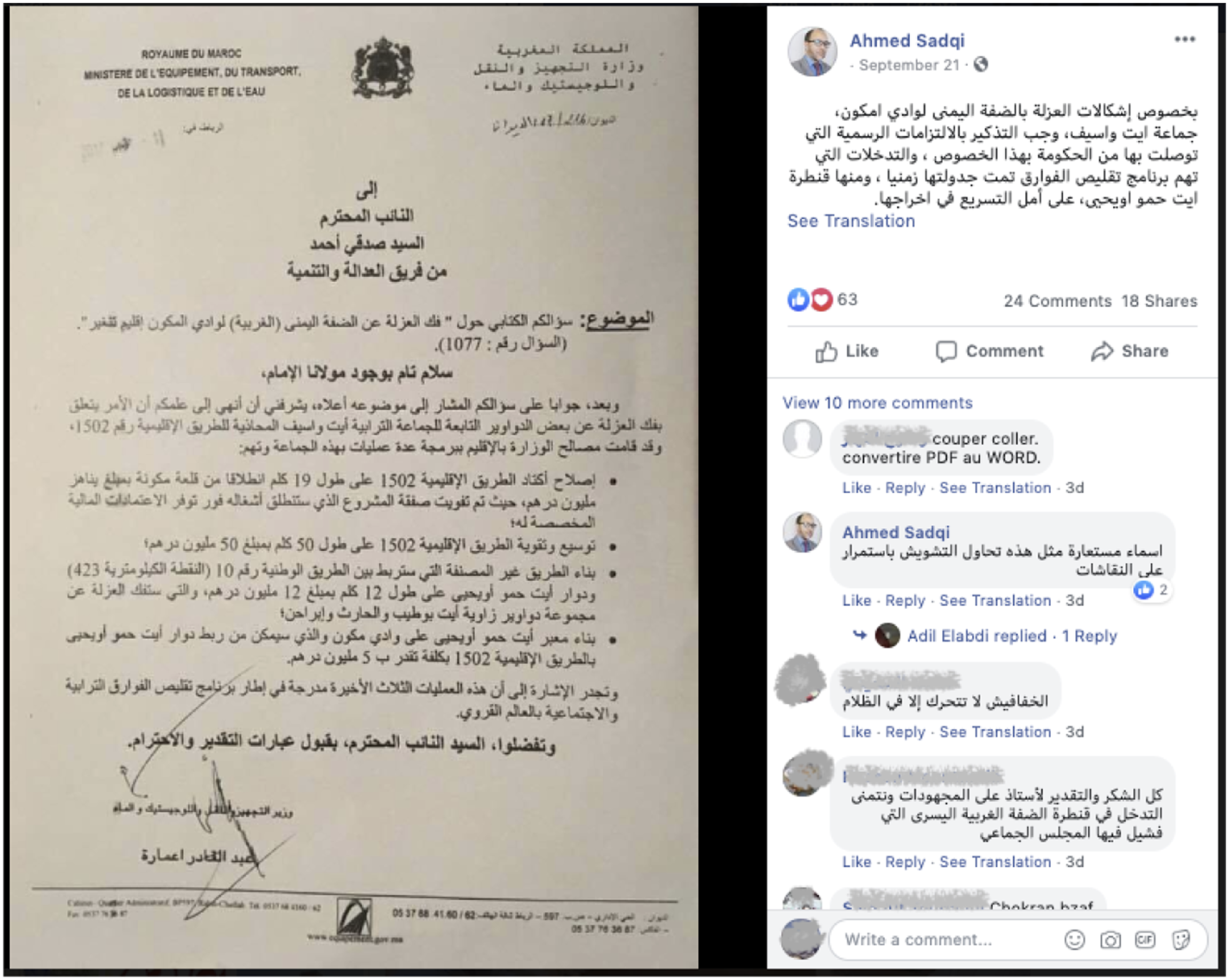
Morocco is a monarchy with substantial opposition representation in the legislature. 58 To that end, the analysis here offers a distinct data point to juxtapose with evidence from within single-party (or effectively single-party) authoritarian legislatures with far more limited opposition participation or success (Noble, 2020; Truex, 2020). But might the results here speak to other multi-party autocratic contexts? During the period under study, the PJD, an opposition party, held the post of prime minister after winning a plurality in legislative elections. This raises a question about whether opposition participation in government is required to facilitate the mechanism demonstrated in this paper. Descriptive evidence suggests that it is partisan rather than opposition participation in government that enables the function of these authorities. MPs from the PJD were no more likely to submit queries to PJD ministers than they were to other ministers, and there is no evidence of co-partisan bias in response rates. 59 On the contrary, as noted below, there is evidence that regime-appointed, non-partisan ministers responded to queries at considerably lower rates. As an additional robustness check, I incorporate a measure of whether or not a party was a part of the governing coalition in the model relating written queries to electoral outcomes in Appendix A4.3; results are unchanged with the inclusion of this control. Hence, though the PJD held a singular post in this case, it seems unlikely that this was the primary driver of query usage or effectiveness.
Of course, there are still important questions about how broadly the results might extend. First, it is clear that the query power explored here is common, present in roughly half of autocracies globally. In Appendix A1.1, I undertake preliminary cross-national analysis and find that query power is associated with legislative competitiveness: its presence predicts an 8–10 percentage-point decrease in dominant party seatshare, even when controlling for other legislative authorities. Constituency service has been shown to be valued by citizens in dominant party settings (Ong, 2015). And studies of dominant party settings have also found evidence of opposition parties using and benefiting from parliamentary institutions (Loidolt & Mecham, 2016; Shehata & Stacher, 2006). On the other hand, the mechanism documented here requires that institutions be more than window-dressing; in settings where legislative authorities are limited or where the regime directly manipulates electoral results (and thus citizens are unable to register their support for good performers), we would not expect ‘by the book’ constituency service to translate into legislative seats. Collectively, this suggests this may pose a viable strategy across a broader range of contexts, though opposition parties may face longer odds in contexts with greater electoral interference.
The publication of internal legislative proceedings offers exciting opportunities for research into autocracies globally (Gandhi et al., 2020), but raises questions about the strength of the resulting empirical inference due to the observational nature of the data and the sometimes limited insight into the data generating process. In this case, it is possible that the effects found are due to the influence of some unobserved attribute of MP or party behavior. I have sought to mitigate the risk of confounding using the data available, including controlling for preceding electoral results as well as district attributes that might be associated with incumbency advantage. A series of robustness checks in Appendix A4 further assess the sensitivity of the results to potential confounders such as participation in the governing coalition or the use of questions to criticize the regime. I cannot entirely rule out the possibility that the estimated effect on electoral outcomes is due to other representative activity that is simply correlated with query submission. However, some additional support for the argument in this paper comes from the mechanism test at the municipal level as well as deputies’ own interview testimony that queries play an important role in solving constituency issues. At a minimum, the evidence supports the idea that constituency service is associated with electoral support, though the effect found may conceivably be transmitted through multiple means (including fieldwork in the district and other forms of direct interaction with constituents) that are correlated with the use of queries. 60
Finally, because the focus here is on legislative politics under autocracy, it is important to consider the regime perspective. Why does the regime allow opposition parties a viable path to voter support? One answer lies in the constitutionalization of legislative authority: as outlined in the theoretical discussion, autocratic institutions must involve some measure of commitment in order to be effective cooptative mechanisms, and revising them is therefore costly. Autocrats are not omniscient, and they may not anticipate all future implications of institutional arrangements when they are being enacted. Query power in Morocco dates to the 1990s, when the regime was seeking to weaken existing opposition through cooptation; that it today creates opportunities for political outsiders may be an unintended consequence of the institution. 61 Rather than remove the authority and face the potential backlash associated with constitutional revision, the regime may prefer obstruction: ignoring requests is a subtler method for sapping their effectiveness. 62
The regime may also derive some benefits from this opposition behavior. Scholars have hypothesized that competitive elections among the selectorate allow the regime to farm out responsibility for citizen satisfaction (Blaydes, 2010). While the autocrat may prefer to have these activities undertaken by ideologically-aligned actors, he must balance an array of strategic considerations, including those that allow for the inclusion of moderate opposition members (Lust-Okar, 2005). Opposition constituency service helps address the bottom-up threat posed by aggrieved citizens. And the fact that voters reward localized action means that vote-seeking parties must spend the bulk of their energy and resources on such activities rather than pursuit of their partisan agenda. If voters perceive such actions as substitutes (as suggested by the negative coefficient on oral queries in Table 2), then elections may help to alleviate policy pressure on the regime.
Conclusion
This paper examines legislative activity and voting patterns in an autocratic context, with an emphasis on the distinction between regime-affiliated and opposition parties. One underlying assumption, corroborated by a broad body of scholarship as well as by interviews with Moroccan politicians, is that many voters in this context expect elected representatives to address constituency-level concerns. While individuals with close ties to the regime might do so through their personal connections, I offer evidence here that opposition politicians use the legitimate authorities of their office to ensure their constituents are not neglected. This addresses an existing puzzle – how opposition actors make headway in an environment designed to disadvantage them – and reveals an important function of democratic institutions in authoritarian settings.
Though the legislative authority examined here – queries directed at government ministries – is common to parliamentary systems globally and present in nearly half of autocracies today, its relevance in an autocratic setting is neither trivial nor obvious. Yet I find that queries play an important role in electoral accountability. Because of these institutional opportunities, opposition parties can hope to achieve parity with or even surpass regime-affiliated candidates by maintaining high levels of effort in office and relentlessly pressuring government ministries to follow through on projects relevant to their district. And yet they may do so at the expense of their policy agenda: the results here suggest that voters are less supportive of activities that address national issues.
These findings raise tantalizing questions about the electoral ceiling for the opposition, as well as the implications of this strategy for public opinion. Can the opposition parlay this action into majority support? 63 And does this ‘by the book’ alternative to patronage-based voting change voter views toward governing institutions? In Appendix A5, I use geocoded, nationally-representative survey data collected during the term in question to show that query submission (as measured by query references to a respondent’s municipality) is associated with higher approval ratings for political representatives. More queries are also linked to respondents’ belief that government is responsive to citizens and that government officials are less corrupt. This evidence is preliminary but suggests an important link between elite behavior and citizen perceptions of government. Future research might take on the broader implications of legislative effort for public attitudes and the larger question of democratization.
Supplemental Material
Supplemental Material - Constituency Service and Electoral Accountability in Autocratic Legislatures
Supplemental Material for Constituency Service and Electoral Accountability in Autocratic Legislatures by Erin York in Comparative Political Studies.
Footnotes
Acknowledgements
I thank Elizabeth Nugent, Lindsay Benstead, Sean Yom, Monika Nalepa, anonymous reviewers, fellows at the HKS Middle East Initiative, and audience participants at the Harvard Kennedy School, Princeton, POMEPS, and APSA for their helpful comments. I thank Khaoula Erraoui and Imane Lahrich for their excellent research assistance, and Ismail Ilsouk for invaluable support in undertaking this project.
Declaration of Conflicting Interests
The author(s) declared no potential conflicts of interest with respect to the research, authorship, and/or publication of this article.
Funding
The author(s) disclosed receipt of the following financial support for the research, authorship, and/or publication of this article: This research was supported in part by the NSF Graduate Research Fellowship, DGE-11-44155.

Supplemental Material
Supplemental material for this article is available online.
Notes
Author Biography
References
Supplementary Material
Please find the following supplemental material available below.
For Open Access articles published under a Creative Commons License, all supplemental material carries the same license as the article it is associated with.
For non-Open Access articles published, all supplemental material carries a non-exclusive license, and permission requests for re-use of supplemental material or any part of supplemental material shall be sent directly to the copyright owner as specified in the copyright notice associated with the article.
