



Abstract
Does supporting a minority cabinet harm a party’s electoral prospects? While minority governments have become more common in recent years, the electoral implications for parties supporting such cabinets remain unclear. Previous research suggests that support parties enjoy a favorable position, exerting policy influence while avoiding electoral losses associated with joining the government. However, we argue that this is only true for support parties without written agreements, as their support is less visible to voters. To test our argument, we compiled a novel dataset on the electoral performance of 563 parties in 304 elections across 31 countries since 1980. We estimate the effect of being a support party on subsequent electoral performance. Our findings indicate that parties which declare support perform better electorally than junior partners, while contract support parties do not. These insights shed light on the relationship between minority governments and electoral competition amidst growing party system fragmentation.
Introduction
“By staying outside, Jimmie Åkesson and his party also avoid taking responsibility for everything they don’t like. A wishful seat.” stated a political commentator in Aftonbladet, one of the largest Swedish daily newspapers, on October 15 in 2022. 1 One day after the presentation of the new Swedish minority government, this commentator thus underlined a traditional expectation about parties which support minority governments: they can exert influence, but do not have to take government responsibilities and therefore avoid negative electoral repercussions.
In this concrete example, the extreme-right Sweden Democrats support the minority coalition led by Ulf Kristersson since October 2022 which is formed by three center-right parties: Moderates, Christian Democrats, and Liberals. Despite the Sweden Democrats having the highest number of MPs among these four cooperating parties, they were not invited to join the coalition formally. Still, they were able to exert substantial policy influence on the mutual written government agreement, the Tidö Agreement, especially in their most salient policy areas of immigration, crime, and energy. Political analysts spoke thus even of the Sweden Democrats as the “big winner in terms of policy”. 2
Minority cabinets make more than a third of all cabinets in parliamentary democracies but we still know only little about the implications for party competition. In his seminal study, Strøm (1984, 1990b) theorized that supporting a cabinet instead of joining it can be understood as a rational strategy for political parties if the expected electoral costs of joining the cabinet would be higher than the prospective policy benefits. Previous studies show that, in comparison to opposition parties, incumbent cabinet parties indeed tend to perform worse in the subsequent elections (Narud & Valen, 2008; Stevenson, 2002). This cost of ruling is especially high in coalition governments due to blurred responsibilities and ambiguous perception of coalition parties’ policy positions (Fortunato & Stevenson, 2013). Thus, latest research shows that it is especially the junior members of government coalitions who drop in the polls since they cannot adequately distinguish themselves from the senior coalition partner (Hjermitslev, 2020; Klüver & Spoon, 2020).
As a consequence, parliamentary parties may rather chose to support a minority cabinet instead of joining it as long as they are still able to influence the cabinet’s policy-making from the outside as the Sweden Democrats in the above-mentioned example. Relatedly, the research on minority governments demonstrates that non-cabinet parties can gain substantive policy pay-offs in exchange for supplying a minority government with legislative stability if they enter formalized support agreements with the cabinet parties (Anghel & Thürk, 2021; Bale & Bergman, 2006a; Otjes & Louwerse, 2013; Warwick, 2011). Exerting policy influence on its core issues from outside of the government allows the non-cabinet party to claim credit and signal success in front of its electorate, while avoiding to be held responsible for unfavorable government decisions (Strøm, 1990b; Thesen, 2016). Supporting minority cabinets externally might be an especially relevant strategy for niche parties, which suffer electorally from shifts toward the center due to their distinct policy profiles (Adams et al., 2006), to maintain their ideological stance and distinct policy positions, thus preserving their electoral appeal without compromising their policy profile (Fortunato & Adams, 2015).
In this paper, we investigate the long-term effects of supporting minority cabinets on a political party’s performance in the subsequent general elections. While the cost of ruling for incumbent government parties has been well established in existing literature (see e.g., Hjermitslev, 2020; Klüver & Spoon, 2020; Narud & Valen, 2008; Rose & Mackie, 1983; Stevenson, 2002; Strøm, 1990a), an important research gap remains regarding the accountability of parties that lend external support to minority cabinets (Fortunato, 2021, p. 36). However, it is crucial to study this accountability of support parties as they exert significant policy influence on minority cabinets’ government programs (Warwick, 2011) and crucially affect the governments’ ideological congruence (Powell, 2019).
Thesen’s 2016 descriptive analysis on Scandinavian parties indicates support for the assumption of support parties enjoying a sweet spot position, while Hjermitslev (2023) shows that survey respondents who are unsatisfied with the government, are also less likely to vote for their formal support parties. However, both analyses are based on a rather small number of support parties. This lack of systematic comparative research on the consequences of support parties is surprising since not only the share of minority governments has increased over the last decades, but especially because the share of formally supported minority cabinets has substantially gone up since the path-breaking study by Kaare Strøm (1990b) and contract support agreements became common even in countries with high minority cabinet experience, for example in Scandinavia and New Zealand (Bale & Bergman, 2006a; Thürk & Krauss, 2022).
We aim to close this gap by arguing that some support parties are in fact better in distinguishing themselves from the government and are thus able to minimize their electoral losses in comparison to junior coalition members. One rationale for this is that especially those support parties with less formalized agreements gain, just as opposition parties, less critical media attention than coalition member parties (Green-Pedersen et al., 2017, p. 145). However, we argue that especially parties which have a highly institutionalized and formalized relationship with the minority cabinet based on a written agreement, so-called contract minority cabinets (Bale & Bergman, 2006a), struggle to distance themselves from the cabinet parties due to blurred responsibilities and wrong responsibility attributions by the electorate (Tromborg et al., 2019). In contrast, we argue that parties which have purely publicly pledged their support for the minority cabinet, but do not rely on a written contract, are more successful to build a public image of non-cabinet parties with limited government responsibility and are thus able to reduce their electoral losses. Empirically, we draw on an analysis of a panel of 563 parties in 304 elections from 31 countries since 1980. We use different modeling strategies, including various linear regression models, Two-way fixed effect models, and the Panel Match Approach. We show that, on average, support parties that purely declare their support fare better electorally than junior coalition partners, but that contract support parties do not.
Our results contribute to the literature in different ways. First, the findings of this study contribute to the debate about the electoral consequences of governing. Contrary to what has been commonly argued, our results show that support parties can ensure the functioning of minority governance in exchange for receiving policy pay-offs, but should do so rather less visibly. While this strategy may not allow them to enjoy the benefits of office, they are not punished by the voters to the same extent as (junior) coalition parties (Hjermitslev, 2020; Klüver & Spoon, 2020). Moreover, the results have important implications for our understanding of party competition. Especially, under minority coalitions, voters seem to struggle to identify the parties participating in cabinet and thus, to attribute government responsibility. Our study therefore supports previous findings that support parties have incentives to distinguish themselves strategically from the cabinet in order to position themselves as opposition parties at points of time when media attention is exceptionally high (Müller & König, 2021; Sagarzazu & Klüver, 2017).
The Electoral Consequences of Supporting Minority Cabinets
If one party wins the majority of seats in parliament, the party can unilaterally form a government. This is for instance the case in the United Kingdom (UK) where most post-war cabinets have been single-party majority governments, in which either the Labour Party or the Conservative Party governed alone. However, the situation is very different when no single party is able to win the majority of seats in parliament. In such a situation, two different scenarios are possible. On the one hand, a majority coalition can form that is composed of at least two different parties that share executive posts and together control the majority of parliamentary seats (Strøm et al., 2008). On the other hand, a minority cabinet can form that controls less than 50% + 1 of the seats and relies on support parties in the opposition to pass legislation in parliament.
While single-party majority governments can more or less independently enact their favoured policies, governing in coalitions or in minority cabinets is much more complex. Political parties pursue different policy objectives so that coalition parties or parties under minority governance have to make compromises with their partner in order to pass legislation and ensure the stability of the government. These compromises however do not come without costs. Previous research has shown that parties are punished electorally for policy compromises they make in government and due to a blurred policy profile that makes it hard for voters to identify the specific position of individual coalition parties (Fortunato, 2019; Greene et al., 2021; Klüver & Spoon, 2020; Plescia et al., 2021). Fortunato (2019) has demonstrated that voters punish coalition parties for the compromises they make in multi-party cabinets and Greene et al. (2021) show that electoral losses are related to holding certain ministerial portfolios. Klüver and Spoon (2020) show that junior partners in particular suffer from their participation in coalition governments as they can only enact some of their election promises and since they struggle to convey their distinct policy profile to voters. Plescia et al. (2021), moreover, find that voters’ willingness to accept policy compromises depends on the strength of their party attachment and the personal salience of the issue to voters.
But do all governing parties suffer the same incumbency costs? We argue that there are important differences between political parties that enter a coalition as a junior party and political parties that support a minority cabinet as a support party. We explain the differential effect for junior coalition partners and support parties as follows. Junior coalition parties take over ministerial offices and are formally part of the government. They typically receive a share of ministerial posts that is proportional to the share of legislative seats that they provide to the coalition (Gamson, 1961; Warwick & Druckman, 2006). However, junior partners cannot enact much of what they promised before the election due to their smaller bargaining power in the cabinet. Accordingly, Warwick (2001) and Däubler and Debus (2009) demonstrate that seat share is an important predictor of the distribution of policy payoffs in coalition cabinets.
Governing in coalitions weakens the clarity of responsibility of the government since decisions within the cabinet are typically taken collectively or at least communicated to the public collectively (Nadeau et al., 2002; Powell & Whitten, 1993; Whitten & Palmer, 1999). Due to the blurred lines of responsibility, particularly junior partners have a very hard time differentiating from their senior partner (Klüver & Spoon, 2020). This, in turn, makes it more difficult for voters to identify the distinct policy profiles of political parties that govern together in a coalition cabinet (Fortunato & Stevenson, 2013; Spoon & Klüver, 2017). As position-taking is an important instrument of party competition over votes (Downs, 1957; Rabinowitz & Macdonald, 1989), governing in coalitions is electorally dangerous for junior coalition parties as voters cannot correctly perceive their policy positions.
What about the electoral impact of supporting a minority cabinet? A minority government is a cabinet that by definition lacks the control over an absolute majority of deputies in parliament (Müller & Strøm, 2000). In order to survive in parliament and to pass legislation, minority cabinets typically rely on support parties (Strøm, 1990b; Thürk, 2021). Support parties behave in a way (by voting in line with the government or by abstaining) that directly helps a minority cabinet to survive without taking over government offices (Bergman, 1995). Support parties commonly demand concessions in a policy area that is important to them in exchange for their support in parliament (Anghel & Thürk, 2021; Field, 2016; Warwick, 2011). In contrast to junior coalition partners, support parties are however not formally part of the government. They do not take over ministerial posts and their support of the government is accordingly much less visible to voters.
Relatedly, voters may typically not hold support parties accountable for policy compromises that support parties make with the minority cabinet parties. The media attention plays an important role for this distinction. Previous research shows that cabinet member parties receive more critical media attention than non-cabinet parties. This is not only true for the share of critical reports on genuine opposition parties, but also on minority cabinet support parties (Green-Pedersen et al., 2017, p. 145). Since support parties only cooperate with, but are not formally part of the government, they are in addition also much better at distinguishing themselves from cabinet parties. This is supported by the fact that support parties are found to cooperate with the minority cabinet strategically and tend to distinguish themselves from the cabinet when media attention is highest (Müller & König, 2021). Thus, support parties are more likely to vote against a minority cabinet just after the elections at the beginning of the legislative period and briefly before the next elections, that is at the end of the legislative period. As a consequence, voters attribute more policy influence to support parties than to genuine opposition parties, yet less than to junior coalition members (Fortunato et al., 2021).
Lastly, given that support parties are no formal cabinet members, voters are less likely to associate the cabinet position with the position of support parties so there is less blurring of policy profiles. Thus, while minority support parties can reach some policy goals in exchange for their legislative support, they do not have to bear the same costs of governing in a coalition as junior coalition partners. We therefore expect that the electoral losses are much smaller for minority support parties than for junior coalition partners.
The electoral losses of support parties of minority cabinets are smaller than the electoral losses of junior coalition parties. However, we expect that the electoral implications also depend on the type of support party. The literature on minority cabinets, typically distinguishes support parties based on the formality of the support party’s cooperation with the minority cabinet (Bäck & Bergman, 2015; Bale & Bergman, 2006a; Strøm, 1990b; Thesen, 2016). While some minority cabinets rely on the unannounced support of non-cabinet parties (substantive minority cabinets), others negotiate terms for a more formalized cooperation and announce them to the public (formal minority cabinets) (Strøm, 1990b). The most formalized cooperation is based on written support agreements which, similarly as coalition agreements, explicitly state the conditions for the cooperation of the parties including the terms of support and the pay-offs for the non-cabinet partner(s). These agreements publicly commit the parties to each other and lead to minority cabinets that function similarly to majority coalitions and are equally stable (Krauss & Thürk, 2021). We argue that formal support parties based on written agreements suffer more severe electoral losses than support parties with less formalized support relationships to the minority cabinet. We explain this expected effect as follows: Support parties that negotiate and commit to a written support agreement, have a highly institutionalized and formalized relationship with the minority cabinet, so-called contract minority cabinets (Bale & Bergman, 2006a, 2006b). These agreements are publicly announced and frequently invoked throughout the legislative term. By contrast, other types of support parties only pledge their allegiance to the minority cabinet, but do not rely on a written contract with spelled-out policy pay-offs. As a result, voters associate support parties much more with the cabinet under contract minority governments which can indeed be referred to as “majority governments in disguise” (Strøm, 1990b, p. 61). A striking example can, again, be the most recent Swedish minority coalition under Ulf Kristersson, formed in October 2022. The tree center-right parties, Moderates, Christian Democrats, and Liberals, formed a minority coalition which only secured 29.5% of legislative seats. However, they prominently run an election campaign on their willingness to cooperate - but not form a government coalition - with the extreme right-wing Sweden Democrats. Together with the Sweden Democrats, the coalition parties entered in a support contract known as the “Tidö Agreement” which regulates the rules of the support party cooperation
3
and their policy agreements in six major policy areas
4
on 63 pages. Based on this document, the support party gained substantial policy influence on the coalition in exchange for their legislative support. The media refers commonly and very frequently to the four parties as “Tidö parties” (including the support party Sweden Democrats) instead of referring only to the coalition parties when reporting on government policies and politics.
5
This example shows that contract minority parties gain similar media attention as coalition members and are indeed held responsible for mutual policy projects by the media. We therefore expect that support parties based on contracts have similar struggles as junior coalition partners. Voters expect the fulfillment of their election promises and punish the support parties for making policy compromises with the minority cabinet. In addition, contract support parties find it difficult to distance themselves from the cabinet parties due to blurred responsibilities and wrong responsibility attributions by the electorate (Tromborg et al., 2019). By contrast, support parties that purely declared their allegiance to the minority cabinet are more successful to build a public image of non-cabinet parties with limited government responsibility. They are thus able to reduce their electoral losses.
The electoral losses of support parties without a written contract are smaller than the electoral losses of contract support parties with a written agreement.
Research Design
We test our theoretical expectations based on a comprehensive new data set including 563 political parties competing in 304 general elections from 31 countries since 1980. 6 We thus go beyond most previous research and do not only include European countries, but also the well-established parliamentary democracies of Australia, Canada, and New Zealand since they regularly produce coalitions and/or minority governments. This country sample allows us to study coalition and minority governments in comparable parliamentary systems and still provides sufficient variation in order to empirically investigate our theoretical arguments.
Measuring the Electoral Success of Parties
The central dependent variable for this analysis is the electoral success of political parties. In order to empirically investigate support parties’ electoral performance, we use the absolute vote share a party wins at the next election (t1). However, since we are interested in understanding if support parties experience negative consequences of their government cooperation, we control for the vote share at the current election at t0 in order to account for a party’s previous election results. For the data of the parties’ election results, we rely on the parliaments and governments database (ParlGov: https://www.parlgov.org/) (Döring, 2013; Döring & Manow, 2016).
Other options to measure parties’ electoral success are to look at the term vote change to analyze the difference between one election and the next (Hjermitslev, 2020; Narud & Valen, 2008) or to weigh the vote change of parties in order to take into account that a 5% vote change can mean a substantial decrease or increase for smaller parties but only little change for large parties (Klüver & Spoon, 2020). We have therefore conducted robustness checks with regression models in which we also use the vote change and the weighted vote change as dependent variables lead to very similar results which increases our confidence in our measurements. Those models can be found in appendix B.
Measuring the Independent Variables
We argue that support parties under minority cabinets do not suffer the same severe consequences as junior coalition partners since they take up no ministerial offices and their governmental responsibility is less obvious to the voters (H1). However, we underline that there are different types of support parties and that the most formalized and institutionalized support parties with written and published agreements of cooperation are less able to paint a picture of themselves as non-cabinet parties with low government responsibility (H2).
The definition of support parties is rather ambiguous and disputed (see e.g. Thesen, 2016, pp. 981–82; Warwick, 1994, p. 31; Lijphart, 1999, p. 104). According to Bäck and Bergman (2015, p. 213) there is a narrow and a broad definition of minority cabinet support parties. The wide definition includes all parties that behave in a way (by voting in line with the government or by abstaining) that directly helps a minority cabinet to survive. However, the authors state that this wide definition of support parties is extremely vague and hard to measure empirically. The most narrow definition understands support parties as parties with formal and written support agreements with a minority cabinet. Warwick (1994, p. 31) argues in similar lines and explains that it is crucial if non-cabinet parties have publicly pledged their support for a minority cabinet since this type of support and cooperation is commonly based on negotiations and policy pay-offs for the support partner. We identified 61 support parties in our data set.
We thus follow Warwick (1994) and Strøm (1990b) and coded declared support parties if (1) there have been negotiations between the party and the minority cabinet prior to the cabinet formation with pay-offs for the supporting partner, (2) the cooperation is not only spontaneous, but a commitment to the support of the survival of the minority cabinet, and (3) the cooperation is publicly declared by the support and cabinet parties to the public. Moreover, we code contract support parties as non-cabinet parties which had a published and written support agreement with a minority cabinet. The information for support parties are based on the data on minority cabinets by Thürk (2021) and the PAGED dataset (Hellström et al., 2021). While the PAGED data set includes a support party identifier, the data by Thürk (2021) also distinguish if the support was of declared nature or based on a written support agreement.
In order to compare the electoral success of support parties with other legislative parties, we rely on the government status of cabinet and opposition parties as reported by the ParlGov data base (Döring, 2013; Döring & Manow, 2016). The main factor for government participation is thus if a party holds senior ministerial offices. 7 For coalition governments, we distinguish between junior and senior member parties of the coalition since we know from previous research that it is especially the junior coalition parties that experience severe electoral losses (Hjermitslev, 2020; Klüver & Spoon, 2020). Hence, we code the senior coalition party based on the fact which party occupied the position of the prime minister. All other coalition member parties are coded as junior coalition members. Descriptive statistics can be found in Table 12 in the Supplementary Materials.
For the linear regression analysis, we control for the policy extremism of a party, for policy position shift and for the absolute size of the policy shifts of political parties as previous research has shown that moderate parties do on average better electorally and that changing policy positions is often associated with electoral punishment (Meyer & Wagner, 2013). In order to construct the measures for these control variables, we rely on data obtained from the Manifesto Project (MP) (Volkens et al., 2018). The MP has generated the most comprehensive and most-widely used dataset on parties’ policy positions by conducting a hand-coded content analysis to election manifestos. Human coders have divided election manifestos into so-called “quasi-sentences” and have then classified these quasi-sentences into policy categories specified in a codebook. We obtained left-right estimates as follows: First, the percentages of left and right categories of the total number of coded quasi-sentences were calculated. Then, the percentage of left sentences was subtracted from the percentage of right sentences. Negative scores represent left positions and positive scores represent right positions.
We measure the policy extremism of parties by the absolute value of the left-right position of political parties obtained from the Manifesto Project. The position shift was generated by subtracting the position at time t + 1 from the left-right position at time t. The absolute size of the position shift is computed by simply taking the absolute value of the position shift. Moreover, we control for the ideological divisiveness of the (legislative) coalition. With the data from the Manifesto Project, we estimate the ideological distance of the two parties in the coalition which are furthest apart (e.g., Saalfeld, 2008). Departing from earlier studies, we do not only include the parties in the government coalition but also support parties, declared as well as contract ones, into this measure for ideological divisiveness in the legislative coalition. The rationale behind this is that we argue that support parties are seen by the public as part of the legislative support of the government. Lastly, we control for if a party is a niche party as it has been argued that especially those parties may be able to keep their image as support parties (Fortunato & Stevenson, 2013).
Estimation
First, we estimate linear regression models and use clustered standard errors at the election level with and without country fixed effects. This approach allows us to use the cabinet status of a party (senior; junior; support; opposition) and test being a support party directly against being a junior member and being in opposition regarding their effect on subsequent party vote shares. We estimate models with the junior coalition partner as reference category as well as with opposition parties as reference category. For all linear regression models, we exclude observations when there was a single-party majority government.
Second, in order to estimate the causal effect of government status on the subsequent vote share of parties at the next election, we make use of our unbalanced panel of parties and rely on a two-way fixed effects modeling strategy which allows for adjusting for any time constant differences across parties.

A crucial time-variant factor that may shape both the outcome and the government status is party size: parties are more likely to join a coalition as junior partner or support a minority cabinet the larger they are, but larger parties also tend to fare better in elections. Thus, all our models control for party size, which we measure as the vote share a party obtained in the previous election (Voteshareit−1).
Additionally, we estimate a number of model specifications for robustness checks with the same models including additional confounding variables, for a sub-sample of Scandinavian countries only (where we see minority cabinets most often), and with the Panel Match Approach (Imai et al., 2021). Our results stay notably robust over the different model specifications. 8
Empirical Results
OLS Models With Party Vote Share as DV.
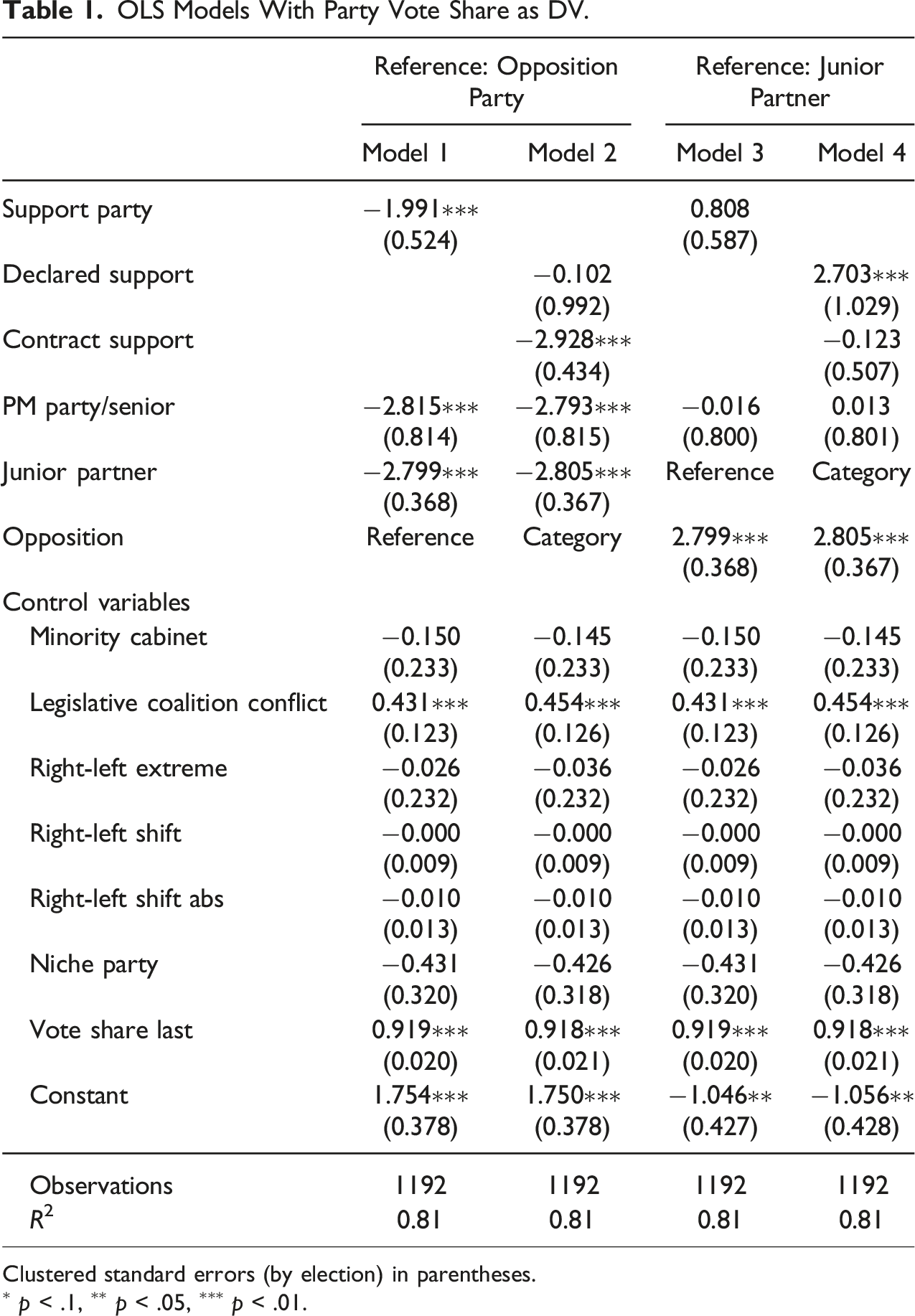
Clustered standard errors (by election) in parentheses.
∗ p < .1, ∗∗ p < .05, ∗∗∗ p < .01.
Figure 1 displays the average marginal effects (AMEs) based on models 1–4 and illustrates the electoral implications of different political alignments. Average marginal effects represent the average change in the dependent variable given a one-unit change in the predictor, with all other factors held constant. For example, an AME of about −2 for support parties compared to opposition parties indicates that, on average, being a support party decreases the predicted vote share by 2 percentage points in subsequent elections, compared to being a genuine opposition member. This decrease is both statistically significant and politically substantive, suggesting that support parties typically cannot avoid losing electoral support. The effect compared to junior coalition partners is insignificant. When we further disaggregate this into ’Declared support’ and ’Contract support’, nuanced patterns emerge. Declared support parties have an almost zero effect compared to opposition parties but perform significantly better, with about a 3 percentage point increase, compared to junior coalition members. In contrast, contract support parties exhibit similar effects to junior coalition members. The effect of government status. Note. Average marginal effects for government status along with 90% and 95% confidence intervals, based on models 1 to 4 presented in Table 1.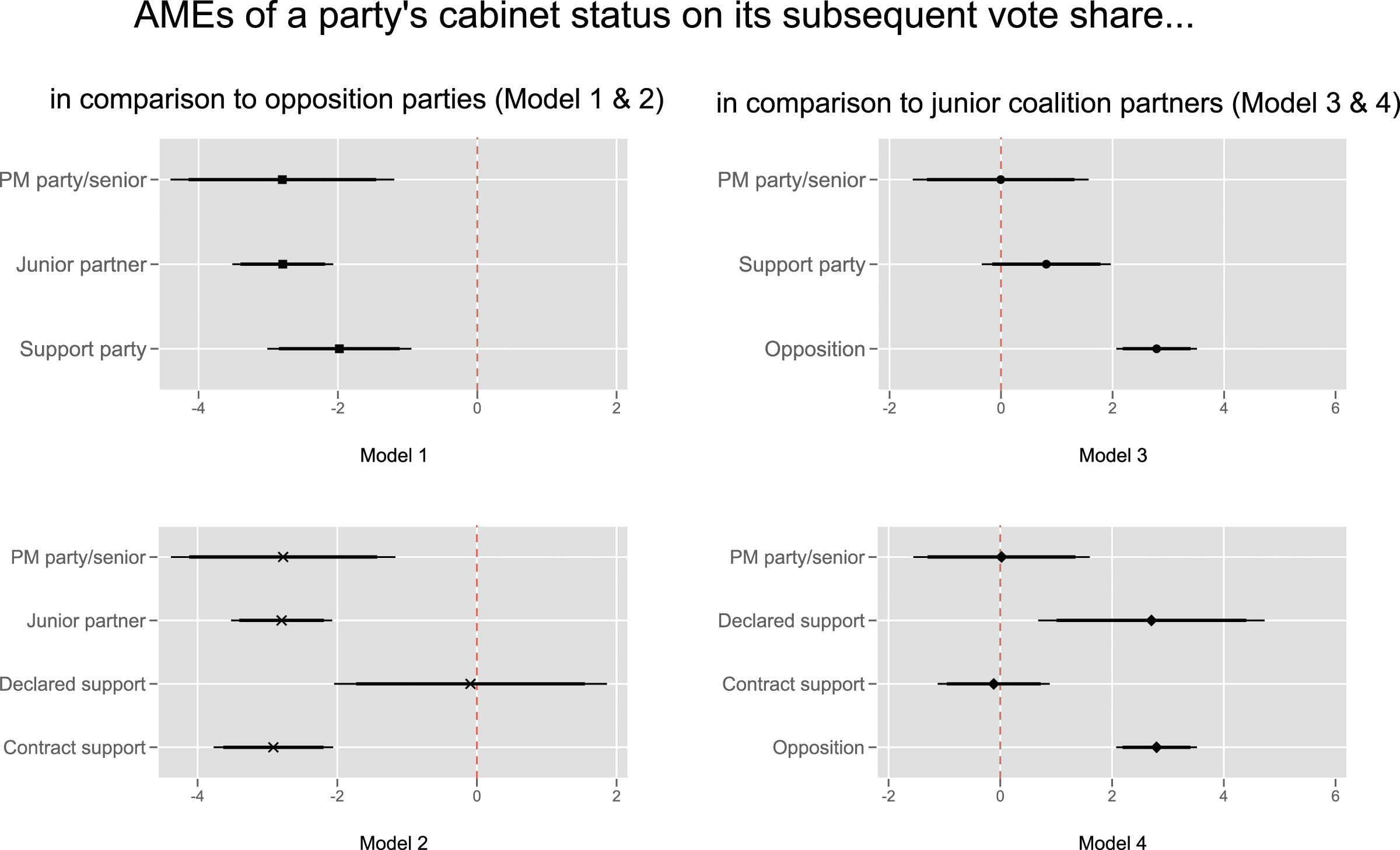
Importantly, when interpreting the substantive effects of support parties, we must consider that, unlike other party types, support parties only occur alongside a minority government. Therefore, their effects must be interpreted jointly. The (non-significant) coefficient for minority status is approximately −0.15 across all models. Consequently, the negative effects of being a support party, in contrast to being a genuine opposition party, should be slightly larger in magnitude in models 1 and 2, while the positive effects should be slightly smaller in models 3 and 4.
Figure 2 presents the results of the two-way fixed effects estimations. The coefficients of government status (junior partner, support party, contract support, declared support) are displayed with 90% and 95% confidence intervals. We have run a series of model specifications based on different samples: (1) the entire dataset that we have compiled (“All cabinets”), (2) only those elections with minority situations where coalition building was necessary (“Coalitions only”), and (3) only those where minority cabinets formed (“Minority cabinets only”). The results for different samples are presented to allow assessing the effect of government status to different benchmarks. For instance, the effect of minority support status in minority settings indicates the effect in comparison to cabinet (senior and junior) and opposition parties under minority governance. By contrast, the effect of minority support status in coalition settings indicates the effect of minority support in comparison to cabinet and opposition parties when a multiparty cabinet is in office. The tabular results can be found in Table 7 in appendix C. The effect of government status, two-way fixed effects models. Note. Treatment effects for government status along with 90% and 95% confidence intervals, based on models 17–28 shown in Table 7 in appendix C.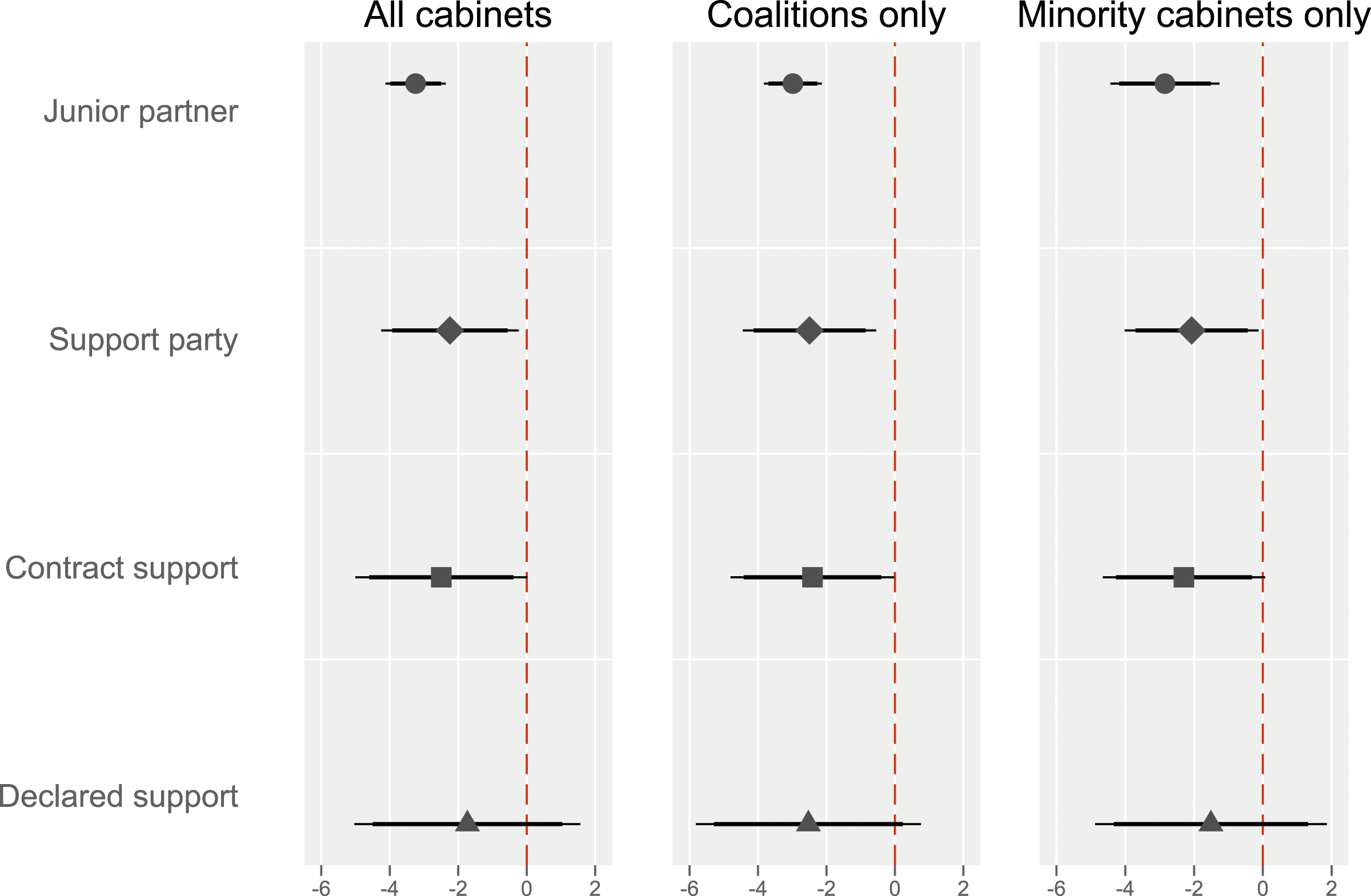
Across the model specifications, the results show that junior parties suffer most substantially from joining a cabinet. On average, they lose 3% of the votes compared to other parties. By contrast, in all model specifications, support parties of minority cabinet also significantly lose votes, about 2.5%, albeit to a lesser extent on average than junior coalition parties. If we however split up minority support parties again into contract support parties and support parties merely pledging their support, the results show important differences. Contract support parties suffer on average significant electoral losses, while the effect for declared support parties is non-significant. This finding is reflected in the models for minority cabinets only, where the effect for declared support parties is not only insignificant but also substantively smaller than the effect for contract support parties. Thus, joining a coalition as a junior partner is more dangerous electorally than supporting a minority cabinet. But when supporting a minority cabinet, merely voicing support rather than signing a formal control is electorally more beneficial for parties.
Robustness Checks
In order to test the robustness of the results, we have estimated a number of additional model specifications. First, we estimate a number of additional linear regression models with different dependent variables and fixed effects. We use the vote change of a party (Hjermitslev, 2020; Narud & Valen, 2008) and weighing the vote change of parties in order to take the size of parties into account (Klüver & Spoon, 2020) as additional dependent variables. We also present the results with country fixed effects. Full results are presented in models 5 to 16 in appendix B. The results are robust and support our theoretical expectations: compared to opposition parties, contract support parties lose more than declared support parties. In contrast, compared to junior coalition partners, contract support parties have a zero effect while declared support parties have a positive and significant effect.
Second, we have estimated a series of two-way fixed effect models with additional time-variant control variables. When controlling for policy extremism, policy shifts, and the ideological divisiveness of the legislative coalition, the size of the effects remain robust. Junior coalition partners suffer most electorally, followed by contract support parties and secondly, by declared support parties. While the effect of junior coalition membership remains statistically significant, as does the effect of support party status, the category for contract support parties is no longer statistically significant when controlling for policy extremism and policy position shifts. However, the effect is just short of traditional values of significance and one major reason for this might be the comparatively low number of “support party treatments” (overall: 61 support parties). This may explain why the combined effect for support parties is still negative and significant. The results can be found in models 29 to 40 in Table 8 in the Supplementary Materials).
In order to further investigate the causal effect of support party status on electoral performance, we make use of recent methodological advances for our panel data of political parties over different countries. The Panel Match Approach (Imai et al., 2021) allows us to apply a matching method to our panel despite its time-series cross-sectional character. The authors also provide an R package for the analysis. Importantly, this approach does not rely on the linearity assumption, but is a nonparametric generalization of the DiD estimator. With the help of this method, a treated unit is matched with control observations that have an identical treatment history. However, in order to apply this method to our data, we need yearly observations for each party which is why we created a second, enlarged data set with observations for every party-year. Thus, for intra-election years, the observations of the latest elections were duplicated. The summary statistics for the data set with almost 6000 observations remain very similar and can be found in the appendix in Table 9. The main effects are presented graphically in Figure 3 the table and additional information can be found in the appendix in Table 15. The effect of government status: Panel Match Approach. Note. DiD effects for government status along with 95% confidence intervals, based on Panel Match approach, models 81–84 shown in Table 15.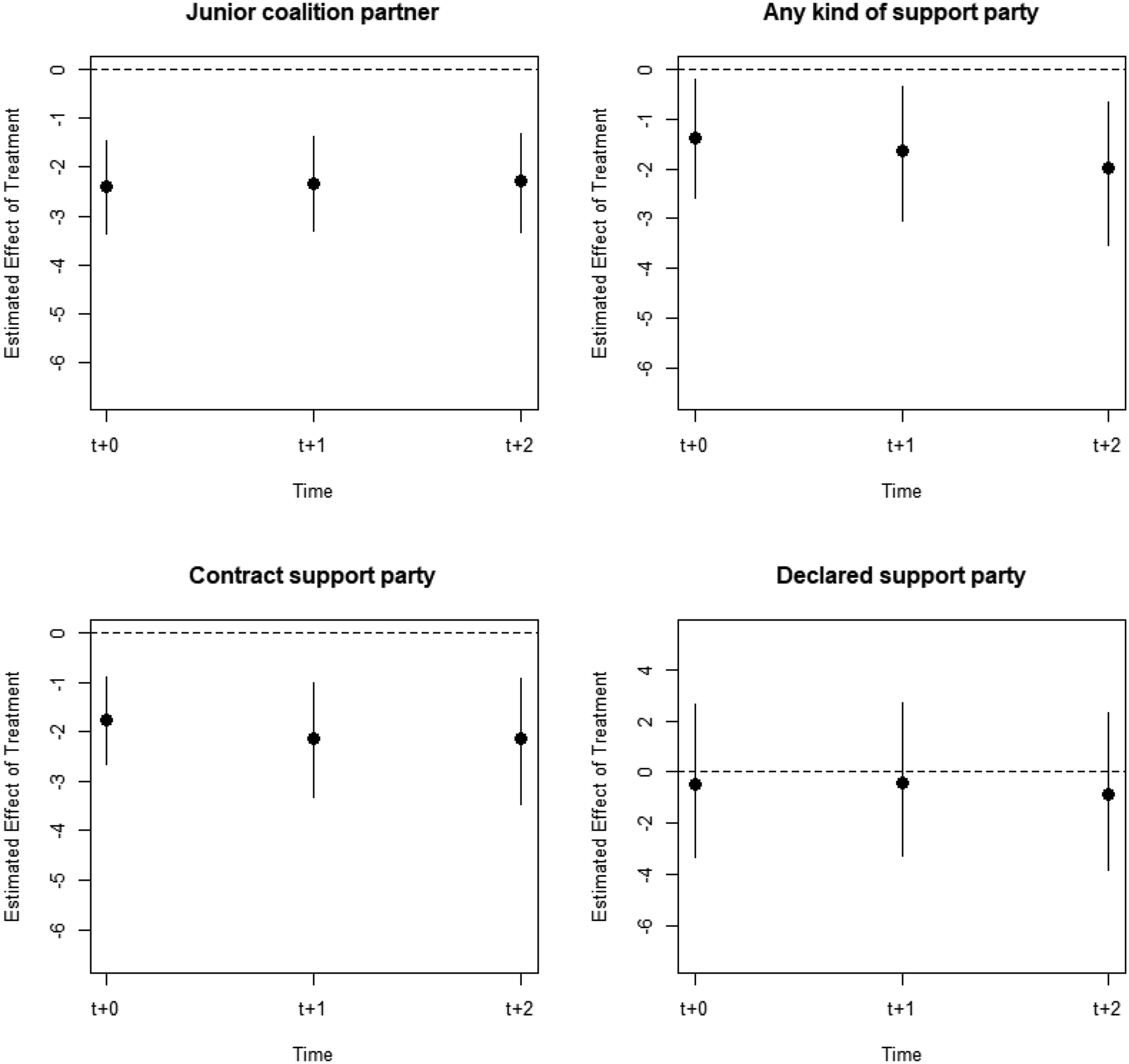
The results mirror the findings presented above: there is a significant negative treatment effect for a party being the junior coalition partner (losing about 2.5%) as well as significant negative, despite somewhat smaller, treatment effects for support parties which seem to be mainly driven by contract support parties (predicted to lose about 2%).
With this enlarged sample, we also re-estimate our main models presented above with clustered standard errors in order to account for similarities in party-election dyads. The results (see Tables 10 and 11 in the appendix) show very similar effect sizes as the results presented above but are highly robust and significant due to drastically reduced standard errors. This indicates that the presented results are in fact substantive. In order to investigate our hypotheses in a most likely scenario, we also estimated our models for three countries only in which we regularly observe minority cabinets and support parties: Denmark, Norway, and Sweden. The results show a negative significant treatment effects for the combined category of support parties (see 13 and 16).
Mechanisms
In order to further shed light on what drives the effects displayed above, we have collected additional empirical evidence to probe the mechanisms that were discussed in the theoretical discussion. More specifically, we have argued that minority support parties are performing better than junior coalition parties as their support for the government is not directly visible for voters. Further, we argued that contract support parties are easier to identify for the voters and are indeed associated with the government. According to our argument, this would result in less knowledge about the composition of government, but in associating contract support parties with the cabinet, not the genuine opposition parties. In what follows, we provide different pieces of evidence to probe these mechanisms.
First, we expect that many voters actually do not even know the composition of the government under minority governance due to blurred responsibilities (Tromborg et al., 2019). We have collected data on the knowledge of citizens about the composition of the government from the Comparative Study of Electoral Systems as well as individual election studies (see Table 18 in the Supplementary Materials for further details). Figure 4 displays the percentage of respondents who correctly identified parties in government. Overall, we see that voters have on average a much easier time to correctly identify the parties in government when a majority cabinet has formed compared to settings in which a minority cabinet is in office. Particularly interesting are the Norwegian and Swedish cases. For both countries, we have data about the correctly predicted government composition when majority and when minority governments were in office. Figure 4 shows that Swedish and Norwegian voters were much better in predicting the government when the cabinet was a majority government as compared to a minority cabinet. Thus, the data supports our argument that voters find it considerably harder to correctly identify the parties in government when minority cabinets are in office as compared to majority cabinets. Public knowledge about the composition of the cabinet.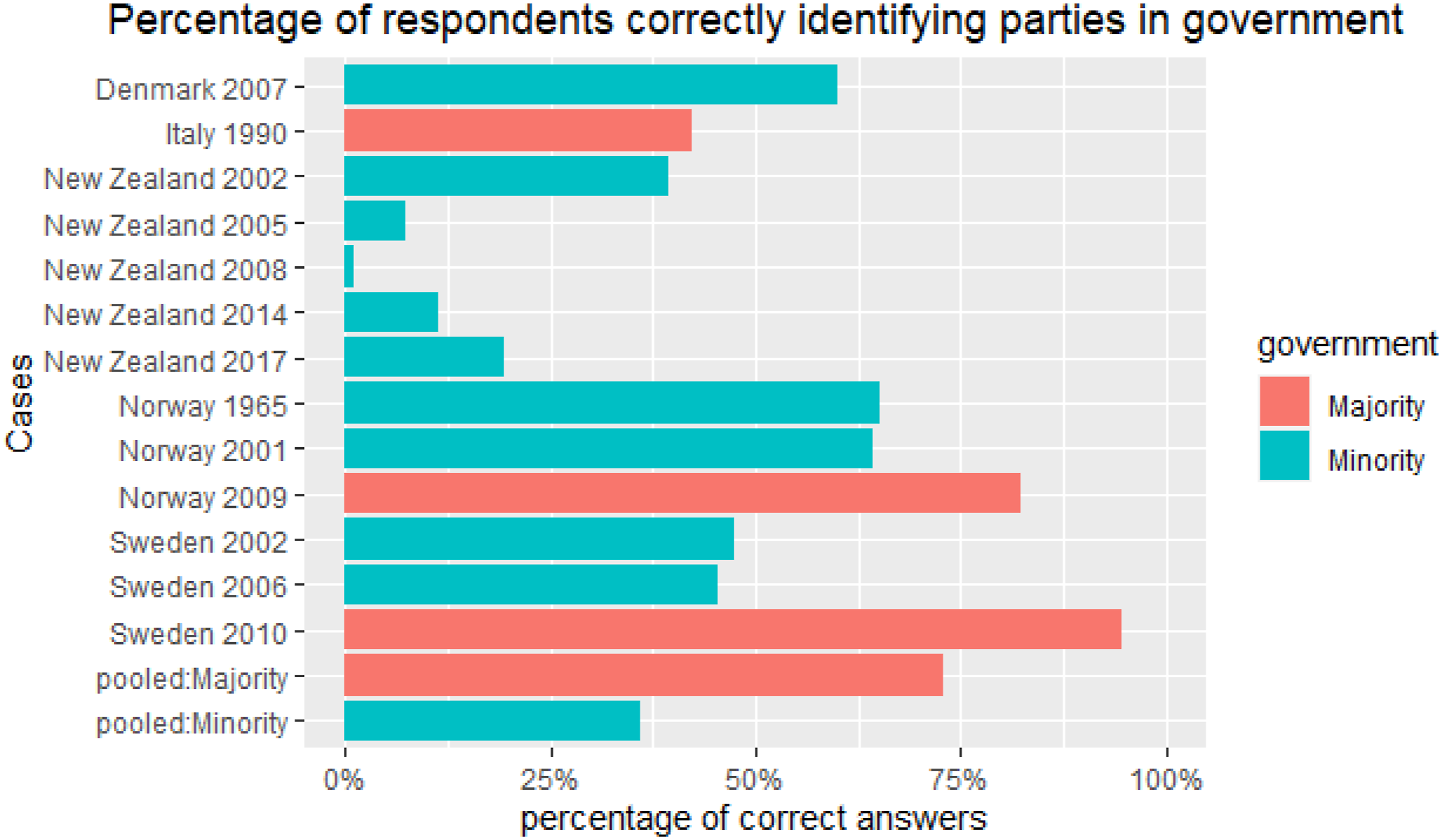
Second, we investigate the causal mechanism behind hypothesis 2 which argues that support parties with written support agreements are more visible to the voters and therefore more likely to experience electoral punishment, too. In order to shed light on this question we can make use of a little natural experiment in Sweden where two center-right parties changed their partisan alliance from being part of the “genuine opposition” to becoming contract support parties to the center-left minority cabinet. If voters are indeed aware of contract support parties being attached to the government, we would expect that the public assessment of contract support parties changes even though controlling for ideological party shifts.
Expectations for Diff-in-Diff Analysis of Public Assessment.
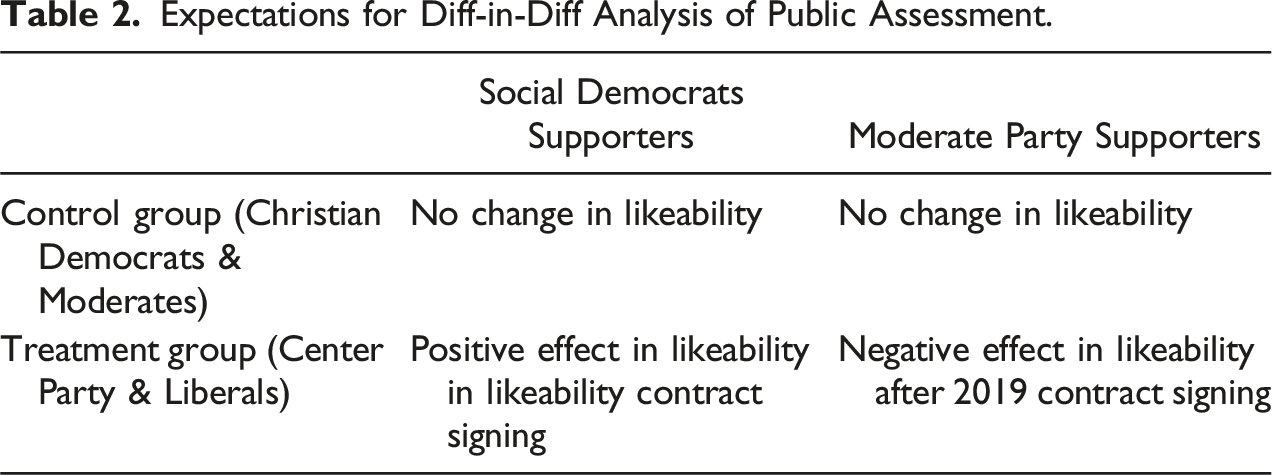
The four center-right parties in Sweden 9 formed a pre-electoral alliance in 2004, the so-called “Alliance”, promising to work together and even publishing a joint program. The four parties formed a majority coalition after the 2006 election and a minority one after the 2010 election. After the 2014 election, they stayed together in opposition, still self-identifying as “Alliance parties” and ran together for the 2018 election. However, after the 2018-elections, the alliance of parties broke down. The Moderates and Christian Democrats wanted to gain office with the support of the Sweden Democrats which would have meant political influence for the extreme right. However, the other two “alliance parties”, Center and Liberals, decided to rather sign a support agreement, the so-called “January Agreement” with the center-left minority cabinet by Social Democrats and Greens. In exchange for 71 policy promises, they supported their former the political opponent in order to avoid giving any influence to the Sweden Democrats. With the help of annual Swedish survey data by the SOM institute (University of Gothenburg, 2023), we investigate the effect of becoming contract support parties for the red-green government for the two treated parties, Center and Liberals, in contrast to the two non-treated parties, Moderates and Christian Democrats.
We do this by analyzing the four parties’ likeability scores by the supporters of the two major parties: the Social Democratic party supporters on the left and the Moderate party supporters on the right (2000–2021). More information about the data can be found in the supplemental materials (E). Descriptive evidence of the likeability of the Center Party for Moderate Party supporters (M in blue color) and Social Democratic supporters (S in red color) is presented in Figure 5. While 0 indicates neutral feelings, positive numbers mean high likeability and negative ones low likeability. From 2000 to 2018, Moderate party identifiers ranked the Center Party more likeable than the Social democratic identifiers. Only in 2019, after the Center Party left the right-wing Alliance party bloc and became a contract support party for the left-wing minority government, the pattern changes and Social democratic party supporters rank the Center more positive than Moderate identifiers do. The pattern looks similar for the Liberal Party (see Figure 13 in the appendix), but different for the Christian Democrats for which there is no significant change in likeability scores (Figure 12). Assessment of Center Party, by party supporters. Note. Center Party, center-right party bloc, joined the Alliance in 2004, left it after elections in late 2018, changed party bloc and joined January agreement in January 2019, stayed on the side of Social Democrats even after elections in 2022.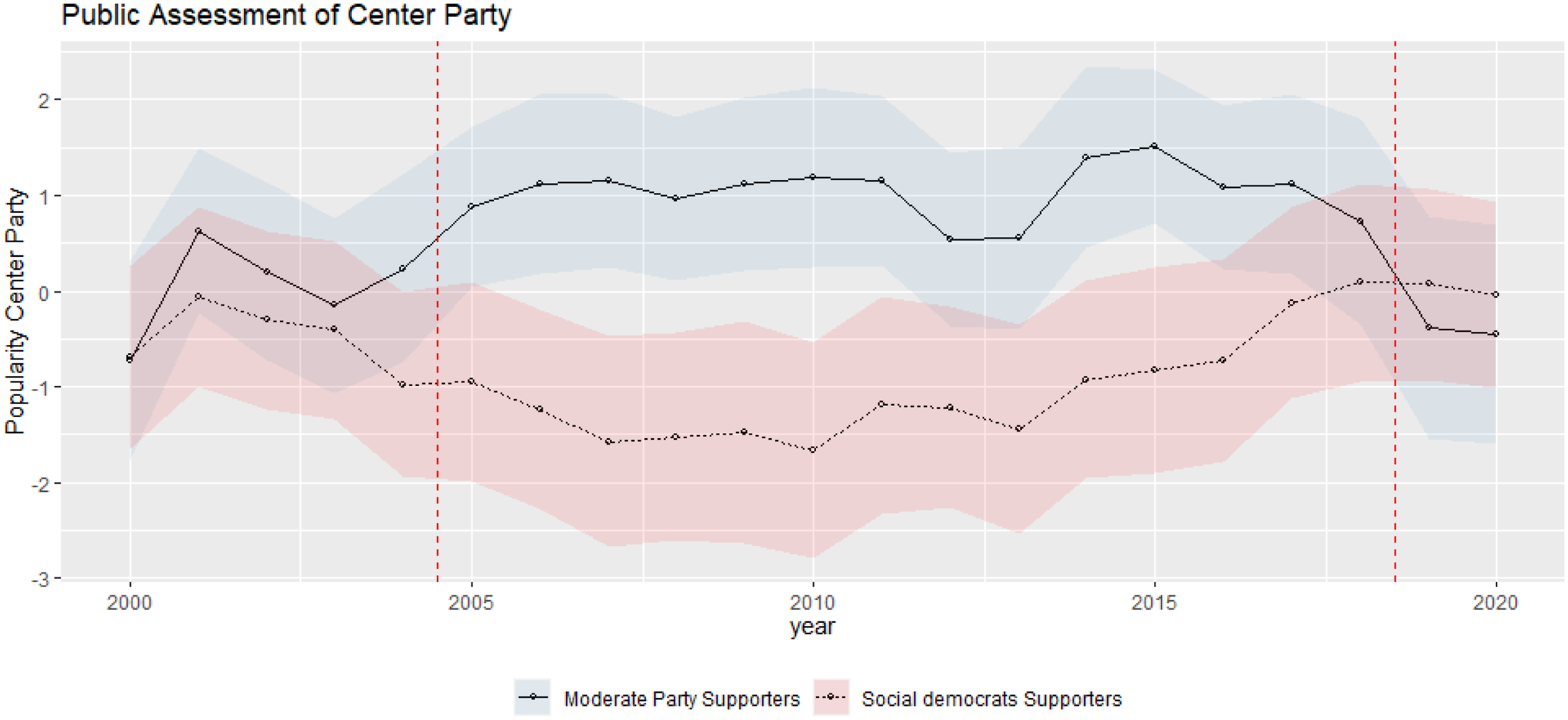
We estimate difference-in-difference models for this data, controlling for the overall likeability of each party in every year and controlling for the ideological distance between parties based on party manifesto data in order to exclude that effects are driven by ideological changes. The Average treatment effects are presented in Figure 6 and in model 17 in the appendix. Becoming a contract support party to the Social democratic-led minority cabinet, has a significant positive effect on the evaluation of a party by survey participants who support the Social Democrats in comparison to the control group who stayed in genuine opposition. In contrast, becoming a contract support party, has a significant negative effect on the likeability of a party by Moderate Party supporters. This finding is striking and shows that voters can change their assessment of parties based on cooperation in parliament despite controlling for ideological shifts between the parties. Thus, voters associate contract support parties indeed with the minority cabinet parties. ATEs for likeability of contract support parties, by party supporters. Note. Ratings of party supporters of Social Democrats (left) and Moderates (right) for the Alliance parties. Treated: Center and Liberals when becoming contract support parties. Control: Christian Democrats and Moderates (for the right plot only Christian Democrats), models 89 and 90 in the appendix. Linear trends assumptions hold only for the model for Social Democrat identifiers (see Figure 10).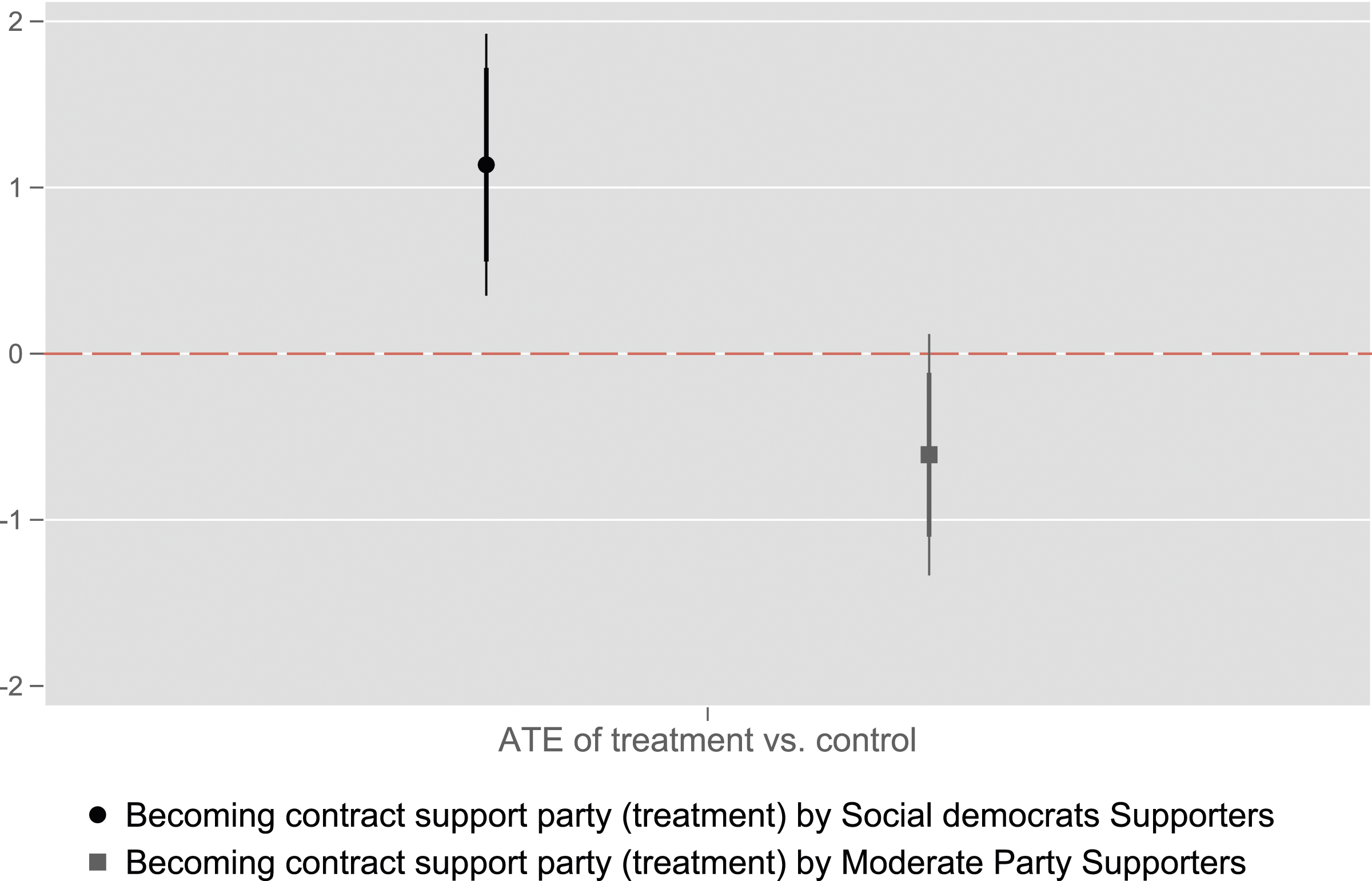
Our presented findings underline that voters are less likely to correctly attribute cabinet responsibility under minority cabinets. Moreover, they show that, on average, voters are indeed able to understand that contract support parties are associated with the government and not the genuine opposition. Thus, the presented data supports our expectations about the causal mechanisms explaining why contract support parties are indeed more likely to perform poorly in upcoming elections and why declared support parties can largely avoid negative effects.
Conclusion
The literature on minority cabinets argues that legislative parties decide about joining cabinet after careful consideration of the advantages and disadvantages of government participation (Strøm, 1984, 1990b). Hence, parties stay out of office, but support a cabinet if they expect the costs of governing to be higher than the policy benefits they may gain as has been theorized for the Sweden Democrats in 2022 in the example in the introduction. Therefore, minority cabinets form if non-cabinet parties assume that they will be able to influence policies from outside the government and anticipate high electoral losses of taking over government responsibility at future elections: if they expect to hit a sweet spot position.
Still, to this point there has been a severe lack of comparative research investigating the theoretical expectation that support parties of minority cabinets experience less severe losses than coalition member parties (e.g., Fortunato, 2021, p. 36). This paper aimed to close this gap by arguing that support parties in general do not have to fear electoral losses to the same extent as junior coalition members. More specifically, we have argued that voters do not make support parties accountable for government policies and that support parties have an easier time to distinguish themselves from cabinet parties. However, we posited that contract support parties, that is support parties which have written and published agreements with a minority cabinet, cannot achieve this image to the same extent as support parties without a formal agreement since they are more associated with the cabinet in the public. Based on a newly compiled data set that combines information on the support party status and the electoral performance of parties, the empirical results support our theoretical arguments and a first compilation of empirical data on the electorate’s (mis-)perception of government participation under minority cabinets supports the causal mechanisms that we have outlined for the expected effects in the theory section.
The findings of this study shed light on the formation of minority governments as well as on the electoral implications of minority governance. Thus, our results challenge to some extent the theoretical argument that it is a rational strategy for parliamentary parties to stay out of government and allow the successful and stable formation of minority cabinets. Support parties can ensure the functioning of minority governance by cooperating with the government parties and receiving policy pay-offs in exchange but should do so rather less visibly. While this strategy may not allow them to enjoy the benefits of office, they are not punished by the voters to the same extent as (junior) coalition parties (Hjermitslev, 2020; Klüver & Spoon, 2020).
Importantly, the findings of this study align with other recently published studies (Fortunato et al., 2021; Hjermitslev, 2023; Tromborg et al., 2019). Specifically, in contexts where voters have more experience with support parties, they recognize these parties (Tromborg et al., 2019) and attribute to them stronger policy responsibilities than to genuine opposition parties, yet less than to junior coalition partners (Fortunato et al., 2021). In countries with limited experience with support parties, voters tend to attribute similar responsibilities to junior coalition members and formal support parties. Additionally, voters generally dissatisfied with government performance also tend to hold external support parties accountable (Hjermitslev, 2023).
The results have important implications for our understanding of party competition. Especially, under minority coalitions, voters seem to struggle to identify the parties participating in cabinet and thus, to attribute government responsibility. Our study therefore supports previous findings that support parties have incentives to distinguish themselves strategically from the cabinet in order to position themselves as opposition parties at points of time when media attention is exceptionally high (Müller & König, 2021). Additionally, our results underline that there are important consequences for the type of agreement support parties close with minority cabinets. On the one hand, previous research shows that contract minority cabinets work similarly to majority coalition governments, that is they are equally successful in the legislative arena (Thürk, 2021) and equally stable (Krauss & Thürk, 2021). On the other hand, this seem to result in comparable electoral losses for contract support parties as for junior coalition members. Support parties, hence, have to consider this trade off carefully when deciding about the formality and institutionalization of cooperation with a minority cabinet.
However, this study is only a first step into to understanding of the consequences for parties of supporting minority cabinets. Future research should concentrate on support party types and support party’s policy success. Especially parties which position themselves as anti-establishment parties and niche parties have higher incentives to stay out of office and not be forced to coalition agreements (Fortunato & Stevenson, 2013). For niche parties, the electoral consequences of government participation might therefore be more costly than for mainstream parties. Moreover, other factors which influence the electoral consequences of (support) parties should be more systematically considered as for example their individual success of influencing government policies and their fulfillment of electoral pledges (Thomson et al., 2017).
Supplemental Material
Supplemental Material - Hitting the Sweet Spot? The Electoral Consequences of Supporting Minority Governments
Supplemental Material for Hitting the Sweet Spot? The Electoral Consequences of Supporting Minority Governments by Maria Thürk and Heike Klüver in Comparative Political Studies
Footnotes
Acknowledgments
We thank Christina Hecht, Ruth Meißner, and Noah Badenhoop for their excellent research assistance. We also want to thank Torun Dewan, Thomas Gschwend, Jan Stuckatz, Christoffer Green-Pedersen, Daniel Höhmann, as well as the participants at the Political Science and Political Economy Lecture in Cologne 2023, for their valuable inputs and comments on earlier versions of this work.
Declaration of Conflicting Interests
The author(s) declared no potential conflicts of interest with respect to the research, authorship, and/or publication of this article.
Funding
The author(s) disclosed receipt of the following financial support for the research, authorship, and/or publication of this article: Heike Klüver is grateful to the German Research Foundation (DFG) for their generous funding of this research through Grant KL 2692/1-1 and KL 2692/3-1.

Supplemental Material
Supplemental material for this article is available online.
Notes
Author Biographies
References
Supplementary Material
Please find the following supplemental material available below.
For Open Access articles published under a Creative Commons License, all supplemental material carries the same license as the article it is associated with.
For non-Open Access articles published, all supplemental material carries a non-exclusive license, and permission requests for re-use of supplemental material or any part of supplemental material shall be sent directly to the copyright owner as specified in the copyright notice associated with the article.
