



Abstract
The “modern” gender vote gap – where women are generally more supportive of left parties than men – is established in many Western democracies. Whilst it is linked to societal changes, and in particular the transformation of gender roles and relations, scholars still grapple with its underlying mechanisms. This paper tests one mechanism currently untested in existing accounts: that women’s specific experiences in less traditional social statuses – in employment, education, or out of marriage – drive their support for the left. Analyses using German, Swiss, and English panel data do show differences in left party support between men and women, and amongst women, according to these social statuses. However, we do not find evidence that these occur because of these experiences directly. Rather, our findings indicate that left-leaning women self-select into certain life trajectories. This suggests that women’s shifting political views due to societal change have corresponding changes in individual life choices.
One of the key electoral transformations in Western Europe over the past 30 years has been the gradual shift in the “gender vote gap”. While women tended to be more conservative and right-leaning than men (De Vaus & McAllister, 1989), they have started to shift to the left since the late 1970s (Dassonneville, 2021). Since the mid-1990s we observe the modern gender vote gap: women, especially from younger generations, are more likely to support left-wing parties than men (Abendschön & Steinmetz, 2014; Giger, 2009; Shorrocks, 2018). This presents parties of both the left and right with new dilemmas whilst trying to build electoral coalitions. Social democratic parties and the libertarian left now find themselves gaining support amongst younger women, who have higher levels of participation in the workforce and education than previous generations, and a different set of priorities to the left’s “traditional” working-class (male) voters. Parties of the right, including parties in the Christian Democratic and Conservative party families, often drew support from religious women (Emmenegger & Manow, 2014) and housewives (Barisione, 2014): two groups that have gradually constituted a smaller proportion of modern electorates. Understanding this electoral transformation is therefore crucial for our understanding of contemporary party competition and electoral cleavages.
Inglehart and Norris’s (2000, 2003) influential “developmental theory” has emphasised the transformation of gender relations and women’s lives that has come with gradual social change. In particular, women’s rising participation in the labour force and higher education, and secularisation and the decline in traditional family forms, are argued to have decreased women’s attachment to the right and increased their attachment to the left, relative to men. Many theoretical accounts of this relationship implicitly or explicitly suggest that women as a group have become on average more left-wing due to their individual-level experiences of employment, education, non-marriage, and divorce, as they shape their political preferences and attitudes in ways that matter for left party support. While these experiences increase women’s economic autonomy and independence, they take place under continued conditions of gender inequality, thus increasing women’s left-wing orientations (Abendschön & Steinmetz, 2014; Bergh, 2007; Giger, 2009; Shorrocks, 2018). For example, Inglehart and Norris (2003, p. 90) emphasise specific elements of women’s experience in the labour market which should affect employed women’s voting choices, such as experiences of horizontal and vertical segregation, over-representation in low-paid jobs and pay inequality, and conflicts between gender-role expectations and the experience of the workplace. Similar arguments are made about women’s less traditional experiences in education and outside of marriage.
We argue that previous research has failed to empirically test this contention that it is women’s specific experiences in employment, education, or out of marriage that drive their support for the left. Extant scholarship, especially on gender vote gaps in comparative perspective, has tended to study differences between men and women without paying attention to how gender interacts with other socioeconomic positions to shape gendered voting behaviour. Where this is examined, research largely relies on observational and (at best repeated) cross-sectional data which has only been able to establish mixed evidence of correlations between socio-economic statuses and gender differences in vote choice. Our aim in this paper is thus to empirically test this mechanism behind the emergence of the gender vote gap on the left, by answering the following question: Do within-individual changes in employment status, education level, and marital status predict change in women’s left party preferences, and are these effects different for women than for men?
To answer this question, we rely on longitudinal data from Germany, Switzerland, and England, countries where we observe a gender gap with women expressing stronger left party support than men. In our analyses, we contrast between-individual and within-individual models to test whether gendered variation in left political support is related to socioeconomic status (changes) that impact men’s and women’s support for left-wing parties differently.
In all three countries, we find that within-individual status changes are relatively unimportant for understanding the gender gap in left-wing voting. While we do find significant group differences, whereby unmarried and highly educated women are more left-wing than similar men or other groups of women, these results cannot be directly attributed to the experience of these socioeconomic statuses. The substantial differences between different groups of women in the absence of within-individual effects suggest the potential for strong self-selection effects. Some women are both more likely to remain unmarried or enter higher education and support left-wing parties. As these political differences more strongly coincide with differences in social statuses among women than among men, our findings suggest that women of different political leanings follow different educational and marital trajectories, rather than their party preference changing as a result of experiencing certain life transitions. This interpretation, however, is consistent with the developmental theory as put forward by Inglehart and Norris, and we expand on this in Discussion section after presenting the main results.
Theoretical Background and Expectations
Women in almost all Western European countries have gradually shifted from being less likely to vote for left-wing parties than men, to being more likely than men to vote for such parties (Abendschön & Steinmetz, 2014; Giger, 2009). The extant scholarship on gender gaps in Western Europe has emphasised how gender relations and women’s lives have been transformed by postindustrialisation, following Inglehart and Norris’ influential “developmental” theory (2000, 2003). They emphasise the role of “long-term structural and cultural trends, which have transformed women’s and men’s lives” (Inglehart & Norris, 2000, p. 442) and that “as women’s and men’s lifestyles and cultural attitudes have been altered by the process of societal modernisation we expect this to have a major impact on their political preferences.” (Inglehart & Norris, 2000, p. 445). The key developments Inglehart and Norris point to are secularisation, women’s increased labour force participation and entry into higher education, and the decline of the traditional family through lower marriage rates, higher divorce rates, and falling fertility rates. Whilst gender inequities remain, these social developments have nevertheless had profound effects on how women live their lives.
In turn, such “structural” changes have both caused and interacted with value shifts. Here, Inglehart and Norris draw on Inglehart’s theory of postmaterialism (Inglehart, 1990), arguing a shift in public opinion towards more “postmaterial” or “self-expression” values – such as quality of life, environmentalism, and gender equality – with postindustrialisation and rising economic security. Inglehart and Norris argue that women in particular have become more supportive of government intervention, more gender-egalitarian and feminist, and more postmaterialist, and argue that these “cultural” shifts, strongly inter-related with societal change brought about by modernisation, are responsible for women’s movement to the left of men in postindustrial nations.
Inglehart and Norris (2000, 2003) specify four approaches to empirically analyse this developmental theory. Firstly, they expect gender gaps to change over time as gender roles and relations within societies shift. Research suggests that the “modern” gender gap has indeed emerged and widened over time in postindustrial advanced democracies (Emmenegger & Manow, 2014; Giger, 2009). Secondly, we should expect differences between societies according to the extent to which these changes have occurred. In line with this expectation, measures of societal gender equality are associated with variation in the gender gap on the left at the country level, with higher levels of women’s labour market participation especially linked to a larger “modern” gender gap in Europe (Abendschön & Steinmetz, 2014; Giger, 2009). Thirdly, we should expect to see generational differences in the gender gap, since each new cohort experiences greater gender equality. Women in younger generations are indeed often more left-leaning (Inglehart & Norris, 2003; Shorrocks 2018; Van Ditmars, 2023), although this generational pattern varies according to the party system context – for example in Britain younger women are not always more likely to support the Labour Party (Campbell, 2006; Campbell & Shorrocks, 2021; Hudde, 2023; Norris, 1999; Shorrocks, 2016). Fourthly, we should expect gender gaps to vary between subgroups within societies according to structural factors such as labour force participation and education (as well as cultural factors, e.g., attitudes towards the role of government and gender equality). Inglehart and Norris’ (2000, 2003) account suggests that gender gaps should vary across societal subgroups because of women’s direct experiences in non-traditional social roles that drive their greater support for parties of the left relative to men. This expectation has received less empirical attention in the literature on gender vote gaps, which tends to focus on the on-average gender gap between men and women rather than testing the contention that individual experiences matter for the increase in women’s left support. The mechanism through which some subgroups see larger gender gaps than others remains underexplored.
Therefore, we focus in this paper on the fourth of these empirical tests of the developmental theory, particularly how gender gaps vary by “structural” factors. Specifically, women in the labour force, with higher levels of education, and who are unmarried or divorced are expected to be more left-wing because of their experience of this socioeconomic status, making women as a group more left-wing on average as their relative proportion in these socioeconomic positions rises. For example, Inglehart and Norris argue how women’s experiences in the workforce can drive them to the left due to “pervasive patterns of horizontal and vertical occupational segregation”, pay disparities, and lower socioeconomic status (2000, p. 446). Others suggest that “employed women are seen to support left parties more because… they are more directly exposed to gender inequalities” (Giger, 2009, p. 481) and that “women’s entry into the workforce has exposed them to discrimination, segregation, and gender inequality” which “makes them more supportive of parties of the left.” (Shorrocks, 2018, p. 139). Similar arguments are made emphasising women’s “new” experiences in education and outside of marriage, as we explore further below, indicating that the dominant theoretical interpretation relies on women’s experience of specific socioeconomic statuses as an explanation for why they are more left-wing on average than men.
Underpinning this is the idea that women in the workforce, with higher levels of education, and outside marriage have increased autonomy and independence from men (Carroll, 1988), creating the conditions for a divergence in preferences between the sexes. Whilst in some ways women’s increased economic activity and financial independence could also be expected to make them more similar to men in their political preferences, the gendered conditions under which these changes have come about has instead shifted women further to the left. We next outline the theoretical mechanisms found in the literature which link specific socioeconomic positions with women’s left voting. We then argue that these theoretical mechanisms have so far been inadequately empirically tested, with few studies examining differences between women and even fewer analysing how men and women’s vote preferences change when their employment, education, and marital status changes. Whilst our arguments here focus on women’s experiences, because these are theorised to be more influential for the emergence of the gender vote gap on the left than men’s, we shall also in places highlight specific mechanisms that apply to men.
Women’s increased entry into the labour market has not entailed equality with men. Women are concentrated in lower paid jobs or public sector roles; may be subject to gender discrimination at work; and often combine employment with the majority of care work in the home; factors that potentially encourage left-wing party support as they are more likely to endorse economic and gender equality and family-friendly policies (Knutsen, 2001; Manza & Brooks, 1998). Women’s labour force participation is found to make women more feminist, because it is an inherently non-gender-traditional role (Giger, 2009; Klein, 1984) and because of the tensions between women’s rising expectations of their economic and social role and the enduring reality of gender inequality (Togeby, 1994). Women’s feminism is then argued to make them more likely to support the left either because this makes women more committed to equality in general or because parties of the left specifically support feminist goals (Bergh, 2007; Conover, 1988; Hayes, 1997).
Thus, because of these experiences in the labour market under conditions of gender inequality, women in work should be more likely to support parties of the left than men in work (H1a), and are expected to become more supportive of the left as a result of their labour market experiences (H1b). At the same time, it is not clear that employment in itself should have such a profound effect on men’s attitudes, since this is a more universal experience for men and they do not experience the same inequalities as women do. 1 Women’s greater support for left-wing parties is thus not just because more women are in work – indeed, women are still less likely to be employed than men – but because women in work are particularly supportive of left-wing parties compared to men in work and have grown in number in recent decades. This expectation is set out in the two hypotheses below. The first specifies the group differences we would expect to see, and the second specifies the mechanism generating these group differences as described by the theoretical discussion above.
Women in the labour market show higher support for left-wing parties relative to women outside of the labour market, while the differences between men inside and outside the labour market are smaller.
Entering into employment will increase women’s support for left-wing parties to a greater extent than men’s.
Turning to education, research suggests that higher levels of education, particularly at University, makes people more economically right-wing and culturally left-wing in their values. For example, higher education decreases support for redistribution, lowers authoritarianism and racial prejudice, and increases support for immigration and the EU (Bullock, 2021; Ford & Jennings, 2020; Gelepithis & Giani, 2022; Scott, 2022; Stubager, 2008; Surridge, 2016; Weakliem, 2002). Higher education is found to make individuals more supportive of centre-right parties and the libertarian left (i.e., the Greens) and less supportive of the populist radical right than other educational groups (Abou‐Chadi & Hix, 2021; Ford & Jennings, 2020; Marshall, 2016). Although there is debate about whether these relationships are attributable to the effects of education itself (see e.g., Simon, 2022), scholars usually point to post-education earnings or within-education socialisation to explain these relationships. However, both are likely to differ for women and men. While the theoretical link between the emergence of the modern gender gap and women’s greater participation in higher education is often mentioned in the gender gap literature, it often remains undeveloped. Therefore, we elaborate on this mechanism below.
Firstly, women’s returns from higher education are lower than men’s, because of educational and then subsequent occupational sex-segregation (Bobbitt-Zeher, 2007; Evertsson et al., 2009; Schulze, 2015), suggesting that the relationship between economic right-wing values and education might be weaker for women, and that highly educated women may be more supportive of the left than highly educated men. Furthermore, women with higher levels of education are more likely to subsequently enter professional occupations and work full-time, suggesting greater labour market integration and enhancing any labour market effects pushing them to the left. Secondly, women’s socialisation experience during education likely differs from men’s again because of educational sex-segregation: women are less likely to study subjects associated with more right-wing economic values, such as maths and science, than men (Charles & Bradley, 2009; Surridge, 2016). Finally, higher education is a further source of feminist orientations, especially for women (Banaszak & Plutzer, 1993; Cunningham et al., 2005; Thijs et al., 2019; Wilcox, 1991). Thus, to the extent that feminism is associated with left-wing voting (Bergh, 2007; Conover, 1988; Hayes, 1997), gaining higher levels of education for women should be a source of their left-wing party support.
Thus, women’s educational experiences should make them more likely to support the centre-left or libertarian left than men’s educational experiences, because women experience lower economic gains from education and may not develop economic right-wing values to the same extent as men because of their subject choices. Thus, whilst men’s experience of higher education may make them more supportive of the left because of its effects on attitudes towards equality or immigration, this should be to a lesser extent than the effect for women. We thus specify the following two hypotheses which set out our expectations with respect to education:
Education Hypothesis A (H2a)Women with a higher educational qualification – especially a university degree – show higher support for left-wing parties relative to women without such a degree, while the differences in left-wing party support between higher educated and not higher educated men are smaller.
Education Hypothesis B (H2b)Gaining a higher educational qualification – especially a university degree – will increase women’s support for left-wing parties to a greater extent than men’s.
It should be noted that women have higher levels of higher education enrolment in younger generations in Western Europe than men (Eurostat, 2022), suggesting that in addition to the conditional effect of education described here, there may also be a compositional effect on the gender gap: women’s greater support for left-wing parties is because of their higher education rates compared to men. However, previous research finds that controlling for education level does not impact on the gender gap, suggesting it is not associated with simply women’s greater levels of education relative to men’s in younger generations (see e.g., Giger, 2009; Shorrocks, 2018).
Finally, remaining unmarried or getting divorced has been argued to increase women’s economic vulnerability whilst at the same time reducing their shared economic interests with men. Men’s on-average higher earning power means that men tend to transfer resources to women in heterosexual marriage; in contexts of low marriage rates, unmarried women are then more likely to rely on the state for economic support (Box-Steffensmeier et al., 2004; Edlund & Pande, 2002). Whilst men and women are negatively economically affected by divorce, this effect is stronger for women (Andreß et al., 2006; Poortman, 2000), a further source of greater left-wing support for unmarried women. Finally, Iversen and Rosenbluth (2006) argue that women’s labour market opportunities interact with divorce risk in shaping women’s left-wing preferences: where women work and divorce rates are high, they will be particularly likely to turn to left-wing parties as they are perceived as being more supportive of enabling women’s employment outside the home. Thus, increasing rates of non-marriage or divorce is theorised to have a more negative effect on women’s economic position than men’s, contributing to the emergence of the gender gap on the left. This discussion leads us to our final four hypotheses relating to marriage and divorce:
Married women show lower support for left-wing parties relative to unmarried women, while the differences between married and unmarried men are smaller.
Getting married will decrease women’s support for left-wing parties to a greater extent than men’s, relative to remaining unmarried.
Divorced women show higher support for left-wing parties relative to married women, while the differences between divorced and married men are smaller.
Getting divorced will increase women’s support for left-wing parties to a greater extent than men’s.
These arguments thus see women’s direct experiences of the labour market, as educated professional women, and being outside a marital union as a source of their left-wing political preferences in contemporary Western European societies. This is consistent with the developmental theory of the gender gap on the left because women’s experiences of these socioeconomic positions become more common as gender roles and relations change in society. This perspective implies that women in employment, with higher levels of education, and out of marriage will be more left-wing than other women and men – as set out in hypotheses 1a, 2a, 3a, and 4a – and that this left-wing orientation is because of these experiences – as set out in hypotheses 1b, 2b, 3b, and 4b. Thus, we should observe conditional relationships, where the relationship between education, labour force participation, and marital status and left-wing voting is moderated by gender, and/or where there are differences between women in their left-wing support depending on their socioeconomic status. Most studies, however, do not explicitly model the conditional relationships. Research instead tends to focus on compositional relationships by adding variables such as employment or homemaker status, education level, and marital status to regressions predicting left-wing vote choice in an attempt to reduce the size or statistical significance of the gender coefficient, without interacting these variables with gender or modelling the relationships separately for men and women. Most studies taking this compositional approach tend to find little evidence for the importance of such socioeconomic status variables for the gender gap (Abendschön & Steinmetz, 2014; Erickson & O’Neill, 2002; Finseraas et al., 2012; Giger, 2009; Inglehart & Norris, 2000, 2003; Shorrocks, 2018).
A handful of studies have explicitly analysed the conditional relationships between gender and vote choice specified above. Manza and Brooks (1998) found employed US women favoured social service spending and thus leant Democratic. Barisione (2014) showed Italian employed women are less supportive of the right than housewives. Post-secondary educated women are more likely to vote for parties that offer economically left-wing, pro-environmental, or internationally cooperative policies than men with post-secondary education or women with lower levels of education (Shorrocks, 2021). Whilst some studies show that single women lean left (Emmenegger & Manow, 2014) or that married women are more right-wing (Barisione, 2014) compared to similar men or women, others find little gender differences by marital status (Shorrocks, 2021; Togeby, 1994).
These studies use cross-sectional data to show differences in left party support among women depending on socioeconomic status. Yet, to adequately test how experiences in employment, education, or in and out of marriage affect vote behaviour, panel data is crucial. Without it, differences among women by socioeconomic status, or the variation in the gender gap across socioeconomic groups, may reflect self-selection into employment, education, and marriage rather than direct effects of these socioeconomic statuses. Few studies have used panel data to study such direct effects, and come to contradictory findings. While in Norway labour force participation or divorce risk barely impacts women’s left-wing voting or social policy preferences (Finseraas et al., 2012), in Germany divorce made women more left-wing compared to men (Edlund et al., 2005). In the US, divorce made men less Democratic, whilst marriage had no impact for men or women (Edlund & Pande, 2002). In the only study we are aware of to use panel data to measure the gender differences in the impact of higher education, Scott (2023) finds that the effect of education on social values is stronger for women.
It is unclear whether these contradictory results are due to the different countries or differences in model specification. These studies also rely on relatively old data, using data from the early 2000s (Edlund et al., 2005; Finseraas et al., 2012) and cohort data with 1965 high school graduates (Edlund & Pande, 2002). Scott (2023) uses more recent data, but the findings are restricted to post-2014 British university graduates. It is also notable that the one study that uses panel data to look at the effect of entry into employment on social policy preferences finds no difference in the impact of this transition between men and women (Finseraas et al., 2012). That study also does not look at the impact of entry into employment on left voting, further illustrating the under-researched nature of the relationship between changes in social status and gendered voting. In this paper, we therefore test our hypotheses using up-to-date panel data from three Western European countries, as described in the next section.
Research Design
Data
Testing our hypotheses requires individual-level longitudinal data with information on respondents’ labour market participation, educational trajectories, and civil status, as well as their political party preferences. To meet these data requirements, we use the three largest household panel studies for Western Europe – from Germany, Switzerland, and Britain. We use all available years of the Swiss Household Panel (SHP), 1999–2019 (SHP Group, 2021), and all available waves from 1999 onwards of the British Household Panel Survey (BHPS), 1999–2009, harmonized with the UK Household Longitudinal Study (UKHLS), 2009–2019 (University of Essex, 2020); and of the German Socio-economic Panel Study (G-SOEP), 1999–2018 (SOEP, 2019).
Our analytic samples comprise, respectively, all British, German and Swiss citizens or non-citizens with voting rights between 18 and 66 years old, as this age range ensures voting rights and the possibility for labour market participation. We restrict our analysis of the BHPS/UKHLS to England to keep the party choice available to voters consistent within the dataset. We exclude the BHPS/UKHLS ethnic minority booster sample to ensure a sample which is representative of the population of England (ethnic minority respondents remain in the main sample), and because the German and Swiss cases do not include ethnic minority booster samples.
Variables
Our dependent variable is support for left-wing political parties. In the G-SOEP, this is operationalized as party identification with the German social-democratic party SPD, Die Linke or Alliance 90/The Greens (Bündnis 90/Die Grünen). In the SHP, we use party preference for the Social Democratic Party of Switzerland (SP), the Swiss Party of Labour, or the Green Party of Switzerland (GRÜNE Schweiz). In the BHPS/UKHLS, we use identifying as a supporter of or feeling closer to the Labour Party or the Green Party. The reference category includes support for other parties. A lack of party identification with any party, support for a candidate instead of a party, support for no party, and intention to abstain are set to missing, to keep the reference category centre and right-wing party support only.
The independent variable indicating labour market participation distinguishes between full-time employment, part-time employment, economic inactivity (i.e., not employed, family care/housework), and the reference category “other,” including retirement, military or social service, being in school/training, or marginal employment. Civil status distinguishes between being married/in a registered partnership, being divorced or separated, and being unmarried as the reference category. Education is operationalized using harmonized international measures (ISCED97) of the highest level of education achieved, recoded into four categories: less then upper secondary education, upper secondary education (including Abitur in Germany and Bac/Matura in Switzerland), post-secondary and tertiary vocational education, and university education.
The analyses distinguish respondents by their reported gender (man, woman). Respondents who change their gender during the panel are excluded. Controls are included using dummy variables for church attendance (1 = once a month or up; 0 = few times a year or less) and having children (1 = yes; 0 = no), as these factors are known to impact political preferences. 2 Secularisation is associated with the emergence of the gender vote gap on the left (Emmenegger & Manow, 2014; Shorrocks, 2018), but primarily because it has reduced women’s right-wing support. We thus do not analyse it as a key independent variable, but include it to make sure that any observed group differences by employment, education, and marital status are not confounded by religiosity. Similarly, having young children has been linked to left-wing voting, especially for women (Campbell, 2006), and it may be correlated with employment and marriage transitions.
Although previous research finds the shift towards the gender gap on the left especially for younger birth cohorts (Dassonneville, 2021; Inglehart & Norris, 2003; Shorrocks, 2018), we do not include a measure of birth cohort in our main models or estimate them separately by cohorts. This is because there is no reason to expect the mechanisms described in the theoretical section to vary by cohort, merely that younger cohorts may have more women who make the transitions into employment and education, and fewer that make the transition into marriage. We do control for cohort as a robustness check as described in the corresponding section.
Modelling Strategy
We estimate two sets of analyses. First, we compare group differences in left-wing party support between individuals by education, labour market participation, and civil status (testing hypotheses 1–4a), with models that estimate the relation between within-individual change and left-wing party support (testing hypotheses 1–4b). To this end, we estimate between-effects (BE) and fixed-effects (FE) models (in an approach similar to Langsæther et al., 2022), with interactions with gender to test our expectations regarding group differences and the differential impact of socioeconomic statuses by gender. Then, we estimate a second set of FE analyses that more explicitly model the transitions in marital status, labour market participation, and educational level, which serve as a more direct test of hypotheses 1–4b.
Fixed-effects regression models (Allison, 2009) measure how change within individuals over time in the independent variables affects their probability to vote for left-wing parties. As these within-individual models control for all time-constant heterogeneity, each observed person serves as their own control group (Halaby, 2004). The inferential power of these models is relatively large. By contrast, between-effects regression models rely on variation between individuals, by calculating group means of the independent variables and relating them to the probability to vote for left-wing parties.
In order to more directly estimate the impact of employment, educational, and marital status changes on party preferences, we estimate a second set of fixed-effects models using variables that more precisely model the transitions of interest by specifying origins and destinations explicitly (following the approach of Kuhn et al., 2021; Lancee & Radl, 2014). Since we are interested in multiple categorical variables, traditional FE models cannot fully capture the within-individual impact of transitioning from one category of interest to the next, as using categorical variables implies interpretation of each category compared to the reference category. If the reference category does not correspond to the previous state of a specific respondent on the variable in question, the FE estimator does not adequately demonstrate the effect of the transition on the dependent variable. Therefore, for instance, the FE regression of a categorical variable for the level of education does not capture the transition of obtaining a university diploma compared to the previous state, having an upper secondary degree, as it compares all n-1 levels of education to a single reference category, which means that the coefficients of n-1 categories of education are estimated in relation to the reference category, which for most is not the previous level of education.
Frequencies of Individuals Experiencing Life Course Transitions in Analytic Samples.
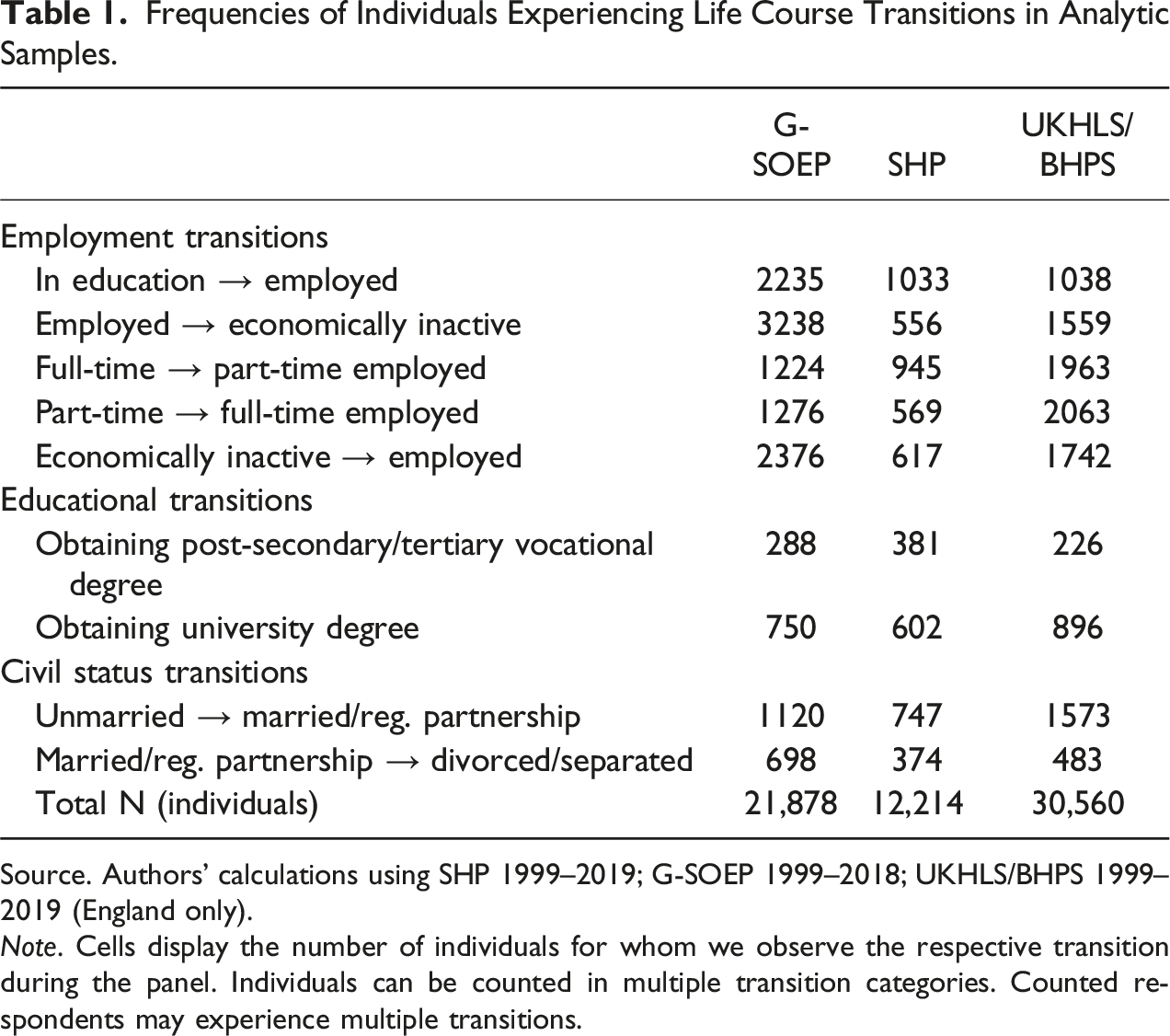
Source. Authors’ calculations using SHP 1999–2019; G-SOEP 1999–2018; UKHLS/BHPS 1999–2019 (England only).
Note. Cells display the number of individuals for whom we observe the respective transition during the panel. Individuals can be counted in multiple transition categories. Counted respondents may experience multiple transitions.
As our dependent variable is a dummy variable, we employ Linear Probability Models (LPM) (Angrist & Pischke, 2008) instead of logit regression in order to be able to compare coefficients across models, for easier interpretation, and because the main results of interest are average marginal effects, for which the application of an LPM instead of a logit model is deemed appropriate (Mood, 2010). In all models, we control for time-specific factors, such as aggregate changes in left-wing party support, by including wave fixed effects (a dummy for all survey years-1).
Results
In Figure 1 we present a descriptive account of the modern gender vote gap in our samples. In all three samples, women are more likely to support left-wing parties than men. In Germany, this pattern is very stable across all years, with an average difference in probability of about 0.07, meaning that women are 7 percentage points more likely to identify with a left-wing party. In England and Switzerland, a consistent gender vote gap is observed from respectively 2006 and 2007 onwards. The size fluctuates between 3 and 7 percentage points. The results for Germany may be more stable than those for the other two countries due to the nature of the variable, as it refers to party identification rather than preference. Difference between women and men in their probability to support left-wing parties. Source. Authors’ calculations using SHP 1999–2019; G-SOEP 1999–2018; UKHLS/BHPS 1999–2019 (England only). Note. Graphs display average marginal effects based on random effects panel models regressing left-wing party support on respondent gender interacted with survey year. Positive values indicate a significantly higher support for left-wing parties among women compared to men.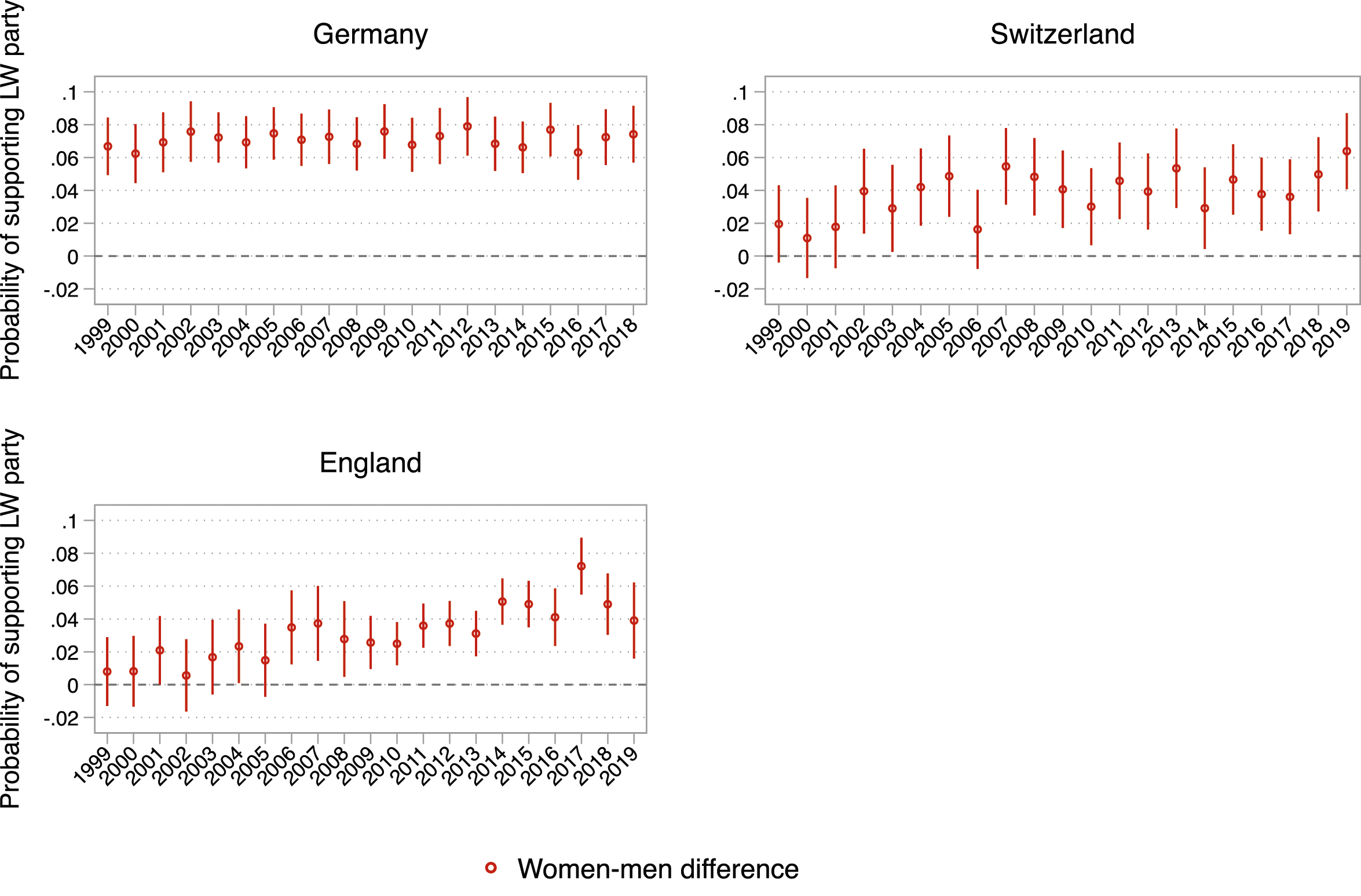
Figures 2 and 3 display average marginal effects by gender of the between-effects and fixed-effects models, respectively. Positive coefficients indicate a larger probability to support or identify with left parties, compared to the reference category. The full regression models are presented in Table S1 and the interaction terms that we refer to in the text are also graphically presented in Figure S1, in Supplemental Information (SI). The most important and coherent results are that within-individual level changes in education, employment, and civil status are – with a few exceptions – not importantly related to a change in support for LW parties, as estimated by the FE models. We thus find little initial support for H1b, 2b, 3b, or 4b. On the other hand, we do find relevant differences between men and women, and between different groups of women, by marital status and education level, which are partially consistent with H1a, 2a, 3a, and 4a. Between-individual models: civil status, education, and employment status predicting left party support among women and men. Source. Authors’ calculations using G-SOEP 1999–2018 (N individuals = 21,878); SHP 1999–2019 (N individuals = 12,214); UKHLS/BHPS 1999–2019 (England only, N individuals = 30,560). Note. Graphs display average marginal effects computed based on between-effects regression models presented in Table S1. Models also include church attendance, having children and wave fixed effects. Within-individual models: civil status, education, and employment status predicting left party support within women and men. Source: Authors’ calculations using G-SOEP 1999–2018 (N individuals = 21,878); SHP 1999–2019 (N individuals = 12,214); UKHLS/BHPS 1999–2019 (England only, N individuals = 30,560). Frequencies of the individuals undergoing transitions are displayed in Table 1. Note. Graphs display average marginal effects computed based on fixed effects regression models presented in Table S1. Models also include church attendance, having children, wave fixed effects and individual fixed effects.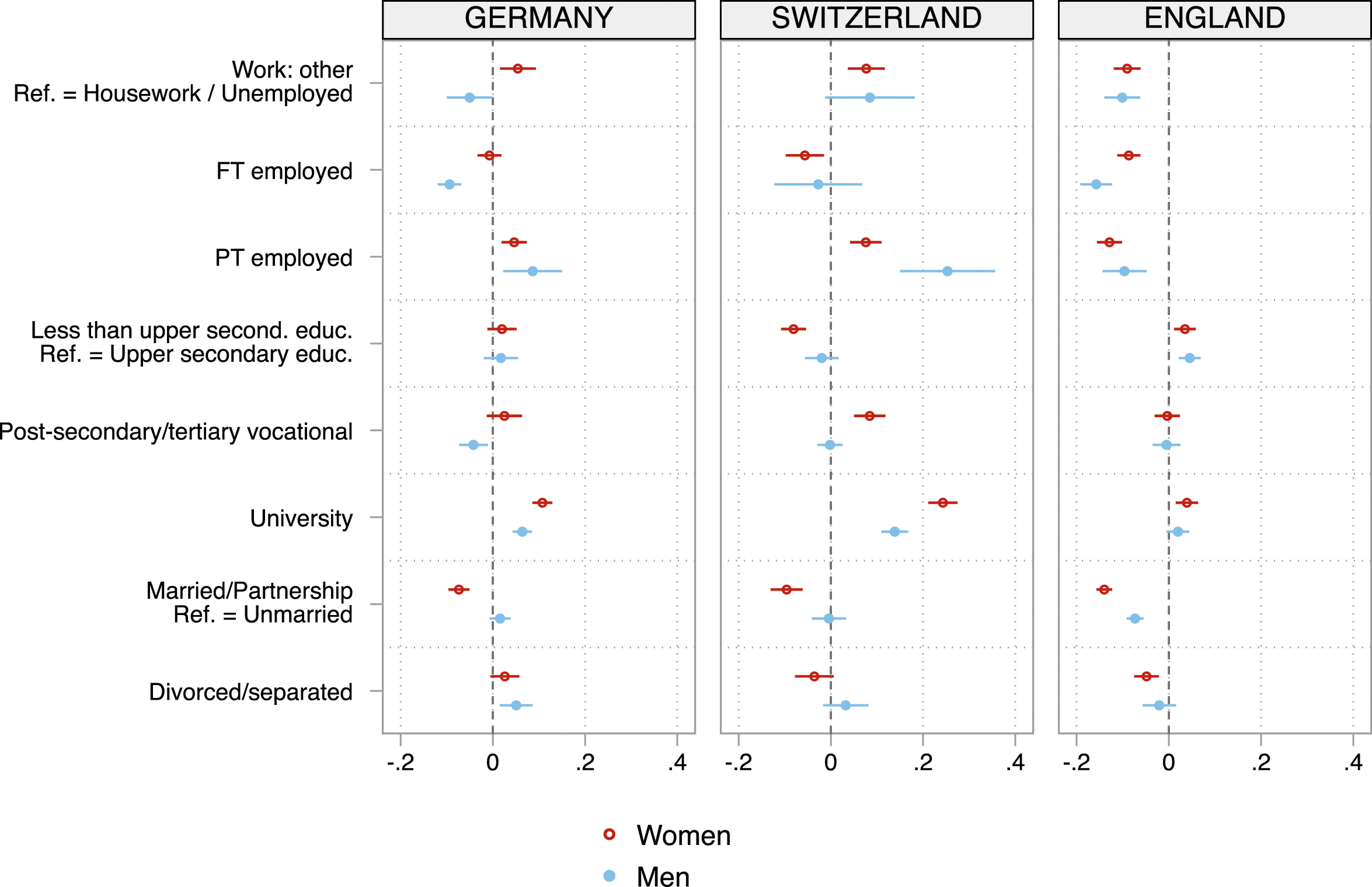
We first discuss the results of Figure 2. Here, Employment Hypothesis A (H1a) has partial support. Full-time working men are less supportive of left parties compared to those not in the labour force in Germany and England, but the statistically significant interaction terms with gender indicate that this difference is smaller among women in England, and absent among German women. This indicates women of these groups are more left-wing than similar men, but surprisingly less left-wing than women out of work. In Switzerland and Germany, those in part-time employment are more supportive of the left than those not in employment, but this difference is smaller for women than men in Switzerland (statistically significant interaction term).
We find clear support for Education Hypothesis A (H2a): in all three samples, women who went to university are more inclined to support the left compared to women with lower educational degrees, while such differences among men are either significantly smaller or absent. The interaction term with gender is statistically significant in Germany and Switzerland. We do not see such a clear trend for the post-secondary/tertiary vocational education.
Pertaining to the Marriage and Divorce Hypotheses A (H3a and H4a), there is moderate to strong support for these expectations. In line with H3a, Figure 2 the BE models shows that married women are less supportive of the left than unmarried women, while for men these differences are absent or significantly smaller (statistically significant interaction terms). The results indicate that divorced women are more left-leaning than married women (but often less left-leaning than unmarried women), but there is only moderate support for H4a, as only in Switzerland are these differences clearly more pronounced among women compared to men indicated by a statistically significant interaction term.
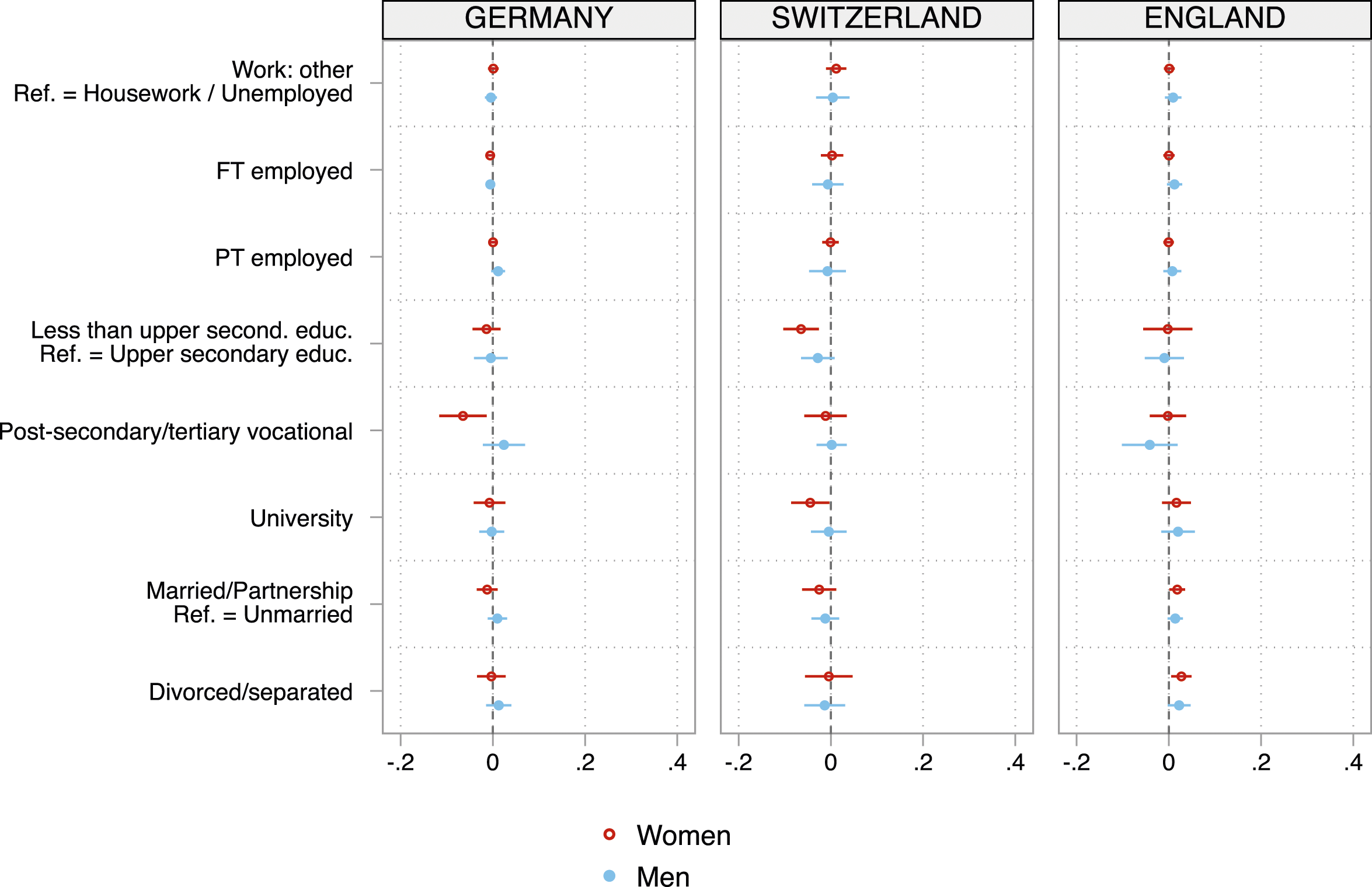
While we thus find many of the expected group differences by socioeconomic statuses, particularly for women, the question remains whether these are the result of experiencing socioeconomic status change these experiences. The results in Figure 3 indicate no support for the second set of hypotheses B (H1-4b) as none of the FE models demonstrate the hypothesized changes in left party support. Contrary to H1b, the within-individual difference from not being in the labour market to being in full-time or part-time employment is not related to change in support for left parties. Regarding education, while the BE results show that the association between left support and higher education is particularly strong amongst women, the FE results indicate that neither men nor women become more supportive of the left after their higher education experience compared to before (contrary to H2b). Surprisingly, obtaining a post-secondary/tertiary vocational degree decreases left party support among German women. However, the large confidence interval of this estimate, due to the relatively small group of respondents that we observe undergoing this change, indicates the uncertainty of this result.
Similar to the results for education, whilst we have seen the political differences between married and unmarried women in particular, we do not find evidence that this occurs as a result of getting married in itself as neither men nor women show within-individual change in their political preference (contrary to H3b). The political effect of the transition from marriage into divorce (H4b) is tested directly in the transition analysis below.
Taken together, the results demonstrate differences between men and women within groups, and between men and women of different groups. In the absence of effects in the FE analysis, these differences mainly point to individuals with different political predispositions and party preferences self-selecting into certain groups and/or trajectories. However, as mentioned, the FE analysis presented is not a full direct test of the B hypotheses. Therefore, we now turn to the results of the second set of FE models that explicitly model all transitions of interest.
Figure 4 plots the average marginal effects of the transition analyses (full regression tables in Table S2 and interaction terms with gender graphically presented in Figure S2 in the SI). Positive coefficients indicate a larger probability to support or identify with left parties after this within-individual transition, compared to the observations prior to this transition. These results are not very different from the FE analysis presented earlier, although there are a few statistically significant effects. Transitions in civil status, education, and employment status predicting left party support within women and men (fixed-effects regression). Source. Authors’ calculations using SHP 1999–2019; G-SOEP 1999–2018; UKHLS/BHPS 1999–2019 (England only). Note. Graphs display average marginal effects based on fixed-effects models regressing left-wing party support on life course transition dummy variables, presented in Table S2. Models also include church attendance, having children, wave fixed effects and individual fixed effects.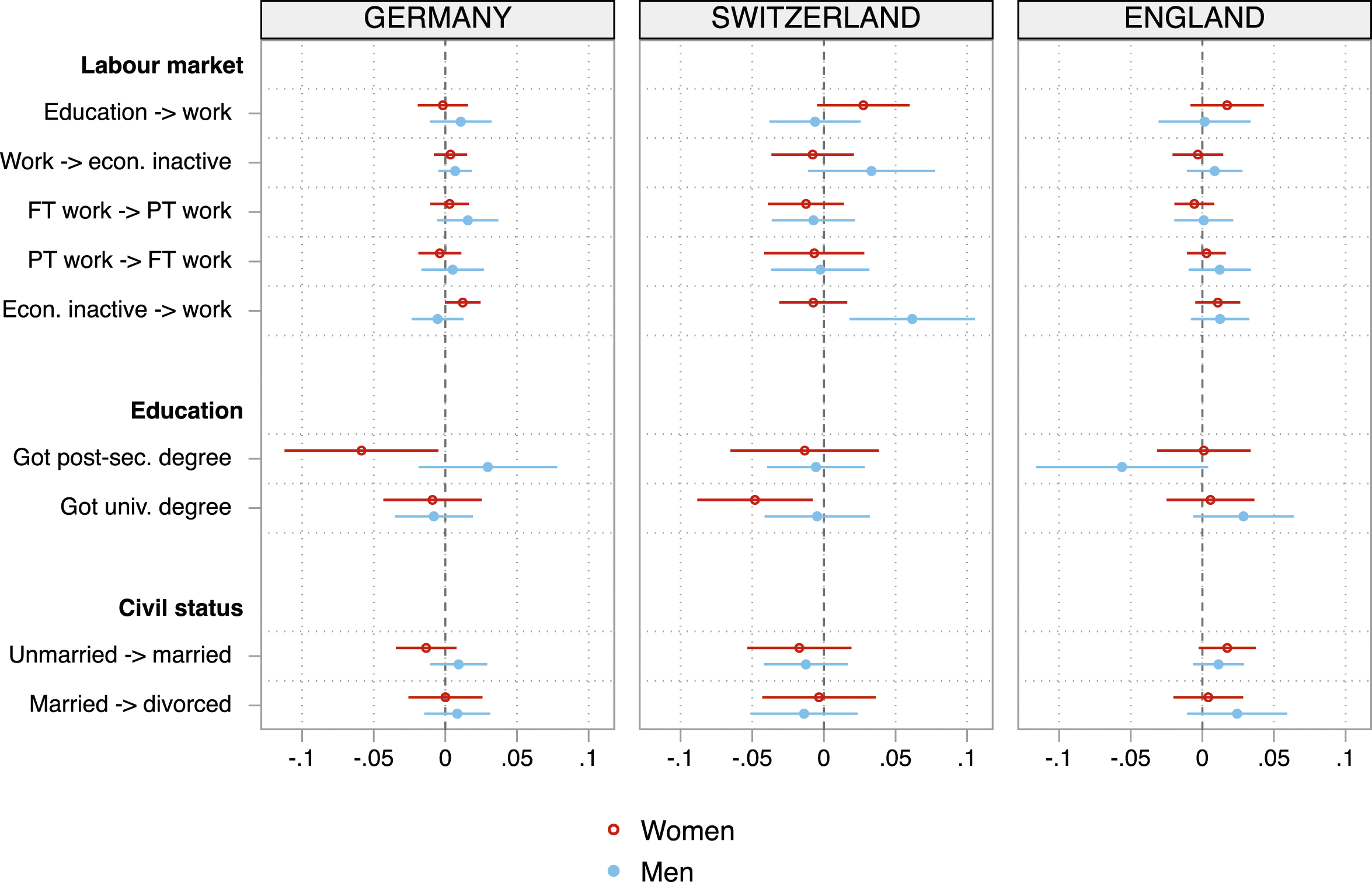
These results do not support Employment Hypothesis 1B, except for the transitions of Swiss women from education into employment, and German women out of the labour market into it, both leading to higher support for left parties but both marginally statistically significant (p > .05). None of the other employment or labour market transitions leads to change in support for left parties among the women in our samples. We do find that Swiss men who transition into employment after having been out of the labour market, move to the left, which might be because they become more supportive of welfare after an experience of unemployment, or potentially because of the subsequent experience of unionisation in the workforce.
Regarding H1b on education, we again find, in line with the foregoing FE analysis, that among German women finishing post-secondary/tertiary vocational education leads to lower support for left parties. We now also find a similar effect among English women, but this estimate is even less certain (p > .05). For men, this effect is not present in all samples. This result is in the opposite direction to that specified in H1b, and it is difficult to explain why we find it, especially because we find no such effect for the transition out of education 4 into employment which is usually around the same time as obtaining a post-secondary or vocational degree. Another difference is the statistically significant negative effect of obtaining a university degree for Swiss women, which is in line with previous work on within-individual change in economic right-wing attitudes as a result of higher education (Scott, 2022), but contrary to literature suggesting that university education leads to more progressive attitudes (Stubager, 2008; Surridge, 2016; Weakliem, 2002).
Finally, we do not find support for H3b and H4b regarding the respective transitions into and out of marriage. In none of the samples do these within-individual changes lead to a change in left party support.
Robustness Checks
We have performed several robustness checks to increase the validity of our findings. All the models reporting these results are available in Supplemental Information (Tables S3–S8) and do not lead to different conclusions. First, we estimate our models excluding green left parties from the dependent variable, considering only left-wing parties that mainly compete on the socioeconomic political dimension. The results of this different configuration do not lead to different conclusions, but, as can be expected, the effects are a bit less pronounced because relevant parts of the electorate (green left voters) are moved to the reference category. Second, we estimate our main models controlling for cohort (BE models only, as cohort is time-invariant), and thirdly without controlling for survey year but controlling for age, to make sure that our estimates are not informed by cohort or age differences in life choices, and not biased due to two-way fixed effects. The results are very similar to those of the main analyses. In these BE analyses, the difference between married and unmarried respondents is more pronounced and more consistent across the three samples, as is the interaction term between marital status and gender. Finally, men are more likely to vote for the populist radical right compared to women (e.g., Harteveld et al., 2015), potentially making them less available as left-wing voters. We therefore also estimate our analyses without populist right parties in the reference category. The results are very similar to the main models: while a few constitutive terms differ in their statistical significance, most importantly, all interaction terms are the same indicating the same differences in left support by social groups and by gender.
Discussion: An Alternative Mechanism
The results presented above show fairly consistent differences between men and women in the relationship between employment status, education, and marital status on the one hand, and political preferences on the other. Men in full-time employment tend to be less left-wing in their party preferences than those out of employment, but the difference between women in and out of the labour market is smaller. Thus employed women are more left-wing than employed men, although they are not more left-wing than women out of the labour force, contrary to what we expected in H1a. Men and women with a University degree are more supportive of left-wing parties than those with lower levels of education, and this difference is greater for women, in line with our expectations in H2a. Married men and women are the least left-wing compared to their divorced and unmarried peers, and these differences are greater for women, again as we expected in H3a and 4a. However, at the same time we find no evidence in both specifications of the fixed-effects models that these differences can be directly attributed to entry into these various socioeconomic statuses. Given the larger differences between groups of women based on educational level and marital status, we interpret this as indicating that the group differences observed are instead due to gendered patterns of self-selection. While our results are consistent with this interpretation, the underlying mechanism that we further elaborate below is beyond the empirical scope of this paper due to the data limitations of the panel data at hand.
This alternative interpretation of the observed group differences suggests that social changes such as secularisation, the erosion of “traditional” family forms, and women’s increased economic independence via the labour market and higher educational attainment, have shifted cultural beliefs in society in ways which have affected both women’s political choices and their employment, education, and marital decisions. Inglehart and Norris’ (2000, 2003) account also emphasises cultural or attitudinal factors, such as attitudes towards the role of the state, postmaterialism, and attitudes towards gender equality, where women are argued to be more progressive than men. However, this account fails to provide strong arguments for why some of these change over time, and indeed there is evidence that women have been more supportive of an active role for government well before the emergence of the gender vote gap on the left (e.g., Shorrocks 2018). Moreover, there is little evidence that women are any more postmaterialist than men (Hayes et al., 2000).
We suggest that the most relevant set of beliefs to have likely changed are attitudes towards gender-roles and feminism, since these are expected to be most impacted by changes to gender roles and relations in society through both “interest-based” and “exposure-based” mechanisms (Bolzendahl & Myers, 2004). “Interest-based” explanations emphasise that those who benefit from greater gender equality – such as women, especially those who work – are most likely to endorse gender-egalitarianism (Kraaykamp, 2012; Togeby, 1994). This suggests that as the numbers increase of those who benefit from gender equality, positive attitudes towards gender equality are likely to increase. “Exposure-based” explanations state instead that as individuals are exposed to feminist ideas and gender-egalitarian arrangements in society, they become more supportive of those arrangements. Exposure to others with gender-egalitarian beliefs can increase gender-egalitarianism (Kroska & Elman, 2009) and generations socialised during periods of educational expansion and secularisation are especially gender-egalitarian (Thijs et al., 2019), suggesting that experiencing a more secular and liberal society shapes a generation’s attitudes towards gender equality. “Exposure-based” explanations thus suggest that value change on gendered issues is not confined just to those who are in socioeconomic positions which mean they benefit from gender equality.
This shift in gender norms towards an endorsement of more feminist positions on gender equality is important for the gender vote gap because such attitudes are likely associated with left-wing voting (Hayes, 1997; Raymond, 2011). Left-wing parties adopt more gender-egalitarian ideologies (Campbell & Erzeel, 2018), have stronger ties to women’s/feminist movements, tend to have more women in their legislative parties (Caul, 1999; Sundström & Stockemer, 2022), and are more likely to support feminist policies – especially those that enable women to combine employment with having children or address women’s economic disadvantage – to a greater extent than right-wing parties when in office (Annesley et al., 2015). As a result, those who are more gender-egalitarian and feminist are more likely to vote left, and the gender vote gap on the left has been associated with women’s greater gender-egalitarianism and feminism compared to men (Bergh, 2007; Conover, 1988). This has been reinforced by secularisation, which comes with less conservative values and reduces the influence of religiosity on women’s vote choice, leaving them able to vote for parties of the left (Emmenegger & Manow, 2014; Shorrocks, 2018).
Importantly, holding gender-egalitarian attitudes can also influence whether women in particular choose to enter employment, higher education, or marriage. If individuals are more gender-egalitarian, then they are more likely to make choices consistent with these values, that is, for women, entering non-gender-traditional economic roles and having non-traditional family structures. Evidence from panel studies suggests that holding gender-egalitarian attitudes is positively linked to women’s labour market entry, additional years or levels of education, and delayed marriage (and vice versa) (Barber & Axinn, 1998; Corrigall & Konrad, 2007; Cunningham, 2008; Cunningham et al., 2005; Khoudja & Fleischmann, 2018). Moreover, not only are women more gender-egalitarian than men in the first place, there is also evidence that these attitudes matter for their life choices to a greater extent than they do for men, especially when it comes to labour market outcomes (Corrigall & Konrad, 2007; Cunningham et al., 2005).
These arguments suggest an alternative process to that set out in our theoretical section, which is still consistent with Inglehart and Norris’ “developmental” theory, as it rests on the changes to gender relations that have occurred in postindustrial societies. Due to these changes and the impact they have on all types of interactions within society – for example in the family, in educational settings, and in the workplace – gender-egalitarianism and feminist orientations increased. Either because this increase is larger for women than men (Brewster & Padavic, 2000; Shorrocks, 2018; Thijs et al., 2019), or because such attitudes have become more important to vote choice over time, this leads to more women on average voting left due to the connection between feminism and support for the left. At the same time, it leads to these same women selecting into non-traditional social positions. The same process does not occur for men because they are less likely to support feminism and be gender-egalitarian, and because these values have less of an impact on their employment, educational, and marital choices. This is consistent with our findings that subgroups of women significantly differ in their left-wing party support, as well as with the developmental theory that emphasizes social change and the transformation of gender roles.
Conclusion
In this paper we theoretically elaborated and empirically tested one possible explanation for how the link between social change – especially in gendered roles and relations – leads to the emergence of the gender vote gap on the left. Existing literature on this relationship, while strongly building on the developmental theory, has not explicitly studied how socioeconomic statuses relate to gender differences in vote choice, leading to mixed evidence and a lack of theoretical clarity, as it is suggested that these changes in women’s life matter for their political choices, yet this has not been adequately tested. We have provided a strong test of a set of expectations that see women’s direct experiences in the labour force, education, and non-marriage as a key mechanism leading them to vote left. Overall, our results do not show support for this perspective. Neither the fixed-effects models nor the transition analysis, in any of the three countries studied here, offer strong support that it is entry into, and experience of, these socioeconomic statuses that increase women’s left-wing support. We find very limited evidence that these transitions are substantively important for women’s – or indeed men’s – left-wing political preferences. This suggests that the increasing number of women who are directly experiencing work, education, and non-marriage – under conditions of gender inequality – is not in itself an explanation for the emergence of the gender vote gap on the left, overall or in younger generations.
At the same time, however, we do find differences between men and women, and between different groups of women, regarding how marital status and education level predict left-wing party preferences. Single women and women with University-level education are more left-wing both than other groups of women and similar men. Because we do not find corresponding within-individual effects, we interpret this as evidence of a self-selection process, where some women both choose to remain unmarried or to gain higher levels of education and make more left-wing political choices. Within the scope of this paper, we are unable to test the value basis of these behaviours, largely because this is not possible with the panel studies we use which do not tend to ask political values and gender ideology questions very often, if at all. We do offer in the preceding section a theoretical explanation that might help to understand this process, based on gender-egalitarian and feminist attitudes. Further research is thus required to understand the attitudinal- or value-based root of the relationship between women’s socioeconomic status – especially non-marriage and higher education – and women’s left support.
One remaining puzzle is that we do not find a consistent relationship between women’s left party support and their labour market participation. Entering the labour market, or moving between full-time and part-time employment, does not lead women to become more supportive of the left despite the literature’s emphasis on women’s labour force experiences – namely lower average pay, discrimination, and difficulties combining work and family life – as a key explanation for the gender vote gap on the left. Moreover, we also do not find evidence that left-wing women are more likely to be employed than other women, although the relationship between employment and left party support varies considerably between the countries included here. This suggests further work is needed to fully understand the relationship between employment, gender, and left party support. It is possible that the interaction between employment, income, and childcare responsibilities is more relevant. This is beyond the scope of our analysis but should be explored in future research.
It is important that the relationship between being unmarried or having a University degree on the one hand, and left-party support on the other, is consistently stronger for women than for men. Interpreting this result as supporting a self-selection mechanism, this suggests that political values are more relevant for women’s life choices than they are for men’s. Our results thus point to the importance of understanding gendered processes of gender and value socialisation which occur in adolescence and young adulthood, before any of the key socioeconomic status changes we study here have taken place. Whilst research has begun to understand how socialisation within the family influences men and women’s ideology differently (Van Ditmars, 2023) and early life experiences are linked to gender gaps in political engagement (Bos et al., 2021; Fraile & Sánchez-Vítores, 2020), we still know comparatively little about gendered patterns of early development of political and gender equality attitudes and values, and how this relates to subsequent life and vote choices. Are some young women socialised into more progressive values, which then influences both their life choices and their party-political support? What elements of the family, social, educational, and political context matter for the (gendered) development of such values? How have these processes changed over time to push younger generations of women towards the left? Future research into why the gender gap on the left has emerged should focus on such questions.
Supplemental Material
Supplemental Material - Social Change and Women’s Left Vote. The Role of Employment, Education, and Marriage in the Gender Vote Gap
Supplemental Material for Social Change and Women’s Left Vote. The Role of Employment, Education, and Marriage in the Gender Vote Gap by Mathilde M. van Ditmars and Rosalind Shorrocks in Comparative Political Studies
Footnotes
Acknowledgements
For helpful comments and feedback on previous version of this paper, the authors wish to thank Rachel Bernhard, the editor and three anonymous reviewers of CPS, as well as the participants of the following conferences and seminars where the article was presented: European Political Science Association (EPSA) Annual Meeting 2021, University of Manchester Democracy and Elections seminar, University of Liverpool Government, Parties, and Elections seminar, and University College London Departmental Research Seminar.
Declaration of Conflicting Interests
The author(s) declared no potential conflicts of interest with respect to the research, authorship, and/or publication of this article.
Funding
The author(s) received no financial support for the research, authorship, and/or publication of this article.
Data Availability Statement
The datasets analysed during the current study are available for the academic community through user agreements and accessed through the following hyperlinks. The BHPS/UKHLS (University of Essex. Institute for social and economic research, NatCen social research, & kantar public, 2020 University of Essex. Institute for Social and Economic Research et al., 2020) is published by the Institute for Social and Economic Research (ISER), University of Essex, https://doi.org/10.5255/UKDA-SN-6614-14. The G-SOEP (SOEP, 2019) is published by the German Institute for Economic Research (DIW), Berlin, https://doi.org/10.5684/soep.v35. The SHP (SHP Group, 2021) is based at the Swiss Centre of Expertise in the Social Sciences (FORS), and the project is financed by the Swiss National Science Foundation (SNSF), https://doi.org/10.23662/FORS-DS-932-6.
Supplemental Material
Supplemental material for this article is available online. Analysis replication files for this article can be found at the CPS Harvard Dataverse (Van Ditmars & Shorrocks, 2024) at:  .
.
Notes
Author Biographies
References
Supplementary Material
Please find the following supplemental material available below.
For Open Access articles published under a Creative Commons License, all supplemental material carries the same license as the article it is associated with.
For non-Open Access articles published, all supplemental material carries a non-exclusive license, and permission requests for re-use of supplemental material or any part of supplemental material shall be sent directly to the copyright owner as specified in the copyright notice associated with the article.
