




Abstract
Unequal representation can result from politicians’ biased perception of public opinion. Existing research has focused on the numerical accuracy with which politicians estimate preferences distributions in surveys. This method ignores politicians’ broader assumptions about public preferences; e.g. regarding their crystallization, salience, malleability, and measurability in surveys. We address these assumptions in a novel two-stage research design using redistributive tax policy in Germany as a case. Interviews with parliamentarians show that voters are perceived as uninformed, disinterested, and susceptible to anti-tax mobilization by business representatives. Support for taxing the rich in polls is dismissed as superficial and irrelevant for political behavior. In a second step, we verify these assumptions in twelve focus groups with high- or low-educated citizens. They largely confirm the assumed indifference and anti-tax attitudes. An education gap in tax preferences cannot be identified. Support expressed in previous surveys tends to disappear in conversations, which aligns with politicians’ experiences.
Keywords
Introduction
This article contributes to the debate about the unequal political representation of lower social classes in redistributive politics (Bartels, 2008; Burgoon et al., 2022; Elkjær, 2020; Elkjær & Iversen, 2022; Elsässer & Schäfer, 2023; Gilens & Page, 2014; Lupu & Warner, 2022). Much research on this topic concludes that lower- and (sometimes) middle-class citizens are less well represented by government decisions than interests of the rich or corporations. Our knowledge about the underlying reasons is, however, limited. As a contribution to filling this gap, we focus on a mechanism that might produce unequal representation: politicians’ perceptions of and assumptions about public support for redistributive policies.
Most previous research has relied on the notions of elites’ ‘responsiveness’ to or ‘congruence’ with preferences in different social strata (Burgoon et al., 2022). Both build on a fairly simple conception of representation. At least implicitly, groups’ preferences are assumed to be exogenous inputs, which policymakers receive as a signal that they attend to more or less selectively and decide to respond to or ignore. A considerable amount of research, to be reviewed in the following section, casts doubts on the realism of this model. In practice, representation involves a great deal of ‘sense making’ among representatives. This includes interpreting ambiguous, incomplete, or outright contradictory signals coming from their constituency (Achen & Bartels, 2016; Henderson et al., 2023). It also means developing persuasive political communication that allows them to mold this noisy signal, in a contested political marketplace, into a foundation for their policy projects (Druckman & Jacobs, 2015; Fairfield, 2013; Huber & Stephens, 2012; Slothuus & Bisgaard, 2021). Such interpretative work is done under conditions of uncertainty (Baumgartner et al., 2011; Kingdon, 1995). What the public wants, how it can be convinced of a policy, and which strategy competitors will pursue are unknowns. Our core interest in this paper is how politicians deal with such uncertainties when engaging with public opinion – and how this might contribute to political inequality in redistributive politics.
To this end, we rely on an innovative two-stage research design addressing the subjectivities involved in the act of representation among political elites as well as citizens. 1 In first step, interviews with 17 politicians (mostly ‘issue specialists’ from the left) provide in-depth accounts of how political elites interpret public support for one of the most redistributive policy approaches available to them: taxing the rich more heavily. Taxation of wealth and high income is a suitable policy issue for our study for several reasons. First, it should be structured by a straightforward conflict line between prosperous segments of the population and low- or middle-income citizens, who should have a direct material interest in lowering top-end inequality. An alignment of the poor and the middle class makes it a priori more likely to achieve anti-rich legislation (Elkjær & Iversen, 2022). Second, and for this reason, the failure to tax the rich more has often been cited as a stark and surprising example for political inequality (Ansell, 2023; Bartels, 2008; Emmenegger & Marx, 2019; Hacker & Pierson, 2020; Piketty, 2021; Saez & Zucman, 2019; Scheve & Stasavage, 2022; Witko et al., 2021). This makes it a relevant case for studying underlying processes.
In the interviews, fiscal policy experts in left parties consistently express a sense of frustration about the lack of policy demand for redistributive tax increases. While taxing the rich correspond to their policy-seeking motivation and is perceived as being in the interest of their constituency, they portray any political project in that direction as an electoral risk. Lower-class citizens are perceived as indifferent or even hostile towards tax increases. The frequently voiced assumption is that the public’s skepticism about redistributive policies is facilitated by strategic political communication of right parties and business lobbyists. Polls indicating support for taxing the rich are perceived as based on superficial attitudes that are politically meaningless.
The interviewees hence point to preference formation as a crucial aspect of political inequality. In their view, representation cannot be limited to responsiveness; it would have to include shaping their constituencies’ perceived interests and preferences. Most of them readily admit that they and their parties shy away from the risky competition for public support with business lobby groups that this would require.
The interview accounts only take us so far, because they could reflect rationalizations or obfuscations of the failure to represent lower classes. In a second step, we therefore attempted to verify politicians’ assumptions about public opinion in twelve focus groups (six each with low- and high-skilled citizens). Focus groups are an important complement to surveys in the context of our study. They make it easier to observe the disinterest, confusion, ambiguities, and non-attitudes that might lead to unclear policy demands. The conversations largely confirm politicians’ assumptions. Taxation generally is not an electorally relevant issue. Not only are even the poorest participants unconvinced of the idea to tax the rich, but their stated reasons largely correspond to what politicians describe as ‘myths’ allegedly spread by business propaganda.
These results contrast with and extend the literature on unequal representation, particularly with regard to (mis)perceptions of public opinion as a mechanism (Broockman & Skovron, 2018; Butler & Dynes, 2016; Henderson et al., 2023; Pereira, 2021; Pilet et al., 2023; Walgrave et al., 2023a, 2023b). Juxtaposing elite perception of public opinion with reasoning in focus groups is a methodological extension of largely survey-based research. For the case of tax politics, this approach leads to a more favorable assessment of politicians’ ability to understand what the public wants. Perceptions of lower-class preferences in particular appear less biased than previously thought. More importantly, however, we broaden the research question beyond the typical focus on the numeric accuracy of support estimates. Instead of asking only if politicians know the result of surveys, we ask in addition which assumptions politicians make about the crystallization, malleability, and electoral relevance of public opinion. This includes the question of how much they trust opinion polls.
The article is structured as follows. After situating our research in the literature on unequal representation and explaining our methodological choices, a first empirical section presents evidence from interviews primarily with left-wing politicians. A second (and larger) empirical section is dedicated to the twelve group conversations. The subsequent section discusses how elite and citizen perspectives relate to each other and what the results mean for debates about elite perceptions of public opinion and unequal representation. As our qualitative empirical strategy generates insights with potential relevance beyond the narrow research question, the section also discusses implications for related academic debates, some of which only became apparent during the research process. This includes topical political science debates on tax attitudes and underlying values (Scheve & Stasavage, 2022), the role of business power in shaping public opinion (Hertel-Fernandez et al., 2019), and meritocratic barriers to redistribution (Jost, 2020). A final section concludes.
Unequal Representation and Public Opinion
There is a growing academic debate about unequal political representation of different social classes (see Burgoon et al., 2022; Elsässer & Schäfer, 2023 for overviews). Several contributions show that positions of political representatives are more congruent with (e.g. Lupu & Warner, 2022) and policy output more responsive to (e.g. Elkjær, 2020; Elsässer et al., 2021; Gilens & Page, 2014) preferences of economically privileged citizens. Ongoing debates concern the questions of whether left parties make a difference (e.g. Schakel & Burgoon, 2022); whether it is primarily the middle or upper class that is overrepresented (e.g. Elkjær & Iversen, 2022); and at which stage of the policy process unequal representation emerges (Alexiadou, 2022; Broockman & Skovron, 2018; Schakel & Burgoon, 2022; Weber, 2020; Witko et al., 2021). Related to the last question, there is a broad consensus that the mechanisms underlying unequal representation are poorly understood. In fact, a call for more mechanism-oriented research can be found in virtually every contribution to the debate.
Despite some contentious points, the literature largely agrees that political representation is biased along class lines. It is also united by a near-universal reliance on survey data, which is analyzed by social categories and then related to some measure of elite positioning or policy output. This empirical setup tends to come with the (usually tacit) ontological assumption that public opinion exists in some pre-political form observable to researchers and politicians. Put differently, many contributions implicitly seem to build on the assumption of exogenous preferences; or at least this is what is suggested by their empirical strategies and interpretations. 2
This is particularly salient in a strand of literature exploring ‘misperceptions’ of public opinion as a mechanism underlying unequal representation. The general argument is that unequal responsiveness results from policymakers distorted views of what voters (in lower social strata) want. For socio-economic issues, there seems to be a perception bias towards positions of affluent voters (Pilet et al., 2023; Walgrave et al., 2023). Possible reasons are that politicians rely more on socially selective personal contacts than on representative surveys of the population (Broockman & Skovron, 2018; Henderson et al., 2023; Pereira, 2021), that they subconsciously discount opinion they disagree with (Butler & Dynes, 2016; Sevenans et al., 2023), or that interest groups strategically distort perceptions (Eichenberger et al., 2022; Hertel-Fernandez et al., 2019).
Narrowing the scientific lens to accuracy of perceived survey patterns ignores the broader question of how politicians understand the actual political relevance of what voters express in surveys. The notion of more or less accurately perceived public opinion necessarily assumes that there is a ‘true’ level of policy support. Practically, this is accompanied by the assumption that surveys are a suitable way to learn about these true preferences. But do politicians share these assumptions?
Much research shows that treating preferences as exogenous inputs to the policy process that politicians could know about and respond to, in principle, is not always realistic (Druckman & Jacobs, 2015; Fairfield, 2013; Slothuus & Bisgaard, 2021). 3 It is plausible – and in line with the misperception literature – that politicians often poorly understand what the public wants, despite ubiquitous polling. However, a gap between actual and perceived preferences is but one possible element to this. On many issues, there simply is no crystallized public opinion to judge correctly (Achen & Bartels, 2016; Zaller, 1992). Particularly when attitudes are amorphous or ambiguous, political elites have opportunities to influence policy support through persuasive communication (Druckman, 2022).
Conceptualizing the elite-citizen linkage as a two-way street does not mean that politicians can easily manipulate preferences. Besides scarce cognitive and material resources for effective political communication, they are limited by competition with other elites as well as exogenous agenda influences (Green-Pedersen, 2019; Grossman & Guinaudeau, 2021). The political attention space is inherently limited (Baumgartner et al., 2011) so that only few issues can be the subject of persuasive efforts. And such efforts become harder when counter framing has to be overcome, particularly when competitors possess superior resources (such as money, media access, or reputation). Effectively, individual policymakers then often face uncertainty a) about what the public or their constituencies prefer; and b) about which effects their communication strategy would have on policy support and electoral prospects.
The dual uncertainty (‘what do voters want?’; ‘which communication might convince them?’) points to politicians’ interpretative work as a crucial element of (mis)representation. In this perspective, understanding when politicians respond to ‘preferences’ forces us to address a number of aspects that go beyond the accuracy of perceived support. On any given issue, policymakers have to make more or less informed assumptions about whether the public holds meaningful attitudes; whether these are (or could become) sufficiently strong to influence vote choice; whether counter-mobilization should be expected; and whether such counter-mobilization could benefit political competitors.
These subjective appraisals often result in non-actions, which is probably why they have received little attention in previous scholarship on unequal representation. They, hence, largely constitute a black box. What follows, in our view, is the need to better understand the assumptions politicians make about (the malleability of) public opinion, the strategic considerations they derive from these assumptions, as well as their behavioral implications. Moreover, we would argue that these issue-specific assumptions are context-dependent and go beyond a mere estimate of average support in the population. They hence do not lend themselves to observations in surveys. This is why we see a need to study politicians’ subjectivity – as well as the plausibility of their assumptions - qualitatively.
Case Selection and Methods
Understanding elites’ and citizens’ subjectivity in representation dynamics arguably requires in-depth engagement in case studies. We do so by focusing on taxation of high incomes and wealth in Germany. Germany serves as a typical case (Gerring & Cojocaru, 2016) for unequal political representation in rich democracies. Most importantly, it shows patterns of unequal responsiveness that are typical for Europe and the US. Both, the bias in German politicians’ perceptions of public opinion (Pilet et al., 2023) and in decision-making in favor of top earners (Elsässer et al., 2021) are consistent with findings for most other rich democracies (for an overview, see Elsässer & Schäfer, 2023).
Pilet et al. (2023: Appendix) show that the perception bias in favor of the rich applies to German tax policy. About 80% of Germans want higher incomes to be “taxed more heavily than today”, a value that politicians significantly underestimate (63%). Elsässer et al. (2021: Appendix) highlight taxing the rich, in addition, as an issue with relatively large preferences gaps, which makes selective responsiveness more likely. They show that 70% of unskilled German workers support “to make sure that people with high income or assets would pay more taxes”, while only about 40% of business owners do.
We confirm this class gap in preferences in a quasi-representative online survey conducted in 2021 (Figure 1).
4
The share agreeing that “taxes for the rich in Germany should be increased a lot” or “somewhat” is almost constant for low-to-middle incomes, but sharply drops for high-income earners. The fact that government (non-)action was in line with preferences of the latter makes tax policy a key example of political inequality (in Germany) and a suitable case for our analysis. It also illustrates how Germany may be viewed as a standard case for how politics of taxation, inequality, and redistribution have developed in many advanced capitalist democracies (Fastenrath et al., 2022; Piketty, 2021; Scheve & Stasavage, 2022). Support for taxing the rich more in Germany by income (2021).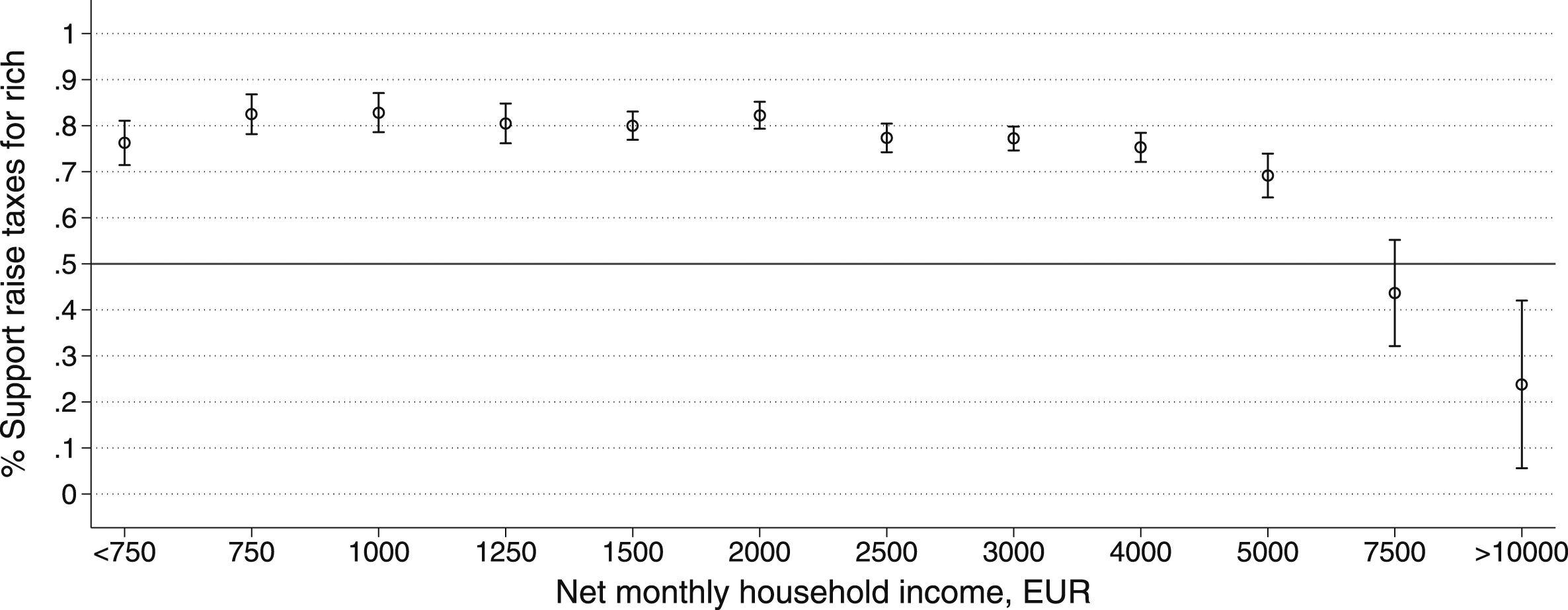
Our main goal is to understand representatives’ assumptions about public opinion and the extent to which elite perceptions and actual attitudes align. We therefore analyze representation in a novel two-stage research design in which we explore linkages between the supply and demand sides of tax policy. 5
In a first step, we conducted 17 interviews, mostly with politicians who represent one of the three left parties in the Bundestag’s finance committee (Social Democrats [SPD], the Greens, and the Left). We hence target actors with potential policy motivation to tax the rich and with first-hand experience in tax politics. To go beyond potentially distinct views of issue specialists (Varone and Helfer, 2022), we also interviewed one of the two SPD party leaders and a campaign strategist (each twice). The accounts were remarkably similar across backgrounds. Also three supplementary interviews with liberal and conservative MPs did not challenge the general perception of public opinion among left-wing politicians. Still, our specific focus should be borne in mind as a potential limitation to the generalizability of our findings.
Our goals were to understand interviewees’ policy motivation, their subjective perception of public opinion on taxing the rich, and what that means for political opportunities in tax politics. The design is elaborated in Fastenrath et al. (2022), where we present a broader picture of elite beliefs that feed into tax politics. Instead of focusing on policy outcomes (as in most contributions on unequal responsiveness), elite interviews bring us closer to the nuts and bolts of policy representation (López et al., 2022). How do politicians interpret their role as representatives? How do they form an image of voter preferences? And how do they assess their opportunities to shape tax discourses? By addressing these and similar questions, elite interviews are an important tool to open the black box of unequal responsiveness.
In a second step, we conducted twelve focus groups, with five to six individuals (64 in total). To facilitate smooth interactions and free expressions, each group exclusively consisted of either low- or high-class participants (measured by education). The primary goal was assessing the extent to which the assumptions of left-wing politicians correspond with or deviate from how voters reason about taxing the rich.
In principle, different methods are conceivable for this task. Focus groups offer the advantage (over closed survey items) of getting to the bottom of the subjective reasons for preferences (Cyr, 2019, p. 11). They thereby provide insight into the relative importance of issues, as non-attitudes and disinterest can be better discerned. A concern in survey research is that closed items incentivize making up non-existent attitudes (Bishop, 2004). This risk is particularly severe for attitudes towards specific policy issues (Berinsky, 2017), whose measurement is central for survey-based responsiveness research. The face-to-face encounters in focus groups raises the bar for attitude improvisation and quickly reveal inconsistency, uncertainty or ambivalence towards political issues (Goerres & Prinzen, 2012). The absence of crystallized preferences might be a key aspect of the representation process and hence should be reflected in the method. Tax attitudes might also reflect contradictory values (Scheve & Stasavage, 2022; Yakter, 2023), which are artificially collapsed in survey items (Zaller, 1992).
In addition to individual views, focus groups allow examining interactive processes (Cyr, 2019; Munday, 2006, p. 90). Generally, the presence of other participants has to be acknowledged as a potential weakness, because social desirability or group think plays a bigger role compared to anonymous surveys. However, this can be turned into an advantage if researchers are directly interested in the direction of such biases. Focus groups “offer an opportunity for researchers to see exactly how views are constructed, expressed, defended and (sometimes) modified during the course of conversations” (Wilkinson, 1998, p. 193). This provides concrete advantages for our research question. By observing how citizens negotiate the pros and cons of taxing the rich, we can learn about which arguments are invoked spontaneously to counter opposing attitudes, how stable attitudes are in situations of disagreement, and – crucially – which frames are most persuasive. The interactive data can thus shed light on whether policymakers are right about certain discourses dominating voters’ thinking about taxing the rich.
Group discussions took place at two different time periods (February-April 2022 and February 2023) in the test studio of a commercial agency in a large German City (Cologne). Given the proximity to the Covid crisis, the Federal Election of 2021, and the energy crisis, fiscal and tax policy were relatively salient issue in the German media, increasing the likelihood that participants had pre-existing opinions. While moderation was carried out by the research team, organization, recruitment, and infrastructure were provided by the agency. Compared to participant observation (Cramer, 2016) or focus groups with acquaintances (Gamson, 1992), a commercial agency might be criticized as an unnatural setting for political conversation. However, a recruitment process independent of pre-existing ties minimizes the risk of selecting politically interested groups. It also provided participants with sufficiently diverse political leanings (Appendix D). Most importantly, it ensured the variation in education necessary for our research. Given our focus on political inequality along class lines, we were interested in the attitude gap between low- and high-educated citizens. The analysis of these two groups in separate sessions follows the methodological literature, which clearly recommends homogeneous groups to reduce fear “about being judged by outsiders who do not share their experiences and perspectives” (Morgan, 2018, p. 51).
All groups began with introductions and a warm-up question. By asking about participants’ recollection of election campaign issues or political topics important to them, we could see whether tax policy, inequality, or redistribution were mentioned spontaneously. Only afterward did we ask directly what participants thought of the general idea to tax the rich more heavily. Depending on the course of the discussion, we then used stimuli in the form of videos, pictures, and excerpts from studies to confront participants with the different arguments for and against taxing the rich. The arguments and perspectives in such stimuli can help participants express their views (Gamson, 1992, p. 24). In our case, they also help to assess whether certain arguments resonate more or less with the groups (e.g. by getting reactions to a TV debate on the topic). We generally ended with asking whether winners of the crisis (the pandemic, energy crisis after the Ukraine invasion), should be taxed more heavily to compensate the losers.
For a systematic presentation of results, we coded individual positions expressed in the conversations into four categories (Appendix C). “Contra” and “Pro” (taxation) were assigned if participants expressed clear objections to or support for tax increases for the rich. Participants who combined negative and positive arguments without a discernible preference were coded as “Ambivalent”. “No attitude” was assigned to participants who did not express any clear opinion.
An important methodological extension consisted in the combination of focus groups with closed survey items. Out of cost considerations, this was limited to four groups, in which participants received a short survey one week before and after the in-person meeting. The survey largely consisted of items to distract from the main question of whether “Rich people in Germany should pay higher taxes”. The comparison of the answers to this closed survey item with the statements in group discussions is valuable in two ways. Methodologically, we can directly address whether focus groups add value compared to the standard survey approach in responsiveness research. Substantively, we can assess whether surveys and direct interactions between politicians and voters might create different signals to political elites.
Elite Interviews: How do Politicians Perceive Public Opinion on Taxing the Rich?
In this section, we describe the findings from the interviews. Non-anonymized quotes are referenced with interviewees’ last name (additional details are in Appendix B). As described above, we focus on ‘left’ members of the Bundestag’s finance committee and two questions: how much public support do politicians perceive for taxing the rich? And which assumptions do they make about the processes underlying preference formation and change? The presentation will be kept brief, mainly because accounts varied little. A fairly straightforward and ‘saturated’ narrative about public opinion emerged early in the process. It hence does not take much nuance to give justice to the material. Brevity also maximizes space for the more intricate follow-up task of assessing the narrative’s validity in focus groups.
Left politicians generally expressed strong policy-seeking motivation to tax the rich. Against the background of income and wealth concentration, budget deficits, the cost of various crises, and the need for public investment, a higher tax burden for the rich appears fundamentally fair to them. They also believe taxing the rich is economically feasible. They generally do not buy into narratives of capital flight (see Fastenrath et al., 2022 for detailed evidence on these points). Hence, support for taxing the rich is high among left-wing fiscal policy experts.
How do they perceive public support? A first observation is that all 14 interviewed left-wing politicians expressed clear assessments of public opinion. They either mentioned (and elaborated) unfavorable public opinion spontaneously in their response to our open question about political barriers to taxing the rich (five interviewees) or they unequivocally confirmed it as an obstructive factor when we asked about it directly (eleven respondents). We take this as a sign that our interviewees had engaged with the question, which is unsurprising in their role. The political feasibility of tax reform likely has been the subject of internal discussion. As we show below, there seems to be a joint and rather crystallized narrative in left parties about tax politics and the role of public opinion in particular.
A second observation is that all politicians (also from the different camps) perceive the public as somewhere between lukewarm and hostile to the idea of taxing the rich more heavily. This is in stark contrast to opinion polls on the topic. Politicians are well aware of this contradiction and sometimes explicitly try to make sense of it (see below). A virtually unanimous assumption is that the public is tax illiterate and that “for many people, the tax issue is too complex” (Petring I). Complexity and the necessary abstract reasoning make tax policy, first and foremost, an unpleasant issue to engage with. This produces indifference and non-attitudes. As one social-democratic interviewee expressed it, “Very rarely does anyone come to me in my Bürgerstunde [constituent meeting] and want to talk to me about national taxation under redistributive aspects” (SPD MoP).
Complexity is not only believed to lower the priority citizens’ attach to taxation. It is also believed to foster a range of misunderstandings and uncertainties that prevent citizens from supporting taxes for the rich. At the core of this uncertainty is the question of who would really be affected by tax increases. A key example is that people tend to confuse marginal and average tax rates. As a consequence, voters “believe that if we raise top marginal rates, they have to pay more taxes” (Left-wing party MoP) or that “think they pay 42% [top marginal rate] on their entire income, which is obviously nonsense” (Greens MoP). Another confusion is between taxes and social-security contributions (that are capped and therefore highly regressive), which leads to an erroneous identification with the interests of the rich. “Well, I am often under the impression that the population assumes to be broadly affected when it concerns taxes. We experience that, when the FDP [Liberals] campaign with ‘More Net of Your Gross Wage!’, this is appealing for the entire population - although many do not pay much in taxes and low-wage workers pay almost none (…). And we are always confronted with the statement: ‘yes, the state always wants more of our money’. (…) Everyone wants more money in the pocket and fewer deductions.” (Kiziltepe)
Additionally, advocating inheritance or net wealth taxes is made difficult by worries, for example of (prospective) homeowners, who are overoptimistic about their prospects of wealth accumulation or inheritances they will receive, and in turn overestimate the probability that they themselves might end up being affected. MPs also suggest that individuals may also underestimate the inheritance tax exemption threshold. “It is a paradox, because we talk about a [tiny] part of the population benefiting exclusively, which plays no role electorally (…). I know this from the local level. People have this dream to receive a big inheritance someday, anticipate that today, although there is no rich uncle. And already today they do not want to pay taxes on that. (…) And people do not see that the rich are getting richer or stay rich because of that, but think: ‘if I ever somehow make a small inheritance, then I will have to pay taxes’.” (SPD MoP) “One realizes that, for example for the net wealth tax, the feeling ‘this could affect me’ is somehow there. Although this has nothing to do with reality. When I talk of an exemption of one million or more, then this does not concern grandma’s house or the painting on the wall (…) But this is also related to the fact that a proper education [Aufklärung] about the economy in general – and also about the tax system – is taking place insufficiently, so that subjective feelings can play a bigger role” (Troost).
That misunderstandings tend to have a pro-business bias is not seen as coincidence (by 13 out of 17 interviewees). Rather, it is argued that “The tax reduction lobby for the wealthiest achieves through an enormously skillful form of communication that the middle class believes it is to their benefit” (Walter-Borjans I). Hence, citizens’ ignorance and confusion are described as entry points for business influences on preference formation. Left-wing politicians across the board lament the spread of anti-taxation ‘myths’ by business-sponsored think tanks, right-wing parties, mainstream economists, and conservative media. Interviewees recounted experience with business-sponsored campaigns “with huge posters and the myths that are created there. (…) Whatever lies are propagated, they are accepted when they are backed up by such huge campaigns.’ (Kiziltepe). Concretely, left-wing interviewees experience tax discourses to be structured around a limited number of business-friendly talking points that have produced internalized and easily activated anti-tax sentiment - “an entire Armada of learned arguments” (Kühl). The most prominent is the job-killer argument that portrays taxes as a risk for investment. This discourse is seen as creating the sentiment of being indirectly affected, “because if he now destroys my employer’s business, then I lose my job!’” (Walter-Borjans I).
This leads to the situation that “workers throw themselves in front of the worst managers who earn 200 times what they do” (Binding). The job-killer rhetoric is particularly harmful for left politicians concerned about economic-competence ratings. They report being intimidated by knee-jerk accusations such as: “this destroys our economy, this jeopardizes jobs, the SPD cannot manage the economy!” (Petring I). Interviewees are convinced that tax increases are therefore associated with “the risk of being easily scandalized” by right-wing counter mobilization and hence considered a “loser issue”. Part of the frequently described business strategy is to emphasize risks for popular family enterprises, the backbone of the German Mittelstand (SMEs). The perception is that a “club of corporate billionaires” successfully mobilizes voters against tax increases because for them “family businesses are all great.” (Paus).
How can the assumption of widespread tax skepticism be reconciled with the support expressed in opinion polls? A third and crucial observation is that left politicians tend to hold a lay theory of different preference levels. They are well aware of supportive polls for the abstract idea of taxing the rich. However, 9 out of 17 interviewees perceive this support as superficial and politically meaningless for two main reasons. The first is that support in surveys is not undergirded by real policy interest and attention. “This is what makes you wonder about these polls. If one really sees inequality as one of our biggest problems, then one should also make a vote choice in this direction. And then the SPD should not poll around 16-18%” (Hendricks). The assumption is that voters based their decision much more on a “general image” of the party “and not a very specific issue when it comes to inheritance tax, the top tax rate or the richest 1% or whatever.” (Petring II).
The second reason is that internalized tax myths are easy to activate through strategic discourse once a policy project becomes concrete, salient, and contested. Meaningful support, in this view, often cannot be gleaned from decontextualized surveys, but has to be established in the policy process. Party leader Norbert Walter-Borjans notes that a large majority expresses support for taxing wealth in surveys, e.g. to fund education, but that this “cannot be sustained when the confrontation gets tougher”. Another interviewee likens this to environmental policy, where “90% of the population in my constituency is for electricity from renewable energy and still we have house-to-house fighting here about every wind turbine” (SPD MoP). A related analogy was “I support animal welfare! But meat must not be expensive” (Hendricks).
Both aspects mean that support in the abstract does not necessarily translate into support for concrete policies. To the contrary, any concrete reform debate is perceived as risky because the inevitable policy details provide an opportunity to mobilize latent tax aversion. While left-wing politicians emphasized superficiality, a liberal interviewee added social desirability (or “lying”, in his words) as a bias: “Who dares to say in a survey: ‘I am against redistribution to the weak’. Nobody!”. The doubtful validity of surveys leads politicians to rely more on direct contacts to get an image of public opinion. In fact, when discussing public opinion, interviewees much more frequently referred to anecdotes from canvassing or constituency meetings than to surveys. “we get all kinds of polls, and they get noticed. It's just that we try to test these polls, well I try to test that a little bit at home [in the constituency] anyway. (...) I then also realize that I have only one or two people in the discussions who are intensively interested in it [taxation], but the others discuss it at a very low level.” (Left-wing party MoP)
The campaign strategist we talked to had a similar assessment. “I have been able to observe these focus groups on many different topics, and I find them much more helpful and instructive [than surveys] in this respect [assessing public opinion].” The reason is that, rather than reflecting on concrete issue positions, “people take the wildest shortcuts to make their statements about parties and leading candidates, which you sometimes can't imagine in your wildest dreams.” (Petring II)
To sum up, the interviewed left-wing politicians portray the politics of taxing the rich as difficult. While this could be expected, their portrayal of public opinion is more surprising. They seem keenly aware that representation involves preference articulation and persuasion – aspects in which they perceive power imbalances that create a clear disadvantage vis-à-vis business interests. This turns the accusation of unresponsiveness on its head. Far from providing an unambiguous mandate to tax the rich, public opinion is perceived as one of the constraints in pursuing their policy-seeking motivation – as well as in representing what they believe to be in their voters’ interest. Representation in this context does not mean responsiveness; it means actively overcoming disinterest, ambiguity, uncertainty, skepticism, or outright resistance through persuasive efforts. Politicians shy away from these efforts because in the competition for public support, the cards are seen as stacked in favor of business interests.
Where does this leave us? The presented evidence informs us about how politicians themselves narrate a process that others portray as a stark failure to do what they were elected to do: represent their voters. While informative in its own right, it raises the question of how sincere the accounts are. After all, impression management is politicians’ daily bread. Rationalizing the failure to represent certainly makes strategic and psychological sense. One might add that the portrayals of the policy process sound a lot like “false consciousness” theories of Marx or Gramsci that are popular in left-wing circles. They hence could be more ideology than experience. Finally, it is difficult to ignore that opinion polls, the only available independent information on public opinion, indicates support for taxing the rich, often by large margins. Could it be that politicians form their perceptions in a bubble of like-minded people and grossly misperceive how the public reasons about taxes? To answer this question and to assess the validity of politicians’ assumptions, we now turn to tax attitudes on the micro-level.
Focus Groups: How the Public Thinks About Taxing the Rich
To begin with the main findings, there were four dominant patterns in the focus groups. All four were surprisingly consistent across groups and education levels. First, the focus groups confirm politicians’ perception that voters tend to be skeptical or opposed to plans to tax the rich more heavily. Based on our coding of individual attitudes (Figure 2, Panel A), a majority of the 64 participants expressed disapproval (26) or ambivalence (15). Only eight participants expressed unambiguous support. Figure 2 also shows the lack of an education gap, which directly contradicts the interpretation of unequal responsiveness. The striking dominance of anti-tax attitudes among the low educated is consistent with politicians’ perceptions. Second, the discussions confirm that the issue has little subjective importance for either low- or high-educated participants. Although it figured in public discourses, the topic is not spontaneously mentioned by a single participant as an important issue in the election campaign, the pandemic, or the energy crisis following the Russian invasion of Ukraine. Hence, even if there would be a preference gap that our method misses, this low salience makes it difficult to argue politicians are unresponsive to priorities of low-educated citizens. Third, the focus groups by and large corroborate politicians’ claim that many voters have internalized pro-business discourses on taxation. Fourth, supporting taxing the rich in surveys has surprisingly weak predictive power for the stances taken on the issue in group discussions. Participants’ preferences regarding higher taxes for the rich by education (Panel A) and response in prior survey (Panel B).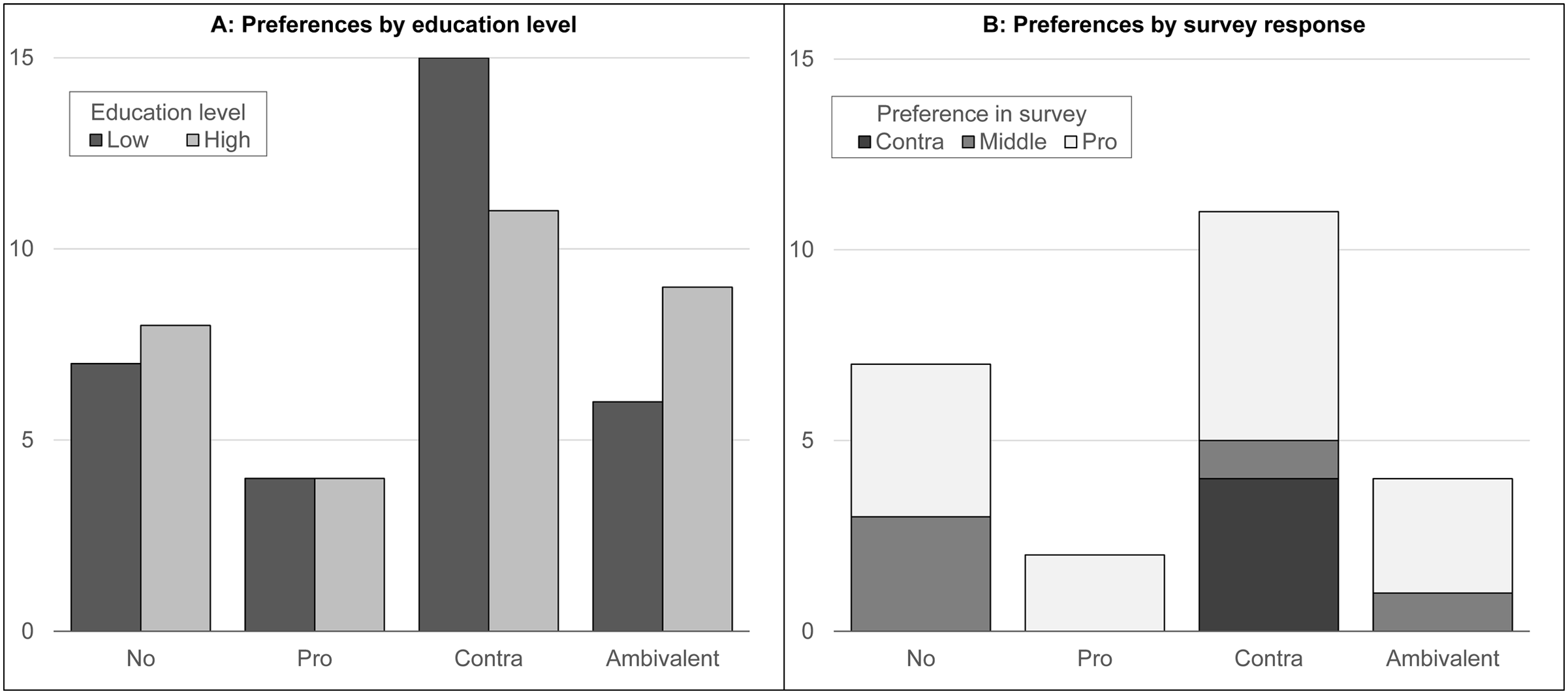
The reminder of this section elaborates and illustrates these four insights. Because of the striking similarities, groups with low- and high-educated citizens are discussed jointly. A list of all participants with aliases is in Appendix C. In the main text, we add to names lower script L for low and H for high education, together with the number of the focus group (1–12).
Interest, Knowledge, and Subjective Relevance
The groups clearly show that interest in tax policy is very limited, and suggest that tax illiteracy feeds uncertainty and skepticism. During the open questions in our warm-up phase, issues of taxation, inequality, or redistribution are not mentioned a single time spontaneously. Questions and stimuli on taxes often lead to open admissions of ignorance or disinterest. A short clip on the issue from a TV debate between the main candidates broadcasted by a private TV station was rated as boring and incomprehensible (“At some point you don’t listen to it anymore. Too much information at once” [AnastasiaL1], “You’re standing there like a duck in a thunderstorm.” [MarcelL3]). In the groups H7 and H8, it was hard to get any conversation going about tax policy.
Lacking interest and knowledge prevented most participants from distinguishing taxing the rich as a separate aspect of tax policy. For some, taxes paid by the rich are simply too abstract and lack personal relevance. JensL10 thought for example that he “can’t say anything about that because, those are [income] dimensions I’m not in, and I don’t think I’ll get there (...).” Importantly, there was little sign that participants were aware of the redistributive aspects of tax policy and that the additional tax revenue might benefit them personally. Ursula’sL2 (sales clerk) statement is a good illustration of this myopic pocketbook view. “I think everyone is looking for what would be the most beneficial. People who work normally would say that it would be nice if we were relieved, I would say. For me, that would make more sense than the rich paying more taxes.”
Instead of engaging with abstract arguments for taxing the rich, participants tended to confound the issue with their own tax experiences. For the low educated, these experiences are consistently negative and often shaped by consumption taxes. MariaL3 (unemployed) bluntly stated: “I don’t give a shit about taxes, but first make sure that people have food on the table […]. But that also concerns taxes on food, which will then be increased and so on.” Such criticism of (regressive) consumption taxes was never combined with demands to shift the tax mix towards wealthy citizens.
A related barrier was uncertainty about who would be affected by tax increases. The question whether the rich should pay more was often answered with the counter-question ‘who is rich?’. This was usually followed by elaborations of how quickly the middle class is considered rich and risks paying too much in taxes. While this might reflect worries about personal tax bills among the high educated, the low educated shared the position that taxes are too high for this group already. “Are we talking about the upper one, two percent or are we already talking somewhere about 40, 50 % of society?” (ErikH11).
Taken together, the conversations hence confirm politicians’ assumptions that tax policy has low salience and that various misleading mental shortcuts prevent people from considering it as a tool for redistribution that might benefit them. Generally, participants did not seem to understand themselves to be in a distributional conflict with the rich.
Arguments about Taxing the Rich
Despite the widespread disinterest, participants were able to provide a number of justifications for their skeptical attitudes towards taxing the rich. Again, low and high educated participants were surprisingly similar in their arguments (overviews of arguments on individual and group level can be found in Appendix C). At the core seemed to be strong meritocratic values, a dominant theme in the group conversations that politicians had actually not addressed in the interviews. At least some rich people were credited (sometimes in elaborate arguments) for having earned their position. The low educated were very susceptible to this reasoning. A typical example comes from NatalieL3 who lives on disability pension. “What simply annoys me is that they always say that the rich should pay more taxes. I myself live just above the poverty line and I don’t see it that way, that if they have worked for it themselves, that they then - it sounds like crap now, that’s how I see it - that they then have to pay for everyone. They already pay a lot of taxes. (...) Of course they have a lot of money, but in my opinion, they have earned it.”
Participants sometimes made an explicit distinction between deserved and undeserved wealth and expressed a willingness to tax the latter. AlexanderL4, a craftsman, agrees in principle to tax the “richest of the rich”. But he adds that there are “people who have worked hard for their wealth” and asks rhetorically: “Why should they then be punished for it, so to speak, for the effort you put in?”. LinaL10 wishes that “one distinguishes between the newly rich and those who have always been rich, through family et cetera.” Based on the realization how difficult it is to draw a firm line between deserved and undeserved wealth, the distinction amounted to an argument against tax increases.
Combined with the tendency to approach socioeconomic issues from personal experience, meritocratic considerations appeared to create a paradoxical identification with rich people. AliL1 (warehouse staff) directly expresses this by saying: “Whether that’s fair or not now, put aside. But if I were in their position, I would also think: ‘Why us, of all people!? I’ve worked for this!’.” JolineH6 remarks that “we all work for our money” and that “if we would be in their position [of the rich], we would be upset as well. And I would understand that.” In some cases, reference was made to self-employed people among acquaintances who work hard and should not be taxed more (“My friend, for example, is a beautician with a small studio. If she suddenly has to pay even more [...]” [AlinaL2], “You can’t [as a self-employed] just take a vacation as you please and so on. I therefore think that shouldn’t necessarily be punished if you make a lot.” [AlexanderL4]).
Besides meritocratic tax resistance, concerns about the economy and the question “how many jobs depend on it?” (LauraH5) were dominant arguments against taxing the rich. Worries about capital flight as a response to higher taxes was frequently mentioned. Participants argue “they will just move abroad” (NorbertL4), “that many would then move to Switzerland or elsewhere” (AnastasiaL1), or that if “I have to give away 60% of my profit or salary or whatever, then I would be stupid to stay in Germany” (JannikL10).
Closely related is the belief that family businesses are particularly worth protecting, because of their importance for the economy. As expected by policymakers, SMEs were highlighted particularly often. The underlying assumption is that higher taxes would force these companies to cut jobs: “All I can think of now is this tax on the rich. [...] You always have to look. A medium-sized company also enables jobs, and if we can all work in the end, or a large part, then you also have to look at what the benefit is.” (JolineH6)
When we used a TV debate with different arguments as a stimulus, the framing of taxes as harming medium-sized family businesses and jobs by the conservative candidate was often seen as the most convincing. In the few cases in which higher taxes were argued for, the objection that this would lead to tax avoidance, which is widespread in German tax discourse, was raised several times.
So far, we have only discussed arguments against taxing the rich. Pro arguments were much less frequent (Figure 2, Panel A). They mostly took the form of ability-to-pay arguments, according to which the rich can afford to contribute more. While usually not the foundation for policy demands, it was at least acknowledged that paying more taxes would not ‘hurt’ the rich. “Come on, seriously! That is small change for them” (MiraH7). Ability to pay was often qualified in ambivalent positions, as in the case of JensL10: “It wouldn’t hurt some to pay a bit more taxes, but one would have to explain to them why (…), just because you did better, had a better plan, and so on (…).” Other pro arguments, such as inequality reduction, additional revenue, or funding the costs of the pandemic, appear only sporadically.
Disagreement and the Dominance of Anti-Tax Arguments
Focus groups do not only permit measuring individual preferences. By including interactions, they allow assessing attitude homogeneity and strength as well as persuasive arguments in case of disagreement. This feature of focus groups turned out to be advantageous for the topic of taxation. As described above, tax critical statements were dominant. That said, group reactions to individual attempts to formulate pro-tax arguments were particularly revealing. Whereas pro-tax statements tended to appear hesitant and improvised, they were generally countered with crisper and more assertive objections. The rather stereotypical counter-arguments might be read as suggestive evidence that many Germans have been exposed to and have internalized anti-tax discourses. Importantly, whereas tax critics often got support from other participants, tax proponents tended to back down when confronted with refutations.
Consider this example from a group of low-skilled participants. Following a series of anti-tax arguments, two participants talk about the possibility to set an upper limit on wealth. [Liem] People also say that a Hartz-4 [social assistance] recipient needs this and that. Then you could just as well say [to the rich]: ‘hey, you don’t need a giant house with 47 rooms and 18 bathrooms. Keep it down!’ Well and then, uhm, that one then... it just depends. [Alexander] But do you really want to have rules about everything in life? Even when you’ve earned your wealth? And then somebody comes and says: ‘listen! 20 million is the end of the line. It doesn’t matter how much you bust your butt. That’s it!’ [Liem] Well, I would... I would work with absolute numbers. Above 20 million it’s ‘finito’, or 25 or 30, but uhm ... [Alexander] But then I think you’d have a lot fewer rich people paying taxes here. [Norbert] Then they’d all go away! [Liem] I’m sure that can be somehow regulated, in some form, in a bill or so. [Dennis] That you stay here!? [chuckles] [Liem] I don’t know. But it’s just about the general thing: Do you think it’s fair or not fair? Would you find it ok or not ok. Of course, if you’ve worked hard for your life, then that’s something else. I’m also not keen on my whole life being overrun with rules, but I would just, uhm, see how unequal it is. At some point you have to react. [pauses] I don’t know.
Liem sticks to his point that something ought to be done about inequality, but his uncertainty is tangible. Concretely, he struggles to respond to the two tax criticisms about depriving people of deserved wealth and the risk of capital flight. Particularly the former throws him off balance as he accepts meritocratic reasoning against taxing the rich. This short dialogue illustrates how difficult it can be to translate general inequality aversion into a preference for concrete redistributive policies. A similar example occurred in another group (L9) with low-skilled participants. [Petra] Yes, correct! Those with money should also pay more. [Stefan] Well, difficult… If someone has become really rich through hard work, I think he deserves it. But of course, there are also rich people who don’t have to do anything, they are just rich. [Dina] And what is rich? Well, you have to distinguish that somehow. [Stefan] If a construction worker, I don’t know, has become rich through diligence, he has a construction company, employees, he might also have a house, at what point is he rich? [Dina] That’s why I say, what is wealth? If you have a company now and you’re responsible for your employees, I don’t even think that’s rich. [Stefan] Difficult. [Petra] Well, I’d say, what do I know, rich is someone, if he has a million or so. That’s what I could imagine. That would be rich for me now. And if he would have to pay more taxes than I do, I would find that okay. [Stefan] But I think then they will find tricks again. [Dina] Yes, that’s the thing. [Stefan] If they have to pay more taxes, they do something. [Petra] Run away abroad.
After a short digression about a well-known tax dodger (former tennis player Boris Becker), the group returns to the question of who is rich. [Dina] What is a million, essentially? [Stefan] Yeah. If you have a million, and then you pay a lot of taxes, phew, then you’re probably left with... [Petra] No, he shouldn’t pay so much tax that he has nothing left. That’s not what I mean. He shouldn’t lose all his wealth, that’s not the point. He should just pay a bit more than normal people. Not – who knows how much – so that he gets poor. That’s also no use. [Dina] Exactly, if you have a million and have to pay 50 percent in tax, then, of course, it becomes annoying. [Petra] That’s not what I meant. I don’t begrudge him that.
It is noteworthy that Petra makes a fairly basic and, one would think, consensual argument that the rich should pay “a bit more”. This would even be the case with a flat tax and does not even require progressivity. Still, her statement is met with routine anti-tax arguments and she gets on the defensive. Ultimately, she acknowledges the risk of capital flight and feels the urge to distance herself from the suspicion of being envious. As the discussion continues, Petra tries to refute arguments against inheritance tax as a form of double taxation. Again, it ends in resignation. [Dina] The inheritance tax is, well…In my opinion, if I inherit, then the person who bequeaths something to me has already paid taxes. [Günther] Exactly! [Dina] So the tax office nicely helps itself two or three times, and I don’t like that. [Petra] Of course, it depends on how much I inherit. If I only inherit, let’s say, a small house from my mother, then I think that’s mean, because maybe the person didn’t have much; mother worked all her life for the house and paid it off, and what have you – then I also don’t think that's okay. But if someone inherits ten or 20 houses or something, why not? [Günther] Although he has of course also already paid taxes on the ten or 20 houses. Where do you draw the line? [Petra] Yeah. Maybe you shouldn't do that… but, yes… I don't know.
In sum, the interaction level shows that it is hard, even among the low educated, to make an argument in favor of taxing the rich. There seem to be firmly established anti-tax arguments in public discourse that are taken for granted by many participants and routinely receive support. The burden of explaining and justifying pro-tax positions seems considerably higher. Most participants do not possess the necessary knowledge and motivation to overcome this discursive barrier.
Tax attitude Differences in Focus Groups and Surveys
A final finding relates to how focus group and survey responses relate to each other. Politicians expressed skepticism about the usefulness of the latter, a view that is in line with our general results. As described by them, personal discussions seem to bring out more critical positions on taxation than surveys (as the one in Figure 1). Focus groups 9-12 allow us to directly contrast group discussions with previous agreement to the survey item “I think rich people in Germany should pay higher taxes” (on a scale from 1[totally disagree] to 7[totally agree]). As shown in Panel B of Figure 2, many participants coded as “contra” or “ambivalent” in the discussions had expressed support in the pre-survey (with values 5–7). While all anti-tax positions are consistently expressed in the survey and discussions, consistent support is rare. LinaL10 spontaneously explained the discrepancy to us by qualifying her own survey response as superficial: “we also had a survey beforehand where we were also supposed to tick an answer and I said I was in favor of it [taxing the rich]. (...) On that general level I would say: ‘why not!’. But what exactly would change as a consequence, that I would rather like to know. How that would affect everything, also for the middle class and so on. That would then maybe change my answer somehow, I think.”
Some further examples throw into sharp relief the gap between conversations and survey. DinaL9, the main tax skeptic in the interaction above, actually supports taxing the rich in the survey (with a value of 6). OmarH12, who gave the same survey response, vocally complained in the conversation that the rich already pay “a hell of a lot! We must not forget that we live in a capitalist state, which means that we have to make sure that people want to make more money”. AmelieH11 (survey support of 6) states that if she were an entrepreneur or a big investor, she would feel “a bit fooled” by a net wealth tax and “move somewhere else where I would be more tax-privileged.”
As mentioned, we repeated the survey a week after the groups. As mean support drops by 0.25 scale points, the discussions seem to have clarified tax resistance for some. Unsurprisingly in this under-powered setup (N = 24), the difference is not significant (p = .35).
Discussion
The elite interviews showed that left politicians believe it is surprisingly difficult to persuade lower-class voters of the need to tax and redistribute the concentrated wealth and income of the economic elite. They work with a model of public opinion that comes close to false consciousness conception. This is illustrated best by their frequent reference to ‘tax myths’. The manipulation of preferences through business lobbyists and allied actors in politics, science, and media is the central theme in their accounts of public tax attitudes. To say that they see public opinion as endogenous to the political process would be an understatement. Ultimately, meaningful support for tax reforms can only be won or lost in concrete and salient policy debates. What voters express prior to these debates is seen as a set of diffuse and usually politically inconsequential attitudes. For them, what might look like strong public support is inherently precarious once actual mobilization for or against reforms begins.
Our findings suggest that politicians have little trust in many opinion polls, particularly on abstract policy principles or socio-economic patterns, and certainly in the realm of tax policy preferences. According to their accounts, this leads them to rely on direct interactions with party members or voters (as has been observed in other countries Henderson et al., 2023; Walgrave et al., 2023). There is a noteworthy tension in this pattern. On the one hand, personal contacts are highly imperfect sources of information, because they tend to be socially and politically selective (Broockman & Skovron, 2018; Pereira, 2021) and because absence of objective information might make it easier to project own preferences on the public (Butler & Dynes, 2016). On the other hand, surveys can be problematic sources too, because they lack validity for many issues. As our research suggests, direct exchanges do seem to provide valuable insights to goal-oriented politicians who wish to understand how voters reason about and prioritize issues.
Overall, our broader qualitative approach reveals patterns that differ from previous findings on the “biased-perception mechanism” in unequal representation (Pilet et al., 2023; Walgrave, Soontjens, & Sevenans, 2023). They indicate that politicians are quite competent in understanding the redistributive preferences – as well as the underlying reasoning – of citizens with different class backgrounds.
It is probably surprising for many readers how powerless and blameless left politicians present themselves. This narrative could be seen as a rationalization or façade of their failure to represent lower-class voters. Our focus groups were an attempt to assess its validity. In several dimensions, we see sufficient overlap between group conversations and elites’ arguments to attest them a valid image of public opinion: limited knowledge about or interest in tax policy, indifference or hostility towards taxing the rich, susceptibility to business criticism of taxation, and a weak link between support expressed in surveys and in face-to-face conversations. This, in our view, makes the broader point of left politicians credible: it does seem difficult to persuade voters of tax increases for the rich. This does not amount to absolving politicians of their responsibility. After all, the link between public and elite opinion is arguably recursive and we do not know what public opinion would counterfactually look like had the left camp in Germany actually mobilized more consistently on the issue (for a more through discussion, see Fastenrath et al., 2022).
The main difference between MPs’ summaries of voters’ beliefs and those actually mentioned by participants were meritocratic barriers to taxing the rich. The prominence of meritocratic arguments also among low-educated participants is a common finding, e.g. in research on system justification (Jost, 2020) or working-class ‘boundary management’ (Lamont, 2000). Why was this key driver ignored by politicians who otherwise proved to have a sophisticated understanding of tax attitudes? Maybe it simply is easier for left politicians to think of citizens as being led astray by business than accepting that they hold deep-seated values contradicting their policy goals.
Our findings indirectly speak to debates about business influences in redistributive politics. Politicians’ accounts resemble the growing literature on preference formation as a key aspect of business lobbying (Emmenegger & Marx, 2019; Fairfield, 2013; Hacker & Pierson, 2020; Hertel-Fernandez et al., 2019; Walker & Rea, 2014). We certainly cannot answer to what extent business agency underlies the patterns we observed in the focus groups. But business-friendly frames did seem to have an edge in discussions. They were invoked routinely and tended to dominate in situations of disagreement (they seemed particularly accessible in Zaller’s [1992] terms). This makes the argument of internalized discourses plausible. At the same time, German business lobbyists do massively engage in attempts to influence public opinion, with a long-standing emphasis on criticizing the excessive tax burden (Kinderman, 2017). Linking such business activity and attitudinal research will be a core task for follow-up studies.
So far, we have treated the conversations about taxes as a test case for representation in redistributive politics. But they bear direct relevance for a growing political-science literature on tax attitudes. Our results confirm that limited knowledge about the tax system is a barrier to developing clear preferences (Bartels, 2008; Stantcheva, 2021; Williamson, 2017). That said, our focus groups also show that many people are perfectly able to reason about taxing the rich. As for most issues, they rely on simplified arguments from the media and political actors. One interpretation is that the business side is better at providing such arguments than proponents of taxing the rich. Our findings are also consistent with Scheve and Stasavage (2022), who argue that an equal treatment norm often prevents citizens from endorsing taxing the rich. More surprising was how little resonance compensatory fairness arguments had (Limberg, 2019), despite a context in which government lockdowns created winners and losers of the Corona pandemic. Overall, Germans seem to be no less skeptical of taxing the rich than citizens of traditionally liberal countries. Important differences to the US case seem to be a less visible division along party lines and the near absence of racialized arguments (as observed by Williamson, 2017), which arguably reflects the different political rhetoric and conflict lines in both countries.
Finally, the divergence of survey response results and stances taken in focus groups, in our view, challenges the extreme dominance of the former in responsiveness research. Surveys can be useful in many contexts, but studying sub-group preferences on an issue-by-issue basis might not be their greatest strength. The boxes respondents tick do not necessarily provide meaningful information about whether and how people will position themselves in real-world policy debates. While this has the potential to call into question the relevance of much research in the responsiveness paradigm (including the question of how accurately survey patterns are perceived), a word of caution is in order. We do not assume that focus groups are necessarily better at revealing ‘true’ preferences. Expressions in them are clearly colored by contingent social dynamics (Cyr, 2019, pp. 32–33). While surveys ignore the situational nature of political views, focus groups might lead to falsely generalizing from idiosyncratic situations. Clearly, more research on their relationship is necessary. Triangulating political attitudes with quantitative and qualitative methods is a fruitful and important direction for future research that should explore whether our observations hold in larger samples and for different issues. The quantitative analysis of open-ended survey items (Ansell, 2023, p. 118; Zollinger, 2022) could be a promising extension of (or compromise between) both methods.
More generally, we have to acknowledge elements in our research design that potentially limit generalizability. It would, for example, be important for follow-up research to study systematically how right-wing politicians conceive of the process of preference formation. We also only studied a single issue. It seems reasonable to expect that our findings generalize to issues with similar characteristics in terms of policy complexity, salience, uncertainty of distributive impacts, and relevance to German business. Some interviewees drew, for example, analogies to decarbonization. Things might look entirely different, however, in other areas, such as identity politics (Pilet et al., 2023). The applicability to other issues therefore is an empirical question and another important avenue for future research.
Conclusions
Based on our case study, responsiveness seems too simple a model of the elite-citizen linkage to capture political inequality in redistributive politics. On the one hand, it risks over-estimating inequality by exclusively relying on surveys. As our focus group results suggest, surveys might exaggerate the preference gaps between socio-economic groups that are a necessary condition for unequal responsiveness.
On the other hand, the responsiveness lens risks under-estimating political inequality by ignoring power asymmetries on the level of preference formation. If representatives of the rich play the long game of shaping public opinion to its advantage, scientists as well as politicians should address precisely this process. For politicians, as they are well aware, this means going beyond the delegate role implied in the responsiveness model and acting instead as trustees that, in the process of representation, help to clarify their constituencies’ interests. Research on political inequality should adopt a similar perspective by including discourses and strategies prior to the decision-making stage. For example, the accuracy of preference estimates is not the only, and arguably not even the most relevant aspect of politicians’ engagement with public opinion. Researchers should take seriously the possibility that it can be incredibly difficult for politicians to persuade voters of redistributive policies that straightforwardly seem in their material interest; and unearth the underlying reasons.
Our research can only elucidate a small part of this complex process. The generalizability of our results (across political camps, issues, types of actors, and country contexts) as well as many nuts and bolts of the argument will have to be addressed in future research. As we hope our case study shows, this endeavor is likely to miss important aspects of real-world political inequality unless qualitative methods will be integrated in research designs.
Supplemental Material
Supplemental Material - The Role of Preference Formation and Perception in Unequal Representation. Combined Evidence From Elite Interviews and Focus Groups in Germany
Supplemental Material for The Role of Preference Formation and Perception in Unequal Representation. Combined Evidence From Elite Interviews and Focus Groups in Germany by Florian Fastenrath, and Paul Marx in Comparative Political Studies
Footnotes
Acknowledgements
Previous versions of this paper were presented at the ECPR Joint Session of Workshops in Toulouse (April 2023), the “Social cohesion in Europe” workshop at the Hertie School of Governance in Berlin (May 2023), the “The Right and (In)Equality” workshop at University of in Konstanz (May 2023), the 29th International Conference of Europeanists in Reykjavik (June 2023), the Annual Conference of the DVPW Section ”Political Economy” in Witten (September 2023), and the “Political Economy of Wealth Conference” at the Max-Planck-Institute for the Study of Societies in Cologne (November 2023). We thank all participants as well as Julian Bank, Alice Barth, Martin Bisgaard, Lea Elsässer, Achim Goerres, Emiliano Grossman, Jakob Horneber, Marcus Kreuzer, Patrick Sullivan, Alexander Trubowitz, and Reimut Zohlnhöfer for their valuable feedback. We are also indebted to all our interviewees, without whose openness and insights this project would not have been possible.
Declaration of Conflicting Interests
The author(s) declared no potential conflicts of interest with respect to the research, authorship, and/or publication of this article.
Funding
The author(s) disclosed receipt of the following financial support for the research, authorship, and/or publication of this article: This research was part of the project “The micro and macro dynamics of political inequality” (PI: Paul Marx), funded by the Deutsche Forschungsgemeinschaft (DFG, German Research Foundation) – Project no. 490987363.

Supplemental Material
Supplemental material for this article is available online.
Notes
Author Biographies
References
Supplementary Material
Please find the following supplemental material available below.
For Open Access articles published under a Creative Commons License, all supplemental material carries the same license as the article it is associated with.
For non-Open Access articles published, all supplemental material carries a non-exclusive license, and permission requests for re-use of supplemental material or any part of supplemental material shall be sent directly to the copyright owner as specified in the copyright notice associated with the article.
