




Abstract
Can outgroup attitudes improve in a repressive context? Existing literature highlights how shared victimization generated under repression facilitates recategorization of identity boundaries, thereby ameliorating exclusionary attitudes. We propose an alternative pathway through which outgroup attitudes can improve. We argue that individuals update their outgroup attitudes when they perceive outgroups as contributing to a shared goal. Rather than being an identity-based response, we suggest that this cognitive process involves instrumental considerations. We evaluate this theory using a web-based survey experiment carried out in post-coup Myanmar and examine attitudes toward the Rohingya, a severely marginalized group. We find that trust and support for Rohingya citizenship rights improve when the Rohingya people are framed as contributing to the pursuit of a shared goal. We also find that this is driven primarily by individuals who have more at stake in the overthrow of the coup regime compared to those with less at stake.
Introduction
Exclusionary attitudes are dangerous because they can culminate in events with devastating consequences for severely marginalized groups. This is even more so in repressive contexts which are common in authoritarian states (Poe & Tate, 1994). When regimes have full and unchecked access to the state and its security apparatus, it is easier for them to institute discriminatory laws and policies, and in the most extreme of cases, instigate ethnic cleansing and genocide. Our research thus asks the following question: How can outgroup attitudes improve in contexts of widespread repression? 1
One of the most promising prejudice reduction strategies studied by political scientists is the Common Ingroup Identity Model (CIIM). The CIIM focuses on reducing bias by recategorizing members of the outgroup into a broader and more inclusive ingroup (see Robinson, 2016; Transue, 2007). This happens via one of two ways: the first emphasizes a pre-existing superordinate identity while the second highlights shared similarities between groups. Yet the CIIM literature has, to date, largely focused on peacetime and laboratory settings; we know a lot less about its effectiveness in contexts of repression. Nugent’s (2020) study remains one of the few studies that demonstrates how shared trauma produced by widespread repression reduces social distance between political opposition groups.
Nevertheless, research from the social psychology discipline suggests that priming individuals on shared victimization may backfire, triggering a sense of competitive victimhood and increasing outgroup hostilities (Noor et al., 2012; Vollhardt, 2013). Moreover, in contrast to acquired identities such as partisanship, certain prejudice reduction strategies are less effective when it comes to ascriptive differences (Paluck et al., 2019). Our study thus considers a second dimension of shared similarities that often accompanies the collective trauma and co-victimization experienced in repressive contexts: we look at how perceptions of outgroup members as contributors to a shared goal of resistance may improve attitudes towards that outgroup. In the context of repression where stakes are high, individuals’ self-interests are usually strongly tied to the desire to secure their property, livelihoods, and persons. If outgroups are viewed as contributing to this overarching goal (for instance, the overthrow of the repressive regime), then we expect individuals to positively update their views of this outgroup.
In this paper, we test these two distinct conceptualizations of shared similarities in a context where ethnic and religious differences are salient. We do this by examining shifts in attitudes toward the Rohingya people in post-coup Myanmar. Specifically, we investigate if levels of outgroup trust, empathy, social distance, and policy support for more equitable rights shift positively when respondents are primed on shared similarites with the Rohingya. The case of Rohingya is especially suitable for this study for empirical and substantive reasons. First, the superordinate (national) identity in Myanmar does not extend to the Rohingya people. As such, any detected changes in attitudes toward this group are better attributable to mechanisms other than a pre-existing superordinate identity. Furthermore, the Rohingya people are a severely marginalized group in Myanmar. Disenfranchised by the Myanmar state, Rohingya do not have citizenship rights. They also face active persecution, including atrocities amounting to genocide in recent years. Thus, any changes in attitudes towards this group are of substantive importance.
To test whether shared similarities can improve attitudes toward the Rohingya people, we fielded a web-based survey experiment in post-coup Myanmar, which is characterized by political instability and violent repression of political dissent. Our treatment frames highlight first, the Rohingya’s shared victimization by the military, and second, the Rohingya’s contribution to the shared goal of resistance efforts against the coup regime. We find that cognitively-based attitudes, such as policy support and trust, improve when outgroups are framed as contributing to the pursuit of a shared goal. 2 Consistent with the logic of our theory, we also find that these improvements are primarily driven by individuals with the largest stakes in the overthrow of the coup regime — namely those whose financial well-being suffered after the coup and those from the ethnic majority. However, we do not see improvements in attitudes that involve emotive responses to outgroups, such as perceived social distance and empathy.
We also find that the shared victimization framing resulted in some improvements in outgroup attitudes, but these effects are not statistically significant. This finding points to the limitations of priming individuals on shared victimization in contexts where there is repression and where group boundaries are deeply ingrained, as is the case of the Rohingya in Myanmar.
This study makes theoretical and empirical contributions to the literature on prejudice reduction. First, it proposes an instrumental pathway for improving outgroup attitudes. This mechanism is largely understudied in the discipline, as much of the work on improving outgroup attitudes emphasize the reconfiguration of group boundaries along the superordinate identity (Broockman & Kalla, 2016; Depetris-Chauvin et al., 2020; Levendusky, 2018; Transue, 2007; Williamson et al., 2021). Second, existing works have been limited to examining prejudice reduction primarily in peacetime settings and in western countries. This study looks at a Southeast Asian country with a repressive context common to authoritarian societies. Finally, it joins a nascent body of work focusing on severely marginalized groups that have faced decades of entrenched prejudice. These include the Romani people in Europe (Findor et al., 2022). Our study thus has important policy implications for understanding how the choice of framing may help ameliorate deep-seated prejudice in deeply divided societies.
Existing Prejudice Reduction Strategies
The objective of improving outgroup attitudes is a central question that has occupied social scientists. While prejudice often occurs at the individual level in day-to-day life, it has far-reaching implications on society. This includes the enactment of discriminatory laws and policies, and occasionally, deadly acts of ethnic cleansing and genocide. Social scientists have studied a wide range of prejudice reduction strategies, including intergroup contact, perspective taking, social recategorization, value consistency and self-interventions, and persuasion (Paluck et al., 2021). Below, we briefly examine the first three strategies, which Paluck and colleagues have found to be the three largest groups of works in the existing literature; these strategies have also been extensively studied by political scientists.
The positive effect of intergroup contact was first highlighted by Allport (1954) who theorized that interpersonal contact would improve intergroup relations under conditions of equal status, cooperation, shared goals, and institutional support. Since then, scholars have extensively tested this mechanism across different settings to mixed results. Although intergroup contact has been shown to work (Pettigrew & Tropp, 2006; Weiss, 2021), it is less effective in overcoming ethnic or religious prejudice (Paluck et al., 2019), especially if these divisions have been entrenched over sustained periods of time (Mousa, 2020; Scacco & Warren, 2018). On a practical level, large-scale contact programs are also resource-intensive and challenging to implement in places with active conflict or deep-seated hostility.
One alternative to contact theory is perspective-taking. By considering “another person’s thoughts, feelings, intentions, and other mental states” (Todd & Burgmer, 2013), individuals’ perspectives are better coordinated with those of outgroup members, thereby improving attitudes towards the outgroup (Broockman & Kalla, 2016; Dovidio et al., 2004; Hainmueller & Hopkins, 2014; Simonovits et al., 2018). Importantly, perspective-taking offers the possibility of a ‘light touch’ approach: Williamson et al. (2021) find that simply priming Americans to think about their own family immigrant experiences is sufficient to improve pro-immigrant attitudes. Yet despite these promising findings, perspective-taking interventions have mostly been tested in laboratory or peacetime settings; we do not know if and how this strategy works in contexts of repression under real-world conditions.
A third body of literature looks at the common ingroup identity model (CIIM). This model borrows from the social recategorization approach to intergroup relations (Tajfel & Turner, 2010). When individuals start recategorizing outgroup members as part of a broader and more inclusive ingroup, intergroup bias is reduced since individuals tend to evaluate members of their own ingroup more favorably (Brewer, 1999; Gaertner et al., 1993).
Recategorization can happen in one of two ways. The first is by making an existing superordinate identity salient. Within the field of political science, scholars have largely focused on the role of national identity (Depetris-Chauvin et al., 2020; Levendusky, 2018; Robinson, 2016; Transue, 2007). However, this assumes that an inclusive national identity exists, which is not always the case. Myanmar’s national identity, for instance, has been founded on a set of criteria that explicitly delineates groups like the Rohingya as ‘permanent outsiders’ (Cheesman, 2017). In contexts where the national identity has been constructed in opposition to a specific outgroup, increasing its saliency may worsen attitudes towards that group.
A second way recategorization may happen is by highlighting shared similarities including common experiences, beliefs, and goals with outgroup members. Nugent (2020) demonstrates this within a context of repression in Egypt and Tunisia. Exposure to widespread repression—or shared trauma—reduces the perceived distance between political opposition groups, ultimately fostering the recategorization of outgroup members into a broader and more inclusive ingroup.
Building on this line of work that emphasizes shared similarities between groups, we identify and test two prejudice reduction interventions in a repressive context where ethnic differences are salient. Unlike acquired identities, ascriptive identities such as ethnicity tend to be ‘stickier’ (Chandra, 2013). Our study thus expands on Nugent’s work by (1) going beyond acquired identities (i.e., political affiliation) and (2) testing two different but related dimensions of living under repression: shared victimization, and shared goals. In particular, we argue that the latter will be especially effective because of its underlying instrumental considerations.
Prejudice Reduction under Repression: Proposing an Instrumental Pathway
Repression occurs when the “state [targets] actors who challenge state beliefs, institutions, and actions”, with the goal of forcing compliance (Davenport, 2007; Hassan et al., 2022). These behaviors may include physical coercion such as arrests, indiscriminate killings, sexual assault, raids, torture, beatings, and burnings; but they may also comprise mental coercion such as a harsh crackdown on individual freedoms as well as the constant surveillance and monitoring of individuals’ activities.
Individuals living under repressive conditions may thus become bounded together in these shared experiences of sufferings, victimization, and insecurity (Nugent, 2020). Yet such shared trauma is but one dimension of living under repression; in response to the sufferings imposed by the repressive regime, we often see the parallel production of collective dissent and resistance against this same regime (Davenport, 2007; Hassan et al., 2022; Siegel, 2011). Consequently, we expect that repressive contexts would facilitate two types of perceived similarities between groups: the first is a sense of shared victimization by the regime while the second focuses on the shared goal of resisting (and perhaps even overthrowing) the regime.
Shared Victimization
The effects of priming individuals on shared suffering and co-victimization has been well-studied in the existing literature. Several empirical studies show how highlighting shared experiences of discrimination and/or disadvantage is sufficient to inspire interminority solidarity and improve interminority relations (Cortland et al., 2017; Craig & Richeson, 2012; Glasford & Calcagno, 2012). In recognizing the shared grievances or injustice faced by members of both one’s ingroup and outgroup, individuals start to recategorize “them” as part of the “us” who are “all in this together”. This effect is not limited to minority groups: the collective experience of surviving a natural disaster has been shown to generate a more inclusive common ingroup identity between members of majority and minority groups (Vezzali et al., 2015).
Notwithstanding these positive findings, there are reasons to expect inflammation of outgroup hostilities when individuals are primed on shared victimization. The social psychology literature highlights the phenomenon of competitive victimhood when individuals (especially those from minority groups) perceive their victimization to be more grievous than those of the outgroup (Noor et al., 2008, 2012), or when the distinct nature of their suffering is not acknowledged (Rosenfeld, 1999; Vollhardt, 2013). Other factors also moderate the effects of co-victimization: Subašić et al. (2011) demonstrate that shared victimization reduces solidarity with marginalized groups when there is no inclusive social identity to facilitate the perception of injustices as shared. In places where there is ongoing conflict, or where group divisions are entrenched, priming individuals on shared sufferings with members of the outgroup may then exacerbate prejudice.
Shared Goal
Scholars have suggested that working together interdependently towards a shared goal promotes a common ingroup identity, thereby fostering positive outgroup relations (Allport, 1954; Gaertner et al., 1990; Sherif, 1958). The empirical work in this regard however, frequently bundles together different treatments, making it difficult to ascertain if it is intergroup interactions (Gaertner et al., 1999), outcome dependency (Brown & Wade, 1987), or the recognition of a common goal itself that drives improvements in outgroup attitudes.
Here, we focus specifically on what happens when groups perceive that they both share in and contribute to a similar goal. In particular, we expect that working towards a common goal will be especially effective in improving outgroup attitudes under conditions of repression because it activates instrumental considerations within a high stakes environment. In other words, it prompts individuals to think about how the outgroup contributes towards their own interests.
Our starting point here is the basic assumption that human behavior is driven by “the most fundamental human interest […of maximizing one’s] life chances, [including] the instrumental pursuit of wealth, security, and power as well as seemingly irrational desires for status and self-esteem” (Hale, 2008). This premise is not new; we know that instrumental consideration can determine how individuals choose to self-identify (Laitin, 1995), as well as dictate which identity cleavages become politically salient (Posner, 2004). Multiple studies also show that when the outgroup is viewed as a threat to one’s self-interests, outgroup hostility increases (see Gay, 2006; Hainmueller & Hopkins, 2014; Mughan & Paxton, 2006).
Our theory considers the flip side of this calculus. Specifically, we argue that when the outgroup is perceived as an ally in ‘maximizing one’s life chances’, outgroup attitudes will improve. Given that we already see some evidence for this when the outgroup is framed as contributing to collective interests such as the national identity (Kalin & Siddiqui, 2020) or the national economy (Guerra et al., 2015; Hainmueller & Hopkins, 2014), we expect self-interests to play an even more influential role in repressive contexts, where the stakes are both clear and high (Chong et al., 2001). Where repression is prevalent, we can assume that individuals will be more strongly motivated by the attainment of security because of the constant threat of violence. This may involve the overthrow of the repressive regime, and/or the (re-) establishment of democracy. Since security is a non-excludable good, individuals stand to benefit from outgroup members’ efforts towards this common goal regardless of whether they themselves contribute to its pursuits. When this happens, we expect outgroup attitudes to improve. Our first hypothesis is thus as follows:
When individuals are reminded of the contributions outgroup members are making towards a shared goal in a repressive context, outgroup attitudes will improve.
If our hypothesized mechanism is true, we would also expect to see the following observable implication. Since improvements in outgroup attitudes are driven by utility calculations, we should see the biggest improvement in outgroup attitudes among individuals with the most at stake in this shared goal. Within the context of repression, this includes those who face higher levels of insecurity (e.g., individuals with severely compromised life prospects from the loss of their livelihoods or those with decreased access to basic services).
Individuals with bigger stakes in the shared goal will see improvements in outgroup attitudes compared to those with less to lose.
Empirical Context
Myanmar is home to some of the longest running civil wars in the world, with intergroup relations in Myanmar largely understood by country observers and scholars alike through the prism of conflict. The Bamar ethnic majority has politically, socially, and culturally dominated the country since independence while many of the politically salient ethnic minority groups, such as the Shan, Kachin, and Karen, have mobilized ethno-nationalist rebellions against the central government.
Despite their subjugated position in Myanmar, the aforementioned ethnic minority groups (along with the Bamar) are considered indigenous to Myanmar, or taingyintar in Burmese, which grants them the “gold standard for citizenship” (Cheesman, 2017). To be taingyintar, one has to belong to “a cultural group present in what is now known as Myanmar before the first British annexation of Burma in 1823” (Thawnhmung & Yadana, 2017). In contrast, groups like the Rohingya, South Asians and Chinese are considered foreign to the country. Especially after the 1962 coup, the military regime led by General Ne Win imposed a series of exclusionary policies, culminating in a new citizenship law (the Burma Citizenship Act of 1982) that stripped these groups of citizenship rights. Those considered non-indigenous were effectively denied key political rights, and constantly questioned about their belonging in Myanmar. Not only are these groups explicitly excluded from the superordinate national identity, the national identity itself is constructed in opposition to them.
For the Rohingya people specifically, the new law made them ineligible for Myanmar citizenship. Successive Myanmar governments have also contended that the Rohingya people are “interlopers” from Bangladesh. They have been the target of several mass deportation and ethnic cleansing campaigns, including “clearance” operations in 1978, between 1991 and 1992, and most recently between 2016 and 2017 (Farrelly, 2016; Myint-U, 2020). In November 2019, The Gambia filed a case against Myanmar at the International Court of Justice, alleging that Myanmar’s atrocities against the Rohingya people amount to genocide. On March 21, 2022, the United States government recognized these atrocities as genocide.
Many members of taingyintar, including ethnic minorities, hold negative attitudes towards the Rohingya. These sentiments are further inflamed by the Buddhist nationalist movement which claimed that Muslim outsiders will take over the country if taingyintar do not defend themselves. Such beliefs can be seen in the way the UN Secretary-General was met with an outcry from the Myanmar people when he called on the Myanmar government to “ensure humanitarian access to Rohingya living in vulnerable conditions” in 2014 (Weng, 2014).
To contextualize this study and the experimental primes we discuss in the next section, it is important to provide an overview of the reform period in Myanmar. In 2010, the country began transitioning from a military dictatorship to a quasi-civilian government. That year, multiparty elections were held for the first time in nearly two decades. 3 The military-backed party, the Union Solidarity and Development Party, won after Aung San Suu Kyi’s party, the National League for Democracy (NLD), boycotted the election on the grounds that it would not be free and fair. In the 2015 general elections, the NLD competed and won the vast majority of seats in the national parliament. For the first time since 1960, there was a peaceful transfer of power to a civilian government. The NLD repeated this landslide win at the 2020 general elections. During this decade of reforms (2010 to 2020), Myanmar was reclassified from an autocracy to a democracy.
This political transition in Myanmar had a profound impact on the lives of ordinary people. Once closed off to the international community, Myanmar’s opening provided its citizens with opportunities that were previously unimaginable. In terms of education opportunities, private establishments – both international and religious – expanded, and hundreds of thousands of people were able to study abroad. When it came to livelihood opportunities, the growing NGO sector as well as small and mid-size enterprises offered jobs to the educated and professional class while new factories and construction projects created blue-collar jobs.
However, these developments came to a halt on February 1, 2021 when the military staged a coup. The military and its proxy party contested the 2020 election results, claiming inconsistencies in the electoral roll amongst other accusations of fraudulent practices.
Opposition to the coup was widespread. Civil servants protested by refusing to turn up for work as part of a nation-wide civil disobedience movement. By February 8, large-scale protests against the coup were taking place across the nation, even in remote villages far from major cities. These pro-democracy protests cut across long-standing ethnic cleavages; people from various ethnic and religious groups, including members of the Rohingya community, participated in the protests. Photos of Rohingya people in refugee camps holding up placards supporting the anti-coup movement began circulating on Myanmar’s social media.
The coup also triggered widespread violence and armed resistance. Although the peripheral regions have always experienced military oppression and violence due to ongoing civil wars, in post-coup Myanmar, violence engulfed the entire country. To clamp down on these nationwide opposition movements, the military moved swiftly, imposing a climate of fear and intimidation, including indiscriminate killings, torture, rape and arbitrary detentions. A year after the coup, over 1500 civilians have been killed by the regime’s security forces, over 10,000 arrested, charged or sentenced, and over 800,000 displaced (according to UNHCR).
This context provides an exceptional circumstance to better understand whether and how outgroup attitudes toward severely marginalized groups like the Rohingya people can be improved in repressive settings. On the one hand, people across Myanmar – regardless of ethnicity or religion – were now experiencing first-hand the horrors of the military’s atrocities which were previously targeted at ethnic minorities and the Rohingya people. This experience could initiate a feeling of shared victimization, recategorizing “them” as “us.” On the other hand, ordinary people in Myanmar were now witnessing how people from across the country, including those who are not one of “us”, were contributing toward the shared goal of overthrowing the coup regime. This realization of outgroups’ contribution toward a shared goal, we argue, can activate instrumental considerations, thereby improving outgroup attitudes. In the following sections, we analyze results from an online survey experiment to evaluate systematic evidence for either pathway.
Survey Experiment in Post-Coup Myanmar
The online survey was fielded in Myanmar between March 5 and 17, 2022, a year after the 2021 coup. At the time of the study, face-to-face interviews were not feasible due to the Covid-19 pandemic and an increasingly violent post-coup situation in Myanmar. In the month prior to the study (February 2022), the Armed Conflict Location & Event Data Project (ACLED) recorded 272 protests, 283 battles, 318 explosions and remote violence, and 117 incidents of violence against civilians across 171 of Myanmar’s 330 townships. It was against this backdrop that study participants were responding to the treatment primes.
Recruitment and Sample
To recruit study participants, we used Facebook advertisements — a tool political scientists have increasingly turned to in recent years to construct online panels (see Chew, 2023; Dulay et al., 2022; Rosenzweig & Zhou, 2021; Samuels and Zucco Jr, 2014). Beyond feasibility and cost effectiveness, studies show that this tool can be effective in recruiting hard to reach populations (Kayrouz et al., 2016). Furthermore, recruited participants complete the survey within a reasonable time and pass attention check at a high rate (Rosenzweig et al., 2020). It has also been suggested that Facebook samples, despite sample biases, are generally aligned with behavioral lab experiment results (Rosenzweig et al., 2020), as well as high-quality survey panels (Zhang et al., 2020). At the same time, however, the population on Facebook is systematically different from the national population along several dimensions, particularly with respect to education, age and political engagement (Rosenzweig et al., 2020).
Like many countries in the Global South, Facebook has wide coverage in Myanmar, with the country’s online population being regular Facebook users. 4 Here, Facebook users are younger, more educated, and more urban compared to non-users (Samet et al., 2022). We took a number of measures to mitigate these sample biases.
We posted our recruitment advertisement, which was in Burmese, on a Facebook page that had been previously utilized to recruit Myanmar participants for survey research. We attempted to mitigate overrepresentation of large urban centers – populations that are significantly younger, more educated, more urban, and arguably more tolerant – by targeting the advertisement to townships beyond the two major metropolitan areas of Yangon and Mandalay. We also set a quota for Yangon and Mandalay residents at 15 percent. To include a meaningful sample of ethnic minorities, we oversampled minorities by targeting townships in the states, which are the subnational administrative units where ethnic minorities are the dominant population (although other subnational units were also included in the population defined for the ads).
To incentivize participation, the advertisement clearly stated that respondents would be reimbursed 5,000 kyat (about 3.5 USD) in mobile top-up credit for data usage (wifi is not widely available in Myanmar). The advertisement reached 433,800 Facebook users, of which 14,426 clicked on the survey link. 5 Respondents who clicked on the Facebook ad were redirected to the survey. To filter out respondents who are neither Burmese nor located in Myanmar, we included screening questions at the beginning of the survey. Our survey was also entirely in Burmese, which allows us to have a high degree of confidence in respondent authenticity.
We recorded 5366 respondents in total. After examining the responses, we dropped those identified as bots and duplicates. The resulting sample consists of 4012 respondents who came from 275 of 330 townships across Myanmar. Of 4012 participants, only 3680 (92%) were exposed to one of the experimental conditions; the rest dropped off before the experiment began. Because the interval between the start of the study and the start of the experiment was fairly short, consisting of basic demographic questions, attrition was likely due to poor internet connection rather than question or treatment sensitivity. In short, the effective sample size was 3680. The study participation of these respondents lasted 17.7 minutes on average.
Despite implementing bias mitigation measures, our sample remains systematically different from the national population—it is younger and more urban than the national population. 6 Given these sample biases, we expect respondents in our sample to be more tolerant, 7 and the baseline measure of outgroup attitudes to be more positive compared to the national population. As such, there is perhaps less room for attitudinal improvement in our sample (Hodson, 2011; Munniksma et al., 2013), making positive effects harder to detect. In other words, we expect any positive effect found in our sample to be just as strong, if not stronger, among the national population. Our sample thus offers a conservative test of the hypotheses we laid out.
Survey Experimental Treatments
The respondents were randomly assigned to one of four groups: two treatment groups, one placebo group, and one control group. Respondents assigned to the treatment and placebo groups were given the following texts to read. Shared Victimization Frame Shared Goal Frame Placebo Frame In the early hours of February 1, the Myanmar military staged a coup, overthrowing civilian leaders who had been popularly elected during the 2020 elections. The state counselor, president, and other top political leaders were arrested in a series of raids. Soldiers also blocked off roads in Nay Pyi Taw and Yangon. The military cracked down on international and domestic media outlets, and enacted internet blackouts. The military formed a State Administrative Council (SAC) on February 2, and on August 1, the SAC declared itself a caretaker government for the country. The military promises to reinstate multiparty elections at a later date. As of October 1, 1147 civilians have been killed, 7022 arrested, and thousand more have had to flee their home.
The first treatment text provides a shared victimization frame. By highlighting shared experiences of victimization, this text is intended to facilitate the realization that respondents are similar to the Rohingya people. It does this by emphasizing how they and the Rohingya people have suffered under the hands of the same perpetrator. This realization might prompt sympathy towards the Rohingya, as the following open-ended response from our study suggests: “Before the coup, maybe in 2019 during the Rohingya crisis, images of the military burning villages and torturing the Rohingya surfaced in the news media. At that time, I mocked the Rohingya people, thinking that the images were staged. Now that I am going through the same thing, I feel sorry and sympathize with the Rohingya people. We, the Bamar people, were such scum toward the Rohingya people, and for that, I will apologize to the Rohingya people every chance I get.”
The second treatment text provides a shared goal frame. It highlights the pursuit of a non-excludable public good—in this case, the overthrow of the coup regime—and the contribution by all people of Myanmar to this undertaking. This treatment, we expect, primes respondents to view members of outgroups, including the Rohingya people, as allies in their struggles toward the shared goal. An open-ended response from our study suggests the recognition of outgroups’ contribution: “I used to discriminate against people from different religious groups… those of Indian/South Asian descent for example. 8 But now I am thankful for them, for their participation in the protests…”
Finally, respondents from the placebo group were given a text about the military coup to read. Our placebo text is guided by concerns of non-specific effects (NSEs) which are ancillary implications of the mode of delivery and other aspects of the treatment (Porter & Velez, 2021). To control for NSEs, it is useful to hold some aspect of the treatment constant (Porter & Velez, 2021). Since both the shared victimization and shared goal frames mention the coup which can evoke strong emotions, we wanted to include a placebo text that allowed us to control for this potential effect.
This setup requires clarification. Although survey experiments using vignette treatments typically feature a common text with systematically varied descriptions of the situation as the treatment, in our case, the entire vignette represents the treatment. The vignettes also do not single out the Rohingya but acknowledge the contribution and sufferings of all ethnic groups. This choice of setup was primarily driven by the need to maintain sensitivity within a potentially hostile climate - we were concerned that focusing on just the Rohingya community would raise respondents’ suspicions about the true intent of the survey. Indeed, this unease was brought up during our focus group discussion (FGD) with five native Burmese speakers who were based in Myanmar. At the same time, because the Rohingya are such a salient group within Myanmar society, we believe that the mere mention of them alone is sufficient to bring about the expected effect. A notable drawback of this setup is that it introduces a bundled effect and does not allow us to test the treatment effect directly. Consequently, there is the possibility that our results underestimate the actual treatment effect of the two frames. Nevertheless, our FGD participants’ unified interpretation of the vignettes as cultivating a shared sense of victimization as well as a shared sense of working towards the same goal provides some reassurance regarding treatment validity.
Because the vignettes are fairly similar in terms of length, it is not surprising that respondents from the placebo and treatment groups spent comparable duration reading the texts; the average duration is 31.0, 30.1, and 29.2 seconds for the placebo, shared victimization and shared goal groups respectively. While we did not implement a factual manipulation check, these figures provide some reassurance regarding treatment exposure. 9
Our sample is fairly balanced across the three groups – placebo and the two treatment frames – we compare in our analysis, with a slight imbalance with respect to income, and residency in the states. 10 To account for these imbalances, we conducted additional analysis with covariate adjustments.
Measuring Outgroup Attitudes
We measured four dimensions of outgroup attitudes. Two are cognitively-based attitudes (trust and policy support) and two are emotive responses to the outgroup (perceived social distance and empathy). The survey questions corresponding to these concepts appeared in fixed order due to concerns about question sensitivity and incompletion rate. 11 The question on perceived social distance appeared first, since it does not single out the Rohingya people as a group. The question that measured policy support appeared next because of its substantive importance. Following that, we measured trust and empathy. While some of these indicators are often measured using an index (for example, empathy), we opted not to do so here because this would repeatedly single out the Rohingya people.
Social Distance
We adapted a classic question from social psychology that measures social distance or the degree to which an individual is willing “to participate in relationships of varying degrees of closeness with members of a group” (Ekici & Yucel, 2015; Enos & Gidron, 2018; Velasco González et al., 2008). This captures the “affective feelings” someone might have towards a member of an outgroup (Enos & Gidron, 2018). Respondents were presented with a scenario: “Imagine that a new family moved into your neighborhood. Which of the following would you not want as a neighbor?” The respondents were presented with a list of nine groups including the Rohingya (in random order). We coded those who selected Rohingya as exhibiting prejudice against the group.
Policy Support
We also measured support for a policy that would mitigate a fundamental source of inequality between the Rohingya and other groups in Myanmar—that is, the provision of citizenship rights for the Rohingya people. Changes in prejudicial attitudes may not automatically lead to increased support for policies that reduce structural inequalities between groups, especially among members of higher status groups (Dixon et al., 2005; Dixon & Lemke, 2007; Dovidio et al., 2008). As such, it is important to examine policy preferences alongside general attitudes.
To measure this, we asked respondents to select the statement they most agreed with from the following: “Rohingya should not have any citizenship rights” (coded 0), “Rohingya should have some citizenship rights” (coded 1), and “Rohingya should have full citizenship rights just like taingyintar.” (coded 2). Because membership in an ethnic group designated as taingyintar is the gold standard for citizenship rights in Myanmar, selecting the third option would indicate support for institutionalized equality in favor of the marginalized outgroup.
Trust
To measure outgroup trust, respondents were asked to make a judgment about how likely an outgroup member would behave in an honest and trustworthy manner (Uslaner, 2002). We adapted the wallet-item question used by various scholars (see Mavridis, 2015; Stolle et al., 2008; Tolsma & Van der Meer, 2017): “Imagine that you lost your wallet containing your government-issued ID card and 100,000 kyats, and it was found by a Rohingya. How likely do you suppose they will return your wallet?” The response options were: “very unlikely” (coded 0), “somewhat unlikely” (coded 1), “somewhat likely” (coded 2), and “very likely” (coded 3).
Empathy
Empathy has been defined as “an other-oriented emotional response congruent with another’s perceived welfare” (Batson et al., 1997). To measure empathy, we adapted a single-item question from another study on anti-immigrant sentiments (Williamson et al., 2021). 12 We asked respondents to what degree they agreed with the following statement: “I empathize with the suffering experienced by the Rohingya people in the last few years.” The response options were “strongly disagree” (coded 0), “somewhat disagree” (coded 1), “somewhat agree” (coded 2), and “strongly agree” (coded 3). Here, we note that the Burmese term for “empathize”, as translated here, is more akin to feelings of sympathy. This is also similar to the statement “I often have tender, concerned feelings for people from another racial or ethnic group who are less fortunate than me” used as part of the affective component of the Group Empathy Index (Sirin et al., 2021).
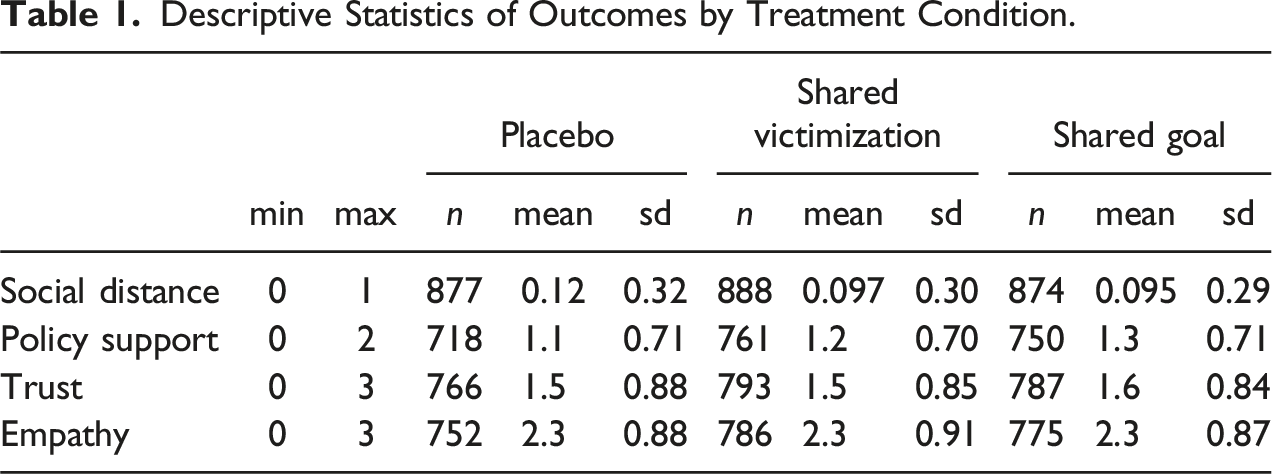
Descriptive Statistics of Outcomes by Treatment Condition.
Key Variables and Conditional Effects
In explaining why the shared goal frame is expected to be effective, the logic we laid out highlights the role of interests. An observable implication of this logic should show that outgroup contribution resonates more with individuals with higher stakes in an improved situation. To evaluate this logic, we examine the effect of treatment frames conditioned on decreased household income and ethnic majority status. 15
Decreased Household Income
Respondents’ household financial situation perhaps speaks most clearly to their material interests. The coup occurred a year into the pandemic and significantly worsened the country’s economy. Soon after the coup, foreign investors halted several multi-billion dollar projects due to concerns about impending international sanctions against Myanmar’s coup regime (Irrawaddy, 2021). As a result, hundreds of thousands of workers became unemployed. Additionally, the Myanmar kyat significantly depreciated—it lost more than 20 percent of its value within 3 months of the coup. In contrast to the reform period when Myanmar’s average economic growth exceeded 6 percent, Myanmar’s economy was projected to contract by 10 percent following the coup (Irrawaddy, 2021). The individuals who were hit hardest by the contracting economy in post-coup Myanmar, we argue, would have larger stakes in the overthrow of the coup regime, compared to those who were not hit as hard. Thus, we expect the Rohingyas’ contribution toward resistance to be more salient and significant for these individuals.
Our measure of decreased household income is based on the following survey question: Has your family’s current household income increased or decreased compared to 2 years ago (2019)? Nearly 64 percent of the respondents reported “decreased a little” or “decreased a lot”; they were coded 1 for the binary variable decreased income. The rest—those who reported “increased a lot”, “increased a little”, or “stayed the same”— were coded 0. It is possible that those who were more critical of the coup regime were also more likely to report that their household income decreased, confounding the effect of decreased income. However, we find that those who were unemployed were more likely to report that their household income decreased compared to those that were employed. Thus, we are fairly confident that this survey measure captured the downturn in respondents’ household financial situation.
Ethnic Status
Compared to ethnic minorities, members of the ethnic majority arguably have larger stakes in the overthrow of the coup regime for several reasons. First, while democracies are generally better protectors of civil liberty and human rights (Poe & Tate, 1994), democracies can fall prey to tyranny of the majority (Boix, 2003; Przeworski et al., 2000), failing to protect ethnic minorities’ cultural and political rights (Liu, 2017). The latter has been the experience of ethnic minorities under a decade of political reform in Myanmar between 2010 and 2020. Ethnic minorities were sidelined by the incumbent parties—including by the NLD, the country’s main prodemocracy party—and human abuses grew rampant in the ethnic minority areas (Weng, 2018).
Second, due to decades-long civil war in Myanmar, which had generally been confined to ethnic minority areas, there are informal institutions of service provision (e.g., community schools) that ethnic minorities can access (Lall, 2021). The services provided by these informal institutions became especially visible in post-coup Myanmar. 16 However, such institutions were not well developed in the predominantly Bamar areas, as these areas did not need to develop alternative institutions of service provision. As such, in post-coup Myanmar, the Bamar population lacked access to basic public services more so than the ethnic minority population.
The variable Bamar is binary and indicates that the respondent self-identified as a Bamar, which accounts for 40 percent of our sample.
Results and Discussion
Because thinking about the coup itself can evoke anger, frustration and fear, comparing outgroup attitudes of respondents exposed to the treatment frames with those in the control group (no text assigned) would bundle the NSEs of reading about the coup with the ‘active ingredients’ embedded in the treatment frames. To disentangle framing effects from other effects of reading about the coup, we compare those receiving the treatment frames to those in the placebo group. 17 We estimated this intent-to-treat effect using an Ordinary Least Square framework. To facilitate comparison across our four outcome indicators, we normalized the variables by converting their values into z scores.
Both treatments produce effects in the expected direction. Those exposed to the shared victimization frame and the shared goal frame reported a decrease in social distance, and increased policy support, trust and empathy compared to those exposed to the placebo frame. This finding is consistent with expectation in the extant literature — priming individuals on shared victimization can ameliorate outgroup attitudes (Nugent, 2020). At the same time, across all four indicators of outgroup attitudes, the point estimates associated with the shared goal frame are larger than those associated with the shared victimization frame (see Figure 1 and Table 2).
18
In fact, the effect of the shared goal frame on policy support is almost twice the effect of the shared victimization frame. Likewise, the effect of the shared goal frame on trust is more than five times the effect of the shared victimization frame. While the differences between frames are not statistically significant, they speak to the potential of the shared goal frame and its underlying instrumental considerations in improving outgroup attitudes under conditions of repression. They also underscore the risk of inadvertently prompting competitive victimhood, triggering feelings of animosity, when highlighting shared experiences of victimization (Vollhardt, 2015). Predicted outgroup attitudes (95% CI). Estimated Effect of Randomized Frames of Post-coup Myanmar on Outgroup Attitudes. Standard errors in parentheses *p < .10, **p < .05, ***p < .01.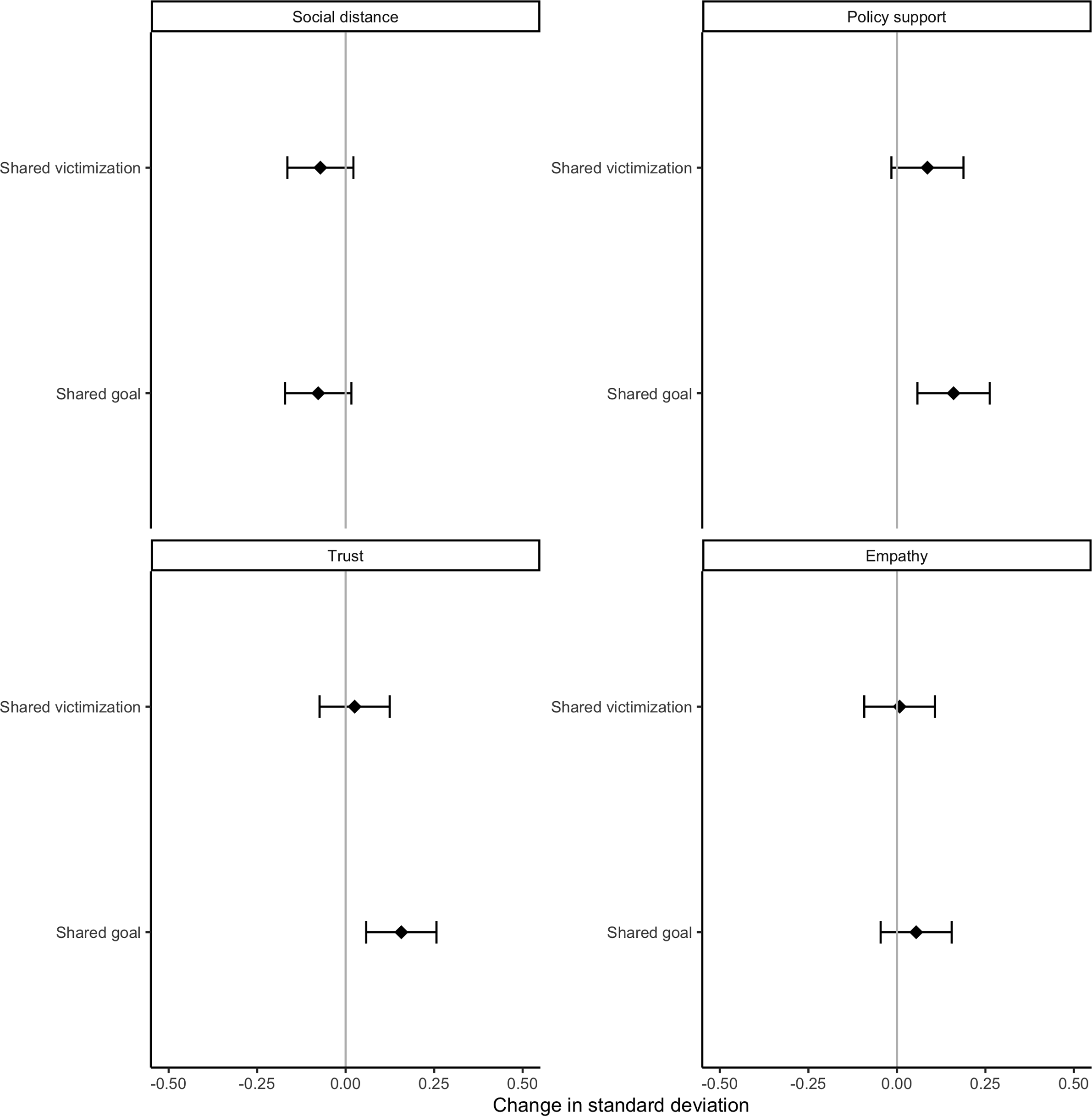
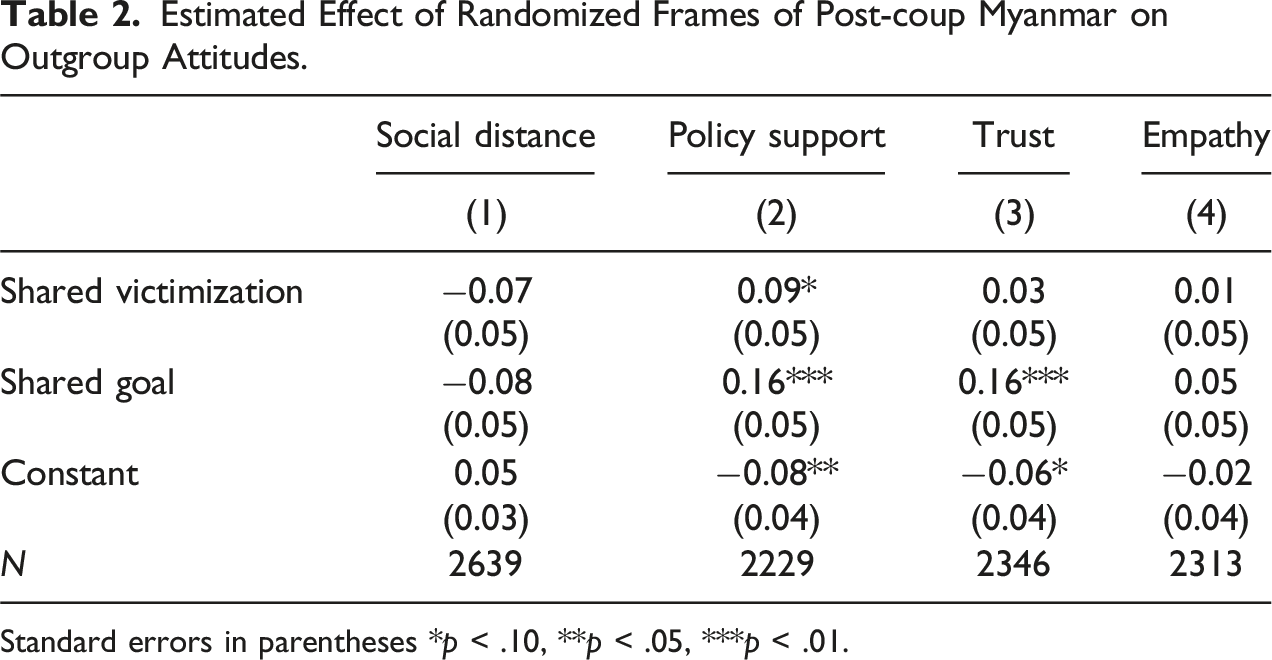
The shared goal frame also affected some outgroup attitudes more than others. Those exposed to this frame indicated stronger policy support and more trust by 0.16 standard deviation (std.) while social distance and empathy shifted by just 0.08 and 0.05 std., respectively; the effect of this frame on policy support and trust are statistically significant at conventional levels. These results indicate selective support for hypothesis 1 and speak to the strengths and limitations of the instrumental pathway in improving outgroup attitudes. Because the shared goal frame primed respondents using a cost-benefit calculus that allowed them to remain “relatively detached observers” as opposed to changing their perceived relationality to the outgroup (Pettigrew & Tropp, 2006), cognitive dimensions of outgroup attitudes (e.g., judgments and beliefs about a group) improved whereas outgroup affect (e.g., feelings and emotional responses) remained the same.
For instance, the measurement of trust reflects the degree of confidence an individual has in an outgroup’s intentions and actions towards them—that these will be benevolent and not harmful (Vezzali et al., 2012). Since the shared goal prime emphasized how actions undertaken by the Rohingya outgroup benefits the respondent’s ingroup, we see an increase in trust towards the Rohingya compared to those in the placebo group. However, when it comes to emotional responses, we did not detect a similar change in outgroup attitudes.
So far, we have shown that those exposed to the shared goal frame became more supportive of Rohingya citizenship rights and reported higher levels of trust toward the Rohingya people. Our second hypothesis specifies that these improvements in outgroup attitudes should be driven by those with the largest stake in the outgroup’s contribution.
To test this hypothesis, we first looked at the effects of the shared goal prime conditional on respondents’ financial well-being. We expect the overthrow of the coup regime to weigh more heavily on respondents’ cost-benefit calculations if they suffered financially in the wake of the coup. Results from this analysis provide some support for our hypothesis (see Figure 2).
19
Predicted outgroup attitudes conditional on household income (95% CI).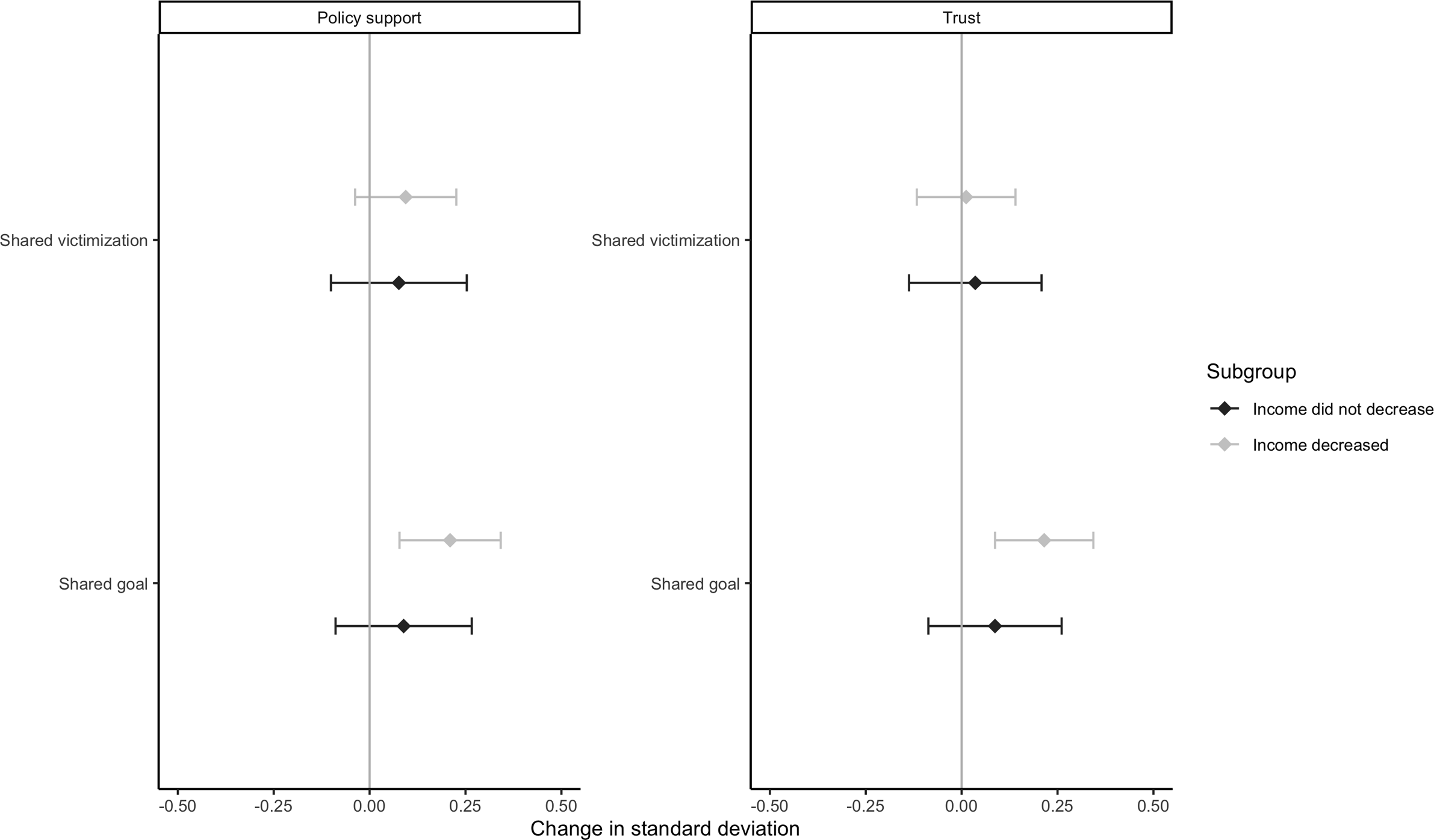
For those who suffered a decrease in income, the shared goal frame leads to a 0.21 std. increase in support for Rohingya citizenship rights. However, for those who did not suffer a decrease in income, the effect of this same frame drops to 0.09 std. While the difference between these two frames is not statistically significant, the difference between the shared goal and placebo frame is statistically significant at conventional levels for those who saw their income decrease after the coup. We see a similar story with trust: Among those who saw a dip in their household income, trust increased by 0.22 std., but those whose household incomes did not drop saw an increase of 0.09 std.
To further evaluate our hypothesized mechanism, we also looked at the effects of the shared goal prime conditional on respondents’ status as a Bamar or ethnic minority. As discussed above, Bamars’ pre-coup political status and disproportionate access to power, combined with the lack of non-state institutions for basic services, meant that they have larger stakes in the success of the resistance movement compared to ethnic minorities. We thus expect the shared goal prime to be more salient for them compared to the ethnic minorities. We find some support for this expectation (see Figure 3). Predicted outgroup attitudes conditional on ethnic status (95% CI).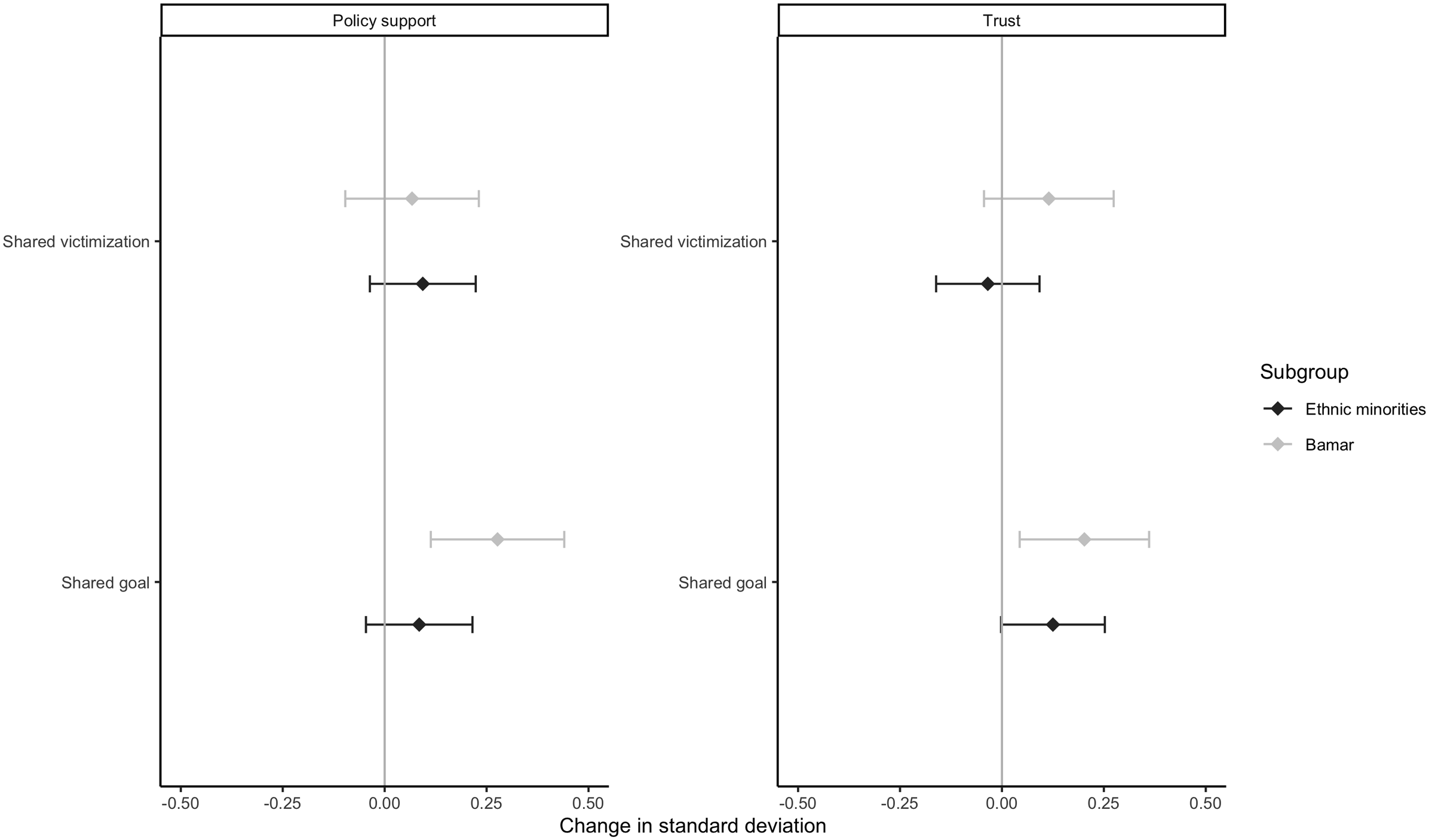
For the ethnic Bamar, the shared goal frame produces a 0.28 std. increase in support for Rohingya citizenship rights. In contrast, the same frame only led to an increase of 0.08 std. among ethnic minorities. Again, while the difference between the two subgroups is not statistically significant, we note that the effect of the shared goal frame is statistically significant for the Bamar subgroup. This pattern is echoed in the findings for trust. Bamar respondents who were exposed to the shared goal frame reported more trust towards the Rohingya by 0.2 std., compared to the 0.13 std. increase for ethnic minority respondents.
Alternative Explanations
By looking at the conditional effects of the shared goal prime on different subgroups based on the stakes they have in the success of the resistance movement, we conclude that the improvement in outgroup attitudes among those exposed to the shared goal frame can be attributable to instrumental considerations. Nevertheless, given that our treatment prime introduced a bundled effect, the detected changes may be due to something other than instrumental considerations.
One alternative explanation is that the mention of ‘democracy’ itself induces momentary tolerance. Democratic values include equality, pluralism and tolerance. While democracies have not necessarily been effective in promoting these values, research indicates that ordinary people across the world associate ‘democracy’ with intrinsic democratic values, as opposed to procedural definitions or material benefits (Dalton et al., 2007). Thus, those exposed to the instrumental frame might be primed to report more tolerant responses. While this is certainly possible, we believe that it is unlikely in the Myanmar context. Because of the legacies of military rule, democracy in Myanmar is primarily understood in procedural terms, namely, through the institution of multi-party elections and the installment of a civilian government. Even if the values of equality, pluralism, and tolerance are indeed associated with democracy in Myanmar, it is unclear if the Rohingya would be viewed as part of the polity. As perceived ‘outsiders’ to the Myanmar nation, it is conceivable that these values would not extend to include the Rohingya.
Another alternative explanation is that the shared goal frame triggered an identity-based response rather than instrumental considerations. Upon realizing that the Rohingya people are striving toward the same goal, individuals might recategorize “them” as part of “us,” generating a more inclusive common ingroup identity. To evaluate this possibility, we examined how the treatment primes affected the extent to which individuals perceived commonality with the Rohingya people. The results are null; the point estimates associated with the shared victimization goal frame are consistently higher than those associated with the shared goal frame (see Appendix I). This suggests that the former may be more effective in eliciting an identity-based response compared to the latter. While these results cannot be interpreted as evidence for instrumental considerations, they provide some assurance that the shared goal frame did not trigger an identity-based response.
Conclusion
In this paper, we tested the effects of two different primes on outgroup attitudes within a context of repression. Although we find some evidence that priming on shared victimization can reduce exclusionary attitudes, these were not conclusive. Instead, they reaffirm what previous studies have found—an emphasis on intergroup similarities based on grievances and sufferings may yield complex emotions that does not necessarily translate into improved outgroup attitudes. However, priming on a shared goal yielded a more promising result. We find that cognitively-derived aspects of outgroup attitudes can be improved by focusing on instrumental considerations. In particular, repositioning outgroup members as allies beneficial to one’s interests may circumvent the difficult and time-consuming process of recategorizing severely marginalized outgroups as part of an inclusive common ingroup. Because this strategy is motivated by individuals’ preferences for maximizing their self-utility, we further show how its effects can be strengthened (or dampened) by individuals’ cost-benefit calculus. We find that improved attitudes towards outgroups are primarily driven by those with the most at stake in the shared goal.
Taken together, our study offers up cautiously optimistic implications for prejudice reduction in places where intergroup relations are dire. First, our findings echo previous work that suggest a ‘light touch’ intervention is sufficient to mitigate negative outgroup attitudes (Williamson et al., 2021). This is encouraging, not least because enacting large-scale contact programs is resource-intensive and time-consuming, particularly in post-conflict settings where hostility between groups runs deep (Mousa, 2020; Scacco & Warren, 2018). In such a context, prejudice reduction strategies such as intergroup contact may even lead to an increase in exclusionary attitudes in the immediate short-term (Enos, 2014).
The case of Myanmar is an exceptional one given the extraordinary nature of the 2021 coup and the widespread violence that arose in its aftermath. The position of the Rohingya people is also distinct from many minority groups elsewhere: viewed as neither co-nationals nor immigrants, the Rohingya people have faced severe and sustained persecution. This raises the question of whether findings from our study extend to other settings and outgroups.
Our expectation is that a shared goal framing will work so long as the contributions of the outgroup towards one’s self-interests is salient. The data at hand provides some evidence suggesting that instrumental considerations can reduce outgroup prejudice under more ordinary conditions. First, we see how priming on a shared goal may produce ameliorating effects when outgroups are co-nationals (see Appendix J). Second, the data shows that a shared goal framing improves outgroup attitudes in places that did not experience immediate exposure to violence (see Appendix K).
Nevertheless, shared goals may be less salient in peacetime settings. Given the lower stakes, it may also be harder to perceive an outgroup’s contribution to a common goal. Future studies should investigate other interethnic phenomena that occur in peacetime settings (e.g., labor movements) and how these may induce a clear sense of a shared goal, potentially improving outgroup attitudes. Future research can also implement a more precise research design to disentangle the bundled effect of the treatment and validate the underlying mechanism. Furthermore, we only test for improvements in outgroup attitudes. While attitudes would inevitably influence behavior, previous studies have shown how discriminatory behavior can be reduced despite the persistence of prejudicial attitudes (Scacco & Warren, 2018). As such, it would be important to test our theory using behavioral outcomes. We also do not know if the mitigating effects of a shared goal framing persists across time. In the case of severely marginalized groups like the Rohingya people, testing on these different aspects of prejudice is all the more pressing.
Supplemental Material
Supplemental Material - Repression, Interests and Outgroup Attitudes: A Survey Experiment in Post-Coup Myanmar
Supplemental Material for Repression, Interests and Outgroup Attitudes: A Survey Experiment in Post-Coup Myanmar by Isabel Chew and Jangai Jap in Comparative Political Studies
Footnotes
Acknowledgments
We thank Donghyun Danny Choi, Charles Crabtree, Dotan Haim, Alan Jacobs, Amy H. Liu, Kai Ostwald, Yang-Yang Zhou and participants of the 2022 American Political Science Association conference, Asian Politics Online Seminar Series, Politics of Race and Ethnicity Lab reading group at the University of Texas at Austin and Comp-Can Colloquium at the University of British Columbia for their valuable comments. We are also grateful for the generous support of the United States Institute of Peace.
Declaration of Conflicting Interests
The author(s) declared no potential conflicts of interest with respect to the research, authorship, and/or publication of this article.
Funding
The author(s) disclosed receipt of the following financial support for the research, authorship, and/or publication of this article: This work was supported by the the United Institute of Peace.

Data Availability Statement
Replication materials and code can be found at Chew & Jap (2024)
Supplemental Material
Supplemental material for this article is available online.
Notes
Author Biographies
References
Supplementary Material
Please find the following supplemental material available below.
For Open Access articles published under a Creative Commons License, all supplemental material carries the same license as the article it is associated with.
For non-Open Access articles published, all supplemental material carries a non-exclusive license, and permission requests for re-use of supplemental material or any part of supplemental material shall be sent directly to the copyright owner as specified in the copyright notice associated with the article.
