




Abstract
What explains citizen support for executive aggrandizement? Previous work points to support for the president, showing that individuals who support the incumbent are more accepting of executive aggrandizement. Yet, the role of the president in shaping support for (and the meaning of) executive aggrandizement is unexplored. I argue that populist discourse increases support for executive aggrandizement by framing the president as the genuine representative of the people and by portraying institutional opposition as corrupt. Two studies support this argument: First, a multilevel analysis shows that a text-based measure of populist discourse is associated with increasing support for the president closing congress or the supreme court. The estimated effect of populist discourse is largest among presidential supporters. Second, a survey experiment conducted in Ecuador shows that populist and anti-elitist discourse increase support for a hypothetical executive closing the legislature. The findings indicate that populist discourse undermines public opinion as an executive accountability mechanism.
Keywords
Democracy still has foes; but it is now best evaded in its own name and by means of its own name. –Giovanni Sartori, The Theory of Democracy Revisited, (1987, 4)
Executive aggrandizement — where presidents gradually dismantle institutional checks on their power — is a significant cause of democratic backsliding and reversal (Bermeo, 2016). In theory, citizens should prevent executive aggrandizement by threatening to withdraw their support from presidents who undermine democratic institutions (Fearon, 2011; Weingast, 1997). Yet, presidents who undermine democratic institutions often maintain significant popular support. In many countries, favorable public opinion has, in fact, facilitated presidents’ efforts to undermine constitutional checks and balances (Haggard & Kaufman, 2021; Przeworski, 2019).
What explains citizen support for executive aggrandizement? Previous work shows that support for the sitting president influences attitudes about checks on the executive: Individuals who support the incumbent also tend to support executive aggrandizement (Albertus & Grossman, 2021; Simonovits et al., 2022; Singer, 2018). The prevailing view is that citizens face a trade-off between partisan or policy considerations, on the one hand, and democratic commitments, on the other (e.g., Graham & Svolik, 2020). However, previous studies take citizens’ democratic commitments as fixed and, in doing so, overlook the role of the president in re-framing democratic principles to cultivate public support. I argue that presidents frame the expansion of executive power as compatible with majoritarian ideas of democratic representation and thereby increase public support for executive aggrandizement. Specifically, populist discourse increases support for executive aggrandizement by framing presidents as champions of ‘the people’ and institutional opposition as a barrier to the popular will.
I find evidence for this argument in repeated cross-sections of survey data and in an original survey experiment conducted in Ecuador. First, an analysis of data from the Latin American Public Opinion Project shows that populist presidential discourse is associated with support for executive aggrandizement, conditional on individual-level support for the president. Moreover, the effect of presidential support depends on whether presidents use populist language: Presidential supporters are only significantly more accepting of executive aggrandizement in contexts where the president uses populist discourse. Second, a survey experiment provides evidence that the direction of these effects runs from populist discourse to support for executive aggrandizement. The experiment randomly assigns a populist frame, an anti-elitist frame, or a baseline condition to a mayoral executive who attempts to close and govern without the legislature. The findings show that populist and anti-elitist discourse increase support for a proposal to close the legislature relative to the baseline condition.
This work expands our understanding of citizen attitudes about executive power by showing that executive discourse shapes citizens’ ideas about checks on the executive. Previous work suggests that citizen attitudes about executive unilateralism are grounded in individuals’ democratic commitments, including their beliefs about the rule of law (Reeves & Rogowski, 2016, 2022). Public attitudes about executive power are, in turn, posited to constrain executive unilateralism and prevent executive aggrandizement (Christenson and Kriner, 2020; Posner and Vermeule, 2011; Weingast, 1997). However, by taking citizens’ democratic commitments as fixed, previous studies overlook presidents’ ability to manipulate public opinion in favor of expanding executive power. The influence of presidents’ populist discourse shown here is consistent with presidential manipulation of public opinion, i.e., the idea that presidents “will want to influence public opinion, not just respond to it” (Maravall, 1999, p. 156). Moreover, the finding that presidents’ populist discourse shapes attitudes about executive aggrandizement helps us understand how democracy-eroding executives avoid electoral punishment. Populist discourse makes it more difficult for citizens to form a consensus about proper limits on the president by increasing support for executive aggrandizement. Thus, populist discourse likely facilitates executive-led backsliding by creating public opinion conditions favorable to expanding presidential power.
Public Support for Executive Aggrandizement
Legitimacy theory holds that presidents abide by constitutional limits because they expect a public backlash in response to democracy-degrading actions. Citizens play a key role, as they are expected to withdraw their support from presidents who violate democratic norms (Fearon, 2011; Weingast, 1997). Yet, against these expectations, presidents who instigate democratic backsliding tend to benefit from popular support (Haggard & Kaufman, 2021; Przeworski, 2019). Presidents who have undermined democratic institutions by expanding presidential power have been reelected by large margins in countries including Turkey, Ecuador, and Venezuela.
Why do citizens accept executive aggrandizement? One possibility is that citizens do not really value democracy. However, most citizens say that they value democracy and reject authoritarianism in public opinion surveys (Norris, 2011; Lupu et al., 2021, ch. 5). In Latin America, citizens generally support democracy as a political system, though, as in older democracies, they are more critical of specific institutions (Booth & Seligson, 2009). Pro-democratic attitudes and their correlates do appear to reduce support for executive aggrandizement (Reeves & Rogowski, 2016; Singer, 2018). But the meaning attached to “democracy” varies; individuals with more majoritarian ideas about democracy favor fewer constraints on the president (Canache, 2012; Carlin & Singer, 2011). Moreover, ideas about constraints on the executive appear to be influenced by support for the sitting president.
Current research indicates that citizens’ “positional incentives” shape their beliefs about democratic norms (Goodman, 2022), including their ideas about executive aggrandizement. While most citizens say they “support democracy,” many will overlook undemocratic actions to support elites who share their policy interests or partisan identities (Graham & Svolik, 2020; Svolik, 2019). Policy-based arguments hold that citizens in weak democracies support efforts to dismantle checks and balances because they favor presidents’ redistributive policies (Acemoglu et al., 2013). Survey evidence from Latin America is consistent with this, showing that individuals who feel represented by the incumbent are more accepting of presidential abuses of power (Singer, 2018). Moreover, support for (and partisan identification with) the sitting president shapes citizens’ ideas about checks on the executive. Individuals who support the incumbent are generally more accepting of presidential “power grabs” and less supportive of checks on the executive (Albertus & Grossman, 2021; Mazepus & Toshkov, 2021; Simonovits et al., 2022). Existing work therefore emphasizes proximity to the president, either in terms of individuals’ policy views or partisan identities, to explain support for actions that undermine executive accountability.
Previous work is less attentive to how presidents themselves shape citizens’ ideas about executive power. Despite this, presidents have clear incentives to cultivate public support for executive aggrandizement. Cultivating public support decreases the risk of popular backlash and increases the cost of legislative opposition to presidents’ actions. 1 Presidents have, in fact, “gone public” with issues of executive constraint by way of constitutional referendums in countries including Venezuela and Ecuador. Moreover, presidential discourse may explain variation in the relationship between presidential support and attitudes about executive aggrandizement. Multilevel models using European Social Survey (ESS) data show that the effect of support for the government party varies by country (Mazepus & Toshkov, 2021, p. 13). While the average effect is positive, support for the government party has no effect in many countries and a negative effect in others. Within-country studies also indicate that the effect of incumbent support depends on the sitting president. Gidengil et al. (2021), for example, find that Republicans are more likely to overlook executive aggrandizement than Democrats — possibly as a result of President Trump’s tendency to disparage power-checking institutions.
I extend previous work by examining the effect of presidential discourse on support for executive aggrandizement. Specifically, I argue that populist presidential discourse increases acceptance of executive aggrandizement—and that this effect is largest among presidential supporters. I focus on populist discourse for two reasons: First, populism in government is empirically associated with democratic backsliding (Carrión, 2022; Huber & Schimpf, 2016). Second, populist discourse contains arguments that are likely to increase support for executive aggrandizement. In the following section, I discuss populism and its relationship to democratic backsliding. I then argue that key features of populist discourse—anti-elitism and people-centrism—increase support for executive aggrandizement.
The Role of Populist Discourse
Populist discourse has two key features: It presents society as divided between a virtuous people and a corrupt elite, and it emphasizes the direct representation of the people. Most definitions agree that populism includes a discourse where the “putative will of the common people is in conflict with a conspiring elite” (Hawkins et al., 2019a, p. 2). The ideational definition conceptualizes populism as “a thin ideology” where society is seen as divided between “a pure people” and a “corrupt elite,” and where “politics should be an expression of the volonté générale (general will) of the people” (Mudde, 2004; Mudde & Kaltwasser, 2013, pp. 149–150). On this definition, populism involves a “Manichean and moral cosmology” that pits ‘the people’ against a “corrupt and self-serving” elite (Hawkins and Kaltwasser, 2018, p. 3). In comparison, the strategic definition sees populism as a “political strategy through which a personalistic leader seeks or exercises government power based on direct, unmediated, uninstitutionalized support” (Barr, 2009; Weyland, 2001, p. 14). The conceptualization of populism employed here is primarily ideational, as I focus on how the communication of populist ideas affects citizens’ attitudes about executive power. However, the argument that these ideas are deployed strategically — to increase support for executive aggrandizement — is compatible with both approaches to the study of populism.
Previous research shows an affinity between populism-in-government and democratic backsliding: Democratic quality tends to decline when populists are in office (Huber & Schimpf, 2016). Specifically, democratic quality declines when populist presidents undermine the legislature and/or judiciary while concentrating power in the executive (Houle, 2009; Huq & Ginsburg, 2018; Ruth, 2018). This dynamic has occurred in countries including Ecuador (under Correa), Venezuela (under Chávez), and Peru (under Fujimori), among others. However, the connection between populism and democratic erosion is less clear. Levitsky and Loxton (2013) suggest that populist presidents undermine democracy because they are politically inexperienced, tend to face hostile legislatures, and have an electoral mandate to “bury the existing political system” (pg. 111). I extend the latter explanation by arguing that populist discourse changes public opinion in ways that reduce the political costs of executive aggrandizement: Populist discourse provides arguments that increase support for executive aggrandizement and thereby undermines public consensus about proper limits on the executive.
Previous work also shows an effect of populist discourse on citizens’ attitudes; two features of this research are important for the argument presented below. First, the effect of populist discourse tends to be conditional on some other individual-level characteristic. The influence of populist discourse on political attitudes depends on individual characteristics including education, relative deprivation, and populist pre-dispositions (Bos et al., 2020; Busby et al., 2019; Rooduijn et al., 2016). Populist discourse tends to affect those who, for some reason or another, are receptive of populist messaging. Second, populist discourse invokes social identities when it succeeds in shaping attitudes and behaviors. Populist discourse succeeds, in part, because it invokes a positive in-group identity (e.g., ‘the people’) while vilifying a relevant out-group (e.g., immigrants or elites) (Busby et al., 2019; Meléndez & Rovira Kaltwasser, 2019). I draw on both of these ideas by arguing that populist discourse interacts with presidential support to increase support for executive aggrandizement.
Populist Discourse and Support for Executive Aggrandizement
Populist discourse includes arguments that, if accepted, lead individuals to favor a strong executive who is willing to ignore institutional constraints while expanding presidential power. The first argument concerns the nature of political representation. Populist presidents use discourse that frames the executive as the single legitimate representative of the popular will. Particularly in presidential systems, populist discourse invokes a “plebiscitary linkage” (Roberts, 2018), where a single individual is vested with “the task of representing ‘the people”’ (Barr, 2009, p. 36). Thus, populist discourse “invokes ‘the people’ to empower a leader.” 2 Populist leaders frame representation in a way that implies broad powers for the president—who represents ‘the people’—while presenting institutional constraints as barriers to the popular will. In this way, populist discourse presents the expansion of executive power as democratic.
In fact, populist presidents have explicitly framed executive coups and more incremental forms of executive aggrandizement as improving democratic representation. After dissolving Peru’s congress in 1992, Fujimori stated that the coup was “not a negation of real democracy, but on the contrary….the search for an authentic transformation to assure a legitimate and effective democracy” (cited in Conaghan, 2005, pp. 29–30). Framing the autogolpe as democratic allowed Peruvians to support Fujimori without admitting to supporting ‘dictatorship’ (Conaghan, 2005, p. 36). More recent Latin American presidents have similarly used populist discourse to justify expanding executive power. For example, both Rafael Correa and Evo Morales framed their inaugural speeches in terms of returning the state to ‘the people’ from the hands of economic elites. The idea that the president represents ‘the people’ against other branches of government provides a democratic justification for expanding executive power.
A related argument — that the legislature and judiciary are controlled by conspiring elites — also encourages popular support for executive aggrandizement. Anti-elitism is central to populist discourse (Hawkins and Kaltwasser, 2017; Mudde, 2004). Once in power, populist presidents invoke this idea strategically: The claim that institutions of horizontal accountability are captured by corrupt elites justifies moves to weaken or dismantle these institutions. Populist presidents typically draw on pre-existing feelings about poor representation to make this claim (Hawkins et al., 2019b; Roberts, 2018). Thus, Fujimori justified his autogolpe as a response to an obstructionist legislature that was out-of-sync with the interests of the people. Presidents Rafeal Correa, Hugo Chavez, and Evo Morales also used anti-elite discourse to justify expanding executive power (Levitsky & Loxton, 2013). Correa, for example, characterized congressional opponents as “immoral representatives of the privileged” as he championed constitutional changes empowering the executive (Conaghan & De la Torre, 2008, p. 278). At the level of public opinion, anti-elitist frames should encourage negative attitudes toward non-executive institutions and, consequently, should increase support for executive aggrandizement.
As recent work suggests, individuals come to terms with supporting undemocratic actions by rationalizing such as actions as compatible democracy (Krishnarajan, 2022). Part of the persuasive power of populist framing is that it encourages individuals with democratic commitments to understand executive aggrandizement as democratic. Incumbents use populist discourse to present the president as the champion of ‘the people’ and to portray opposition-controlled institutions as barriers to the popular will. Populists endorse a highly majoritarian view of democracy that should still appeal to individuals with democratic sympathies. Hence, populist discourse provides democratic—though not liberal—reasons for citizens to support executive aggrandizement.
Presidential Support and Uptake of Populist Discourse
The effect of populist discourse should depend on individuals accepting the arguments presented by populist presidents. This follows from research showing that framing effects depend on individuals accepting the information contained in elite discourse: Frames must be accepted and internalized to influence individuals’ political attitudes (Chong & Druckman, 2007a; Zaller, 1992). Further, the acceptance of particular frames depends on individual predispositions including beliefs about the information source and political identities (e.g., Druckman, 2001). I focus on presidential support, with the expectation that presidential supporters will accept presidents’ populist arguments while those who favor the opposition will reject them. This is consistent with research showing that individuals tend to accept frames from elites who represent their preferred party and reject frames from out-party elites (Druckman et al., 2013; Mullinix, 2016).
Similarly, individuals should accept populist arguments encouraging support for executive aggrandizement if they support the president and reject them if they do not. Citizens are thought to “delegate to ostensibly credible elites” as they “sort through many possible frames” (Druckman, 2001, p. 1045). Presidential supporters should identify the president as a credible source and, accordingly, should accept populist frames put forward in presidential discourse. The effects of populist frames should be particularly compelling if they reflect an anti-establishment identity shared by those who reject ‘mainstream’ parties (compare to Meléndez & Rovira Kaltwasser, 2019). Opposition supporters, in contrast, should reject presidents’ populist arguments in favor of frames put forward by other elites. Populist discourse should therefore encourage support for executive aggrandizement among presidential supporters but have a less substantial impact among opposition supporters and non-supporters.
Evidence from Cross-national Surveys
I first examine this hypothesis using cross-national public opinion data. The analysis uses repeated cross-sectional survey data from eighteen Latin American countries between 2010 and 2019. The individual-level data were collected by the Latin American Public Opinion Project (LAPOP), with surveys of roughly 1,500 respondents conducted every two years in each country (LAPOP Lab, 2024). I combined these individual-level data with country-year-level variables from multiple sources to explain public support for two types of executive aggrandizement: the president closing the legislature and the president closing the supreme court.
Dependent Variables
I use two survey questions as indicators of support for executive aggrandizement. These questions tap into support for executive aggrandizement by asking if presidents should be able to govern without legislative or judicial constraints. The first, support for closing congress, asks: “Do you believe that when the country is facing very difficult times it is justifiable for the president of the country to close the congress and govern without [it]?” The second, support for closing the court, is identical except that it asks about closing the supreme court instead of congress. Responses are dichotomous, with ones indicating “it is justifiable” for the president to close and govern without that branch of government and zeros indicating that “it is not justifiable” for the president to do so. 3
In using these indicators, I take the president closing the legislature or judiciary as instances of executive aggrandizement. These actions fit Bermeo’s (2016) definition of executive aggrandizement in that they are “institutional changes that hamper the power of opposition forces to challenge executive preferences” (pg. 10). The wording of these questions suggests the idea of emergency powers (see, e.g. Ferejohn & Pasquino, 2004) by implying that the president may be justified in wielding extraordinary authority during times of crisis, i.e., during “very difficult times.” While the idea of crisis may increase support for closing either branch, this wording has the virtue of realism since populist leaders tend to “propagate a sense of crisis” to legitimate their leadership (Moffitt, 2015, p. 210). The use of emergency powers is also associated with declining democratic quality (Lührmann & Rooney, 2021). However, closing another branch of government is highly visible and constitutionally questionable compared with other strategies that presidents use to sideline political opposition. Thus, these questions may not detect support for more subtle types of executive aggrandizement. Respondents who balk at the president closing the supreme court (or congress) may be willing to endorse more gradual and legalistic strategies such as court-packing (or changing legislative rules). As such, these questions likely understate the extent of popular support for subtler forms of executive aggrandizement.
Still, a significant minority of respondents endorse the president closing congress or the supreme court. Across country years, 17% of respondents are willing to endorse the president closing congress and 15% of respondents are willing to endorse closing the supreme court. However, public support for these actions varies between countries and over time. In the data used below, public support for closing congress was greatest in Peru under Pedro Pablo Kuczynski – where 37% of respondents approved of closing congress – and support for closing the supreme court was greatest in Brazil under Jair Bolsonaro – where 38% percent of respondents approved of closing the supreme court. In comparison, citizens are relatively intolerant of executive aggrandizement in countries such as Chile, Uruguay, and Argentina. During most country years, fewer than 10% of respondents in these countries said it would be justified for the president to close either branch of government.
Statistical Model
I pair repeated cross-sections of LAPOP survey data with country-year-level variables to estimate multilevel models of support for closing congress or the supreme court. Recall that the LAPOP data were collected in 18 Latin American countries at roughly two-year intervals. I use this data to estimate a multilevel logistic regression with three levels, as recommended by Schmidt-Catran and Fairbrother (2016). In this case, individuals are nested within country-years, within countries. The model includes random intercepts at the country- and country-year levels, random slopes at the country-level, and fixed intercepts for each survey-year (compare to Schmidt-Catran et al., 2019). Random slopes are included for the presidential supporter and non-voter variables to appropriately test the cross-level interaction between these individual-level variables and the upper-level variable, populist discourse (Heisig and Schaeffer, 2019). 4 Meanwhile, the fixed intercepts capture year-specific variation caused by common temporal shocks.
Independent Variables
At the country-year level, the main independent variable measures the populist content of presidential discourse. I use a text-based measure of executive populism from the Global Populism Dataset. For each presidential term, populist discourse is measured on a continuous scale from 0 (“not at all populist”) to 2 (“extremely populist”) based on human coders’ assessment of four speeches (Hawkins et al., 2019a). These scores were then averaged to create an overall populist discourse score for each president. 5 Across the country-years included in the analysis, the average value of populist discourse is .48 (s.d. = .52); the minimum value is 0, and the maximum value is 1.75.
As argued above, the uptake of populist discourse should depend on whether individuals support the sitting president. I constructed a measure of presidential support from self-reported vote choice in (the first round of) the last presidential election: Presidential support is a dummy variable where individuals who voted for the winning candidate (the sitting president) are coded as 1 and all other non-missing values are coded as 0. Alongside this, I include another dummy variable, non-voter, for individuals who did not vote or cast a null ballot. Accordingly, the baseline category captures opposition supporters, i.e., those who voted for a losing candidate in the last presidential election. 6 I employ vote choice rather than partisan identification to measure presidential support because Latin American presidents, and populists in particular, often eschew established political parties. 7
Control Variables
The model includes controls for individual-level variables likely associated with both presidential support and attitudes about executive aggrandizement. As noted above, pro- or anti-democratic attitudes should influence whether individuals see executive aggrandizement as problematic. Individuals who are ambivalent about democracy are likely more supportive of executive aggrandizement regardless of presidential discourse, and attitudes about democracy are also associated with support for the incumbent (e.g., Anderson et al., 2005). Accordingly, I include an indicator of support for democracy as well as correlates of democratic attitudes. These include wealth and education, which are typically associated with pro-democratic attitudes (see Carlin, 2006); interpersonal trust, which is sometimes associated with support for democracy (Cleary & Stokes, 2009), gender (Azpuru, 2017); and an urban/rural dummy variable (Fox, 1990). Full variable descriptions are available in the SI, Table S1.
Further, attitudes about institutional performance and policy outputs influence how much authority individuals are willing to delegate to the president (Carlin & Singer, 2011). I therefore include a measure of satisfaction with democracy (as it currently functions), an index of sociotropic and egocentric economic evaluations (i.e., economic evaluation), and a variable measuring feelings of personal security (i.e., neighborhood safe). As discussed above, individuals who feel well represented by the incumbent government are more likely to delegate extraordinary powers to the executive (Singer, 2018). Satisfaction with democracy and positive assessments of the economy should therefore increase support for executive aggrandizement. Meanwhile, previous work indicates that individuals who feel unsafe in their neighborhoods are more accepting of executive aggrandizement (Singer, 2018, p. 1772).
I also include country-year-level controls for variables influencing the prevalence of, or individuals’ responsiveness to, presidents’ populist discourse. Given the more limited number of higher-level units, I opt for a fairly parsimonious specification at this level. Additionally, note that several variables defined at the country-year-level are aggregates of individual-level variables available in the survey data; these allow for an effect of public opinion variables on between-country (and country-year) differences in the dependent variables (Snijders & Bosker, 2012, p. 56).
The first of these, mean support for democracy, is a country-year average of the support for democracy variable introduced above. The expectation is that higher levels of mass support for democracy (as a regime type) will reduce support for executive aggrandizement (Reeves & Rogowski, 2022). The second, mass polarization, indicates the proportion of individuals at the left and right extremes of the ideological spectrum using the measure proposed by Lauka et al. (2018, p. 118). Polarization exacerbates differences between presidential and opposition supporters, potentially increasing supporters’ receptiveness to Manichean elements in populist discourse. It may also shape whether presidents adopt populist discourse in response to public demand, i.e., the supply of populist discourse. I use an ideological polarization measure derived from the survey data because it is available for all country-years with observations of the dependent variables. However, the results are similar when I use an alternative polarization measure, as shown in Tables S9 and S10 of the SI.
The analysis also includes two variables originally measured at the country-year level. First, Legislative control indicates the proportion of seats controlled by the president’s party in the lower house. 8 Citizens are likely more accepting of executive aggrandizement if the president is hamstrung by an opposition-controlled legislature, and presidents should also be more likely to deploy populist discourse against legislative opposition. Second, I include an indicator of democratic quality from the Varieties of Democracy dataset: The liberal democracy index captures both constraints on the executive and the quality of electoral democracy (Coppedge et al, 2020). Well-functioning liberal institutions might shape norms around presidential power in ways that decrease support for executive aggrandizement. Alternatively, individuals might bristle against constraints on executive power where liberal democracy is strong, as work by Claassen (2020) suggests. 9
Empirical Results
Multilevel Logistic Models of Support for Closing Congress. Coefficients are in Logged Odds.
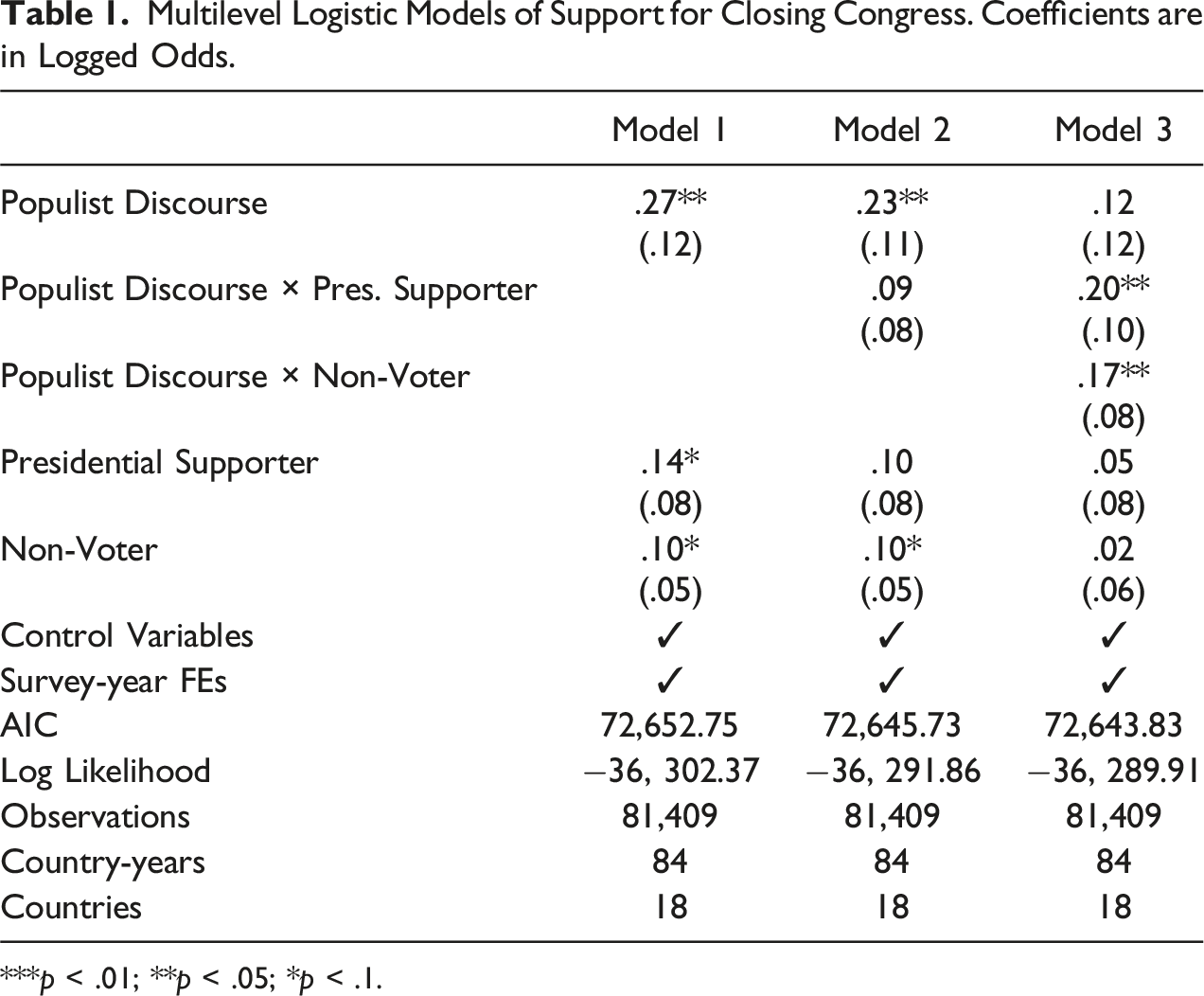
***p < .01; **p < .05; *p < .1.
Multilevel Logistic Models of Support for Closing the Court. Coefficients are in Logged Odds.
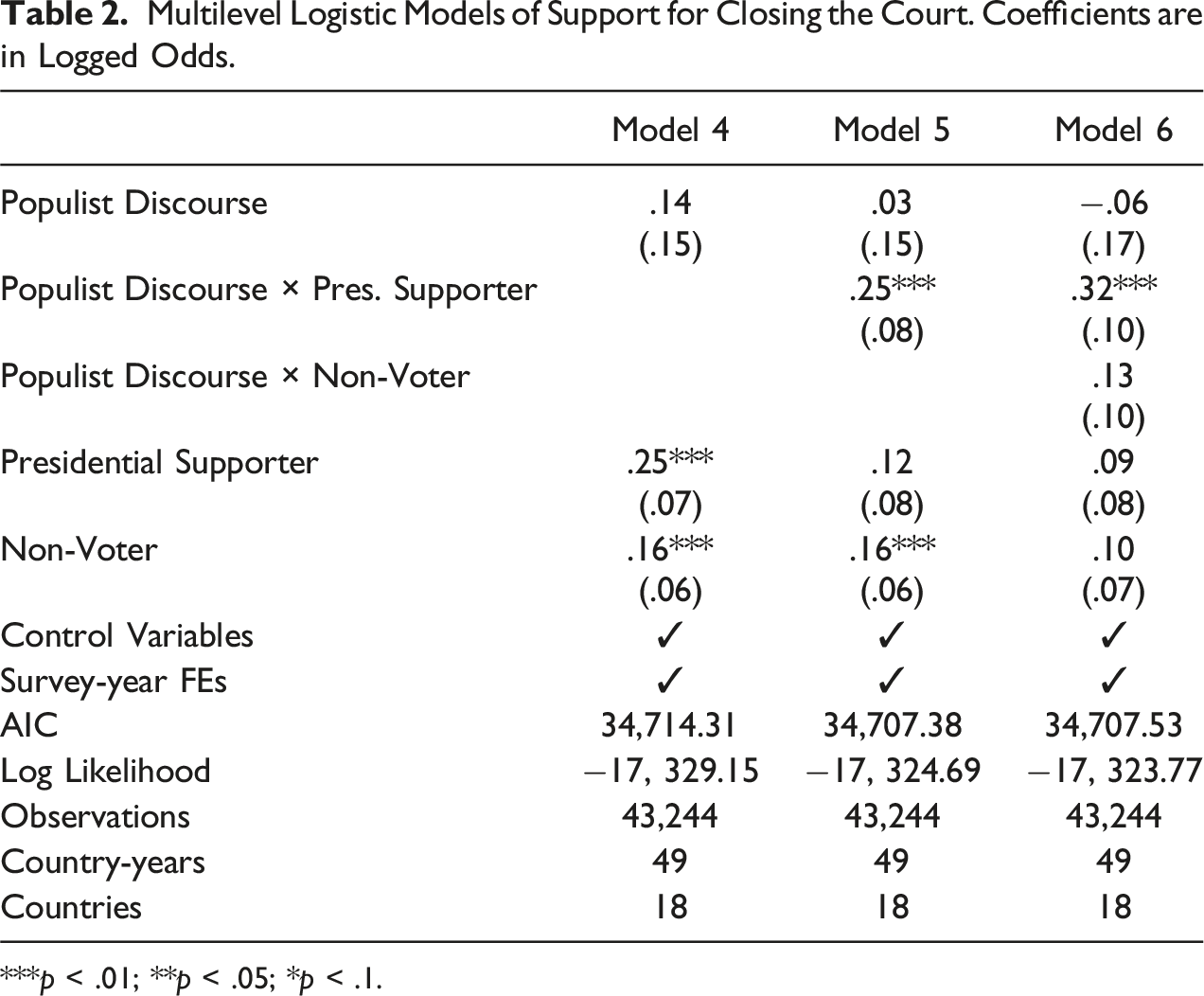
***p < .01; **p < .05; *p < .1.
Models 1 and 4 (in Tables 1 and 2) present the main effect of populist discourse on support for the president closing congress or the court. 10 This estimate is positive and statistically significant in the close-congress model (p < .05) and positive but non-significant in the close-court model. With covariates held at their means, Model 1 indicates that moving from the minimum to the maximum value of populist discourse is associated with a 7 percentage point increase in the probability that a respondent says that the president is justified in closing congress. While not statistically significant, Model 4 indicates that moving from the minimum to the maximum value of populist discourse is associated with a 3 percentage point increase in the probability that an average respondent says it is justified for the president to close and govern without the supreme court. Thus, on average, individuals are more supportive of the president closing congress in country-years with more populist presidents. 11 However, this main effect may mask heterogeneity in who responds to populist discourse.
I examine whether this relationship is conditional on individual support for the sitting president by interacting populist discourse with the presidential supporter and non-voter dummy variables. Models 2 and 5 introduce the cross-level interaction between populist discourse and presidential support to the models of support for closing congress and the court. The populist discourse × presidential supporter interaction term is positive but not statistically significant in Model 2, the model of support for closing congress. In comparison, the interaction term is positive and statically significant in Model 5, indicating larger effects of populist discourse on support for closing the court among individuals who support the sitting president. Additionally, the estimate on the presidential supporter dummy variable diminishes in size with the inclusion of the interaction term. This means that presidential support has a larger positive effect on support for closing the supreme court in country-years with more populist presidents. In fact, the non-significant estimate on the presidential supporter variable in Model 5 indicates that support for the president is only associated with greater support for closing the supreme court in country-years with values of populist discourse greater than zero. Populist presidential discourse appears to amplify the positive effect of presidential support on acceptance of the president closing the supreme court.
The final models in Tables 1 and 2 (Models 3 and 6) include an additional interaction between populist presidential discourse and the non-voter dummy variable. With this addition, the populist discourse × presidential supporter interaction is positive and statistically significant for both support for closing congress (Model 3) and the supreme court (Model 6). These models indicate that populist discourse is associated with larger increases in support for closing either branch of government among individuals who support the sitting president. The populist discourse × non-voter interaction is also positive and statistically significant in the close-congress model, indicating a larger positive effect of populist discourse among non- and null- voters than among opposition supporters. This interaction term is slightly smaller in magnitude than the populism discourse × presidential supporter interaction, suggesting that non-voters are somewhat less responsive to presidents’ populist discourse than presidential supporters. However, note that the populist discourse × non-voter interaction term is positive but modest and non-significant in the close-court model, possibly due to that model’s smaller sample size.
To examine the substantive effects, I plot predicted probabilities of presidential supporters, non-voters, and opposition supporters saying that it is justified for the president to close either branch over the range of populist discourse in Figure 1. These predictions are from Models 3 (closing congress) and 6 (closing the court). Predictions were made on the fixed portion of the model, with continuous controls held at their means and categorical controls held at their modal values. The top row in Figure 1 presents predicted probabilities of a respondent saying that it is justified for the president to close and govern without congress among opposition supporters (left-panel), non-voters (center-panel), and presidential supporters (right-panel). As shown here, populist presidential discourse corresponds with substantial increases in support for closing congress among presidential supporters, more moderate increases among non-voters, and negligible increases among opposition supporters. When populist discourse is equal to 0, between 18 and 22 percent of all individuals respond that it is justified for the president close and govern without congress. Then, as populist discourse increases above moderate levels, presidential supporters and non-voters become increasingly likely to endorse the president closing congress. When populist discourse is at its maximum observed value, 33% of presidential supporters, 30% of non-voters, and 21% of opposition supporters say the president is justified in closing congress. Over the range of populist discourse, the probability of saying it is justified for the president to close congress increases substantially, by 11 percentage points, among presidential supporters. Predicted probabilities of saying it is justified for the president to close and govern without congress (top row) or the supreme court (bottom row) among opposition supporters, non-voters, and presidential supporters. Bands indicate 95% confidence intervals. Predictions were calculated with the 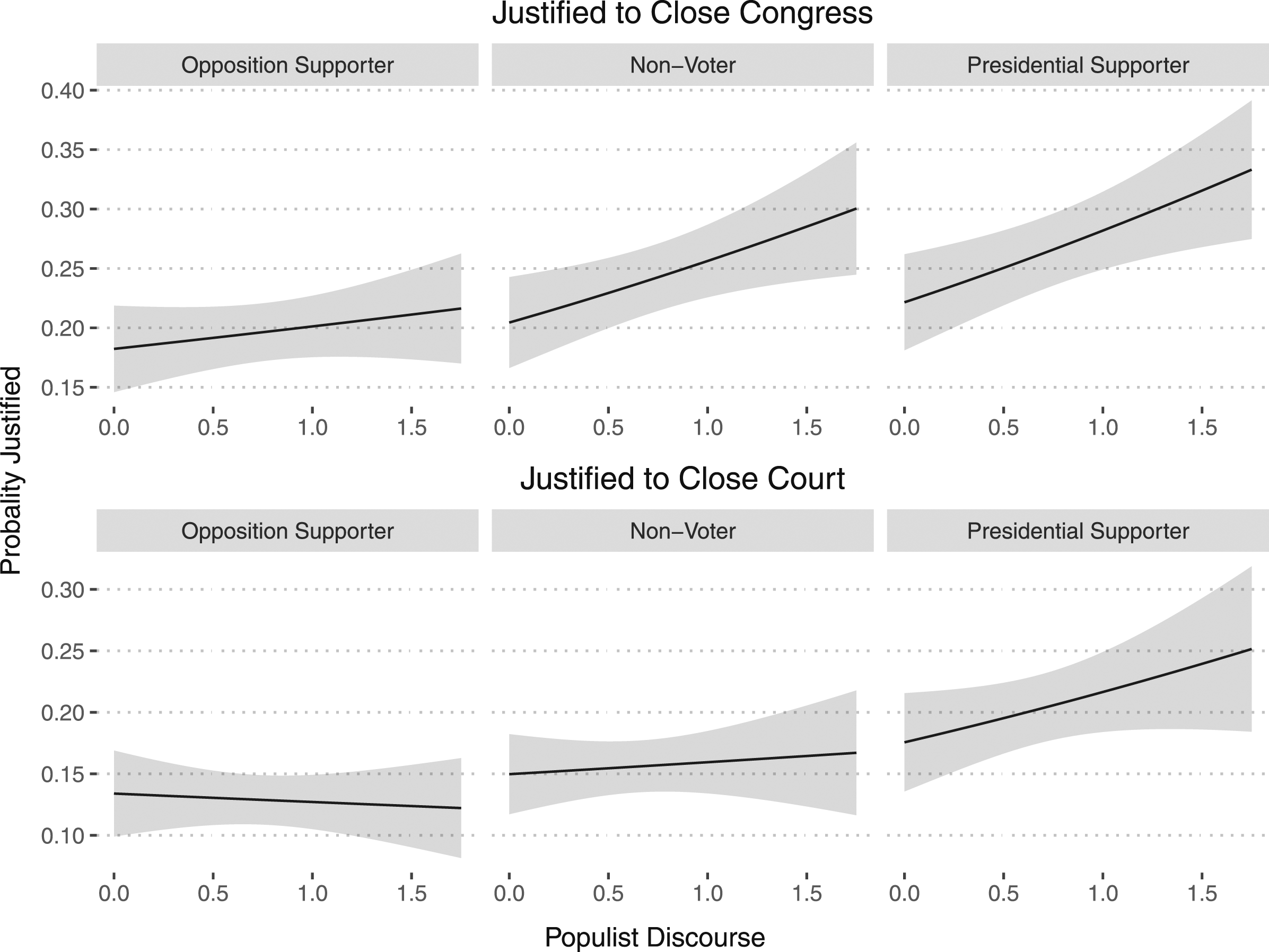
The bottom row of Figure 1 shows a similar pattern with respect to support for the president closing the supreme court. When populist discourse is equal to 0, 17% of presidential supporters, 15% of non-voters, and 13% of opposition supporters say the president is justified in closing and governing without the court. From this point, increases in the populist discourse are associated with substantial increases in the probability of saying it “is justified” among presidential supporters and with modest (and non-significant) changes among non-voters and opposition supporters. At the maximum observed value of populist discourse, 12% of opposition supporters, 17% of non-voters, and 25% of presidential supporters respond that it “is justified” for the president to close and govern without the supreme court. The larger effect of populist discourse among presidential supporters is consistent with the idea that supporters are more likely to accept and respond to presidents’ populist discourse.
The effect of populist discourse among presidential supporters is robust to alternative specifications accounting for potential biases not addressed in Models 1–6. Previous research showing that polarization, corruption, and low levels of democracy exacerbate differences between presidential supporters and other voters (i.e., Singer, 2023, 2018; Anderson & Tverdova, 2003) might suggest that the conditional effect of populist discourse is driven by some other country-level variable. To address this possibility, I add the country-year-level control variables and their interaction with presidential support to the model in a sequential manner. The resulting models, presented in Tables S13 and S14 of the SI, suggest that it is indeed populist discourse associated with support for closing congress and the supreme court among presidential supporters. 12 Another possibility is that the effect of populist discourse among presidential supporters might be a result of selection bias, where individuals with populist predispositions select into supporting populist presidents. As one test of this possibility, I add control for populist attitudes to the model: The results, presented in the SI, Table S15, suggest that populist presidential discourse corresponds with increasing acceptance of the president closing congress aggrandizement among presidential supporters even when individual-level populist attitudes are held constant. 13
A further concern involves the role of non-governmental parties. While the analysis focuses on presidential discourse, messaging from populist opposition parties might similarly increase support for executive aggrandizement. Indeed, the variable measuring populist presidential discourse might capture a broader populist political milieu rather than discourse exclusive to the president (or presidential party). Although the Global Populism Dataset only codes incumbent discourse, making this difficult to rule conclusively, there are reasons to think that presidential discourse is uniquely linked to support for executive aggrandizement. First, data from the Global Party Survey indicates that the sitting president’s party tends to be the most populist actor in the party systems considered here, suggesting that presidential rhetoric underlies the relationship between populist discourse and support for closing congress or the supreme court. 14 Second, supporters of populist opposition parties are not especially supportive of executive aggrandizement. If populist opposition parties indeed increase support for executive aggrandizement, we would expect that their supporters are relatively more accepting of the executive closing congress and the supreme court. However, individual-level models using LAPOP’s 2018/2019 survey wave show that supporters of major populist opposition parties (identified using the Global Party Survey) are no more supportive of the president closing congress or the supreme court than supporters of other – non-populist – opposition parties. 15 Hence, populist presidential discourse appears uniquely associated with increasing support for executive aggrandizement.
Lastly, several control variables (shown in Tables S4 and S5) are of interest. The estimate on mass support for democracy is negative and statistically significant: Mass support for democracy is associated with decreasing support for executive aggrandizement, as Reeves and Rogowski (2022) find as well. Meanwhile, the estimate on the liberal democracy index indicates that stronger liberal institutions, including constraints on the president, are associated with increasing support for closing congress or the court (compare to Claassen, 2020). Finally, the estimate on the legislative control variable indicates that increases in the proportion of seats held by the president’s party are associated with decreases in the support for closing congress. Citizens are unlikely to see closing congress as a solution to institutional gridlock when the president’s party controls the legislature.
Experimental Evidence from Ecuador
The evidence presented thus far indicates that populist discourse is associated with greater support for executive aggrandizement, with the effect concentrated mainly among presidential supporters. In fact, presidential supporters are only more supportive of executive aggrandizement in contexts where the president uses at least modestly populist discourse. Nevertheless, the preceding analysis cannot rule out the possibility of reverse causality, where presidents simply adopt citizens’ previously-held populist attitudes, or selection effects, where individuals who are already disposed to support executive aggrandizement select into populist parties.
Yet, the direction of causality is important to our understanding of populism and democratic backsliding. If populist presidents simply mirror citizens’ anti-democratic sentiments, then populist discourse does little to change the overall distribution of support for executive aggrandizement. Alternatively, if populist discourse shapes attitudes from the top-down, executives may use it to shape the distribution of public support for actions that undermine checks and balances. I conducted a survey experiment that randomly assigns a discursive frame and party affiliation to an Ecuadorian mayoral executive who attempts to close and govern without the legislature to study the causal effect of populist discourse.
Political Context
Ecuador has a history of populist leadership, most recently under President Rafael Correa (2007–2017). Correa was elected after a period of major instability; from 1997 to 2005, public protests forced at least three presidents from office. Correa’s Revolución Ciudadana (Citizen’s Revolution) promised economic transformation and social inclusion. During his 10-year presidency, Correa significantly expanded presidential power and partially stabilized party competition along pro- versus anti-correísta lines. Though he oversaw substantial economic growth, democratic quality declined under Correa. His government is used as an example of backsliding through executive aggrandizement (Bermeo, 2016; De la Torre, 2017). Researchers describe Correa’s government in terms such as “hybrid regime,” “technocratic populism,” and a “plebiscitary presidency” (Conaghan & De la Torre, 2008; De la Torre, 2020; Levitsky & Loxton, 2013).
Correa’s discourse and leadership style were decidedly populist. As president, he engaged in a “permanent campaign” where he appealed directly to citizens through media, including a weekly radio show (Conaghan & De la Torre, 2008). His discourse characterized society as divided between his backers and the downtrodden, on the one hand, and the partidocracia (partyocracy), media, and banks, on the other. As Polga-Hecimovich and Sánchez describe it, “Correa reoriented politics around support for or opposition to himself” (2021, 8).
The division between pro- and anti-correísta camps remains salient despite Correa leaving office in 2017. Correa’s successor and former vice-president, Lenín Moreno, broke with Correa’s Revolución Ciudadana and pursued corruption charges against Correa and other cabinet officials; Correa was convicted of corruption charges in April 2020. Ecuador’s latest presidential election (2021) went to a runoff between a right-of-center candidate, Guillermo Lasso, and a Correa-backed candidate, Andrés Arauz (Polga-Hecimovich & Sánchez, 2021). Lasso won the second-round with 52.4% of the vote, despite Correa campaigning for Arauz from exile. Correa himself remains popular; a plurality of voters in Guayaquil and Quito support him in the first round of a snap election. 16
Volatile electoral politics mean that levels of mass partisanship are comparatively low in Ecuador (Lupu, 2015). Parties are poorly institutionalized, and parties’ fortunes vary significantly between elections (Mainwaring & Torcal, 2006). For citizens, party identification is complicated by changes in party names: Correa governed under the banner of Alianza País (AP), but after that party split with Correa, the Correísta camp coalesced under Revolución Ciudadana (RC), a name previously associated with the pro-Correa movement (Wolff, 2018). Looking toward the survey experiment, low levels of partisanship and reluctant party support may attenuate the effect of incumbent support on acceptance of executive aggrandizement.
Experimental Design
The survey experiment was included as part of an omnibus-style survey of residents of Ecuador’s largest cities, Quito and Guayaquil (Moncagatta et al., 2022). Respondents were sampled from an online panel with sampling quotas based on Ecuador’s latest census. 17 Surveys were collected between February 21st and March 20th, 2022. After survey dropout, there were 3013 individual responses available for the analysis. The experiment presented respondents with a short story about a mayor who plans to close the municipal council and govern without it. As discussed above, closing the legislature is an extreme form of executive aggrandizement relative to the more incremental steps that incumbents usually take to limit horizontal accountability. The experiment therefore presents a tough test of populist discourse as a cause of increased support for executive aggrandizement. 18
The vignette discusses a mayoral instead of a presidential executive because real presidents’ visibility makes it difficult to credibly manipulate their discourse and party affiliation. Of course, the use of a mayoral executive raises questions about the comparability between executive aggrandizement attitudes at the municipal and presidential levels. It is possible that respondents perceive mayoral aggrandizement as less risky than presidential aggrandizement, and that this perception increases the size of any treatment effects. However, large city governments are politically salient in Ecuador, making municipal-level executive aggrandizement a serious breach of democratic norms. With this in mind, the survey vignette stated that the mayor represents “one of the largest cities in Ecuador” to invoke Guayaquil or Quito. Attitudes about closing the municipal legislature are also highly correlated with an index of executive aggrandizement attitudes concerning the president (r = .41, p < .01), suggesting the comparability of these attitudes. 19 Finally, the use of a municipal executive might, in fact, attenuate the effect of populist discourse, at least insofar as municipal executives have a less compelling claim to represent “the people” than presidential executives. I refer to the municipal council as “the legislature” throughout to emphasize the executive-legislative dynamic common to many cases of executive aggrandizement.
Experimental vignettes with the framing manipulation shown in bold and the party affiliation shown in italics. Vignettes included the title “Alcalde Lopez from CREO/Revolución Ciudadana intends to close the city council.”
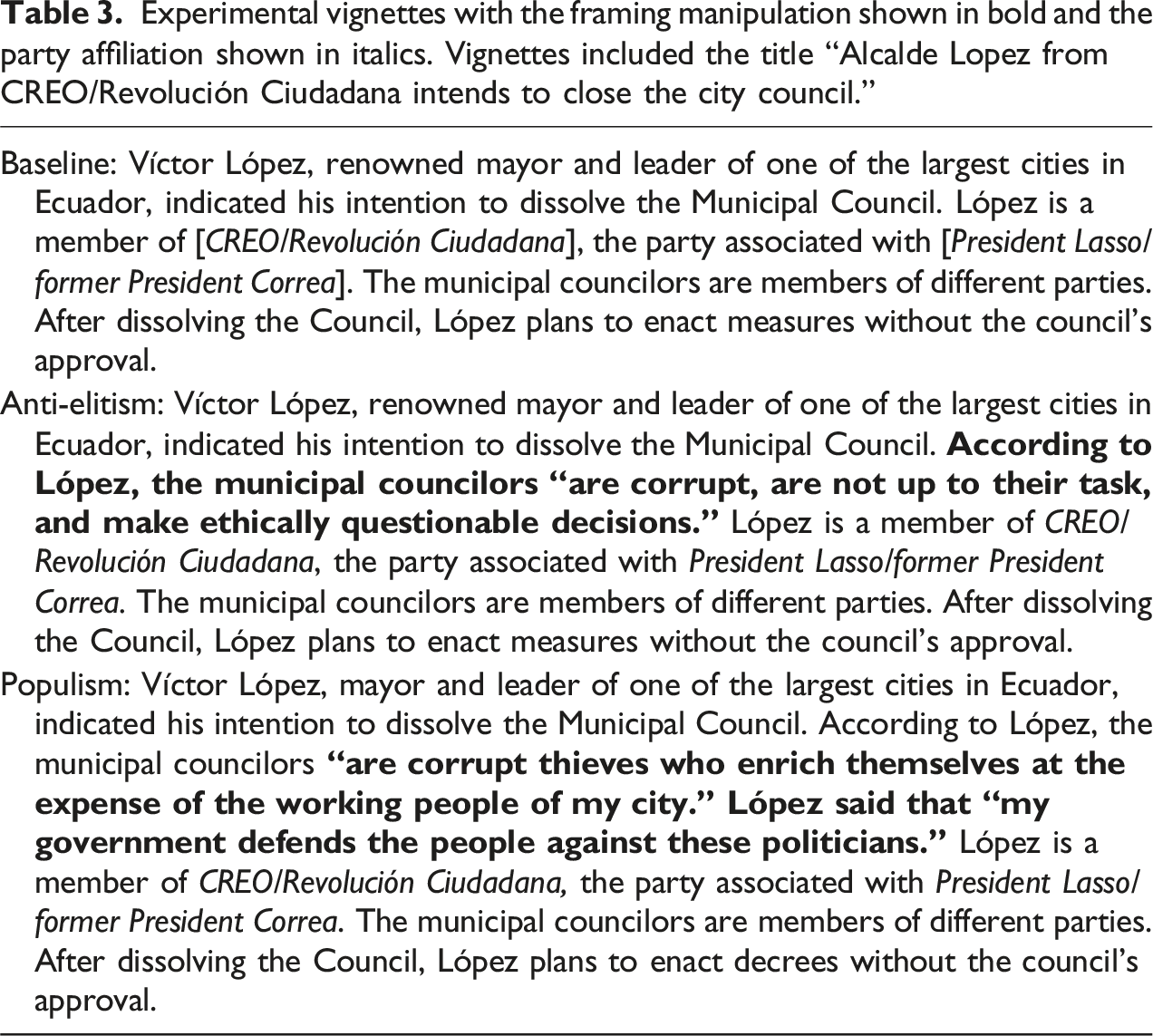
The argument for closing the legislature, or the discourse manipulation, has three levels. In the populism condition, the mayor states that the legislators “are corrupt thieves who enrich themselves at the expense of the working people of my city” and claims to defend “the people against these politicians.” Note that the populism condition includes the main features of populist discourse: It pits the people against the elite and situates the mayor on the side of the virtuous people. The language used in the populism treatment is also highly moralistic, evoking the Manichean dimension of populist discourse. Second, in the anti-elitism condition, the mayor says that the legislators “are corrupt, are not up to their task, and make ethically questionable decisions.” The anti-elitism condition includes a central component of populist discourse – the idea of elite corruption – but does not invoke the people and uses less moralistic language than the populism condition. Accordingly, the anti-elitism condition helps disentangle the extent to which support for closing the legislature is driven by accusations of institutional corruption versus representational claims – to defend the people against malicious elites – made by populist leaders. The anti-elitism treatment is weaker than the populist treatment, but should still increase support for closing the legislature relative to the baseline. Third, in the baseline condition, the mayor does not offer any discursive justification for closing the legislature.
Acceptance or rejection of populist discourse should depend on support for the executive. The experiment therefore manipulates the mayor’s party affiliation: He is either associated with CREO, “the party associated with President Lasso,” or Revolución Ciudadana, “the party associated with former President Correa.” These are the two major parties that competed in the second-round of Ecuador’s February 2021 presidential election. The names of the party leaders, Lasso and Correa, were included to make the parties easier to identify in the context of Ecuador’s weak party system, and because the name of the Correa-affiliated party has changed several times. I coded party support based on respondents’ vote choice in the second round of the last national election (asked pre-treatment). Respondents were coded as incumbent supporters if they voted for the party shown in the vignette, opposition supporters if they voted for the opposing party, and non-supporters if they did not vote or cast a null ballot. Note that the vignette states that the “municipal councilors are members of different parties” after indicating the mayor’s party affiliation. Coupled with the mayor’s proposal to dissolve the council, this implies that the mayor’s party holds a legislative minority or, at minimum, that he faces significant legislative opposition.
Lastly, the dependent variable measures support for closing the legislature using the mean of two Likert items asked immediately after the survey vignette (alpha = .87). The first item asked if “the mayor should dissolve the municipal council,” while the second asked if “it is justified for the mayor to dissolve the council.” Responses are on a five-point scale, ranging from strongly disagree (0) to strongly agree (4). Higher values therefore indicate greater support for closing the legislature. Across conditions, the mean value is 1.66 (s.d. = 1.16), indicating that most respondents slightly disagree with the executive closing the legislature.
Results
The mean estimates and 95% CIs shown below are predictions from OLS models regressing support for closing the legislature on categorical indicators of treatment assignment. These models are shown in the SI (Table S18) alongside tests for significant differences between conditions (Tables S19, S20, S21).
Figure 2 shows that the populist and the anti-elitist frames increase support for closing the legislature relative to the baseline: Support for closing the legislature is highest with the populism frame, lower with the anti-elitism frame, and lowest in the baseline condition. Tests for differences in means (Table S19) indicate significant differences between the populism and baseline conditions (p < .01) and the anti-elitist and baseline conditions (p < .01). However, the difference in means between the populism and anti-elitism conditions is not statistically significant (two-tailed p-value = .27). Substantively, the populist frame increases mean support for closing the legislature by .33 units (22%) relative to the baseline, while the anti-elitist frame increases support for closing the legislature by .27 units (18%) relative to the baseline. These findings mirror those from the cross-national analysis, showing that populist discourse increases support for executive aggrandizement. Mean support for closing the legislature by framing condition.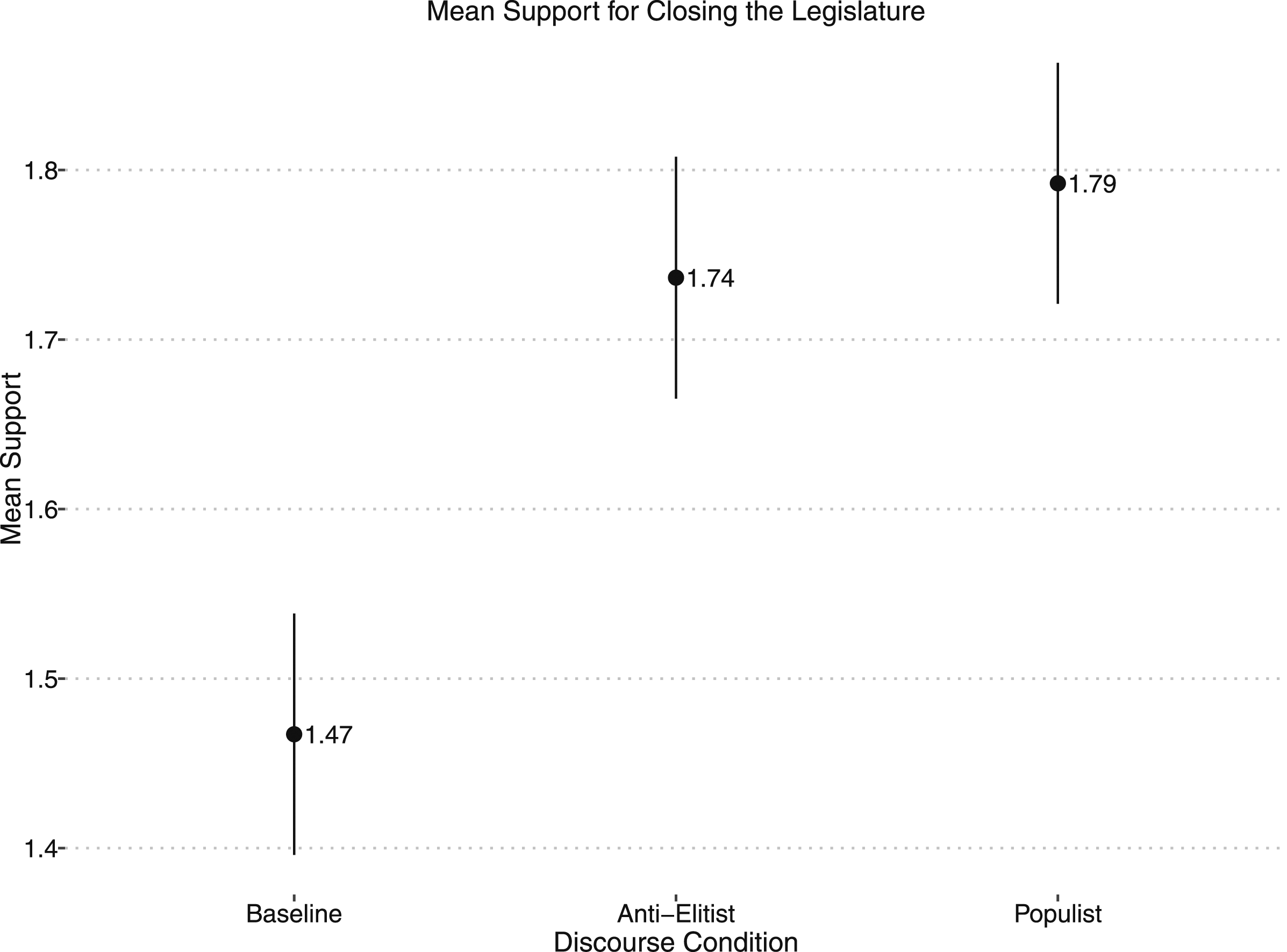
Second, I examine the interaction between incumbent party support and the executive discourse. Figure 3 presents mean support for closing the legislature by discourse condition among incumbent and opposition party supporters. Mean estimates and 95% CIs are from an OLS model regressing support for closing the legislature on the incumbent support × discourse condition interaction term and a dummy variable for non- or null-voters (Table S18, Model 2). As shown in Figure 3, support for closing the legislature is higher among incumbent party supporters across all three conditions. Support for the party shown in the vignette increases mean support for closing the legislature by .20 units in the baseline condition (p < .05), .24 units in the anti-elitism condition (p < .01), and .29 units in the populism condition (p < .001) relative to opposition support. However, the positive effect of incumbent support does not differ significantly across the discourse conditions.
20
We can also examine the effect of moving from the baseline to the anti-elitism or populism conditions among incumbent versus opposition supporters. Here, too, the effect of the populist and anti-elitist frames is larger among incumbent supporters than opposition supporters, but not significantly so. The effect of moving from the baseline frame to the anti-elitism frame is to increase support for closing the legislature by .30 units among incumbent supporters (p < .01) and by .26 units among opposition supporters (p < .001). Similarly, moving from the baseline to the populism frame increases support for closing the legislature by .39 units among incumbent supporters (p < .001) and by .30 units among opposition supporters (p < .001). Mean support for closing the legislature by frame and party support. Party support is coded based on vote choice in the last national election.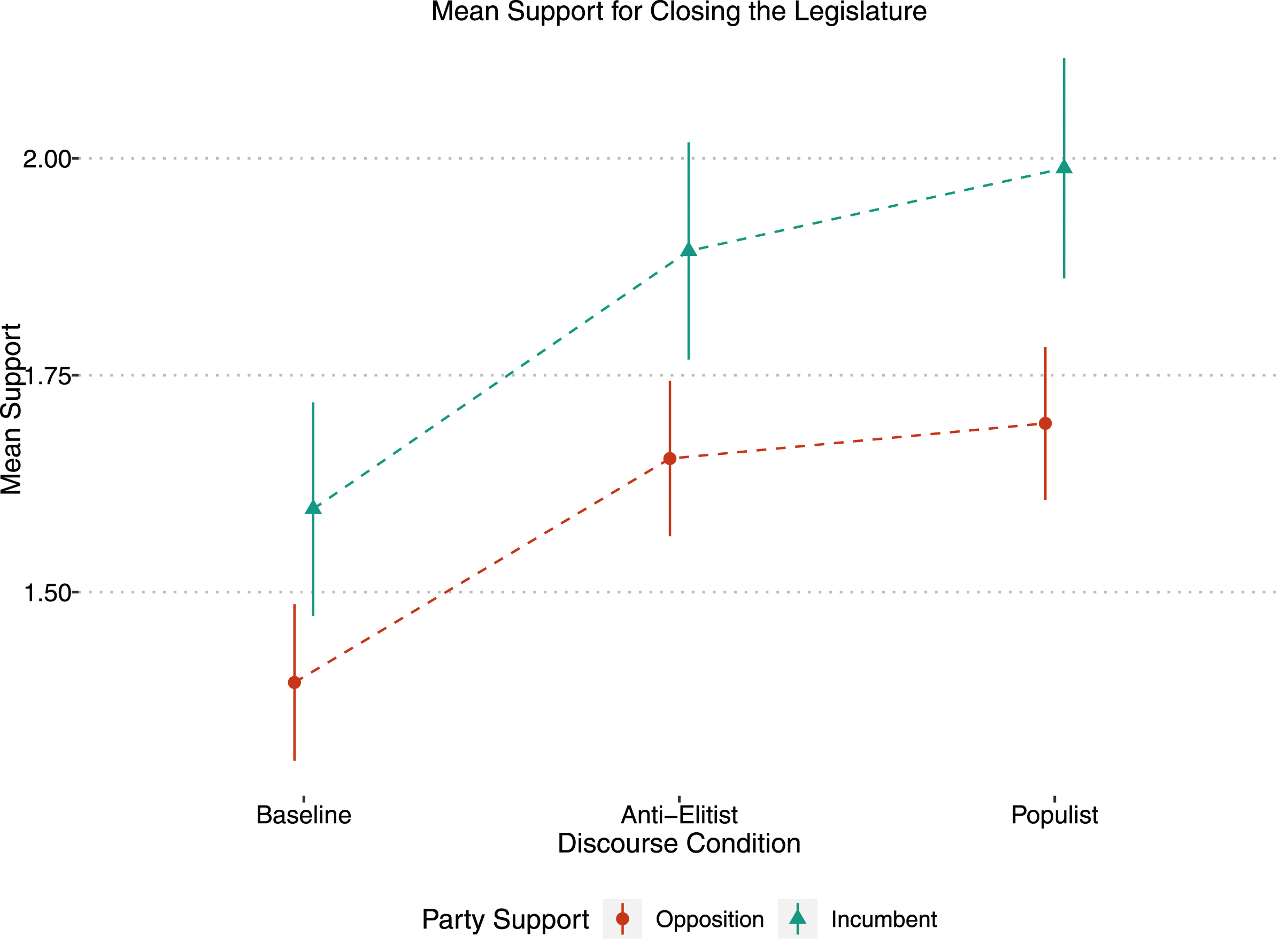
The experimental results are similar under alternative model specifications. Table S22, in the SI, adds interaction terms between non- or null-voters and the discourse conditions, as well as controls for pre-treatment executive aggrandizement attitudes and the party shown in the vignette. Populist discourse and anti-elitist discourse increase support for closing the legislature across these specifications. Meanwhile, the interaction terms between party support and the discourse conditions are not significant, indicating similarly-sized positive effects of the anti-elitist and populist frames regardless of support for the incumbent party. I also find no effect of the party shown in the vignette, indicating similar levels of support for closing the legislature by hypothetical CREO and Revolución Ciudadana incumbents.
Discussion and Conclusion
The evidence shown here supports the hypothesis that populist discourse increases support for executive aggrandizement in Latin America. First, a multilevel analysis of survey data from 18 Latin American countries showed that populist presidential discourse is associated with increased support for the president closing congress or the supreme court–particularly among presidential supporters. The multilevel analysis also indicated that populist discourse amplifies the effect of presidential support on the acceptance of executive aggrandizement. Nevertheless, the multilevel analysis raised questions regarding the direction of these effects; we might observe a similar relationship between populist discourse and support for executive aggrandizement if presidents simply adopt citizens’ pre-existing populist attitudes. To address this, I conducted a survey experiment that randomly assigned an executive’s party affiliation and discursive justification for executive aggrandizement. The survey experiment shows that populist and anti-elitist discourse increase support for closing the legislature relative to the control condition. In combination, the multilevel analysis and survey experiment are strong evidence that populist discourse increases support for executive aggrandizement.
The experimental results are consistent with a top-down effect of populist discourse on support for executive aggrandizement. However, they differ from the cross-national findings regarding the moderating effect of incumbent support: The smaller-but-still-significant effect of populist discourse among opposition supporters might indicate that opposition supporters are persuaded by executives’ populist discourse. Opposition supporters might accept arguments in executives’ populist discourse, even if they are somewhat less likely to than incumbent supporters. Alternatively, the effect among opposition supporters may be an artifact of an experimental treatment where the opposition does not offer a competing frame (e.g., disavowing corruption) or of a political context where party brands are weak. In real-world discourse, competing frames from legislative (or other) opposition groups may cancel out the more modest effect of incumbents’ discourse among opposition supporters (see Chong & Druckman, 2007b). Future experimental work might examine the influence of populist discourse when opposition leaders offer competing frames or in contexts with more stable party systems.
The experimental results also raise a question as to whether it is populist discourse or corruption accusations – in the anti-elitism condition – that increase support for executive aggrandizement. Notably, support for closing the legislature is not substantively different between the anti-elitism and populism conditions. It is possible, then, that the anti-elitist component of populist discourse drives support for executive aggrandizement while the people-centric element is less important. Yet, this experimental design is not ideally suited to distinguish between different dimensions of populist discourse. The populism and anti-elitism conditions differ both in terms of their people-centric content and the moralism of their language. While this is conceptually appropriate — populism “is a moral discourse” that frames the politics as “a cosmic struggle between ‘the people’ and ‘the elite’” (Hawkins and Kaltwasser, 2018, p. 3) — it limits inferences about how populism’s people-centric and anti-elitist dimensions separately affect support for executive aggrandizement.
Even so, the people-centric element of populist discourse involves the claim to represent ‘the people.’ This representational claim, as well as the more moralistic language in the populism treatment, should be most compelling to incumbent supporters. The experimental results are consistent with this: Though not statistically significant, average support for closing the legislature is .10 points higher among incumbent supporters in the populism condition compared to those in the anti-elitism condition. 21 The estimated effect is about half that size, .04 points, among opposition supporters. In combination with the observational results, which indicate a significant conditional effect of incumbent support, this suggests populist discourse increases support for executive aggrandizement among incumbent supporters.
More broadly, looking at presidents’ discourse explains contextual variation in the relationship between presidential support and support executive aggrandizement. Previous studies show that support for some executives increases acceptance of executive aggrandizement while support for others does not (Gidengil et al., 2021; Mazepus & Toshkov, 2021). The present finding suggests that executive discourse may explain this variation: Presidential supporters are more likely to endorse executive aggrandizement when the presidents use populist discourse. These findings also suggest that the dangers posed by presidential supporters — pointed out by Singer (2018), Albertus and Grossman (2021), and others — are exacerbated by executives’ populist discourse. However, the effect of populist discourse is not exclusive to presidential supporters. The experimental results leave open the possibility that populist discourse affects opposition supporters and non-supporters as well. Similarly, the cross-national results indicate that populist discourse increases support for executive aggrandizement among presidential supporters and some unaligned voters. From the perspective of a democracy-eroding executive, convincing unaligned voters to accept executive aggrandizement further reduces the risk of popular backlash to presidential actions.
Executives have a strong incentive to deploy populist discourse if it increases support for executive aggrandizement among their supporters and has no negative effect among other voters. But it does not follow that populist discourse is always the dominant strategy for democracy-degrading executives. Populists sometimes moderate once elected (Akkerman et al., 2016), and anti-institutional messages can backfire among opposition supporters (Bowler et al., 2022). Regarding the observational results, populist discourse may not backfire – decrease opposition support for closing congress or the supreme court – because baseline support for these actions is quite low among opposition supporters. Alternatively, populist discourse might not affect support for executive aggrandizement among opposition supporters but have negative consequences for other attitudes about the executive.
The relationship between populist discourse and support for executive aggrandizement echoes concerns about delegative democracy and presidentialism in Latin America (Linz, 1990; O’Donell, 1994). Populist presidents appeal to the people and denigrate congress, in part, to manage the tension between congressional and presidential legitimacy endemic to presidentialism. It is possible that the relationship between populist discourse and attitudes about executive aggrandizement is stronger in presidential systems, where the executive has a “strong claim to democratic, even plebiscitary, legitimacy” (Linz, 1990, p. 53). Yet, evidence for the effect of presidentialism on democratic backsliding is mixed (Benasaglio Berlucchi & Kellam, 2023), and popular support for backsliding by populist prime ministers (e.g., Hungary’s Viktor Orbán and Turkey’s Tayyip Erdoğan) suggests that populist discourse may also increase support executive aggrandizement in parliamentary systems. 22
That presidential discourse shapes attitudes about executive aggrandizement has critical implications for executive accountability and democratic backsliding. While public opinion is typically seen as a constraint on presidential power (e.g., Christenson and Kriner, 2020; Posner and Vermeule, 2011), the evidence shown here indicates that presidents can shape attitudes about executive aggrandizement to circumvent public opinion as an accountability mechanism. In this sense, the analysis agrees with the observation that presidents “change citizen evaluations to avoid voter punishment” (Druckman & Jacobs, 2015, p. 3). Populist presidential discourse makes it more difficult for citizens to agree on what constitutes undemocratic behavior and effectively police presidential actions, creating a public opinion environment that is conducive to democratic backsliding. Increasing public support for executive aggrandizement also makes it more costly for opposition leaders to challenge presidential behaviors. Presidents’ strategic use of populist discourse therefore helps explain the relationship between populism and democratic backsliding observed in previous work (Huber & Schimpf, 2016; Levitsky & Loxton, 2013).
The finding that presidents’ populist discourse increases support for executive aggrandizement is no great consolation to observers concerned about democratic backsliding. After all, presidents are likely to adopt populist discourse to legitimate their efforts to undermine democratic institutions. However, presidents’ strategic use of populist discourse does help explain why backsliding governments are able to maintain significant public support: Presidents employ populist discourse to manipulate citizens’ democratic commitments and increase public support for executive-led backsliding. Further studies might consider alternative frames that bolster citizens’ commitment to checks on the executive.
Supplemental Material
Supplemental Material - Populist Discourse and Public Support for Executive Aggrandizement in Latin America
Supplemental Material for Populist Discourse and Public Support for Executive Aggrandizement in Latin America by Brett Bessen in Comparative Political Studies
Footnotes
Author’s Note
Thank you to Andy Baker, Carew Boulding, Jennifer Cole, Brendan Connell, Jennifer Fitzgerald, Kai Ostwald, Paolo Moncagatta, Andrew Philips, Rodolfo Sarsfield, Susan Stokes, the three anonymous reviewers, and the CPS editors, for their thoughtful comments. Any errors are my own.
Declaration of Conflicting Interests
The author(s) declared no potential conflicts of interest with respect to the research, authorship, and/or publication of this article.
Funding
This research was supported by the University of Colorado Boulder’s Department of Political Science through a Graduate Student Research Grant and by Tecnologico de Monterrey's School of Social Sciences and Government through a Faculty Development Grant.

Supplemental Material
Supplemental material for this article is available online.
Notes
References
Supplementary Material
Please find the following supplemental material available below.
For Open Access articles published under a Creative Commons License, all supplemental material carries the same license as the article it is associated with.
For non-Open Access articles published, all supplemental material carries a non-exclusive license, and permission requests for re-use of supplemental material or any part of supplemental material shall be sent directly to the copyright owner as specified in the copyright notice associated with the article.
