




Abstract
During armed conflict civilians often inhabit areas of contested governance or areas where rebel groups, NGOs, and/or criminal syndicates vie for authority and challenge the control of the state. As non-state actors confront the authority and legitimacy of the state, civilians become central players in that competition asked to uphold or undercut these alternative governance claims. In this paper we examine the long-term impact of rebel governance for citizens living in spaces where state governance is challenged. Leveraging survey data from areas historically under PKK control in Southeastern Turkey, we focus on the ways in which contestation over governance during the conflict influenced future trust and engagement with the Turkish state. Specifically, we find that individual engagement with rebel governance institutions and personal conflict experience are important factors in understanding the effects of contested governance. Our findings increase our understanding of the long-term impact of armed conflict on civilians and the potential lasting impacts of rebel governance on the post-conflict state.
During periods of armed conflict, civilians often inhabit areas of contested governance where they are subjected to the authority of multiple armed actors. Rebel groups challenge the government’s right to rule through violence, but also by undermining the legitimacy of the state’s governing institutions. Under certain circumstances rebel groups themselves take up the mantle of the state, making and enforcing rules and providing goods and services to the civilian population (Arjona et al., 2015; Cunningham & Loyle, 2021; Huang, 2016; Loyle et al., 2023; Mampilly, 2011). These efforts at governance are not made in isolation, but rather under the cloak of the state’s governing authority. When rebels (attempt to) govern, civilians are often forced to make choices about which authorities to engage with and how to structure that engagement (Arjona, 2016). Sometimes the decision to cooperate or comply with rebel governance is voluntary, but often this engagement is coerced. Civilian engagement with rebel institutions is likely a product of their conflict allegiances, but may also be a strategic choice based on a civilian’s perceptions of the efficiency and effectiveness of state and rebel governance (Revkin, 2021).
How a civilian engages with rebel institutions during armed conflict likely has lasting implications for their relationship to state governance once the conflict has ended. It may be that sustained rebel challenges to the monopoly of state institutions lead civilians to distrust the state once rebellion has ended (Kubota, 2017, 2018). Alternatively, exposure to inefficient or coercive rebel governance may cause civilians to appreciate effective, state-based institutions more fully (Deglow & Sundberg, 2021a; Huang, 2016). In this article, we examine the long-term relationship between exposure to rebel governance and civilian trust in state institutions based on the choices and experiences of civilians during armed conflict. We define rebel governance as the actions rebel groups engage in to regulate the social, political, and economic life of non-combatants (Arjona et al., 2015, p. 3). We ask the question of how an individual’s exposure to rebel governance influences their attitudes towards state institutions? Building from the existing literature on rebel governance we argue that a civilian’s experiences during the conflict and engagement with alternative governing arrangements are important for understanding this relationship.
In examining the long-term influence of rebel governance, we focus specifically on contestation between the rebel group and the state over the ability to make and enforce rules. To test this relationship, we conduct a survey of individuals living in Turkey during the conflict with the Kurdistan Worker’s Party, commonly known as the PKK. The PKK is a secessionist rebel group seeking to constitute a new state for ethnic Kurds, with greater rights and privileges for the minority group. During the over thirty-year conflict, the PKK has worked to undermine the legitimacy and authority of the Turkey government in Southeastern Turkey creating a series of parallel governing institutions, including an alternative judicial system through its own People’s Courts. Our survey was designed to gage civilian exposure to rebel judicial institutions during the height of the conflict as well as contemporary perspectives of governance by the Turkish state, particularly the Turkish judiciary. We focus specifically on the role of a parallel judicial structure because of the centrality of rulemaking and rule-enforcement to the core functions of the state (Weber, 1918). We find that exposure to rebel governance reduces civilians’ contemporary trust in state governance institutions. Furthermore, this effect is conditioned by an individual’s personal experience with violence and their positionality within the conflict vis-à-vis the rebel group’s constituency.
This paper offers at least three contributions to our study of rebel governance both during and after conflict. First, there has been a recent call in the rebel governance literature to engage more directly with the experiences of civilians living under rebel rule in order to better understand why rebels chose the governance tactics that they do and to what effect (Arjona, 2016; Arjona et al., 2015, p. 297; Loyle et al., 2023). This article is an attempt to directly engage with civilian responses to rebel governance through an individual-level survey of people exposed to rebel governance. Second, our findings expand our understanding of the legacies of rebel governance by examining variation in civilian exposure to rebel governance institutions. Rather than assuming a uniform experience with rebel institutions, our survey allows us to test for different theoretical mechanisms related to institutional exposure, conflict experience, and demographic characteristics, and how these mechanisms influence the legacy of rebel rule. And third, our work draws attention to the importance of accounting for the impacts of rebel governance in areas of policy and programing to advance rule-of-law and trust in state institutions once a conflict has ended.
Living in Areas of Contested Authority
While much early literature on governance and statebuilding has focused on the role of the state, increasingly scholars have turned their attention to the myriad of different actors within a state who offer components of governance (e.g., Florea, 2014; Lemke and Crabtree, 2020; Risse ed., 2011; Staniland, 2017). Civil society groups, international organizations, cultural, religious or tribal authorities, criminal syndicates and other types of armed actors, have all demonstrated an ability to challenge the state’s capacity to make and enforce rules, provide goods and services, and exercise a monopoly over the use of force (Cammett & MacLean, 2011). Contestation over governance and authority are particularly pronounced in areas of armed conflict. Rebel groups seeking to directly challenge the authority of the state often seek to do so, in part, by offering civilians alternative governance arrangements such as parallel judiciaries, security forces, or social services (i.e., schools, hospitals, etc.) (e.g., Albert, 2022; Huang, 2016; Loyle, 2021; Stewart, 2018). In some cases, these alternative governing provisions parallel or directly challenge official state arrangements. In other cases, where state penetration or reach is weak, rebel groups may offer governance not currently provided by the state.
While there is a well-developed literature on contested statehood (e.g., Florea, 2014; Lemke and Crabtree, 2020; Risse ed., 2011) and rebel governance (c.f. Arjona et al., 2015; Huang, 2016; Loyle et al., 2023; Mampilly, 2011; Stewart, 2021), the lasting impact of these arrangements on civilians living under rebel control has been less studied (Arjona et al., 2015, p. 297). Cammett and MacLean (2011) emphasize that the relationship between contested governance and citizenship is neither consistently positive nor negative as citizens begin to conceptualize or alter their notions of rights under the current political system (14). In her study of civil wars, Huang (2016) suggests that certain configurations of rebel governance can lead to greater democratic outcomes in the post-conflict period through a learning mechanism whereby citizens develop new understandings and subsequent demands for democratic governance. Martin et al. (2022), on the other hand, find that individuals who lived under rebel rule in Côte d’Ivoire held more negative attitudes towards state institutions than other Ivorians even seven years after the civil war. Martin et al. (2022) attribute this outcome to a disruption in norms of compliance with the state, the during-conflict creation of local institutions, and economic resentment. Similarly, Kubota (2018) found that living under rebel rule in Sri Lanka negatively impacted individuals’ social groups and local organizations which subsequently weakened interpersonal trust. While it is likely that exposure to rebel governance will impact an individual’s relationship with the state, the direction of this impact is less clear.
The Legacy of Rebel Governance
While the study of armed conflict has traditionally focused on the ability of rebel groups to challenge the state’s monopoly on the use of force, the adoption of parallel governing institutions offers an opportunity for a rebel group to directly undermine the state’s ability to make and enforce rules. In addition to the physical insecurity of armed conflict, the ability of rebel groups to usurp these basic functions of governance weakens a state’s right-to-rule and can have long-term consequences for civilian perceptions of the state’s effectiveness and legitimacy once the conflict has ended. But what is the likely direction of this relationship?
Challenges to state governance have the potential to weaken perceptions of state effectiveness and therefore the ability of rebel groups to mount a credible challenge to state institutions can erode trust in the state. State institutions foster trust by being perceived as efficient, fair, and impartial (Freitag & Bühlmann, 2009; Knight, 2001; Rothstein & Stolle, 2008). Ineffective state institutions, however, undermine the building and preservation of generalized societal trust (Rothstein & Stolle, 2008). Börzel and Risse (2016) find that experiences with fair and impartial governance institutions increased generalized trust within a community that could then be upscaled beyond the community to state governance. Before a conflict the state was perceived as the only game in town and subsequently derived its legitimacy, in part, from its centrality of governance. Challenges to state institutions can undermine civilian perception of the state’s ability to rule efficiently and subsequently erode trust in state institutions (Deglow & Sundberg, 2021a; Kubota, 2017).
While the literature suggests that exposure to rebel governance likely has a negative impact on an individual’s trust in state institutions, this expectation disregards individual characteristics and experiences. Civilians do not engage with or experience rebel governance in a political or social vacuum. Other factors such as an individual’s prior experience with state institutions, demographic characteristics, and experience with the conflict itself could impact the ways in which exposure to rebel governance influences how an individual subsequently views the state. The long-term impact of rebel governance is therefore likely a product of two interrelated factors: an individual’s experience with or exposure to governing institutions and that individuals’ personal experiences during the conflict.
Civilian Exposure to Rebel Governance
The impact of rebel governance on a civilian’s future attitudes towards the state is likely conditioned, first and foremost, by the exposure that an individual had with rebel governance institutions. The ability of rebel governance to undermine trust in state institutions is likely heightened when civilians engage with rebel institutions. Exposure to rebel governance institutions can undermine the credibility of the state by weakening its legitimacy, demonstrating the inefficiencies of state institutions, and a lack of monopoly on governance. This effect is present whether an individual’s experience with rebel institutions was positive or negative as it is ultimately just the presence of an alternative governance structure which weakens state credibility. We should therefore expect that:
Individuals who are exposed to rebel governance institutions are likely to have less trust in state institutions than those individuals who are not exposed to rebel institutions.
Civilian Experiences During Conflict
But exposure alone may not be enough to have lasting impacts on civilian attitudes towards state institutions. The impact of rebel governance on civilians’ perceptions is likely to be influenced by an individual’s positionality within the conflict itself. Specifically, a civilian’s experience with the conflict has the potential to impact their long-term trust in governing institutions. One of the central functions of the state is to provide security for its citizens (Weber, 1918). The inability of the state to live up to this agreement will likely have a lasting impact on an individual’s trust in the state and subsequently their trust in state governance. Citizens may perceive the state’s inability to provide security as a signal of its inefficiency, which will likely undermine future trust in the state (Bakke et al., 2014; Deglow & Sundberg, 2021a).
Even in areas of armed conflict there is typically large variation in individuals’ experience with violence (Bakke et al., 2009). What a person saw or faced could be a product of where they live, who they are, who they know, or often just happenstance. Civilians who experience violence during armed conflict are likely to more rigorously challenge the state’s ability to live up to its end of the security bargain—weakening the individual’s overall trust in the state (Deglow & Sundberg, 2021a). Therefore, we would expect civilians who experienced high levels of violence during the conflict to have less trust in state governance than those individuals who were not directly impacted by the conflict in this way. While this experience is likely to be heightened when the state itself is the perpetrator of violence against the individual, experiencing any form of violence during the conflict undermines an individual’s trust in the state’s ability to maintain order (De Juan & Pierskalla, 2016). We should therefore expect that:
Civilians who experience violence during a conflict are likely to have less trust in state governance institutions than those individuals who did not experience violence.
Beyond experiences with violence, an individual’s positionality vis-à-vis the challenging authority will likely impact a person’s experience with rebel governance institutions. Individuals who are members of the challenger’s constituency are more likely to experience the positive benefits (either real or perceived) of rebel authority and be less likely to trust state institutions. Constituency members are those individuals a contesting authority claims to represent, the “in-group population” (Akcinaroglu & Tokdemir, 2018, p. 358). A rebel group’s constituency could be an ethnic or religious group (as in the case of the Kurdish population and the PKK), or an ideological group (as in the case of the FARC in Colombia or the Maoists in Nepal). As constituency members are more likely to receive benefits from rebel governing institutions, they are more likely to view these institutions favorably. Constituency members may also be more likely to voluntarily engage with rebel governance or to avoid engaging with state institutions. For these reasons, we should therefore expect that:
Civilians who are members of the rebel group’s constituency are likely to have less trust in state governance than those individuals not represented by the rebel group.
Rebel Governance in Southeastern Turkey
To study the relationship between rebel governance and state institutions, we examine the attitudes of civilians living in Southeastern Turkey and study the impact that exposure to PKK judicial institutions had on contemporary attitudes toward the Turkish judiciary. Rebel governance can be defined as “the set of actions rebels engage in to regulate the social, political, and economic life of non-combatants during war” (Arjona et al., 2015, p. 3). Stewart (2020) estimates that one-third of all rebel groups active in civil wars between 1945 and 2003 engaged in some form of governance of civilians. PKK rule in Turkey is selected as our case of rebel rule for several reasons. First, the conflict between the Turkish government and the PKK is a high intensity, long duration civil war which gave the PKK the opportunity to adopt and establish governance institutions. This increases that likelihood that individuals in our sample were exposed to rebel governance. Second, the PKK conflict was regionally concentrated allowing us to include in our sample individuals who had little or no exposure to rebel governance or the conflict. Third, in the range of rebel governance cases, the PKK’s operation in Turkey is an example of contested governance. While the PKK attempted to govern throughout the Southeastern region, at no point during the conflict did the PKK successfully oust the Turkish government. In other words, the Turkish government maintained a working government throughout the conflict allowing us to measure perceptions of a functioning institution. This contestation was particularly present when it came to adjudicating disputes and serves as the justification for our focus on the PKK’s judicial institutions.
In 1984, the PKK (Partiya Karkerên Kurdistanê or Kurdistan Workers’ Party) began an armed struggle against the Turkish state. Lead by Abdullah Öcalan, the separatist group advocated for an independent Kurdish state with greater cultural autonomy and linguistic rights for Kurds. While the conflict began as a low-level urban guerilla campaign, it went on to become one of the longest running civil wars in modern history. During the war, the PKK relied on terrorism as well as conventional civil war tactics against state security forces and civilians. The Turkish state responded with widespread human rights abuses, including the forced relocation of Kurdish villages and arrests of sympathetic activist, journalists, and politicians. Most of the fighting took place in Kurdish strongholds in Southeastern Turkey and across the border in Northern Iraq. Over 35,000 people were killed over the course of the conflict. Peace talks with the government and the PKK were held between 2012 and 2015, but eventually broke down over accusations that the Turkish state was not doing enough to protect Kurdish citizens from ongoing IS attacks. The conflict resumed, returning to levels of violence not seen since the 1990s.
Given its successionist goals, the PKK had an incentive to pursue a maximalist model of governance (Mampilly & Stewart, 2021). In areas of high PKK penetration, the group created a rich set of governing institutions: security, village, education, public relations, finance, and justice committees (people’s courts). Village committees oversaw problems arising from blood feuds, land disputes, domestic and family problems, and trading of animals. Finance committees oversaw the collection of taxes from shops, marketplaces, taxicabs, and landowners. Justice committees were responsible for adjudicating disputes and crimes that other committees could not settle (Delibas, 2019). Through the creation of a tribunal system, the PKK arbitrated disputes between citizens and judged members of its own cadre (Barkey & Fuller, 1998, p. 29; Marcus, 1994; O’Connor & Francis, 2021). In some areas the PKK operated its own police forces (Imset, 1992, p. 270). Throughout the conflict, the PKK maintained governance institutions, parallel to the Turkish state, which allowed it to make and enforce its own set of rules. While most of the PKK’s governance efforts were concentrated in Northern Iraq, there is evidence of PKK governance throughout the Southeast region of Turkey. For example, in Hilvan, a large district of Urfa, the PKK replaced almost all state functions in the 1980s and 1990s (Delibas, 2019). In other areas, however, the PKK concentrated its resources exclusively on its military aims.
A central component of PKK’s governance was their popular tribunals or “people’s courts.” These tribunals were developed with the “intent to display [the PKK] as an alternative to the Turkish state… in areas where the local people had lost their trust in the Turkish state” (Hamdan et al., 2009, p. 62, qtd. Marcus 1994). In some cases, the PKK offered governance in areas partially abandoned by the Turkish state. One Kurdish professional from the town of Cizre/Şırnak alleged, “There’s no longer any need for people to seek out the PKK when they have a problem, because the PKK is everywhere. It will hear about the problem and take steps to deal with it. The PKK has to do this. The government doesn’t care anymore if one Kurd kills another Kurd” (qtd. Marcus, 1994). While PKK tribunals acted as community dispute resolution mechanisms, they also functioned as an extension of the PKK’s military command where a trial merely preceded a field execution (Marcus, 2007, p. 137). Tribunal proceedings were used to publicly try guerilla fighters for disobedience, desertion, or other violations of the PKK’s code of conduct.
Throughout the conflict the government judiciary continued to function. The judicial court system in Turkey consists of civil courts and criminal courts. Civil courts (Peace Courts/Sulh Mahkemeleri and District Courts of Appeal/Bölge Adliye Mahkemeleri) handle cases related to commercial disputes, ownership rights, divorce, or inheritance. Criminal courts (Penal Courts/Asliye Ceza Mahkemeleri and Heavy Penal Courts/Ağır Ceza Mahkemeleri) have jurisdiction over cases related to murder, assault, rape, robbery, etc. Alternative dispute resolution processes such as mediation is not permitted in criminal cases. However, in commercial disputes or disputes related to employment claims, parties are required to undertake a mediation process before filing a lawsuit. Judicial courts in Turkey suffer from a heavy workload which often leads to critiques of delayed justice (“Turkey: Improving the effectiveness,” 2022).
PKK tribunals operated alongside Turkish courts. The PKK’s then-commander of Erzurum province, Küçük Zeki, told the journalist Aliza Marcus, “the idea was that whatever the state does, we do, that we should sort of share authority, they operate during the day, and we operate at night” (Marcus, 2007, p. 182). While the Turkish state remained the law of the land, in some cases people preferred to engage PKK tribunals rather than the state courts (Marcus, 2007, p. 178). In other cases, people participated in PKK courts because of pressure to do so. A local from Nusaybin/Mardin said, “between 1989 and 1993, the region was under the complete control of the PKK. If there was an incident that required a judicial process, the parties had to first see the regional administrator of the PKK. If they went directly to the official court, then the PKK punished them for that wrongdoing” (O’Connor, 2021, p. 72). The number of cases before state courts dropped significantly in some towns in Diyarbakır and Şırnak provinces in the early 1990s. In 1992, one local governor in Cizre/Şırnak told a journalist that the Turkish courts in town have not received a single application in the past 6 months (Imset, 1992).
Over time, the PKK moved its military bases out of Turkey and into Northern Iraq. Following the ceasefire in 2012, the PKK halted governance activities in Turkey and judicial and security dominance returned to the Turkish state. While fighting has resumed since the breakdown of the ceasefire agreement in 2015, PKK governance has not returned to the region. Following the cessation of PKK governance activities, pro-Kurdish political parties became a strong force in shaping state-society relations through local service delivery in the region (Scalbert-Yucel, 2009). From 2015, however, the Turkish government has targeted these local governance structures removing elected mayors of the pro-Kurdish opposition party from office and replacing them with appointed trustees.
Although it is difficult to evaluate contemporary attitudes towards the PKK in Southeast Turkey, the PKK’s perceived strength and influence has declined in the 2000s. In our survey, 63% of the respondents in our sample and 54% of Kurdish respondents agreed that the PKK’s activities against the state have declined when compared to the 1990s. Similarly, 59% of the respondents and 48% of Kurdish respondents agreed that the PKK’s influence on Kurdish people has decreased when compared to the 1990s. While the PKK maintains a presence in the hearts and minds of some people in Southeast Turkey, their strength and ability to contest the Turkish government has been significantly undermined.
Empirical Design
To examine the impact of rebel governance on state institutions, we conducted a nation-wide individual-level survey in Turkey with an oversampling of participants in the Southeast region where the armed conflict was most directly fought and where PKK rebel governance was present. 1 Our survey was designed to investigate individual-level determinants of trust in the Turkish judiciary and the impact of exposure to PKK “people’s courts” on those attitudes. We focus on governance contestation over the making and enforcing of rules through an institutional judicial structure as this component of governance is one of the central functions of the state. Furthermore, unlike the provision of goods and services, the making and enforcing of rules is more likely to have a long-term impact on individual’s perceptions of state governance as the provision of a parallel judiciary represents a critical failure of the state’s monopoly on governance. Furthermore, the continued functioning of the Turkey judiciary through the conflict allows for a more comparable measure of competing institutions.
Of note, Turkish citizens’ trust in the judiciary has historically been higher than their trust in the government. For example, in the World Values Survey Wave 7 (2017–2020), 74% of respondents reported trust in the judiciary, whereas 69% had trust in the government. Although perceptions of both the government and judiciary have improved over the years, 2 trust in the judiciary remains high. Moreover, Turkish citizens’ trust in the judiciary is only moderately correlated with their trust in the government (r = .62).
Data Collection and Sampling Strategy
The survey of 1816 respondents over the age of 18 was conducted over nine weeks between November 7, 2020 and December 29, 2020 in partnership with a Turkish survey firm and 76 local enumerators. 3 First, a nationally representative main sample (N = 1366) was selected based on stratified random probability sampling to ensure coverage across metropolitan, urban, and rural settlements. Then, a booster sample (N = 450) was selected, using the same method, from Kurdish-majority provinces in the Eastern and Southeastern regions (e.g., Bitlis, Muş, Tunceli, Van, Diyarbakır, Mardin, Siirt, Batman, and Şırnak). Surveys were conducted face-to-face with an average completion time of 37 minutes. To ensure data quality, cross-validation checks were done by calling the respondents following the survey. The total response rate was 17% and the cooperation rate was 27%. 4 Additional information on sampling is presented in Appendix 1.
Ethical and Security Considerations
Conducting research in conflict-affected areas raises unique ethical challenges (Cronin-Furman and Lake 2018; Sriram et al., 2009; Wood 2006). Given the nature of our research, there were a number of ethical and security considerations which were taken into account. The first, and most pressing, concern involved the security of enumerators and survey participants. The last five years in Turkey have been marred by political unrest. The period since 2015 has witnessed a failed coup attempt followed by mass arrests and detention of thousands of citizens including public workers, military personnel, journalists, and opposition politicians on terrorism-related charges pertaining, in part, to accusations of support for the PKK. The then co-leader of the HDP opposition party, Selahattin Demirtaş, has been accused of spreading pro-PKK propaganda and indicted on his alleged ties to rebel groups. The pervasiveness of the regime underpinning the personalization of President Recep Tayyip Erdoğan’s executive power, along with the imposition of strict constraints on civil liberties, and attempts to suppress non-violent dissent have all grown in this period. The PKK and pro-PKK groups remain highly criminalized and stigmatized in Turkey.
Given the political and security climate in the country, we had concerns about people’s willingness to acknowledge an affinity for the PKK or to discuss prior experiences with PKK governance institutions. We also had concerns about respondent’s security if they chose to directly disclose this information. For these reasons we were highly intentional in the way in which we structured survey questions. The inability to directly question respondents about their relationship with the PKK required that we used alternative questioning techniques (e.g., Loyle et al., 2019). For example, rather than ask people directly whether or not they brought disputes before PKK tribunals, our survey asked where “members of the community” (çevrenizde biri) would go if they experienced a dispute or crime. This allowed respondents to acknowledge the presence of PKK governance in their communities without personally admitting to engaging with the PKK. Furthermore, rather than including the PKK as a response option for a given question, we asked a number of open-ended questions and then hand-coded the responses. This allowed respondents to acknowledge the PKK only if they personally felt comfortable doing so or to use euphemisms for the PKK (such as “the party,” parti in Turkish). Our questions were designed in close collaboration with the locally-based survey firm in order to ensure the safety of the enumerator teams and to maximize respondent participation. 5
Despite our efforts, it remains possible that the security environment in Turkey would make respondents less willing to answer any form of question about the PKK. Despite this concern our overall response rate was high for all PKK-related questions. The average response rate for PKK-related questions was 89.3%. While this is lower than the average response rate for demographic related questions (96.7%), it is comparable to the response rate for non-PKK-related questions asked about Turkish domestic and foreign politics (92.4%). The response rates for PKK-related questions range from 85.6% to 94.5% whereas the response rates for non-PKK-related questions range from 77.7% to 99.2%.
A second area of ethical concern was the ongoing global COVID-19 pandemic. The fielding of our survey coincided with the second wave of COVID-19 in Turkey. While enumerators were able to conduct interviews in all selected provinces as no curfew covering a whole province was in effect, there were several accommodations made to our research protocol to ensure the safety of research participants as well as project enumerators. For example, the survey company was unable to safely organize in-person group training sessions for the enumerators and instead opted for online training. Due to local quarantine measures such as weekend lockdowns, it was difficult to reach some of the selected households. In addition, enumerators reported that selected individuals were more reluctant than usual to participate in in-person interviews. In other words, it was COVID-19 rather than our research topic which likely contributed most directly to our survey response rate.
Identifying Trust in the Turkish Judiciary
To examine the impact of rebel governance on attitudes toward state institutions, our main outcome variable of interest is an individual’s contemporary level of trust in the Turkish judiciary. The survey directly asked respondents how much confidence they had in the Turkish judiciary. 6 From the responses to this question, we construct an ordinal measure of trust in the judiciary that ranks level of trust in the following way: 1 = none at all, 2 = not very much, 3 = quite a lot, and 4 = a great deal. 7 Overall, 19% of respondents (N = 350) maintain a great deal of trust in the Turkish judicial system. Twenty-seven percent of respondents (N = 497) answered that they had quite a lot of trust in the judiciary, whereas 24% of respondents (N = 442) said that they did not have much trust in the judicial system. Finally, 26% of respondents (N = 468) said that they had no trust at all in the judiciary. 8
Civilian Exposure to PKK Governance in Turkey
While the PKK was active throughout Southeast Turkey, not all individuals who lived in conflict-affected areas engaged with PKK’s governance institutions. To account for people’s exposure to PKK governance, we created a dummy variable based on three survey questions. The first question asked “Did the PKK resolve disputes or enforce justice in your community?” 9 The second question asked “When the PKK was relatively active in your area, if members of your community experienced a dispute (e.g., quarrels, conflicts between neighbors, land disputes, etc.) what would they do to manage the situation?” 10 The third question asked “When the PKK was relatively active in your area, if members of your community experienced a crime (e.g., petty crime, thefts, muggings) what would they do to manage the situation?” 11 The second and third questions were asked as open-ended questions and responses were hand-coded. Respondent answers to these questions included responses such as “the party” (parti in Turkish, referring to the PKK), police and gendarmerie, respected community members, family members, and religious leaders. We coded exposure to rebel governance institutions 1 if the respondent either answered “yes” to the first question or answered either the second or third question with “the party” or some other reference to the PKK. Recall that given security concerns, we did not ask people directly about their engagement with the PKK, but rather their exposure to PKK governance through PKK activities in their community. The variable was coded 0 if the respondent was not exposed to PKK judicial institutions. Thirteen percent of the respondents were exposed to rebel governance in the 1990s.
Exposure to rebel governance only captures the respondent’s experience with the PKK’s governance activities, and not their experience with the PKK’s coercive activities. In the following subsection we describe the variables that capture the respondents’ experience with PKK and state violence, namely, conflict experience in area and personal experience with violence.
Civilian Experiences During Conflict in Turkey
In accounting for civilian experiences during conflict, we have two main concepts of interest: an individuals’ experience with violence and whether an individual was a member of the rebel group’s constituency.
To test our Hypothesis 2a, we are interested in measuring an individual’s overall conflict experience. Not all individuals living in areas of rebel governance directly experienced violence. We expect experience with violence to condition the effect of exposure to rebel governance. To account for variation in exposure to violence, we construct two measures of conflict experience in the 1990s: conflict presence in an individual’s geographic area and personal experience with violence. To measure conflict presence in the respondent’s geographic area, we rely on participant responses to questions that ask about the range of PKK activities in the area that the participant or their family lived in the 1990s. 12 Accordingly, conflict experience in area is coded 1 if the respondent has ever seen or heard of the PKK engaging in at least one of the following activities where the respondent lived in the 1990s: identity checks on the road, kidnapping government officials such as teachers or doctors, kidnapping and forcibly recruiting children, damaging public property such as bridges or dams, sabotaging private sector investments, attacking civilians, and hassling local businesses. The variable was coded 0 if the respondent had not experienced these activities.
Conflict experience in area captures whether or not the PKK was militarily active in the geographic area that the respondent lived in the 1990s rather than the respondent’s personal experience with PKK violence. It could be that the respondent lived in a neighborhood, district, or town, where the PKK was militarily active, witnessed the PKK’s coercive activities but was not personally affected by the violence. In other words, individuals could have observed the PKK’s coercive activities without being personally targeted with violence. Hence, this measure helps us mitigate the potential selection bias regarding whether individuals, who experienced violence, were targeted by the PKK because of their perceived support for the state. Overall, 45% of respondents experienced conflict in their area. In Appendix 3, we include a variety of alternative specifications of this measure including a count measure and a principal component measure of conflict experiences.
To capture personal experiences with violence, the survey asked respondents if they or any of their acquaintances have been physically harmed by the conflict in the 1990s. 13 The personal experience with violence measure is coded as 1 if the respondent or an acquaintance was physically harmed and zero if not. Civilians could have been harmed in a variety of conflict settings ranging from mine explosions and village raids to getting caught in the crossfire and being in the wrong place at the wrong time when a bomb exploded. To reiterate the concern regarding potential selection bias, not all cases of civilian victimization can be treated as as-if random. However, even targeted violence, such as PKK raids of villages perceived to be pro-government, might have involved harming locals whose individual attitudes might have favored the PKK. Since individual political loyalties during conflict are private information (Fjelde & Hultman, 2014) and rebel groups rely on heuristics to assess civilian loyalties (Balcells & Steele, 2016; Steele, 2011), civilian victimization cannot be perfectly predicted by individuals’ distrust of (or support for) the state. Overall, 16% of respondents had a personal experience with violence during the conflict.
The conceptual distinction between conflict experience in area and personal experience with violence is supported by the survey responses. For example, 73% of respondents, who experienced conflict in their geographic area (N = 817), reported that they were not personally harmed by the conflict. Moreover, 30% of respondents, who reported that they or their acquaintances were physically harmed by the conflict (N = 286), said that they did not experience conflict in their geographic area. The empirical differences between these two measures reflect the wide variation in civilian experiences during the conflict. Furthermore, not all individuals who experienced conflict in the 1990s were exposed to rebel governance. For example, 81% of respondents, who experienced conflict in their geographic area (N = 817), reported that they were not exposed to PKK governance. On the other hand, 24% of respondents, who reported that they were exposed to PKK governance (N = 227), said that they did not experience conflict in their geographic area.
Finally, the ability of respondents to recall their past experiences might be a concern. Although several studies suggest that survey respondents tend to provide consistent reports of violent and traumatic experiences (Hepp et al., 2006; Widom & Shepard, 1996), given the study’s focus on rebel governance in the 1990s, respondents might have difficulty recalling events that occurred over the last 30 years. To minimize recall bias, when we ask our respondents about conflict experience and exposure to rebel governance, we mention particular coercive acts that the PKK engaged in and specific types of disputes/crimes that the PKK might have helped resolve to prompt our respondents to recall specific incidents that they have experienced. 14
To test our Hypothesis 2b, we are interested in measuring whether or not an individual was a member of the PKK’s constituency which may impact their experience with PKK governance and subsequently an individual’s post-conflict perception of the Turkish judiciary. As discussed above, given the current security situation in Turkey it was not possible to directly ask respondents about their sympathies or allegiances with the PKK during the height of the conflict in the 1990s or today. Rather in our analysis we identify whether or not a respondent is a member of the Kurdish ethnic group. 15 The rebel group constituency measure is coded as 1 if the respondent self-identified as Kurdish and 0 if not. Thirty-four percent of our respondents self-identified as Kurdish. 16
It is important to note that not all Kurds were or are supportive of the PKK. Many Kurds were victimized by the PKK or cooperated with the PKK only because of pressure to do so. For example, 109 Kurdish respondents (17.8%) said that they voted for the incumbent party AKP in 2018 rather than the pro-Kurdish HDP party. The AKP (Adalet ve Kalkınma Partisi or Justice and Development Party) is the party of current the President, Recep Tayyip Erdoğan, and has, at times, been openly hostile towards the case for Kurdish rights. Therefore, rather than a measurement of allegiance with the PKK our measure of constituency membership should best be understood as identifying individuals in our sample who would be most likely to receive direct benefits from PKK governance given the PKK’s stated goal of improving the lives of the Kurdish people. 17
Respondents’ varying experiences with different aspects of the conflict such as exposure to rebel governance institutions, witnessing rebels’ military activities, and being physically harmed by violence reveal that civilian experience during the conflict is a multi-faceted concept. Each of our four variables—exposure to rebel governance, conflict experience in area, personal experience with violence, and member of rebel group constituency—is intended to capture a different facet of an individual’s conflict experience to help us evaluate the impact these experiences have on subsequent attitudes towards the state.
Alternative Explanations for Contemporary Judicial Attitudes
Alternative factors could explain a civilian’s current perceptions of the Turkish judiciary. We include in our models several control variables to account for these alternative explanations. First, we control for whether or not a respondent was living in an historical area of rebel governance when our survey was conducted. We could expect that simply living in an area where rebel governance was present could call into question the efficacy of the state and negatively impact an individual’s trust in state institutions. We define the area of rebel governance as those provinces where the PKK attempted to govern in the 1990s. Accordingly, rebel governance area is coded 1 if the respondent is living in one of the following Kurdish-majority provinces where the PKK was active in the 1990s: Bitlis, Diyarbakır, Mardin, Muş, Siirt, Tunceli, Van, Batman, and Şırnak, and 0 if the respondent was living outside this area.
Second, we control for political party affiliation. Strong partisanship can serve as a cognitive shortcut to evaluate the efficacy of state institutions and subsequently an individual’s trust in those institutions. Accordingly, we expect citizens affiliated with the current governing party to have more trust in the judicial system than citizens affiliated with opposition parties. Accounting for party affiliation also helps us disentangle the legacy of exposure to conflict and rebel governance from the impact of the increasingly authoritarian nature of the Turkish government since 2015. Individuals affiliated with the governing party are presumably less affected by or concerned with the recent authoritarian developments, making them less likely to distrust the judiciary. We code affiliation with the government party as 1 if the respondent said they would be voting for the AKP in the next national election, and 0 if the respondent said they would be voting for another party or did not respond to the question. 18 Twenty-seven percent of respondents are affiliated with the current governing party.
Third, we control for recent interaction with the state judiciary. Civilians who recently turned to a justice authority but were not satisfied with the decisions of the court may develop resentment toward state judicial institutions independent of their conflict experience. To measure recent exposure to the state judiciary, our survey asks respondents if they had a personal experience with a justice authority in the past two years, which authority they went to (i.e., civil court, criminal court, administrative court, respected community members, religious leaders), and if they were satisfied with the results. We code recent negative experience with state judiciary 1 if the respondent turned to a civil, criminal or administrative court and (a) they were not satisfied with the court’s decision or (b) their case was never resolved, and 0 if the respondent (a) turned to a civil, criminal or administrative court and they were satisfied with the court’s decision or (b) did not turn to a civil, criminal administrative court in the past two years. Five percent of the respondents had a negative experience with state judiciary in the past two years.
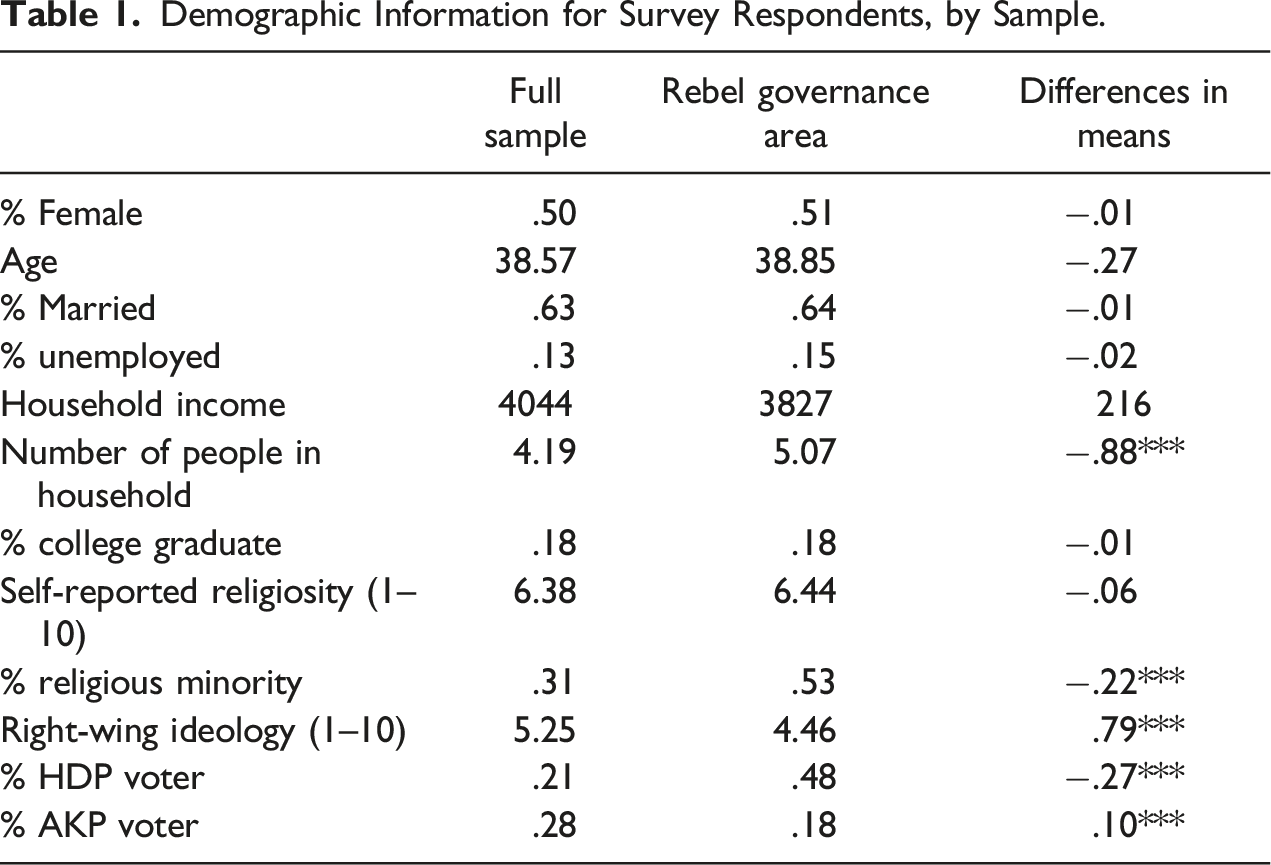
Survey Demographics
Demographic Information for Survey Respondents, by Sample.
Empirical Results
Perceptions of the Judiciary
Before testing our hypotheses about the relationship between individual exposure to rebel governance and contemporary trust in state institutions, we begin by exploring our respondents’ overall attitude towards the Turkish judiciary. Recall that to capture this attitude, respondents were asked “How much trust (or confidence) do you have in the Turkish judicial system?” Overall, attitudes towards the judiciary are quite polarized with 19% of respondents (N = 350) maintaining a great deal of trust in the Turkish judicial system while 26% of respondents (N = 468) said that they had no trust at all in the judiciary.
As shown in Figure 1, when compared to the full sample, the Southeast sample, our rebel governance area, displays slightly higher levels of trust in the Turkish judicial system. Forty-six percent of respondents from the Southeast reported that they had either a great deal of trust or quite a lot of trust in the judiciary. Twenty-one percent of respondents answered that they had no trust at all, compared to 27% in the full sample. The distinction between the two samples is not statistically significant for most answers, with the exception of the “no answer” category. This should call us to question the most basic assumption that living in an area of contested governance should weaken an individual’s view of the state. Trust in the Judicial System, by region.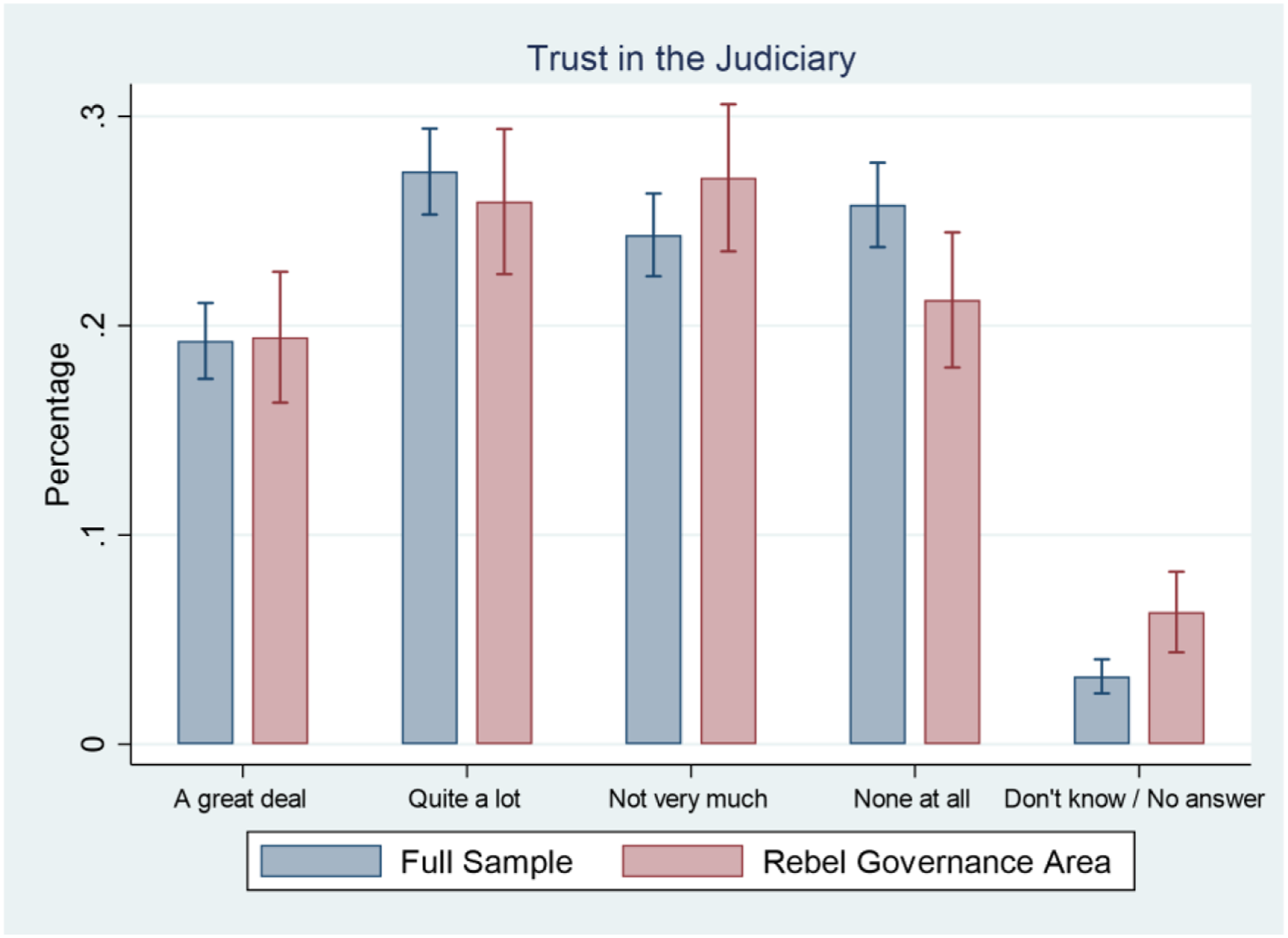
Furthermore, and important for our remaining hypotheses, we find variation in contemporary attitudes across the Southeast. As discussed above, it is possible that not all individuals in Southeast Turkey experienced the presence of rebel governance in the same way. The conflict progressed differently across the southeast of Turkey and, subsequently, people experienced rebel governance differently across that space. Given this variation, individual attitudes towards the Turkish judicial system vary across the area. Figure 2 shows the provincial distribution of trust in the judiciary. Trust in the judicial system, by province.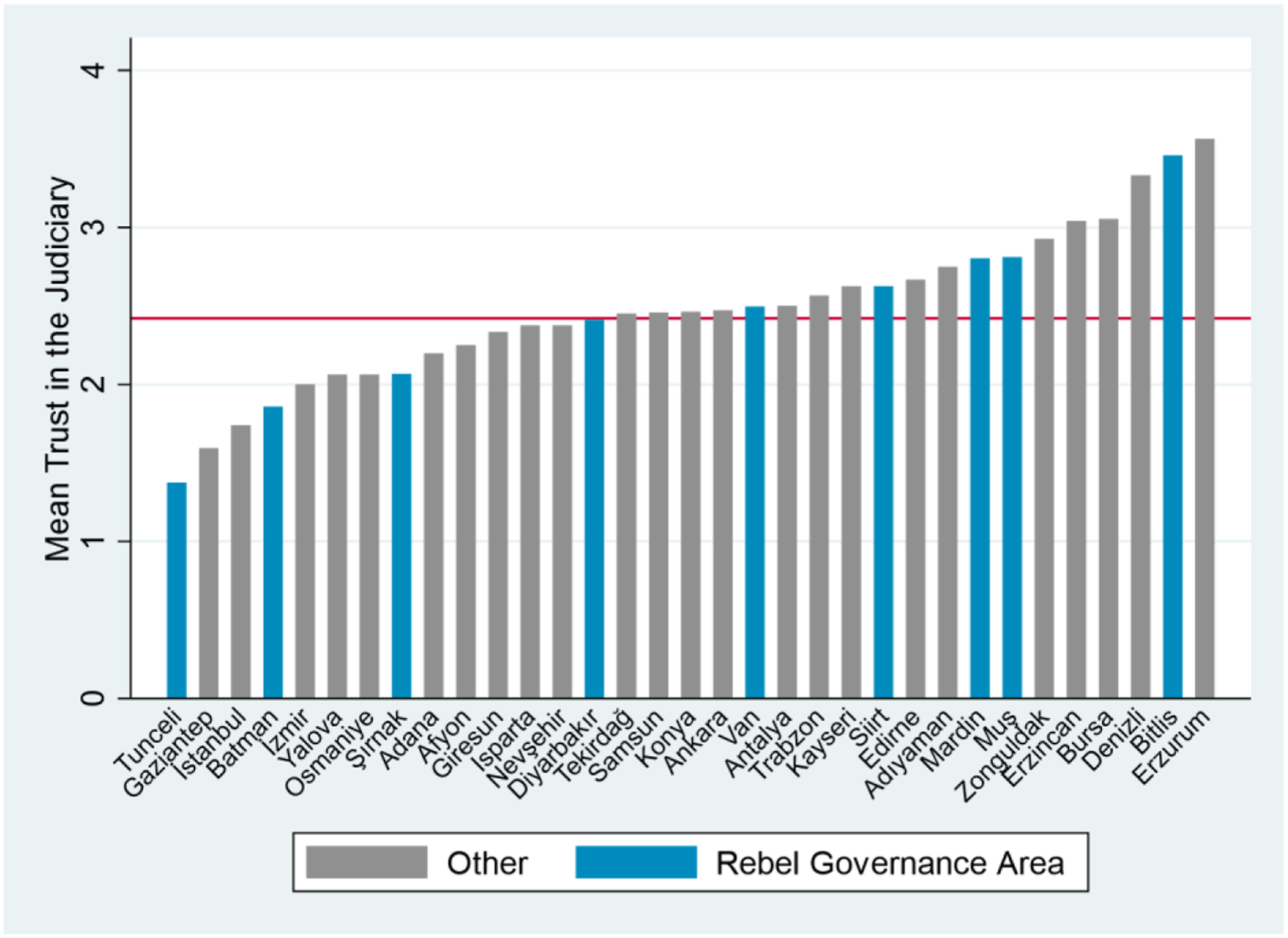
As seen in Figure 2, four Southeastern and Eastern provinces have average values of trust in the judiciary below the national average (2.42): Tunceli, Batman, Şırnak, and Diyarbakır. In other Southeastern and Eastern provinces such as Mardin, Muş, and Bitlis, civilian perceptions of the Turkish judicial system are much more positive. On the other hand, average values of trust in the judiciary are remarkably low in some major Western cities, most notably İstanbul and İzmir, that have majority-Turkish populations. Other major non-Southeast cities such as Osmaniye and Adana that have received significant flows of Kurdish migration in the 1990s also have less than average confidence in the Turkish judiciary. Respondents living in historic areas of rebel governance (e.g., Kurdish-majority provinces such as Bitlis, Diyarbakır, Mardin, Muş, Siirt, Tunceli, Van, Batman, and Şırnak) have on average higher levels of trust in the judiciary.
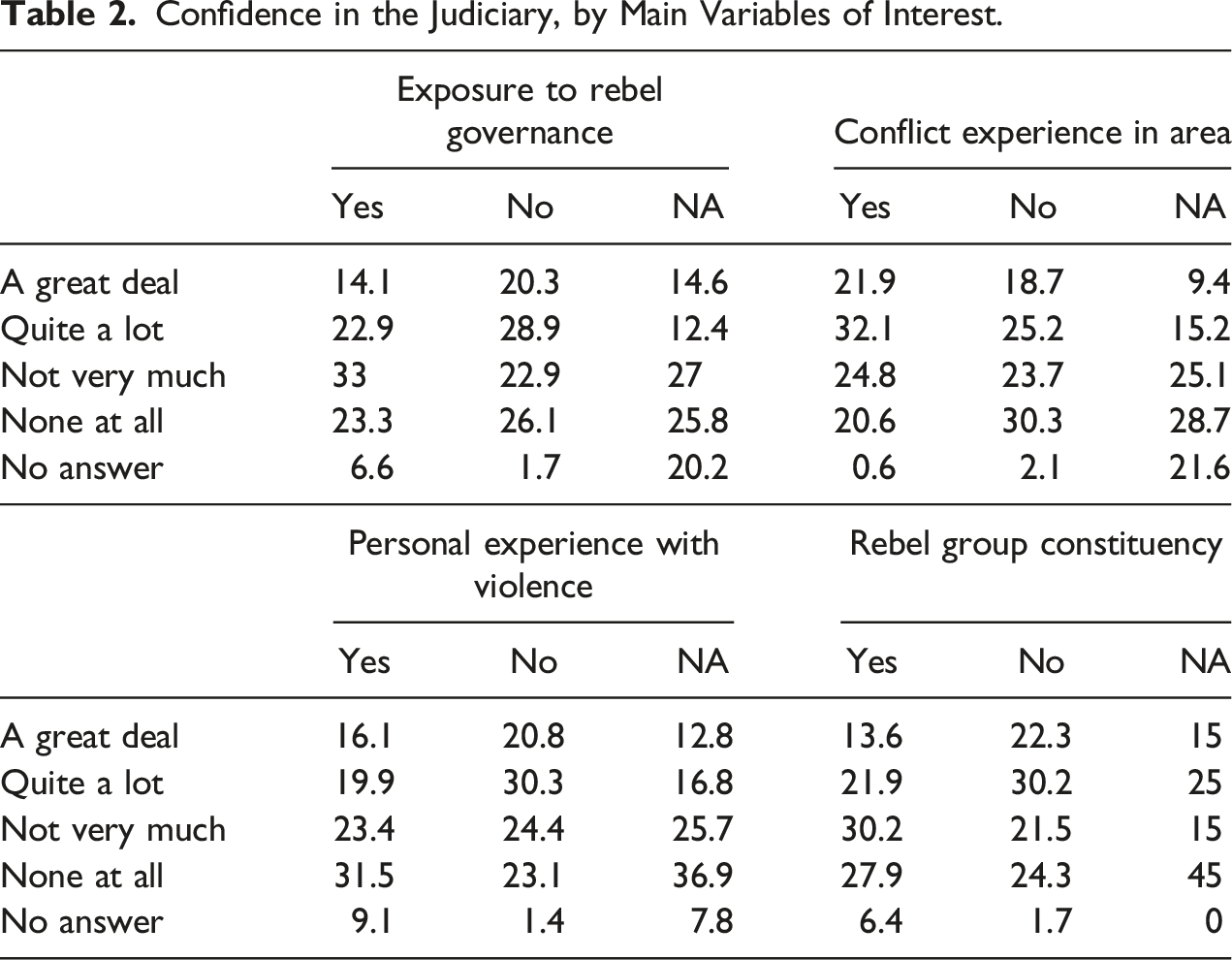
Lending support to H1, we find that respondents who were exposed to rebel governance (13%) (i.e., living in an area where the PKK enforced rules, settled disputes, or operated courts) have on average lower levels of trust in the judiciary than those who were not exposed to rebel governance.
The findings for H2a are mixed. Respondents who experienced conflict in the 1990s (45%) have on average higher levels of confidence in the Turkish judiciary than those respondents who did not experience conflict. Respondents who had personal experience with violence (16%) (i.e., being physically harmed during the armed conflict, knowing someone who had been physically harmed) have on average lower levels of trust in the judiciary than those who had no personal experience with violence.
Confidence in the Judiciary, by Main Variables of Interest.
Test of Primary Hypotheses
To estimate the impact of rebel governance on contemporary attitudes towards state institutions, we run a set of ordered logistic regression models with unclustered robust standard errors predicting an individual’s trust in the Turkish judiciary. 20 We include as covariates exposure to PKK governance, conflict experience in area, personal experience with violence, and PKK constituency in both a full and reduced model. In our full model, we also look at the impact of living in the rebel governance area, affiliation with the AKP party, and recent negative experience with the state judiciary. We control for education level and age, and include dummy variables for two provinces whose residents display unusually low levels of trust in the judiciary (e.g., İstanbul and İzmir). 21 Furthermore, rebels are often more successful in extending their governance to areas where civilian constituents are already distrustful of the state governance institutions (Martin et al., 2022). In other words, rebel governance areas may be selected by rebels for reasons that may be endogenous to trust in the judiciary. This could create a selection effect wherein our results are driven by citizens’ pre-rebel governance distrust of the state rather than exposure to rebel governance. To account for potential selection effects and control for unobserved heterogeneity across districts, we run our models with district fixed effects. Our results from the fixed effects models are comparable to our main results and are reported in Appendix 9.
In examining Hypothesis 1, we allow for variation in individual exposure to rebel governance institutions. In examining Hypothesis 2a and 2b, we account for variation in individual experiences with the conflict and test the relationship between perceptions of the judiciary and individual experiences with the conflict both in regard to experiences of violence during the conflict (H2a) and being a member of the rebel group’s constituency (H2b).
Exposure to rebel governance
We find support for the impact of exposure to rebel governance on current perceptions of the judiciary (H1) in our extended model. Civilians who were exposed to rebel governance institutions, have less trust in state institutions than civilians who were not exposed to rebel governance.
Conflict experience
In both our models, we find support for the impact of conflict experience on current perceptions of the judiciary (H2a, H2b); however, variation in conflict experience has different effects on these perceptions. First, the two measures of experience with violence—conflict presence in the individual’s geographic area and personal experience with violence—have opposing effects. H2a predicts that civilians who experience violence during a conflict are likely to have less trust in state governance institutions than those individuals who did not experience violence. We find that this is true for individuals who had personal experience with violence in the 1990s. On the other hand, conflict presence in one’s geographic area leads to higher trust in state governance.
It is important to note that our two measures of experience with violence are intended to capture different types of experiences. Our measure of conflict experience in one’s geographic area captures individuals’ exposure to PKK’s coercive acts such as identity checks on the road, kidnapping government officials and children, damaging public properties, sabotaging private sector investments, or attacking civilians and local businesses. However, our measure of personal experience with violence concerns violence by either the PKK or the government. Therefore, our findings suggest that exposure to the PKK’s coercive acts is likely to increase trust in the judiciary. In contrast, personal exposure to violence by either the PKK or the government is likely to decrease trust in the judiciary. This finding is similar to work by Deglow and Sunderland (2021b) in Afghanistan which finds that after largescale insurgent attacks citizens in Kabul tended to “rally” around the state and increased their trust in state institutions. However, higher levels of conflict intensity over time decreased civilian trust in the police (Deglow and Sunderland, 2021a).
In both our models, we find support for H2b. Civilian constituents of the PKK have much less trust in state governance than those civilians represented by the state. Although the substantive effect of being a member of the rebel group’s constituency is larger than the effect sizes of other variables of interest, our findings are not solely driven by Kurdish identity. Below, we interpret and discuss our findings in substantive terms.
Discussion of Findings
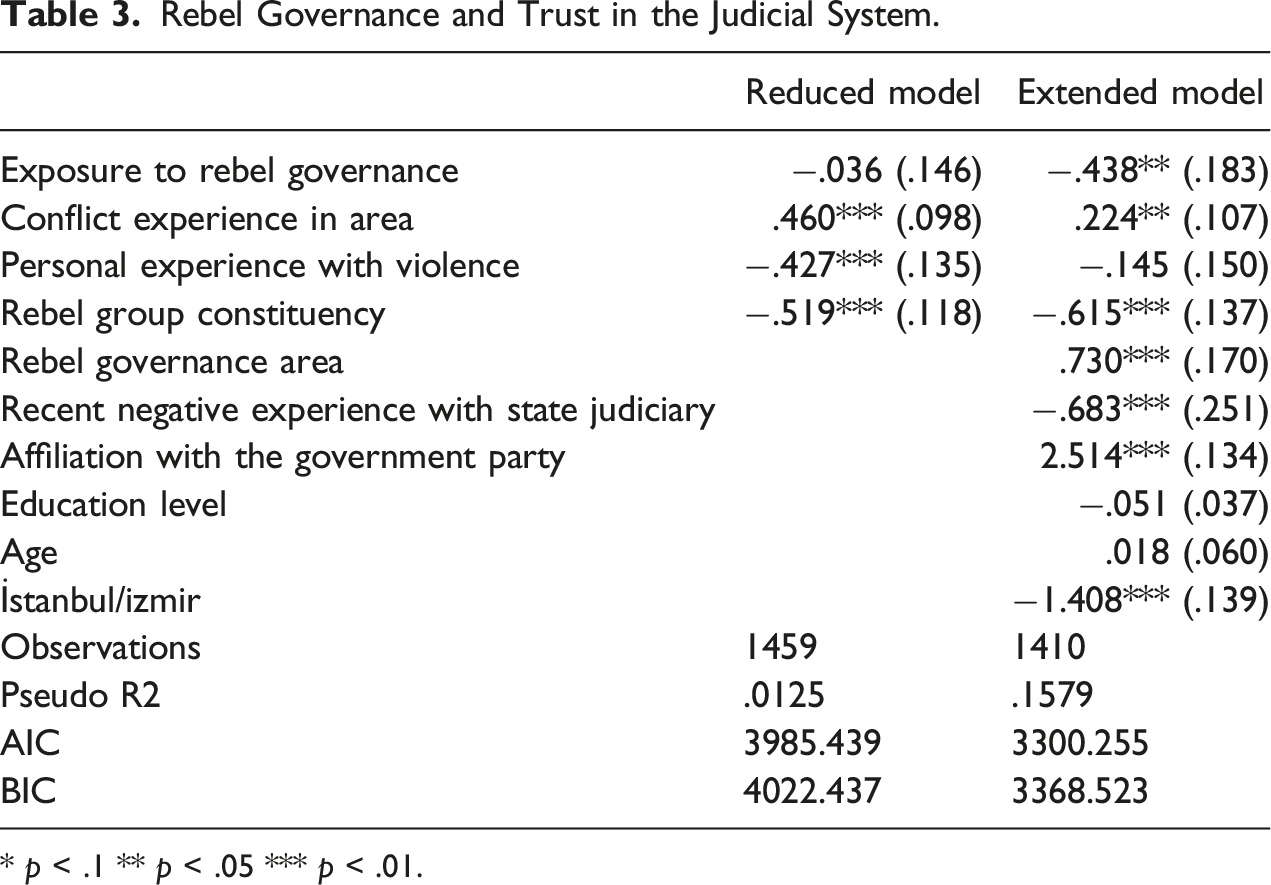
Empirical results are comparable across both the full and reduced model. However, most of the effects that we find evidence for are substantively larger in our reduced model. When we include indicators capturing alternative explanations (e.g., living in rebel governance area, recent negative experience with state judiciary, and affiliation with the government party) and controls for demographics (e.g., education level, age, residency in İstanbul/İzmir) in our extended model, the estimated coefficients on our conflict experience variables are substantively smaller. For example, as shown in Figure 3, conflict experience in area has a larger positive effect on the confidence in the judiciary in the reduced model, compared to the extended model. Similarly, personal experience with violence has a larger negative effect in the reduced model, compared to the extended model. The Akaike’s Information Criteria (AIC) and Bayesian Information Criteria (BIC) values presented in Table 3 show that our extended model performs better.
22
Coefficient plot. Rebel Governance and Trust in the Judicial System. * p < .1 ** p < .05 *** p < .01.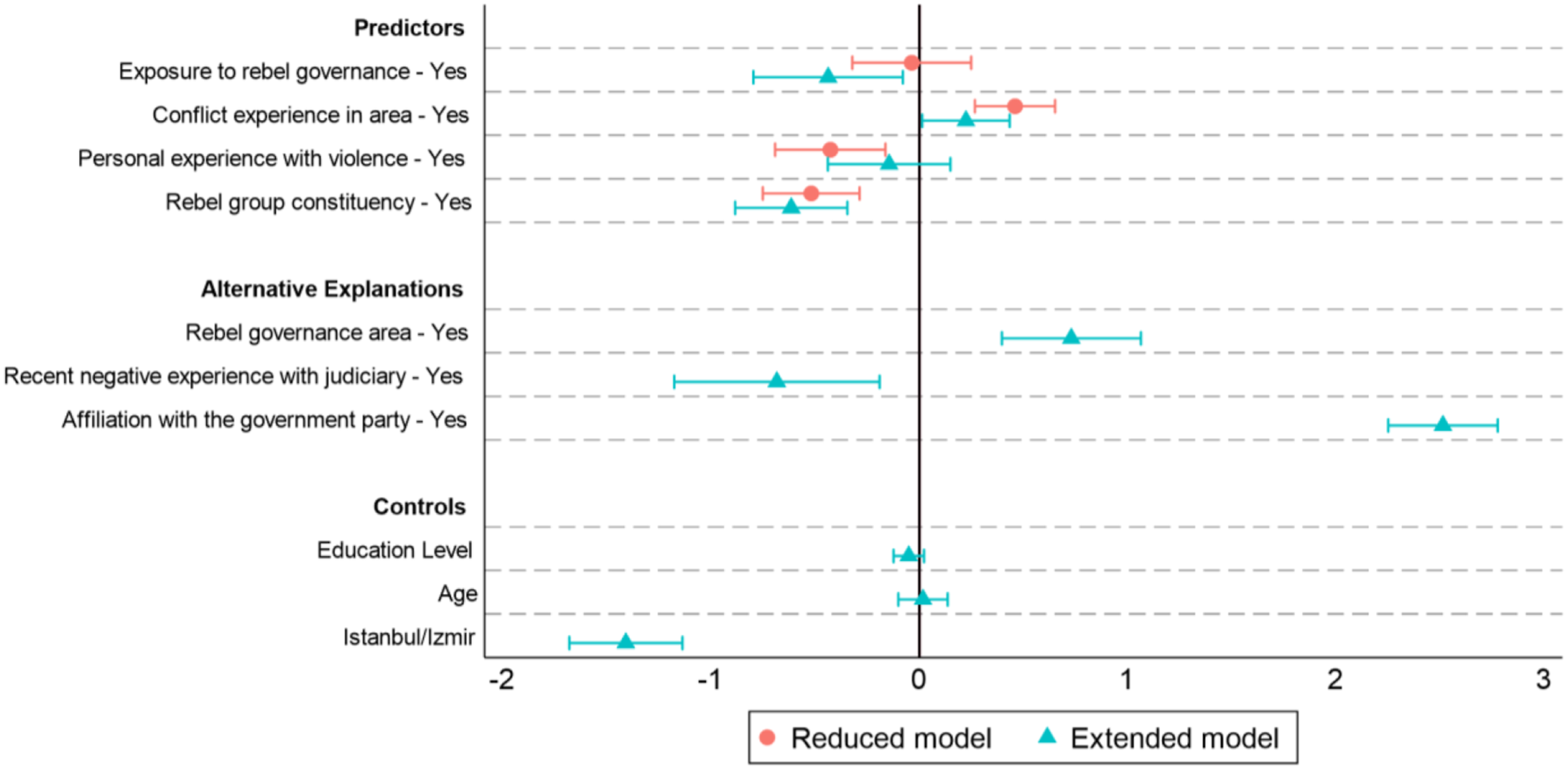
Predicted probabilities for our main explanatory variables are included in Figure 4. The baseline probability of having “a great deal of trust” in the judiciary is estimated to be 22% in the absence of any conflict experience. Predicted probability of having “a great deal of trust” in the judiciary in the presence of conflict experience is calculated separately for each of our four indicators (e.g., reduced model) by keeping other indicators at the baseline category, which is the absence of such experience. Predicted probability of having “A Great Deal of Trust” in the Judicial System, Extended Model.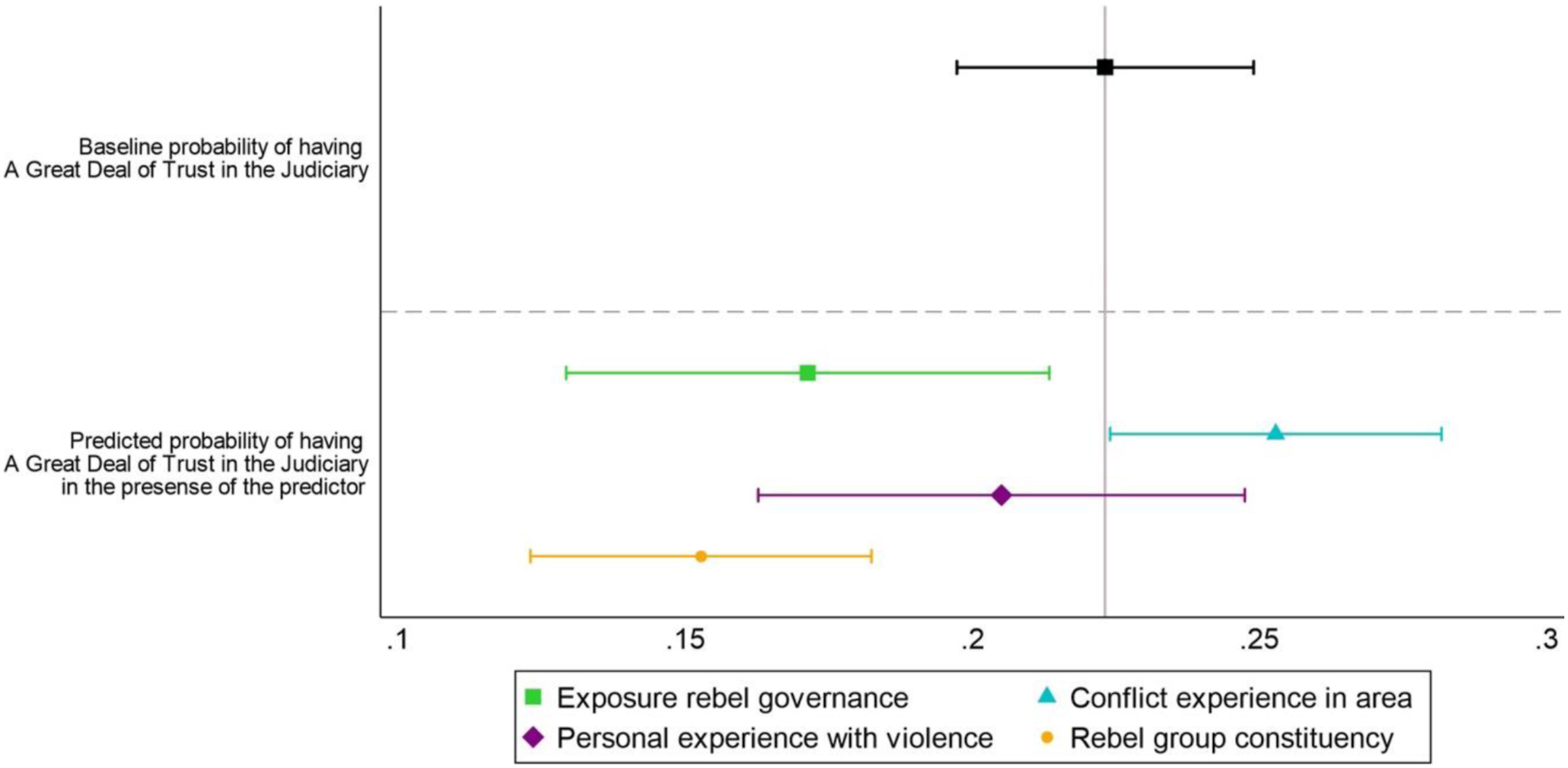
Individuals, who had experienced conflict in their geographic area, are more likely than individuals, who did not, to have “a great deal of trust” in the judiciary. Individuals, who had conflict experience in area, have a 25% (p < .5) likelihood of having “a great deal of trust” in the judiciary, compared to 22% likelihood of the baseline prediction. This finding suggests that living in an area of conflict does not necessarily reduce civilians’ trust in state institutions.
In contrast, having personal experience with violence, exposure to rebel governance, and membership in the rebel group’s constituency decreases the probability of having “a great deal of trust” in the judiciary. Individuals, who had personal experience with violence have a 20% (p < .5) likelihood of having “a great deal of trust” in the judiciary, compared to 22% likelihood of the baseline prediction. Civilians, who had personal experience with violence but were not members of the rebel group’s constituency and were not exposed to rebel governance in the 1990s, are still likely to have less trust in state institutions. In addition, individuals, who were exposed to rebel governance, also have a 17% likelihood of having “a great deal of trust” in the judiciary, compared to a 22% likelihood of the baseline prediction. This suggests that civilians, who were exposed to rebel governance but were members of the state’s constituency during the conflict and did not personally experience violence, are still likely to have less trust in state institutions. Whether rebel governance will negatively impact future trust in state institutions depends on individuals’ experiences with different aspects of the conflict. Finally, individuals, who are members of the rebel group’s constituency, only have a 15% (p < .5) likelihood of having “a great deal of trust” in the judiciary.
Accounting for Rebel Constituency
Our finding that the civilian constituents of the PKK have such drastically low levels of trust in the judiciary may raise the question of whether other results of our study are also driven by the impact of ethnic identity. To ensure this is not the case, we run our models on the Kurdish subsample and present our findings in Appendix 7. Restricting the sample to members of the rebel group’s constituency does not change our findings regarding the impacts of exposure to rebel governance and personal experience with violence. We find that exposure to rebel governance and personal experience with violence decreases trust in the judiciary in the Kurdish subsample as well. Members of the rebel group’s constituency, who were exposed to rebel governance or had personal experience with violence, are significantly less likely to have “a great deal of trust” in the judicial system than their co-ethnics, who were not exposed to rebel governance or had personal experience with violence. As shown in Figure 5, Kurdish individuals, who were not exposed to rebel governance, have a 17% likelihood of having “a great deal of trust” in the judiciary. In contrast, Kurdish individuals exposed to rebel governance only have a 11% likelihood (Panel A). In addition, having personal experience with violence decreases the likelihood of having “a great deal of trust” in the judiciary from 16% to 9% for Kurdish individuals (Panel B). Predicted probability of having “A Great Deal of Trust” in Judicial System for Kurdish Subsample.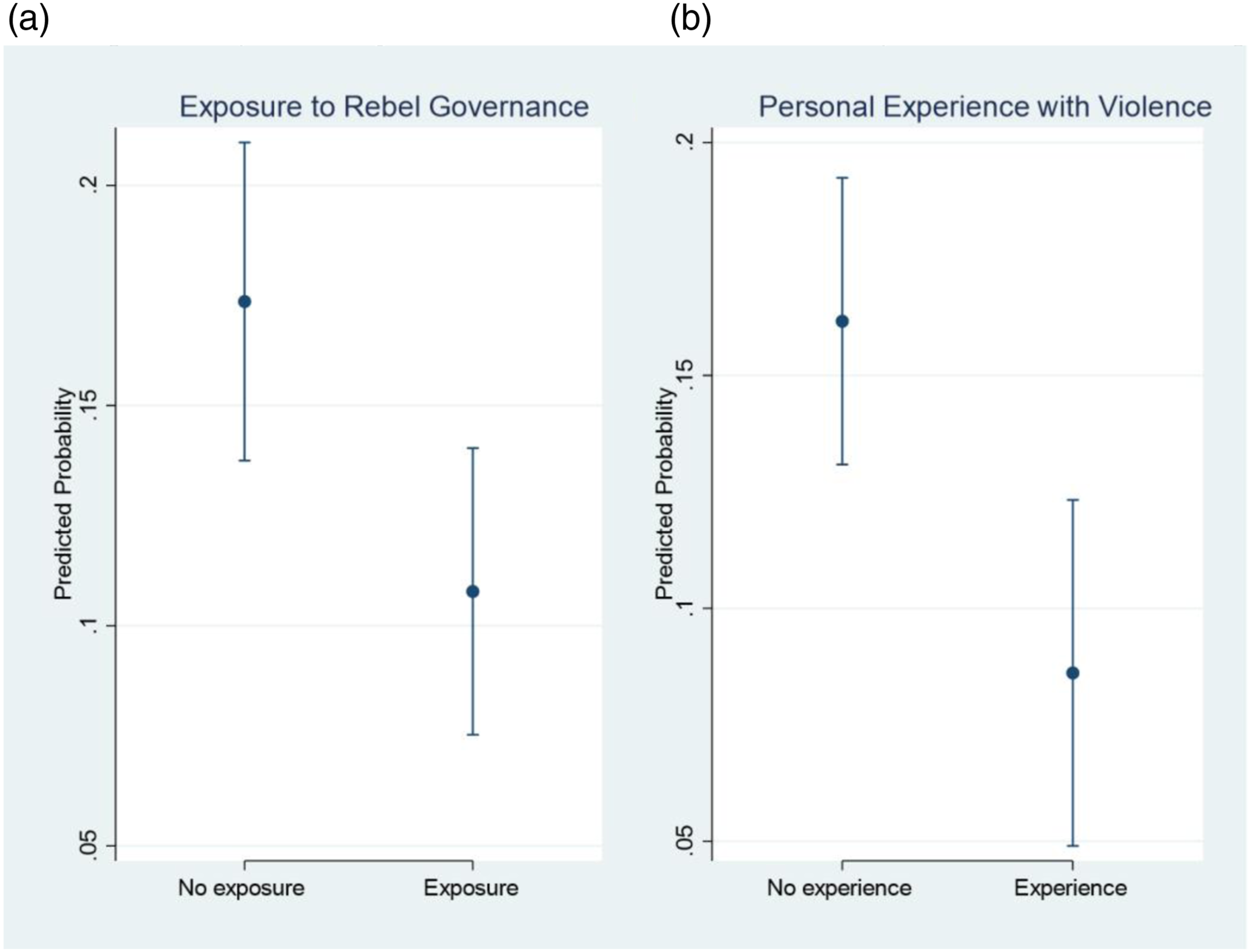
These findings yield support for H1, H2a, and H2b and suggest that (1) exposure to rebel governance, (2) personal experience with violence, (3) membership in the rebel group’s constituency, is likely to impede citizens’ post-conflict trust in state governance institutions.
Conclusion
Understanding the long-term consequences of rebel governance is an important step in understanding how to design stable, democratic institutions in the post-conflict period. This project is part of a larger call within the rebel governance literature to engage with the experiences of civilians living under rebel rule (Arjona, Kasfir and Mampilly, 2015, p. 297; Loyle et al., 2023). While much work has focused on the governance choices and behaviors of rebels, we have often assumed a passive role for civilians in these interactions. This is not always the case. Arjona (2016) and others have documented the ways in which civilians living under rebel rule capitulate, shirk, and actively resist rebel rule. But what are the implications of these interactions once the guns have fallen silent?
In our analysis we advance a greater understanding of the lasting impacts of rebel governance based on individual exposure to rebel institutions. Importantly, our findings demonstrate that the impact of rebel governance is conditioned by people’s conflict experience. People’s experiences during the conflict, either positive or negative, can impact the ways in which they later view state governing institutions. While we have made generalized conclusions about the impact of violence, moving forward, future research should investigate the impacts of different types of violence on people’s post-conflict attitudes and preferences. Furthermore, given the security context in Turkey we were unable to directly ask about the perpetrator of an individual’s conflict experience. It is likely that victims of state violence will respond differently to post-conflict institutions than those who were victimized by a rebel group. And finally, our work speaks directly to the role of contested judicial institutions as a central component to a functioning state; however, rebels govern in a wide range of ways and this variation should be investigated further.
While we have examined our research questions in the case of rebel rule in Turkey, our findings have broader implications for contested governance beyond rebel rule. Work by Cammett and MacLean (2011), for example, has called us to question the impact of goods and services provision by a variety of non-state actors including NGOs and religious organizations. Beyond the immediate erosion of legitimacy for the state, these governance interventions can impact the way that individuals think about the state’s competence and its ability to provide governance effectively and efficiently into the future.
Supplemental Material
Supplemental Material - The Legacies of Rebel Rule in Southeast Turkey
Supplemental Material for The Legacies of Rebel Rule in Southeast Turkey by Cyanne E. Loyle, and Ilayda Onder in Comparative Political Studies
Footnotes
Author’s Note
Peace Reseach Insitute Oslo (PRIO), Oslo, Norway.
Declaration of Conflicting Interests
The author(s) declared no potential conflicts of interest with respect to the research, authorship, and/or publication of this article.
Funding
The author(s) disclosed receipt of the following financial support for the research, authorship, and/or publication of this article: This work was supported by the Pennsylvania State University.

Supplemental Material
Supplemental material for this article is available online.
Notes
Author Biographies
References
Supplementary Material
Please find the following supplemental material available below.
For Open Access articles published under a Creative Commons License, all supplemental material carries the same license as the article it is associated with.
For non-Open Access articles published, all supplemental material carries a non-exclusive license, and permission requests for re-use of supplemental material or any part of supplemental material shall be sent directly to the copyright owner as specified in the copyright notice associated with the article.
