




Abstract
Traditional leaders can influence electoral outcomes. We designed an experiment to investigate why public endorsements by chiefs affect voters—and which types of voters they influence. Chiefs have incentives to prefer politicians who will promote local development, and can use endorsements to sway elections accordingly. We argue that voters often interpret chiefs’ endorsements as a signal of candidate quality. To assess this argument, we exposed voters to real endorsements made by chiefs during Ghana’s 2020 presidential election. We show that endorsements impact the vote choice of undecided voters. Consistent with a signaling mechanism, respondents exposed to chiefs’ rationale for endorsing a candidate were no more likely to vote for the endorsed candidate than those who only heard chiefs’ approval of a candidate. Further, treated respondents hold higher evaluations of the endorsed candidate on multiple dimensions of candidate quality. Our results suggest that chiefs influence voters through a non-coercive mechanism, which has positive implications for accountability.
Most Africans approve of the performance of their traditional leaders—unelected notables whose prominent positions derive from their communities’ historical socio-cultural customs (Baldwin 2013). 1 Chiefs’ words and actions have been found to influence voter behavior in a number of countries, including South Africa, Senegal, Zambia, and Ghana (Baldwin, 2013; De Kadt & Larreguy, 2018; Koter, 2013; Nathan, 2019). While there is some consensus that chiefs can influence voters, there is much more debate surrounding (and fewer empirical answers to) questions related to the extent of their impact, which voters are swayed, and why. Since roughly a quarter of the world’s population lives under the authority of traditional leaders, 2 a better understanding of their influence is relevant in African countries and beyond (Baldwin & Holzinger, 2019).
Understanding how traditional leaders can persuade individuals to vote for the chiefs’ preferred political candidates is important because if chiefs rely on coercive tactics, this can undermine electoral accountability. Traditional leaders’ control over local social and economic benefits (Acemoglu et al., 2014) may pressure citizens to oblige their chief’s wishes due to feared material repercussions or norms of deference (Koter, 2013; Mamdani, 2018; Ntsebeza, 2005). However, if chiefs influence voters via non-coercive mechanisms, they may instead bolster political responsiveness by helping voters coordinate their support for candidates who will perform best for their communities (Baldwin 2016).
In this study, we focus on one way in which chiefs can influence voting behavior: by publicly endorsing political candidates. We argue that in many contexts the effect of chiefly endorsements on vote choice likely operates through a non-coercive channel. Chiefs have both public and private incentives to bring development to their traditional areas. They often have physical and economic ties to an area and are unable to transfer locations. Their public legitimacy also often depends on bringing development to local residents (Boafo-Arthur 2003). Since they cannot levy their own taxes, chiefs largely rely on public funds (controlled by politicians) for new projects. Given these incentives, it is rational for chiefs to support political candidates who they believe will promote local development. To the extent that voters also seek to elect welfare-enhancing candidates and believe that chiefs care about development, we argue that they interpret chiefs’ endorsements as a signal of candidate quality and rally around the endorsed politician. Voters pay more attention to the source of the endorsement and the incentives of this actor than to the endorsement’s informational content.
We also expect the impact of endorsements to vary according to voters’ partisanship. A signaling mechanism is unlikely to alter the attitudes of voters who are already aligned with an endorsed candidate, as they already believe the candidate will perform well. Endorsements will have more significant effects on voters who do not hold strong partisan preferences—unaligned voters. Unaligned voters may use endorsements to update their beliefs about a candidate or political party.
We also expect endorsements to have larger effects among voters who approve of their chief; prior studies have found that endorsements influence voting behavior when voters perceive the source to be credible (Lupia, 1994). Citizens who disapprove of their chief’s performance are less likely to believe he is a credible source. We pre-registered the hypotheses that we test in this paper. 3 Below, we also note one instance where we test a hypothesis that was not pre-registered.
There are at least three empirical challenges associated with estimating and understanding the causal effect of endorsements. First, since traditional leaders may back candidates who are already popular, correlations between endorsements and vote shares may be an unreliable measure of chiefs’ influence. 4 The second challenge is related to the mechanism: since coercive and non-coercive channels of chiefly influence can both generate the same observed outcome (i.e., a vote for the endorsed candidate), it is difficult to identify voters’ motivations. Finally, aggregate vote returns cannot be used to discover which types of voters are influenced by chiefs’ partisan endorsements.
We use an experimental approach to overcome these challenges, and to estimate the causal effects of chiefly endorsements on citizens’ vote choices in Ghana’s December 2020 presidential election. Our design allows us to move beyond prior studies in two ways. First, by randomizing chiefly endorsements at the individual level, we can assess which voters are driven by such messages. Second, and relatedly, we investigate why endorsements influence vote choice in presidential races. We do so by unbundling individual components of endorsement messages, as well as by assessing the impact of endorsements on an array of potential intermediate outcomes. To the best of our knowledge, our study is the first to experimentally manipulate exposure to endorsements in a developing democracy using real endorsements made by actual elites during an election campaign.
We limit our analysis to paramount chiefs because these are the leaders presidential candidates seek endorsements from. 5 We also restrict the study to endorsements of the incumbent presidential candidate to avoid possible heterogeneity according to candidate status. We also discuss potential ethical concerns related to conducting an experiment close to an election in The Sampling, interview procedure, and ethical considerations section below. 6
To assess our argument, we randomly exposed individuals to news about their traditional leader’s endorsement of the incumbent presidential candidate (one of the two main candidates in the race). This news consisted of real messages delivered by chiefs at public events during the campaign. To reiterate, our treatment consists of three distinct public endorsements messages, with respondents matched to their corresponding traditional leader in three traditional areas. We investigated the treatment’s immediate and medium-term effects by interviewing the panel of respondents (N
To assess whether endorsements operate via a signaling mechanism based on the source’s position or through their informational content, we disaggregated endorsement messages into two components: (1) explicit approval of a candidate and (2) a rationale for their support. To evaluate our argument that voters will positively update their attitudes regarding the candidate’s expected quality and performance, we gathered data on theoretically relevant intermediate outcome variables (e.g., expectations of local public goods). We also collected intermediate outcomes that would indicate coercive channels (e.g., fear of exclusion) to assess alternative mechanisms.
Our results show that endorsements influence voters’ attitudes and behavior. In the full sample, the treatment had a significant and strong immediate effect, stimulating a 4-percentage-point (pp) increase in intention to vote for the endorsed candidate. Disaggregating these results by prior partisanship, this effect is concentrated among unaligned voters, who experience a 12-pp treatment effect. Considering actual vote choice, the effect disappears in the full sample. However, we continue to detect a positive and significant effect among unaligned voters, who are 8.5 pp more likely to have voted for the endorsed candidate. As expected, these effects are moderated by approval of the chief: the treatment effect among unaligned voters who also approve of their chief’s performance is 14 pp.
Regarding mechanisms, we find that providing voters with information about why the chief endorsed a particular candidate had no additional effect beyond the approval message. This suggests that endorsements operate through a signaling—as opposed to a direct informational—channel. Our investigation of intermediate outcomes suggests that this signaling runs through a positive channel. Voters exposed to the treatment update positively on candidate characteristics and expected performance. A mediation analysis indicates that the public’s expectation that the endorsed presidential candidate will deliver local development (i.e., local public goods) is most responsible for driving the positive treatment effect among unaligned voters.
This study makes three significant contributions. First, we advance the literature on traditional leaders and democratic accountability by providing evidence that chiefs do not influence residents’ voting behavior through coercion. Our results build on those of Baldwin (2013, 2016), but suggest a broader argument. Citizens vote with their chiefs because they expect traditional leaders to support candidates who share their interest in local development; this effect is independent of whether they think local public goods are coproduced by chiefs and politicians. These results have positive implications for electoral accountability, as voters can punish politicians who renege on their promises. In the Conclusion, we outline three potentially important scope conditions for our argument.
Second, the study contributes to the literature on indirect political appeals in the context of a developing democracy. Our results suggest that the source of an endorsement matters more than its informational content, and that such messages can persuade unaligned voters. These findings build on research from Bolivia, which shows that voters can be persuaded even when endorsements contain no direct information about policy platforms (Poertner, 2021). The implication is that organizations or elites who seek to influence voters need to build public legitimacy rather than hone their messages.
Third, our findings add to the literature on voting behavior and persuasion during campaigns. These findings share similarities with results from Kenya that endorsements from in-group members can persuade voters to support out-group politicians (Arriola et al., 2022). They also complement burgeoning research on the role of trusted elites in shaping electoral or civic attitudes in developing democracies (McClendon & Riedl, 2019; Condra et al., 2019; Blair et al., 2021; A. Grossman et al., 2022).
Theoretical Background and Hypotheses
Chiefs can influence the voting behavior of local residents (De Kadt & Larreguy, 2018; Baldwin, 2013; Nathan, 2019). Based on findings from prior literature, our theoretical starting point is not whether endorsements influence voters, but why. Theoretically, endorsements by local elites (including chiefs) may influence voters through coercive or non-coercive channels. Coercive mechanisms entail voters interpreting endorsements as an instruction to vote for a leader’s preferred candidate to avoid potential sanctions, for example, losing access to private benefits or services that chiefs control. Under such mechanisms, voters do not consider the candidate’s quality or expected performance (Stokes, 2005; Mares & Young, 2019). In contrast, non-coercive channels involve voters using endorsements as a signal of candidate quality or expected high performance.
Much of the literature suggests that chiefs mobilize support for particular candidates through coercive channels. Chiefs are important elites who are embedded in their communities’ social, economic, and political networks. They often have significant powers, including the ability to determine (customary) laws, allocate land, and adjudicate disputes (Goldstein & Udry, 2008; Koter, 2013; Acemoglu et al., 2014; Baldwin 2016; Baldwin & Mvukiyehe, 2015). 7 They also often manage the distribution of private investments, aid projects, and government patronage within their communities (Adotey, 2019; Bratton et al., 2005). 8 Accordingly, chiefs can leverage their networks to monitor and sanction citizens’ behavior, including their vote choice (Acemoglu et al., 2014). Coupled with the chiefs’ authority over laws, land rights, and the distribution of patronage within their communities, citizens may fear they will be disadvantaged if they do not oblige their wishes (Conroy-Krutz, 2018; Koter, 2013).
Yet, the image of fearful and threatening chiefs is somewhat at odds with public opinion data which shows that chiefs are popular and well trusted in many African countries. The most recent Afrobarometer surveys, which were conducted in 2019–2021, show that traditional leaders consistently receive significantly higher ratings—on trust, performance, listening, and lack of corruption—than elected representatives. Across 22 African countries, 64% of respondents had a lot or some trust in, and approval of, their chief. 9 Africans are four times as likely to say that traditional leaders listen to them compared to elected parliamentarians.
We argue that in many contexts endorsements by chiefs are likely to influence voters through a non-coercive channel that is rooted in traditional leaders’ desire to advance local development. Chiefs have public and private incentives to help bring to power politicians they expect to perform well. It is thus rational for voters to interpret chiefly endorsements as a credible signal of candidate quality. Voters then vote with their chief not because they are coerced, but because they expect the favored candidate to best serve the community.
Since the pre-colonial period, traditional leaders’ legitimacy has been linked with their ability to advance the socio-economic wellbeing of citizens within their traditional areas (Addo-Fening, 2008; Logan, 2013). Citizens expect chiefs to use their access to, and control over, local and external resources to support local development. Since several democratic constitutions do not allow chiefs to tax residents, they must rely on resources from either the government or non-governmental organizations to provide major public infrastructure in their traditional areas. This reliance on government resources ties chiefs’ fates to the actions of politicians. Accordingly, chiefs have an incentive to use their positions to rally public support for political candidates who they think will help deliver public goods to local communities (Boafo-Arthur 2003).
Beyond chiefs’ public reputations, they also have private incentives to support candidates who they expect to better serve their communities. Chiefs cannot transfer their authority to another traditional area or region. Baldwin (2016) describes them as “stationary bandits” in classical Olsonian terms (p. 21). Accordingly, chiefs typically make economic investments in their traditional areas, for example, locating businesses there (Goldstein & Udry, 2008). Chiefs also often receive royalties from the sale of natural resources in their traditional areas. These private economic interests incentivize chiefs to back candidates who they believe will provide infrastructure that supports the local economy.
Finally, formal institutions encourage good governance and benevolent leadership by chiefs. While chiefs are typically not elected, they can be sanctioned or removed if they do not serve in the interests of local communities. They also typically rule by consensus and are subject to oversight, for example, by councils of advisers (Addo-Fening, 2008; Nathan, 2019). These advisers may question chiefs who support a candidate who is not expected to perform well. Baldwin and Holzinger (2019) report that 68% of traditional institutions use inclusive decision-making approaches: chiefs often consult with a broad cross-section of the population to make decisions.
Importantly, these incentives need to be combined with chiefs having the ability to gather relevant information on political candidates. Chiefs can gain information about candidates through two types of interactions with them that voters and other community leaders are often not privy to. First, paramount chiefs interact with national-level politicians through their seats on regional or national advisory bodies. Such bodies include, for example, Ghana and Botswana’s National House of Chiefs, and South Africa’s National House of Traditional Leaders. Second, political candidates may hold meetings with paramount chiefs during election campaigns. Through these meetings, chiefs acquire knowledge of the presidential candidates’ intensions.
Regarding voters, they also typically seek to elect politicians who they expect will bring development to their communities. For example, in national elections, voters prefer presidential candidates who promise to dedicate public funds to specific local projects (Wantchekon, 2003). Therefore, voters’ and chiefs’ interests are often aligned, which can lead citizens to vote for a chief’s preferred candidate because they expect this individual to best serve their community. In short, voters takes chiefly endorsements as a signal of candidate quality and future performance.
Our focus on citizens’ developmental concerns and chiefs’ role in development is similar to that of Baldwin (2013, 2016). However, unlike Baldwin, our argument does not assume that voters think the chief and the endorsed candidate will coproduce local public goods. Baldwin (2013) uses data from Zambia to show that exposure to endorsements increases voter support for the endorsed parliamentary candidate by 18 pp for people who perceive the joint importance of their chief and Member of Parliament delivering development, compared to a 4-pp increase in the full sample. However, while the argument of co-production is convincing, it is less applicable to presidential candidates. In the context of presidential candidates, individual chiefs are unlikely to directly work with elected presidents to fundraise for, and construct, local infrastructure.
If voters take endorsements by chiefs as a signal of candidate quality, we can expect voters who are exposed to endorsements to assess the endorsed candidate as being of higher quality—more likeable and trustworthy, in our context. In evaluating candidates’ performance, we expect voters to update their beliefs that the approved candidate will successfully deliver local development. While we outline a non-coercive mechanism that aligns the interests of voters and chiefs, given prior literature we also explore coercive channels of influence. We test two types of coercive strategies: (1) distributing private benefits and (2) threatening to withdraw private or public benefits. To test the former, we assess whether individuals who are exposed to endorsements vote for the favored candidate because they expect to receive private benefits from the chief. To investigate the latter, we evaluate whether chiefly endorsements influence vote choice because voters fear negative reprisals for themselves or their community.
While many voters may interpret endorsements from chiefs as a signal of candidate quality, such support is unlikely to have uniform effects across voters (Kousser et al., 2015). The endorsement may have little effect on voters who already support the endorsed candidate, as it provides no new information; ceiling effects will likely mask any positive effects for copartisan supporters. By contrast, unaligned or opposition voters may be swayed by the endorsement since it can provide new information about the candidate. Unaligned (or “swing”) voters have also been shown to base their voting decisions on public goods provision (Weghorst and Lindberg 2013). Accordingly, if non-partisans take the endorsement as a signal of performance, this show of support will encourage them to vote for the favored candidate. In theory, the endorsement may cause opposition voters to moderate their positions and switch their support to the endorsed candidate (Brierley et al., 2020; Platas & Raffler, 2021). However, it is equally likely that they will not be moved by chiefly endorsements as other information continues to hold sway. Accordingly, we assess whether chiefly endorsements have a greater effect on voters who are (i) undecided or (ii) opposition supporters.
Voters’ prior evaluation of the chief is also likely to condition the extent to which the leader’s endorsement influences their voting decision. In general, endorsements have been shown to influence voters when the source is deemed to be honest or credible (Lupia, 1994)—that is, they consistently provide accurate and valuable information to, or perform useful services for, the voter (Sobel, 1985). Research from Kenya shows that only endorsements from coethnic elites can persuade citizens to support non-coethnic political candidates (Arriola et al., 2022). This suggests that endorsements are most effective when voters trust the endorser. Therefore, we argue that those who approved (did not approve) of the chief prior to treatment may be more (less) influenced by his endorsement. Specifically, we hypothesize that endorsements will have stronger effects on those who have higher pre-treatment evaluations of the chief.
Ghanaian Chiefs in Context
Ghana has held multi-party elections since 1992. Presidents are elected via majority rule in a single nationwide constituency. 10 Because votes count equally irrespective of where they are cast, parties have an incentive to mobilize nationally. Two parties dominate national politics—the New Patriotic Party (NPP) and the National Democratic Congress (NDC). In the 2020 election that we studied, Nana Akuffo-Addo (NPP) was the incumbent president, and his main competitor was John Mahama (NDC). Akuffo-Addo won the election with 51% of the votes.
Chiefs play important socio-economic and cultural roles in life across rural and urban constituencies that are comparable to those in other African countries along three dimensions: they (1) promote local development, (2) allocate land, and (3) resolve local disputes. First, chiefs have been key development actors since pre-colonial times (Boafo-Arthur 2003). Communities often select highly educated chiefs in anticipation that they will use their professional networks to organize and lobby for local development projects and initiatives (Kleist, 2011). To support local development, chiefs often develop bilateral ties to international donors and establish personal foundations with developmental aims. Second, and relatedly, traditional institutions control more than three-quarters (78%) of Ghana’s land (COLANDEF, 2019). Chiefs’ control over land relates to their developmental role, because government actors must gain their permission to construct new local infrastructure. Control over lands by traditional authorities is relatively common in many African countries. Afrobarometer (Round 8) data indicates that across 22 African countries 54% of respondents believe chiefs influence land allocation, rising to over 60% in Sierra Leona, Mali, Nigeria, Ghana, Niger, Zambia, and Liberia (Logan & Katenda, 2021). Third, chiefs mediate local disputes. Recent Afrobarometer data (Round 8) shows that 71% of African respondents thought traditional leaders have “a lot” or “some” influence in solving local disputes (Logan & Katenda, 2021). These figures reach 80% or more in Lesotho, Sierra Leona, Mali, Nigeria, Ghana, and Kenya.
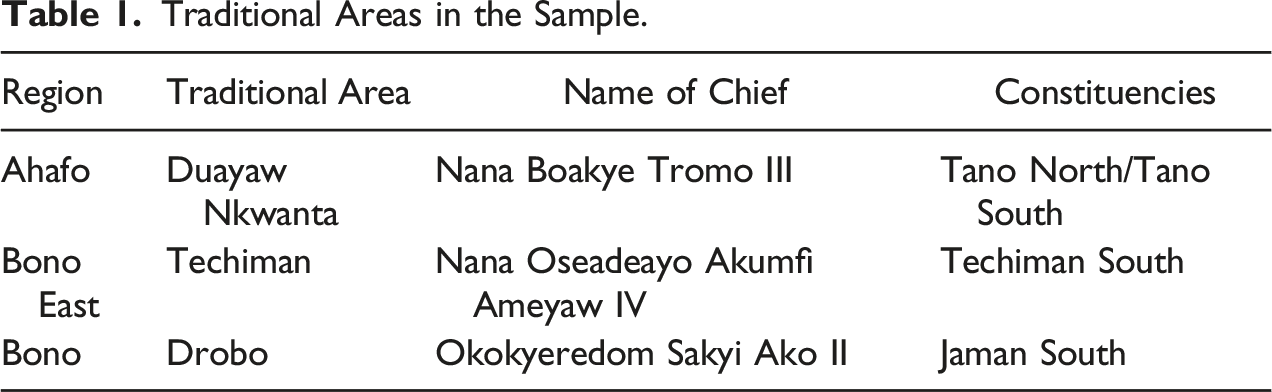
Our study is conducted in traditional areas in the Bono, Bono East, and Ahafo regions. Chiefs from these regions are part of the Akan chieftaincy system. 11 Selection into positions can be very competitive. Chiefs are selected based on both hereditary criteria and their level of education and professional backgrounds (Boafo-Arthur 2003; Kleist, 2011).
We focus on the pronouncements of paramount chiefs who head the sub-chiefs of communities that constitute the traditional area. It is true that citizens interact more with their community chiefs than paramount chiefs. Moreover, in theory, sub-chiefs may endorse a different candidate to the paramount chief. However, paramount chiefs often consult and “speak” on behalf of their community chiefs. In all the endorsements that we study, the paramount chiefs stated that their endorsement represents that of their council of sub-chiefs and elders. Therefore, citizens are likely to believe that their local chief supports the candidate endorsed by the paramount chief.
Chiefs and Politics
While many countries prohibit chiefs from explicitly participating in party politics, they are often believed to influence the outcomes of elections in African countries. According to Afrobarometer data (Round 8) nearly 40% of Africans think chiefs have “a lot” or “some” influence over vote choice. 12 Ghana’s constitution bans chiefs from engaging in “active partisan politics” and prohibits them from becoming Members of Parliament (Articles 276 and 277). The Code of Royal Ethics, published by Ghana’s House of Chiefs (2012), also states that “A chief should not openly declare his support by word or deed for a particular political party” (3.1.6).
Yet traditional leaders have pronounced their support for presidential candidates in all eight of the country’s multi-party elections (Ansah-Koi & Kumi, 1996; Boafo-Arthur, 2003; Gyimah-Boadi 2007). 13 In the 2016 presidential elections, the paramount chiefs of the Gbese, Dormaa, and Sunyani traditional areas declared their support for the incumbent, NDC candidate John Mahama. The paramount chiefs of Sefwi Anhwiaso, Adoagyir, and Nwoase-Ahenkro supported the opposition NPP’s candidate, Nana Akufo-Addo. 14
Presidential aspirants actively court chiefs’ endorsements because they believe they can influence voters (Gyampo, 2009; Rathbone, 2000). 15 During the December 2020 election, the incumbent president’s campaign team publicly claimed that 95% of chiefs had endorsed the president. 16
Explicit endorsements from chiefs were also reported in recent elections in Zambia and Malawi. 17 In Malawi, the head of the Electoral Commission urged traditional leaders not to endorse candidates and to desist from creating “no-go zones,” stating that chiefs are “expected to be non-partisan when discharging their duties.” 18
Public endorsements by chiefs generate considerable debate in Ghana. Those concerned about the practice argue that it violates the constitution (Gyampo, 2009). Beyond the legal ramifications, there are concerns that such pronouncements damage a chief’s reputation and jeopardize their long-term ability to promote local governance and development (Gyampo, 2009; Boafo-Arthur, 2003). Partisan engagements can also damage the perception that chiefs are wise and symbols of cohesion and unity (Abotchie, 2006; Ansah-Koi, 1996). 19 By inciting partisan divides, citizens may refuse to comply with a chief’s call to contribute labor or in-kind support (or pay levies) to collective projects in the future (Nugent, 1996) or send their disputes to the leader (Addo-Fening, 2008). However, others argue that endorsements do not constitute engagement in active partisan politics, and that chiefs have a constitutional right to voice their political opinions (Boafo-Arthur 2003).
Chiefly Political Endorsements
We define chiefly political endorsements as a traditional leader’s public praise of and direct appeal to dependents to vote for a particular candidate. Such endorsements must express explicit electoral support. Such endorsements may occur at a chief’s palace, traditional ceremonial grounds, or a public (official) event. We consider political endorsements to differ from the routine courtesy visits of political aspirants to chiefs’ palaces, usually to ask for “permission” to mobilize voters within the traditional area.
Such endorsements typically contain three components. First, the traditional leader applauds the national policies of the political aspirant. Second, he expresses “appreciation” for the politician’s supply of local public infrastructure and social programs and appeals for more. Third, he calls on residents to vote for the politician or pledge their support to the candidate.
In our study, for example, the paramount chief of Drobo Traditional Area, Okokyeredom Sakyi Ako II, praised the president for his exemplary bravery and leadership. He also lauded the “many” social intervention programs he had rolled out, including the Free Senior High School program (national policy). He expressed gratitude to the president for rehabilitating the 31.7 km Baafono-Zezera-Adamsu feeder road (local infrastructure). He then appealed for him to build a mast to boost telecommunication network connectivity, build a police station to strengthen security, and help complete the Drobo-Berekum road (request). The speech ended with the chief assuring the president that he and his people “will not let him down,” and that they should grant him “Four more [years] for Nana” (endorsement). 20
Research Design
We adopt an experimental approach to estimate the causal effects of chiefly political endorsements on citizens’ vote choice. The treatments take the form of audio news reports that were designed to be as authentic as possible in three ways. First, they were designed to sound like actual news reports of endorsements that voters may hear on the radio. Second, they contained only real information that each chief said during an actual political endorsement event. Third, they contained the chief’s voice as they made the endorsement: respondents in the treatment groups listened to the message from their own paramount chief. 21 These features add to the external validity of the study. The news reporter was held constant across all treatment audios. 22 The recordings were in Akan, the dominant local language in all three traditional areas studied. The treatment was as similar as possible across the three traditional areas, although the specific projects that chiefs mentioned obviously varied according to the local context.
Traditional Areas in the Sample.
Sampling, Interview Procedure, and Ethical Considerations
While the random selection of traditional areas into the sample may be desirable, this sampling method was not possible for multiple reasons. First, we limited our sample to traditional areas where the chief had publicly endorsed the incumbent candidate. This was to ensure that our treatment contained only genuine information. Indeed, an important ethical concern of the project is that the treatment could induce feelings of coercion among treated respondents. Only operating in chieftaincies where paramount chiefs had made actual public endorsements ensured that the treatment exposed respondents to information they may have “naturally” encountered in their ordinary lives.
Second, we restricted the sample to a single chieftaincy system. We focused on the Akan system because endorsements of the incumbent were prevalent among Akan chiefs, and because this is the largest traditional system in the country. Finally, within the Akan system we restricted the sample to traditional areas in the Bono, Bono East, and Ahafo regions. We selected these regions because they are electorally competitive, which ensures a mix of partisan preferences among voters. Finally, we selected traditional areas where the chiefs’ endorsements were similar in length and detail to promote consistency in the treatment across traditional areas. Further analysis shows that the sampled traditional areas are comparable to traditional areas that fall under the Akan system of governance, and the nation more broadly. 23 For example, levels of contact and approval of chiefs within the sampled areas is 25 and 58%, respectively, compared to nationwide figures of 21 and 55%, and Akan area only figures of 20 and 52%. 24
Within traditional areas, the sampling of respondents and randomization decisions were guided by two further ethical considerations. First, we ensured that the number of respondents who received the endorsement audio constituted only a small percentage of the electorate to avoid the risk that our experiment influenced the election outcome. 25 Second, randomization occurred at the individual, rather than cluster, level to minimize the potential for spillover effects.
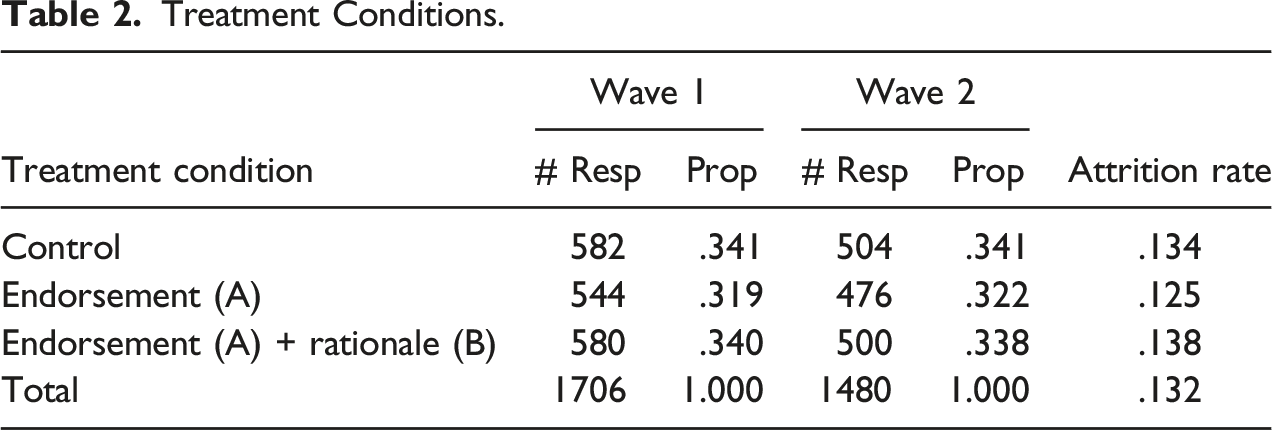
Treatment Conditions.
At the sampled polling stations, enumerators used a random-walk technique to select households. Within households, respondents were randomly selected, alternating between males and females. If selected respondents were not home, enumerators waited or returned to interview them. Informed and voluntary oral consent was sought and received from all participants. Respondents were told they were part of a research study.
The survey software randomized a third of the respondents into each of the three treatment conditions (Table 2). 27 We first interviewed respondents the week before the presidential election (Wave 1). We re-interviewed these respondents about a week after the election (Wave 2), which allows us to investigate the treatment’s immediate and medium-term effects. Attrition between the two surveys is balanced across both treatment conditions (about 13%), and is thus unlikely to bias our estimates (Table 2).
After completing a short survey, participants listened to the chiefs’ endorsement or placebo message using earphones, so the interviewers were blind to the treatment conditions. Our analysis demonstrates that the endorsement messages provided new information to the vast majority of respondents: only 21% of the control group said they had already heard about their traditional leader’s public endorsement.
We use the following survey item as a manipulation check: “Thinking back to the audio I just played you, do you think it was an endorsement for Nana Akufo-Addo?” About 87% of those assigned to the treatment correctly recognized it as such; about 9% of those assigned to the control group incorrectly identified it as an endorsement of the incumbent candidate (see Appendix Table D1 and Table D2). Because not all treated participants correctly identified the treatment, our estimates are intent-to-treat (ITT) effects. 28
Sample and Balance Statistics
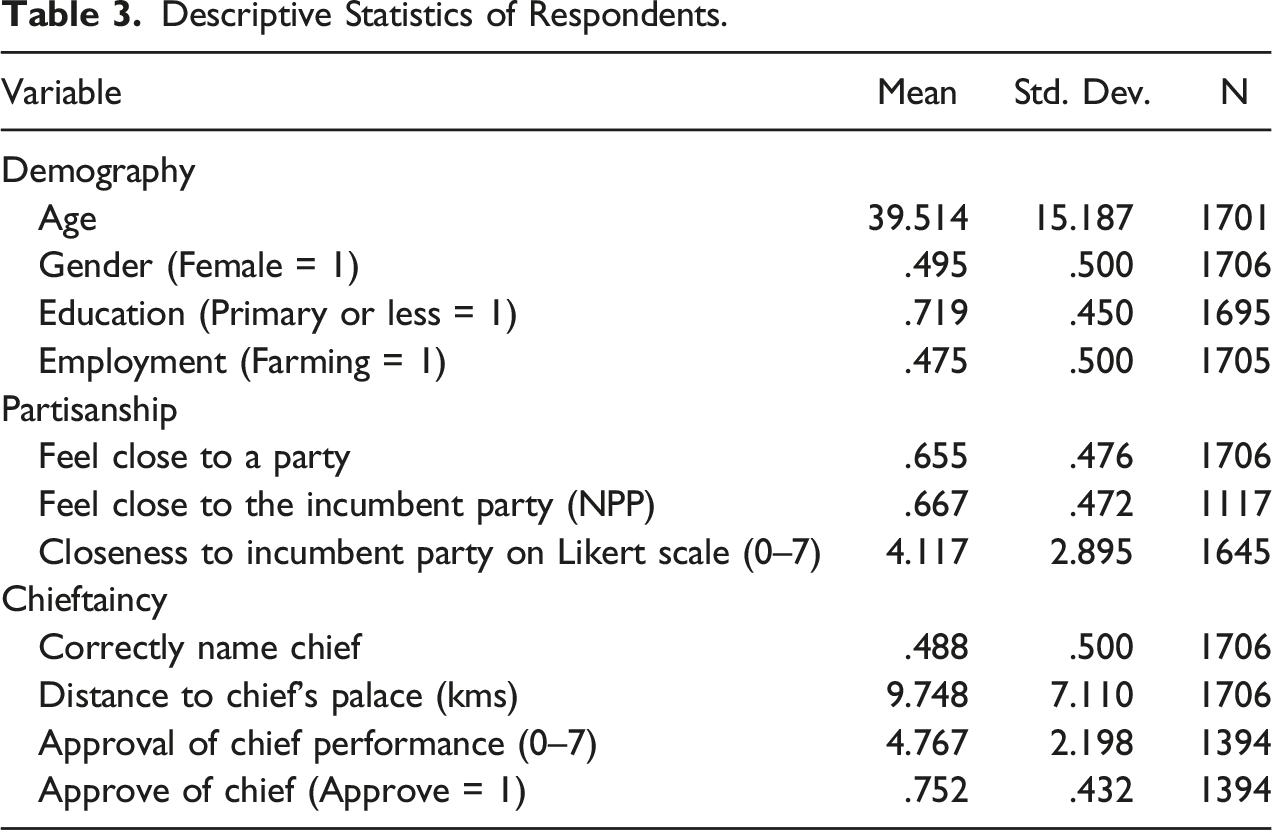
Descriptive Statistics of Respondents.
Measurement of Main Outcomes and Moderator Variables
We focus on the causal effects of chiefly political endorsements on vote choice for the favored candidate. In each wave, we asked respondents to identify the candidate they intended to vote for (Wave 1) or did vote for (Wave 2). To diminish response bias, we presented this question as an electronic ballot; after being reassured again that survey responses were anonymous respondents privately clicked on the logo of their preferred party. 30 Balance in non-response rates across treatment and control groups provides evidence that respondents felt equally comfortable to provide answers. 31
Regarding moderator variables, our partisanship measure has three categories: incumbent supporter; opposition supporter; and unaligned. We asked respondents whether they feel close to a political party, and if so, which party. Unaligned voters are those who said they did not feel close to any political party. Incumbent supporters are those who identify as being close to the NPP, otherwise, respondents are classified as opposition supporters (NDC and minor parties). In Appendix F2, we display our results using two alternative classifications of partisanship. 32 Across each measure the results are substantively the same.
To measure respondents’ approval of their chief, we use a question that asks their “overall assessment” of the chief. Responses are measured on a Likert scale (0 = lowest, 7 = highest). We code those who assessed the chief’s performance as four or above as approving the chief. 33
Estimation Strategy
To examine the effect of chiefly endorsements on vote choice, we estimate

Results
Do Chiefly Endorsement Affect Vote Choice?
We begin by displaying results from the full sample, before analyzing effects across partisan groups. Figure 1 displays the treatment and control means (Panel A) and ITT effects (Panel B) related to whether the respondent voted for the endorsed candidate. In Wave 1, the treatment has a positive effect on vote choice: it increases the probability that a respondent will report that she intends to vote for the chief’s endorsed candidate by 4.3 pp (p < .01).
35
This demonstrates that chiefly endorsements have a causal effect on vote intentions. Average intent-to-treat effect of chiefly endorsement on vote choice.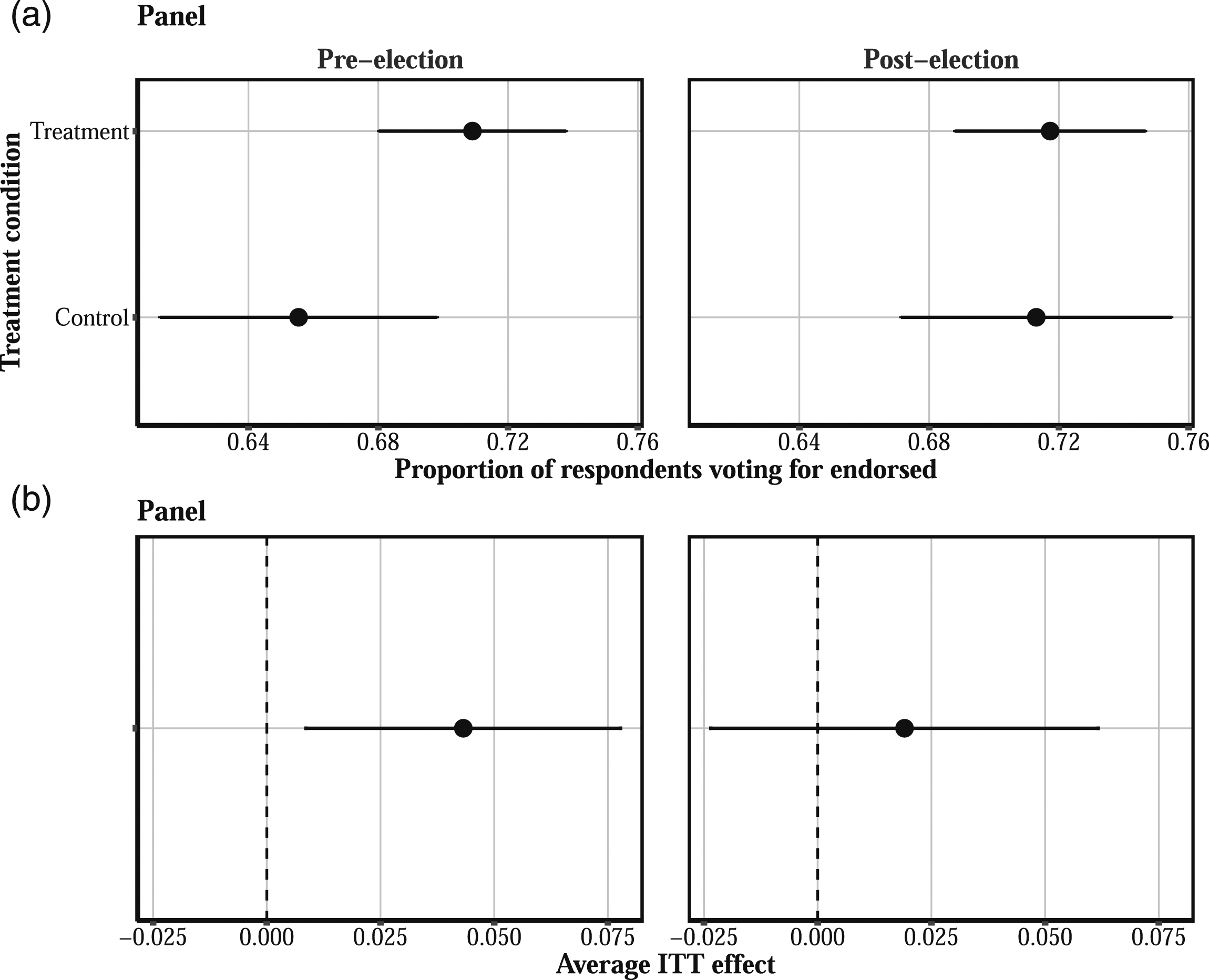
However, in Wave 2, the causal effect of about two pp is not statistically significant. While a similar share of treated respondents say they will vote for the endorsed candidates as in Wave 1, a much larger share of respondents in the control group report voting for the endorsed (72%, up from roughly 66% (top, left panel)). 36 In sum, our results lend some support to our hypothesis: endorsements have a significant and positive effect on vote intention in Wave 1.
Heterogeneous Effects by Partisanship and Prior Approval of Chief
Figure 2 displays the average marginal effect (AME) of the treatment by respondents’ partisanship.
37
The left side shows the AME for copartisans of the endorsed candidate in the pre-election (circle) and post-election period (triangle) with 95% confidence intervals. The middle shows the results for opposition parties’ supporters and the right panel shows that for unaligned voters. The results (left) show that the endorsement did not change the vote choice of those who were copartisans of the endorsed candidate. Similarly, the treatment did not move supporters of opposition parties: the treatment effect is close to zero in both survey waves. Average marginal effect of chiefly endorsement on vote choice by partisanship.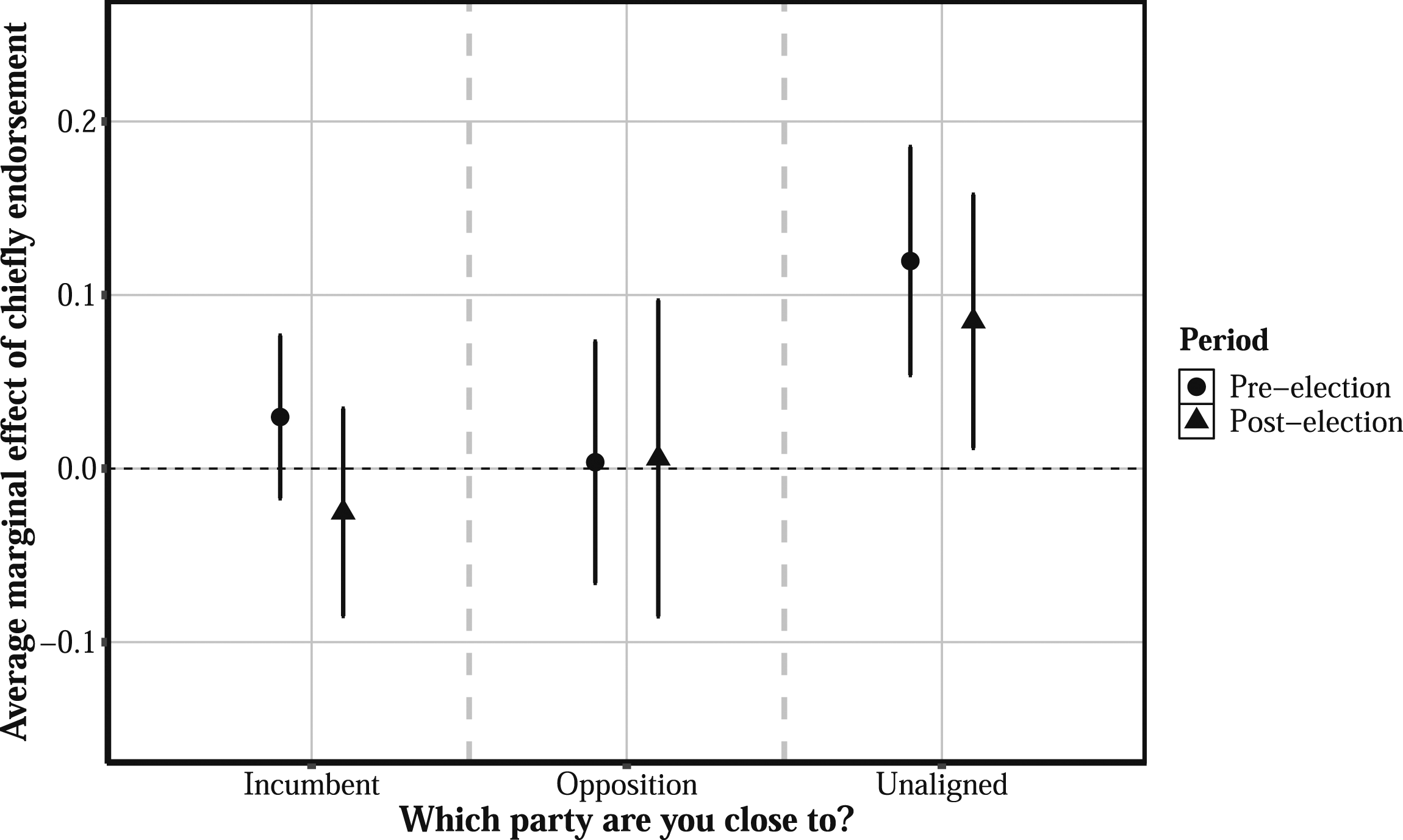
In contrast, the results on the right side of Figure 2 show that endorsements have a large and positive effect on the voting intentions and final vote choice of unaligned voters. In Wave 1 (pre-election), the treatment effect is 12 pp. In Wave 2 (post-election), it is 8.5 pp. These results show that the treatment has a significant effect on unaligned voters, but is unable to sway the intentions or final vote choice of opposition supporters. 38
Regarding evaluations of chiefs’ performance, it is less clear whether this variable moderates the treatment effect (see Appendix F3). In Wave 1, we find positive effects for respondents who approve and for those who disapprove of the chief (6 pp and 6.6 pp, respectively). However, the effect is not statistically significant for those who do not approve (p < .23), but significant at the 6% level for those who do approve. In Wave 2, the effect is close to zero for those who do not approve, and while it remains positive for those who approve of the chief (4.1 pp), it is not statistically significance (p < .2). Overall, these results suggest that prior levels of approval do not strongly moderate the effect. 39
We next explore whether there is an interactive effect between partisanship and prior approval. We did not pre-specify the interaction of these two moderators, and therefore these results may be taken as exploratory. Figure 3 displays the results. The results for incumbent supporters are presented in the left panel, opposition supporters in the middle panel, and unaligned voters in the right panel. As we subset the full sample into smaller categories, our results become less precise (which results in larger confidence intervals).
40
However, overall these heterogeneous results indicate a very strong interaction effect. Specifically, chiefly endorsements were more effective among respondents who were unaligned and approved of the chief’s performance; the treatment significantly increased their propensity to say that they intend to vote for the endorsed candidate and reporting actually voting for them. The size of this AME is 10.4 pp (p < .02) and 14 pp (p < .001) in Waves 1 and 2, respectively. For comparison, for unaligned voters who did not approve of the chief’s performance, the AME is 11.3 pp (p < .11) and −.6 pp (p < .94) in Waves 1 and 2, respectively. In contrast, the results do not display clear evidence of an interaction effect among either incumbent or opposition respondents, although we note that these null effects may be due to insufficient power. Overall, these results suggest that chiefly endorsements have the largest and most consistent effect among unaligned supporters who hold position evaluations of the chief. Average marginal effect of chiefly endorsement by partisanship and evaluation of chief.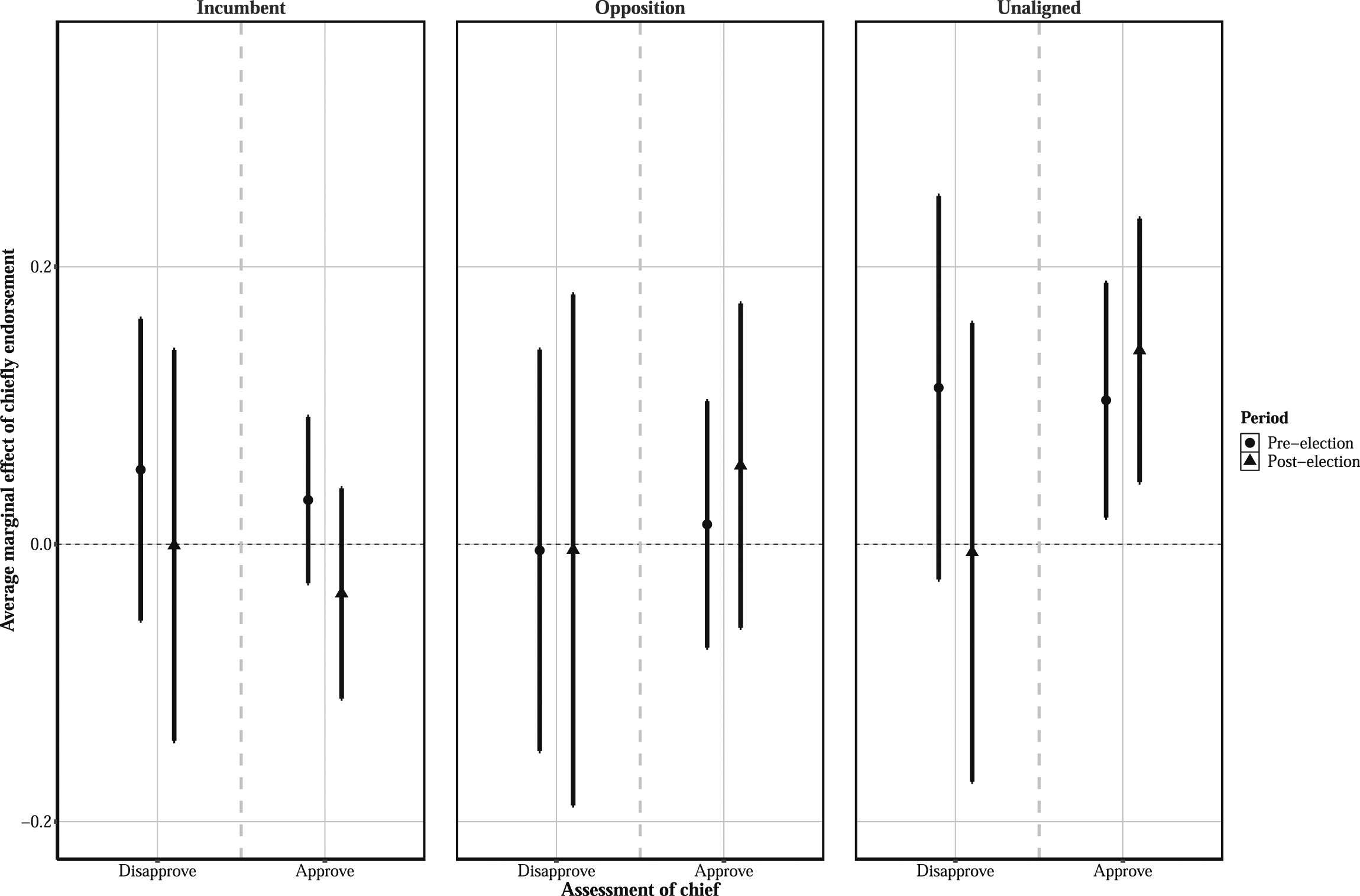
Mechanisms
We study mechanisms in two ways. First, we disaggregate the treatment to determine whether the rationale chiefs provide for their approval has an effect over and above the endorsement alone. Second, we analyze the effect of the endorsement on theoretically relevant intermediate variables that might mediate the treatment and the outcome measure. As pre-registered, we focus on the mechanism that drives the effect of endorsements we detect among unaligned voters. 41
Does the Rationale for the Endorsement Matter?
Figure 4 displays the average ITT effects, disaggregating the treatment into its components in the pre-election and post-election periods. The figure shows that the treatment has no additional positive effect when respondents hear the rationale in addition to the endorsement. In Wave one the average ITT effect is 9.5 pp (p < .15) for endorsements only (circle) and 14.2 pp (p < .02) for endorsements plus rationale (triangle).
42
The difference between these two treatment effects is not statistically significant (difference = 4.7 pp, SE = .09, p < .60). In Wave 2, the ITT effect is 8.7 pp (p < .12) for endorsements only and 9.6 pp (p < .08) for endorsements plus rationale.
43
Again, the difference between these treatment effects is not statistically significant (difference = .009 pp, SE = .078, p < .91). These results suggest that the informational content of endorsements is not important, and supports the argument that endorsements operate through a signaling mechanism that is dependent on the chiefs’ positions. Average ITT effect of chiefly endorsement on vote choice among unaligned voters by treatment type.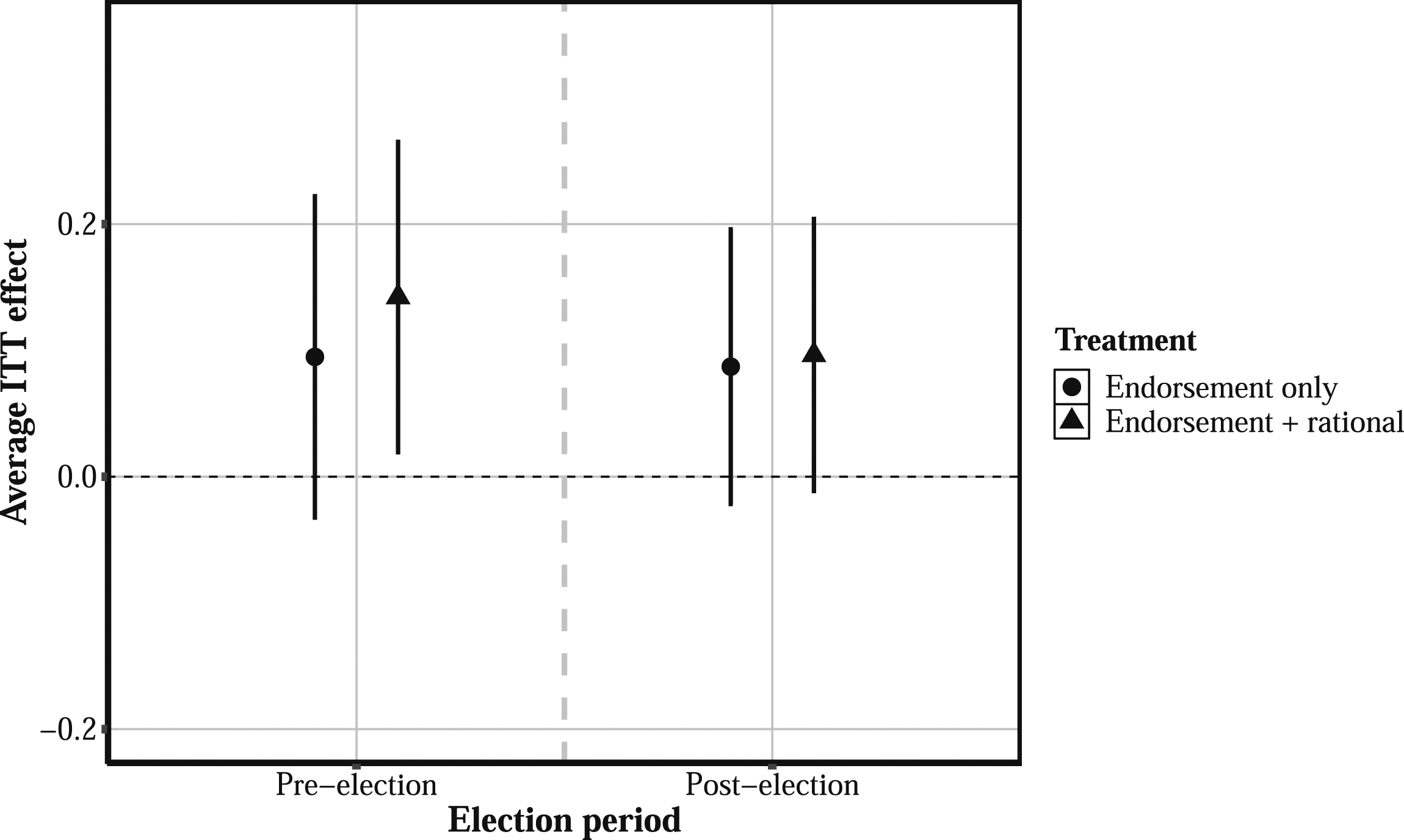
Effect on Intermediate Variables and Causal Mediation Analyses
We argue that because of chiefs’ personal and private interests in electing high-performing candidates, a non-coercive way in which endorsements may influence voters is through voters interpreting the endorsement as a signal of candidate quality. Accordingly, we assess whether endorsements lead treated voters to update their beliefs on candidate (i) quality and (ii) expected performance. As endorsements may affect vote choice through coercive channels, we also assess two alternative mechanisms. First, voters expecting private benefits from the chief if they support the endorsed candidate. Second, increased fear of being disadvantaged by the chief if they do not vote for the endorsed candidate. These mechanisms are not mutually exclusive: respondents may update on multiple beliefs. The outcomes we report were collected in Wave 1 of the survey after respondents had heard the treatment or control audio and before answering questions related to our main outcomes. 44
To investigate the potential mediating role of these intermediary outcomes, we first examine the average ITT effects related to each mechanism: we compare means in control and treatment groups. Second, we employ a semi-nonparameteric approach of causal mediation analysis to determine which of our intermediate variables mediates most of the effect of the treatment on vote choice (Imai et al., 2011). 45 Under the strong assumption of sequential ignorability, this approach helps to causally identify the proportion of the total effect of the treatment on the primary outcome that runs through a hypothesized mechanism (i.e., indirect effect or average causal mediation effect (ACME)) versus all other channels (i.e., direct effect or average direct effect).
Sequential ignorability implies assuming that: (1) the observed pre-treatment confounders are independent of the treatment and (2) there are no pre-treatment and post-treatment covariates that confound the relationship between the intermediary variable and the outcome. While the first ignorability assumption is satisfied by randomization, the second cannot be proven by observed data (Manski, 2009). Accordingly, Imai et al. (2011) propose a sensitivity test to examine the extent to which this assumption must be violated to reverse the conclusions. The sensitivity tests we perform give us confidence that our conclusions are not susceptible to severe violations of the assumption. Appendix Figures H1 and H2 display the results for the causal mediation and sensitivity analysis for each of our intermediate variables, respectively.
Average ITT Effects of Chiefly Endorsement on Intermediate Outcomes.
Note: The exact survey questions we use to assess each of these mechanisms are as follows. Personal quality: (i) How likeable do you think Nana Akufo-Addo is as a presidential candidate? (ii) How trustworthy do YOU think Nana Akufo-Addo is as a presidential candidate? Expected performance: How likely do you think it is that Nana Akuffo-Addo will do a good job at constructing new infrastructure in your local area/working in Accra to make good policies for the country? Chief-politician relationship: (i) How likely is it that [chief name] would have the listening ear of Nana Akufo-Addo if he were to be elected? (ii) How likely is it that [chief name] would be able to work with Nana Akufo-Addo to advance development in your local area? Private gain: Should Nana Akufo-Addo win, how likely is it that [chief name] will provide more benefits to you personally or your family? Fear: Assuming that [chief name] did endorse a candidate, how fearful are you that if you do not vote for the candidate that [chief name] endorses you or your community will be disadvantaged?
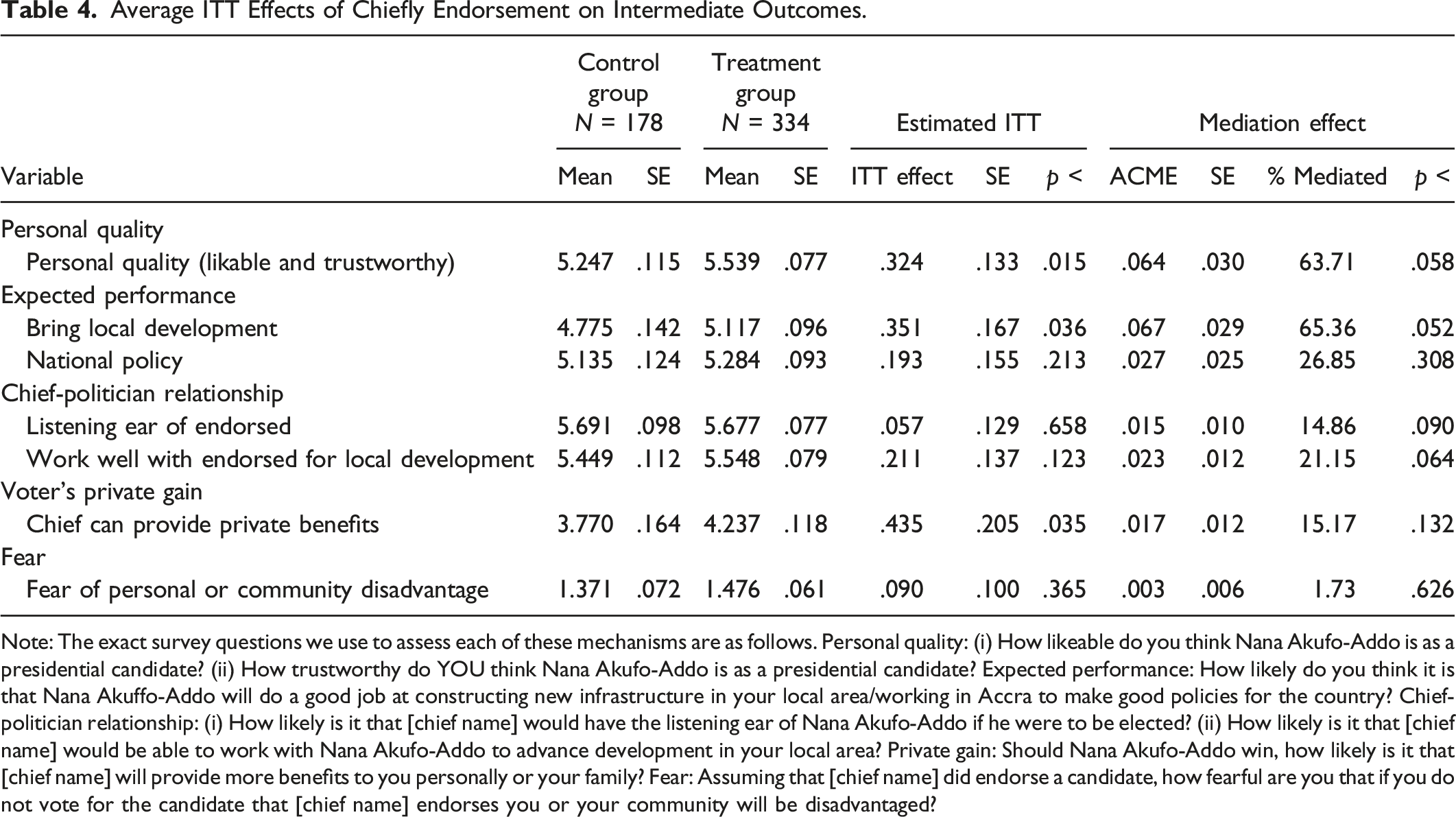
We find evidence of positive updating on candidates’ perceived likability and trustworthiness (.32, p < .02). These effects represent a 6% increase from a mean of 5.539 in the control group. The causal mediation analysis shows that respondents’ updates of the endorsed candidate’s personal qualities meditate 64% (ACME = 6.4 pp) of the total effect among unaligned voters. Overall, these results provide evidence of positive updating on candidate quality.
We also find evidence that endorsement led to positive updating on expectations that the candidate will bring local development. The ITT effect is .35 (p < .04)), which represents a 7% increase from the control group (the control group mean was 4.775). Further, we find that local development accounts for 65% (ACME = 6.7 pp) of the total effect of endorsement on vote choice. By contrast, we find no evidence that endorsements affect perceptions of the endorsed candidate’s performance in delivering national policies.
Concerning how voters expect presidential candidates to deliver local development, and whether voters think endorsements signal that chiefs will coproduce public goods with the candidate, we also asked respondents about their expectations regarding the future working relationship between the chief and the candidate. First, we asked whether they expect the candidate to listen to the chief after they are elected, which we use to measure how effectively chiefs can lobby for local public goods. Second, we asked respondents how well the chief and candidate would work together to bring about local development. The treatment has a small positive effect on beliefs that the favored candidate would listen to appeals from the chief (.06), but this effect is not statistically significant (p < .65). Similarly, while the effect on perceptions of an enhanced working relationship between the chief and the president is also positive (.21), again, it is not statistically significant (p < .12). Further, we find that these intermediate variables do not mediate a significant share of the treatment’s effect on vote choice (15% and 21%, respectively). These results indicate that beliefs about the need for a collaborative working relationship between the chief and the endorsed for the production of local public goods do not primarily drive the endorsement’s effect. Overall, our results suggest that the treatment effect among unaligned voters is not driven by voters’ expectations of co-production of public infrastructure by chiefs and endorsed presidential candidates.
We do find some support for the argument that voters expect private benefits from the chief. The treatment increased voters’ belief that electing the endorsed candidate would put their chief in a position to provide benefits to themselves or their families by .43 (p < .03)), which represents about a 12% increase from the mean in the control group. However, the causal mediation analysis shows that such expectations of private benefits from the chief if the favored candidate is elected only mediates the effect by 15% (ACME = 1.7 pp). Thus, while unaligned voters expect the chief to stand a better chance of providing private benefit under the endorsed’s term in office, such change in beliefs does not appear to drive their ultimate vote.
Finally, we do not find significant evidence that the treatment increased respondents’ fear of incurring a personal or communal disadvantage. While the ITT effect is positive (.09), it is not statistically significant at conventional levels. Furthermore, the causal mediation analysis suggests that such fears mediates only 2% (ACME = .3 pp) of the effect.
In short, the positive results we find on how endorsements affect vote choice appear to operate primarily through citizens updating their beliefs about candidate quality and presidential candidates’ intention to provide local development projects.
Conclusion
We leverage real endorsement messages from traditional leaders for the incumbent candidate in Ghana’s 2020 presidential election and an experimental design to investigate chiefly influences on vote choice. Our results show that upon hearing chiefs’ endorsements voters are more inclined to vote with the endorsed candidate. However, it is only among unaligned (“swing”) voters that endorsements affect final vote choice. We find particularly large impact among unaligned voters who held positive evaluations of their paramount chief. Our results on mechanisms suggest that unaligned voters—who are often considered to engage in performance-based voting—take chiefs’ endorsements as a signal of candidate quality. Endorsements enhance voters’ perceptions about the personal characteristics and expected performance of the candidate in delivering infrastructure and public service in their local area.
We believe that these results are likely to apply to other African countries and contexts beyond Ghana. Our results suggest that traditional leaders might have a more substantial influence where partisan attachments are weaker and where citizens hold positive evaluations of traditional leaders. While Ghana has significant proportions of citizens who consider themselves unaligned (40%) and evaluate their chiefs’ performance highly (50%), these figures are below the continental averages (53% and 59%, respectively) according to recent Afrobarometer data (Round 8). 47
However, our theory may be subject to at least three important scope conditions. First, our theory relies on chiefs having incentives to support candidates they think will perform well. As we argue, this is part relies on chiefs being personally invested and tied to a particular area of land. Second, it also likely depends on chiefs facing informal or formal checks on their power. As we state in the theory section, 68% of traditional authorities operate with inclusive decision-making institutions, which leaves a significant minority that do not (Baldwin & Holzinger, 2019). Research from Ghana shows that succession institutions may be particularly important in determining whether chiefs work to enhance local livelihoods or capture resources for themselves (Nathan, 2019). Third, a non-coercive relationship between chiefs and citizens is more likely when the democratic space is relatively open, supported by a vibrant and independent local media and judiciary. Free media grants citizens the ability to report and push back against overt intimidation by traditional leaders.
Our results have important implications for governance and accountability. We provide causal evidence that exposure to chiefly endorsements affects individual voting decision. Thus, chiefly endorsements can give favored candidates an advantage over their opponents. As incumbent candidates are often better positioned than opposition candidates to solicit endorsements, the results suggest that chiefly endorsements can be considered a form of incumbency advantage and can undermine democratic competition.
Nonetheless, our results suggest that chiefs’ influence on voters runs through a positive mechanism, in which voters update their beliefs about the potential to advance community development, rather than a coercive channel, which complements Baldwin (2013)’s seminal contribution. However, our findings also demonstrate that it is not through improving their relationship with the chief that presidential candidates are expected to be more able to deliver development. Indeed, we find null effects on the intermediate variable based on a question that asks whether voters expect the chief and politician to work together to bring development. These results contrast with those of Baldwin (2013), our findings suggest that the developmental effect can run independently of expected chief-politician dynamics.
We interpret our results related to mechanisms—which combine null effects on the rationale component of the endorsements with the significant effects on expectations of local development—as illustrating that voters expect chiefs to support politicians who they anticipate will provide local public goods to the traditional area. Thus, voters interpret a chief’s endorsement of a candidate as a signal of how the chief is likely to perform in office. Our discovery of a non-coercive rather than coercive causal channel is reassuring for accountability because voters can sanction politicians who go on to underperform.
Further research could examine how chiefly endorsements affect support for opposition candidates. Most chiefs support the incumbent candidate, and our study suggests that this may provide a source of incumbency advantage in new democracies. However, it remains unclear whether similar results would hold for opposition politicians.
Supplemental Material
Supplemental Material - Chiefs’ Endorsements and Voter Behavior
Supplemental Material for Chiefs’ Endorsements and Voter Behavior by Sarah Brierley, and George K. Ofosu in Comparative Political Studies
Footnotes
Acknowledgments
We thank Daniel Kumi and our team of survey enumerators for excellent field research assistance. We thank Kojo Pumpuni Asante, Kate Baldwin, George Bob-Milliar, E. Gyimah-Boadi, Ryan Jablonski, Eric Kramon, Lauren MacLean, Noah Nathan, and H. Kwasi Prempeh for helpful insights and suggestions. Florian Sichart provided excellent research assistance. Prior versions of the paper were presented at the Working Group of African Political Economy workshop in August 2021 and the American Political Science Association meeting in October 2021. The study was approved by the London School of Economics Ethics Review Board (#16169) on November 10, 2020. The LSE Global Challenge Research Grant and the International Growth Centre provided financial support for the project. Replication materials and code can be found at  .
.
Declaration of Conflicting Interests
The author(s) declared no potential conflicts of interest with respect to the research, authorship, and/or publication of this article.
Funding
The author(s) disclosed receipt of the following financial support for the research, authorship, and/or publication of this article: This work was supported by the International Growth Centre (GHA-20224), London School of Economics and Political Science (Global Challenge Research Grant).
Supplemental Material
Supplemental material for this article is available online.
Notes
Author Biographies
References
Supplementary Material
Please find the following supplemental material available below.
For Open Access articles published under a Creative Commons License, all supplemental material carries the same license as the article it is associated with.
For non-Open Access articles published, all supplemental material carries a non-exclusive license, and permission requests for re-use of supplemental material or any part of supplemental material shall be sent directly to the copyright owner as specified in the copyright notice associated with the article.
