



Abstract
How does living on property taken from others affect voting behavior? Recent studies have argued that benefiting from historical violence leads to support for the far right. We extend this fledgling literature with new theoretical insights and original data from Israel, using case-specific variation in the nature of displacement to uncover heterogeneous treatment effects. Exploiting the coercion during the settlement of Jewish migrants on rural lands following the 1948 war, we show that living on lands taken from Palestinians consistently led to hawkish right-wing voting—even 70 years after the violence occurred and despite the widespread rejection of guilt over that violence. We also show that exposure to the ruins of the displaced villages increased right-wing voting and that the impact of intergroup contact is divergent: it decreased intolerant voting in most villages but increased it among Jewish communities that reside on violently taken land. Our results are robust when matching is used to account for several controls and spatiotemporal dependencies.
Introduction
In 1949, heated debate plagued the elite of the newly created state of Israel. Controversial construction work began on the lands of the displaced Palestinian village of Deir Yassin to build a Jewish neighborhood on the outskirts of Jerusalem. A group of intellectuals had written to Israel’s prime minister, David Ben Gurion, asking for the settlement to be cancelled because failing to do so would appear to endorse the infamous events in the villages a year earlier. Ben Gurion did not respond and eventually claimed that he was too busy to read their letters (Ellis, 1999, p. 32). The scholars were referring to the displacement of Deir Yassin, a pivotal moment in the 1947–1949 war that included the killing of at least a hundred civilians by extreme Jewish militias—possibly sparking the decision of many Palestinians across the land to leave (Morris, 2004, p. 79).
This anecdote is important because it is rare. It is an extreme example; the massacre involved more violence than most wartime displacements, which made it stand out. The protest against the settlement on the village lands was also an exception—hundreds of displaced Palestinian villages were resettled by Jewish communities without opposition. This pattern raises questions that are of scholarly importance regarding the relationship of communities to their politically sensitive past. Can engagement with a violent history have persistent political consequences? What is the relationship between residing on taken land and right-wing voting? Following on the work of Charnysh (2015), Charnysh and Finkel (2017), and Homola et al. (2020b), we aim to answer this question using data from a new case study to show that the effects are heterogeneous and conditional. We provide possible answers using a large, original, geolocated data set that captures information about the histories of all Jewish non-urban localities in Israel, including wartime events, post-war construction, and vote share in over 20 subsequent elections.
We argue that living on taken lands increases right-wing voting, following an intuition that emphasizes psychological motives, particularly when the response to guilt is cognitive dissonance. Based on prior studies that relied on cognitive dissonance theory (e.g., Acharya et al., 2018), we posit that the political consequences of taking others’ property are far-reaching and can be pronounced in a number of ways. Our framework suggests that this effect is varied and interacts with other social institutions and processes, such as economic structures, types of violence, exposure to historical remains, temporal contexts, and contact with the minority group. In particular, we argue that this pattern becomes stronger as violence increases, if there is evidence of the violent past, or if there is close contact with the group that has been harmed. In sum, we develop a framework to explore the heterogeneous legacies of residing on others’ property, showing that the long-term effect is conditioned on a subtle and often-overlooked variation in the salience of past violence and the context in which it occurred. We thus expand upon prior studies by introducing a set of moderators and by looking at the effect over time, both of which further our understanding of this relationship.
The study promotes the resurgent literature on the legacies of violence (notable examples include but are not limited to Balcells, 2011; Besley & Reynal-Querol, 2014; Charnysh, 2015, 2019; Costalli & Ruggeri, 2015; Canetti et al., 2018; Dinas & Fouka, 2018; Walden & Zhukov, 2021) by identifying the long-term effects of violence on the group that benefited from it and examining shifts in those effects. It adds nuance to it and extends the theoretical exploration of possible heterogeneous effects in the literature. Additionally, our findings can help illustrate one possible source of motivation for right-wing voting and the salience of debates on historical narratives in societies with violent pasts, contributing to work on historical memory in conflict (Checkel, 2017; Podeh, 2000). It also contributes to our understanding of political behavior by testing some of the predictions stemming from the cognitive dissonance approach. We argue that obstacles to the repression of guilt stemming from variation in the nature of the displacement will lead to different effects; thus, while we cannot show that this psychological mechanism is what generated our findings, we do show that its predictions are supported by the data—continuing a long line of research that used insight from psychology to explain behavior in conflicts (Bar-Tal, 2000; Canetti et al., 2009; Bauer et al., 2014).
We adopt an empirical strategy that uses the unique forms of coercion in the settlement of lands in Israel to address concerns of self-selection as a possible driver of the results. We also use matching to improve inference and look at spatial variation to explain the heterogeneity of the results. We examine how the effect changes over time and what that could indicate for different mechanisms, showing that the findings are in line with what could be expected from the cognitive dissonance mechanism, albeit without directly testing any specific possible mechanism. Our results suggest a nuanced answer to the question of the relationship between taking others’ property and right-wing voting, showing that the effect is conditional and heterogeneous since it heavily depends on variation in the nature of the displacement and its aftermath. Finally, we show that the main results survive extensive different robustness tests and are in line with preliminary survey evidence on the individual processes that our group-level proxies represent.
We believe that our results may have important implications for attempts to reach peace and reconciliation in post-conflict settings, suggesting that the possibility of transitional justice, which is often used as a key tool for healing anger over past wrongdoings, could be a key deterrent that induces individuals to oppose the peace process. The Israeli-Palestinian conflict is one of the bloodiest and most intractable conflicts in the world, and it holds a central place in global politics. Two main reasons that attempt to resolve it have failed are the electoral power of the right-wing in Israel and the difficulty in resolving the refugee issue. We explain why these are so salient and why individuals will oppose reconciliation even if they have nothing to lose from territorial compromise, due to the symbolic guilt that acknowledging wrongdoing can cause (following, but not definitely confirming, the intuition of the cognitive dissonance approach). As we explain below, this has important implications for our understanding of the intractability of territorial conflicts and processes of foreign policy attitude formation. We thus continue previous work that links micro-level resettlement to macro-level conflict (McNamee, 2018; McNamee & Zhang, 2019; Schutte, 2019).
We proceed with a discussion of the puzzle we worked on in the context of contemporary scholarship. We then explain our theoretical basis and expectations. In the empirical section of the paper, we introduce the necessary historical background of our case study and the reasons for its selection, detail how we gathered our data, and explains our analysis and findings. Finally, we conclude with support for our findings in robustness tests and survey evidence and a discussion of these results and their importance.
The Literature on Violent History and Electoral Behavior
What is the long-term impact of residing on land taken from others? Previous studies mentioned above have argued that profiteering from violence in various ways leads to an increase in hawkish and intolerant voting. We argue that these legacies are heterogeneous, varying based on micro-level differences in the setting of the historic violent event. These differences create various lasting variations in economic structures, contact with victims, the salience of the past, and perception of it. These subtle differences interact with how voters approach memory and determine the nature of the legacy, leading the effect of residing on taken land to vary, even within the same case study.
As we detail below, many Jewish migrants to the newly formed State of Israel were settled on rural lands, some of which had been taken from Palestinians through violence during the 1947–1949 war. Does this exogenous settlement process have persistent political legacies? The difference between villages that are or are not settled on taken lands is subtle and often repressed, but the consequences of guilt over past violent actions can be powerful. To answer this question, we turned to the literature on the legacies of violence to explain how these communities will behave differently. We then relied on cognitive dissonance theory to develop certain hypotheses and supported them with a quantitative analysis of voting patterns in Israel, which we explain next.
An emerging and growing field has created vigorous interest in the inter-generational political legacies of historical mass violence (Walden & Zhukov, 2021). A distinct stream in the body of research focuses on the legacies of violent property transfers on the perpetrators and profiteers in the short and long term. Their results show that profiteering from political violence increases hostility, intolerance, and hawkishness toward the damaged out-group (Acharya et al., 2016, p. 629; Charnysh, 2020; Charnysh & Finkel, 2017, p. 809; Homola et al., 2020a, p. 581; Nyhan & Zeitoff, 2018). The main argument is that the victimization of the out-group induces vilification by profiteers, who do so because of feelings of guilt and the clash between their beliefs about themselves and their actual behavior (Acharya et al., 2018, p. 406). The first series of studies, by Acharya et al. (2016), focused on communities that profited from slavery in the southern United States. They were followed by studies such as Charnysh & Finkel, 2017; Homola et al., 2020a, which increasingly focused on the Jewish Holocaust and its impact on German and Polish communities.
But this growing body of literature suffers from numerous challenges on which we elaborate, some of which could be attributed to the limited geographical scope of the empirical inquiries, given that findings are based on evidence from a few distinct case studies. We strive to identify and fill some of these gaps using original data on the consequences of the Palestinian exodus from the newly formed state of Israel, an often-overlooked case of mass violence. While this is in some ways just another distinct case study, so studying it does not solve the problem of generalizability in the literature, it does allow for the testing of previous expectations in a radically different context from prior studies. This can contribute to our confidence in the universality of these findings while also enabling the advancement of our understanding of this relationship, due to the unique empirical features of the case study.
The case complements the existing literature by identifying the territorial profit that groups perpetrating forced displacement generate from the violence and its political effects, which shape the ensuing protracted territorial conflict. Additionally, the theoretical basis of the current body of research can still be expanded. Scholars have suggested numerous possible causal mechanisms, using insights from psychology (cognitive dissonance theory) or economics (material threat theory) to offer a robust explanation for the relationship between the profit from violence and right-wing voting (Acharya et al., 2018). However, there is still work to be done on extending these insights to investigate how numerous institutions and social processes affect this relationship, which has been established in numerous contexts, but with no sufficient emphasis on how the relationship interacts and is conditioned by these other variables. We focused on cognitive dissonance theory to generate our predictions and explain why it is important to look at the obstacles to rejecting guilt that leads to exacerbated effect sizes. Thus, in our study, we develop the main theories of the body of research, adapting them to the case of the Israeli-Palestinian conflict and developing new testable expectations regarding the effects of violence and its interaction with other influential explanations, such as temporal political conditions, intergroup contact, and exposure to the past. We do not show that the psychological mechanism—or guilt more broadly—is what drives the results, but we do show that our expectations of a heterogeneous treatment effect developed on this mechanism are supported by the data.
We thus offer a more nuanced approach to the legacy of violent resettlement, arguing that the effect of violence depends on the visibility of the past in daily life and that it alters the result of inter-ethnic contact. As we show in the next section, these are expectations that are derived from existing theoretical approaches on which the existing body of literature relies, but which have not been previously deduced and tested. Prior studies have not accounted for or seriously considered the extent of awareness about the past or explained how contact with the damaged population might affect the legacies of violence. Although our observational and ecological study does not provide direct support for any particular mechanism, we do show that the propositions we generated from cognitive dissonance theory are well supported in our case study, while the expectations of alternative economic-threat theories have weaker support. This allows us to offer a preliminary indication of the plausibility of these two mechanisms that the literature has previously emphasized, but we do not provide clear evidence in support of one specific mechanism; we use the psychological mechanism only to develop theoretical intuition.
Our case study includes unique events and a wealth of data that make such inquiries possible. In this study, we develop an improved way to operationalize and precisely measure which communities took others’ property and to identify the effects of those actions. We exploited exogenous settlement dynamics, variations in levels of violence, changing political conditions in Israel over time, clear ideological identification of each village, and the spatial dispersion of villages in order to fully capture the effect of awareness about the violent past and how it varied between villages. The study thus supplements the literature with a new empirical exploration of the historic roots of right-wing voting and a further exploration of the possible consequences of the psychological mechanism on which it is built and heavily depends.
Finally, our study is important because it looks at the legacy of violent resettlement in an active conflict. While studies noted above raised the possibility that the behavioral result of wartime property transfers can influence processes of reconciliation and the resolution of conflicts, they tended to look at peaceful, Western states. We examine the legacies of residing on taken land in an intractable conflict that is central to world politics. This enabled us to observe, on the one hand, how changes in the macro-level conflict dynamics shaped these legacies and observe, on the other hand, how micro-level inter-ethnic interaction affected them. As we discuss in the conclusion, the findings point to multiple fruitful avenues of inquiry that can improve our understanding of territorial conflicts, foreign policy attitude formation, and the intractability of protracted conflicts.
Theoretical Framework and Expectations
How does the history of violence in a village shape the continuing political preferences of its residents? Building on the literature described above, this study advances theory by introducing a set of mediators and conditioning variables that shape the legacies of violence on those that benefited from it. It then uses a set of unique case-specific variations in the nature of displacement and the visibility of the violent past to uncover this heterogeneous treatment effect. The study does not develop new mechanisms or test them in any way. There are two possible mechanisms offered in past research—cognitive dissonance and economic advantage (Charnysh & Finkel, 2017) and we relied heavily on the former. While we did not directly measure dissonance or prove that it is the actual mechanism, we used it to develop our hypotheses and thus gave it a more central place. We thus describe this one possible mechanism, the psychological guilt mechanism, in greater detail; because it forms the foundation of our theoretical intuition, it was used to develop our theoretical thinking and forms the basis from which our hypotheses arise. We do not, however, argue that this is the only mechanism leading to our results since that is beyond the scope of this case study.
Cognitive dissonance, long studied by psychologists, is a phenomenon that includes a powerful reaction of individuals to a clash (dissonance) between their beliefs and values and their actions (Festinger, 1962). When these are not consistent, a powerful psychological discomfort emerges that will induce the individual to try to resolve the clash (Festinger, 1957). One common defense mechanism used in these situations is rationalization, in which individuals make excuses for their behavior in attempts to make their actions seem moral or even admirable. The rationalization of political violence may include relying on circumstances for justification, such as demonizing the victim or rejecting moral fallacies in the behavior (Castano & Giner-Sorolla, 2006, p. 804). Psychologists have found that this kind of rationalization about profiteering leads directly to increased ethnic hatred (Imhoff & Banse, 2009).
As mentioned before, there are two main prior explanations for the relationship between residing on taken land and right-wing voting: the economic-materialist approach and the psychological cognitive dissonance approach. The relationship can be represented by individuals feeling that their control of a property is threatened by members of a damaged minority who are demanding reparations. For example, citizens who profited from violence against Jews in the Holocaust may fear that the victims will return and demand reparations; they will thus vote for anti-Semitic parties that fiercely oppose reparations which will exacerbate the fear of the threat (Charnysh & Finkel, 2017, p. 806). Alternatively, the fear may be based on a psychological, non-materialistic threat. This explanation is based on the influential cognitive dissonance theory outlined above. According to this framework, the guilt over violence will include dissonance between how individuals perceive themselves and their communities and their behaviors or actions in real life (Acharya et al., 2018). The social psychology literature emphasizes the centrality of group guilt in conflict processes and the strong need of individuals to believe that their group is righteous (Halperin et al., 2014, p. 15). Most people strive to see themselves as good and their actions as justified. As a result, to put their actions in a favorable context, they may adopt hostile, degrading, and vilifying views toward the group that suffered from their actions. Previous studies have reported that profiteering will lead to right-wing voting, based on both these mechanisms.
The use of cognitive dissonance to explain the historically persistent shift toward intolerant attitudes has been formally developed in the game theoretical model of Acharya et al. (2018, p. 406). They theorized that ethnic hostility will persist well after violence has subsided because of guilt over the hurt caused. Individuals like to think that they and their group are good, moral, and righteous, but this belief clashes with the perpetrated violence, which is normally seen as bad or immoral. This means that individuals that associate themselves with the damage caused by violence face a conundrum that is driven by three incentives; (1) Individuals find it essential to see themselves as good, moral people; (2) Individuals must solve the clash of their actions when residing on taken land with their view of themselves as good; (3) Individuals would prefer to adapt their beliefs so they can view their actions more favorably rather than change their actions.
As a result, a common solution is to turn to beliefs that minimize feelings of guilt about the violence through developing hatred of the victims. From an intolerant and hawkish point of view, there was nothing wrong with the violence or benefiting from it. These beliefs will be reflected in an individual’s attitudes and ideological stances because they strive to minimize inconsistencies in their belief systems. This mechanism applies not only to the original perpetrators and settlers but also to their descendants and close community members, who want to believe their ancestors and peers were and are good. Thus, they also feel the need to justify the continuing benefit from the property transfers, even long after the violence (Acharya et al., 2018, p. 408).
This theoretical discussion leads to the expectation in this study and in the body of literature (Acharya et al., 2016; Charnysh & Finkel, 2017; Homola et al., 2020a) about the nature of the relationship between profiting from violence and voting, including this study’s additions to those expectations. We look at violence in two forms: forced migration or depopulation of whole villages, and the physical violence that was used to achieve this goal. While many studies concentrate on mass violence, we focus on this form of violence, which is more widespread and common. Our main independent variable is profiteering, the process by which individuals gain an advantage from violence. Our conceptualization does not emphasize receiving material profit from violence; instead, the focus is largely on the association the profiteer is forced to make between their community and historic violence, which is what ignites the mechanisms. 1 That is why we focus on what might increase awareness of the violence and thus generate this association. We argue that this psychological process has political implications, specifically focusing on right-wing voting, since right-wing ideology encompasses more of the values that residing on taken land is likely to induce, such as nationalism, hawkishness, intolerance, bigotry, militancy, and prejudice (Mitts, 2019; Rubinstein, 1996; Suleiman, 2000; Yakter & Tessler, 2022; Yishai, 2001).
We measure this ideology by focusing on how it is displayed in voting choices, given that the beliefs and attitudes created by this psychological process may change electoral outcomes and thus have real-world implications. Building on the past studies discussed above, we expect that those associated with violent resettlement will be more likely to vote for right-wing parties.
Individuals that took others’ property would show higher electoral support for parties with right-wing ideologies.
2
To continue the theoretical inquiry, we focus on the obstacles to denial as part of the process of dealing with guilt and how those factors can change the strength of the effect outlined in H1. Individuals strive to avoid cognitive dissonance as much as possible; thus, the presentation of evidence that enhances their awareness of the past only serves to strengthen their defense mechanisms. While the best solution might be for those feeling guilt over violent resettlement to ignore the history of the villages where they live, when that is not possible, those individuals will likely resort to the psychological mechanism discussed above, which in turn will increase right-wing voting. There is a vast body of evidence that contradicting a person’s prior beliefs about a conflict may reduce that individual’s prejudices and increase support for peace, but it may also backfire (Saguy & Halperin, 2014). The present study uses proximity to the remnants of depopulated Palestinian villages and their visibility to measure this dynamic.
The association between residing on taken land and electoral support for parties that hold right-wing ideologies will strengthen as a result of exposure to evidence of historical violence. Similarly, a significant obstacle to ignoring the past and a possible igniter of the right-wing defense mechanism is the presence of a population that was damaged by the violence. The common belief in the prejudice reduction literature is that intergroup contact will usually lead to more tolerant behavior, but it can also have the opposite effect if that interaction is not positive (Enos, 2014; Maoz, 2011; Mousa, 2020). There is also research indicating that the effectiveness of contact in changing attitudes depends on whether the interaction was confrontational or a peaceful acceptance of narratives (Kalla & Broockman, 2020; Lowe, 2021). We contribute to this literature by identifying a variable that will determine the consequence of contact: shared history. While communities that did not profit from the wartime violence and that live in close contact with the out-group will be more likely to vote for tolerant, left-wing parties, communities that reside on violently taken lands and in close daily contact with the out-group will exhibit increased right-wing voting. This is because the nature of the interaction will change in accordance with the political history of the village. Confronting the population that suffered, or its co-ethnics, will be likely to ignite the proposed psychological mechanism and thus increase the size of the effect. Some of the displaced Palestinians did not flee Israel but instead joined surviving Palestinian villages, so this study focused on contact with them and their surviving group members.
The associations between residing on taken land and electoral support for parties with right-wing ideologies will be exacerbated by contact with the ethnic group whose members were displaced. Historical violence will also be more difficult to ignore if it was part of an infamous, extreme event, such as a massacre. Similarly, individuals will respond more strongly if the property they own was taken with direct violence as part of an intentional effort than if their property was taken after its previous inhabitants fled as a consequence of violence in other places. Therefore, to observe associations of violence with electoral outcomes, the present study uses variations in the intensity of violence, which is possible in this case because of the different ways land was taken during the war.
The associations between residing on taken land and electoral support for parties with right-wing ideologies will be stronger if the violence used during the displacement was more pronounced and intense. In summary, we extend the expectation that profiteering will lead to right-wing voting by testing how the strength of the effect of residing on taken land varies depending on the nature of the interaction with the violent past (H2 a, b, and c). In the appendix, we also look at how these relationships change over time, depending on context. We now turn to the use of the Israeli case study and the empirical tests for these expectations, showing how we use case-specific variation in the nature of displacement to show the heterogeneous treatment effects of taking others’ property.
Displacement and Resettlement in the First Jewish-Arab War
It is important to be aware of the setting and characteristics of the case study, to better contextualize the results. Moreover, studies of the Palestinian exodus have to date focused mainly on historical questions, and only recently has it begun to receive attention from political scientists (Arnon et al., 2022; Haran Diman, 2023; McAlexander, 2022; Muchlinski, 2021). We describe the general historical events that were studied and explain why this case study is interesting. We then detail its benefits for empirical research.
Historical Background
Arabs and Jews lived together in Israel/Palestine under the Turkish and British rule for decades with varying degrees of coexistence and violence (Klein, 2014; Naor & Jacobson, 2016). But in the early 20th century, the growth of the Zionist movement, which aspired to create a national home where Jews could settle, created increasing strain between the groups. Some Zionists organized themselves into relatively homogeneous ideological groups that began settling in small, rural villages of Jews across the country. This effort was given a boost by waves of Jewish refugees after WW2 arriving up to 1947 when war broke out over the division of the land between Arabs and Jews. During the war, Jewish militias made significant territorial gains that eventually forced the Arab states supporting the Palestinians to end the war and the creation of a Jewish state on 78% of the land.
The early Israeli narrative was that Palestinians voluntarily fled villages and were not forcibly expelled. Some Israelis also placed responsibility for the war on the Arab forces that had rejected UN resolution 181 which proposed to partition the land. However, beginning in the 21st century, some Israeli historians and textbooks adopted a more critical perspective and recognized that some areas had been intentionally cleansed (Nets-Zehngut, 2013, p. 41). The Palestinian narrative, which is also promoted by several Israeli historians, is that part of the military strategy of the Jewish forces was to methodically cleanse the captured Palestinian villages by forcing their inhabitants to leave (Pappe, 2006). This depopulation was carried out through the use of displacement, the demolition of homes, and massacres (Morris, 2004, p. 504). It also frequently included mass looting and quick resettlement of a village with Jewish refugees (Raz, 2021). At other times, flight happened before the villages were captured as a result of perceptions of threat and the fear of massacres, particularly after the events at Deir Yassin in April 1948.
After the war, the wave of Jewish immigration to the new state of Israel from European and Arab countries was much larger, in part because of violence. The population was sent by the same settling movements 3 to different parts of the state and established hundreds of villages that were intended to protect Israel’s territorial integrity. Some of these villages were built on the ruins of depopulated Palestinian villages or their land, while others were established on previously unoccupied land. About a third of the villages founded by these movements before 1948 were expanded to include lands and property that were taken from displaced Palestinians who were once their neighbors. 4 The result was that some Jewish settlers became owners of property that had belonged to populations that were violently displaced, while others became owners of property that did not have such a violent past. As we show, this process was exogenous to personal preferences; the control over where settlements would be built and who would reside in them rested with governmental agencies and the settling movements. Individuals who joined the settlement enterprise—voluntarily or in some cases less freely—had no control over where they were sent.
In sum, some immigrants were forced to settle in rural areas, often explicitly against their wishes, and then the decision of where to settle was done centrally by the national leadership, so they had no control over it. This means that immigrants’ attitudes are exogenous to whether they settled on taken land or not. Immigrants had limited ability to decide on which settling movement to join—which usually correlates with their idealogy; for this reason, we control for the movement the village belongs to, only comparing villages of the same movement, to eliminate the possibility of endogeneity stemming from this fact. After the war and until reforms undertaken in the 1980s, inter-village migration was strongly restricted—it was very hard to join existing villages if you were not a member of one of the original families and very few people left the villages that survived beyond a few years. This limits the risk of post-war sorting violating exogeneity, and we make sure the results are robust if we only look at elections conducted before the reforms of 1980 or at villages founded after the first few years. Violence against Palestinians did persist after the war, though it was mostly concentrated on Palestinians in the occupied territories (the West Bank and Gaza, occupied by Israel in the 1967 war). In contrast, in land taken after 1948, violence was more restricted and does not nearly compare to the events in the 1948 war, meaning it is unlikely post-war violence would influence the results beyond the limited ways we discuss in the appendix.
Case Selection
The Israeli-Palestinian case complements the existing literature in a number of ways, including a wealth of data and theoretical challenges. First, it broadens the geographic scope of prior studies and tests their findings with an active conflict, which underscores the importance of the findings for reconciliation efforts, as we explain below. The displacement and settlement patterns have unique empirical benefits arising from their spatial dispersion, creating avenues to capture differences in important variables that were not previously observed. This process was also exogenous to personal preferences on the exact location of the village, as explained below. It also allows us to theorize the effects of residing on taken land on the results of intergroup contact and engagement with the past, this has not been possible because of lack of such fine-grained data and variation. It is possible now because of the characteristics of the case study—the relatively clear ethnic segregation in Israel, the variation in the remnants of past violence, and the differences in the intensity of violence, for example.
This case study could be viewed as challenging to the proposed theory because of its distinctive social context. In Europe and the United States, the crimes of the Nazis and slave owners, respectively, have been mostly acknowledged, at least by the mainstream. It is important to note that these mass atrocities are inherently not identical or clearly comparable to the Palestinian exodus—in the end, these are all unique cases of violence, on different scales and with different dynamics and intentions. However, the Israeli state officially denies any wrongdoing, steadfastly refuses to accept responsibility or apologize, and prohibits teaching about the victimization of Palestinian in public schools (Koldas, 2011). This presents a challenge to demonstrating our expectation that these violent events will have lasting legacies because it is a symptom of the wider rejection of guilt and repression of this episode in history by the majority of Israeli Jews.
Paradoxically, it may be a symptom that directly follows from our theoretical framework. We argue that dissonance and strong guilt induce an unwillingness to engage with the past and the deliberate adoption of ignorance with regard to the history of the displaced villages. The dissonance will be particularly strong in the Israeli case because Jewish residents of lands taken from others are publicly pointed out as such, due to the territorial nature of the profit that makes it easy to identify the relevant villages. But as we demonstrate, the rejection of guilt and obliviousness about the events of the war does not mean that they have no lasting political impact. However, it is important to note that just as the case can be seen in challenging in some ways to the hypotheses, in other ways it is actually more likely for a relationship to be found in this case. This is because, as mentioned before, the conflict is ongoing and the Palestinians demand reparations—meaning support for the right-wing among those on taken land would be even more likely.
As already noted, the case complements other studies that have speculated that the patterns created by profiteering pose a possible challenge to the reconciliation of conflicts, given those episodes of mass violence are frequently accompanied by property transfers (Homola et al., 2020a, p. 588). In fact, in one study, the Israeli-Palestinian conflict was explicitly mentioned as an important example (Charnysh & Finkel, 2017, p. 801). But these claims were based on tests conducted in peaceful Western countries that were not directly involved in active conflict processes. As noted, the fact that a conflict is ongoing makes it easier to vilify victims and deny guilt because it provides a wealth of examples that can be used to justify the violence—so if we indeed see an effect in spite of the denial, it will provide stronger support for our intuition. It is also likely to cause strong dissonance because Palestinian refugees were vocal in their demand for reparations and emphasizing wrongdoing. We, therefore, expect to find similar results but will also have a stronger and better-founded basis for claiming an important impact on conflict processes.
However, the setting is also drastically different in many ways—meaning that our study contributes to the external validity of the main finding (profiteering leads to right-wing voting) but also that comparison is not obvious. The extent to which the coercive structure in the American South still persists is unclear, but at least some of the violent institutions do not exist anymore. In the German case, the situation now is definitely different from the short episode of the Jewish holocaust. In the Israeli/Palestinian case, violence continues to be a regular occurrence, and the structure continues to be repressive, though the Palestinian citizens of Israel have a much more peaceful and free existence compared to those living in the occupied territories or in the situation in 1948. In all of these, the violent past is more or less present both in memory and in existing political institutions, meaning that comparison is not obvious.
Finally, the Israeli case is particularly interesting because of the past experience of those who settle on taken lands. To a significant degree, many of the Jewish migrants to Israel were themselves refugees fleeing the atrocities in Europe in World War Two or people displaced by violence and repression Jews experience in MENA countries. This may make it easier for settlers to justify violence against Palestinians and residing on taken land. In other words, living on taken lands would be more likely to lead to far-right voting because deflecting the guilt by justifying it would be easier. This also poses an empirical challenge, since experiences of violence can also cause far-right voting directly; we account for it by matching based on year of settlement and country of origin as a robustness test that controls for differences in the levels of violence experienced by different waves of migrants.
Empirical Opportunities
Our case study helps overcome problems that were previously challenging, such as identifying moderators, the operationalization of contact and awareness of the past, and endogeneity, due to the numerous opportunities it presents. First, the study extricated some observable implications on the moderators of the impact of residing on taken land and then tests these implications in a way that was not previously possible. Additionally, the present study addresses the problems of endogeneity between right-wing ideology and the settling of violently taken land, due to Israel’s coercive resettlement process.
A key useful phenomenon in our case study is Israel’s historic institutionalization of village-building. The construction of Jewish villages in Israel was carried out by the settling movements before, during, and immediately after the 1948 war. The ideological groups set up rural villages. As already noted, the new immigrants were organized and sent by settling movements. We argue that their control over where they were assigned was extremely limited. The decision was mostly out of their hands, and we thus treat their allocation as exogenous to their ideological opinion. These allocations were not conducted by lottery, but they were made without consideration of personal desires.
There is an abundance of historical evidence supporting this position. The Jewish villagers in Israel were given financial assistance, governmental support, and even free land in return for living in less desirable, non-urban areas, which was seen as necessary for the nation-building project (Sofer & Applebaum, 2006, p. 326). The selection of settlement sites by the movements or the National Jewish Agency (Schwartz, 1999, p. 130) was influenced before the war by land availability because the British and Ottoman administrations decided where villages could be formed. In order to join a village, one had to be a member of the ideological movement, and after joining members were assigned a settlement site; however, many members of these movements did not identify with the ideology at all. Rather, they were coerced to formally join in order to obtain housing of any kind (Schwartz, 1999, p. 132). Decisions regarding which settlers would be placed on taken land were not related to the individual members’ beliefs, and they had no influence over it.
This was particularly enforced following the 1948 war when the state suffered from food shortages, mass migrations, and the need to prevent the return of Palestinian refugees. Together with expanding the productive agricultural villages that existed before the war, the shared solution was to resettle Jewish migrants on agricultural land, some of which were previously occupied by Palestinians. This was done in spite of the migrants’ reluctance to work in agriculture when they want to live in urban areas. The state responded to this reluctance with coercion (Schwartz, 1999, pp. 134, 139). This dynamic was captured by Weingrod (1966), who dubbed the settlers reluctant pioneers and wrote that the immigrants often painfully and rarely cheerfully sought to adjust to their new condition. Additionally, before being moved to rural settlements, most immigrants were housed in temporary camps in very poor conditions (Simon, 2005); this made them less fastidious about the alternative housing solution offered to them. The immigrants thus had only limited control over the type of village or general location where they were resettled, they also had no choice as to whether it was Palestinian land, so the variance in violent or nonviolent resettlement was exogenous to their personal preferences or ideology.
Even the government did not fully control who will settle the new lands; as Goldstein (2011) explains, it strongly preferred to use experienced agricultural workers from existing settlements or among retired soldiers, but they were unavailable, and their numbers did not fit the ambitious settlement plans. Thus, the government reluctantly resorted to taking the incoming migrants, who were readily available, and placing them in the hundreds of new villages that were being constructed (ibid, 42). In other words, the need to crystallize the territorial achievements and boost agricultural supply led the government to create many new settlements and then fill them with its most available human resource: new immigrants. The shortage in human resources led the government to avoid placing restrictions on migration and to adopt a policy of open, unselected immigration (Hacohen, 2003). This meant that abandoned villages and free lands were settled with migrants not only without regard to their personal preferences but also with no selection based on their identity. 5
Below, we provide the results of balance tests to empirically support these claims and demonstrate that the villages set up with or without violent displacement are not significantly different in multiple key social and economic variables. We then describe how we use matching to account for possible other selection biases originating in the state decision about land allocation and control for varied possible confounding variables. Following the results section, we use multiple robustness tests to answer concerns that this dynamic only applies to specific historical periods or ethnic groups.
Data and Methodology
As noted above, focusing on the Israeli–Palestinian conflict is beneficial not only due to the reasons outlined above but also because of the empirical opportunities it provides. This allows for testing of these expectations in the field, utilizing variation that wasn’t used before, such as in the visibility of the past. In particular, this study used an original data set containing information about the First Jewish–Arab war (1947–1949), which was coupled with longitudinal village-level electoral data (1955–2021). 6
Dependent Variable: Right-Wing Vote Shares
This study relies on an extensive and innovative and disaggregated analysis of election results in Israel, which allowed for the estimation of the effects over time. We collected voting data for elections held since 1996 from electronic village-level files of the Central Elections Committee (CEC) and integrated them into our data set using unique identifiers created by the Israeli Central Bureau for Statistics (ICBS). For earlier elections, we collected text files from the ICBS and digitized them.
Israel has a volatile proportional representation system with a constantly changing set of parties, but the ideological makeup of the Knesset, Israel’s legislature, is more stable (Hazan, 2021). Therefore, rather than focusing on votes for a single party, the parties were instead categorized as belonging to either the right-wing or the left-wing bloc. The distinction is not always absolutely clear, so as the most important dimension in marginal cases, we used the dimension of security policy, which is the party’s approach to the conflict and to Palestinians. Emphasis was also placed on which bloc the party supported (Shamir & Arian, 2014). 7
Independent Variables
Identifying Violent Resettlement
Identifying the communities that took others’ property and are exposed to the corresponding legacies is typically a major methodological challenge, but it is easier in the case of Israel. This is because the profit is in the form of land, and it is relatively easy to determine which communities live on displaced lands. For this purpose, the study uses a list created by Zochrot, an Israeli NGO devoted to the documentation and memorialization of the Palestinian Exodus that has recorded all of the Israeli Jewish villages that were built on taken lands. 8 The Jewish villages on the list were manually matched with villages in the ICBS records and with data on Palestinian villages during the war. The list’s validity was corroborated by comparing the locations of displaced Palestinian villages with the coordinates of present-day Israeli villages, compiled from the data sources detailed below. It is important to note that the list includes not just villages founded after the war, which replaced depopulated Palestinian villages but also settlements that were founded before the war and then expanded to include seized lands or property. In both cases, the village residents took over others’ property to some extent, but the political dynamics involved may be different, so we verified our results on subsamples that included villages founded before the war and those founded after the war. 9
Our data set contains 836 non-urban
10
Jewish villages, of which 394 are on land taken from displaced Palestinians, and 442 are on land that was not violently taken. Of these villages, 68.2% were constructed after the war. Figure 1 presents the locations of these two groups of villages in the 1948 lands of Israel. It is possible to empirically substantiate our view of the settlement patterns as orthogonal to personal characteristics by regressing this binary variable with key aggregated village-level variables from the earliest comprehensive census (1961). Figure 2 displays the null results of such models, providing evidence that ethnic origin, the economic situation in the early years, and the average level of education are balanced across villages, whether or not they were settled on violently taken land. This shows that the most relevant socioeconomic variables that predict right-wing voting were not skewed across villages on different types of land. Location of Jewish villages in Israel. Balance tests with 1961 census data. *Note: these are the results of simple ordinary least squares models with no controls or matching. Villages formed after 1961 are not included in the analysis. 1948 census was not used since it was carried out before the vast majority of villages were founded and dramatic changes were still happening due to the war; the resettlement process and any selection that can be associated with it had not yet started. However, we tested whether the result was null and balance was found if we regressed the violent history with the 1948-based measure for ethnic origin and indeed found identical results—villages were not significantly different in these observable aspects. “Ethnic origin” is coded as 1 = Mizrahi and 2 = Ashkenazi. The results stay the same with regional fixed effects. This is not a perfect test, since the data is only available for after the war is not measuring political preferences—and thus can only indicate orthogonality, not confirm it.

Remains of the Past
One of the main contributions we offer to the field is an exploration of the effects of remnants of the violent past on modern political behavior. Prior studies about death camps have mentioned the importance of evidence of the past and its visibility (Charnysh & Finkel, 2017; Homola et al., 2020a). The Israeli case is different because the evidence is more subtle. There are no museums devoted to the topic or large camps—only stone walls, rubble, and a few remaining buildings, as documented by Khalidi in a survey of displaced villages (1992). The locations of displaced villages depended on proximity to agricultural land and water sources, along with, ultimately, the decisions of the settling movements. We argue that the proximity of Jewish villages to remnants of displaced Palestinian villages is exogenous and quasi-random, and thus it was exploited as an instrumental proxy of awareness of the past. Some villages were established in areas with Palestinian buildings, while others were placed on agricultural lands that belonged to Palestinians. This would create different interactions with the past: residents who face clear evidence of the violence and the remnants of prior occupants will find it hard to deny that anything happened and will be more aware of the history of their village. It is hard to ignore destroyed houses if you pass them on a daily basis, but it is much easier if they are far away. This is also true of villages that were founded before the war and then expanded to Palestinian land due to the same dynamic and interactions with these villages before the war.
Therefore, as part of our second hypothesis (H2a), this proxy variable was used first to measure awareness of the past. The aerial distance was determined with GIS software, using the geolocation of remains collected by Khalidi in his fieldwork and the location of Jewish village centers according to ICBS records. The mean distance between the Jewish villages that settled on taken lands and the remains of the corresponding depopulated Palestinian village is 5.85 km (SD = 1.94) The locations of these remains can be seen in the map of the displaced villages in Figure 3. Location of remaining and displaced Palestinian villages in Israel.
Similarly, the level of destruction in different villages varied; in some, houses were demolished with explosives or other tools, leaving little or nothing. In other villages, stone walls and houses are still standing—and are sometimes inhabited by resettled Jews. We used data from Falah (1996), who classified depopulated villages into seven categories according to their visibility. These data were used with the expectation that visibility of the remains increases awareness of the past, so effect sizes will be larger. Of all the depopulated villages identified, 17.12% were completely obliterated, while 64.55% had visible, but not inhabited, remains. In the remaining, 18.32%, Jewish families lived in houses taken from Palestinians.
It is important to note that the remnants of Palestinian villages if still existing, are very obviously part of those villages. This is because pre-1948 Palestinian building style and materials were drastically different both from those of pre-1948 Jewish villages and post-1948 Palestinian and Jewish villages. They are often built using a particular method and rock and following a traditional design, so ruins are distinctive and are identifiable to individuals that encounter them as remains of a Palestinian village. In the appendix, we included photos of what is left of three example villages, matching the three levels of destruction described above.
Intergroup Contact
While many Palestinian villages were displaced, there are 120 villages in Israel that are homogeneous communities of Palestinian citizens of Israel (PCIs), as shown in the map of surviving villages in Figure 3. Some of these villages host refugees who were displaced or uprooted from the surrounding areas. Even those that do not host actual refugees are home to survivors who were significantly impacted by the exodus (Haran Diman & Miodownik, 2023a) and are the close group members of the direct victims of violence. We hypothesized that, normally, contact with these communities would lead to a reduction in intolerant attitudes and thus right-wing voting, similar to the expectation of the intergroup contact theory. But we also contended that in villages on the displaced land, the result will be the opposite: right-wing voting will be strengthened because the interaction with the population that was harmed will be negative, and the psychological defense mechanism previously described will be activated (see H2b). For this study, the proximity of Jewish villages and PCI villages was used as a proxy for daily intergroup contact, because there is usually economic interdependence between these villages, and PCIs are a key workforce in the agricultural, construction, and service sectors. In later periods, the two groups also shared the use of public services, such as mass transportation and malls. We calculated the aerial distance between each Jewish village and the nearest PCI village using GIS software and the records of the ICBS records (mean = 10 km, SD = 8.06). This serves as a crude, non-experimental proxy for inter-ethnic contact, as a result of this economic interdependence and shared institutions, but it is the best measure that can be achieved with observational village-level data.
The Violent Price of Resettlement
Among the villages built on seized land, there is a variation in the level of violence used for the displacement of the village’s former occupants. Morris (1989, 2004) sorted the reasons for exodus into six categories. Some of these included flight as the result of direct violence, 11 and others included the flight as an indirect result of violence. 12 We used Morris’s records to create a dichotomous variable that captures which villages were actually violently displaced to test whether the residents who later settled in those villages tended to vote more for right-wing parties (possibly because of stronger guilt—see H2c). A total of 77.65% of the villages of profiteers are on land that was displaced with direct violence (SD = .416). Morris also gathered evidence regarding whether there were massacres in each village, and we included a similar variable to test whether villages that were established where a massacre occurred have a similar pattern (11.69% of the villages, SD = .326). Additionally, a greater number of people displaced by violence may lead to increased guilt and make the possibility of refugee return more salient. Thus, wider victimization will lead to increased guilt. We used two measures to observe this variation: the 1945 population of the depopulated villages, as documented in the British survey of Palestine (mean = 1763, SD = 2546); and the 1998 number of refugees and their descendants from every village, as documented by Abu-Sitta (2010) (mean = 12,159, SD = 18,119).
Method and Controls
In the following section, the results of a naive 13 ordinary least squares (OLS) linear regression model are presented for illustrative purposes and to demonstrate that our findings are not the result of suppression effects (i.e., those that only appear when controls are used). However, for the substantive test of our hypotheses we use coarsened exact matching (CEM, see Iacus et al., 2017; Blackwell et al., 2009) in our linear regressions, and out analysis is centered on it. This was done to account for spatial interdependence, temporal effects, ideological identification, and village-level characteristics and to reduce the imbalance in our model, using the data sources we describe below. With this approach, the ability to infer causal relationships from the data is further enhanced. Matching is used to limit confounding and bias in the estimation of treatment effect with observational data by increasing the balance in the data—meaning that across the key variables matched for, the two categories will be similar, since units from each group are compared to the closest unit in the other group. CEM is superior to other matching methods because it requires fewer assumptions, limits the influence of researcher decisions on the outcome, and is fast and easy to implement.
The treatment variable was the indicator of whether a village was located on taken land. 14 We also controlled for the sub-district, election year, village size, economic standing, and settling movement. This means that the CEM algorithm compared observations from the same year, area, ideological organization, village size, 15 and village socioeconomic level, 16 so that the main plausible difference between them is whether a village is located on violently taken land. Next, observations are disposed of randomly in order to reduce the imbalance in covariates between treated and control groups. The data on these control variables were gathered from the ICBS records. 17 Since data is only available after the war, it does lead to the danger of post-treatment bias (Montgomery et al., 2018). We make sure our results are robust both with and without the controls, to balance the bias arising from either omitted or post-treatment variables; however, it is inherently a problem with no solution that limits our ability to draw causal conclusions (King, 2010).
Including the CEM weights in our analysis enabled us to account for the ideological homogeneity of rural villages in Israel as a result of the ideological associations of the settling movements. This means that we compare every village that settled on taken land to a village that belongs to the same settling movement but did not settle on taken land in order to calculate the size of the effect. This serves two purposes: first, it accounts for the possibility of selection bias in the decision by settling movements to place villages on seized land; second, it allows for a focus on the small differences in generally homogeneous voting patterns created by a violent history, thus challenging our theoretical expectations. By comparing observations from the same election cycle, we account for changing contexts and temporary effects that change over time, as is necessary with panel data. Further, by comparing villages from the same area, we account for the possibility of spatial interdependence, which is always important but is particularly useful in historical persistence studies. Finally, village-level characteristics such as size and socioeconomic status were introduced because they may affect voting patterns and be correlated with residing on taken lands, so including them eases concerns that these may have been confounding variables. 18
Overall, matching on observable variables will not allow us to isolate the cognitive dissonance mechanism, since our study suffers from an ecological fallacy. 19 However, the matching does allow us to account for the central drivers of right-wing voting in Israel and show that they do not confound our results. Namely, the base of the right-wing in Israel is among the poorer classes, peripheral towns, and Mizrachi communities (Getmansky & Zeitoff, 2014, p. 593). We match socioeconomic status, sub-district, and village size to account for the first two, and in the robustness tests we introduce a measure for ethnicity to account for the third.
Therefore, what the CEM algorithm does is to find for election results from every village that settled on taken land a comparable village that belongs to the same settling movement, is in the same sub-district, of the same socioeconomic class, of the same size, whose members identify with the same ethnic background (only in the robustness tests), and in the same election year; the only key difference is not being settled on taken land. It then calculates the differences between each pair of villages and sums them to calculate the overall effect. Thus, we use the CEM algorithm to increase our confidence that the difference between the villages is only in the history of the land on which they reside and to isolate the variation that originates from it by comparing only very similar villages.
Analysis and Findings
Our findings supported most of our expectations in a significant, strong, and robust manner. With both simple regressions and CEM weights, we consistently found that wartime property transfers continued to affect the electoral decisions of Jews in Israel, pushing them toward more hawkish and intolerant right-wing parties. This pattern was found even seven decades after the Exodus ended. Interestingly, wartime transfers also altered the results of contact with the damaged group, a previously unidentified and far-reaching consequence. Additionally, the effect of residing on taken land varied according to the intensity of the violence used and the level of exposure to evidence of the violence. Therefore, the effects are different for the various village structures, which also are findings that had not been previously revealed. These results are explained in greater detail in the following sections.
The Divergent Effects of Taking Others’ Property
Figure 4
20
presents the results of our main models, the effects of settling on violently taken land in the first Jewish–Arab war (1947–1949) on right-wing voting in the last 20 elections in Israel. This enables us to test the expectation detailed in H1 on the positive relationship between profiteering and right wing-voting. The figure includes the results of the naive model (OLS) and models that include the weights from the CEM analysis with the controls for size, economic factors, spatiotemporal explanations, and ideological associations. As is apparent from the models, residents of communities built on land where Palestinians had lived vote more for right-wing parties, even with matching that accounts for these control variables and which reduces imbalance (p < .01). The effect size for the entire sample corresponds to a 2% increase in voting for the right wing, which is identical in size to the effect found in previous studies on profiteering and voting (Charnysh & Finkel, 2017, p. 813). However, the effect was substantially larger under certain conditions, as we explain below. Residing on taken land and right-wing voting.
We can strengthen our confidence that the effect is a result of residing on taken land by looking at the different economic structures of the villages. The two central rural village types in Israel are the moshav and the kibbutz; the main difference between them is the land ownership structure. In a typical kibbutz, particularly in the first decades following the war, the land is collectively owned by the community, and members share the property collectively. Private property rarely existed, and the land was owned by the settling movement, not the villagers themselves. In a moshav, residents have ownership of the land and manage it more independently, although still in cooperation. Among a subsample of villages that belong to the moshav movement, the relationship described above is stronger—the effect size is tripled (p < .0001), as shown in the moshavim column in Figure 3. A 6.89% increase in right-wing vote share is expected only in moshav villages as a result of residing on taken land, as opposed to the 1.8% increase across all villages. Conversely, the kibbutzim column reveals that in these villages, the naïve model showed the opposite results (p < .0001) and that they were insignificant with CEM weights. This suggests that directly owning land may be an essential factor in the impact of violent resettlement—comparing very similar kibbutzim that did and did not reside on taken lands revealed no statistically significant difference while doing the same for very similar moshavim that did and did not take over land did show statistically significant and substantially large differences in right-wing voting.
This is an interesting and rather surprising finding that can be interpreted using both of the theoretical approaches described above. We argue that the collective ownership of land allows individuals to distance themselves from violence. Individuals in communities whose land has no violent history can still feel guilty over the harm caused by their group but can ignore it by excusing themselves on the basis of not, strictly speaking, owning taken lands. Similarly, kibbutz members can create an illusion that they are not residing on taken land and thus avoid guilt in a way that moshav members cannot. Alternatively, it is also possible that kibbutz members hold stronger leftist ideological stances, leading them to accept the guilt more easily. But proponents of the materialist-threat theory could argue that this is the result of different levels of economic threat on owners and non-owners of land. Both explanations are equally possible, and in order to better disentangle this finding, further research on these village structures is needed, following recent fruitful work in comparative politics that compared the moshav and kibbutz (Muchlinski, 2021). Overall, the results in this section support H1.
Awareness of the Violent Pasts Increases Effect Sizes
Next, we turn to test the expectation in H2a regarding how evidence of the past strengthens the main relationship. For the analysis discussed in this subsection, the sample included only villages that were created by residing on taken land, so there can be no identical matching with villages that have no violent past. Nevertheless, the same controls used for the CEM models are used here.
21
We found that the greater the distance of a village from the remains of a displaced Palestinian village, the smaller its share of right-wing party votes. In other words, proximity to the remains of a violently seized village, which served as the proxy for greater exposure to evidence of historical violence and a stronger awareness of that history, is associated with higher right-wing vote shares. This is significant with both the naïve model (p < .0001) and with the controls (p < .001). Figure 5 presents the linear prediction of right-wing vote share by distance from remains in both models.
22
It is clear that villages closer to remains vote more for the right wing. Right-wing voting among settlers on taken lands and distance from ruins of Palestinian villages.
Figure 6
23
presents the association between the varying levels of visibility of village remnants and right-wing voting among those that took others’ property. As the figure shows, settlers who live on the land where a village was completely destroyed and thus has no visible remnants, vote significantly less for right-wing parties than other villages who also reside on taken lands (p < .01).
24
The majority of villages on land with some remnants of a former village do not significantly differ from the other villages with a violent past overall. However, villages in which Jewish residents live in the former houses of displaced Palestinians vote significantly more for the right-wing than other communities who were involved in violent resettlement (p < .0001).
25
This supports H2a. Right-wing voting among settlers on taken lands and the visibility of the ruins.
Guilt Overshadows Intergroup Contact
Intergroup contact is the most intensively studied cause of prejudice reduction in social psychology and political science (Paluck et al., 2021, p. 540). However, research on the importance of the context of contact is still limited. More specifically, there is inadequate research on how collective history interacts with contact. Our study is thus consequential to this area of research by identifying how contact is associated with varying effects of different historical violence. We propose in H2b that contact will increase the difference in right-wing voting between villages with and without a history of violent resettlement. Figure 7,
26
which presents the linear prediction of the interaction between distance to the nearest PCI village and residing on land taken through displacement, is particularly illustrative. Among villages that were not established on land taken from displaced Palestinians, proximity to Palestinian villages leads to a decrease in the vote share of right-wing parties (or, conversely, greater distance is associated with increased right-wing vote shares; p < .0001). But among villages that are “guilty” of owning the lands of displaced Palestinians, proximity to the nearest Palestinian village is associated with an increase in right-wing voting (i.e., a greater distance is associated with a decrease; p < .0001). Right-wing voting and intergroup contact.
Thus, while contact between majority and minority groups can have a positive influence on reducing votes cast for intolerant parties, this relationship is reversed if the contact is overshadowed by a history of violence. 27 Among Jewish villages that are very close to Palestinian villages, the communities who took others’ property have a much larger right-wing vote share. Looking at a subsample of villages that are less than five km away from PCI villages, violent history is associated with a 7.19% increase in right-wing voting (p < .0001) and among villages that are less than one km away from a PCI village, the effect size is 13.45% (p < .05), which confirms our expectation in H2b.
Do Bloodier Pasts Create Greater Impacts?
In H2c, we also discussed the possibility that pronounced violence during displacement will be associated with increased effect sizes. The analysis focused on villages whose land was taken using active expulsion or on which a massacre occurred. In the analysis of this relationship, along with CEM and the same controls for socioeconomic status, village size, spatiotemporal effects, and the settling movement, we matched villages with more violent pasts to two groups: those that are not on taken land at all (“between groups”) and those that are, but the land was not taken with direct violence (“between profiteers”). This allowed for the identification of both the effect of increased violence by itself and how this effect is pronounced when combined with the main effect of being located on taken land.
As shown in Figure 8,
28
the results were mixed: villages on land that were taken violently vote for the right-wing significantly and strongly more than those not on taken land. This was true with both the OLS regression and the CEM method (p < .0001; see the second row in Figure 7). However, if we compare villages where the land was acquired with active expulsion to those where the land was taken as a result of indirect violence, the increased intensity of violence led to strongly increased right-wing vote shares only in the OLS model (p < .0001) and was not statistically significant with the CEM method. Villages located on land where a massacre occurred do not significantly differ in right-wing voting in any of the models or comparisons. However, a larger number of victims or people hurt by the violence, as measured either by the 1945 population or the number of refugees in 1998, was strongly associated with right-wing vote share, even in the CEM model that included controls for village size. Figure 9
29
illustrates these results. Thus, there is some indication that more violence leads to more right-wing votes, but this finding is not conclusive in all model specifications and independent variable operationalizations, so we cannot fully reject the null hypothesis in H2c. Right-wing voting in villages on lands that were taken with direct violence. Right-wing voting among those that took others’ property and the number of Palestinians uprooted from every village.

Robustness Tests
To increase our confidence in the results, we carried out a long series of robustness checks that included the use of different model specifications, various alternative data structures, many new controls, and the introduction of new data. These robustness tests show that the effect we found is consistent and robust, rule out many alternative explanations, and may ease some potential empirical concerns. The different tests are described below.
We tested the robustness of our results when they faced several statistical challenges. The results were all consistent with robust standard errors that account for heteroskedasticity (see Model A in Figure 10). Although we accounted for spatial and temporal effects using matching with the election year and sub-district level, we can also corroborate this with fixed effects at the sub-district or election year level (see Models C and B) and can cluster our standard errors by election year or village level (see Models D and G) with consistent results. We then turned to account for other temporal or social explanations and had consistent results, which are explained next. Taking others’ property was associated with right-wing voting in all model specifications and with added controls, as shown in Figure 10. Robustness in various models.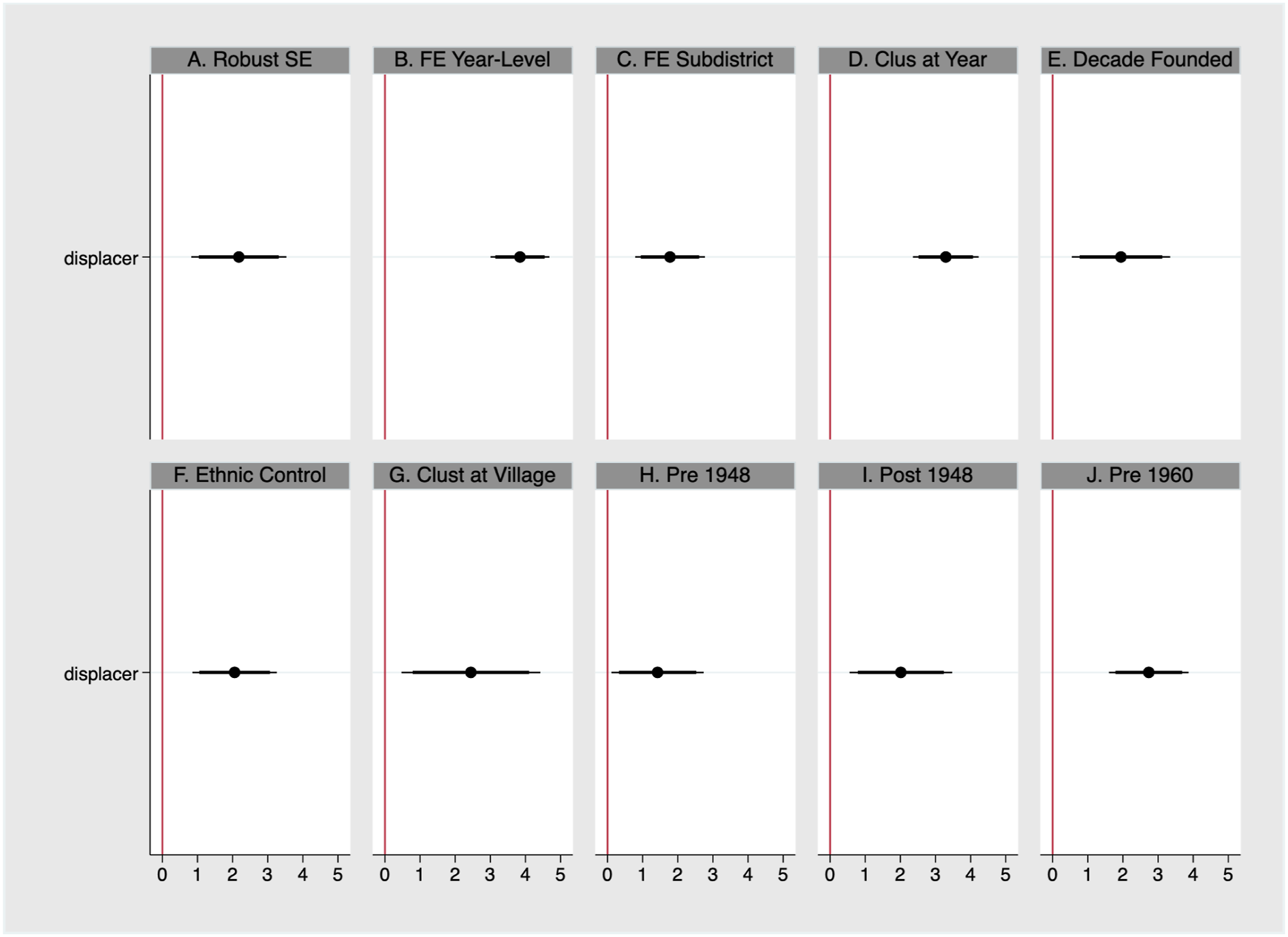
In addition, the year each locality was founded could impact the observed relationships. This is because different eras had different dynamics in the interaction between settlers and the Palestinian population when the villages were founded. As previously noted, some villages that were founded before the 1947–1949 war were expanded to include Palestinian land, while villages founded after the war were established on the land of already depopulated Palestinian villages. In this case, villages that were founded some years after the war likely would not connect the violent past to their village. Furthermore, their inhabitants would have had more freedom in their decision to relocate. We, therefore, tested our results on a subsample that includes only villages founded before the war (Model H), after the war (Model I), or before 1960 (Model J), which resulted in consistent and even stronger correlations. Using the CEM process and all other controls, we also tested the inclusion of a variable that captured the decade a village was founded, gathered from ICBS records, and the results were once again consistent (see Model E). The results were also consistent when looking only at elections before 1980, which was done to ease concerns that the results were generated by later movement between villages that introduced selection bias. The Likud party first gained power in 1977; in the years that followed, it led to the privatization of rural settlements and lifted governmental regulation over them. We only looked at these rural villages because they stayed homogeneous and were closed to new outsiders, but this policy change arguably made inter-village migration easier, as villages were more open to new residents who were not just members of founding families. This may lead to concern over selection bias. For that reason, we carried out the same analysis just before 1980 and reached identical results. All this means that the effect is not a result of patterns that arise from the waves of migration or inter-village movement at specific periods—it is consistent for subsamples that include various periods in which the village was founded and years in which the voting took place. The time of settlement did not matter for the relationship we observed.
Furthermore, the Jewish population in Israel is divided by ethnicity based on the country of origin of many of the migrants who have relocated to the state. These groups are usually distinguished as either Mizrahi Jews, who originate from Asia and Africa, or Ashkenazi Jews that arrived from Europe, the Americas, or the countries of the former Soviet Union. The former is, or at least were, substantially disadvantaged because the most powerful positions in society were held by Ashkenazi groups. Mizrahi Jews are also the electoral base of the right-wing and are more likely to vote for right-wing parties, in contrast to Ashkenazi Jews who traditionally are more likely to vote for the left wing. Therefore, bias in the allocation of these two groups to villages may create right-wing voting, and the ethnic origin of the residents of these villages may be a key omitted variable. Luckily, these villages tend to be homogeneous, so we could categorize the ethnicities of residents. We used data on the country of origin of the parents of respondents in the 1961, 1972, 1982, 1995, and 2008 censuses in Israel, which were provided by the ICBS. We calculated the mode response to a question on this origin in every village in order to identify the largest ethnic group in each location and then merged it with our data set. 30 We found that our results were consistent when the analysis was conducted only on Ashkenazi villages or only Mizrahi villages as well as when our binary variable determining whether the largest group is Mizrahi or Ashkenazi was included in the CEM (see Model F in Figure 10).
Additional Survey Evidence
We also attempted to overcome the ecological fallacy inherent in our observational group-level study by using evidence from an original survey. The results validated many of our proxies and showed that taking others’ property is related to not only right-wing voting but also directly to hatred of the Palestinians. However, the survey did not test the mechanisms or provide clear and strong support for any of them. We expand on the survey below.
In order to better understand and gain more confidence in our results, we carried out a short online follow-up survey among the residents of rural villages in Israel. A description of the method and questionnaire appears in the appendix. The survey was carried out on a large online sample provided by the Panel-Proyect Hamidgan company, which is the leading academic opt-in survey company in the country and has previously supported thousands of academic studies in Israel. The survey was approved by a university ethics board. It was sent to 17,324 Israeli Jews who registered on the survey platform; 1,293 started answering (9.8% response rate). Of that number, 812 were filtered out with a filter question, “Do you live in a kibbutz, moshav or other rural settlement inside the green line?” Thus, 352 completed the survey in full. 62 responses were later excluded for lying in the filter question. Respondents were asked if they lived in a rural village inside the green line; if they did, they were allowed to continue to fill out the questionnaire. All relevant sections of the questionnaire are translated in the online appendix, but there was also a set of demographic questions the respondents completed when registering on the online platform.
Since the Israeli population is heavily clustered in cities and urban areas, it proved difficult to reach a large enough sample, but we were able to collect 290 responses after filtering and testing whether the respondent’s village actually met the filtering criterion. This makes the individual-level sample underpowered for investigating the main effects because the small sample size makes it hard to use interactions or detect mechanisms. However, we can still test our key assumptions and the validity of our proxies and isolate the effect on intergroup relations.
First, we assumed that people living in a village with a violent history are at least somewhat aware of the past. Since denialism about the events of the war is so strong among the Israeli public and education about violence against Palestinians in the war so scarce, we expected there to be very low acceptance and knowledge of that history. We asked respondents the following question: There are villages in Israel that were established on buildings or land that were, before the formation of the state, part of a Palestinian Arab village. To the best of your knowledge, does your house in the village in which you live reside on land or buildings that were in the past part of a Palestinian Arab village?
Because of the aforementioned tendency to deny the existence of these events, we allowed survey respondents a few options to inadvertently acknowledge that their land does have a violent history—they could reply with a direct “Yes” but also with “Maybe, it’s possible” and “I don’t know,” as well as a clear “No.” Figure 11 plots the likelihood of every response by surveyed individuals who reside in villages that we determined are or are not on taken lands. Responses to whether a village was on land that was once a Palestinian Arab village.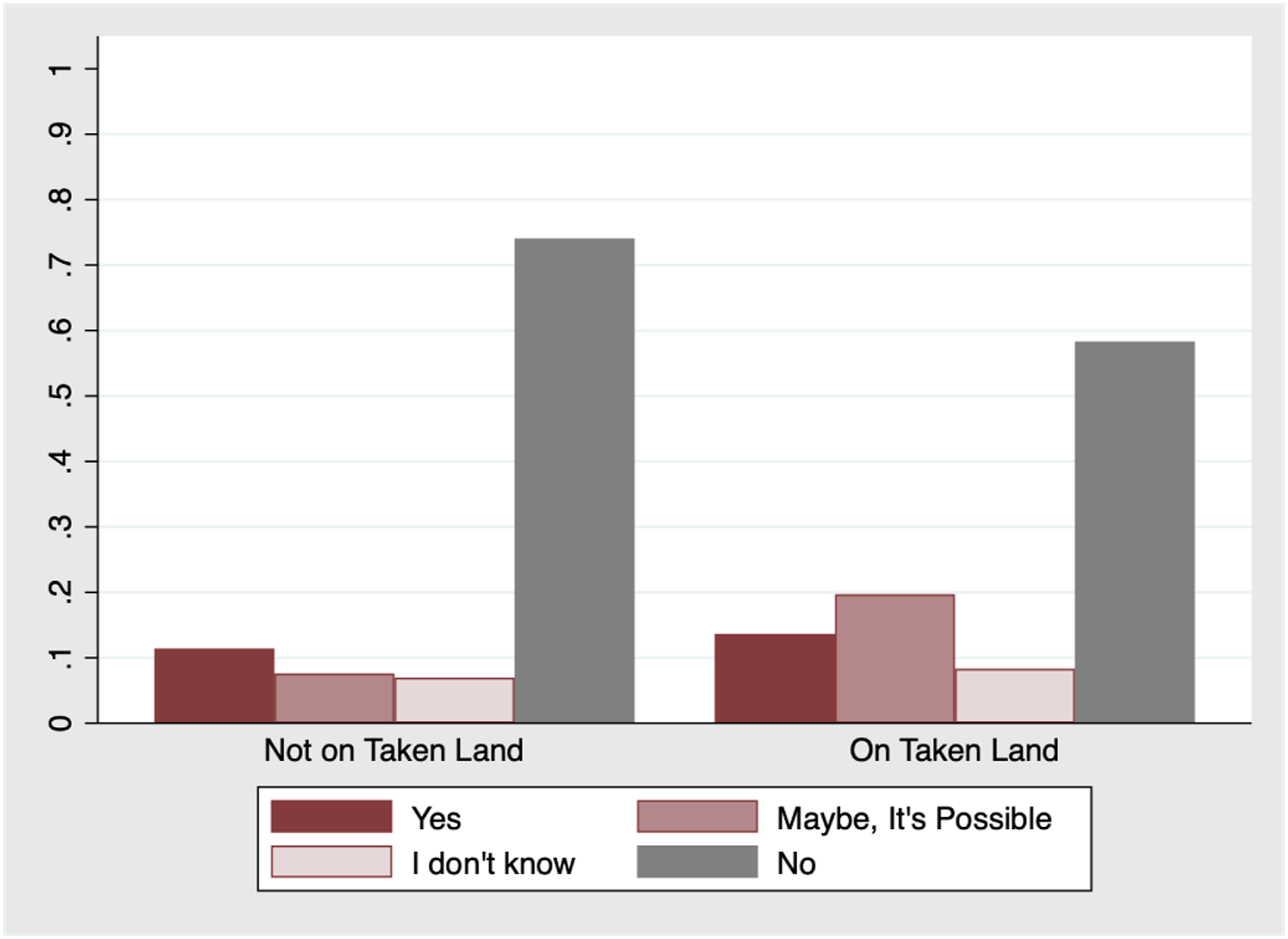
Figure 11 shows that respondents who do reside on taken lands are less likely to say that they do not live on such lands and more likely to accept this historical description. From this point on, we focus on the likelihood that respondents replied with a straight “No”—considering the other responses as not completely denying guilt, which is the norm in Israeli culture and political memory. We found that respondents that we identified as living in a village established on land that had once been a Palestinian village were indeed significantly less likely to deny that they live on land taken from Palestinians during the war (p < .01) in a logit model.
Second, we focus only on the group that does live on lands with a violent history. We used a set of proxies for awareness of the past and can empirically support this premise. The survey revealed that proximity to the remnants of a previous village, based on the measure used in the main analysis, is associated with a greater likelihood that the respondent would acknowledge living on land taken from Palestinians during the war (p < .1). Similarly, in villages where Palestinian houses still exist and are occupied by Jewish residents, such likelihood was significantly higher (p < .01). Looking at variation in rejection of guilt, as shown in Figure 12, we can see that the likelihood that a respondent would categorically deny living on such land decreases as the distance of the village from the ruins of a previous village decreases. With every kilometer closer to the remains of a replaced village, a clear trend emerges: respondents are less and less likely to deny that they live on taken land. Among villages right next to such remains, fewer than 40% of respondents denied that their village was on former Palestinian lands which is a staggeringly low share given that the public consensus ignores any such history. Similarly, as seen in Figure 13, rejection of guilt directly relates to the visibility of the remains of a displaced Palestinian village. Additionally, in villages in which there are residents who live in a seized Palestinian house, a majority of respondents would not deny that their village is located on displaced people’s land. Rejection of the land’s past and distance from remains. Rejection of the land’s past and visibility of remains.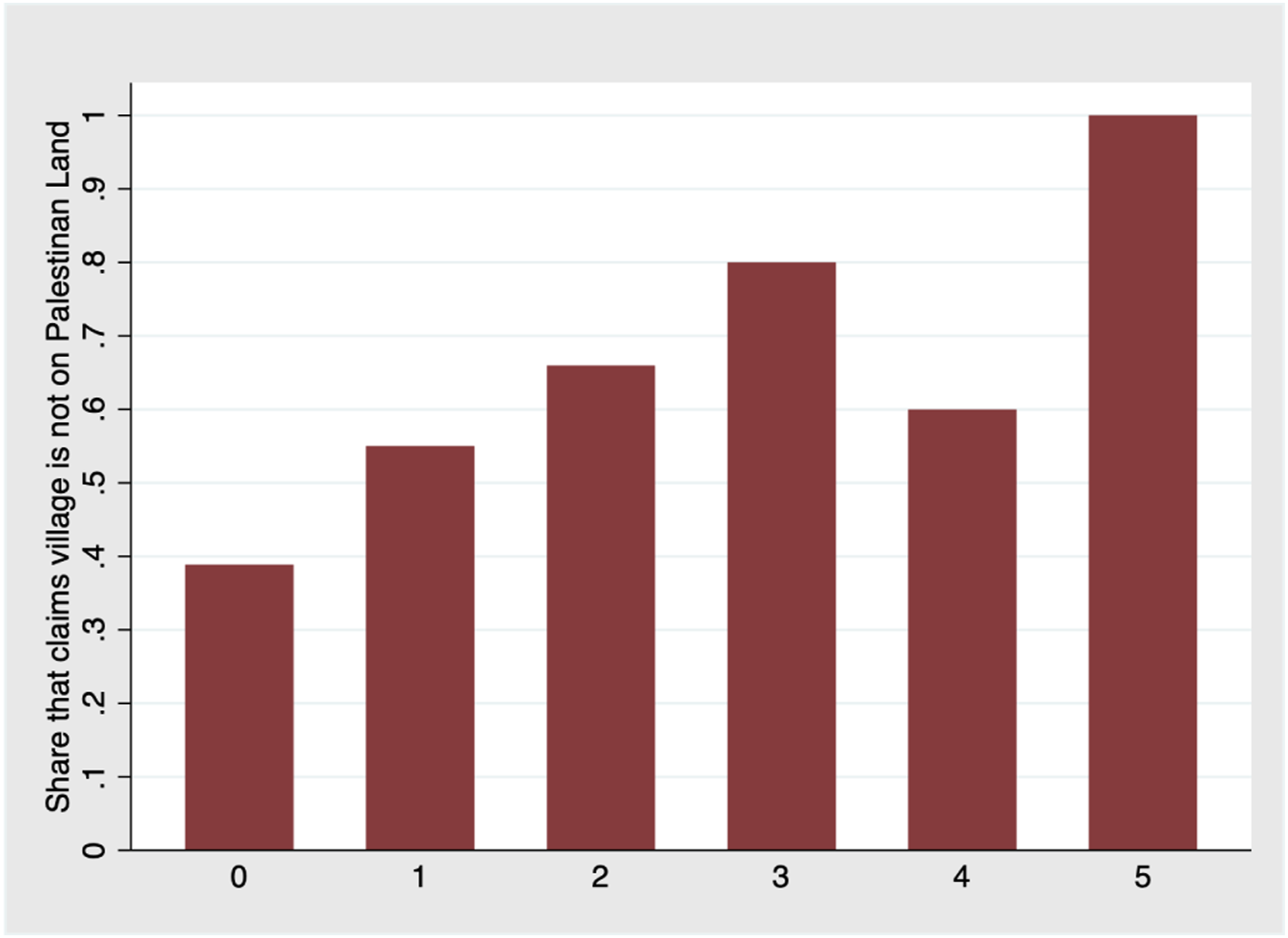
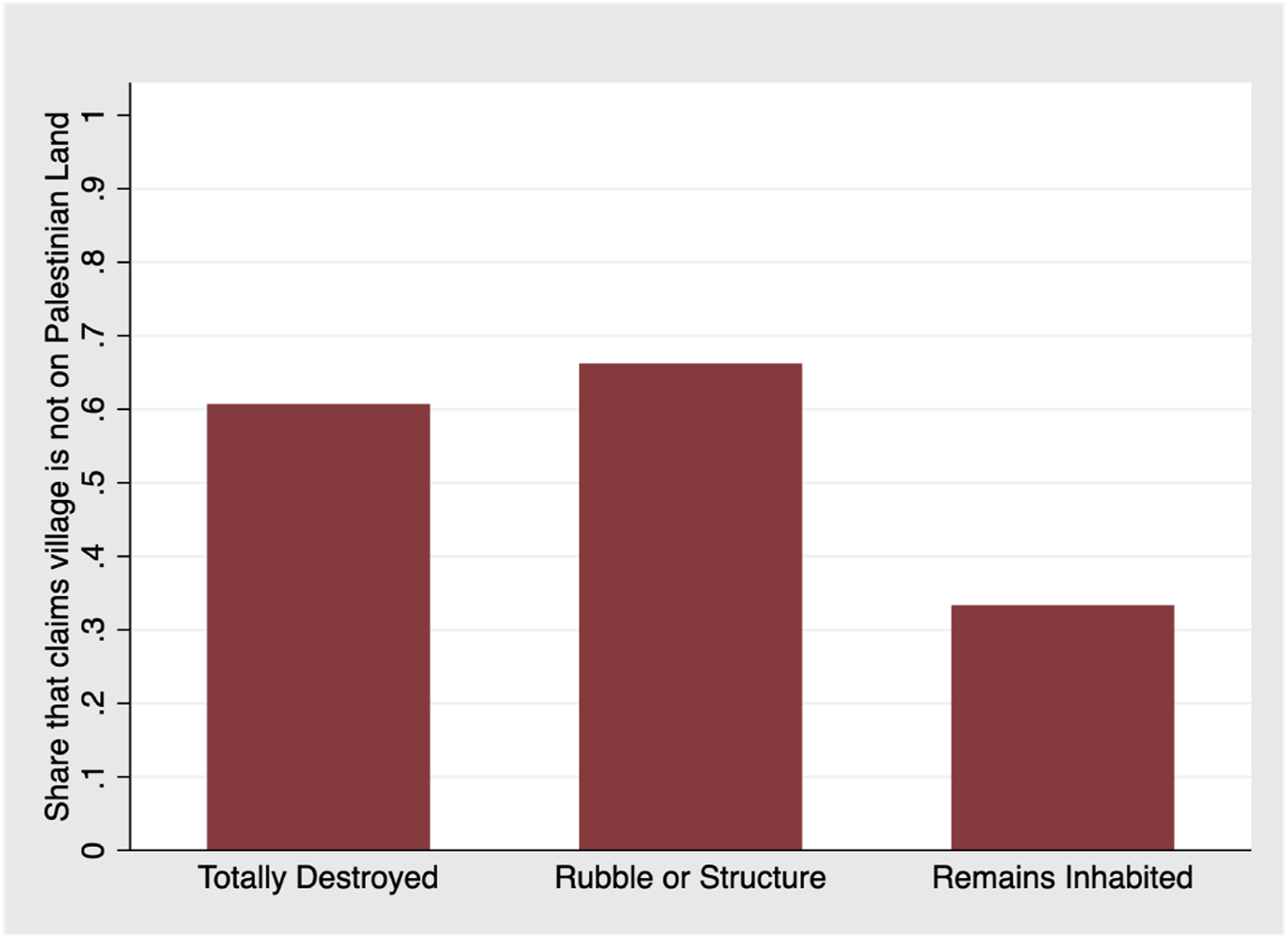
Third, we also assumed that right-wing voting will be the natural expression of prejudice, intolerance, and animosity toward the out-group; this assumption also requires empirical backing. We indeed found a strong and significant correlation between both self-reported right-wing ideology (on a scale of 1 to 10) or voting in the last two elections and the expression of negative feelings about Palestinians (p < .001), negative descriptions of Palestinians (p < .001), rejection of refugee return (p < .001), expression of claims that the Palestinians were not forcibly expelled (p < .001), and support for the repression of Palestinian attempts to memorialize the Exodus (p < .001). These questions appear in the online appendix. This shows that right-wing voting and ideology, as opposed to left-wing voting and ideology, are very closely related to intolerance toward Palestinians as a group, support for revisionist historical accounts that reject Israeli guilt for wartime events, and support for policies that reduce the threat of both refugee return and the threat of Palestinian insistence on the memory of wartime events.
Using a matching process similar to the one previously outlined but implementing it on the survey data, we once again found that village-level history of violent resettlement is positively correlated with self-reported right-wing ideology (p = .065). Testing, if this association depends on age, reveals that it does not; Figure ?? reveals that there is no statistically significant interaction between residing on taken land and age in their association with right-wing voting, suggesting that this legacy is time-invariant and stable across generations. Furthermore, we found that it is also directly and significantly correlated with the expression of negative emotions towards the Palestinians (p < .05). 31 This survey evidence does not completely eliminate the ecological fallacy embedded in our empirical strategy. In addition, it is based on a limited sample, since the studied population is difficult to reach, which limits the possibility of in-depth analysis. However, it does support our assertions that our group-level proxies well represent individual processes and beliefs and so complement the analysis to some extent.
Conclusion
We investigated the continuing influence of the Palestinian Exodus on the political behavior of Jewish Israelis. Using a large original data set, a demographic transfer process in which migrants were settled without regard to their preferences, varied spatial dispersions, and matching, we found that communities that took others’ property after the violence in the first Jewish-Arab war are more likely to vote for the hawkish, right-wing parties. We relied on intuition from cognitive dissonance theory and drew from it a series of novel theoretical expectations that were supported by results showing that the influence of the Exodus depends on economic structures, that violence alters the result of intergroup contact, and that physical remnants of the past can ignite the relationship between historical violence and right-wing voting.
This study advances our understanding of the roots of modern intolerance and far-right voting, which are both crucially important in contemporary politics. In recent years, there has been a surge in intolerant and nationalist attitudes that is frequently accompanied by contentious discourse about guilt and blame over the past in numerous countries. This study offers an explanation for why these attitudes and beliefs about the past go together, although more research is needed to disentangle the link between ideological movements and historical negationism.
Our study also contributes to the vast literature on the contact hypothesis and prejudice reduction by emphasizing the importance of collective history. There have been divergent findings on the impact of intergroup contact, and the field is increasingly focused on the conditions in which it succeeds in lowering intolerance. We offer one crucial variable that exists in many post-conflict settings. Further research could explore that variable with individual-level and experimental research designs.
By continuing to study the legacies of violence, this field of research can advance and open new avenues in areas such as the historical political economy and the persistence of historical institutions, thus contributing to our understanding of the deep roots of electoral decisions. Further exploration of the mechanisms is needed, perhaps including efforts to observe dissonance directly.
The results also have highly significant policy implications. The Israeli–Palestinian conflict is intractable while also being central to world politics. A significant barrier in negotiations, which has repeatedly caused their breakdown, is the question of reparations or a just solution for Palestinian refugees (Barak, 2005). We have offered some new insights into why this issue remains unresolvable—leaders who agree to accept guilt over the exodus will face an electoral nightmare due to the residents of hundreds of villages on taken lands who will oppose such a compromise, even if it does not affect them in any material way.
Since violent property transfers are a common aspect of territorial conflicts, they could be an important factor in their protraction. Existing theories all emphasize the value of territory to the public but then explain this value by either focusing on the material and strategic importance of land or on the symbolic importance of land to national narratives and identities (Hassner, 2007; Manekin et al., 2018; Shelef, 2016). Our results support a hypothesis that an additional micro-level source for why territorial issues are particularly contentious is psychological. The territorial acquisition is very frequently accompanied by violence and thus guilt. This dynamic can create an aversion to compromise that includes not only the rejection of territorial concessions but also strong resistance to symbolic acts such as official apologies, expressions of guilt, reparations, or other essential elements of transitional justice. This makes reaching reconciliation and a peaceful resolution of these conflicts particularly challenging. Our study explores this possibility and shows that ownership of disputed territory is associated with hawkishness even when the material threat is low, but further research is needed in order to directly observe guilt or dissonance and see how they affect conflict processes.
Supplemental Material
Supplemental Material - Bloody Pasts and Current Politics: The Political Legacies of Violent Resettlement
Supplemental Material for Bloody Pasts and Current Politics: The Political Legacies of Violent Resettlement Amiad Haran Diman, and Dan Miodownik in Comparative Political Studies.
Footnotes
Acknowledgments
We thank Omer Yair, Chagai Weiss, Michael Freedman, Enzo Nussio, Simon Hug, Kristian Gleditsch, Stathis Kalyvas, Ana Vilhelmina Verdnik, Jamie Shenk, Samuel Ritholtz, Broderick McDonald, Mikael Naghizadeh, as well as other participants of the 2021 Jan Tinbergen Peace Science Conference and the T.E. Lawrence Graduate Workshop on Conflict and Violence in All Souls College, the University of Oxford, for their helpful comments and suggestions and two anonymous reviewers and the editors for greatly helping in improving the paper.
Declaration of Conflicting Interests
The author(s) declared no potential conflicts of interest with respect to the research, authorship, and/or publication of this article.
Funding
The author(s) received no financial support for the research, authorship, and/or publication of this article.

Data Availability Statement
Replication materials and code can be found at Haran Diman & Miodownik, 2023b.
Supplemental Material
Supplemental material for this article is available online.
Notes
Author Biographies
References
Supplementary Material
Please find the following supplemental material available below.
For Open Access articles published under a Creative Commons License, all supplemental material carries the same license as the article it is associated with.
For non-Open Access articles published, all supplemental material carries a non-exclusive license, and permission requests for re-use of supplemental material or any part of supplemental material shall be sent directly to the copyright owner as specified in the copyright notice associated with the article.
