




Abstract
While United Nations (UN) peacekeeping operations are increasingly deployed during ongoing violent conflict, they are also increasingly staffed with civilian personnel tasked with peacebuilding at the local level. How does violent conflict affect civilian peacekeepers’ peacebuilding efforts locally? Shifting the research focus from military to civilian peacekeepers, we argue that the latter have various incentives and the capacity to concentrate their local-level peacebuilding efforts in violence-affected areas. We test our argument using novel, georeferenced data on peacebuilding by “Civil Affairs” personnel of the peacekeeping operation in the Central African Republic. Consistent with our expectation, violence positively correlates with civilian peacekeepers’ peacebuilding interventions both within and across localities. Furthermore, mediation analyses suggest that this correlation is not merely due to greater UN military deployments in violence-affected areas. Instrumental variable regression supports a causal interpretation: violence leads to more efforts by civilian peacekeepers. These findings inform expectations and assessments of peacekeeping effectiveness.
Keywords
Introduction
Civilian components of United Nations (UN) peacekeeping operations (PKOs) are increasingly tasked with local peacebuilding activities (UNDPKO, 2012; da Costa and Karlsrud, 2013; O’Bryan et al., 2017; Smidt, 2020a, 2020b; Duursma, 2021). At the same time, PKOs are increasingly deployed in countries with ongoing conflicts, where local outbreaks of violence are frequent (Karlsrud, 2015; Duursma, 2022a). This poses a dilemma for unarmed civilian peacekeepers: assisting peacebuilding where local people are in greatest danger has potentially the biggest impact, but it also increases the risk of civilian peacekeepers to come under attack (Mahoney, 2015: 115). How do civilian peacekeepers manage this dilemma? Do they step up local peacebuilding activities in response to violent incidents or do they, alternatively, scale back activities in violence-affected areas?
Existing peacekeeping literature has increasingly turned to examine local-level processes (Fjelde et al., 2019; Ruggeri et al., 2017). However, these studies tend to overlook the local activities of civilian personnel. Instead, researchers focus on uniformed personnel, that is, UN military and police. One robust finding is that within-country deployments of uniformed peacekeepers are driven by their organizational mission to reduce violence (Powers et al., 2015; Ruggeri et al., 2018). Thus, uniformed peacekeepers are sent to the most violence-affected areas. Yet, we cannot just extrapolate this finding to civilian peacekeepers. In contrast to UN police and military personnel, civilian peacekeepers do not possess military means to protect themselves. Moreover, their work relies on close interactions with domestic actors, which can make them especially vulnerable to attack (UNDPKO, 2012; da Costa and Karlsrud, 2013; O’Bryan et al., 2017). A distinct inquiry of how violence affects civilian peacekeepers’ work is required.
Investigating how violence impacts peacebuilding efforts by civilian peacekeepers is also crucial for understanding mission efficiency and managing expectations. This is because civilian peacekeepers are not only a distinct category of personnel but also an important one. There are over 16,000 civilian peacekeepers, that is, the second largest staff category in PKOs after military personnel and a “growing force” (United Nations, 2022). Thereof, the civilian peacekeepers in the Civil Affairs section that are responsible for local peacebuilding are part of one of the largest sections in PKOs. If such a significant proportion of peacekeeping personnel avoids rather than manages risk, the mission’s efficiency in achieving mandated peacebuilding goals likely suffers. Moreover, if civilian personnel shy back from operating in violence-affected areas, their credibility and legitimacy as peacebuilders may suffer (Fisher, 2017; Duffield 2010)—and, consequently, this can seriously hamper mission effectiveness (Whalan, 2013).
Furthermore, investigating how violence affects civilian peacekeepers’ peacebuilding efforts contributes to assessments of their effectiveness (Mvukiyehe & Samii, 2017; Mvukiyehe, 2017; Smidt, 2020a, 2020b; Julian, 2020, 105ff; Duursma, 2021; Duursma, 2022b). Several researchers find that the activity of civilian peacekeepers indeed negatively correlates with violence. However, they fail to explicitly consider where and when civilian peacekeepers conduct their peacebuilding activities in the first place (e.g., Smidt, 2020b; Duursma, 2021). If civilian peacekeepers eschewed peacebuilding activities in violent environments, as some studies suggest (Fisher, 2017; Duffield, 2010), we should not interpret the apparent negative correlation between civilian peacekeepers’ activity and violence (found in existing research) as evidence that civilian peacekeepers help reduce violence. Therefore, our results are important. They show that violence “attracts” peacebuilding—and, hence, imply that previous studies likely under-estimated rather than over-estimated civilian peacekeepers’ benefits for reducing violence.
We have a broad understanding of local peacebuilding to encompass all efforts aimed at strengthening subnational political and social conditions that enable peaceful relations among local actors. The Civil Affairs section is widely seen as the most important unit for local peacebuilding efforts (Bernstein & Kugel, 2017; Zahar & Mechoulan, 2017). Civil Affairs personnel are usually both male and female and both national and international staff, and they are typically present throughout the entire host country, including in remote locations. In addition to collecting information on local developments, Civil Affairs officers are tasked with different local-level peacebuilding activities: conflict management targeting armed groups, reconciliation within and between communal groups, and support to the extension of state authority (UNDPKO 2012, 22–23). Over time, the protection of civilians has also become a core task of the Civil Affairs section (United Nations, 2020; see, Online Appendix K for details on these peacebuilding activities). Civil Affairs officers are unarmed civilians and therefore do not fulfill any military tasks, though they do coordinate with the PKO’s military force component.
We argue that civilian peacekeepers (from the Civil Affairs section) generally increase their local peacebuilding activities in response to higher levels of armed violence because they possess organizational incentives and capacity to do so. Civilian peacekeepers face pressure from their organization—that is, the UN Security Council, the UN Secretariat in New York and the leadership at field-level mission headquarters—to focus their efforts on violence-affected areas in greatest need for assistance because this prioritization aligns with the UN mission and, specifically, mandate provisions for local conflict resolution. Civilian peacekeepers also have intrinsic incentives to go to violence-affected areas, including an ambition of being seen as “locally relevant.” Finally, civilian peacekeepers possess the capacity to react to violent incidents due to a network of local field offices and locally knowledgeable staff.
We also propose plausible alternative explanations for a positive relationship between violence and peacebuilding efforts: First, it could be that civilian peacekeepers operate in the most violence-affected areas because UN military are present in these areas and may provide them with logistics and protection. Second, it could also be that civilian peacekeepers operate in the most violence-affected areas because armed actors respond to their (anticipated) peacebuilding efforts with violence. Since we cannot directly test our preferred causal mechanism (that peacekeepers deliberately become active in violent areas due to their motivation and capacity), testing our argument against these two alternative mechanisms is important. If civilian peacekeepers did not deliberately select into the most violent areas (but only choose the most convenient places or even attract violence), then this would reveal a serious limitation of civilian peacebuilding in war-torn countries.
We test the effect of violence on civilian peacekeepers’ local peacebuilding activities in the Central African Republic (CAR) from January 2016 to December 2018. To do so, we draw on original georeferenced data on peacebuilding activities by Civil Affairs staff of the UN peacekeeping operation in the country. The CAR in this period is a suitable case, because it hosts the currently youngest PKO, known by its acronym MINUSCA, which operates in the context of ongoing armed conflict and is mandated with local peacebuilding tasks. In these regards, the CAR is representative of operating environments of contemporary PKOs in Africa. The period of analysis starts at the outset of full deployment of MINUSCA. This period that is (tragically) similar to later periods in the CAR in terms of both violence and peacebuilding, which supports the generalizability of our findings within CAR.
We examine the correlation between violence and local peacebuilding across third-tier administrative units and months. Our models estimate variation in local peacebuilding efforts both across units (pooled models) and within units over time (fixed effects models), controlling for a variety of potential confounders (i.e., state capacity, poverty, and political exclusion). Furthermore, we test whether the effect of violence on local peacebuilding is due to military deployment, that is, our first alternative explanation, using causal mediation analysis together with sensitivity tests. Finally, we evaluate the causal effect of violence on local peacebuilding with an instrumental variable approach, employing the three-way interaction between prices of rough diamonds, prevalence of diamond mining, and distance to international borders as relevant and exogenous source of variation in violence.
Consistent with our argument, we find a significant positive relationship between violence and civilian peacekeepers’ peacebuilding efforts both across and within subnational units. The association between violence and peacebuilding is mostly direct and only partly mediated by UN military deployment. Thus, contrary to our first alternative explanation and consistent with our main argument, civilian peacekeepers’ incentives and capacity seem to matter and the concentration of their peacebuilding efforts in violence-prone areas is not only explained by availability of UN military support. The instrumental variable analysis supports a causal interpretation of the correlation. Thus, contrary to the second alternative explanation and consistent with our argument, peacebuilding does not “attract” violence, but violence leads to more peacebuilding efforts. Our conclusion discusses the implications of these findings.
Civilian Peacekeepers and Selection Processes in Peacekeeping Efforts
The latest generation of peacekeeping missions are frequently deployed amidst ongoing armed conflict (Karlsrud, 2015; Hultman et al., 2019; Duursma 2022a). This raises the question whether peacekeeping staff go where violence takes place or stay in stable areas within their war-torn host country. Existing literature can answer this question for military peacekeeping personnel. We lack assessments of where and when civilian peacekeepers engage in peacebuilding activities on the ground.
Moving from country- to local-level analyses, recent quantitative studies explore subnational deployments of military peacekeepers, showing that both the level of insecurity and the availability of infrastructure (e.g., roads) drive their local presence (Powers et al., 2015; Ruggeri et al., 2018). In the most comprehensive study on subnational deployments, using data from eight African countries in the period 1989–2006, Ruggeri et al. (2018) show that peacekeepers are likely to be deployed in areas where armed violence has taken place. However, there seems to be a notable delay in deployment: only violence two years previously makes a location more susceptible to peacekeeping presence. Drawing on evidence from the Democratic Republic of the Congo (DRC), Ivory Coast, and Sierra Leone, an earlier study by Powers et al. (2015) came to a similar conclusion with one important qualification, namely, that responsiveness to armed violence only sets in after a PKO has already been deployed in the country for a couple of years.
The overwhelming focus on where military peacekeepers are deployed in the quantitative literature stands in contrast with several qualitative and case-oriented studies that suggest that civilian peacekeepers play an increasingly crucial role in peacekeeping operations (Campbell, 2018; Krause, 2019; Mvukiyehe, 2017; Nagelhus Schia & Karlsrud, 2013). Campbell (2018) argues that the UN can succeed in local-level peacebuilding if civilian staff within peacekeeping operations work with and empower local stakeholders. Krause (2019) shows that despite their often-used ad hoc approach, civilian peacekeepers effectively brokered peace deals in conflicts between local communities in South Sudan. Moreover, a handful of quantitative studies examines the impact of civilian staff in PKOs, focusing on particular aspects of local peacebuilding, such as the effect of social-cohesion workshops on communal violence (Smidt, 2020b), the impact of local mediation efforts on the time until armed clashes reoccur (Duursma, 2021) and the conclusion of local ceasefires (Duursma, 2022b), and the consequences of civic education campaigns for pro-peace attitudes and behaviors (Mvukiyehe, 2017; Mvukiyehe & Samii, 2017; Smidt, 2020a).
These works suggest that local peacebuilding makes a relevant contribution to mission success, for example, by reducing violence and violence-conducive attitudes. However, we cannot fully understand these contributions of local peacebuilding without knowing where and when civilian peacekeepers can and do engage in local peacebuilding in the first place. As mentioned in the introduction, it could be that previous correlational analyses over-estimated civilian peacekeepers’ contribution to peace because civilian components pre-dominantly carry out their work in stable, non-violent places. Since civilian and uniformed personnel differ in many respects (e.g., in their mandates, activities and means of self-protection), we also cannot just transfer extant findings for the military to the civilian domain and assume that civilian peacekeepers are equally pro-active when faced with violence. Our manuscript therefore completes the understanding of international peacekeeping by investigating, both theoretically and empirically, where and when civilian peacekeepers engage in local-level peacebuilding activities.
How Violence Affects Civilian Peacekeepers’ Efforts in Building Peace Locally
Akin to how military peacekeepers “go where the job needs to be done” (Ruggeri et al., 2018: 1011), we argue that violence leads to more local peacebuilding efforts. To explain this relationship, we propose that civilian peacekeepers have mandate-related, bureaucratic and personal incentives to fulfill the UN peacebuilding mission locally and the relevant capacity to do so. Alternatively, however, a positive relationship between violence and local peacebuilding efforts may also originate from (i) more logistical support and protection by UN military in more violence-affected areas and (ii) armed actors’ violent responses to (anticipated) local peacebuilding events. In what follows, we detail these complex relationships between violence and local peacebuilding.
A positive Association Between Violence and Peacebuilding: Civilian Peacekeepers’ Incentives and Capacity
The UN Security Council tasks all contemporary PKOs in Africa with providing “support to the resolution of local and intercommunal conflicts” (United Nations Security Council, 2021a, 10, for Mali; see also United Nations Security Council 2021b, six for South Sudan; United Nations Security Council, 2021c, 12 for DR Congo). 1 Thus, since civilian peacekeepers are responsible for this task, mandates direct civilian peacekeepers to ward concentrating their efforts in places where local conflict take place and turn violent hotspots. The UN Security Council has also established mechanisms to enforce PKOs’ compliance with their mandate. For instance, it requires regular reports on whether the PKO invests resources according to mandate provisions. Civil Affairs personnel in field offices must send daily reports to the PKO headquarters, which has the duty to collect these reports and to send aggregated summaries in form of Secretary-General progress reports to the UN Security Council. While delegation problems can occur (Blair, Di Salvatore, 2021, 667–8), reporting requirements likely incentivize civilian peacekeepers to align efforts with mandated tasks and focus peacebuilding on violence-affected areas.
Moreover, from a bureaucratic politics perspective, the sections responsible for local peacebuilding within the PKO and the UN Secretariat—most notably the Civil Affairs section—should focus their efforts on violence-affected areas to demonstrate their relevance in implementing the organization’s mandate. Not demonstrating their contribution to mandate implementation might lead to a curtailing of funding and personnel. Threats of resource cuts have become especially credibly, since the adoption of results-based budgeting in the late 1990s, where the UN Advisory Committee on Administrative and Budgetary Questions requires PKOs to report on whether they meet explicit targets for certain activities and how the delivery of those activities supports the implementation of mandated tasks (Ortiz et al., 2004). Therefore, the Civil Affairs section in the UN Secretariat and the Head of Civil Affairs at the mission headquarters—who is responsible for ensuring mandate implementation on the ground and deciding on where peacekeepers from the Civil Affairs section can deploy and engage—have strong incentives to send their staff to violence-infected areas in need of peacebuilding.
Ultimately, however, it is the civilian peacekeepers in field offices, who decide on where and when peacebuilding activities are carried out (e.g., where and when to meet local community leaders to discuss conflict prevention, to initiate or support local mediation efforts to find peaceful agreements for conflicts over land and other local resources, to negotiate with armed groups over civilian protection issues, or to organize workshop with youth and civil society actors to strengthen conflict resolution expertise, to just name a few activities). There is wide recognition within the UN that the work of civilian peacekeepers at local levels, especially those in the Civil Affairs section, requires flexibility and this led to a shift toward decentralizing authority from the Mission headquarters to the field offices (da Costa and Karlsrud, 2013: 304; Schia & Karlsrud, 2013). Of course, staff in the field are still expected to align their activities with mandate priorities. Supervisions from headquarters and incentives related to career progression and promotion may ensure that they do so. Yet, as we discuss below, intrinsic motivations stemming from their self-image and reinforced by local actors’ demands also likely make sure that civilian peacekeepers at the field offices manage rather than avoid risks and likely step-up activities in the wake of violence.
For starters, being locally relevant is part of the professional image that civilian peacekeepers hold of themselves and being seen as locally relevant can augment their status among colleagues (Nagelhus Schia & Karlsrud, 2013, 239). Thus, civilian peacekeepers are likely motivated to assist with peacebuilding where violence indicates a local need. Case evidence confirms that civilian personnel in PKOs respond to local peacebuilding needs (Boege & Rinck, 2019; Campbell, 2018). For instance, a Civil Affairs officer from the town Bossangoa in the Central African Republic explains his responsiveness to violence as follows: “If I have a workshop, I could potentially cancel this if a farmer-herder conflict takes place. I would rather go there [to the conflict-affected locality] than attend a workshop” (Interview with UN Civil Affairs Officer in Bossangoa on 29 January 2020).
Second, and relatedly, civilian peacekeepers’ personal commitment to assist the most violence-affected areas might be reinforced by domestic actors’ request for international support in these areas. Analyzing local peacebuilding activities by the PKO in the Central African Republic, Zahar and Mechoulan (2017, 21–22) find that “the majority of mediation initiatives surveyed have had extremely local impulses.” Likewise, Nagelhus Schia and Karlsrud (2013, 242) describe how UN peacebuilding in Haiti, Liberia, and South Sudan followed local initiatives. Violence may prompt domestic actors to reach out to civilian peacekeepers. For example, in February 2017, Christian and Muslim militia members engaged in a series of attacks and counterattacks in the town of Kouki in the Central African Republic. At some point, however, militia leaders became worried that events would escalate further and prevent their access to a local market. Therefore, they called on civilian peacekeepers to provide mediation support (Zahar and Melouchan 2017, 17–18; MINUSCA Daily sit-rep, 26 May 2017; telephone interview with a UN staff member, 16 December 2020).
Beyond these motives for responding to violence with peacebuilding efforts, civilian peacekeepers also have the capacity to do so. The Civil Affairs section is tasked with information gathering (Duursma, 2021), which allows the civilian peacekeepers to draw on up-to-date information to identify local violent conflicts and react promptly. Civil Affairs staff have a comparative advantage in information gathering over other units in the PKO because they engage in community-based outreach activities throughout the host country. Indeed, Civil Affairs officers often make it clear that this widespread reach allows them to “feel the temperature on the ground” and act as “the eyes and ears of the mission at the subnational level” (Schia & Karlsrud, 2013: 239). Moreover, a substantial part of the personnel of the Civil Affairs section typically consists of Community Liaison Assistants (CLAs), who are national staff to help establish direct links between local communities, civil society, and local authorities (Schia & Karlsrud, 2013: 236; Duursma, 2021). These CLAs are typically well aware of ongoing armed violence in their areas of operation. Zahar and Mechoulan note that CLAs in the CAR have helped local peacebuilding efforts because they have “furthered the link between the mission and communities and enabled the latter to have direct access to and a presence in an increasing number of remote communities” (Zahar & Mechoulan, 2017: 24). CLAs are also tasked to manage extensive networks of local informants, known as Community Alert Network (CAN), which help warn peacekeepers of ongoing violence (Duursma, 2021).
Thus, Civil Affairs staff might also be able to identify locations at risk of violence. When this is the case, local peacebuilding efforts might be in anticipation of violence rather than in response to it. The idea of preventive peacebuilding where the threat of violence looms large is not inconsistent with our argument, because it presupposes that civilian staff engages in violence-prone areas. Yet, our reading of Civil Affairs reports suggests that preventive peacebuilding tends to be the exception. Instead, the capacity of Civil Affairs staff to anticipate where violence will likely erupt helps them to respond more quickly, and possibly more adequately, when violence actually breaks out (Zahar & Mechoulan, 2017, 24; da Costa and Karlsrud 2013). Empirically, we note that there would only be a positive correlation between violence and preventive peacebuilding if prevention fails and violence occurs. Given extant work on civilian peacekeepers’ violence-reducing impact, we think this is unlikely (e.g., Smidt, 2020b; Duursma, 2021). Yet, we test whether violence in previous periods also correlates with contemporaneous peacebuilding. If there is a correlation between past violence and current peacebuilding efforts, civilian peacekeepers do not just fail to prevent conflict escalation but also react to it.
We also recognize that awareness of ongoing violence and emerging threats does not automatically lead to more local peacebuilding. Information does not always translate to adequate responses in armed conflicts (George & Holl, 1997). Within the context of the protection of civilians, an internal audit by the UN found that even with information available, a response is sometimes lacking. However, this audit also showed that available information on ongoing violence or impending attacks on civilians is found to be a key determinant of a peacekeeping response (Office of Internal Oversight Services, 30 July 2018: 29). This is in line with several studies in the peacekeeping literature that show that a capacity to identify violence makes it at least more likely that peacekeepers will respond to it (Dorn, 2009; Duursma, 2017). Contemporary PKOs are under scrutiny to not only collect information, but also to translate this information into responses (Smith, 2021).
In short, considering their organizational and personal incentives, civilian peacekeepers should generally respond to greater demand for peacebuilding support in the most violence-affected areas. Civilian peacekeepers also have the capacity to do so because they typically collect high-quality and up-to-date information that allows them to identify areas where conflict recently escalated. Taken together, we thus expect to observe:
There is a positive correlation between the amount of violence and the number of local peacebuilding activities. Beyond selecting into those subnational areas that recently experienced violence, our argument implies that civilian peacekeepers within a specific locality react to the outbreak of violence in that locality within a short timeframe. Specifically, we expect that the initial response occurs within a few days, for example, by embarking on a fact-finding mission or meeting with conflict parties to initiate mediation. Civilian peacekeepers likely require more time—one or 2 weeks and sometimes longer—to prepare substantive follow-up peacebuilding activities because they must contact relevant local stakeholders, prepare the agenda, get security clearance from the UN Department of Safety and Security, and liaise with other PKO elements to arrange the logistics and provision of security. Therefore, we test the correlation between local violence and peacebuilding efforts using measures of violence in both contemporaneous periods as well as 1 month previously. As an additional test, we also estimate how many weeks it generally takes for civilian peacekeepers to respond to violent incidents.
A Negative Association Between Violence and Peacebuilding?
Our argument emphasizes peacekeepers’ incentives to explain why violence-affected places receive most peacebuilding support. However, this supply side-oriented perspective must grapple with the possibility that an analysis of peacekeepers’ incentives might also predict the opposite, that is, that violence prevents civilian peacekeepers from engaging in local peacebuilding efforts.
First, the remnants of once prevalent discursive frames at UN headquarters and field level may prevent local responsiveness. These frames may include, as Autesserre (2009) highlighted, the belief that local violent conflict is “innate and therefore acceptable” and international intervention should be exclusively concerned with the national and international realms. However, the introduction of local conflict resolution as priority task in PKO mandates and the creation of the UN Civil Affairs section in 2008 suggest, that these discursive frames have become a minority view in peacekeeping missions.
Second, as local violence occurs, civilian peacekeepers may fear for their own security. Thus, they may prefer staying in their compounds over venturing out into presumably dangerous and unpredictable environments (Duffield 2009; Fisher, 2017). PKO leadership may also encourage “bunkerization” because they fear casualties that could provoke negative publicity and make it harder to attract qualified personnel. Moreover, the UN Department of Safety and Security (UNDSS) often plays a restrictive role in relation to Civil Affairs ability to do their job. Restrictive rules, in turn, may explain why only one civilian peacekeeper was killed between 2016 and 2018, namely, a national staff member in 2017. By way of comparison, 113 military staff members were killed in peacekeeping missions within this period.
However, civilian peacekeepers have found ways to deal with the contradiction between needs-oriented peacebuilding and restrictive security rules through breaking or “bending” these rules (Campbell, 2018: 4). Instead of always erring on the side of maximum safety, civilian peacekeepers engage in local peacebuilding based on what they believe strikes a balance between ensuring their security on the one hand and engaging in needs-based local peacebuilding on the other hand (da Costa and Karlsrud, 2013). Thus, empirical testing of whether civilian peacekeepers engage in local peacebuilding in response to armed violence is warranted.
Alternative Explanations for a Positive Association Between Violence and Peacebuilding
Even if civilian peacekeepers do generally engage in the localities more affected by violence, as our hypothesis suggests, peacekeepers’ incentives and capacity may not be responsible for this pattern. We discuss two alternative explanations.
First, a positive relationship between the occurrence of violence and local peacebuilding efforts could be explained by protection and logistics provided by the UN military force that are mostly deployed in violence-affected areas. A military presence could help protect civilian peacekeepers and, thereby, enable their work. Indeed, protection of UN infrastructure and staff is a primary task in the mandates of the UN military. Furthermore, civilian peacekeepers may benefit from transport and logistical support, when they organize peacebuilding workshops and mediation events in remote localities (Fjelde & Smidt, 2022, 6, for a similar argument on how uniformed peacekeepers enable election assistance by civilian personnel).
The presence of UN military potentially not just strengthens the positive relationship between violence and civilian peacekeepers’ local peacebuilding efforts. It may be that civilian peacekeepers just chose localities with UN military deployment, because the availability of protection and logistics makes this choice convenient from an organizational perspective. Previous studies show that UN military deployments target those areas where violence occurs (e.g., Powers et al., 2015; Ruggeri et al., 2018). Thus, rather than civilian peacekeepers’ incentives and capacity, UN military deployment patterns may explain why civilian peacekeepers become more active in local peacebuilding in areas with higher levels of violence. If UN military deployment is an alternative explanation, then we should observe the following.
There is no direct positive correlation between violence and local peacebuilding. Violence only correlates with local peacebuilding activities through the deployment of UN military. Second, a positive relationship between violence and civilian peacekeepers’ local peacebuilding efforts could be driven by reverse causation. Several previous studies suggest that armed groups tactically adapt to the deployment of military peacekeepers (Di Salvatore et al., 2022; Duursma, 2019). Thus, rebel groups and militias may also anticipate civilian peacekeepers’ engagement and scale-up armed violence to deter civilian participation in UN-sponsored events. Moreover, armed actors may sponsor violence to retaliate against local populations that turn up at peacebuilding events. Violent deterrence or retaliation for cooperation with the UN are likely in the polarized environments of ongoing conflicts, where the UN is sometimes seen as a party to the conflict or at least as partial (Karlsrud, 2015). Finally, armed groups may also see the arrival of civilian peacekeepers as signal of impending negotiations. Therefore, they may scale up violence, including coercion against civilians, as “a last-minute strategy” to establish territorial control and strengthen their bargaining position (cf. Hultman 2019). Overall, these arguments suggest that the positive correlation between violence and local peacebuilding might not result from a situation where violence “attracts” greater efforts by civilian peacekeepers. Instead, local peacebuilding might “attract” violence by armed actors. This leads us to our final hypothesis.
While there is a positive correlation between the amount of violence and the number of local peacebuilding activities, violence does not cause local peacebuilding.
Research Design
We examine our hypotheses in the Central African Republic from January 2016 to October 2018. We use communities, the third-tier administrative unit, because Civil Affairs officers typically determine a peacebuilding priority area at this level. As a peacekeeping official of MINUSCA highlights, each community in CAR is “a different world” and “that’s why it is so important we work locally” (Interview with a Political Affairs officer in Bossangoa, 28 January 2020). Replication materials and code can be found at Smidt and Duursma (2023). 2
Case Selection
The Central African Republic has experienced several civil war episodes since its independence from France in 1960. The latest one began in December 2012, when a rebel group named Séléka emerged in the northern part of the country. In March 2013, Séléka rebels took control of the capital Bangui. The rebels subsequently deposed President François Bozizé and installed their leader Michel Djotodia in power (Lombard, 2016: 9). After taking power, Séléka rebels started to pillage and kill Christian civilians in the capital Bangui and other places in the country. In response, Christian “self-defence” militia groups called Anti-Balaka undertook revenge killings against the Muslim population. In February 2014, MINUSCA was deployed in response to escalating violence.
The Central African Republic in the period 2016–2018 is a suitable case for analyzing our argument. First, MINUSCA has a mandate to conduct local peacebuilding activities to foster reconciliation, support conflict management, build local state authority, and protect civilians (United Nations, 2021). In addition, January 2016 seems to be a suitable starting point because the PKO was fully operational with field offices in many locations by that time. Limited availability of high-quality data on local peacebuilding explains why our analyses end in October 2018. Yet, based on interviews with MINUSCA staff and reading of more aggregated Secretary-General reports, we are confident that patterns of peacebuilding have remained the same after October 2018. Moreover, based on data from ACLED, levels violence are tragically similar for later years. In late 2020, a new rebel coalition emerged in the context of presidential and legislative elections scheduled for late December 2020, but this rebel collation was only short-lived. Finally, many violence-conducive structural factors are highly persistent, like the dire socio-economic situation, land-related grievance, incomplete disarmament of militias, and slow security sector reform progress, to name just a few. Therefore, we are confident that the results that we find for 2016–2018 also apply in later periods.
Second, the country presents the typical operating environment of newly deployed PKOs: Like in many other contemporary cases of peacekeeping, fighting is ongoing—especially between non-state armed actors—and one-sided violence against civilians is routinized. In addition, people in the Central African Republic suffer from communal violence, for example, between farmer and herder groups in competition over land ownership and access (Lombard, 2016; Zahar and Mechoulan 2017). Thus, our findings—at least, in terms of the direction of the estimated effects—likely have external validity in current PKO host countries, like Mali, South Sudan, or the Democratic Republic of the Congo.
Data on Local Peacebuilding Activities
Our data set on local peacebuilding activities draws on daily situation reports from January 2016 to October 2018, which were provided by the Civil Affairs unit at the UN headquarters in New York in close coordination with the Civil Affairs section of MINUSCA. As situation reports also contain sensitive information on ongoing security situations and the identities of local partners, Civil Affairs could not share more recent data with us. In 2016, the year in which our data set starts, there were a total of 86 staff members (67 male, 18 female) working within the Civil Affairs section of MINUSCA at 36 locations. The most staff members (63) were national staff from the CAR, thereof the majority (50) working as CLA. Of the 23 international staff members, 15 were from an African country and most of these were from neighboring countries.
The reports compiled by the Civil Affairs staff of MINUSCA provide detailed and comprehensive information on all local peacebuilding activities involving Civil Affairs officers, including the date of activities and their physical location. The data set also includes a wealth of information on the types of peacebuilding activities and the actors involved in them (see codebook in Online Appendix L). Although international NGOs and other sections of MINUSCA sometimes also organize local peacebuilding events (e.g., the Political Affairs section), we capture a very large proportion of all local peacebuilding engagement in the Central African Republic. Field work-based evidence shows that the Civil Affairs division in the CAR “has the primary responsibility for conducting local peacebuilding interventions and social-cohesion activities” (Zahar and Mechoulan 2017, 27).
The source information of our data set is not without limitations. First, passive language sometimes obscures whether Civil Affairs was involved in convening an event. In ambiguous cases, we decided to code involvement. Inter-coder reliability checks on a random sample of cases in our data set show that two or more coders agree on coding a variable in the same way in over 90% of these cases. Second, Civil Affairs officers might portray themselves and their activities in a favorable light and under-report unsuccessful activities. Yet, our reading of the situation reports does not reveal evidence for this sort of bias. A Civil Affairs officer based in Bossangoa further reflects in this regard: “Sometimes I feel like there is only bad news that we are reporting. For example, today a farmer-herder conflict took place in Benzabé, but I have to report it. I doubt it that we do not report on some type of incidents. If we report, it either is on a violent incident or on a positive interaction – and we report this as such” (Interview in Bossangoa on 29 January 2020). Moreover, our data set and the information we use for this analysis only includes the “hard facts,” that is, the type, location, and date of an activity. This information should be less prone to individuals' judgement and, thus, potential biases than Civil Affairs officers’ assessments of success or failure of activities.
Dependent Variable
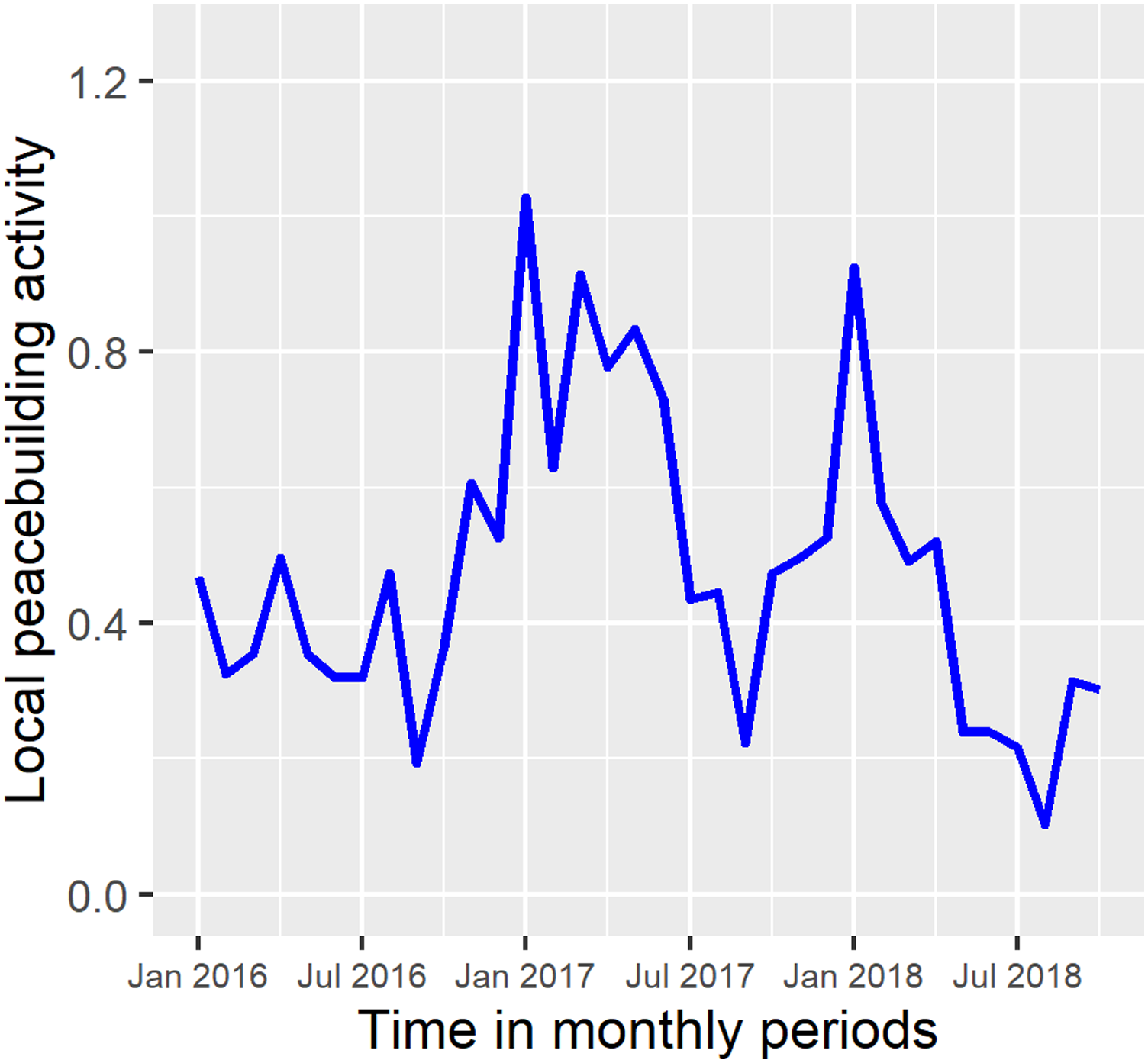
Our dependent variable records the number of local peacebuilding activities in a community and month. About 88% of all activities last less than 1 day, another 10% last between one and three days and less than one percent of the activities between four to 14 days (e.g., longer fact-finding missions and information/sensitization campaigns). We record the months of the activity onset. The maximum number of peacebuilding activities conducted in a single month and community is 30. The mean number of activities per observations is .48 with a SD of 1.61. Thus, our outcome of interest is over-dispersed, and we subsequently employ a negative binomial model. Figures 1 and 2 show the geographical distribution of peacebuilding activities and temporal distribution of the monthly mean numbers of peacebuilding activities, respectively. Geographical spread of peacebuilding activities in the CAR, 2016–2018. Monthly means of peacebuilding activities in the CAR, 2016–2018.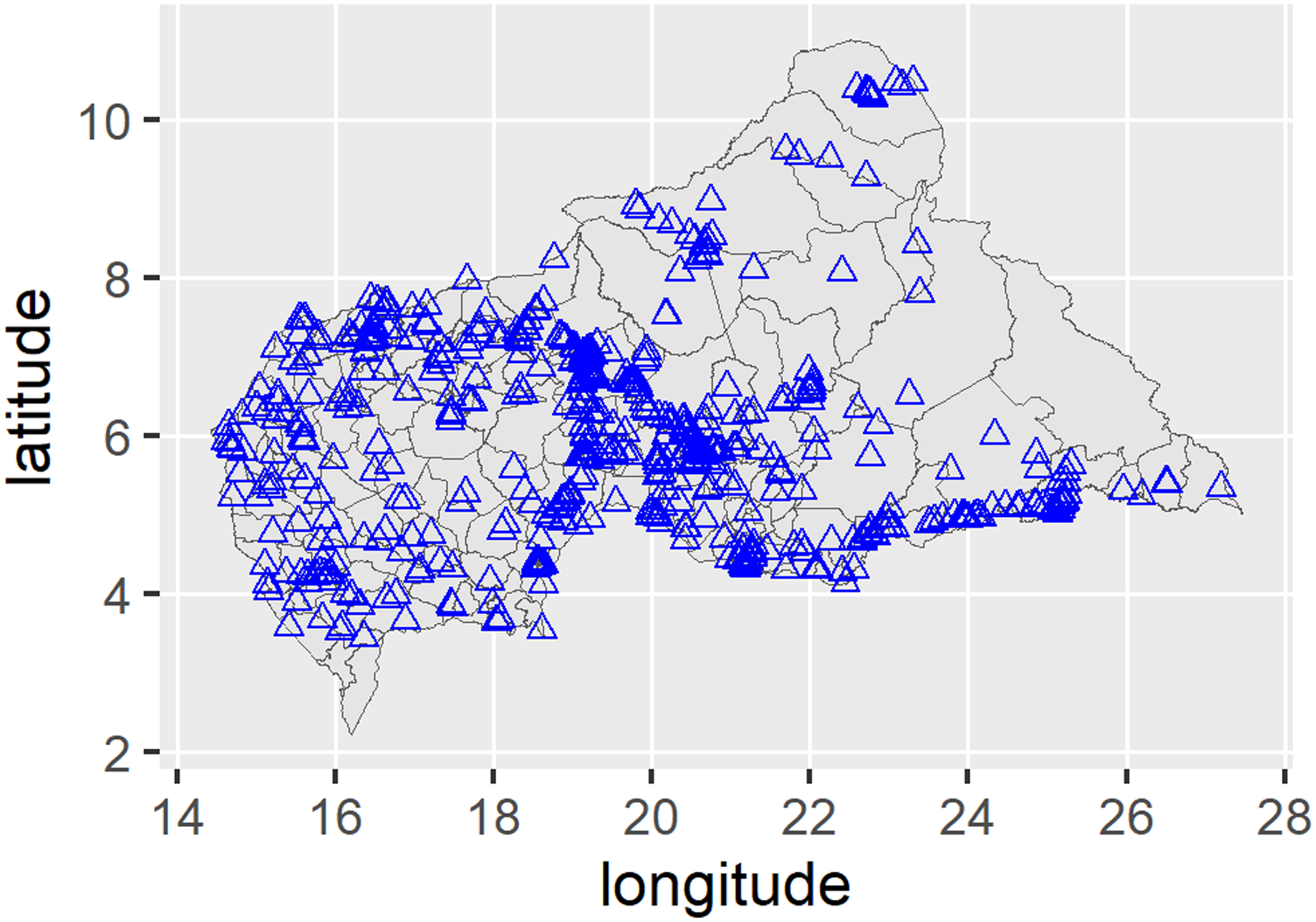
Independent Variable
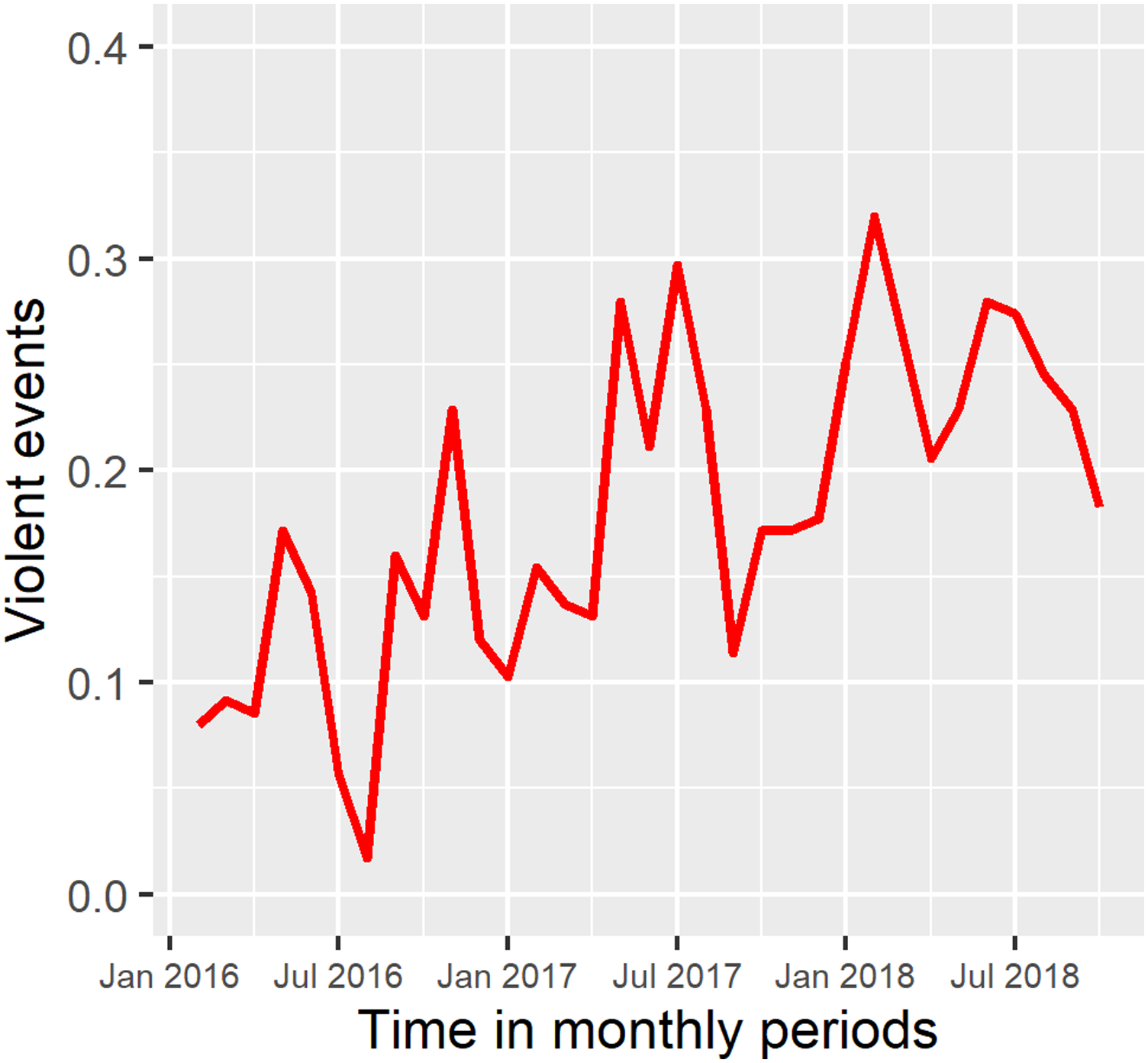
To capture violent conflict, our main explanatory variable, we construct a count of incidents of organized violence (contemporaneously and lagged by 1 month) using data from the Armed Conflict Locations and Events Data set (ACLED) (Raleigh et al., 2010). Of the observations in the sample, 8.74% see at least one event of organized violence. The mean number of violent events in a community and month is .18 with a SD of .79. Figure 3 illustrates the geographic distribution and Figure 4 the temporal distribution. Geographical spread of violent events in the CAR, 2016–2018. Monthly means of violent events in the CAR, 2016–2018.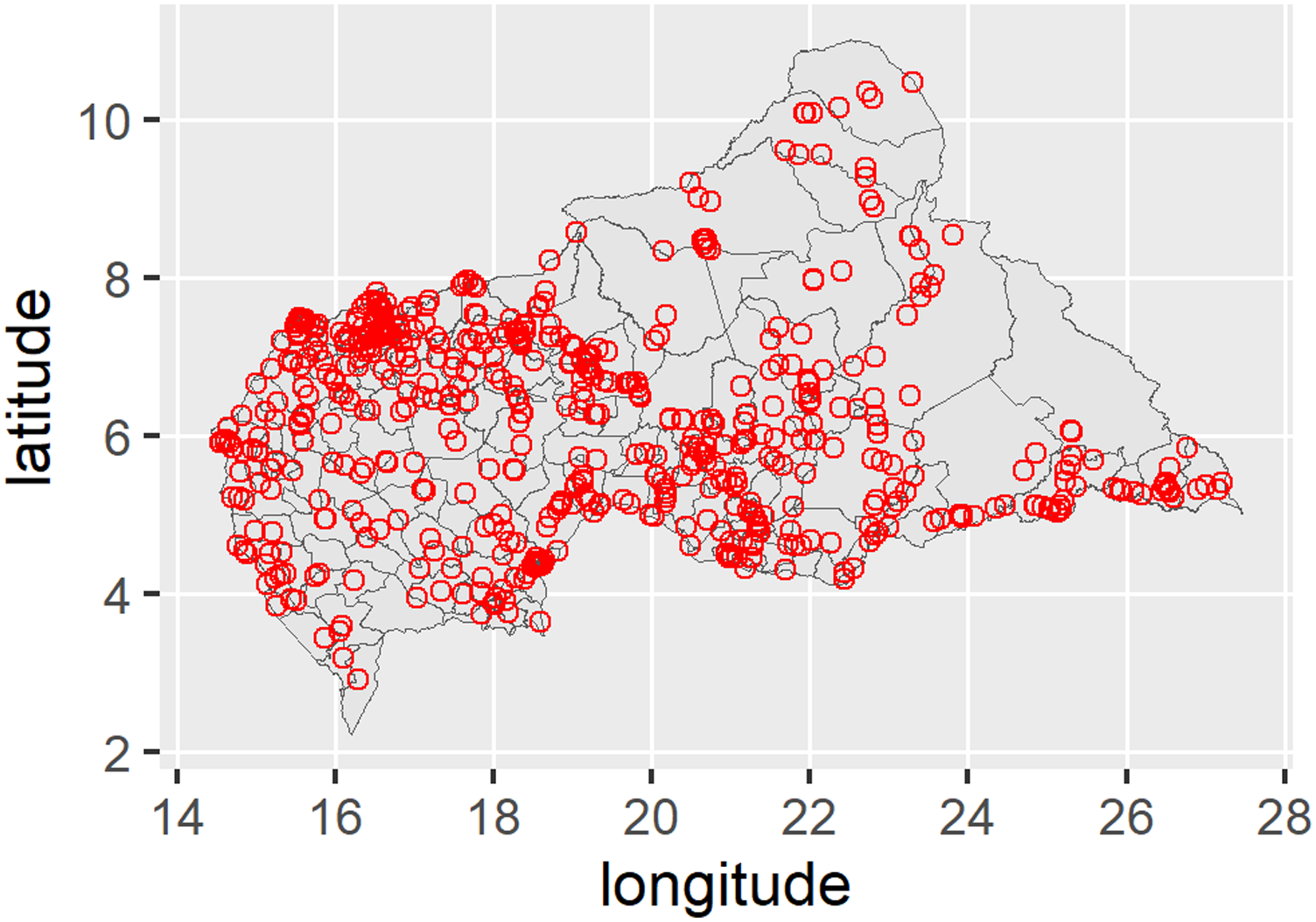
In Appendices H and J, we show that results are robust for different types of violence, that is, violence against civilians, non-state armed violence and state-based armed violence, and for violence measured with information from the UCDP Georeferenced Events Data set Version 21.1 (Pettersson et al., 2021; Sundberg & Melander, 2013).
Control Variables
We control for a wide variety of potentially confounding factors that could influence both violence and peacebuilding. First, we include road density and distance to the capital since missing infrastructure in more remote areas hampers the logistics of peacebuilding and presents an opportunity for armed actors to organize violence outside the state’s reach. Data comes from OCHA Humanitarian Data Exchange (2021a). Moreover, we include the geographic size and population density (number of inhabitants per square km) with the expectation that larger and more densely populated areas experience more peacebuilding and violent events. Data for both geographic and population size are retrieved from the OCHA Humanitarian Data Exchange (2021b, 2021c). Furthermore, food insecurity threatens lives and livelihoods, potentially driving people into the arms of armed groups and exacerbating rivalries between communal groups. Areas suffering from food insecurity are likely also priority areas for peacebuilding. Food insecurity is measured yearly on a four-point scale using data from the Integrated Food Insecurity Phase Classification Global Platform that is available from OCHA Humanitarian Data Exchange (2021d). Additionally, violent conflicts are often fought along ethnic and religious lines. The analyses thus control for ethnic fractionalization 3 and the proportion of Muslims (Müller-Crepon and Hunzinger 2018). The history of violence also matters for both contemporaneous insecurity and peacebuilding. Therefore, we construct a three months-moving average (the sum of the first, second and third lag) of violence using information from ACLED. Finally, we include the number of roadblocks in a community in a year, because such illegal checkpoints indicate the presence of non-state armed actors and can affect both violence between non-state armed groups and against civilians as well as peacebuilding efforts. Data comes from MINUSCA (2020). While most of our controls are time-invariant or vary only yearly (food insecurity and roadblocks), we lag the moving average of violence by 1 month in models that include the one month-lag of violence as main predictor. Summary statistics for all variables are in Online Appendix A.
Identification Strategy
For testing Hypothesis 1—that violence is positively correlated with civilian peacekeepers’ local peacebuilding efforts—we estimate pooled and fixed effects negative binomial models of local peacebuilding activities. Standard errors are clustered within communities to account for potential non-independence (see Online Appendix I for Conley standard errors that are robust against both spatial clustering and serial correlation). The pooled models allow us to observe whether variation in violence across communities is associated with geographical and temporal variation in peacebuilding support. The fixed effects models control for time-invariant differences across communities, for example, geographic attributes like mountains or forests that enable armed groups’ activity but hinder peacebuilding. Thus, these models allow us to assess whether variation in violence within communities over time relates to over-time variation in civilian peacekeepers’ engagement in peacebuilding. Online Appendix C shows the robustness of effect directions using first differences rather than levels of violence and peacebuilding, but standard errors are unsurprisingly larger.
Mediation Analysis (Hypothesis 2)
We test the first alternative explanation and Hypothesis 2—that violence only positively correlates with local peacebuilding efforts through UN military—using causal mediation analysis methods proposed by Imai et al. (2011). Our mediator variable is (i) a binary variable for whether a community and month hosts a UN military base and, in an alternative specification, (ii) the natural log of the number of UN military personnel. Data is obtained from the Geo-PKO data set Version 1.1. (Fjelde et al., 2019; Cil et al., 2020; Sundberg, 2020).
Causal mediation analysis identifies the indirect (or mediation) effect and the direct effect of violence on civilian peacekeepers’ peacebuilding efforts. In our analysis, the indirect effect corresponds to the effect of violence through the mediator UN military and captures the alternative explanation put forward in Hypothesis 2. The direct effect of violence corresponds to the effect of violence explained through all alternative mechanisms, including our preferred explanation (i.e., that civilian peacekeepers possess incentives and capacity to engage in local peacebuilding in response to violence). Therefore, if the mediation analysis supports a direct effect, then this is evidence against Hypothesis 2 and strengthens our preferred explanation.
The identification of the direct effect and the indirect (or mediation) effect builds on the “sequential ignorability assumption.” This assumption consists of two parts: The first part requires that given our control variables, violence (the main independent variable or “treatment”) should be exogenous to UN military (the mediator variable) and peacebuilding efforts (the outcome variable). In other words, the “assignment” of the violence is ignorable. If we had run an experiment, then random assignment of the treatment would have satisfied the first part of the sequential ignorability assumption. However, in our observational study, violence is obviously not randomly assigned to communities and months. Therefore, we lag violence by 2 months to strengthen the plausibility that it is independent of UN military deployments 1 month previously. We additionally control for potentially confounding covariates that could influence violence on the one hand and military deployment and peacebuilding events on the other. Since we might not be able to catch all confounders, we run sensitivity analyses to check how sensitive the results are to violations of sequential ignorability, and we find it to be very unlikely that violations of the “sequential ignorability assumption” explain our results.
Moreover, the second part of the “sequential ignorability assumption” likely holds in our case. It requires that UN military (the mediator variable) is exogenous to local peacebuilding efforts (the outcome variable) after conditioning on our control variables and violence. That is, the assignment of mediator status is ignorable. It would be violated if UN military presence or personnel numbers were affected by the timing and location of peacebuilding efforts. We think of this violation as unlikely, especially after we condition on violence 2 months previously and our control variables. Civil Affairs situation reports suggest that peacebuilding activities are often spontaneously organized and announced on short notice, leaving little time for UN military to adjust deployment. In fact, the establishment of UN military bases is much slower, for example, current deployments only respond to the history of violence one or 2 years previously (Ruggeri et al., 2018). While our study likely fulfills the second part of the sequential ignorability assumption, again we note that our sensitivity tests reported in the results section reveal the robustness of our main findings in case it would be violated.
In addition, mediation analysis requires that our control variables are pre-treatment. This assumption is likely fulfilled. We exclude roadblocks from the mediation analyses, as they are likely influenced by UN military deployment. All other controls are slowly changing structural variables, like terrain, food insecurity or demographics; neither violence nor UN military should influence them.
In Online Appendix E, we replace the mediation analyses with a simple control variable strategy and include UN military presence and numbers as covariates in our main models. The coefficient on violence remains positive and significant, making it unlikely that peacebuilding efforts in violent areas are merely a function of military deployments in these areas. We prefer causal mediation analysis over this control variable strategy because it is a more direct test of our alternative explanation that the effect of violence on peacebuilding runs through UN military presence.
Instrumental Variable Analysis (Hypothesis 3)
We test Hypothesis 3 and the second alternative explanation—that violence does not cause local peacebuilding—with an instrumental variable model. While civilian peacekeepers might go to the most violence-affected places, an alternative explanation for a positive correlation between violence and local peacebuilding efforts might be reverse causation. Peacebuilding potentially leads to more violence, for example, since armed actors want to deter local populations from participating in it. 4 Instrumental variable models replace the possibly endogenous variable (i.e., violence) with an instrument that is highly correlated with violence but exogenous to the outcome (i.e., peacebuilding efforts). If instrumented violence has a positive and significant coefficient in the models of peacebuilding events, then we can reject Hypothesis 3.
We propose to use a triple interaction between the world market prices for rough diamonds, the prevalence of diamond mines, and the distance of a community to the nearest international border as instrument for violence. Figure 5 illustrates the instrumental variable strategy (solid arrows). This strategy needs to meet two criteria: (i) the instrument needs to be relevant and (ii) it must influence peacebuilding only through violence and, thus, should also not directly correlate with peacebuilding (i.e., the exclusion restriction). With regards to the relevance of our instrument, existing studies show that increasing world market diamond prices fuel violence in diamond-rich areas, for example, because of greater competition among armed groups with higher returns to looting (for example, Blair, Christensen, & Rudkin, 2021). However, rising diamond prices do not affect (and may even decrease) violence in areas where diamond mining is not prevalent (Rigterink, 2020). Identification strategy for Hypothesis 3.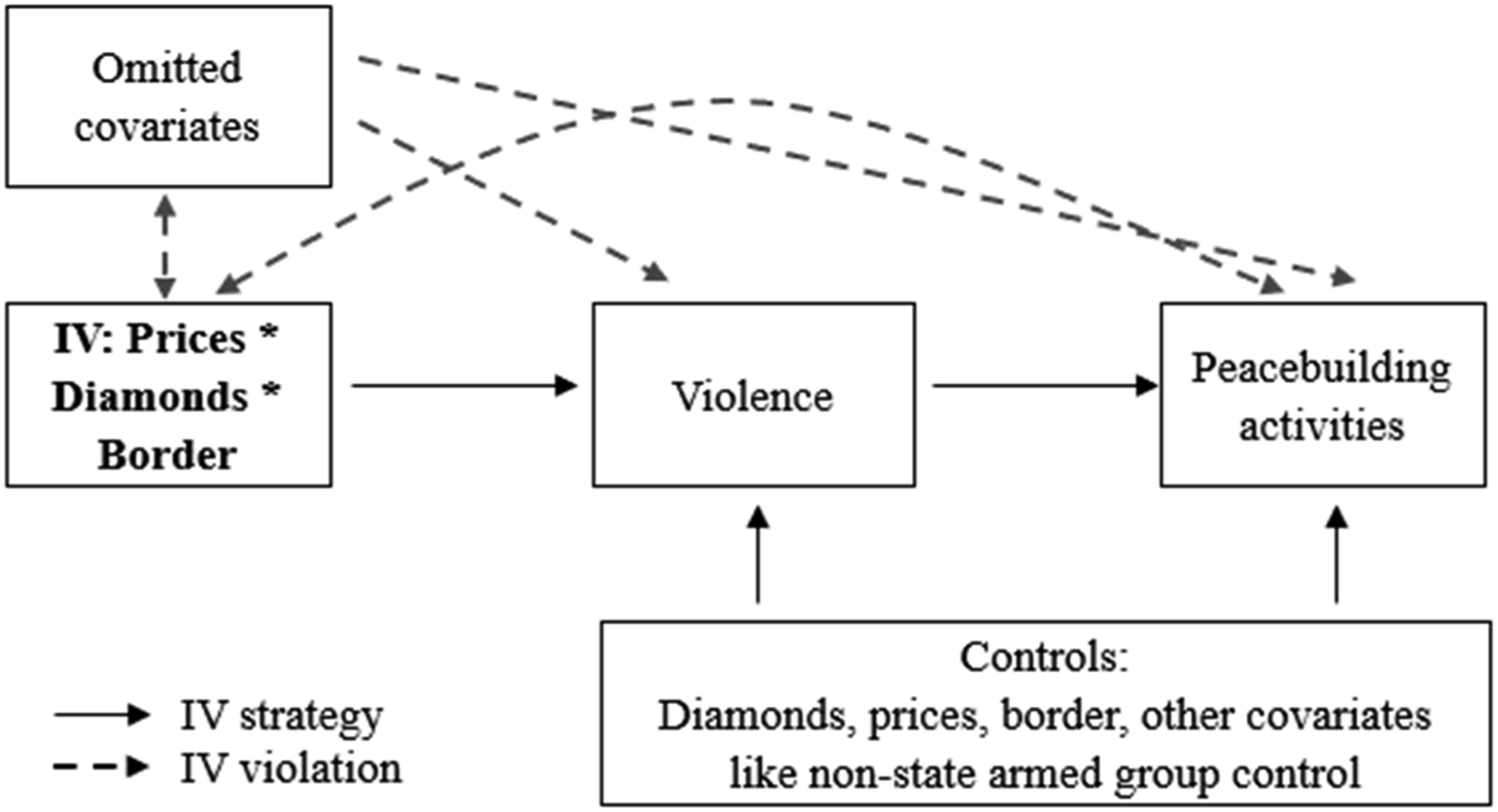
Qualitative evidence from the CAR supports this correlation. Due to their high value-to-weight ratio and the small-scale, informal mining of alluvial deposits, diamonds in the CAR are particularly susceptible to theft and exploitation by armed rebel groups (DeWitt et al., 2018). Indeed, “armed groups [in CAR] vie for control over areas with valuable mineral resources” (Stimson Centre, 2016). A senior armed group (Séléka) leader acknowledges that “we started to trade diamonds, and it became like a business for us” (The Enough Project, 2014, 9). Thus, armed group commanders are likely aware of diamond price fluctuation (e.g., through having established close contacts to diamond traders and middlemen) and adjust their investment in violence accordingly to obtain control over diamond mines or forced labor for mining activity (Blair, Christensen, & Rudkin, 2021). 5
Moreover, in our period of analyses (2016–2018), only a small percentage (3.2–4.3%) of annual diamond production are legally exported. “The remainder is likely smuggled out of the country by illegal diamond traders and armed group” (Chirico & Bergstrresser, 2019). 6 Illegal smuggling is easier when diamonds are harvested in communities that are closer to an international border, especially since many armed group leaders themselves take diamonds across the border and sell them to intermediaries in Chad, Sudan, Cameroon, and the DR Congo (The Enough Project, 2014, 10; DeWitt et al., 2018, 25). Overall, we thus propose that an increase in diamond prices heightens violence in diamond-rich border areas, while diamond prices do not influence violence in diamond-poor areas and areas far away from international borders. In the empirical section, we test this claim.
Beyond relevance, an instrument also needs to fulfill the exclusion restriction. As summarized in Figure 5 (dashed arrows), the instrument should not directly correlate with the dependent variable (i.e., peacebuilding activities). This independence assumption would be violated if civilian peacekeepers scale-up peacebuilding efforts in diamond-rich areas close to borders in response to rising rough diamond prices on the world market. While civilian peacekeepers might choose to engage in mining areas because of armed group activity in those locations, it is hardly conceivable that civilian peacekeepers adapt efforts to rough diamond price change. Except through first-hand interaction with diamond traders, current diamond price information—especially for rough diamonds—is difficult to get (Paul Zimnisky Diamond Analytics 2022). Indeed, Civil Affairs personnel of the PKO in CAR confirms that they do not spend time and effort on acquiring these data and also do not structure their work around diamond price fluctuation (Email exchange with MINUSCA Civil Affairs, 30.11.2022).
Second, the instrument should relate to peacebuilding activities only through violence and not through other omitted covariates. This excludability assumption would be violated if fluctuation in rough diamond prices changes conditions other than violence that trigger peacebuilding, but only in diamond-rich areas near an international border. One such condition could be a greater prevalence of armed groups. Armed groups may seek control over mining communities in border areas with shorter smuggle routes to neighboring countries, especially when diamond prices are rising. Civilian peacekeepers may then engage in more (preventive) peacebuilding in such communities—although our reading of Civil Affairs situation reports reveals little evidence for this. Nevertheless, all our models control for roadblocks maintained by armed groups as a proxy measure for armed group prevalence. Beyond this condition, we think it is unlikely that diamond price change in diamond-rich border zones influence peacebuilding through channels other than violence. Of course, the exclusion restriction is an assumption that cannot be tested, and we may not be able to eliminate all potential violations. Nonetheless, this assumption seems plausible in our case.
Data on rough diamond prices comes from Petra Diamonds’ Analyst Guidance FY2019 based on data from Bloomberg. Prices are recorded as a monthly changing index ranging from 108 to 208 in our sample (Petra Diamonds, 2019). We retrieve data on the prevalence of diamond mines from a study on mining activity in the CAR between 2013 and 2017 (DeWitt et al., 2018). The variable is time-invariant and recorded on a five-point scale ranging from zero mines, one to five mines, 6–20 mines, 21–40 mines and over 40 mines in a community. Finally, the data on distance to the next international border is from OCHA Humanitarian Data Exchange (2021c).
Results
Results for Hypothesis 1
Regressions of Peacebuilding Activities on Violence in Contemporaneous Months.
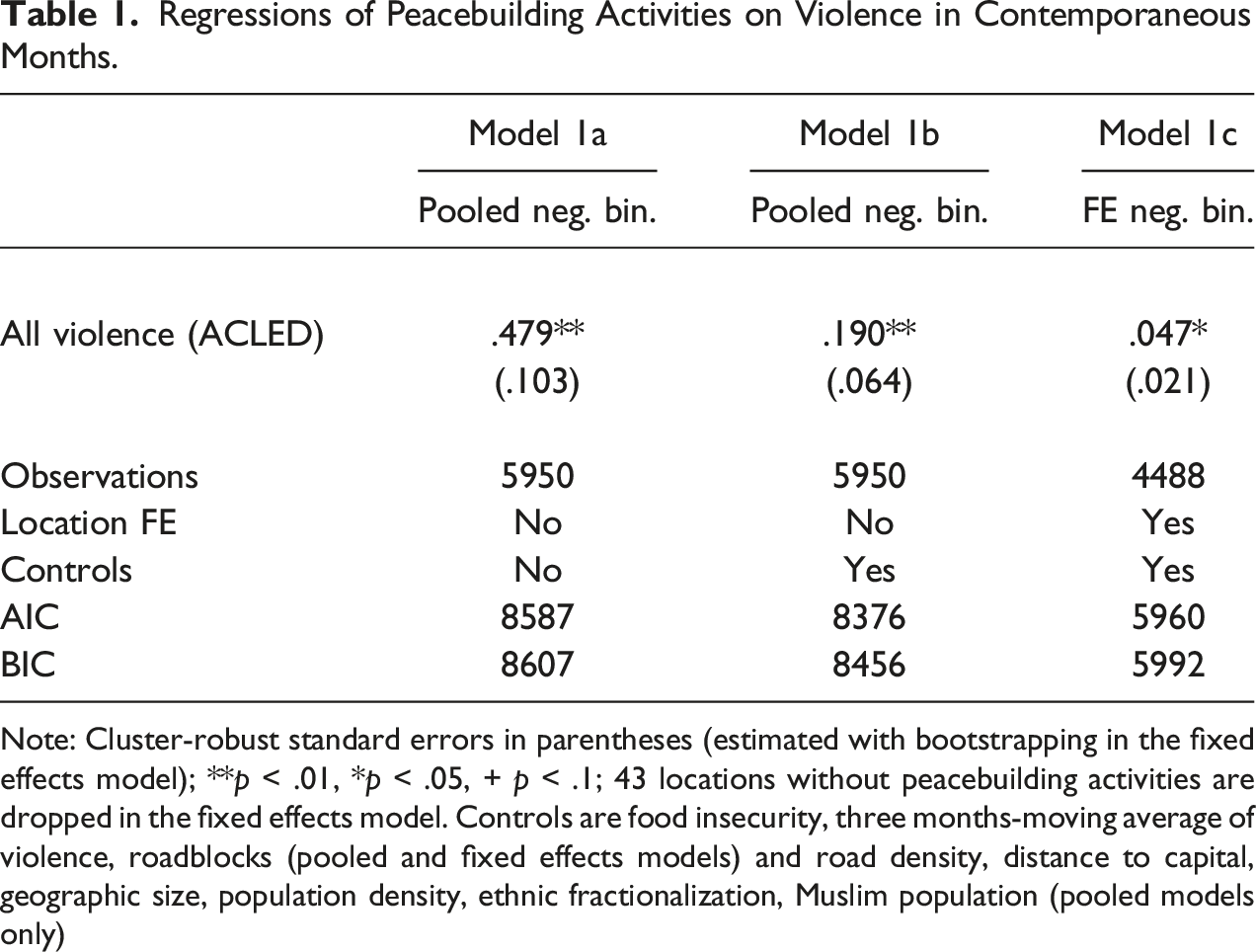
Note: Cluster-robust standard errors in parentheses (estimated with bootstrapping in the fixed effects model); **p < .01, *p < .05, + p < .1; 43 locations without peacebuilding activities are dropped in the fixed effects model. Controls are food insecurity, three months-moving average of violence, roadblocks (pooled and fixed effects models) and road density, distance to capital, geographic size, population density, ethnic fractionalization, Muslim population (pooled models only)
Regressions of Peacebuilding Activities on Violence 1 month Previously.
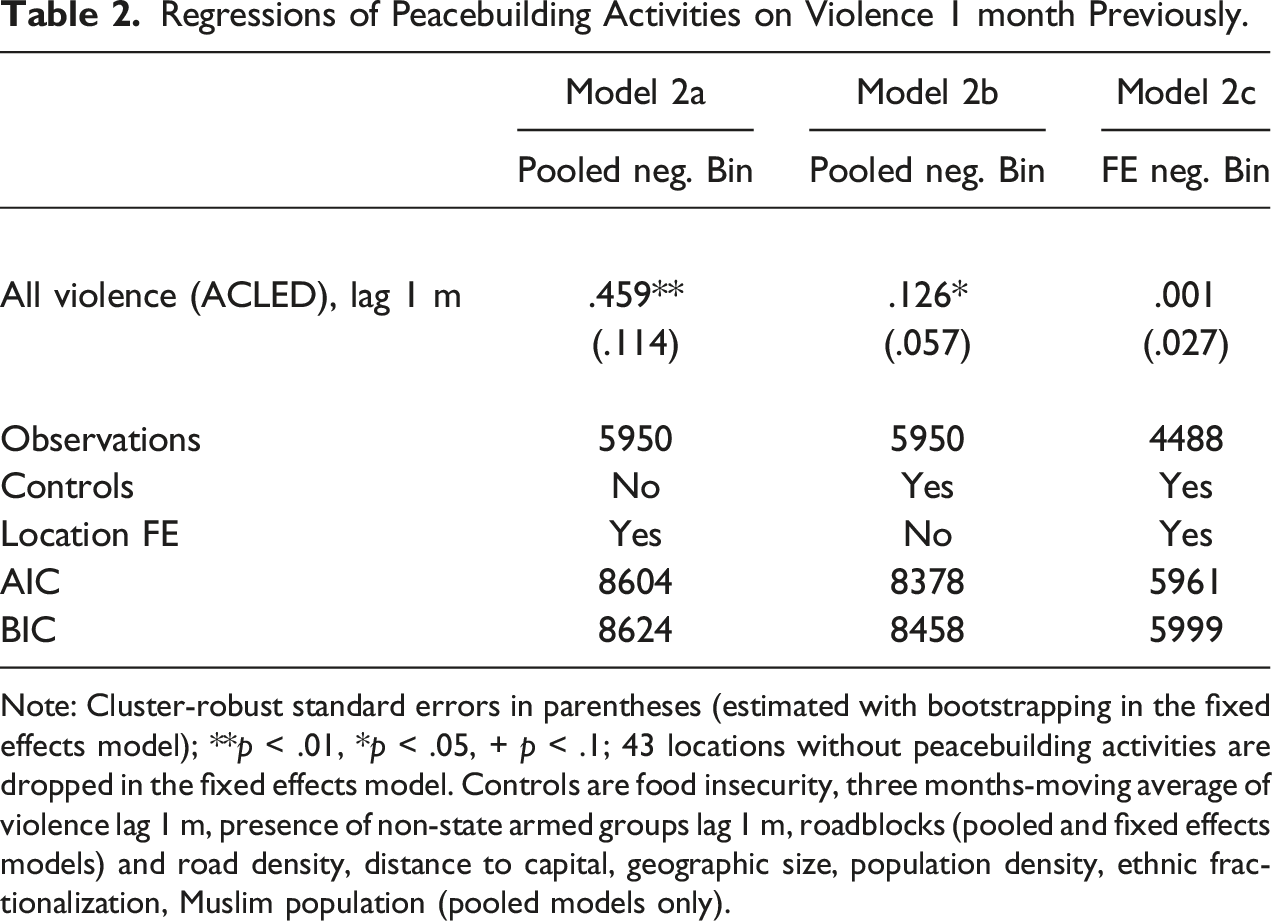
Note: Cluster-robust standard errors in parentheses (estimated with bootstrapping in the fixed effects model); **p < .01, *p < .05, + p < .1; 43 locations without peacebuilding activities are dropped in the fixed effects model. Controls are food insecurity, three months-moving average of violence lag 1 m, presence of non-state armed groups lag 1 m, roadblocks (pooled and fixed effects models) and road density, distance to capital, geographic size, population density, ethnic fractionalization, Muslim population (pooled models only).
Figure 6 illustrates the magnitude of these correlations in terms of the average predicted difference in peacebuilding events when violence increases by one event and all other covariates are held at their mean.
7
A one event-increase in contemporaneous violence or violence one month previously is associated with an average increase of .07 and .05 peacebuilding events across communities, respectively (Model 1b and 2b). Moreover, a temporary increase by one event above the baseline level of violence in a subnational location is related to an average increase of .024 peacebuilding events in that location in the same month (Model 1c). However, peacebuilding activities in a specific locality do not seem to respond to violence that occurred one month ago in that specific locality. That is, the confidence interval around the estimated effect of a temporary increase by one event above the locality-specific baseline level of violence one month previously includes zero (Model 2c). Again, this confirms our above interpretation: When civilian peacekeepers choose in which areas to intervene, they choose those with a “history of violence” (i.e., with violence one month previously). However, when peacekeepers decide on their response within a given locality, then they respond to the violence in this locality within the same month and do not respond to violent incidents one month ago. Predicted difference in peacebuilding for a unit-increase in violence.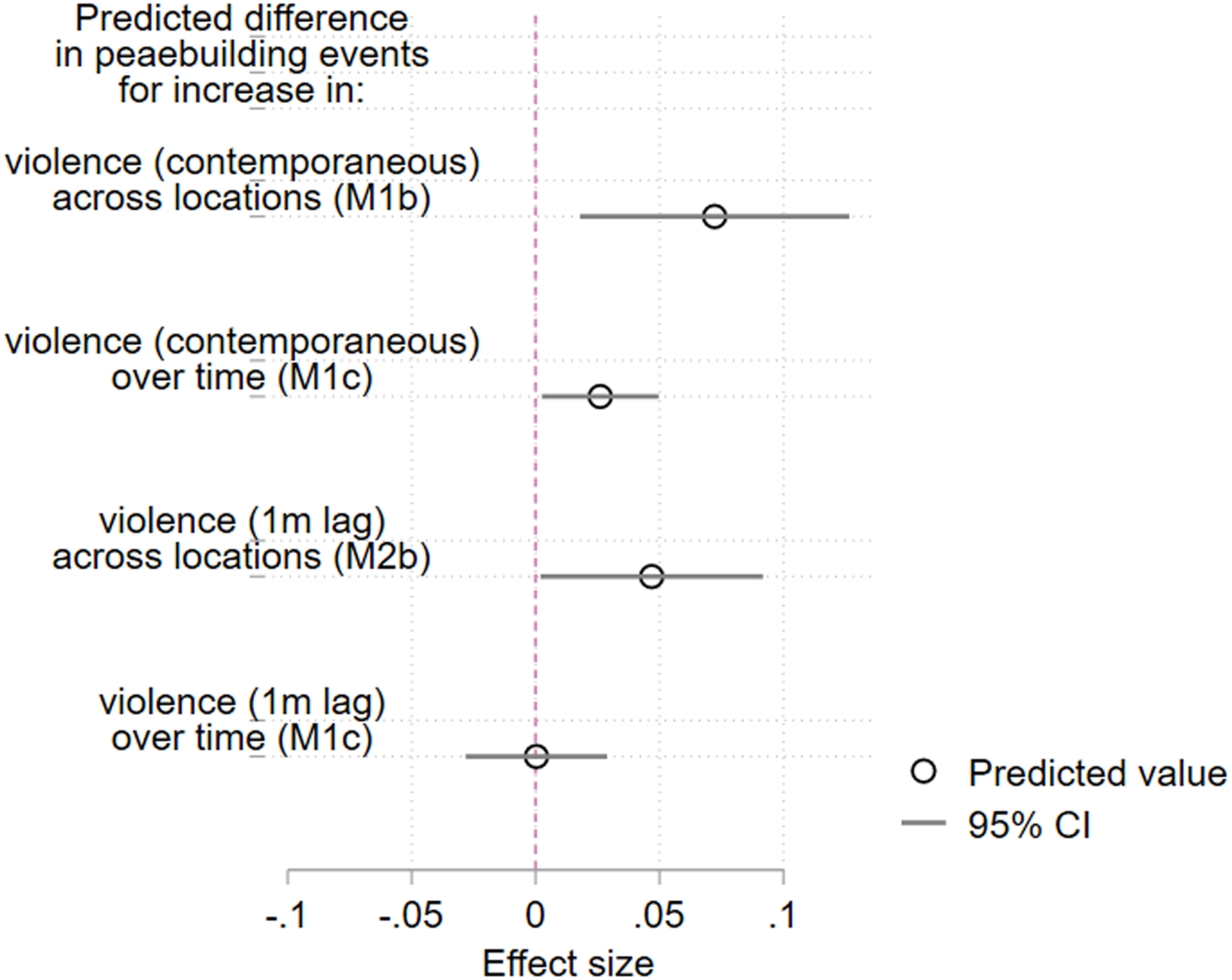
In addition, we note that the size of the significant correlations is only moderate—and as we show below likely under-estimate the true effect of violence on peacebuilding. For comparison, roadblocks are associated with a roughly five times larger effect size, that is, .23 additional peacebuilding events for each standard deviation increase in roadblocks (Model 1b).
One interesting finding is that civilian peacekeepers apparently react more or less immediately to an outbreak of violent conflict in a given subnational area, but do not condition their peacebuilding activity on violent incidents that occurred four or more weeks ago in a given locality. We probe this finding further by disaggregating the unit of analysis to weekly periods. Then, we estimate fixed effects models of civilian peacekeepers’ peacebuilding activities including counts of violent incidents in contemporaneous weeks as well as counts of violent incidents one, two, three, four, five or six weeks previously (see Online Appendix B.5). Figure 7 illustrates the results. Civilian peacekeepers usually do not respond to violent conflict escalation in the same week. However, violent incidents in the previous week are associated with greater numbers of peacebuilding events in the contemporary week. Predicted difference in peacebuilding for a unit-increase in violence in contemporaneous weeks and one to 6 weeks previously.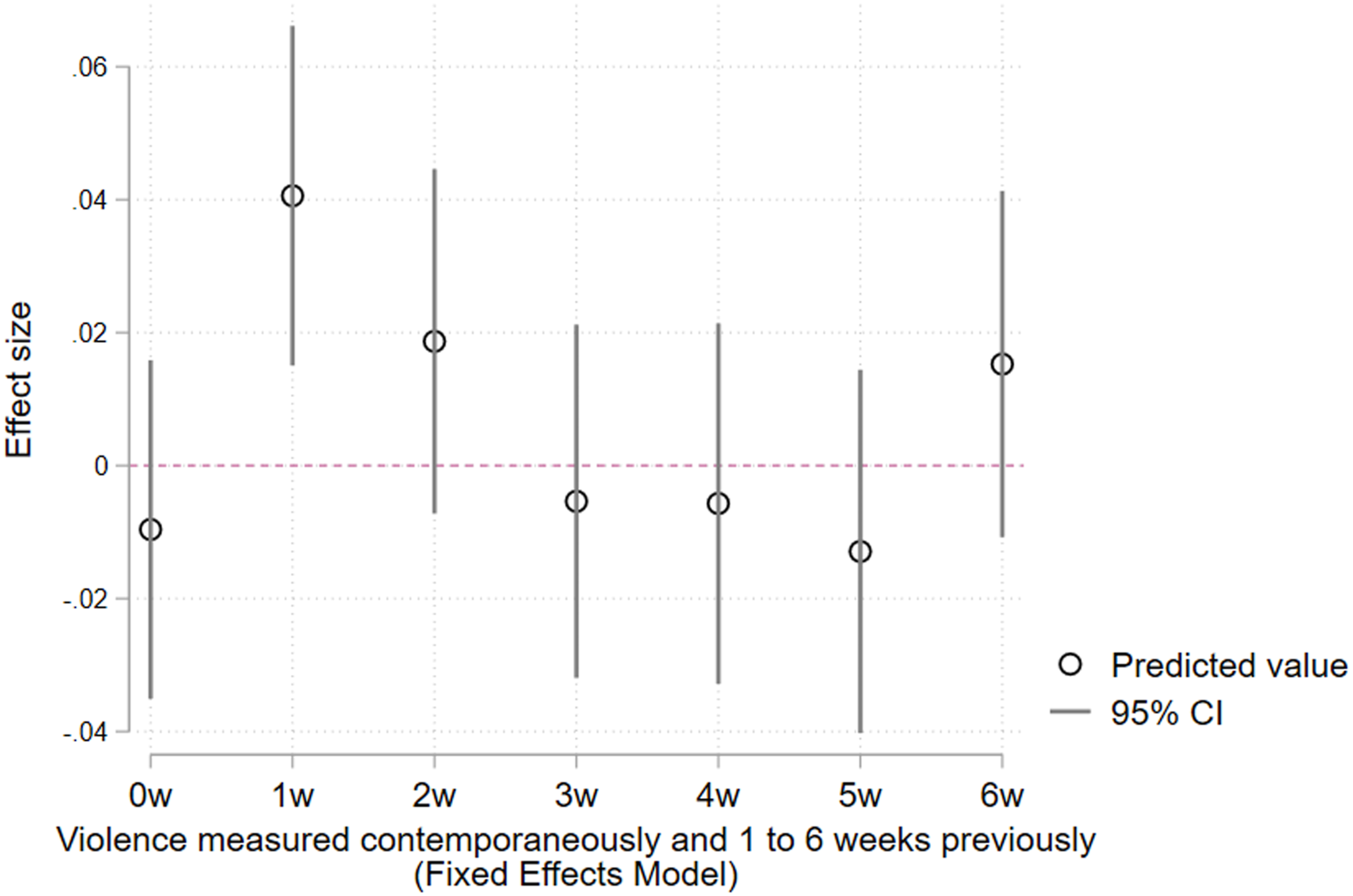
Results for Hypothesis 2
We propose that the positive correlation between violence and peacebuilding results from civilian peacekeepers’ motives and capacity to respond to the escalation of conflict. An alternative explanation, summarized in Hypothesis 2, is that more peacebuilding in violent communities is a function of the availability of military protection and logistics in violence-prone areas. The results of our mediation analyses, however, provide evidence against this alternative explanation.
Mediator Model of UN Military and Outcome Model of Peacebuilding Events.
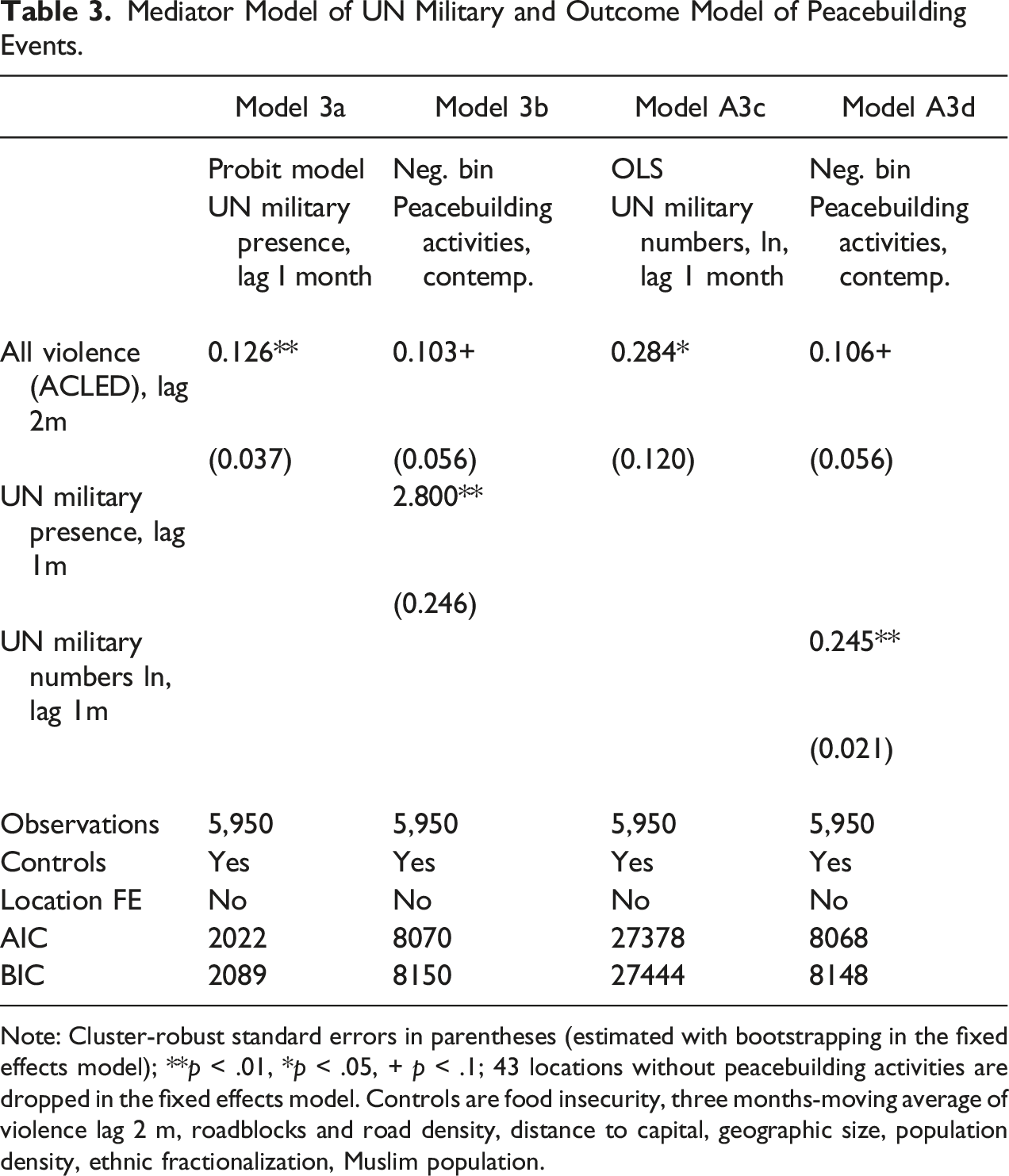
Note: Cluster-robust standard errors in parentheses (estimated with bootstrapping in the fixed effects model); **p < .01, *p < .05, + p < .1; 43 locations without peacebuilding activities are dropped in the fixed effects model. Controls are food insecurity, three months-moving average of violence lag 2 m, roadblocks and road density, distance to capital, geographic size, population density, ethnic fractionalization, Muslim population.
Figure 8 illustrates the results. A one event-increase in violence two months previously is directly associated with .07 (Model 3b) or .06 (Model 3d) additional peacebuilding events. This increase is statistically significant, suggesting that civilian peacekeepers are partly autonomous from military deployments in their response to violent conflict across communities. However, the mediation effect is also positive and significant. A change in military presence or military personnel numbers after violence has increased from 0 to 1 event is associated with an increase in peacebuilding by of .04 events (Model 3b) or .06 events (Model 3d), respectively. Direct and indirect effect of violence in sequential periods.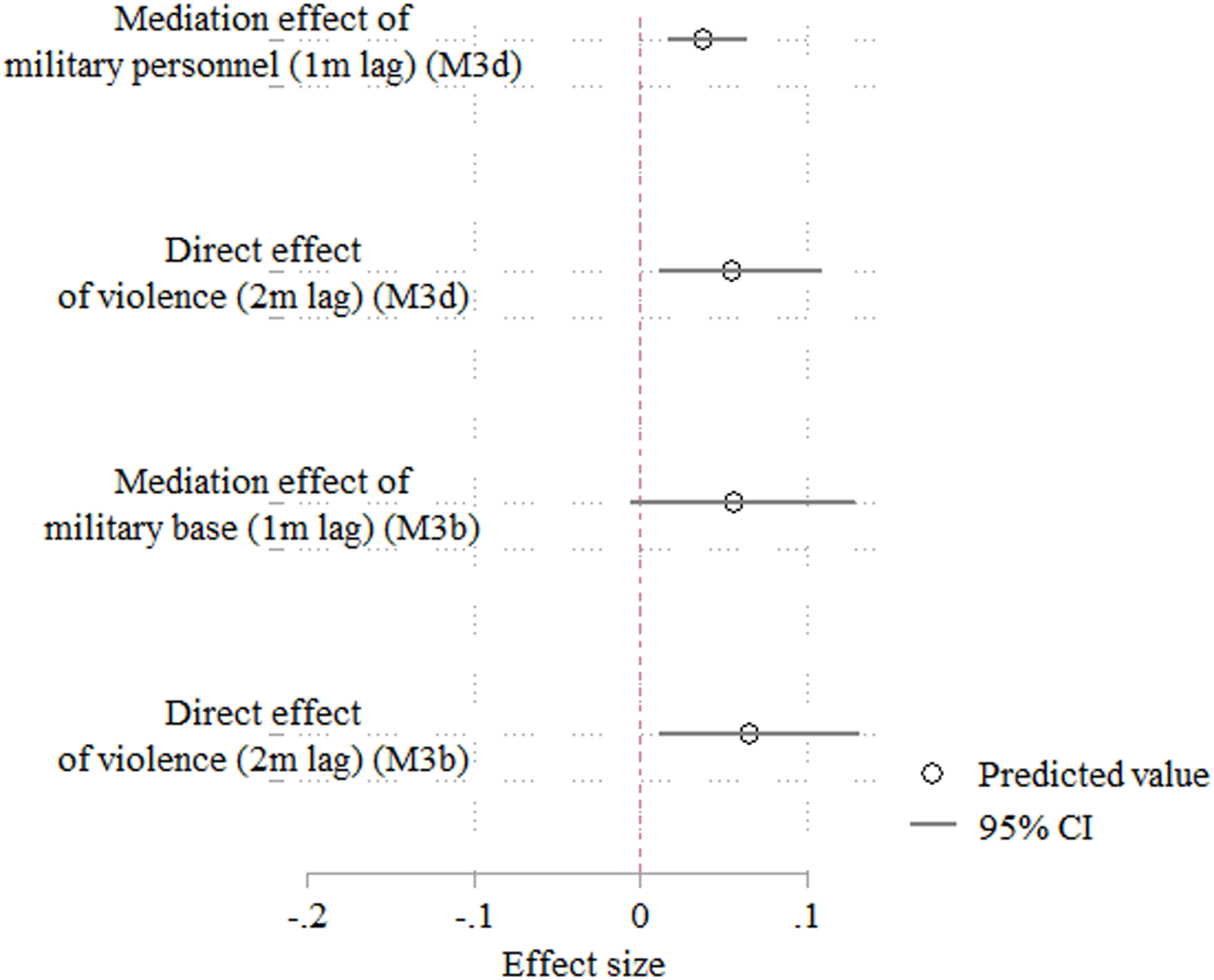
We assess the sensitivity of these results to violations of the “sequential ignorability assumption” (Imai et al., 2011). This assumption would be violated if there were unmeasured confounders that influence both the values of the mediator variable (i.e., UN military deployment) and the values of our outcome of interest (i.e., peacebuilding events). In the presence of such confounders, the error terms of the mediator model of UN military (Models 3a and 3c, respectively) and the error terms of the outcome model of peacebuilding (Models 3b and 3d, respectively) would be correlated. Sensitivity analyses estimate to which degree errors must be correlated, so that the direct and mediation effects turn statistically zero.
We find that our results are highly robust to violations of the sequential ignorability assumption (see Online Appendix B.3.2). 9 Only if the correlation between the errors of the mediator model of UN military presence (strength) and the outcome model of peacebuilding was equal to or smaller than −.90 (−.60), would the direct effect of violence become statistically indistinguishable from zero. Put differently, omitted confounders would need to explain 94.87% (77.46%) of the variation in UN military presence (strength) and 94.87% (77.46%) of the variation in peacebuilding for the direct effect of violence to go away. These figures are high, and it is unlikely that omitted factors so strongly influence the variation in both mediator and outcome.
The above models lag violence by two months to increase the plausibility of sequential ignorability. However, our argument implies a more immediate effect of violence on peacebuilding, that is, that civilian peacekeepers quickly react to the escalation of tensions within the same month. In Online Appendix D, we therefore show that contemporaneous violence also has a strong and robust direct association with contemporaneous peacebuilding activities if we take the indirect effect of violence through UN military into account. In Online Appendix E, we re-estimate the main models controlling for UN military presence and strength. The coefficient on violence remains positive and significant.
Results for Hypothesis 3
Although there is a direct correlation between violence and peacebuilding, the relationship might not be causal. As proposed in Hypothesis 3, it is conceivable that violence does not lead to greater peacebuilding efforts, but peacebuilding efforts attract more violence. We test this alternative explanation with instrumental variable regression, as proposed by Woolridge (2015), using a control function approach (see Online Appendix B.4 for full models and Online Appendix F for two-stage least squares estimation).
The first stage equation estimates the effect of our instrumental variable (i.e., the triple interaction between diamond prices, mining prevalence, and border distance) on our main independent variable of interest (i.e., violence) given all control variables. The F-statistic of this model of violence is 14.90, indicating that our instrument is relevant. Figure 9 illustrates that as the prevalence of diamond mines increases to five, 20 and 40 mines in an area, rising diamond prices are positively and progressively more strongly correlated with violence. As expected, this positive marginal effect of diamond prices is restricted to communities close to an international border, that is, to communities which are one standard deviation less than the average distance (equivalent to 20 km) away from an international border.
10
Overall, the evidence shows that our instrument is a relevant predictor of violence. Marginal effect of diamond prices by mine prevalence and border distance.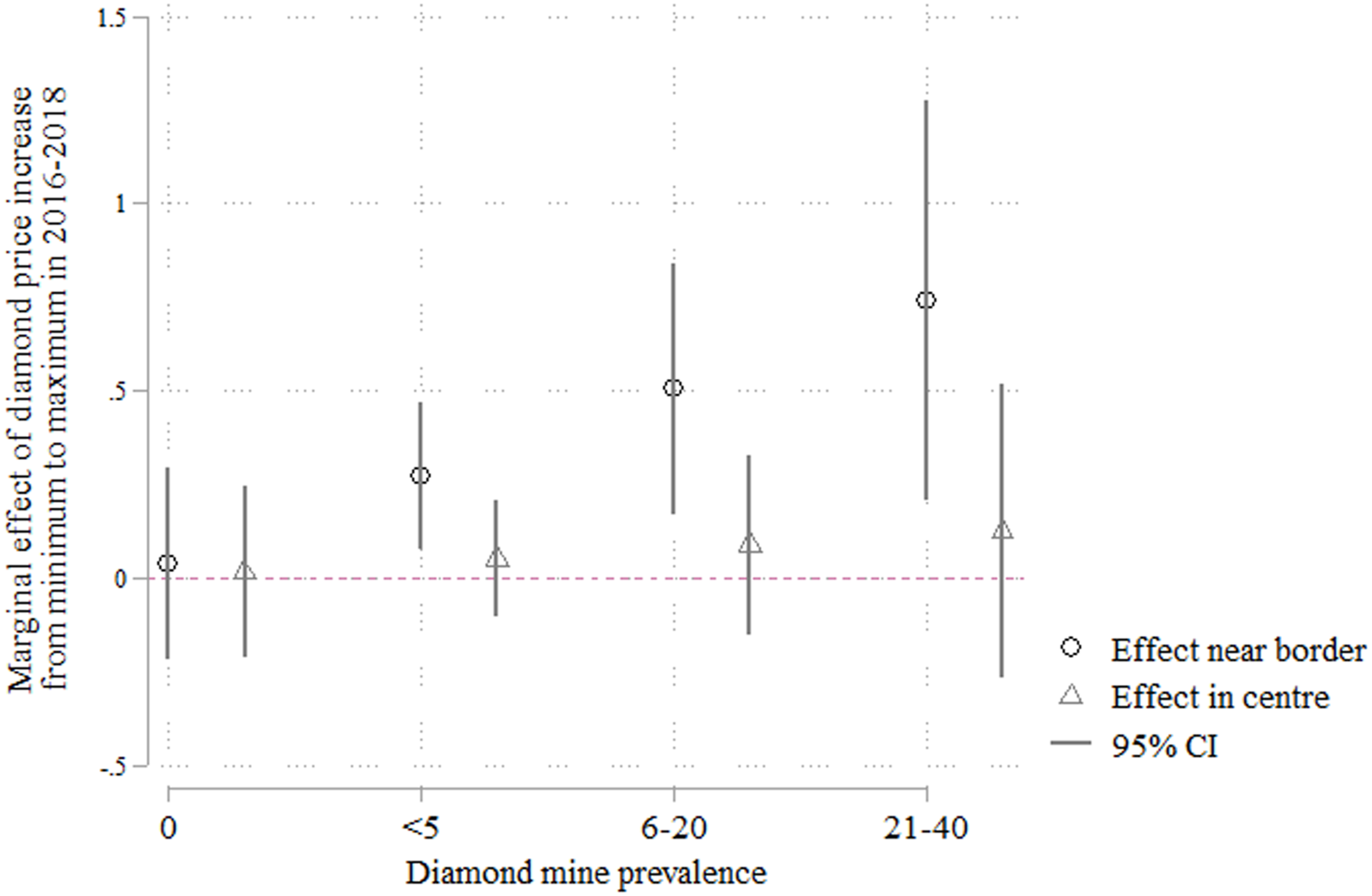
Instrumental Variable Regression Models of Peacebuilding (Only Second Stage).
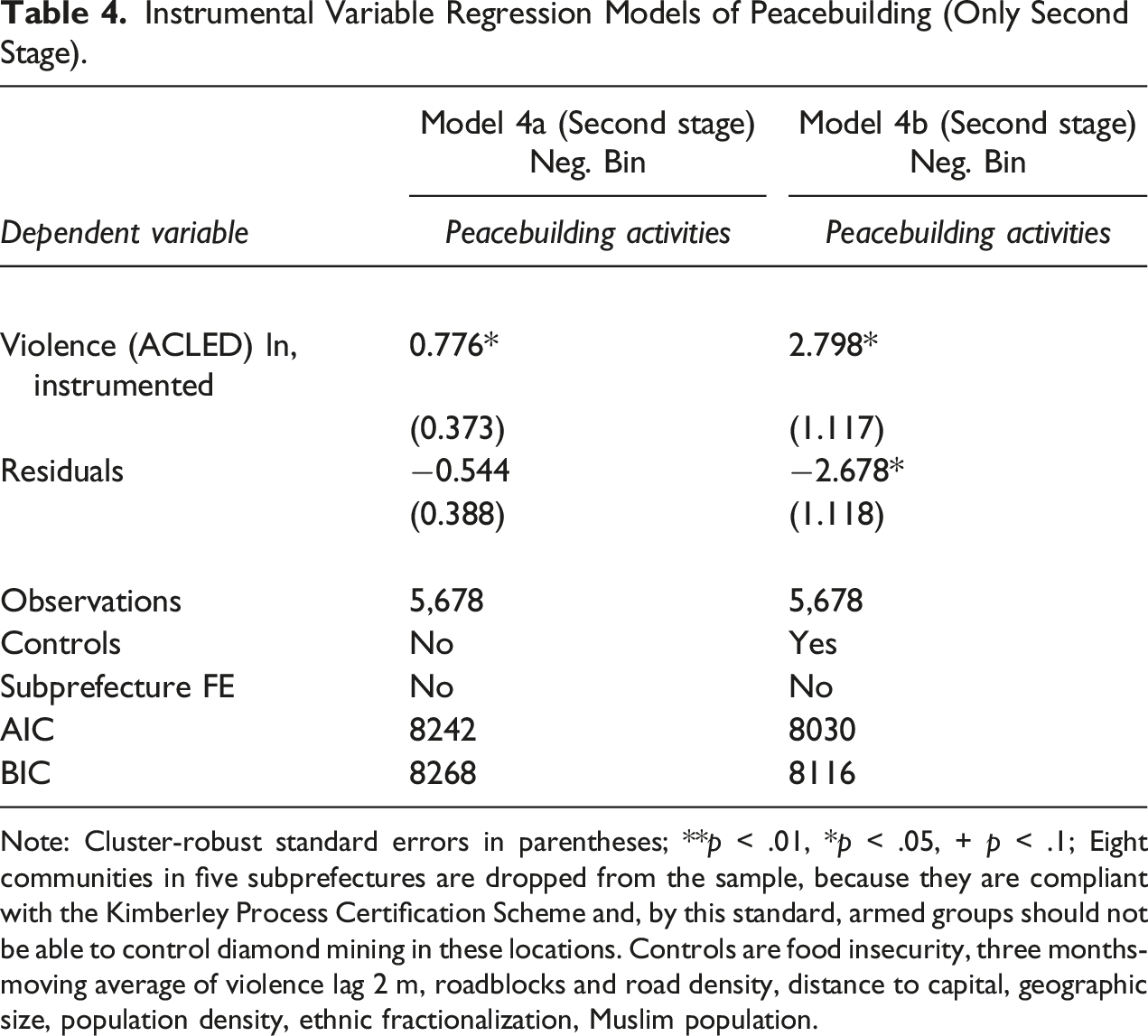
Note: Cluster-robust standard errors in parentheses; **p < .01, *p < .05, + p < .1; Eight communities in five subprefectures are dropped from the sample, because they are compliant with the Kimberley Process Certification Scheme and, by this standard, armed groups should not be able to control diamond mining in these locations. Controls are food insecurity, three months-moving average of violence lag 2 m, roadblocks and road density, distance to capital, geographic size, population density, ethnic fractionalization, Muslim population.
Figure 10 illustrates that, all else equal, if violence increases by one unit (i.e., if logged violence increases from −4.60 to .00), local peacebuilding efforts increase by .28 events (Model 4b with controls), providing evidence against Hypothesis 3. Consistent with our main argument, we conclude that violence leads civilian peacekeepers to heighten their local peacebuilding efforts. We also note that the size of the marginal effect of instrumented violence on peacebuilding is many times larger than the size of the marginal effect of a one event-increase in violence based on the “naïve” baseline model (where it ranges between .05 and .07), suggesting that endogeneity biases the effect of violence on peacebuilding downward.
11
Predicted difference in peacebuilding for a unit-increase in violence.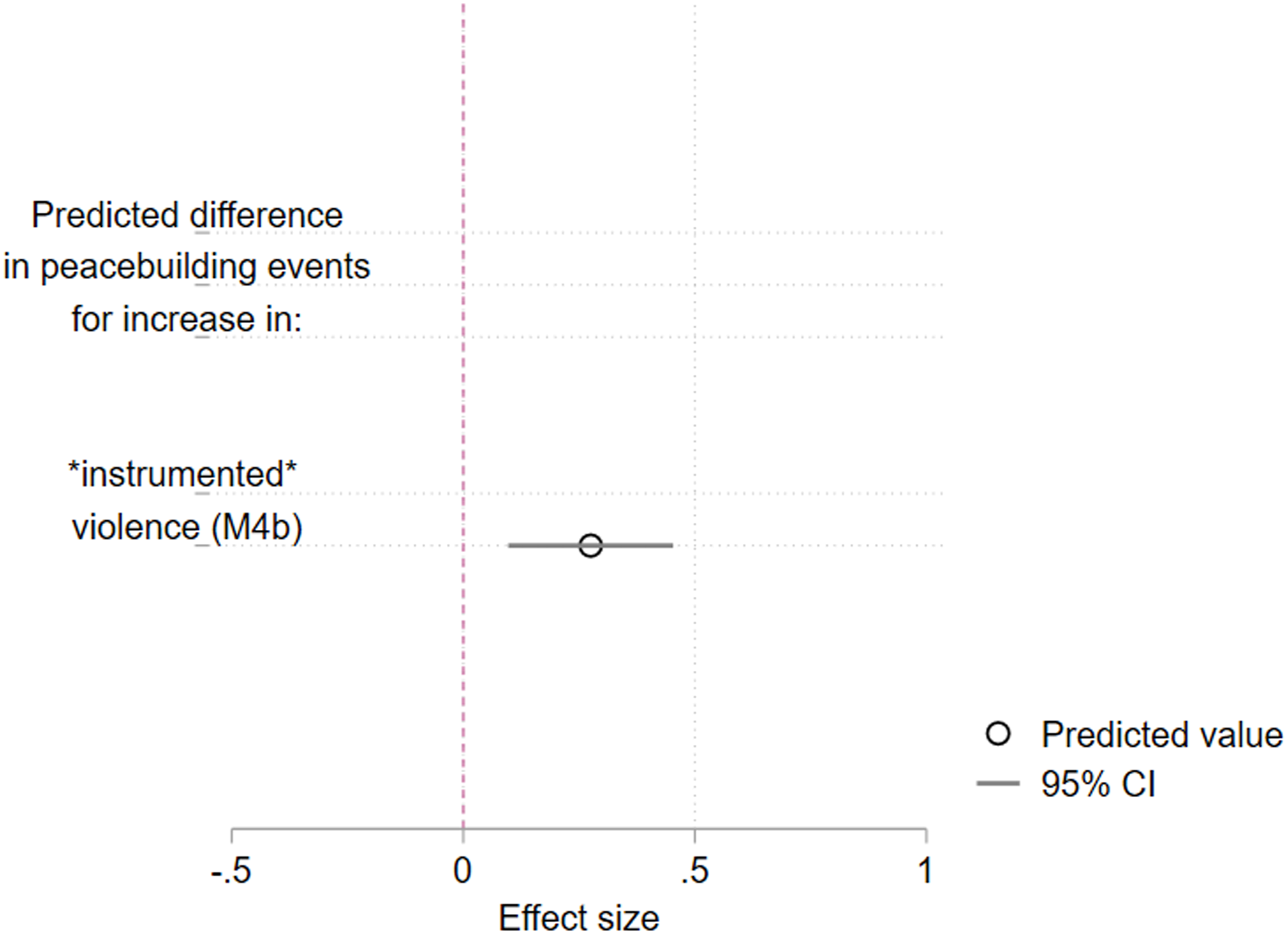
Additional Tests
We conduct a variety of additional tests throughout the article and add another three here. First, Appendix G disaggregates peacebuilding into the four activity types. Contemporaneous violence positively correlates with civilian protection, conflict management and reconciliation activities, but not state authority extension in the pooled models. When it comes to the fixed effects models explaining temporal variation, the coefficient on contemporaneous violence is only significant in the model of civilian protection. However, using weekly units of analysis shows, that violence in a community also leads to more conflict management and reconciliation one week later.
Moreover, Appendix H shows the results for different types of violence. While one-sided violence and non-state armed conflict are associated with peacebuilding, the correlation is less strong for state-based violence. The latter finding is likely driven by the low prevalence of state-based violence (i.e., four events).
Finally, Appendix J illustrates that direction and significance of the coefficient on contemporaneous violence remain robust when we measure violence with data from UCDP Georeferenced Events Data set Version 21.1 (Pettersson et al., 2021; Sundberg & Melander, 2013).
Conclusion
In this article, we find that civilian peacekeepers generally engage in peacebuilding in areas with the highest levels of violence and that an upsurge in violence in a subnational area (compared to that area’s baseline level of violence) is associated with more peacebuilding in that area as well. We argue that organizational and personal incentives of civilian peacekeepers as well as their capacity for local engagement are responsible for these relationships. While we do not provide a direct test of this causal mechanism, our analyses exclude two plausible alternative explanations. First, mediation analyses suggest that civilian peacekeepers do not only go to violent areas, because their military counterparts deployed there provide logistics and protection. Thus, there is a direct effect of violence on peacebuilding. However, our findings also suggest that the force component supports civilian engagement, since also the indirect effect of violence on peacebuilding through UN military deployment is significant. As a side note, this finding is good news for civil-military relations in peacekeeping, which seem to be effective in that they enable well-targeted peacebuilding intervention. Second, instrumenting violence with the marginal effect of rising world market rough diamond prices, our findings support a causal interpretation of the positive relationship between violence on peacebuilding efforts. Higher levels of insecurity indeed lead civilian peacekeepers to invest more in local peacebuilding.
Although the magnitude and significance of the estimated effects may be different in other countries, the direction of the relationship between violence and peacebuilding likely has external validity. Like MINUSCA in the Central African Republic, the contemporary PKOs in Mali, South Sudan, and the Democratic Republic of Congo are all requested to carry out a local conflict resolution mandate and they are all deployed in ongoing armed conflict, especially encountering violence between non-state armed groups in specific subnational localities. Thus, it is plausible that civilian peacekeepers also respond to violence with greater engagement in these settings.
Since there are only very few events of state-based violence (i.e., violence between government and rebels) in the Central African Republic, however, more empirical research is needed to check whether this type of violence attracts local peacebuilding efforts in the same way. Another avenue for more research is to further disentangle the causal mechanisms underpinning the positive effect of violence on peacebuilding. More qualitative research might help provide a direct test of our supply side argument that emphasizes civilian peacekeepers’ incentives and capacity for local engagement.
Overall, our results indicate that civilian peacekeepers try to fulfill their local conflict resolution mandate by targeting the most violent areas in greatest need of peacebuilding support. UN policymakers should publicize this targeting choice, as it likely helps increase a PKO’s reputation and legitimacy in the eyes of local and international stakeholders. Furthermore, our results suggest that civilian peacekeepers do not focus on the easiest cases where peace is more likely to prevail. This choice needs to be taken into account in future research on the impact of local peacebuilding efforts by peacekeeping missions in order to avoid underestimating civilian peacekeepers’ success in reducing local insecurity. This knowledge is thus a crucial first step for a valid assessment of the impact of the civilian and local dimensions of peacekeeping.
Supplemental Material
Supplemental Material - Peacekeepers Without Helmets: How Violence Shapes Local Peacebuilding by Civilian Peacekeepers
Supplemental Material for Peacekeepers Without Helmets: How Violence Shapes Local Peacebuilding by Civilian Peacekeepers Allard Duursma, Hannah Smidt in Comparative Political Studies.
Footnotes
Acknowledgement
We thank Marine Epiney, Shirine Dimachkie, Zoé Goy, Sara Kallis, Rafael Schnabel, and Gregory Vermoessen from the University of Zurich for their excellent research assistance. We thank Zorzeta Bakaki, Sabine Otto, Lisa Hultman and Jessica Di Salvatore for helpful comments on a previous draft of this paper during the annual meeting of the Network of European Peace Scientist (June 2021)
Declaration of Conflicting Interests
The author(s) declared no potential conflicts of interest with respect to the research, authorship, and/or publication of this article.
Funding
The author(s) received no financial support for the research, authorship, and/or publication of this article.

Supplemental Material
Supplemental material for this article is available online.
Notes
Author Biographies
References
Supplementary Material
Please find the following supplemental material available below.
For Open Access articles published under a Creative Commons License, all supplemental material carries the same license as the article it is associated with.
For non-Open Access articles published, all supplemental material carries a non-exclusive license, and permission requests for re-use of supplemental material or any part of supplemental material shall be sent directly to the copyright owner as specified in the copyright notice associated with the article.
