




Abstract
Much recent work has debated the effect of decentralization on service provision, its underlying mechanisms, and the tradeoff between responsiveness and elite capture. This study contributes to that debate by investigating a rare partial rollout of institutional change that reversed administrative, fiscal, and political decentralization in Taiwan. Utilizing a difference-in-differences design, I find that centralization decreases public goods provision and that such a negative effect is stronger and more robust on those public goods that involve greater local government activity. Additional evidence related to mechanisms suggests that the loss of proximity and accountability in service delivery after centralization can be critical. The effect heterogeneity results do not constitute strong evidence that centralization significantly improves service provision in areas with higher levels of local elite capture. These findings highlight the importance of decentralization’s responsiveness advantages in improving local service provision and advance the policy debate on local institutional choice.
Introduction
Since the 1980s, many international policy and aid agencies have recognized that decentralization reforms can enhance government effectiveness and service delivery in the developing world. 1 A wealth of studies and international statistics document that a very high proportion of countries in Asia, Africa, and Latin America have implemented decentralization reforms in various policy areas and across different levels of government (Falleti, 2005; Gadenne & Singhal, 2014; Manor, 1999). While such reforms have been hugely successful in multiple regions, attempts to reverse them, driven by discontent with undelivered promises and opportunistic political considerations, persist in many countries (Dickovick, 2011; Eaton, 2014; Malesky et al., 2014; Ostwald et al., 2016).
Such recent re-centralization efforts present new opportunities to revisit, both theoretically and empirically, the debate on the theorized costs and benefits of decentralization vis-à-vis centralization. Proponents of the former argue that by devolving responsibility for public service provision to local governments, decentralization brings governance processes closer to citizens. The merits of proximity are purported to yield several governance advantages, such as more timely and accurate information about local preferences (Hayek, 1948; Sadanandan, 2017), greater government responsiveness to citizen demands (Faguet, 2004), and stronger citizen accountability mechanisms to keep politicians in check (Ashworth, 2012; Besley, 2006; Ferejohn, 1986).
Yet despite these advantages, decentralization may give local elites a window of opportunity to hijack devolved benefits to advance their own interests (Bardhan & Mookherjee, 2000; Reinikka & Svensson, 2004). Local elites can capture the policymaking and implementation processes and curtail accountability mechanisms through the use of violence (Christensen et al., 2019; Fergusson et al., 2021), clientelism (Anderson et al., 2015; Baland & Robinson, 2008), and electoral manipulation (Ofosu, 2019). Since centralization is likely to undermine such elite influence, there is good reason to believe it can improve service delivery (Malesky et al., 2014).
This paper examines the core hypotheses regarding the theorized benefits and costs of decentralization vis-à-vis centralization in Taiwan. I exploit a recent municipal reform that reclassified sub-national units to analyze the partial rollout of centralization. The municipal reform and the Taiwanese context have at least four notable features that make this an appropriate case for such an analysis. First, the Taiwan case involved the transfer of responsibilities, resources, and authority from lower to upper tiers of government at the sub-national level, rather than centralizing power from sub-national to national governments. Second, the municipal reform constituted what I call comprehensive centralization: it reversed all three major dimensions of decentralization identified in the literature—administrative, fiscal, and political (Falleti, 2005; Manor, 1999). Third, the non-uniform nature of the reform offers a clear, over-time comparison between treated and untreated units, which allows me to use a more credible empirical strategy (i.e., a difference-in-differences (DiD) design) to identify the effects of centralization. Finally, Taiwan’s limited democratic experience and local elite persistence make it an important case for studying how the influence of elite capture on local governance varies across decentralized and centralized systems.
I find evidence that the switch to more centralized systems is negatively associated with a bundle of public goods outcomes, particularly those that involve more local government activity (e.g., road maintenance). The results are robust to a series of placebo tests and a near-border analysis that focuses on treated and untreated units that lie on either side of the municipality–county border. To examine the mechanisms underlying the results, I draw on qualitative evidence from interviews with district executives, legislative councilors, and high-ranking bureaucrats, who all noted a significant loss of proximity advantages following centralization. Such a loss is consequential for service delivery because it significantly lengthens the administrative process and thereby reduces government responsiveness.
For treatment effect heterogeneity, I investigate whether centralization had a more positive effect on service provision in areas with a higher degree of local elite capture. I create a measure of pre-reform elite capture by applying a latent variable approach to the outcomes of court rulings on electoral malpractice, a major way for local elites to capture local decentralized governance. The results of the heterogeneous treatment effects provide little support for the conditional effects of local elite capture.
This study contributes to the literature on the political economy of development in three ways. First, although there is a vast literature on the theorized costs and benefits of decentralization vis-à-vis centralization, the available empirical evidence remains largely inconclusive (Gadenne & Singhal, 2014; Treisman, 2007). This study joins a growing body of literature that utilizes quasi-experimental designs to identify the effects of (de)centralization on public service provision (e.g., Beazer & Reuter, 2022; Flèche, 2021; Kosec & Mogues, 2020; Malesky et al., 2014; Zarychta, 2020). In contrast to recent studies that investigate only a subset of the three decentralization dimensions, I evaluate a comprehensive centralization reform, which represents a strong case to adjudicate how important the theorized benefits of decentralization are in promoting governance outcomes. My main and supplementary findings suggest that the loss of efficiency and responsiveness generated by an overly centralized reform can outweigh the purported benefits of centralization.
Second, this study extends the prior literature by bringing new evidence to bear on the relationship among centralization, elite capture, and governance outcomes. Recent research on the political economy of development suggests that decentralization may have a less positive effect on public service provision than canonical theories predict, as decentralization may also create opportunities for local elites to capture the policymaking and implementation processes (Acemoglu & Robinson, 2008; Bardhan & Mookherjee, 2000). This therefore raises the question of whether a more centralized system may mitigate the potential negative impact of local elite capture, thus improving public service provision (e.g., Alatas et al., 2013; Malesky et al., 2014). This paper contributes to this line of inquiry by drawing on a variety of information, including judicial outcomes, qualitative evidence, and survey data. The results generally qualify the alleged positive effect of centralization efforts on service provision through elite undermining.
Finally, the study’s findings have implications for the amalgamation (proliferation) of sub-national government units around the world. Since the municipal reform reclassified sub-national jurisdictions, some of which were achieved by amalgamating neighboring units, the Taiwan case starkly contrasts with a more common trend of administrative unit proliferation in many new democracies (Grossman et al., 2017; Grossman & Lewis, 2014; Hassan & Sheely, 2017; Pierskalla, 2016). In this respect, the Taiwan case is more in line with the broader context of municipal amalgamation reforms implemented in numerous developed countries. Much of the literature on such reforms has focused on whether (and how) decreased jurisdiction size promotes developmental and democratic outcomes (e.g., Blom-Hansen et al., 2016; Harjunen et al., 2021; Lassen & Serritzlew, 2011). This study uses the case of Taiwan to investigate the centralization process associated with amalgamation and highlights centralization’s negative impact on local service provision.
Centralization in Taiwan
Local Government Architecture
Taiwan transitioned to democracy in the 1990s. Most significant political positions, including the head of province (1994), president, and vice president (1996), were opened up to electoral contestation during that period. 2 The 2000 presidential election was a watershed moment in Taiwan’s political history: the victory of the Democratic Progressive Party (DPP), the main opposition party since the political liberalization of the 1980s, ended the Kuomintang’s (KMT) more than half-century of rule. Since 2000, Taiwan has mainly been governed by these two major parties, alternating every 8 years.
Two tiers of local governments are subordinate to the central government (see Figure 1). In the first tier, special municipalities, provincial cities, and counties horizontally separate into the executive and legislative branches. Local citizens can elect their own mayors and representatives, who have the power to oversee the executive branch and deliberate on budget and policy proposals. Historically, special municipalities were deemed superior to counties and provincial cities because special municipalities were under the direct control of the central government without the intermediary of the Taiwan Provincial Government.
3
However, since the provincial government was downsized in 1998 (and its functions minimized),
4
this intermediate tier of government no longer significantly affects the exercise of government authority and service delivery among counties, provincial cities, and special municipalities. However, it is important to note that special municipalities still have exclusive advantages in the power to appoint lower-level officials and receive larger fiscal transfers from the central government. Administrative Divisions of Taiwan before 2010.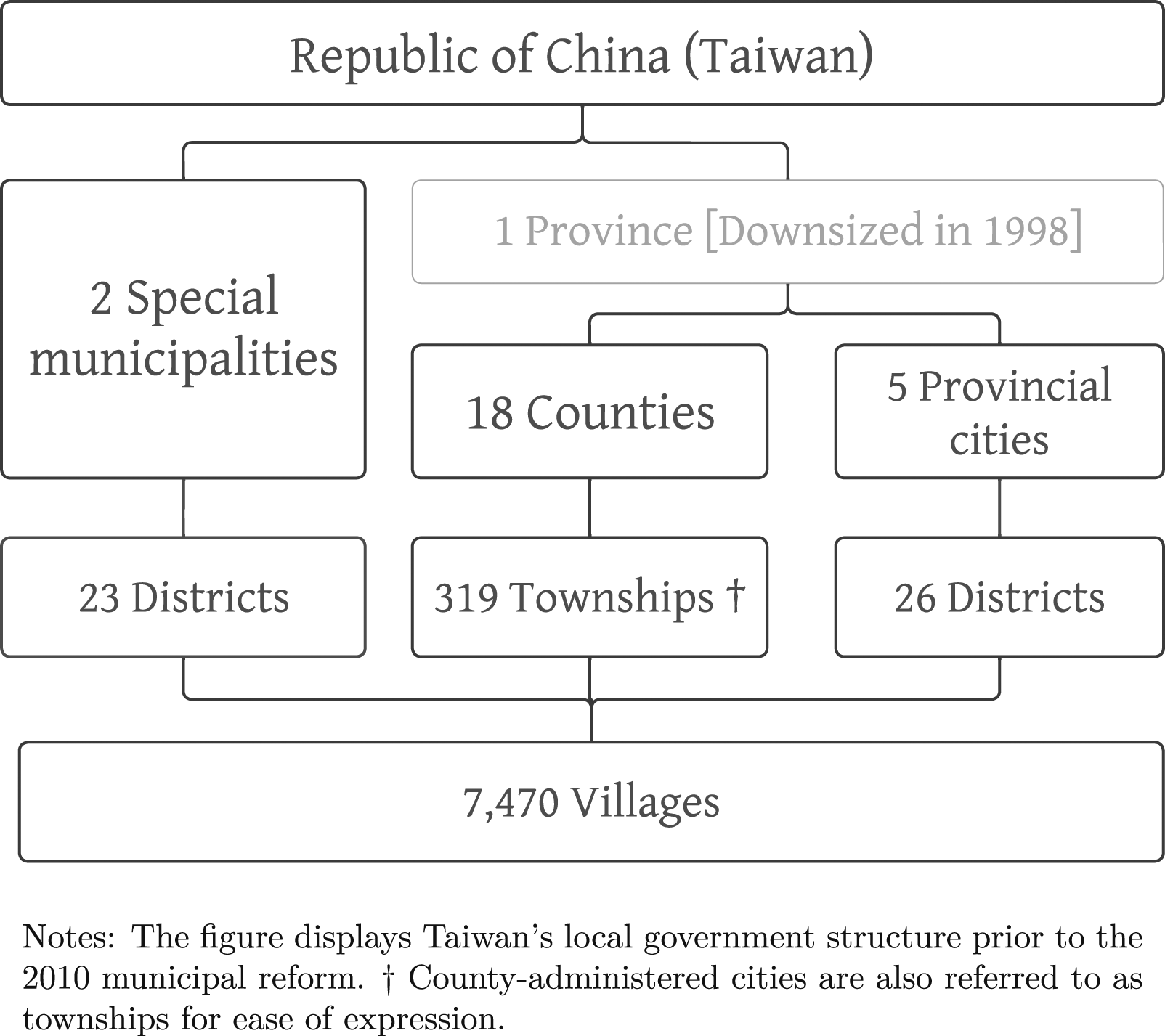
The second tier consists of townships and districts. As Figure 1 illustrates, townships are the sub-units of counties, while districts are the sub-units of special municipalities or provincial cities. In addition to this difference in administrative division, another major distinction between the two is that, according to the Local Government Act, townships—like the upper units of local government—are local self-governing bodies (Article 14), whereas districts are not. Instead, district offices are merely local branches of the upper tier of local government. This distinction is critical because that status grants townships the authority to exercise a range of decentralized functions that districts do not enjoy. 5
Townships are distinct from districts in three respects—political, administrative, and fiscal (Table A.1). Township governments adopt a horizontal separation of political power: they have an executive branch headed by a township mayor and a legislative branch (township council) composed of dozens of councilors to oversee the township executive power and approve budget and policy plans. Township mayors and councilors are popularly elected on a quadrennial basis. In districts, the key executive official—the chief administrator—is directly appointed by elected mayors of the upper special municipal or provincial city governments and is thus accountable to these elected mayors. Districts have no legislative branch to oversee the chief administrator.
In administrative terms, township governments establish formal walk-in offices to process local residents’ requests and run a wide range of bureaucratic agencies. Governments at this level are given administrative responsibility and discretion to provide public services such as social welfare, infrastructure maintenance (e.g., roads and street lighting), community development, and waste management. In sharp contrast, district offices have very little responsibility for (or discretion in) public service provision and only undertake simple administrative functions, most of which are paperwork based and related to service applications.
Finally, townships also differ from districts in their level of fiscal authority. Townships enjoy a degree of fiscal autonomy, 6 which includes more control over their own budgets and the right to retain own-source revenues from local taxes and fees. Districts have little fiscal autonomy; special municipalities or provincial cities have the sole authority to determine and allocate district offices’ budgets.
The 2010 Municipal Reform
From Decentralized to Centralized Governance
A 2010 municipal reform triggered a partial rollout of centralization in Taiwan. This reform did not transfer any power from local governments to the central government; it involved a vertical transfer of resources and powers between lower and upper tiers of local government. At the heart of the reform were four reclassifications into special municipalities: one county and three mergers of counties and provincial cities. Importantly, as a consequence of reclassification in this tier of local government, the municipal reform also entailed a reorganization of the sub-units (townships) under the former counties, resulting in their switch from townships to districts (sub-units of special municipalities). Since township governments have the power to perform decentralized functions, while district offices do not, this switch naturally ended the decentralized governance functions long performed by the former townships. 7
The reform’s reversal of decentralization can be characterized as what I call “comprehensive centralization,” which has political, administrative, and fiscal dimensions (Falleti, 2005; Manor, 1999). At the political level, chief administrators are appointed by mayors of special municipalities rather than elected. At the administrative and fiscal levels, special municipal governments take on administrative responsibility for the provision of most public services and directly allocate budgets for district offices (these budgets tend to be modest, given district offices’ simplified administrative responsibilities and functions). After the reform, newly converted district offices were no longer directly in charge of road maintenance (a core local public service); the reform shifted this responsibility upward to the public works departments of special municipal governments. 8 Since district offices, unlike township governments, lack the autonomy to raise their own revenue from local taxes and fees, the difference in revenue between township governments and district offices can be enormous. One newly converted district office saw its budget drop by 70% (from approximately USD 80 million to USD 25 million) after the reform (Shih & Sun, 2013). In short, the switch to appointments, the reduction of administrative responsibilities, and the significant loss of fiscal autonomy constitute the “comprehensive” nature of the centralization process. 9
Since the reversal of decentralization operated through the switch from townships to districts, this second tier of local government serves as the unit of study in my empirical analysis, which compares townships that became districts (treated) to those that did not (untreated). I exclude townships that were already districts (N = 49) prior to the 2010 reform from the sample. Of the 319 total townships, 108 switched to districts and were thus affected by the centralization treatment; the rest retained their decentralized governance functions.
Reform Background and Process
The 2010 municipal reform was designed to help achieve a long-term development goal dating back to the late 1990’s and early 2000’s to initiate regional planning and promote globally competitive metropolitan areas in Taiwan. Many policymakers and legislators believed a moderate increase in the number of special municipalities would improve administrative efficiency and urban competitiveness because they enjoy economies of scale and have greater appointment power and fiscal capacity. Support for the reform gained traction during the 2008 presidential election campaign when then-candidate Ma Ying-jeou promised “three capitals and fifteen counties” (Wang, 2009). With the KMT’s landslide victory in the 2008 presidential and legislative elections, 10 President Ma faced a more harmonious executive–legislative relationship than the 2000–2008 DPP government did, which allowed the Ma administration to push for reform more forcefully.
The Local Government Act stipulated that a candidate unit must have a population of at least 1.25 million and fulfill certain subjective conditions to be reclassified. To apply for reclassification, candidate units (counties or mergers of county and city) must pass a motion confirming that a majority of county and city councilors approve the proposal (Ministry of the Interior, 2011, 82–83). Formal requests are then forwarded to the Ministry of the Interior for review. The review board 11 considers the economic, political, and cultural significance of candidate units, as stipulated by the Local Government Act, as well as popular support from national public opinion polls (Ministry of the Interior, 2011, 268–282).
The reform resulted in four successful reclassifications. Three of the newly established municipalities were formed through amalgamation with a pair of neighboring administrative units (e.g., Tainan City and Tainan County), and one (Taipei County) was reclassified independently. There were also three unsuccessful reclassification proposals, including Changhua County, Taoyuan County, and the merger of Chiayi and Yunlin counties. According to the review board, these applications were rejected due to the lack of a clear vision for regional integration and of the majority support of the people nationwide (Ministry of the Interior, 2011, 92–96). 12
How did political elites and citizens react to the reform? The unified government gave central policymakers a strong incentive and capacity to implement the reform to fulfill President Ma’s campaign promise. Partisanship does not seem to have affected the success of reclassification applications, as the successful reclassification cases were equally split between counties under KMT rule and those under DPP rule. 13
Support for the reform among local politicians may have depended on what level of government they served. Among county and city politicians (mayors and councilors), there was a strong desire to adopt the reform in their jurisdictions, regardless of party affiliation. 14 Because special municipalities wield more administrative and fiscal power, a successful reclassification could help county and city politicians advance their political careers and expand their future power. Their support for the reform could have also been a response to strong citizen demands. Local citizen support for the reform was high: average support in counties and cities that were ultimately reclassified amounted to 69%, according to polling results conducted by the Ministry of Interior (Ministry of the Interior, 2011, 88). Arguably, the major source of opposition came from township officials who feared losing their positions due to the switch from elections to appointments associated with the reform (Su, 2013). These dissenting officials would have hoped to advocate for chief administrators to continue to be popularly elected and not appointed. However, they had no formal veto power as they could not participate in any of the legislative and review processes that led to the reform.
Potential Limits on Taiwan’s decentralized Governance
It is important not to exaggerate the success of decentralized local governance in Taiwan, which has long faced a variety of constraints and challenges. One limit on the practice of decentralized governance pertains to the lack of local fiscal capacity. Decentralization devolves only partial fiscal authority to township governments. Between 2000 and 2011, intergovernmental transfers accounted for more than one-third of township government revenue (Kuo and So, 2013, 335). In remote townships, local revenues are often insufficient to maintain well-functioning local governance (e.g., to pay for street lighting (Lin, 2021)). Township governments are usually unable to properly execute and complete some infrastructure and construction projects (e.g., building community activity centers) without applying for additional funding from higher levels of government.
Another serious problem associated with local decentralized governance is local elite capture. I use the term “local elites” to refer primarily to elite networks, or factions, at the township level, including elected township officials, local notable families, and village chiefs. Local politics in Taiwan is heavily influenced by the legacy of the KMT Party’s long autocratic rule. After retreating from Mainland China to Taiwan in 1949, the KMT government faced strong incentives to garner local support to consolidate its rule on the island (Wu, 1987). To co-opt local elites, the KMT reached out to local influential families, granting them political positions (usually with local party machines to help them win elections) and permits to run monopolized industries to maximize their rents (Huang, 1996; Wu, 2003). In exchange, many local elites have long been the KMT’s local allies and served as an integral part of the party’s election machine (Chen, 1995; Wang, 1996). 15 For all five township elections held between 2002 and 2018, KMT candidates held about 50% of the political offices; DPP candidates 16% of political offices; and independent candidates 32%. 16
Local elite capture in Taiwan takes several forms. To obtain political office, local candidates have long been found to employ a variety of tactics to manipulate electoral outcomes, such as vote buying (Wang & Kurzman, 2007; Wu & Huang, 2004), “voter” buying (Hidalgo & Nichter, 2016), and opposition intimidation. Once in office, local political leaders engage in a variety of illegal activities such as influence peddling, taking kickbacks from government procurement contracts, and embezzling public funds (Wu, 2019). For illegal activities such as electoral intimidation and procurement-related corruption, local political officials often collude with organized crime to reinforce reciprocal relationships in rent extraction (Hood, 1996). Thus, the extent to which the promises and spirit of townships as sites of self-government have been fulfilled remains highly disputed.
Theoretical Foundations
Few theoretical debates in comparative political economy are as controversial as the benefits and costs of decentralization vis-à-vis centralization (Bardhan, 2002; Treisman, 2007). A canonical theory argues that decentralization facilitates interjurisdictional competition (Tiebout, 1956). By transferring tasks and responsibilities to more local units of governance, decentralization allows mobile capital to better sort itself into preferred local policy packages. According to advocates of decentralization, local units also have the advantage of more information about local preferences and can therefore craft and experiment with policies and services that better meet local needs (Hayek, 1948; Sadanandan, 2017). Political decentralization also brings in local elections through which local citizens can sanction poorly performing officials. Electoral accountability thus motivates opportunistic politicians to behave in congruence with local voters’ preferences (Barro, 1973; Besley, 2006; Ferejohn, 1986). Overall, the bulk of the literature associates decentralization with the advantages of competition, information, and accountability.
Despite these well-known theoretical mechanisms, less attention has been paid to how administrative, fiscal, and political decentralization (or different subsets of combinations) together affect governance outcomes. Drawing on the Taiwanese reform context, this study theorizes that a full combination of the three (i.e., comprehensive decentralization) improves local public goods more, especially those relevant to citizen welfare, than other partial combinations. I treat each type as a separate pillar that underpins decentralization: administrative decentralization devolves the responsibility for service delivery to sub-national governments; fiscal decentralization empowers sub-national governments with the fiscal capacity to adequately fund and execute public projects; and political decentralization gives those in control of the local state a strong incentive to respond to local concerns rather than the preferences of their appointers, which may not be aligned with local needs. When all three pillars are in place, decentralization is more likely to provide public goods that improve local citizens’ welfare.
Since the Taiwanese reform uniquely removed not just “responsibility” and “capacity” but also “incentive,” it is informative to focus on how the “incentive” pillar (or lack thereof) makes a difference. Two recent works are particularly relevant in this regard. Beazer and Reuter (2022) analyze the effect of canceling local elections on pro-poor policy in Russia. They find that with administrative and fiscal dimensions left intact, a reversal of political decentralization incentivizes sub-national officials to place greater emphasis on advancing the central appointers’ core interests than on promoting citizen welfare. Focusing on Ethiopia, Kosec and Mogues (2020) also suggest the importance of political decentralization in aligning officials’ incentives. They find that in an autocratic context without effective political decentralization, the partial rollout of administrative and fiscal decentralization leads sub-national politicians to prioritize productivity services that better advance their interests (i.e., rent extraction) over social services that improve citizens’ utility. Taken together, these findings suggest that although administrative and fiscal decentralization may increase government efficiency in service delivery, the addition of political decentralization better incentivizes public goods providers to focus on services that improve citizen welfare. Because a reversal of comprehensive decentralization undoes any beneficial effects of decentralization, this study expects it to have a negative impact on service delivery.
The switch from townships to districts (i.e., comprehensive centralization) will result in a reduction in the provision of public goods.
However, many scholars also recognize that most of the theorized benefits of decentralization can only be realized under certain conditions, which are not always present. In a context characterized by spillovers and a limited degree of local heterogeneity in tastes, most theories suggest that decentralized provision can be inferior to centralized provision that produces a “one size fits all” outcome (Besley & Coate, 2003; Oates, 1972). In practice, decentralization can also create extra nodes in the multi-layered governance structure and thus reduce administrative efficiency (Malesky et al., 2014). A growing body of evidence suggests that local elite capture may circumscribe the theorized benefits of decentralized governance. The concept of elite capture is used in at least two ways in the literature. First, decentralization creates a window of opportunity for local elites to capture local policymaking and implementation processes (Bardhan & Mookherjee, 2000). Mounting research on development economics has found that local elites divert decentralized public resources to advance their private interests (Reinikka & Svensson, 2004), counteract community monitoring initiatives (Olken, 2007), hijack the social service delivery targeting the poor (Bardhan & Mookherjee, 2006), and exert their informal influence to affect the group decision-making process and extract rents (Mattingly, 2016). Second, in the dimension of political decentralization, local elites can adversely impact the quality of election processes (Acemoglu & Robinson, 2008; Martinez-Bravo et al., 2017) through the use of coercive patron–client relationships (Baland & Robinson, 2008; Frye et al., 2014), electoral manipulation (Ascencio & Rueda, 2019; Ofosu, 2019) and violence (Christensen et al., 2019; Fergusson et al., 2021). To the extent that local elites can employ such de facto measures to capture local election processes, these elites can undermine the power of accountability mechanisms otherwise promised by political decentralization. The two conceptualizations of elite capture are related. Rueda and Ruiz (2020) formally derive and find that those who take office in the absence of fair electoral competition are more inclined to use their political positions to secure private rents. Accordingly, if local elite capture, as these studies find, renders the purported promises of decentralization undelivered, this may constitute a reason to prefer a more centralized system that helps block elite influence. With centralization, upper-level officials and bureaucrats are given greater responsibility for service delivery because more administrative functions and fiscal resources are under the control of upper-level governments. The transfer of authority thus helps mitigate the potential negative impact of local elite capture on local governance. The switch to an appointment system (i.e., political centralization) also allows upper-level leaders to bypass entrenched local elites—whose behaviors may not be meaningfully constrained by electoral mechanisms—and appoint like-minded officials. Indeed, many centralization reforms (e.g., Taiwan, Vietnam, the Progressive reform movement in the U.S.) and policy domains (e.g., China’s judicial centralization reform since 2015) were motivated at least in part by policymakers’ desire to curb local elite capture. Recent scholarly work lends some credibility to the elite-undermining effect of centralization. Utilizing both administrative data government transfer programs and field experiments in Indonesia, Alatas et al. (2013) find modest evidence that “elite capture …for formal elites is more likely to occur in areas where the village leadership is elected.” In a similar vein, Malesky et al. (2014) find that abolishing local councils in Vietnam helped prevent local elites from diverting public resources for their own benefit and attributed improvements in service delivery to the mechanism of elite undermining. Accordingly, despite the alleged overall negative effect of comprehensive centralization (i.e., H1), the above discussion implies that centralization is likely to improve service provision if local elites engage in extensive manipulation under decentralized governance.
As the level of elite capture increases, centralization will have a greater effect on service provision.
Research Design
Dependent Variables
The dependent variables are five public goods measures at the township/district level. The first is tap water coverage, which is the percentage of township (district) residents that has access to piped water. Relevant data are sourced from the annual statistical reports of the Taiwan Water Corporation (a state-owned enterprise). The second and third public goods measures are the number of community libraries and activity centers; the data for these are retrieved from the Socio-Economic Geographic Information System (SEGIS). The fourth variable is accidental injury death rate, most of which is made up of motor vehicle deaths. I use this variable to proxy for road conditions, a widely used public good that has received considerable attention in prior studies. To justify this measure, I assume that motor vehicle deaths can be partly explained by road conditions, such as roughness or wetness, which is likely to hold in the Taiwanese context as the vast majority of people commute by scooter. I obtain data on the cause of death statistics released by the Ministry of Health and Welfare. The final measure is public columbarium (i.e., public storage of cinerary urns). I focus here on the maximum number of niches at the township/district level. I divide the number by the elderly dependency rate to account for demographic demands. The degree of data missingness is higher for libraries, activity centers, and public columbaria because not all county/city/special municipal governments publish these data on SEGIS.
By selecting these variables, this study considers the extent to which township governments have the necessary resources, responsibilities, and authority to provide these public goods. The involvement of township governments is critical, whether in applying for funding from higher levels of government to finance public projects, participating in the implementation process, or helping to express local needs. This calculation serves as a benchmark for comparing with the level of public goods provision in newly converted districts, which have assumed very little responsibility for providing these goods since the centralization reform.
Further, the five chosen outcomes are important local public services, albeit with varying degrees of government involvement. For instance, since road conditions are highly visible to voters in the course of their daily lives, road maintenance has long been a core public service of great concern to elected officials; township governments thus make sure to set aside the necessary staff and budget to conduct ordinary road maintenance (e.g., repairing potholes). The importance of community buildings and public columbaria in local government activity has also increased due to the country’s rapidly aging population. This demographic shift has generated strong demands for public facilities to provide long-term care, recreational activities for the elderly, and storage of cinerary urns. However, to finance these construction projects, township governments usually need to apply for additional funding from higher levels of government. Lastly, the demand for piped water is uneven and tends to be more pronounced in rural and mountainous areas. The expansion of tap water coverage depends heavily on the joint efforts of local branches of Taiwan Water Corporation. I analyze tap water coverage because it is reported that township governments can still play a role in communicating local demands to upper-level government officials (Chang, 2021; Chiu, 2021) and co-producing piped water supplies by assisting in the replacement of old water mains (Chang, 2014).
Table A.2 summarizes the five public goods outcomes in three dimensions—government involvement, reliance on intergovernmental transfers, and the intensity of citizen demand. With contrasting degrees of variation in these three dimensions, analyzing the five public goods offers a useful range to bracket the effect of centralization on local service provision. Specifically, centralization should be expected to have a stronger effect on road conditions and a weaker effect on piped water supply.
I exclude some important public goods from the analysis. For example, social welfare provision is a major function of township governments, 17 but social expenditure data, the primary outcome measure of welfare provision, are unavailable for each newly converted district after the reform. I also exclude education and health services, which are prominent in other work—especially the number of primary schools and hospitals 18 —because upper-level (rather than township) governments have decision-making authority over the construction of new schools and hospitals. Additionally, the number of schools has greatly diminished in importance due to Taiwan’s chronically low fertility rate. 19
Different tiers of local government share similar policy objectives. On the one hand, higher-level local governments (e.g., special municipal governments in this study) serve a larger jurisdiction and enjoy economies of scale. 20 On the other hand, to the extent that public goods such as road maintenance and public facilities are important local needs, providing these goods can remain a major policy goal for reelection-minded special municipal mayors. I return to the issue of misaligned objectives in Alternative Explanations section.
Explanatory Variables
The main independent variable of interest is centralization caused by the municipal reform. This is a dummy variable that takes a value of 0 for township-years in which decentralization remains, and 1 for years in which centralization was implemented. Figure 2 visualizes the scale of the units affected by the reform. Treated units are indicated in blue after 2010, while those that remain gray are the control units.
21
The geographic Distribution of treated and untreated units.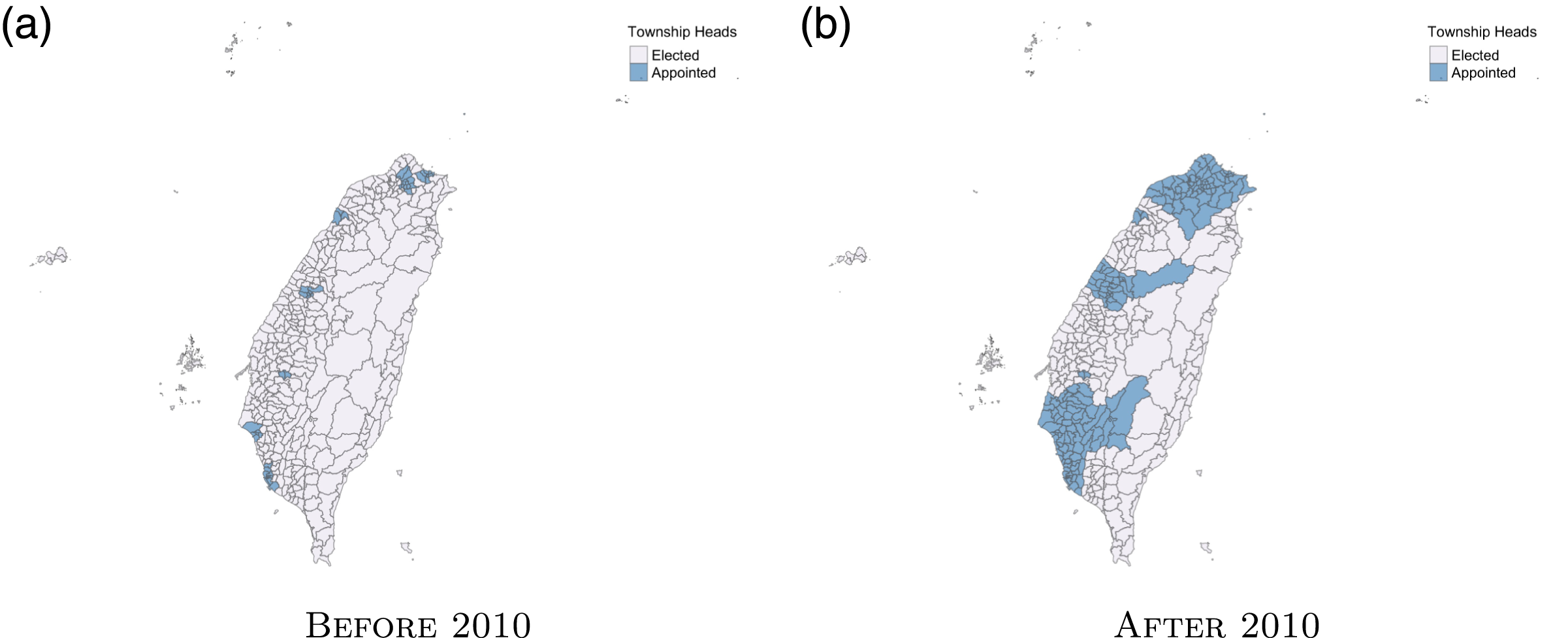
Another key explanatory variable of interest is a measure of local elite capture. I follow Ferraz and Finan (2011) and Rueda and Ruiz (2020) and hand code online court rulings documenting whether candidates or brokers engaged in electoral malpractice (e.g., vote buying and electoral intimidation) in a given township district. I gather data on court rulings at the district court level 22 from the Law and Regulation Retrieving System. 23
I collect and focus on court rulings concerning electoral malpractice on two grounds. First, the electoral dimension speaks to the very theoretical idea that local elites can exercise de facto power to offset political decentralization. Second, in order for elites to employ other forms of elite capture, such as corruption, they must first secure their positions. Therefore, the way in which local elites are elected and take office gives us meaningful information about how they will behave in office. Rueda and Ruiz (2020) formally derive and empirically find that rent extraction increases with the level of electoral manipulation.
Methodologically, my coding scheme considers whether a court found any of three related actors guilty—the elected township official, other candidates, and any brokers involved in electoral malpractice. I apply the two-parameter logistic item response theory (2pL IRT), which regards each item of investigation outcome as a manifest of a latent trait, to generate a latent quantity of local capture for township-years before 2010 in which elections were held. 24 I average all the election-year values within each township to calculate the final pre-treatment variable of local capture. 25
The validity of the measure of elite capture largely depends on the extent to which local courts’ decisions are insulated from local political forces. However, Taiwan’s judicial system exhibits features that help reduce the extent to which township-level political forces can capture local courts. The funding of local courts and the judicial personnel management system—two major forms of political control over the judiciary (Wang, 2015)—are not dependent on any level of local government. Local court budgets are mainly planned and approved by the judicial (the Judicial Yuan) and legislative branches (the Legislative Yuan) at the central level. As for personnel management, the Personnel Review Committee of the Judicial Yuan reviews local judges for promotion. The committee is composed mainly of officials in the Judicial Yuan, judges from various regions, and legal scholars. 26 Such a centralized system helps reduce the extent to which local officials can capture the local judiciary through personnel and fiscal channels.
However, local political forces might bias the courts’ decisions through informal channels. To mitigate the degree of potential bias, I construct the pre-treatment variable by taking multiple indicators into account for different actors across periods. This approach leverages the fact that the extent to which the local judiciary can be influenced through informal channels varies with the different types of actors and time periods being considered. As a robustness check, I also examine the conditional hypothesis by using another related variable—local political awareness, measured as the share of the population with primary education and below 27 —to proxy for local elite capture. The use of this alternative measure is theoretically motivated by Bardhan and Mookherjee (2000), who find that local elite capture decreases with citizens’ political awareness. Here, the presumption is that to the extent that the measure of local elite capture based on court rulings is valid, at a minimum the conditional results based on the measure should be very similar to those based on the alternative measure. 28
Lastly, this study demonstrates construct validity by showing that the measure produces theoretically expected results. I regress the latent variable on a vector of covariates thought to impact elite capture according to the literature and the Taiwanese context. Figure B.1 indicates that the latent measure is positively correlated with the KMT’s national legislative election vote share, which is in line with previous findings that many local elites were local brokers cultivated during the KMT’s authoritarian rule (Chen, 1995; Wang, 1996; Wu, 1987). I also find that, consistent with theoretical expectations from the literature on clientelism (Kitschelt & Kselman, 2013; Kitschelt & Wilkinson, 2007), the variable is negatively correlated with mean household income levels (a measure of economic development) and population density (a measure of urbanization).
Identification Strategy
I employ a DiD design to investigate how centralization affects service provision. The key assumption of DiD design is the parallel-trends assumption—that treated and untreated townships would have followed the same trend in public goods provision had the municipal reform not occurred. I take several steps to check if the assumption holds in this context. To examine whether there are differential pre-trends prior to the reform, I first estimate a dynamic treatment effects model that includes leads and lags, as advocated by Angrist and Pischke (2008), and display the results in Figure 3. As shown, I find no evidence that the public goods measures I consider exhibit divergent pre-trends between treated and untreated units. Dynamic treatment effects with leads and lags.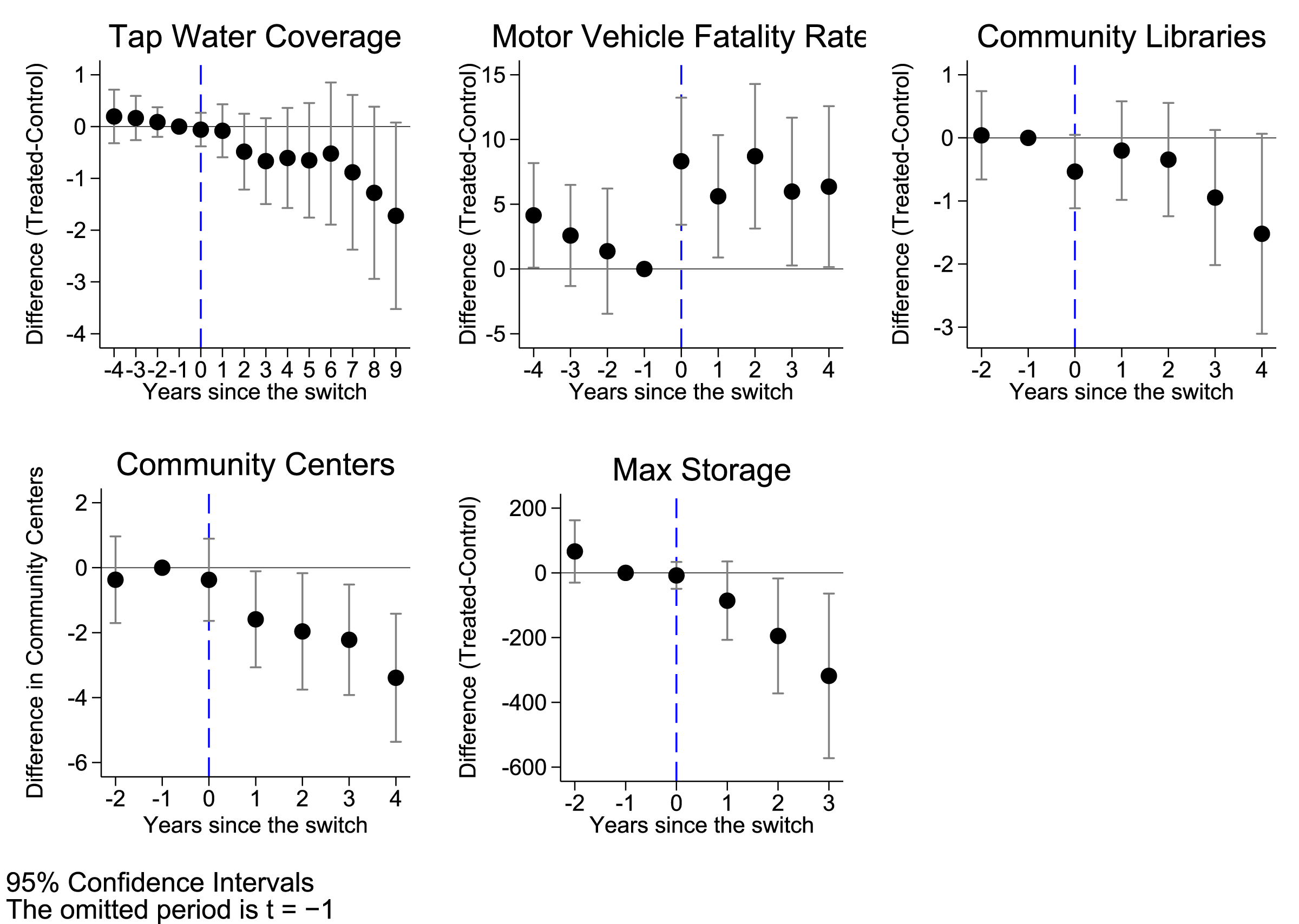
To mitigate general concerns about the influence of time-varying confounders on the pre-trends, I reconstruct a control sample that ensures balance across several pre-treatment variables. I apply entropy balancing (Hainmueller, 2012), reweighting the untreated observations using pre-treatment outcome variables and time-varying covariates such as population size, economic development, old-age dependency ratio, etc. This approach is designed to bolster the credibility of the assumption that treated units would have followed the counterfactual trend if the municipal reform had not been enacted. 29
Finally, in robustness checks, I conduct a DiD analysis on a subsample of treated and untreated townships that lie on either side of a municipal–county border. 30 Given that the geographical boundaries were at least somewhat arbitrarily drawn, 31 the fact that some units along the borders received the treatment while others did not was arguably an “as-if” random process, which helps allay concerns that some units selected into the reform. In addition, since units near the border tend to be “peripheral,” the strategy excludes units in core areas that are more likely to spur population growth, investment, and urban development projects, thus diminishing the possibility of differential pre-trends as well as the role of alternative explanations in driving the results. Figure B.2 visualizes the geographic location of the near-border units.
The generalized DiD model specification takes the form of

Note that Equation 1 does not include a vector of time-varying covariates. Since most of the relevant time-varying variables are arguably posttreatment, their potential impact on causal identification needs to be treated more carefully than simply controlling for them. To avoid posttreatment bias but still account for time-varying confounders, I employ sequential g-estimation as advocated by Acharya et al. (2016) to uncover the average controlled direct effect, which helps adjudicate whether my DiD findings are mainly driven by other competing explanations (indicated by time-varying confounders) rather than by centralization reversals. For relevant time-varying covariates, I consider population size and local economic development (measured the mean household income), both of which could be affected by the municipal reform and explain the outcome variables.
Analysis
Main Results
Main did results.
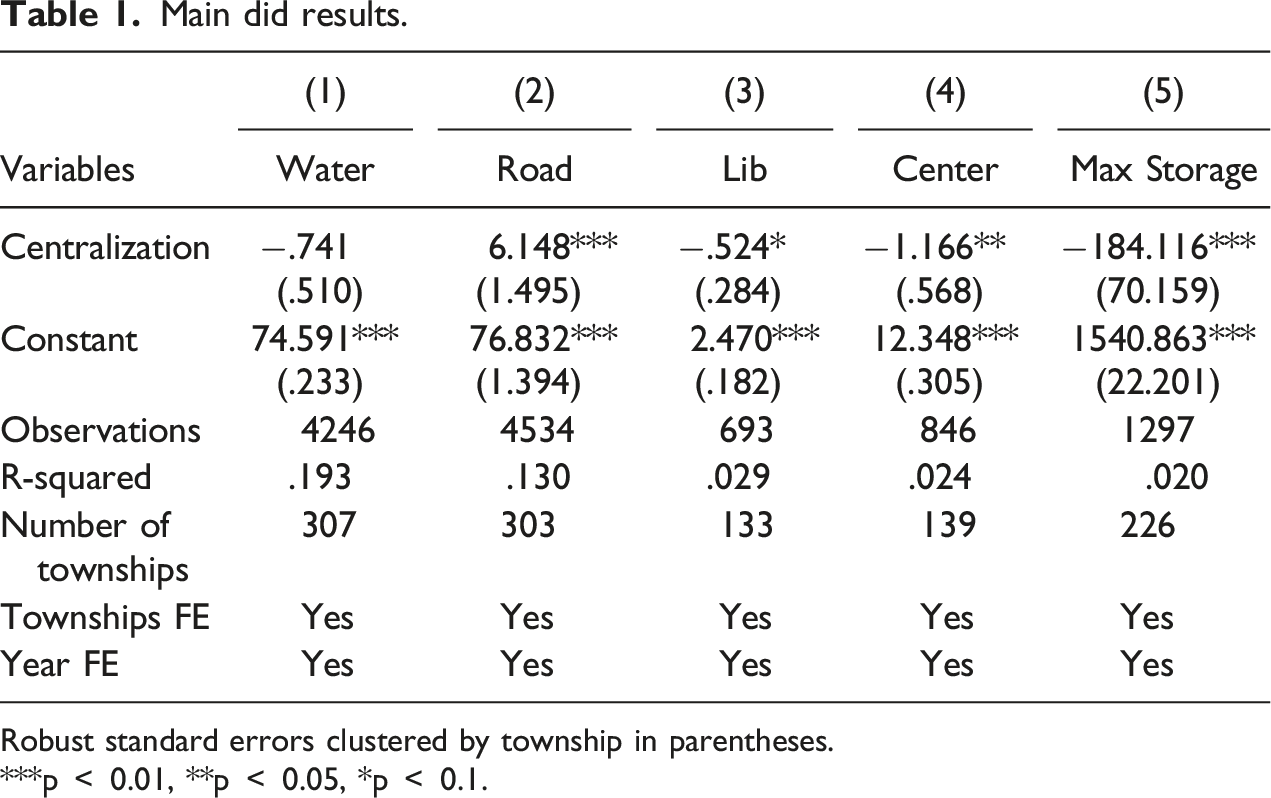
Robust standard errors clustered by township in parentheses.
***p
The credibility of DiD results hinges upon whether the parallel-trends assumption is met. To check this, I estimate a more flexible, non-parametric DiD model including leads and lags that indicate the difference between switching and non-switching units at τ years away from the reform. 33 This specification allows me not only to trace the over-time effect of centralization efforts but also to provide statistical tests to assess whether the pre-trends between treated and untreated townships were already significantly different prior to the reform. Figure 3 displays the results. Each of the black dots, paired with 95% confidence intervals, denotes the difference in public goods provision between switching and non-switching townships at τ years relative to the reform. The figure indicates that estimates for each public good before the reform (i.e., left of the blue dashed line) are statistically indistinguishable from zero, as the 95% confidence intervals overlap with y-intercept equal to 0. This shows that the dynamic treatment effects only become significant—and are in the expected direction—after the reform (i.e., right of the blue dashed line). These results thus provide additional evidence in support of the parallel-trends assumption.
Taking a more conservative approach, I rerun the DiD regression model with clustered standard errors at the county level. To address the issue related to a few clusters of treated units, I apply the wild cluster bootstrap procedure (Cameron et al., 2008; Canay et al., 2021). Moreover, following Malesky et al. (2014), I re-estimate the main results at the county level. This approach is advantageous for wiping out heterogeneity in townships within treated and untreated units, although it is also risky because of the loss of statistical power in aggregation. Tables C.2–C.3 display these results, which demonstrate that the negative effect of centralization is more robust on the provision of road maintenance and public columbaria, two public goods that have greater township government activity and citizen demands.
Finally, I show that the main results are robust to the following robustness tests: 1) placebo tests that first subset the data prior to the reform and then estimate the DiD results assuming the reform happened years earlier (Table C.4); 2) weighted least squares regressions using the baseline DiD model with weights calculated through entropy balancing (Hainmueller, 2012) (Table C.5); 3) a DiD analysis that focuses on treated and untreated units on different sides of the municipality–county border (Table C.7); 4) the panel jackknife procedure to ensure that the results are not driven by any township panels (Figure B.3); 5) an analysis of a placebo dependent variable on which we should not find a significant DiD effect (Table C.8); 6) sensitivity analyses (Cinelli & Hazlett, 2020; VanderWeele & Ding, 2017) gauging how robust the DiD results are to the threat of unobserved confounders (Table C.9); and 7) combining all five dependent variables into an index by averaging five standardized outcome variables (Table C.10).
Mechanisms
This paper has demonstrated that reversing decentralization measures leads to a decline in service provision in Taiwanese localities. To investigate the mechanisms underlying this result, in this subsection I first draw on qualitative evidence from interviews with district officers, legislative councilors, and public officials from several newly established special municipalities. I then rule out two alternative explanations to increase our confidence in the conclusions drawn from the qualitative evidence.
Centralization Reduced Administrative Efficiency
Many believe that centralization facilitates administrative efficiency as it helps reduce excessive nodes in the multi-layered governance structure. However, qualitative studies consistently find that centralization exacerbates administrative efficiency because newly converted district offices do not exploit the potential advantages of proximity after such reforms are implemented. Administrative centralization transfers numerous public service tasks that were previously the responsibility of township governments to different departments of special municipalities. Thus, many bottom-up demands for public service that township governments could previously address must now go through much lengthier administrative processes—starting with notifying village units in district offices to the arrival of bureaucrats from special municipal governments—which reduces government responsiveness. The following account from a district executive exemplifies this problem: Take filling a pothole as an example. We have to follow the procedure and it takes a lot of time …Therefore, residents would react: what is the point of switching to a district office? In the past, the township mayor could make a decision in the morning and execute it in the afternoon. You …dragged it for a month. That’s why you receive such a reaction. (Yu, 2013, 71)
The lengthier administrative processes are more problematic for remote areas: If it is a remote area, then the influence is certainly large. In the past, village chiefs reflected demands, and the township government could directly assign staff. But, now even though they file a request to the district office, the office has to fight for it and then pass it on to the municipal government. The speed of implementation will be much worse. (Shih & Sun, 2013, 587)
In addition to the longer waiting times, the lack of fiscal autonomy in district offices is also a crucial factor in the reduced responsiveness. Prior township governments had the authority to raise funds and tailor their own budgets to respond to local needs, but the newly converted district offices lost such fiscal authority. Instead, their budgets are allocated by special municipal governments. Due to the shrinking of administrative functions, special municipal governments tend not to allocate too much funding to district offices. Accordingly, many interviewees across different positions suggested that rather than holding all the power and resources in hand, special municipal governments delegated a certain degree of administrative and fiscal power to district offices to redress the responsiveness gap (Shih & Sun, 2013, 202).
Alternative Explanations
Average controlled direct effects.
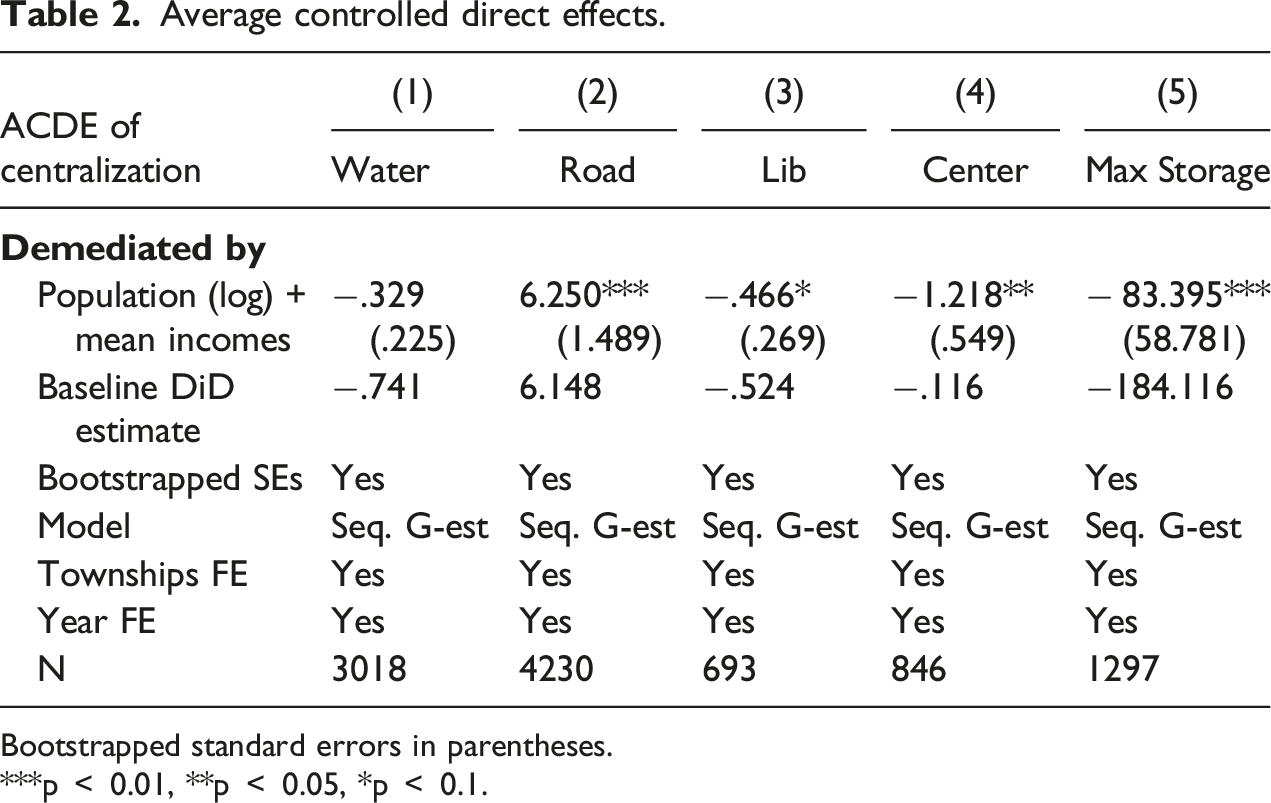
Bootstrapped standard errors in parentheses.
***p
Heterogeneous Treatment Effects by Local Elite Capture
To test the conditional effect of local elite capture, I re-estimate Equation 1 by interacting the centralization variable with a latent measure of local elite capture, which is generated by applying 2pL IRT to the outcomes of investigations of electoral malpractice among elected township mayors, other candidates, and brokers. The latent measure is a continuous variable spanning from −.23 to .89; higher values indicate more serious local elite capture during elections prior to the reform. If we find evidence in support of the conditional hypothesis, we should observe that the coefficient of the interaction term, centralization×local elite capture, is positive and statistically significant.
Heterogeneous treatment effects by local elite capture.
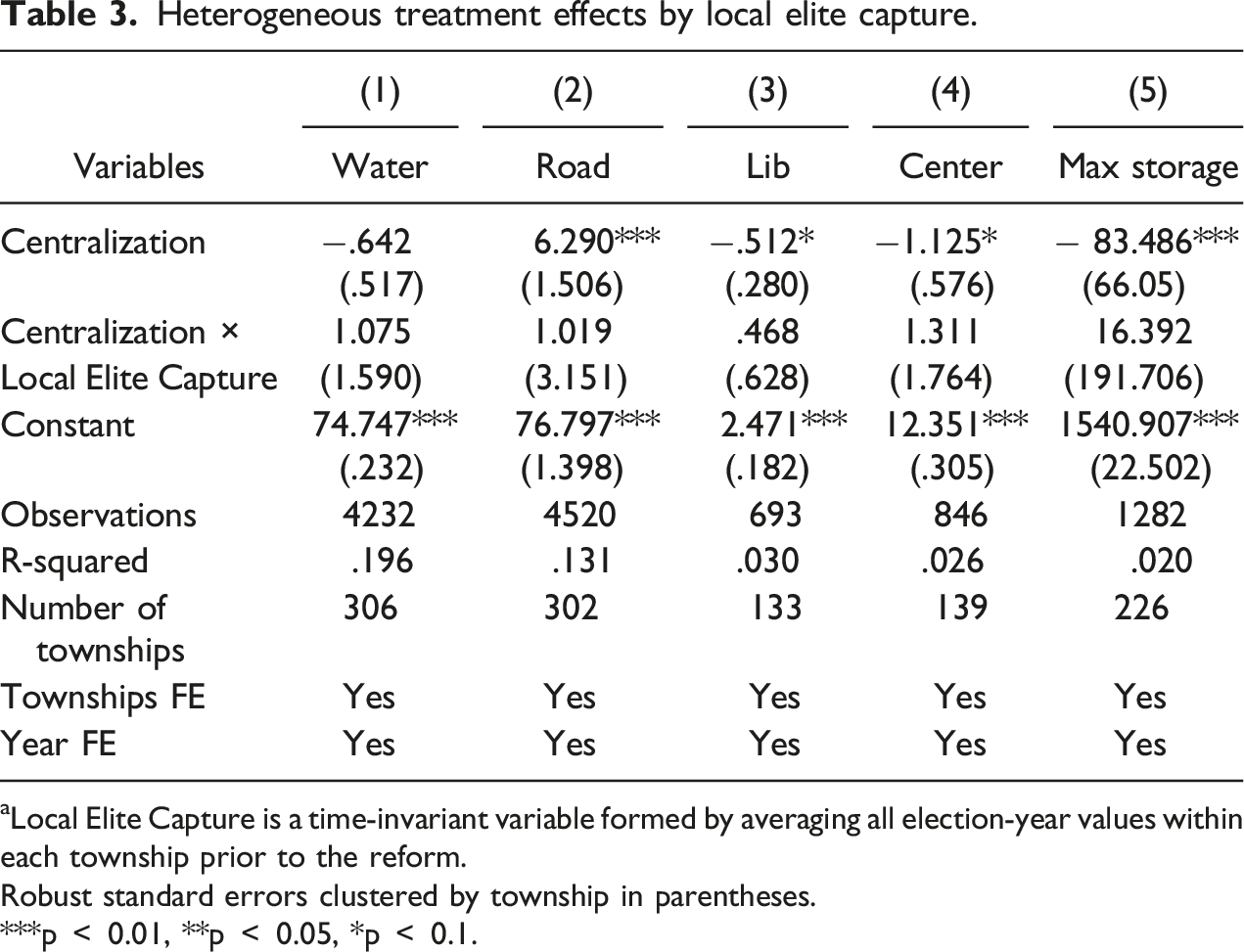
Local Elite Capture is a time-invariant variable formed by averaging all election-year values within each township prior to the reform.Robust standard errors clustered by township in parentheses.
***p
To better evaluate the magnitude of the interaction effects, Figure 4 plots the marginal effects of centralization over the entire range of the local elite capture measure. Across all panels, the marginal effects of centralization vary positively (but weakly) with local elite capture. For the outcomes of libraries and community centers, moving the value of local elite capture from the minimum to the maximum attenuates the decline in these outcomes due to centralization, but this attenuation is not discernible. The slope of the predicted effects for urn storage capacity is very close to zero, and the effects are statistically significant only in the middle range of the measure.
34
Marginal effect of centralization on public goods provision.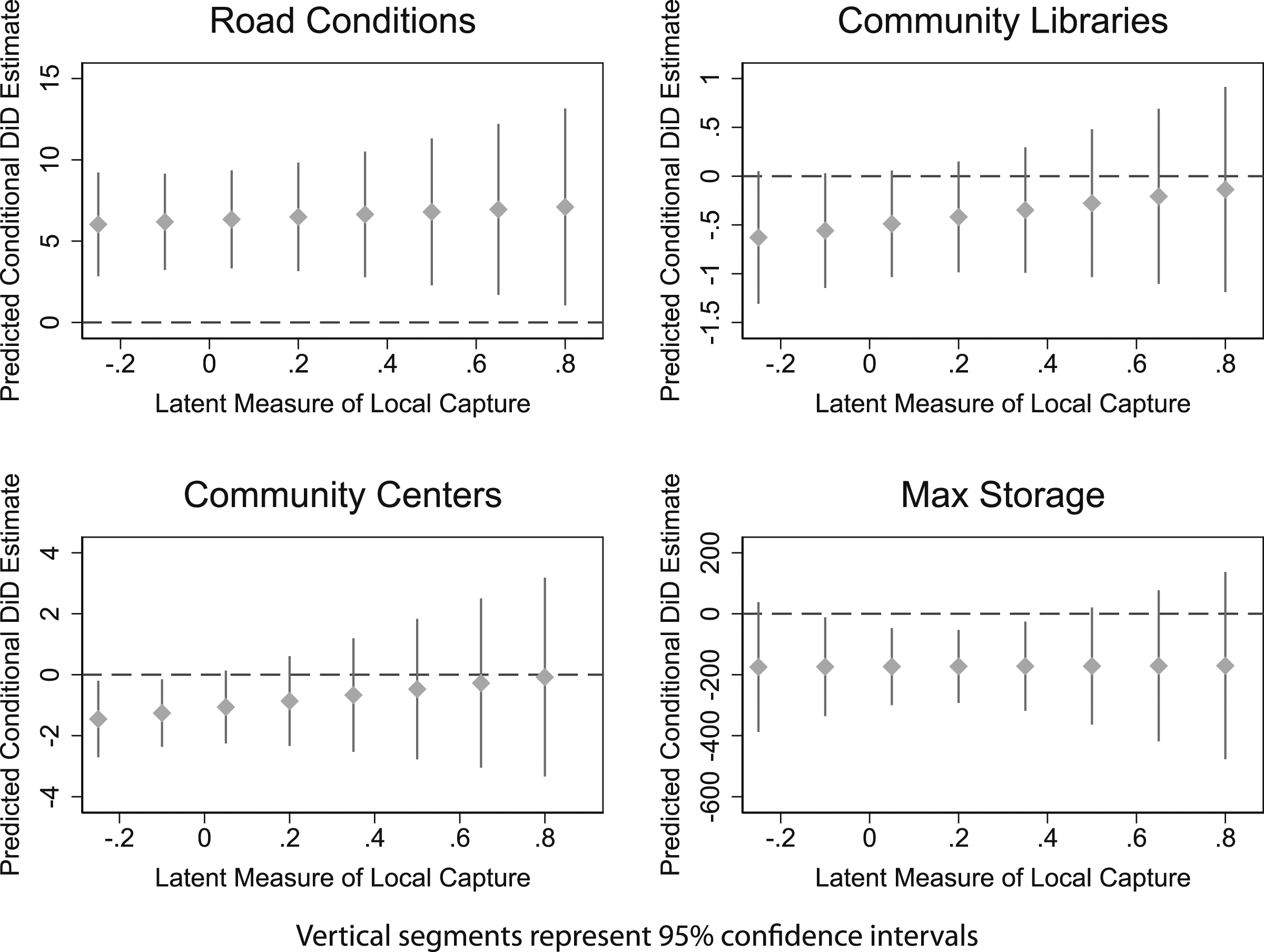
To mitigate the potential difficulties associated with measuring the main variable of elite capture, I replicate the heterogeneous analyses using the share of residents with a primary education or less as a measure of political awareness. Bardhan and Mookherjee (2000) posit that local capture decreases with the degree of political awareness, which is also an important foundation underlying political accountability (Dunning et al., 2019; Grossman and Michelitch, 2017). The results of heterogeneous analyses by political awareness (see Table C.11 and Figure B.4 for the marginal effect plot) yield very similar conclusions. Overall, a series of heterogeneous analyses suggest that there are only weak average treatment effects conditional on local elite capture.
Discussion
In this section, I discuss additional implications of the empirical results, the limitations of this research, and the generalizability of the findings. Many pundits and policymakers support a more centralized system because they believe centralization can reduce elite influence, thus improving local governance. However, the negative effect of centralization and the null results of heterogeneous analyses call into question the mechanism of elite undermining in the Taiwanese context.
I first offer evidence regarding this implication of the findings. I conduct an additional quantitative analysis on the elite-undermining effect of centralization, analyzing the change in local elite influence in the election process. I utilize micro-level survey data collected in five waves (2004–2020) of Taiwan’s Election and Democratization Study (TEDS) presidential elections modules and conduct a DiD analysis at the individual level. To gauge the degree of local elite activity, I focus on respondents’ answers to questions regarding whether they were canvassed by local factions, notables, or village chiefs during the elections. Although this is a crude gauge of the de facto power of local elites, the resulting measure mitigates social desirability bias, which typically plagues direct questions on vote buying.
Table C.13 displays the micro-level DiD results. Model 1 presents the aggregate DiD estimate, which indicates that centralization reduces local elite electoral mobilization by .0329, but the effect is less precisely estimated. Model 2 presents the dynamic treatment effects, which reveal a more nuanced pattern of the elite-undermining effect of centralization. The effect magnitude increases over time, but is not generally substantial in the short term. I do not observe a more discernible difference between the treatment and control groups until after the 2016 election. These findings suggest that the elite-undermining effect of centralization may require a longer time to materialize—a profound temporal dynamic that prior studies have not fully appreciated.
One limitation of this study pertains to the causal mechanisms underlying the main results. Since the centralization reform involved administrative, fiscal, and political dimensions, it was in essence a bundled treatment, which makes it very difficult to isolate which dimension of centralization is the primary driver of the main results. For example, the qualitative evidence on mechanisms attributes the loss of administrative efficiency to both administrative and fiscal centralization. However, there is some suggestive evidence that political centralization (i.e., the cancellation of township elections) might also lead to a reduction in public goods provision. In supplementary information E, I provide a more detailed, empirical discussion of why the importance of political centralization cannot be dismissed entirely.
The large-scale nature of the centralization reform evaluated here has broad implications for the generalizability of the main findings. The depth and breadth of Taiwan’s centralization reform are arguably more sweeping than the cases studied recently by others, which only encompass a subset of the three centralization dimensions. 35 The Vietnamese context Malesky et al. (2014) examine arguably provides the most similar level of centralization efforts to the Taiwan case—namely, the abolition of District People’s Councils (local legislative branch). Still, Taiwan’s centralization reform took place in a consolidating democratic environment 36 in which local governments are subject to greater political accountability than in Vietnam’s one-party system, where the ruling party largely controls local elections.
Given the sweeping nature of its centralization reform, Taiwan represents a most-likely case for the effects of centralization, whether positive or negative, to be found. It represents a strong case to evaluate how important the theorized benefits of decentralization are in promoting governance outcomes. This paper aligns with Beazer and Reuter (2022) and Flèche (2021), who show that centralization measures are negatively associated with various outcomes of citizen welfare. Yet, my empirical findings contradict those of Malesky et al. (2014), who find that abolishing local councils improves service delivery, which they attribute to the erosion of elite capture. The evidence on mechanisms I draw from qualitative interviews suggests a different story underscoring the loss of administrative efficiency and responsiveness. My survey evidence also reveals that the elite-undermining effect of centralization requires longer to manifest. Combined, these supplementary findings suggest that for a large-scale centralization reform, the loss of efficiency and responsiveness is likely to outweigh the benefits of elite undermining in the short run. Future research should examine why centralization leads to welfare-enhancing outcomes in some contexts but not others.
Conclusion
Despite the long-standing debate on the theorized costs and benefits of decentralization vis-à-vis centralization, the empirical evidence regarding the effect of (de)centralization remains inconclusive. Moreover, important questions, such as the relationship among centralization, local elite capture, and service provision, still receive relatively little attention from the current scholarship. This paper contributes to empirical work on how (de)centralization affects service provision by analyzing a rare partial rollout centralization reform in Taiwan. Utilizing a DiD strategy, I find evidence that centralization decreases local public goods provision. Additional results on effect heterogeneity provide little support for the conditional hypothesis that centralization improves service delivery in areas with higher levels of pre-reform elite capture. These results, along with supplementary evidence on mechanisms, suggest that an overly centralized system that reduces administrative efficiency and responsiveness can backfire.
The findings have implications for the question of whether democratic institutions influence the effectiveness of decentralization. A prominent argument for why democratic environments are better able to unlock the power of decentralization is that fair and free elections allow voters to punish political leaders who deliver bad policy outcomes (Ashworth, 2012; Besley, 2006; Ferejohn, 1986). Other recent studies more broadly address why decentralization may instead undermine development (Faguet, 2014) and entrench undemocratic rule (Tajbakhsh, 2022) in autocratic and distorted democratic contexts, although there is some evidence that authoritarian elections can help align local officials′ incentives to meet citizen needs (e.g., Beazer & Reuter, 2022). This study adds to this broad discussion by measuring sub-national variation in election quality in Taiwan. I find that when the level of elite capture is low (i.e., more robust electoral accountability), decentralized provision (control) outperforms centralized provision (treatment) for certain public goods (see Figure 4). The analysis provides suggestive evidence to support the prevailing view that democracy with fair and free elections can enhance the effectiveness of decentralization.
This study also provides policy insight for local institutional choice. The idea of curbing local bossism and elite influence by creating a more centralized system has emerged in different countries, periods, and policy domains (Malesky et al., 2014; Tausanovitch & Warshaw, 2014; Wang, 2021). Many Taiwanese legislators have long advocated abolishing all remaining township elections for similar reasons. My findings suggest that the loss of responsiveness associated with centralization needs to be emphasized alongside the benefits of elite undermining. These results invite policymakers to re-evaluate the pros and cons of political centralization.
My findings highlight at least three promising avenues for future work on the consequences of centralization. First, following the burgeoning literature on constituency service in American and comparative politics (Newland & Liu, 2021; White et al., 2015), future research can randomly assign varied online requests to township and district mailboxes. By comparing bureaucratic responsiveness between treated and untreated units, such a design helps address the problem of oversupply that is not well identified by typical public goods measures. Second, future studies could explore the behavioral consequences of centralization. For example, the policy feedback perspective could be employed to study whether political centralization alienates local citizens from democratic politics and undermines political efficacy. Third, Taiwan’s ongoing elite-driven reform process provides an opportunity to investigate the conditions under which citizens would support political centralization (specifically the change from elections to appointments) and the extent to which elite messages can shape citizens’ attitudes on this issue.
Supplemental Material
Supplemental Material - Centralization, Elite Capture, and Service Provision: Evidence From Taiwan
Supplemental Material for Centralization, Elite Capture, and Service Provision: Evidence From Taiwan by Hsu Yumin Wang in Comparative Political Studies
Footnotes
Acknowledgements
I am indebted to Jennifer Gandhi, Natalia Bueno, Miguel Rueda, Zachary Peskowitz, Danielle Jung, Nahomi Ichino, Eddy Yeung, Siniša Mirić, Tzu-Hao Chen, and Yuru Fu for their continued guidance and support. Previous versions of the paper were presented at MPSA 2021 and APSA 2021. I am grateful to panel discussants Paweł Charaszs, Austin Horng-En Wang, and Chia-Chien Chang for their constructive comments. I also thank the editors and three anonymous reviewers at CPS for their valuable suggestions and advice. All errors remain my own.
Declaration of Conflicting Interests
The author(s) declared no potential conflicts of interest with respect to the research, authorship, and/or publication of this article.
Funding
The author(s) received no financial support for the research, authorship, and/or publication of this article.

Supplemental Material
Supplemental material for this article is available online.
Notes
Author biography
References
Supplementary Material
Please find the following supplemental material available below.
For Open Access articles published under a Creative Commons License, all supplemental material carries the same license as the article it is associated with.
For non-Open Access articles published, all supplemental material carries a non-exclusive license, and permission requests for re-use of supplemental material or any part of supplemental material shall be sent directly to the copyright owner as specified in the copyright notice associated with the article.
