




Abstract
Autocrats typically respond with coercion when citizens take to the streets demanding political reform. Sometimes, however, they tolerate mass protests and even give in to protesters’ demands. While the effect of coercion on mobilization is well-studied, we know less about the role of concession-making. We argue that accommodating demands is rarely an effective strategy in demobilizing opposition movements. Authoritarian rulers are usually neither willing nor able to fully address protesters’ dynamic demands, nor can they offer credible commitments. We conduct a quantitative analysis using multiple cross-national data sets to empirically assess the relationship between concessions by the government and subsequent mass mobilization. By analyzing protest events in temporal and spatial proximity, we estimate the effect of making concessions on protest mobilization at the subnational level in 18 autocracies from 1991 to 2012. Our results indicate that concessions are associated with a significant and substantive increase in subsequent protest activity.
Authoritarian governments typically respond with coercion when citizens take to the streets demanding political reform. Yet, they sometimes tolerate mass protests and even offer concessions—non-repressive responses that signal a government’s willingness to accommodate demands—in the hopes of appeasing activists or dividing the opposition. It remains an open theoretical and empirical question whether concessions lead to demobilization or whether they add fuel to the fire. In 2019, for instance, mass mobilization in Algeria continued despite the fact that the long-term authoritarian leader Abdelaziz Bouteflika abandoned his plan to seek a fifth term in office in response to large-scale mobilization. A first glance at protest event data in Figure 1 reveals that protests without a concession last, on average, 2 days, whereas protests with a concession (almost 10%) last for almost 7 days.
1
In this article, we examine whether protest episodes are in fact more likely to continue when governments accede to protesters’ demands. Distribution of the length of protest intervals that received no concession (left) and those that did receive a concession (right). Data source: Mass Mobilization (Clark & Regan, 2016).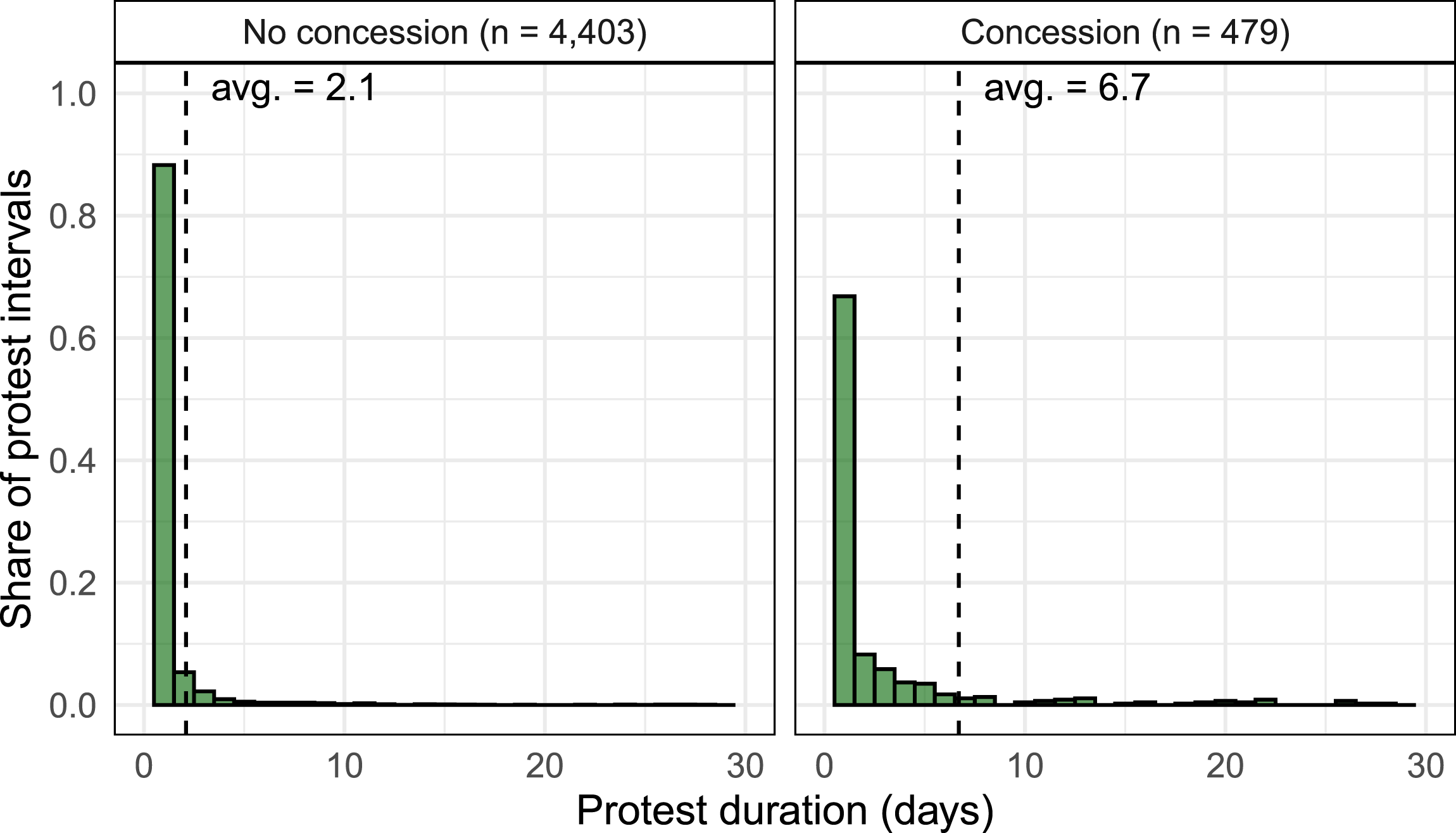
Despite a few notable exceptions (Butcher & Pinckney, 2022; Cunningham, 2011; Klein & Regan, 2018; Mueller, 2022; Vüllers & Schwarz, 2019), the rich literature on the government’s responses to protest has predominantly focused on state repression and its implications for protesters (Carey, 2006; Davenport, 2007; Opp & Roehl, 1990; Steinert-Threlkeld et al., 2021). Less attention has been paid to what happens when a concession is granted. Existing work assumes that concessions signal a protest’s success and reduce mobilization since protesters lack the motivation to continue, without investigating whether protests do end afterward (Chenoweth & Stephan, 2011; McAlexander & Ricart-Huguet, 2021; Moore, 2000). Seminal work by Rasler (1996) suggests that there are reasons to question the demobilizing effect of concessions. As her study on Iran shows, if such agreements remain inconsistent and are mixed with repression, they can in turn lead to violent mobilization (ibid.). Still, the overall effects of giving in to protesters’ demands under authoritarianism remain unclear and systematic comparisons across countries are lacking.
Although there are valid arguments in favor of a dampening effect of concessions on protest, we argue that concessions are rarely effective at demobilizing opposition movements because of protesters’ dynamic demands and governments’ commitment problems. First, repression by authoritarian governments prevents the emergence of strong independent civil society organizations that channel and coordinate citizens’ grievances. Outbursts of protests bring new demands to light. Yet, these demands can change rapidly. It is, therefore, unlikely that negotiations between the government and a heterogeneous group of activists will lead to a meaningful agreement that most protesters will accept. Second, even if a concession meets protesters’ concerns, widespread issues regarding the implementation of the agreement complicate the process. Protesters might fear that the government will not keep its promises once they leave the streets and the government is uncertain whether protesters will accept the concession it offers.
To study the relationship between government concessions and protest across time and space, we rely on the Nonviolent and Violent Campaigns and Outcomes 3 (NAVCO) event data (Chenoweth et al., 2018). We propose a novel operationalization of protest episodes to investigate protest events that take place in close temporal and spatial proximity. Taking the temporal sequences of protest dynamics and state responses into account is crucial for our analysis as it reduces reversed causality concerns, meaning that longer protests are more likely to get concessions offered. Our cross-sectional time series analysis, which includes subnational data on 18 autocracies from 1991 to 2012, leverages variation within protest episodes and allows us to analyze the relationship between government concessions and subsequent protest mobilization at a high resolution.
Our estimates suggest that when governments accommodate demands, the number of protests in the following week increases by 40%. Analyses conducted at the subnational and national level yield similar results and our overall results are robust to a variety of alternative model specifications. These findings challenge the assumption that concessions are the final indication of protest success and the endpoint of mobilization. Instead, protesters push for further concessions and prevent immediate demobilization in the short term after receiving government concessions. Our study highlights the challenges that arise when seeking to reach an agreement in government–protester interactions and helps to explain the prevalence of repressive state responses in authoritarian settings.
The paper is structured as follows. First, we review extant scholarship on the consequences of state responses to mass mobilization. Second, we outline our argument about the mobilizing effect of concessions. We use the 2019 protests in Hong Kong to briefly illustrate the proposed mechanisms. Third, we describe the data and our operationalization of protest episodes, followed by a quantitative analysis of the relationship between concessions and subsequent protests. We conclude by discussing the implications of our findings for the “protest-repression nexus” and avenues for future research, particularly with regard to measuring concessions.
State Responses to Protest in Authoritarian Regimes
Mass uprisings are the third most frequent cause of authoritarian regime breakdown after elite coups and elections (Geddes et al., 2018, 179). To stay in power, incumbents rely on diverse strategies to stifle dissent, from ignoring or tolerating protest to mobilizing regime supporters and exerting lethal violence against activists. While there has been extensive research on repressive responses, we lack systematic studies of accommodating government responses.
Although state repression is by far the most common response to protest under authoritarianism, authoritarian governments sometimes grant concessions, that is, they give in to or partially accommodate protesters’ demands. Prior research has identified several factors that explain the occurrence of concessions. For instance, protests that impose economic costs and disrupt the economy receive concessions more frequently than protests that make political demands (Klein et al., 2021; Klein & Regan, 2018). Here, more cohesive demands are found to increase the likelihood of concessions and success of protests in democratic countries (Mueller, 2022). And as Vüllers and Schwarz (2019) show, even protest announcements can pressure the state to change course.
The presence of political institutions that regulate policy-making processes (Reuter & Robertson, 2015) and constrain the incumbent’s power (Davies, 2016) facilitate concessions while reducing repression. And anti-regime movements in autocracies that are part of the institutional apparatus receive more non-repressive responses (Conrad, 2011). Despite these studies on the determinants of government concessions, we know relatively little about the effect of concessions on mass mobilization.
One reason for the lack of attention to the consequences of concessions is that several studies equate concessions to protest success. For example, DeNardo argues that protesters who are able to gain concessions employ “efficient strategies” that lead to success (DeNardo, 1985, 65). In game-theoretic models, a compromise is assumed to end protest activities since activists cannot mobilize bystanders once the government fulfilled their demands (Pierskalla, 2009, 123). And even though Ginkel and Smith acknowledge that “making concessions is a tricky business” as it reduces the regime’s bargaining power during further negotiations, they argue that concessions also decrease the likelihood of a revolution (Ginkel & Smith, 1999, 303). In a similar vein, Chenoweth and Stephan speak of successful protest campaigns when “organized civilian populations have successfully used nonviolent resistance methods […] to extract political concessions” (Chenoweth & Stephan, 2011, 20). These perspectives, however, cannot explain instances in which protests are sustained after a concession was made.
As a result of the focus on concessions as the successful endpoint of mobilization, only a few studies test the effects of concessions on subsequent protest dynamics empirically—with mixed results. Rasler (1996) demonstrates that a mix of granting concessions and repression increased opposition activity in Iran during the 1979 revolution. Internally divided groups tend to react more violently to conceding responses (Cunningham, 2011) and concessions in the form of newly created democratic institutions increase the risk of collective mobilization against an authoritarian ruler (while decreasing the risk of elite coups (Woo & Conrad, 2019)). Inclán (2009), however, does not find more protests after procedural concessions during the Zapatista protests in Mexico. Evidence from Kyrgyzstan shows that even concessions that are not related to the initial protest issue prevent the spread of further protest (Hummel, 2019).
Along with an emerging interest in concessions, alternative government responses have increasingly gained scholarly attention. For example, states might decide to simply ignore protesters and their demands. Ignorance can be a deliberate decision to avoid fueling anti-government resentments (Weiss, 2013) and is more likely when protesters remain nonviolent and do not threaten regime survival (Cai, 2010). However, not responding to protests does not necessarily lead to demobilization (Yuen & Cheng, 2017); if inaction is perceived as contempt, it can lead to more protests (Bishara, 2015). Another common response strategy is the mobilization of regime supporters to curb mobilization efforts against the regime (Hellmeier & Weidmann, 2020). Evidence from the former Soviet states illustrates how authoritarian leaders mobilized youth movements and other state-affiliated groups to counter regional and domestic protest movements (Koesel & Bunce, 2013).
The most common—and most studied—government response to dissent in autocracies remains, however, repression (e.g., Chenoweth et al., 2017) or “protest control” (Earl, 2006, 129). Repression is a crucial source of stability in authoritarian regimes (Escribà-Folch, 2013; Gerschewski, 2013) and a large literature has investigated the “repression-dissent nexus” (e.g., Carey, 2006; Davenport et al., 2005; Lichbach, 1987; Moore, 2000; Pierskalla, 2009). Previous work shows that repression is constrained by the perceived and anticipated threat dissent poses to the regime (e.g., Carey, 2010; Sutton et al., 2014). Several empirical studies explain the occurrence and severity of repression across space and time. For instance, Ritter (2014) finds that repression is less likely but more severe in highly stable regimes.
In addition, existing research gives insight into the reciprocal relationship between repression and protest: Protesters’ behavior affects state repression, which in turn triggers a reaction by protesters (Carey, 2006). Yet, empirical studies yield mixed results. While repression at times reduces protest activity (Shadmehr and Boleslavsky, 2021), it can also trigger backlash effects (Brockett, 1993; Curtice & Behlendorf, 2021; Hess & Martin, 2006). A meta-study finds evidence for an inverted-U relationship (Zhukov et al., 2019, 611). Citizens mobilize for the least protests in contexts with very low or very high repression. Similar work on the consequences of concessions is lacking. Notwithstanding that previous research suggests a “concession-repression dilemma” (Cai, 2008, 412)—as both types of government responses can trigger future mobilization—we lack a clear theoretical framework to understand why government concessions can fuel mobilization and evidence beyond individual protest movements.
Our contribution to the literature is of theoretical and empirical nature. First, we argue that concessions do not necessarily lead to demobilization and discuss two mechanisms to explain why concessions can even lead to more protests in authoritarian regimes. Authoritarian governments are unlikely to offer an agreement that satisfies the majority of protesters in an environment with volatile demands and heterogeneous protest movements. Even if incumbents offer more substantial policy changes, they cannot credibly commit to those policies. The lack of trust in the incumbent government motivates activists to emphasize their resolve through continued protests. Second, to our knowledge, we conduct the first large-N study on the effects of concessions on protest using data at the subnational level for several authoritarian regimes. Our study thus complements existing comparative work on other government responses such as repression and case studies on the role of concessions.
Theoretical Framework
Our theoretical framework starts with the widespread assumption that autocrats’ main goal is to stay in power as long as possible (De Mesquita & Smith, 2010) and accumulate wealth either for leisure or to buy elite support (Acemoglu & Robinson, 2006). It follows that we can expect authoritarian governments to be unwilling to accommodate protesters’ demands, as giving in would imply sharing the spoils of power and having fewer resources to distribute to core supporters. The fact that only about one in 10 protests receives a concession (see Figure 1) attests to that. On occasion, however, other responses such as political repression are either not feasible or deemed ineffective (if, e.g., the government needs to garner public support (Guriev & Treisman, 2022, 14)). In those instances, we would expect incumbents to turn towards concession-making.
The core question for us is how such concessions affect the (de)mobilization of dissent. Existing work provides good arguments for why we should expect to find a dampening effect on protests. Assuming that protesters are rational actors, they should be unwilling to invest more time in rallying and stay at home once they have achieved their goals. As Pierskalla describes in his influential formal model of opposition-government interactions: “(…) it is always rational for the opposition to acquiesce after the government accommodates” (Pierskalla, 2009, 124). 2 A large literature has described the challenges of organizing collective action, and we know that the lack of a “critical mass” (Oliver et al., 1985) can lead to the collapse of mobilization efforts. It follows that elites can choose policies strategically to prevent a revolution (Acemoglu & Robinson, 2006). Put simply, as soon as the motivation to participate in demonstrations is gone, protests should fade out quickly.
Even if not every activist is satisfied by the state’s offer, concessions can still lead to demobilization if they drive a wedge between groups in opposition movements. We know that governments sometimes attempt to “divide and concede” (Cunningham, 2011), which is why internally divided movements are more likely to gain concessions. A partial demobilization can deprive a movement of its attractiveness to the broader population. In addition to that, concessions can increase the likelihood of future repression. According to Moore (2000), governments use repression and concession-making in complementary ways, meaning that if concessions do not appease protesters, they will rely more on repression. Anticipation of repression can thus further contribute to demobilization.
Although we follow the notion that opposition movements and the government make strategic decisions to obtain political goals, we believe that demobilization via concessions rarely plays out in authoritarian regimes. There are two important assumptions of rational choice models that are oftentimes not met in autocracies: stable demands and credible commitments. As we discuss below, the repressive nature of authoritarian politics creates an environment in which changing demands and mutual distrust between protesters and the government can lead to continued mobilization.
First, government–protester negotiations in authoritarian regimes take place in a complex bargaining environment characterized by dynamic demands. Civil society typically faces repression; it cannot exercise its democratic core function of aggregating and representing interests (Diamond, 1994, 8). This leads to limited civilian and governmental knowledge of citizens’ support for the regime (preference falsification, see Kuran (1989)). It is only when a large-scale protest erupts—often triggered by an outrageous incident or “moral shock” (Jasper, 1998) that people learn about the extent of regime dissatisfaction. Rallies serve as an opportunity for activists to connect and exchange ideas and allow for the development of concrete demands for political reform. Thus, a movement’s demands further develop during the protest cycle and can range from changes to a specific policy to regime change.
As civil society groups under authoritarianism often lack hierarchical organization and state repression targets opposition activists, protests unearth diverse demands, and the bargaining environment between dissidents and the regime is intricate. 3 In this setting, there is a high likelihood that the government’s response will fail to adequately address the grievances of the majority of protesters. Dissatisfaction with the government’s response can motivate future mobilization.
Second, even if an incumbent offers substantial concessions, commitment problems—a crucial feature of authoritarian politics (Acemoglu & Robinson, 2006; Boix & Svolik, 2013)—imply that the incumbent might not follow through with the agreed compromise and that protesters remain uncertain about the incumbent’s implementation of bargaining outcomes. If democratically elected governments do not deliver on concessions as promised, citizens can punish them at the polls. 4 If the authoritarian government reneges on its promises, activists have little recourse beyond further mobilizing the public. Typically, re-mobilizing after a protest has faded out is more difficult than continuously mobilizing, since barriers to collective action such as mobilizing bystanders have to be overcome again and again. This dynamic also explains the government’s use of “mock concessions” to buy time and prepare for future protests. In the absence of government trust, activists’ most beneficial strategy is to “ride the wave” of protest to demonstrate their resolve and deter the government from defaulting on its commitments.
In addition, there is no guarantee that activists will accept concessions, particularly if offering them concessions is perceived as government weakness or a partial victory for the movement—in those cases, protesters might push for a greater number of concessions. When people learn that protest is an effective strategy, they will be willing to invest more time and resources to make their political preferences heard. When perceived as a signal of regime weakness (Ginkel & Smith, 1999), concessions by the government can raise overall expectations about future bargaining outcomes and thus increase a movement’s momentum.
Illustrative Case: Hong Kong 2019
To illustrate the dynamics described above, we summarize some key insights from one of the most prominent protest campaigns in recent years, the anti-extradition movement in Hong Kong in response to the controversial bill regarding the extradition of Hong Kong residents to mainland China. Following a crackdown on activists involved in the 2014 Umbrella Movement, resistance to the extradition bill was organized in a decentralized and leaderless fashion (Lai & Sing, 2020, 47). Initially, activists simply demanded the withdrawal of the bill. During the weeks of demonstrations that followed, however, a set of so-called “five demands” emerged. These included investigations into police violence and popular elections in addition to the bill’s withdrawal. The demands were the result of strategical considerations and the movement’s “ideological restraint” (Lee et al., 2020, 37) in its moderate appearance. Nevertheless, the leaderless nature of the movement rendered bargaining processes more complex. The government faced a “heightened difficulty […] in identifying representatives from a leaderless protest movement for negotiation” (Lai & Sing, 2020, 63), an issue characterized by factionalized organizing activities.
Following weeks of massive protests, the administration in Hong Kong postponed the bill and, after demonstrations continued, withdrew it completely (Perper, 2019). Nevertheless, protests did not cease after Carrie Lam, former Chief Executive of Hong Kong, announced the bill’s withdrawal, due to activists’ concerns that authorities might ratify the bill at a later stage. In a move that exemplified protesters’ lack of trust in the authorities, the security law that was introduced in 2020 again allows for the extradition of Hong Kong residents to mainland China. This outcome demonstrates that policy concessions can be elusive if accountability is low. Moreover, these developments illustrate the ways in which authoritarian governments might accommodate protesters’ demands simply to buy time; if concessions are at least partially effective in demobilizing a movement, autocrats can employ this strategy to target leading activists and gradually weaken a movement.
In a nutshell, extant work provides arguments supporting possible effects in both directions. Concessions can satisfy or divide activists to an extent that there is less collective action. We argue, however, that there are two primary reasons to doubt that government concessions to protesters will lead to demobilization. In an authoritarian regime that represses independent civil society organizations, dynamic and heterogeneous demands draw out the negotiation process. Because autocratic incumbents are unwilling to follow through on promises made to activists, and protesters, in turn, further strategize the effectiveness of protesting to pursue political goals, we hypothesize that concessions lead to an uptick in future protests. In the next section, we describe our approach to analyze the relationship between concessions and protest frequency empirically.
Data and Descriptives
Our analysis 5 builds on the Nonviolent and Violent Campaigns and Outcomes (NAVCO) 3 data (Chenoweth et al., 2018), to the best of our knowledge, the only available data set that provides information about concessions across space and time at protest event level. 6 It contains information on government concessions for protest events from selected mobilization campaigns from 1990 to 2012 in 26 countries (see Table A2 in Appendix A).
Besides limited data availability, examining the relationship between concessions and protest mobilization is exacerbated by endogeneity concerns. 7 Sustained protests are more likely to receive a concession. To reduce these concerns we need to pay close attention to the temporal sequence of multiple protest events and the timing of concessions. Therefore, we used the NAVCO 3 event data to construct protest episodes within larger campaigns that consist of multiple events in close temporal and spatial proximity. These episodes enable us to assess the effect of concessions in response to protests on subsequent mobilization while accounting for previous protest dynamics.
Before assigning events to episodes, we take a few pre-processing steps to create a sample of comparable observations at high geographical resolution. First, we restrict NAVCO 3 to events that involve activists as “actors” and the incumbent government as “target” of mobilization attempts to focus on anti-government protests. 8 We also subset the data to autocracies based on regime classifications in the Rulers, Elections, and Irregular Governance (REIGN) data (Bell et al., 2021). Subsequently, we geoparse the event locations in NAVCO using the package mordecai (Halterman, 2017) in Python and convert the data entries to a spatial grid cell structure at a grid size of approximately 55 km2 (Tollefsen et al., 2012). Analyzing protest events at a spatially fine-grained level enables us to account for local mobilization dynamics. This is particularly relevant for large countries. 9
We end up with a sample of 2587 anti-government protest events in 169 grid cells in 18 authoritarian regimes 10 between 1991 and 2012. The number of protest events and concessions per country within the observed time frame is displayed in Appendix A (Table A2). The data reports the highest numbers of protest events around the Arab uprisings in 2011 and 2012 (see Appendix A Figure A3). Next, we use these events to construct protest episodes.
Operationalization of Protest Episodes and Dependent Variable
We conceptualize protest episodes as series of events that occur in temporal and spatial proximity to each other. More specifically, events belong to the same protest wave if they occur in the same location and within a time window of 7 days, as oftentimes protests take place on a weekly basis like the protests in the Arab world after Friday’s prayers. 11 If a demonstration is followed by another rally within our predefined spatio-temporal window, the wave continues, otherwise it ends with the last observed event. Using data at the subnational level allows us to trace mobilization patterns within large countries with several major cities, such as China. 12 This conceptualization allows us to track the number of protests in each week over time.
We considered the inclusion of additional event characteristics to identify protest episodes such as leading actors and demands. However, protesters’ identity is often unknown. Especially in authoritarian states, protesters have the incentive to hide their identity to avoid targeted repression. Demands, as we argue above, can change over time, even if the organizers stay the same (Brockett, 1993). Thus, operationalizing protest episodes based on further protest characteristics risks introducing measurement uncertainty and selection bias. Despite the risk of including unrelated events into the same protest wave, we prefer to rely on information that is by necessity available and relatively accurate in any protest event data set: event date and location. This procedure yields 1194 unique protest episodes.
Our operationalization of protest episodes allows us to look beyond individual events and analyze the effect of concessions on mobilization since we know whether protest continues after the government has offered a concession, our main independent variable. Upcoming protests measures the number of protest events in the next week. For analyses at the subnational level that compare protest events across grid cells, upcoming protests is the sum of protest events in the next week within the same grid cell. If there are no events in the subsequent week the variable takes a value of zero. The distribution of the variable is depicted in Figure A5 in Appendix A.
Independent Variable: Concessions
We operationalize concessions on the basis of NAVCO 3 data as an explicitly non-violent government response to a protest event. As the concession variable is based on the coding of a government response to a specific protest event, concessions are attributable to a single protest event that was coded as the day 13 on which the event happened.
The concession variable denotes the degree to which a concession meets protesters’ demands at the respective event. The data distinguishes seven types of government responses that range from “full accommodation” of demands to “physical repression” (Chenoweth et al., 2018). We code the following four types of responses as a concession: a) full accommodation that appeases or surrenders to protesters and their demands; b) material concession that involves an action to signal the intention to cooperate with the opponent; c) non-material concession that involves a conciliatory statement to signal the intention to cooperate; and d) neutral response that includes attempts to ask for help from a third party to resolve the conflict (for short descriptions of all four responses, see Dugan & Chenoweth, 2012: p. 608). Neutral responses are included to capture responses that remain ambiguous regarding the government’s willingness to compromise—otherwise the response would be coded as material or non-material concession—but are nevertheless distinct from repressive responses. Overall, the share of conceding responses remains relatively stable at around 20% throughout the years (Figure A3 in Appendix A). 14 Table A3 in Appendix A shows that, as expected, full concessions are rarely granted by governments (less than 2% of all protest events), whereas neutral responses are the most common response.
Figure 2(a) depicts differences in autocratic government responses by main protest issue. Unsurprisingly, protests that demand institutional reform or policy change are more likely to receive concessions compared to demonstrations in favor of regime change. Protesters demanding regime change not only receive fewer concessions in relative, as well as absolute terms, but they also experience the most incidents of government violence. Figure 2(b) displays that over half of the protests included in our sample raise policy demands. Both figures show that besides violent and conceding responses, protesters often receive no response from the government (these cases are labeled as missing information). Government responses to protest events, displayed by protesters’ demands. “No information” includes events for which no response was reported as well as information was missing. Demands that are coded as “unspecified” are excluded from the figure. For clarity, demands with fewer than 40 observations are excluded, N = 2210. Data source: NAVCO 3 (Chenoweth et al., 2018).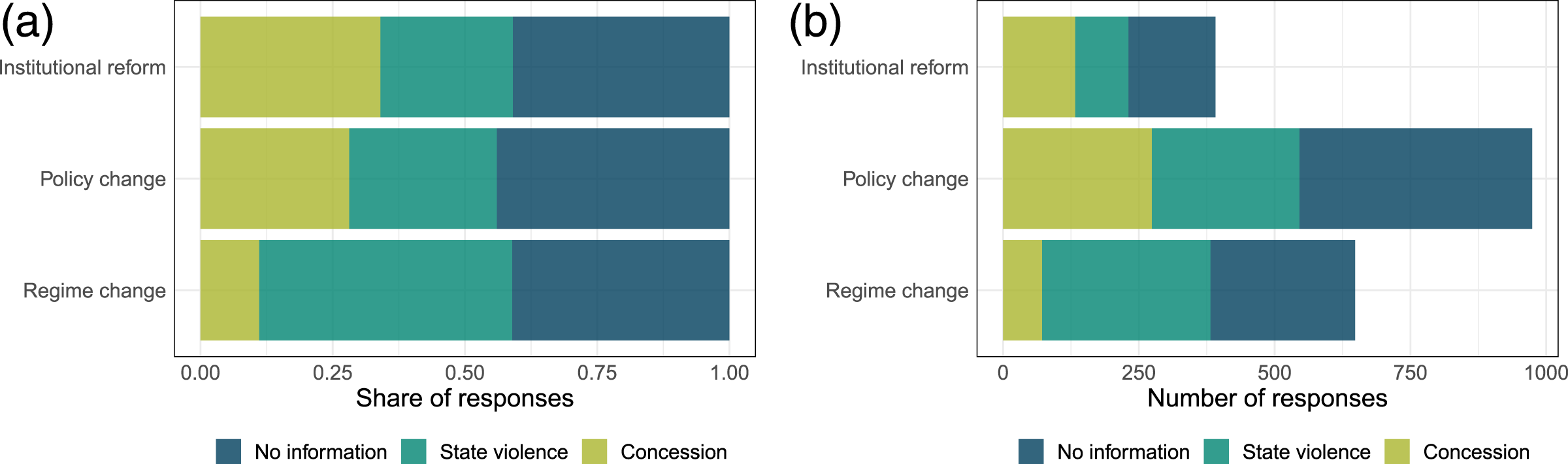
Figure 3 illustrates how concessions are distributed across protest episodes. Every circle represents one protest episodes in the sample (n = 1194). Circles vary in size, depending on the total number of participants per episodes.
15
The longest protest episodes displayed in Figure 3 occurred in Mexico in 1991 (49 days), Syria in 2012 (43 days), and Egypt (38 days) and Iraq (37 days) in 2011. Whereas during protest episodes in Syria (2012) and Mexico (1991), the government did not make any concession, several long episodes led to multiple concessions. Concessions and length of protest episodes (in days). Protest episodes are identified on the basis of protests that occur in the same grid cell within 7 days. The x-axis (protest length) is cut off after 50 days for visualization purposes. Data source: NAVCO 3 (Chenoweth et al., 2018).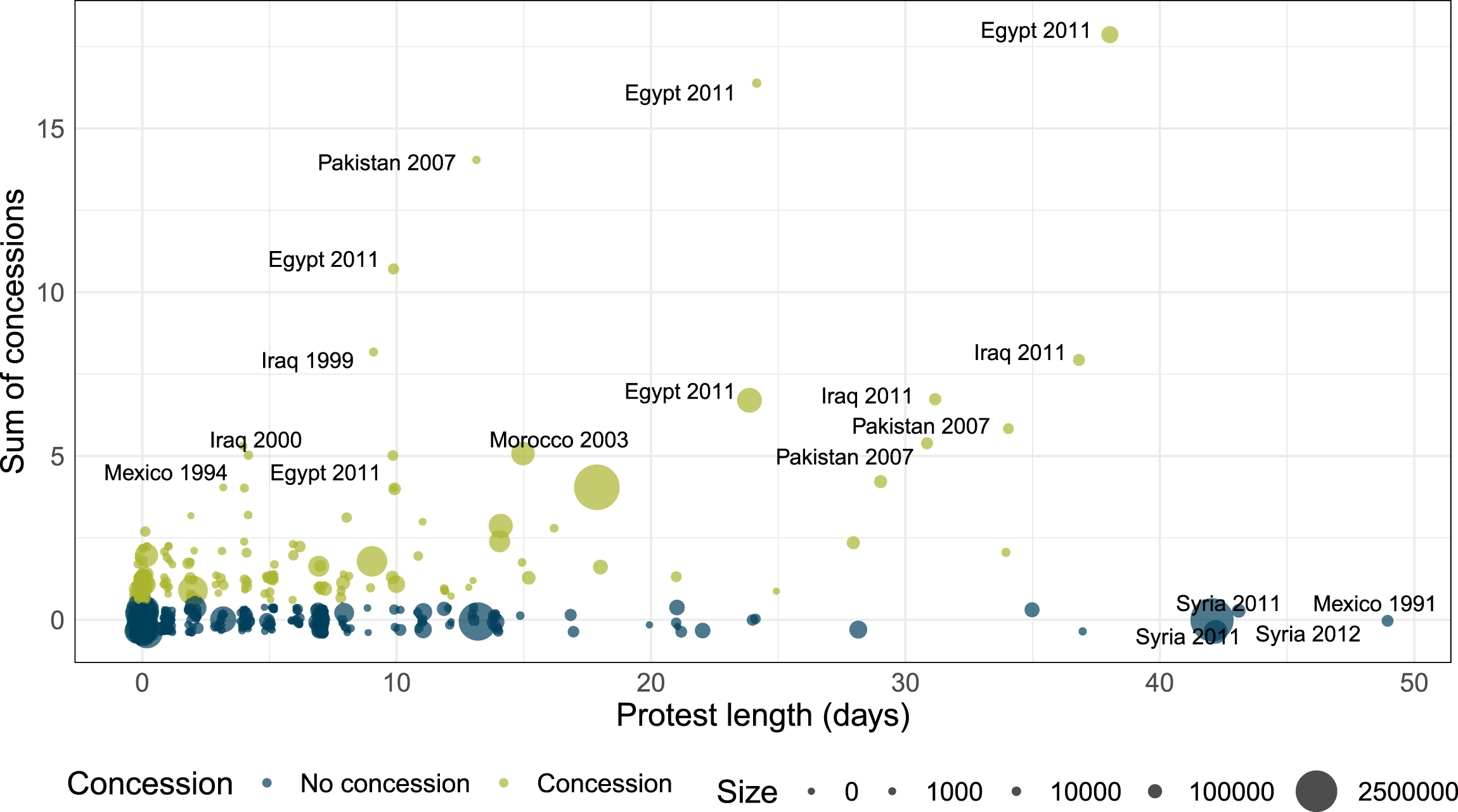
In our main analysis, we use the sum of all concessions (concessions (sum)) granted in a given protest week to capture the state’s willingness to compromise. 16
Control Variables
To reduce concerns of omitted variable bias, we include a series of additional variables in our models. First, protest characteristics, such as size, the degree of violence and the scope of demands affect the likelihood of concessions (Klein & Regan, 2018) as well as the prospects of further mobilization (e.g., Chenoweth & Belgioioso, 2019). We include participant numbers, incidents of protesters’ and the state’s use of violence as well as protest demands.
Protest size represents the total number of protest participants per week. We calculate average participant numbers based on the estimated range of participants in NAVCO 3 and include the logged term in the regression. Protesters’ violence sums up incidents where a protest event was coded as “primarily violent event” (Lewis et al., 2016). Similarly, state violence denotes the sum of violent government responses per week ranging from non-physical to lethal repression. Protesters’ demands are included as dummy variables for the three most prominent demands: policy change, institutional reform, and regime change. 17 More than one demand can be raised per episode-week.
Second, we account for temporal and spatial correlation. We include days since last protest to capture, within a protest episode, the number of days from the first protest event of a protest week to the last protest event in a previous protest week. The variable’s squared term is included to allow for non-linear time dependencies. Further, we include protests in the rest of the country, which captures the number of protest events occurring in the same week in the rest of the country (outside of the grid under observation).
Third, country characteristics affect the likelihood of concessions. A repressive regime might opt to use violence instead of concessions in response to protests (e.g., Carey, 2006). Institutional constraints affect a state’s choice to concede or tolerate protests (e.g., Davies, 2016). Both factors also affect protest mobilization. As an indicator of a state’s coercive capacity, we include the physical violence index from the Varieties of Democracy (V-Dem) project (Coppedge et al., 2021; Pemstein et al., 2021). As a proxy for the presence of democratic institutions in a given country, we include V-Dem’s electoral democracy index. Additionally, we account for a country’s coup risk that captures a regime’s stability and unity by including a measure developed by REIGN (Bell et al., 2021).
A country’s economic development might impact the incumbent’s capacity to offer concessions as well as protest dynamics. We include data on GDP (gross domestic product) per capita and population size, compiled by the World Bank. Both variables are logged and all country-specific controls are lagged by one year. As an additional indicator of economic activity, we include a measure of night lights that captures the calibrated average nighttime light emissions (Elvidge et al., 2014; Sundberg & Melander, 2013) at the grid level.
Regression Analysis
Based on our operationalization of protest episodes at the grid cell level, we conduct regression analyses to estimate the effect of concessions on subsequent mobilization by protesters. The NAVCO 3 data is aggregated at the weekly level 18 and the unit of analysis is the grid-protest week.
We estimate the association between concessions and the occurrence of subsequent protests within the same protest episodes. If concessions demobilized protesters, we should observe fewer protests after their announcement. We run negative binomial models in R (Venables & Ripley, 2002) with the number of protests in the subsequent week as the dependent variable. 19 Our expectation is that the number of protests is higher in weeks following a concession compared to weeks without concessions. In addition to the aforementioned control variables, we address unobserved heterogeneity by including grid cell, year, and in some cases grid-year dummies.
Concessions and Protests in the Next Week (7 days). Negative Binomial Models.
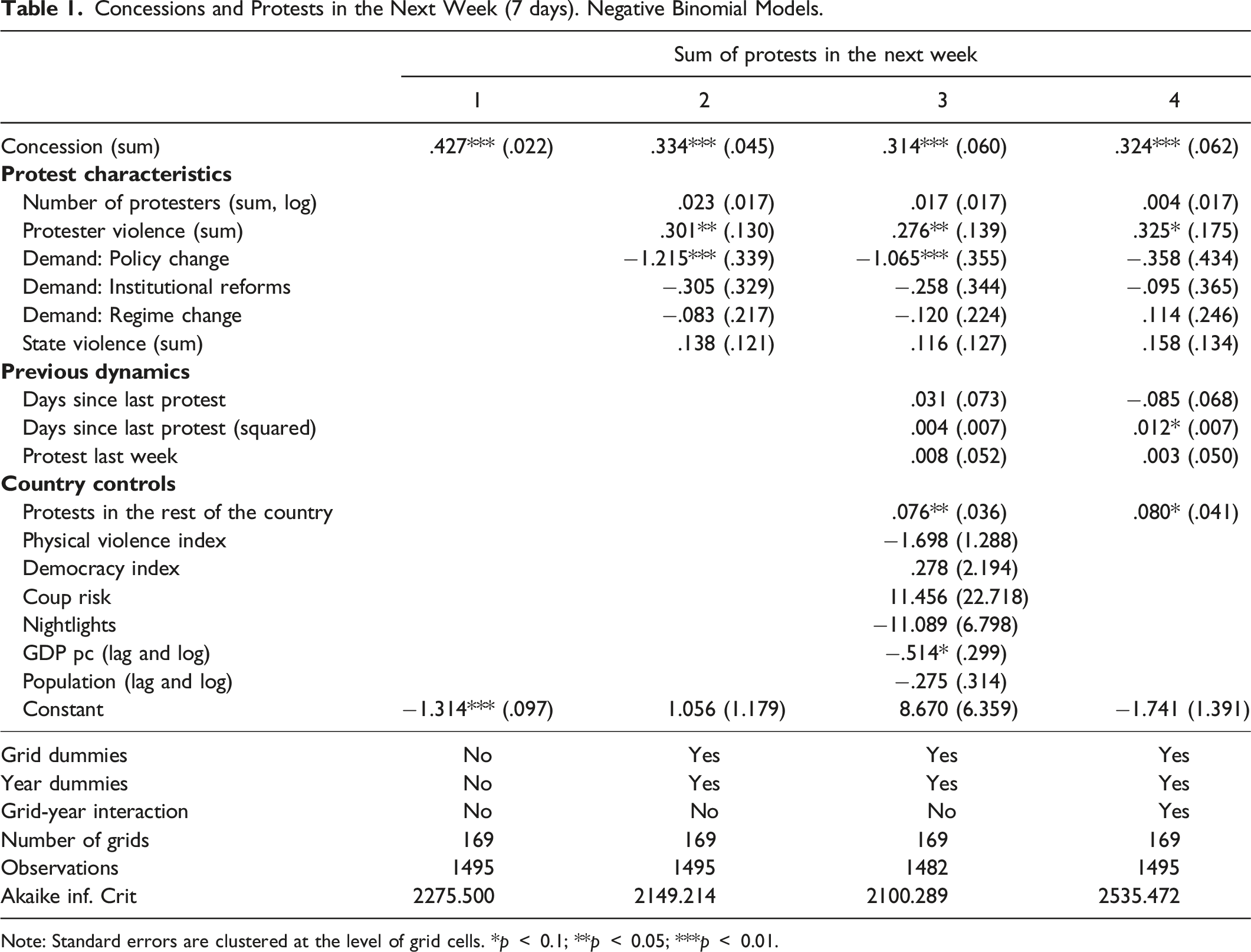
Note: Standard errors are clustered at the level of grid cells. *p
Figure 4 shows the marginal effects of concessions as estimated in Model 2 (including controls for other protest characteristics, grid-fixed effects, and year-fixed effects). The plot shows the predicted number of further protest events in the week after a given concession. The rate at which protest events occur in the following week after a concession increases by 1.396 (thus 40%). Marginal effect plot based on Model 2 (Table 1).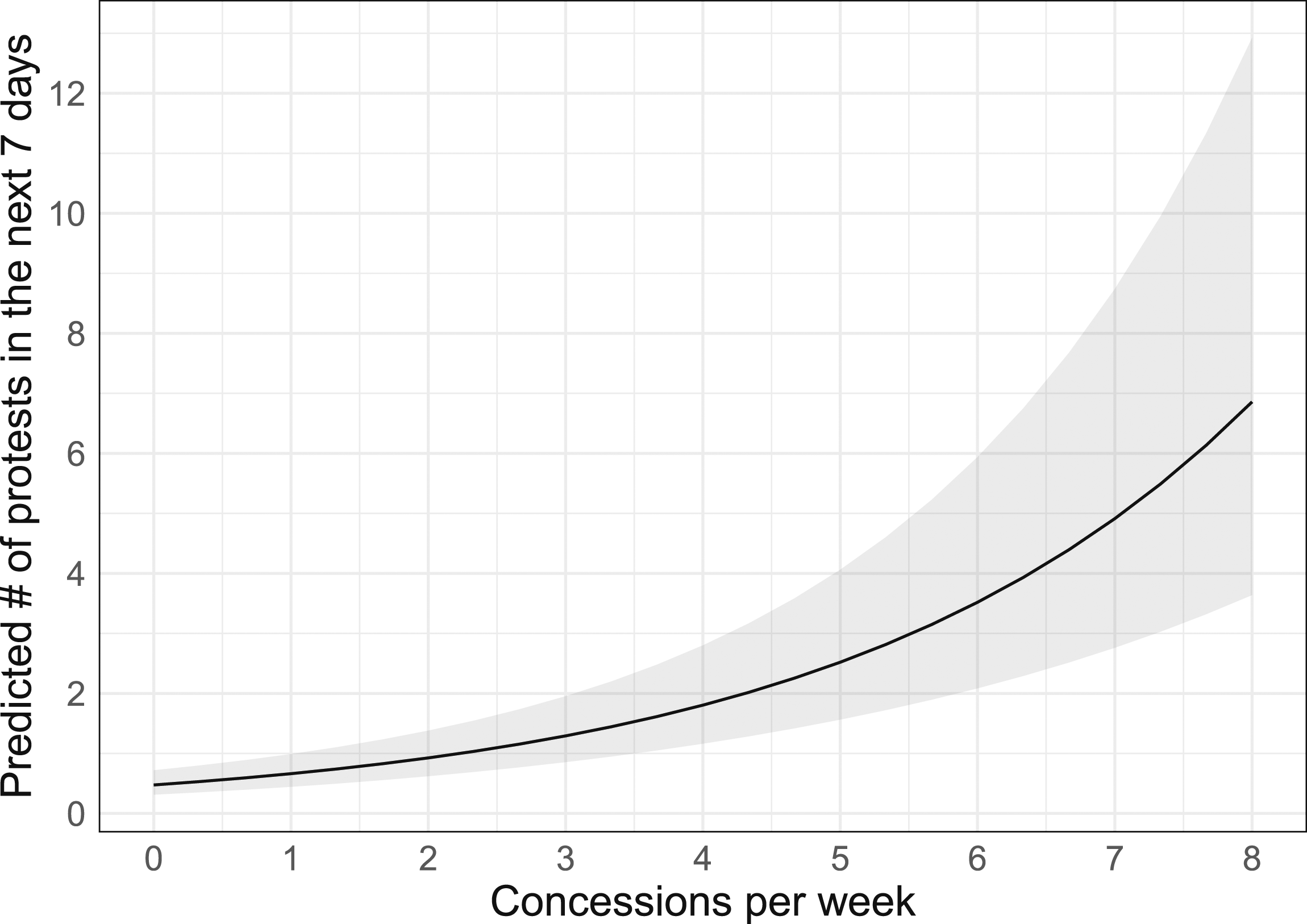
Addressing Endogeneity Concerns
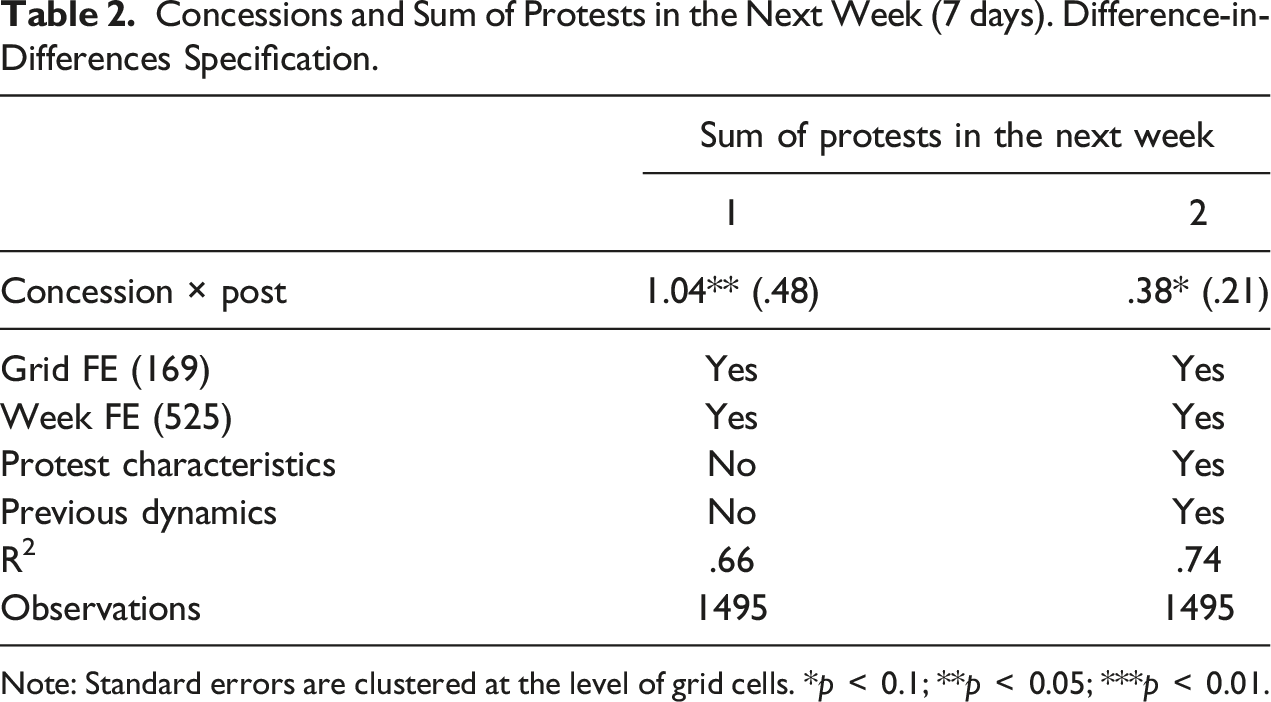
As mentioned at the beginning of the empirical section, our estimates might be biased due to the endogeneity between concessions and protest mobilization. The government might concede to protests that are expected to endure longer and protesters might stay in the streets if they expect to get a concession eventually. Although it is impossible to rule out anticipation effects completely, the way we construct protest episodes allows for the inclusion of information on previous and current protests that occurred in spatial and temporal proximity. To further address endogeneity concerns, we compute a difference-in-differences (DiD) model to estimate the effect of the first concession in a given protest episodes. In Appendix B, we discuss parallel trends (see Figure B1).
To obtain the average effect of the first concession on subsequent protest mobilization within a DiD framework, we estimate a generalized DiD specification that summarizes the weekly event study coefficients into estimates for the pre- and post-concession period using the following specification:
ProtestMobilizationgt+1 is the sum of protests in the following week (7 days) at t + 1 in the grid cell g. The coefficient of interest is β which captures the interaction between a dummy taking the value one when the government grants the first concession during a protest wave and a dummy variable indicating that the unit (protest wave) is post-concession. Similar to our main model in Table 1, we account for protest dynamics. With ProtestCharacteristics gt , we include a set of variables measuring protest size, degree of protesters’ violence, demands and state violence against the protesters in grid g in week t. Further, we control for previous wave dynamics with PreviousProtestgt−1 and include information on the elapsed time since previous protests and event frequencies in the same grid cell g at t − 1. We include grid cell (ϵ g ) and week (θ t ) fixed effects, to account for time-invariant characteristics of each grid as well as broader time trends. Finally, ϕgt denotes the error term. Standard errors are clustered at the grid cell level.
Concessions and Sum of Protests in the Next Week (7 days). Difference-in-Differences Specification.
Note: Standard errors are clustered at the level of grid cells. *p
Robustness Tests
In addition to the negative binomial models presented in Table 1 and the DiD specification in Table 2, we run a series of robustness tests for our main analysis that are displayed in Appendix B. First, we address alternative approaches to capture protest episodes and thereby measure our dependent variable. To ensure that the results are not driven by our chosen parameters to operationalize protest episodes, we first vary the time threshold between protest events to identify events belonging to the same episode. We rerun all models using thresholds of 14, 21, and 29 days between events. The results remain highly comparable and significant, giving further indication that concessions are positively related to increasing mobilization afterwards (see Tables B4 to B9 in the Appendix).
Next, we vary the spatial distance between protest events. Defining protest episodes on the basis of events occurring in the same location might lead us to split protest events into different episodes that in fact belong to the same episodes at the national level. It could be that the effect of concessions is not limited to the location of the protest. To address these issues of spatial aggregation, we run all models for protest episodes defined at the country level. Thus, protest events need to occur within a time threshold of 7, 14, 21, or 29 days in the same country, not in the same grid cell (see Tables B7 to B10 in the Appendix). In a similar vein, we cluster standard errors by country instead of grid cells but cluster protest events at the grid level in Tables B8 to B11 to address concerns about the unit at which concessions affect protests. The effects of concessions on protest activity remain statistically significant and display the expected sign. At the country level uncertainty increases with longer time distances between events.
20
Results from all models accounting for unobserved heterogeneity for each protest location per year (as in Model 4 in Table 1) at the subnational and country level across various time windows are displayed in Figure 5. Coefficient plot of negative binomial models for protest episodes defined at time windows of 7, 14, 21, and 30 days between protest events at the subnational and national level. For readability, country and time controls are excluded.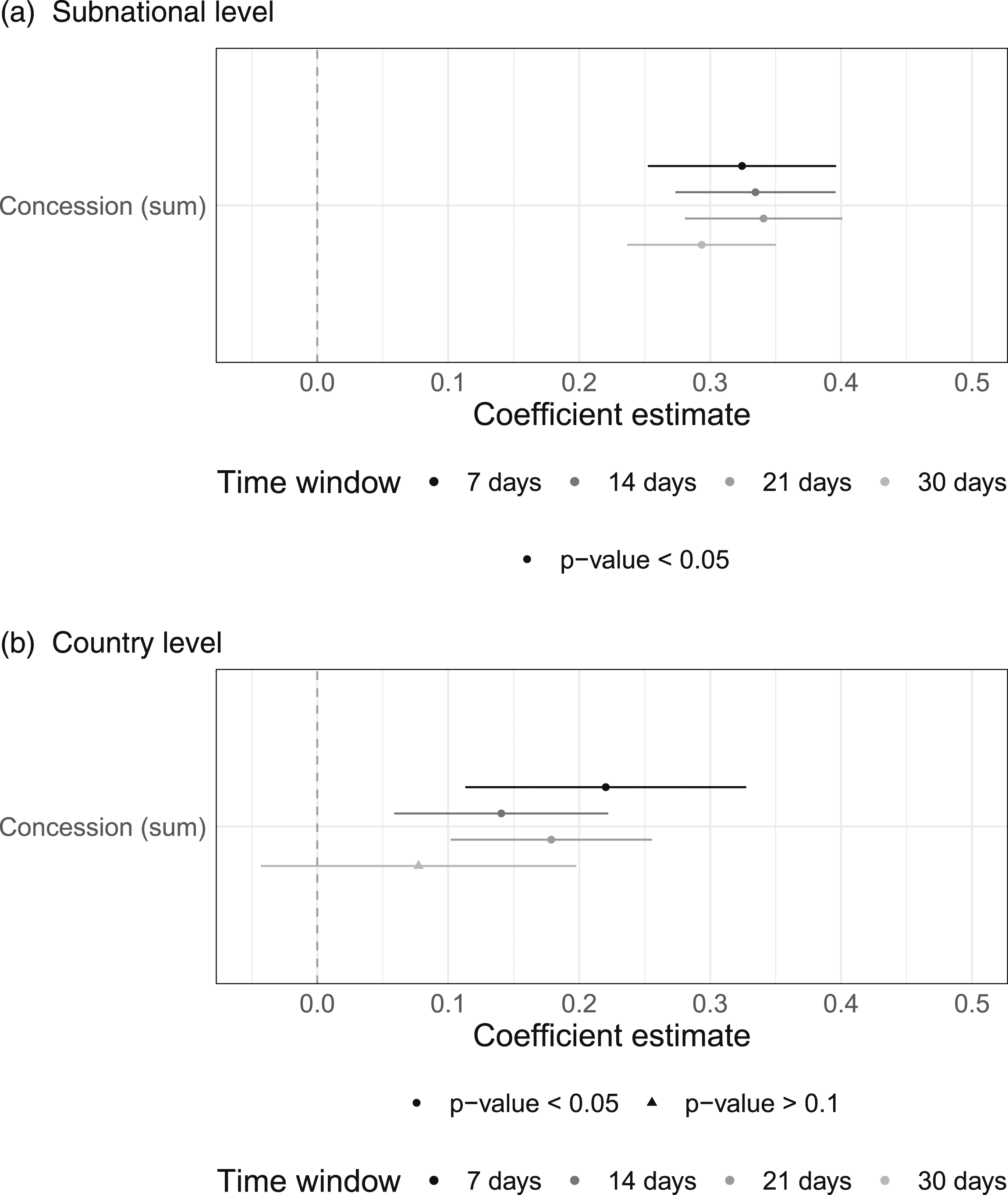
Second, we investigate alternative ways to measure our independent variable. We include concessions as the share of protest events in a week that received a concession (Tables B12 to B15) and as a dummy variable that is one if one or several concessions have been offered per week and zero otherwise (see Tables B16 to B19 in the Appendix). Results are robust and remain comparable to the main results.
Further, we disaggregate the concession variable into the four types of conceding responses. Since, except for neutral responses, all types of concessions are very rare, there is high uncertainty around the estimates for each concession type individually (see Tables B20 to B23 in the Appendix). Therefore, the empirical results offer only limited insights into the effect of specific concession subtypes.
Third, we check whether our results are robust to additional model specifications. While overdispersion led us to use negative binomial models, there are many observations for which the dependent variable is zero, that is, no protests took place in the subsequent week. We summarize additional zero-inflated negative binomial models in Tables B24 to B27 and Poisson regressions with the same variables as in our main models (see Tables B28 to B31) that all yield similar results to the models presented in Table 1. 21 The results are highly comparable and statistically significant.
Fourth, we investigate effect heterogeneity. Concessions could work differently in different institutional contexts. For example, the extent to which commitment problems impact the effects of concessions could depend on the type of regime that grants a concession. We interact concessions with regime type measured by REIGN (Bell et al., 2021) in Tables B32 to B35 in Appendix B but find no evidence for interaction effects.
Finally, to probe the plausibility of our proposed mechanisms, we look at the role of dynamic demands during concession-protest dynamics. We construct two variables that count the diversity of demands (one if at least two demands are raised, zero otherwise) and demand volatility (zero if the raised demands remain the same, compared to the previous week and one if demands changed). We are limited in testing the mechanism more thoroughly. Still, Figures B1 and B2 in Appendix B indeed show that in the week the government grants a concession, protesters advance more diverse and volatile demands than at other points in time.
Overall, the statistical results indicate support for mobilizing effects of concessions by authoritarian governments. If the incumbent offers concessions, we observe more protest activity controlling for various protest and country-level characteristics. We find these effects at the subnational level as well as at the country level.
Conclusion
Previous work on government responses to protests in authoritarian regimes has mainly focused on government repression, treating concessions to protesters as the natural endpoint of mobilization. However, even authoritarian incumbents sometimes give in to protesters’ demands. Recent examples, like the demonstrations in Hong Kong and Algeria in 2019, prove that government concessions do not necessarily lead to demobilization. This paper aimed to explore this apparent puzzle by asking whether protest continues after government concessions. We argued that concession-making rarely leads to demobilization as the bargaining environment in repressive regimes and dynamic demands make it challenging to achieve a compromise that satisfies the majority of activists. In addition, protesters have little reason to trust that autocrats will implement agreements made during contentious episodes.
Our large-N empirical analysis of protest mobilization at the subnational and national levels indicates that concessions are associated with increased protests. This finding complements existing studies showing that governments accommodating protesters’ demands can spur demonstrations (e.g., Rasler, 1996). Thus, this article challenges views that expect concession-making to lead to demobilization and provides a theoretical framework to understand the underlying reasons for this phenomenon.
While our results suggest a robust mobilizing effect of concessions, there are at least three avenues for future research. First, we need a better understanding of the strategic choices made by authoritarian governments that precede conceding responses. Why do autocrats concede, and what alternative choices were on the table? Under what circumstances are concessions sincere, and when do autocrats use them to buy time?
Second, our research design and the data we used did not allow for a thorough test of different mechanisms. Commitment problems with multiple actors involved are particularly difficult to capture in observational data. More insights into protesters’ considerations when reacting to state responses, for example, through surveys or survey experiments would be valuable. Our argument concerning dynamic demands could be tested more systematically with more extensive data on protesters’ demands and government concessions. Additional granular data is necessary to pinpoint the mechanisms outlined in the theory section.
Third, we need a better understanding of when and why concessions lead to concrete policy change and other political outcomes. Our analysis is limited to short-term dynamics and more evidence on the mid-to long-term dynamics is needed. For example, the transition literature emphasizes the importance of repeated elections and mobilization around them for democratization (Schedler, 2009). Small concessions regarding the openness of elections can lead to significant political change over the years. In addition to that, it could be that concessions increase mobilization in the short term but deter a full-blown revolution. Capturing these dynamics is beyond the scope of this paper.
Lastly, further comprehensive data on the varieties of government concessions to protests are needed. A promising avenue for research on protest dynamics is studying government concessions to protesters’ demands at the event level, without treating them as the endpoint of mobilization but as one of many (co-occurring) strategies in possible government responses. Gathering more extensive data on the types of concessions themselves and their relationship to demands raised will advance our understanding of citizen–government interactions during contentious episodes.
Supplemental Material
Supplemental Material - State Concessions and Protest Mobilization in Authoritarian Regimes
Supplemental Material for State Concessions and Protest Mobilization in Authoritarian Regimes by Elena Leuschner and Sebastian Hellmeier in Comparative Political Studies
Footnotes
Acknowledgment
We would like to thank Vanessa Boese-Schlosser, Belén González, Carl Müller-Crepon, Carl Dahlström, Johannes Lindvall, Philipp Lutscher and Marcia Grimes as well as participants at the V-Dem Seminar Series 2021, the Workshop on Conflict Dynamics in Oxford, the IPI Brown Bag at WZB Berlin and the ISA 2021 Annual Convention.
Declaration of Conflicting Interests
The author(s) declared no potential conflicts of interest with respect to the research, authorship, and/or publication of this article.
Funding
Sebastian Hellmeier disclosed receipt of the following financial support for the research, authorship, and/or publication of this article: This work was supported by European Research Council grant no: 724191, Vetenskapsradet grant no 2018-016114.

Supplemental Material
Supplemental material for this article is available online.
Notes
Author Biographies
References
Supplementary Material
Please find the following supplemental material available below.
For Open Access articles published under a Creative Commons License, all supplemental material carries the same license as the article it is associated with.
For non-Open Access articles published, all supplemental material carries a non-exclusive license, and permission requests for re-use of supplemental material or any part of supplemental material shall be sent directly to the copyright owner as specified in the copyright notice associated with the article.
