




Abstract
Why do people become opposition activists in authoritarian regimes where dissent invites social censure and can be dangerous? We make a new contribution to answering this classic question: personality. For the first time outside of democratic contexts, we investigate the association between personality traits and opposition activism, arguing that some traits work universally, while others interact with political context. We propose that—as in democracies—high extraversion predicts political activism, regardless of its pro- or anti-regime orientation, and, in particular, that extraversion is critical to explain the shift from online to offline action. We also argue that—contrary to democratic contexts—low agreeableness predicts opposition activism in autocracies, because it reduces the perceived costs of non-conformity. We test these arguments based on two independent survey samples from Russia, a stable authoritarian regime. In a series of statistical tests, including two case-control designs, we find consistent support for all hypotheses.
Keywords
What does it take to be an opposition activist in an authoritarian regime? The degree to which participating in opposition activity is dangerous varies across different kinds of authoritarian regimes, but it is always hard and rarely rewarding in any material sense. So what is it that drives people, nonetheless, to take up the challenge of fighting for democracy and better constitutional and civil rights in regimes that make such work potentially dangerous?
This is a classic question that has attracted scholars from a wide range of traditions over more than 100 years from immiseration through relative deprivation, to collective action and social movements, with different scholars placing different weights on individual, collective and societal factors. Individual factors like education and biography matter (Corrigall-Brown, 2012; Lawrence, 2017; Verba et al., 1995), so too do organizations (Loveman, 1998) and networks (McAdam, 1986). Previous, perhaps chance, involvement in activism is also critical, fostering the development of values and identities conducive to renewed contentious action (Beissinger, 2011; Mironova & Whitt, 2020; Smyth, 2018).
In this paper, we focus on a different, possibly earlier, part of the causal chain—asking what are the individual level factors that shape decisions to get involved in opposition activity under autocracy and that can influence the degree of involvement people undertake. Specifically, we look at the political psychology underlying activist behavior in autocracies. The political psychology research to date is very limited in this area. We know that emotions matter, both positively and negatively (Pearlman, 2013; Young, 2019) and that personality traits matter for authoritarian support (Greene & Robertson, 2017; Hasmath et al., 2019; Truex, 2021), but the research on the political psychology of authoritarianism in general, and activism in particular, is thin. This is ironic, since one of the most prominent theories of authoritarian collapse places psychology front and center. In an enormously influential work, Timur Kuran put forward the intuitively appealing, but empirically untested, argument that some people (exogenously) find authoritarian rule less bearable than others and so are willing to step forward first when the risks are great and the rewards are scant (Kuran, 1991). While theoretically influential, there is remarkably little empirical research that actually digs down into who these people are and what shapes their decisions.
We contribute to the individual level psychology of activism and suggest an answer that varies across individuals and makes an important difference in the likelihood that they will engage in opposition activism in an authoritarian regime—personality. Certainly, protesting can have serious repressive repercussions for individuals in all kinds of political regimes. Opposition activism under authoritarian political conditions is, however, a particularly demanding activity. Not only does it subject individuals to the permanent threat of state repression, it also comes at the risk of conflict with a person’s immediate social surroundings. Moreover, the chances of success are low, so external motivations do not carry very far. To explain the puzzle of activism in such situations, we argue that some people are psychologically better equipped than others to bear the social costs and reap the social rewards of high-risk activism. In this paper, our focus is exclusively on authoritarian regimes, though we consider the implications of our argument for activism in democracies in the conclusion.
In developing our argument, we build on preexisting research using the most broadly validated and cross-culturally stable measure of personality, the Five Factor model, also known as the Big Five: openness to experience, conscientiousness, extraversion, agreeableness, and neuroticism (John & Srivastava, 1999). We argue that it is the combination of two personality traits—low agreeableness and high extraversion—that prepares individuals to engage in contentious action in an authoritarian context. In doing so, we build on the insight that extraversion, a tendency to be gregarious and assertive, shows the most consistent associations with protest and activism in democracies (Mondak et al., 2010). We extrapolate this finding to activism in authoritarian regimes, but argue that in these contexts, there is an important second component: agreeableness. High agreeableness is characterized by interpersonal warmth, but also by the desire to evade conflict and to maintain positive relations with others (Graziano & Tobin, 2016). Where opposition is “primarily the domain of people willing to accept social marginalization” (Greene and Robertson, 2017, p. 1804), it is a strong predictor of support for an authoritarian leader (Truex, 2021). Building on these findings, we argue that opposition activism, which regularly exposes individuals to social conflict, selects for people who score low on the trait of agreeableness. However, we argue that agreeableness and extraversion interact with one another to shape the different kinds of political activism in which individuals are likely to participate. The less agreeable a person is, the more likely they are to like the regime’s opponents and so to join in online activity supportive of opposition. However, to make the transition to offline organizing and campaign activism, requires high levels of extraversion and the more agreeable a person is, the more extraverted they will need to be to engage in activism.
We test this argument with two independent and different survey samples from Russia taken at different points over 5 years. The first sample includes 1223 educated, internet using urban citizens surveyed in 2013. The second consists of 1182 core supporters of Russian opposition politician Aleksey Navalny, sampled online in 2018, comprising both passive online supporters and offline activists. In a series of within-sample and cross-sample statistical models, we consistently find support for our theoretical expectations that in an authoritarian regime, extraversion predicts activism regardless of political orientation, extraversion and agreeableness jointly predict opposition activism, and higher levels of extraversion are needed to produce activism amongst more agreeable people. With these findings from Russia (and evidence from a parallel study in Belarus), we make three contributions to the literature.
First, we propose a novel explanation of what it takes to be an activist in a politically hostile authoritarian climate. As is well known, the opportunity to be an activist is not open to all, perhaps especially in an established and apparently stable authoritarian regime (Ost, 2018). Opportunities for activism are shaped by material and organizational factors or on socialization experiences (McAdam, 1986) and identities (LeBas, 2011). Nevertheless, even amongst those who appear from a structural perspective to be possible protesters, there is great variation with most remaining quiescent while others take up different degrees of either pro or anti-regime political action. Personality allows to move a step back in the causal chain of activist mobilization, asking for the personal characteristics that make individuals more likely to engage in contentious action and involve themselves in networks of dissenters.
A psychological perspective complements biographical explanations of activist mobilization. Psychological differences matter in many classic accounts. As Vaclav Havel tells the parable of the greengrocer, who is passive and follows the state’s instructions, while contrasting him with “the dissident of the ‘Eastern Bohemian Brewery’”, Havel emphasizes an interior “personal sense of responsibility” that pushes a person into the strange career of opposition (Havel, 2018, p. 384). However, as Havel emphasizes, a psychological perspective is not independent of life experience but intimately related to the development of political identities and social solidarity through action such as protest rallies. But seeking social occasions may be more likely for some people than for others. Those who are more outgoing, sociable, and curious may be more drawn to such socializing experiences in the first place (see Gabowitsch, 2016, for curiosity as a motivation to participate in protest rallies). A focus on personality, then, does not challenge but complements accounts that focus on biography.
Second, existing research on personality and politics in authoritarian regimes has examined the connections between personality and discontent separately from the connections between personality and activism (Truex, 2021). We extend the research on extraversion to show both that extraversion is an important contributor to political activity in authoritarian regimes regardless of orientation towards the regime and, in particular, is critical to making the leap from online “passive” discontent to offline organizing and political work. Regimes and scholars alike are well aware of the close connections between online behavior and offline protest (Enikolopov et al., 2020) and so authoritarian regimes often monitor and engage with online activism trying to confuse and disrupt (Gunitsky, 2015; Roberts, 2018). Nevertheless, offline activity in the form of electoral outreach or protests is what destabilizes authoritarian regimes in the end and so understanding what facilitates the transition from online activity to offline political action is critical.
Third, our study makes an original contribution to understanding the role of agreeableness in shaping political behavior and not just attitudes. In this paper, we confirm the finding that in an authoritarian regime a desire to fit in (a key element of agreeableness) matters for political attitudes (Greene & Robertson, 2017; Truex, 2021), but we show that this trait also shapes political behavior through its interaction with other traits, namely, extraversion—highly agreeable people need to exhibit higher levels of extraversion than less agreeable people before they are likely to participate actively in opposition activity. Trait to trait interactions, while increasingly common in psychology, have been included occasionally in works of political science (see, for instance, Mondak, 2010 for trait-trait interactions in the prediction of political knowledge) but have so far not been broadly used for explaining political behavior.
Personality and Political Participation in Context
The term “personality trait” is used to characterize individual dispositions that directly influence behavior (see Mondak & Halperin, 2008). Today, personality often refers to the so called Big Five model (John & Srivastava, 1999, p. 103). The model is situated at the “highest level of abstraction”, with each factor capturing several facets, which in turn subsume more specific traits (Gosling et al., 2003, p. 506). These five factors are openness/intellect, conscientiousness, extraversion, agreeableness, and neuroticism. They are the result of genetics and individual environmental effects (Jang et al., 1996) and are thought to be largely stable over time (McCrae & Costa, 1984), although Roberts and Mroczek (2008) show that they can also evolve across the life span. 1
In recent years, research has shown the importance of some of these personality traits in shaping political attitudes. However, the overwhelming majority of studies on personality and politics come from democratic contexts (see Sibley et al. (2012) for a meta-analysis drawn exclusively from democracies). There is, for instance, ample research from the US and Western Europe that finds liberals score higher on openness and conservatives score higher on conscientiousness (e.g., Carney et al., 2008). Recent research suggests that some of the effect of openness and conscientiousness might be artifactual due to a desire for consistency on the part of survey respondents (Bakker et al., 2020; Ludeke et al., 2016), but we expect this to be less of a problem both because of the context in which we are working, Russia, where the left-right dimension of politics is less salient, and given our focus on two traits, whose association with politics is non-obvious and highly contextual (Bakker et al., 2015; Greene & Robertson, 2017).
We focus here not on democracies but on autocracies and not on attitudes, but on action. In post-Communism, scholars have noted that one of the biggest challenges facing opponents of incumbent authoritarians is the difficulty of actually mobilizing the dissatisfied out of defeatism and despondency into action (Thomson, 2018). It is not enough that people support the idea of a change, they must also do something about it. However, while there is considerable literature on support and opposition (Chaisty & Whitefield, 2013; Greene & Robertson, 2019), the demobilization argument points out that these sentiments do not translate easily into action. Instead, other factors are required to make the move from attitude to action, especially where the fear of repression exacerbates the collective action problem. Again, networks are of great importance (Onuch, 2015), as are identities (Pearlman, 2018). But especially for mobilizing first movers, the literature on personality and political activism in democratic societies provides important additional insights.
Most importantly for our purposes, although extraversion is often associated with migration (Canache et al., 2013; Fouarge et al., 2019), it is also consistently linked to various forms of political activity like voting (Gerber et al., 2011), contacting and advocating for political candidates (Mondak et al., 2010), donating to a political candidate’s campaign (Gerber et al., 2011), or engaging in community-level civic action (Mondak et al., 2011). Even more significantly, extraversion is correlated with contentious actions like protest participation, both directly (Ackermann, 2017) and indirectly, mediated by efficacy and the frequency of political discussion (Gallego & Oberski, 2012), though some studies question whether the relationship is direct (Brandstätter & Opp, 2014) and others have suggested that extraversion interacts with regime type so its effects are positive in democracies and negative in autocracies (Chang et al., 2021).
Extraversion, however, does not operate in a vacuum. As we show in this paper, extraversion is a good predictor of activism in authoritarian regimes, but it predicts not just opposition activity but also pro-regime activity. Building on previous research on authoritarian regimes, we would expect the factor that shapes the direction to be agreeableness. Recent research on authoritarianism has emphasized claims from psychology that “dispositions and situations have powerful interactive effects on behaviour” (Funder, 2008, p. 577, italics original), leading scholars to argue that the political and social environment shapes the effects of personality traits on behavior (Ackermann, 2017, p. 21). In this context, the move from a democracy, where political disagreement is widespread and normalized to an authoritarian context where opposition and treason are often conflated is highly consequential (Greene & Robertson, 2017).
Finally, not only do we expect some traits to interact with context, there are grounds to expect them to also interact with one another. Studies on the interaction of two personality traits usually take their conceptual starting point in the Abridged Big Five Dimensional Circumplex (AB5C) taxonomy by Hofstee et al. (1992). Based on this model, researchers have used interactions of different Big Five factors to explain behaviour (Jensen & Patel, 2011; Witt et al., 2002). By examining the effects of trait-trait interactions, therefore, important nuances can be revealed that would remain obscured if traits were only conceived of as individual factors (Witt et al., 2002, p. 848).
How Agreeableness and Extraversion Produce Opposition Activists
We argue that opposition activism in authoritarian regimes selects for individuals who are low on agreeableness and high on extraversion. Clearly, protesters in democracies do face repression, as the large literature on policing in the US and Western Europe testifies (see Della Porta & Fillieule, 2004). Authoritarian regimes, however, act much more systematically to forcefully quell dissent (Møller & Skaaning, 2013). In addition to repression, moreover, taking a stand against the incumbent regime can have significant social consequences, which discourage those who value harmony from thinking differently, never mind acting differently.
Highly agreeable individuals are “considerate, warm, compassionate, generous, and arouse liking from others” (Graziano & Tobin, 2016, p. 105). By contrast, people low on agreeableness tend to be “critical, skeptical, try to push limits, express hostility directly, and show condescending behavior to others” (Graziano & Tobin, 2016, p. 105). Agreeableness is a multi-faceted construct; what appears to be common to most agreeable persons, however, is that they seek to maintain positive relations with others (Graziano & Eisenberg, 1997).
With regard to politics, a large study from the US found that agreeableness might “matter on the margins for moral traditionalism and moral judgement” (Mondak, 2010, p. 135–138) and to marginally increase the likelihood to vote Democrat (Mondak, 2010), but there was no association with ideology. In general, the literature has found associations of agreeableness with political attitudes and ideologies in democracies to be weak and inconsistent at best (Gerber et al., 2010; Sibley et al., 2012).
This changes, however, when ideas or behavior come with the potential for conflict in people’s social surroundings. Even in democratic systems, the desire to avoid conflict with others has been shown to negatively affect protest participation, campaign support, and political discussion (Ulbig & Funk, 1999) and illegal protest activities (Gallego & Oberski, 2012). Also, the recent findings of an association between low agreeableness and support for European populist parties (Bakker et al., 2021) suggest that agreeableness might have a role to play when explaining attitudes and behavior that are in conflict with majority norms and behaviors.
This connection appears even more important in contexts that are characterized by greater pressures toward conformity. In authoritarian regimes, dissent is often delegitimized and stigmatized by state media, political leaders, and officially approved social institutions. In such a context, disagreeing invites conflict with prevailing social norms (Greene and Robertson, 2017, p. 1804). Consequently, opposition activism in authoritarian regimes not only comes with the risk of repression, but also at the risk of reputational loss and social conflict, when friends and relatives believe a person’s activism to be futile, dangerous, or disloyal. 2 Therefore, opposition activism under authoritarianism should select for individuals who tend to accept social conflict and marginalization, that is people low on agreeableness.
The second part of the argument is played by extraversion, which has consistently been linked to political activism through its facets of assertiveness, efficacy, and the tendency to be sociable. More extraverted individuals “are characterized by energy, dominance, spontaneity, and sociability” (Wilt & Revelle, 2016). Individuals who self-recruit into activism are likely to be higher than average on extraversion for several reasons: First, activism is associated with recurrent social interaction among activist peers and is therefore attractive to individuals who particularly enjoy social activities (Mondak et al., 2010). Second, the energy and enthusiasm associated with high extraversion can diminish the off-putting emotional effects of failure that oppositionists in stable autocracies usually have to endure. Finally, highly extraverted people may assess political participation as being less dangerous than do the less extraverted.
Groups by Predicted Levels of Extraversion and Agreeableness.
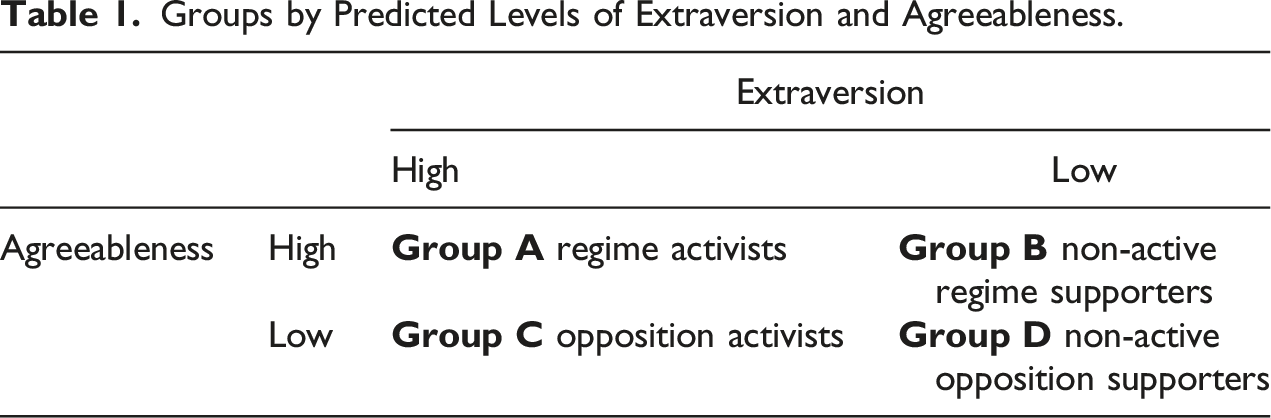
Although the table suggests—and the results later confirm—that our model should be able to explain pro-government activism as well as opposition activism, here we concentrate on the latter. Based on the reasoning outlined above, then, we formulate the following hypotheses—two that test the predictions of extraversion and two that test the combination of extraversion and agreeableness.
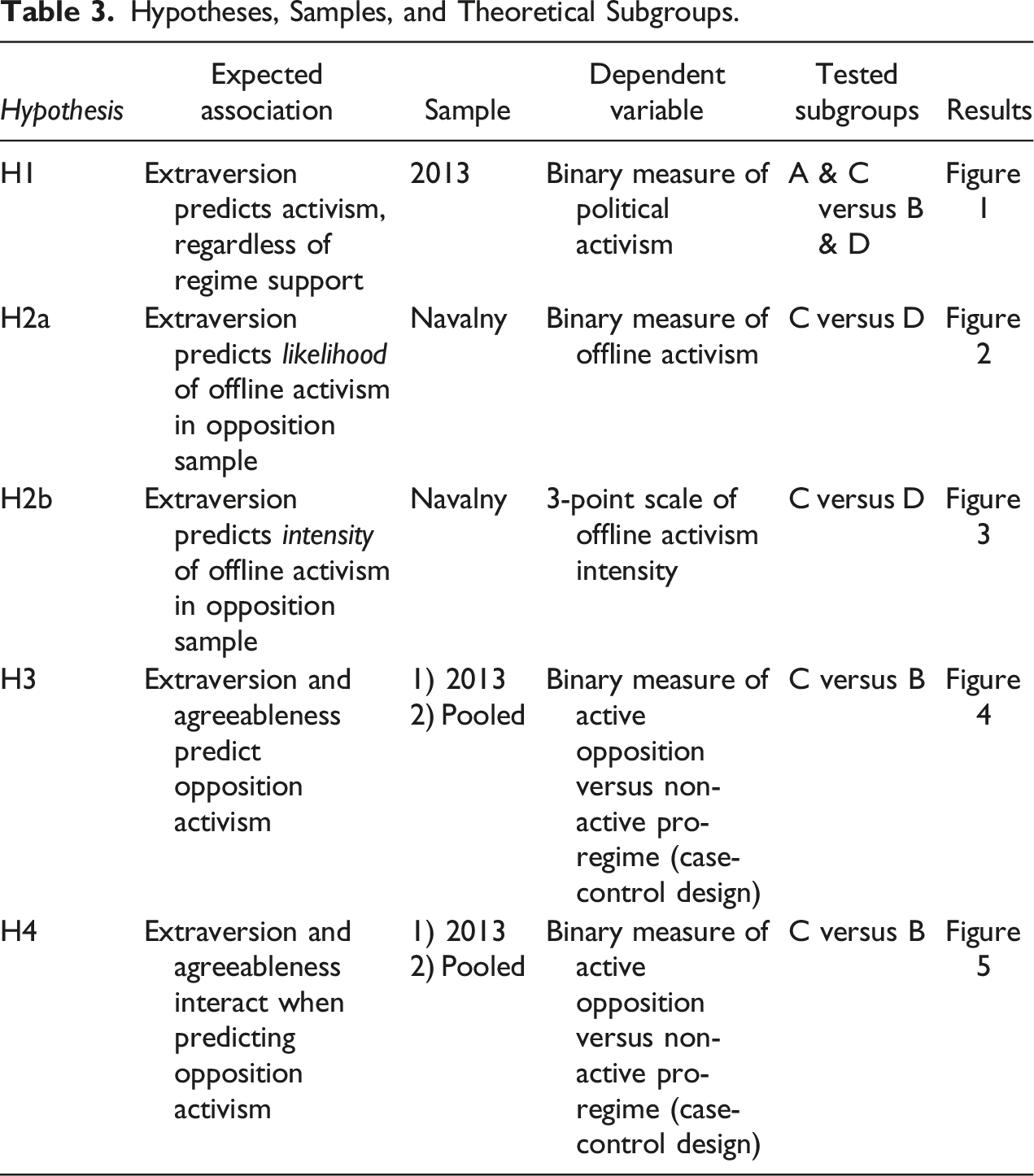
Regardless of political orientation, higher levels of extraversion are associated with a higher likelihood of being engaged in political activism (groups A & C vs. groups B & D in Table 1).
3
Amongst committed opposition supporters, higher levels of extraversion are associated with a higher likelihood of offline activism (group C vs. group D).
Amongst active regime opponents, higher levels of extraversion are associated with more frequent activism (group C vs. group D).
Research Design
Case Selection
To test these hypotheses, we collect data from one of the most influential of contemporary electoral authoritarian regimes, Russia. Russia is a particularly useful case to look at for a number of reasons. First, the political regime is archetypical of the kind of authoritarianism we see in the world today. As in many other countries, autocracy in Russia coexists with, indeed depends in part upon, a paper commitment to democracy and institutions that play a role in aggregating interests and controlling society. Information and media are controlled domestically, but the country is far from entirely cut off from the outside world. At the top of the system stands a “strongman” leader who seeks to present himself as the authentic voice of the nation. Moreover, the fact that the authoritarian regime uses elections to legitimate its claim on power to the outside and to its own citizens means that opposition, though obstructed and often repressed, is usually allowed to compete in elections. All of these are elements that are typical of contemporary autocracy.
From an empirical perspective, Russia presents an opportunity for research on authoritarian regimes. Though indisputably autocratic, Russia has a longstanding tradition of world class public opinion and survey research and, at least before the full-scale invasion of Ukraine on 24 February 2022, it was possible to conduct such research relatively free of state interference or censorship. In addition, the regime in Russia has been relatively stable for more than a decade now. Whatever the consequences for Russian citizens, from a research perspective this creates the possibility of studying relationships over time to test the reliability and durability of previous findings.
During the 2000s, President Putin’s claim to legitimacy was to a large degree based on the impressive economic recovery since 1999 (Treisman, 2011) and the restoration of stability and order (Sharafutdinova, 2020). However, when protests flooded the country’s urban centers in the wake of fraudulent parliamentary elections in December 2011, authorities and kremlin-friendly media began to directly discredit dissent. Dominant state-controlled media quickly painted protesters as irresponsible troublemakers (Lankina et al., 2020) and systematically associated opposition with social deviance and a lack of patriotism (Smyth et al., 2013).
The details of this story are specific to the Russian case, but the basic plot is not. Political acquiescence is an important part of officially propagated behavioral norms in many authoritarian regimes, so that dissent can be expected to come at an increased social cost. We argue, therefore, that the choice of the Russian case can contribute to a broader debate on the individual underpinnings of opposition activism in authoritarian contexts. Of course, findings from one country need to be tested elsewhere since both prior research, and our own arguments, suggest that context is likely to matter (Ackermann, 2017; Greene & Robertson, 2017). To begin exploring this we provide confirmatory evidence from a parallel study conducted in Belarus in September 2021 (Appendix N).
Data
To test our theoretical expectations, we rely on two independently gathered samples. 4 The first comprises approximately 1200 respondents to an online survey conducted in October 2013 in all Russian cities with a population over 1 million. The focus of the survey was educated, internet using urbanites between 16 and 65 years old. Invitations to take the survey were issued to members of a 300 000 strong marketing panel and stratified on age and gender based in internet penetration data. To qualify for the full survey, respondents had to live in one of the 13 cities with a population greater than 1 million, have some higher education and respond that they could at a minimum afford to buy food and clothes.
This sampling strategy was chosen in order to focus on a key opposition constituency, educated urbanites, and to draw reasonable numbers of both regime supporters and regime opponents. For understanding oppositionists, this sample is clearly better than a nationally representative sample where the number of admitted opposition supporters is likely to be small and where the opportunities to become an opposition activist are likely to be much more limited. Moreover, such a sampling strategy focuses on the kinds of urban constituencies that are known to be a vulnerability for contemporary authoritarian regimes in general (Wallace, 2013) and that have played a crucial role in Russia and other parts of the former Soviet space.
The potential downside is that the point estimates of support do not reflect the national polls, but this is not a major concern here since we are more interested in the relationships between personality measures and political variables and not necessarily in point estimates. Moreover, as the Supplementary Appendix shows, the sampling strategy does not lead to significant curtailment of the variation on key variables such as income and so there is no reason to expect the relationships identified to be flipped or to have radically different coefficients.
The second sample consists of 1182 strong supporters of Aleksei Navalny, who since the protests of 2011/12 has established himself as the most visible politician of the democratic opposition, which led to his imprisonment in 2021. Again, this sample offers us the opportunity to compare behavior within a group of individuals with plausibly similar opportunities to become activists.
The survey was conducted between in early 2018 during Navalny’s—ultimately unsuccessful—presidential campaign, using the campaign’s public social media groups on the Russian Facebook equivalent VKontakte (VK) for access to his follower base (see Dollbaum and Semenov (2022) for details). As in the first sample, invitations were stratified by age and gender, using information available on the subscribers’ profile pages. This offers the rare opportunity to test hypotheses about the characteristics most likely to predict opposition activism on a statistically well-powered sample.
The sample, of course, is not representative of Navalny’s supporter base as a whole, because the procedure of data gathering likely biases it in favor of young or tech-savvy individuals and underrepresents supporters from smaller towns and rural areas. Moreover, subscribing to a campaign group on social media sends a public signal, which means that the data underrepresent those who would vote for Navalny but refrain from openly expressing their support. But here, this drawback is an advantage: selecting for the most convinced and committed supporters greatly increases the likelihood of capturing core offline activists of Navalny’s movement. Moreover, by selecting only those already willing to indicate public support, we have set up a hard test of our theory that extraversion predicts offline opposition campaign activity even within this sample of already confessed supporters.
While neither of our samples is nationally representative (a fact which we note above brings with it significant advantages), there is strong supporting evidence that gives us confidence in our findings. Most broadly, research on the relationship between personality and politics even in much more constrained convenience samples than ours has been shown to generalize well to nationally representative samples (Vitriol et al., 2019). In terms of specifically comparable studies, our findings on agreeableness and extraversion are also consistent with three different surveys relating personality traits and satisfaction with the regime using three different kinds of sample, including one nationally representative sample, in China (Truex, 2021). Hence, although our paper goes beyond the existing literature, it does so from a solid and replicated empirical foundation.
Variables and Measures
Dependent Variables
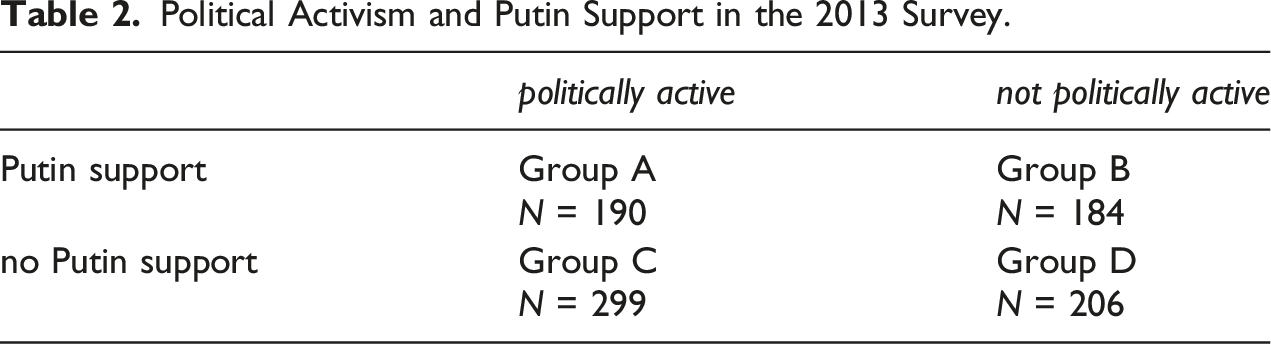
In H1, using the 2013 sample, we test the effect of extraversion on political activism regardless of political orientation. We mark as politically active those who have participated in “political demonstrations” or were engaged in “a civic organization or political campaign” at least once in the past year (see the Supplementary Appendix). This measure is therefore sensitive to protest participation and to political activism more broadly. For H2, using the Navalny sample, we then inspect whether extraversion also helps to explain who turns to actual campaign work in a group of highly committed opposition supporters. We first measure this with a binary variable, before looking at the extent of involvement by differentiating between regular, sporadic, and no involvement in campaigns.
Political Activism and Putin Support in the 2013 Survey.
Hypotheses, Samples, and Theoretical Subgroups.
Independent Variables
To measure personality traits, we use the Ten Item Personality Inventory (TIPI) (Gosling et al., 2003). The TIPI is widely used in political science applications (Gerber et al., 2010, 2011; Greene & Robertson, 2017) and has been used in more than 3000 studies. 7 Direct comparisons of the TIPI with longer batteries of questions suggest that there is little to no difference in results (Carney et al., 2008; Gerber et al., 2011), although there is some debate on this score (Bakker & Lelkes, 2018).
Since in 2013, there was no standard Russian language TIPI, we made our own translation in consultation with native speakers with decades of experience of survey research in Russia. For the Navalny survey, we used a translated and validated version. As Appendix A shows, the two translations are similar but not identical and the results are highly consistent across the two surveys, further strengthening confidence in the robustness of the results.
Control Variables
We include five covariates in the regression models. First, we capture a respondent’s wealth with a four-point scale of items they can typically afford, ranging from food and clothes to real estate. This measure gives a more realistic assessment of a household’s economic situation and is also less prone to generate missing values than direct questions on income. We also control for gender, age and education. For the latter, we use a three-point scale running from unfinished higher education to an advanced degree. Finally, we include a dummy for whether the respondent lives in Moscow or not. 8
Results
H1: Extraversion and Activism in the Population Sample
We start with presenting the results of a logistic regression model with the binary activism measure from the 2013 sample as the dependent variable (groups A & C vs. groups B & D in Table 1).
9
Consistent with H1, extraversion is significantly associated with political activism. Figure 1 shows the changes in the predicted probabilities of being politically active when moving from one standard deviation (SD) below the mean to one SD above the mean on extraversion, holding all other variables at their mean. The predicted probability increases by 10 percentage points—less than for gender, but more than for Moscow residence—showing the association to be substantively meaningful. In addition to holding controls at their mean, in Appendix I we also compute predicted probabilities with the observed-value approach (Hanmer & Kalkan, 2013), showing the robustness of the calculations.
10
Predicted probabilities of political activism by extraversion. Effects of gender and Moscow residence are shown for comparison. Based on model 2 in Table G1 in the Supplementary Appendix.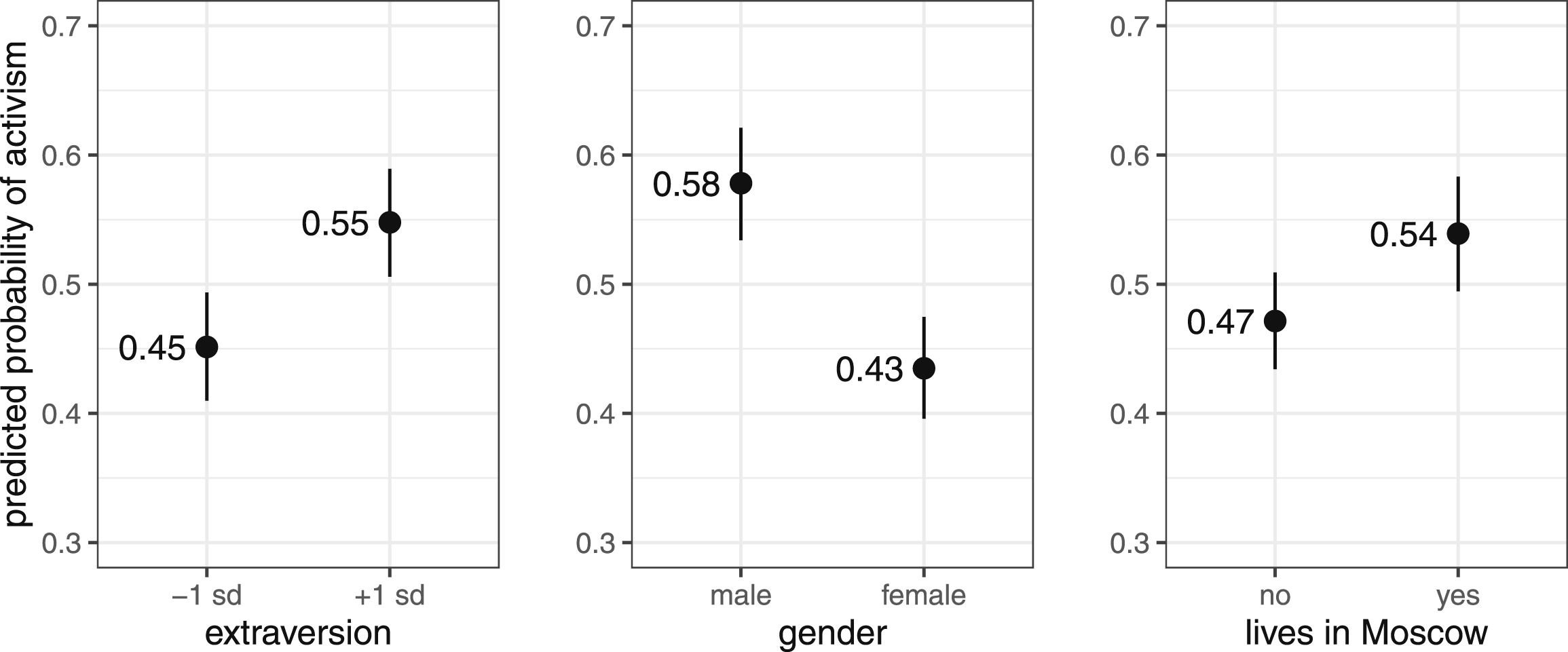
As the regression tables in the Supplementary Appendix show, when we include a binary measure of Putin support as a control variable, the statistical effect of extraversion remains intact, supporting our proposition that extraversion drives activism regardless of political orientation. The results are fully robust to different definitions of activism and Putin support (see Table H2 in the Supplementary Appendix).
H2a & H2b: Extraversion and Activism in the Opposition Supporter Sample
The next set of logistic regression model tests our argument that the difference between mere online opposition supporters and online supporters who also do active offline campaign work depends to a large degree on extraversion (group C vs. group D in Table 1).
11
The first models test the association of personality with a binary dependent variable of campaign work (H2a). Again, higher levels of extraversion are consistently and significantly related to campaign activism, suggesting that extraversion is an important factor to consider when explaining the transition from online to offline activism. Adding control variables does not change the results substantially. The marginal effects plots in Figure 2 show that, as for H1, we are witnessing a substantively meaningful phenomenon: moving from one SD below to one SD above the mean on the extraversion scale increases the predicted probability by eight percentage points—or by about 45%. Predicted probabilities of offline activism by extraversion. Effects of gender and Moscow residence are shown for comparison (the effect of gender is not statistically significant). Based on model 2 in Table G2 in the Supplementary Appendix.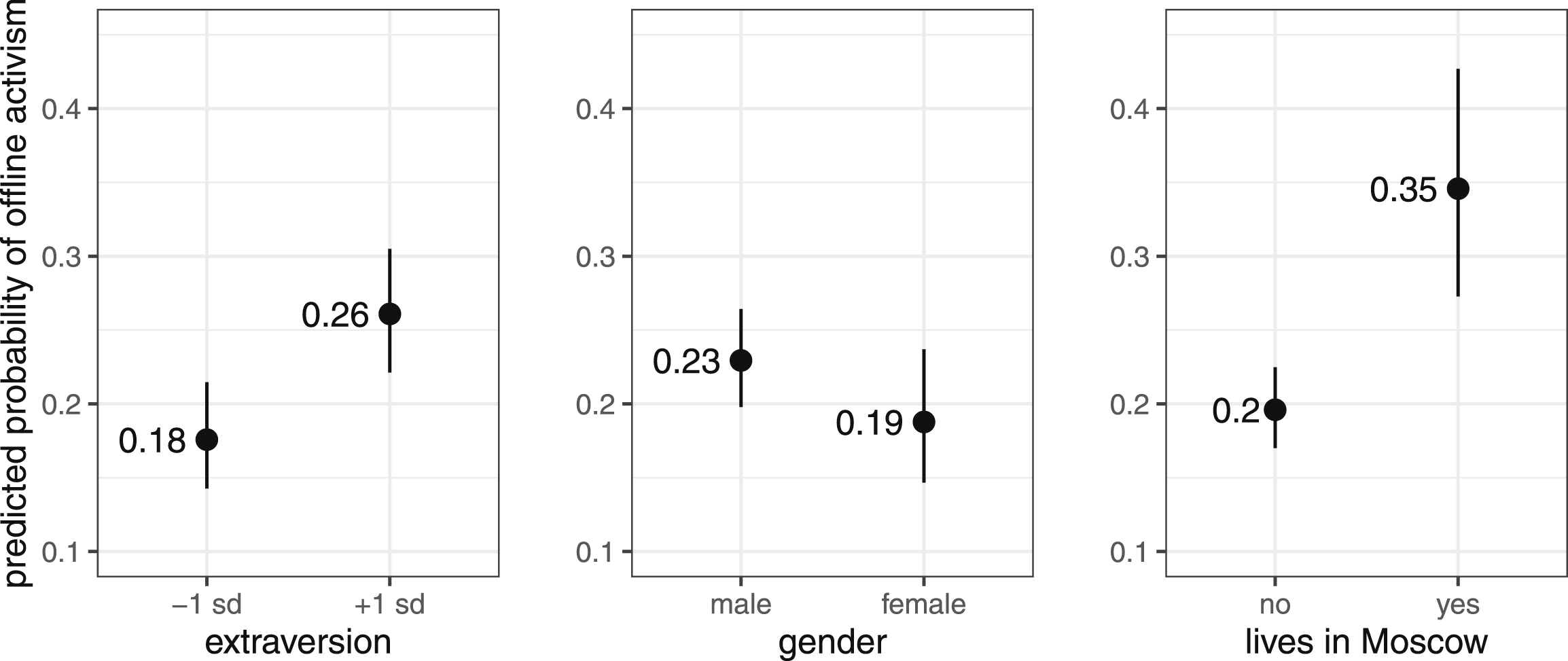
In a second step, we test the statistical effects of personality on a three-point activism scale (H2b). Here, the group of campaign workers was subdivided into those who only sporadically engaged (once a month or less) and those who more regularly performed tasks for the campaign (at least twice a month). This differentiation results in a substantially better model fit, suggesting that extraversion differentiates well between different degrees of activist involvement.
Concerning effect sizes, moving from one SD below to one SD above the mean on the extraversion scale reduces the likelihood of being non-active by nine percentage points and increases the likelihood of either sporadically or regularly engaging in campaign work by 4–5 percentage points, respectively. Given the rather low base rate in the sample, this means increasing the predicted probability by 40% (see Figure 3). Predicted probabilities of campaign work intensity by extraversion in Navalny sample. Based on model 4 in Table G2 in the Supplementary Appendix.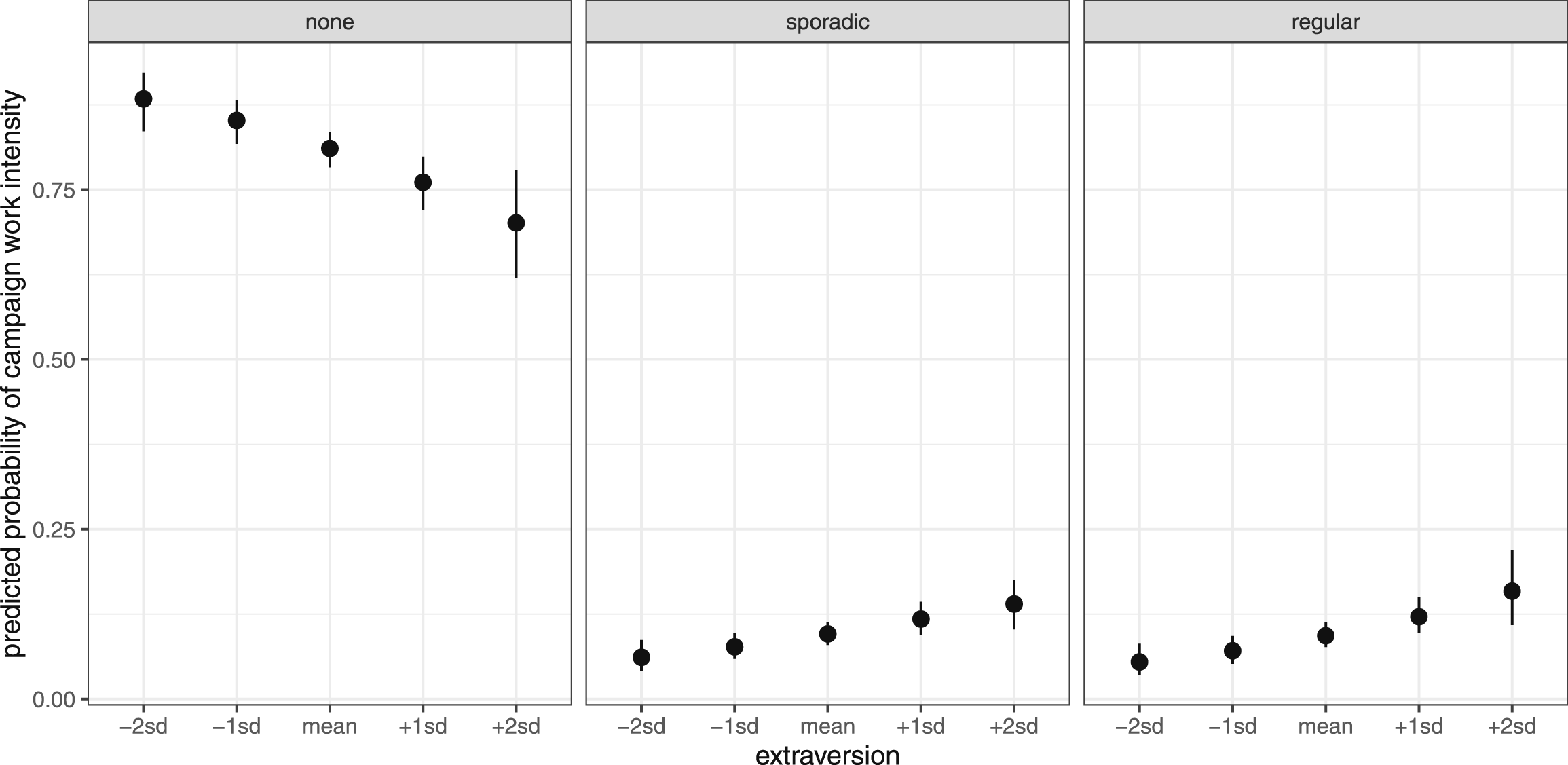
H3: Extraversion and Agreeableness in a Case-Control Design
These results on H1 and H2a/H2b match findings from the only other study of the relationship between personality and activism in an authoritarian context that we are aware of (Truex, 2021). Truex shows that Chinese citizens who protest have above-average scores on extraversion. At the same time, he emphasizes that protesting does not mean to be in opposition to the authoritarian regime: just like in Russia, protesters in China frequently question the decisions of lower levels of government while remaining loyal to the national political leadership. Here, we go beyond these findings to demonstrate that while extraversion helps explain an individual’s level of political activism, it is low agreeableness that distinctively characterizes activists who oppose the authoritarian regime.
In this step, we specifically compare activists with an oppositional orientation to non-active regime supporters (group B vs. group C in Table 1), hypothesizing that the former should be both higher on extraversion and lower on agreeableness than the latter. For the comparison, we restrict the samples to contain only these two groups. Restricting the sample in this way is necessary, because theoretically we do not expect that politically active Putin supporters should differ much from opposition activists on extraversion, or that active and non-active Putin supporters differ much on agreeableness. This setup is essentially a case-control design, in which “cases”, that is, opposition activists, are compared to non-cases (Keogh & Cox, 2014).
In medical research, so called cohort studies investigate the prevalence of cases (usually diseases) in a population, given exposure to a hypothesized cause. When cases are rare, however—like opposition activism in authoritarian regimes—cohort studies would require immense numbers of observations to identify enough cases. Case-control studies, by contrast, sample cases and a control group of non-cases, and retrospectively compare exposure across these groups. Here, “the ratio of cases and controls is higher than in the underlying population in order to make more efficient use of resources” (Keogh & Cox, 2014, p. 8). Therefore, the pooled comparisons do not provide accurate assessments of the prevalence of opposition activism in the population, but they do help to identify factors that make opposition activism more likely.
The test is organized as follows. In a first step, we test the hypothesis on the 2013 sample. Then, we pool the “non-cases” from the 2013 sample with the “cases” from the Navalny data so that the new data set contains the non-active Putin supporters and the campaign activists from the Navalny sample. This two-step procedure compares the non-active Putin supporters with active regime opponents of increasing levels of engagement, varying what constitutes a “case”, while keeping the “non-cases” the same. Taking into account that, in representative samples, strongly committed opposition activists are likely to constitute an extreme minority, this ensures that the comparisons exploit the full empirical range between the theoretically derived groups B and C in our argument (see Table 1).
Despite the benefits of a cross-sample case-control design, we are conscious that comparing two samples as different as our two comes with difficulties. First, the samples were recruited 5 years apart and use slightly different translations of the TIPI. However, we view these differences as constituting a hard test for the theory and thus as inferentially beneficial: If the results hold across the two samples, they should increase confidence that we are not dealing with a snapshot and that the results are independent of concrete wordings of the TIPI questions. Second, as we show in the Supplementary Appendix, the samples exhibit relatively large differences on basic distributions of age and gender. To mitigate potentially resulting biases, we therefore weight the Navalny sample to increase comparability. The results remain unchanged (see Table H8 in the Supplementary Appendix).
In all models (see Table G3 in the Supplementary Appendix), agreeableness and extraversion significantly distinguish between non-active Putin supporters and opposition activists in the expected direction, supporting H3. The findings hold up when other definitions of activism and Putin support are used, except for one combination in the within-sample comparison where the effect of extraversion is significant only at the 10% level (see Table H5 in the Supplementary Appendix). 12
Figure 4 plots the effect sizes. In the within-sample comparison of the 2013 data, an increase in extraversion from one SD below to one SD above the mean increases the probability to be in the opposition activist subsample by 15 percentage points. A similar increase in agreeableness decreases the chance by 13 percentage points. These effects are comparable, for instance, to the effects of gender. Turning to the pooled samples, agreeableness and extraversion show large statistical effects. When moving from one SD below to one SD above the mean, the likelihood of being in the opposition activist group increases by 64 percentage points for extraversion and decreases by 54 percentage points for agreeableness, when all other variables are held at their means (with the observed-value approach, the effect sizes decrease somewhat but remain large, see Supplementary Appendix). The fact that effect sizes in the pooled samples greatly increase when compared to the within-sample comparison suggests that highly committed opposition activists are even more likely to be high on extraversion and low on agreeableness than non-active regime supporters when contrasted with the within-sample comparison (see also the mean differences in Figure A1 in the Supplementary Appendix). This is consistent with our argument that personality is not only relevant for explaining opposition activism in a simple, binary way, but that it is at least equally important for differentiating between different degrees of involvement in opposition activism. Predicted probabilities of being in the opposition activist group in both case-control designs. Gender and Moscow residence are included for comparison. Based on models 2 and 4 in Table G3 in the Supplementary Appendix.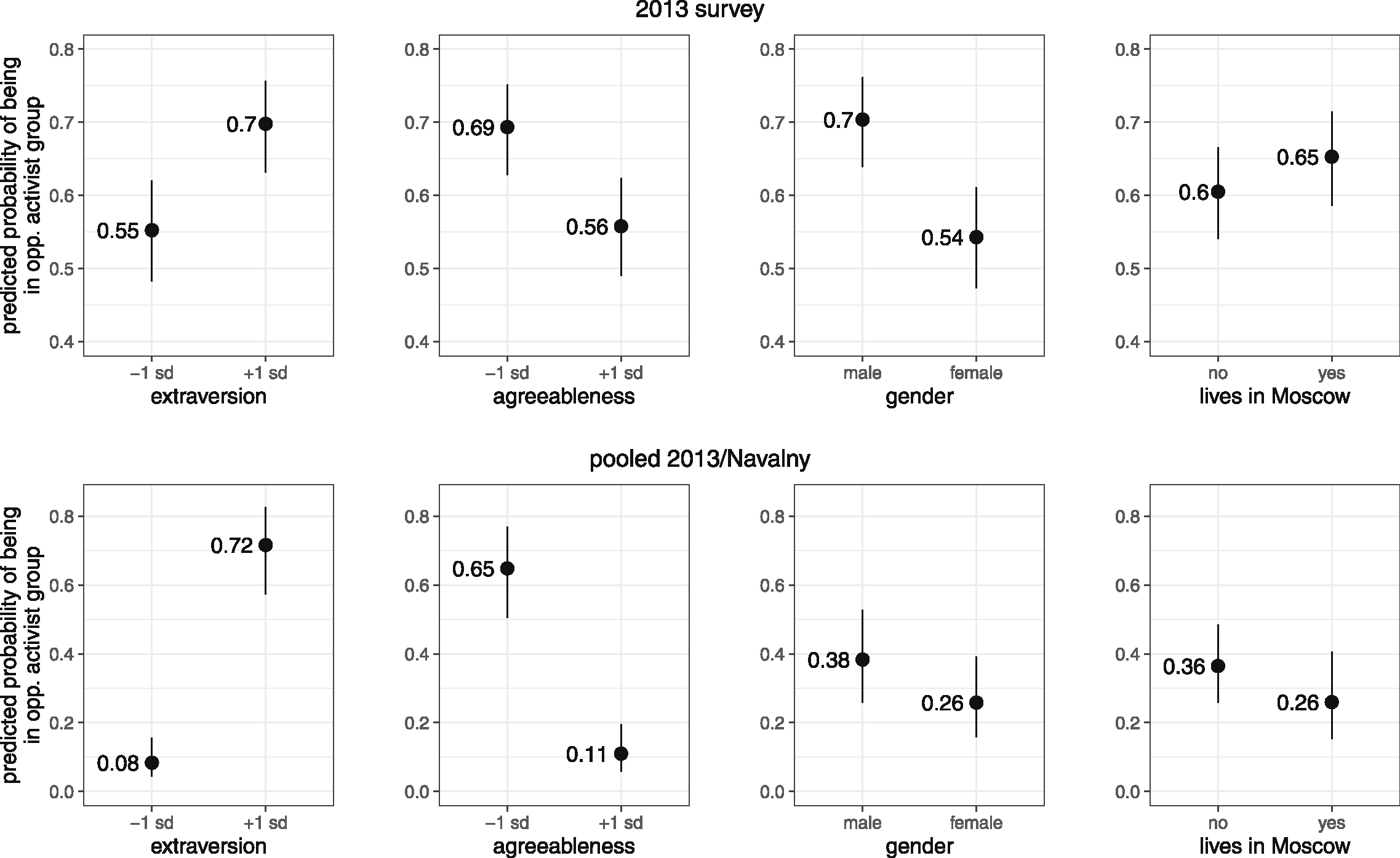
In addition to the various robustness checks performed in Appendix H, we also begin to test the applicability of the theory beyond the Russian case, performing a similar case-control design with online survey data gathered in Belarus in September 2021 and showing that extraversion predicts activism (replicating our findings here) and agreeableness predicts authoritarian leader support (replicating findings by Greene and Robertson (2017) and Truex (2021), see Appendices N and O).
H4: Interaction Effects
The results displayed above have demonstrated independent effects of extraversion and agreeableness. In this final step we now test the interaction between the two, arguing that, at different levels of agreeableness, extraversion has different effects on the likelihood to be an opposition activist. More precisely, our argument suggests a reinforcement process: compared to less agreeable individuals, highly agreeable individuals need stronger increases in extraversion to arrive at the same likelihood of opposition activism.
To test this claim, we plot marginal effects of both agreeableness and extraversion based on the full models with interaction effects as displayed in appendix K (see Figure 5). These results show the predicted probabilities for individuals with one SD below the mean and with one SD above on agreeableness, holding all other variables at their mean. When examining the plots of the pooled samples, where non-active Putin voters are compared to core activists of the Navalny campaign, we see clear support for our reinforcement hypothesis: for people low on agreeableness, lower values of extraversion are required for the same predicted probability of being in the activist group as compared to people higher on agreeableness (only on the high end of the extraversion scale do the curves overlap).
13
The differences, meanwhile, are striking: whereas for people low on agreeableness, below-average values on extraversion are sufficient for pushing the probability over the 50% threshold, highly agreeable individuals need extraversion of a full SD above the mean for a similar likelihood of opposition activism. Looking at the 2013 sample alone, the direction of the interaction is the same—extraversion produces higher predicted probabilities for lower levels of agreeableness—but the confidence intervals overlap at both ends of the extraversion scale, where fewer observations lie. We therefore find stronger support for H4 in the pooled sample that features the highly committed, core opposition activists.
14
Marginal effects plots of interaction between extraversion and agreeableness in predicting probability of opposition activism. Plots are based on models 1 and 2 in Table K1 in the Supplementary Appendix. All other variables are held at their mean. Personality variables are standardized.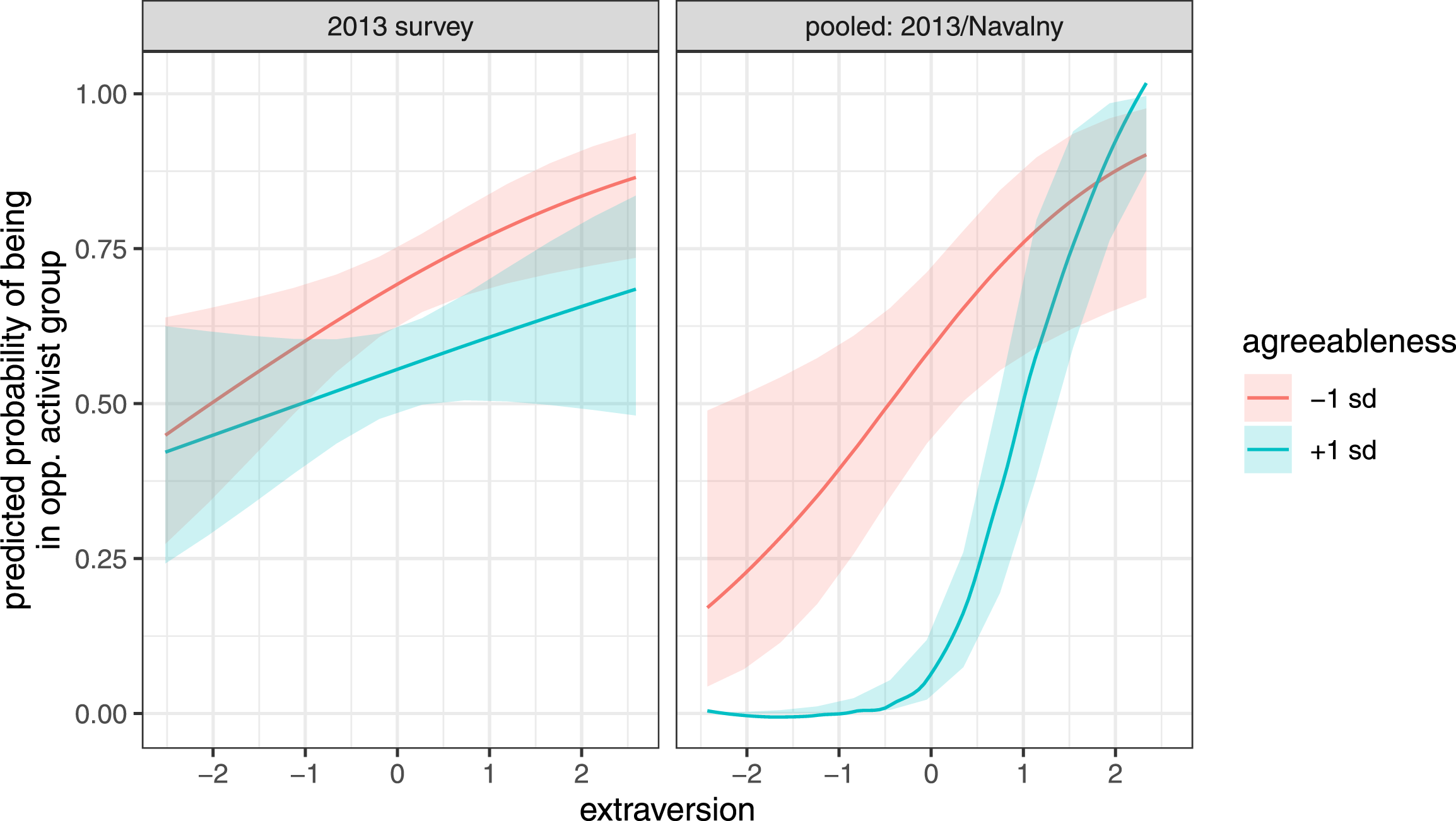
Discussion
What drives people to become opposition activists in an authoritarian regime, where active dissent is potentially dangerous and socially ostracizing? Our answer to this question makes three original contributions. First, our argument puts individual differences in personality front and center, proposing an addition to the literature that, so far, has largely focused on resources, networks, and identities. Our findings strongly suggest considering personality as an important factor in activism research in non-democracies. A next step could be to better understand possible interactions between personality and more established explanatory factors. For instance, the effect of agreeableness on the likelihood to partake in opposition activism could vary depending on an individual’s network: If somebody is so deeply embedded in opposition circles that the negative social repercussions of engagement can be expected to be minimal, agreeableness might have no—or even a positive—effect. On the other hand, personality might (partially) predict the self-selection into different networks in the first place. But this is an empirical question for future study.
Second, building on the literature that finds extraversion to predict political activism in democracies, we provide the first evidence that this relationship holds in stable authoritarian environments. More importantly still, we demonstrate that extraversion is an important explanatory factor for making the leap from online activism to offline campaign work among highly committed supporters of an oppositional challenger—and that it even differentiates between different degrees of involvement in offline opposition activism.
Third, building on research that finds agreeableness to be associated with support for authoritarian leaders (Greene & Robertson, 2017), we show here that agreeableness also matters for political behavior, not just attitudes. It does so in its interaction with extraversion: highly agreeable individuals need higher levels of extraversion than do less agreeable individuals before they are likely to participate in opposition activism. This finding on the interaction of two traits for explaining political behavior is relevant beyond the specific authoritarian political context.
Although Russia is an exemplary case of a modern authoritarian regime, the question remains how well our argument travels to other contexts. Recent research on China is consistent with the research on Russia (Truex, 2021), though further work in other authoritarian contexts would be useful. In Russia itself, we have also seen enormous recent changes in the context for political protest. The invasion of Ukraine and the crackdown on anti-war protests in which more than 16 000 people have been detained have obviously made protesting much riskier and more dangerous. In this context, courage or bravery is likely also to be key predictor of protest participation. While usually considered a virtue rather than a personality trait, there is some evidence that extraversion is correlated with (self-assessments) of courage (Furnham & Lester, 2012), suggesting perhaps an even greater role for extraversion in such highly repressive contexts (see also the negative association between extraversion and fear to engage in politics in appendix F).
What are the implications of these findings for democratic contexts? Our argument holds that individuals low on agreeableness are psychologically better equipped to deal with the social repercussions associated with exhibiting opinions and behavior that go against established social and political norms. Recent studies linking low agreeableness and voting for populist parties in Western European democracies suggest that low agreeableness is associated with forms of political dissent there too (Bakker et al., 2016; Bakker et al., 2021). In this view, the relation between agreeableness and political behavior are not radically different in democracies and authoritarian regimes, since the driving mechanism—heightened acceptance of conflict with one’s social surroundings among people low on agreeableness—is similar. What differs are merely the specific political actors whose active support gets people in trouble with social institutions and in conflict with peers and family. This interpretation supports the hypothesis that the effects of personality on political action “depend on contextual factors that affect the meaning of political stimuli” (Gerber et al., 2010, p. 111). Testing the moderation effect of political context, but also further investigating the role of trait-trait interactions for political behavior, is a worthwhile avenue for further research.
Zooming out from the individual level, we might wonder whether the fact that agreeableness and extraversion matter for protest participation might have implications for protest coordination across different parts of the opposition. Extraverts are more sociable, after all, and so might do well coordinating with others. On the other hand, where lower levels of agreeableness are associated with protest, perhaps this might make coordination across different groups more difficult. This simple picture, of course, is muddied by the fact that there are also strategic factors that shape leaders’ approach to coordination (Armstrong et al., 2020). Nevertheless, we know from previous research in Russia at least, that coordination often takes place at local levels even when national elites or even local leaders are bought off (Dollbaum, 2017), a finding that may be consistent with the individual level findings here.
Supplemental Material
Supplemental Material - The Activist Personality: Extraversion, Agreeableness, and Opposition Activism in Authoritarian Regimes
Supplemental Material for The Activist Personality: Extraversion, Agreeableness, and Opposition Activism in Authoritarian Regimes by Jan Matti Dollbaum and Graeme B. Robertson in Comparative Political Studies
Footnotes
Declaration of Conflicting Interests
The author(s) declared no potential conflicts of interest with respect to the research, authorship, and/or publication of this article.
Funding
The author(s) received no financial support for the research, authorship, and/or publication of this article.

Supplemental Material
Supplemental material for this article is available online.
Notes
Author Biographies
References
Supplementary Material
Please find the following supplemental material available below.
For Open Access articles published under a Creative Commons License, all supplemental material carries the same license as the article it is associated with.
For non-Open Access articles published, all supplemental material carries a non-exclusive license, and permission requests for re-use of supplemental material or any part of supplemental material shall be sent directly to the copyright owner as specified in the copyright notice associated with the article.
