



Abstract
This paper introduces the Extraterritorial Rights and Restrictions dataset (EVRR), the first global time-series dataset of non-resident citizen voting policies and procedures. Although there have been previous efforts to document external voting, no existing data source simultaneously captures the scale (195 countries), time frame (71 years), and level of detail concerning extraterritorial voting rights and restrictions (over 20 variables). After a brief overview of prior datasets, we introduce EVRR coding criteria with a focus on conceptual clarity and transparency. Descriptive analysis of the dataset reveals both the steady expansion of extraterritorial voting as well as several regional and temporal trends of voting rights restrictions. Finally, we revisit and extend the work of two groundbreaking cross-national studies focused on the causes and effects of external voting rights. Using EVRR data we demonstrate that including more fine-grained aspects of extraterritorial voting provisions in these analyses improves understanding of important political and economic outcomes.
Over the last three decades, the majority of the world’s states extended voting rights to non-resident citizens. 1 This translates to the mass enfranchisement of roughly 200 million emigrants in the elections of over 140 countries around the world. For countries with competitive elections, especially the 75 states with sizable diaspora populations, incorporating diaspora votes has the potential to change election outcomes. 2 Moreover, given the importance of economic remittances for many developing economies, the inclusion of emigrant citizens in elections has not only political but also economic implications.
There is significant variation in the extent to which states enable their non-resident citizens to vote from abroad. This variation exists cross-nationally and over time, as well as sub-nationally depending on the type of election as well as electoral cycle. In some cases, political actors support diaspora voting, expanding access and adjusting campaign strategies to mobilize supporters abroad; in others, political actors minimize emigrant participation by imposing significant voting restrictions or ignoring calls for enfranchisement entirely. Despite attempts to systematically collect and analyze cross-national data on extraterritorial voting dating back 20 years (Blais et al., 2001), this variation within emigrant enfranchisement—not only the formal recognition of voting rights but also the array of policy decisions shaping the ability to vote from abroad—has not been fully captured by existing global datasets covering non-resident citizen enfranchisement. Documenting this variation is critical to understand the degree of emigrant political inclusion in which legal adoption of voting rights is only the first step in a dynamic process of expanding or restricting effective enfranchisement abroad. 3 This important distinction between legal rights and multifaceted implementation is not captured by any existing global dataset. 4
The Extraterritorial Voting Rights and Restrictions Dataset (EVRR) is the first comprehensive global time-series dataset of external voting, covering 195 countries from 1950 to 2020. EVRR makes four central contributions to our understanding of extraterritorial voting rights. First, EVRR distinguishes between legal adoption and implementation of extraterritorial voting rights. Second, EVRR systematically codes over 20 restrictions on external voting rights, focusing on three ways participation is regulated: voter eligibility, modality of access, and institutional integration. Third, EVRR presents longitudinal data with country-year observations for 71 years, enabling changes in rights and restrictions to be tracked over an extensive period of time. Fourth, EVRR provides a detailed codebook and sourcing for each variable, facilitating both the interpretation of coding procedures and continued updating of the dataset.
The richer empirical analysis that the EVRR dataset makes possible comes at a time in which scholars working in quite diverse areas have increasingly recognized the importance of migrant rights and political engagement. Recent scholarship highlights the important role of migrant political ties within international labor markets and financial flows (e.g., Mosley & Singer, 2015), conflict studies (Helbling & Meierrieks, 2020), democratization (e.g., Escribà-Folch et al., 2015), autocratic regime stability (Dendere, 2018; Miller & Peters, 2020), and elections (e.g., Arrighi & Bauböck, 2017; O’Mahony, 2013). The EVRR dataset enables analysis of the causes and consequences of emigrant political inclusion (and exclusion) to be conducted in a more nuanced fashion across a larger number of cases and over a longer period of time.
In this paper we introduce EVRR and present initial applications using new variables from the dataset. We first conceptualize extraterritorial voting and develop how this definition motivates the core dimensions and indicators we measure. Next, we review the existing cross-national efforts to measure emigrant voting rights, all of which have notable limitations, including scope of coverage, poorly defined variables, or failure to measure restrictions. We then introduce EVRR, explaining how our coding strategy and sources address and overcome these challenges by presenting detailed measurement criteria for two core variables—Legal Adoption and Implementation—as well as a brief overview of the 22 additional restrictions variables included in the dataset. We then provide initial analysis of the dataset revealing descriptive trends in external voting rights and restrictions across regions and over time.
Finally, we replicate and extend two groundbreaking cross-national studies on emigrant political inclusion: the international diffusion of extraterritorial voting rights (Turcu & Urbatsch, 2015) and the relationship between the extension of political rights and migrant remittances (Leblang, 2017). We find that it is not legal extension of extraterritorial voting rights that drives regional diffusion but the actual implementation of external voting abroad. We also find that although adoption and implementation of extraterritorial voting by themselves are not associated with higher levels of remittances, more inclusive modalities of external voting are associated with significantly higher levels of remittances. These analyses demonstrate the value of the EVRR dataset and approach: more fine-grained variables measuring how extraterritorial voting is organized improves our understanding of major causes and consequences of extending political rights to citizens abroad. 5
Defining Extraterritorial Voting
We define extraterritorial voting as the ability for a non-resident citizen to vote in elections in the country where they hold citizenship from outside of the country’s physical boundaries. 6 As the core components of this definition motivate the structure and content of our dataset variables, it is important to briefly develop each of the central concepts of this definition.
First, we argue that the ability of non-resident citizens to vote is actually two separate phenomena—sequential and conditional but empirically distinct. First, the legal ability to vote from abroad (i.e., de jure enfranchisement) entails formal codification by decree, legislation, or judicial ruling. The foundational variable of our dataset (
Next, we define a non-resident citizen as a national citizen that lives outside of their country of origin. They may live outside the country temporarily or permanently, but their primary residence is abroad. Depending on requirements and location, non-resident citizens may not be eligible to vote in the elections of their country of origin from their country of residence. Thus, our first category of variable indicators concerns emigrant voter eligibility, including voter registration and identification requirements, as well as citizenship, residency, and temporal rules governing participation.
The ability to vote…from outside of the country’s physical boundaries requires that countries provide some kind of external voting mechanism to non-resident citizens where they currently live. The next category of EVRR variable indicators thus codes for the different types of voting modalities governments organize for extraterritorial voting, including postal ballots, proxy voting, or polling stations at diplomatic bureaus abroad. Moreover, this criteria also then excludes states that allow non-resident citizens to vote but only if they physically return to the origin country (e.g., Nigeria, Ireland, Israel).
Finally, to vote…in elections in their country of origin recognizes that countries hold numerous types of elections at different levels of government. For enfranchised diasporas, only some contests may be open to them; for instance, the ability to cast votes in presidential elections but not legislative or sub-national elections. Countries also vary in the ways they channel the votes of non-resident citizens into their institutional structures. A handful of countries have special seats in their legislatures reserved for diaspora respresentatives. Thus our final category of EVRR variables details the institutional integration of extraterritorial votes into different levels of government.
Previous Approaches to Extraterritorial Voting Datasets
In recent decades we have witnessed a plethora of citizenship policy indices documenting and measuring the numerous dimensions of citizenship and related rights, including voting rights (e.g., The Indicators of Citizenship Rights for Immigrants (ICRI), Migration Policy Index (MPI), Citizenship Policy Index (CPI), Citizenship Regime Inclusiveness Index (CITRIX)) (Goodman, 2015). However, with a few recent exceptions (e.g. GLOBALCIT's Election Law Indicators (ELECLAW)), citizenship policy indices generally do not consider emigrant citizens. In other words, these indices do not address which citizenship rights (including suffrage) of non-resident citizens are upheld or extended beyond a country’s physical borders. 7
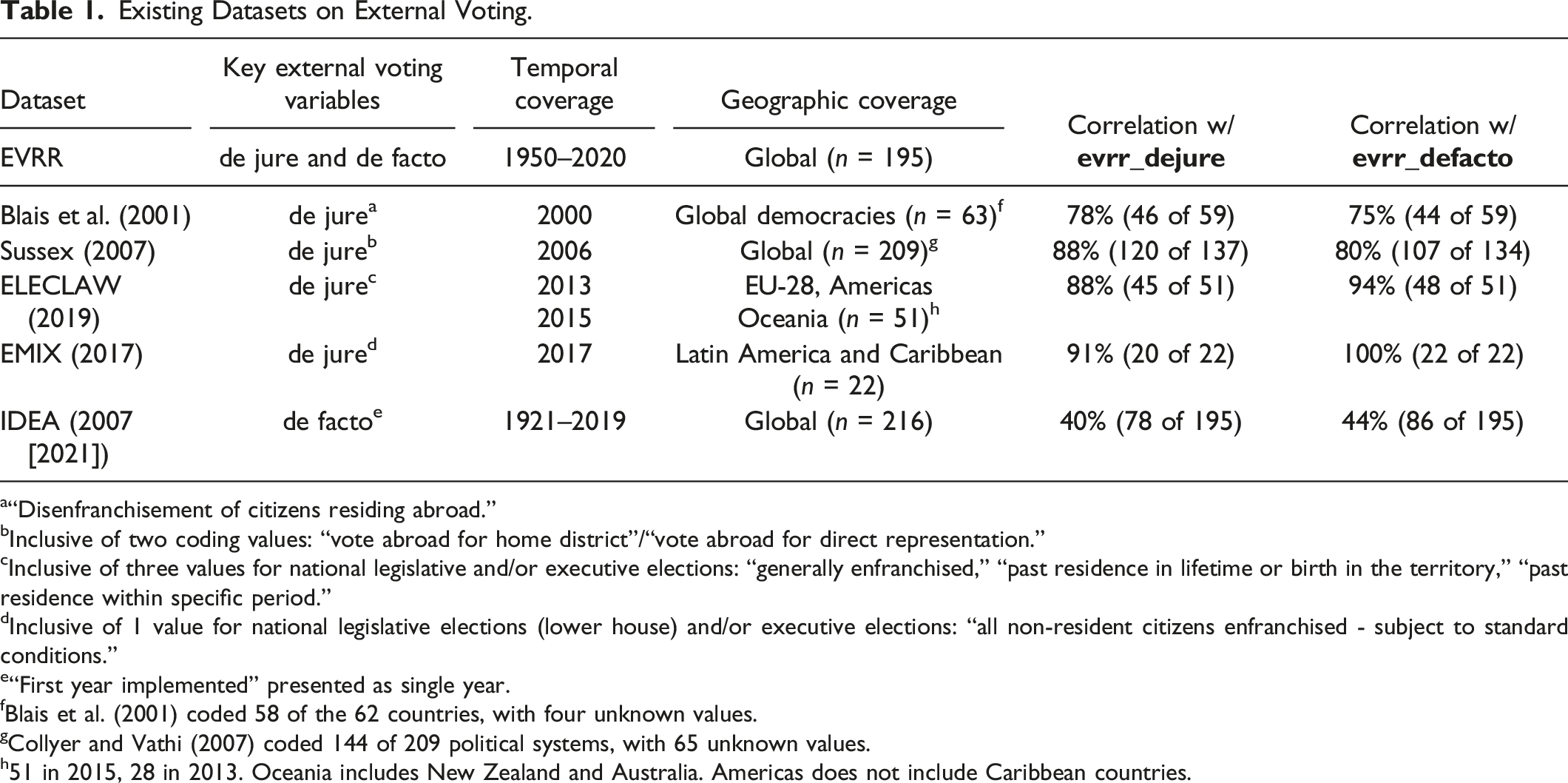
That does not mean that researchers have not been interested in documenting extraterritorial voting systematically. The earliest effort to codify external voting rights across countries was part of an analysis assessing the scope of suffrage across 63 democracies (Blais et al., 2001). In addition to variables coding suffrage requirements related to age, incarceration, mental capacity, and citizenship, the study included the variable “disenfranchisement of citizens residing abroad,” with countries coded as “yes” if residency outside of the country precluded a citizen from voting in a national election. This is not exactly the same concept as external voting, as the residual “no” category includes both countries that organize voting access for citizens abroad as well as countries that only allow non-residents to vote if they physically return to their country for the election. The measure also conflates de jure and de facto enfranchisement, and focuses primarily on democracies in Europe and the Americas. 8 Despite the lack of measurement clarity and limited coverage, Blais et al. (2001) was an important first step in coding both voting abroad and restrictions.
In 2007 the International Institute for Democracy and Electoral Assistance (IDEA) published their groundbreaking Voting From Abroad Database, covering external voting for 216 countries and territories (Ellis et al., 2007). 9 For each country, IDEA lists two characteristics: Election type, specifying which elections emigrants can participate (e.g., executive, legislative) and Voting method, specifying the modalities by which emigrants can cast their ballot (e.g., personal, proxy, postal). It also lists two dates: Year and First year but does not specify in their methodology what those dates reference. 10 IDEA also includes a comments section which highlights individual country particularities. Given its complete geographic coverage of external voting, the IDEA database has been the source for most maps, tables, and cross-national analyses of external voting to date (e.g., Brand, 2010; Collyer & Vathi, 2007; Lafleur, 2013, 2015; Rhodes & Harutyunyan, 2010; Turcu & Urbatsch, 2015). While the efforts by IDEA to develop and maintain a major cross-national database of emigrant voting represent a significant advance, ambiguous concepts, opaque coding criteria, and a significant lack of data on a number of countries in the Global South, particularly sub-Saharan Africa, reduce both reliability and validity of the ambitious effort.
A number of more recent datasets have improved measurement clarity and include more micro-level policy variables associated with external voting, including the Sussex Database (Collyer, 2013; Collyer & Vathi, 2007), ELECLAW indicators (Schmid et al., 2015, 2019), and the EMIX dataset (Palop-Garcia & Pedroza, 2017; Pedroza & Palop-García, 2017). Yet these datasets also have limitations; they are either geographically broad but temporally static (i.e., capturing a single moment in time) or temporally extensive but limited in their regional coverage to European and Latin American countries.
A series of new papers also feature original datasets focusing on external voting provisions at the electoral level, including papers analyzing variation in emigrant voter turnout (Burgess & Tyburski, 2020; Ciornei & Østergaard-Nielsen, 2020), testing a theory of emigrant voter access in African elections (Wellman, 2021), or exploring the interaction between immigrant and emigrant voting rights (Finn, 2020). These recent data collection efforts have significantly enhanced our understanding of the multifaceted dimensions of external voting provisions. Yet these advances in concept and measure precision have often come at the cost of geographic and temporal scope relative to the more comprehensive, but less detailed, global data sources. We compare these prior efforts to our new dataset in more detail after introducing EVRR in the next section.
EVRR advances existing efforts by combining the strengths of these prior approaches in three critical ways. First, it complements the recent data collection efforts that also include multiple, disaggregated variables to more precisely document and analyze the extensive variation within external voting policies and practices. Second, it extends the coverage of these variables globally, maintaining the cross-national ambitions of the foundational IDEA and Sussex databases, allowing for greater comparative cross-regional analysis. Our comprehensive coverage particularly advances the field by including countries and regions where systematic external voting data has been limited and difficult to collect, including sub-Saharan Africa and the Pacific islands. Third, it is longitudinally expansive, enabling a better understanding of external voting policy development over time, both within countries as well as documenting regional and global trends.
Introducing EVRR: Measuring Extraterritorial Voting Rights
Covering 195 countries between 1950 and 2020, the EVRR dataset provides the first global time-series dataset of non-resident voting that covers multiple dimensions of emigrant inclusion in national elections. 11 Our starting position is that the enfranchisement of non-residents is both multifaceted and dynamic. Countries that enfranchise non-resident citizens face an array of choices as to how voting will be facilitated and incorporated into the existing political system; once decided, these choices can evolve over time depending on a variety of factors, including emigrant demand, political party in power, and changes in bureaucratic capacity. EVRR codes the voting rights extended to non-resident citizens, the restrictions placed on the exercise of these rights, and how these rights and restrictions change over time. Our unit of analysis is country-year, covering every year from 1950 to 2020. Data is coded for the end of a calendar year (i.e., if the first legislation providing for external voting is ratified in August, we code legal adoption as yes for that year). Most EVRR variables are binary (1 for yes, 0 for no) with exceptions outlined below.
Constructing the dataset began in earnest in 2017, led by three principal researchers with the assistance of undergraduate research assistants. When coding EVRR variables, we prioritized primary source documentation for evidence. For de jure changes, we relied on relevant legal documents, including national constitutions, electoral laws, legal rulings, and policy memos. Wherever possible, multiple iterations of the same source type (e.g., electoral laws) were collected over time to establish critical changes in the texts and subsequent policy settings. For de facto enfranchisement, we used evidence from domestic and international election monitoring reports, as well as electoral commission and embassy websites. We supplemented our primary research with secondary sources, including news reports, academic articles, as well as publications from NGOs and diaspora groups. All coding decisions are referenced and reported in individual country files; all sources cited in country files are included in an electronic project database.
We encountered significant variation in terms of availability of source documentation as well as (often) vague language. In many of the cases where we were unsure or uncertain, multiple members of the research team would independently code variables based on the collected documentation. The lead researchers also met regularly to discuss particularly challenging cases. For observations where we either did not have enough evidence, or the policy parameters were not articulated, we code “.e”. 12
We consider extraterritorial voting rights to exist (
It is worth noting three key criteria for excluding countries that extend de jure emigrant enfranchisement but only in partial, conditional ways. As outlined above, for our definition, non-resident citizens must be able to cast their vote from outside of the country; if non-resident citizens have to physically return to their home country to vote, we code as
The legal adoption of extraterritorial voting rights constitutes de jure enfranchisement; the exercise of these rights in practice constitutes implementation during elections, that is, de facto enfranchisement. We consider extraterritorial voting rights to have been effectively enacted (
Existing Datasets on External Voting.
a“Disenfranchisement of citizens residing abroad.”
bInclusive of two coding values: “vote abroad for home district”/“vote abroad for direct representation.”
cInclusive of three values for national legislative and/or executive elections: “generally enfranchised,” “past residence in lifetime or birth in the territory,” “past residence within specific period.”
dInclusive of 1 value for national legislative elections (lower house) and/or executive elections: “all non-resident citizens enfranchised - subject to standard conditions.”
e“First year implemented” presented as single year.
fBlais et al. (2001) coded 58 of the 62 countries, with four unknown values.
gCollyer and Vathi (2007) coded 144 of 209 political systems, with 65 unknown values.
h51 in 2015, 28 in 2013. Oceania includes New Zealand and Australia. Americas does not include Caribbean countries.
There is less correspondence between EVRR and IDEA’s “date of first enfranchisement” measure, especially comparing
EVRR: Measuring Extraterritorial Voting Restrictions
External Voting is a dynamic process, with the sequencing of decisions about adopting voting rights for non-resident citizens, establishing provisions for their participation, and organizing voting abroad during elections significantly varying across countries. Similarly, the politics of these decisions also vary in theoretically important ways. If, for example, leaders are extending rights to conform to regional norms, then adoption of electoral rights without implementation, or adoption accompanied by strict restrictions, may be enough to satisfy minimal perceived standards. On the other hand, if enfranchisement is driven by vote-seeking politicians, we might expect inclusive rules put in place and quickly implemented in pursuit of electoral gain. Different theoretical accounts of enfranchisement lead to different hypotheses regarding adoption, restrictions, and implementation. Systematic hypothesis testing about the causes and consequences of the extension of extraterritorial voting rights requires disaggregation and nuance rather than simple binary measures of diaspora enfranchisement.
The EVRR dataset thus includes over 20 additional variables related to how external voting may be organized. This data comprises the substantial majority of the new data we have systematically collected for this dataset. EVRR groups rules governing external voting rights into three broad categories: voter eligibility, modality of access, and institutional integration. This corresponds to who can vote, how extraterritorial voting occurs, and how votes are channeled into the electoral system. 16
Eligibility
Deciding who constitutes “the people” granted the right to select leaders is a continual process. Even when countries enfranchise non-resident citizens across occupational and social categories, further choices expand or limit the extent of inclusion. Whether individual non-resident citizens can exercise their right to vote is often subject to particular eligibility criteria for both registering and voting abroad. Our set of variables focuses on two types of eligibility criteria: (1) those restricting the scope of non-resident enfranchisement; and (2) those increasing the cost of maintaining eligibility.
A country’s citizenship laws shape the scope of diaspora enfranchisement. The most formal eligibility restrictions rescind voting rights based on citizenship criteria. For countries that do not allow dual citizenship, the legality is simple: non-resident citizens shift to non-citizens when they are naturalized by another country, thereby negating their right to vote. Other countries that allow dual citizenship may include rules prohibiting dual citizens from participating in elections. We include variables for both the existence of dual citizenship (
A second set of rules and restrictions increase (or decrease) the cost of maintaining eligibility. Maintaining eligibility may be dependent upon whether a citizen abroad possesses particular forms of identification (
Modality of Access
Similar to our approach to eligibility, variables focusing on voting modality also capture different costs of participation. These costs can become particularly burdensome when voting from a foreign country, where non-resident citizens may live a long distance from diplomatic polling stations. Countries seeking to include non-resident citizens can lower costs primarily through convenient voter options, including broad coverage of polling stations in destination countries or a remote voting option (i.e., postal, online).
The primary modality of external voting, in-person voting, occurs most often at diplomatic bureaus (i.e., embassies, high commissions, or consulates) (
Institutional Integration
Our final dimension includes variables measuring the scope of elections non-resident voters are able to participate in. The electoral contests in which non-residents are permitted to participate vary across countries, including executive elections (
While our coverage of policy variables is comprehensive, it is not exhaustive; in this first edition of EVRR we attempted to code the policy variables across time and around the world that we observed across numerous regions. We also were limited at times by uneven data availability. We envision potential updates could include additional variables; for example, whether states organize separate diaspora electoral district(s) (e.g., South Africa) or integrate diaspora votes into domestic electoral districts (e.g., Botswana). 18 Nevertheless, EVRR’s combination of the core non-resident enfranchisement variables and the variables focusing on eligibility, modality, and institutional integration allow us to track broad changes in the voting rights of non-resident citizens across time and across countries. EVRR offers a unique ability to identify global and regional trends, which we explore below.
Descriptive Analysis of Extraterritorial Voting Trends
The Extraterritorial Voting Rights and Restrictions dataset (EVRR) dataset enables us to analyze the inclusion of emigrant citizens into electoral politics throughout the world and over time. Figure 1 illuminates how legal extension of external voting rights has diffused around the world. In 1970, only nine countries had extended voting rights to citizens abroad, with the majority of these countries located in the Global South. By 1990, most Western European countries had adopted extraterritorial voting, with a majority of countries in Latin America and the former Soviet Union legally enfranchising by 2000. Between 1990 and 2020, over 100 countries extended external voting for the first time, including 35 new extensions in Africa. Today a total of 141 countries legally enfranchise non-resident citizens. Scholars of democratization, state formation, and post-conflict transitions will note how the timing of legal adoption often corresponds with processes of independence, transitions to multi-party politics, or moments of major constitutional and/or electoral reform. Global distribution of legal external voting enfranchisement (evrr_dejure) over time (1970–2020).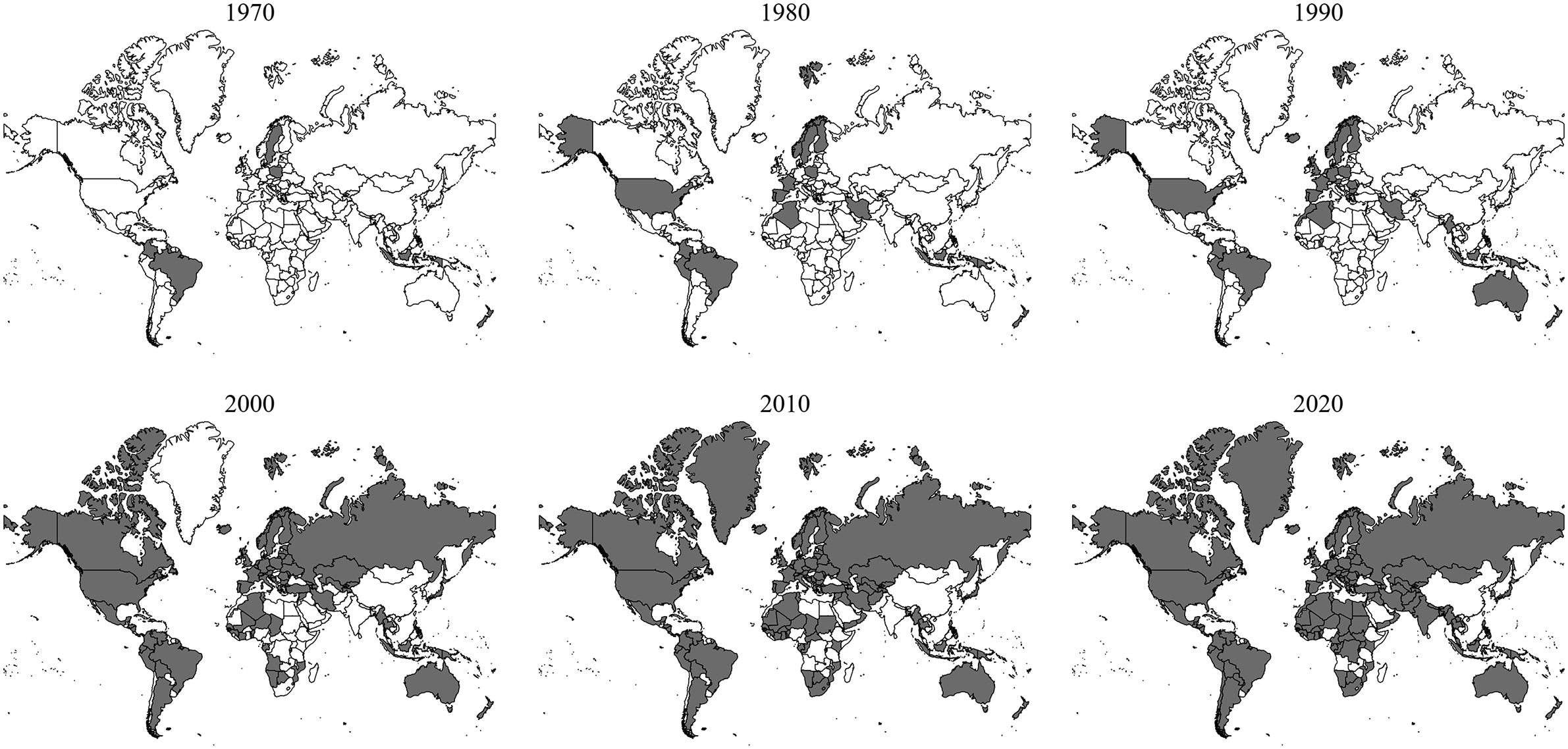
Turning to implementation, we observe a broadly similar process of diffusion, with some notable individual country delays (Figure 2). Whereas only a handful of countries organized voting for citizens abroad in 1980, most Western European countries had implemented by 1990, followed by North America, South America, and Eastern Europe in 2000. We observe more recent implementation in sub-Saharan Africa, Asia, and the Middle East and North Africa (MENA) region, with many countries implementing after 2000 in these regions. It is only within the last decade that the majority of countries in the world have begun to implement diaspora voting. As of 2020, 127 countries have organized extraterritorial voting in at least one national election. Scholars researching external voter turnout and transnational party mobilization, changes in levels of emigration or economic remittances, as well as the domestic electoral dynamics of particular countries may be interested in individual country cases of delayed implementation as well as reversals. Global distribution of effective external voting implementation (evrr_defacto) over time (1970–2020).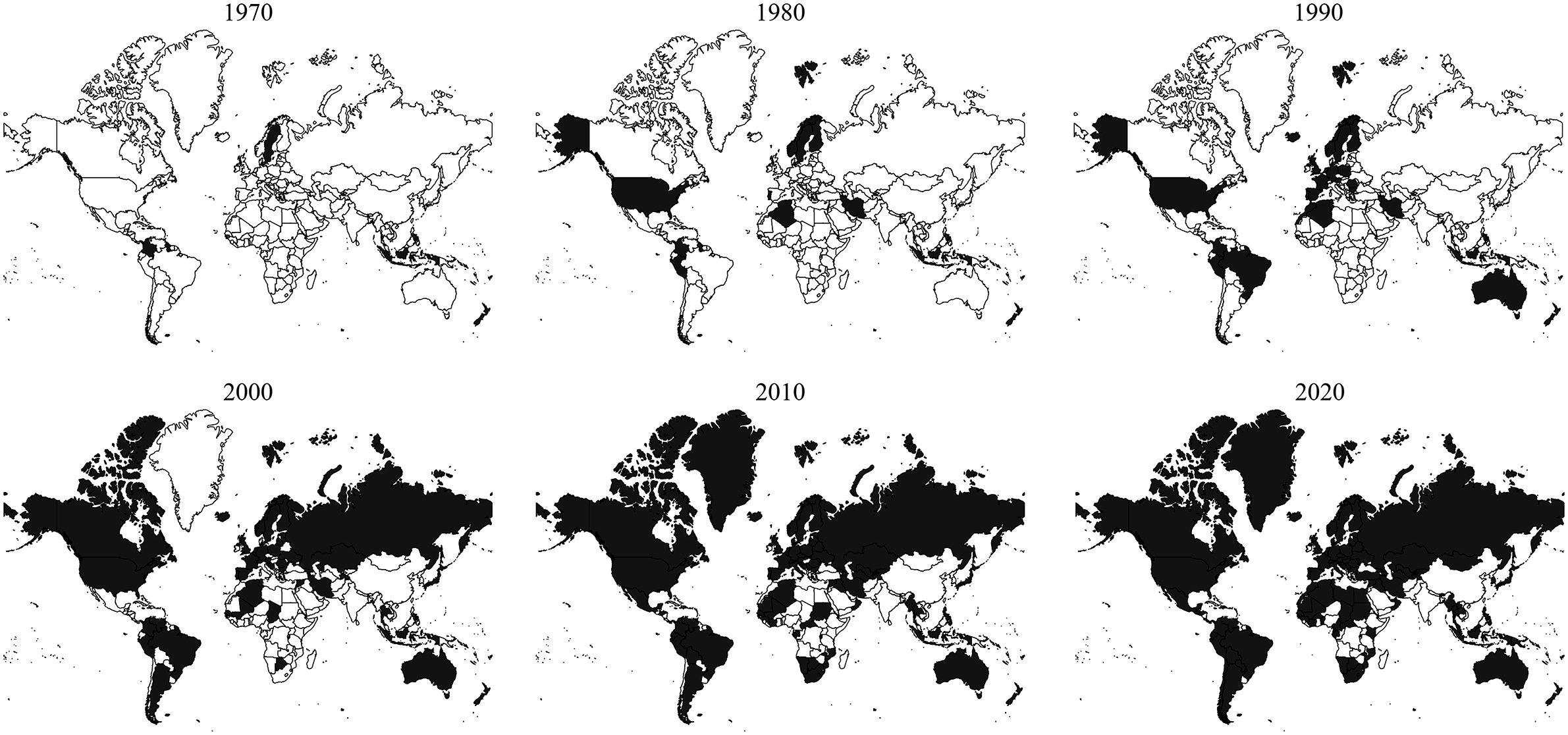
Indeed, EVRR allows observation of distinct patterns between the adoption and implementation of external voting. We observe a significant spike in the number of countries that legally expanded voting to citizens abroad in the early 1990s (Figure 3a). Worth noting is that the majority of countries that have legally extended diaspora voting rights since 1990 have done so after 2000. The provision of external voting implementation follows a different pattern (Figure 3b). It is not until 2004 when the majority of national elections around the world included external voting; in recent years the percentage of national elections that include diaspora populations continues to steadily increase. The difference in these external voting trends can be partially explained by the variation we observe in the number of years between adoption and implementation. These gaps can span from a couple of years to multiple electoral cycles; for example, Bolivia did not organize external voting until 2009, nearly 18 years and five electoral cycles after initial legal enfranchisement.
20
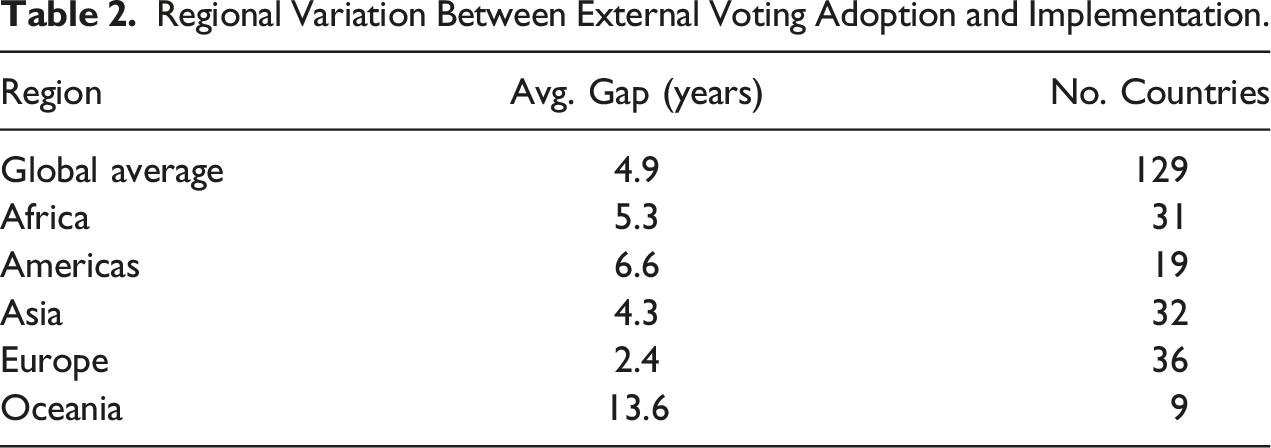
Table 2 displays the regional variation between adoption and implementation; these delays further underscore the importance of disaggregating de jure from de facto enfranchisement, often reflecting both capacity issues and domestic political contestation over emigrant electoral inclusion. (a): External voting adoption by country ( Regional Variation Between External Voting Adoption and Implementation.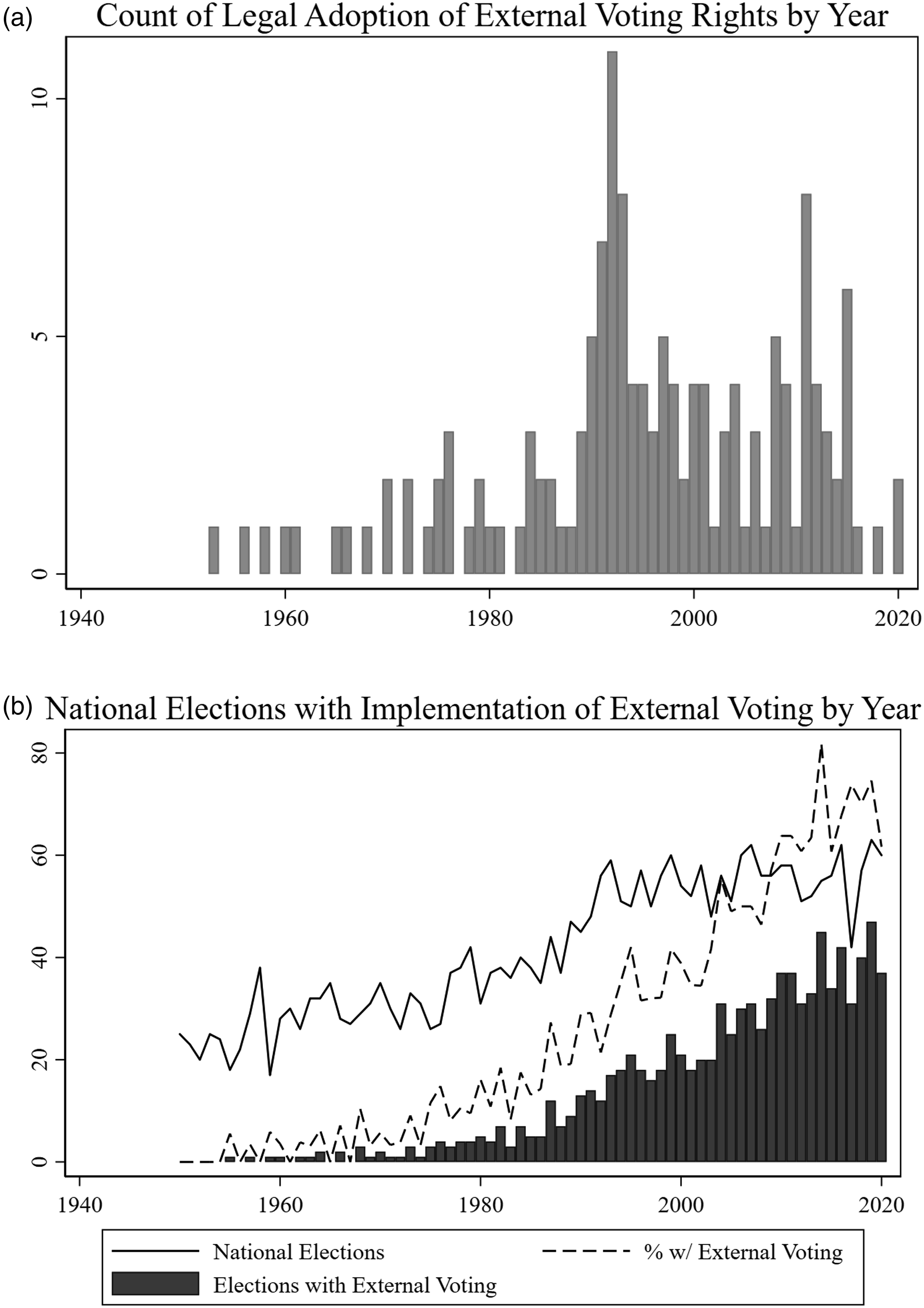
As of the end of 2020, 18 countries have adopted extraterritorial voting laws but have yet to organize voting abroad. These include (with the year of legal enfranchisement in parentheses): Albania (2020), Angola (1992), Bangladesh (2009), Comoros (2005), Congo (2001), DRC (2015), Gambia (2015), Ghana (2006), Greece (1975), Haiti (2012), India (2015), Nepal (2018), Nicaragua (1996), Pakistan (2013), Sierra Leone (2012), South Sudan (2011), Uganda (2020), and Yemen (2001). The countries in this “never implemented” category comprise a diversity of regime types, electoral systems, levels of economic development, conflict, and relative size of their diaspora populations; the heterogeneity of these countries underscores the domestic political and logistical dynamics informing decisions to include emigrants in elections apart from broader global, regional, and temporal trends.
Moving beyond dichotomous measures of adoption and implementation, our more fine-grained measures of rights and restrictions show distinct patterns over time as well (Figure 4). For instance, there is a dramatic increase in requirements for emigrants to register to vote abroad with the diplomatic bureau of where they are living before election day ( Global variation in (a): external voting eligibility requirements, (b): voting modality, and (c): institutional integration of external voters over time.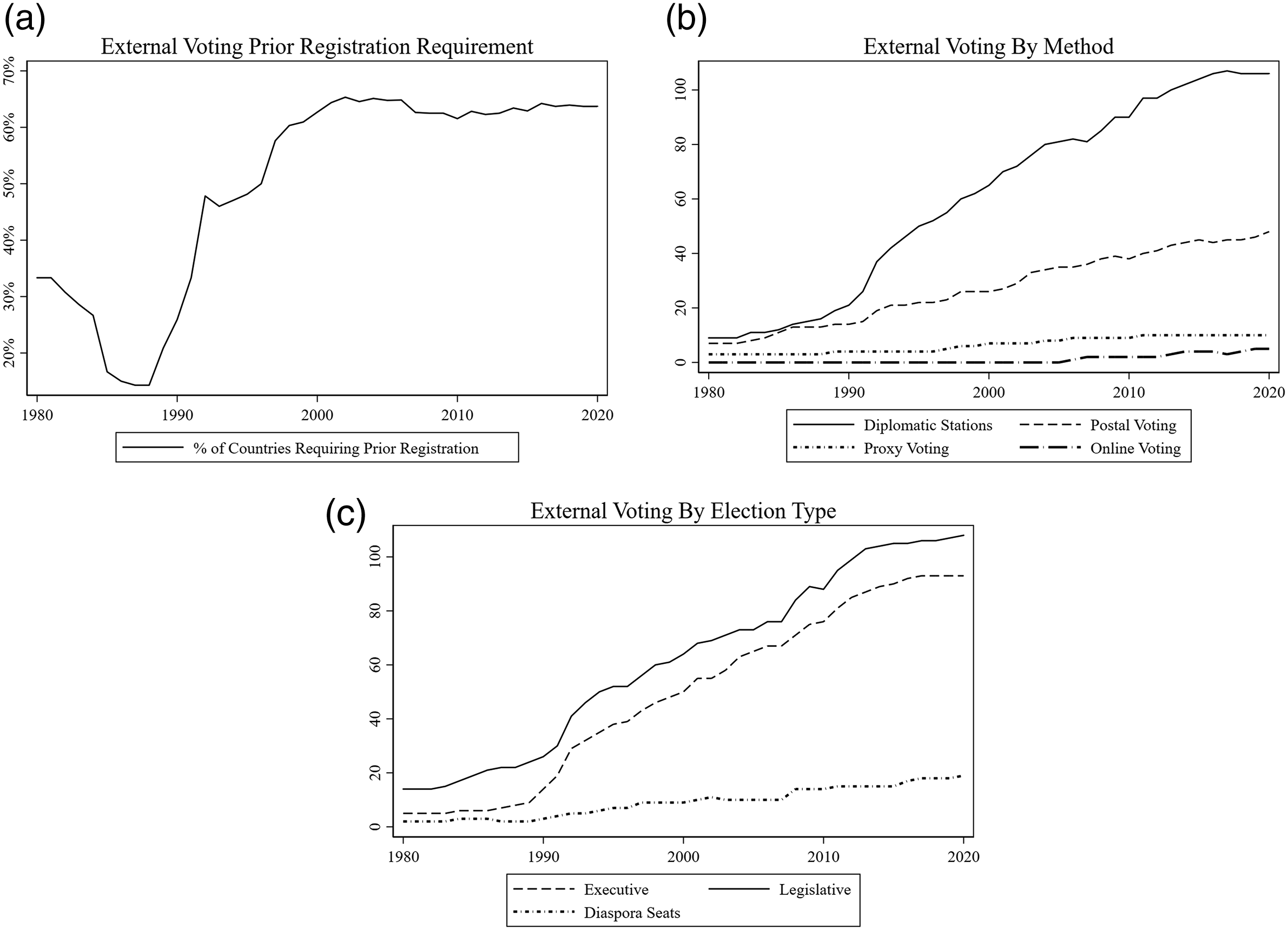
Moreover, EVRR enables scholars to track and compare dynamic changes to extraterritorial voting over time within individual countries and regions of interest. There is significant country-level as well as regional heterogeneity in terms of policy stability; while some country external voting policies are relatively sticky, others exhibit significant variation, often corresponding with major changes in migration patterns or turnover of governing parties. For example, the political blocs in Ukraine have fought for years over rules for voting abroad, with parties associated with Russian-speakers generally preferring fewer restrictions. The implementation of neighborhood polling stations in Russia became contentious during the controversial 2004 elections. 21 The last minute announcement of the creation of 420 additional polling stations in the Russian Federation was viewed as benefiting the incumbent Party of Regions. Provisions allowing such stations were removed in later electoral laws. Similarly, the change in government following the 2014 ouster of Party of Regions’ President Viktor Yanukovych ushered in more restrictive identification requirements for voters abroad. 22
While it is impossible for any cross-national dataset to capture all of the rich details of what occurs during elections around the world in the more than one hundred countries that have adopted and implemented extraterritorial voting, EVRR captures the scale, scope and evolution of external voting across the globe in a fashion never before attempted. This allows scholars who focus on particular countries or regions the ability to better contextualize their research against a truly global comparison set, and scholars who engage in broad cross-national quantitative research to use richer and more reliable measures of extraterritorial voting rights and restrictions in their analyses.
Extensions of Extraterritorial Voting Studies Using EVRR
As outlined above, EVRR is both dynamic and detailed, enhancing the study of emigrant voting over time and around the world. EVRR variables can shed new light for scholars seeking to address both the causes of migrant political inclusion as well as potential consequences. To demonstrate this point, we revisit two recently published pieces in Comparative Political Studies that engage with the issue of migrant political rights. 23 First, our disaggregation of Legal Adoption and First Implementation provides leverage in better understanding the role of international diffusion as a cause of emigrant enfranchisement (Turcu & Urbatsch, 2015). Second, our variables measuring the inclusion and institutional incorporation of emigrant voters allow us to analyze the relationship between migrant political engagement and their connection to their home country through remittance levels (Leblang, 2017). More broadly, these extensions of pre-existing scholarship allow us to make two important points about the potential value of the EVRR dataset. First, EVRR allows us new opportunities to study the causes and processes of political reform as it relates to non-resident citizen voting rights. Using EVRR variables leads us to build on and revise important findings on the correlates of diaspora enfranchisement. Second, we demonstrate one potential avenue through which voting rights may affect important decisions made by migrants; specifically, their economic engagement with their country of origin. This highlights the potential to use EVRR variables to analyze a range of migrant attitudes and behaviors.
Diffusion of Diaspora Enfranchisement
Turcu and Urbatsch (2015) is one of the first cross-national empirical analyses of diaspora enfranchisement. 24 Turcu and Urbatsch (T&U) interpret the rapid increase of emigrant voting rights since 1990 as an example of international diffusion associated with democratization. They outline two potential mechanisms driving this diffusion: (1) states extend emigrant voting rights to signal their commitment to democratic norms to compete for benefits from the international community; and (2) states copy the “successful” diaspora engagement strategies of neighboring countries. Using the IDEA dataset, their analysis finds that a neighboring country’s recent legal adoption of extraterritorial voting rights doubles the chance a country will enfranchise non-resident citizens.
The authors acknowledge important slippage between their argument and their measurements. Whereas their theory is concerned with de jure enfranchisement, that is, “the incentives and motivations for policymakers as they enacted legislation” (Turcu & Urbatsch, 2015, p. 417), their main outcome variable (using IDEA) captures the first year of implementation. Given adoption and implementation are distinct political processes (e.g., Palop-García & Pedroza, 2019; Wellman, 2021), this suggests different mechanisms of policy diffusion may be operating at each stage. An international diffusion story of legal adoption is inherently elite-centric, with emigrant enfranchisement laws passed to satisfy international actors or knowledgeable activists within the diaspora community. On the other hand, an international diffusion story of implementation engages a broader set of stakeholders. Mass displays of external voting in host countries visually signal democratic norm compliance to international observers broadly and neighboring host countries specifically. Similarly, external electoral participation binds the diaspora to the home country, thereby inspiring emulation among neighboring states. The choice of adoption or implementation variables, then, has theoretical implications for understanding which proposed democratic diffusion mechanisms may be at work.
The EVRR dataset allows for a more precise test of T&U’s argument with variables that more closely match their theory. Our dependent variables are First Adoption, the first year
Our findings regarding the recent adoption of extraterritorial voting depart dramatically from Turcu and Urbatsch.
27
Marginal effects of the two key neighborhood enfranchisement variables are presented in Figure 5.
28
Remarkably, Recent Nearby Adoption decreases the likelihood of adoption, though this effect is not statistically significant. This is the opposite of the T&U analysis, which finds a positive and significant relationship. There is a positive relationship between Recent Nearby Implementation and First Implementation; however, the relationship is also not statistically significant. Marginal effects of Recent Nearby Adoption and Recent Nearby Implementation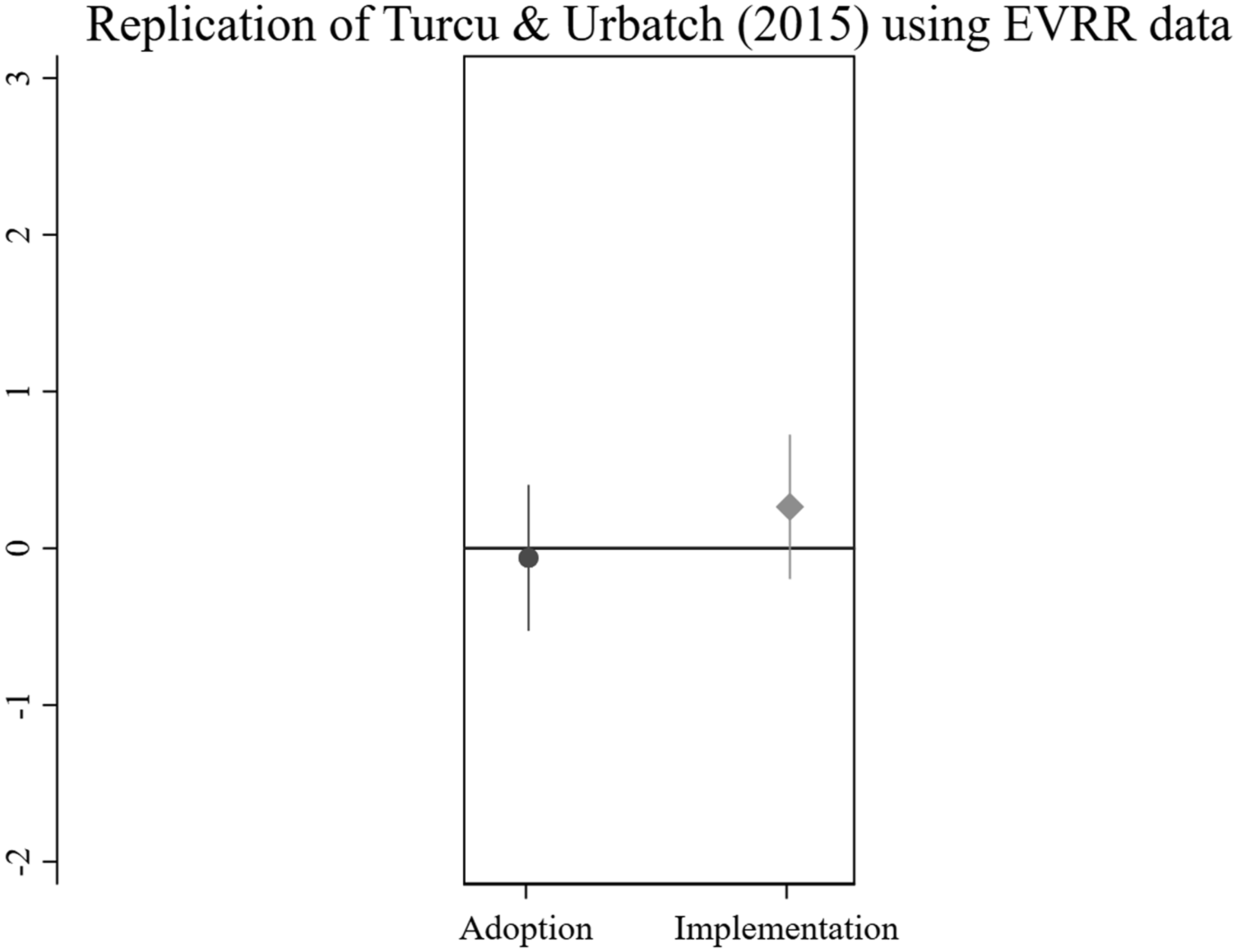
Similar to T&U, we find that extraterritorial voting rights are significantly more likely to be extended in an election year, and less likely to be extended in countries with a legacy of British colonialism. However, an additional set of control variables are statistically significant in our model that fall below significance in T&U’s. Specifically, we find strong positive relationships between the likelihood of adoption and GDP per capita, as well as population size. Conversely, we find a strong negative relationship between the likelihood of adoption and regime durability, indicating regimes adopt extraterritorial voting rights during periods of regime change. Examining the implementation models, we find a similar relationship. Again, three key variables that slipped below standard levels of statistical significance in T&U’s models—GDP per capita, population size, and regime durability—strongly correlate with first implementation in at least one of models, while British colonial legacy negatively correlates with implementation in every model.
T&U’s baseline model assumes all countries are equally likely to be influenced by their neighbors. However, theoretically countries should differ depending on how they are situated in the international system. The significant coefficients on many of our control variables, including population and wealth, suggest systematic differences in countries’ approaches to enfranchising emigrants depending on these structural factors. Conditional diffusion effects are likely, given underlying theories of diffusion (e.g., Gilardi, 2012). In our context, it seems likely that neighborhood enfranchisements are more likely to spur emulation among smaller, poorer countries, whereas larger, richer countries may be less sensitive to the practices of their neighbors.
We thus extend the analysis by testing our hypotheses that an interactive relationship exists between Recent Nearby Implementation and metrics of country status, namely, population size and GDP per capita. We find evidence that neighborhood enfranchisement prompts emulation only in smaller, poorer countries. Figure 6 plots the marginal effect of Recent Nearby Implementation over the natural log of country population.
29
In countries with small populations, there is a higher likelihood of implementing extraterritorial voting rights when there has been a Recent Nearby Implementation. However, the likelihood of implementation declines as country size increases. In countries with a population of 5 million or more, there is no significant relationship between the likelihood of implementation and a neighbor’s recent implementation. Marginal effect of Recent Nearby Implementation by country population (ln).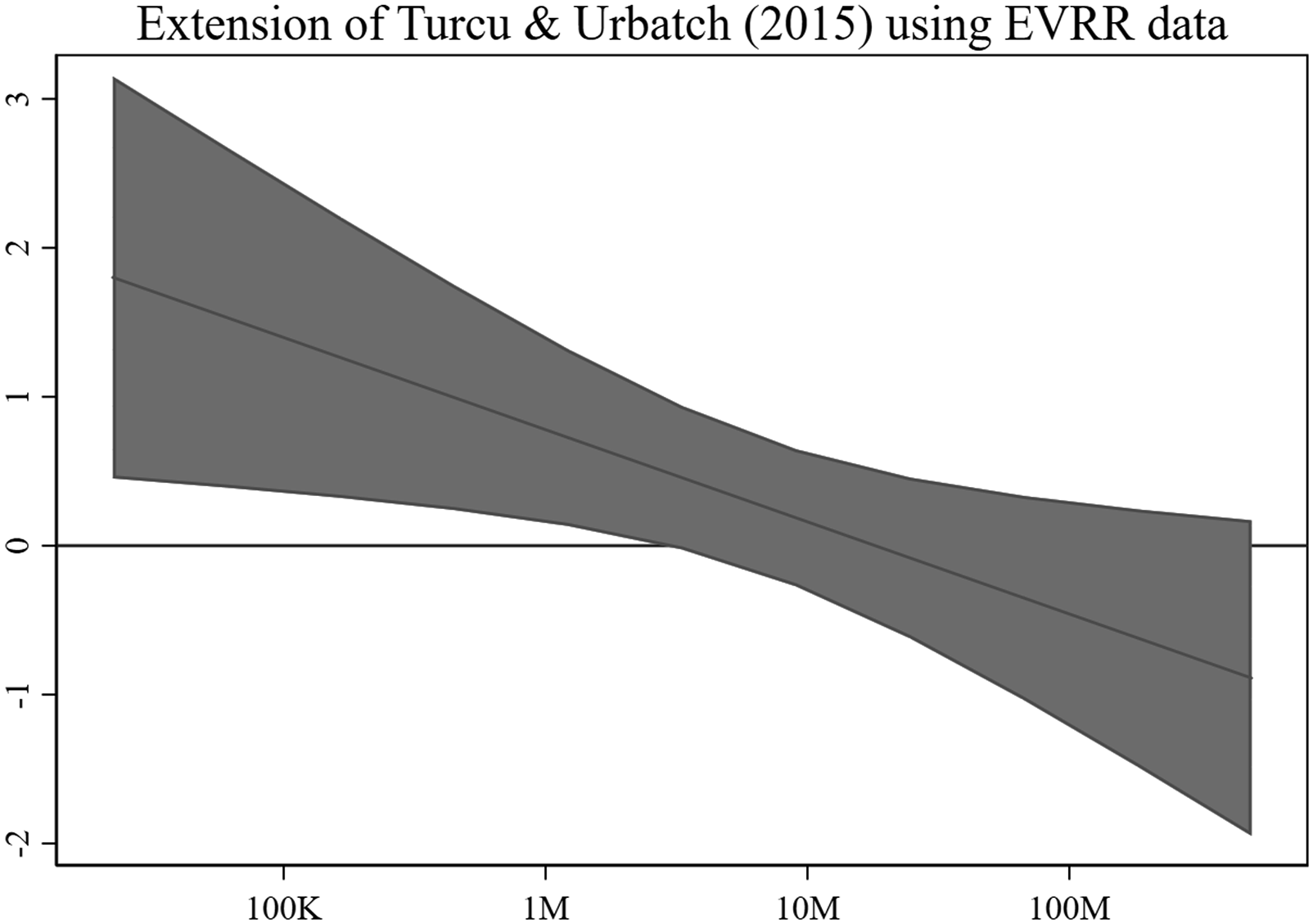
Overall, our findings differ from T&U’s in empirically significant ways, with important theoretical implications. First, we find no evidence that legal enactment of extraterritorial voting inspires emulation in nearby countries. Diffusion of rights may still possess a neighborhood logic, but it appears to work only through the implementation of rights, which involves the visible event of elections that engages the diaspora through their active participation. Second, a number of the core variables that are generally thought to correlate with the extension of voting rights to non-resident citizens—regime change, wealth, population size—are significant in our models but not T&U’s. This is not simply an artifact of the data sources but rather a consequence of running the models with our newly constructed variables. Our results align with other qualitative and quantitative assessments of emigrant enfranchisement that also emphasize these important political and socio-demographic conditions. Third, we find that the effect of neighborhood diffusion is conditional on country-level variables related to structural factors, particularly population size and economic wealth.
Diaspora Voting and Remittances
In the CPS article “Harnessing the Diaspora,” Leblang (2017) asks whether extending political rights to citizens abroad encourages economic remittances. He presents two distinct mechanisms connecting migrant political rights—measured as the extension of dual citizenship—to increased remittance flows. First, dual citizenship expands economic opportunities for emigrants; naturalization makes it easier to get a job in the destination country as well as ease cross-border travel and increase opportunities for investment in both locations (p. 77–78). Second, dual citizenship acts as a “mechanism of symbolic attachment,” fostering affective ties between non-resident citizens and their homelands, which can strengthen a sense of “diasporic identity” bolstering economic and political participation (p. 82).
The EVRR dataset enables us to build on this work by expanding whether and how different kinds of political rights to citizens abroad (e.g., external voting, direct representation) also encourage economic remittances. Though extraterritorial voting rights may not improve economic opportunities for non-resident citizens in destination countries, it is likely that participating in elections from abroad may increase “symbolic attachment” to the home country. Prior research has found that migrant remittances increase around national (O’Mahony, 2013) and sub-national elections (Nyblade & O’Mahony, 2014), but only when elections are free, fair and competitive (and when migrants’ economic conditions allow). While it is possible that legal enfranchisement alone may engender stronger ties, this prior research on migrant remittances and home country elections suggests that higher levels of economic engagement is conditional on the elections being meaningful to emigrants. We should expect, then, that an extension of the vote to non-residents is more likely to increase economic and political engagement when accompanied by more inclusive provisions. External voting policies that broaden the scope of non-resident eligibility and voting choices or decrease the costs of voting should be more likely to generate increased engagement and correlate more strongly with remittance flows.
To test this hypothesis, we build on Leblang’s two-part empirical strategy connecting dual citizenship extension with remittance flows. First, he compiles migrant surveys to identify individual-level correlates of remittances.
30
Second, he employs a time-series cross-sectional (TSCS) dataset to test the national-level hypothesis that countries that allow dual citizenship received higher amounts of remittances. We proceed by first adding our core variables (
The empirical basis for the micro-level analysis is a set of surveys conducted in seven countries (Australia, France, Italy, Germany, Japan, Spain, and the United States) between 1997 and 2006 compiled by the World Bank.
32
Respondents in the surveys came from a total of 114 different home countries. Because of EVRR’s unprecedented global coverage we are able to merge EVRR variables to match a respondent’s home country institutions for all 114 countries in any given year. This approach mirrors (i.e., using the same variables and model specifications) and extends Leblang’s remittances model beyond the dual citizenship variable by expanding the analysis to include
When added to Leblang’s individual-level remittance model,
This relationship between both Neighborhood Polling Stations and Diaspora Representatives, on the one hand, and remittances on the other, is also present in the TSCS analysis.
34
The TSCS dataset originally created by Leblang includes a global sample of developing countries between 1980 and 2009. The USD remittances are drawn from the World Development Indicators. Again, we use Leblang’s model specifications and variables as a baseline. When
We graphically represent the estimated effects of inclusive diaspora engagement on remittance flows based on these models for three representative countries in Figure 7. Taking the average values for Mexico, Morocco, and the Philippines across this period, we calculate and report the predicted annual level of remittances in four situations: first, no extraterritorial voting and dual citizenship; second, dual citizenship and no extraterritorial voting; third, no dual citizenship and inclusive extraterritorial voting with additional polling stations; and fourth, no dual citizenship but extraterritorial voting that includes diaspora seats (but no additional polling stations). Figure 7 shows that any of the three policies aimed at more inclusive emigrant engagement is associated with statistically significant and substantively much larger levels of remittance flows. The effect of Neighborhood Polling Stations ( Predicted remittance levels given different external voting policies.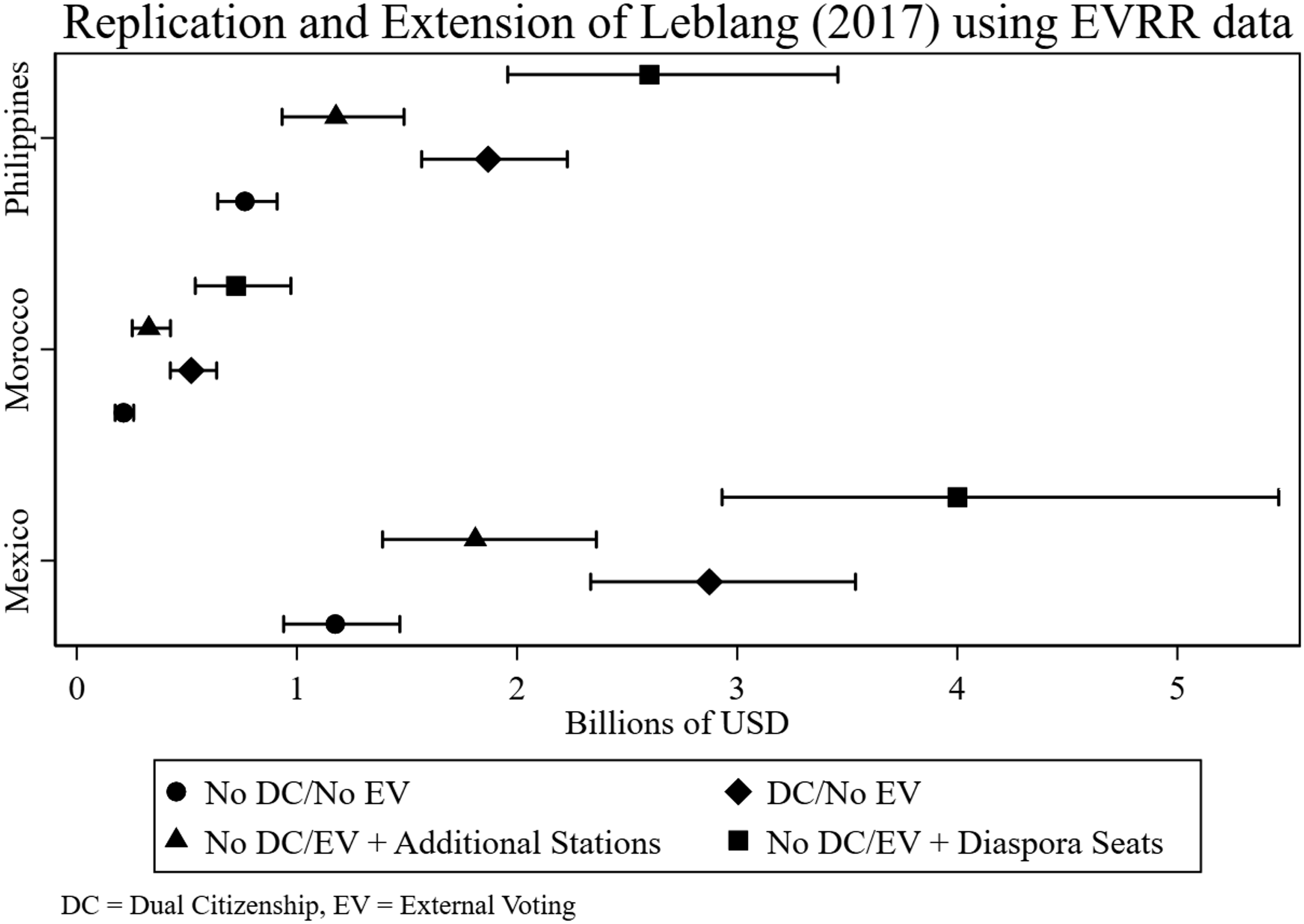
Taking the macro-level and micro-level analyses together, the results indicate a consistent relationship between remittance flows and certain types of extraterritorial voting rules. Specifically, we observe a positive correlation between remittances and more inclusive extraterritorial voting provisions. Both variables indicate an administratively costly commitment by origin countries to expand participation through direct representation and reduce costs for potential non-resident voting.
The finding does raise the question: why were these two consistently signed and significant, whereas other measures of eligibility, modality, and institutional structure were not? We suspect it is a combination of both variable simplicity and the directness of relationship to voter participation. The Neighborhood Polling Stations measure, akin to expanding polling stations domestically, can increase voter turnout (e.g., Brady & McNulty, 2011). Similarly, as the existence of Diaspora Representatives generate competition among candidates and parties over emigrant support, their existence can be seen as an institutional choice intended to strengthen diaspora engagement (Gamlen, 2014).
These results strongly suggest the value of moving beyond binary measures of non-resident enfranchisement and instead analyzing the variation within emigrant voting policies. Our results indicate that symbolic enfranchisement accompanied with restrictive rules does not strongly correlate with increased remittances, whereas more inclusive enfranchisement does. By measuring these more fine-grained aspects of external voting in 195 countries over time, the EVRR dataset enables a systematic, and also more nuanced, analysis of the important relationship between remittances and political engagement in ways that were not possible with the existing detailed but regionally focused datasets, or earlier cross-national databases. The relationship between diaspora engagement efforts and remittances is certainly more complex than captured in these regression models; we hope this analysis serves as a starting point for future research.
Conclusion
In this paper we introduce the Extraterritorial Voting Rights and Restrictions dataset (EVRR), a new time-series dataset that documents dynamic changes in extraterritorial voting rights and procedures around the world. Although previous global databases and more detailed regional efforts to document external voting exist, no existing data source simultaneously captures the scale (195 countries), time frame (71 years), and the multiple policy choices that shape external voting, legally and on the ground (over 20 variables). Furthermore, we carefully document the sources for each of our coding decisions, allowing interested scholars and researchers access to hundreds of primary and secondary source material and the ability to review our coding decisions. This transparency also enables ongoing improvement if any coding decisions turn out to rest on errors in our underlying source documentation, and as new data sources become available.
EVRR allows for a more precise empirical understanding of external voting provision for more of the world and for a longer duration of time than ever before. This dataset thus enables new insights into foundational studies of political transnationalism. Our extension of Turcu and Urbatsch (2015) demonstrates that mere adoption of extraterritorial voting rights is not associated with any change in the likelihood of adoption of those rights by neighboring countries, while actual implementation of external voting rights does appear to influence the likelihood of adoption by nearby countries. Analyzing EVRR data within their research design also suggests regional policy emulation appears more likely to occur in smaller, poorer countries. Our extension of Leblang (2017) finds that while adoption or implementation of extraterritorial voting itself is not associated with higher levels of remittances from migrants, more inclusive modes of external vote access, including organizing polling stations beyond diplomatic bureaus (
Moreover, the dataset enables researchers to explore new sets of research questions. Under what conditions are we more likely to observe inclusive emigrant voting policies? Are there significant regional differences between modalities or restrictions, and if so, why? What is the effect of voting modality on diaspora turnout? Do diaspora voter restrictions reflect increasing voting registration hurdles domestically? EVRR captures both the dramatic global wave of emigrant enfranchisement and the wide range of the policies that shape those rights on the ground and thus subsequent levels of diaspora electoral participation. We hope that scholars will be able to use the EVRR dataset to conduct richer, more nuanced analyses of transnational voting, diaspora political engagement, and democratization in an era of unprecedented international mobility.
Supplemental Material
Supplemental Material—The Extraterritorial Voting Rights and Restrictions Dataset (1950–2020)
Supplemental Material for The Extraterritorial Voting Rights and Restrictions Dataset (1950–2020) by Elizabeth Iams Wellman, Nathan W. Allen, and Benjamin Nyblade in Comparative Political Studies
Footnotes
Acknowledgements
The authors thank Michael Collyer, David Leblang, Anca Turcu, and R. Urbatsch for generously sharing their data with us. We also thank our undergraduate research assistants, including Nick Bremner, Cole Curnew, Matty Connelly, Ashley Hatt, Gabriela Ivanova, Erin Kinzie, Manoela Lobato Strehl, Alyssa Mansfield, Annie MacKinnon, Rachel MacQueen, Alexandra Pear, Gates Tenerowicz, Francesca Walton, and Jaimie Wood. EVRR benefitted from feedback at numerous conferences and workshops, especially from Gabrielle Bardall, Katrina Burgess, Daniel Naujoks, Peter Penar, Brendan Skip Mark, Gerasimos Tsuorapas and Maarten Vink. We also thank the CPS editors and three reviewers for their insightful comments. EVRR has been generously supported by the Social Sciences and Humanities Research Council, UCLA’s Promise Institute, Williams College Class of ’57 Fellowship, and the Mamdouha S. Bobst Center for Peace and Justice at Princeton University.
Declaration of Conflicting Interests
The author(s) declared no potential conflicts of interest with respect to the research, authorship, and/or publication of this article.
Funding
The author(s) disclosed receipt of the following financial support for the research, authorship, and/or publication of this article: This work was supported by the Social Sciences and Humanities Research Council of Canada, UCLA's Promise Institute, Williams College Class of '57 Fellowship, the Mamdouha S. Bobst Center for Peace and Justice at Princeton University, and the University Dissertation Fellowship, Yale University.

Supplemental Material
Supplemental material for this article is available online.
Notes
Author Biographies
References
Supplementary Material
Please find the following supplemental material available below.
For Open Access articles published under a Creative Commons License, all supplemental material carries the same license as the article it is associated with.
For non-Open Access articles published, all supplemental material carries a non-exclusive license, and permission requests for re-use of supplemental material or any part of supplemental material shall be sent directly to the copyright owner as specified in the copyright notice associated with the article.
