




Abstract
Most political systems consist of multiple layers. While this fact is widely acknowledged, we know surprisingly little about its implications for policy-making. Most comparative studies still focus exclusively on the national level. We posit that both “methodological nationalism” and “methodological subnationalism” should be avoided. We argue instead that in multilevel systems national and subnational governments jointly affect policy-making. Their respective influence is, however, conditional on the distribution of policy authority. Moreover, we identify power asymmetries, as subnational governments hardly affect policy-making in centralized systems whereas national governments shape subnational policy-making even in decentralized polities. Empirically, we study the case of education policy. Novel data on regional education spending, regional and national governments’ ideology, and regional authority over education in 282 regions in 15 countries over 21 years reveals strong support for the interplay between ideology and the distribution of authority across levels. We conclude by sketching a resulting research agenda.
Keywords
Introduction
Most democracies are multi-level systems: besides the national level, several subnational—and sometimes supranational—levels exist. While the literature on territorial politics, decentralization, and federalism has established this fact and started mapping patterns, as well as causes and consequences of decentralization (for many: Alonso, 2012; Däubler et al., 2019; Hooghe et al., 2016; Röth & Kaiser 2019; Toubeau & Wagner, 2015), we still know surprisingly little about the politics of policy-making in complex multilevel systems. How do national and subnational policy-makers jointly shape policies—and how do institutions affect this relationship? This paper contributes to this crucial political science question by theorizing on power asymmetries between national and regional governments and by offering a first broad comparative study of regional and national governments’ influence on policy-making, conditional on patterns of authority. Empirically, we use the crucial case of education policy.
In today’s knowledge economies, education policy is of utmost importance. Skills are the backbone of post-industrial knowledge-based economies: They contribute to economic growth (Barro, 2001), shape patterns of (youth) unemployment (Breen, 2005), and form a defining characteristic of countries’ variety of capitalism (Hall & Soskice, 2001). Moreover, education is the most important determinant of upward mobility (Breen & Jonsson, 2005), it contributes to social cohesion (Green et al., 2006) and civic engagement (Mettler, 2002), thereby strengthening democracies.
Education has become a central political cleavage in today’s societies (Beramendi et al., 2015; Busemeyer et al., 2013; Stubager, 2010) and a core field in political science (Busemeyer, 2015; Gift & Wibbels, 2014; Iversen & Stephens, 2008). Political scientists have analyzed the causes and consequences of education systems, focusing particularly on the role of parties and other collective actors. Much comparative work has concentrated on education expenditure as an element of education policy that can be systematically compared across countries, contexts, and time (Ansell, 2010; Boix, 1997; Busemeyer, 2015; Castles, 1989; Garritzmann, 2016; Garritzmann & Seng, 2016; Iversen & Stephens, 2008; Jensen, 2011; Schmidt, 2007). Expenditure is but one element of education policy, but it is a central one not only because it is a proxy for countries’ commitment to education; we also know that spending causally affects student outcomes (Jackson, 2018).
Existing comparative work has always analyzed education policy at the national level. But often education policy is not decided by national governments, as authority frequently lies with subnational levels: In fact, education policy is the core competence of many subnational governments. Consequently, the pitfalls of “methodological nationalism” (Jeffery & Schakel, 2013) are widely present in comparative studies on education policy, putting doubt on some existing findings since authority is wrongly attributed to the national level.
We argue that in order to obtain a better understanding of policy-making in multi-level governance systems (in education or other areas), we need to take institutions seriously and study policy-making at the governmental level that holds authority over the respective policy. As we will show, for education policy this is in many cases regional governments (e.g., US States, German Länder, Swiss Kantone). We argue, though, that it would be equally misleading to replace methodological nationalism with “methodological subnationalism” because national governments remain relevant even in decentralized settings. We theorize that and why power asymmetries exist, as national governments can influence regional policy-making even in cases where they lack formal authority whereas regional governments cannot affect policy-making in centralized arenas. In short, the interaction between ideological standpoints of regional and national governments with their respective degrees of policy authority is crucial.
Exemplarily using the critical case of education, this article more generally contributes to a better understanding of policy-making in multi-level systems. To the best of our knowledge, we offer the first broad comparative study of regional and national governments’ influence on regional public policy-making and on conditioning institutional effects. The arguments easily travel to other policy areas, both (re-)distributive ones (e.g., health care or pensions) as well as regulatory ones (e.g., law-and-order or environmental policies).
Empirically, we collected novel data on regional per capita public education spending in 282 regions in 15 OECD countries over two decades (1990–2010). For a subset of 132 regions we can moreover analyze spending disaggregated by educational sectors, which allows exploring different distributive dynamics in different educational sectors.
Our second empirical contribution is that we gathered data on regional governments’ partisan composition and measured their ideological positions. This data could easily be used in many other ways and helps to enhance scholarship on subnational party politics and policy-making.
As a third novel feature we developed—using qualitative literature and expert interviews—a measure of regional governments’ authority over education spending. While regional authority has recently received increased scholarly attention (Hooghe et al., 2016), existing indices remain general and cannot cover policy-specific elements. Analyzing the “scope” and “depth” of regions’ policy-making capacities, our Regional Education Authority Index (REAI) captures authority over education much more accurately.
A major advantage of our comparative analysis is that we can systematically analyze the role of institutions and their interplay with political actors. Existing country-comparative work has been constrained by the lack of institutional variation and low numbers of cases; our regional-level analysis, in contrast, allows exploring the interplay of actors and institutions across a wide range of contexts and using thousands of observations.
This study reveals several relevant findings. Descriptively, we show that regions in many countries have considerable educational authority while national governments often only have weak formal powers, casting doubt on analyses that concentrate on the national level alone. We also detect sizeable variation within countries as well as over time, identifying a trend toward more decentralization. Mirroring these differences, our spending data reveals large within-country regional differences that are sometimes larger than differences between countries.
Multi-level and fixed-effects regressions strongly support our arguments: governments’ ideological standpoints matter, but partisan effects are contingent on the distribution of educational authority. Moreover, the power-asymmetry argument is confirmed: Whereas regional governments do not matter in centralized systems, national governments still affect education spending in decentralized settings, implying that national governments matter even in contexts where they lack formal authority.
These arguments and findings enhance our understanding of policy-making in complex multi-level systems. The concluding discussion spells out important implications for the literatures on the politics of education, party politics, public policy, and territorial politics and sketches a resulting research agenda for future work.
The Politics of Education
A core assumption of representative democracy is that elected governing parties can and do shape public policies. Accordingly, a large literature addresses this question. Our point of departure is that most studies—on education policy but also other public policies—focus on the national level, which—as we demonstrate below—overlooks that education policy often is a competence of subnational governments. The existing literature is of great value, still, as it helps inform hypotheses about the determinants of subnational education policy.
The literature on the government-education policy nexus falls into three camps, with conflicting expectations (Garritzmann & Seng, 2016). A first group theorizes on education from the perspective of welfare state research. In line with the partisan hypothesis (Hibbs, 1977) and power resources theory (Stephens, 1979) they expect that leftwing parties increase public education spending, because education can contribute to upward mobility, foster equality of opportunities, and decrease educational and socio-economic inequalities. Empirically, several studies have found support for this thesis (Boix, 1997; Busemeyer, 2015; Castles, 1989; Iversen & Stephens, 2008; Schmidt, 2007).
A second group disagrees, arguing that education is de facto much less redistributive than other social policies because access to education depends on parental background (Le Grand, 1982; Marx, 1890/1891): Children from higher socio-economic strata are much more likely to benefit from education, particularly from higher education (Becker & Hecken, 2009) and childcare (Van Lancker, 2014). Consequently, it might rather be rightwing parties that expand education spending to please their upper- and middle-class constituency, particularly regarding higher education and childcare.
Scholars in a third group expect partisan effects to vary over time and educational sectors (Ansell, 2010; Busemeyer, 2015; Garritzmann, 2016; Garritzmann & Seng, 2016): Drawing on historical institutionalism, the main argument is that parties had much leeway in shaping education systems in the two or three immediate post-World War II decades, but over time parties’ room-for-maneuver has decreased as path dependencies prevail. Garritzmann and Seng (2016) show this decreasing partisan influence for total public education spending, Garritzmann (2016) for higher education spending, and Busemeyer (2015) for vocational education and training. Even if parties wanted to spend more, they would increasingly be constrained by path dependencies.
We argue that one reason for these inconclusive results is that these studies are partly looking for effects in the wrong place, as they entirely concentrate on the national level although education policy often is decided by regional governments. Thus, the comparative literature on the politics of education falls victim to the critique of “methodological nationalism” (Jeffery & Schakel, 2013).
We acknowledge the distribution of political authority over education policy and propose to study the politics of education on the regional level instead. A few single-case studies on subnational education spending exist, particularly on the U.S. (e.g., Harris et al., 2001), but also on Germany (e.g., Rauh et al., 2011), Spain (Liu et al., 2014), and Norway (Falch & Rattsø, 1999). Yet, no study has explored regional education spending from a comparative perspective—and therefore none has been able to make generalizable claims or explore the interplay between governments and institutions, especially degrees of regional authority.
The broad literature on decentralization, federalism, and multi-level governance systems, in turn, offers considerable knowledge on causes and consequences of different constellations of political authority (for many: Alonso, 2012; Hooghe et al., 2016; Kleider, 2018; O’Neill, 2005; Röth & Kaiser, 2019; Toubeau & Wagner, 2015), but has not comparatively studied the interplay of different levels of governments and institutions for (education) policy-making, either (but see Kleider, 2014).
In sum, we detect an important gap in existing work: Education has become increasingly relevant in both politics and political science, but the comparative literature has focused on the country level, despite the fact that authority over education often lies with subnational governments. While we study the case of education here, this claim also applies to other public policy areas. Before presenting our research design, we develop theoretical expectations next.
How Ideology and Regional Authority Shape Education Expenditure
We argue—and show empirically below—that in multi-level systems the regional level is most often the relevant level of analysis for education policy. Thus, we develop a framework to study how national and regional governments jointly shape regional education policy. Sometimes, authority over education is decentralized further, to municipalities, school districts, or even individual schools and we develop a research agenda for the analysis of additional territorial layers that may inform future work.
How does government composition and ideology affect education spending? We start from existing theories to develop testable implications. Yet, we extend this work by bringing in the crucial role of institutions, particularly the distribution of authority over education within countries. As summarized above, discussion is ongoing on whether leftwing or rightwing governments are proponents of education spending or whether partisan effects differ across educational sectors and time. Our analysis helps to disentangle these rival claims.
We start by looking at parties’ preferences. Before testing whether parties (can) matter, we first need to know whether they do want to make a difference in the first place. Previous empirical work has analyzed parties’ positions on education, showing complex and partly ambiguous patterns. Yet, left and left-liberal parties tend to be the most forceful proponents of educational expansion in their party manifestos (Ansell, 2010; Busemeyer et al., 2013; Green-Pedersen & Jensen, 2019; Kraft, 2018), in coalition agreements (Jungblut, 2016), and according to experts’ evaluations, at least for the area of public higher education subsidies, where we have systematic expert data (Garritzmann, 2016). At the level of individual voters, we know that citizens’ preferences toward education spending also follow a left-right ideological pattern—unless respondents are forced to prioritize education against other policy areas, in which case citizens’ self-interest trumps ideological positions (Busemeyer & Garritzmann, 2017). Moreover, we know that voters reward left parties for emphasizing educational investments (Abou-Chadi & Wagner, 2019), providing left parties with electoral incentives to expand education. Against this background we expect:
Hypothesis 1. Governments with more left-leaning ideological standpoints increase public education expenditures more than parties with more right-leaning ideological positions.
Moreover, we expect that these effects are stronger for higher education than for schools (primary and secondary education). Ansell (2010) theorizes that once higher education enrollment rates reached a certain threshold, left parties have incentives to spend more than rightwing parties (to enable their constituency to enter higher education). As the higher education enrollment levels in all countries in our sample are comparatively high (Lee & Lee, 2016), this should be the case here, too. Moreover, Garritzmann (2016) shows that leftwing governments in all OECD countries during the entire post-war period have attempted to expand financial student aid (to enhance equality of opportunities). In turn, all parties have similar incentives to invest in primary and secondary education (with the partial exception of upper-secondary education in highly stratified educational systems) as these areas of education are much less redistributive, making it less likely to detect partisan differences on expenditures (Jensen, 2011). 1 Thus, we posit:
Hypothesis 2. The effect of left-leaning governments is even stronger for public expenditure on higher education than for primary and secondary education.
Our third hypothesis—and a main contribution of this article—is that partisan influence is moderated by the degree of authority over education policy. The literatures on territorial politics, federalism, and decentralization have studied distributions of political power across political systems and explored their causes and some consequences (Alonso, 2012; Hooghe et al., 2016; Kleider, 2018; O’Neill, 2005; Röth & Kaiser, 2019; Toubeau & Wagner, 2015). Despite this increased attention to subnational politics, much less attention has been paid to the politics of public policy-making and how policies are jointly shaped by national and subnational actors as well as by the distribution of authority.
We expect that in highly centralized systems the central government plays a crucial role for regional education spending while regional governments are negligible. 2 But if authority over education policy is decentralized to regional governments, we should expect regional governments’ ideological positions to become a main determinant while the central government should become less relevant. From our view, these are straightforward expectations, but surprisingly have neither been made nor tested before (a notable exception is Kleider, 2014, 2018).
In one of the most influential studies of regional governments, Putnam (1993, p. 36) even argued that in the pragmatic day-to-day business of regional governments their ideological positions become irrelevant. We argue, in contrast, that Putnam’s assessment ceases to apply the more authority is given to a region. Once equipped with considerable competences, subnational levels are subject to a process of politicization (Hooghe & Marks, 2009). Decentralized competences become regionally salient and contested and parties address them in their portfolio (Newman, 1997). In short, we expect:
Hypothesis 3. The effect of regional and national governments on regional education expenditure is moderated by institutional contexts: In centralized polities national government ideology affects expenditure while regional governments are irrelevant. The more authority over education is decentralized to the regional level, the more the ideological standing of the regional governments matter, whereas national governments lose influence.
Yet, we do not stop here. Going further, we argue that the conditioning effect of institutions (Hypothesis 3) is asymmetric, as power tilts toward national governments. In order to understand the politics of subnational policy-making we need not only investigate the influence of institutional settings on national and regional governments, but we also have to acknowledge the interdependence between national and regional governments. By definition no level holds absolute power in multi-level systems (Rhodes, 1997), which necessitates collaborative policy networks (Papadopoulos, 2007). These are characterized by mutual interdependence on each other’s resources and information (Hooghe, 1996, p. 18). Consequently, we shall theorize on the relationship between national and regional governments, rather than replacing “methodological nationalism” with “methodological regionalism.”
We argue that while national and subnational levels mutually depend on each other, this interdependence is asymmetric: We expect that national governments influence regional policy-making even in cases where they lack formal authority to do so, while regional governments are often negligible in highly centralized politics. There are several reasons for this; here, we discuss two partisan and two institutional sources of this asymmetry.
Partisan Origins of Power Asymmetries
The first reason for power asymmetries between regional and national governments runs through a party-political channel: Even when regional governments are fully independent, the same is not true for regional party politicians. As the literature on political alignment has demonstrated (Arulampalam et al., 2009; Solé-Ollé & Sorribas-Navarro, 2008), there are close ties between national and subnational parties. National parties can build on considerable personnel and economic resources, as well as on strategic experience, which is likely to preserve their decisive role through powerful regional partisan branches (Collignon, 2020, p. 123), putting them in a more powerful position than regional politicians. As a result, regional governments can be subject to substantial pressure from national party organizations when they engage in policy positions or coalition behavior which departs from national parties’ strategies. Furthermore, at the individual-level, politicians of regional party branches could be responsive to national-level parties, either because of centralized candidate nomination procedures, because of centralized budget allocation structures, or simply due to career ambitions of sub-national representatives (Dodeigne, 2018). In short, even in highly decentralized settings, intra-party incentives can redirect regional politicians’ responsiveness toward the center.
A second mechanism is “encroaching”: even in formally fully decentralized policy domains, national parties can find creative ways to “encroach” on genuine regional competences (Weingast, 2014). As a least-likely case, consider Germany: For historical reasons, the central government is constitutionally prohibited from engaging in education and cultural policies, which are strongly regionalized (“Ländersache”). Yet, the federal government has repetitively sought ways around these hurdles, for example by becoming the main funder of financial student aid (“BAföG”), by launching the “Excellence Initiative” to fund leading universities, by making federally funded Third-Party finance (via the German Research Foundation) more relevant for universities, by investing in digital innovation in schools (“Digitalpakt”), or by supporting schools in offering full-day educational opportunities (“Programm Ganztagsschule”). As this example illustrates, national-level parties can—and do—find ways to engage in policy-influence even in highly decentralized polities.
Thus, there are at least two partisan channels through which national governments influence policy-making, even in fully regionalized policy areas.
Institutional Origins of Power Asymmetries
Besides partisan dynamics, at least two institutional factors contribute to power asymmetries between national and regional governments: policy interdependence and problems of regional collective action.
Simply put, the idea of “policy interdependence” is that—even when authority over specific policy issues is fully regionalized—regions (or subnational levels in general) can hardly treat those issues in isolation. The most obvious institutional factor leading to power asymmetries is the fiscal structure of multi-level systems. While regions—or other subnational entities—can be responsible for policy-making, they de facto are often dependent on fiscal transfers from the central level, a fact known as “vertical fiscal imbalance” (Rodden & Wibbels, 2002). Fiscal dependencies activate mechanisms for organizational or ideologically tailored transfers from the center to regions (Fisher & Papke, 2000; Kleider et al., 2018; Solé-Ollé & Sorribas-Navarro, 2008). National governments can therefore affect regional governments through these transfers even in decentralized polities, whereas the reverse is impossible.
Whereas fiscal centralization creates incentives for alignment effects as discussed above, fiscal decentralization creates rising regional disparities (Kleider, 2018). Many national governments address these growing subnational inequalities with equalization schemes or regional development programs, such as subsidies, special grants, or formalized intergovernmental redistribution programs. This is crucial for policy-making in education, too, especially because investment in human capital is costly for regions (large parts of their budgets are spent on education) and because regional development needs to address many policy domains simultaneously. The successful exercise of regional education policy is typically dependent on other (potentially centralized) policies such as economic policies or infrastructural investments. Whereas fiscal centralization creates dependencies of all regional governments on a national government’s resources, fiscal decentralization creates dependencies particularly of disadvantaged regions to receive additional resources and national interventions in other policy domains which complement education policies. In short, high degrees of decentralization in specific policy areas do not resolve the coordination problem triggered by policy interdependence (Marks, 1993; Rhodes, 1997). Education policy is a domain with comparatively high policy independence. Thus, from an economic and functional perspective an efficient handling of education policy would demand high degrees of centralization (Schakel, 2009), but for mainly cultural reasons it is one of the most decentralized policy domains in many countries.
The most important argument why the described dependencies are asymmetric results from the fact that there is only one national government in each country, but many subnational governments (in our sample between 3 and 51 regional governments). Thus, while in theory it is possible that all regional governments could coordinate and systematically aim to affect policy-making under interdependency, this is highly unlikely in practice as regions and their governments have heterogenous partisan composition, interests, and ideologies. The resulting collective action problems make it likely that—simply because of the higher number of subnational governments—the national government is more influential in affecting regional politics, whereas the opposite is difficult to achieve, resulting in asymmetric power relations.
In sum, several party-political and institutional reasons lead us to expect an asymmetric relationship between central and regional governments. Thus, refining Hypothesis 3 we expect:
Hypothesis 4. The moderating effect of authority over education (of Hypothesis 3) is asymmetric: National government ideology affects regional education expenditure even in polities where authority formally lies exclusively with regional governments whereas regional government ideology remains ineffective in centralized settings.
Data and Methods
To test these hypotheses, we constructed a unique dataset including three novel elements 3 : First, we collected regional per capita public education spending for 282 regions in 15 OECD countries over 21 years (1990–2010). 4 Second, we complemented this dataset with novel data on the partisan composition and ideological standpoints of regional governments, constructing cabinet seat-share weighted manifesto-based ideology measures. Third, we created a new measure capturing the degree of authority that regional governments have over education policy, the Regional Education Authority Index (REAI), which allows comparisons across and within regions, countries, and time. As none of this information has been available yet, this article also makes an important descriptive contribution. We introduce these data in turn.
Measuring Regional Education Spending
We collected data on regional public per capita education spending from national statistics offices (cf. Kleider, 2014; Kleider et al., 2018 for details) covering 282 regions in 15 advanced capitalist democracies from 1990 to 2010. While this was time-consuming, data comparability was facilitated by the “Classification of the Functions of Government,” a procedure of standardizing governmental bookkeeping. The system splits government expenditure into functional groups, making them comparable across contexts and time. One of these groups is “education,” which we use here.
More specifically, we use two dependent variables: In the main analysis, the dependent variable is regional public per capita education spending, including all main levels of education (primary, secondary, and tertiary education). In additional analyses, we investigate sector-specific education spending: For about half of the regions (132) in eight countries (Australia, Belgium, Canada, Germany, Spain, Switzerland, UK, and US) we were able to gather data disaggregated into spending on schools (primary and secondary education), on the one hand, and tertiary education, on the other. 5 This is interesting because the distributive dynamics—and politics—likely differ across educational levels, as theorized in Hypothesis 2.
We analyze education spending in per capita amounts as a more accurate and reliable measure that allows for substantive comparisons across contexts better than either total amounts or expenditures relative to (regional) GDP. Spending measurements are deflated and transformed in international dollars to the base of 2010 to ensure comparability. Despite several efforts, data on regional education spending remained unavailable for some region-years. As this is our dependent variable, we focus on the 3817 cases where we have full information, as imputation does not make sense for substantive reasons (we systematically analyze and discuss missing values in the Supplemental Appendix I, 4.1).
Measuring Regional Governments’ Partisan Composition and Ideology
The second novel dataset provides information on the partisan composition and ideological standpoints of regional governments. In the few existing single-country studies, regional government ideology is commonly measured by simple categorical left-right dichotomies (e.g., Rauh et al., 2011). Literature on party positions on the national level teaches us, however, that categorical partisan distinctions provide at best rough proxies of partisan preferences over time and across geographical units (Volkens et al., 2018; for education: Busemeyer et al., 2013; Kraft, 2018). Unfortunately, approaches capturing ideological differences based on sub-national party manifestos only cover very few countries (see Alonso et al., 2013).
Lacking comparative data, we compiled two kinds of information. First, we collected information on the partisan composition of all regional governments in our sample: For each region-year we coded which parties were in the respective regional government (for details cf. Supplemental Appendix III). 6 Second, we created a measure of regional government parties’ ideological standpoints. As systematic codings of regional party manifestos are unavailable, we used the country-wide manifestos, as collected by the Manifestos Project (Volkens et al., 2018), as proxies. The assumption is that—although regional party positions might differ from nation-wide party positions—the positions should still be rather similar (the nation-wide position should be a representative “average” of the regional parties’ positions). Empirically, we find that the variation within regional units over time is higher than the variation across regions within countries, which provides confidence in our approach. Moreover, recent studies have successfully demonstrated that parties’ nation-wide manifestos can be used to measure party positions for sub-national parties (Kleider et al., 2018; Röth & Kaiser, 2019).
We follow a two-dimensional ideological approach (Bornschier, 2010) and distinguish an economic and a cultural dimension: We concentrate on a party’s position on the economic (state-market) dimension. Although we think the cultural dimension adds substantial aspects to the preferences of political parties over education policies (cf. Beramendi et al., 2015; Garritzmann et al., 2018), the cultural dimension is less comparable over space and time—and comparability problems increase in multi-level frameworks where the location of cultural identity has multiple territorial focal points (e.g., religion, ethnicity, language, historical experiences) (we underpin this point empirically in Supplemental Appendix I using the case of Spain). We thus focus on the economic dimension here, and encourage future research to additionally explore the cultural dimension. We operationalize parties’ positions on the economic dimension based on data from the Manifesto Project and applying a transformation procedure proposed by Röth (2017, 2018). In the robustness section, we assess alternative ideology scales such as the commonly known RILE (Laver & Budge, 1992) and the transformation by Franzmann and Kaiser (2006). Moreover, we show in Supplemental Appendix I that our measure has the strongest correlation with estimations based on expert surveys.
We created regional governments’ ideological standpoints as the cabinet seat-share weighted average of all governing parties’ ideological standpoints on the economic dimension:

where IDEO is a party’s or government’s ideological position on the economic dimension; and CSS is the respective parties’ cabinet seat-share (see Röth, 2018, pp. 76–87 for a detailed justification of that approach).
To the best of our knowledge, no such comparative database on regional governments’ composition and ideological standpoints exists yet. While we use this data to study partisan influence on education spending, it could easily be used in many other respects in future research.
Measuring Regional Authority over Education Policy
An important element of our framework is the degree of regional authority over education policy. No comparative data captures this so far. While Hooghe et al. (2016) proposed a measure of regional authority, their “Regional Authority Index” (RAI) is not policy-specific. As we have strong reasons to assume that education is special when it comes to regional authority (i.e., authority might be more decentralized than in other policy areas), using a general measure of regional authority might be misleading. 7 Thus, we created a novel, more specific measure of regional authority over education policy. Following Hooghe et al. (2016) we distinguish between a “scope” and “depth” dimension. 8
“Scope” covers the number of education sectors that the regions are responsible for, distinguishing schooling (primary and secondary education) from tertiary education (academic and vocational education). The intuition is that governments’ capacity to affect expenditure should be higher the larger the number of educational sectors they can influence. The variable takes three values: “0” indicates that the regional government does not have authoritative competence over education funding in any educational sector (i.e., authority lies at a higher or lower level). “1” is assigned when the regional government has authoritative competence over school funding or over post-secondary education expenditure. Finally, “2” indicates that the regional government has authoritative competence over school and post-secondary expenditure. 9
“Depth” covers the degree to which regions are independent of central governments in decision-making about education funding, that is, to what degree regions have to follow national frameworks (e.g., regarding years of schooling, number of students per class, closing of schools and opening of new schools, teacher hiring process). The intuition is that the more freely regional governments can decide over expenditure, the larger their influence. The variable takes four values: “0” indicates that the regional government has no authoritative competences. “1” indicates that the regional government simply executes central governments’ education policy and has some but only limited authoritative competence over education. “2” is assigned when the regional government has authoritative competence over education expenditure but is subject to central government frameworks. Finally, “3” is coded when the regional government is free of central government frameworks.
Empirically, we coded the scope and depth for all 282 regions in our dataset from 1990 to 2010. 10 The systematic, theory-guided coding process has the advantage that we can compare regions’ authority across regions, across and within countries, and over time. All coding decisions are based on primary and secondary sources, as described in Supplemental Appendix II. We triangulated all codings with different sources. In ambiguous cases we consulted country experts. 11
We combine the scope and the depth dimension into a Regional Education Authority Index (REAI). We connect scope and depth multiplicatively, because both dimensions are necessary—but not individually sufficient—to exercise influence. To exemplify, if a regional government is involved in all education areas, but its authority is strictly limited by the central government, its competence remains limited. Vice versa, if a regional government has strong authority, but only in a few education areas, then again its influence is limited. Accordingly, our REAI takes values for each region r at time t:

As explained above, we can disaggregate our spending data by education sector for eight countries. For these, we also provide a more fine-grained measure that differentiates between authority over tertiary and non-tertiary education (cf. Supplemental Appendix II).
We also hasten to emphasize that while the REAI covers decentralization to some degree, it should not be confused with a measure of decentralization. For example, if regions’ authority is low, this can mean that authority lies at a higher level (national or supra-national), but it could also lie at a lower (municipality, school district, or even school) level. Therefore, we prefer the more precise term “regional authority.”
Estimation strategy
In order to acknowledge the nested structure of our data, we apply multilevel models with three levels: Region-years (t) are nested in regions (r), and regions in countries (c). We first specify a random effects model of the following form:

where ecrt ~ N(0, σ e 2), ucr ~ N(0, σ u 2), vc ~ N(0, σ v 2)
Region-level variables are captured by the vector Xcrt; country-level variables by the vector Zct. Each c has a random intercept vc; each r a random intercept ucr. ecrt is the error term.
A more conservative estimation would include region-fixed effects to limit the confounding potential of omitted factors. The disadvantage of region-fixed effects is to restrict inference to within-region variation. Yet, as so often in political science, we have several important independent variables that are substantively interesting, but rarely change over time. In particular regional authority over education is time-invariant for most regions (but not for all); moreover, several control variables (introduced below) hardly change. Bell and Jones (2015) suggest random effects models in this case. We therefore present models with and without region-fixed effects to identify whether the estimates are robust. We thus estimate the following fixed-effects equation:

where ecrt ~ N(0, σ e 2), vc ~ N(0, σ v 2)
which equals equation (3), but adds region-fixed effects Dcr.
To test Hypotheses 3 and 4, we add an interaction effect between government ideology and our REAI to equation (3). As a Wald-test indicates correlation of the residuals over time, we specify residual errors with an autoregressive process (AR1) (Wooldridge, 2010).
Controls
Regional governments are not the only factor influencing regional education spending. Therefore, we include four groups of control variables (the findings, however, also hold in models without any control variables, as well as in models with different combinations of control variables).
First, we control for the ideology of countries’ national governments because, as stated in Hypotheses 3 and 4, we expect that national governments also influence regional spending. Moreover, as there is a certain correlation between national and regional government ideology (indicating co-trends), we aim to ensure that any effect of regional government ideology is not spuriously driven by national government orientations, and vice versa. We operationalize national government ideology analogously to the procedure described above as countries’ cabinet seat-share weighted positions on the economic dimension. Moreover, we control for the ideological proximity between national and regional governments because we showed elsewhere that proximity can increase the spending capacities of regional governments (Kleider et al., 2018).
Second, governments face different reform opportunity structures: We control for government duration (in days per year), as longer governments have more time to implement reforms. In case several cabinets govern within the same year, we select the most enduring one. We also control for the number of parties in the regional government, as multiparty governments face different consensual challenges and wider voter groups for appeasement. 12 As discussed above, there are good reasons to assume that governments’ fiscal opportunities also play an important role. Therefore, we analyze whether controlling for fiscal capacities changes the results. We discuss these results in Supplemental Appendix I (section 4.3) but highlight here that the main results all continue to hold.
Third, we capture regions’ socio-demographic characteristics. We control for demand for education by including the population share below age 15. Population size and population density (in logarithmic form) are included to capture potential economies-of-scale effects in the provision of educational services. As we measure education spending in per capita units, we assume that higher and spatially more concentrated demand for education decreases per capita spending. Second, we include the level and growth rate of GDP per capita, expecting that spending grows with economic capacity. Third, the unemployment rate controls for labor market conditions, which might restrict governments’ ability to increase public expenditure.
Finally, we control for several geographical and cultural factors: we control for “mountainous regions” because educational provisions in mountainous areas is more expensive and at the same time, we detected that mountainous regions have more rightwing regional governments. We operationalize this using the Eurostat classification scheme (Eurostat, 2018) and ArcGIS data for non-European regions. 13 Moreover, we add a dummy for regions that have formally decided to provide multilingual educational services (see Supplemental Appendix I for details), as the provision of multilingual educational services arguably is more expensive. Additionally, we control for the number of regions within a country to account for differences in contributing cases to the sample across countries. Finally, we add a dummy for “special regions” in cases where the available data did not allow distinguishing spending of regional and lower-level municipalities.
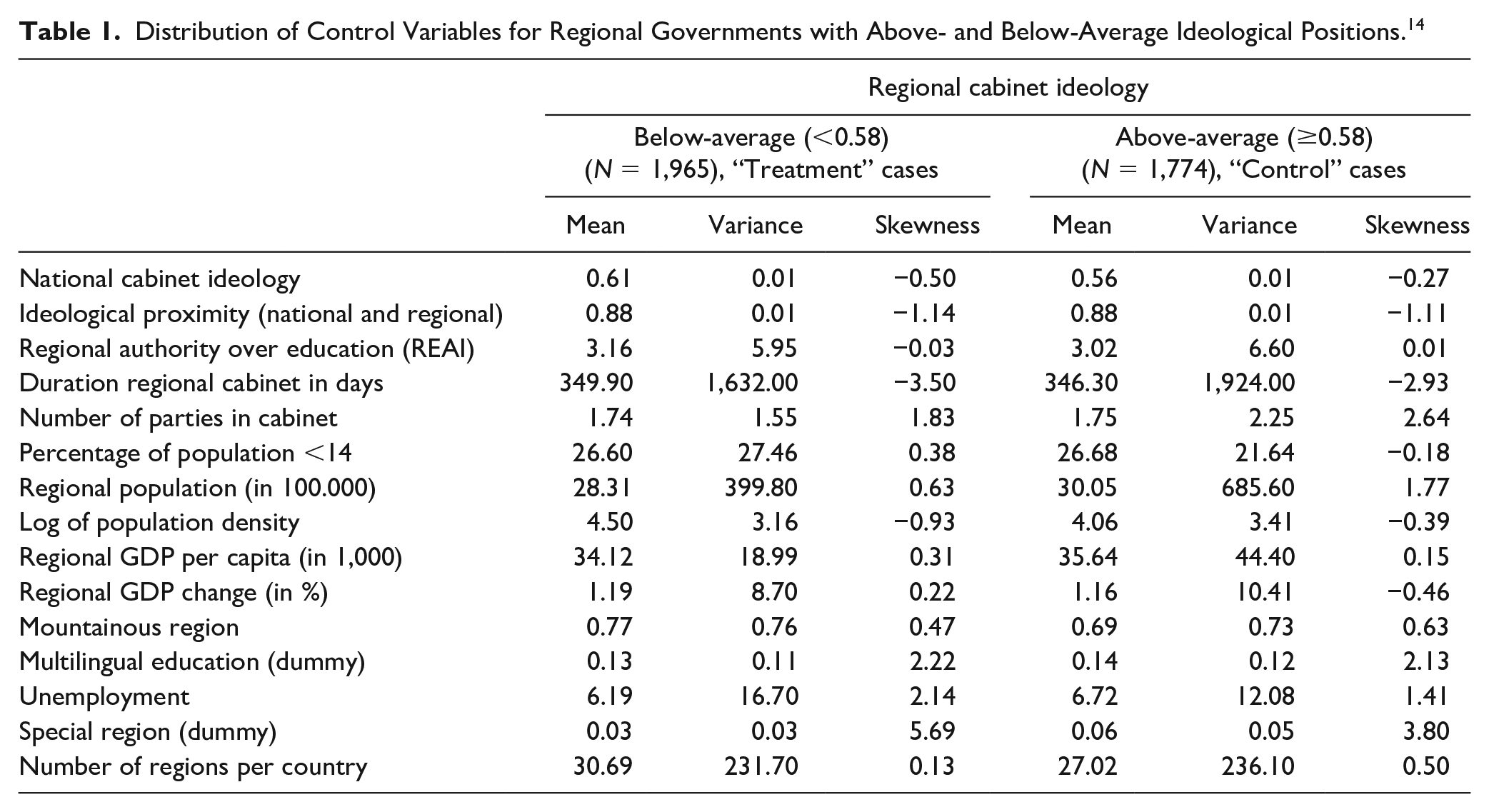
Control variables are useful additions to regression models when they systematically affect the treatment condition as well as the outcome. To test for this, we divide the sample in two groups: those observations above and those below the average value on regional governments’ position on the economic dimension (0.58 on the 0–1 scale). Table 1 depicts the three moments (mean, variance, and skewness) of the control variables for both groups. As all controls show differences in (at least) one of the three moments on the treatment condition, we include them all in our empirical analyses. The findings also replicate in models without control variables, though.
Distribution of Control Variables for Regional Governments with Above- and Below-Average Ideological Positions. 14
Descriptive Findings
How does authority over education differ across regions? Does education spending vary across and within regions? Do parties matter? And does the effect of regional and national governments’ ideology differ across institutional contexts? To answer these questions, we present findings in two steps, beginning with noteworthy descriptive findings before turning to regression results.
Regional Education Authority
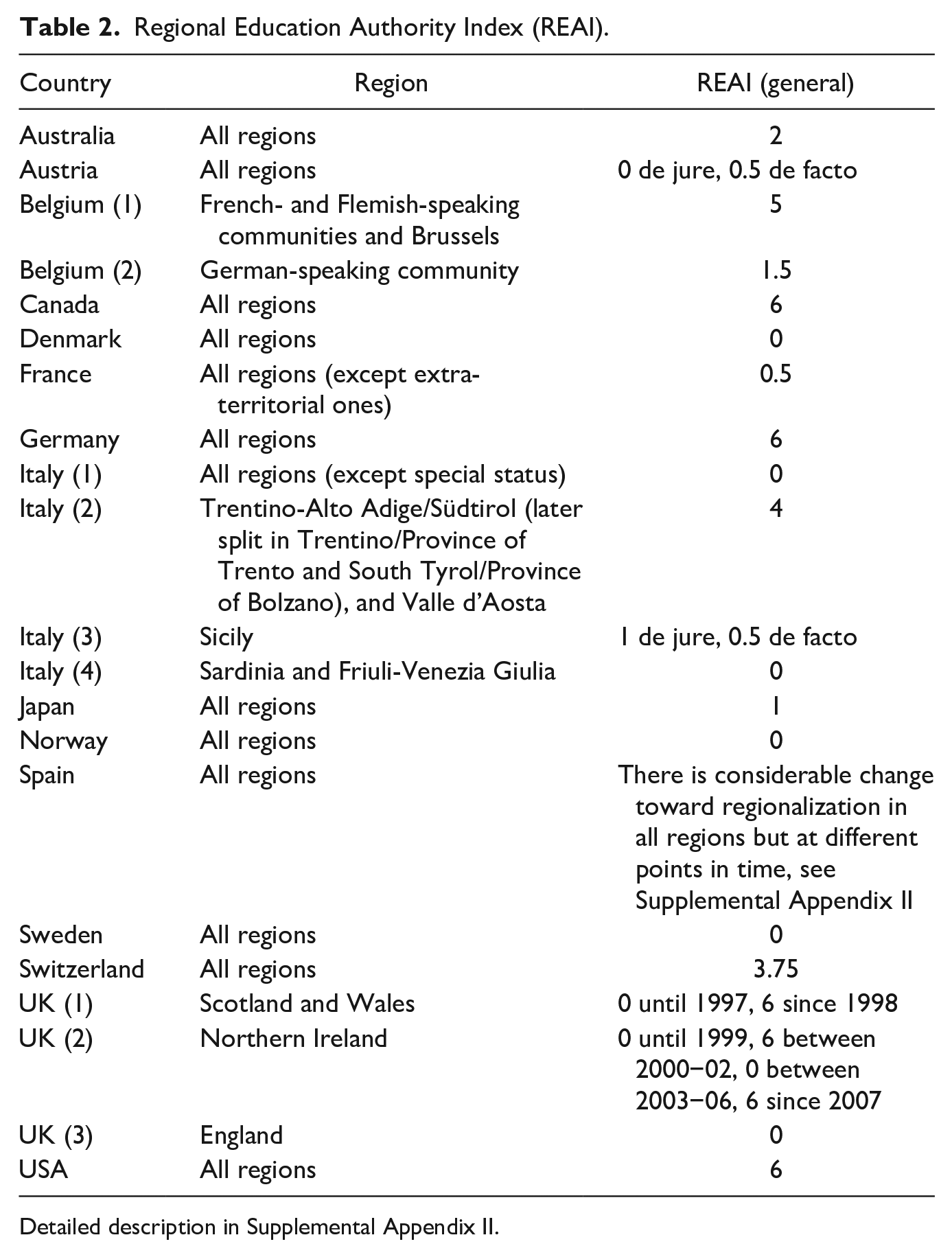
Table 2 provides a descriptive overview on our Regional Education Authority Index (see Supplemental Appendix II for detailed information). A few descriptive results are remarkable. First, the REAI shows that regional governments in many countries have considerable authority over education policy. This is important because it justifies our skepticism toward the existing comparative literature’s focus on the national level (“methodological nationalism”; Jeffery & Schakel, 2013).
Regional Education Authority Index (REAI).
Detailed description in Supplemental Appendix II.
More concretely we find that regions in several federal countries have considerable educational authority: The U.S. states, the German Länder, and the Canadian provinces and territories are ideal-typical examples. Yet, this is not the case for all federations: in some federations the regions have much lower authority over education policy than might be expected from a simple federalism perspective. For example, the Australian, Belgian, and Swiss regions only rank in the mid-field of our authority measure. This implies that federalism can at best only be a rough proxy for decentralization and regional authority (over education).
Second, our REAI reveals important variation across regions within countries, indicating power asymmetries. For example, while for most Italian regions authority is centralized in Rome, some regions with special status have considerable powers. In fact, the governments in some of the Italian regions have more capacities to affect education policy than the administrations in the Swiss Kantone. Belgium and the UK are two other important examples of within-country variation.
Third, in two cases the REAI shows interesting temporal variation. In Spain, the autonomous communities and cities stepwise received larger powers over education policy. Whereas Spain used to be highly centralized, today all regions have considerable educational authority. In the UK, the devolution process similarly moved control away from Westminster to the devolved regions. We thus witness a trend toward more regional authority.
Finally, a closer look reveals variation across educational sectors in some countries (see Supplemental Appendix II). In Australia and Switzerland, the regions have less authority over tertiary education than over schools. Again, these fine-grained but important nuances would get lost when using more general decentralization measures or federalism as a proxy.
Regional Education Spending
Equality of opportunities is a prominent normative goal of education policy in democracies; yet, our data shows fundamental inequalities, as cross-regional differences in per capita spending are substantive. The average regional per capita spending is 929 international-$ with a high standard deviation of 647. The biggest part of variation can be attributed to cross-regional differences (standard deviation of 619), but there is also substantial variation within regions over time (standard deviation of 149). For example, regions in Canada or Switzerland reveal massive differences in education spending (482–3815 in Switzerland) whereas regions in Sweden or France show very low variability (145–406 in France).
Moreover, within-country differences have increased: the average within-country difference between the lowest and the highest spending regions increased from 801 international-$ in 1990 to 976 in 2010. To illustrate: In 2010, the Swiss Kantone of Nidwalden spent 803 international-$ per capita whereas Basel-Stadt spent 3815, that is, almost five times as much. These differences are persistent and have even increased slightly between 1990 and 2010. Regional differences in education spending in Canada are equally high as in Switzerland—and they have massively increased during the last 20 years. In other countries, such as Germany, regional differences in education spending have been reduced, in part due to consolidated efforts to increase educational opportunities in the East-German Länder after Reunification.
The upper panel in Figure 1 shows the empirical distribution of regional education spending at different degrees of regional authority. The figure already lends some first initial evidence to our expectation, showing that the variance of education spending across regions and countries increases with higher levels of sub-national authority.
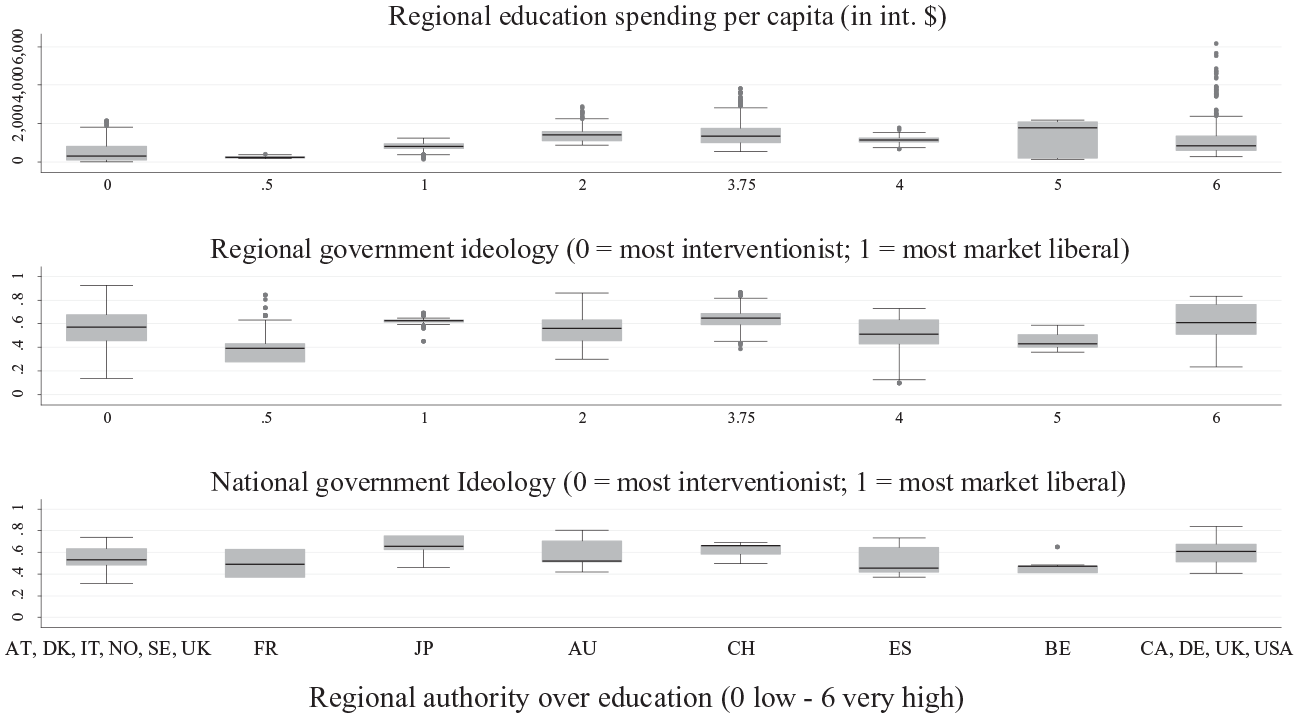
Distribution of regional education spending (upper panel), regional government ideology (medium panel), and national government ideology (lower panel) across different degrees of regional education authority in 282 regions, 1990 to 2010.
Regional Government Ideology
The panel in the middle of Figure 1 shows regional governments’ ideological positions and reveals considerable differences. While some heavily lean toward state-interventionism (the whiskers of the box plots reach below 0.2 on the 0–1 scale), others take strong market-friendly positions (>0.8). This large variance is not only substantively interesting, but relevant for our present analysis because it is a precondition for potential partisan effects.
More importantly, we find that differences in regional government ideology are, with the exception of Japan, quite similar across all degrees of regional authority, that is, regional governments’ ideological positions vary irrespective of their level of regional authority over education. The same holds true for national governments’ ideological positions (cf. the lowest panel in Figure 1). This is important and ensuring information for our analysis, because having variation in ideological positions across different degrees of authority allows us to test our Hypotheses 3 and 4 about the interaction of government ideology and authority.
Regression Findings
Government Effects on Total Public Regional Education Spending
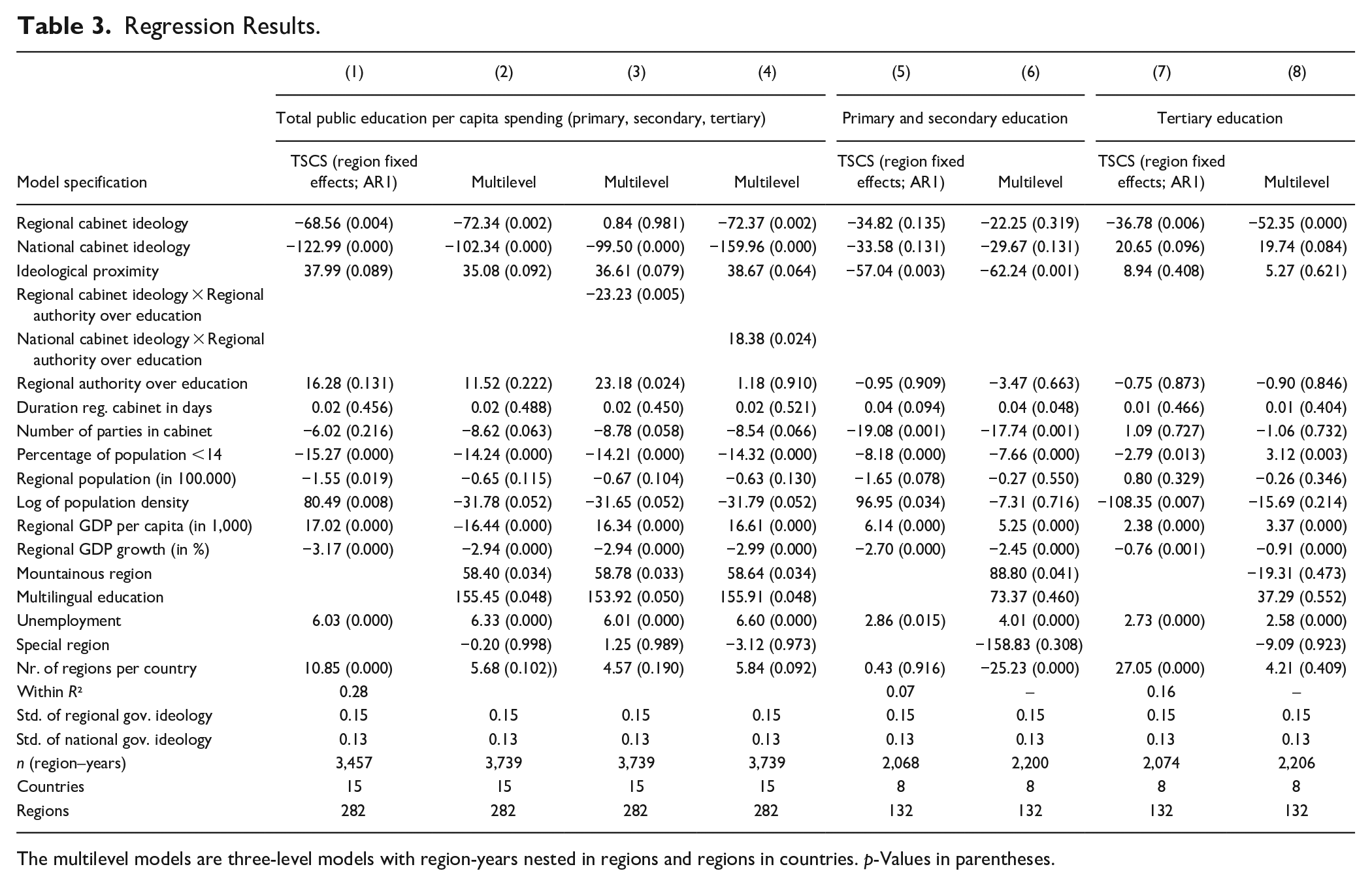
How do governments affect regional education spending? The multilevel regressions in Table 3 indicate that regional governments’ as well as national governments’ ideological standpoints have systematic and sizeable effects on regional per capita public education spending. Substantively, we find that more market-liberal governments decrease education spending whereas more interventionist governments increase expenditure, confirming Hypothesis 1. This is true both for regional and for national governments. Models 1 and 2 show that the ideology effects hold—with comparable substance—in both region-fixed effects and random effects specifications at a significance level of 99%. That is, the effect is not driven by cross-regional differences alone, but can also be shown when focusing on the fixed-effects specification focusing on within-region variation.
Regression Results.
The multilevel models are three-level models with region-years nested in regions and regions in countries. p-Values in parentheses.
Moreover, as expected in Hypothesis 3, the effects of national and regional government ideology are moderated by the degree of regional authority over education (Models 3 and 4): In contexts where authority over education is centralized, regional governments have no effect on education spending. But once regional governments are equipped with a certain degree of authority over education, they also shape education policies in line with their preferences.
Figure 2 shows the marginal effect of regional governments (left-side in Figure 2) and national governments (right-side of Figure 2) on education spending, conditional on the degree of regional authority. We see that regional governments’ ideology shows significant effects (at the 95% level) as soon as authority is higher than 3 on the 0 to 6 scale. Substantively, this threshold indicates that regional governments in Switzerland, Spain, Belgium (after decentralization reforms), Canada, Germany, the UK (after devolution, with the exception of England), and the U.S. have significant effects on regional education spending. We observe the reversed effect for national governments: National governments’ ideological standpoints play an important role in shaping regional education spending, and the size of this effect decreases in contexts where regional governments have higher degrees of authority.
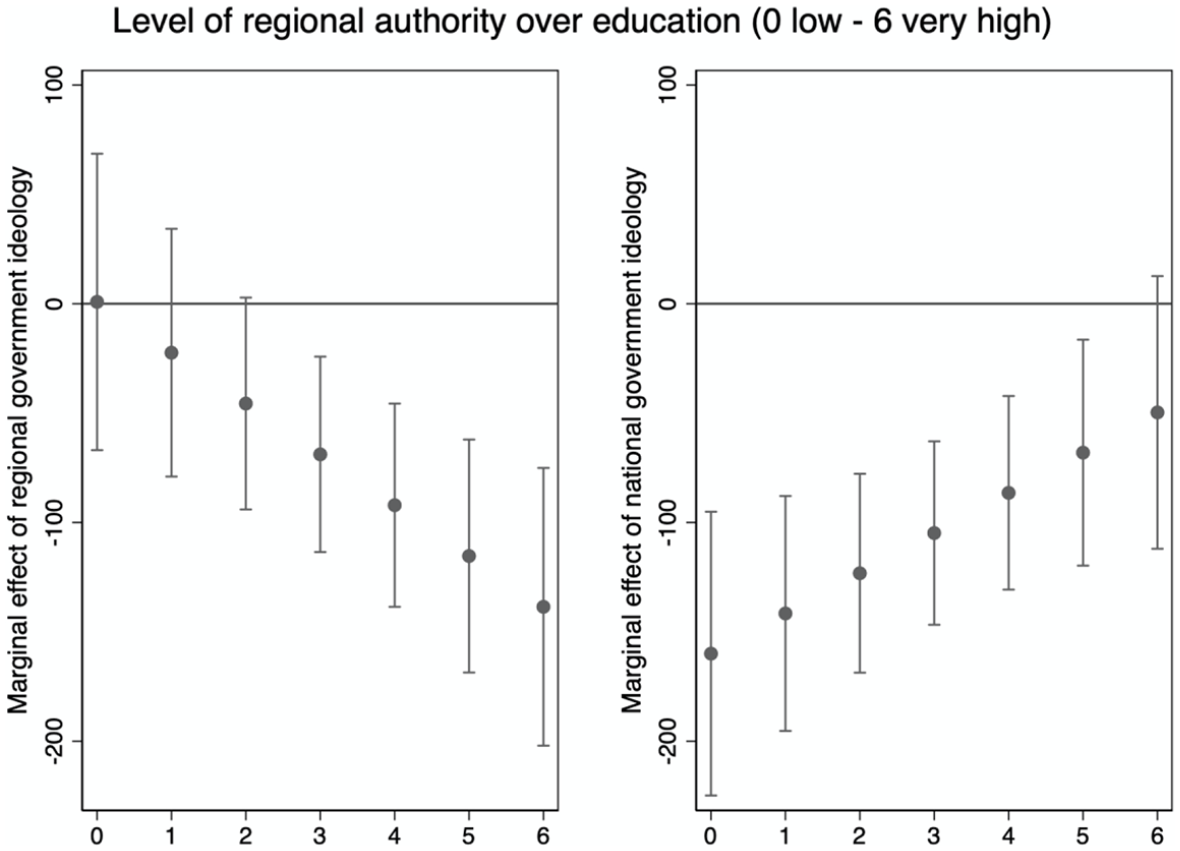
Marginal effects of regional (left-side) and national governments’ (right-side) ideology on education spending at different degrees of regional authority over education.
Yet, in line with Hypothesis 4, a closer look uncovers a noteworthy asymmetry: While the effect of regional governments decreases as authority is more centralized, the effect of national governments does not decrease to the same extent as authority is decentralized to regions. Thus, national governments find ways to shape regional education spending even as authority becomes regionalized. Only in cases where authority over education is decentralized to the highest degree (REAI = 6) does the national government’s influence on regional education budgets become insignificant.
This is an important finding, not least from a normative perspective, because it reveals that—controlling for a range of potential confounders—national governments are crucial policy actors also for regional policy-making and do affect policy-making even in decentralized polities. In fact, the estimates should even be regarded as a “lower-bound” for the true effect of national governments, because we already control for ideological alignment, which is one of the crucial theoretical reasons for national government interference in regional policy-making. Moreover, in Supplemental Appendix I Section 4.3, we further demonstrate that the power asymmetry finding persists even when controlling for regional fiscal authority, which implies that—as theorized above—there are several channels through which national governments interfere with regional policy-making.
The effects of regional and national governments are substantial in size. Model 2 shows that a one-unit change in governments’ ideology (i.e., from the most state-interventionist to the most market-friendly) increases per capita education spending by 72 international-$ annually. As the average per capita spending on education is 929 international-$, this equals an annual 8% increase. A typical alternation between a center-left to a center-right cabinet equals a change of 0.3 on the market liberalism scale. Accordingly, the impact of an alternation from an average center-left to an average center-right government after 4 years would be an average reduction of education spending of 87.6 international-$ per capita, that is, more than a 9% decrease.
Looking at the interaction effect, we see that in highly centralized polities the substantive effect of regional government ideology is zero, but increases with authority. The effect size of regional government ideology in regions with the highest degree of regional education authority is −138.56. As a typical real-world example, consider the case of Catalonia: Our model predicts that the alternation from a center-right government in 2003 from Jordi Pujol (center-right) to Pasqual Maragall (center-left) implies an increase of 66.5 international-$ until 2006 (when the government was terminated). In fact, the Maragall government increased spending from 1027 to 1154 international-$ per capita.
Government Effects on Disaggregated Regional Education Spending
We theorized in Hypothesis 2 that partisan differences should be more pronounced in the case of tertiary education than for spending on primary and secondary education. Models 5 and 6 in Table 3 show results focusing on regional public primary and secondary education expenditure, and Models 7 and 8 for tertiary education. As explained, our sample is smaller here, as disaggregated spending data was only available for about half of the regions (132) in eight countries. As most regions in this subsample have high degrees of regional authority, it is not meaningful to analyze the interaction between national government ideology and regional authority over education here, in light of the low variance on the respective institutions. We therefore focus on the main effect of both levels of governments. Given this high degree of regional authority in these regions, we would expect a rather small effect of national governments at best.
Models 5 and 6 demonstrate that more market-liberal regional governments do not significantly reduce primary and secondary education spending on the regional level. In contrast, models 7 and 8 show that more market-liberal regional governments substantially and systematically reduce tertiary education spending, while more interventionist governments increase expenditures. These results are fully in line with Hypothesis 2. A typical government alternation (center-left to center-right) is associated with an increase of 52 international-$ per student and year, which equals a 13% increase in spending on higher education whereas we found an average increase of 9% in the models using total education spending as dependent variable. Accordingly, our inference that more interventionist regional governments increase education spending is predominantly driven by increased expenses on tertiary education (at least for those countries where we have disaggregated data) and thus confirms Hypothesis 2.
Overall, the data strongly confirms all four hypotheses: The partisan composition and ideological positions of regional and national governments play a crucial role for regional education spending, predominantly in the area of tertiary education—and these effects are conditional on the degree of regional authority, but are asymmetric as national governments also matter in regionalized polities. In Supplemental Appendix I (Section 4.8) we describe the performance of the control variables. For reasons of limited space we just note here that, interestingly, regional authority does not have a spending effect on its own. This puts doubts on the claim of previous studies that more decentralized systems tend to exhibit higher education spending.
Robustness
We conducted a range of robustness tests. First, we tested other model specifications. It turns out that the above-reported multilevel models actually show the “weakest” results in support of our hypotheses, whereas alternative specifications (e.g., differently specified multilevel models, time-series cross-section models with and without fixed-effects, and simple pooled OLS models) show equally significant but substantively stronger effects (Supplemental Appendix I, Table A5).
Second, adding a lagged dependent variable barely changes the interaction effect and thus reduces concerns about endogeneity and path dependencies.
Third, different aggregation procedures and alternative measurements for the REAI support our main conclusions.
Fourth, as discussed in the argumentation around Hypothesis 4, we are particularly interested in controlling for the “revenue side” of policy-making since one reason for the power asymmetries might run through fiscal transfers. Centralized fiscal authority provides national governments with the opportunity to influence regional policy trough the channel of resource dependency. However, decentralized fiscal authority leaves at least poor regions short of sufficient revenues as well. Yet, and as expected, adding a measure of the fiscal capacity of regions to our spending-focused REAI does not change our main conclusions (Supplemental Appendix I, Section 4.3). This implies that while the revenue side is without doubt important for policy-making, controlling for this does not cancel out the power asymmetries between national and regional governments. This also implies that—as theorized—there is not one but several channels through which national governments affect regional policy-making.
Fifth, the exclusion of single countries indicates that none individually is necessary for our findings (Tables A8–A10 in Supplemental Appendix I).
Sixth, the main results do not depend on specific control variables (Supplemental Appendix I, Table A11). The findings also replicate in models without any controls (Supplemental Figure A13) as well as in models with other combinations of control variables. The interaction effect between regional authority and regional government ideology changes only marginally.
Finally, we tested a range of alternative measures of partisan ideology. Table A12 in Supplemental Appendix I, for example, replicates our findings using the common RILE-index (Laver & Budge, 1992) in almost all specifications. We also discuss in Supplemental Appendix I why we focus on manifesto-based measures, mainly because of data availability across countries and time, but show that the measure used here correlates the strongest with expert survey evaluations.
Conclusion
Representative democracy presupposes that elected governing parties can and do shape public policy. Despite the relevance of this question, we know surprisingly little about the politics of policy-making in multi-level systems. This paper aimed to offer theoretical and empirical insights into the complex interplay of regional and national policy-makers’ influence on policy-making, conditional on institutional distributions of authority.
Empirically, we used the critical case of education policy. As capitalist democracies develop into post-industrial knowledge economies, it is crucial to understand the degree to which elected representatives shape education policies. The location of authority over education varies across countries and frequently appears to be one of the most decentralized policy domains. An assessment of democratic responsiveness can thus only be done justice by overcoming “methodological nationalism.” We argue, however, that exchanging methodological nationalism with “methodological regionalism” does not resolve the problem.
Policy-making in multi-level systems is characterized by a complex interplay of national and regional governments, whose respective influence is moderated by institutions. We identified a crucial power asymmetry as regional governments do not affect policy-making in centralized polities, but national governments remain influential even in decentralized systems. The reasons lie in intra-partisan incentives as well as in institutional factors tilting power toward the center.
Using three novel datasets that introduce information on regional education spending, regional governments’ partisan composition and ideological standpoints, as well as regional authority over education policy in 282 regions in 15 OECD countries over 21 years, this article produced several findings: We showed that (1) education spending, governments’ ideological standpoints, and authority over education differ considerably within countries across regions in interesting and important ways, revealing large-scale within-country inequalities in the funding of education; (2) regional government ideology has a sizable effect on education spending, with economically more left-leaning parties spending much more than economically right-leaning ones; (3) these effects are particularly strong for tertiary education; (4) the degree of regional authority over education policy moderates partisan effects, as regional parties only matter once they receive at least moderately high autonomy to shape policies; and (5) a crucial power asymmetry exists, as national governments also have considerable effects on regional education spending, even in contexts where authority formally is decentralized.
On the one hand, the results are reaffirming for (scholars of) representative democracy and democratic representation. Prominent recent literatures have claimed that representative governments might be increasingly constrained, both by international developments (such as globalization) as well as by domestic constraints (such as path dependencies), both limiting governments’ room-for-maneuver. While this might be true to some degree, our results clearly show that regional and national governments still make a substantial difference in policy-making.
On the other hand, the findings also indicate that regional governments are constrained—namely politically by national governments, even in contexts where the political system does not design such effects. This raises further empirical and normative questions.
The results highlight the need to combine institutional analyses and party-political analyses, as either perspective alone produces incomplete results. The findings teach us that we cannot understand differences in public policy without paying close attention to the distribution of authority across different political levels. Both “methodological nationalism” and “methodological subnationalism” are misleading.
While we showed this for the case of education, the arguments and analytical perspective equally travel to other public policy areas. Future research could extend these arguments for other elements of education policy (e.g., educational governance, teaching contents, or quality), as well as for other policy areas. Moreover, the research agenda could be extended to even lower governmental levels, especially the local level. We still need a much better understanding of the politics of policy-making in complex multi-level systems, both in terms of the interplay of actors and institutions, as well as regarding the specific causal mechanisms.
The arguments and findings contribute to and extend several research fields, especially in public policy and welfare state research, party politics, and territorial politics. For example, we add to public policy research by theorizing and empirically exploring the complex interactions between parties at different levels of government and condition institutional affects; we enrich work in (subnational) party politics by providing a new dataset on regional governments and their ideological standpoints; we add to discussions about multi-dimensional party preferences by showing that and how the economic dimension is vital in explaining policy-outputs; and to territorial politics we add by demonstrating that and how the distribution of policy authority is an important moderating factor for party politics and by identifying power asymmetries between levels of government.
These findings imply that scholars interested in party politics and/or policy-making need to pay simultaneous attention to both the national and the regional level. Moreover, we also hope that our novel empirical data triggers future work, for example by studying party competition dynamics, party-voter linkages, causes of decentralization (in education), or consequences of unequal education spending.
Supplemental Material
sj-pdf-1-cps-10.1177_0010414021997499 – Supplemental material for Policy-Making in Multi-Level Systems: Ideology, Authority, and Education
Supplemental material, sj-pdf-1-cps-10.1177_0010414021997499 for Policy-Making in Multi-Level Systems: Ideology, Authority, and Education by Julian L. Garritzmann, Leonce Röth and Hanna Kleider in Comparative Political Studies
Supplemental Material
sj-pdf-2-cps-10.1177_0010414021997499 – Supplemental material for Policy-Making in Multi-Level Systems: Ideology, Authority, and Education
Supplemental material, sj-pdf-2-cps-10.1177_0010414021997499 for Policy-Making in Multi-Level Systems: Ideology, Authority, and Education by Julian L. Garritzmann, Leonce Röth and Hanna Kleider in Comparative Political Studies
Supplemental Material
sj-pdf-3-cps-10.1177_0010414021997499 – Supplemental material for Policy-Making in Multi-Level Systems: Ideology, Authority, and Education
Supplemental material, sj-pdf-3-cps-10.1177_0010414021997499 for Policy-Making in Multi-Level Systems: Ideology, Authority, and Education by Julian L. Garritzmann, Leonce Röth and Hanna Kleider in Comparative Political Studies
Supplemental Material
sj-pdf-4-cps-10.1177_0010414021997499 – Supplemental material for Policy-Making in Multi-Level Systems: Ideology, Authority, and Education
Supplemental material, sj-pdf-4-cps-10.1177_0010414021997499 for Policy-Making in Multi-Level Systems: Ideology, Authority, and Education by Julian L. Garritzmann, Leonce Röth and Hanna Kleider in Comparative Political Studies
Footnotes
Acknowledgements
We thank participants and discussants at various conferences (CES, ECPR, EPSA, MPSA, SASE, SVPW) and workshops (in Mannheim, Florence, Konstanz, Zürich, and Köln) for helpful comments. For helpful assistants with gathering and cross-checking the data we thank Pelle Ahlin, Susumu Annaka, Charlotte Kurz, Léonie Trick, Annie Watson, and Marie Zeller. We also wish to extent our thanks to several country experts (Gilberto Capano, Jon Fiva, Sandra León, Yosuke Sunahara, and Emmanuele Pavolini) who took the time to discuss country-specific questions with us, as well as to André Kaiser for thoughtful feedback. Finally, we are grateful to the editors and the three anonymous reviewers for excellent and constructive feedback.
Declaration of Conflicting Interests
The authors declared no potential conflicts of interest with respect to the research, authorship, and/or publication of this article.
Funding
The authors disclosed receipt of the following financial support for the research, authorship, and/or publication of this article: This work was supported by the German Research Foundation under grant numbers GZ: KA 1741/10-1 and KA 1741/10-2.

Notes
Author Biographies
References
Supplementary Material
Please find the following supplemental material available below.
For Open Access articles published under a Creative Commons License, all supplemental material carries the same license as the article it is associated with.
For non-Open Access articles published, all supplemental material carries a non-exclusive license, and permission requests for re-use of supplemental material or any part of supplemental material shall be sent directly to the copyright owner as specified in the copyright notice associated with the article.
