



Abstract
This article problematises the proliferation of European Union (EU) agencies with operational tasks as a new phenomenon capturing the exercise of joint sovereignty in European integration. While joint decision-making has been a feature of EU politics for decades, joint sovereignty is a broader category that additionally involves the creation of EU bodies able to intervene ‘on the ground’ alongside national public actors. We argue that the choice for joint sovereignty opens a Pandora’s box of implementation deficiencies which undermine the ability of both national and supranational actors to conduct operational activities effectively. We subsequently identify two frequent dysfunctions in policy implementation and connect them to ambiguity and conflict at the decision-making stage. Empirically, we illustrate the systemic link between decision-making and implementation problems in the functioning of two agencies with operational tasks active in the fields of border management (Frontex) and police cooperation (Europol).
Introduction
In modern governance, ‘agencification’ is a phenomenon describing the transfer of government powers from classic ministerial departments to new bodies delegated with specialised tasks and various degrees of autonomy (Trondal, 2014). In the European Union (EU), agencies proliferated in the 1990s in many policy areas (Levi-Faur, 2011). At the outset, EU agencies fulfilled mainly (semi-)regulatory functions such as providing information and expertise-based rules in the single market (Egeberg & Trondal, 2017; Majone, 1994). However, the last two decades have also witnessed a strengthening of EU agencies with operational tasks in fields like border management (the European Border and Coast Guard Agency, known as Frontex), asylum (the European Asylum Support Office, EASO), police cooperation (Europol), or civil and criminal justice (Eurojust and the European Public Prosecutor’s Office). The development is significant for two reasons. First, agencies with operational tasks go beyond the EU’s classical ‘regulatory state’ model because they require supranational capacity-building in terms of money, personnel and coercive ability (Bremer et al., 2020; Genschel & Jachtenfuchs, 2016). Second, operational tasks presuppose the physical presence of EU officials on member states’ territories in order to limit, enhance, or even replace the actions of national public authorities. While EU institutions had already been involved in policy enforcement vis-à-vis private actors (Scholten, 2017), operational tasks are substantively different because they target the activities of public actors.
In this article, we conceptualise this new empirical trend as the exercise of ‘joint sovereignty’ in the EU. We focus, in particular, on the domestic sovereignty of member states (Krasner, 1999; Thomson, 1995) and its two main components: decision-making authority (the sole right to make rules in a given territory) and coercive capacity 1 (the sole capability to physically enforce said rules through a centralised bureaucratic apparatus). Borrowing from the new intergovernmentalism, we first show the proliferation of EU agencies since the Maastricht Treaty as a process of ‘integration without supranationalism’ which created ‘de novo bodies’ (Bickerton et al., 2015) under joint national and supranational authority. Then, we examine the case of operational agencies as a specific institutional form through which national and supranational actors share not only decision-making authority but also the capacity to enforce rules ‘on the ground’ in different policy areas. When operational agencies participate in activities like law enforcement, border management, or inspections of national infrastructure, member states come to exercise sovereignty jointly with them and thus no longer hold the monopoly of coercive capacities on their territories. Given its emphasis on physical policy enforcement, the resulting joint sovereignty model is broader than shared authority in multi-level governance (Hooghe & Marks, 2001) and goes beyond notions of ‘pooled sovereignty’ in decision-making (Moravcsik, 1998). Beyond the EU, similar arrangements can be found in other ‘coming-together’ polities (Kelemen, 2014; Stepan, 1999) practicing cooperative or executive federalism, such as the United States, Switzerland or Germany (Bolleyer & Thorlakson, 2012; Börzel, 2005).
Second, we tackle the connection between the conditions that facilitate the emergence of joint sovereignty in the EU and the ability of the resulting system to implement its own decisions effectively. Borrowing a metaphor from Scholten (2017, p. 1360), we argue that joint sovereignty opens a ‘Pandora’s box’ of implementation deficiencies when the same conditions that allow the establishment of joint coercive capacities undermine the ability of the system as a whole to enforce policies effectively. In order to establish new institutions or to adopt policies under the joint sovereignty model, member states typically strike compromises with a high level of ambiguity (Matland, 1995) or based on ‘incomplete contracts’ (Jones et al., 2016; Pollack, 2003, p. 22). This pushes policy conflict further down the line to the implementation stage. Consequently, the same conditions that pave the way for the emergence of joint sovereignty create vertical conflicts over the ill-defined exercise of joint coercive capacities in policy implementation. Which actor on which level of authority is, for instance, responsible for registering, processing and implementing the decision of an asylum application? The EU’s systematic reliance on hybrid governance structures equips both national and supranational actors with the ability to enforce policies on the ground, which generates specific deficiencies. Using an adapted version of Matland’s (1995) ambiguity–conflict model in policy implementation, we identify responsibility-shifting and obstruction as the most likely dysfunctions of joint sovereignty in the EU. Empirically, we illustrate the deficiencies with two emblematic examples borrowed from the activities of Frontex (responsible for border management) and Europol (tasked with coordinating police cooperation).
Our contribution to the literature is fourfold. First, we analyse the EU agencification phenomenon in a new light. While acknowledging the role of all agencies in the construction of an EU administrative space, that is the ‘institutionalisation of common administrative capacity’ (Trondal & Peters, 2013, p. 296), we understand the expansion of operational agencies in particular as a new feature of EU governance, that is, the exercise of joint sovereignty. Second, we investigate tenets of the new intergovernmentalism (Bickerton et al., 2015) and the core state powers literature (Genschel & Jachtenfuchs, 2016) by examining the practical consequences of sharing sovereignty in the EU multi-level system. Third, in exploring such consequences, we open up a new area of investigation in the flourishing literature focusing on the challenges of multi-level implementation (Heidbreder, 2017; Thomann & Sager, 2017). Fourth, we expose pathologies of joint sovereignty that apply not only to the EU but also to other multi-level contexts. When novel pressures for centralisation occur in devolved areas of competence, ‘coming-together’ federations (Kelemen, 2014; Stepan, 1999) might indeed develop similar implementation dysfunctions as the EU.
The article is organised as follows. We start with a description of a new empirical phenomenon in European integration: the expansion of EU agencies with operational tasks (section 2). Next, we conceptualise the development as the emergence of ‘joint sovereignty’ in the EU, which displays specific features (section 3). We then explain how the conditions that facilitate decision-making on joint sovereignty are bound to lead to systemic implementation deficiencies (section 4). To illustrate the problems, we describe two cases of ineffective implementation: on the one hand, the mechanics of responsibility-shifting as reflected in Frontex’s approach to fundamental rights in joint operations; on the other hand, the practices of obstruction visible in the reluctance of national authorities to share police intelligence with Europol (section 5). We conclude by discussing the applicability of our argument to other EU policy areas and institutional arrangements.
Empirical Observation: The Rise of EU Agencies with Operational Tasks
In the past three decades, agencification has become a pervasive feature of EU governance (Egeberg & Trondal, 2017). Since the early 1990s, agencies have proliferated across policy fields and acquired an increasingly important role in the functioning of the EU machinery (Egeberg & Trondal, 2017; Ripoll Servent, 2018). Among the plethora of existing networks and committees (Levi-Faur, 2011), EU agencies are the institutions which have undergone the most impressive development: from only two agencies created in 1975, the EU now counts over 36 of these bodies, which possess a wide range of different implementation tasks (for an overview, see Vos et al., 2018).
The most common understanding of EU agencies is provided by Kelemen & Tarrant, who define them as EU-level public authorities with a legal personality and a certain degree of organisational and financial autonomy, created by secondary legislation in order to perform clearly specified tasks (Kelemen & Tarrant, 2011). All EU agencies are characterised by a shared governance structure (Vos et al., 2018) as their management boards are composed by member states’ representatives and the European Commission, and sometimes even the European Parliament (Busuioc, 2012). Therefore, the autonomy of agencies is dependent on the interplay between national and supranational actors. From a delegation perspective, agencies act under the control exerted by multiple principals (Kelemen & Tarrant, 2011; Thatcher, 2011), that is, according to a double delegation logic by the Commission and the member states (Michaelowa et al., 2018). Due to legal limitations set by the Treaties 2 and the Court of Justice, 3 agencies are usually unable to take fully autonomous decisions and/or to organise operations independently from the member states. Nevertheless, various agencies are progressively moving to the forefront of policy implementation (Chamon, 2016; Scholten, 2017), thus unsettling the traditional paradigm of EU executive federalism (Börzel, 2005) and the assumption that policy implementation is chiefly a national concern (Tsourdi, 2021).
Despite having many similarities, EU agencies differ substantially from each other. Existing classifications are based either on the type of function (e.g. Wonka & Rittberger, 2010) or on the kind of powers and level of discretion conferred on them (for an overview, see Chamon, 2016). For the purpose of our argument, we categorise agencies according to the target of their enforcement action: specifically, we identify a fundamental distinction between agencies tasked with regulation and those tasked with operational activities 4 (Chamon, 2016, p. 24; Wonka & Rittberger, 2010). Accordingly, the pursuit of regulatory tasks implies the production and enforcement of common rules vis-à-vis private actors (Scholten, 2017), where enforcement usually occurs ‘from the distance’, that is, experts monitor compliance with rules and (in some cases) impose sanctions in case of violations. 5 Since regulatory agencies mainly target private actors, they are common in internal market policies. Their role is to provide rules and scientific expertise, to work as an enhancement of comitology committees and to implement detailed rules stemming from complex legislation (Migliorati, 2020b). Such agencies may enjoy considerable autonomy both in setting regulatory standards and in implementing them. For example, the European Medicines Agency (EMA) plays a crucial role in the approval of pharmaceutical products and sets regulatory standards and best practices for pharmacovigilance (Sabel & Zeitlin, 2008). The European Food Safety Authority (EFSA) identifies and ranks public health hazards in food and feed production (Hartley, 2016). In turn, the European Securities and Market Authority (ESMA) sets regulatory and supervisory standards and practices in the financial sector, and even has the right to directly apply and enforce some aspects of EU law vis-à-vis private parties 6 (Scholten, 2017; Scholten & Van Rijsbergen, 2014).
Conversely, operational tasks entail assisting member states in the physical enforcement of rules on their territories; as such, they are associated with public authorities in ‘hands-on’ activities like law enforcement, border management and inspections. To this end, operational agencies require fiscal, administrative and coercive resources, typically considered ‘core state powers’ in European integration (Bremer et al., 2020). Different from regulatory tasks, operational activities imply direct contact with state actors, and in some cases, even the ability to enhance the human and material resources of individual member states by drawing from the EU budget – as is the case for Frontex (Tsourdi, 2021, p. 180). In general, operational tasks vary according to the mandate of the agency. They can include the exchange of information to facilitate or realise operational activities (e.g. Europol); providing training for national officials (e.g. CEPOL and EASO); the coordination of joint member state operations (Eurojust, Europol, EASO, Frontex and the European Fisheries Control Agency) or the organisation and execution of inspections (e.g. the European Maritime Safety Authority) (cf. Chamon, 2016 pp. 40–44).
In the past three decades, EU agencies with operational tasks have witnessed a remarkable development. Figure 1 compares the two groups in absolute numbers over time, while Figure 2 compares their economic empowerment as reflected by their EU-funded budgets.
7
Given the pervasiveness of agencification in the post-Maastricht era, it is unsurprising that the number of both regulatory and operational agencies has increased substantially. Moreover, keeping in mind that the role of the EU as a regulatory polity has persisted since the 1990s (Majone, 1994), agencies with regulatory and information-sharing tasks continue to outnumber operational ones. Yet, the more interesting observation can be found in Figure 2: Compared to regulatory bodies, agencies with operational mandates have seen their budgets increase massively, especially in the past 5 years. These budgetary increases concern agencies involved in border management, asylum and law enforcement – namely, Frontex, EASO, Europol and EU-Lisa. Increase in the number of EU regulatory and operational agencies over time (own account; data available at Freudlsperger et al., 2021). Increase in the budgets of EU regulatory and operational agencies over time (own account; data updated from Migliorati, 2020a and available at Freudlsperger et al., 2021).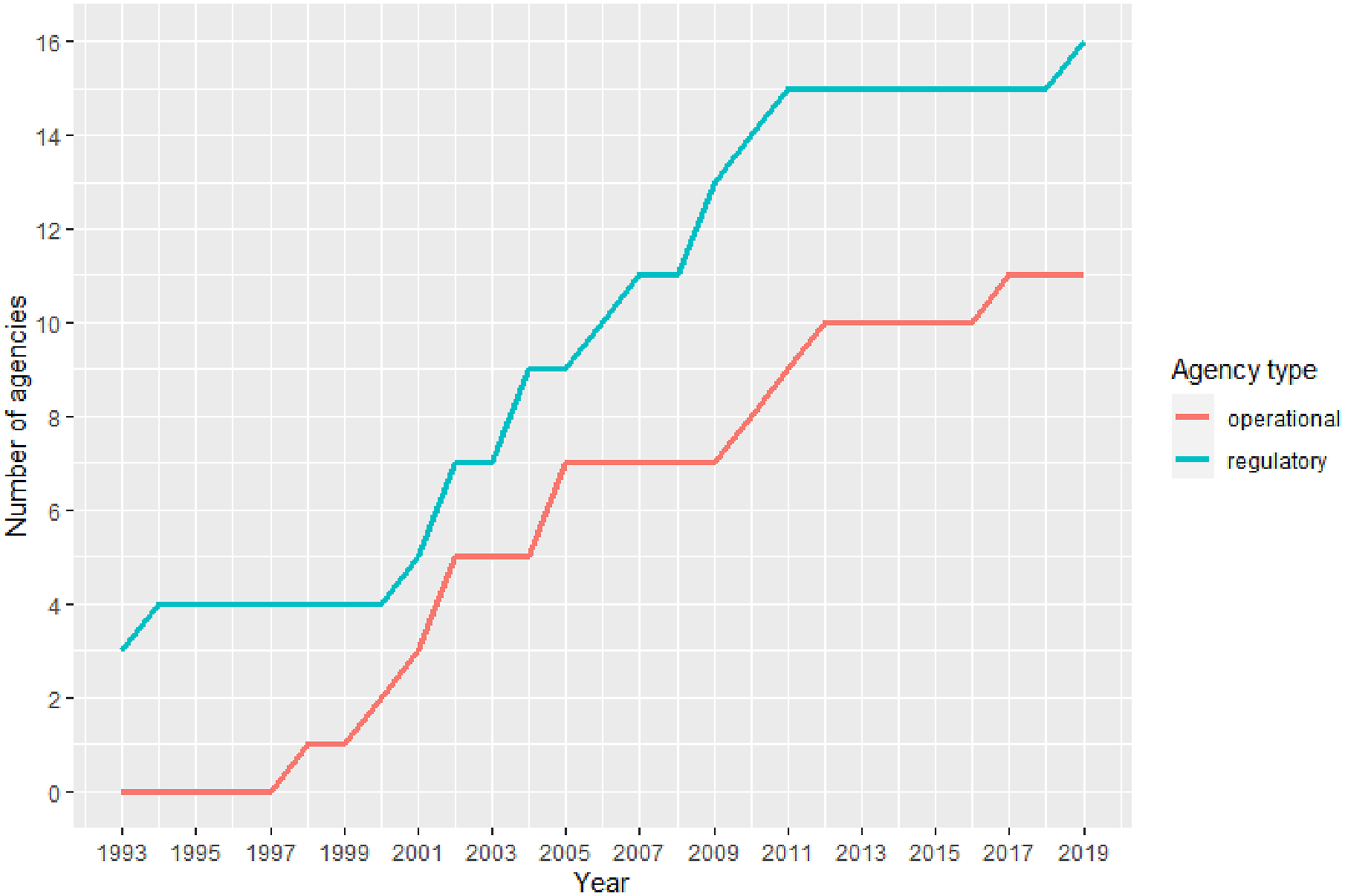
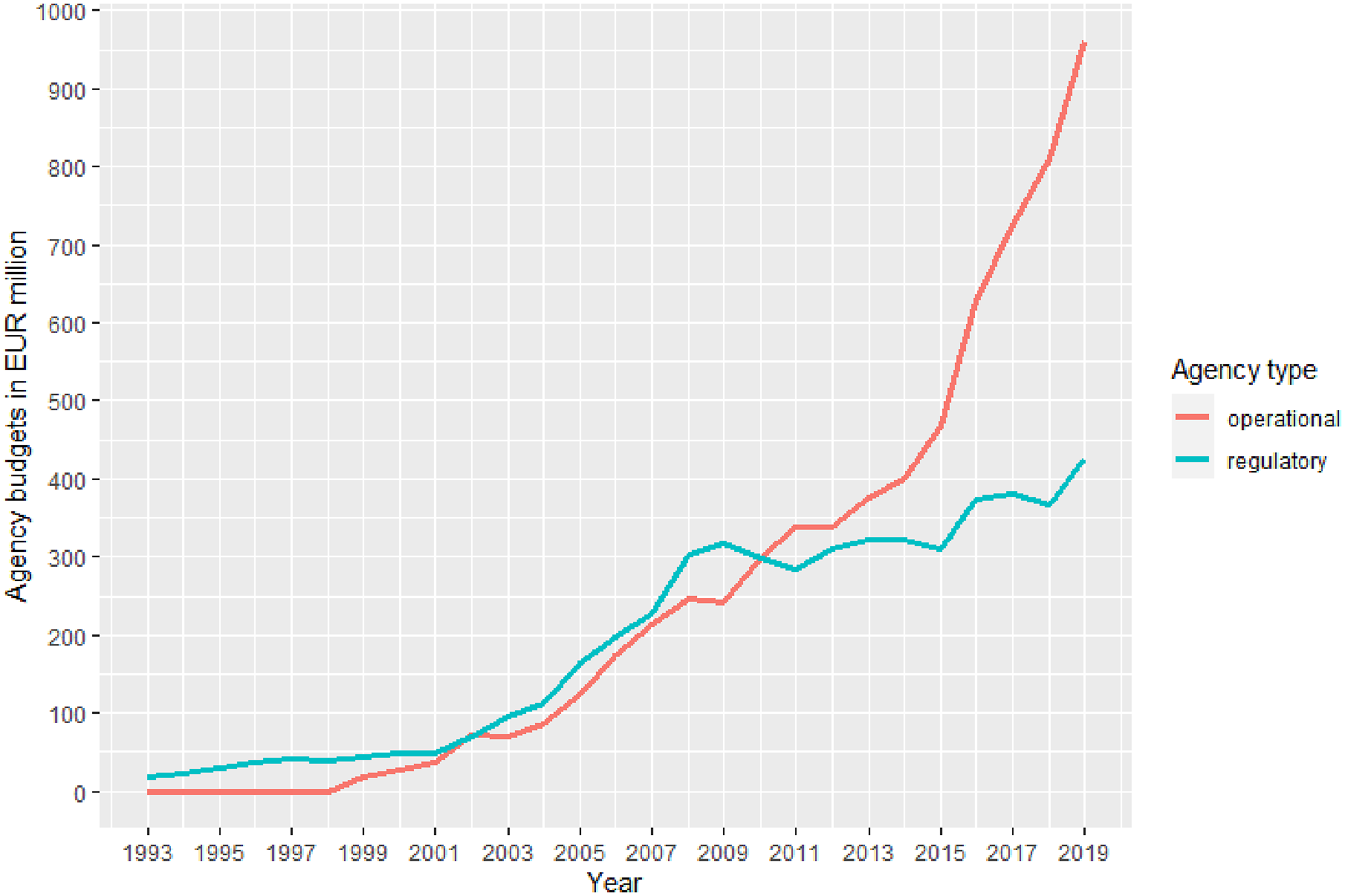
As with any public institution, budgetary increases signal an expansion of activities; in fact, the budgets of EU agencies are strongly correlated with their empowerment over time (Migliorati, 2020a). In other words, higher budgets mean not only more money and staff, but also an extension of their original mandate – as was the case for Frontex or EASO. With their mandates expanding and their budgets increasing, EU agencies with operational mandates are likely to become more involved in ‘hands-on’ policy implementation in the member states.
In the next section, we argue that the expansion of EU agencies with operational tasks signals a broader development in European integration since the Maastricht Treaty.
Towards a Joint Sovereignty Model
Why are EU agencies with operational tasks on the rise? The main explanation for this phenomenon has two parts. The first part refers to the general expansion of EU agencies in European integration after the Maastricht Treaty (1993) and the broader trend towards ‘integration without supranationalism’ (Bickerton et al., 2015). The new intergovernmentalism describes the phenomenon as a deliberate decision by national governments to further advance European integration without empowering the traditional supranational institutions – the Commission, the European Parliament (EP), or the Court of Justice (Bickerton et al., 2015, p. 705). Instead, member states created new governance structures where decision-making authority remained in the hands of national governments or became shared in a hybrid intergovernmental-supranational architecture within de novo bodies (which include both regulatory and operational agencies). Given the increased domestic contestation of EU policy-making since Maastricht, national governments felt constrained not to transfer further powers to supranational institutions (see also Hooghe & Marks, 2009).
The second part of the explanation concerns the rise of EU operational agencies in particular. This relates to another development in European integration in the post-Maastricht era, when the EU expanded from market integration to the integration of core state powers (Genschel & Jachtenfuchs, 2016). Core state powers denote key functions of sovereign government ‘derived from the state’s twin monopoly of legitimate coercion and taxation’, including police forces, border patrols, the military, public administration and fiscal institutions (Bremer et al., 20020, p. 58). Unlike in market integration, the integration of core state powers concerns and directly affects state elites as opposed to private economic actors (Genschel & Jachtenfuchs, 2016, p. 52). In such fields, it is generally difficult to use the EU’s classic ‘regulatory state’ model (Majone, 1994), that is, pooling decision-making at the supranational level whilst leaving implementation dependent on member states’ capacities. To an extent, core state powers integration required the establishment of supranational capacities able to intervene directly vis-à-vis or alongside member states within their territories (Genschel & Jachtenfuchs, 2016). This resulted in the establishment (and empowerment) of operational agencies.
Against this background, we argue that the rise of EU agencies with operational tasks illustrates the emergence of a joint sovereignty model in the EU political system. We are specifically interested in the transformation of member states’ domestic sovereignty (Krasner, 1999, p. 4) when EU institutions gain the ‘authority to intervene coercively in activities within [their] territory’ (Thomson, 1995, p. 219). In international law, the term ‘joint sovereignty’ refers to disputes over territorial borders within condominiums. Condominiums are political entities where two or more states simultaneously exercise sovereignty within a territory in conformity with pre-established rules, for example, Andorra (Samuels, 2008). Transposed to the EU, ‘joint sovereignty’ moves away from territorial conflict between horizontal units; instead, the concept denotes the vertical exercise of decision-making authority and coercive capacities by two levels of governance (the EU and national actors) at the same time. In the next pages, we outline the building blocks of the term.
Theorising Joint Sovereignty
Two fundamental issues have long haunted the academic debate on the concept of sovereignty, and on sovereignty in the EU in particular. The first concerns sovereignty’s very nature. Is sovereignty real, something found ‘out there’? Or is it a discursive construct that merely serves to reproduce existing power structures (Krasner, 1999)? Traditional political thought understood sovereignty as something tangible, the ‘supreme authority within a territory’ (Bodin, 1992), ‘the exercise of the general will’ (Rousseau and Cranston, 2003, p. 69), or control over the ‘state of exception’ (Schmitt and Schwab, 2005, p. 5). More recently, scholars from the ‘linguistic turn’ emphasised the socially constructed character of sovereignty, pointing to the contingency of its meaning and instrumental usage over time (Adler-Nissen & Gammeltoft-Hansen, 2008; Bartelson, 2014; Werner & de Wilde, 2001). A second cause of fundamental disagreement, especially in multi-level polities, concerns the divisibility and the sharing of sovereignty (Wæver, 1995, p. 417). If sovereignty describes the ultimate authority in a given territory, how can it be shared across levels of governance?
In our view, sovereignty has practical implications for the workings of the international system and the self-understanding of embedded actors, irrespective of the constructed nature of the term (Bartelson, 2014; Krasner, 1999). In the EU setting, the divisibility of sovereignty is a de facto reality: ‘pooled among governments, negotiated by thousands of officials through hundreds of multilateral committees, compromised through acceptance of regulations and court judgements which operate on the principle of mutual interference in each other’s domestic affairs’ (Wallace, 1999, p. 506). In adopting such a pragmatic approach, we follow recent contributions that demonstrate the continued relevance of the concept in EU multi-level governance. Scholars have shown the evolution of the EU political system has generated conflicts of sovereignty between the national and the supranational level (Brack et al., 2019) that have reconfigured previously established sovereignty practices (Jabko & Luhman, 2019). We take this observation as our starting point and explore the recent reconfiguration of sovereignty in the EU from both an analytical and an empirical perspective.
Our conceptualisation of ‘sovereignty’ starts from Krasner’s notion of ‘domestic’ or ‘internal’ sovereignty, denoting the ‘legitimate authority within a polity and the extent to which that authority can be effectively exercised’ (Krasner, 1999, p. 4). From this perspective, sovereignty comprises two dimensions. First, authority denotes the exclusive right to take legally binding decisions recognised as legitimate in a given territory (Thomson, 1995, p. 223). Second, the exercise of authority presupposes the capability to enforce rules, which in turn requires ‘a central bureaucratic apparatus claiming a monopoly on organised coercive forces’ (Thomson, 1995, p. 221). The emphasis on physical enforcement overlaps with Weber’s definition of the state as the entity holding ‘a monopoly of the legitimate use of physical force within a given territory’ (Weber, 1946). A sovereign entity thus fulfils both conditions at the same time: it can take authoritative decisions and physically enforce them in practice.
If we accept the premise above that sovereignty can be divided in multi-level polities, then ‘joint sovereignty’ denotes the simultaneous exercise of decision-making authority and coercive capacities within a given territory by (at least) two levels of governance. In the EU, the Treaties set the division of competences between national and supranational actors and thus diffuse the exercise of legitimate authority (Hooghe & Marks, 2001, p. xiii). In fact, joint decision-making has been a feature of European integration for decades, as seen in the different procedures of the EU legislative process (Scharpf, 2006). The novelty lies in the ability of operational agencies to engage in activities that erode member states’ monopoly of coercive capacities within their territories. In this respect, we argue that operational agencies mark a shift from ‘pooled’ (Moravcsik, 1998) or ‘shared sovereignty’ (Wallace, 1999) to ‘joint sovereignty’ in European integration. The difference between the terms is substantive, not only in terms of who is doing the sharing but also in respect to what is being shared. Both Moravcsik and Wallace emphasised the sharing of decision-making authority on the horizontal, among member states; by contrast, ‘joint sovereignty’ is about sharing both decision-making authority and coercive capacities on the vertical, between national and EU-level actors. For Moravcsik, national governments started pooling their sovereignty once they agreed to replace unanimity with qualified majority voting in the Council (Moravcsik, 1998, p. 67). For Wallace, member states were no longer fully sovereign because they had to constantly negotiate and make compromises with each other in EU decision-making (Wallace, 1999, p. 506). By contrast, ‘joint sovereignty’ takes root with the emergence of joint national and supranational capacities for the physical enforcement of EU rules.
Following this line of thought, all EU agencies – including regulatory ones – fit the category of joint decision-making authority. Since they are governed by member states’ representatives, the European Commission, and sometimes even the EP (Busuioc, 2012; Vos et al., 2018), agencies allow national and supranational actors to take decisions together. Conversely, only operational agencies participate in the physical implementation of EU policies ‘on the ground’ in areas such as border management or law enforcement (see section 2). In fact, their main goal is to limit, enhance, or even replace the coercive resources of member states in a given situation. Unlike regulatory agencies whose role in enforcement targets private actors, operational agencies affect the activities of public actors themselves. Moreover, unlike the Commission in infringement procedures (Scholten, 2017, p. 1350), operational agencies have a direct role in enforcement that typically involves their physical presence within member states’ territories. From this standpoint, joint coercive capacities go beyond the horizontal coordination of national public administrations through networks (Heidbreder, 2017, p. 1371) or the convergence of national administrative practices in an emerging ‘European administrative space’ (Olsen, 2003).
The patterns we describe for the EU are potentially indicative of a broader phenomenon found in ‘coming-together federations’ (Kelemen, 2014; Stepan, 1999). When such polities face novel challenges that exert pressures for centralisation, they occasionally revert to similarly hybrid institutional structures as the EU. This is especially the case if, like the EU, such systems have developed highly institutionalised intergovernmental relations (Bolleyer, 2009) and already practice cooperative or executive federalism, whereby the federal and sub-federal level divide legislative and enforcement functions (Bolleyer & Thorlakson, 2012; Börzel, 2005). One example in recent history concerns the fight against terrorism. In most federal systems (Canada being an exception), law enforcement is a devolved competence. Since the 1990s and 2000s, some federations have resorted to the establishment of similar jointly owned capacities that bring together federal and sub-federal authorities in the enforcement of anti-terror legislation. Already pre-9/11, the Federal Bureau of Investigation established Joint Terrorism Task Forces uniting federal, state and local law enforcement authorities (Kilroy, 2019). In Germany, federal and Land police authorities and intelligence services established jointly owned enforcement structures such as the Joint Internet Surveillance Centre (GIZ) and the National Cyberdefence Centre (NCAZ) (Stüwe, 2019).
Keeping this in mind, in the next section we argue that the proliferation of joint coercive capacities has consequences for the ability of multi-level polities to implement their own policies effectively – especially in the EU.
Joint Sovereignty and the Problems of Multi-Level Implementation
The choice for joint sovereignty, which consists of sharing decision-making authority and coercive capacities, does not automatically lead to dysfunctions in policy implementation. When governance structures entail a clear division of decision-making authority and coercive activities between the two levels, joint sovereignty can lead to effective outcomes. Conversely, joint sovereignty can open a ‘Pandora’s box’ of implementation deficiencies when the problems associated with joint decision-making come to undermine the effective use of shared coercive capacities at the enforcement stage.
We examine cases of multi-level policy implementation in an operational context as the locus where joint sovereignty problems are likely to occur. In order to map potential outcomes of joint sovereignty, we employ Matland’s famous ambiguity–conflict model of policy implementation (Matland, 1995). The model was originally designed to explore top-down or bottom-up conflicts in policy implementation more generally (Hill & Hupe, 2002; Sabatier, 1986). While the model has been applied to the EU context before (e.g. Bossong, 2008; Heidbreder, 2017), we modify its parameters to capture the simultaneous implementation of operational tasks by two levels of governance.
In line with Matland’s model, policy implementation can be understood by examining two dimensions: (1) the ambiguity of goals or means in a policy to be implemented and (2) the level of conflict between implementing actors (Matland, 1995, pp. 156–157). Transposed to joint sovereignty, ambiguity refers to the clarity of rules specifying the division of responsibilities between multiple levels of governance in the use of coercive capacities. When member states decide to create a new policy or institution with joint coercive capacities, they adopt a legislative act that is supposed to clarify the role of different actors in the implementation process. Such clarity is possible in theory. In practice, however, clarity is difficult to achieve when legislative agreements reflect compromises on the lowest common denominator between numerous parties with diverging preferences. In fact, according to Matland, ambiguity ‘is often a prerequisite for getting new policies passed at the legitimation stage’, overcoming conflict by allowing ‘diverse actors [to] interpret the same act in different ways’ (Matland, 1995, p. 158). In the EU context, an ambiguous division of competences between levels of governance is known to facilitate agreement in legislative decision-making (Jones et al., 2016; Pollack, 2003), yet it risks generating confusion or conflict at the implementation stage. Eventually, the choice for joint sovereignty via legislative ambiguity will catch up with national and supranational actors, resulting in vertical conflicts over the ill-defined exercise of joint coercive capacities.
The other dimension necessary to understand policy implementation under a joint sovereignty model is the degree of conflict between implementing actors at different levels of governance. According to Matland, conflict describes a situation when ‘more than one organisation sees a policy as directly relevant to its interests and when the organisations have incongruous views’ (Matland, 1995, p. 156). When it is agreed that a policy requires joint coercive capacities, national and EU actors can discover that they hold incompatible preferences about the objectives or means of implementation; moreover, they can enter into jurisdictional disputes about their respective roles in the process (Heidbreder, 2017, p. 1372). Oftentimes, the intensity of such conflicts is linked to the decision-making stage, specifically to the strategies that allowed governments to overcome deadlock and adopt a common policy in the first place (Falkner, 2011, pp. 7–8). Such strategies include, among others, incomplete contracting, the use of qualified majority voting and resorting to different types of ‘subterfuge’ (Falkner, 2011; Héritier, 1999). What these strategies have in common is that they merely suppress conflict, and that political and administrative actors might later refuse to enforce decisions that run counter to their own preferences. Figure 3 captures the possible outcomes of joint sovereignty in multi-level implementation. Possible outcomes of joint sovereignty in the multi-level implementation of operational tasks. The grey boxes identify systemic deficiencies.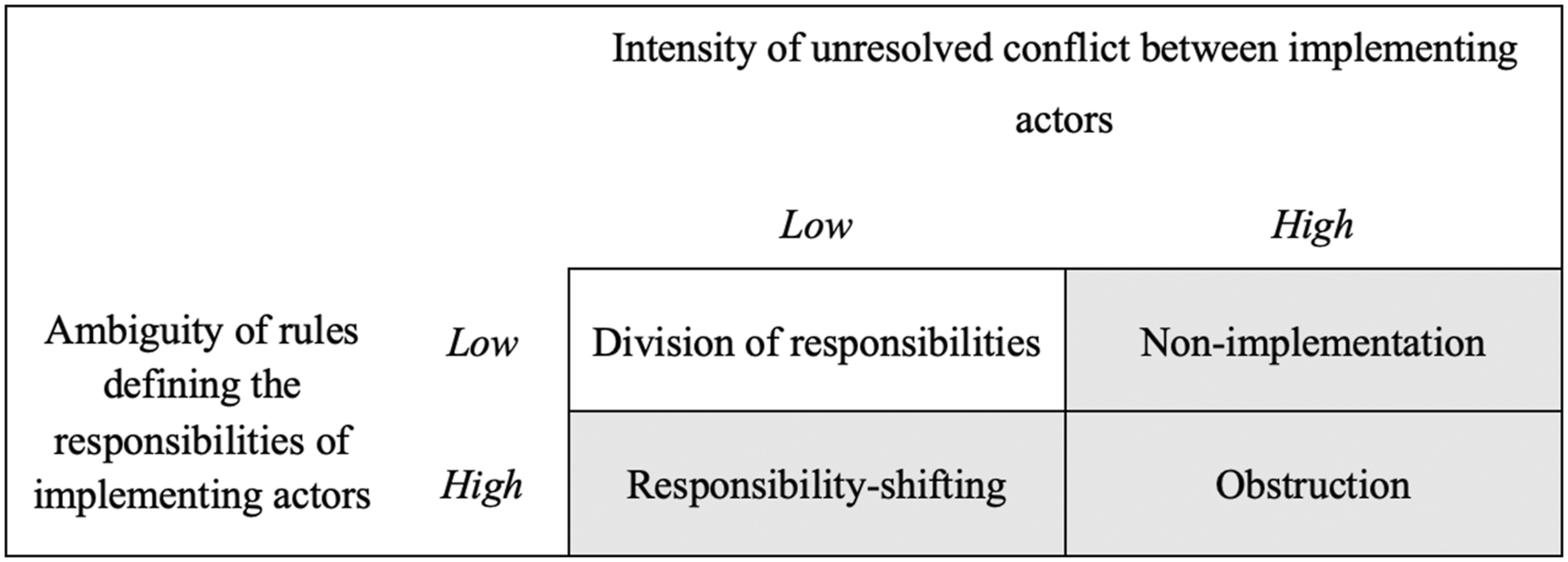
Based on the interaction between the adapted dimensions of ambiguity and conflict, we identify four possible outcomes of joint sovereignty in multi-level implementation. Whereas one of these constellations constitutes a case of effective multi-level implementation (division of responsibilities), there are three dysfunctional outcomes (non-implementation, responsibility-shifting and obstruction). We discuss them in turn below.
Division of Responsibilities
Joint sovereignty can result in effective multi-level implementation under conditions of low ambiguity and low conflict. If the EU creates joint coercive capacities with a clear understanding of the responsibilities assigned to implementing actors at different levels and without persistent conflict at the decision-making stage, a functional division of responsibilities is possible during implementation. Hypothetically, let us assume that member states wanted to create a jointly managed system for processing asylum applications to the EU. 8 In this scenario, all national competent authorities would support the instrument because they would see the benefit of EU help in the performance of operational tasks, such as the registration of asylum-seekers, interviews with applicants, or returns of migrants whose application was rejected. Consequently, the EU would be able to adopt a new policy that would clearly define the attribution of tasks between national and EU actors in the implementation of such a system. Once the system becomes operational, implementing actors would have unambiguous guidelines regarding their competences in the process while enforcement would be unencumbered by conflicts between levels of authority. In other words, implementation would run smoothly. More generally, a functional division of responsibilities is likely to occur in systems of administrative or executive federalism in which the federal level legislates and the sub-federal level enforces federal law (Bolleyer & Thorlakson, 2012). One example is the governance of public security in Switzerland, which continues to possess no federal police force (Kelemen, 2014). Consequently, the anti-terror units established in the wake of 9/11 remain fully canton-owned (Mohler & Schweizer, 2019).
Non-Implementation
The second constellation occurs when the EU establishes joint coercive capacities with little ambiguity over responsibilities between levels of governance but under conditions of high conflict among member states. National governments who oppose the policy are either outvoted through qualified majority voting or agree to the instruments in the context of ‘package deals’ where they strongly support the adoption of other measures (which are conditional on the contested policy). At the implementation stage, national authorities from the countries who opposed the instrument simply defy their respective obligations and refuse to contribute to multi-level implementation. To continue the example above, let us assume that not all member states are in favour of a jointly managed system for the processing of asylum applications. Despite a clear separation of competences between levels of authority, a few national governments object to the instrument because they want to preserve national sovereignty in asylum decisions. However, the objecting governments are not able to veto the measure in the Council due to qualified majority voting. After the instrument is adopted, national competent authorities refuse to cooperate with the supranational actors meant to support the processing of asylum applications on their territories. Consequently, the system as a whole is undermined, as EU actors are dependent on the cooperation of national authorities for the use of joint capacities in multi-level implementation.
While non-implementation is a theoretical possibility, it remains highly unlikely at the current stage in the evolution of the EU polity. In practice, in cases where member states oppose the creation of joint coercive capacities, there is either deadlock in decision-making or the instrument is adopted via differentiated integration, where each government can opt out (Leuffen et al., 2013). For example, only 22 member states participate in the European Public Prosecutor’s Office. In any case, under conditions of high conflict, the possibility for the EU to adopt a policy with clear rules for the responsibilities of implementing actors (i.e. with low ambiguity) is virtually inexistent. In other systems, non-implementation indeed occurs on highly politicised issues. Examples include the refusal of various US states to enforce parts of the post-9/11 Patriot Act (Bulman-Pozen & Gerken, 2009) or the proclamation of sanctuary cities and states that refuse the enforcement of federal immigration law (Amdur, 2016). In the EU, by contrast, most current problems of multi-level implementation stem from ambiguous rules at the decision-making stage, which can breed the two types of dysfunctionalities discussed below.
Responsibility-Shifting
This constellation is bound to occur when the EU adopts a new policy which requires joint coercive capacities under conditions of high ambiguity (the legal framework lacks clarity regarding the division of responsibilities between different levels) and low conflict (with no persistent opposition from individual member states). In such cases, implementation responsibilities remain unclear, opening up the possibility for national actors to shift responsibility for the execution of specific tasks to the EU level, or the other way around, for EU actors to claim that responsibility belongs to national authorities. This constellation is deficient because it results in incomplete implementation or outright failures to act in specific cases. In the hypothetical example above on the joint management of asylum applications, responsibility-shifting would be the result of member states agreeing in principle to the utility of such a system, but without discussing the details of the division of tasks between levels of governance in implementation. Once the system becomes operational, it is unclear who is supposed to do what, allowing each level of governance to shift the blame for poorly implemented measures. Responsibility-shifting occurs frequently in multi-level settings (Heinkelmann-Wild & Zangl, 2020), and agencification has even bred new variants of this pathology (Mortensen, 2016). One example in the US context was Hurricane Katrina where, despite disaster management being a competence shared between the federal and the state level (Birkland & Waterman, 2008), Louisiana and federal officials attributed the responsibility for mishandling the crisis to the respective other (Maestas et al., 2008).
Obstruction
The fourth and final constellation is bound to occur when the EU establishes joint coercive capacities under conditions of high ambiguity (lack of clarity regarding the division of responsibilities between levels of governance) and high conflict (unresolved domestic contestation of decisions adopted despite national opposition). In such cases, both national and supranational administrative actors participate in multi-level policy implementation but have not defined a clear division of responsibilities between themselves; moreover, the two levels hold contrasting views of whether and how policies should be enforced. The constellation is deficient because it leads to uncoordinated and contradictory implementing action that wastes resources (money or time) for both national and EU actors. In the hypothetical example of joint processing of asylum applications, these problems emerge when a few member states oppose such a system yet cannot prevent its adoption at the EU level. Instead, they agree to create a system ambiguous enough to allow national authorities to water down their contribution to policy implementation. For example, national asylum authorities can formally invite EU actors on their territories but only grant them partial access to asylum-seekers, thus obstructing the management of the joint processing system. Lower-level obstruction is among the classic pathologies of the literature on top-down implementation (Derthick, 1972; Pressman & Wildavsky, 1973; Stoker, 1991) and remains a common issue in multi-level systems. Recent examples of administrative obstruction include US states that wilfully seek to sabotage the roll-out of the federal Aid to Families with Dependent Children program (Bulman-Pozen & Gerken, 2009) or of Obamacare (May, 2015).
Keeping in mind that non-implementation is empirically unlikely in the current EU context (for the reasons stated above), we argue that responsibility-shifting and obstruction represent the likely systemic deficiencies of the joint sovereignty model. More generally, joint sovereignty is bound to create problems in policy implementation because the conditions that allow its establishment in the EU multi-level system, that is, high rule ambiguity, come to undermine the ability of that very system to effectively use coercive capacities in practice.
From an empirical perspective, how do we recognise the deficiencies of joint sovereignty when we see them? The observable implications of our argument presuppose an analysis of the deliberate inclusion of ambiguity at the decision-making stage and the occurrence of conflict at both the decision-making and the implementation stage. Initially, we have to examine the extent to which a new policy fails to specify the division of implementing tasks between national and supranational actors with joint coercive capacities, and the degree of decision-making conflict between political actors at both levels of governance. Next, we move to investigating the effectiveness of policy implementation, with a focus on dysfunctionalities encountered in the process of enforcing operational tasks. Finally, we assess the causes for implementation failure, testing the connection to high ambiguity of coercive responsibilities and/or unresolved conflict at the decision-making stage that continues to manifest itself during multi-level implementation.
Illustration: Joint Sovereignty in Practice
Given the novelty of the phenomenon under analysis, we test the plausibility of our argument by examining two crucial cases (Gerring, 2007) that correspond to the systemic implementation deficiencies of the joint sovereignty model. Our attempt is exploratory (Stebbins, 2001) – aiming to empirically identify the occurrence of responsibility-shifting and obstruction in cases that clearly fulfil the scope conditions of our argument. We specifically focus on two examples of EU agencies with operational tasks, namely, Frontex (dealing with border management) and Europol (covering police cooperation). Both agencies are perfect examples of the choice for joint sovereignty in the EU context – not least because border control and law enforcement are key core state powers (Genschel & Jachtenfuchs, 2016). At the EU level, the mandate of the two agencies has expanded significantly in recent years, in parallel to their budgets (see the Supplemental appendix). In theory, the functioning of these agencies should offer ample scope for the manifestation of joint sovereignty problems in policy implementation; to paraphrase Levy’s ideas about the inverse Sinatra inference: if our expectations about joint sovereignty ‘cannot make it here, [they] cannot make it anywhere’ (Levy, 2008, p. 12). What follows is an empirical illustration of responsibility-shifting and obstruction in relation to Frontex’s mandate on the protection of fundamental rights and Europol’s mandate on the gathering of intelligence for counter-terrorism purposes.
Shifting Responsibility for Human Rights between Frontex and Member States
As outlined above, we expect responsibility-shifting to occur under conditions of high ambiguity (regarding the division of responsibilities between levels of governance) and low conflict (with no persistent opposition from individual member states). In such instances, administrative actors on both levels exploit ambiguous mandates in order to shirk responsibility for deficient policy implementation. The approach to human rights under the joint operations led by Frontex and the Greek border authorities between 2006 and 2020 provides a case in point.
Frontex was established in 2004 through Regulation 2004/2007. Its formal purpose was to ensure effective management of the EU’s external borders by coordinating operational tasks implementing relevant EU measures. This included monitoring migratory flows, carrying out risk analyses and vulnerability assessments, as well as coordinating joint operations and rapid border interventions at the external borders (Ekelund, 2017). Since 2004, the agency was reformed four times in order to respond to increasing migratory pressures at the EU’s external borders. This was done by means of a more robust mandate (Ripoll Servent, 2018) and an immensely increased budget. However, since the beginnings of its operations, Frontex has been criticised by several scholars and practitioners for its alleged non-compliance with international human rights law (Ekelund, 2017). Following our main argument, we trace these deficiencies back to the high ambiguity of Frontex’s mandate and the absence of (open) conflict over human rights violations between the agency and national authorities.
In the regulation establishing Frontex, the issue of human rights was only mentioned in the Preamble in relation to Article 6(2) TEU and the EU Charter of Fundamental Rights. This reflected the limited scope of operational activities envisaged for the agency: there was no conflict regarding its responsibilities for fundamental rights protection because that was not considered a possibility at the time. However, the lack of clarity in this respect will become problematic at the implementation stage with the increase of Frontex activities over time. Since 2006, several border patrol operations known as the ‘Poseidon Joint Operation’ have been carried out at the Greek borders under the supervision and assistance of Frontex and with the participation of EU member states that provided personnel and equipment. Until 2010, these missions had a rather limited budget and focused on the monitoring of migrants smuggling and border guards training (Frontex, 2011). In 2010, in response to an unprecedented migratory pressure on the Greek-Turkish border, the Greek government requested the direct intervention of Frontex Rapid Borders Intervention Teams (RABIT), a system to ‘provide rapid operational assistance, for a limited period of time, to a requesting member state facing a situation of urgent and exceptional pressures’ (Regulation 863/2007, Art 1). Over 4 months, Frontex activity increased massively and coordinated the deployment of a total of 567 officers from 26 member states and Schengen-associated Countries (Frontex, 2011). The deployment of this mission together with the steady increase of Frontex operational activities (Keller et al., 2011) raised the first serious concerns regarding the ambiguity of the Frontex mandate as to human rights protection.
Among the most worrisome aspects was the unclear division of responsibilities between border guards from other EU member states, Frontex and the requesting member state (Carrera & Guild, 2010). According to Amnesty International and the European Council on Refugees and Exiles (ECRE), the blurring of tasks and responsibilities in the Poseidon Joint operation’s mandate ‘potentially permits member states to engage in border management with impunity’ (Amnesty International & ECRE, 2010). In 2011, these concerns were echoed by the European Court of Human rights (ECtHR) in a judgement (M.S.S. v. Belgium and Greece, 30696/09) which found that conditions in Greek migrant detention centres at the time were ‘inhuman and degrading’ (European Court of Human Rights, 2011). During the 2010-2011 RABIT mission in Greece, Frontex also facilitated the transfer of migrants to detention centres in which Human Rights Watch documented similar conditions to those condemned by the ECtHR. Nevertheless, neither the agency nor national border guards were held responsible (Human Rights Watch, 2011). The agency defended itself by stating that it had ‘no direct role in the immigration or asylum systems of member states and especially not in detention’ (Arias Fernández, quoted in Mann, 2011). From the EU side, the Commission spokesperson for internal affairs claimed that ‘Frontex should not be held responsible for the failings of a member state, in this case Greece’ (quoted in Traynor, 2011).
In 2011, the agency’s mandate was amended to ‘rapidly strengthen the competences of Frontex and put more effective tools at its disposal’ (JHA Council, 2011). Under pressures exerted by the EP and the Fundamental Rights Agency (European Union Agency for Fundamental Rights, 2013), EU Regulation 1168/2011 also required Frontex to adopt a ‘Fundamental Rights Strategy’ (Article 26a Regulation), whose implementation was to be actively monitored (Articles 26a[1]) with the help of a Consultative Forum on fundamental rights (Article 26a[2]) and a Fundamental Rights Officer (Article 26a[3]). However, when the EU Ombudsman recommended Frontex to establish a complaints mechanism, the agency rejected the proposal by stating, once again, that individual incidents are the responsibility of the respective member state (European Ombudsman, 2013). In 2012, Frontex eventually sought to develop internal procedures for staff and guest officers to report possible violations. Still, the ambiguity of the legislation limited its practical applicability. According to Amnesty International, ‘the lack of a clear mechanism for investigating reports of human rights abuses from joint operations or operational areas where Frontex is present and the inability to handle individual complaints means that this human rights framework is, in practice, of limited discernible impact’ (Amnesty International, 2014).
In the following years, border management activities under the Poseidon Joint operation were the stage of further illegal pushbacks perpetrated by Greek authorities in areas of Frontex jurisdiction, that is, on the land border between Greece and Turkey in Evros and a large section of the Aegean Sea (Amnesty International, 2014). In such circumstances, Frontex would have had the power to activate Article 3(1)a of the Frontex Regulation to suspend the operation, yet it failed to do so.
In response to preoccupations voiced by several institutions including the Ombudsman and the EP (European Parliament, 2015), EU Regulation 2016/1624/EU incorporated new safeguards with regard to the human rights obligations of the actors participating in the activities of Frontex. Article 72, in particular, established a mechanism to allow migrants and asylum-seekers the possibility to lodge individual complaints about fundamental rights violations committed by staff involved in Frontex activities (Carrera & Stefan, 2018). At the same time, since 2015, Greece has been accused of illegal pushbacks of thousands of refugees (Kingsley & Shoumali, 2020). There is also recent evidence of multiple instances in which Frontex personnel was either present at pushbacks, or sufficiently close to be aware of them (Waters et al., 2020). While denying any involvement, Frontex pointed out that it can suspend officers on its operations, but has neither ‘the authority over national border police forces’ nor ‘the power to conduct investigations’ on the territory of EU member states (Euractiv, 2019).
From the outset, it appears that Frontex reforms over time have primarily focused on member states’ desire to strengthen border protection, rather than upholding human rights standards (Lavenex, 2015). The insertion of human rights protection mechanisms has run in parallel to the empowerment of Frontex. At the decision-making stage, this may have been rather uncontroversial as the EU legislator is bound to commit to human rights protection in line with principles enshrined in the European Charter of Fundamental Rights. However, at the implementation stage, the reforms have not reduced the ambiguity over responsibilities or indeed curbed human rights violations under Frontex’s watch (Carrera & Den Hertog, 2016). Ultimately, the effectiveness of the multi-level implementation of human rights norms in the EU border regime is systematically undermined by the ambiguity of the mandate and responsibilities of Frontex and national border guards. In the absence of any visible conflict between the EU agency and national authorities, this ambiguity has allowed the creation of broad legal grey areas where both administrative levels can shift the responsibility for human rights violations on the respective other. While Frontex continuously shifts its responsibility for pushbacks onto member states, administrative actors on neither level of authority are effectively held accountable for the deficient implementation of their mandate (Fink, 2020).
National Obstruction of Europol’s Counter-Terrorism Efforts
In contrast to responsibility-shifting, we expect to see obstruction under conditions of high ambiguity (regarding the division of responsibilities between levels of governance) and a high level of conflict between implementing actors. In such instances, administrative actors on one level dispute the authority of actors on the other level, undermining the efficiency of multi-level implementation through non-cooperative action. The counter-terrorism activities of the European Union Agency for Law Enforcement Cooperation, known as Europol, provide a case in point.
In January 1994, Europol began limited operations outside the EU treaty framework as the Europol Drugs Unit, focusing specifically on enhancing the exchange of information between member states concerning the illicit trafficking of drugs (Niemeier & Wiegand, 2010). It was only in 2010 that the Lisbon Treaty integrated Europol into the EU treaty framework, officially rendering it an EU agency (Article 88 TFEU). Over time, Europol’s substantive and operational mandate increased substantially. Areas of operation now extend to virtually all types of organised and transnational crime and, since 9/11, have included counter-terrorism activities. Europol has also built up significant expertise beyond information exchange, in areas such as strategic analysis, intelligence analysis, forensics, operational coordination of member state investigations, and by participating in joint investigation teams with the member states (Aden, 2018). As of 2020, Europol disposes of 1300 staff (Europol, 2020d) and an annual budget of EUR 158 million (Europol, 2020c).
Collecting and connecting (Cruickshank, 2017) information on crime and terrorism in (and also beyond) the EU is part of Europol’s core business. As the Treaty stipulates, Europol is to engage in the ‘the collection, storage, processing, analysis and exchange of information, in particular that forwarded by the authorities of the member states or third countries or bodies’ (Article 88[2] TFEU). To this end, Europol has created the Europol Information System (EIS). Established in 2005, the EIS is to collect all central criminal information and intelligence of transnational relevance in and for the EU. According to Europol, the database ‘contains information on serious international crimes, suspected and convicted persons, criminal structures, and offences and the means used to commit them’ (Europol, 2020b). Since 2013, the EIS has also contained DNA samples. The EIS is interlinked with SIENA (Secure Information Exchange Network Application), Europol’s encrypted messaging environment. By the end of 2019, the EIS contained close to 750,000 data points, over 50% of which were related to terrorist activities (Europol, 2020a).
Despite this record of gradually increasing capacities, the effectiveness of intelligence-sharing in counter-terrorism via Europol has proved persistently low. Deficient multi-level implementation has led some observers to conclude that EU ‘anti-terrorism convergence has failed’ (Wieczorek, 2018, p. 53). In line with our paper’s conceptual framework, we trace this finding to a high level of both rule ambiguity and implementation conflict concerning the sharing of data between Europol and member states. Reticent to disclose what they regard as highly sensitive information and oftentimes preferring more easily controllable bilateral information channels over the EIS, member states have a longstanding record of non-cooperative behaviour that has consistently obstructed the effective implementation of counter-terrorism policies in the EU.
EU legislation that mandates Europol to engage in intelligence-sharing activities has specified member states’ data-sharing obligations in a notoriously ambiguous manner. In 2002, the first Council decision (2003/48/JHA) on police and judicial cooperation to combat terrorism stipulated that ‘each member state shall take necessary measures to ensure’ (emphases added) that all available information on terrorist activities in the respective member state be transmitted to Europol. Despite specifying the type of information to be transmitted to the EIS (i.e. name, date and place of birth, nationality, sex, place of residence, profession, identification documents, fingerprints and DNA profiles), the subsequent Council decisions of 2005 (2005/671/JHA) and 2009 (2009/371/JHA) kept this original wording intact. Consequently, EU member states are legally obliged but cannot be forced to disclose their information with Europol. The same applies to the latest Europol Regulation (2016/794), which depicts Europol as ‘a hub for information exchange in the Union’ and states that ‘clear obligations should be laid down requiring member states to provide Europol with the data necessary for it to fulfil its objectives’, but otherwise maintains the original wording of 2002. Despite a sophisticated EU-level legal and technical infrastructure in place via various decisions, regulations and the EIS, member states retain ultimate ownership of their intelligence and control de facto the extent to which they share sensitive intelligence with others.
The high level of ambiguity in EU rules on counter-terrorism intelligence-sharing stems from conflicts among and between member states and EU institutions over the sensitivity of the data to be shared. Since 2002, member states have frequently ignored the various Council decisions that had encouraged them to share particularly the most sensitive categories of intelligence with Europol. As Bureš observes, ‘national security and law enforcement agencies are still too often reluctant to share “high-grade”, real-time intelligence on terrorism that can be acted on immediately. […] Although numerous Council decisions and Commission proposals include an obligation for EU member states to share information, in practical terms, this duty has had little impact because it cannot force member states’ authorities to share more information, that is, intelligence that has not previously been disseminated’ (Bureš, 2016, p. 61).
Ultimately, member states’ deficient sharing of intelligence with Europol has variously undermined the efficiency of counter-terrorism efforts in the EU. Already in the run-up to the 2004 Madrid train bombings, security agencies in France, Germany, Italy, Norway and Spain had kept information about terror suspects to themselves, refraining from sharing it with their EU partners (Gebauer, 2004). Before the 2015 Paris attacks, again, Belgian authorities withheld information they had gathered on the Abdeslam brothers from Europol, depriving French services of important knowledge on the latter’s prior criminal activities (Bureš, 2016). Ahead of the 2017 Barcelona attacks, the Catalan police (Mossos d’Esquadra) had repeatedly demanded EIS access, but was hindered by national police forces (Carrera et al., 2017). Ultimately, in an institutional environment characterised by a high level of role ambiguity, persistent conflict about the extent of member states’ obligation to share sensitive data with Europol has bred a longstanding pattern of obstructive behaviour. This obstruction has seriously hampered the effectiveness of counter-terrorism efforts in the EU multi-level system.
Conclusion
To sum up, the rise of EU agencies with operational tasks is a new and expanding phenomenon that captures the exercise of joint sovereignty in the EU. Under joint sovereignty, national and supranational actors take decisions together and share the coercive capacities necessary to implement policies ‘on the ground’ on member states’ territories. EU agencies with operational tasks illustrate both features and additionally allow member states to avoid full transfers of competence to supranational institutions while benefiting from resources created at the EU level. At the implementation stage, however, the exercise of joint sovereignty poses specific challenges. Whether intentionally or not, the institutional choice for joint sovereignty opens the way for several implementation deficiencies that undermine the ability of both national and supranational actors to enforce policies effectively. We subsequently identified two likely dysfunctions in policy implementation and connected them to ambiguity and conflict at the decision-making stage. As shown by the case of human rights violations in border management activities, responsibility-shifting occurs under conditions of high ambiguity and low conflict. By contrast, the case of Europol’s intelligence-gathering efforts in counter-terrorism illustrates obstruction. In this case, high ambiguity and high conflict between implementing actors allow national authorities not to share data with each other and thus undermine the whole system. Overall, joint sovereignty marks a new stage in the evolution of the EU polity but breeds new systemic pathologies that hamper the effectiveness of policy implementation.
In the future, joint sovereignty warrants additional investigation in different directions. First, future research should move beyond the cases currently covered. Both Frontex and Europol provide instructive illustrations of the mechanics of joint sovereignty dysfunctions. The pathologies they describe, however, may apply to other newly established (or reformed) agencies with operational tasks. For instance, the European Labour Authority, established in 2019, has the power to coordinate and support the execution of concerted and joint inspections of companies suspected of labour mobility abuses, together with national authorities (EU Regulation 2019/1149, Articles 8–9). The European Public Prosecutor’s Office began its operations at the end of 2020, combining under one roof supranational and national efforts to investigate fraud against the EU budget. The COVID-19 crisis has led to a proposal to turn the European Centre for Disease Prevention and Control into a European Health Agency able to coordinate the management of health threats (Deruelle & Engeli, 2021). In June 2021, the EU legislators have agreed to turn EASO into the European Union Agency for Asylum (EUAA), able to provide stronger operational and technical assistance. Second, scholars should look beyond the EU case in exploring the dynamics of joint sovereignty in multi-level implementation. In this article, we provided various examples of similar institutions and pathologies in cooperative coming-together federations. Systematic comparison could aid in exposing the specificities of joint sovereignty in the EU and in predicting its durability and future development.
Finally, future analyses should move beyond the confines of the here and now. Joint sovereignty is a recent development of the EU’s multi-level system, and its mechanics could evolve. For instance, the European Commission’s current criticism of human rights violations at sea might encourage Frontex (European Commission, 2020) to take a more conflictual stance vis-à-vis national authorities in the future, which could eventually lead to a replacement of the current pattern of responsibility-shifting with obstructive action. Were this the case, the implementation deficiencies described here would amount not merely to a highly dysfunctional but also a lasting dynamic of European integration.
Supplemental Material
sj-pdf-1-cps-10.1177_00104140211066223 – Supplemental Material for Opening Pandora’s Box? Joint Sovereignty and the Rise of EU Agencies with Operational Tasks
Supplemental Material, sj-pdf-1-cps-10.1177_00104140211066223 for Opening Pandora’s Box? Joint Sovereignty and the Rise of EU Agencies with Operational Tasks by Christian Freudlsperger, Adina Maricut-Akbik, and Marta Migliorati in Comparative Political Studies
Footnotes
Acknowledgements
There are many people who helped us develop this article in the last 3 years. We are particularly grateful to Ramona Coman, Markus Jachtenfuchs, Craig Parsons, Uwe Puetter, Christine Reh, Frank Schimmelfennig, the three CPS reviewers and the supporting community at the Jacques Delors Centre in Berlin.
Declaration of Conflicting Interests
The authors declared no potential conflicts of interest with respect to the research, authorship, and/or publication of this article.
Funding
The authors received no financial support for the research, authorship, and/or publication of this article.

Supplemental Material
Supplemental material for this article is available online.
Notes
Author Biographies
References
Supplementary Material
Please find the following supplemental material available below.
For Open Access articles published under a Creative Commons License, all supplemental material carries the same license as the article it is associated with.
For non-Open Access articles published, all supplemental material carries a non-exclusive license, and permission requests for re-use of supplemental material or any part of supplemental material shall be sent directly to the copyright owner as specified in the copyright notice associated with the article.
