



Abstract
How were the most underprivileged women mobilized after suffrage? Newly enfranchised women faced a multitude of barriers to voting, and this was especially the case for working-class women. We theorize that working-class women were more likely to acquire civic attitudes and information through ties with neighbors of the same class than working-class men or privileged classes. Working-class women’s typical employment and domestic responsibilities provided the most opportunities, motivation, and need for local networks, while limiting the opportunities to acquire political resources via outside employment or voluntary associations typically available to other social groups. Utilizing an original dataset of individual voting records in a mid-sized industrial city during interwar period in Sweden, we employ a difference-in-differences design that isolates neighbor effects from confounders at the individual level. Consistent with our argument, we find that class homogeneity of neighbors enhanced working-class women’s turnout, but not that of privileged classes and working-class men.
While suffrage provides de jure access to the polls, it does not guarantee de facto electoral participation of previously disenfranchised groups. Given that groups barred from suffrage tend to be socially and economically marginalized, newly enfranchised electorates are likely to struggle taking advantage of their new political rights (see Corder & Wolbrecht, 2006, 2016; Kim, 2017, on women). Indeed, while women’s suffrage cut a sharp end to the exclusion of women from the public sphere, it did not immediately challenge the gendered character of work and family that limited women’s access to education, resourceful employment outside the home, and associated networks. This was especially the case for working-class women, who faced the most severe obstacles to political resources. So how did the most underprivileged group among newly enfranchised women overcome “double barrier” of their class and gender and secure de facto political voice after suffrage?
Despite repeated calls for intersectional approaches in democratization scholarship (Caraway, 2004; Baldez, 2010, p. 202), the exploration of early women’s voting behavior by another category has been limited by a virtual lack of individual-level data. In this research, we rise to this challenge by taking advantage of unique data from electoral registers in a mid-sized industrial city in Sweden. This individual-level data allows us to apply intersectional lens to the study of women’s turnout immediately after suffrage expansion.
Through the analysis of our original dataset, we propose a class-specific pathway from de jure to de facto inclusion of women in the public sphere: local networks. We argue that newly enfranchised working-class women at the turn of the 20th century assessed political resources through social ties with neighbors to a greater extent than working-class men or privileged classes. Social and institutional barriers to women’s outside employment, combined with caring responsibilities at home without access to private childcare, meant that working-class women’s typical economic, social, and political engagements were more often local. In turn, working-class women’s opportunities to develop civic skills and to acquire political information through outside employment or voluntary associations were more limited than that of working-class men and privileged classes. Working-class men had better opportunities to access political resources through outside employment and associated networks such as unions than working-class women. Upper- and middle-class women could rely on political resources associated with their privileged class or access resources through voluntary associations.
Classic neighborhood studies demonstrate how the opportunity to forge social ties with neighbors fosters propensity to vote (e.g., Huckfeldt & Sprague, 1995; Cho et al., 2006; Fieldhouse & Cutts, 2012; Johnston et al., 2005; McClurg, 2006). Being surrounded by those who are “alike” is theorized to induce political conformity and to ease information flows (Mutz, 2002; Sinclair, 2012), both of which fosters political participation. However, scholars do not sufficiently explore the theoretical conditions that underpin the theorized effects and therefore mostly fail to explore heterogeneity of “neighbor effects” across social groups. Specifically, classic neighborhood studies rarely conceptually differentiate between “living nearby” and “politically interacting” with neighbors and between shared “social” and “political” identity of neighbors. Yet, unless neighbors typically interact with one another, and unless the shared social identity of interacting neighbors is sufficiently politicized, living in a socially homogeneous locality may not increase turnout. We argue that once the propensity to foster social ties with neighbors and the propensity of social identity to become politicized is taken into account, being surrounded by neighbors who are “alike” may induce the propensity to vote of some social groups more than others. We argue that neighbor effects should be more pronounced among newly enfranchised working-class women at the turn of the 20th century than for other social groups.
In order to probe whether working-class women’s opportunities and motivation to forge local ties with neighbors of their class fostered their turnout more than working-class men and privileged classes, we generate an original dataset of about 5000 individual voting records from electoral registers in a single Swedish city of Södertäje between 1921 and 1934. Collecting individual-level data of such quality and detail is not feasible for large populations, which naturally limits the geographical scope of our study in exchange for an intersectional approach to early women’s voting. To address the issues implied by such trade-offs, we therefore devote special attention to case selection and generalizability. The character of a fairly typical industrializing mid-sized city provides a good testing ground: even though spatial proximity of neighbors is higher, it is a tough test given the city’s high mobility, employment heterogeneity, and opportunities for social ties with non-neighbors. In addition, understanding the historical pathways to the success of women’s political mobilization in Sweden seems important, especially given that Sweden did not stand out in terms of women’s employment or industrialization at the turn of the 20th century (Supplemental Figure A17).
Utilizing our original individual-level dataset, we apply a cross-sectional difference-in-differences approach that allows us to isolate neighbor effects from individual confounders. As theorized, we find that working-class women were more likely to vote if surrounded by working-class neighbors than working-class women surrounded by mixed-class neighbors. In turn, we find that women and men of privileged classes and working-class men did not respond to class composition of neighbors. Testing the proposed mechanisms, we suggest that working-class women’s social conformity to local norms and access to political information helped to drive the observed “neighbor effects.” Taking advantage of unique census data from 1928, we then provide ecological evidence that our findings are generalizable beyond Södertäje to all Swedish towns and that our theoretical framework can explain observed patterns in rural settings.
This paper has important implications for women’s representation. While scholars focus on de jure inclusion of women, such as inclusive quotas, power-sharing arrangements, and party organizations (e.g., Folke & Rickne, 2016; Hughes, 2011; Kittilson & Schwindt-Bayer, 2010), we suggests that de facto inclusion of women is equally important. Uncovering how the most underprivileged group among newly enfranchised women mobilized seems paramount to our understanding of how social inequalities may limit de facto inclusion of the most underprivileged groups even under de jure inclusive institutions.
Where We Are: Explaining Turnout of Newly Enfranchised Women
Recent research demonstrates how inclusive context fostered turnout of early women voters. Skorge (2018) documents how introduction of a proportional electoral system in Norway enhanced politicians’ incentives to mobilize women and therefore increased their relative turnout to men. In turn, Kim (2017) argues that direct democracy at the local level in Sweden increased women’s sense of efficacy and therefore their turnout. On the other hand, Corder and Wolbrecht (2006) find that barriers to voting, such as poll taxes or strict registration requirements, affected women more than men. In addition, Corder and Wolbrecht (2016) show that newly enfranchised women were more likely to vote relative to men in highly competitive states. Despite the immense merits of demonstrating the robust impact of contextual factors for early women’s turnout, these studies cannot explain why some women were more likely to vote within the same institutional context.
In turn, scholars of women’s post-war political participation demonstrate the importance of civic institutions, such as education and outside employment (e.g., Burns et al., 2001; Iversen & Rosenbluth, 2006; Rosenstone & Hansen, 1993, p. 160). Civic institutions encourage women’s turnout by providing vital political resources, such as better information, independent income, and by helping to cultivate civic skills, social networks, or even gender consciousness. However, it is not clear to what extent education and associated employment can comprehensively explain turnout of women at the turn of the 20th century. After World War II, the increase in women’s employment reflected entry of married women to clerical and public sector jobs that provided ample political resources. Before the war, most married women faced formal and informal barriers to outside employment. In addition, most jobs available to women seeking employment, such as domestic service, casual work, domestic manufacturing, or work in family enterprises, did not require extensive education, were not unionized and often did not provide independent income or access to networks outside of one’s community (Costa, 2000; Kessler-Harris 2007; Stanfors, 2003).
Given women’s barriers to outside employment, political development scholars identify alternative pathway to political resources for women at the turn of the 20th century: voluntary networks. Carpenter and Moore (2014) argue that women’s anti-slavery canvassing provided organizational experience and networks to women that enhanced their future political mobilization. Indeed, Carpenter et al. (2018) finds that women’s turnout after the ratification of the Nineteenth Amendment was higher in states with greater pre-suffrage petitioning for the vote. In turn, Morgan-Collins (2021) argues that American suffragists helped to generate group consciousness and provided information that enabled women not only to mobilize, but also to coordinate electorally on progressive issues. However, women’s engagement in organized activities or voluntary associations was mostly an experience of privileged women (Evans, 1977, p. 144–145). While some working-class women participated in working-class associations or took part in civic activities, their opportunities to do so were more limited, often reflecting gendered responsibilities at home without access to private childcare.
Despite the recent advances in our understanding of the roots of women’s political participation, it therefore remains to be explained how did the most underprivileged of newly enfranchised women access information and develop civic skills that enabled them to take advantage of their newly gained right to vote.
Theoretical Framework: Mobilization Through Social Ties with Neighbors
We argue that newly enfranchised working-class women at the turn of the 20th century were mobilized through local networks to a greater extent than working-class men or privileged classes. Drawing on classic accounts that highlight the importance of local networks for political participation, we expect that working-class women were more likely to vote when surrounded by working-class neighbors and that such effects were more pronounced for working-class women than for working-class men or privileged classes. We argue that this reflects working-class women’s stronger motivation and opportunity to interact with neighbors and working-class women’s stronger politicization of working-class identity, not that of women workers. In the reminder of this section, we discuss why motivation to interact with neighbors may determine that only some social groups are responsive to local context and why politicization of shared identity among neighbors may determine that only some identities drive such responsiveness.
Social Interaction: Which Social Groups Forge Ties With Neighbors?
We expect working-class women’s turnout to be more responsive to social composition of their neighbors than that of working-class men and privileged women because working-class women were more likely to forge ties with neighbors. We argue that this is because social composition of neighbors affects turnout only for social groups who typically interact with neighbors.
Classic neighbor studies suggest that having neighbors who are “alike” encourages mobilization and identify two main channels through which mobilization occurs: political conformity and political information. However, both channels implicitly assume that social homogeneity of neighbors increases mobilization only if it provides greater opportunity for interactions with those “alike.” Frequent interactions with neighbors who are “alike” induce conformity to the groups’ civic norms through strengthening group identity (Postmes & Branscombe, 2002) or social pressure (Mutz, 2002). In addition, frequent interactions with neighbors who are “alike” improve information flows between neighbors, or through exchanges with a local opinion leaders and informed local canvassers (Mutz, 2002; Sinclair, 2012). This secondary mobilization is also especially valuable to canvassers, who have an incentive to target well-networked individuals (Fraga, 2018, p. 79–80; Rosenstone & Hansen, 1993, p. 24–29).
While the importance of social interaction for “neighbor effects” has been recognized, most “neighbor” studies do not conceptually differentiate between “living” in close proximity to neighbors who are “alike” and “interacting” with neighbors who are “alike.” Yet unless neighbors look to one another for political interaction, conformity is unlikely to be enforced and information unlikely to be transmitted. For example, professionals may mostly forge political networks with other professionals in outside employment or a union, while having much weaker incentives to forge such ties with their neighbors. On the other hand, those without outside employment or those employed locally have an incentive to cultivate ties with neighbors—the only network readily available to them. Indeed, urban sociologists often point to the persistent importance of neighbor ties among women and low income groups that otherwise have fewer opportunities for outside relations (e.g., Henning & Lieberg, 1996, on Sweden; Völker, et al., 2007, on the Netherlands). In political science, Fuchs (1955) has directly linked limited social networks of American Jewish women outside of their neighborhood to their voting behavior. The failure to account for neighbors’ likelihood of political interactions may explain why mobilization appeals do not always spillover to neighbors (Sinclair, 2012, ch. 2), or why young people do not respond to voting propensity of their neighbors (Fieldhouse & Cutts, 2012).
At the turn of the 20th century, working-class women had the strongest opportunity and motivation to interact with neighbors. Despite the changing social and economic status of women that accompanied the first wave of suffrage, women’s role as mothers and wives continued being socially and institutionally supported (Kessler-Harris 2007, p. 15). Formal employment outside the home, especially for married women, was discouraged through joint taxation, marriage bars, wage discrimination, and occupational segregation (Costa, 2000). At the same time, some upper- and middle-class women had access to elite education and resources that enabled them to combine child rearing with activities in civic associations or even high status professions. Single working-class women who were employed outside the home, were often in non-unionized, socially isolating jobs, such as domestic service, while married working-class women who were in need of independent income often sought local employment compatible with family responsibilities, such as casual work, domestic manufacturing, or work in family businesses and farms (Costa, 2000).
Identity Politicization: Which Social Identity Is Politicized?
We expect working-class women’s turnout to respond to the proportion of workers among neighbors, not the proportion of women workers among neighbors. We argue that this is because social composition of neighbors affects political participation only if the majority social identity is sufficiently politicized.
Classic neighbor studies suggest that having neighbors who are “alike” encourages mobilization of members of the majority group. However, these studies implicitly assume that the shared social identity is sufficiently politicized. Political conformity and political information induces turnout among the majority members because the group internalizes a sense of shared belonging, or shares material or symbolic grievances (Huddy, 2013). Shared group identity is also valuable to organized interests and politicians who have an incentive to define the group’s shared issues and to mobilize the group on those shared issues (Morgan-Collins 2021; Valenzuela & Michelson, 2016).
While the importance of shared politicized identity for “neighbor effects” has been recognized, most “neighbor studies” do not conceptually differentiate between “social” and “political” identity. Yet, unless neighbors have a shared political identity, interacting with neighbors will not induce mobilization along this shared identity. For example, those sharing marital status characteristics may identify as “married,” but political salience of being married is likely to be weak and therefore unlikely to enhance shared political behavior of the group. On the other hand, individuals who share a working-class identity that is highly politically salient will respond to whether their neighbors are also working-class. The failure to account for the strength of politicization of the shared identity may explain why the strength of neighbor effects varies with respect to class and religion (Foladare, 1968), or why there are no mobilization spillover effects to neighbors without taking into account their socio-economic status (Sinclair, 2012, ch. 2).
At the turn of the 20th century, class identity alone was more strongly politicized than class-gender identity for working-class women. Organized women’s groups, especially suffragists, contributed to the politicization of women’s shared identity by defining women’s issues and pressing politicians to respond accordingly (Morgan-Collins 2021). However, most early women’s movements were essentially middle-class in terms of their membership and agenda (Evans, 1977, p. 144–145). This may at least partly reflect the fact that working-class women faced a double barrier of both class and gender, of which class was more strongly politicized and linked to immediate, material interests. Even though working-class women organized in separate women’s working-class associations, their participation was often limited due to women’s weak employment outside the home, weak unionization and gendered commitments at home without access to private childcare (Kessler-Harris 2007, ch. 1). Social interactions with working-class neighbors and local opinion leaders would have therefore been more likely to encourage working-class women to adopt the identity of workers, not that of working-class women.
Swedish Women in Context: Labor Force and Voluntary Associations
In this section, we discuss how our argument fits with the historical context of early women voters in Sweden. We focus on women’s labor force and voluntary associations to demonstrate how class shaped women’s access to local networks.
Women’s Labor Force
At the turn of the 20th century, Sweden did not stand out internationally with respect to women’s employment. Family policies sought to bring functionally divided family model to the working-class, employers were allowed to dismiss women workers upon marriage until 1938, maternity leave was not introduced until 1937, government subsidized childcare was not established until 1943 and joint household taxation favored one-earner household until the 1970s (Haavet, 2006; Stanfors, 2003, p. 82–87). The incentives for women to work outside the home were further hindered by wage discrimination, occupational sex-segregation, and educational disparities between women and men. The average hourly wage of female blue-collar worker was nearly half of the corresponding male wage (Swensson 2004, p. 204–206). Over 25% of gainfully employed women were in domestic service, 30% in agriculture, and 20% in industry, compared to 40% of men in agriculture and another 40% in industry. 1 Work in domestic service, however, was undervalued, unregulated, and deprived women of the opportunity to forge collegial social ties (Swensson 2004, p. 210). Until state financed secondary schools opened up to girls in 1927, girls were only required to attend elementary school, although girls of wealthy families were educated in private secondary schools (Stanfors, 2003, p. 73, 146–147).
Without policies supporting a dual-earner model, motherhood thus provided institutional and logistical barriers to outside work especially for working-class women who did not have access to private childcare. Consequently, full-time work outside the home that generated independent income was typically an isolated part of women’s life course even for working-class women. Single working-class women were expected to exit the labor market upon marriage, while married working-class women were mostly marginal workers who worked at times of economic need or high demand for labor (Stanfors, 2003, p. 10, 82). In 1920, only about a third of Swedish women above 15 years old were gainfully employed outside the home, of which less than 5% were married (Åmark, 2006). While these statistics underestimate the total amount of women’s labor, they reflect women’s weaker participation in labor force outside the home. Woman’s labor that is not accounted in these statistics mostly includes women’s unremunerated, informal, or part-time work in the home, such as in domestic manufacturing, family enterprises, or other casual work (Stanfors, 2003; Vikström 2003).
Women’s Voluntary Associations
Swedish upper- and middle-class women came to dominate charitable and philanthropic organizations in the second half of the 19th century (Lundström, 1996). Women’s engagement in charitable organizations and local poor relief boards reflected not only “women’s solicitude” (Karlsson Sjögren, 2012) but also the ability of privileged women to devote time and effort to voluntary activities outside the home. Privileged women could rely on servants and private kindergartens, while childcare for working-class women only operated on a charity basis (Stanfors, 2003, p. 87). It is therefore not surprising that the first women’s organizations drew on privileged women’s experience in philanthropy, leaving middle-class women as the main component of the National Suffrage Society (LKPR) (Blom, 2012; Florin, 2009). While the LKPR sought to maintain a cross class alliance (Sainsbury, 2001), disagreements between working-class and privileged women were common (Evans, 1977, p. 147).
By 1920, separate Social Democratic Women’s Association united 120 local clubs that were predominantly concerned with economic vulnerability of single mothers and working conditions of women. 2 However, most working-class women who worked outside the home were not organized in neither the clubs nor the unions. Significant proportion of working women were employed in domestic service, domestic manufacturing, and family enterprises, all of which limited opportunities for unionization. In turn, women in industrial jobs were often single and expected to leave upon marriage, which discouraged any organized activities. In addition, the position of unions towards women was ambivalent, balancing class unity with the protection of men’s jobs. For example, while the industrial Textile Worker’s Union was equally successful in the unionization of both sexes, the craft’s Tailoring Worker’s Union initially discouraged women’s labor and opposed the inclusion of women dominated trades (Uppenberg, 2012). In the end, only about 10% of all members of Trade Union Confederacy in 1920 were women (Uppenberg, 2012).
Case Selection
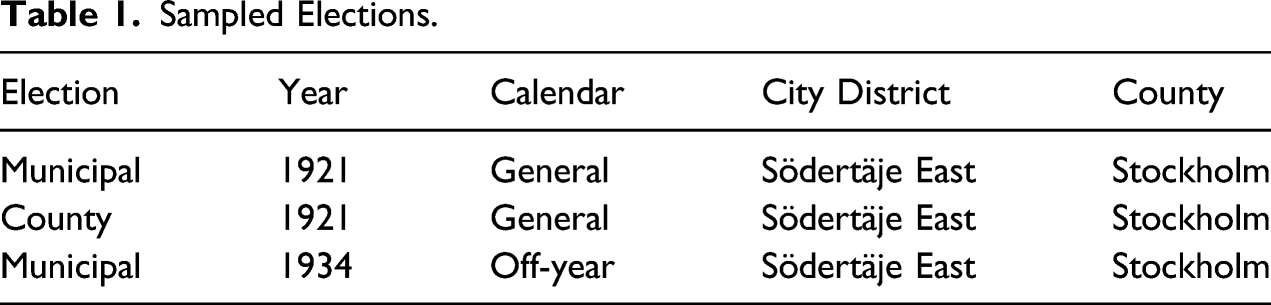
After carefully mapping data availability, 3 we collect data to probe working-class women’s responsiveness to the class composition of their neighbors in a city district Södertäje East, which covers about half of Södertäje (map in Supplemental Figure A1a), the second largest city in the Stockhom county. Södertäje started industrializing in the 1890s, doubling its population over the next three decades (Nordström, 1968, p. 779–842). By 1910, only about 5% of workers were employed in the agricultural sector (Supplemental Table A1). The city produced a variety of industrial products, from gas mantles by AB Keros and trolleys by Scania-Vabis, to beer, soda, matches, wooden boxes, wall tiles, and fur hats (Nordström, 1968, p. 766–776). Predictably, industrialization was accompanied by economic hardship, repeated lockouts, and a range of social issues (Nordström, 1968, p. 779–842). In the 1921 parliamentary elections, Socialists received nearly 10 percentage points; more votes (46%) than in the rest of Sweden (Supplemental Table A1). While men’s turnout in Södertäje was four percentage points below the national average, women’s turnout was seven percentage points above national average (Supplemental Table A1). These patterns of women’s turnout were typical in early 20th century cities (Tingsten, 1937) and across Swedish cities at the time of suffrage. 4
The urban character of a fairly typical mid-sized industrializing Södertäje provides a good testing ground for our theoretical framework. (i) Södertäje offers a “tough” test. If local networks mobilize early working-class women voters in an industrializing urban setting where geographical mobility, employment heterogeneity, and opportunities for social ties outside one’s neighbors are high in general, we should expect local networks to play a significant role elsewhere in the country. (ii) Södertäje provides a “typical urban” setting. The variety of industries in the city, together with its mid-sized character, makes it more likely that our results generalize to other cities in Sweden. (iii) Södertäje offers good level of geographical closeness to neighbors. A detailed contemporary map suggests that Södertäje East was densely populated throughout the city, with fairly spaced properties on similar-sized plots (map in Supplemental Figure A1b). 5
Sampled Elections.
Data and Variables
Data Structure: Properties, Families, and Electors.
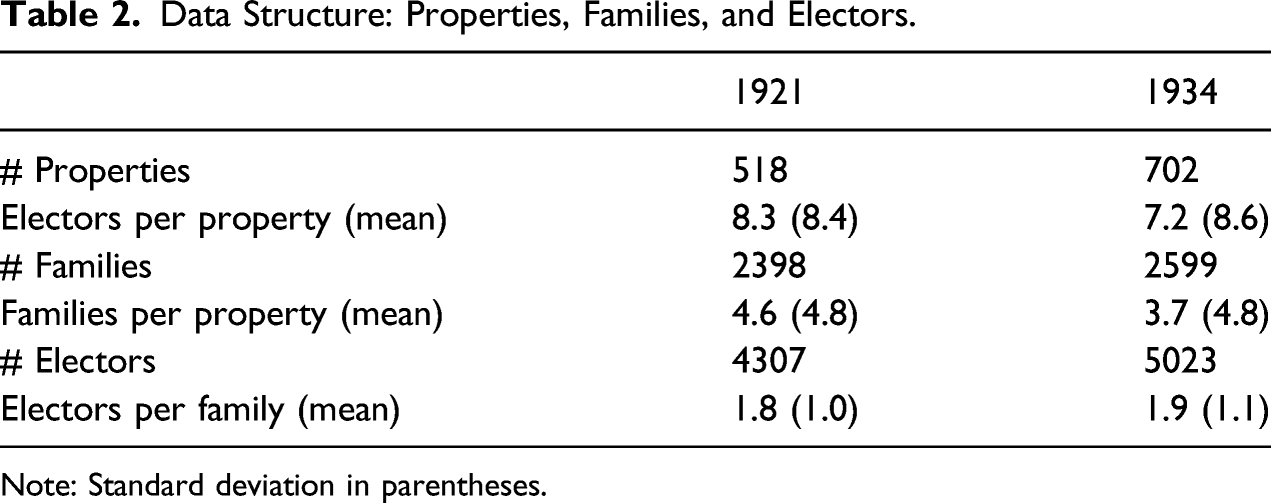
Note: Standard deviation in parentheses.
Class
Using data on occupation in the registers, combined with occupation classification in the 1910 census, we assign each occupation into one of three categories: (i) upper class consisting of owners (land, farm, building, factory), (ii) middle-class consisting of white-collar occupations in the public sector and service, professionals, merchants, and small holders, and (iii) working-class consisting of blue-collar manual jobs in industry, agriculture, transport, service, and domestic service. 12 By using occupation rather than income for class categorization, we therefore consider class as both economic and social concept. That is, while ownership status and income is taken into account as an objective-economic component, subjective-status component of class is also considered. As we argue in the theory section, a sense of (social and economic) “similarity” facilitates the development of neighbor ties. This implies that even if some white-collar workers, such as clerks, may earn the same income as some blue-collar skilled workers, such as tradesman, the former has a higher social status. This also implies that agricultural workers are considered working-class, as they are more similar to industrial workers in terms of earnings and social status than to any other class. 13 Both implications are consistent with the contemporary classification of working-class occupations in the 1910 census.
The most severe limitation of the occupation data is that women’s gainful employment is overridden by their civil status and therefore only available for unmarried women. Occupation of formally “dependent” women is listed as “wife,” “daughter,” or “widow.” Some formally “dependent” women may therefore still be employed. We make two coding decisions in this respect. First, we assume that married women’s class is largely determined by their husbands, and classify all married women based on their husband’s occupation. Given the contemporary listing of wives as “dependents,” this assumption seems more plausible at the turn of the 20th century than in more recent periods. 14 “Wives” are the most common “occupation” category for women (54%), and the occupation of their husbands’ is easily determined given that they are always listed below husbands. 15 Second, we classify all other formally “dependent” women (daughters and widows) as a separate category of unclassified “dependents” 16 In contrast to “wives,” we cannot easily determine the class of “daughters” (2.6% of all women) as they are not systematically listed below fathers in the registers. The classification of “widows” (11% of all women) is similarly challenging given that their deceased husbands do not appear in the registers. 17 Overall, we are able to assign over 93% of age-eligible electors into one of the four class categories. 18 Among the eligible electors in the 1921 registers, 68% are working-class, 20% middle-class, 2% upper class, and 10% formally “dependent.” Electoral registers in 1934 return nearly identical distribution (Supplemental Table A2).
Class Composition
To proxy the size of one’s in-group neighbors, we prefer to combine upper- and middle-class categories into a single category that refers to a single non-working-class, that is those in non-manual jobs. 19 We measure the size of one’s in-group as the proportion of in-group neighbors living in the same property. The rationale here is to capture the smallest geographical unit, property, with the most regular social interactions. 20 Note that, by definition, properties with a single family do not have neighbors in a property and therefore are not considered in the models. 21 The measure also considers only electors with a known class (worker, middle, or upper). That is, the proportion of working-class neighbors in a property is calculated as the total number of known workers among neighbors divided by the total number of neighbor electors with a known class. 22 One concern with our indicator is that class composition of neighbors may be related to the number of electors in a property. This is not the case in 1921 (Supplemental Figure A4a,b). In 1934, properties with a larger number of electors have fewer workers and more upper- and middle-class electors (Supplemental Figure A4c,d). However, this seems to be mostly driven by the very largest properties. Somewhat reassuring is the fact that our results are robust to excluding these large properties (Supplemental Figure A9).
The proportion of one’s in-group property-neighbors varies substantially (Figure 1).
23
While most workers had more than half of neighbors who are also workers, about 40% of workers lived in properties that were occupied only by workers (Figure 1a). Properties with 100% upper- and middle-class electors were not very common, and about a third of upper- and middle-class electors had more than half of neighbors who were also upper or middle class (Figure 1b). The “mixed” class living reflects several factors: (i) owners living in own apartment buildings, (ii) upper- and middle-class families employing domestic workers who reside on the property, and (iii) some middle-class families living in the same properties as some skilled working-class families. Class composition of neighbors. Notes: Darker (lighter) color refers to 1921 (1934); single-family properties excluded.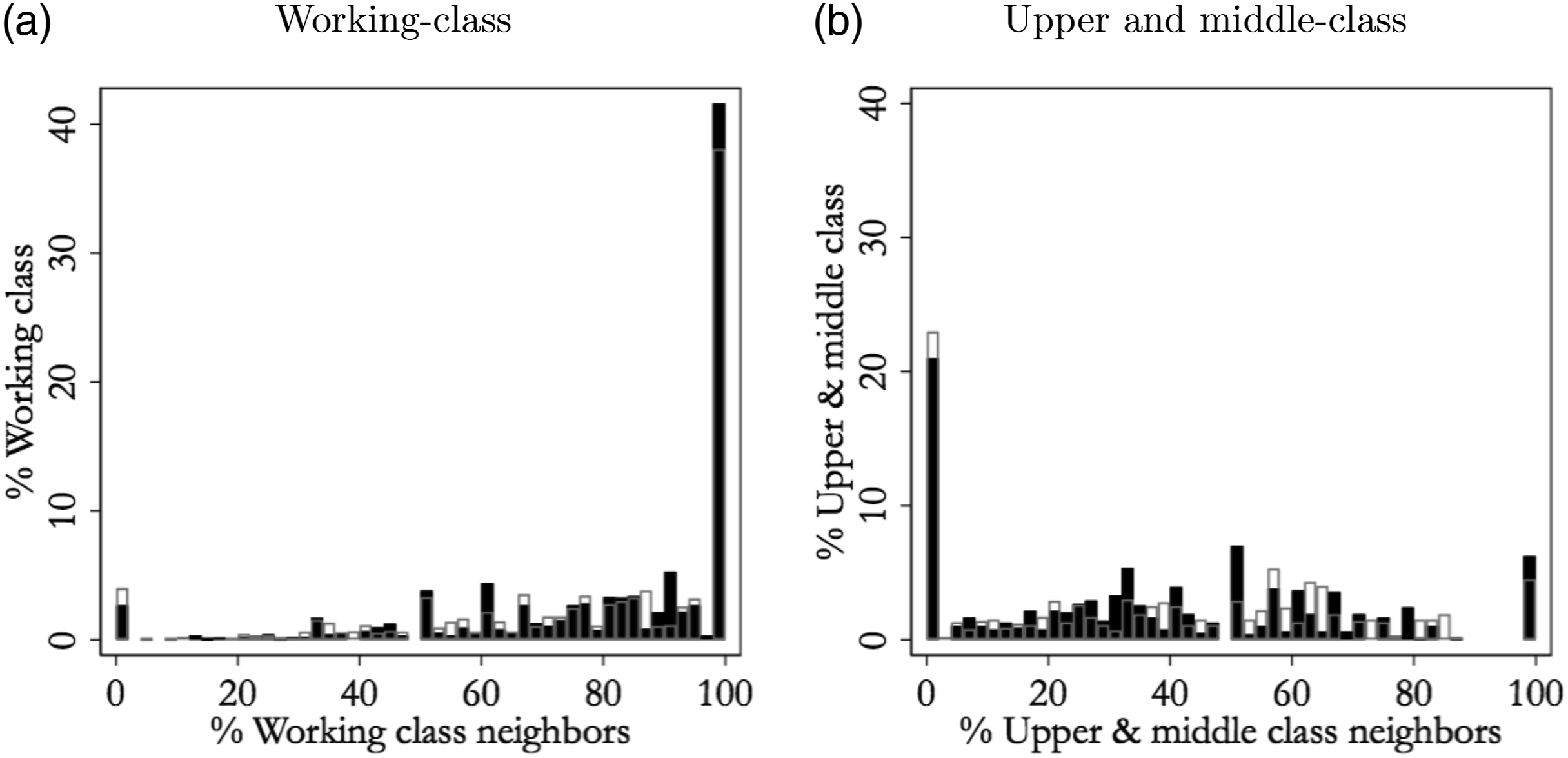
Turnout
Turnout varies by elections, from over 44% and 39% in the 1921 municipal and county elections, to less than 18% in the off-year 1934 municipal elections (Supplemental Table A6). In all three elections, women voted less often than men, but the gender turnout gap “shrinks” over time from about 15 and 12 percentage points (pp) difference between women and men in the 1921 elections respectively, to slightly over 2 pp in the 1934 election (Supplemental Table A6). In all three elections, workers voted less often than upper- and middle-class. However, the gap between turnout of workers and non-workers remained at 15, 10, and 11 pp across the three election, respectively (Supplemental Table A6). In 1921, the difference in turnout between women and men was most pronounced among working-class women (Figures 2a,b). By 1934, the difference in turnout between women and men narrowed to few percentage points for both workers and non-workers (Figure 2c). In all elections, electors classified as “dependents,” mostly consisting of widows, voted the least often. Turnout by gender, class, and election in Södertäje. Notes: First bar (lighter) indicates women’s turnout, and second bar (darker) indicates men’s turnout; “UpMid” refers to a combined upper and middle class, “Work” to working-class, “Dep” to unclassified dependents; only age-eligible electors who retained their right to vote included; about 23% of electors were upper and middle class, 68% working class, and 9% dependents in 1921; tile graph showing relative size of each demographic group in Supplemental Figure A3.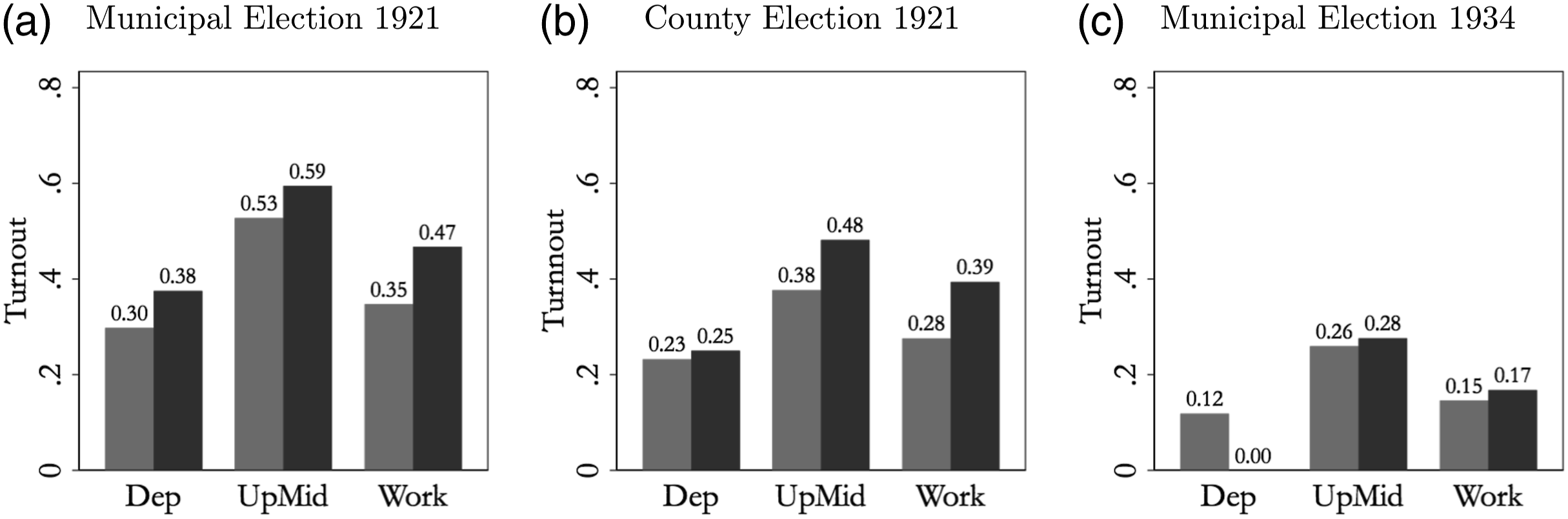
Empirical Strategy
Identifying “neighbor effects” is not an easy task, given that similar “types” of voters tend to live in geographic proximity. That is, a worker living in a majority middle-class property is most likely different from a worker who lives in a majority working-class property. For example, one can imagine that workers living in working-class properties are more likely to be poorer and/or to work in a factory than workers living in middle-class properties. In this case, comparing turnout of workers living in middle-class properties to turnout of workers living in working-class properties will be confounded by the type of jobs and income levels of the workers living in each property. The crux of identifying “neighbor effects” is thus the fact that comparing individuals across properties is unlikely to separate neighbor effects from individual-level confounders.
In tackling this problem, we apply solution proposed by Barber and Imai (2014). 24 Rather than comparing electors across properties, we compare electors within properties. In other words, we first compare turnout of workers and non-workers within each property and then estimate whether this within-property difference varies with property-level class composition. This allows us to control for observed and unobserved characteristics shared by all electors (workers and non-workers) living in the same property. In other words, by comparing working-class and middle-class electors within the same property, we can better isolate neighbor effects from individual-level confounders. 25
In order to identify neighbor effects, we estimate a linear probability model with property fixed effects. The linear fixed effect model operationalizes the identification strategy, where the property fixed effects allow within-property comparison. The advantage of using linear probability models in our case is a relatively straightforward interpretation of the estimates and handling of the property fixed effects.
26
Very reassuring is the fact that logistic regression returns similar estimates (Supplemental Figure A13). Specifically, we estimate average neighbor effects for workers (non-workers) with the following general form
In all models, we also include individual-level controls for age, age squared and marital status and cluster standard errors at the property level. In gauging gender-specific neighbor effects, we fit the equation above separately for women and men. If working-class women respond to class composition of their neighbors, we expect that working-class women’s probability to vote compared to all other women in the same property increases with the proportion of workers among their neighbors.
Results
In this section, we estimate whether the proportion of one’s in-group neighbors affects one’s likelihood to vote. Figure 3 depicts point estimates of the interaction term between one’s class and class composition of one’s neighbors γ that indicates the average neighbor effects for each class. Sub-figure a) identifies whether worker’s probability to vote increases with the proportion of workers among their neighbors and sub-figure b) identifies whether upper- and middle-class electors are more likely to vote as the proportion of upper- and middle-class neighbors increases. In order to gauge gender-specific effects, we also fit each model separately for women (gray) and men (black). Full models are reported in Supplemental Tables A9 and A10. The first three models in Figure 3a show that workers are more likely to vote if surrounded by working-class neighbors. The effects are statistically significant at 5% level or less in all three sampled elections. However, a very different picture emerges once we examine neighbor effects separately for women and men. Average neighbor effects by class and gender. Notes: Linear probability models; all models include controls for age, age squared, married, and a constant; coefficients in gray refer to models for women, black for men, and red for both women and men; dependent variable is a binary indicator of turnout among eligibles; standard errors clustered at the property level; “M21/M34” denotes municipal elections in 1921/1934, and “C21” denotes county elections in 1921; 95% CIs.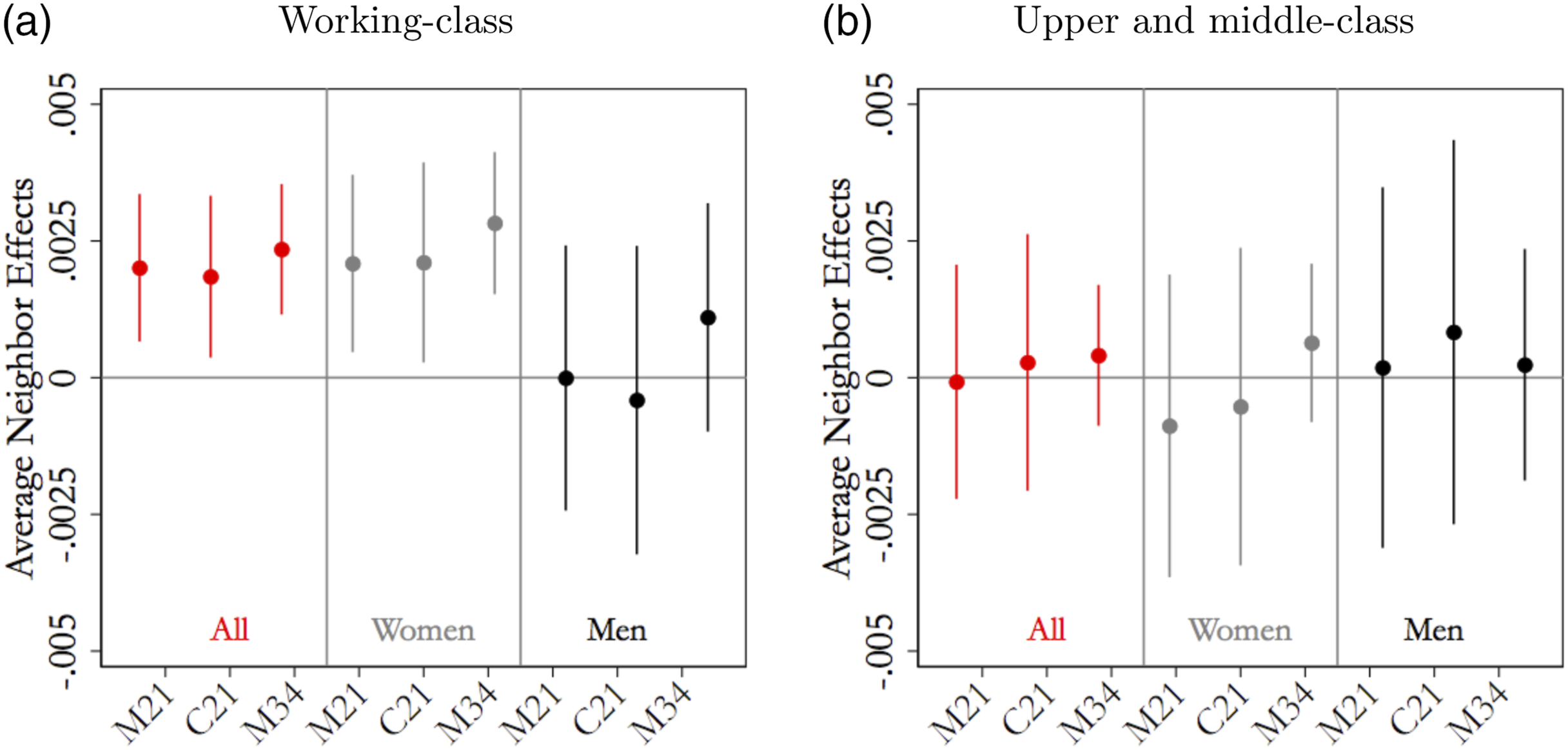
The middle set of models in Figure 3a shows that working-class women are more likely to vote if surrounded by working-class neighbors than mixed-class neighbors. The point estimates are comparable or slightly larger than the overall neighbor effects and again statistically significant at 5% or less. The models suggest that one standard deviation (approximately 43) increase in the proportion of workers among neighbors in a property increases the probability of women workers to vote by 9.1, 9.2, and 12.1 pp in the three elections, respectively. These are sizable effects of comparable size to other individual-level determinants of turnout. As we show in the full results reported in Supplemental Table A9, married working-class women were about 14.7, 13.6, and 3.9 pp more likely to vote than single working-class women in the three elections respectively. In turn, one standard deviation (approximately 15) increase in age increases the probability of women workers to vote by about 6.1, 4.7, and 3.1 pp in the three elections respectively when age is set at its mean. These effects lessen with increasing age.
The third set of models in Figure 3a shows that neighbor effects are not observed for men workers. All three coefficients are close to zero or half-sized and far from being statistically significant at conventional levels. The overall neighbor effects for workers are therefore driven by women, which is consistent with our argument that working-class women were especially responsive to “where they lived” by forging politicized networks with their neighbors to a greater extent than working-class men who tended to have more opportunities to forge politicized ties outside the home via employment, unions, or other associations.
Figure 3b shows that upper- and middle-class women and men also did not respond to “where they lived.” Neither of the three sets of coefficients in Figure 3b shows large or statistically significant estimates for upper- and middle-class electors. This is consistent with our argument that upper- and middle-class electors had more opportunities and resources to forge politicized networks outside the home—such as through outside employment or voluntary associations.
Next, we probe our expectation that gender-class composition—in contrast to class alone—does not matter for the mobilization of working-class women (Supplemental Figure A5). Indeed, while working-class women respond to how many other workers (men and women) live nearby (Figure 3), they do not respond as strongly to how many other women workers are among their neighbors. In 1921, the estimated average neighbor effects that consider both gender and class composition are smaller in magnitude and imprecisely estimated. In 1934, the estimated average neighbor effects are of similar size and significance. This is consistent with our theoretical framework where working-class women adopted a shared politicized identity of workers—perhaps through secondary politicization via male neighbors and family members—not of working-class women. By 1934, working-class women’s participation in unions and women’s party clubs would have increased, plausibly enhancing working-class women’s group consciousness as both workers and women.
In the Appendix, we report full results for several sensitivity and robustness analyses. First, we address potential issues raised by missing values for most women’s occupations. We plot the proportion of one’s in-group neighbors among electors with a known class (our independent variable) on the proportion of dependents and widows among all of one’s neighbors and show that there is no correlation between the two (Supplemental Figure A12). Given that we do not know class of electors classified as dependents, the lack of a clear relationship is reassuring against a potential bias caused by missing values. We then run the main model for working-class women separately for married and unmarried women (Supplemental Figure A11). This addresses the issue of missing values on women’s occupation in two additional ways: (i) if assigning class to married women based on their husbands’ occupation introduces too much noise, we should observe effects only among single women and (ii) if not assigning class to women dependents (largely widows) drives the main results, we should also observe effects only among single women. However, we do not observe systematic differences between the two sub-samples by marital status. This provides further reassurance that our main result is not driven by missing data on women’s occupation.
Second, we show that the main result is robust to an alternative measure of class composition of neighbors as a proportion of known in-group neighbors out of all electors living in the property, that is out of electors with both known and unknown class (Supplemental Figure A6). Third, we show that the main result is robust to excluding families with more than one wife (Supplemental Figure A8). This is a conservative test to ensure that our results are not driven by erroneously classifying neighbors with the same last name as related. Fourth, we show that the main result for upper and middle class remains unaltered when we run models only for middle class (Supplemental Figure A7). Fifth, we probe robustness of the main result to excluding one of the seven neighborhoods at the time (Supplemental Figure A10). The results are comparable across all models, suggesting that our effects for working-class women are not driven by a single neighborhood. Sixth, we show that logistic regression returns comparable results (Supplemental Figure A13).
Mechanisms
In the theory section, we refer to two mechanisms behind “neighbor effects” for groups that have motivation, need, and opportunities to forge local ties: political conformity and political information. The extent to which each drives the observed effects is hard to disentangle. For example, well-networked individuals may both be compelled to conform to social norms, but also have better access to information. We nonetheless explore the most direct implications of each mechanism.
Political conformity
One way to identify whether working-class women were more likely to mobilize if surrounded by working-class neighbors because of increased conformity is to exploit variation in the length of residence among electors. We expect those who live longer in the same property to be more likely to develop stronger ties with neighbors of the same class, which should increase their identification with and social pressure to local norms. To this end, we take advantage of the time span in our data and identify age-eligible electors in 1934 who were also registered in 1921.
27
About 29% of age-eligible electors in 1934 could be matched into the same neighborhood in both election years.
28
Exploiting this data, we fit the main result for working-class women in the 1934 election separately for women who appeared on the electoral registers in 1921 and for those who would have been eligible to vote in 1921 but were not matched (Figure 4a). Given the uneven size of the two sub-samples, the resulting estimates have wide confidence intervals, which prevent us to derive statistically meaningful conclusions. The point estimates are nonetheless larger in size for working-class women who remained in the same neighborhood for at least 13 years, which is consistent with the proposed mechanism. Mechanisms. Notes: Linear probability models; all models include controls for age, age squared, married, and a constant; standard errors clustered at the property level; all models fitted for working-class women in the 1934 election; sub-figure a splits the sample by length of residence; sub-figure b splits the sample by whether one lived in a property with a member of a Women’s Social Democratic Club; 95% CIs.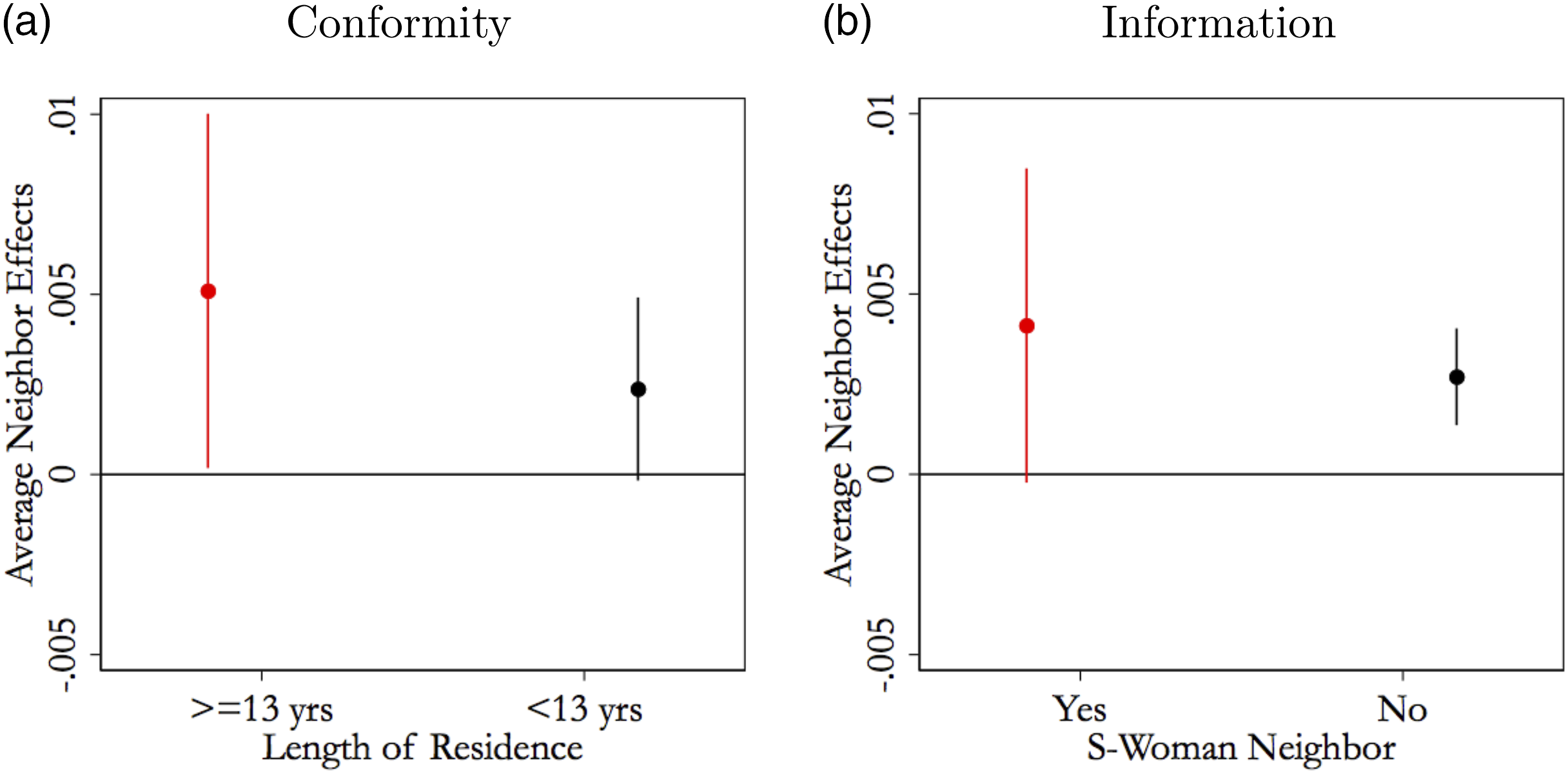
Political information
One way to identify whether working-class women were responsive to class composition of their neighbors due to a better information from local opinion leaders and canvassers is to exploit variation in the “type” of one’s neighbors. We expect those who live in class homogeneous properties with a politicized member to be more likely to obtain political information. To this end, we take advantage of the fact that socialist women in Södertäje were organized in a women’s wing of the Swedish Social Democratic Party. The membership records of Södertäje Women’s Social Democratic Club indicate 304 entries between 1917 and 1932. Out of the 304 entries, we match 81 women to Södertäje East 29 and 18 with individual women in Södertäje East in the 1934 electoral register. 30 As we would expect, working-class women living in a property with a member of the Women’s Social Democratic Club were almost twice as likely to vote in the 1934 election than other working-class women. We then fit the main result for working-class women in the 1934 election separately for those who lived in a property with a member and those who did not (Figure 4b). 31 Given the uneven size of the two sub-samples that widens confidence intervals around the estimates, we cannot derive statistically meaningful conclusions. The point estimates of neighbor effects are nonetheless larger in size for working-class women who lived in properties with a woman party member, which is consistent with the proposed mechanism.
Alternative Mechanisms
Were working-class women responsive because they were new voters?
Given that new voters lack experience with political process, they may be particularly susceptible to “soak” in the influence of their most immediate surroundings. The responsiveness of working-class women to class composition of their neighbors may therefore reflect working-class women’s “new” status as voters, rather than their access to politicized local networks. This explanations, however, is at odds with the fact that working-class women were still responsive to class composition of their neighbors in the 1934 election, which is a sixth election since women’s equal admittance to a local ballot box in 1919, and an election where we no longer observe a sizable gender turnout gap. In addition, the estimated effects of class composition of one’s neighbors are not smaller in 1934 than in 1921, which is also at odds with this alternative explanation. It therefore seems unlikely that it would affect only working-class women who would not have learned anything in six election years, even though, by then, they would have voted at a similar level as men. We nonetheless probe this possibility by splitting our sample by new voting status: “new” electors who came to voting age for the first or second time in the 1934 election and all other “established” electors (Supplemental Figure A14). While we find that “new” voters of all social groups indeed tend to be more responsive to class composition than “established” voters, only working-class women are responsive to neighbor context among the established electors. Overall, this suggests that while new voters indeed respond more to “where they live,” this cannot explain why working-class women were more responsive to class composition than all other social groups, including upper- and middle-class women who also mostly voted for the first time in 1919.
We working-class women responsive because they were domestic servants?
While our theory predicts that domestic workers would have been especially unlikely to vote given that most of them resided in upper- and middle-class properties, and were therefore most isolated from in-group politicized networks, it seems important to assess whether our findings can be driven entirely by domestic servants. However, the average neighbor effects are similar in size and precision level regardless of whether we include or exclude women domestic servants (Supplemental Figure A15a). Even though most women domestic servants were single, it may still be that some married women were employed as domestic servants, but we cannot exclude these women from the data set for missing occupation of married women. However, further restricting the data set to single women, for which we have information on occupation, the coefficients for all three municipal elections are positive, larger in size size, and significant at 5% level in two of the three elections (Supplemental Figure A15a). Overall, these two tests provide evidence that is consistent with the explanation that our result is not driven by domestic servants.
Were working-class women responsive because of pressure by employers?
Another possibility is that women were more vulnerable to employers’ pressure, especially in large working-class apartment buildings, perhaps because of weaker unionization. To probe this possibility, we identify women whose occupation is listed as “factory worker” and who should therefore be most vulnerable to employer’s pressure. However, the average neighbor effects are similar in size and precision level regardless of whether we include or exclude women factory workers (Supplemental Figure A15b). Even though most women factory workers were single, it may still be that some married women worked in factories, but we cannot exclude these women from the data set for missing occupation of married women. However, further restricting the data set to single women, for which we have information on occupations, the coefficients for municipal elections in 1934 and 1921 are positive and of similar size (Supplemental Figure A15b). The effects for county elections in 1921 are smaller in size and imprecisely estimated. Overall, these two tests provide evidence that is consistent with the explanation our result is unlikely to be explained by working-class women’s disproportionate employer pressure in the largely working-class properties.
Were working-class women responsive because their husbands voted for them?
While voting by proxy has been abolished in 1919, married couples continued being allowed to vote by proxy (Karlsson Sjögren, 2012). This raises a concern that married women’s votes may have been “hidden” second votes of their husbands. We therefore pay special attention to the possibility that the main result is driven by working-class husbands, but find no indication in the data that proxy voting has been utilized by working-class husbands in a systematic way. First, if marital proxy voting explained our main finding, we would observe neighbor effects only among married women, which is not the case (Supplemental Figure A11). Second, if most votes of married women were “hidden” votes of their husbands, we would expect marital status to impact women’s turnout, especially working-class women’s, to a greater degree than men’s, which is also not the case (Supplemental Table A11).
Beyond Södertäje
One remaining question is to what extent our results from Södertäje can tells us something general about the mobilization of early women voters. In this section, we therefore discuss the generalizability of our findings to other cities and rural localities in Sweden. To this end, we take advantage of unique data presented in the 1928 census.
32
The census reports municipality-level turnout for each social group (women of all classes and men of all classes) by municipality-level proportion of workers and returns results that are consistent with our findings.
33
This data provides ecological evidence that our findings from Södertäje are generalizable across all urban municipalities in Sweden (Figure 5a) and can provide insights into the generalizability of our findings beyond the urban settings (Figure 5b). Turnout by class, sex, and the proportion of workers in Swedish municipalities in 1928. Notes: Proportion of workers in a municipality on the x-axis, turnout of each class on the y-axis; numbers displayed in the graphs refer to gender turnout gap (percentage point difference between women’s and men’s turnout); data from 1928 census (p. 75), see also Tingsten (1937, p. 171).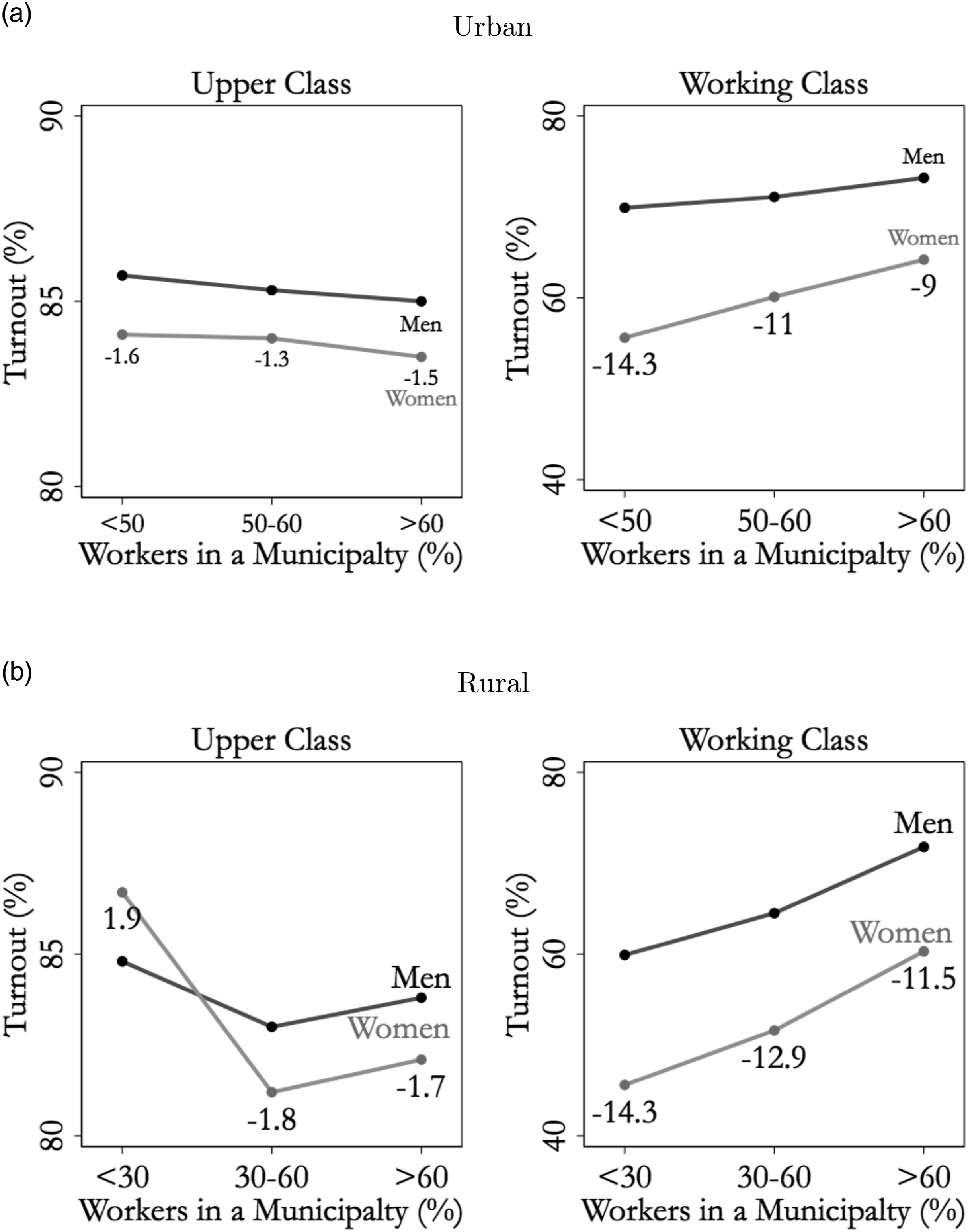
Figure 5a shows that turnout of working-class women is higher in municipalities with greater proportion of workers in cities. While only about 55% of working-class women voted in cities where workers were in a minority, over 65% of working-class women voted in cities where workers were in a majority. In turn, the relevant difference in men’s turnout between the two types of municipalities is only few percentage points. Importantly, neither upper-class women nor upper-class men responded to class composition of their cities. This provides ecological evidence for our argument that, unlike privileged classes and working-class men, urban working-class women mobilized through local networks.
Figure 5b shows that while turnout of all social groups responds to class composition of municipalities in a rural setting, these relationships are always stronger for women and especially noticeable for working-class women. That is, while turnout of both working-class women and men was higher in rural municipalities with greater proportion of workers, this was especially the case for working-class women. Similarly, while turnout of upper-class women and men was higher in rural municipalities with fewer workers, this was especially the case for upper-class women. This is consistent with our argument that when opportunities to forge politicized networks outside of one’s most immediate surroundings are more limited—in this case through agricultural character of rural economies—local networks provide vital resources to all social groups. This is also consistent with our argument that working-class—and possibly upper-class rural—women relied on local networks to a greater extent than men of their class, reflecting greater opportunities and need to form local social ties.
Discussion
Scholars emphasize that limited electoral participation of the most underprivileged groups bears weak political representation (APSA Task Force 2004; Barreto, 2018). If social inequalities drive electoral inequalities that in turn limit representation of marginalized groups, we have to better understand the pathways to mobilization of the most underprivileged groups. A thorough examination of working-class women among newly enfranchised voters provides a unique opportunity to enrich our understanding of how did the most underprivileged groups gain de facto access to the polls upon de jure access to politics. Through the study of early working-class women voters, this paper uncovers one such pathway: local networks.
Despite the troubling social and economic implications of geographic segregation of marginalized groups, this paper demonstrates how living close to “those alike” may empower electorally those whose access to politically relevant resources is limited the most. In many ways, local networks may act as an “alternative” resource available to newly enfranchised groups when access to traditional political resources through education or outside employment is limited. At the turn of the 20th century, women were institutionally and culturally incentivized to leave employment upon marriage, while non-unionized, casual, unremunerated, or domestic-based jobs were mostly available to married women in economic need. While this limited opportunities of the most underprivileged women to develop civic skills, the increased social and economic “presence” of working-class women in the local community did not necessarily impede their mobilization, it became their pathway to vital resources—at least until better paying careers outside their local community became available.
Future research may assess the extent to which successful mobilization of working-class women after suffrage not only helped to close the gender turnout gap, but also improved lives of working-class women. Quick glance at the history of social reform laws that made significant advancements in health and social security of the most vulnerable mothers and their children suggests that the adoption of these laws often coincided with the introduction of working-class women into the electorate (e.g., Peterson, 2018, on Norway; Skocpol, 1995, on US).
Future research should also explore the extent to which social composition of one’s neighbors promotes women’s mobilization in contemporary settings. While the level and character of women’s labor force are by no means similar to what they were a century ago, women’s labor force participation continues to lag behind men’s. Western women continue being more likely to take part-time jobs, work fewer hours, enter different types of jobs, commute shorted distances and take longer family leaves (Crane, 2007; Lewis et al., 2008). The extent to which these differences are strong enough to warrant a class-specific pathway to women’s mobilization remains to be determined.
Supplemental Material
sj-pdf-1-cps-10.1177_00104140211036036 – Supplemental Material for At the Intersection of Gender and Class: How Were Newly Enfranchised Women Mobilized in Sweden?
Supplemental Material, sj-pdf-1-cps-10.1177_00104140211036036 for At the Intersection of Gender and Class: How Were Newly Enfranchised Women Mobilized in Sweden? by Mona Morgan-Collins and Grace Natusch in Comparative Political Studies
Footnotes
Acknowledgments
We would like to thank various people for their advice and feedback including Ana Catalano Weeks, Soledad Prillaman, Rachel Bernhard, Jeong Kim, Dawn Teele, Oyvind Skorge, Diana O’Brian, Melanie Hughes, Carissa Tudor, Rosalind Shorrocks, Selina Hofstetter, Amanda Clayton, Tessa DiTonto, Malu Gatto, Nick Vyvian, Gidon Cohen, Patrick Khun, Julie Novkov, Drude Dahlerup, Monique Leyenaar, Lenita Freidenvall, and participants at seminars at the LSE, Newcastle University, and at EGEN, ECPG, PSA, and APSA conferences. Please send any comments at mona.morgan-collins@durham.ac.uk. Replication files can be found at ( ).
).
Declaration of Conflicting Interests
The author(s) declared no potential conflicts of interest with respect to the research, authorship, and/or publication of this article.
Funding
The author(s) received no financial support for the research, authorship, and/or publication of this article.
Supplemental Material
Supplemental material for this article is available online.
Notes
References
Supplementary Material
Please find the following supplemental material available below.
For Open Access articles published under a Creative Commons License, all supplemental material carries the same license as the article it is associated with.
For non-Open Access articles published, all supplemental material carries a non-exclusive license, and permission requests for re-use of supplemental material or any part of supplemental material shall be sent directly to the copyright owner as specified in the copyright notice associated with the article.
