




Abstract
The last decade has witnessed the rise of populist parties and a number of actors that question liberal democracy. Many explanations of this rely on dissatisfied citizens. We ask in this article whether and how institutions allowing citizens to participate in policy-making affect differences in democratic satisfaction within varying representative contexts as well as between electoral winners and losers. To do so, we first develop a measure of sub-national direct democracy and then use it together with extensive survey data to investigate how direct democracy is associated with citizens’ evaluation of their democratic system. We conclude that direct democracy is not generally related to more satisfied people but rather closes the “satisfaction-gap” between electoral winners and losers. In contrast to previous research, we demonstrate that this mechanism holds across different representative systems.
Keywords
Recent decades have seen an intensified interest in democratic satisfaction. Liberal democracy seemed to be the inevitable outcome of historic processes and modernization (Fukuyama, 1989; Lipset, 1959). But the last decade and the crystallization of political forces opposed to liberal democracy highlight that liberal democracy is the only possible outcome. This fuels research on how citizens evaluate the political system in which they live and how satisfied they are with it (e.g. Esaiasson et al., 2020; Liberini et al., 2017; Norris, 2011). The main challenge emerges from populist parties, which have been considered to be “an expression of dissatisfaction with existing modes of organized elite-mass political intermediation and the desire to abandon the intermediaries that stand between citizens and rulers” (Kitschelt, 2002, p. 179). In this study, we focus on institutions allowing for more citizen involvement and whether they go along with higher levels of individual satisfaction with democracy.
Direct democratic institutions receive special attention since they appear to bridge the gap between (perhaps) naive ideals of individual engagement with the res publica and a representative system. This is not a new phenomenon and can actually be traced back to the early days of representative democracy. After the French revolution, the assémble nationale had to draft a constitution. One faction, the Girondist to whom Condorcet belonged, proposed a draft that entailed a number of direct democratic elements but it was ultimately rejected (Kölz, 2004). Ever since, direct democracy has been proposed as a remedy to felt deficiencies of representative democracies. Whether direct democracy empirically succeeds in overcoming these perceived deficiencies and whether it has negative externalities are other questions.
This is reflected in both public discourse 1 and in academic research (Freitag & Stadelmann-Steffen, 2010; Frey, 1994; Frey and Stutzer, 2000, 2010; Gerber, 1999; Heidbreder et al., 2019; Leemann & Wasserfallen, 2016; Matsusaka, 2005; 2010; Stadelmann-Steffen & Vatter, 2012; Stutzer & Frey, 2003; Smith and Tolbert, 2004; Webb, et al., 2019). Hug (2009) explicitly called for a study on how direct democratic institutions interact with elements of the representative system. At times when democracy is not the only game in town anymore, it is even more relevant to know more about whether direct democratic institutions affect (dis)satisfaction with the representative political system and how this depends on the structure of the representative system.
This is the starting point of this study, in which we delve deeper into the association between direct democracy and individual satisfaction using a comparative perspective across countries and sub-national units. We ask: Is direct democracy related to higher levels of democratic satisfaction and how does it interact with representative democracy? Regarding the latter, we particularly focus on how electoral winners and losers in different representative contexts react to direct democratic institutions. These representative contexts not only vary with respect to formal electoral procedures, that is, majoritarian versus proportional elections but also more broadly with the way in which they deal with and integrate (political) minorities (Bernauer & Vatter, 2012; Lijphart, 1999).
We are not the first ones to study the role of direct democracy for democratic satisfaction. Most prominently, the studies by Frey and Stutzer (2010, 2000), Stutzer and Frey (2003) and their “happiness hypothesis” have triggered a series of research analyzing the relationship between direct democracy institutions and citizens’ satisfaction with democracy. This literature provides mixed empirical results (Altman, 2002; Bernauer & Vatter, 2012; Dorn et al., 2007; Radcliff & Shufeldt, 2016; Stadelmann-Steffen & Vatter, 2012). In the present study, we go beyond previous research in at least three respects.
First, based on a short review of the existing literature, we develop novel arguments regarding the interaction between electoral and direct democracy, namely, concerning the gap in democratic satisfaction between electoral winners and losers. While previous authors have either focused their argumentation on consensual forms of direct democracy (Bernauer & Vatter, 2012) or on the role of direct democracy in majoritarian electoral systems (Radcliff & Shufeldt, 2016), we argue and show empirically that direct democracy narrows the winner–loser gap quite independently from the characteristics of the electoral system.
Second, we propose a sub-national comparative research design including all the sub-national units from the United States, Switzerland, Germany, and Austria. This enables us to study and compare both majoritarian and consensual sub-national democracies, which moreover exhibit varying degrees of direct democracy. In fact, one of the main shortcomings of previous research has been that it was often entirely sub-national research on countries in which direct democracy is extensively developed (e.g., Swiss cantons or the US states), but these countries all follow either a consensual or a majoritarian system. In contrast, while studies at the country level were able to compare these different representative models of democracy, they face the problem that there is very little variation in direct democracy among the studied countries (Bernauer & Vatter, 2012). Thus, based on these previous approaches, we lack a truly comparative view, which has consequences for the scope and opportunity to understand and learn about direct democratic institutions. 2 Our sub-national cross-country approach enables us to take Hug’s claim seriously, namely, that we should try to understand better how direct democratic institutions interact with other elements of representative democracy (Hug, 2009). Finally, as the third departure from the existing literature, we build on work by Altman (2017) to propose and provide a measure of direct democratic institutions for 101 sub-national units across four countries. We refer to direct democracy as a set of institutions that allow citizens to challenge a government’s decision. It is an institutionalized process by which either citizens collect (sufficient) signatures and force a ballot vote thereby or the constitution demands a mandatory ballot vote. This ballot decision can take the form of an initiative (when citizens propose a new law) or of an optional or mandatory referendum. This bundle of institutions distinguishes, for example, from instances where the government “allows” people to vote on an issue (Altman, 2017). Depending on how easy the access to these direct democratic instruments is and how frequently they are used, we conceptualize direct democracy not only as a binary feature (i.e., is available or not) but as a matter of degree. The four countries under investigation, that is, the United States, Switzerland, Germany, and Austria, are the four cases that we identified where direct democracy not only exists at the sub-national level but also varies between within the country in a relevant way.
The remainder of the study is organized as follows. We first present previous research on the relationship between direct democracy and individual satisfaction as well as literature on representative systems and satisfaction. Based on this, we formulate a number of empirical expectations. We then present the measurement approach, building on the country-level index by Altman (2017), and show how it compares to existing measures. In the fourth section, we provide empirical results by analyzing the association between direct democracy and satisfaction with democracy in 101 sub-national units and across four countries. In particular, and in line with the theoretical argument, we show that the gap in satisfaction with democracy between electoral winners and electoral losers disappears when direct democratic institutions are extensively available.
Theoretical Background
Before presenting our argument, we first discuss two strands of literature, namely, research on how elements of the representative system (e.g., majoritarian vs. consensus) affects citizens’ satisfaction and research on how direct democratic institutions can affect satisfaction with democracy. Second, we bring these two discussions together and formulate our argument. The core claim we make builds on the work by Anderson and Guillory (1997) that the representative system leads to a satisfaction gap between electoral winners and losers. We argue that this gap can be narrowed through direct democratic institutions; extensive forms of direct democratic institutions are capable of refilling this satisfaction gap such that the differences between winners and losers become smaller.
Representative Democracy and Democratic Satisfaction
How does the nature of the representative system affect citizens’ satisfaction with the democratic system? Anderson and Guillory (1997) show that consensus and majoritarian democracies treat winners (those who have voted for a political party entering the government) and losers (who have voted for a party that is not part of the government) in the electoral process differently, which influences citizens’ satisfaction. They find that in majoritarian democracies, the gap in democratic satisfaction between winners and losers in the electoral systems is larger compared with consensual democracies (see also Anderson et al., 2005; Anderson & Guillory, 1997; Bernauer & Vatter, 2012; Martini & Quaranta, 2019; Singh et al., 2012). In a nutshell, in majoritarian systems, the winners tend to be more satisfied, while the losers are less satisfied.
Anderson and Guillory (1997) argue that this is due to the institutional settings, that is, the nature of representative democracy. In particular, institutional settings that provide “electoral losers with significant rights to participate in governmental decision-making” (Anderson & Guillory, 1997, p. 68) reduce the gap between winners and losers. In this argument, the focus is on typical elements of consensual democracies such as two chambers, multiparty governments, federalism, and decentralization following Lijphart (1999), but Anderson and Guillory also name referendums.
Direct Democracy and Democratic Satisfaction
In a series of influential empirical studies, Frey and Stutzer (2000, 2010) have documented an association between direct democracy (in the Swiss cantons) and people’s life satisfaction. The authors found that people reported significantly higher levels of satisfaction if they lived in a Swiss canton with easier access to and more frequent use of direct democratic institutions. Similar findings have been presented for the US context (Radcliff & Shufeldt, 2016). But some of these findings have also been questioned, especially in the case of Switzerland (Dorn et al., 2007; Stadelmann-Steffen & Vatter, 2012).
Theoretically, the argument that direct democracy affects individual satisfaction seems to be quite compelling, in particular if applied to democratic satisfaction, on which we concentrate in the following. First, policy outcomes in a direct democratic setting can be expected to be closer to the median voter’s preferences, therefore resulting in more satisfied citizens. Second, direct democracy should produce positive procedural effects, that is, provide the perception of procedural fairness.
Several studies corroborate these underlying mechanisms, especially with respect to the outcome of direct democracy. Gerber (1996) shows that laws passed by the legislature are closer to the median voter in the states that allow for initiatives. Similarly, Matsusaka (2004) claimed that “direct democracy works” with respect to outcomes, voter competence, and the principal–agent problem. For the Swiss context, Leemann and Wasserfallen (2016) documented that direct democratic institutions are conducive for policy congruence, even when no vote takes place. The constant threat of a referendum constrains legislators to a certain extent. Finally, Olken (2010) showed how participation in decision-making affects satisfaction.
However, previous research also offers arguments and findings that question a general positive relationship between direct democracy and democratic satisfaction. One concern emphasizes that the mechanisms and, thus, potentially the outcomes of direct democracy are contingent on how these participatory instruments are embedded in the political system (Heidbreder et al., 2019). A consequence of this is that these effects may not materialize under any circumstances. In particular, we need to consider that direct democratic institutions interact with other elements of representative democracy (Hug, 2009). Most importantly, direct democracy may differently affect satisfaction in majoritarian and consensual political systems.
This can be illustrated by contrasting the sub-national entities of the United States and Switzerland. Switzerland is a typical example of a consensus democracy (Linder, 2010; Lijphart, 1999) of which direct democracy is a crucial and integral element. Direct democracy has forced and still forces political actors to share power; it has played a pivotal role in the emergence of a multiparty government and a consensual political culture. Although the US states along with Switzerland can be considered as “the pioneers of modern direct democracy” (Gross & Kaufmann, 2003, p. 3), the role of direct democracy in the United States is quite different. Direct democratic rights in the United States have not led to power sharing, but direct democracy offers a way to “get around” the legislature (Heidbreder et al., 2019, p. 375). By building a parallel, independent way of policy-making, direct democracy may exacerbate problems of representation that are inherent to majoritarian democracies and, as a consequence, negatively affect satisfaction with democracy (Aarts and Thomasson, 2008). 3 Unlike in Switzerland, direct democracy in the United States infrequently involves a broader input and discussion on a salient problem but rather produces outputs that are even more conflicting than those originating from the traditional policy-making arena (Möckli, 1994, p. 111, 352). 4 From this perspective, the question must be asked whether direct democracy increases democratic satisfaction in political systems such as those in the US states.
Direct and Representative Institutions and How They Affect Satisfaction with Democracy
We are not the first to look at the intersection of representative and direct democracy with a focus on how it affects citizens’ satisfaction. Bernauer and Vatter (2012) claim that direct democracy (combined with large governments) is another consensual aspect that decreases losers’ deprivation and limits winners’ satisfaction. For them, these two elements, consensual decision-making (or power sharing) and direct democracy, are both part of horizontal power sharing. We take a different point of view here. Based on their analysis of 24 countries, they limit their study to the specific situation where direct democracy is embedded in the context of consensual democracy. This is obviously the result of empirical limitations, namely, that Switzerland—being the only country with substantial direct democracy at the national level—is an outlier on the cabinets-direct-democracy dimension. The authors acknowledge that only in Switzerland, one can observe a level of consensual direct democracy that is able to equalize satisfaction with democracy between electoral winners and losers (ibid. 455). Hence, empirically, this raises some doubts about whether this result is driven by the case of Switzerland. At the theoretical level, accordingly, the study does not provide an argument about how direct democracy could interact with a more majoritarian model of democracy.
Finally, the study by Radcliff and Shufeldt (2016) suggests that direct democracy may affect winner–loser differences in majoritarian contexts. Following these authors, citizens in the US states gain psychologically or emotionally from knowing that important matters will be discussed and decided in an inclusive way rather than in a “confusing, uncertain, and potentially corrupt ‘smoke filled rooms’ of the legislative process” (Radcliff & Shufeldt, 2016, p. 1419). This argument implies that the benefits of direct democracy may be particularly important in a majoritarian setting to also intrinsically include the electoral losers.
Hypotheses
Building on these two strands of literature, we formulate several expectations with respect to how direct democracy affects individual democratic satisfaction in different representative contexts.
First, we follow previous research in assuming that direct democracy has the potential to generally increase satisfaction with democracy. Given that previous research has had substantial empirical limits related to the lack of variance either with respect to different representative contexts or direct democracy, we think that the inconclusive findings could be the result of these empirical limitations, while we consider the proposed theoretical mechanisms as valid and reasonable. Our first expectation, therefore, suggests that more extensive direct democracy is generally related to higher levels of democratic satisfaction.
Nevertheless, we also agree on the fact that when studying the effects of direct democracy, we should take into account these institutions’ embeddings in various representative contexts (Hug, 2009) and consider that the impact of direct democracy may be contingent on the representative context. Therefore, we test a second hypothesis: The relationship between direct democracy and satisfaction with democracy varies between representative contexts.
In addition, previous research on the winner–loser gap provides different arguments according to which direct democracy may decrease democratic satisfaction between winners and losers of the electoral system. While Bernauer and Vatter (2012) emphasize the equalizing effect of consensual direct democracy (i.e., direct democracy embedded in a consensual representative setting), which is obviously predominant in Switzerland, the study by Radcliff and Shufeldt (2016) implies that direct democracy may particularly accommodate losers in majoritarian systems because direct democracy prevents winners to take absolutely all. Both studies do not investigate the independent effect of direct democracy and are theoretically and empirically limited to their specific country contexts. However, based on these studies and linking them to previous research on direct democracy and democratic satisfaction, we assume that the equalizing effect of direct democracy could be rather generic and affect winner–loser differences in democratic systems across different representative contexts. The main mechanisms that we assume to be at play are related to the procedural and substantial direct democracy effects reported in previous research (Frey and Stutzer, 2000; Stadelmann-Steffen & Vatter, 2012): On the one hand, the procedural effect of direct democracy can be expected to be more important for electoral losers than for winners. However, the latter have been shown to profit from “outcome favorability” (Marien & Kern, 2018) in different electoral systems, that is, to exhibit higher levels of satisfaction with democracy; easy access to direct democratic instruments may signal to the former that the democratic process is still open also for electoral losers. This should decrease the differences in democratic satisfaction between electoral winners and losers. Moreover, at the level of political outcomes, a strong reliance on direct democracy has been shown to have a “democratic effect” especially in situations of conflict between the political elite and the citizens (Leemann & Wasserfallen, 2016). Thus, in the context of a strong direct democracy, political outcomes are likely to move somewhat away from the winning majority and tend to better include the minority, that is, the electoral losers. Summarizing this discussion, both mechanisms can be expected to bring electoral winners and losers closer together with respect to their democratic satisfaction compared with a context where citizens’ direct involvement does not exist or is more limited: Direct democracy reduces the gap in satisfaction with democracy between electoral winners and losers.
Research Design
In this section, we describe our methodological approach to test our theoretical expectations, data, and operationalizations. A Comparative Measure of Sub-national Direct Democracy specifically discusses and presents our comparative measure of sub-national direct democracy.
Data and Operationalization
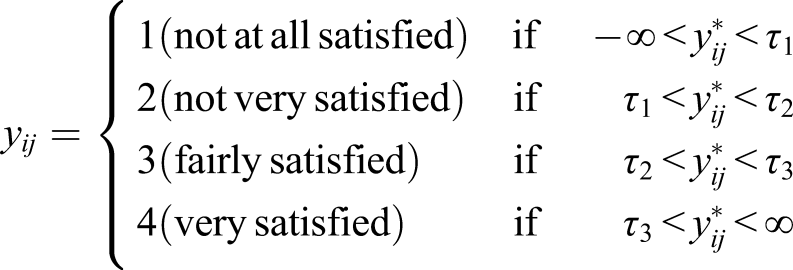
For our analyses, we use four surveys conducted in Austria, Germany, Switzerland, and the United States (ANES, 2019; AUTNES et al., 2016; GLES, 2018; Selects, 2016). Each of these surveys asks respondents how satisfied they are with democracy and provides four answer categories (from “very satisfied” to “not satisfied at all”). 5 This forms the outcome variable in all analyses presented here. 6
We acknowledge that conceptually, our measure of democratic satisfaction has its weaknesses since it captures national satisfaction, while our hypotheses focus at the sub-national level. Unfortunately, to the best of our knowledge, there is no empirical alternative to this approach as no data are available that contain information on sub-national democratic satisfaction and are comparable across the sub-national units of several countries. However, in Supplemental Material A2, we present additional analyses to support our claim that our measure of national democratic satisfaction is a useful indicator to analyze variance in sub-national satisfaction with democracy. For this purpose, we use the few datasets that do contain both national and sub-national democratic satisfaction to compare how individuals across different sub-national units and countries evaluate these two phenomena. 7 These analyses demonstrate that empirically, individual evaluations of national and sub-national satisfaction with democracy are highly correlated at the individual level, whereas sub-national satisfaction is evaluated slightly better across all sub-national units and the correlations are similar across sub-national units. Moreover, and important for our analyses, when using this data to replicate the individual-level models presented in this article, the winner–loser gap can be observed independent of whether national or sub-national satisfaction with democracy is the dependent variable. To summarize, national democratic satisfaction seems to be a valid indicator for and captures the relevant variation in sub-national satisfaction with democracy. This also means that the weaknesses related to our main dependent variable are mostly conceptual in nature, while there is no reason to believe that they should affect our empirical conclusions. If at all, our approach may rather underestimate the role of sub-national direct democracy.
On the individual level, our central explanatory variable is whether an individual is an electoral winner or loser. To create this variable, we first collected data on the composition of the sub-national government of the 101 units in 2016. Considering that governments differ with respect to their form and electoral procedures, this indicator may thus capture the incumbent’s party affiliation in presidential systems such as those in the US states, a single-party government such as that in the German Bundesland Bayern, or several political parties forming a coalition government such as in most German Bundesländer and particularly in all Austrian and Swiss sub-national governments. We then generate a binary variable indicating whether a respondent supports a political party in the government (winner) or not (loser). 8
Moreover, we integrate indicators for gender and age, seven indicators for different education categories, and six employment categories. We have a fairly large data set; hence, we add all these individual factors as binary indicators.
On the context level, our central explanatory variable is the sub-national direct democracy index, which measures to what extent a citizenry can rely on direct democratic procedures (We explain this indicator in more detail in A Comparative Measure of Sub-National Direct Democracy). A second factor that differs systematically across sub-national units is the size of the government majority. This variable allows us to account for varying degrees of majoritarian and consensual democracies (Anderson & Guillory, 1997; Lijphart, 1999). To measure this, we use the sum of the vote shares of all parties that are in the government. The size of the governing coalition can affect satisfaction by affecting the perceived legitimacy of decisions (e.g., André & Depauw, 2017; Arnesen et al., 2019). Later on, we also rely on an alternative measure that operationalizes horizontal power sharing (Bernauer & Vatter, 2019). We present an overview of all variables in Supplemental Material A1).
Across various model specifications, we estimate hierarchical ordered logit models where individuals i are nested in a sub-national unit j. The underlying latent variable
We have a number of different model specifications. The following equation defines the model we present as Model 1 in Table 2. Individual-level variables are grouped into a matrix
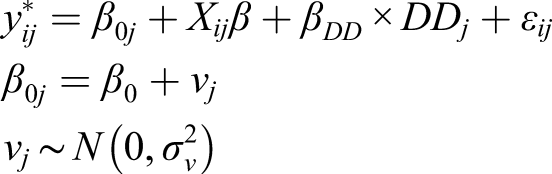
In most models, we also include a fixed-effects specification to account for country differences; this is indicated in each table. All models are estimated in R, relying on the
A Comparative Measure of Sub-National Direct Democracy
In the previous sections, we have pointed out the limits of cross-national analyses given the lack of variance with regards to direct democracy. The alternative strategy, country-specific sub-national analyses, is also problematic: When analyzing all Swiss cantons or all US states, there is little variance with regards to representative democracy. All Swiss cantons more or less follow the ideal of a consensual democracy with proportional electoral systems, oversized executives, etc. (Vatter, 2002). All American states have majoritarian political systems. Hence, the most promising way to investigate the interaction between direct democracy and representative democracy is to analyze sub-national entities (with and without direct democracy) across different country contexts. This enables us to analyze variance both regarding direct democracy and representative democracy.
However, measuring direct democracy (at the sub-national level) is not self-evident (see, e.g., Matsusaka, 2000; Stutzer, 1999; Leemann, 2019). Very different measurement approaches have been used in the US and the European (mostly Swiss) context, for example. To date, there are no comparable comparative data or indicators for sub-national democracy. To that end, we propose a measure of direct democratic institutions for sub-national units that allows to measure the extent of these institutions across various country contexts. This index builds directly on Altman (2017) and his Direct Democracy Practice Potential but has been adapted for our purposes. While the technical discussion on the index is relegated to the online appendix (see Supplemental Material Subsection A3.4), in this section, we describe the concept and how it departs from existing conceptions. We then discuss how the index is constructed. In the final step, we show how sub-national entities in the United States, Switzerland, Germany, and Austria compare to each other on terms of the extent of direct democracy they offer to the citizenry.
Direct Democracy: A Concept
Our concept of direct democracy is a set of institutions that allow citizens to challenge a government’s decision. It is an institutionalized process by which citizens either collect (sufficient) signatures and force a ballot vote thereby or the constitution demands a mandatory ballot vote. The outcome of the vote has to be binding. We choose this narrow definition on purpose because using a broader concept would run the risk of conflating fundamentally different aspects. We want to capture the non-representative avenue by which citizens can change or affect policy decisions (see, e.g., Cheneval & el-Wakil, 2018). This deviates, for example, from the definition of direct democracy by Altman (2011), which would also cover plebiscites and, more generally, ballot votes initiated by the government. Our concept is in fact closer to what Altman labels bottom-up direct democracy, with the exception that we include mandatory referendums.
The latter is important to account for the indirect way through which direct democratic institutions can affect policy outcomes. Policymakers knowing or expecting a referendum vote down the road will anticipate this and not implement their preferred policy but rather the best policy that will likely survive the vote (e.g., Gerber, 1996; Hug, 2004; Matsusaka and McCarty, 2001; Leemann & Wasserfallen, 2016; Neidhart, 1970). 9 The empirical evidence in the United States is mixed. On the one hand, Lascher et al. (1996) did not find empirical support for such a mechanism. On the other hand, Gerber (1996) presents results that are fully consistent with such a mechanism. In Switzerland, we find a clearer picture. There is empirical support for the anticipation claim in Swiss cantons (Leemann & Wasserfallen, 2016). This is part of the core characteristic of our concept of direct democracy. 10 It is also in line with many formal theoretical treatments of the subject where the policy-setter (legislature or government) does not implement its ideal point but rather the best policy for itself such that it just fails to provoke a referendum (e.g., Hug, 2004; Leemann & Wasserfallen, 2016; Matsusaka and McCarty, 2001; Romer & Rosenthal, 1978). The essence is that representative systems produce different outcomes when every governmental decision can potentially be challenged at the ballot box.
In consequence, this understanding also (mostly) excludes the increasing number of referendums on EU-related matters in EU states. These referendums, as we argue here, are in most cases not actually elements of the institutionalized decision-making process and, therefore, in many respects follow a different logic than direct democracy, as conceptualized in this study (Heidbreder et al., 2019).
Finally, there is a rare institution that straddles the line between direct and representative democracy: the recall (Kölz, 1996, p. 105). The recall allows citizens to collect signatures to unseat an elected official. While it is somewhere between the representative and direct part, we eventually exclude it from the final measure as it also empirically appears to be an independent dimension unrelated to the other elements of direct democracy (see Supplemental Figure A7 and Supplemental Material Subsection A3.4 for more details).
Measuring Sub-National Direct Democracy
The sub-national direct democracy index (snDDI) is based on a number of different institutions and indicators. For each of the three institutions—the initiative, optional, and mandatory referendum—we want to measure how easily they can be used by citizens to force the legislative or executive to change policy and whether they are actually used.
To measure the strength of each component, we follow—with some exceptions (see later)—the indicators of the cross-national direct democracy measure proposed by Altman (2017). We rely on the number of signatures that have to be collected (
Operationalization
For most components, we follow closely the operationalization of Altman (2015) and apply it to sub-national units. The operationalization of time to collect signatures (t measured in years) is
Details of the sub-national direct democracy index.
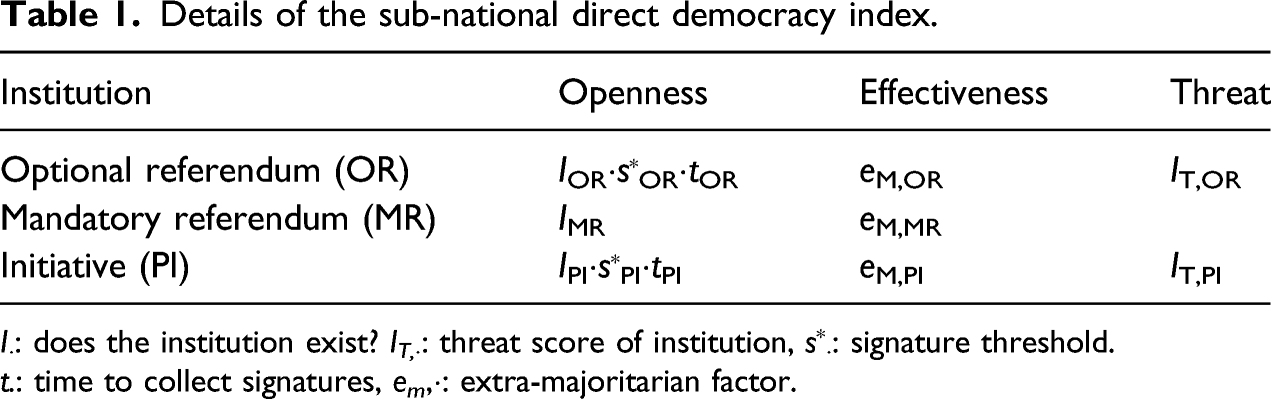
I⋅: does the institution exist? IT,⋅: threat score of institution, s*⋅: signature threshold.
t.: time to collect signatures, e m ,⋅: extra-majoritarian factor.
The next section is a brief descriptive account of the measures in the United States, Germany, Switzerland, and Austria.
Comparing Direct Democracy in Sub-National Units
Figure 1 shows the values of the indicator in the sub-national units of the United States, Germany, Austria, and Switzerland. It is important to note that the index documents considerable variance in the degree of direct democracy not only between but also within countries. Comparison of sub-national direct democracy index.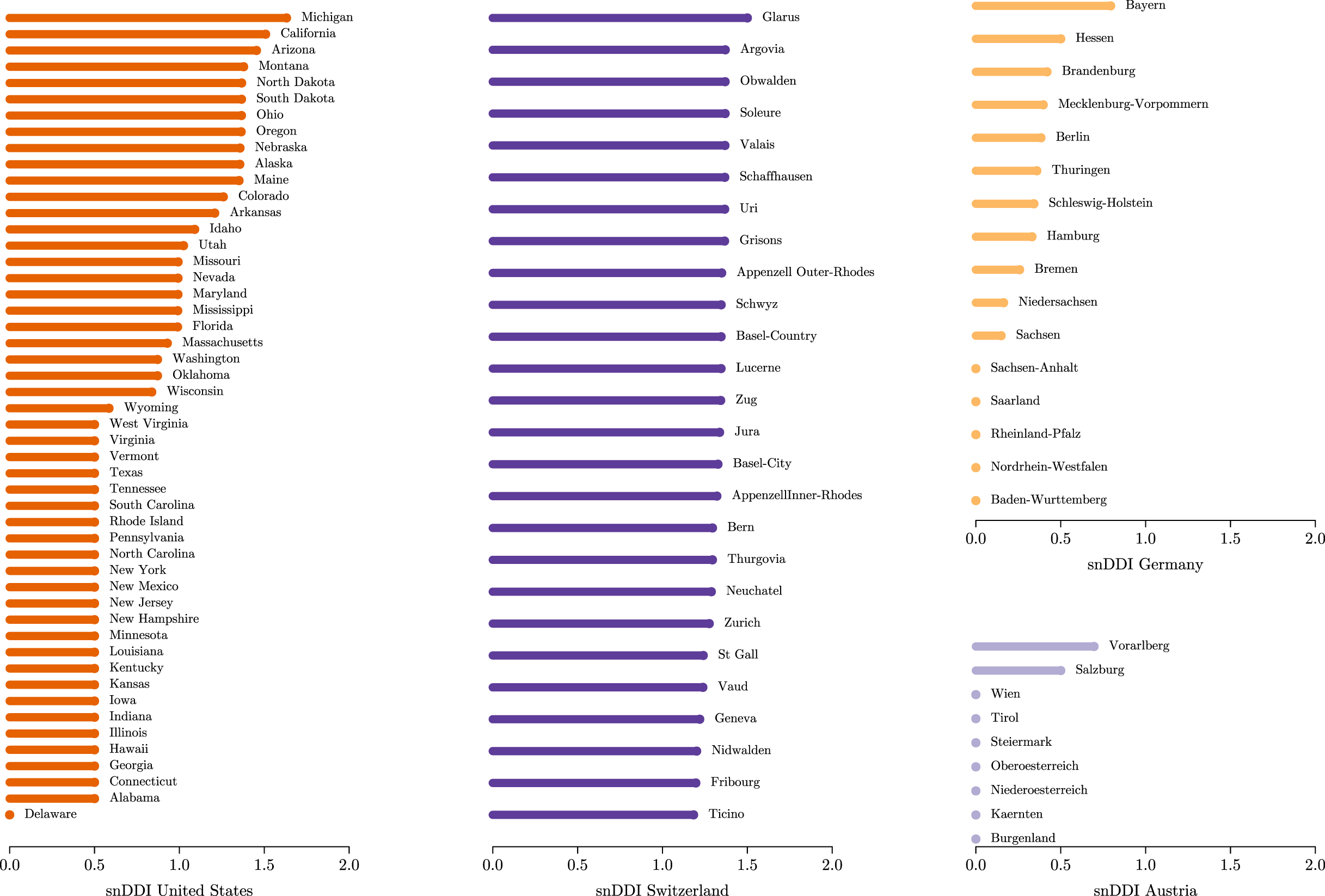
In Austria, most citizens do not have access to direct democracy, with the exception of those living in Vorarlberg and Salzburg. In Germany, this picture changes, and most Länder know direct democratic instruments, although at a moderate level. The United States is an interesting case. About half of the states have DDIs, but even the other states (with the exception of Delaware) score a non-zero score since they require a mandatory referendum for changes in the state constitution. Finally, Swiss cantons have extensive DDIs, comparable to the upper half of the states in the United States.
Validation of this measure is not straight forward. However, for the Swiss cantons, there exists a continuous measure and one can compare the two to see if there is a strong commonality. In the online appendix, we provide such a comparison demonstrating that the correlations between the two measures are very high (see Supplemental Material Subsection A3.3). This also suggests that our measure is able to capture relevant variance within the group of entities with a high degree of direct democracy. We also provide a full table with individual values of the sub-national units on the index (see Supplemental Material Subsection A3.2).
Empirical Tests: Are Direct Democratic Rights Related to Higher Satisfaction with Democracy?
Satisfaction with Democracy in General
In a first empirical test, we explore whether respondents living in sub-national units with more extensive direct democratic rights are in general more satisfied with democracy than respondents living in sub-national units with less extensive direct democratic rights.
Ordered logit models.
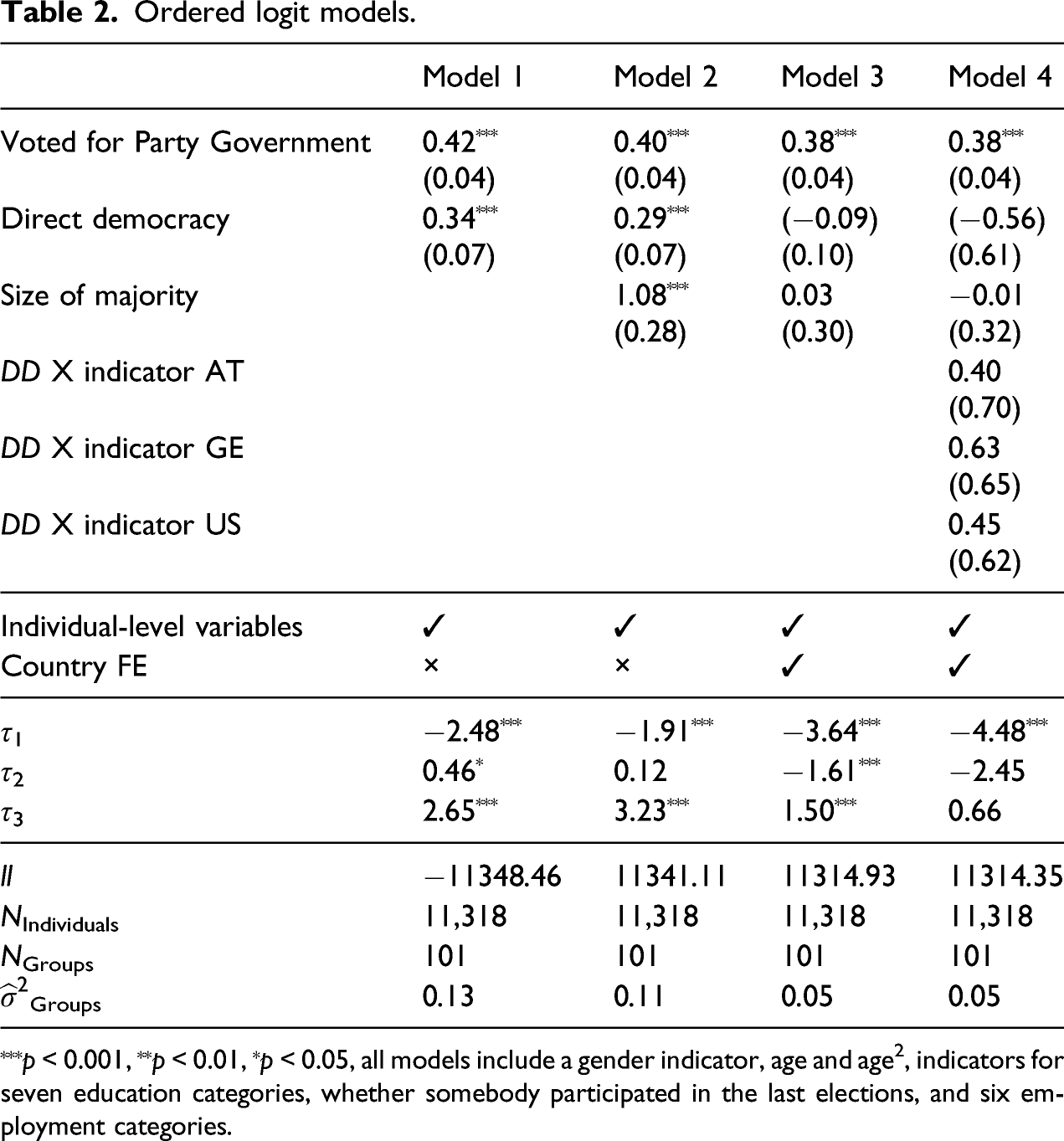
***p < 0.001, **p < 0.01, *p < 0.05, all models include a gender indicator, age and age2, indicators for seven education categories, whether somebody participated in the last elections, and six employment categories.
Model 1 contains the winner–loser variable, that is, whether or not a respondent voted for a party in the government and the snDDI, as well as all other individual-level variables (included but estimates not shown). Model 2 adds a context-variable accounting for the size of the majority. In Model 3, we add country fixed effects. Finally, in Model 4, we interact country indicators with the snDDI to allow for country-specific effects.
Across all models, electoral winners display a significantly higher satisfaction with democracy than electoral losers. Turning to direct democracy, the picture is less clear. In Model 1, there is a positive estimate, and this relationship remains positive and significant when we take into account the size of the majority. But once we allow for unobserved country-level factors—which constrains
Finally, in Model 4, we allow a country-specific relationship between individual satisfaction and sub-national levels of direct democracy. Baseline for the direct democratic effect is Switzerland, and the three interactions show the deviation thereof. We find that a significant parameter estimate is not present in any of the countries. 13
These first tests fail to provide systematic empirical evidence in favor of the satisfaction hypothesis (see Model 3). Moreover, the estimates do not suggest that the relationship between direct democracy and satisfaction with democracy systematically varies between different representative contexts (see Model 4). The results are consistent, that is, there is no significant coefficient for the snDDI in any model. We also run the same models and replace the snDDI with a measure of direct democracy usage rather than institutional provisions. The results presented in the online appendix, see Supplemental Table A12, are line with the results presented here.
Winners and Losers When There is Some Direct Democracy
In the next step, we test whether electoral winners’ and losers’ satisfaction with democracy is different when, in addition to the institution of representative government, (significant) direct democratic institutions exist.
In most polities, electoral losers are less satisfied with democracy compared with electoral winners (In Supplementary Figure A3, we provide a visualization of the satisfaction gap per sub-national unit). Three observations are noteworthy. First, the winner–loser gap varies considerably between the 101 units, both between and within countries. Second, the variance in the winner–loser gap is very pronounced for the United States, while it is very limited for Switzerland. Third, the average gap is the largest in Austria and the United States On an individual level, the difference in satisfaction between electoral winners and losers is similar between respondents that participated in elections and those that abstained.
Ordered logit models.
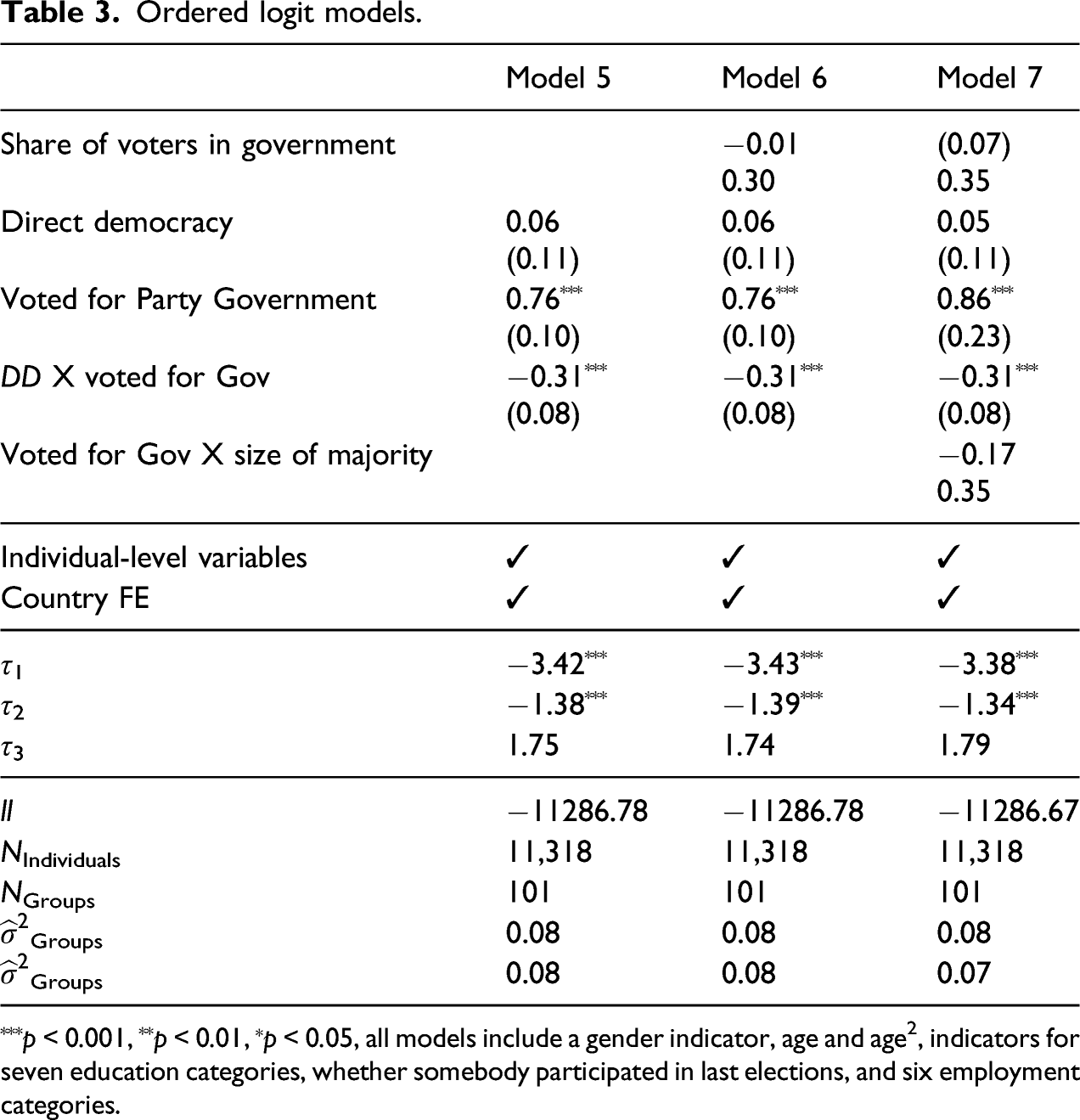
***p < 0.001, **p < 0.01, *p < 0.05, all models include a gender indicator, age and age2, indicators for seven education categories, whether somebody participated in last elections, and six employment categories.
Across all models in Table 3, we find a consistent negative and statistically significant interaction effect between the winner–loser gap and the extent of direct democracy afforded to citizens. Model 5 is the most parsimonious model and only includes whether a respondent is an electoral winner, the extent of direct democracy in that sub-national unit, and the interaction of both factors. In Model 6, we further include our proxy for the type of representative system. Including this variable does not affect the results. In Model 7, we also include an interaction with the size of the majority in the government, but this interaction term is not statistically significant. Conversely, the significant interaction coefficient describing direct democracy’s potential to close the gap between electoral winners and losers persists even after taking into account the extent of horizontal power sharing.
We also provide a number of robustness tests. First, we rely on a measure from Bernauer and Vatter (2019) on horizontal power sharing and find similar results (see Supplemental Table A13). Second, and as mentioned earlier, we replicate the results by using direct democracy usage rather than the institutional provisions. Supplemental Table A13 shows almost identical results. Third, following the suggestions of an anonymous reviewer, we also estimate one set of models, where we simply count how many direct democratic institutions are present in a sub-national unit, while not taking into account the ease by which they can be used. These results are presented in Supplemental Table A15. Fourth, an additional robustness test does not use the combined index value but only the sub-components for each institution. These results are presented in Supplemental Table A16. All of these additional models support the main findings of this study. The significant negative interaction effect between election winner and direct democracy is present in all these alternative models.
To illustrate the model interaction, we resort to predicted probabilities across the full range of potential values for direct democracy. The simulated outcomes are shown in Figure 2. We rely on a pseudo-Bayesian approach and generate 1000 draws from a multivariate normal distribution where the central moment is the estimated coefficient vector and the second moment is the variance–covariance matrix. We use these to provide first and second moments of the predicted outcomes. This allows us to show the overall relationship between satisfaction and direct democracy for electoral winners and electoral losers. We also add an illustration of the net difference between the two in the lower panel, informing about the substantial relevance of the interaction. Satisfaction with democracy at varying levels of direct democracy for winners and losers. Note: Upper panel shows predicted probabilities to be satisfied with democracy. Lower panel shows difference in satisfaction with democracy for electoral winners and losers. All results are based on simulated predicted probabilities from posterior vector.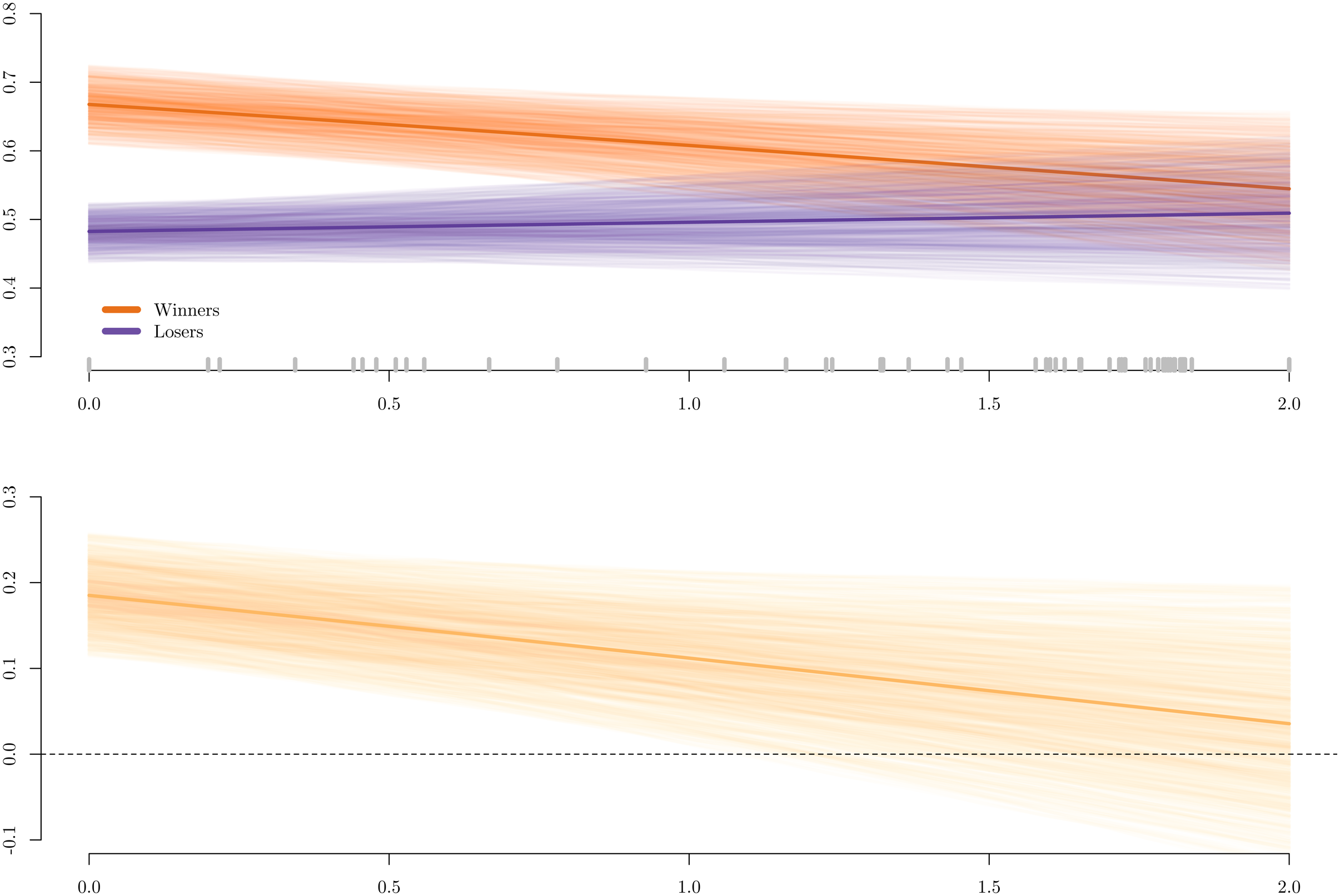
The figure demonstrates that the satisfaction gap between electoral winners and electoral losers closes the higher the level of direct democracy is. 14 As the lower panel in Figure 2 illustrates, the difference in democratic satisfaction between electoral winners and losers is statistically significant in sub-national units with no or low levels of direct democracy. The difference is similar to that found between respondents participating in the election and respondents not participating in the election. 15 However, with increasing sub-national direct democracy, the winner–loser gap diminishes and loses statistical significance. When the snDDI is greater than 1, which is the case in all Swiss cantons and 15 US states, there is no significant difference between winners and losers. Finally, such a narrowing of the gap can also be found in the raw data (see the, Supplementary Figure A8).
Overall, these results clearly suggest that direct democracy closes the gap between winners and losers in an electoral system. This mechanism is not bound to one particular representative system, as suggested by previous literature (Bernauer & Vatter, 2012; Radcliff & Shufeldt, 2016) but seems to be relevant across the majoritarian and consensual sub-national democracies of Switzerland, the United States, Germany, and Austria. In fact, the interaction effect is stable even if an additional interaction between direct democracy and the share of voters represented in government is added as a proxy for the distinction between consensual and majoritarian democracies. Moreover, the latter is not significant, thus corroborating our previous conclusion that the relationship between direct democracy and democratic satisfaction does not systematically vary between different representative systems.
Conclusion
This study starts from the observation that the quantitative literature on direct democracy is stuck within countries. As a consequence, many expectations about what direct democracy can and cannot do are empirically built on weak ground. On the one hand, results obtained in one specific context tend to be generalized despite the fact that direct democratic institutions may generate varying mechanisms and outcomes in different representative contexts (Heidbreder et al., 2019; Hug, 2009). On the other hand, results are often inconsistent, possibly due to the fact that they have been obtained in different contexts. To break out of these confinements, we propose a comparative sub-national perspective across national borders to analyze whether direct democratic institutions are systematically associated with citizens’ satisfaction with democracy (Frey and Stutzer, 2000, 2010). For this reason, we develop an index that allows to measure how strong the direct democratic rights in sub-national units are in the United States, Switzerland, Germany, and Austria. We present—to the best of our knowledge—the most encompassing empirical test of the satisfaction hypothesis including 101 sub-national units from four countries in which direct democracy—at least de jure—is a relevant element in the sub-national policy-making process.
The first main conclusion of this analysis is that there is no general robust relationship between the extent to which direct democracy exists in an entity and the level of citizens’ satisfaction with how democracy works. Even though we document substantial differences in both the degree of direct democracy and democratic satisfaction within and between countries, there is no consistent association between the two phenomenons once we control for country-specific effects. Hence, our analysis, which compared with previous research uses a different measure of direct democracy and a cross-country comparative design, does not lend empirical support to the prominent satisfaction thesis (Frey and Stutzer, 2000; Stutzer & Frey, 2003). The second important finding is that there is a robust interaction between satisfaction with democracy and the presence of direct democratic institutions. Electoral winners and electoral losers differ in their satisfaction. This satisfaction gap is large when there is no or little direct democracy, while it diminishes and finally disappears as the extent of direct democracy increases. In contrast to previous research, we find this equalizing mechanism to work across different representative systems, that is, it is not limited to the specific combination of consensual and direct democracy (Bernauer & Vatter, 2012) or direct democracy in majoritarian democracies (Radcliff & Shufeldt, 2016). While part of the motivation was to illustrate how the effects of direct democracy can vary across representative systems, the relationship between winner–loser gap, direct democracy, and satisfaction does not vary across the four systems analyzed here. In the model-based predictions, satisfaction appears to decline more for the electoral winners than it increases for the electoral losers. In the raw data, satisfaction is higher for both groups, and the gap narrows where extensive direct democracy exists. It remains an open question for future research to determine the relative contributions (of winners and losers) to the narrowing of the gap.
The findings presented in this study have several implications. Theoretically and empirically, we add to the chorus of those arguing that direct democracy does not make democracy better as such and in an automatic way (see, e.g., Freitag & Stadelmann-Steffen, 2010; Leemann, 2015). However, our cross-country sub-national approach consistently shows that direct democracy is not per se related to more democratic satisfaction; our results imply that direct democracy moderates the outcomes of the representative context in which these instruments are embedded. In particular, we document a varying association between direct democracy and satisfaction with democracy for electoral winners and losers. In this vein, however, our findings also come with a grain of salt. There is no evidence that strong reliance on direct democratic instruments make the losers more satisfied, that is, catching up with the winners.
We need to acknowledge that our design—besides the merits—comes at the cost of some disadvantages as well. The analyses are based on observational, cross-sectional data, which—like in almost all previous research on these matters—do not allow us to identify causal effects. Of course, this limitation is not only a question of data availability but also of the fact that direct democratic institutions are rather stable over time. Moreover, the disadvantages of this study are also related to the fact that we only have four observations on the country-level, which limits our ability to disentangle the effects of sub-national direct democracy and the national representative system. A path for future research could be to apply this indicator to even more countries where direct democratic instruments exist at the sub-national level, as well as to other research questions to further improve our understanding of how direct democracy “works” in different representative contexts.
Supplemental Material
sj-pdf-1-cps-10.1177_00104140211024302 – Supplemental Material for Satisfaction With Democracy: When Government by the People Brings Electoral Losers and Winners Together
Supplemental Material, sj-pdf-1-cps-10.1177_00104140211024302 for Satisfaction With Democracy: When Government by the People Brings Electoral Losers and Winners Together by Lucas Leemann and Isabelle Stadelmann-Steffen in Comparative Political Studies
Footnotes
Acknowledgments
We are grateful to Nadine Golinelli, Lisa Marti, and Angela Odermatt for impeccable research assistance and to Kathrin Ackermann, Michael Strebel, Adrian Vatter, and Fabio Wasserfallen for very valuable comments. We thank Julian Bernauer for making data available. Earlier versions were presented at the annual meeting of the Swiss Political Science Association 2018 and 2019, the German Political Science Association 2018, and the ECPR virtual event 2020. This article won the best paper prize 2020 by the ECPR standing group Democratic Innovations. A full replication archive is available (Leemann & Stadelmann-Steffen, 2021).
Declaration of Conflicting Interests
The authors declared no potential conflicts of interest with respect to the research, authorship, and/or publication of this article.
Funding
The authors received no financial support for the research, authorship, and/or publication of this article.

Notes
Supplemental Material
Supplemental material for this article is available online.
Author Biographies
References
Supplementary Material
Please find the following supplemental material available below.
For Open Access articles published under a Creative Commons License, all supplemental material carries the same license as the article it is associated with.
For non-Open Access articles published, all supplemental material carries a non-exclusive license, and permission requests for re-use of supplemental material or any part of supplemental material shall be sent directly to the copyright owner as specified in the copyright notice associated with the article.
