




Abstract
While delegation of policymaking authority from citizens to parliament is the most defining characteristic of representative democracy, public demand for delegating such authority away from legislature/government to technocrats or back to citizens appears to have increased. Drawing on spatial models of voting, we argue that the distance between individuals’ ideal policy points, the status quo, experts’ policy positions and aggregated societal policy preferences can help explain whether individuals prefer to delegate decision-making power away from parliament and, if so, to whom. The effects of individual’s preference distance from these ideal points are likely to be stronger the more salient the policy issue is for the respective individual. We test this argument using survey experiments in Germany, Switzerland and the United Kingdom. The analysis provides evidence for the empirical implications of our theoretical arguments. The research presented here contributes to better understanding variation in citizens’ support for representative democracy and preferences for delegating policymaking authority away from parliament.
Keywords
Introduction
A central question in the study of democracy is who should have the final say in policy decisions. While parliaments in Western representative democracies were, are and likely will continue to be the central pillar of decision-making, their legitimacy has come under increasing attack in recent years. A focal point of the critique here concerns the chain of delegation (Strøm, 2000), which reflects the principal–agent relationship between voters and parliament. Voters delegate authority to elected officials, who are expected to be responsive to citizens’ preferences and are held accountable by voters primarily via elections. The latter indicates that citizens can punish or reward incumbents for past performance, as is highlighted, for example, by theories of economic voting (see, for example, Key, 1966; Kinder & Kiewiet, 1979; Lewis-Beck, 1986, 1994; Lewis-Beck & Stegmaier, 2000).
Parliamentary decision-making, however, is not the only decision-making option. Citizens may demand delegating political decision-making authority to other institutions and decision-making mechanisms, such as referenda or independent agencies. Support for such alternatives is the focus of this study. On the one hand, the literature on policy delegation argues that experts can (and maybe should) decide on highly technical issues (Alesina & Tabellini, 2007, 2008) and that require impartiality to ascertain societal trust (Rothstein & Teorell, 2008). Technocratic governance has become increasingly popular in times of economic or political crises (McDonnell & Valbruzzi, 2014). On the other hand, political populists criticise elite decision-making, calling for more inclusion of citizens in policy decisions. Understanding when and under which conditions citizens support alternatives to conventional parliamentary decision-making, and to whom they prefer to delegate policymaking authority is thus of utmost importance.
In this study, we argue that citizens’ support for particular forms of political decision-making depends upon their own policy position relative to expected outcomes of different decision-making processes. Following a logic analogous to spatial models of voting (Adams et al., 2005; Downs, 1957) – that is, presuming that citizens favour decision-making that maximises their chance of realising their preferred political outcome – we argue that individuals’ willingness to delegate away from parliament is a function of the distance between their position in a given policy area and the status quo. We expect citizens to be more opposed to parliamentary policymaking when dissatisfied with the status quo of parliamentary governance in a given issue and when the issue is salient for the respective individual.
Our argument also explains which forms of decision-making individuals prefer when delegating authority away from parliament. We expect individuals to support the decision-making process that generates an outcome closest to their ideal point. The position of experts is thus relevant for citizens' support of technocratic forms of policymaking (delegation to an independent agency). Analogously, the position of the public (the demos) is important in the case of support for referenda.
To test these theoretical arguments, we designed and fielded original nationally representative surveys in three countries: Germany, Switzerland, and the United Kingdom (N = 2100, 2101, and 2117, respectively). This selection allows us to assess our arguments in countries with differing democratic institutions and modes of decision-making. The cases vary in their overall outlook on democracy (majoritarian vs. consensus democracies), their usage of direct democracy (CH > DE and UK) and their degree of accountability (UK > DE > CH). Thus, analysing these different contexts provides a more comprehensive understanding of citizens' attitudes towards decision-making processes. We rely both on stated policy preferences as well as a survey embedded experiment to assess the role of individuals’ policy positions as well as the positions of experts and the public on individuals’ willingness to delegate decision-making authority away from parliament and towards technocratic institutions or citizens (referenda).
The results suggest that individuals’ preferred choice of institution for policymaking is a function of instrumental considerations. An individual’s preferred policy position, relative to the status quo, is associated with their willingness to delegate policymaking authority away from parliament if the issue is salient. Individuals who prefer policies that are further away from the status quo are less likely to support parliamentary policymaking in this case. However, individuals differ in their preferences for who should take up this policymaking authority. When their preferences are aligned with those of experts, they are more likely to support policymaking by independent agencies. When their preferences are aligned with those of the public at large, the demos, then they are more likely to support policymaking through referenda. Our results also point to an interesting asymmetry, whereby individuals with very liberal positions still support referenda when faced with an opposing demos, whereas conservatives retreat to parliamentary decision-making in the same situation.
Our findings speak to a broad literature on citizens’ policy process preferences. Hibbing and Theiss-Morse (2002) emphasise that while citizens generally desire little involvement in policymaking, they do desire direct democratic control when dissatisfied with a policy outcome (Bengtsson & Mattila, 2009). Inspiring research on democratic innovation, several studies started assessing citizens’ democratic preferences, most notably direct democracy. For a long time, studies such as Bowler et al. (2007) assumed that citizens’ preferences were stable. However, recent studies, most notably Werner (2020) and Landwehr and Harms (2019), assume that citizens' preferences are less stable than often assumed and a function of outcome favourability (Esaiasson et al., 2016). While this research has focused on when and why citizens desire direct democratic institutions, research has paid less attention to a second, increasingly important alternative to parliamentary representation: delegation to experts. A different strand of research, building around seminal work by Bertsou and Pastorella (2017), has looked into citizens’ attitudes towards technocratic governance (Bertsou & Caramani, 2020). Yet with few exceptions (notably, see Coffé & Michels, 2014), these literatures do usually not connect and contrast citizens' preferences for different decision-making procedures. Building on this research, we examine the choice between a variety of delegation options, rather than support for one of these options. This trade-off is central to the study of citizens’ preferences regarding delegation and for understanding the level of support institutions receive.
More generally, it is important to understand when, why and to whom citizens prefer to delegate decision-making authority. The chain of delegation has experienced growing criticism by technocrats and even more so by populists. Many populists and technocrats have in fact advocated changes in the political chain of delegation, albeit for different reasons. 1 Both technocratic and populist critiques of the current political status quo are reactions to the perceived failure of governance (Lawson & Merkl, 1988; Pastorella, 2016). While citizens are rarely asked directly to make decisions on institutional design, their process preferences drive (dis)satisfaction with both decision-making procedures and outcomes (Esaiasson et al., 2012, 2016). Thereby, the legitimacy of democratic decisions can suffer. Given that our findings indicate that such preferences are issue specific, process preferences may exert even more pressure on policymakers. Hence, '[u]nderstanding different forms of participation not as alternative models of governance but as responses to specific problems of governance, with particular strengths and appropriate uses, may also help to remedy the neglect of agonistic approaches to participation’ (Dean, 2016, p. 210).
The remainder of the study is structured as follows. In the next section, we outline the theoretical argument. We then describe our research design before presenting the results. We then conclude with a discussion of the implications of our results for the literature on representative democracy.
Theory
Representative democracy’s minimum requirement is some linkage between citizens’ preferences and public policies enacted by their representatives. At the same time, decision makers ought to be accountable to citizens for their actions, which requires parliaments to be responsive to citizens’ needs and preferences (Arnold & Franklin, 2012; Pitkin, 1967). This chain of delegation (Strøm, 2000) involves a principal–agent relationship between citizens and representatives. In representative parliamentary democracies, citizens elect members of parliament (MP) who elect a prime minister/head of government, who then selects ministers and subsequently members of the civil service.
Yet, what should happen if citizens are dissatisfied with the results of representative democracy? One solution could be to demand alternative forms of policymaking, that is, delegating decision-making authority away from parliament to some other institution. In this case, the chain of delegation changes as voting becomes something more than a pure mechanism for controlling elected officials (Riker, 1982). In what Riker (1982) calls the ‘populist view’ rather than the ‘liberal view’, citizens have a more active role in the political process, beyond merely electing officials.
Citizens could demand the delegation of authority to the people, that is, by using direct democratic mechanisms for policymaking. In fact, delegation to direct democratic institutions is a common request by populists (Bowler et al., 2017; Jacobs et al., 2018; Mohrenberg et al., 2021; Ruth & Welp, 2013). Citizens could also seek delegation to experts, such as in the form of independent agencies, to achieve efficient policy outcomes, or even to international and supranational organisations, such as the European Union or the United Nations.
Although citizens are rarely confronted with the exact choice of institutional design features, their preferences and subsequent (dis)satisfaction with the decision-making procedure have substantial consequences for the perceived legitimacy of outcomes (Esaiasson et al., 2012, 2016), which, in turn, affect political parties and translate into the political debate (Dalton, 2004; Dalton et al., 2010; Strøm, 2000).
Preferences for Delegation
Our theoretical approach to explaining preferences for delegation is influenced by spatial models of voting (e.g. Adams et al., 2005; Ansolabehere & Snyder, 2000; Downs, 1957). Spatial models rest upon the assumption that voters assess the (perceived) policy distance between their issue positions and the positions parties and candidates hold (Downs, 1957). Following an instrumental logic, voters then seek to maximise their utility by selecting the option closest to their own policy preference regarding whom to vote for [or delegate authority to]. In this model, vote choice is then a function of these perceptions.
Building on this logic, we assume, for a given policy issue, a unidimensional policy space with continuous policy positions. 2 Furthermore, we assume that individuals can separate one issue dimension from other dimensions. 3 With these assumptions in mind, individuals’ willingness to delegate decision-making authority away from parliament is affected by the distance between their policy position on a given issue and the status quo. If individuals hold substantially different policy positions than the parliament, then they should be less likely to prefer parliamentary decision-making. Assuming that individuals seek to maximise the likelihood that their preferred policy is implemented (what we call instrumental logic in this study), support for alternatives to parliamentary decision-making increases the larger the distance between individuals' preferences and those of the parliament. 4
However, we do not expect the effect of this policy distance from the status quo to be homogeneous across all issue areas. Policy issues vary in their salience. We expect individuals with policy preferences further away from the status quo to be more sensitive to these deviations the more salient the issue is for them (cf. Bélanger & Meguid, 2008). Salience is generally defined as a level of concern, attention or importance placed on a given issue (Bélanger & Meguid, 2008). We thus consider the possibility that individuals are more (or less) sensitive to a particular issue, leading to a stronger (weaker) consideration of their policy preferences and their utility from policymaking in parliament. In the extreme case, individuals may not care about the respective policy area at all. In this case, their desire for delegation will be unaffected by their preference relative to the status quo, simply because they are indifferent as to whether or not their positions will translate to policy. Hence, we expect the following relationships.
Whom Do Individuals Prefer to Delegate To?
So far, we have outlined the conditions under which individuals’ policy preferences affect support for the delegation of policymaking authority to parliament. However, to whom do individuals wish to delegate authority to if not to the parliament? In this section, we focus on two forms of delegation: delegation to experts through independent agencies and delegation to ‘the people’ through referenda.
The focus on independent agencies and referenda being alternatives to parliamentary policymaking is based upon the premise that technocracy and populism, respectively, are two alternatives that challenge the status quo of representative democracy. As Caramani (2017, p. 54) argues, technocracy and populism are both derived from a ‘unitary, nonpluralist, unmediated, and unaccountable vision of society’s general interest’. Arguably, these two responses differ substantially in terms of democratic legitimacy (Caramani, 2017; Centeno, 1993) and their output efficiency (Centeno, 1993). While weakening representative democracy, referenda produce democratically legitimised decisions. Technocratic institutions, by definition, offer detachment from public opinion and instead seek efficient solutions to technical problems (Alesina & Tabellini, 2007, 2008), which are, at best, indirectly democratic (Pastorella, 2016).
Despite these different mechanisms, we extend the theoretical framework outlined above to incorporate additional factors. The ideal points of experts and the public are also relevant for deciding which institution an individual prefers.
Starting with the role of experts, one would anticipate that, absent additional information, support for experts is highest close to the status quo. Essentially, because experts are independent, apolitical and produce more efficient outcomes than parliamentarians (Pastorella, 2016; Rothstein & Teorell, 2008), expert governance should resonate with citizens who do not desire different (in terms of position) but more efficient outcomes. The following hypothesis reflects this argument:
In contrast to this argument, consideration of the ideal points of experts builds upon the spatial logic outlined above by adding a new reference point. If individuals follow an instrumental logic, then we should expect individuals’ perceptions of experts’ policy preferences to influence whether they prefer to delegate policymaking to them. In the most extreme case, even an individual truly dissatisfied with the status quo will still not want to change the status quo and allow independent technocratic agencies to make policy decisions if their policy preferences are even further away from those of the experts. However, if the experts’ policy position is closer to the ideal point of the individual, she should be more likely to prefer delegation to experts rather than keeping policymaking at the parliament.
While individuals are likely to consider the distance between their ideal point and the perceived ideal point of experts when forming preferences about delegation to experts, they are also likely to hold beliefs on the distribution of preferences across society (the “popular will”). For delegation to direct democratic instruments, the preferences of the majority of citizens on a given policy issue are likely to affect whether an individual prefers to delegate decision-making authority to citizens at large (referenda). Again applying an instrumental logic, citizens consider whether their preferences are likely to be implemented via referenda and potentially oppose delegation to this form of decision-making even if they think referenda are a more legitimate procedure (Arvai & Froschauer, 2010; Esaiasson et al., 2016; Marien & Kern, 2017). 5
Unsurprisingly, political actors tend to mobilise on issues and suggest referenda when they perceive themselves to represent a majority in a given issue area. For example, calls for referenda on international trade agreements, such as the Comprehensive Economic and Trade Agreement (CETA) or the Transatlantic Trade and Investment Partnership (TTIP), were particularly loud in countries such as Germany and Austria, where opposition parties expressed the desire to vote on these issues via referenda (Austrian Freedom Party, 2017; Die Zeit, 2017) and knew that a majority of citizens was concerned about the consequences of these agreements. Similar mechanisms exist at the individual level (Esaiasson et al., 2016). We expect that individuals support referenda more, the closer their own policy preferences are aligned with those of the mass public. If the distance between individuals' positions and the ideal point expressed via referenda is small, individuals should be more willing to delegate to the people as it seems likely that their position garners enough public support to be implemented. On the other hand, if the majority of citizens holds different views, an individual is less likely to favour delegation as the implementation of her preferred policy position is unlikely. Thus, we hypothesise:
In summary, we expect that the spatial distance between individuals’ ideal policy point, the status quo, experts’ policy position and the aggregated societal policy preference help explain whether individuals prefer to delegate decision-making authority away from parliament and, if yes, to whom.
Research Design
To test the empirical implications of our theory, we fielded nationally representative surveys in Germany, Switzerland, and the United Kingdom in October 2017. 6 The surveys were fielded with Ipsos. Respondents were drawn from Ipsos’ online panel, and hard quotas were applied on several key demographics. Specifically, our samples are nationally representative with regards to age, education, gender and geographical region within each country. The sample includes approximately 2100 respondents per country (2100 in Switzerland, 2101 in Germany and 2117 in the United Kingdom; in total 6318 respondents).
The case selection allows us to assess our theoretical arguments in a variety of contexts. The three countries, Germany, Switzerland and the United Kingdom, vary in the amount of direct democratic decision-making but also in their electoral systems (Qvortrup, 2014). Switzerland puts strong emphasis on direct democracy, an element that is largely absent in Germany and the United Kingdom (Qvortrup, 2014). Citizens' willingness to delegate thus may systematically vary by their exposure to direct democracy. The countries at hand also differ in the degrees of proportionality and varying clarity of accountability of their political systems. Citizens’ attitudes about parliamentary decision-making thus may by the respective context. Additionally, majoritarian institutions may, for example, increase the average distance between citizens and parliament, which in return should affect their sensitivity to positions of themselves and other policymaking processes. While our theoretical argument does not point to particular commonalities or differences in the role of issue positions across the three countries, testing our hypotheses in these three countries allows us to assess the extent to which the results are generalisable and travel across political contexts.
We focus on three policy issues to examine the relationship between individuals’ issue positions and preferences towards delegation: namely immigration, nuclear power and marijuana legalisation. We chose these issue areas for the following reasons. First, the literature on policy delegation argues that delegation is not a useful tool to address distributive problems. Policies which distribute resources to different groups require normative guidance. Experts are not necessarily equipped to make these decisions because they cannot make normative statements based on their technical expertise. In contrast, issues like monetary policy, while having substantial impact on society, are considered to require technical expertise (Lohmann, 1998) and independence, a central reason to delegate to experts (see Alesina & Tabellini, 2007, 2008 for an extensive discussion).
Second, these issues vary in terms of public salience. When designing the study, we asked individuals to choose up to three items which they consider to be important issues their country face. In our sample, approximately 42% (immigration), 19% (nuclear power) and 2% (marijuana) of respondents considered the respective issue area to be one of the most important issues. Individuals who received a treatment were randomly assigned to answering questions about one of these issues (individuals in the control responded to questions concerning all three issues to increase statistical power).
To experimentally manipulate perceptions of expert opinions, we rely on a survey embedded experiment. Individuals in a treatment arm of the survey proceed in the following manner. For illustrative purposes, we will use the example of nuclear power and the UK survey (also displayed in Figure 1). Following a brief introductory statement, respondents are asked to position themselves on a scale where the extremes are to ‘greatly reduce nuclear power’ or ‘greatly increase nuclear power’, with the middle point being the status quo (i.e. maintain the current level of nuclear power) as in the first part of Figure 1. This question allows us to capture the distance from the status quo.
7
After this, respondents are randomly assigned to receiving information about how experts either favour an increase or decrease in nuclear power, using real quotations from two physicists, as shown in the second part of Figure 1.
8
Respondents then are returned to the scale where they previously positioned themselves. Added to this scale is the expert’s ‘position’ given individuals’ previous statement in step 1, as in the lowest part of Figure 1. The expert holds either liberal (−0.8) or conservative (0.8) positions. Respondents then answer a manipulation check, with the item asking whether the experts supported more, less or the same amount of nuclear power as the respondents do. Thereby, we ensure that individuals are aware of the distance between themselves, the status quo and the experts. Finally, respondents respond to the question that constitutes the dependent variable in our analysis (see the subsequent section), namely who should have policymaking authority. Example of treatment.
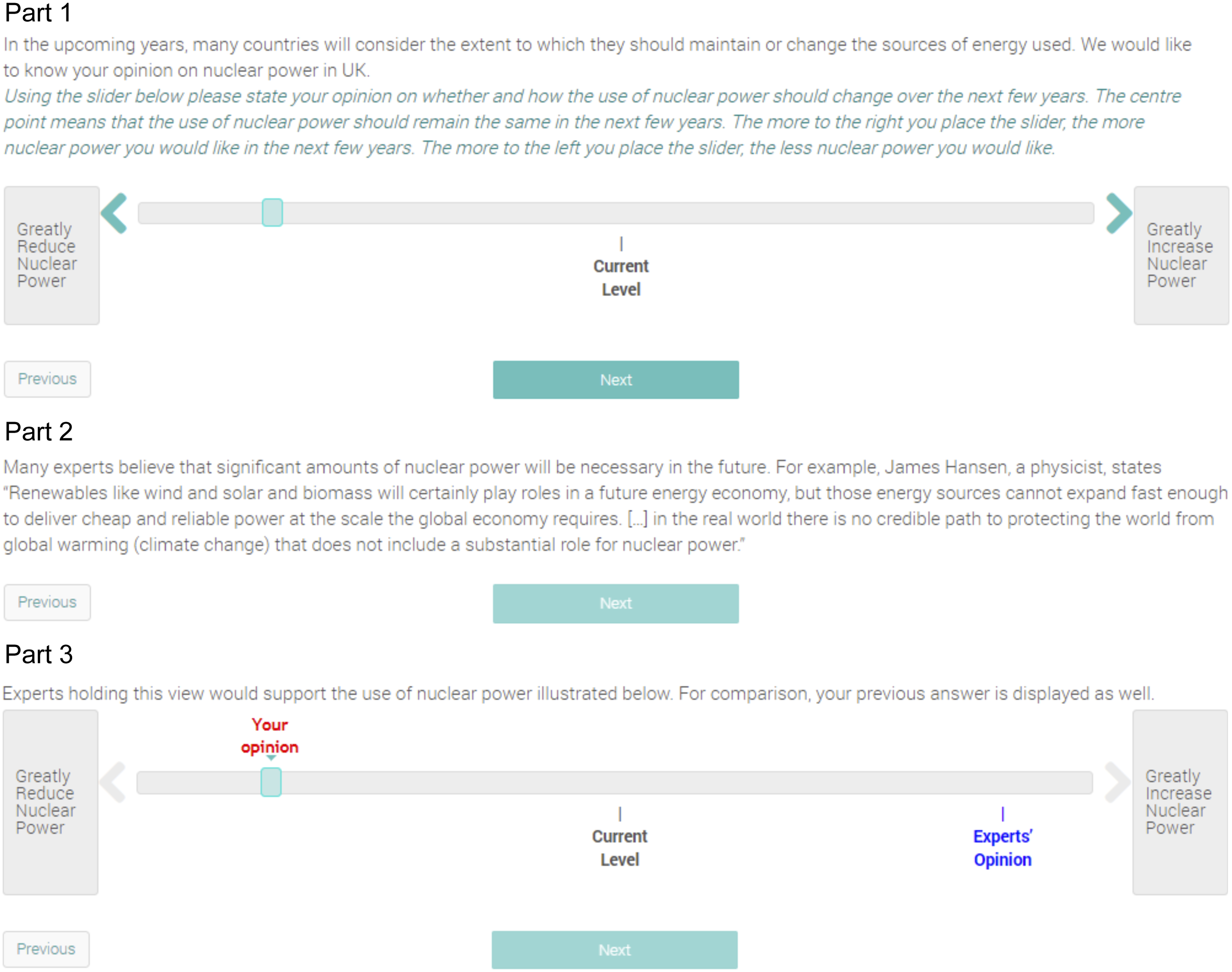
Those in the control group engage in the first and fifth tasks outlined above (stating their position and choosing whom to delegate too), without any contextual information about experts.
With this design, we capture all spatial information necessary to test Hypotheses 1a to 3. To capture the societal ideal policy position, we calculate the average position of individuals’ ideal policy position for a given issue within a given country. The distance between this point and an individual’s policy position allows us to test Hypothesis 3. Figure 2 displays the distribution of policy preferences and the mean position across countries and policy areas. The value of zero indicates the status quo, while +1 indicates more liberal policy positions (more immigration, less nuclear power and higher legalisation of marijuana) and −1 indicates more conservative policy positions (less immigration, more nuclear power and more criminalisation of marijuana). While we could have randomly assigned societal ideal points, this information would have been less credible and more likely to fail in manipulating citizens' perceptions. Thus, we decided to use available information, which most likely represent citizens' perceived societal position on most issues. Distribution of policy positions across countries and policy areas. Note: The dashed vertical lines indicate the mean position for an issue within a country. The value of zero indicates the status quo, while +1 indicates more liberal policy positions (more immigration, less nuclear power and higher legalisation of marijuana) and −1 indicates more conservative policy positions (less immigration, more nuclear power and more criminalisation of marijuana).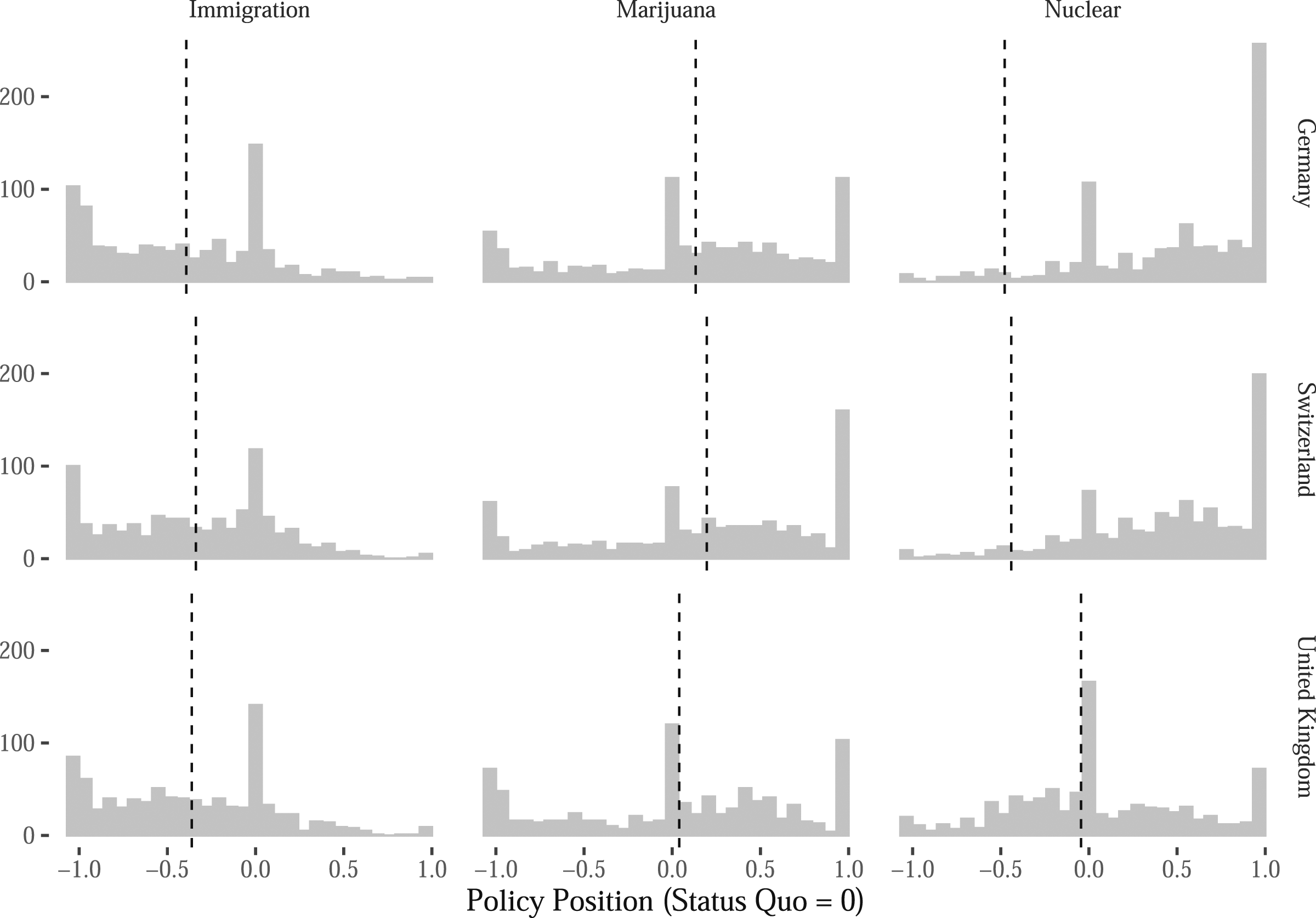
A potential concern with using these aggregated preferences as a measure of the public’s perception of the demos' position is that individuals' may hold biased perceptions of others' preferences. For example, individuals may believe that the demos' position is closer to their own than it is in reality, as is documented in previous psychological research (e.g. Tversky & Kahneman, 1974). For our empirical analysis, such a bias in perceptions would likely lead to attenuation bias as it will have the effect of minimising perceived differences between an individual’s policy position and that of the demos. In the conclusion, we discuss potential avenues for exploring this issue further in future research.
Dependent Variable
Our dependent variable item asked respondents whom they would delegate policymaking to for the different issue(s). Specifically, they were asked: In your opinion, who should make the key decisions about <ISSUE> in <COUNTRY>? They could choose from: (i) parliament and government, (ii) an independent regulatory agency staffed with technical experts, (iii) <COUNTRY> citizens, through popular referendum (vote), (iv) an international organisation (e.g. UN and EU), (v) other (please specify), (vi) do not care and (vii) do not know. As the combined number of responses for categories iv–vii are relatively low (≈200 per issue), we exclude them in the main analysis due to concerns about statistical power but include them in a robustness check.
Other Variables
Based on our theoretical model, issue salience is an important moderator of our spatial argument. To measure whether respondents consider the issue at hand to be important, we asked them to select up to three issues they consider to be among the most important issues facing their country at this time. The full list of issues is outlined in Section A1 in the Supplementary Material.
Furthermore, we control for a wide range of alternative explanations for why individuals might support delegation, which stem from the existing literature. Specifically, we control for age, gender, education, income and self-placement on the (non-policy specific) left–right scale. Furthermore, we include the perceived effectiveness of experts and individuals’ populist attitudes (Schulz et al., 2017) as these attitudes are likely to also influence preferences for delegation to experts and referendums. Following the argumentation on political attitudes above, we also include support for the incumbent 9 (Smith et al., 2010), and satisfaction with democracy (Webb, 2013), as individuals’ willingness to delegate decision-making away from parliament might also be affected by discontent with the democratic political system. 10
We use logistic regression to assess individuals’ preferences to delegate decision-making power away from parliament (H1a and H1b). In other words, we create a dummy variable that captures whether an individual supports decision-making via parliament (1) or not (0). For the question of whom individuals want to delegate to (H2a, H2b and H3), we apply multinomial logistic regression and estimate the uncertainty via bootstrapping. Here, we use a categorical nominal variable that measures whether individuals prefer decision-making by parliament, referendums or independent agencies. We include country and issue fixed effects to account for heterogeneity arising from different institutional and issue contexts. Uncertainty estimates for all quantities of interest are generated using bootstrapping, with 500 samples.
Estimating Equation
Our baseline estimating equation is

Results
We start by examining individuals’ support for the parliament to make policy in each specific issue area, relative to any alternative, in line with hypotheses 1a and 1b. For Germany and the United Kingdom, this corresponds to the status quo of policymaking. Although Switzerland differs to some extent, given its direct democracy features, the details and thus the ‘key decisions’ regarding policy design and implementation are often left to the parliament. Our empirical specification for Hypothesis 1a is


Figure 3 displays the relationship between policy positions and support for parliamentary policymaking. The left panel (a) Unconditional Association displays the average relationship, while the right panel (b) Conditional Association allows the effect of policy position to vary by whether an individual considers the issue important (green line) or not (purple line). In general, we see that the further an individual’s policy position is from the status quo, the less they support parliamentary decision-making. However, the results suggest that this relationship is determined by those individuals who consider the issue to be important. In such cases, individuals are significantly more supportive of the status quo of policymaking when they have policy preferences close to the status quo, and more negative towards the status quo of policymaking when they are far from the status quo. In contrast, support for parliamentary policymaking is less sensitive to an individual’s policy position when she does not consider the issue to be important. While these findings are consistent with H1b, they only provide suggestive evidence for H1a. In summary, individuals’ instrumental preferences for the form of decision-making tend to be confined only to issues they personally consider important. Effect of position on support for parliamentary decision-making by salience. Note: The solid line indicates the predicted probability of choosing the parliament to set policy in the issue area. The shaded area indicates 95% confidence intervals estimated using bootstrapping. The colour is determined by whether the issue is or is not considered to be one of the most important facing the country. The solid line indicates the predicted probability for an individual choosing the parliament to make the important policy decisions.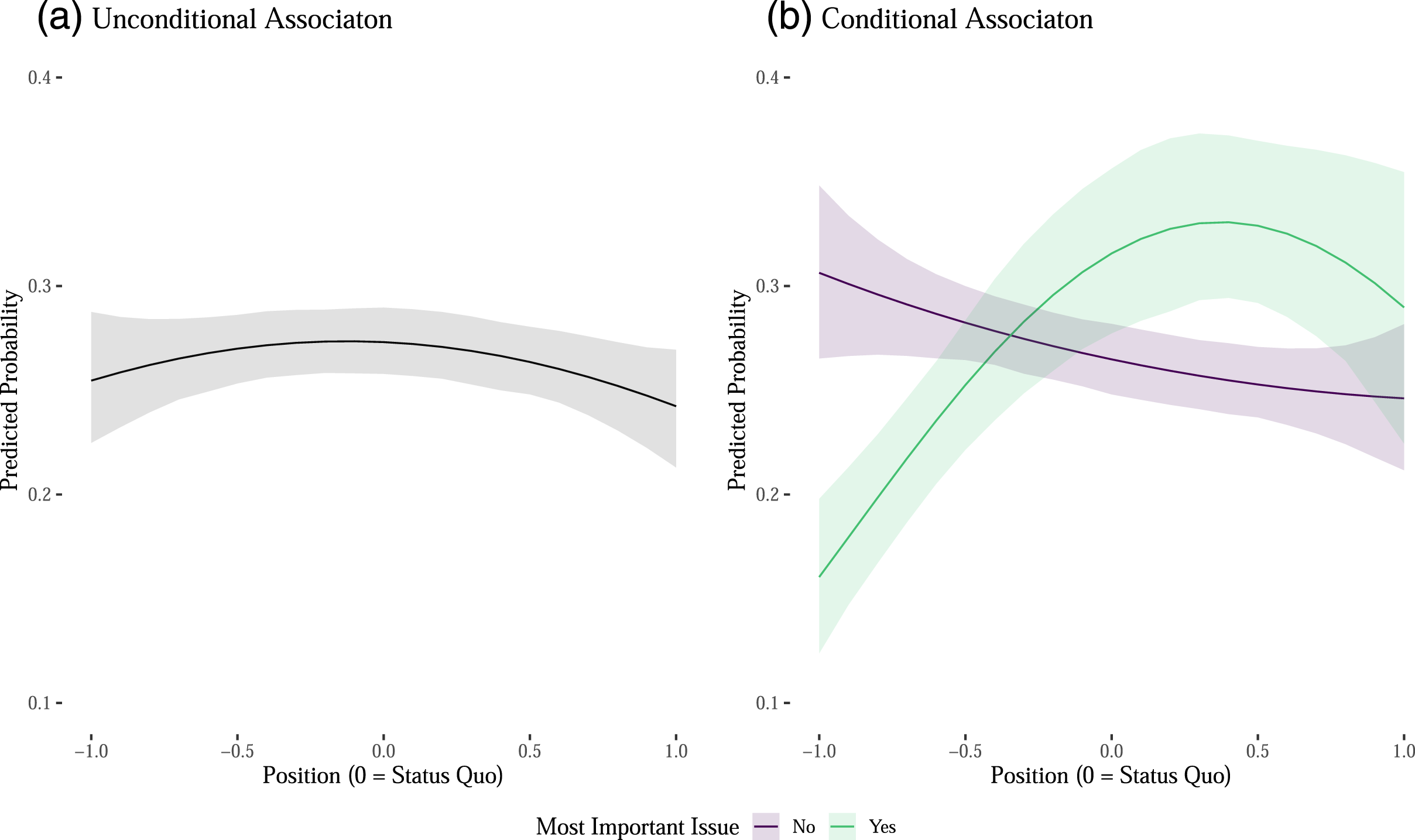
Which Decision-Making Processes Do Citizens Prefer?
Having demonstrated that individuals’ policy preferences are relevant for understanding support for parliamentary policymaking, we move on to examining the factors that condition this relationship, as outlined in the theory section. Specifically, we proceed three-fold. First, we focus on the preference to delegate authority to experts (H2a) or the people. Second, we analyse how expert positions affect individuals' utility and thus their preferences for delegation to experts (H2b). Finally, we assess how the most likely outcome of referenda, specifically the policy preference of other citizens influences citizens' support for referenda (H3).
First, we examine which type of decision-making individuals choose to delegate policymaking authority to if they decide not to support parliamentary decision-making. To do so, we estimate the delegation preference (parliament, independent agencies and referenda) as a function of individuals' position using a multinomial logit regression, with parliamentary decision-making as the baseline category. Our empirical specification, for an individual’s random utility for a given decision-making type, is

Figure 4 reaffirms our findings from Figure 3. The further individuals are away from the status quo, the less likely they are to prefer parliamentary decision-making (compare Figure 3 left panel). The pattern is stronger for delegation to experts. These results are in line with H2a as they indicate that citizens do not perceive independent experts to be really independent from politics and the status quo, contrary to existing arguments (Rothstein & Teorell, 2008). Rather, experts are still objectively accountable to parliament, and thus indirectly legitimised (Pastorella, 2016, p. 953). At the same time, the larger the distance between individual ideal points and the status quo, the higher the support for decision-making via referenda. We also find that these effects are largely symmetric when comparing conservative and liberal individuals with policy positions far from the status quo. Effect of policy position on decision whom to delegate to. Note: The solid line indicates the predicted probability of selecting a particular decision-making institution. The shaded area indicates 95% confidence intervals estimated using bootstrapping.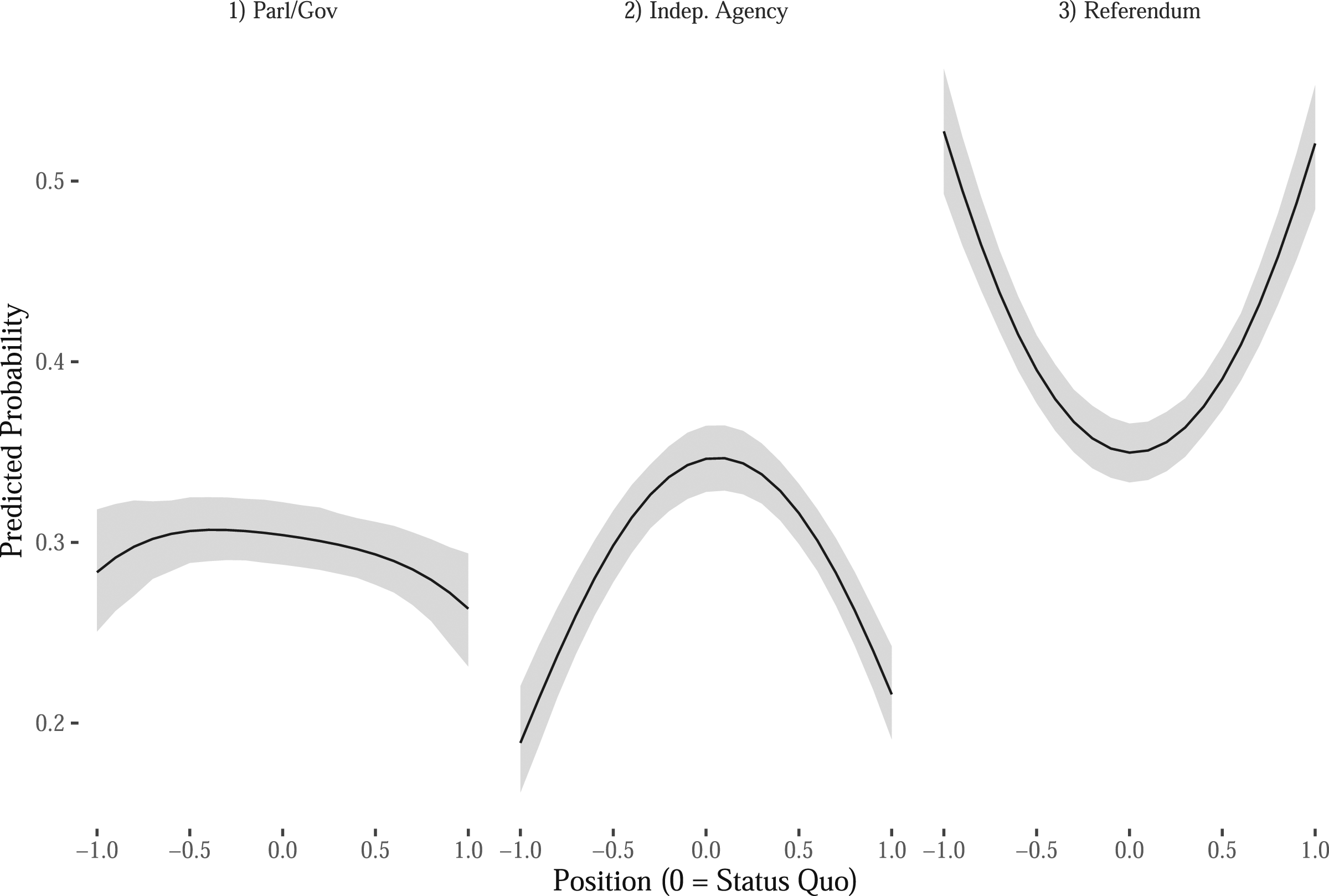
Second, and to test Hypothesis 2b, we examine how the randomly assigned experts' position affects individuals’ support for independent agencies. Our empirical specification for an individual’s random utility for a given decision-making type is

Therefore, we estimate how the difference between an individual’s position and the (randomly assigned) expert position affects whom the individual prefers policy to be decided by, while controlling for the direct impact of their political position.
Figure 5 reveals that information about experts’ position moderates the relationship between individuals’ policy positions and support for decision-making options. The first row displays the association between an individual’s policy position and the predicted probabilities that an individual prefers independent agencies as the form of decision-making, conditional on the expert position treatment. The second row shows the difference between the predicted probabilities when receiving the ‘liberal’ expert (position = 0.8), compared to the ‘conservative’ expert position (= −0.8). In line with our theoretical argumentation, we find that liberal respondents are more supportive of expert decision-making when the expert position is liberal, while conservatives are opposed. Relationship between support for decision-making bodies and policy position depends upon expert positioning. Note: The first row displays the association between an individual’s policy position and the predicted probabilities that an individual chooses a form of decision-making, conditional on the expert position treatment. The second row shows the difference between the predicted probabilities when receiving the ‘liberal’ expert (position = 0.8), compared to the ‘conservative’ expert (position = −0.8). Therefore, values above zero indicate that support for this form of decision-making is stronger when the expert position is liberal, than when it is conservative. The light shaded area indicates 95% confidence intervals, and the darker shaded area 83.4% confidence intervals, both estimated using bootstrapping.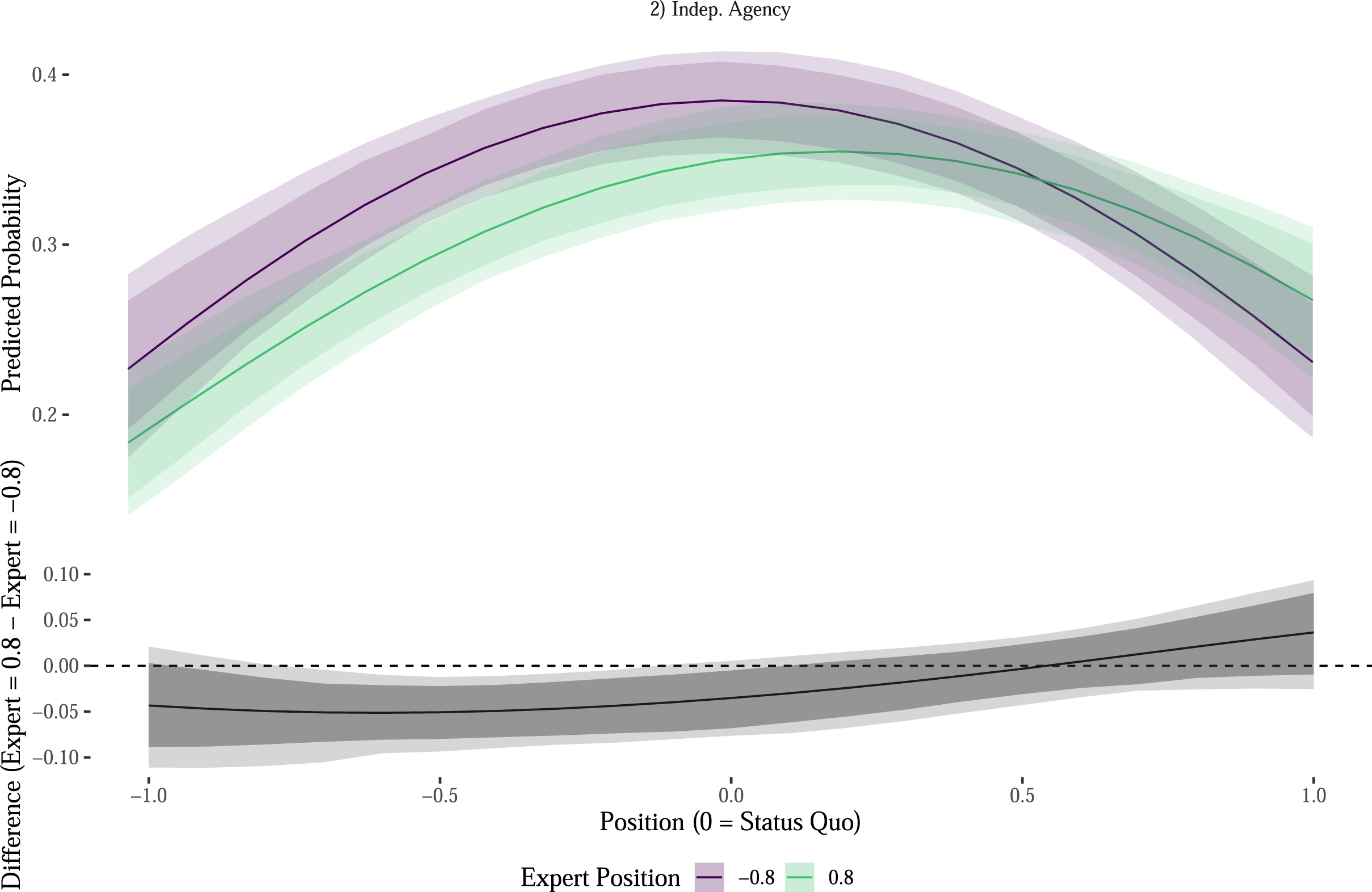
Furthermore, conservative individuals' support for decision-making via independent agencies when experts are said to be similarly conservative is significantly higher than if the experts are said to be liberal (indicated by the negative effects in the lower panel in Figure 5). This effect is mirrored by those individuals who have more liberal policy positions than the status quo. In this case, they exhibit higher levels of support for decision-making by independent agencies when provided information that experts hold liberal, rather than conservative, policy positions (H2b).
Finally, to test Hypothesis 3, we examine whether individuals benchmark their position against the position of the public at large, the ‘demos’, when deciding whom to delegate policymaking authority to. We anticipate that citizens consider the most likely outcome of referenda, which is the aggregated societal position (the mean). Our empirical specification for an individual’s random utility for a given decision-making type is

Figure 6 displays the results. The first row shows the association between an individual’s policy position and the predicted probabilities that an individual chooses referenda, conditional on the demos’ position. The second row shows the difference between the predicted probabilities for a ‘liberal’ demos (position = 0.25), compared to a ‘conservative’ demos (position = −0.25). Therefore, values above zero indicate that support for referenda is higher when the demos position is liberal, than when it is conservative. Relationship between support for decision-making bodies and policy position depends upon the position of the demos. Note: The first row displays the association between an individual’s policy position and the predicted probabilities that an individual chooses a form of decision-making, conditional on the demos’ position. The second row shows the difference between the predicted probabilities for a ‘liberal’ demos (position = 0.25), compared to a ‘conservative’ demos (position = −0.25). Therefore, values above zero indicate that support for this form of decision-making is stronger when the demos position is liberal, than when it is conservative. The light shaded area indicates 95% confidence intervals, and the darker shaded are 83.4% confidence intervals, both estimated using bootstrapping.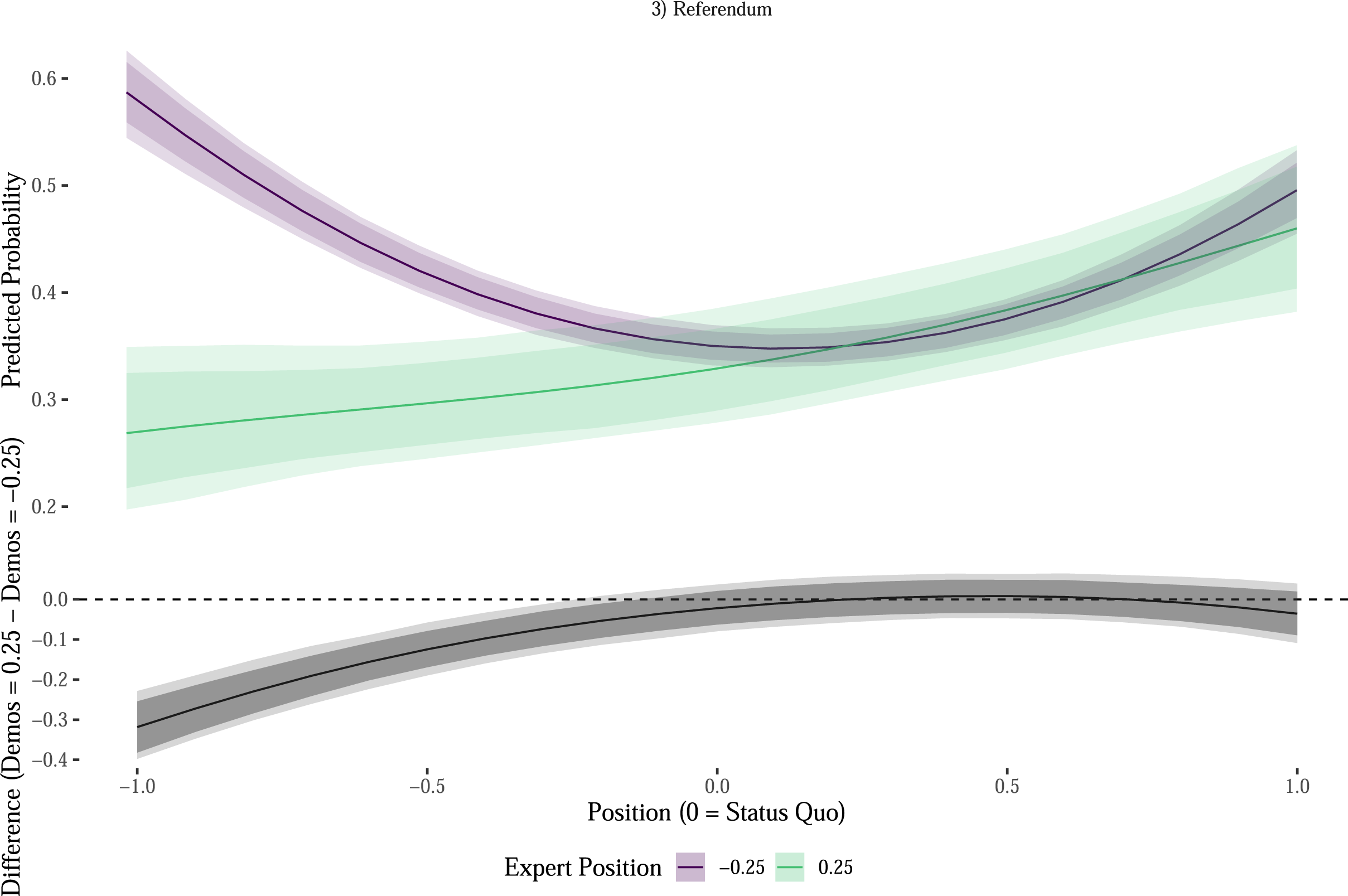
We find that the position of the average individual, the demos, plays a significant role in moderating the relationship between an individual’s position and whether they support policymaking through referenda. We can see that individuals close to the demos’ position are more likely to support this decision-making process. However, when facing a demos that holds the opposite policy position, there is an asymmetry between individuals holding conservative and liberal policy positions far from the status quo. Individuals with extremely liberal policy positions show similar levels of support for referenda, regardless of the demos’ position. In contrast, individuals with extremely conservative policy positions do not support referenda when faced with a liberal demos. Rather, they return to support for parliamentary decision-making (see Figure A2 in the Supplementary Material). This finding suggests that the underlying reasons for why certain segments of society support or oppose referenda could be different. Particularly, these findings indicate that liberals support referenda regardless of the ‘demos’ position, whereas conservatives follow the outlined instrumental logic. 11
Robustness checks
We also undertook several robustness tests, whose results are shown in the Supplementary Material. First, we investigated country and issue-specific effects, as shown in the Supplementary Material (see Section A7 in the Supplementary Material). In our main statistical models, as shown in Tables A1 and A2 in the Supplementary Material, we find that support for decision-making processes varies by country and issue. Reanalyses by country and issue sub-groups, however, suggest that our findings about the relationship between policy positions and decision-making preferences, and the role of other actors’ positions, are not driven by individual countries and issues. Second, we re-estimate the multinomial logit models including the rare, and therefore excluded, outcomes. To ensure that the estimation converges, we combine the choices of ‘International Organization’ and ‘Other’, as well as the ‘do not know’ and ‘do not care’ choices. Doing so leads to similar parameter estimates and statistical significance, suggesting that our results are robust to our specification and estimation choices. Third, we allow for a more flexible functional form by using cubic basis splines with three knots (one internal and two boundaries). This allows for a highly non-linear relationship between individuals' policy positions and their support for the various bodies of decision-making. This increases confidence in the relationship we find being driven by individuals' quadratic loss (or gain) when considering alternatives relative to the status quo, rather than by an assumed quadratic functional form. The results, presented in section A6 in the Supplementary Material, largely mirror those of the main text, with no significant non-linearities that undermine the inferences made. Fourth, we follow the advice of Beiser-McGrath and Beiser-McGrath (2020) in assessing whether the non-linear relationships we find are potentially capturing other unmodelled non-linearities and interactions. To do so, we specify for all variables cubic polynomials, pairwise and triple interactions and interactions between linear and quadratic terms. 12 We estimate this using the adaptive Lasso in order to minimise overfitting through parameter penalisation. The results, displayed in section A8 of the Supplementary Material, suggest that the results we find are generally robust to unmodelled interactions and non-linearities. The one exception is that the main results for the importance of the demos’ position no longer hold.
Summary
Overall, the results presented in this section are in line with the expected empirical implications of our theoretical argument, namely that instrumental policy concerns matter when citizens form their preferences on delegation of decision-making authority. When individuals prefer policies that are further away from the status quo, they are less likely to support parliamentary policymaking. However, whom they wish to delegate policymaking to instead is dependent upon the position of other societal actors. On the one hand, when citizens’ preferences are aligned with experts, they are more likely to support policymaking by independent agencies. On the other hand, when their preferences are aligned with the public at large, the demos, then they are more likely to support policymaking by referenda. These results are broadly consistent across countries and issue areas.
Furthermore, there is some evidence for an interesting asymmetry in how individuals respond to a public at large holding the opposite viewpoint. In such a case, individuals with extremely liberal policy preferences still strongly support referenda, while individuals with conservative policy preferences retreat to supporting parliamentary decision-making. However, these differences are not driven by variation in individuals’ populist attitudes.
Conclusion
In this study, we argue that an individual’s willingness to delegate policymaking away from parliament, in a given policy area, depends on her policy position vis-á-vis parliament. That is, if the distance between an individual’s and the parliament’s ideal points is large for a given policy issue, the individual will prefer delegating policymaking authority away from the parliament. We also argue that this effect is influenced by the salience the issue has for the individual.
Other societal ideal points become relevant when choosing whom to delegate decision-making authority to, if not the parliament. The choice of whom to delegate to, either a technocratic (independent agency) or populist (referenda) mode of decision-making depends on the policy position of experts and the public, respectively. This implies that individuals maximise their utility by choosing the option that is closest to their policy preferences and thus promises to result in the most favoured outcome. Original nationally representative survey data (N = 6318 in total) from three European countries (the United Kingdom, Germany and Switzerland) support our theoretical arguments.
Our research contributes to the literature on citizens’ process preferences with regards to alternative democratic decision-making procedures. Starting with Hibbing and Theiss-Morse (2002), the literature has argued for a long time that decision-making preferences are quite stable (Bowler et al., 2007), whereas only more recent literature has assessed the support for direct democracy through the lens of outcome favourability (Esaiasson et al., 2016; Landwehr & Harms, 2019; Werner, 2020). Our findings lend additional support for the outcome favourability arguments and raise doubts about how stable the support for democratic decision-making procedures is (Bowler et al., 2007).
Moreover, the analysis of citizens’ preferences concerning delegation of policymaking to technocratic governance has received little attention (Bertsou & Pastorella, 2017), and it is here where we shed new light on. Until now, most of the literature on individuals’ support for different decision-making processes does not consider potential trade-offs between these different decision-making modes (for a notable exception, see Coffé & Michels, 2014). By contrasting competing alternatives, we are able to examine preferences for one process vis-à-vis other alternatives. Additionally, our case selection allows us to assess our theoretical arguments in countries with different political systems regarding the degree of accountability, representativeness and direct democracy.
Our findings also have implications for understanding how citizens relate to representation and representative democracy in general. The results suggest that the dominant approach in the current literature, which examines general attitudes towards democracy and representation, misses considerable variation by policy issues. By not considering issue-specific justifications for delegation to referenda, prior research does not fully distinguish support for direct democracy writ large from support for policies in salient issue areas. Indeed, we find considerable heterogeneity based upon individuals’ policy preferences, the specific issue and the position of experts and the public at large. In times of ‘anti-politics’ (Hay & Stoker, 2009) and ‘populist zeitgeist’ (Mudde, 2004; Rooduijn et al., 2014), representative democracy faces particularly severe pressure (Huber & Ruth, 2017). However, expressions of discontent are often issue-specific and may reflect the salience of particular issues.
While this study provides a starting point for better understanding delegation, it also implies venues for future research. First, we explicitly focus on a spatial, instrumental logic rooted in the literature on outcome favourability (Esaiasson et al., 2016). This also seems important in the light of our findings as perceptions of responsiveness are likely to be issue-specific.
Second and related, we focus on three issue areas of differing salience, namely immigration, nuclear power and the legalisation of marijuana. Future research could look into other issue areas. Thereby, research could compare issue areas that align and are orthogonal to the economic left–right axis or explicitly allow the level of technical complexity to vary to understand whether individuals consider this dimension as argued by Alesina and Tabellini (2007, 2008).
Finally, our results for the effect of the demos’ position suggest variation in the underlying rationale to support referenda. In particular, they indicate that liberals support referenda as a decision-making process, regardless of whether the demos’ position is close or not to their preferred position. One potential explanation for this is that liberals hold a stronger belief that citizens should be involved and accept outcomes regardless of their own preferences. Conservative respondents, on the other hand, seem to only support referenda if they expect them to lead to their preferred outcome. For conservative respondents and referenda, hence, the instrumental logic applies. Further research could more explicitly examine this question, for example, by seeking to manipulate individuals’ perceptions of societal positions and measuring potential mechanisms. Research in political psychology suggests that citizens have biased perceptions of societal ideal points, as understood in this article (e.g. Tversky & Kahneman, 1974). Future research could scrutinise the process through which individuals form second-order beliefs and how this matters for delegation preferences.
Supplemental Material
sj-pdf-1-cps-10.1177_00104140211024284 – Supplemental Material for Parliament, People or Technocrats? Explaining Mass Public Preferences on Delegation of Policymaking Authority
Supplemental Material, sj-pdf-1-cps-10.1177_00104140211024284 for Parliament, People or Technocrats? Explaining Mass Public Preferences on Delegation of Policymaking Authority by Liam F. Beiser-McGrath, Robert A. Huber, Thomas Bernauer and Vally Koubi in Comparative Political Studies
Footnotes
Declaration of Conflicting Interests
The authors declared no potential conflicts of interest with respect to the research, authorship, and/or publication of this article.
Funding
The authors disclosed receipt of the following financial support for the research, authorship, and/or publication of this article: National Center for Competence in Research (NCCR) (Democracy in the twenty-first century).

Notes
Author Biographies
References
Supplementary Material
Please find the following supplemental material available below.
For Open Access articles published under a Creative Commons License, all supplemental material carries the same license as the article it is associated with.
For non-Open Access articles published, all supplemental material carries a non-exclusive license, and permission requests for re-use of supplemental material or any part of supplemental material shall be sent directly to the copyright owner as specified in the copyright notice associated with the article.
