




Abstract
Authoritarian regimes sometimes professionalize their legal systems to govern more effectively. Yet when quasi-autonomous courts rule in contradiction to popular conceptions of right and wrong—popular morality—it might threaten citizens’ trust in the regime. We use the case of contemporary China to investigate this “moral-legal dilemma”—the competing needs of legal development and the satisfaction of popular justice concerns. Four case studies demonstrate that when court rulings conflict with popular morality, the party-state selectively alters decisions, so long as intervention does not significantly jeopardize the integrity of the legal system. Two online survey experiments then assess citizens’ reactions to moral-legal conflict in court rulings. We find that people are more likely to experience “moral dissonance” when legal decisions conflict with popular morality. We do not find that moral-legal conflict in court rulings significantly undermines individuals’ trust in the regime. Our analysis underscores the need for more attention to the moral foundations of authoritarian rule.
A major barrier to the development of the rule of law in authoritarian regimes is that their courts lack political independence. Yet many such regimes still build comprehensive legal systems to promote domestic markets, attract international capital investment, and resolve societal disputes (Moustafa, 2007; Peerenboom, 2002; Wang, 2014). So long as disputes do not directly threaten the regime, it can be more efficient to leave their resolution in the hands of a professional, autonomous, and quasi-independent judiciary (Hurst, 2018). Even with politically sensitive decisions such as criminal prosecution of official corruption, the use of formal legal institutions can make state decisions appear more legitimate because they seem rule-based (Ginsburg & Moustafa, 2008).
Legal development, however, may generate challenges to an authoritarian regime that might not appear under a democracy. In democracies, public disapproval of court decisions may undermine popular support for the courts (Hoekstra, 2000) or, in more extreme instances, the courts’ institutional legitimacy (Bartels & Johnston 2013; cf. Bonneau et al., 2017; Gibson & Nelson, 2015). Yet even if citizens deem court decisions unjust, studies show that this dissatisfaction does not make citizens reject the legitimacy of the democratic regime itself (Kirkpatrick, 2008). 1
In authoritarian regimes, the stakes of unpopular legal decisions are potentially far higher. Since the judiciary in an authoritarian system is widely understood to be not fully autonomous, much less politically independent, citizens may expect the regime to intervene and overturn unpopular decisions; they may even withhold support for the regime if it fails to do so. Thus, public outrage over seemingly unjust legal decisions may extend beyond the judiciary and threaten the popularity of the regime itself.
This raises a number of questions: Do citizens living under authoritarian rule expect that their visions of right and wrong—popular morality—will be upheld by the legal system and its institutions? When legal decisions conflict with popular morality, will citizens lose trust in the regime—since they are aware that the regime is capable of overturning unpopular legal decisions? When the regime confronts unpopular court decisions, does it bend to the popular will? Or do concerns with legal integrity take precedence over worries about regime popularity?
In this study, we investigate what we call the autocrat’s moral-legal dilemma. On one hand, a modern legal system helps the regime govern more efficiently and effectively—and potentially reap the benefits of popular support through improved governance and economic performance. On the other hand, the regime might lose support if it does not affirmatively intervene to overturn well-publicized and widely unpopular legal judgments rendered by its judiciary. As a result, authoritarian regimes face a real dilemma: they can either intervene to alter legal decisions that have triggered popular backlash, and therefore portray themselves as defenders of popular visions of morality, but bearing a real cost to the integrity of the legal system itself; or they can refrain from such intervention to maintain the institutional integrity of the legal system, but risk a decline in their popular support.
We investigate the autocrat’s moral-legal dilemma in China—a developmental authoritarian regime which has gone to great lengths to build popular political support (e.g., Dickson, 2016; Tang, 2016). Since the 1980s, China has seen the substantial development of a formal legal system from something close to a blank slate. Drawing on its imperial-historical codes and practices, borrowing from Japan and the West, and staffed by professionally trained attorneys and judges, China’s legal system has tended toward a “partial rule of law” (Peerenboom, 2002; Wang, 2014). At the same time, the rise of the Internet and social media has placed the state under intense public scrutiny, and popular platforms like Weibo have allowed netizens to engage in heated public debates—which often include views that do not align with government decisions—that can rapidly reach a national if not global audience.
Specifically, when formal legal decisions contradict popular notions of right and wrong, they often trigger strong public outcries, some of which can potentially erode popular trust in the regime. Therefore, the party-state often attempts to address and satisfy the moral demands of its citizenry by intervening in legal cases that have caused popular backlash, usually because of a perceived incongruity between the court’s ruling and popular moral values. This phenomenon is documented in the legal literature on China as “judicial populism” (Belkin, 2018; Liebman, 2011).
We take two steps to explore the moral-legal dilemma in China. First, through an analysis of four highly salient court cases in recent years, we show that the party-state is indeed aware of the moral-legal dilemma we highlight here, and sometimes intervenes to accommodate popular morality when legal decisions that are perceived to be unjust elicit public moral outcry. However, we find that such responsiveness is selective. Lack of regime intervention in two of the four cases suggests that “judicial populism” is pragmatic: the regime intervenes to alter legal decisions so long as such intervention does not jeopardize the long-term integrity of the legal system.
Second, we test whether moral-legal tensions in court decisions impinge on popular support for the regime—do citizens get upset when specific legal rulings violate their visions of right and wrong? And does this make them lose trust in the regime and its institutions? To assess whether the regime’s sensitivities concerning moral-legal conflicts are justified, we conduct an online survey experiment of 1,048 Chinese citizens. We test whether an incongruence between specific court decisions and popular morality erodes individual citizens’ trust in state institutions. We examine this moral-legal conflict in a non-political context (sentencing of a murderer), as well as an explicitly political context (prosecution of official corruption). We find that legal rulings that conflict with popular moral beliefs in both the political and non-political contexts cause individuals to feel dissatisfaction with the court’s decision, which we term moral dissonance. However, we do not find a significant negative effect of moral-legal conflict on individuals’ trust in the regime and its institutions.
Our study makes three contributions to existing research. First, it underscores the importance of popular justice to authoritarian legitimacy. To autocrats who seek to maintain popular support, it is important that they be perceived as a trusted authority to adjudicate between “right” and “wrong.” Although previous research has theorized about the importance of the Chinese Communist Party (CCP)’s moral legitimacy (Perry, 2002; Shue, 2004), ours is one of the few studies to explore it empirically.
Second, we highlight the importance of the substantive practices—and not just the very existence and assumed logics—of authoritarian institutions, legal or otherwise. The expansive but inchoate literature on authoritarian institutions still tends to be somewhat stronger on the question of “why institutions exist” than “how institutions govern,” as in, how they perform their substantive functions. Building on findings that the mere existence of legal institutions can bolster the legitimacy of authoritarian regimes by providing the appearance of “rule of law” (Ginsburg & Moustafa, 2008; Moustafa, 2007), we find that the substance of legal institutional behavior matters as well. In this case, the public’s perception of the moral rectitude of judicial decisions may influence state behavior, and regime approval may be affected in turn.
Third, at the heart of the moral-legal dilemma—for both democracies and authoritarian regimes—is the tension between responsiveness and effectiveness. The existing literature has rightly construed responsiveness as a positive aspect of regime performance, which, in an authoritarian context, is believed to be a component of its performance legitimacy. However, there are downsides to unbridled responsiveness in democracies as well as authoritarian regimes. For one thing, unbridled responsiveness can potentially undermine the fundamental integrity and effectiveness of institutions that are critically important for good governance. In democracies, populist leaders may respond to, or take advantage of, popular passions in ways that undermine democratic institutions, rule of law norms, and effective, responsible governance (e.g., in areas such as environmental protection and pandemic management). Our study seeks to highlight this tension between responsiveness and effectiveness but in a context that has received relatively less scholarly attention, that is, governance in non-democracies.
The rest of this paper is structured as follows. We begin with a theoretical discussion of the tension between morality and legality, and address why, despite its prevalence in democracies as well, it is particularly important and can become a “dilemma” for authoritarian regimes. We then briefly survey China’s legal development since 1978. As an empirical matter, we first analyze four recent court cases to illustrate the potency of moral-legal conflicts in China, and explain why the regime has been selectively responsive to popular outrage resulting from them. We then present our hypotheses on the relationship between moral-legal conflicts and trust in state institutions, as well as our survey experiment design. The final two sections present our results and conclude with the implications of our findings.
The Moral-Legal Dilemma
If the rule of law requires a politically independent judiciary, then authoritarian regimes lack the rule of law. The literature has instead conceptualized legality under authoritarianism as “rule by law” (Liebman, 2011; Stockmann & Gallagher, 2011). Under this arrangement, regimes stay above the law, but they may still use legal institutions to promote domestic markets, attract international investment, and maintain social stability, while enjoying downstream popular support generated through improved economic performance and public security. Aside from these economic and social benefits of legal institutionalization, authoritarian leaders can use the courts to legitimize their decision-making. Even though these regimes do not enjoy the kind of “procedural legitimacy” bestowed by independent judiciaries in some democracies (Gibson, 1989; Sunshine & Tyler, 2003), the use of formal legalistic procedures can still impart an appearance of the rule of law (Ginsburg & Moustafa, 2008; Moustafa, 2007).
However, in any society, legalistic procedures might produce outcomes that are rejected by popular morality. Popular morality is the dominant set of shared principles of conduct (also referred to as “norms” and “values”) concerning right and wrong behavior in a society. 2 Some moral codes are universal; for example, it is wrong to murder for fun. Others are culture-specific; for example, gun ownership is considered a moral right by a significant number of Americans, but not by citizens in many other countries. Unlike opinions formed through “rational” reasoning—such as choosing a lower-priced product of the same quality—moral beliefs affect people’s judgment at a more intuitive and emotional level, such as voting for raising taxes on oneself out of principles of care and fairness. Some recent research in moral psychology argues that people, in reacting to morally complex situations, reflexively form judgments based on “moral intuitions” that are deeply rooted in one’s cultural upbringing (Haidt, 2012). Scholars also argue that humans are “intuitive prosecutors” who punish violators of societal norms (Goldberg et al., 1999; Tetlock et al., 2007). While morality in any society is never monolithic, the most salient and widely shared norms at any given point in time are the ones that will likely become the point of contention should they come into conflict with the law.
In the U.S., decisions rendered by state and federal courts frequently give rise to public contention when they defy popular conceptions of justice. The lenient sentencing of a Stanford student charged with sexual assault in People v. Turner (2015), and the similarly light treatment of a wealthy Fort Worth teenager convicted of four counts of manslaughter in 2013, are two recent examples of judicial action in the U.S. that generated public outrage at the deemed unjust and preferential treatment of wealthy young white male defendants (Fernandez & Schwartz, 2013; Stack, 2016).
When people are deeply dissatisfied with specific court rulings in democracies, legal institutions or individual judges may suffer the brunt of their outrage and criticism; but a line of literature finds that citizens do not tend to lose trust in the democratic political system. This is because democratic legitimacy is sheltered by the perceived independence of their judiciaries. In the U.S. for instance, the Supreme Court is sometimes responsive to public opinion (Casillas et al., 2011; McGuire & Stimson, 2004; Mishler & Sheehan, 1996), and indeed it may lose some popular support when its decisions contradict citizens’ beliefs (Bartels & Johnston, 2013; Hoekstra, 2000). Yet even when American citizens disagree with or defy court decisions, perceiving them to be unjust, they do not fundamentally reject democracy (Kirkpatrick, 2008). Authoritarian regimes are not similarly sheltered from the fallout of unpopular legal decisions because courts are rightly seen as subservient to the regime’s political direction (and not the dictates of law as interpreted by an autonomous legal system). Consequently, citizens are more likely to associate formal legal decisions with the political regime itself, and may lose trust in the regime if legal rulings fail to conform to their expectations of justice.
The autocrat’s moral-legal dilemma refers to this fundamental tension between formalized legality and popular morality, and between legal institutionalization and legal populism. Legal systems are designed to define and uphold norms of right and wrong in a society. Yet legal codes do not always conform to popular morality. For example, adultery is not punishable by law in many societies, but it may well be considered morally reprehensible by the majority in these societies. In the long run, morality and legality tend to co-evolve. Legal codes and canonical judicial opinions influence societal moral beliefs, and vice versa. For example, Loving v. Virginia (1967) caused significant change in American views toward interracial marriage (Root, 2001). In turn, the evolution of popular morality through socioeconomic changes can influence legal outcomes. The gradual shift in public opinion toward support of gay marriage eventually resulted in the its legalization in the landmark Supreme Court decision in Obergefell v. Hodges (2015). Juries often allow public opinion to play a significant role in the legal process, and in extreme situations to allow public opinion to override legal prescriptions, as in the case of jury nullification.
The upshot for our purpose here is that the tension between morality and legality exists everywhere, but it may be especially acute for authoritarian regimes. For autocrats, building an efficient and stable legal system to achieve developmental goals requires giving the judiciary some professional autonomy, if not political independence, including nonintervention in the legal process to accommodate popular justice concerns. Yet when the public is well aware that the regime can intervene at any time to pressure courts to change a legal decision, they may hold the regime accountable for decisions that do not accord with their expectations of justice.
The Moral-Legal Dilemma in China
Significant legal-institutional development is unfolding today in China, which may be traced back to the very beginning of the Reform Era (Lubman, 1999; Peerenboom, 2002). Following the chaotic decade of the Cultural Revolution, Deng Xiaoping pushed for “rule of law” (依法治国) as a way of avoiding the mob justice of the Maoist period under which he and many other reform-era leaders suffered. Since the mid-eighties, the legal sector has expanded rapidly in China, with the number of lawyers growing at an annual rate of 9.5% and law firms at 7.5% (Xinhuanet, 2017). Despite this significant expansion, legal development has been starkly uneven across regions and topics of practice. It appears that judicial fairness is more respected in the commercial realm and in provinces with high FDI inflows, though not at all in the political realm, a phenomenon Wang (2014) calls “partial rule of law.” Similarly, Hurst (2018) argues that China’s legal regime sees far less political intervention in the civil realm than the criminal realm.
China’s legal development in the twentieth century has been exposed to substantial influence from abroad. Yet Chinese legality is simultaneously entwined with traditional morality and historical legal institutions (Huang, 2010). When formal legality and popular morality come into sharp conflict, scholars have observed a rise in the Party’s responsiveness to popular moral outrage over legal decisions—a phenomena sometimes called “judicial populism” (Belkin, 2018) or “populist legalism” (Liebman, 2011). Judicial populism refers to the Party’s willingness to align legal decisions with public opinion, usually against the letter of the law, in order to mitigate popular outrage triggered by a conflict between the law and citizens’ expectations of justice.
The interlacing of legal and moral authority in China long precedes the CCP. Going back to the imperial and Nationalist periods, the Chinese legal system has made exceptions for Filial Felons—criminals who acted to avenge their parents or had family obligations that would be otherwise unfulfilled if they served a prison sentence or were executed (Buoye, 2009; Lean, 2007). The Great Qing Legal Code (大清律例) expected courts to represent the moral authority of the emperor and adhere to Confucian principles whenever appropriate. For example, Qing judges would provide clemency to single sons who had committed crimes if their parents were elderly and needed care (Buoye, 2009). Huang (2010) argues that Chinese jurisprudence has historically balanced human relations, moral reasoning, and law in legal decision-making.
Yet the rise of social media has made the moral-legal dilemma more salient and judicial populism more prevalent (Belkin, 2018). Social media allows individuals to receive social confirmation of their beliefs at a scale much larger than traditional social groups and thus helps strengthen individually-held popular beliefs. It also allows like-minded individuals to conduct online collective action, exerting pressures on the regime without taking to the streets. Popular outcries often play a positive role in holding state agents accountable to public opinion in China despite the lack of formal electoral institutions of accountability.
The party-state is well aware of the power of public opinion. In 2008, the Party argued that courts should consider public opinion in their rulings to “maintain social stability” (Belkin, 2018). The perceived link between social stability and public satisfaction with court rulings is likely rooted in the lack of judicial independence, which entangles legal decisions with the Party’s moral image, and thus legitimacy. Court decisions in China are not independent and are subject to Party oversight (Zhu 2010). Party political-legal committees monitor decisions and can intervene to change them. Before a ruling is made, most decisions are sent to adjudication committees for approval (Peerenboom, 2010). This has become an even more interventionist process under Xi Jinping, particularly in cases with large “social impact” (Belkin, 2018, p. 198). Crucially, many of these cases are not explicitly political and are instead civil, commercial, or non-political criminal matters.
Selective Judicial Populism
In this part, we briefly outline four important legal cases which took place in recent years that the CCP itself referred to as “big moral cases (道德大案).” A common feature of these cases is an acute tension between popular morality and formal legality which triggered widespread backlash that played out online and offline. The amount of attention the Chinese public paid to these cases as well as the Party’s own acknowledgment of its moral-legal dilemma are evidence for the political significance of this phenomenon for the regime. These four cases—one intellectual property case, two homicide cases, and one divorce case—should give the reader a sense of the wide range of moral-legal conflicts that the regime considers potentially problematic. We did not include any political case (such as corruption) because online discussion about prominent political figures tends to be more censored.
We analyze the variation in state response in these four cases to illustrate the logic underlying selective judicial populism—that is, the regime’s selective responsiveness to popular moral demands. In the first two cases—a homicide to protect the dignity of one’s mother and an intellectual property case centered on illicit trading of generic pharmaceuticals (much like the Dallas Buyers Club)—the state intervened to significantly alter legal decisions following widespread public outcry. In the other two cases—a murder to avenge one’s mother and a divorce contestation resulting from adultery—the state refrained from intervening to accommodate popular justice concerns despite equally massive public outrage. We find that when intervention might potentially jeopardize the long-term integrity of the legal system, and thus long-term developmental goals, the party refrains from intervening. In the end, popular morality does not always trump legality in China.
The Yu Huan Homicide Case: “The judge does not have a mother”
One of the starkest examples of the CCP’s concern with aligning legal decisions with popular morality is the Yu Huan homicide case. In February 2017, Yu Huan, a 22-year-old man from Shandong Province, was sentenced to life in prison for stabbing and killing a man and injuring three others who were extorting debt payments from his mother. Yu’s mother, a steel factory owner, had taken out a high-interest loan in the amount of 1.35 million yuan (about US$200,000) from a local businessman-gangster, surnamed Wu, to keep her struggling factory from closing. Although she had paid back about two million yuan over the course of two years, she could not afford to pay off all of the interest. In April 2016, Mr. Wu came to her factory with three of his henchmen to extort payment. They sexually molested Yu’s mother in front of him. Enraged, Yu Huan grabbed a knife from a nearby table and stabbed gangster Wu and three of his men. Wu died in the hospital the following morning.
The Intermediate People’s Court of Liaocheng City in Shandong Province convicted Yu on charges of harm with intent (故意伤害) that resulted in one death and multiple injuries and sentenced him to life in prison. When the ruling became public, it caused widespread fury from citizens who believed that the ruling was heartless in its punishment of a filial son who was trying to protect his mother’s dignity. 3 The case received over One billion comments across various news sites reporting the decision. Yi Zhongtian, a famous Chinese historian, declared his support for the dropping of all charges against Yu in a popular Weibo post: “How was this red-blooded young man guilty? Stabbing the person who humiliates your mother is not only self-defense but also a brave act!” (BBC, 2017). Another popular post by a prominent law professor stated: “Even though it may be inappropriate for me, as a legal professional, to say this, Yu Huan did the people a favor by getting rid of this evil. As the judge decides the case, other than upholding the law, he should also take care not to go against the majority of the people’s basic sense of justice. The mother and son in this case are truly sympathetic figures; the law should not be so cold!” One top-voted Weibo post by an anonymous individual exclaimed: “The judge does not have a mother.”
Public backlash against the decision raged online for a month, at which point the People’s Daily—the party-state’s most authoritative publication—released an editorial that articulated the regime’s moral-legal dilemma and the necessity of considering popular morality when making legal decisions: As for whether the sentence is reasonable, this reveals the conflict that exists between behavior driven by legal regulations and ethical (伦理) demands, and the rift between legal rules and normal human feelings (人心常情). Only by responding well to the heart’s demands (人心诉求), examining the ethical situation of a case, and dealing with the ethical issues in the rule of law will [we] be able to make the people feel that there is equality and justice in every case. And it is precisely because of this, at this transitional stage of China’s legal system, whether it’s legislation or adjudication, that [we] need to face up to the importance of protecting ethical values in this transitional period, thus grasping the relationship between logic and experience, the letter of the law and popular sentiments, and law and ethics (People’s Daily, 2017).
Four months after the Intermediate People’s Court ruling that sentenced Yu to life in prison, the Shandong Province Higher People’s Court, on mandatory re-hearing, reduced Yu’s prison sentence to five years, determining that Yu had acted “excessively in self-defense (防卫过当)” based on new evidence introduced. In a news interview, the Higher People’s Court judge presiding over the case noted that the court took into account considerations beyond the letter of the law: “[The court] uncovered as many factual details as possible, while broadly considering heavenly ethics (天理), the law of the land (国法), and human sentiments (人情) in [its] judgment” (Chinanews, 2018).
The Lu Yong Case of Illegal Drugs Trade: “Lu’s behavior was in a sense heroic”
The 2014-2015 Lu Yong Case was an extreme example of judicial responsiveness to popular morality which ended not only in the state’s complete disregard of the law but also substantial healthcare reforms. Lu Yong, a textile factory owner from Jiangsu Province, was diagnosed with chronic myelocytic leukemia (CML) in 2002. CML can be treated with biological target therapy with a drug called Imatinib which inhibits the progression of the cancer; in fact, patients can achieve a normal life expectancy if they take the drug indefinitely. But, the Chinese Food and Drug Administration-approved version of Imatinib, the Swiss-made Gleevac, was exorbitantly expensive, costing about 280,000 RMB a year (about US$40,000)—nine times China’s urban disposable income per capita in 2015. Through his research, Lu found that a generic version of Gleevac, manufactured in India, cost significantly less. He started purchasing this drug from India for thousands of CML patients in China, whom he met on support forums, using fake credit cards, effectively reducing the price to one-eighth of the cost of Gleevac.
In 2013, Lu was detained and charged for selling fake drugs, as the Indian-manufactured generic version of the medication was not registered with the Chinese FDA. His arrest generated widespread public outrage because citizens believed that Lu’s illegal behavior was motivated by his benevolent desire to help other leukemia patients acquire life-saving medication that they otherwise could not afford. Over 300 leukemia patients signed a petition pleading for his release, and their cause rode the wave of pre-existing discontent over the declining affordability of healthcare and pharmaceuticals in China. People believed that even though Lu broke the law, he did the right thing. The procurator in charge of prosecuting Lu’s case expressed his “dilemma (两难)” in a news interview: “From the perspective of evidence, Lu Yong broke the law by selling fake drugs; but from the perspective of ordinary people, Lu’s behavior was in a sense heroic” (Xinhuanet, 2015).
Three months after Lu’s arrest, prosecutors withdrew all charges, despite the clear illegality of selling “fake” drugs and using fake credit cards. The case further prompted authorities to eliminate import tariffs and slash value-added taxes on antineoplastic drugs and to include them under coverage in the state’s basic healthcare insurance plan (Wang, 2018). In 2018, Lu’s story was turned into a blockbuster film “Dying to Survive” (我不是药神).
The Zhang Koukou Murder Case: “The law does not support blood vengeance”
Although the imperatives of responsiveness to public sentiment prevailed in the two homicide and intellectual property cases just discussed, the imperatives of the authority and coherence of the legal system carried greater weight in the next two criminal and civil cases.
The 2018–2019 Zhang Koukou Case is one of the most recent examples of the collision between the law and popular morality and the regime’s moral-legal dilemma. It shares several parallels with the Yu Huan Case, but resulted in a dramatically different outcome. In the summer of 1996, 13-year-old Zhang Koukou witnessed his mother’s death during a neighborhood dispute that became physical. The court convicted and sentenced the perpetrator—a 17-year-old teenager—to seven years in prison and ordered compensation to Zhang’s family. Two decades later, Zhang Koukou returned to his home village for Chinese New Year. Upon learning that the person responsible for his mother’s death who had since been released from prison was also back home for the holiday, Zhang stabbed and killed that person, his older brother, and his father on New Year’s Eve. Two days later, Zhang surrendered himself to the police.
Zhang Koukou was charged with intentional homicide and sentenced to death by the Intermediate People’s Court of Hanzhong City in Shaanxi Province. The ensuing social media storm developed a similar narrative as the Yu Huan Case. Zhang’s vengeance for his mother’s death elicited widespread public sympathy. One popular Weibo post exclaimed that: “Even though the law does not support blood vengeance, this most simple and basic form of justice should have its place in [our] moral system.” A courtroom speech made by Zhang’s defense lawyer was widely circulated on social media. The speech eschewed the constraints presented by the evidence and law, and instead appealed to the moral emotions of the audience. It opened with a vivid description of the horrid scene of a mother’s death in the arms of the young man, followed by a Freudian analysis of the impact of childhood trauma on one’s adult life. It then expounded on the cultural and historical foundations for revenge, citing Hamlet, the Count of Mount Cristo, Confucius, as well as examples of lenient sentencing for revenge murderers during the Song, Ming, and Qing dynasties. It concluded with the claims that “when it comes to revenge, [we] cannot dismiss it with the simple term ‘rule of law,’” and that “the law of the land should properly align with popular feelings of justice.”
Like Yu Huan, Zhang Koukou’s violent revenge against his mother’s murderer was driven by age-old notions of filial piety. Like the Yu Huan Case, it caused a widespread public outcry over the perceived injustice of the conviction and sentencing. Yet unlike the Yu Huan Case, the next higher level of the People’s Court rejected Zhang’s appeal and upheld the Intermediate Court’s original decision, despite its evident unpopularity with a significant portion of the citizenry, who continued to see Zhang as a hero. The court’s verdict included a long list of legal rebuttals to Zhang’s appeal, emphasizing the premeditated nature of the revenge murder, and the cruelty with which it was carried out, arguing that Zhang’s decision was in part caused by his “inability to rationally treat [his] inner hatred (不能理智对待内心仇恨)” (Pengpai News, 2019).
The Wang Baoqiang Divorce Case: “The Chinese legal system would become a legendary joke”
Finally, the celebrity divorce case below provides another example of the party-state’s refusal to accommodate popular morality as well as the uncanny potential for a family law case to turn political.
In August 2016, the Chinese Internet was taken by storm when Wang Baoqiang, a popular movie star, posted a statement on Weibo that his wife had been having an extramarital affair with his agent and that he was seeking a divorce. Even though Wang was one of the highest-paid celebrities in China, the characters he often portrays and his own personal background represent a story of the grassroots (草根). Wang came from the countryside, had poor, illiterate parents, and never went to college. He made his career in China’s Hollywood by playing Forrest Gump-like characters: the good soldier; an innocent man from an underprivileged background, without great intelligence but with a heart of gold. Meanwhile, Wang’s stay-at-home wife, Ms. Ma, represented the opposite of Wang and his characters: she was from an urban middle class family, college educated, and did not work.
Within days, Wang’s “divorce statement” received millions of upvotes, comments, and reposts in Weibo; posts with the hashtag #WangBaoQiangDivorce had over five billion views (BBC 2016). Netizens strongly sympathized with Wang, and wished to see his cheating wife kicked to the curb, receiving nothing out of the couple’s shared 290-million-USD net worth, and no custody for the couple’s two children. The public’s outrage was fueled by two morally-laden grievances: first, concerns over growing structural inequality in China, manifested in the couple’s dramatically different socioeconomic backgrounds; and second, violation of traditional moral expectations of monogamy—especially for women. One popular post on Weibo blatantly called for violent action against Ms. Ma. One would think such online discussion about a celebrity divorce would be apolitical, yet one of the top-voted comments on Weibo suggests otherwise: “Our society needs positive energy! Severely punish (严惩) Song [Wang’s agent] and Ma [Wang’s wife]!!!. . . Without [severe punishment] mass outrage (民愤) cannot be quelled. If the law favors Ma, the Chinese legal system would become a legendary joke. This is now not a matter of divorce, but a matter of Chinese law and morality!”
The party-state’s moral-legal dilemma is manifest here: it can intervene in a court decision —which would give Ma the kind of “severe punishment” the public deems proper and just —to assuage mass outrage. Yet surrendering to mass outrage in a case like this might do injury to the autonomy and authority of substantive law and the legal institutions that wield it. Unlike in the Yu Huan and Lu Yong cases, popular outrage did not prevail in the Wang Baoqiang divorce case. Online discussion of the divorce was briefly censored in the first week after Wang released his statement. The eventual court decision that came two years later divided the assets evenly between the couple—an unpopular decision that was met with more outrage on Weibo.
Discussion
The variation in regime responsiveness to popular moral sentiments—extreme responsiveness in the Yu Huan and Lu Yong cases, and the lack of it in the Zhang Koukou and Wang Baoqiang cases—suggests that judicial populism is selective and takes into account the long-term ramifications of decisions on the legal system—that is, the kinds of legal precedents that bending the law would set. Popular morality matters, yet it is very clearly not all that matters. Imperatives of “rule of law” can override moral considerations, suggesting that the party-state only accommodates popular pressure to some extent.
In both the Yu Huan Case and the Lu Yong Case, public sentiments driven by moral expectations of filial piety, public-spiritedness, and benevolence overrode the letter of the law. They illustrate perfectly “judicial populism” in the PRC: the party-state sometimes intervenes in legal decisions in response to popular perceptions of right and wrong, just and unjust, to secure its moral authority and public support. However, allowing legal decisions to be completely driven by public sentiments can potentially hamper the authority and long-term integrity of the regime’s legal institutions, which help the regime with its developmental goals. Hence judicial populism does not always, or even often, drive legal decisions: in the Zhang Koukou Case and Wang Baoqiang Case, the party-state was less interested in bending the law to appease popular sentiments.
The party-state’s calculation was not random. Comparing the two homicide cases, responsiveness was easier in the Yu Huan Case (e.g., by using self-defense-related justification through bending or reinterpreting the evidence, or seeing to the introduction of new evidence), whereas the Zhang Koukou Case featured clearly premeditated murder (albeit due to a provocation that took place two decades prior). Even though Zhang Koukou’s appeal elicited strong public sympathy, as did Yu Huan’s, the benefits of accommodating popular sentiments in the Zhang Case apparently did not exceed the potential damage to the autonomy and authority of the legal system, as well as the risk of undermining criminal law deterrence regarding revenge homicides, or even incentivizing more revenge homicides. Similarly, if the party-state responded to popular outrage against the actor’s wife, it might exact a potential damage to the development of Chinese civil and property law, that corner of legal system development in the PRC deemed most crucial to economic reform and growth. Finally, extreme responsiveness to popular sentiment in the Lu Yong case caused minimal damages to the legal system 4 —the charges were dropped based on Lu’s perceived positive contribution to society and the small likelihood that such cases would emerge again.
The party-state’s uneven responsiveness in the legal arena echoes existing arguments about the unevenness of legal development in China in different sectors and regions (Gallagher, 2017; Wang, 2014). The regime’s willingness to intervene in legal decisions to accommodate public sentiments—affirming to the people that it safeguards their visions of justice—suggests that the regime perceives a real threat to its popularity if it fails to do so. Yet the severity of this threat in any given situation is uncertain. In the following section, we use an experimental research design to assess whether the conflict between formal legal decisions and popular morality damages public support as much as the regime evidently fears; or whether the regime can safely focus its attention on fostering the coherent and consistent operation of the legal system as it presumably hopes.
Hypotheses and Experimental Design
Will failure to satisfy popular morality in legal decisions actually lead to dissatisfaction with the legal system and other state institutions in authoritarian regimes such as China? This part assesses the state’s moral-legal dilemma with experimental evidence.
We test three individual-level hypotheses regarding citizen reactions to legal rulings and perceptions of state institutions. Our moral dissonance hypothesis states that citizens will be dissatisfied with a legal ruling if the ruling conflicts with their moral beliefs about what is and is not just. Moral dissonance is the psychological discomfort stemming from a misalignment between a legal decision and one’s moral beliefs. For example, a child who kills their abuser or a poor person who steals food to survive has broken the law but has moral justification for doing so; ruling on the side of the law in these cases may appear as unjust or even cruel. The moral consonance hypothesis considers the proposition that citizens will be more satisfied with legal rulings that conform to their moral beliefs. Moral consonance is closely intertwined with the desire for retribution: punishing perceived “wrongdoers” may bring a certain amount of psychological satisfaction, particularly if an individual believes that wrongdoers have previously escaped justice (Goldberg et al., 1999). Finally, we test whether moral consonance and dissonance influence trust in the court system and other state institutions. Because the court system is an integral part of the party-state, we expect that the misalignment or alignment between legal decisions and popular morality will reflect not just on the court system but other state institutions. Figure 1 lays out the causal flow of our argument.
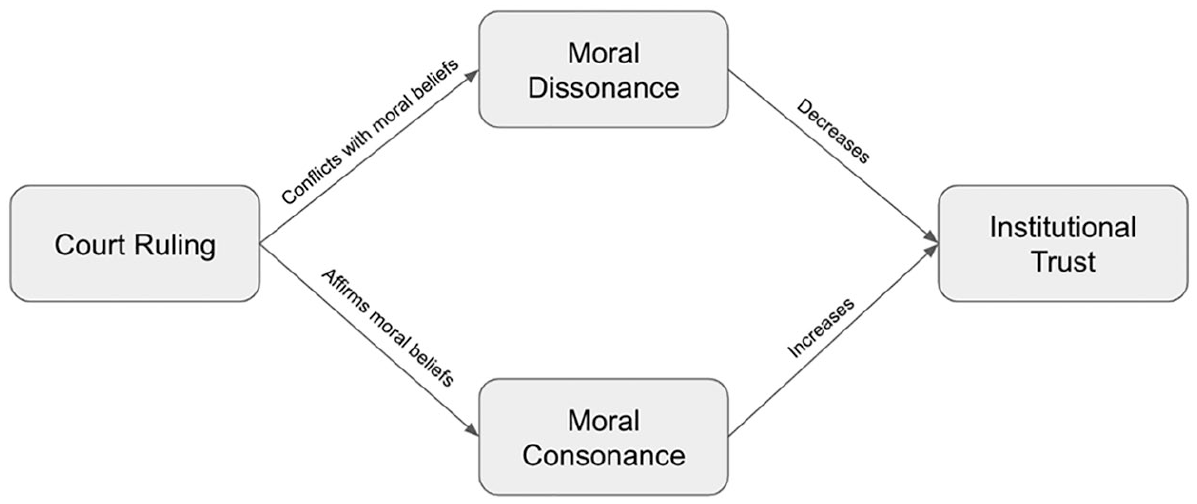
Schematic for main hypotheses.
We test these three hypotheses through two related survey experiments that presented a total of 1,048 respondents with hypothetical legal rulings that do or do not conflict with popularly held moral beliefs in China—filial piety in particular. We look at this dynamic in both a non-political criminal (homicide) and political criminal (official corruption) context. Existing research on political trust in China predominantly focuses on attitudes toward overtly political matters, such as corruption, inequality, education, and government service provision (Lu, 2014; Wang & Dickson, 2018). We use the homicide study to test whether trust toward the regime and its institutions suffers if they fail to uphold popular moral beliefs in legal decisions that do not directly pertain to political performance. Further, given that online discussion of official corruption tends to be censored, the second experiment shows the latent diversity in public opinion concerning corruption in different moral contexts.
Study 1: Homicide Experiment
For the homicide experiment, we randomly assigned respondents to two different legal rulings in which a man is being sentenced to death for murder. Each ruling varies only according to the stated reason for the murder, which does or does not include an extenuating circumstance that is designed to be perceived as a moral justification for the murder. In the baseline condition, the defendant murders a man for entering his home and destroying his valuables. In the moral dissonance treatment condition, the defendant murders a man for entering his home and beating up and sexually molesting his parents (see Table 1 for the full case vignettes, and Table A in the Appendix for the original vignettes in Chinese).
Legal Case Vignettes for the Homicide Experiment.
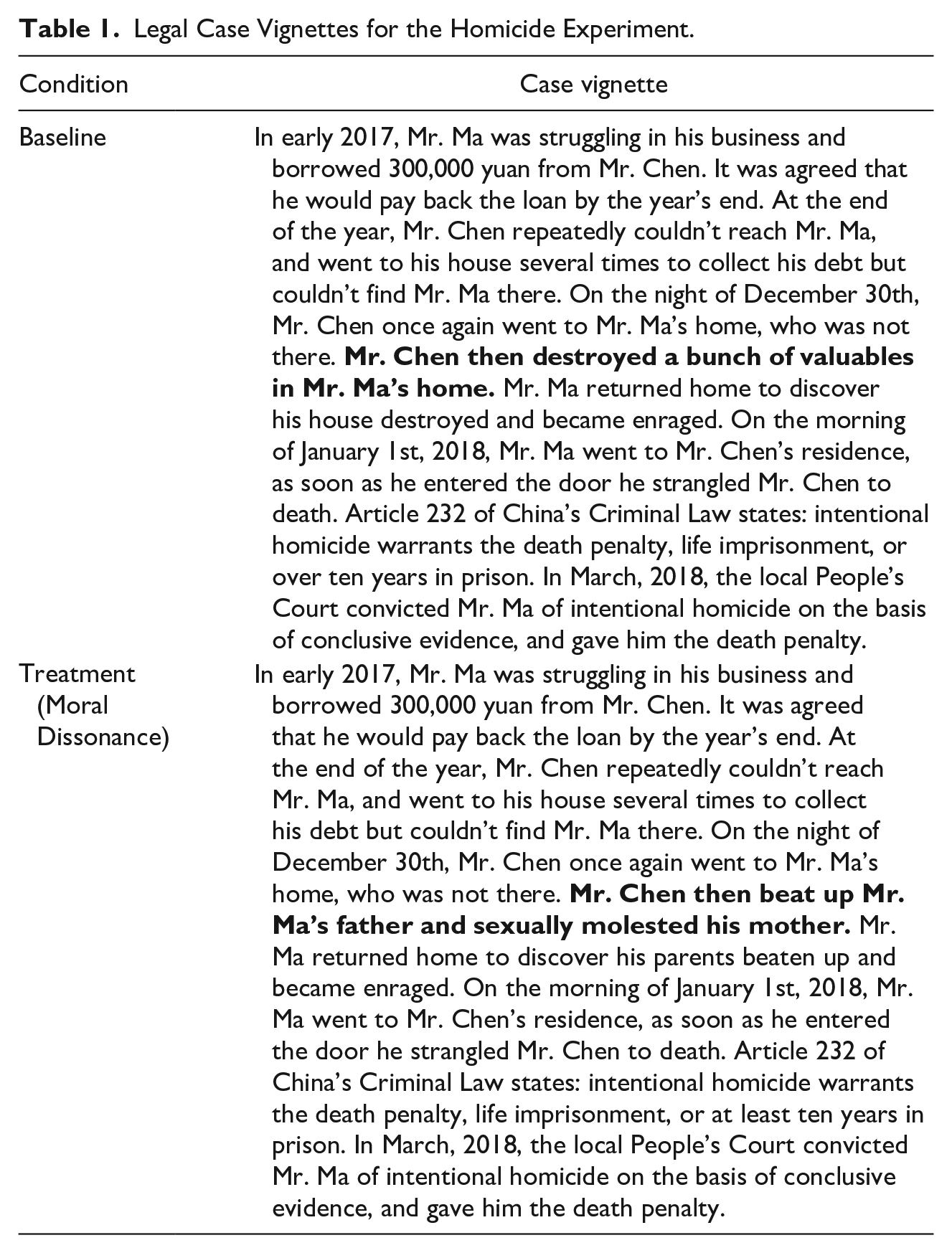
Our case detail makes it clear that the murder occurred in the morning of the day after the victim’s actions; therefore, there is no room for interpretation of the case as self-defense. In both scenarios, the defendant is sentenced to death based on Article 232 of China’s Criminal Law. Our hypothesis is that while the death sentence is technically within the bounds of the law in both scenarios, in the treatment condition individuals may view the murderer’s behavior as being justifiably filial and the legal ruling too harsh; in this case we expect the legal ruling to conflict with individuals’ moral beliefs and produce moral dissonance. We further hypothesize that moral dissonance leads to distrust in the court system and other state institutions. 5
Study 2: Corruption Experiment
Our corruption study tests both the moral dissonance and moral consonance hypotheses and therefore has one baseline condition and two experimental conditions. The baseline presents a case of a mayor caught embezzling ten million yuan (approximately $1.5 million USD in 2018) with no extenuating circumstances provided. The vignette then states that the mayor was sentenced to death based on Article 383 of China’s Criminal Law—a realistic sentencing in the Reform era for officials embezzling a large amount of public funds. 6
The vignette in the moral dissonance condition adds a line explaining that the official spent most of the embezzled funds on his mother’s cancer treatment. We hypothesize that people will be sympathetic toward the filial official and view the death penalty as an unreasonable punishment—even though the Chinese public is highly concerned with corruption. The vignette in the moral consonance condition adds a line to the baseline vignette explaining that the official spent most of the embezzled funds on gambling and mistresses. We hypothesize that the state’s harsh punishment of a dissolute official may affirm respondents’ moral belief in the reprehensibility of corruption, leading to increased support for state institutions. However, gambling and mistresses as charges of moral depravity are often included in the media’s portrayal of corruption cases, which may weaken the moral consonance treatment since, for the Chinese public, there is a common expectation that corrupt officials gamble and maintain mistresses. See Table 2 for the complete vignettes in English and Table B in the Appendix for the original Chinese.
Legal Case Vignettes for the Corruption Experiment.
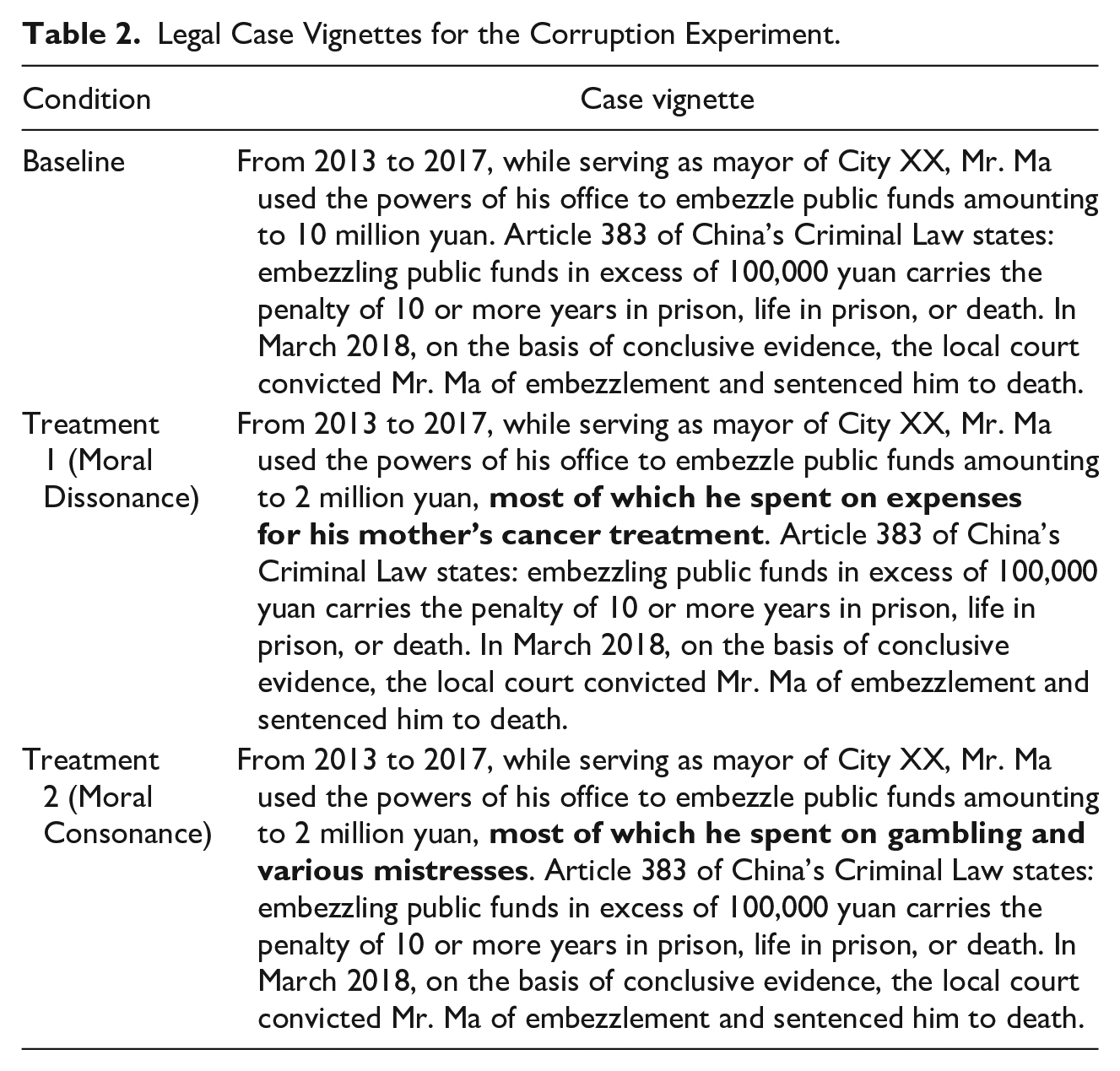
In both the homicide and corruption experiments, the moral-legal conflict in the dissonance scenario pertains to the norm of filial piety. We chose to investigate this norm because it was historically built into Chinese jurisprudence and features heavily in many recent high-profile moral-legal conflicts (Buoye, 2009). The sympathy toward individuals who break the law to help or protect their parents has frequently provoked Chinese citizens to call for a reprieve of the defendant, as in the Yu Huan and Zhang Koukou cases. The consonance scenario in the corruption experiment centers on the norms of propriety and monogamy—gambling and extramarital affairs violate popular moral beliefs and frequently trigger public, anti-elite outrage.
We deliberately designed our treatments to be as realistic as possible to increase the ecological validity of our findings. We patterned the vignettes for both studies on past Chinese legal cases, with some modified details. We asked Chinese lawyers and judges to read various versions of our vignettes and confirm the realism of the sentencing decisions. Furthermore, we wrote our vignettes based on existing media reporting of crimes and associated legal decisions so that they resembled news reporting respondents might encounter in real-life. The realism of treatments in survey experiments might come at the expense of treatment strength. But, an unrealistically strong treatment dosage impairs the ability of a study’s findings to travel to a real-world context.
We conducted both survey experiments online through Qualtrics on a random sample of 1,048 respondents: 420 respondents for the murder study and 628 for the corruption study. After acquiring their consent, we asked respondents to report their gender and age for pre-screening in order to ensure an even gender balance and an age distribution that resembled that of the general population, according to the National Statistical Bureau’s census in 2010. Before being randomized to the treatment, respondents answered five questions regarding their moral beliefs adapted from Haidt’s (2012) Moral Foundations Survey. These questions asked respondents to indicate how much they agreed with a particular moral statement, each of which represented one of the five primary moral foundations: authority/respect, loyalty, care, fairness, and sanctity. We expect that people’s moral values may correlate with their trust in regime institutions. Individuals who score high on authority/respect, loyalty, and sanctity may simply be more trusting of authority. Respondents then took a distractor math test to lessen experimenter demand—that is, changes in respondents’ behavior due to cues about the experimenter’s expectations of them.
In the post-treatment survey, we asked respondents a series of questions regarding the perceived reasonableness of the ruling, their trust in the courts, and other state institutions, as well as personal background information (age, education, and income). To measure moral dissonance/consonance, we asked respondents to evaluate the reasonableness (合理) of the ruling. If the ruling conflicts with respondents’ moral intuitions, we expect them to find it less reasonable (more dissonant) and vice versa. We followed this question with another math distractor and then presented a battery of questions about respondents’ trust in eight entities: the People’s Daily, the National People’s Congress, their local government, the central government, civil servants, the courts, the police, and the Internet. We include the Internet as a measure of a non-state entity. Finally, we include an additional measure of regime trust by asking the respondent whether they agree or disagree with the statement that “Chinese citizens should not change their citizenship under any circumstances.” This measure does not directly ask the respondent to evaluate the regime, making self-censorship less likely; it also presents the respondent a situation that may occur in real life, making it easier to answer than general and vague questions of regime trust. In addition, if “exit” is the ultimate measure of system support (Hirschman, 1970), this question best measures the likelihood for a Chinese citizen to reject the system. See Table C in the Appendix for descriptive statistics.
When Morality and Law Collide: The Effects of Moral-Legal Conflict
Our moral dissonance hypothesis expects that legal rulings contradicting popular morality will cause individuals to be dissatisfied with these decisions, while our moral consonance hypothesis predicts the reverse. Both experiments strongly confirm the moral dissonance hypothesis and lend some credence to the moral consonance hypothesis. Figures 2 and 3 present group averages for levels of perceived reasonableness of the legal ruling for the homicide and corruption experiments, respectively. Compared to the baseline, respondents in the dissonant treatment condition in the homicide study—harshly punishing a murderer who avenged his parents—were more likely to find the judge’s ruling less reasonable despite its explicit accordance with the letter of the law. This effect (mean difference = −0.336, p < 0.001) represents an 8.4% decrease in perceived reasonableness on this scale. We similarly find that respondents who receive the dissonance condition in the corruption experiment—severely punishing a corrupt official who spent the embezzled funds on his mother’s cancer treatment—were significantly more likely to feel dissatisfied with the ruling (mean difference = −0.268, p < 0.001), a 6.7% shift.
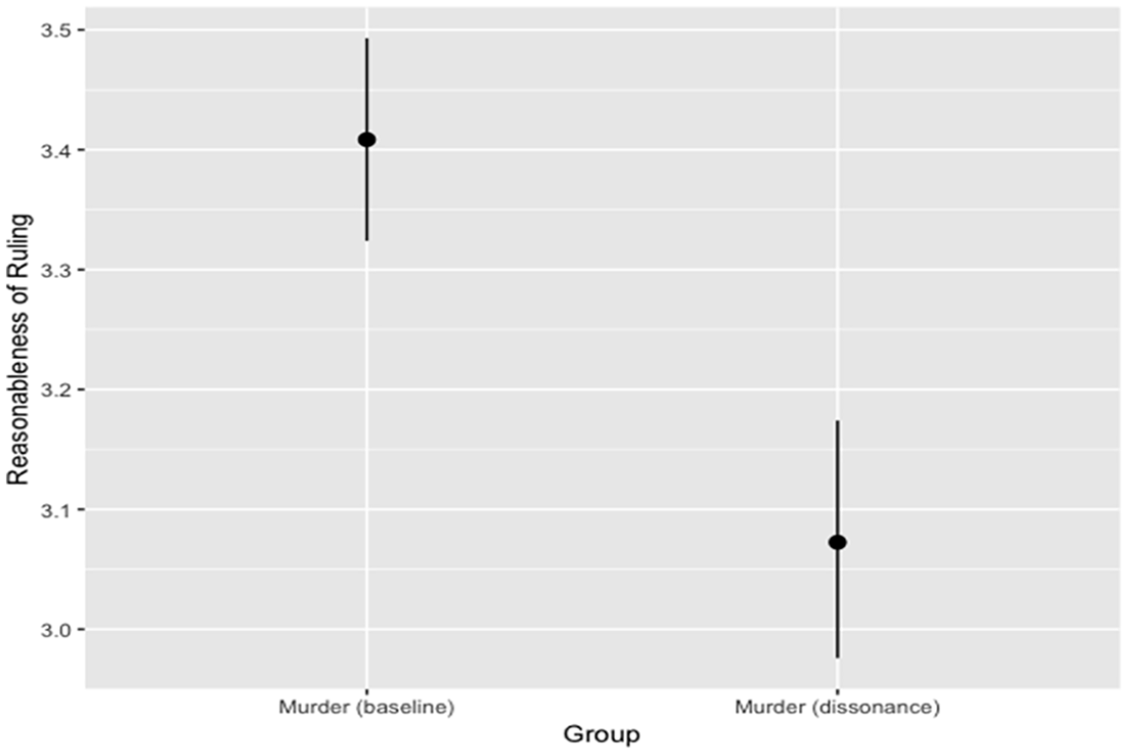
Group averages for perceived reasonableness of the legal ruling with 95% confidence intervals (murder experiment).
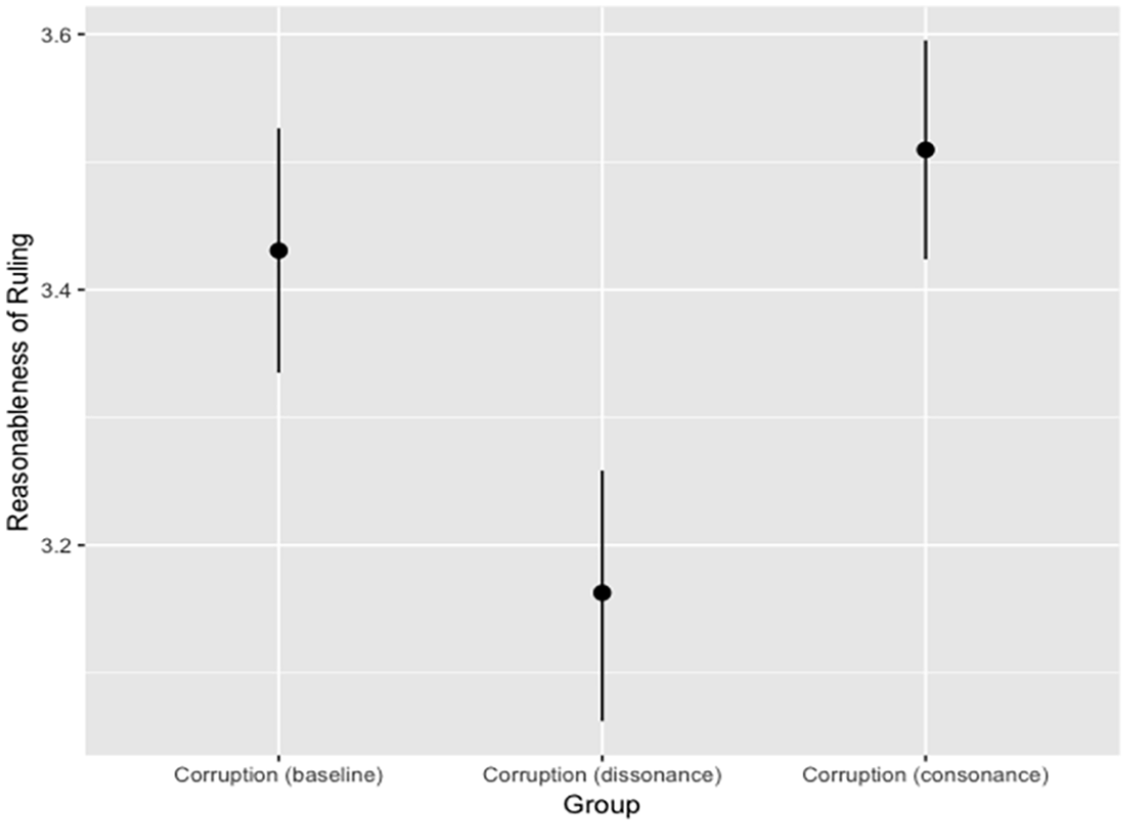
Group averages for perceived reasonableness of the legal ruling with 95% confidence intervals (corruption experiment).
In the corruption study, we do not find a statistically significant difference between the effects of the moral consonance treatment and the baseline condition. Although respondents in the consonance treatment group—harshly punishing a corrupt official who spent embezzled public funds on extramarital affairs and gambling—are more likely to find the ruling reasonable (mean difference = 0.079, p = 0.48), this difference is not statistically significant from the baseline; however, it is significantly lower than the dissonance condition (mean difference = −0.347, p < 0.001). The lack of significant difference between the consonance and baseline conditions confirms our expectation that the consonance condition may be similar to existing popular perceptions of official corruption. Indeed, anti-corruption campaigns throughout the Reform era have always highlighted the moral depravity of corrupt officials, with publicized verdicts often citing lurid details like spending embezzled funds on gambling and mistresses; this may have informed people’s prior beliefs about official corruption. Since the baseline condition does not specify any details regarding the behavior of the corrupt officials, respondents may simply be imputing immoral behavior to them based on these prior perceptions. The ongoing anti-corruption campaign under Xi may be further priming these beliefs. In light of this, it is surprising that we still find a significant relationship between the dissonance vignette and moral dissonance, indicating citizens can sympathize with corrupt officials if they are filial to their parents.
We find evidence that individuals’ moral beliefs moderate their reaction to the legal ruling, but this effect is only significant in the homicide scenario (Table 3). Since the dissonance treatments relate to filial piety, we expect that people who score high on the authority/respect moral foundation—agreeing with the statement “People should always conform to the traditions of society”—will be more likely to find the ruling unreasonable if the sentenced individual was filial. We find this to be true in the homicide study: respondents who have stronger moral attachments to authority and tradition experience stronger moral dissonance when the sentenced individual was acting out of filial piety (Table 3, Model 2). In the corruption study, we test the potential moderating effects of authority and sanctity, since the dissonance treatment relates to filial piety and the consonance treatment relates to sexual indiscretion. We do not find significant moderating effects (Table 3, Model 4), though the signs on the coefficients are in their expected directions. People scoring high on authority were more likely to find the ruling unreasonable if the official used the embezzled money to care for his mother, while respondents who scored high on sanctity—agreeing with the statement “Chastity is an important and valuable virtue”—were more likely to accept sentencing corrupt officials to death if they were involved in prostitution and gambling. The state media’s frequent depiction of corruption as something especially depraved, involving prostitution and gambling, etc., may explain why the corruption scenario activates sanctity-related moral beliefs.
Logit Models With and Without Interaction Effects for Perceived Reasonableness of the Legal Ruling.
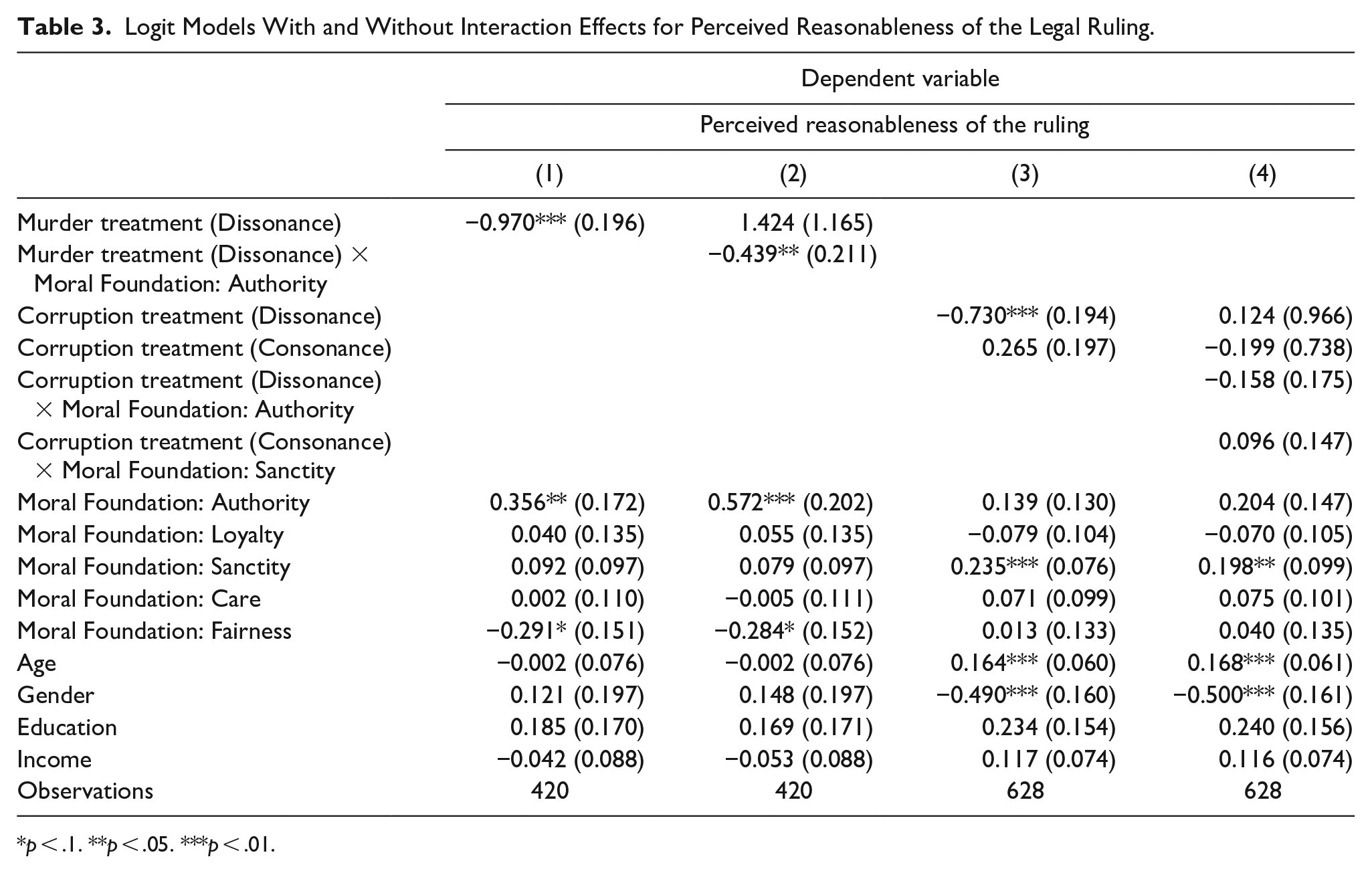
p < .1. **p < .05. ***p < .01.
Moral Dissonance and Institutional Trust
Next we consider whether and how moral-legal conflicts affect people’s trust in state institutions. To reiterate a key lesson from the case-study section: the CCP sometimes intervenes to alleviate moral dissonance and sometimes does not. This suggests that moral dissonance in court cases is perceived to be a serious threat to the CCP’s popularity, but not so great that it always overrides the competing imperative of legal development.
We find no significant differences between the baseline and treatment conditions in terms of regime trust (Table 4). Distrust of the local and central governments is higher for the dissonance treatments, though not significantly so. Looking at the question regarding citizenship change, we do not find significant differences between the treatment and baseline groups in either the murder or corruption scenarios. The relative values of the averages for the dissonance treatments, however, conform to our theoretical expectations. Compared to baseline, respondents in the dissonance treatment groups are more likely on average to support the statement that Chinese citizens should be able to change their citizenship regardless of circumstances.
Moral Dissonance and Consonance Treatments and Institutional Trust.
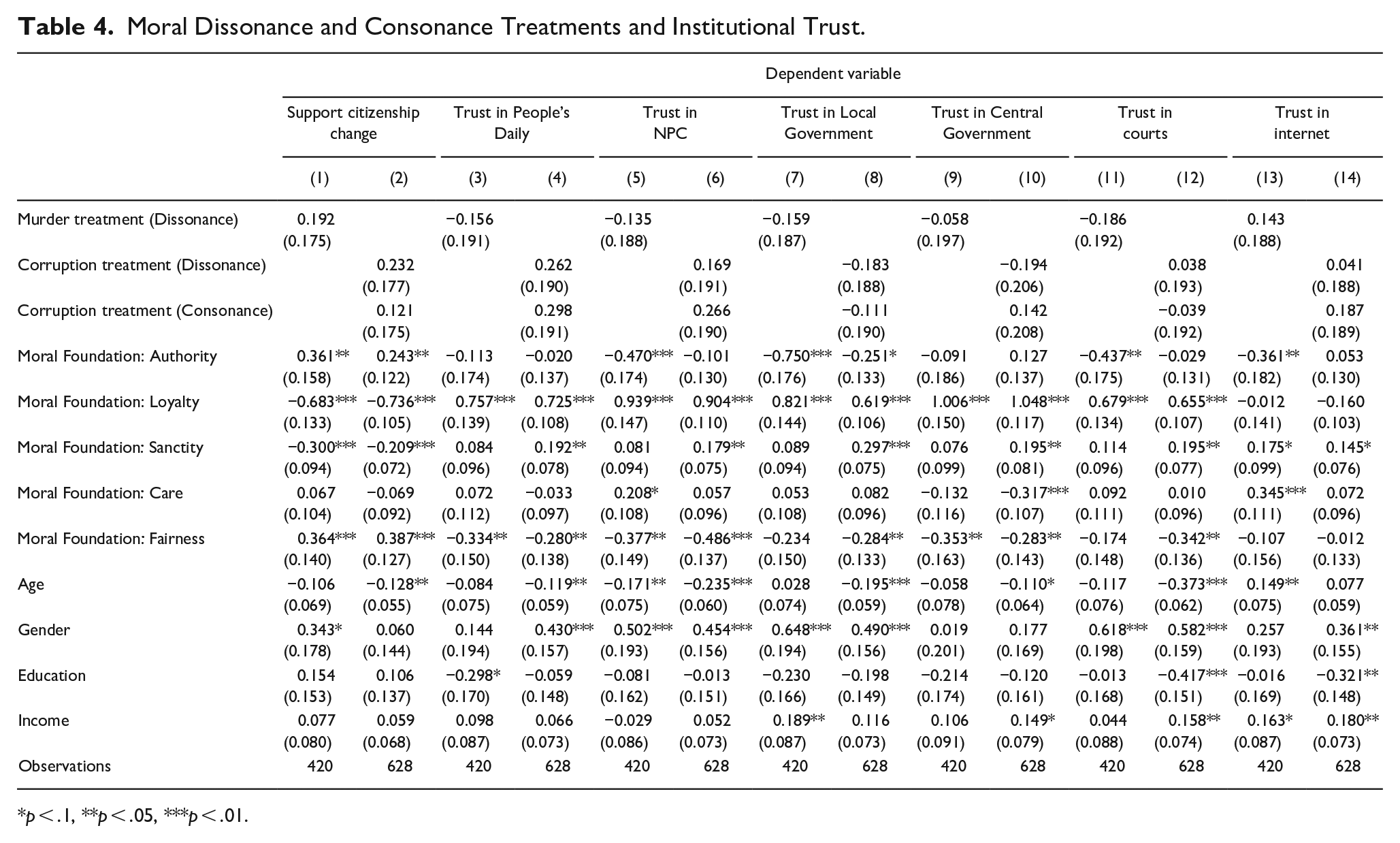
p < .1, **p < .05, ***p < .01.
While we do not find a direct treatment effect for moral-legal conflict on institutional trust, we attribute this to the weakness of the treatment and the small size of the sample. First, the treatment is a single court case with minimal description, which pales in comparison to the emotional gravity and societal impact of those cases described in our case studies. Second, our study was underpowered considering the small effect size. For the trust variables, the power of all our models was below 0.3.
We find statistically significant correlations between individual moral beliefs and indicators of institutional trust (Table 4). Those who score high on loyalty and sanctity as moral foundations are more trusting of state institutions in general and less likely to approve of Chinese citizens freely changing their citizenship. Respondents who score high on authority, counterintuitively, are much less trusting and are more likely to support citizenship change. Respondents who score high on fairness are also less trusting of state institutions, though this moral foundation seems to be capturing people with strong beliefs in equality—for example, “everyone deserves an equal opportunity to succeed.” Interestingly, these moral foundations map onto pro-state and anti-state sentiment in a way that is somewhat similar to the U.S. In the U.S., loyalty, sanctity, and tradition foundations correlate with conservative political beliefs, while care and fairness are mainly associated with liberal beliefs (Haidt, 2012).
Conclusion and Future Directions
Our study illustrates the autocrat’s moral-legal dilemma: the competing needs for legal development and the satisfaction of popular justice concerns, each of which might suffer if the authoritarian regime favors one at the expense of the other. Four case studies demonstrate the Chinese regime’s selective responsiveness to popular moral demands in legal decision-making, while the experimental results find legal rulings that conflict with popular morality cause individuals to feel dissatisfied with the verdict, even when it strictly reflects the letter of the law. Moreover, we find this effect to be stronger among respondents who score high on authority/respect, presumably because they are more sensitive to violations of filial piety.
Unlike societies with the rule of law, where moral-legal conflicts do not seem to damage public trust in legal and regime institutions, authoritarian regimes may sometimes need to shore up institutional trust by appeasing popular morality. However, while deference to popular morality may boost political support in the short term, it may come at two costs. First, submission to popular justice might reduce the regime’s authority to elicit legal compliance from society—rule by law may become more difficult over time. Second, political intervention in legal decisions may hinder efforts to establish a professional court system that helps with economic development and effective resolution of societal conflicts.
Our study contributes to the burgeoning literature on courts and judicial processes in authoritarian regimes. Instead of looking at whether the presence or absence of institutions (e.g., courts, legislatures, parliaments) confers support to an authoritarian regime, we argue that the substance of institutional performance matters.
In regimes where the division between the regime and the courts is minimal, the perceived justness or unjustness of the courts’ decisions reflects on the moral authority of the regime itself. Unable to rely on the procedural legitimacy of truly independent courts, authoritarian regimes might need to calibrate judicial outcomes to popular morality, either to boost their moral standing or to avoid jeopardizing their legitimacy. While recent research has shown the importance of “judicial rituals” in providing a veneer of justice or fairness to court decisions that repress regime insiders (Shen-Bayh, 2018), we recommend that scholars also look at non-political legal decisions in other criminal, commercial, and civil arenas. After all, it is in precisely these areas where a vast majority of legal decisions in any society are made. Indeed, in China, public outrage over perceived injustice in the rendering of decisions is commonplace, and the regime is often willing to realign these decisions with popular moral expectations.
Our study opens up four avenues of future research. First, our experiments primarily focus on judicial decisions rather than procedures. Future research may investigate whether variations in procedure influence the perceived legitimacy of legal decisions and regime institutions. Second, understanding the party-state’s selective responsiveness to popular morality will require more systematic inquiry into the rationales for intervention and nonintervention. Third, our quantitative analysis shows the diversity of individual moral foundations in China and their potential to influence individuals’ moral judgments and political support. Future research may explore this diversity in moral foundations—especially in areas that are contentious—within nondemocratic regimes. Can contentious court decisions become politicized in China like Roe v. Wade (1973) in the U.S.?
Finally, at a more theoretical level, our study highlights the tension between the two biggest responsibilities of every government—responsiveness to public opinion and effective governance for the common good. Like morality and legality, responsiveness and effectiveness are neither mutually exclusive nor completely overlapping; striking the perfect balance between the two is the holy grail of governance. Our study concludes that such a tradeoff between regime objectives is real, and that it warrants more normative consideration and systematic empirical assessment.
Supplemental Material
ML_project_final – Supplemental material for The Autocrat’s Moral-Legal Dilemma: Popular Morality and Legal Institutions in China
Supplemental material, ML_project_final for The Autocrat’s Moral-Legal Dilemma: Popular Morality and Legal Institutions in China by Iza Ding and Jeffrey Javed in Comparative Political Studies
Supplemental Material
ML_Survey_822 – Supplemental material for The Autocrat’s Moral-Legal Dilemma: Popular Morality and Legal Institutions in China
Supplemental material, ML_Survey_822 for The Autocrat’s Moral-Legal Dilemma: Popular Morality and Legal Institutions in China by Iza Ding and Jeffrey Javed in Comparative Political Studies
Footnotes
Appendix
Descriptive Statistics for Major Variables.
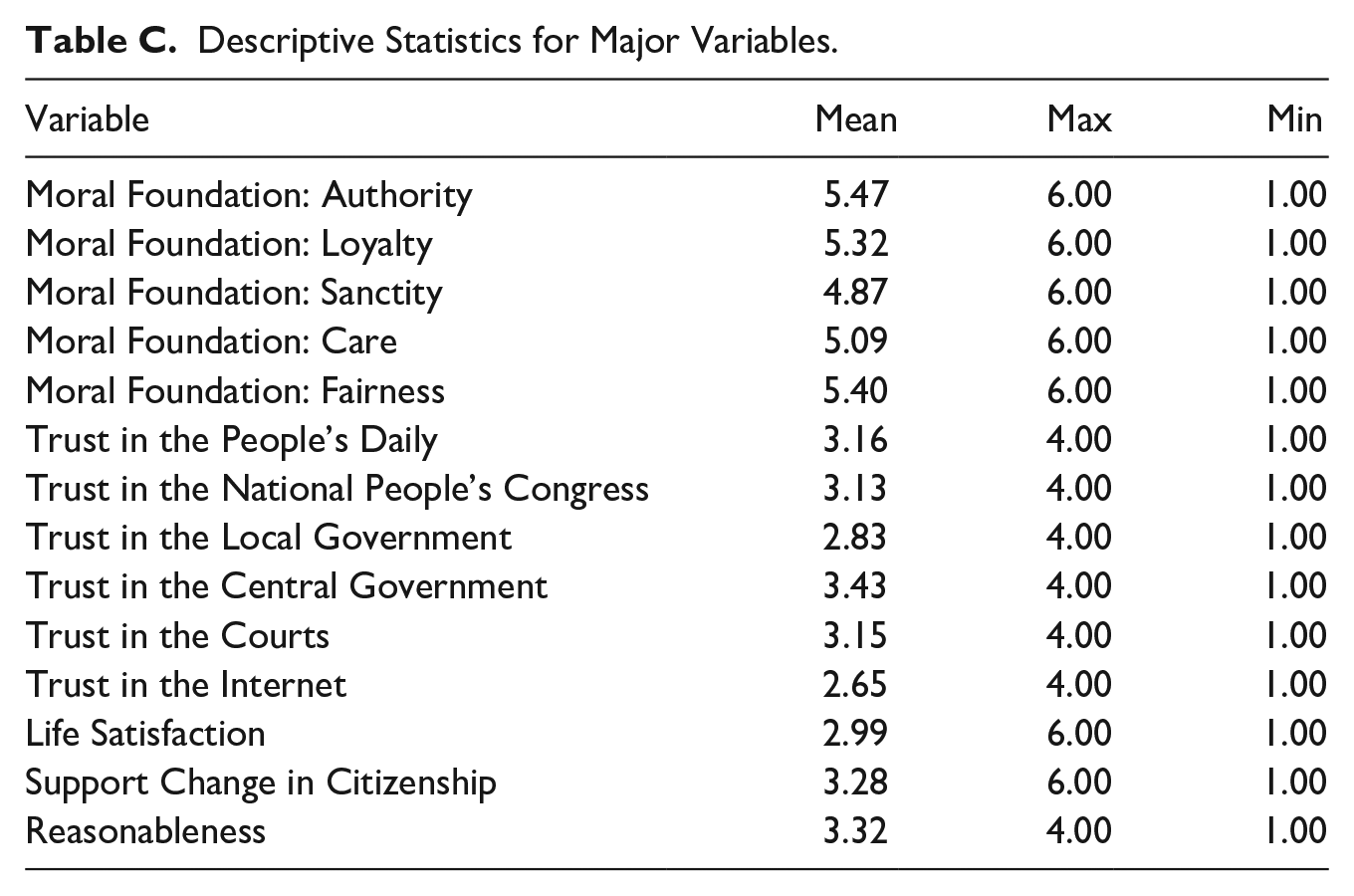
| Variable | Mean | Max | Min |
|---|---|---|---|
| Moral Foundation: Authority | 5.47 | 6.00 | 1.00 |
| Moral Foundation: Loyalty | 5.32 | 6.00 | 1.00 |
| Moral Foundation: Sanctity | 4.87 | 6.00 | 1.00 |
| Moral Foundation: Care | 5.09 | 6.00 | 1.00 |
| Moral Foundation: Fairness | 5.40 | 6.00 | 1.00 |
| Trust in the People’s Daily | 3.16 | 4.00 | 1.00 |
| Trust in the National People’s Congress | 3.13 | 4.00 | 1.00 |
| Trust in the Local Government | 2.83 | 4.00 | 1.00 |
| Trust in the Central Government | 3.43 | 4.00 | 1.00 |
| Trust in the Courts | 3.15 | 4.00 | 1.00 |
| Trust in the Internet | 2.65 | 4.00 | 1.00 |
| Life Satisfaction | 2.99 | 6.00 | 1.00 |
| Support Change in Citizenship | 3.28 | 6.00 | 1.00 |
| Reasonableness | 3.32 | 4.00 | 1.00 |
Acknowledgements
The authors would like to thank Deng Yanhua, Martin Dimitrov, Gao Xiang, Mary Gallagher, Nico Howson, Huang Haifeng, Eddy Malesky, Meng Tianguang, Paul Schuler, Dan Slater, Mike Thompson, Yan Yunxiang, participants of the Global Politics Workshop at the University of Pittsburgh, Historical Legacies Workshop at the University of Michigan, Workshop on Chinese Politics and Society at Shanghai Jiao Tong University, China-Vietnam Workshop at McGill University, and Workshop on Political Science and Methods at Tsinghua University, as well as three anonymous reviewers for their helpful feedback.
Declaration of Conflicting Interests
The authors declared no potential conflicts of interest with respect to the research, authorship, and/or publication of this article.
Funding
The authors disclosed receipt of the following financial support for the research, authorship, and/or publication of this article: This research received financial support from the Department of Political Science at the University of Pittsburgh and the Lieberthal-Rogel Center for Chinese Studies at the University of Michigan.

Supplemental Material
Supplemental material for this article is available online.
Notes
Author Biographies
References
Supplementary Material
Please find the following supplemental material available below.
For Open Access articles published under a Creative Commons License, all supplemental material carries the same license as the article it is associated with.
For non-Open Access articles published, all supplemental material carries a non-exclusive license, and permission requests for re-use of supplemental material or any part of supplemental material shall be sent directly to the copyright owner as specified in the copyright notice associated with the article.
