




Abstract
The presence of natural resources makes civil conflicts more likely to erupt, last longer, and more difficult to end. Yet rebels do not always exploit resources wherever they are present. Why? I argue that rebels extract more resources when they compete with governments over territorial authority. Territorial competition facilitates black market access, generates financial pressure, and produces governance incentives for rebels to extract natural resources. I test this proposition in a two-tiered research design. First, I show globally that moderate territorial control predicts more resource extraction by rebels. Subsequently, I focus on the example of ivory poaching which offers a rare glimpse into the usually hidden resource extraction process. I match spatially disaggregated conflict event data to subnational poaching data in conflict-affected African countries. Results show that rebels seeking territorial control substantially increase poaching rates. These findings highlight the strategic conditions under which territorial competition shapes rebel criminal behavior.
Introduction
When do rebel groups extract natural resources during civil conflicts? An extensive literature links rebels’ exploitation of lootable natural resources to armed conflict. When insurgents can mine and sell diamonds, profit from cocaine processed from coca plants, or harvest and smuggle timber, conflicts are more likely to erupt, last longer, and are much more difficult to end. 1 Although precise estimates are difficult to obtain, the protracted conflicts these resources help finance kill thousands of civilians and combatants alike (Gates et al., 2012). Moreover, resource extraction incurs enormous ecological costs, such as toxic contaminants from mining chemicals, large-scale deforestation from illegal logging, or population-threatening hunting of high-value wildlife (Daskin & Pringle, 2018; Gaynor et al., 2016).
Existing research, however, often assumes that when resources are present, rebels will exploit these resources when they have an opportunity to do so. 2 Yet rebels do not automatically loot resources over the course of a conflict: almost 20% of all rebel groups between 1990 and 2012 initiated or ended at least one type of resource extraction over the course of a conflict. 3 Why?
I argue that insurgents extract resources as a consequence of their armed struggle against a government over territorial authority. When rebels lack territorial control, they also lack the necessary market access to start extracting resources. Alternatively, without income or civilian support structures generated at least partially through resource extraction it is difficult for rebels to firmly establish territorial control. Instead, it is when rebels actively compete with a government to establish political authority over territory that they intensify resource extraction.
I identify three mechanisms that drive the link between territorial competition and resource extraction. First, territorial competition erodes borders and undermines law enforcement, enabling easier access to black markets where rebels can sell or smuggle illicit goods. Second, rebels who compete with a government over territory have organizational pressure to finance increasingly expensive warfare. And third, insurgents seeking political authority over territory can use illicit resource extraction as a governance strategy to generate civilian cooperation. Together, these mechanisms imply that higher levels of territorial competition should lead to more extensive resource extraction by rebels.
I test this proposition in a two-tiered research design. In a macro setting, I first test my main hypothesis by combining data on rebel groups’ level of territorial control with information on rebel funding from natural resources, using a global sample of 270 rebel groups between 1989 and 2012 (Cunningham et al., 2013; Walsh et al., 2018). Second, to investigate the proposed causal mechanisms in greater detail, I turn to a micro-level analysis of territorial competition and illegal ivory poaching in Africa.
Ivory poaching is uniquely suited for studying the mechanisms of the competition-extraction link, since it is a rare type of resource where we have direct evidence on the extraction process itself. Resource extraction by rebels is usually hidden from outside observers. This makes it extremely difficult to empirically test theories that link conflict and resource extraction. To overcome this challenge, I use an original data source that allows me to capture poaching rates directly: the Monitoring of Illegally Killed Elephants (MIKE) program under the Convention on International Trade in Endangered Species of Wild Fauna and Flora (CITES) that collects annual poaching rates across the African continent (CITES, 1999).
I match the spatial extent of MIKE monitoring sites to data on the geographic location of conflict events from the Armed Conflict Location and Event Dataset (ACLED) (Raleigh et al., 2010). To distinguish territorial competition from regular battlefield violence, I consider a subset of ACLED events, such as territory acquisition or headquarter establishment. I control for a wide range of conflict variables as well as site fixed effects to disentangle the competition-extraction relationship from alternative explanations, such as battlefield violence and state failure.
Results from both the macro- and micro analysis are consistent with my expectation that territorial competition increases rebels’ level of resource extraction. I show in the macro-level analysis that rebels across the globe engage in more illegal resource exploitation when they hold moderate levels of territory. In the micro-level setting, I document evidence that rebels who compete with a government over the strategic control of territory increase poaching rates by 9% to 36%. Crucially the effect of territorial competition events on poaching rates is much stronger than the effect of all conflict events, suggesting that the effect is driven by territorial competition instead of general instability due to conflict. I also report conditional effects in support of the market access, financial, and governance mechanisms specified above.
This paper helps to fill a blind spot of research on civil conflict and lootable natural resources. Previous research largely assumes resource endowments are exogenously given and proceeds to study the consequences of natural resources on civil conflict onset, duration, or termination. 4 I relax this assumption by endogenizing rebels’ choice to illegally exploit resources. This allows me to unpack the causal pathway between resource presence and exploitation. Future research on the resources-conflict link needs to take this pathway into account to fully understand the conditions under which resources lead to conflict.
This study also contributes to the growing body of research on rebel governance in conflict zones (Arjona et al., 2015; Stewart, 2018). My theory, in contrast to existing research that links rebel governance to outcomes such as service provision or civilian victimization, sheds light on an underexplored, but core function of rebel governance: the conditions under which armed nonstate actors engage in criminal behavior, such as illegal resource exploitation. This approach contributes to the literature on how criminal organizations and different types of crime emerge. To date, this field of research has not systematically explored the role of strategic territorial competition between rebels and the state (Skaperdas, 2001).
Finally, this study adds to our understanding of the ecological consequences of armed conflict (Gaynor et al., 2016; Hendrix et al., 2016). The study’s empirical focus on ivory poaching adds nuance to explanations of how human conflict drives the alarming decline of the African elephant population—one of the most severe ecology crises on the globe and part of a global criminal enterprise in organized illegal wildlife trade that generates between US$7 billion and $23 billion in illicit revenue annually (Nellemann et al., 2013). Adding to ecological research that documents a close relationship between conflict and poaching (Daskin & Pringle, 2018; Gaynor et al., 2016), my theory and empirical results highlight that it is primarily the competition between rebels and states over territory that drives the conflict-poaching relationship.
Research on Resource Exploitation and Rebellion
Studies that link natural resources to civil wars tend to assume that it is the presence of resources that increases the likelihood of rebellion and protracts conflicts. 5 Arguments differ, however, about the precise context under which resources affect conflict. Some studies suggest that while lucrative resources initially increase the risk of violence, very high levels of resource income lower conflict risks, as high resource revenues allow governments to either buy off or repress potential rebels (Collier et al., 2009; Fjelde, 2009).
Others argue that particularly lootable resources are most relevant for rebellions. 6 Lootable resources include minerals, such as gold, alluvial diamonds, tungsten, or copper; high-value wildlife, such as ivory or rhino horn; plants that can be processed into highly lucrative narcotics, such as coca or poppy plants; or even on-shore petroleum or gas fields. In contrast to labor-, technology-, and capital-intensive resources, such as off-shore petroleum or oil fracking, lootable resources have several desirable features for rebel organizations: they are highly profitable, require little technological investment, and can be easily taxed. Examples include UNITA’s mining and selling of diamonds to finance their struggle against the Angolan government and Charles Taylor’s National Patriotric Front of Liberia (NPFL) that mined/harvested and sold diamonds, iron, rubber, and timber to fund their fight against the Liberian government in the 1990s (Le Billon, 2008).
Common to most of the studies on the resource-conflict link is the assumption that if resources are present, particularly lootable resources, rebels will inevitably exploit them. Only a few studies show that insurgents vary their resource production for specific types of resources in selected countries, such as opium in Afghanistan or oil theft in Syria (Do et al., 2018; Lind et al., 2013; Ocakli & Scotch, 2017). But neither do rebels automatically extract resources when they are present, nor does this hold true for only certain types of resources in specific contexts. Figure 1 plots the number of of natural resources that selected groups use for financing rebellion. It documents considerable variation in the number of resources across rebels in the same country and for the same rebel group over time across African, Asian, and even European civil conflicts. Given that the plot shows variation within countries, where resource endowments remain more or less constant, the variation in rebels’ degree of resource extraction is puzzling.
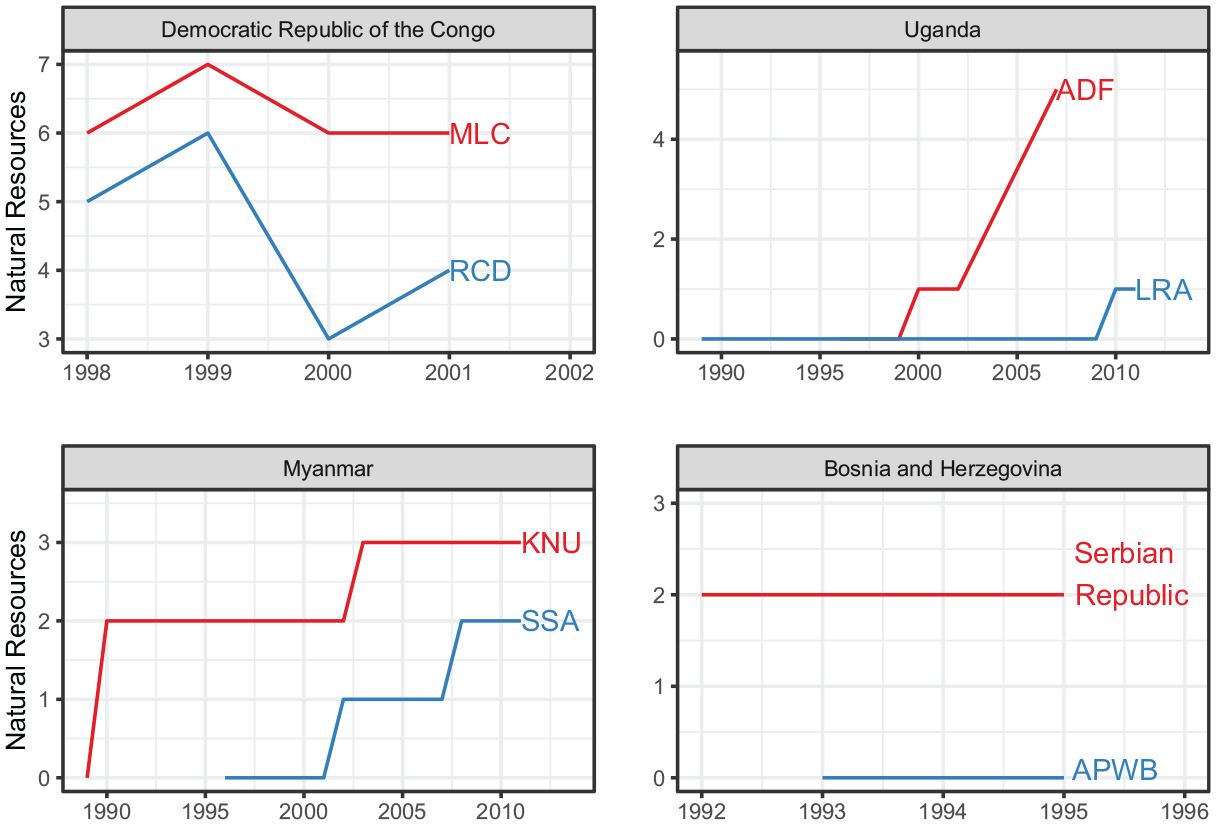
Varying levels of resource extraction by selected rebel groups.
Existing arguments cannot easily explain this puzzle. One explanation might be that it is the location of natural resources within a country that drives the resource-conflict link, and thus the variation observed in Figure 1. Natural resources tend to increase the risk of conflict onset and prolong duration when they are located in or close to the areas where fighting is concentrated and in settlement areas of marginalized groups (Hunziker & Cederman, 2017; Lujala, 2010). Yet, without detailed information on the resource extraction volume, a spatial overlap of resource and conflict or marginalized group locations cannot tell us whether rebel presence is in fact correlated with higher resource production.
Another argument is that rebels’ intensity of resource extraction is governed by the numerous financial and political challenges of organizing warfare and controlling contested territory (Weinstein, 2007). Intensified resource extraction could be a likely consequence of the strategic decision calculus of organizing rebellion. While many studies have explored the consequences of territorial control and rebel governance for public goods provision, civilian victimization, or effectiveness of rebel administration, research on resource production as a function of rebel governance has been largely neglected (Mampilly, 2011; Stewart, 2018; Weinstein, 2007). 7 In fact, studies on the organization of rebellion typically assume that rebel access to resource endowments is exogenous, and not a strategic choice by rebels (Lujala, 2010; Weinstein, 2007).
In contrast, I argue that resource location matters, but only if it overlaps with the territorial and governance interests of rebel groups. Specifically, I show that market opportunities, financial incentives, and governance ambitions that arise from rebels’ strategic territorial interests intensify their resource extraction activities.
How Territorial Competition Shapes Natural Resource Extraction in Civil Conflicts
I expect that rebel organizations which violently and politically challenge the territorial authority of a state will intensify their resource extraction activities. 8 Civil conflicts are, at their core, a competition among organized armed groups—typically a government and one or more rebel organizations—over the control of territory, defined as variation in “the level of, presence of, and access enjoyed by political actors in a given place and time” (Kalyvas, 2006, p. 210), both in secessionist conflicts and in conflicts over the control of a central government.
Territorial competition in this sense denotes violent and nonviolent activities by rebel and government forces to establish physical presence to and political authority over the population in a given territory. 9 Rebel groups seek strategic control over territory to be able to extract resources from this population in form of taxes, information, and recruits (Arjona et al., 2015; Kalyvas, 2006; Stewart, 2018; Weinstein, 2007). Examples include establishing bases and governance structures or targeting the other sides’ political physical and symbolic institutions.
Rebels’ de facto ability to challenge and, in some cases, even establish territorial control varies across and within conflicts, however. The Irish Republican Army (IRA), for instance, never held systematic territorial control during the Northern Ireland conflict (Sànchez-Cuenca, 2007). In contrast, the Liberation Tigers of Tamil Eelam (LTTE) in Sri Lanka established significant territorial presence and governance structures for long periods of time during its conflict with the Sri Lankan government (Mampilly, 2011). It is this variation in degree of territorial control that shapes rebels’ opportunities and incentives to engage in and intensify their illicit resource extraction through three mechanisms.
This process creates a dynamic that is similar to the way criminal groups in non-civil conflict contexts—cartels, gangs, and mafia-like organizations—compete with state authorities (or each other) over territory to access and control illegal markets (Skaperdas, 2001). By violently challenging the state’s territorial control or by filling a power vacuum as alternative enforcers of property rights such criminal organizations achieve access to and control over illicit markets, particularly in locations where state institutions are weak and trust is low (Gambetta, 1993; Skaperdas, 2001). Consequently, in the same way that territorial control enables “traditional” criminal organizations to access and control markets, rebel groups who challenge the territorial control of a state improve their access to or even control of illicit markets to which they can smuggle and sell illicitly produced resources.
Such institutional erosion not only allows insurgents to intensify their own illicit resource extraction, but also facilitates rebels’ connections to criminal networks that are necessary to sell products from resources, such as diamonds, gold, or narcotics processed from plants (Lind et al., 2013). Particularly important in this erosion process is the bypassing of national borders (Salehyan, 2009). Porous borders allow rebels to smuggle illicit goods either by themselves or through middle-men. In Angola’s civil war, for example, UNITA rebels relied on cross-border smuggling networks to turn their physical control over diamond mines into monetary income (Global Witness, 1998).
One consequence of these monetary incentives is that rebels who have external financial support have fewer reasons to engage in illicit resource extraction. The Taliban’s involvement in the opium trade is an instructive example. Opium has long played a large role in financing the Taliban insurgency after the NATO invasion. But it was particularly when donations from citizens in the Gulf states to the Taliban dried up that the Taliban leadership increased its involvement in the opium trade from simply taxing opium production to engaging in all aspects of opium production to trade (Moreau, 2013; Piazza, 2012).
Where rebels try to establish territorial control yet have not completely succeeded in doing so they can use violence to deter civilians from defection or punish them for it retroactively (Kalyvas, 2006). Rebels can and do use this violence to coerce civilians to assist in the resource extraction process, either by taxing civilian production or through forced labor.
However, violence alone can be ineffective to ensure civilian compliance with the insurgents’ rules. Instead, rebels need often at least a modicum of legitimacy among civilians to govern effectively. Including civilians in the resource extraction process can be one strategy that complements violence as a means of political rule by rebel groups. 10 Typically, rebels include civilians in resource extraction by allowing or encouraging them to produce raw materials for illicit goods. This production can take different forms: civilians may become coca or poppy farmers, participate in hunting groups (such as for ivory), or become part of the work force in artisanal mines. At the same time, rebels provide protection to civilians from state authorities. Such a strategy allows rebel groups who seek to govern a specific territory to provide civilians with a potentially lucrative source of income, thereby increasing their legitimacy vis-á-vis the government in contested areas. The FARC’s involvement in drug manufacturing and trafficking in Colombia exemplifies the process of resource extraction as a governance strategy. During their conflict, the group repeatedly “defended its practice of promoting coca cultivation and then taxing drug farmers for protecting their crops on the grounds that impoverished peasants in remote, roadless areas lack alternatives to make a living” (Otis, 2014, p. 4).
Empirical Implications
To illustrate that it is particularly territorial competition between a rebel group and a state that drives a group’s extraction activities, it is useful to compare the mechanisms described above to the two other possible territorial conflict scenarios (see Figure 2 above): rebel groups with no territorial control and groups with firmly established, large areas of territorial control, so-called “liberated zones” (Kalyvas, 2006).
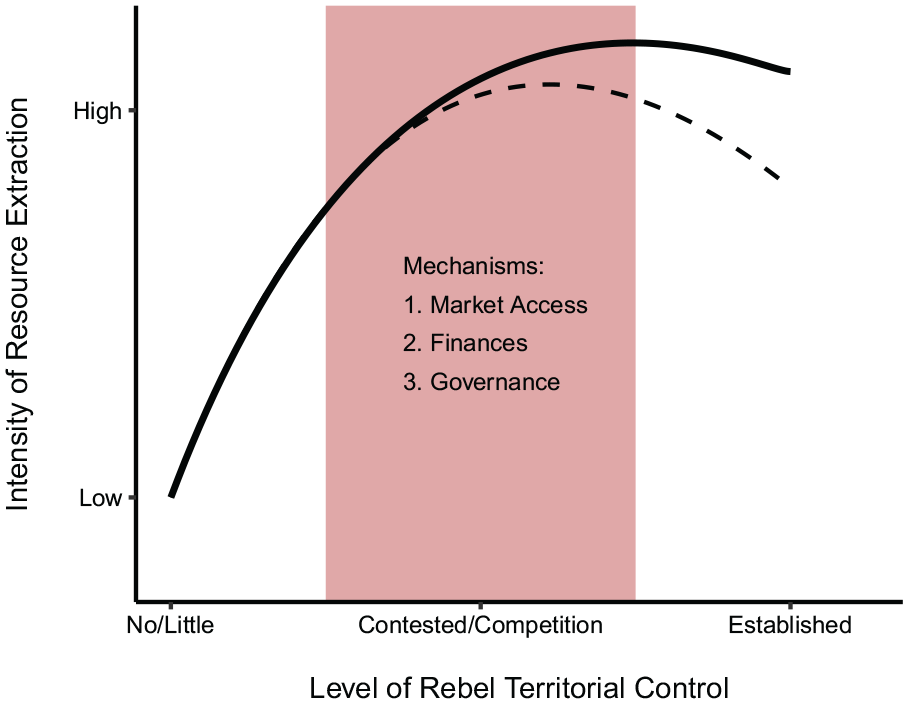
Rebels’ resource extraction as a function of territorial control.
When an armed group lacks territorial control (cf. the left part of Figure 2), it is very difficult for the group to construct mines, harvest timber, or organize and equip hunting raids. Even though the main advantage of financing rebellion through natural resources is the minimal technological and human effort required to do so, resource extraction still requires at least some initial investment and level of organization, such as narcotics processing labs, mining equipment, and protection from government forces. If a group is militarily too weak to physically challenge the government’s authority over territory, the group’s ability to engage in resource extraction is diminished. Moreover, in conflicts where rebels are militarily much weaker than the government, they have tactical incentives not to be pinned down by stationary resource production activities (Beardsley et al., 2015). Lack of investment and tactical incentives does not mean that those “roving bandit” groups will not engage in any any resource extraction. They will still engage in quick and cheap forms of extraction or stealing resources instead of actively engaging in establishing extraction systems themselves. Correspondingly, the y-axis in Figure 2 starts at “low resource extraction” instead of “no resource extraction.”
When a rebel group has firmly established territorial control, in contrast, two possible pathways emerge. First, their incentives for resource extraction can remain high (see solid line in Figure 2). The incentives and opportunities for resource extraction described in the mechanisms above remain in place as rebels consolidate their rule, such as ISIS’ harnessing of oil production in Iraq (Do et al., 2018).
There is also the possibility that when rebels consolidate their rule their resource extraction activities diminish (represented by the dashed line in Figure 2). By becoming more state-like, rebel rulers also are more likely to diversify their income sources. A group can increase taxation of civilians and businesses, becoming closer to being a “stationary” rather than a “roving” bandit (Olson, 1993). This might reduce rebels’ incentives to engage in resource extraction, particularly if they also run into danger of being targeted by international sanctions against their funding sources. These sanctions clash, however, with rebels’ concerns about their international recognition as legitimate representatives of the state they fight domestically (Jo, 2015).
Ultimately, which of those two routes rebels take once they have established control is an empirical question. Without benefiting economically and/or politically from resource extraction during territorial competition, however, it is unlikely that rebels can establish “liberated zones” in the first place.
Consequently, the main empirical implication I test below is that we should observe particularly intense resource extraction when rebels compete with a government over territory.
Macro Analysis: Rebels and Resource Extraction
In a first step, I test this expectation in a macro analysis across 270 rebel groups in 71 countries between 1990 and 2011, combining information from two data sources. I match information from the Non-state Actor (NSA) dataset—specifically on the extent to which a non-state armed group had territorial control over the course of a conflict—to data from the Rebel Contraband Dataset (RCD) on income sources of rebels between 1989 and 2010 (Cunningham et al., 2013; Walsh et al., 2018). For each group in the NSA data I calculate from the RCD dataset the number of illegal extraction of natural resources strategies in which the group is engaged. The NSA data set distinguishes between “low,” “moderate,” and “high” forms of territorial control, allowing me to test the shape of the proposed empirical relationship in Figure 2. I use this information to generate a categorical variable Territorial Competition where “no control” is the reference category. This procedure results in a dataset in 1180 dyad-years as the unit of observation.
Using this data, I estimate OLS models with standard errors clustered by country of the following equation:

where the indexes refer to rebel group
Figure 3 presents a plot of the estimated coefficients for each category of the Territorial Competition variable. The plot shows that, consistent with my theoretical expectation sketched in Figure 2, moderate territorial control is associated with approximately 25% more resources crimes in which a rebel group engages compared to groups with no control (the reference category). This pattern is consistent with my expectation that when groups compete with a government over territory (plausibly proxied by the “moderate” control category in the NSA dataset) they also engage in more illegal resource extraction. In contrast, when rebels have low levels of territorial control, different specifications of Equation 1 converge on a substantively small and statistically insignificant effect. Interestingly, we also see almost no difference in resource extraction when rebels have established high territorial control compared to no control. This lends support to the proposition that groups’ incentives and opportunities to extract resources become weaker once they have firmly established territorial control, possibly due to international sanctions. 11
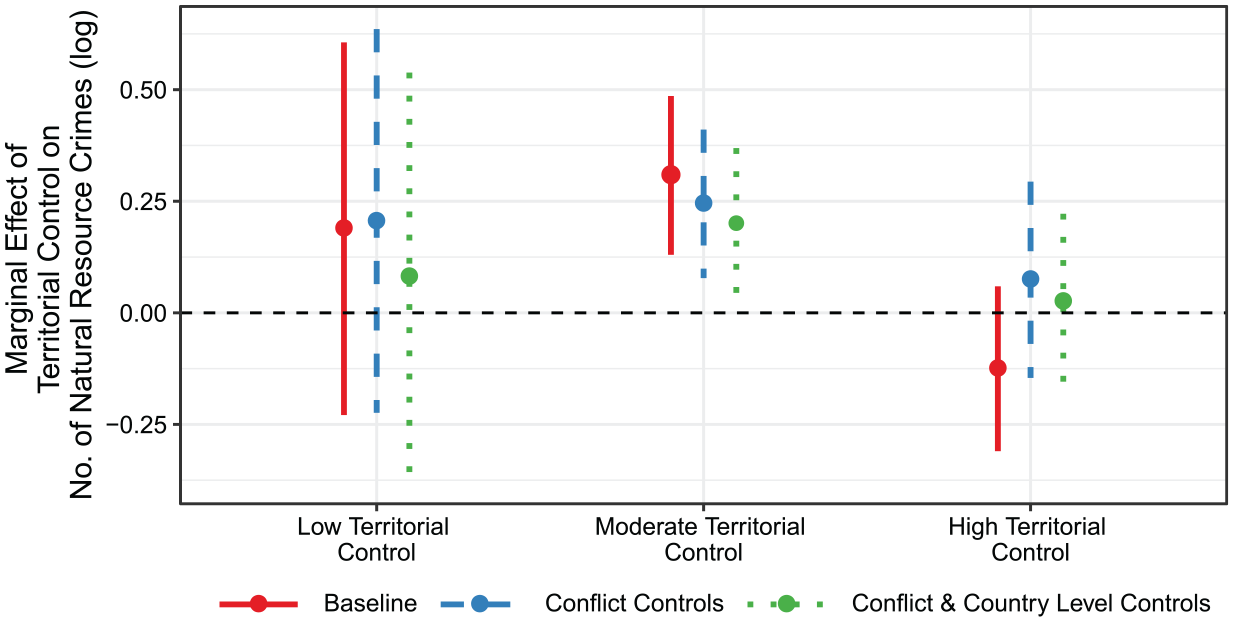
Levels of territorial control and illicit extraction of natural resources: macro-level analysis.
While this analysis reveals an empirical pattern that is consistent with my theoretical expectation, it remains insufficient for a number of reasons.
First, the RCD data only provides limited information on the level of resource extraction. While I circumvent this problem by computing the number of different resources rebels extract, this approach has its shortcomings. It masks any differences between groups (and over time) in the intensity of resource extraction. When rebels compete over territory they might intensify the extraction of one single resource and not diversify the different types of resources. Second, a group-level research design cannot hold constant differences between the access of rebel groups to a single type of resource. To identify an effect of territorial competition, we ideally would directly observe competition around resource production sites and capture resource output over time.
Most importantly, however, at such a high level of aggregation it is difficult to observe the precise mechanisms at play. While it is plausible that the NSA variable “moderate territorial control” captures the market access, finance, and governance mechanisms, the coarseness of the data and the “moderate level of territorial control” measure by the NSA prevent me from testing these mechanisms directly at this level of analysis. To address these problems, I turn to a micro-level analysis of territorial competition and ivory poaching.
Micro Analysis: Ivory Poaching and Territorial Competition in Africa
Ivory poaching offers a unique opportunity to study the relationship between territorial competition and resource extraction. First, ivory poaching represents a hard case for such a study, since ivory is a less important funding source of rebellion relative to other resources. A large number of studies have debunked the myth that ivory is “Africa’s White Gold” (Kalron & Crosta, 2013) that fuels conflicts on the continent (Haenlein & Smith, 2017; Somerville, 2017; Titeca & Edmond, 2019). While rebel groups can and do poach or cooperate with poachers, this is often not rebels’ single most important funding source, but one among many. 12 This assessment is supported by the RCD data, depicted in Figure 4. The figure shows that animal crimes—which include ivory poaching, but also rhino horn or fur smuggling—rank on position 12 of the most important funding sources of rebellion worldwide, behind resources such as opium, timber, or gold, but ahead of coltan or coal. It is this relative low importance of ivory poaching as funding source for rebellion that makes it a hard case: as poaching takes place less often than other forms of resource extraction, it becomes harder to detect a link between territorial competition and resource extraction in the form of poaching compared to other resources.
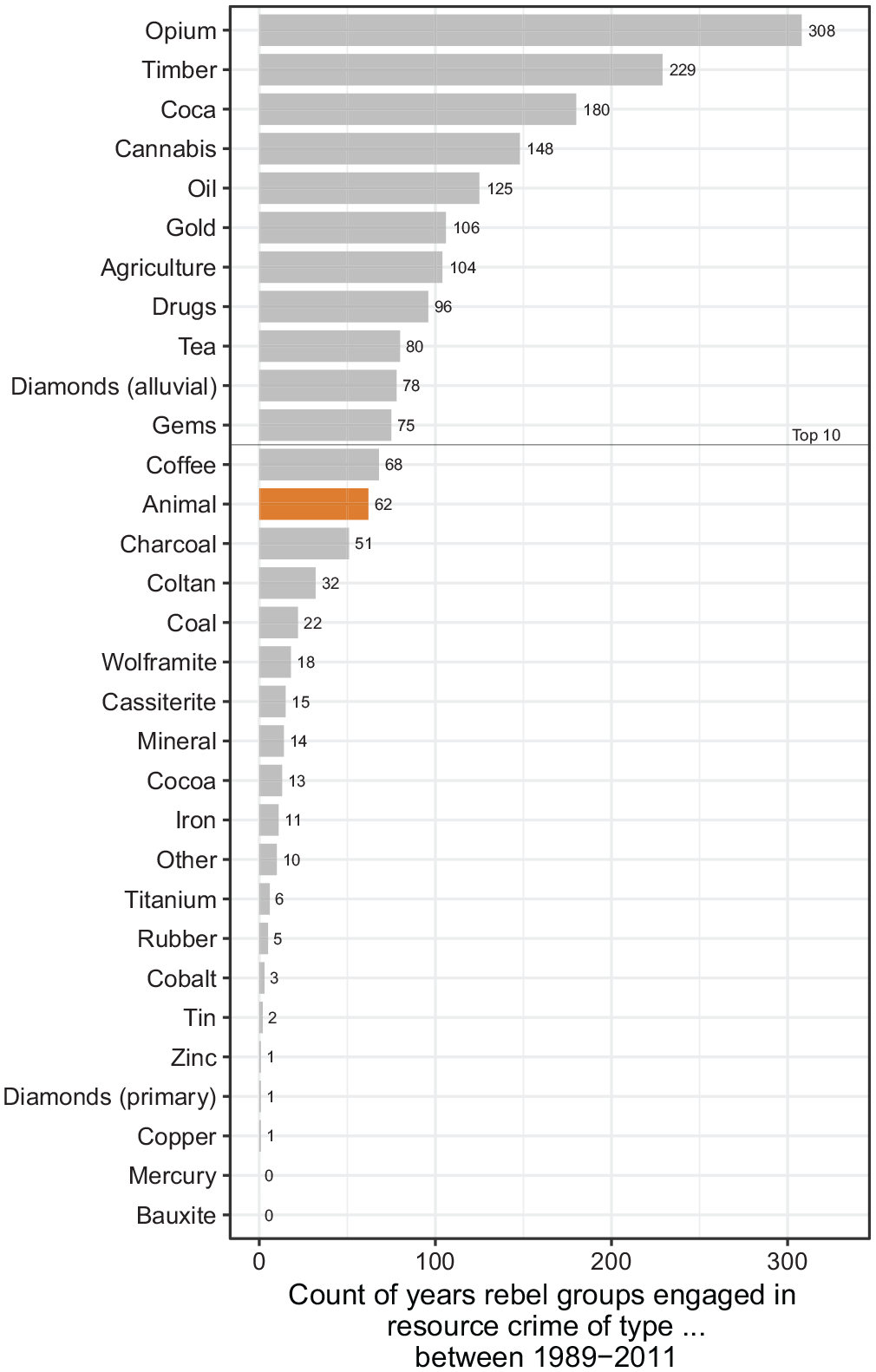
Relative importance of rebel group funding sources.
Second, and in contrast to more prominent resources such as opium, timber, or coca, ivory allows us to capture variation in the resource production process itself. It is extremely difficult to observe resource production in conflict zones, since it is demanding to access the production sites, such as gold mines, or coca plantations. The enormous number of ecologists who study declining elephant population in Africa, combined with international efforts to monitor this development, allow us to directly glimpse variation in the resource extraction levels of ivory: poaching (Chase et al., 2016; CITES, 1999). This enables me to hold the level of resource endowments in a location constant in order to link resource extraction levels to variation in territorial competition within resource sites.
Finally, poaching also allows me to investigate the theorized mechanisms that govern the territorial competition-extraction link. A number of studies, for instance, illustrate the links between the market access mechanism and poaching. Territorial competition not only allows rebel groups to reach elephant sites more easily, but also facilitates their access to transnational crime networks. With their multiple interlinked conflict systems, Central and West Africa are among the main poaching hotspots. There is evidence, for instance, that the Janjaweed militia “travelled from Darfur through Chad to kill between 300 and 600 elephants in Cameroon in 2012.” 13 Moreover, in the DRC, particularly in the Eastern part of the country where a number of national parks are located, local militias collaborate with middle-men to transport ivory to trading hubs in Uganda or Kenya (Nellemann et al., 2013).
The DRC also exemplifies how competition over territorial control drives rebels’ financial incentives to engage in poaching. Observers note that “[. . .] any criminal enterprise operating in the vicinity of an elephant range [in the DRC] has a strong incentive to profit from this very lucrative trade, and armed groups are best organized and equipped to dominate local poaching” (Vira et al., 2014, p. 43). This is because ivory poaching is a highly profitable income source. Observers estimate that 1 kg of ivory yields a return of up to $100 in the eastern Democratic Republic of the Congo (one tusk weighs around 3.8 kg). 14
Ivory poaching can also be part of a rebel group’s governance strategy. Poaching is typically organized in a way that allows for easy taxation. Rebel groups often function as “patrons” that fund, equip, and ultimately tax poaching raids, since they typically possess the necessary weaponry and means of transportation. Again, poaching in the DRC illustrates this link. A local militia led by “Colonel President” Thomas—a major elephant poacher near Okapi National Park in the DRC—is “reaching out to local populations to leverage local discontent, in order to create legitimacy and operating space for his force” (Vira et al., 2014, p. 42). Including local civilians in poaching operations is appealing for both insurgents and civilians alike, since it offers a lucrative income for poor subsistence farmers in conflict-affected areas. In addition, rebels also function as middle-men between the actual elephant hunters in the bush and their contacts in ivory trading hubs, thus allowing the ivory to move up the value chain (Vira et al., 2014, p. 10). Nevertheless, the entry barrier to ivory poaching is relatively low, so that rebels can and do also poach themselves, such as the Lord’s Resistance Army in Northern DRC’s Garama National Park (Somerville, 2017, p. 313; see also Appendix D.1).
Despite this anecdotal evidence consistent with my theoretical expectations, the link between strategic conflict over territorial control and ivory poaching could also be a spurious one, driven for instance by overall conflict intensity or differences in ivory availability across sites. To separate out the effect of insurgency on ivory poaching from these and other alternative explanations, I now turn to a multivariate analysis.
Measuring Poaching Rates
I combine information from the Monitoring the Illegal Killing of Elephants program with spatially disaggregated conflict data from the ACLED dataset to test my theoretical expectation that higher territorial competition should lead to increased levels of resource extraction. CITES established the MIKE program in 2002 to track ivory poaching activities in 79 monitoring sites across 40 African and Asian countries (CITES, 1999). I use only data from MIKE monitoring sites in conflict-affected African countries, covering the two African elephant species, the African savannah elephant (Loxodonta africana) and the African forest elephant (Loxodonta africana cyclotis).
The MIKE data collection process is based on reports by site personnel and local law enforcement officials. Site personnel regularly assess the size of a park’s elephant population through aerial surveys, foot patrols, dung surveys, and information collected by scientists or tourists (CITES, 1999). Rangers who discover an elephant carcass within the MIKE site boundaries register this information together with the likely cause of the elephants’ death. This allows MIKE personnel to report two key numbers for each monitoring site at the end of a calendar year: the total number of illegally killed elephants
These numbers allow me to construct the standard poaching measure, the proportion of illegally killed elephants (PIKE), which is the main dependent variable of interest:

The PIKE index represents the count of illegally killed elephants divided by the number of total elephant carcasses (the sum of illegal and naturally occurring deaths) discovered by MIKE field workers. By including the overall number of carcasses in the denominator, the PIKE measure controls for natural variation in overall elephant mortality, patrolling intensity, and reporting bias (Underwood et al., 2013). The PIKE index is widely used in ecology, economics, and criminology to investigate correlates of elephant poaching (Hsiang & Sekar, 2016; Underwood et al., 2013). Since PIKE is a proportion, it is bound between 0 (= no illegal elephant killings) and 1 (= all documented elephant carcasses were illegal deaths). Although MIKE data is available from 2002, data collection started late at many sites in that year. This makes 2002 incomparable to future years. I therefore include PIKE estimates between 2003 and 2015, the latest year for which data is publicly available.
Since PIKE is based on carcass counts by local field workers and law enforcement officials, the data collection process is not strictly independent of conflict events. Higher conflict intensity is likely to limit rangers’ ability to collect data on elephant carcasses. This is not necessarily a threat to my empirical approach, however. Even though the correlation between conflict intensity and poaching measurement introduces bias, this bias should make it harder to detect a positive relationship between conflict and poaching rates, if poaching rates are systematically lower in cases of high conflict intensity.
Moreover, poaching does not only occur within MIKE monitoring sites, but data only exists for these. Data from the International Union for the Conservation of Nature (IUCN) shows that the known and possible range of both African savannah and forest elephants have a much greater extent than is captured by the MIKE sites. Using data on the extent of elephant ranges, I estimate that MIKE sites only cover about 22.4% of known and possible elephant ranges (see Figure 5). Rebels likely also poach outside of MIKE monitoring sites, in locations where they know that rangers are unlikely to thwart their efforts. In addition, MIKE sites tend to be closer to a country’s capital on average than conflict events. As a result, any estimated effect of conflict on poaching likely reflects the lower boundary of the true effect. 15
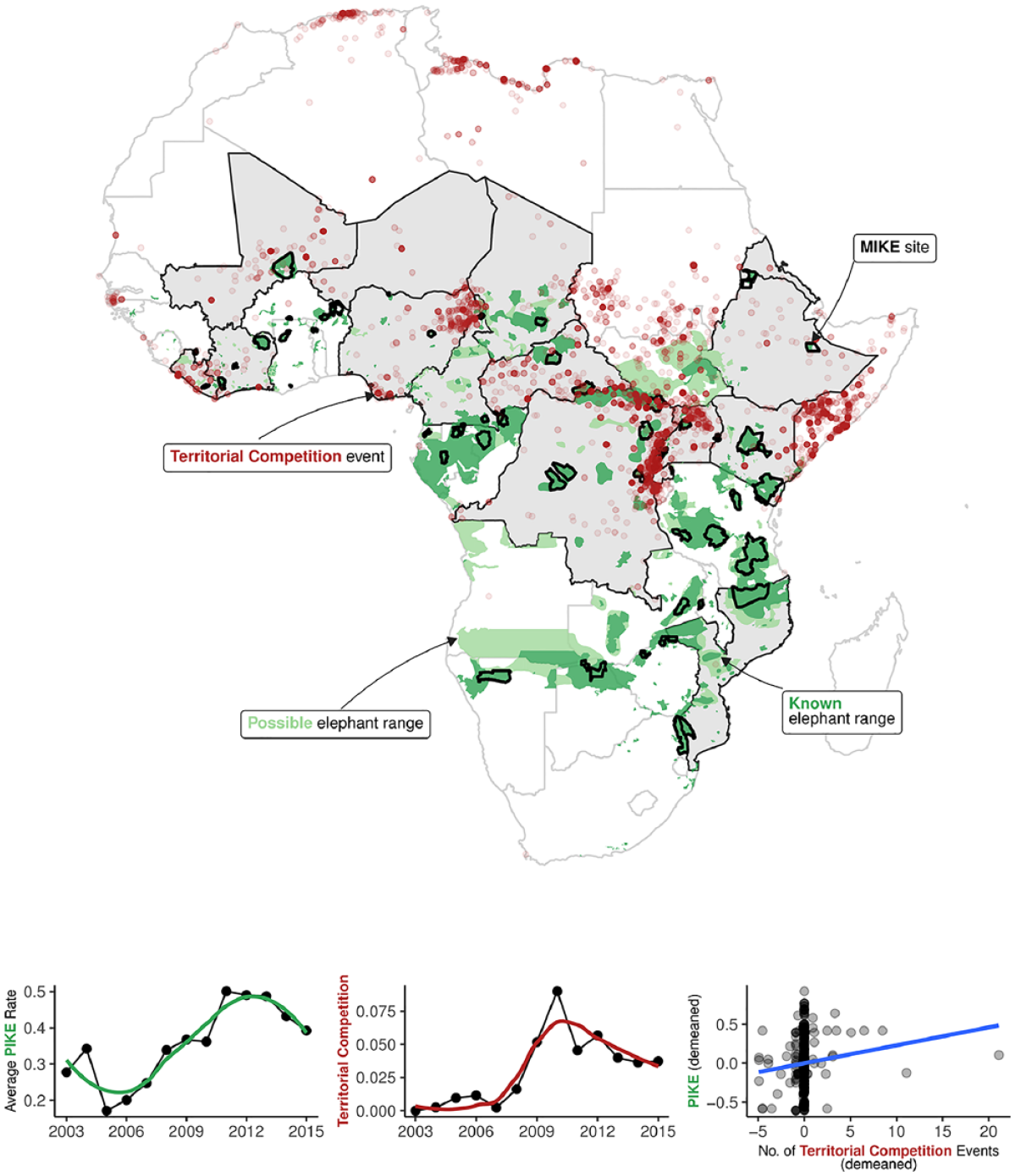
Territorial competition events and MIKE elephant observation sites in Africa, 2003–2015.
Territorial Competition
The main independent variable of interest is Territorial Competition: rebel actions that capture the group’s intention to gain political control over a given territory. To capture territorial competition within monitoring sites, I match the location of conflict events to the spatial extent of the monitoring sites as given by a shapefile available from CITES. 16
It is not straightforward which types of conflict event plausibly capture territorial competition between rebels and government. If civil conflict is at its core about the establishment of territorial control, all conflict events—government-rebel battles, one-sided violence, troop movements, and others—could be related to an increase in resource extraction. However, not all conflict events reflect the posited theoretical mechanisms equally well. While battlefield clashes between government and rebels might capture the first (opportunity/market access) and second (financial incentives) mechanisms, they do not necessarily reflect an actor’s need to establish some form of basic rule over the territory in question (the third mechanism). In fact, civil wars often erupt subnationally in places where the state has more control (Koren & Sarbahi, 2018). These places that are, by definition, more difficult for insurgents to govern. Consequently, I generate my main independent variable of interest,
I use the following types of ACLED events to create a measure for Territorial Competition: (1) headquarters or bases being established by rebels; (2) strategic nonviolent activities by rebels, such as recruitment drives or troop movements; (3) rebels taking over territory; and (4) one-sided violence by rebels. The governance mechanism specified above suggests that insurgents have political incentives to perpetrate selective one-sided violence in order to establish strategic control by punishing defection in contested territories. While the nonoccurrence of one-sided violence implies either no or alternatively fully established territorial control, the active perpetration of such violence captures rebels’ ambitions to establish territorial control where they have not yet fully achieved that (Kalyvas, 2006).
The total count of these four event types within a MIKE elephant site per year constitutes
Sample
I use the information from ACLED to generate two site-year panel datasets, one study data set and one expanded data set. The study data set uses data from countries with MIKE sites where there was at least one ACLED event in any site between 2003 and 2015 and in which the Uppsala Conflict Data Program registered a state-based armed conflict in the period between 2003 and 2015. This results in a panel dataset of 429 site-years across 33 monitoring sites in 13 countries (see Appendix A.2).
The expanded sample includes all countries with MIKE sites where there was at least one ACLED event in the country, dropping the restriction that a UCDP armed conflict must have been recorded in the country. The expanded sample accounts for the fact that conflict events might spill over into countries that are not officially labeled as “conflict-affected” as their governments are not part of the main incompatibility registered by UCDP. Examples include Tanzania, where the conflict from the DRC has frequently spilled over through its Western border to the DRC (see Figure 5). Yet in these countries, too, competition between rebels and the government over territorial control (e.g. rebels seeking to establish areas of retreat) could affect poaching.
Unless otherwise noted, all analyses use the narrower study sample as it offers more credible comparison groups of conflict-affected and -unaffected sites within conflict-affected countries. I replicate the main results using the expanded sample in the Appendix D.12 which does not substantially alter the results. Appendix B.2 provides summary statistics.
Figure 5 maps Territorial Competition events and MIKE monitoring sites on the African continent. We see that territorial competition events often cluster near monitoring sites (solid dark shapes). The correlation between territorial competition and poaching is also visible by joint trends over time and in a scatterplot of poaching against territorial competition events displayed in the bottom of Figure 5.
Figure 5 also shows that the only country with a substantive elephant population, many territorial competition events, but no MIKE sites is South Sudan. This is because South Sudan is not part of the MIKE program. Thus, no poaching data exists. Nevertheless, there is substantial anecdotal evidence that rebel groups poached during both the South Sudanese independence war until 2005 and the Southern Sudanese internal civil war that started in 2013 (Somerville, 2017, pp. 231–234). Thus, it is unlikely that the theoretical mechanisms play out entirely different in South Sudan, even though the country is not part of my data set.
Empirical Strategy
To investigate the impact of territorial competition on poaching rates within MIKE sites, I estimate an equation of the following form:

where the main coefficient of interest is
Site fixed effects also account for different ivory endowments across sites. Rebels’ resource extraction critically depends on the availability and amount of such resources in the first place. By holding constant the between-site differences in average elephant population (and thus ivory endowments), site fixed effects capture this important source of potential bias.
Site fixed effects also control for constant country-level factors, that might drive conflict activity between countries, such as political environment and economic development. In essence, mi ensures that the model exploits only the within-site variation of poaching and conflict events over time, allowing the contrasting of sites to their natural comparison units: themselves at an different points in time.
The year fixed effects
In additional models, I introduce an interaction term between country-fixed effects and country-specific time trends to Equation 3. This strategy allows me to flexibly control for time-varying trends on the country-level that simultaneously affect conflict occurrence and poaching rates, such as country-specific economic growth or population trends. In an alternative approach, I replace the country-specific time trends with country-level covariates denoted by the vector
All models are estimated with ordinary least squares.
18
Since residuals
Findings
Main Results
Table 1 presents the main results. Models 1 to 3 introduce site fixed effects, year fixed effects and government/rebel battle events in a stepwise manner. Model 4 adds country-specific time trends to these models. Model 5 replaces country-specific time trends with country-level covariates that capture temporal variation in the institutional and socio-economic environment of the conflict. The results are consistent with my theoretical expectation: the coefficient for Territorial Competition is positive and precisely estimated in all models. Coefficient size across models is stable and ranges between 0.018 and 0.024. This means that one additional territorial competition event predicts an increase in poaching rates between 1.8 and 2.4%. When I replace the country-specific time trends with country-level covariates in Model 5, none of the country-level covariates emerges as a statistically significant predictor of PIKE rates in conflict-affected countries. Overall and consistent with theoretical expectations, the results from Table 1 suggest that competition over territorial control increases resource extraction, as captured by poaching rates in MIKE monitoring sites.
Territorial Competition and Poaching Rates.
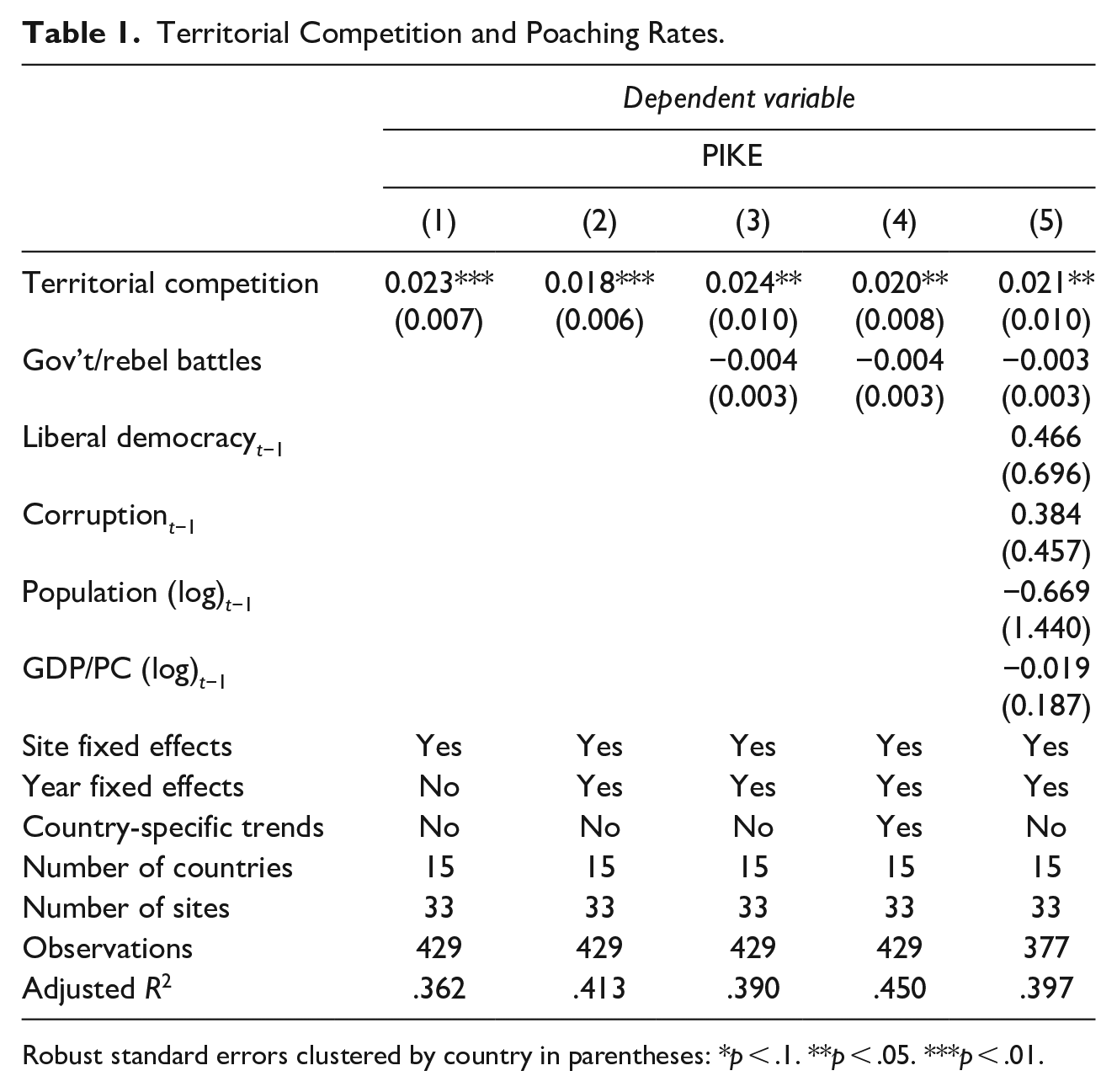
Robust standard errors clustered by country in parentheses: *p < .1. **p < .05. ***p < .01.
To better interpret the substantive size of this effect, Figure 6 plots model predictions for different scenarios of territorial competition. The blue/dashed point estimates and confidence intervals represent predictions of PIKE rates as a function of 5, 10, and 20 territorial competition events, respectively. These models predict a corresponding increase between 9 and 36% in PIKE rates. Given that the within-site standard deviation of PIKE scores is 0.27 or 27%, this is a substantively large effect size.
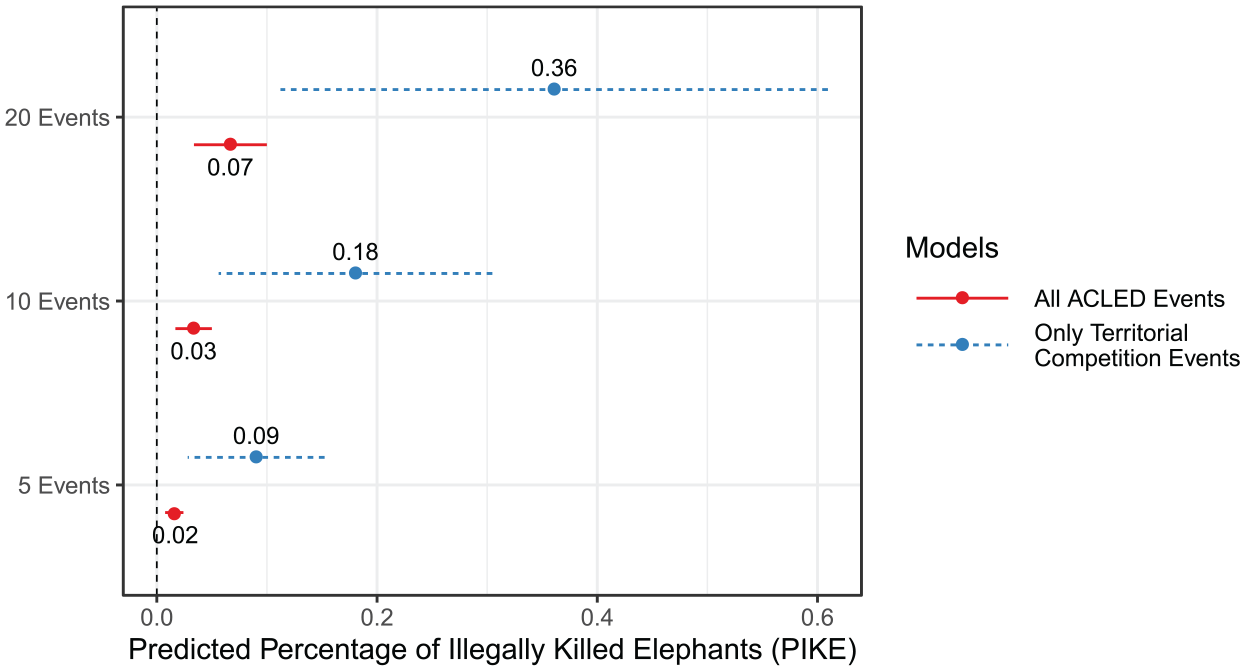
Substantive effects of different types of conflict events on poaching.
Linking Poaching to Territorial Competition
Do these results really reflect increased poaching activity by rebels as a result of their competition over territorial control? There are four pieces of evidence that, taken together, make poaching by rebels themselves (or their subsidiaries) the most likely explanation for the observed empirical patterns.
The first piece of evidence is that all ACLED conflict events predict lower poaching rates than only territorial competition events (see Figure 6). Yet, if territorial competition simply allows others—such as local civilians and/or criminal organizations—to engage in ivory hunting, not only rebel groups, we should see the opposite. All ACLED events plausibly reflect higher conflict intensity, and thus represent a better breeding ground for all poachers, if this explanation is correct. This is not what we observe, however, suggesting that it is indeed primarily the competition between rebel groups and governments over territory that drives poaching rates.
Second, I exploit the fact that ACLED sometimes, albeit rarely, captures events that are directly related to poaching. I demonstrate in Appendix D.1 that the components of the territorial competition variable much better predict the accidental mentioning of poaching events in the ACLED event description than other conflict event types. Thus, territorial competition can even predict poaching when measured directly by ACLED itself—even though this measurement is noisy and imprecise since ACLED’s purpose is not to capture poaching, but conflict.
Third, I summarize case evidence from the Lord’s Resistance Army in Uganda and the DRC that directly engaged in poaching itself (see Appendix D.1). I also sketch the case of the Séléka rebel group in the Central African Republic that outsourced poaching to gangs. Crucially, in both cases, the data used for the quantitative analysis reflects key patterns described in the qualitative evidence.
Finally, there is suggestive evidence from the macro data that also points to a link between territorial competition and poaching. In the final section of Appendix D.1, I replicate the macro analysis, but use a dummy whether or not a rebel group engaged in animal crimes as dependent variable. The results are broadly similar to the results of the macro analysis that uses all resource crimes as dependent variable, even though they are not statistically significant due to the low number of animal crimes compared to other resource crimes.
Taken together, these four pieces of evidence suggest that is indeed rebel groups that poach themselves or outsource poaching as a result of their competition over territory.
Robustness Tests
I consider and test a number of alternative explanations in Appendix D. To save space, I explain the logic of these tests in more detail in the respective sections of the Appendix and only summarize the results here. Specifically, I test for the possibility that rebel territorial competition and poaching is jointly determined by (1) prior battle violence, (2) prior levels of poaching, (3) peace agreements, (4) peacekeeping deployments, (5) availability of other natural resources and resource profitability shocks (including development measured through night lights); (6) droughts and rainfall shocks; (7) migration and IDP flows; (8) choice of unit of observation (MAUP problem), (9) two different types of reporting bias, (10) ACLED geocoding precision, or (11) sample choice. I also replicate a key null finding on one-sided violence (see “Governance” mechanism below) with corresponding data from the UCDP GED dataset. Across all models the results remain robust and, more importantly, substantively similar in size to the main findings.
Exploring Mechanisms
Market Access
The market access mechanism posits that the effect of territorial competition on ivory poaching varies according to the institutional context in which the conflict takes place, most notably black market access. Greater opportunities for rebels to cooperate with organized crime allow for quicker profit turnarounds and thus should increase the effect of conflict on poaching.
To test this expectation, I introduce an interaction term between Territorial Competition and the V-Dem measure of political corruption. Higher levels of corruption should make it easier for rebels to circumvent local law enforcement officials (who might even profit from poaching themselves) and gain quicker access to the middle-men who transport ivory on to major trading hubs. I therefore expect the marginal effect of poaching to be particularly high in countries with high corruption.
Figure 7 confirms this expectation. The plot shows the marginal effect of Territorial Competition events at varying levels of V-Dem’s political corruption measure. 19 As linear fixed effects models can be susceptible to biases from nonlinearities in the data, I compute and plot marginal effects both based on a linear model and a nonlinear kernel estimator (Hainmueller et al., 2019). Consistent with the expectation that high corruption allows rebels easier access to black markets, the plot shows that the marginal effect of Territorial Competition becomes positive and statistically significant only at high levels of political corruption. In an alternative test in Appendix D.14 I also demonstrate that territorial competition particularly increases poaching in parks that are close to a state’s border. This finding echoes qualitative evidence that points to porous borders as facilitators of poaching in general (Vira & Ewing, 2014). The evidence above suggests that porous borders, and the easy access to smuggling routes they provide, also facilitate poaching in the context of territorial competition.
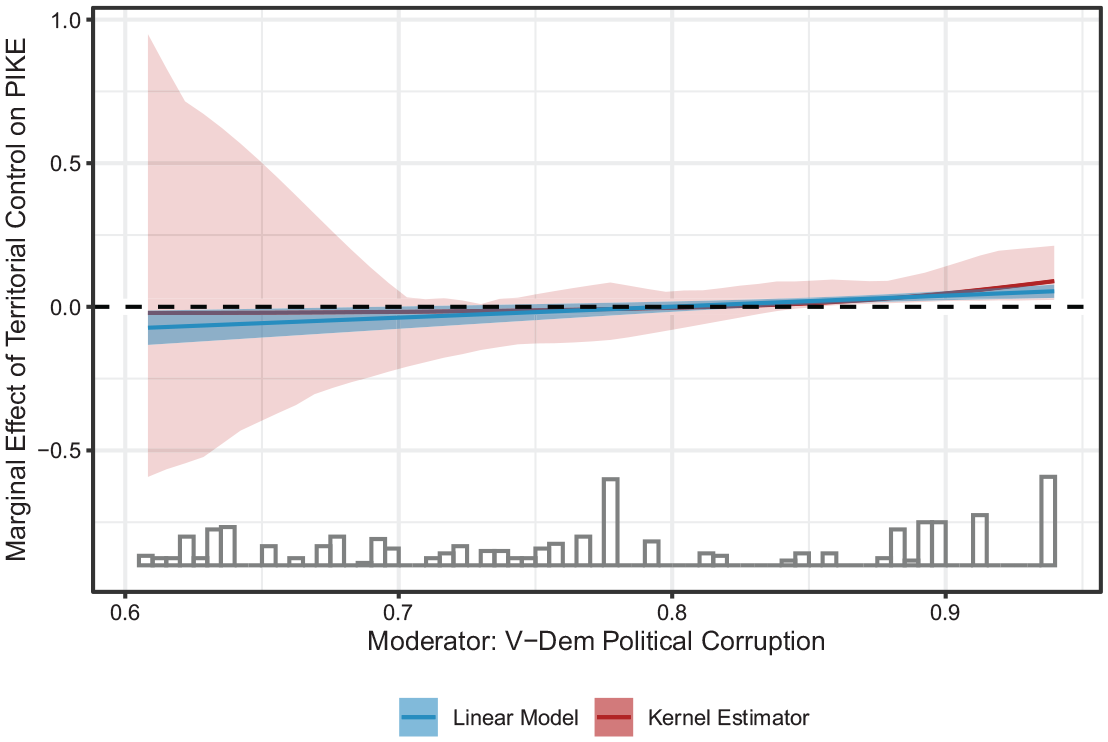
Territorial competition, Black market access, and poaching.
Finances
The finance mechanism implies that insurgent groups with external support should poach less. Financial strains of competition with the government over territory generate monetary incentives for rebel groups to intensify resource extraction. If rebels can rely on external support, for instance by powerful states or non-state actors, however, rebels’ financial incentives to extract resource should become weaker.
To test this implication, I exploit the ALLY field in the ACLED data. This field indicates for each event that the actor responsible for an event had outside support. While ACLED does not distinguish between military or non-military support it is still a useful proxy to test this proposition. I generate a count of all events for which ACLED records an ally and interact this count with the Territorial Competition variable. The expectation is that the marginal effect of Territorial Competition is particularly large when rebels have few or no outside support.
The marginal effects plotted in Figure 8 are consistent with this proposition. The plot shows that the marginal effect of Territorial Competition is positive and statistically significant only when rebels have no outside sponsor. As the number of outside supporters increases, the effect of Territorial Competition becomes small, eventually even negative, and statistically insignificant. These results show that external support does not only shape how rebel engage in strategic violence (Salehyan et al., 2014; Weinstein, 2007), but also rebels’ resource exploitation strategies.
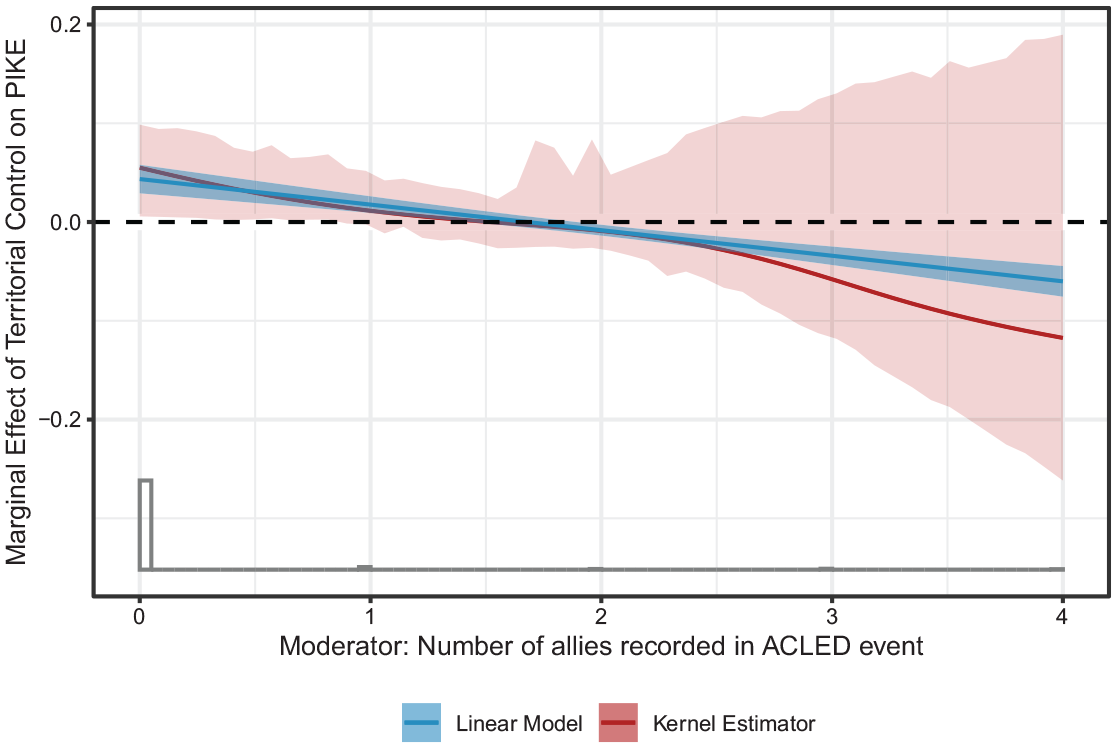
Territorial competition, financial incentives, and poaching.
Governance
The governance mechanisms posits that we should observe poaching rates to be particularly high when rebels intent to govern a specific piece of territory.
Measuring governance intentions during civil conflicts is difficult, however, since intentions are unobservable. Nevertheless, I disaggregate the Territorial Competition variable into its component ACLED event types to try to at least approximate governance intentions. I identified two plausible pathways for the governance mechanisms: rebels can coerce civilians into collaborating in the extraction process or include civilians in the extraction process to gain legitimacy.
One-sided Violence and Strategic Developments (e.g. recruitment raids) events should be indicative of the first, more violent approach to governance. Headquarter Establishment and Transfer of Territory should reflect the second, legitimacy-based approach. Headquarter Establishment indicates that at least some form of bureaucratic organization of a headquarter takes place, while Transfer of Territory captures the nonviolent acquisition of territory by rebels, indicating that a transfer of political authority takes place.
Figure 9 supports the latter theoretical expectation. The plot shows the coefficients of regressing PIKE rates on different components of the Territorial Competition variable. Consistent with the expectation that governance incentives drive resource extraction, the coefficients are largest for the Headquarter Establishment and Transfer of Territory variables.
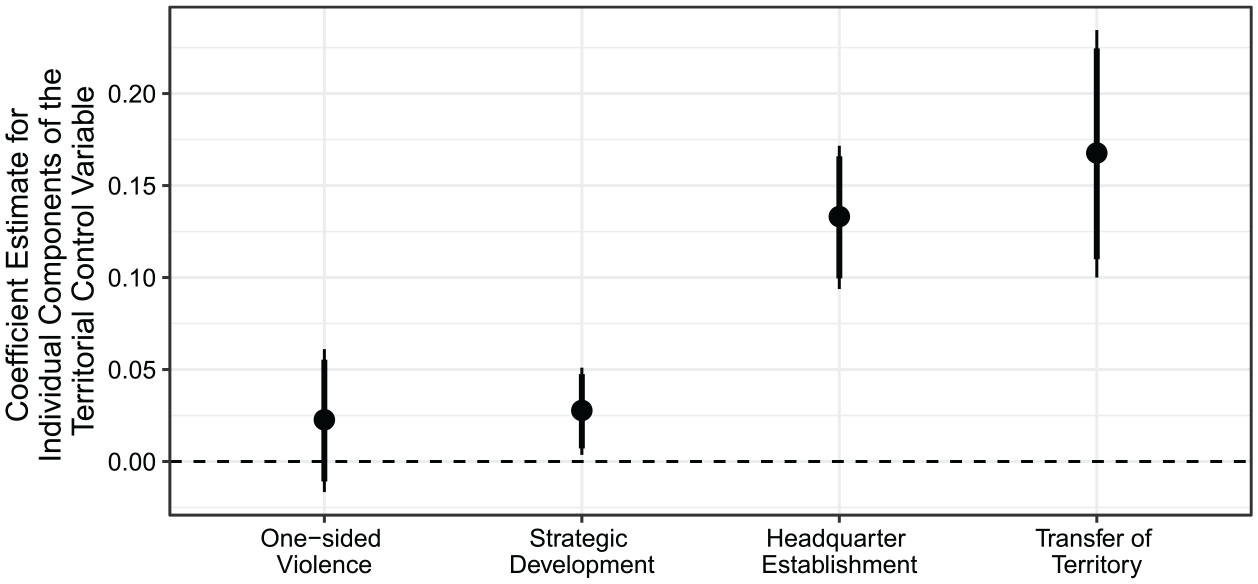
Territorial competition, governance, and poaching.
Conclusion
When do rebels extract natural resource in civil conflicts? I argue that rebels have particularly strong incentives to extract natural resources when they are actively competing with a government over territorial authority. I test this argument in a two-part research design. In a macro-level analysis, I show that rebels group with moderate levels of territorial controls engage in a larger number of resource crimes. In a micro-level analysis, I match geo-referenced conflict event data to geographically disaggregated information on a conflict resource where we have unique evidence of its extraction patterns: ivory poaching. Results from fixed-effects specifications provide robust support for my core hypothesis: ivory poaching is particularly prevalent in contexts where territory is actively contested. I also document supporting quantitative and anecdotal qualitative evidence for the market access, financial, and governance mechanisms that drive this pattern. The fact that a similar empirical pattern emerges in both the macro- and the micro-level analysis highlights the robustness of the results.
One key implication of this study pertains to the notion of a resource “curse” in civil conflicts. In contrast to the assumption of an exogenous curse of resource presence that permeates the literature, the theoretical argument advanced here endogenizes the choice of insurgents to extract resources. It highlights the market, financial, and governance conditions under which insurgents are most likely to mine, log, or hunt lootable resources to finance warfare. Future research that links resource presence to conflict onset or duration might benefit from taking these conditions into account.
This article also generates new avenues for the research program on rebel governance. Variation in the institutions created by rebel organizations can influence a wide range of outcomes, including public good provision, post-conflict democratization, or civilian victimization during civil wars. Building on the insights from this resesarch program, I demonstrate the close relationship between governance incentives and resource extraction. Possible extensions of the analysis presented here could further investigate why, as suggested by the results of the macro analysis, rebels with high territorial control seem to engage in less resource crimes than rebels with moderate territorial control.
Finally, this study helps to advance our understanding about ecological consequences of conflict. It provides a theoretical micro-foundation and delivers robust empirical evidence to inform a critical policy debate that seeks to address one of the most pressing ecology crises in Africa: the potential extinction of the continent’s elephant population (Nellemann et al., 2013). While I show, consistent with existing research, that conflict drives poaching rates, it is particularly competition over territory that increases poaching rates during conflicts. This finding could help to anticipate rebel behavior to better protect wildlife in conflict.
Supplemental Material
insurgency_and_ivory_appendix – Supplemental material for Insurgency and Ivory: The Territorial Origins of Illicit Resource Extraction in Civil Conflicts
Supplemental material, insurgency_and_ivory_appendix for Insurgency and Ivory: The Territorial Origins of Illicit Resource Extraction in Civil Conflicts by Felix Haass in Comparative Political Studies
Research Data
replication_insurgency_ivory – Research Data for Insurgency and Ivory: The Territorial Origins of Illicit Resource Extraction in Civil Conflicts
Research Data, replication_insurgency_ivory for Insurgency and Ivory: The Territorial Origins of Illicit Resource Extraction in Civil Conflicts by Felix Haass in Comparative Political Studies
Footnotes
Acknowledgements
I am grateful to Ghassan Baliki, Matthias Basedau, Tilman Brück, Alexander De Juan, Belén González, Christoph Heuser, Tobias Ide, Martin Ottmann, Désirée Reder, Adam Scharpf, Hannah Smidt, Guy Schvitz, and Haley Swedlund for helpful comments and suggestions. I also thank three anonymous reviewers for their valuable feedback. The manuscript benefited from useful feedback by the participants at the AFK Empirical Methods Workshop in Mannheim (2017), the Leibniz Environment and Development symposium in Berlin (2018), the Research Team “Institutions for Sustainable Peace” at GIGA (2018, 2019) as well as audience members in the IDD Guest Seminar Series in Birmingham (2018). I thank Jim Walsh for providing early access to the RCD dataset. I acknowledge support from the German Research Foundation (ME 1701/7-1).
Author’s Note
Felix Haass is also affiliated with University of Oslo, Norway.
Declaration of Conflicting Interests
The author declared no potential conflicts of interest with respect to the research, authorship, and/or publication of this article.
Funding
The author received no financial support for the research, authorship, and/or publication of this article.

Notes
Author Biography
References
Supplementary Material
Please find the following supplemental material available below.
For Open Access articles published under a Creative Commons License, all supplemental material carries the same license as the article it is associated with.
For non-Open Access articles published, all supplemental material carries a non-exclusive license, and permission requests for re-use of supplemental material or any part of supplemental material shall be sent directly to the copyright owner as specified in the copyright notice associated with the article.
