




Abstract
Does local exposure to refugees increase right-wing support? This paper studies a case uniquely suited to address this question: the allocation of refugees to the rural hinterlands of eastern Germany during the European refugee crisis. Similar to non-urban regions elsewhere, the area has had minimal previous exposure to foreigners, but distinctively leans towards the political right. Our data comprise electoral outcomes, and individual-level survey and behavioral measures. A policy allocating refugees following strict administrative rules and a matching procedure allow for causal identification. Our measurements confirm the presence of widespread anti-immigrant sentiments. However, these are unaffected by the presence of refugees in respondents’ hometowns: on average, we record null effects for all outcomes, which we interpret as supporting a sociotropic perspective on immigration attitudes. Masked by these overall null findings, we observe convergence: local exposure to refugees appears to have pulled both right- and left-leaning individuals more towards the center.
Introduction
Between 2015 and 2017, 3.1 million refugees arrived on European shores, nearly half of whom (44%) applied for asylum in Germany (Eurostat, 2018). The unprecedented inflow put the German asylum system under strain and required the re-distribution of refugees to localities that had never hosted a substantial number of foreigners before. This paper exploits variation in the allocation of refugees to study the effect of first-time, local exposure to foreigners on right-wing support and anti-immigrant sentiments. We focus on rural areas in Germany’s eastern regions that previously had minimal exposure to foreigners, but distinctively lean towards the political right.
Our study thus investigates a context that is fairly common, politically important, but rarely studied: the rural hinterlands of a country, where the presence of foreigners is low, but anti-immigrant sentiments run high. As shown in Figure 1, this characterizes large stretches of central, eastern, and southern Europe (Golder, 2016). Our setting also shows similarities with rural and suburban areas in the US that are predominantly white and staunchly conservative (Cable, 2012). Indeed, right-wing populists have made headway in governments in Europe, Latin America, and the US due in large part to the support they garnered in non-urban contexts, often mobilizing their supporters with anti-immigrant messages (Alba & Foner, 2017). Our study area is no exception to this trend: between the beginning of the refugee crisis in 2015 and our data collection in 2018, support for Germany’s populist right-wing party AfD surged from 6% to 16% nationwide, and from 7% to 27% in Germany’s eastern states. How much of this shift can be attributed to the arrival of foreigners in people’s hometowns? Do individuals exposed to refugees in their municipality show political attitudes and behavior that are different from those without local exposure?
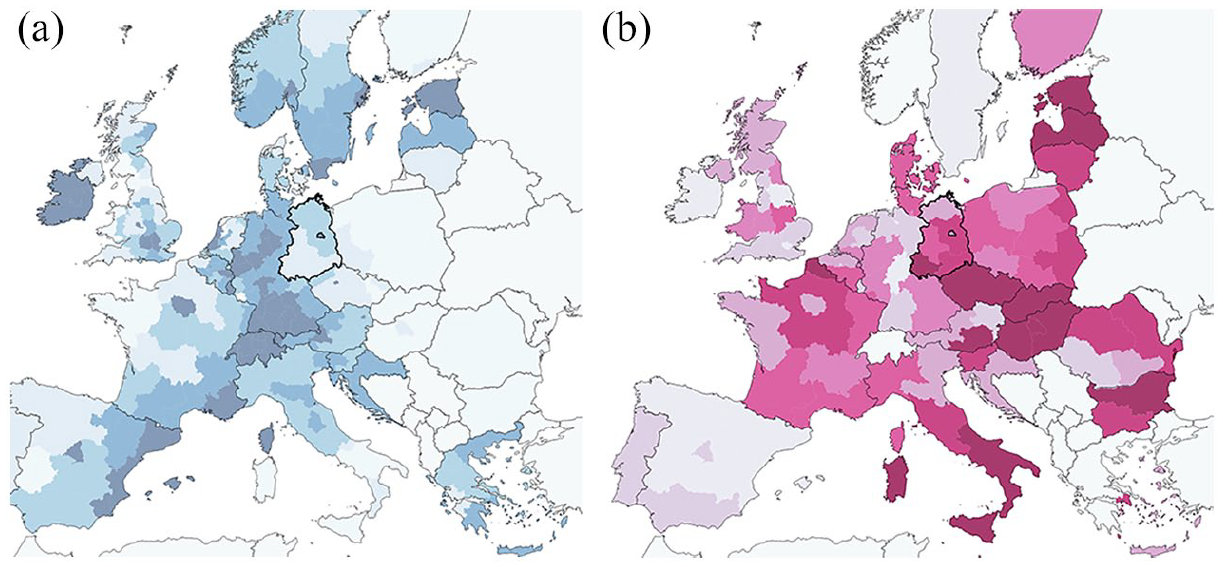
Foreign population and attitudes towards immigration in Europe: (a) presence of foreigners and (b) prevalence of anti-immigrant attitudes.
Theoretically, the effect of exposure is indeterminate. Several theories from psychology and sociology lead us to believe that exposure to refugees may trigger more negative attitudes towards them. Locals might fear rising crime levels, or perceive refugees as challenging their way of life. However, other work, notably contact theory, makes the opposite prediction: by facilitating more personal contact, physical proximity is likely to go along with milder attitudes toward the newcomers. Political scientists have linked local exposure to immigrants to increased community discord that might negatively influence how strangers are perceived (Williamson, 2015). However, this contrasts with a body of work demonstrating that what matters for outgroup attitudes are not so much individual attributes or experiences, but how the impact of immigrants for society as a whole is evaluated (Dancygier & Donelly, 2015; Hainmueller & Hopkins, 2014; Sniderman et al., 2004). This sociotropic perspective, then, casts doubt on whether we should expect any effect of personal exposure at all.
Yet others have pointed out that empirically, what is usually observed is a positive association between the presence of immigrants and liberal attitudes towards them (Alba & Foner, 2017; Jennings & Stoker, 2016)—just as demonstrated in Figure 1, where we see that regions with higher shares of foreigners tend to be more open to immigration. Both often go together, especially in urban areas. Extant research suggests that this correlation likely is the result of selective migration in and out of cities (Maxwell, 2019). It remains unclear, however, whether the presence of foreigners has anything to do with why individuals move into or out of cities (i.e., whether they choose to be close to immigrants, for example because they enjoy cultural diversity), or whether liberal attitudes towards migrants are simply a correlate of other traits that make people choose city life. In short, the causal effect of local exposure to foreigners remains underexplored, with possible effects ranging from negative to neutral, or even positive.
We contribute to this debate by bringing to bear a rich set of original data. Our data comprise electoral results at the municipality level plus individual-level data from a random sample of 1,320 individuals from 236 closely-matched municipalities in Germany’s eastern regions. half of which received refugees. Most of these are rural municipalities or small towns, in which the share of foreigners in the population was less than 1.5% before 2015. This focus on communities with minimal previous exposure to foreigners allows us to circumvent problems of resident and immigrant self-selection that mar similar studies. We analyze a diverse set of outcomes, including voting behavior, attitudes towards immigrants and refugees, and behavioral bias as displayed in economic games. Causal identification relies on a policy that allocates refugees following strict administrative rules, which we combine with a matching design that provides us with a sample of statistically indistinguishable treatment and control municipalities.
The study adds to a growing literature on the causal effects of refugee allocation that has produced contradictory findings. While Dustmann et al. (2018), Bratti et al. (2017), Hangartner et al. (2018), and Dinas et al. (2018) demonstrate increased support for anti-immigrant parties and sentiments in rural Denmark, Italy, and Greece, Steinmayr (2020) shows that under certain conditions, the presence of refugees can also reduce the vote share for the political far-right.
In line with the first set of studies, we also record high levels of anti-immigrant sentiments and right-wing support in our study area. Refugees indeed entered a hostile environment in the eastern regions of Germany. Correlational results suggest that much of this hostility is driven by a general rejection of immigration and feelings of neglect by the political elites. However, we record no differences in right-wing support between villages hosting refugees and those in the control condition. Instead, our estimates for the treatment effect are zero or very close to zero on all outcomes. Several robustness checks demonstrate that these null effects are precisely estimated and not due to deficiencies in the design or data. If anything, we find evidence for the convergence of attitudes: both right- and left-leaning individuals show greater moderation in their views when living in a municipality that has received refugees.
Our study contributes to the existing literature in at least three ways. First, rather than narrowing in on a specific outcome, we provide a rigorous assessment of the individual-level effects of refugees’ allocation on a broad range of both attitudinal and behavioral outcomes (cp. Hangartner et al., 2018). Our outcome measures include behavioral games, voting decisions, and a large number of survey items capturing attitudes towards immigrants and refugees, populism, and right-wing support. The fact that we record precisely estimated null effects in all dimensions lends confidence to our null results. Second, we focus on first-time exposure to foreigners. Rather than experiencing a change in dosage, first-time exposure is a change in kind—a transition from a state where opinions about immigration rely on abstract conjectures to one in which these opinions can rely on actual experience (cp. Egan & Mullin, 2012; Klašnja et al., 2016).
First-time exposure reduces the possibility of attitudinal spillover effects from past experiences with previous immigrant populations. Such prior exposure to immigrants may otherwise have informed individuals’ political attitudes, and thus may be reflected in the behavior towards these newcomers in ways that are difficult to account for. Our setting provides a clean test for the impact of the personal experience of having foreigners in one’s own place of living. Third, we provide a systematic analysis of treatment heterogeneity along demographic, partisan, and ideological lines. This allows us to demonstrate how exposure led to the convergence of attitudes. We argue that the local presence of refugees served as a “reality check” for everybody, weakening the hostility among right-wing and authoritarian individuals, as well as providing those more left-wing and libertarian with a less sanguine view of the issue. We proceed by introducing our case, theory, and empirical strategy. We then take a detailed look at the results, and draw out the implications of our findings for theory and policy.
The 2015 Refugee Crisis in Germany’s Eastern Regions
One problem with the study of the effect of outgroup exposure is that migratory processes—the typical cause of outgroup exposure—are highly self-selective. Migrants typically choose where to settle and may systematically prefer one location over another, depending on the presence of other migrants, availability of jobs, etc. A second problem is that locations with observable ethnic diversity—where intergroup contact can be studied—often have been diverse for a long period of time. Local natives thus have had time to adjust and potentially relocate in response to the influx, thus distorting any effort at measuring the effect of exposure. Finally, exposure to outgroup members, especially more long-term exposure, cannot typically be randomized for practical and ethical reasons. The effect of outgroup exposure thus cannot be studied by means of an experiment that would allow for clean causal identification. To overcome these problems, this paper exploits the unique setting of the European refugee crisis in Germany.
During the course of 2015 and 2016, Germany received 1.2 million refugees, mainly from Syria, Iraq, and Afghanistan (Federal Office for Migration and Refugees, 2017). The influx of refugees was both unexpected and swift. While refugee numbers had been on the rise since 2011, the mass-arrival was triggered by the decision of German authorities in August 2015 to suspend the “Dublin” rules for Syrian refugees. 1 The surge in refugee-arrivals put the German asylum system, designed to handle about 150,000 asylum seekers per year, under great pressure. Under the system, asylum seekers are distributed to the sixteen German states (the Länder) following a quota system (the Königsteiner Schlüssel): each state receives a number of asylum seekers according to its population size and economic capacity. The states then allocate asylum seekers to their counties (Landkreise), again following a quota system. Each state follows its own rules but usually distributes asylum seekers according to the population size of a county. The counties then decide which municipalities will host the asylum seekers, a decision that will often be driven by practical considerations such as the availability of housing (as discussed shortly). The preferences of the refugees are not considered in the allocation process, and asylum seekers are in many states legally obliged to stay at their assigned place of residence until their application has been processed, which on average took seven months during this point in time.
The very large number of asylum seekers that arrived in 2015 meant that counties and municipalities throughout Germany received more asylum seekers than they were prepared to accommodate. In order to better understand the allocation process at the municipality level, we carried out qualitative interviews with mayors and county-level officials. Our interviews testify to the somewhat haphazard nature of the refugee allocation process at the lowest administrative level during the crisis. In one case, the mayor of a town in Saxony was called by a representative of the county in the evening, and was informed that 50 refugees would be arriving the next morning. Without the knowledge of the mayor, the county had rented a former professional school to serve as refugee shelter. Early the following morning, buses arrived with approximately 325 refugees. In another case, after having been informed by the county administration that his municipality had been designated to host 30 refugees, a mayor had started renting property from local landlords. The arrival of refugees was called off last minutes.
These experiences appear typical. All of the mayors we talked to made some type of preparations, but only a subset of municipalities eventually received refugees. For many municipalities in Germany’s eastern regions hosting refugees meant having foreigners living in their midst for the first time in their modern history. Unlike the former West Germany, which have seen several waves of immigration in the last 50 years, the states that formerly belonged to the German Democratic Republic (GDR) are remarkably ethnically homogeneous due to their history as part of the Soviet bloc. In 2014, the year before the refugee crisis, in the vast majority of municipalities (>80%) the share of foreign citizens was under 1.5% (see Figure 3a). The 2015 influx of refugees therefore allows us to study the effect of first-time local exposure to foreigners.
Previous Evidence on the Political Consequences of Exposure to Refugees
Our paper joins a limited number of studies that exploit exogenous shocks to provide causal estimates for the impact of refugee allocations. Early studies in this literature focused on economic outcomes such as earnings in ethnic enclaves, network effects and preferences for redistribution (Dahlberg et al., 2012). This changed with the onset of the war in Syria, and the refugee crisis that ensued. While efforts to understand the economic effects of this crisis continue (Gehrsitz & Ungerer, 2017), scholars have also turned their attention to the political consequences.
Exploiting the as-if-random allocation of refugees in Denmark, Dustmann et al. (2018) document a shift in voting to the political right in rural areas. Similarly, Dinas et al. (2018) demonstrate increased support for the Greek radical right party Golden Dawn in areas closer to the arrival points of refugees. Bratti et al. (2017) show that proximity to refugee reception centers is associated with more anti-regime votes and higher turnout in Italy. Not all studies note a general shift to the right, however. Studying refugee allocations in one Austrian state heavily exposed to the refugee crisis, Steinmayr (2020) reaches more nuanced conclusions. Here, mere exposure to transiting migrants increased support for the political right, while longer-term exposure to asylum-seekers hosted in communities reduced it. As these studies do not use individual-level data, they keep silent as to the mechanisms that may explain their outcomes. Closest to our study is Hangartner et al. (2018), who investigate the effect of the mass arrival of refugees on Greek islands. The authors collected individual-level survey data to demonstrate that exposure to the refugee crisis increased anti-refugee sentiments, heightened support for anti-immigration policies, and decreased the willingness to financially or politically support refugees.
These previous studies informed the identification of our outcome measures. We start by examining voting behavior at the municipality level (using administrative data) and supplement this data with individual level attitudinal and behavioral measures, including self reported voting in the 2017 national election and measures of hostility against refugees and immigrants. To this list, we add an additional outcome: support for populist politics. In so doing, we tap into the debate on the the rise of right-wing populism in Europe and beyond, which many authors have linked to discontent with immigration (Inglehart & Norris, 2017). This debate is particularly pertinent for our case of eastern Germany, where Germany’s new right-wing populist party, the Alternative for Germany (AfD), has made substantial gains (Schmitt-Beck, 2017). 2
Theoretical Mechanisms
A vast, multidisciplinary literature has been advanced to explain the reasons exposure to immigrants—and outgroup members in general—may impact attitudes and behavior toward them. Taking an inclusive approach, we identify six explanatory mechanisms, ranging from economic competition to empathy (Figure 2). We do not engage here in a discussion of the relative merit of each of these mechanisms. Instead, we set out to measure all of them as best as we can, then descriptively assess the extent to which they correlate with our outcome measures and, finally, test whether treatment, in terms of the allocation of refugees in the municipality, affects any of them. Assuming that our outcomes of interest are brought about by any of these mechanisms we expect to observe treatment effects on these mechanisms as well.
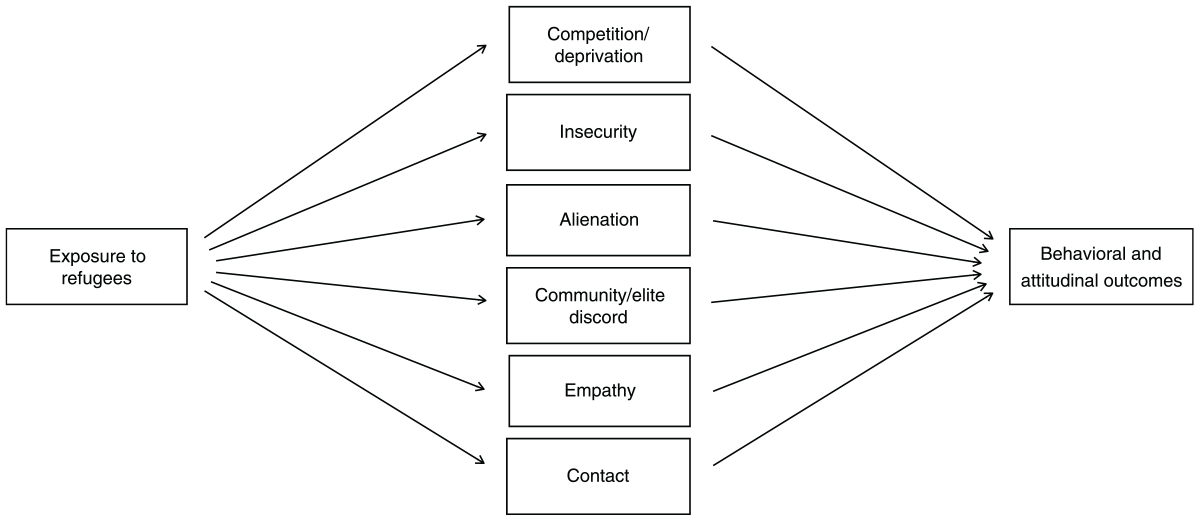
Overview of potential mechanisms included in study.
From political science and sociology we adopt four possible explanations. First, a large literature relates anti-immigrant sentiments to economic competition or the fear thereof, albeit with quite mixed results (Hainmueller & Hopkins, 2014). A related argument is that a sense of relative deprivation vis-à-vis other members of the society translates into rejection of immigrants among those feeling deprived, arguably due to a process of scapegoating (Citrin et al., 1997; Inglehart & Norris, 2017). We hypothesize that exposure to refugees may heighten this sense of competition and deprivation, which in turn will affect attitudes and behavior towards immigrants. Second, exposure to foreigners is often correlated with an increased sense of insecurity in the population, and this is also true for urban areas in Germany (Ferwerda et al., 2017; Lüdemann, 2006). We test the idea that the presence of refugees may go along with an increased fear of crime in the treatment municipalities, which in turn drives up behavioral biases, anti-immigrant attitudes, and right-wing support.
Third, another well-established literature argues that anti-immigrant attitudes are often motivated by feelings of alienation towards newcomers and sociotropic concerns with the preservation of “national culture” (Dancygier & Donelly, 2015; Hainmueller & Hopkins, 2014; Sniderman et al., 2004). We therefore include several items probing for such feelings. Fourth, based on an argument by Williamson (2015), we hypothesize that hosting refugees may lead to dissatisfaction with elites on both the local and national level when these are observed to cater to the newcomers, for example, by supporting them through welfare programs and specific offers such as language courses. We expect such discord to directly translate into anti-immigrant attitudes.
To these explanations we add two mechanisms adopted from psychology. Fifth, we test for the idea that direct exposure to refugees increases feelings of empathy towards them, which should lower biases and reduce prejudice (Oceja et al., 2014). Finally, we expect that the presence of refugees in a municipality entails encounters between natives and the newcomers, and hence focus on contact as our sixth mechanism. Namely, contact may lead to the reduction of prejudice in case the relationship is among equals, based on common goals, oriented towards a superordinate ideal, and enjoys the support of the authorities (Allport, 1954; Paluck et al., 2018). While superficial, incidental contact—for example, crossing each other on the street—is likely to fall short of enabling any prejudice-reducing effect (Enos, 2014; Hangartner et al., 2018; Sands & de Kadt, 2020), intentional interactions in which the engagement with refugees is deeper—for example, helping them navigate their new surroundings—could have such effect.
Research Design and Measurement
Our empirical strategy consists of comparing political attitudes and behavior of people from municipalities in Germany’s eastern regions that received refugees with those of people from control municipalities that did not received refugees. Causal identification relies on two factors: (a) the fact that down to the level of the county, assignment was plausibly orthogonal to possible confounders; (b) a matching strategy that ensures that the threat of selective exposure below this level is negligible.
Treatment Definition
We define a municipality as treated if it received more than four refugees per 1,000 inhabitants. 3 The number of refugees per municipality was determined using administrative records of the number of people that received an asylum seeker allowance in the municipality (FDZ, 2017). Figure 3b reports the distribution of the number of refugees in treatment municipalities. We report results for the extensive margin—whether a municipality received refugees or not—throughout the paper. Results for the intensive margin—the number of refugees received relative to the local population—are included in the Supplemental Appendix, where we show that differences in “treatment dosage” hardly affect our results.
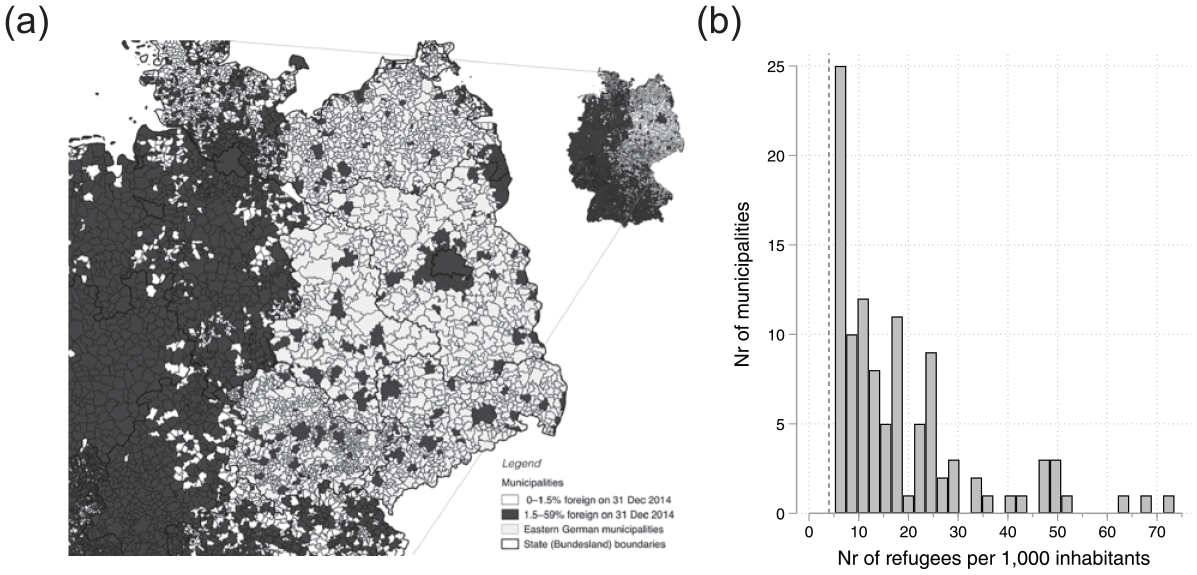
Shares of immigrants and refugees in sample municipalities before and after the refugee crisis: (a) foreign population share prior to 2015 and (b) number of refugees in host municipalities 2015.
Sampling of Municipalities
The allocation of refugees followed stringent bureaucratic rules down to the level of the county, which should assure that the assignment of refugees to counties was orthogonal to pre-treatment covariates. Table 6A in the Supplemental Appendix demonstrates that this indeed appears to be the case. In a regression of the number of refugees allocated to a county on a large number of covariates such as the age structure of the population, purchasing power, or vote shares in the previous elections, none significantly predicts allocation.
However, the rule-based approach to refugee-allocation did not reach beyond the level of the county. Instead, the administration of each county decided how the refugees would be distributed among its constitutive municipalities. Therefore, we cannot simply assume random allocation to municipalities: if county administrations systematically had favored certain types of municipalities, our effect estimates may be biased. To address this issue we implemented a matching strategy at the municipality level using a combination of exact and propensity-score matching. 4 Our starting population were all municipalities in the eastern German Bundesländer of Mecklenburg-Vorpommern, Sachsen-Anhalt, Brandenburg, Thüringen, and Sachsen. Following a pre-registered sampling and matching procedure (spelled out in detail in the Supplemental Appendix), we matched municipalities that had been allocated a sizable number of refugees in 2015 to equivalent municipalities that received no refugees.
Since we are interested in first-time exposure, we limited our selection to municipalities that had hosted very limited numbers (less than 1.5%) of foreigners before 2015 (see Figure 3a). We matched municipalities along a range of political, demographic, and geographic factors. We also made sure that potential control municipalities were located at some distance (>6 km, the median distance between municipality centroids) from treatment municipalities. The matching process resulted in the selection of 120 treatment and 120 control municipalities. As shown in the results section (Table 1), the matching procedure led to excellent balance across covariates, rendering treatment, and control municipalities statistically indistinguishable. In order to minimize possible selection along non-observed dimensions, as mentioned above we conducted qualitative interviews with mayors of potential target municipalities. 5 From the interviews, two factors emerged as possible determinants of refugee allocation at the local level that had not been included in the matching procedure.
Descriptives and Balance.
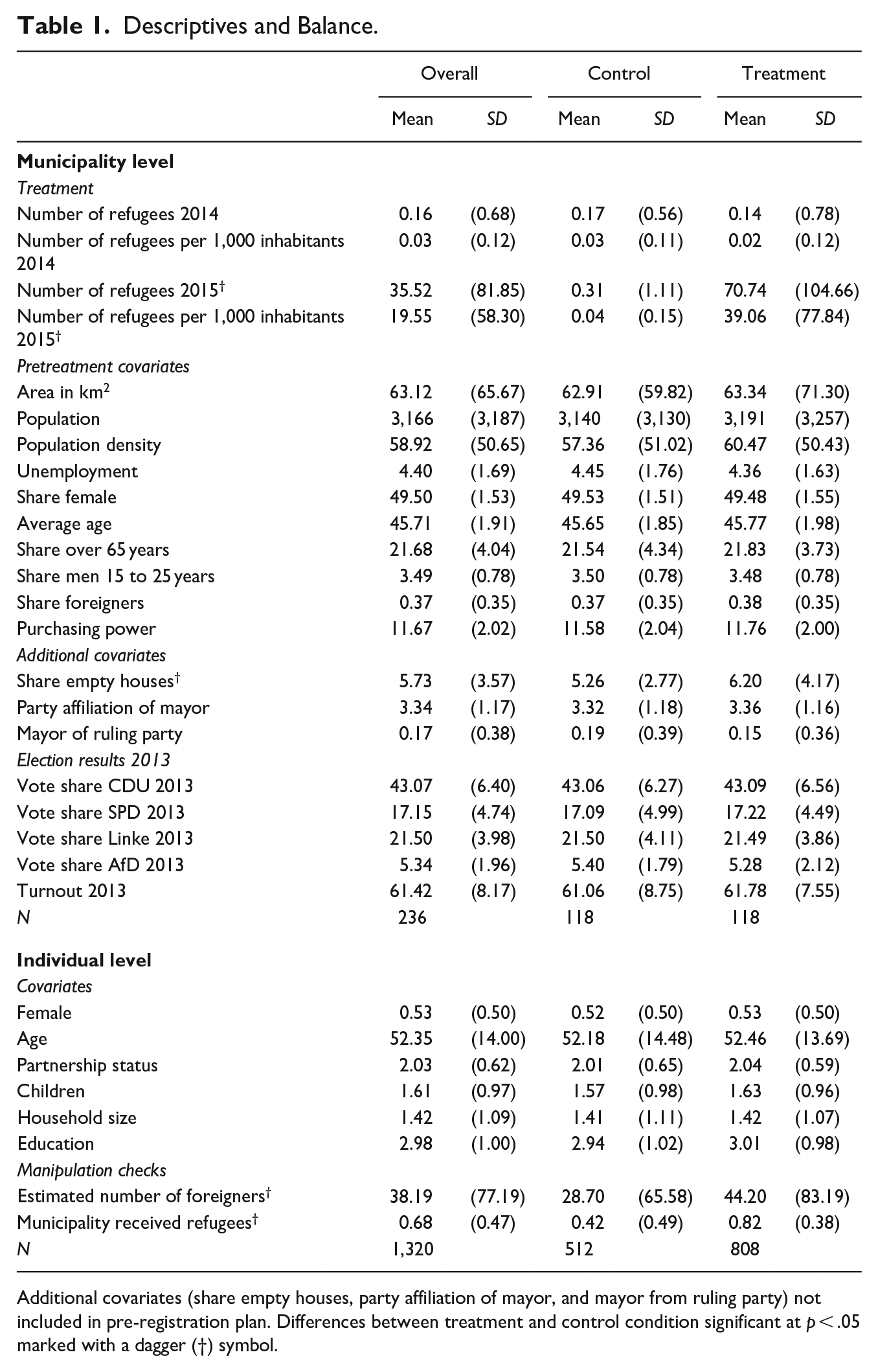
Additional covariates (share empty houses, party affiliation of mayor, and mayor from ruling party) not included in pre-registration plan. Differences between treatment and control condition significant at p < .05 marked with a dagger (†) symbol.
First, and most important, mayors repeatedly stated that refugees were allocated to municipalities were housing was available, usually larger buildings that could be turned into group accommodations. This is in line with the discussion of refugee allocation in Austria, where Steinmayr (2020) uses the availability of housing as an instrumental variable to predict refugee allocation. As shown in Table 1, available housing is a predictor—in fact, the only significant predictor—of refugee allocation in our matched sample. In our interviews, we tried to find out why those that hosted had (marginally) more empty housing—but ultimately failed to uncover a clear pattern. Neither the mayors nor officials responsible for the redistribution seemed aware of this difference. The overwhelming sense was one of crisis, where higher levels of the administration sent people to the lower levels as quickly as possible before a new group of refugees arrived, and left it to local administrators to find pragmatic solutions. 6
Second, among the mayors there was the suspicion that the political leaning of a municipality might have played a role, with more liberal municipalities being more likely to receive refugees. Anticipating this argument, we had included election results from the last election in 2013 in our matching procedure. As a result, our treatment and control group are indistinguishable in terms of general party support (Table 1). 7 In order to address the more specific concern that the party affiliation of the mayor could play a role in whether a municipality received refugees, we additionally hand-collected the name, gender, and political affiliation of the mayor for each municipality and coded whether that affiliation matched the ruling party in the state. Again, these indicators are balanced across treatment conditions, giving us confidence that selection according to political criteria is negligible in our sample.
Recruitment of Participants
Within the sampled municipalities, we recruited individuals proportional to the population sizes in the different states and municipalities, as shown in Table 18A in the Supplemental Appendix. In order to be able to differentiate among varying intensities of treatment, we oversampled respondents from treated municipalities, who consequently make up 61.2% of our sample. Participants were recruited by phone based on a random sample of telephone numbers using a protocol that allowed targeting sample and control municipalities based on the pre-dial code (detailed in the Supplemental Appendix). During the call, participants were invited to answer our online survey and to take part in the behavioral games on a website that we programmed for this purpose using oTree (Chen et al., 2016).
Of those individuals who had declared their willingness to take part in the study on the phone, 37.4% went on to complete the online survey and experiments. Due to incomplete interviews and failure to recruit individuals in four of the 240 target municipalities, our final sample consists of 1,320 participants from 236 municipalities (808 respondents from 118 treatment municipalities, and 512 respondents from 118 control municipalities). The survey took an average of 30 min, and participants received a variable compensation of 10 to 20 Euros (2–4 times the federal hourly minimum wage), with the exact amount depending on their decisions in the behavioral games.
Outcome Measures
We use a combination of attitudinal and behavioral measures to capture our outcomes of interest. Our general approach is to form groups of measures, and then to standardize and average over the items to construct a scale. We construct a total of four scales, the first capturing right-wing support, the second anti-refugee sentiments, the third a populist worldview, and the fourth behavioral bias. Disaggregated results for all individual components of the scales are included in the Supplemental Appendix.
We measure hostility towards refugees with a battery of seven questions, which we combine into a “refugee-rejection scale.” Respondents were asked to what extent they support restricting access for refugees from war, persecution, and economic hardship. We further probed for their support for deportations of rejected asylum seekers, how they expected the labor market to react to the inflow of refugees, and if they wanted the government to invest more in the protection of refugees from violence. A principal component factor analysis reveals all items load onto a single factor and the scale has a high reliability (Cronbach’s α = .79).
Right-wing attitudes are measured using eight questions capturing ethnocentrism, xenophobia, and skepticism of foreigners. The extent to which individuals are willing to act on these beliefs—that is, right-wing behavior—is measured with a question on party vote in the 2017 general elections. Individuals that reported voting for the right-wing populist party AfD (12% of the sample) or the established radical right-wing party NPD (0.4% of the sample) receive a score of one, whereas others are assigned a zero. 8 As an additional, quasi-behavioral measure we asked respondents if they were willing to support a petition urging the federal government to restrict voting rights for non-Germans in local elections. The petition text and layout was taken from a real online petition circulating shortly before our study went into the field. Our “right-wing-support scale” combines both the attitudinal and the behavioral items (Cronbach’s α = .82).
A specifically populist worldview is traced with two items borrowed from Akkerman et al. (2014) that capture the “people-centered” and the “anti-pluralist” dimensions of modern populism. Following classic research in the field (Ivarsflaten, 2008), we combine these items with a further question probing for general satisfaction with democracy into a populism scale. Because it combines different dimensions of populism, by construction the reliability of this scale is rather low (Cronbach’s α = .41) but is maintained here for comparability with previous research.
In order to capture actual behavior, we embedded two standard behavioral games in our survey: the dictator game and the trust game. In both games, respondents are asked to decide whether and how much money to allocate between themselves and a partner. In the dictator game, respondents have to decide whether they want to share money with their partner or keep it for themselves. Since keeping the money is the most profitable solution, sending money is typically interpreted as an altruistic act. The trust game, in contrast, is strategic. Here, respondents have to decide whether to send parts or all of the money to their partner, which is doubled in the process. The partner can then decide whether and how much of the doubled amount of money to return. Sending money can be profitable if the partner returns more than what was sent, but is also risky, as the partner may decide to simply keep the doubled amount. All our respondents played both games twice, in random order: once with a partner with a prototypical German name and appearance, and once with a partner with an Arab name and Middle Eastern phenotype. 9 The measurements of the six explanatory mechanisms followed an analogous approach, with several items per mechanism being combined into a summary indicator (see Section B in the Supplemental Appendix for details).
Results
Descriptives and Balance
Table 1 reports summary statistics for our treatment indicators and covariates. Starting with the treatment, we see that in 2014 the average number of refugees in both treatment and control municipalities was a mere 0.16. This situation hardly changed in 2015 in the control municipalities, where both the absolute number of refugees and their number relative to the population remained close to zero. However, the treatment municipalities experienced a considerable change: here, in 2015, the average number of refugees was 71, corresponding to almost 40 refugees per 1,000 inhabitants.
Our study region consists of relatively small municipalities with an average population of 3,166, located in rural areas with an average population density of 59 persons/km2. This is less than half the average population density in eastern German states (139 persons/km2), but comparable to that of the U.S. Midwest (with an average population density of 63 persons/km2 [U.S. Census Bureau, 2017]). Looking across treatment conditions, we find that all covariates used during matching are highly balanced; there are no observable differences along important dimensions such as level of unemployment, purchasing power, or party support. For the possible factors influencing the allocation of refugees brought up during our qualitative interviews, we see that there are no differences according to mayors’ affiliation nor whether they belong to the ruling party in the state, quelling concerns about a politically driven allocation process. 10 The only significant difference between treatment and control municipalities is the availability of empty housing. In terms of political orientation, until the refugee crisis of 2015, our study area was dominated by Angela Merkel’s conservative Christian Democratic Party (CDU), who had garnered no less than 45% of the votes in the general elections of 2013.
Moving on to the individual level, we see that balance across treatment and control municipalities is excellent, even though individual characteristics were not matched, confirming the effectiveness of our matching and sampling strategies. Moreover, our sample broadly reflects the general population in the municipalities, as the comparison reported in Table 19A in the Supplemental Appendix shows.
Manipulation Checks
Could it be that individuals in treated municipalities did not actually notice the presence of refugees in their midst? Two items included in our survey allow us to refute this “unawareness hypothesis.” First, we asked our survey respondents how many foreigners lived in their place of residence. Second, we directly asked them whether their village or town had received refugees. The results are included in Table 1. Here we see that the estimated number of refugees in the participants’ home community is much higher in the treatment municipalities, and that individuals are largely aware that their municipality hosts refugees. Both differences are significant at p < .001 in two-sided t-tests. In others words, people in treated municipalities were well aware of the presence of refugees in their hometown.
Election Results
The refugee crisis of 2015 took place in the middle of the national election cycle, making for a convenient test of the effect of refugee allocation on voting behavior. Overall, the change in party votes that occurred between the elections of 2013 and 2017 is dramatic: as shown in Figure 4a there was a massive shift in votes from all political camps towards right-wing populists. Angela Merkel’s Christian Democrats (CDU) suffered a 13 percentage points loss, corresponding to about one third of its votes. The social democrats of the SPD and the socialists of DIE LINKE encountered a similar fate, respectively loosing one fifth and one third of their previously-held votes in the studied areas. The right-wing populists of the AfD, in contrast, surged from 6% in 2013 to 25% in 2017, quadrupling their vote share.
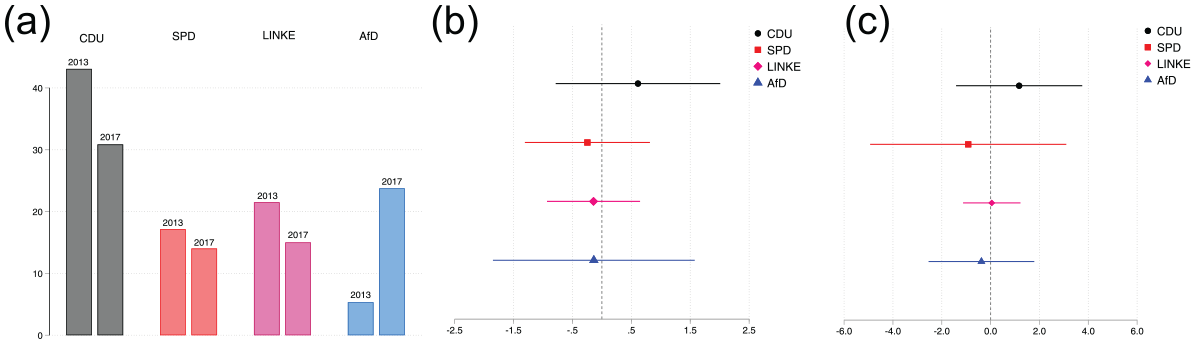
Changes in party vote and treatment effects: (a) party vote shares in the 2013 and 2017 general elections, (b) treatment effect for the 2017 general elections, and (c) treatment effect for the 2016 state elections.
Were these monumental shifts in party support affected by the arrival of refugees in some of the municipalities? Perhaps surprisingly, this is not the case. As Figure 4b shows, there are no meaningful differences between treatment and control municipalities in the share of votes for the AfD or any other party. Election results only ever differ by at most 0.3 percentage points. Thus, the presence of refugees in one’s community appears to have had no role in affecting vote change between the 2013 and 2017 election.
The German electoral system also provides an opportunity to check for short-term electoral consequences of the refugee crisis. In 2016, state-level elections were held in two of the five states in focus. Both elections were contested by the AfD, which garnered 25% of the vote, just as at the federal level. Figure 4c plots the treatment effect for having received refugees. As in the case of the 2017 general elections, no shift in vote shares is visible. That is, even in the short run—the year following the onset of the refugee crisis—hosting refugees had no effect on populist and anti-immigrant voting. This result also provides evidence against the idea that an effect showed only shortly and then withered away.
Individual-Level Outcomes
Turning our attention to individual-level outcomes, Table 2 provides evidence for substantial support for right-wing positions and parties. For example, among our participants, 36% support the statement that foreigners only come to Germany to exploit the welfare state, and 34% of participants support the idea that child support should only be given to native Germans. Refugees indeed entered a hostile environment. This said, there are no differences between treated and control municipalities. Instead, we record null effects on every measure of right-wing support.
Outcomes.
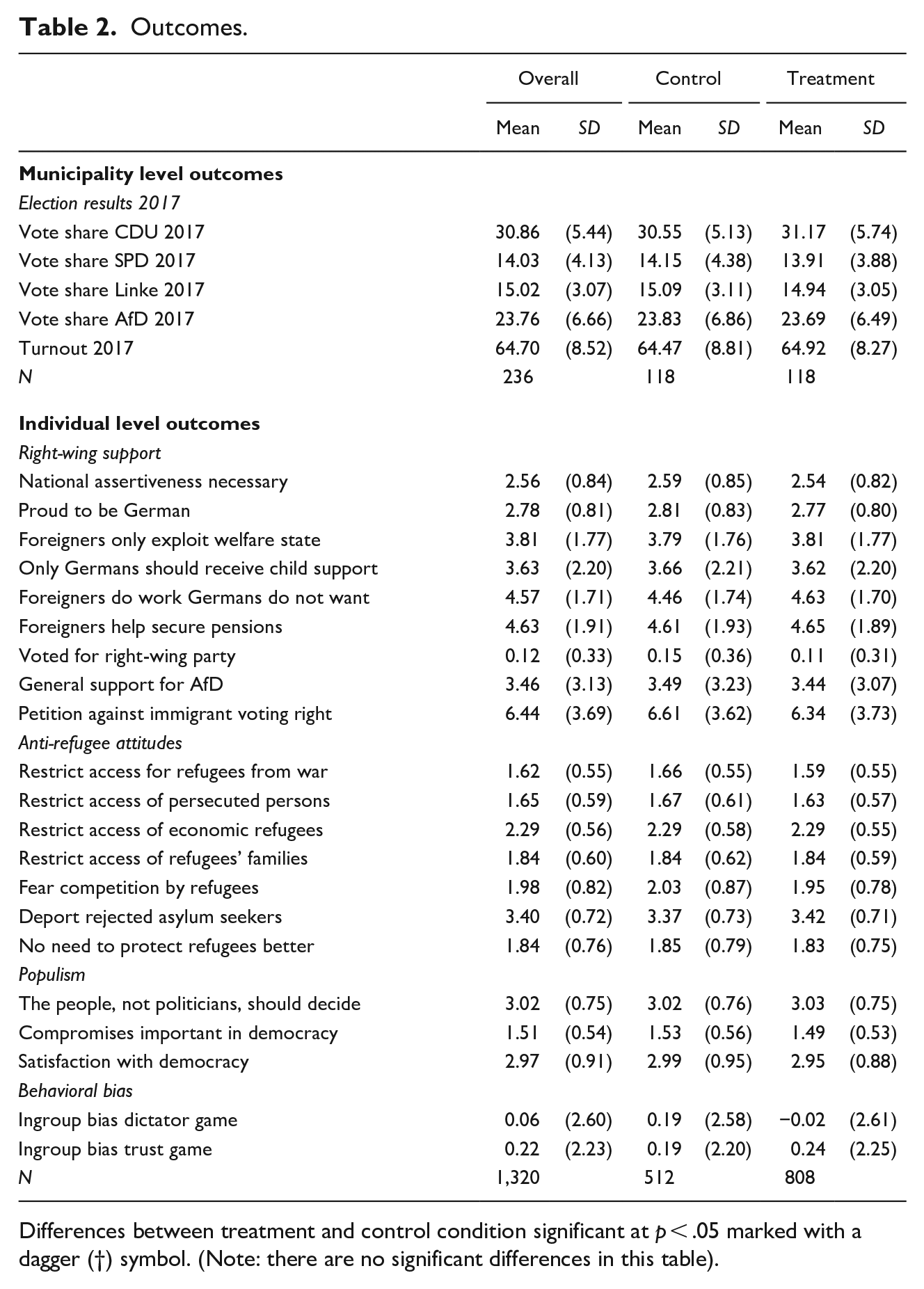
Differences between treatment and control condition significant at p < .05 marked with a dagger (†) symbol. (Note: there are no significant differences in this table).
There is meaningful variation in attitudes towards refugees. A majority of around 60% support limiting the access of refugees fleeing war and political or religious persecution—which also means that around 40% of participants support unrestricted access, however. Full access for refugees leaving their country for economic reasons, in contrast, is only supported by 5% of the respondents. Our participants thus reflect wider trends in attitudes that are more favorable towards refugees fleeing from violence as compared to economic migrants (Bansak et al., 2016). Yet again, there are no differences between treatment and control municipalities for any of the indicators.
Distinctively populist positions also enjoy broad support. No fewer than 77% of our participants agree that “the people” rather than politicians should make the most important policy decisions. At the same time, 77% also declare that they are generally satisfied with the German democratic system. Our participants therefore show conflicting attitudes of relatively high satisfaction with democracy but low support for the politicians that are at the center of that system. Once more, these figures are unaffected by the presence of refugees, however.
Finally, we consider our measures of behavioral bias towards outgroup members. Overall, we see only limited evidence for behavioral bias. The most popular choice in both the dictator and the trust game was to treat ingroup and outgroup members the same: 62% of participants in the dictator game and 67% in the trust game decided this way. The remaining participants showed substantially small but statistically significant bias in the trust game, where they sent 27 cents more to ingroup members (p < .001, paired t-test). No bias is detectable in the non-strategic dictator game, where on average a mere 6 cents more were handed to ingroup members (p = .37, paired t-test). Similar to the attitudinal measures, our behavioral measures remain unaffected by the allocation of refugees.
Regression Results
To address the possibility that our null results are driven by remaining imbalances between treatment and control municipalities, we estimate OLS regression models including the treatment indicator and the full set of individual and municipality-level control variables. Since the treatment took place at the municipality level, standard errors are clustered at this level in all our models. We consider five outcomes: the share of votes for the AfD at the municipality level, and the four scales summarizing our indicators for right-wing support, attitudes toward refugees, populism, and behavioral bias.
The results are presented in Figure 5. All effects are close to zero: The estimated effect on voting for the AfD is 0.3% points, and in no case is the difference in outcome scales larger than 0.05 standard deviations. Moreover, confidence intervals are not particularly large—not extending beyond 1.5% points or 0.1 standard deviations in either direction. We thus find strong evidence for precisely estimated null effects across the board. In order to formalize this statement, we conducted equivalence tests (Schuirmann, 1987). We tested the hypothesis that the treatment moves the outcomes by ±0.2 standard deviations, a value conventionally considered a small effect (Cohen, 1988). Even this relatively conservative hypothesis can be rejected at p < .001 for all outcomes. 11
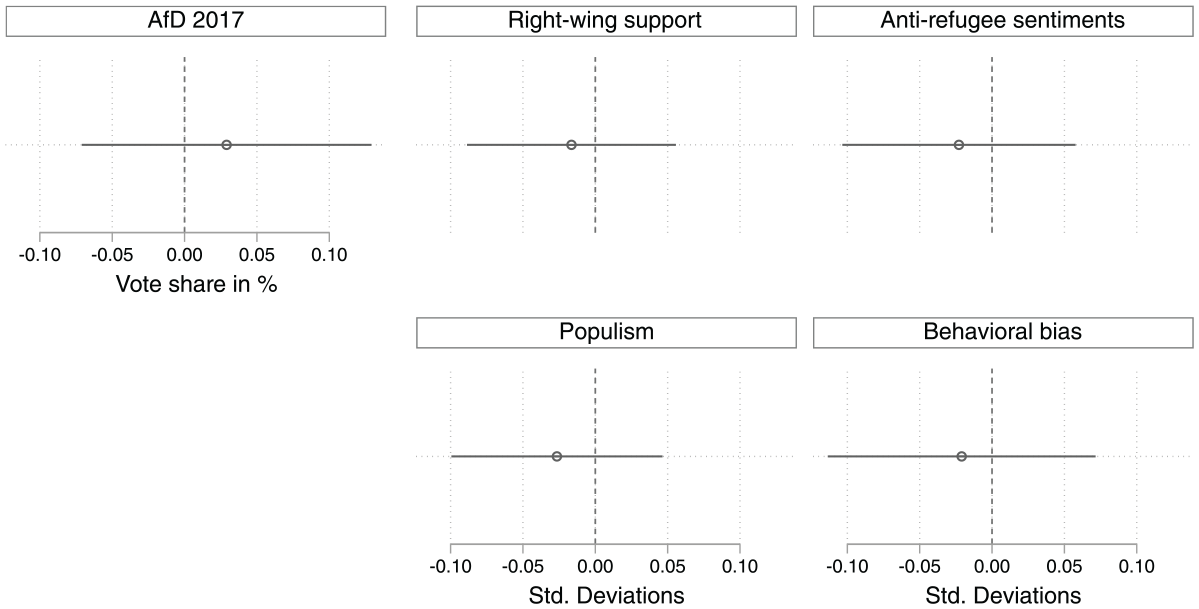
Regression of outcomes on treatment.
To further probe the robustness of our null finding, we conduct several checks (detailed in the Supplemental Appendix). We show that “treatment dosage”—whether a municipality received only very few or substantial numbers of refugees—plays a negligible role. We find some evidence that the five municipalities that received the highest numbers of refugees relative to the resident population (200–600 refugees per 1,000 inhabitants) show higher support for the AfD, but cannot confirm this result for our other indicators. Nor do we find variation in outcomes for the range of less extreme forms of the treatment (under 200 refugees per 1,000 inhabitants). Likewise, we demonstrate that classification errors—individuals incorrectly classifying their municipality as having received refugees or vice versa—have little role in explaining our results.
By means of spatial econometric tests, we also show that our null findings are not simply a result of spatial spillovers from treatment to control municipalities. With the exception of the election results, for which there seems to be some local interdependence, none of our outcome measures is affected by spatial autocorrelation. Further, we demonstrate that the allocation of refugees was not “prevented” by protests or attacks against designated housing. Finally, we show that selective attrition is not a problem: 92% of our sample already lived at their current place of residence before the onset of the refugee crisis, and reported numbers of individuals moving into or out of neighborhoods are small and virtually identical across treatment conditions. In sum, while the attitudinal and behavioral measures show widespread anti-immigrant sentiments and right-wing support, the actual allocation of a sizable number of refugees in municipalities seems to have no effect on any of the included outcomes.
Results Theoretical Mechanisms
Even if we are not finding any treatment effects on our outcomes, we nonetheless test whether the allocation of refugees has had any effect on the explanatory mechanisms that are traditionally linked to changes in attitudes and behavior toward outgroup members. Ideally, each of these mechanisms is expected to have a mediating role in the causal chain connecting refugees allocation to our behavioral and attitudinal outcomes. We therefore consider the possibility that the treatment might have affected the mechanisms, even though it has not had any repercussion on outcomes (yet). 12
First, we find that in line with extant work, the theoretical mechanisms we derived from previous literature are all highly relevant predictors in our study context. Table 3 presents pairwise correlations between our outcome measures and the scaled explanatory mechanisms. Correlations are substantial, they are all highly statistically significant at p < .001, and go in the expected direction. Particularly close correlations are recorded between our outcome measures and the two measures capturing cultural alienation and elite discord, respectively. Albeit merely suggestive, these correlations are in line with work that has pointed to sociotropic concerns about a loss of national culture, and to feelings of neglect by the state as important predictors of support for the political right (Hochschild, 2016).
Pairwise Correlations Between Outcomes and Theoretical Mechanisms.
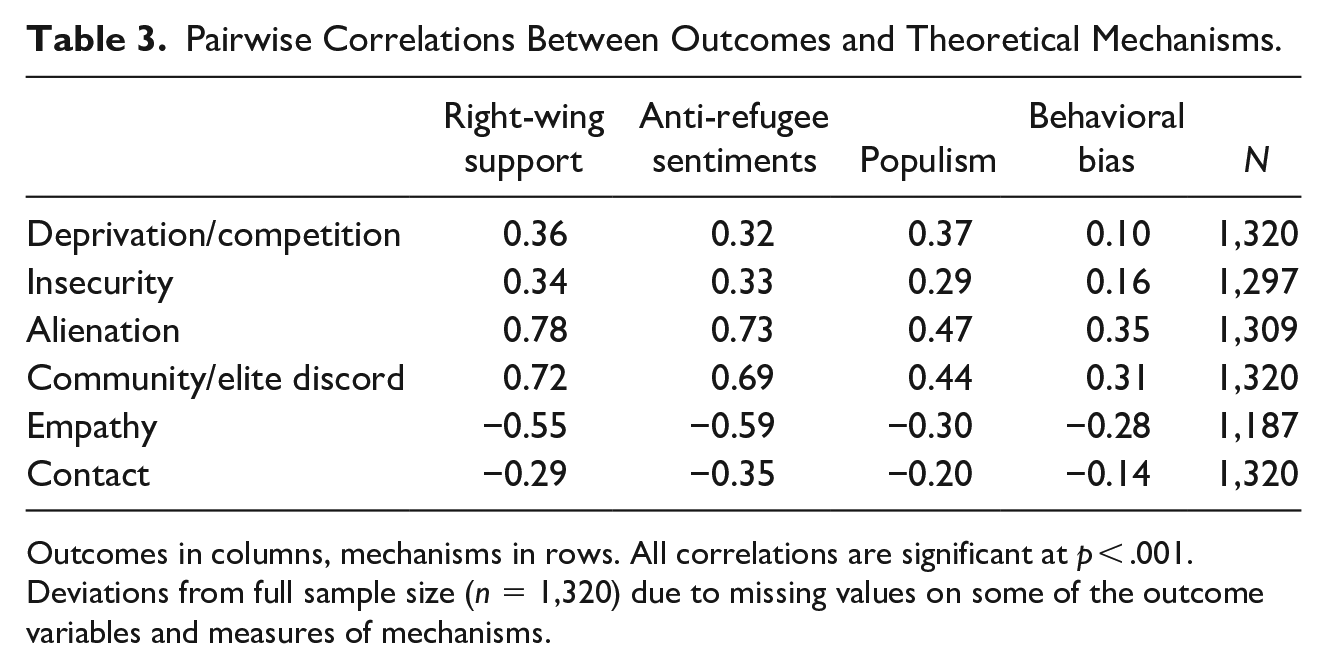
Outcomes in columns, mechanisms in rows. All correlations are significant at p < .001. Deviations from full sample size (n = 1,320) due to missing values on some of the outcome variables and measures of mechanisms.
But did the local exposure to refugees cause a change in these mechanisms? To address this question, in Figure 6 we report treatment effects for each of the six theoretical mechanisms. Once again, very few effects are visible. A partial exception is contact. The allocation of refugees to a municipality seems to have somewhat improved the opportunity for people to seek out contact with refugees (p = .04). Yet this effect evidently was not strong enough to impact overall attitudes.
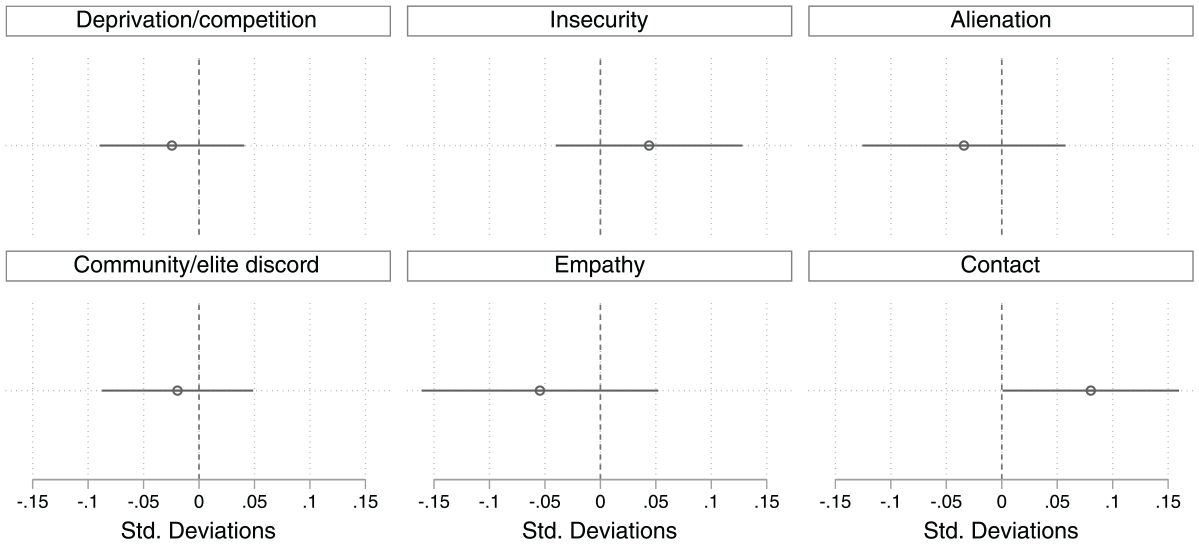
Regression of mechanisms on treatment indicator.
Treatment Heterogeneity
Although we do not find overall effects in our study population, there might be sub-groups for which the physical presence of refugees makes a difference. We pursue two approaches to exploring heterogeneity of treatment effects in our data: one data-driven, and one theoretically-informed approach. First, we use recursive partitioning (a machine learning technique) to uncover systematic heterogeneity along the pre-treatment demographic variables sex, age, education, partnership status, parental status, and household size. The approach, adapted for the purposes of causal inference by Athey and Imbens (2016), uses causal trees to systematically sieve through the data to discover partitions that result in the most salient differences in causal effects in an objective manner. The results of this exercise are plotted in Figure 7. We find that age stands out as the variable that results in the most salient partitions. For all outcomes, the single strongest heterogeneity in treatment effect is between younger people under the age of 40 and older people above 40, with the younger cohort becoming more negative with exposure.
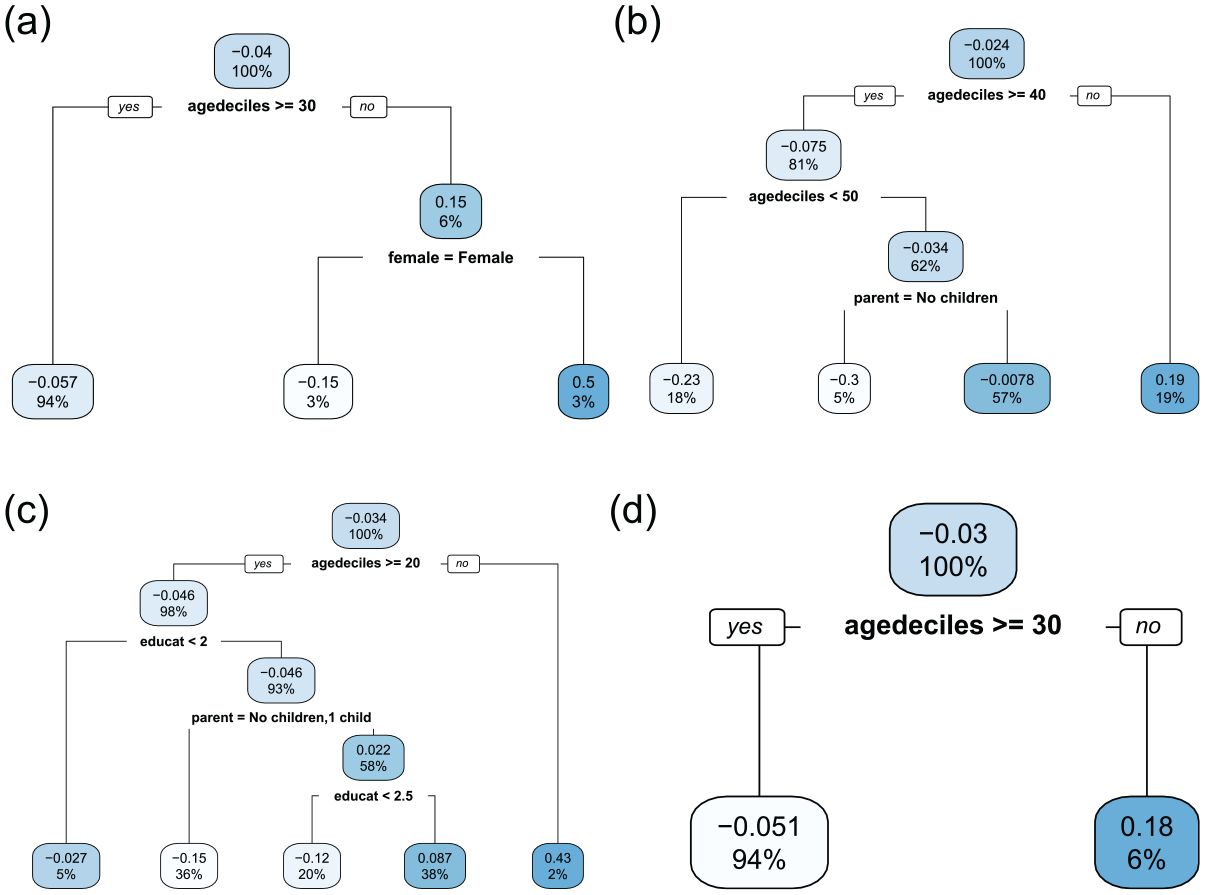
Causal tree diagrams of heterogeneous treatment effects based on Athey and Imbens (2016): (a) behavioral bias, (b) right-wing support, (c) populism, and (d) anti-refugee sentiments.
To further examine this finding, we look at treatment effects on our mechanisms separately for those over the age of 40 and those under. The results, reported in Figure 10A in the Supplemental Appendix, show that all mechanisms tend to be more negatively affected by the treatment among the younger cohorts. Heterogeneity is particularly pronounced for alienation. Local exposure appears to make younger people worry more strongly about a loss of national culture and the supposed cultural threat posed by immigrants. What is more, unlike for those over 40, among the younger there is no increase in contact that could have attenuated the negative impact on other factors. Future work could explore these age differences more in detail.
Our second approach is driven by theory. The highly politicized and divisive nature of immigration in eastern Germany, even in the face of a minimal presence of foreigners, makes political ideology, in terms of the classic left-right identification as well as in terms of authoritarianism, a likely dimension of differentiation. Both dimensions are considered relatively stable characteristics that do not change as quickly as the types of attitudinal measures we used to construct the tested mechanisms (Knutsen, 1995). We measure ideological orientation with a 11-point scale, which we summarize in three categories, and authoritarianism with a classic indicator based on child rearing questions (cp. Feldman & Stenner, 1997). A priori, it is not clear what impact the arrival of refugees has on these partisan subgroups (Hopkins, 2010). On the one hand, their respective views can be strengthened by direct experience, as some of the literature on public opinion polarization suggests (Anderson et al., 2005). On the other hand, the actual presence of refugees might contrast the heated rhetoric that surrounds their arrival, eventually replacing the alarmism of the right as well as the sanguine views of the left with a more realistic and middle of the road experience. This would actually lead to convergence rather than further polarization. We test this idea by interacting the treatment indicator with i) a categorical variable classifying participants as “left,” “center” or “right” based on their self-placement on a left-right scale, and ii) a three-point libertarian-moderate-authoritarian scale.
Figure 8 presents the results. A pattern consistent across all four outcomes emerges: refugee arrivals seem to make individuals on the ideological right less negative in their attitudes and behavior toward foreigners, while those on the left become more negative. A similar pattern is also visible when considering the authoritarianism scale: authoritarian respondents in treated municipalities tend to become less negative, while liberal ones become more so. 13 Indeed, when pooling outcomes in a multilevel framework using the approach suggested by Gelman et al. (2012), the heterogeneous treatment effects become statistically significant. 14 As an additional test, we conduct variance ratio tests, probing for the hypothesis that the variance in responses is smaller in treatment than in control municipalities. The hypothesis is rejected for behavioral bias (F = 1.02, p = .61), but confirmed for right-wing support (F = 0.85, p = .02), anti-refugee sentiments (F = 0.83, p = .01), and populism (F = 0.87, p = .05). The null effects reported in our main results above thus mask a substantial amount of heterogeneity in the treatment effect along respondents’ ideological orientation. However, rather than having polarized communities, the allocation of refugees led to the convergence of attitudes, with individuals both on the right and left moving closer to the center.
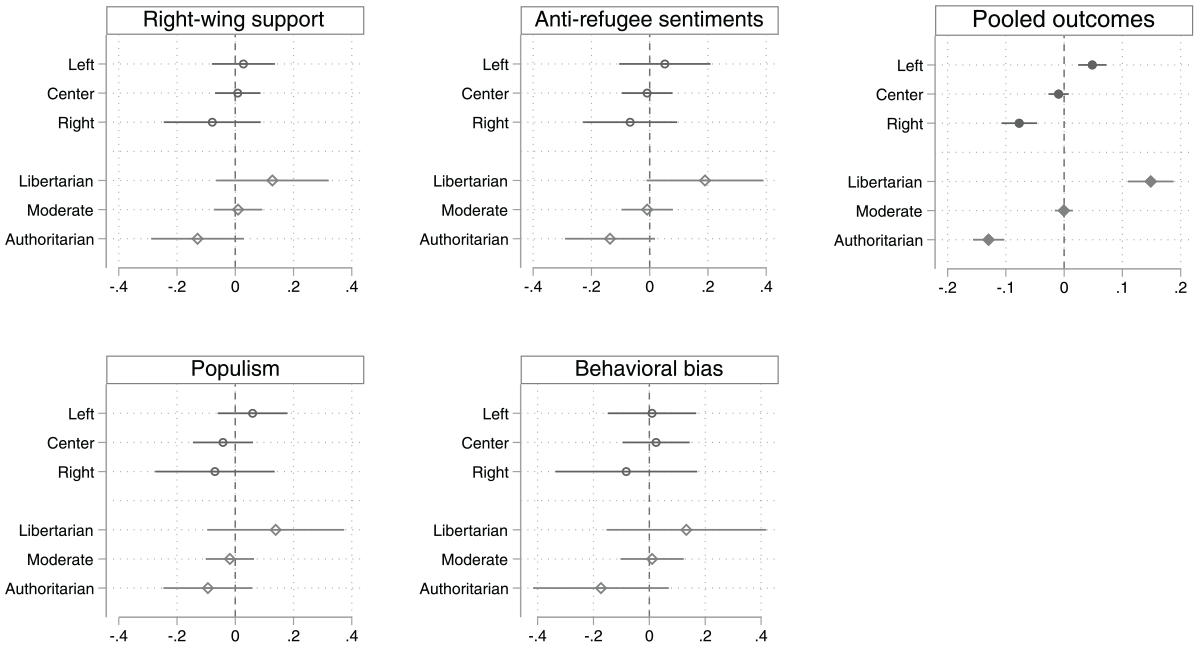
Heterogeneous treatment effects for political and ideological orientation.
Discussion
This study examines how first-time exposure to foreigners impacts natives’ attitudes and behavior towards them and support for right-wing politics. Inference relies on official voting results in the 2013 and 2017 national elections and an original survey of 1,320 German citizens recruited in closely matched municipalities with and without exposure to refugees. We find that residents of municipalities with exposure to refugees are indistinguishable from those without exposure across all measures of right-wing support and anti-immigrant attitudes and behavior. Given the structural similarity of our study region to other non-urban areas in Europe and the US, our findings may extend to similar settings in which the presence of foreigners is relatively low but there is strong anti-immigrant sentiment.
Our study is, in several ways, a crucial test for the causal effect of local exposure to refugees on political attitudes and behavior. The influx of refugees was pronounced, happened relatively quickly, and met the local population unprepared: they neither had influence over the wars and conditions that triggered the migration flows, nor over the decision of the German government to keep open the borders. Refugees arrived in areas where, despite low levels of immigration and ethnic diversity, anti-immigrant sentiments were widespread. Moreover, these areas experienced a surge in support of right-wing populist political actors during national and local elections. Despite these favorable conditions for finding an effect of local exposure of refugees on political attitudes and behavior, we uncover null effects across the board. On balance, neither right-wing attitudes, voting, nor stylized cooperative interactions with non-Germans are affected. Not even specific attitudes towards refugees are affected by actually hosting refugees in one’s community. While we find that classic explanations of anti-immigrant sentiments do a good job explaining what we observe, our results reveal that local exposure had little impact on these mechanisms.
We interpret our findings as broadly supporting the sociotropic view of immigration concerns (Dancygier & Donelly, 2015; Hainmueller & Hopkins, 2014; Sniderman et al., 2004; Valentino et al., 2017). Sociotropic motives mean that people are concerned with the general direction in which their community is going, rather than with their own personal situation. An implication of this theory is that individuals’ personal experiences—such as local exposure to and the specific situation of refugees surrounding them—matter little to attitude formation. Our study explicitly tests and confirms this implication. The situation of individual refugees hosted in their communities seems not to be what respondents are reacting to. Nor do they seem resentful of specific individuals they encounter, as powerfully shown in the low bias in the behavioral games and the substantial degree of empathy they hold for refugees, especially for refugees from regions affected by war. Nevertheless, respondents are highly critical of what they perceived as an open door immigration policy. Individuals in our study area, our data suggests, are not anti-immigrant, but anti-immigration. Ideas about policy dominate local experience.
Yet beneath the cover of this overall null effect, smaller processes appear to have taken place that seem to be driven by local exposure. For one, we observe heterogeneity by age, with younger people being more negatively affected than older ones. For another, we see the convergence of attitudes. This convergence is consistent with a learning or belief-updating process, where those leaning to the authoritarian right positively update their priors, and those on the left are led to correct overly optimistic initial beliefs. Both processes warrant closer examination in future studies.
Supplemental Material
sgb_strangers_appendix – Supplemental material for Strangers in Hostile Lands: Exposure to Refugees and Right-Wing Support in Germany’s Eastern Regions
Supplemental material, sgb_strangers_appendix for Strangers in Hostile Lands: Exposure to Refugees and Right-Wing Support in Germany’s Eastern Regions by Max Schaub, Johanna Gereke and Delia Baldassarri in Comparative Political Studies
Footnotes
Acknowledgements
The authors thank Maria Abascal, Bernd Beber, Marco Casari, Diego Gambetta, Guy Grossman, Anselm Hager, Dominik Hangartner, Macartan Humphreys, Ross Macmillan, Barum Park, Alexandra Scacco, Merlin Schaeffer, Jasper Tjaden, Jeremy Weinstein, and Nan Zhang for their helpful feedback. Jasper Jansen provided excellent research assistance. We would also like to thank Thomas Ritter and his team from the CATI Lab at the University of Jena for their data collection efforts.
Declaration of Conflicting Interests
The authors declared no potential conflicts of interest with respect to the research, authorship, and/or publication of this article.
Funding
The authors disclosed receipt of the following financial support for the research, authorship, and/or publication of this article: Funding for this project was provided by the European Research Council (Grant No. 639284).

Supplemental Material
Notes
Author Biographies
References
Supplementary Material
Please find the following supplemental material available below.
For Open Access articles published under a Creative Commons License, all supplemental material carries the same license as the article it is associated with.
For non-Open Access articles published, all supplemental material carries a non-exclusive license, and permission requests for re-use of supplemental material or any part of supplemental material shall be sent directly to the copyright owner as specified in the copyright notice associated with the article.
