




Abstract
Why do authoritarian governments exclude ethnic groups if this jeopardizes their regime survival? We generalize existing arguments that attribute exclusion dynamics to ethnic coalition formation. We argue that a mutual commitment problem, between the ethnic ruling group and potential coalition members, leads to power-balanced ethnic coalitions. However, authoritarian regimes with institutions that mitigate credible commitment problems facilitate the formation of coalitions that are less balanced in power. We test our arguments with a k-adic conditional logit approach, using data on ethnic groups and their power status. We demonstrate that in autocracies, the ruling ethnic group is more likely to form and maintain coalitions that balance population sizes among all coalition members. Furthermore, we provide evidence that the extent to which balancing occurs is conditional on authoritarian regime type.
Introduction
Why are some ethnic groups included, whereas others are excluded from political power? This is an important question because current research provides increasing theoretical and empirical evidence that the exclusion of ethnic groups increases the risk of armed civil conflict (Cederman et al., 2010, 2011). The ethnic coalition literature provides compelling arguments that inclusion and exclusion dynamics are a consequence of equilibrium outcomes to maximize regime survival given potential internal and external challengers (Bormann, 2019; Francois et al., 2015; Roessler, 2016; Roessler & Ohls, 2018). We contribute to this literature by (a) providing a theory of ethnic coalitions, which takes into account the internal dynamics of potential coalition members (“dual selectorate theory”) and (b) demonstrating that ethnic power balancing is more likely to affect coalition formation in personalist regimes because commitment problems cannot be mitigated.
In his seminal contribution, Roessler (2016) concludes that ethnic coalitions are formed by large powerful ethnic groups, which results in relatively large ethnic coalitions. Ethnic groups become coalition members when a group poses an immediate threat to the government (Roessler, 2016). In this case, the ruling ethnic group accepts the long-term risk of a coup d’etat over the short-term risk of civil war, but only if it can balance the challenger’s threat within the coalition by having sufficient power to threaten civil war itself were it removed from power. This implies that only large ethnic ruling groups can afford to include other powerful ethnic groups. Thus, three types of empirically observable ethnic coalitions are difficult to explain within the framework of Roessler (2016) and Roessler and Ohls (2018): (I) coalitions among small groups, (II) coalitions between small ruling groups and large coalition partners, and (III) coalitions between large ruling groups and small coalition partners.
In contrast to Roessler (2016) and Roessler and Ohls (2018), coalitions between small ruling groups and large coalition partners (II) and between large ruling groups and small coalitions partners (III) can be explained by Bormann (2019), who argues that larger ethnic coalitions are more likely to form as leaders are uncertain about the size of their own group’s following and those of others, but want to be sure to defend against outside challenges. Hence, the deterrence of outside challengers is driving large ethnic coalitions. 1 However, this approach cannot explain the internal balancing dynamics among small ethnic groups in small coalitions (I) and balancing patterns more generally.
Our theoretical approach is informed by Roessler (2016), Roessler and Ohls (2018), and Bormann (2019), but stresses general balancing tendencies that are conditional on the institutional differences in autocracies. Consider Sierra Leone between 1968 and 1992 (party-based autocracy) and the Democratic Republic of Congo between 1966 and 1990 (personalist autocracy), two countries that have been dominated by small ethnic groups, but where the type of ethnic ruling coalitions differs starkly. Sierra Leone’s independence in 1961 was strongly driven by the Sierra Leone People’s Party (SLPP), which became the ruling party after independence and structured political power around parties and electoral contestation (Allen, 1968). While the SLPP leadership was largely comprised of members of the Mende ethnic group (Kandeh, 1992), which represents about one-third of the population, an ethnically diverse coalition was forged in their initial years in office. During Albert Margai’s rule (1964-1967), ethnic tension increased and former coalition members became excluded from the government (Kandeh, 1992). This gave rise to the oppositional All People’s Congress (APC) comprised of northern ethnic groups (Allen, 1968). Once in power, the APC moves the existing party system to a one-party rule with a very unbalanced ruling coalition. A small ethnic group, the Limba (about 8% of the population), is able to hold not only the presidency but also the key ministerial positions while forming a long-term ruling ethnic coalition with the Temne (about one-third of the population) and the Creole (about 6%) ethnic group (see Figure 1) (Cederman et al., 2010; Vogt et al., 2015).
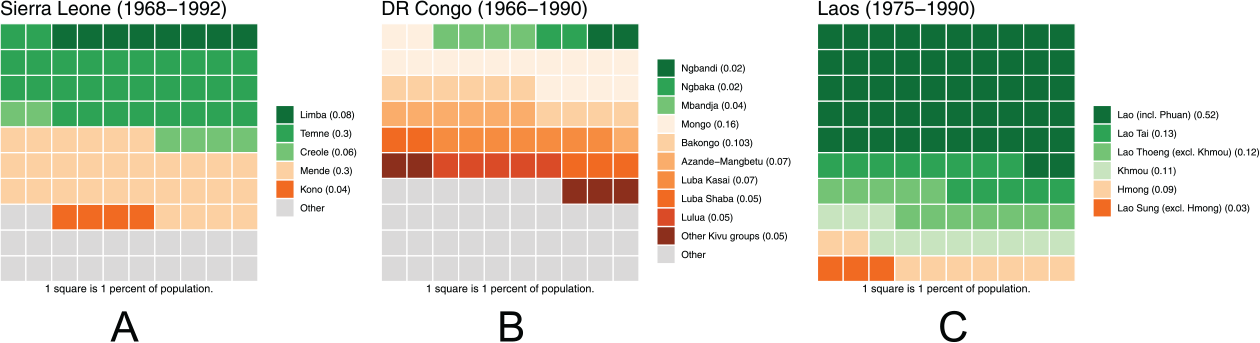
Percentage of ruling ethnic group (dark green), coalition groups (lighter greens), excluded groups (reds), and other groups (gray) in Sierra Leone (1968-1992), Democratic Republic of Congo (1966-1990), and Laos (1975-1990). Democratic Republic of Congo is an example of small ethnic groups balancing in authoritarian personal regimes, while Sierra Leone and Laos are the examples of unbalanced ethnic coalitions in authoritarian party regimes. Each square represents 1% of the population according to the Ethnic Power Relations dataset: (A) Sierra Leone, (B) Democratic Republic of Congo, and (C) Laos.
In contrast, the Democratic Republic of Congo has been characterized by personal rule from a very early stage (Callaghy, 1987). While the provisional constitution (Loi Fundamental in 1960) established a parliamentary republic, the Constitution de Luluabourg of 1964 featured a strong presidential centralization of power. Presidential powers were further enshrined by the Constitution du Zaïre in 1974, consolidating the dictatorship of President Mobutu Sese Seko. The political system was unable to deal with the contest for political access and, despite the official promotion of a Zairian nationalism (Young & Turner, 1985), Mobutu restricted access to power to mainly three small ethnic groups: his own ethnic group the Ngbandi (2% of the population), the Ngbaka (2% of the population), and the Mbanja (4% of the population) (Cederman et al., 2010; Vogt et al., 2015).
Sierra Leone and the Democratic Republic of Congo are not the only countries led by small ethnic groups. Figure 2 demonstrates ethnic coalition behavior conditional on the status highest (ruling) ethnic group according to the Ethnic Power Relations (EPR). 2 The left panel demonstrates that the median coalition partner size (included groups) of small ruling ethnic groups (0%–10% of the population) is about 13% of population, but with substantial variation. Furthermore, as the right panel in Figure 2 shows, coalitions of small partners also include only few partners, making the overall size of these coalitions relatively small.
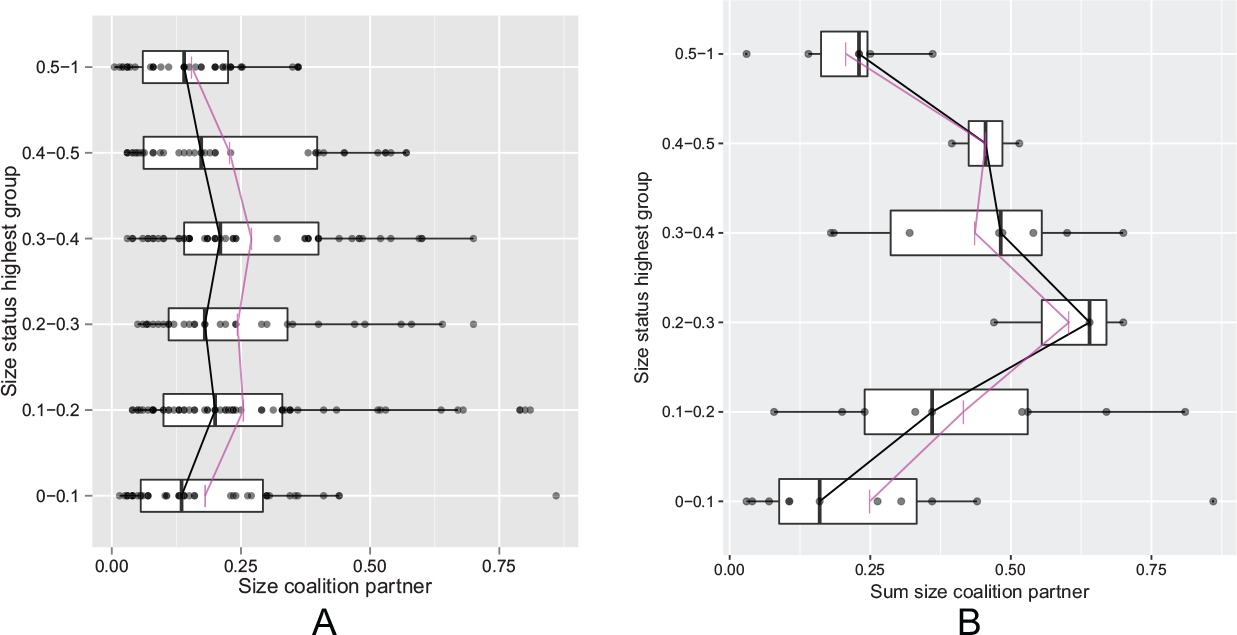
Left panel shows the size of ethnic coalition partners conditional on the size of the status highest (ruling) ethnic group. Right panel pertains to the overall size of the ethnic coalition partners excluding the status highest group. The black line connects the median values, while the pink line connects the mean values. Only coalitions with two or more groups are included in the plot: (A) Coalition partner size and (B) Coalition partner size (sum).
Figure 2 also demonstrates that large groups form coalitions with small groups, which can be brought in line with Bormann (2019), but is more difficult to explain by the theoretical framework of Roessler (2016) and Roessler and Ohls (2018). We argue that especially party-based regimes allow small ethnic groups to be included in ruling coalitions without the fear of being exploited. For example, in Laos, the communist Pathet Lao ruled the country through the Lao People’s Revolutionary Party (Ireson & Ireson, 1991; Lund, 2011). The largest ethnic group, the Lao (about half of the population), was in charge of most government positions during 1975 to 2017 and while the ethnic Hmong were strongly discriminated against other ethnic groups, such as the Lao Tao (13%), the Khmou (11%), and the Lao Thoeng (12% of the population) (Cederman et al., 2010; Vogt et al., 2015), had representation in government positions (see Figure 1).
We provide a theoretical framework that explains the balanced and unbalanced coalition formation in authoritarian regimes conditional on regime type. We argue that a double commitment problem constrains the ability of otherwise mutually beneficial ethnic coalitions to form in personalist authoritarian states. Here, ruling ethnic groups have incentives to exclude ethnic groups that are more powerful than themselves as these groups cannot credibly commit to remain loyal to the ruling group. However, ethnic groups that are potential coalition partners have no incentive to join the coalition as the ruling group cannot commit to existing agreements if it is stronger than its coalition partners. This mutual commitment problem makes it difficult for ruling ethnic groups to include other ethnic groups that are dissimilar in power. However, party-based authoritarian systems can provide institutional arrangements that mitigate the double commitment problem and allow for unbalanced ethnic ruling coalitions.
Our argument differs from Roessler and Ohls (2018) in several relevant ways. First, we do not assume that the only reason to include an ethnic group in a coalition is to avoid armed conflict with the group in question. Instead, we argue that the ruling ethnic group also has incentives to include other, especially weaker, groups to strengthen the coalition against outside challenges by other groups and to prevent coups by forming large ethnic coalitions (Arriola, 2009; Bormann, 2019). Second, Roessler and Ohls (2018) understand group strength as an absolute concept where two groups can only form a coalition if both are above an absolute threshold of capability that allows them to threaten costly civil war. In our theory, group strength is a relational concept: We argue that even in the absence of institutions facilitating credible commitment, ethnic groups can form coalitions if they are of similar strength. That means that even weaker ruling groups can form coalitions with similarly weak groups. Third, we theorize dynamics within potential coalition partners to understand the conditions under which some ethnic groups are unwilling to join ethnic coalitions (“dual selectorate theory”).
Authoritarian Politics and Ethnic Ruling Coalitions
Two important problems of authoritarian rule have been outlined by previous research (Svolik, 2012; Wintrobe, 1998): (a) problems of authoritarian power-sharing and (b) problems of authoritarian control. In the context of ethnic coalitions, the problem of authoritarian power-sharing 3 originates from the need to include some groups in government to guarantee political survival while minimizing the risk of coups. The problem of authoritarian control, however, requires leaders to control groups outside of the coalition (Svolik, 2012).
The existing literature offers slightly different perspectives on how ruling coalitions deal with the lack of binding agreements and the shape of coalitions we should be observing empirically. When it comes to authoritarian power-sharing, a main challenge that authoritarian ruling coalitions face is the difficulty of the coalition ruler to commit to promises vis-à-vis her coalition members (Magaloni, 2008; Svolik, 2009). This problem is most prominent in personalist regimes where the ruling group can make decisions with few constraints (Geddes, 1999). However, Magaloni (2008) argues that this commitment problem can be solved by the creation of political parties that control some access to power. These political institutions are argued to be stable because they are in the self-interest of the ruler by guaranteeing less internal challenges and longer tenure. Svolik (2009) identifies the same commitment problem but argues that stability in ruling coalitions can only be established if the coalition members maintain a credible threat against the ruler. However, because the threat of a coup d’etat itself might lack credibility, rulers can slowly erode the power of ruling coalition members until the ruler can no longer be threatened (Svolik, 2009).
But, it is not only the members of the ruling coalition that fear defection by the ruler. Similarly, rulers need to be concerned about the threat of coups from the inside. This is why Acemoglu et al. (2008) argue that authoritarian ruling coalitions need to be self-enforcing in the sense that there are no sub-coalitions within in the current coalition that would be strong enough to deter outside challengers. A slightly different argument is presented by Roessler and Ohls (2018) who stress the trade-off between excluding powerful actors which can then pose the risk of rebellion and including them at the increased risk of a coup d’etat. Their argument suggests that powerful actors will be included, but only by powerful rulers who can balance their coalition partners’ strength (Roessler & Ohls, 2018). Weak actors are not expected to be included in ruling coalitions because they do not pose enough of an external threat and would only contribute to higher incidents of coup d’etats. Thus, Roessler and Ohls (2018) considerably constrain the set of possible ruling coalitions suggested by Acemoglu et al. (2008) which in turn allows for some configurations that would not be self-enforcing in the latter framework.
Ethnic Coalitions and the Logic of Survival in Authoritarian Regimes
Our theoretical argument is based on the assumption that leaders in authoritarian states attempt to stay in power despite problems of authoritarian power-sharing and authoritarian control (Svolik, 2012; Wintrobe, 1998) and that while authoritarian rulers have incentives to mitigate outside threats by including ethnic groups into the ruling coalition (Acemoglu et al., 2008; Bormann, 2019; Francois et al., 2015), this might also increase the risk of internal coup d’etats (Roessler & Ohls, 2018). We argue that in authoritarian states with weak institutional features, which fail to guarantee binding coalition agreements, both authoritarian rulers and potential ruling coalition members face commitment problems that can only be solved by forming power-balanced coalitions.
We propose that ethnic coalition formation in autocratic states involves an autocratic ruler and leaders from ethnic groups that can potentially become members of the ethnic coalition. 4 The autocratic ruler and the other ethnic leaders rely on the support of their respective ethnic groups. In fact, the autocratic ruler and all ethnic leaders need to ensure that their policies not only maximize their private rents (private benefits from staying in office or becoming a part of the ruling coalition) but also that they have support among their own ethnic group. This is a crucial assumption in our theoretical framework because we thereby increase the cost for forming ethnic coalitions that might buy off ethnic leaders but do not provide political and economic access to the entire population of the ethnic coalition members. We assume that unsuccessful policies (e.g., minister posts for ethnic leaders without benefits for their ethnic groups) increase the probability of a group leader being replaced by other members of the group’s respective ethnic elite. 5
We assume that initially the leader of the ruling ethnic group approaches the leaders of ethnic groups which she would like to include in the government coalition. 6 Leaders of potential coalition members in turn decide whether to lead their ethnic groups into a government coalition.
The Autocratic Ruler
We assume that inclusion of ethnic groups fosters regime survival because it increases regime stability (Acemoglu et al., 2008; Bormann, 2019; Francois et al., 2015) by preventing outside challengers. But inclusion is not without risks for the existing government (Wucherpfennig et al., 2016). Included ethnic groups become members of the security apparatus which in turn gives them new abilities to rise against the existing leadership (Roessler & Ohls, 2018; Svolik, 2012). 7 While preventing outside challenges (Acemoglu et al., 2008; Bormann, 2019; Francois et al., 2015), the inside threat becomes especially problematic for the ruling group when coalition members are more powerful. Groups that are more powerful have a particularly high risk of staging coups and as a result face a commitment problem when being considered for inclusion.
In line with previous work (Bormann, 2019; Francois et al., 2015; Roessler & Ohls, 2018), we conceptualize an ethnic group’s power as a function of its size compared to the rest of the population. When included, ethnic groups that are relatively large vis-à-vis the ruling ethnic group—if their representation in state institutions is at least to some degree proportional to their size—are more likely to be successful when staging a coup. We argue that this representation should be guaranteed because leaders of included ethnic groups need to ensure political benefits to their supporters.
However, this guarantee of representation makes it unlikely that the ruling ethnic group includes groups that are relatively large compared to themselves because they cannot be given a level of representation that is acceptable to them while posing a manageable coup risk. For this reason, ruling groups will not select relatively large ethnic groups into the ruling coalition. Instead they will prefer to rule with ethnic groups that are small enough to credibly commit to the ethnic coalition or—if that is not an option—rule alone. 8
The Leaders of Potential Coalition Members
Based on the above argument, we only expect groups that are similar-sized or smaller than the ruling ethnic group to receive an offer to join the ruling coalition. Leaders of potential coalition members can accept or reject an offer to be included into the government coalition by the autocratic ruler. Since the leaders of ethnic groups are interested in remaining in their current leadership position, they need to carefully weigh the risks and benefits of being included or remaining outside the ruling coalition.
The leader’s preference is to remain the leader of her ethnic group. The leader’s position will be strengthened if she enters the coalition and is able to increase political and economic access to her ethnic group. If the leader rejects the offer by the government and can convincingly demonstrate that the government would likely exploit the group once in a coalition, her position remains unchanged.
However, the leader’s position will weaken if she promises benefits from joining the government but cannot deliver as supporters might not be able to distinguish whether the leader was unable or unwilling to further their interests. Hence, leaders who join a coalition and are unable to provide benefits to their group are subject to leadership removal, as group members have difficulty observing whether the leader has not received any spoils or is simply consuming them for her personal benefit. Similarly, if she does not join the government even though her supporters are convinced that this would increase their benefits, supporters also have incentives to punish her. 9
This logic puts leaders whose ethnic group is relatively small vis-à-vis the ruling ethnic group in a position to decline ethnic coalition membership. This decision is driven by a commitment problem of the ruling autocrat. Potential coalition partners fear that the ruler will renege on coalition agreements. This is especially the case if the ruling group is much larger than that of the coalition members. When coalition members are relatively small vis-à-vis the ruling ethnic group, they are likely to be exploited in the ruling coalition as their potential to threaten a coup is very low. This logic is very much in line with existing arguments in the literature that put the commitment problem of the authoritarian ruler at the center of their analysis (Magaloni, 2008; Svolik, 2009). 10
Ethnic leaders who join a coalition and are unable to deliver promised spoils are likely to be punished by their group members, as group members cannot distinguish whether their leader has not received spoils or has hidden part of the spoils for her personal benefit. This leads to the following outcome: group members have to punish leaders for not delivering promised goods to avoid the misappropriation of funds, which in turn keeps group leaders from joining coalitions where they cannot be sure of being rewarded appropriately by the ruling ethnic group altogether. For these reasons, ethnic groups do not have incentives to join coalitions in which they are relatively small partners. Because neither the ruler nor potential coalition members want to end up as the smaller coalition partner, coalitions of ethnic groups that are fairly similar in size are most likely to form
However, the initial formation might be influenced by incomplete information (Bormann, 2019) or external pressures that lead to unstable coalitions that break down after short periods of time. This implies that balanced ethnic coalitions that are formed on the equilibrium path should persist for longer periods of time and more frequently reaffirmed by the coalition members. Hence, we expect that
Authoritarian Regime Types
Our general argument focuses on the difficulty of credible commitments in authoritarian regimes that stem from the lack of executive constraints and the absence or weak institutionalization of rules for the selection of the executive compared to democracies. However, authoritarian states differ considerably in their institutional make-up (in the international context, compare with Weeks, 2008) and the ability of the institutional framework to alleviate commitment problems (e.g., Magaloni, 2008) among ethnic groups. While some types of authoritarian regimes aggravate issues of credible commitment in the coalition formation stage, other types of regimes mitigate these issues and allow for coalitions that would otherwise not form or persist. We follow the distinction of regime types in Geddes et al. (2014) 11 and argue that personalist regimes aggravate the problems of credible commitment between ethnic coalition partners while dominant-party regimes facilitate commitment within ethnic coalitions.
Leaders of personalist regimes have the most difficulty to credibly commit to weaker coalition partners and not to defect once they have joined the coalition. In a personalist regime, a small group with the dictator at its center controls policy and access to power (Geddes et al., 2014). As a result, the leader of the state can replace the members of the government coalition at will (Geddes, 1999) which makes credible commitment toward weaker coalition partners difficult. At the same time, coalition partners that experience increases in relative power have incentives to renege on existing agreements by attempting coups.
Dominant-party regimes, however, facilitate credible commitment among ethnic groups in a government coalition and allow the ruling group to form coalitions that are not based exclusively on power balancing. In a dominant-party regime, the party controls access to power and influence on policy (Geddes et al., 2014). Other parties may exist in such regimes and run in elections, but face harassment or institutional disadvantage (Geddes, 1999). Dominant parties provide institutionalized rules of succession that make it worthwhile for elites to commit to the regime and the current leader as they will have sufficient opportunities to increase their power and access to state resources in the future (Magaloni, 2008). 12
In an ethnic context, these characteristics of party regimes make it worthwhile for representatives of other ethnic groups in the coalition to support the regime, as the party structure protects them from defection by the ruler and guarantees spoils and opportunities in the long run. Thus, the institutional framework of a dominant-party regime helps ruling groups overcome their difficulty of committing to weaker coalition partners. This makes it less risky for weaker ethnic groups to join coalitions with stronger ruling groups and benefit from the material advantages that often accompany political inclusion.
Party regimes also makes it easier for coalition partners to abstain from overthrowing the ruling group in a coup because they have less incentives for defection, as future opportunities are more certain for them and will outweigh the insecure opportunities that come with a risky coup (on the latter point see Magaloni, 2008). However, as coalition partners become particularly powerful and their chance of being successful in a coup rises, there comes a point where the high likelihood of becoming the ruling group themselves is no longer outweighed by the securities provided by the party (Magaloni, 2008). Thus, including groups that are much more powerful than the ruling group remains risky, even under dominant-party regimes. Instead, ruling groups have the biggest incentives to include several smaller ethnic groups that help them deter challenges by outside groups attempting to overthrow the government. In addition, a larger and ethnically more divided government coalition can deter coups, as coordinating a coup between the larger number of ethnic groups needed to overthrow the government is difficult (see Arriola, 2009). However, if the ruling group is small itself or if there are few small groups in a given state, a ruling group may not be able to form this ideal type of coalition. In such situations, the institutional structure of dominant-party states may lead ruling groups to include stronger groups than themselves in order not to be vulnerable to outside attacks. Thus, we expect the following hypothesis to hold:
Again, we argue that in the formation stage, exogenous pressures and incomplete information increase the chance of unstable, off equilibrium path coalitions. Hence, we argue that the differences between dominant-party regimes and personalist regimes should be especially pronounced over time. The persistent reaffirmation of balanced coalitions in personalist regimes and the ability to form less-balanced ethnic coalitions in dominant-party regimes lead us to the hypothesis that
Research Design
We provide a research design that is directly derived from our theoretical argument. Since we are interested in the choice of a potential ethnic coalition given a ruling ethnic group, we implement a k-adic (Poast, 2010) conditional logit approach. The approach is slightly different from the k-adic approach in Bormann (2019) because we only use those coalition member permutations that include the ruling ethnic group. Thus, in a country with three ethnic groups A, B, and C, with ruling ethnic group A, we would only consider A, AB, AC, and ABC as potential coalitions and would exclude B, C, and BC as they do not entail the ruling group. The conditional logit approach is appropriate because the leader chooses, with agreement of the potential coalition members, out of a set of choices where their realization probability sums to one. We analyze two samples of potential coalitions. The first includes only years of actual coalition change, testing Hypotheses 1a and 2a about the initial formation. The second sample analyzes the persistence of ethnic coalitions (Hypotheses 1b and 2b) by including all potential coalitions over time. In this section, we provide a detailed description of our research design.
Unit of Analysis and Sample
The unit of analysis is the potential ethnic ruling coalition that can form in a given year. We identify ethnic groups and their size using the EPR data version 2014 (Cederman et al., 2010; Vogt et al., 2015). The potential ethnic ruling coalitions are the combinations of all relevant and active ethnic groups in each year. We constrain the sample of coalitions in several ways to suit our theoretical focus. First, we only include potential ethnic coalitions that include the ruling ethnic group. Our approach differs from Bormann’s as our argument focuses on ruling groups’ strategic choices of inclusion and exclusion and potential coalition partners’ reactions to these choices while our argument does not address the dynamics that bring a group into the highest position of power in the first place. We define the ruling group to be the status highest group using the power-ranking provided by EPR. Status highest ethnic groups are coded by EPR as “monopoly,” “dominant,” or “senior partner.” 14 Second, we restrict our analysis to countries “born” or gaining independence after 1946 to isolate the initial and probably crucial formation of ethnic ruling coalitions. Third, as our theoretical argument pertains to autocratic regimes, we only include years under autocratic regimes as defined by Geddes et al. (2014). 15 That means we not only exclude country-years that are classed as democratic but also periods where states are not independent, occupied by a foreign power, and situations where the government does not control the majority of the state’s territory and transitional periods (Geddes et al., 2014). 16
Variables
The dependent variable is coded one if a potential ethnic ruling coalition is realized and otherwise zero. Our first hypothesis suggests that potential coalitions with similarly sized ethnic groups are most likely to be realized. We test this argument of balanced coalitions by calculating the Gini coefficient based on relative population size of all ethnic groups in a potential coalition using the EPR data (Cederman et al., 2010; Vogt et al., 2015). Originally, the Gini coefficient is calculated as
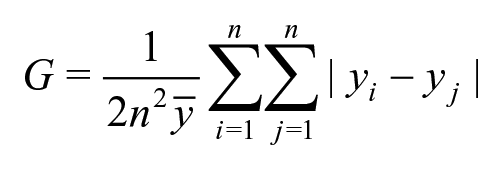
where n is the population size and yi is the income of an individual i (Cowell, 2011). In our application, n is the number of ethnic groups in a coalition and yi is group i’s population share. The Gini coefficient, a measure of how unequal the population distribution is within a potential coalition, takes a value of zero when all groups are equally sized and can theoretically take a maximum value approaching one for very unequal distributions (maximum observed value in our data is .82). 17
We distinguish three different types of authoritarian regimes based on data from Geddes et al. (2014): one on party regimes, one on personalist regimes, and one category in which we include all other types of regimes. Hypothesis 2 expects that in dominant-party systems, ethnic coalitions are formed by less similar-sized ethnic groups than in personalist regimes. Other types of regimes are expected to feature effects between personalist and dominant-party systems. To test these expectations, we interact dummy variables on the party and the other type of regime with our inequality measure using personalist regimes as the baseline category.
We include a number of variables that have a direct effect on the Gini coefficient and are plausible explanations for coalition realization. Importantly, we indicate whether a potential coalition only includes the ruling group as single coalitions have by definition a Gini coefficient equal to zero. 18 In addition, using EPR data, we control for the combined proportional size of all included groups vis-à-vis the government.
We also consider a number of variables that may have an effect on our equality measures alongside the realization of a coalition. We control for the possibility that the government tries to mitigate outside challenges by minimizing the number of geographically dispersed ethnic groups within the ethnic ruling coalition. For this, we include a variable on the number of groups that are included alongside the ruling group that are geographically dispersed using data from EPR based on GEO-EPR (Wucherpfennig et al., 2011). The empirical models also account for past conflict between potential coalition members as this might increase, or respectively decrease, the probability of coalition realization. Hence, we control for whether the members of the coalition have been in conflict with one another in the past using the EPR data which draws on the UCDP/PRIO Armed Conflict dataset (N. P. Gleditsch et al., 2002). Following Bormann (2019), we additionally include a measure on ethnic cleavage dimensions within a coalition. As suggested in Bormann (2019), and using the Ethnic Dimensions data (Bormann et al., 2017) provided in the EPR data, we construct a cumulative score that takes value three if coalition members differ in language, religion, and phenotype, and value zero if they differ in none of these dimensions. 19
As mentioned above, we analyze two samples to account for the past record of potential coalitions being excluded and included from power. Hence, we analyze the full sample of potential coalitions which allows us to model persistence of particular coalitions, as well as a subsample that only includes years where a new coalition came into power. We include a number of variables to model temporal dependence. We include a variable on the total, cumulative number of years that a coalition was in power before the year under scrutiny. In addition, we include a variable on the time since the last year out of power (or where the coalition did not exist). We include similar variables for years out of power that is the total, cumulative years that a coalition was out of power up until the year under scrutiny and the number of years since the most recent year in power (or since the beginning of a coalition’s existence). 20 We also include a lagged dependent variable. 21 We include squared and cubed terms of all non-binary time variables following the suggestion of Carter and Signorino (2010).
Summary statistics for all models and variables can be found in the Supplemental Appendix (Table A1). The analysis sample on coalition changes contains 45,834 observations in 90 country-years and as a result with 90 realized coalitions. The full analysis sample contains 789,650 observations in 2,166 country-years with 2,166 corresponding realizations.
Method
We use a k-adic conditional logit model that compares all potential coalitions within a country-year as this is the choice that the status highest groups face in any given year. In other words, the probabilities of realization for all potential coalitions within a country-year sum to one, reflecting the fact that the status highest groups must choose exactly one of the potential coalitions in a given year. This setup also allows us to control for—potentially unobserved—country- and senior-partner-specific characteristics in a convenient way and to only include variables that are specific to a given potential coalition. Standard errors are clustered by country-year.
Results
Before turning to the multivariate results, we provide insights into the descriptive bivariate relationship between the outcome variable (ethnic coalition realization) and the main independent variable (power inequality in potential ethnic coalitions) conditional on our two main automatic regime types of interest (dominant-party regimes and personalist regimes). The first plot in Figure 3 pertains to the full sample of potential coalitions and demonstrates that non-realized ethnic coalitions display higher levels of power imbalances than realized coalitions. 22 This is in line with our first set of hypotheses. Subsetting the full sample, we can also demonstrate that realized ethnic coalitions in dominant-party regimes are more unbalanced than in personalist regimes, where ethnic ruling coalitions have very low power inequality scores. Thus, Figure 3 shows that the hypothesized relationships are clearly visible in the underlying data, and in the following, we demonstrate that the multivariate analysis confirms these patterns.
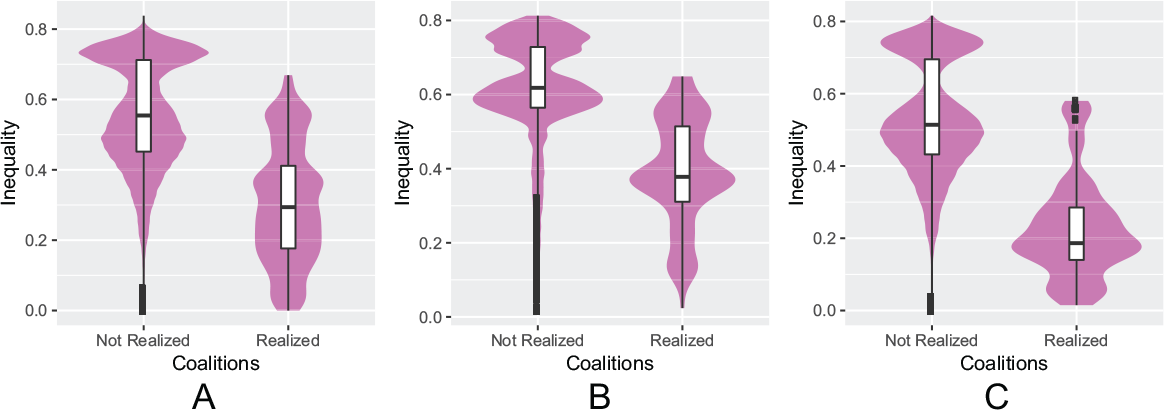
Power inequality in non-realized vs. realized ethnic coalitions in (A) the full sample, (B) in dominant-party regimes, and (C) personalist regimes. Only coalitions with two or more groups are included in the plot. Power is measured as an ethnic group’s share of the total population size. On average, realized coalitions are more balanced than non-realized ethnic coalitions. Realized coalitions in personalist regimes are more balanced than in dominant-party regimes.
Main Findings
Table 1 provides estimates from our conditional logit models pertaining to Hypotheses 1a and 1b. 23 Model 1 (capturing the formation of ethnic coalitions) and Model 2 (focusing on the occurrence or persistence of ethnic coalitions) are the baseline models that include our measure of size inequality in potential coalitions alongside the described control variables. Hypothesis 1a expects that potential coalitions with ethnic groups of similar size are more likely to be realized, while Hypothesis 1b implies that balanced ethnic coalitions should also be more persistent and thus occur more frequently over time. The results from Models 1 and 2 support this argument: the variable on size inequality in a potential coalition is significantly negative. Thus, a coalition is more likely to be realized if all included groups are similar in size. Coalitions of groups that differ considerably in size, however, are less likely to be realized.
Estimates From Conditional Logit Models on Autocratic Years.
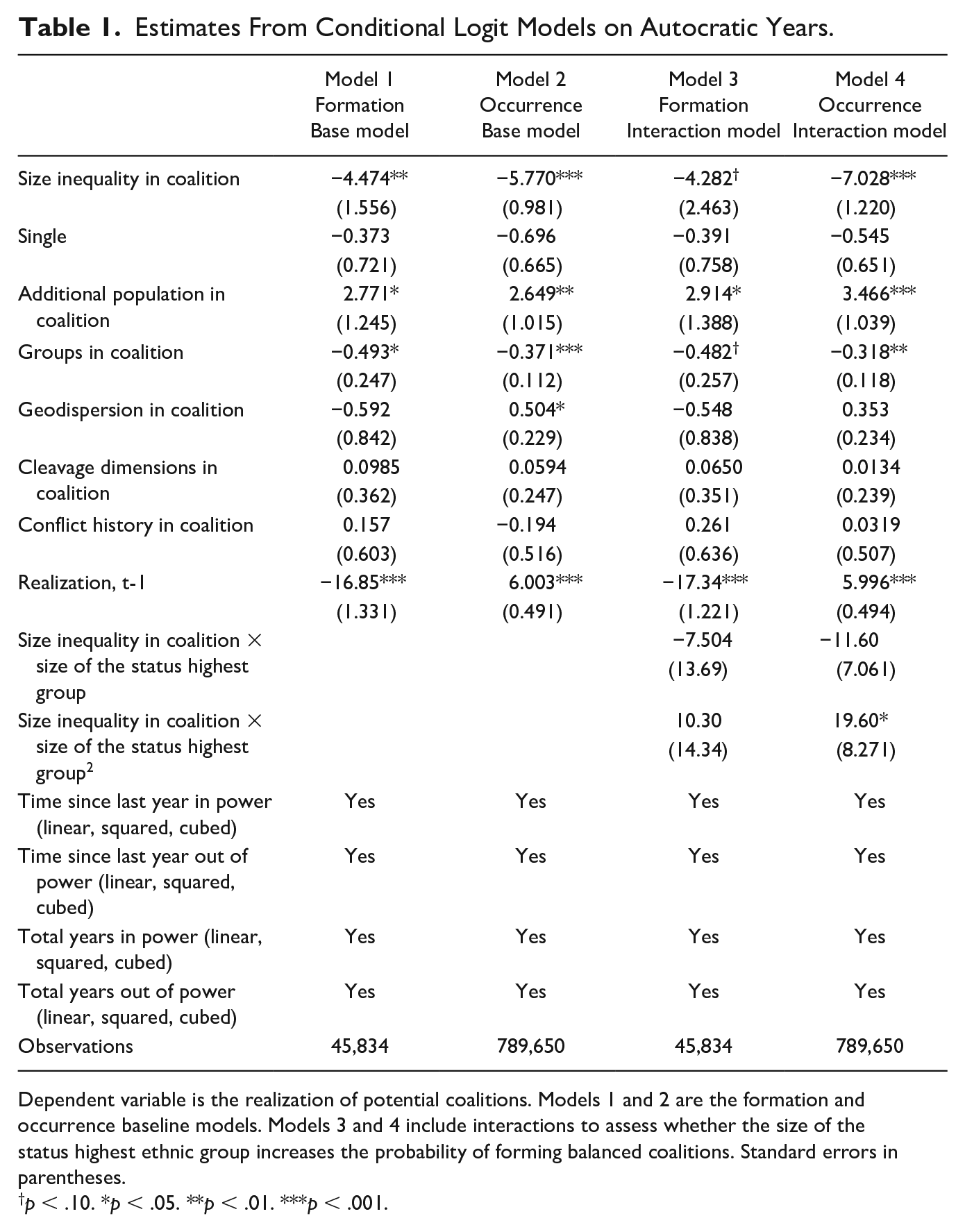
Dependent variable is the realization of potential coalitions. Models 1 and 2 are the formation and occurrence baseline models. Models 3 and 4 include interactions to assess whether the size of the status highest ethnic group increases the probability of forming balanced coalitions. Standard errors in parentheses.
p < .10. *p < .05. **p < .01. ***p < .001.
Models 1 and 2 in Table 1 also provide insights into additional coalition dynamics. First, holding all other variables constant, ethnic coalitions that include larger parts of the population are more likely to be realized and persistent, which speaks to insights by Bormann (2019) to increase the coalition size. The second consistent finding in these first models is that, holding everything else constant, the status highest groups seem to minimize the number of ethnic groups in their coalition. Thus, from these first models, we get an initial glimpse at the optimization of ethnic coalitions. Balanced coalitions that maximize the population included while minimizing the number of groups seem to be most likely to form and persist.
Models 3 and 4 in Table 1 investigate whether power balancing is more likely between powerful groups, as this finding has been established on the dyadic level (Roessler & Ohls, 2018). This argument would imply that with increasing size of the status highest group, we should see a stronger effect of balancing. Because very large status highest groups, by construct, cannot form balanced coalitions, we include the interaction between the size of the status highest group, its squared term, and our measure of inequality in potential coalitions into the baseline models. Models 3 and 4 in Table 1 show the estimates for the formation and occurrence model. Constitutive terms on the size of the status highest group cannot be included as the models only compare potential coalitions within country-years, where these variables do not vary.
According to Models 3 and 4 in Table 1, power balancing does seem to become initially more important with increasing group size of the status highest group (up to about one-third of the population) and then less important with larger groups (greater than one-third of the population). However, the confidence intervals are fairly large (even in the occurrence model), especially up to a group size of about one-third of the population. Hence, different to the dyadic level analysis (Roessler & Ohls, 2018), our k-adic approach does not suggest that power balancing is particularly prominent between large groups and that balancing is a more general pattern in regard to the ethnic group size.
However, if the patterns that we establish in the first set of models are driven by commitment problems, we should observe differences in power balancing between regimes that provide different degrees of institutional guarantees to mitigate the inability to form unbalanced ethnic ruling coalitions. Hence, we turn to Hypotheses 2a and 2b that test whether dominant-party regimes are more likely to support unbalanced coalitions compared to personalist regimes. We expect that coalitions of groups that are dissimilar in size are more likely to form in authoritarian regimes that feature a dominant party compared to personalist regimes (Hypothesis 2a) and that unbalanced coalitions are also more persistent in dominant-party than in personalist regimes (Hypothesis 2b).
Testing these hypotheses, we interact dummy variables on party regimes and the other type of authoritarian regimes with our measure of inequality in the population size of coalition partners. Table 2 provides the estimates for the formation (Model 5) and occurrence/persistence model (Model 6). Again, note that constitutive terms on the size of the status highest group cannot be included as the models only compare potential coalitions within country-years, where these variables do not vary. We find the inequality measure to be negative and statistically significant in both samples. The interaction term with dominant-party regimes carries a positive sign in both models and reaches statistical significance at conventional levels. In party regimes, the effect of inequality on the latent utility of selecting an alternative (see Wooldridge, 2010) remains negative in both models but is much closer to the value zero. Thus, the evidence suggests that compared to personalist regimes (baseline category), dominant-party regimes provide an institutional context that facilitates the formation and endurance of coalitions between more unequal coalition partners as we expected under Hypotheses 2a and 2b.
Estimates From Conditional Logit Models on Autocratic Years.
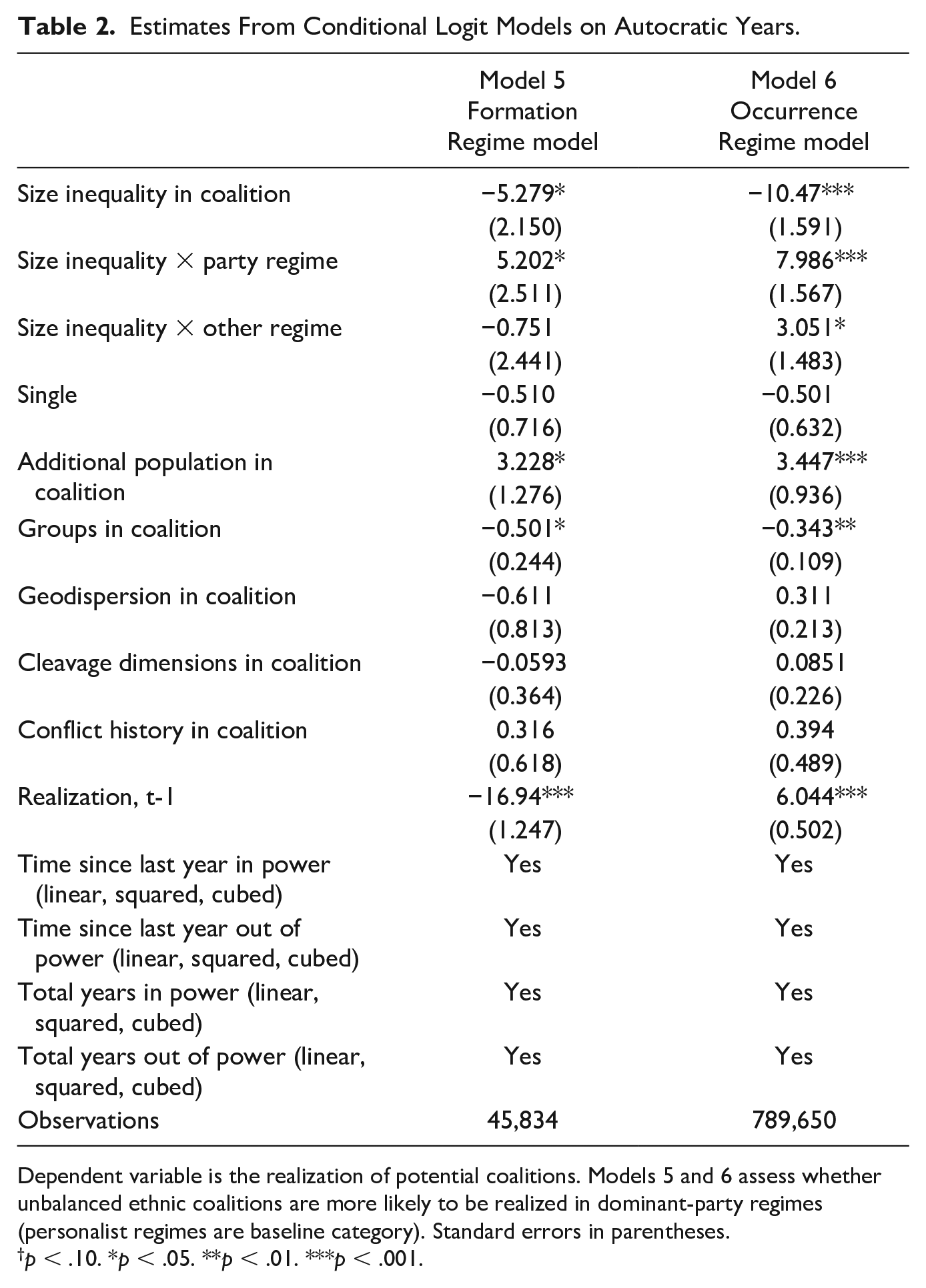
Dependent variable is the realization of potential coalitions. Models 5 and 6 assess whether unbalanced ethnic coalitions are more likely to be realized in dominant-party regimes (personalist regimes are baseline category). Standard errors in parentheses.
p < .10. *p < .05. **p < .01. ***p < .001.
The interaction term between other types of regimes and the inequality of size in coalitions cannot be distinguished from zero in the formation model (Model 5 in Table 2). However, the effect is positive and statistically significant in the occurrence model (Model 6 in Table 2), which suggests that credible commitment is more difficult in personalist regimes than in hybrid types, military regimes, monarchies, and oligarchies over the long run.
Robustness I: Accounting for Single Coalition Effects
As our inequality measure takes a value of zero when an ethnic group rules alone, the effects of size inequality could be driven by different probabilities of single coalitions across regime types. Models 5 and 6 in Table 2 are unable to rule out this possibility as the variable on single coalitions is not interacted with the variable on regime type. 24 Thus, to distinguish whether the effect of size inequality or the likelihood to rule alone—or both—differs between regime types, we include interactions between single coalitions and our two regime-type dummies alongside the interactions between the size inequality and the two regime-type dummies in Table 3. In addition, as previous research suggests that the effect of power balancing may depend on the strength of the ruling group which in turn may be correlated with regime types, we also control for interaction terms between a dummy variable on whether the status highest group is larger than the median and our measures of inequality and single coalition to rule out the possibility that not the regime type but the size of the ruling group is the true moderating variable.
Estimates From Conditional Logit Models on Autocratic Years Including Additional Interactions.
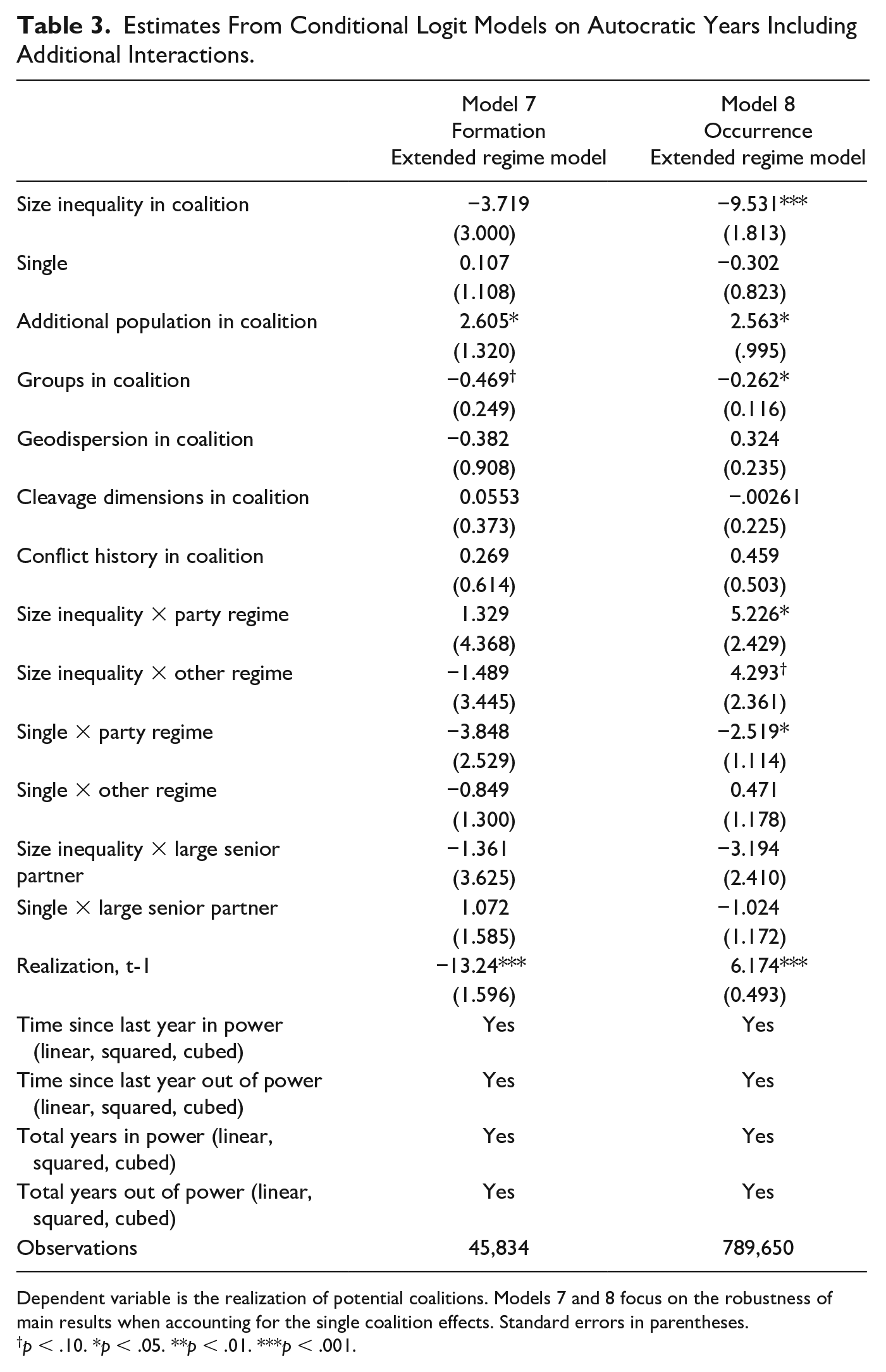
Dependent variable is the realization of potential coalitions. Models 7 and 8 focus on the robustness of main results when accounting for the single coalition effects. Standard errors in parentheses.
p < .10. *p < .05. **p < .01. ***p < .001.
In the occurrence model (Model 8 in Table 3), we find evidence suggesting that single coalitions are less likely to be realized in party regimes than in personalist regimes. This might again point to support for the argument that party regimes facilitate credible commitment between groups. The evidence also suggests that this relationship by itself does not drive our previous finding that under party regimes ruling groups can maintain less power-balanced coalitions than under personalist regimes. In the formation model (Model 7 in Table 3), the results suggest that the inclusion of the interactions with regime types and the larger status highest groups weakens the previous findings on regime type. The uncertainty around coefficients is fairly large and even though the direction of the party effect is largely maintained. None of the model’s estimates reaches statistical significance but this may not be surprising given the complexity of the model specification and the small number of realized coalitions in the sample. Given these results, we are more confident that our insight, that unbalanced coalitions are more likely to occur in party regimes, holds in regard to the persistence and occurrence of ethnic coalitions than the formation itself. 25
Robustness II: Endogenous Institutions
There are two potential threats to our inference that we must rule out.
Omitted factors
We must rule out that there are omitted factors that affect both the type of authoritarian regime and the ethnic composition of the government coalition. First, the ethnic configuration of a state, that is the types of ethnic groups that exist and their sizes, determines what kinds of ethnic government coalitions can be formed. For example, the ethnic configuration of a state may affect which group is most likely to become the ruling group in the first place and as a result the types of coalitions that can form. The ethnic configuration may also affect the type of authoritarian regime as leaders may be forward-looking and build institutions that facilitate coalition formation under the circumstances they face. However, these potentially omitted country-year-specific factors do not pose a threat to our inference. The conditional logit model that we use in our main specification is equivalent to introducing a fixed effect for each country-year (Wooldridge, 2010). As a result, our models control for country-year-specific factors, such as the ethnic make-up of a state or characteristics of the ruling group, such as size. However, there could also be omitted factors at the level of potential ethnic coalitions, such as long-standing ethnic tensions or rivalries between specific groups that may affect regime type as well as the ethnic make-up of the government coalition. Below, we introduce a two-stage least squares (2SLS) model where we instrument for the type of authoritarian regime to rule out that our findings are driven by unobserved factors linked to the regime type.
Reverse causality
We must be able to exclude the possibility that the type of authoritarian regime in a given year is actually not the cause but the consequence of the ethnic composition of the government. Powerful ethnic groups may introduce a suitable type of authoritarian institutions after they have formed their government coalition. For example, leaders may form or plan on forming a coalition with groups that differ considerably in power and may introduce a dominant-party system to stabilize the coalition. Our 2SLS model allows us to rule out the possibility that our findings are driven by reverse causality.
Instrumental variable analysis
To rule out threats to our inference stemming from omitted factors or reverse causality associated with the type of authoritarian regime, we use an instrumental variable approach. A suitable instrumental variable explains whether a state has a dominant-party regime or not. At the same time, the instrumental variable should not have an effect on power imbalances in the government coalition other than through its effect on the regime type. We use the regime types of close-by states as our instruments.
Our instrumental variable analysis uses the country-year instead of the potential-coalition-year from our main models as the unit of analysis. This is necessary because the first stage aims to explain the type of authoritarian regime, a variable that only varies within country-years. After explaining whether a state features a dominant party in a given year in the first stage using our instruments, the second stage explains the degree of inequality in the sizes of the groups that form the actual government coalition.
Our instruments are spatial lags of the regime types of other states around the world. Spatial lags have been used as instruments for different types of regimes (Albertus & Menaldo, 2013; Giuliano et al., 2013; Miller, 2015). In addition, empirical research suggests that a state’s regime type is affected by the institutions of states that are geographically close (K. S. Gleditsch & Ward, 2006; Starr, 1991). We use spatial lags of three types of regimes: Party regimes, military regimes, and democracies. Most straightforwardly, it is likely that states surrounded by party regimes are more likely to introduce this form of government themselves emulating the institutional make-up of proximate states. In addition, Gehlbach and Keefer (2012) instrument for the level of institutionalization of autocratic ruling parties with whether the first autocratic leader was a military officer. They justify this choice with Geddes (2008)’s argument that “ . . . ruling parties are likely to be loosely organized when the autocrat is a military leader” (Gehlbach & Keefer, 2012, p. 628). We follow this logic as it may be the case that states surrounded by military regimes emulate this characteristic of military leadership as well. Finally, we include a spatial lag of democracies. The logic here is that autocratic governments that are surrounded by democracies may feel pressured to demonstrate the legitimacy of their own regime and thus employ a dominant party that helps them mimic democratic processes and institutions. 26 We row-standardize all our spatial lags. In addition, we time-lag the spatial lags of the regime types by 1 year to prevent reverse causality in our first stage, as each state i‘s institutions likely affect those of surrounding states as much as they are affected by them.
We employ a 2SLS model to estimate the effect of party regimes on our Gini coefficient on differences in government groups’ sizes. We control for ethnic characteristics of the state, such as a measure on ethnic cleavage dimensions for the population of the state and the total number of politically relevant ethnic groups. In addition, we control for the Gini coefficient of the most equal multi-ethnic coalition in a state that is possible to be formed by the ruling group, both in the current year and in the first year of a state’s existence in the EPR data. We use these control variables to model the fact that different governments face different ethnic configurations and some are less able to form equal coalitions due to external circumstances. The ethnic configuration when states first come into existence may have a particular strong effect on the regime type of a state for subsequent years as well. We also control for GDP per capita (in 10,000s), 27 population size, a dummy on the presence of ethnic and a dummy on the presence of non-ethnic conflict in the previous year, and a dummy for whether the government coalition is a single coalition. The latter variable makes sure we only draw inferences based on the effect of party regimes on power balancing in multi-group coalitions and exclude party regime’s ability to explain whether a multi-group coalition is formed in the first place. We use robust standard errors as the first stage employs a linear probability model. We include dummies for three world regions, Africa, Asia, and the Middle East (using Europe as the excluded category) as well as a lagged dependent variable in an attempt to purge temporal autocorrelation.
When instrumented in this way (Column 2 in Table A5), the dummy variable on party regimes has a positive and statistically significant effect on the level of inequality among groups in the government coalition. Thus, our instrumental variable analysis supports the findings from our main models. Our results are robust to a number of alternative specifications, such as controlling for the level of inequality in the government coalition in a state’s first year of existence or not row-standardizing spatial lags. When we include dummy variables on a state’s primary colonial ruler using data from the ICOW Colonial History Dataset (Hensel, 2018), however, the variable on party regimes loses statistical significance. However, it is not clear whether these dummies are important control variables or just have high explanatory power as some colonial powers have only been exerting influence over few or even one state. If we exclude ruler dummies that are only positive for one state, the party variable retains significance at the 10% level (P > |z|=.065).
When testing for overidentifying restrictions, 28 we do not reject the null hypothesis that the instruments are not correlated with the error term. Thus, we have confidence in the results of our instrumental analysis and conclude that our main findings are not exclusively reflecting the fact that leaders may also be forward-looking and install regimes to stabilize coalitions they already have formed or plan to form. The degree to which leaders install autocratic institutions strategically in response to the ethnic characteristics of a state is an interesting empirical question in and of itself and could fruitfully be explored in future research to shed new light on the understanding of autocratic institutions.
Robustness III: Further Analyses
We have also tested the robustness of our main findings using a number of alternative specifications. We have considered two alternative ways of calculating the Gini coefficient we use to operationalize the difference in group sizes in a coalition. First, the standardization of the measure by the mean income in a state is useful when comparing wealth as it sets differences between individuals in proportion to the total wealth of a population. In a rich society, small differences are less meaningful than in a poor one. In our case, this standardization could be considered less important as proportional group sizes are already standardized and total differences in group size might matter more than the relative differences. Using a Gini version that is not mean-standardized (Supplemental Appendix Tables A6 and A7), our main results from Tables 1 and 2 are similar. 29
Second, the Gini coefficient takes population size into account by dividing by 2n2. An alternative possibility would be to divide by n(n−1), the number of comparisons made between all groups in a coalition, to get a more straightforward mean difference standardized by the mean group size in the coalition. Using this measure (Supplemental Appendix Tables A8 and A9), our results from Tables 1 and 2 are again similar.
We conduct another set of models to account for cases that provide a high number of potential coalitions. While in some countries, only two potential coalitions are possible; in others, this is the case for thousands. To rule out that our results are driven by country-years with particularly many groups—and thus potential coalitions—we rerun our analyses excluding country-years where the number of potential coalitions exceeds the 90th percentile, a number of 512 potential coalitions (Supplemental Appendix Tables A10 and A11). This decreases our observation numbers considerably, from 45,834 to 1,802 in the sample on coalition formation and from 427,298 to 72,850 in our occurrence model. Nevertheless, our main results from Tables 1 and 2 are largely retained, but they highlight that the occurrence model is more robust to sample reduction.
While our argument focuses on autocratic regimes, we also explore how power differentials among potential coalition partners affect coalition formation in democratic states. On one hand, we would expect democratic institutions to be particularly effective at alleviating commitment problems of the ruling group toward weaker coalition partners. However, in democratic states, elections facilitate access to power and regular change of government. As a result, democratic leaders are likely less concerned with being overthrown by violent challenges or mass uprisings and have less incentive to add small coalition partners to their coalition to protect themselves against this fate. As a result of these two counterbalancing effects of democratic institutions, power differentials between ethnic groups should be a less relevant factor in the formation of democratic government coalitions and a larger variety of coalitions should be possible.
Our empirical analyses support this expectation. Supplemental Appendix Table A12 only considers democratic states based on the definition in Geddes et al. (2014). Our variable on the size inequality of ethnic groups does not have a significant effect on coalition formation in any of our four main specifications. 30 In Supplemental Appendix Table A13, we include democratic and autocratic regimes and introduce an interaction between democracy and our measure on inequality in the size of coalition partners alongside our original interaction terms between inequality and the autocratic regime types of interest, again using personalist regimes as the baseline category. In the formation model, the interaction term between the size inequality and democracy is positive but does not reach statistical significance. In the occurrence model, the positive coefficient of the interaction term is highly significant but smaller than the coefficient of the interaction term with party regimes. The occurrence model thus not only provides some evidence for the effectiveness of democratic institutions in alleviating commitment problems compared to personalist regimes but also suggests that coalitions between dissimilarly sized groups are less likely in democratic regimes than in autocratic regimes with dominant parties. Comparing Supplemental Appendix Figure 4 with Figure 3 shows indeed that in democracies realized coalitions of similarly sized coalition partners are more common than in party regimes but also that coalitions among coalition partners with larger power imbalances are more common than in personalist regimes. This supports our initial notion that while democratic institutions facilitate imbalanced coalitions, incentives for forming specific types of coalitions are less strong.
Finally, we have rerun our main models without the lagged dependent variable (Supplemental Appendix Tables A14 and A15). This is especially relevant as in the models on coalition changes, the LDV takes the value 0 for all realized coalitions by definition. Results from Tables 1 and 2 remain robust.
Conclusion
This article analyzes authoritarian leaders’ strategic choice for including and excluding other ethnic groups from a ruling coalition. We contribute to a growing literature explaining the dynamics of authoritarian politics (e.g., Acemoglu et al., 2008; Bormann, 2019; Magaloni, 2008; Roessler, 2011; Svolik, 2009, 2012). Our argument highlights that both the ruling ethnic group and groups that are potential coalition partners want to avoid ending up as a relatively weak coalition member in the future. Without institutions that can help actors overcome commitment problems in authoritarian regimes, similarly sized ethnic groups are more likely to form ruling coalitions. Using a research design that allows us to explicitly model the agency of the ruling ethnic group, we find support for the theoretical argument that the status highest groups and potential coalition members seek coalitions in which all ethnic groups are of a fairly similar size. These results are particularly strong when focusing on the persistence of ethnic coalitions.
We also find that the necessity of power balancing in ethnic coalitions depends on the type of authoritarian regime. While leaders in personalist regimes have to rely heavily on balanced coalitions, leaders in regimes with dominant parties can include other ethnic groups that differ in power from themselves as the institutional make-up of the state helps overcome commitment problems. These findings are in line with previous arguments and findings on authoritarian institutions (Gandhi & Przeworski, 2007; Magaloni, 2008), but they also show for the first time that authoritarian institutions help facilitating coalitions between ethnic groups competing for power.
Using a k-adic research design that reflects the interaction between the ruling ethnic group and potential coalition members, we provide novel insights as to why particular ethnic groups are included or excluded from power in authoritarian regimes. In line with previous work that highlights worries about power balance inside the ruling coalition (Acemoglu et al., 2008), we argue that it is not only that authoritarian leaders have difficulties in committing to their coalition promises (Magaloni, 2008; Svolik, 2009) but potential coalition members also find it difficult to commit to not overthrowing the government leader in a coup (Roessler, 2011). In combination with the institutional structure of the state, this focus on stable ruling coalitions, we argue, provides the basis for ethnic inclusion dynamics in authoritarian regimes. It follows that the exclusion of particular ethnic groups, at least to some extent, is a function of coalition formation and institutional constraints rather than governments trying to target particular ethnic groups.
This article analyzes ruling ethnic groups’ strategic decisions on which other groups to share power with but does not analyze why specific groups come to power in the first place. We have only been concerned with making sure that the mechanisms that bring ethnic groups to power in the first place do not bias our inference on the logic of subsequent ethnic coalition-building processes. However, the question of how ethnic groups reach the highest position of power in a state is important in and of itself to fully understand the dynamics of ethnic power-sharing and exclusion. Our findings have implications for future research attempting to understand the processes that determine ethnic groups’ ascent to government leadership. The finding that commitment problems constrain ethnic coalition formation in the absence of institutions that facilitate credible commitment likely also has implications for the types of groups that reach positions of power in the first place. On one hand, the absence of these types of institutions makes it harder for ethnic groups that have particular difficulty to credibly commit to others to rise to power. However, the presence of these types of institutions likely makes capturing the state leadership possible for a much more diverse set of ethnic groups. Future empirical research exploring the relationship between characteristics of the ethnic group controlling the government and institutional characteristics of the state constitutes a fruitful next step toward understanding ethnic power-sharing.
Supplemental Material
Appendix_CPS_finalversion – Supplemental material for Ethnic Coalitions and the Logic of Political Survival in Authoritarian Regimes
Supplemental material, Appendix_CPS_finalversion for Ethnic Coalitions and the Logic of Political Survival in Authoritarian Regimes by Janina Beiser-McGrath and Nils W. Metternich in Comparative Political Studies
Footnotes
Authors’ Note
This manuscript has greatly befitted from the anonymous reviewers and feedback we received presenting our work at University of Oxford, London School of Economics and Political Science, University of Exeter, University of Konstanz, the 2016 European Political Science Association Meeting, and at the ENCoRe Conference, January 2016, University of Geneva. In addition, we thank Carl Müller-Crepon for helpful comments.
Declaration of Conflicting Interests
The authors declared no potential conflicts of interest with respect to the research, authorship, and/or publication of this article.
Funding
The authors disclosed receipt of the following financial support for the research, authorship, and/or publication of this article: Nils W. Metternich acknowledges support from the Economic and Social Research Council (ES/L011506/1) and the Gerda Henkel Stiftung (AZ 07/KF/13). Janina Beiser-McGrath acknowledges support by the EU FP7 Marie Curie Zukunftskolleg Incoming Fellowship Program, University of Konstanz (Grant no. 291784) and by the Zukunftskolleg Interim Grant, University of Konstanz.

Supplemental Material
Notes
Author Biographies
References
Supplementary Material
Please find the following supplemental material available below.
For Open Access articles published under a Creative Commons License, all supplemental material carries the same license as the article it is associated with.
For non-Open Access articles published, all supplemental material carries a non-exclusive license, and permission requests for re-use of supplemental material or any part of supplemental material shall be sent directly to the copyright owner as specified in the copyright notice associated with the article.
