




Abstract
Existing research has argued that terrorism is common in civil war because it is “effective.” Surprisingly, however, only some groups use terrorism during civil wars, while many refrain altogether. We also see considerable variation in the use of terrorism over time. This article presents a theory of terrorism as a mobilization strategy in civil war, taking into account benefits, costs, and temporal dynamics. We argue that the choice and the timing of terrorism arise from the interaction between conditions for effective mobilization and battlefield dynamics. Terrorism can mobilize support when it provokes indiscriminate government repression or when it radicalizes rebels’ constituency by antagonizing specific societal groups. The timing of attacks, however, is influenced by battlefield losses, which increase rebels’ need to rally civilian support. The analyses of new disaggregated data on rebels’ terrorist attacks during conflicts (1989–2009) and of Islamic State of Iraq and Syria (ISIS) tactics in Iraq and Syria support our theoretical argument.
Introduction
In 2017, 10 organizations alone were responsible for 4,282 terrorist attacks, amounting to approximately 40% of all attacks and 68% of all terrorist fatalities in that year (17,915 victims). 1 Nine of these organizations have been involved in civil wars, which have now become the main source of global terrorism (Findley & Young, 2012). Many have argued that groups in conflict use terrorism because it “works” (e.g., Kydd & Walter, 2006; Pape, 2003). For example, terrorism may increase groups’ chances of entering into negotiations and obtaining government concessions, and help to advertise the group’s cause to a large audience (e.g., Thomas, 2014; Wood & Kathman, 2014). However, a closer look at insurgent groups’ actual use of terrorism in civil conflicts 2 reveals two surprising patterns. Although some groups carry out a large number of attacks, nearly 50% of all insurgent groups active between 1970 and 2011 never resorted to terrorism. Moreover, among groups that employ terrorism, there is considerable temporal variation in its use. Figure 1 illustrates this variation for a sample of groups engaged in civil war during the past 8 years. It is clear that terror tactics are not used regularly, with attacks being concentrated at specific times and almost absent at others. Given the existing arguments about terrorism’s effectiveness, it is puzzling that terrorism is not used more often and by all rebel groups. Why, then, do some rebel groups resort to terror tactics, while others refrain from doing so? And what explains the timing of terrorist attacks in civil war?
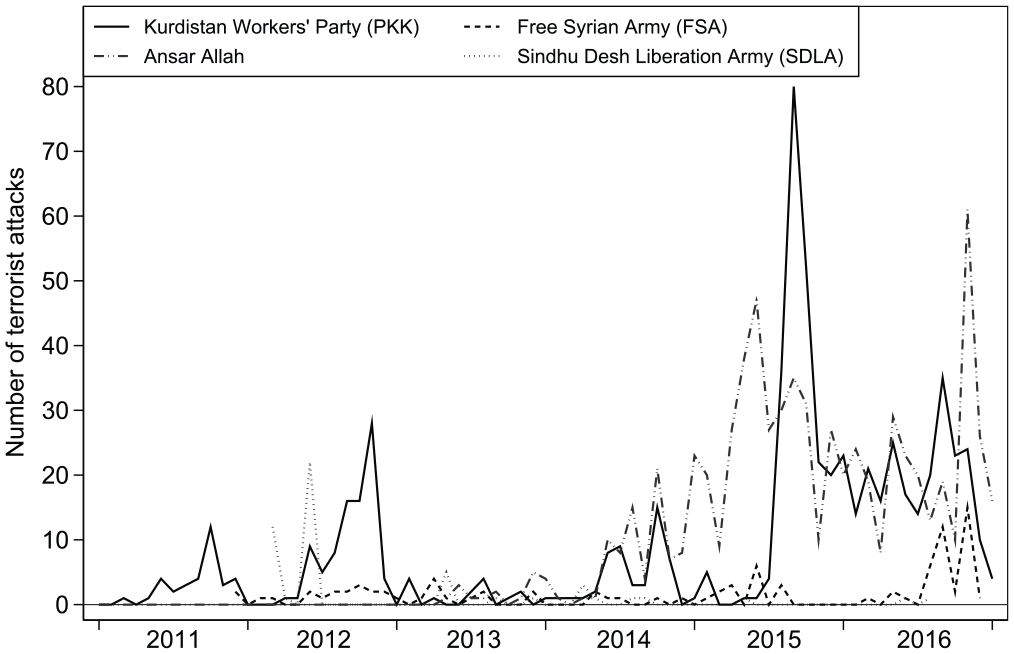
Patterns of terrorism by rebel groups over time.
Despite a growing body of work on terrorism in civil war, the existing research only provides incomplete answers to these questions. Studies have pointed to several factors associated with terrorism such as regime type, rebel capabilities, funding sources, ideology, intergroup competition, and organizational structures (e.g., Belgioioso, 2018; Fortna et al., 2018; Hultman, 2007; Polo & Gleditsch, 2016; Stanton, 2013). Although important, these factors tend to be rather static and cannot explain variation in the use and frequency of terrorism by rebel groups over time. To date, the timing of terrorism in civil war remains largely unexplained. Moreover, many existing studies tend to emphasize the benefits of terrorism while downplaying its costs, especially the risk that terrorism will backfire by alienating civilians (see also Fortna, 2015). Most rebel groups rely on some form of local civilian support (Kalyvas, 2006). As a result, it remains unclear why, and when, groups that depend on popular support can benefit from resorting to terror tactics.
In this article, we present a theory of terrorism as a mobilization strategy in civil war. This theory aims to explain not only why some rebel groups resort to terrorism (and many others refrain from doing so) but also when they do so—that is, the timing of terrorist attacks. Drawing on a rationalist framework, we regard terrorism as a tool to help rebels achieve proximate rather than ultimate goals. Winning the support of the local population is a key proximate goal for rebel organizations. We argue that rebel groups seeking to drum up popular support employ terrorism as an instrument of mobilization. Building on seminal research by Lake (2002), Kydd and Walter (2006), and Goodwin (2006), we identify the logics of provocation and boundary activation as key mechanisms of mobilization. Rebel groups use terrorist attacks to provoke indiscriminate government repression and to radicalize their core constituency by exacerbating in-group out-group cleavages. These mechanisms, however, are not straightforward and are fraught with risks. Terrorism may generate selective government responses that can be lethal for rebels (Carter, 2016) and entail significant political costs, such as the alienation of civilians. We explicitly incorporate such risks and identify two conditions under which terrorism is more likely to be effective in mobilizing civilians. When rebel groups fight a government that is susceptible to provocation due to a history of indiscriminately repressive policies, groups can leverage government responses to overcome collective action problems and mobilize fence-sitters against the incumbent. Terrorism is also beneficial when there is a strong out-group antagonism within rebels’ core constituency. Insurgents can then exploit provocative attacks against out-groups to radicalize their support-base and reduce the risk of abandonment or backlash.
However, mobilization mechanisms per se do not tell us when rebels are more likely to resort to terrorism—that is, the timing of attacks. We argue that terrorist mobilization strategies are more likely to be triggered when other, less risky options become too costly or unfeasible. This happens, specifically, when rebel groups experience major losses on the battlefield. The death of rebel combatants directly reduces the membership size of a rebel organization and can lead to a further loss of resources (e.g., territory). Moreover, adverse outcomes on the battlefield are observed by the rebels’ constituency, which may feel frustrated and whose commitment may begin to falter. These effects put pressure on the rebel leadership which needs to reinvigorate support for the rebel movement and attract new rebel fighters. Following major losses, rebels’ need to mobilize and consolidate support is greatest; alternative strategies, such as providing social services, simultaneously become less feasible. It is precisely at this point that rebels are more likely to use terrorism as a means of provocation and boundary activation. We argue, however, that the effect of losses is strictly conditional. Losses trigger terrorism and shape the timing of attacks only when rebels are optimistic about the positive effect of terrorism on support. When rebels expect a backlash, they will not resort to terrorism, despite having suffered major military losses. Thus, the choice and timing of terrorism in civil war are the product of the interaction between conditions for effective mobilization and battlefield dynamics.
We test our theory using a two-pronged research design. First, we conduct a large-N analysis leveraging an original monthly data set on rebel terrorism (1970–2011) that links rebel groups in the UCDP Georeferenced Event Dataset (GED) (Sundberg & Melander, 2013) with organizations and attacks in the Global Terrorism Database (GTD, 2016). Through this analysis, we test the conditions under which rebel groups resort to terrorism and whether temporal variation in attacks results from specific battlefield dynamics. Second, we complement the macro-analysis with a quantitative case study on the terrorist strategies of the Islamic State of Iraq and Syria (ISIS). This allows us to test our mobilization mechanism with more granular data. We find robust support for our theoretical argument at both the macro- and micro-levels.
This study has significant implications for our understanding of terrorism as an insurgent tactic and of its embeddedness in strategic environments such as civil wars. First, by focusing on terrorism as an instrument of mobilization, and by identifying specific conditions under which terrorism is both effective and necessary for generating civilian support, we systematically account for variation in the use of terrorism across conflicts, rebel groups, and time.
Second, we introduce an important dynamic component to models of terrorism by explicitly examining the timing of terrorist attacks during civil wars. We do so through the analysis of the relationship between terrorism and specific battlefield dynamics, which have been largely overlooked in recent studies of terrorism. In doing so, this research provides evidence of a crucial dilemma for governments engaged in intrastate conflicts. Those rebel groups that are able to leverage terrorism as a mobilization strategy may take a very long time to defeat. Inflicting major battlefield losses on these groups is likely to backfire by increasing their incentives to unleash terrorist violence.
Third, in contrast to previous rationalist explanations (e.g., Hultman, 2007; Pape, 2003; Wood & Kathman, 2014), our argument highlights not only the benefits but also the political costs of terrorism. We show that while these costs can be substantial—which explains why many non-state actors choose to avoid terrorism—they are also not uniform across rebel groups. Conditional on military losses on the battlefield, some groups can capitalize on repressive government policies and on the attitudes of their constituency to maximize the impact of terrorist violence and drum up support.
Finally, our empirical approach, with new time-varying data at the group and micro-levels, allows us to examine the dynamics of terrorism in civil war in ways that were not previously possible.
Benefits, Costs, and Dynamics of Terrorism
Terrorism is the “premeditated use of violence by subnational groups” against public, noncombatant targets “to obtain a political objective through the intimidation of a large audience beyond the immediate victims” (Enders & Sandler, 2012, p. 3). Terrorism often occurs in the context of civil war; in fact, at least 50% of global terrorist attacks are civil war related (Findley & Young, 2012; Polo & Gleditsch, 2016; Stanton, 2013). However, terrorism differs from other forms of violence against noncombatants during civil wars in that the ultimate aim of terrorism is to influence the government and not the immediate physical victims of attacks. For example, as Fortna (2015) highlights, “an attack on a public market is intended to influence the government, not shoppers” (p. 523). This characteristic of indirect targeting further differentiates terrorism from direct violence intended to carry out political and ethnic cleansing, punish collaboration with the opponent, or extract resources (Balcells, 2010; Fjelde & Hultman, 2014; Kalyvas, 2006; Wood, 2014). 3
Civil conflict scholars are increasingly seeking to understand rebel terrorism. The burgeoning literature on terrorism in civil war explores a number of factors such as regime type (Stanton, 2013), rebel capabilities (Hultman, 2007; Polo & Gleditsch, 2016), rebel group goals (Akcinaroglu & Tokdemir, 2018), intergroup competition (Belgioioso, 2018), rebel funding sources (Fortna et al., 2018), peace processes and mediation attempts (Findley & Young, 2015; Pospieszna & DeRouen, 2017), and coercive versus conciliatory state behavior (Asal et al., 2019). This work is important but it often downplays two aspects: the potential for terrorism to alienate popular support for rebels and the temporal dynamics of terrorist violence, especially the timing of terrorist attacks during civil wars.
Rebels interact not only with the government but also with civilian audiences. Most rebel groups in civil war rely on local support from the population. Even radical Islamist groups such as Al-Qaida in the Islamic Maghreb (AQIM) recognize the importance of local support and urge combatants to marry local women to strengthen such ties (Ghanem, 2017). Many existing studies tend to emphasize how terrorism can impose costs on the government and signal resolve but do not systematically address the consequences of terrorism for popular support, especially the risk of alienating civilians (Fortna, 2015). Research that explicitly takes into account the potentially counterproductive effects of terrorism suggests that rebel groups that rely on local support should be less likely to use terrorism. However, the empirical record is far more mixed and many organizations that rely on local support also engage in terrorism (e.g., Polo, 2020). Others have argued that the use of terrorism is due to dynamics internal to the organization such as principal–agent problems or socialization mechanisms (Abrahms & Potter, 2015; Davis & Jang, 2018), but this implies that the decision to engage in terrorism may not be strategic. Given that most insurgent organizations ultimately want (and depend on) public support, it remains unclear why they would strategically engage in indiscriminate targeting such as terrorism. Several rationalist explanations suggest that rebel groups engage in terrorism despite their need for popular support due to terrorism’s ability to impose costs and its coercive effect on government behavior. 4 Yet, it is puzzling that terrorism does not appear to help rebels win a civil war or achieve negotiated settlements (Fortna, 2015). 5
In contrast, we adopt an alternative approach—namely, that rebel groups use terrorism not despite depending on civilian support but precisely because they depend on it. Put differently, rebels use terrorism as a mobilization strategy to win and consolidate the support of the population. Although it has received limited attention in the civil war literature, the notion that terrorism can be employed to garner support is not new to the terrorism literature. For example, work by Kydd and Walter (2006), Lake (2002), and Bueno de Mesquita and Dickson (2007) examines how terrorism can be used to provoke the government into extreme responses that can shift support away from the incumbent. What has not been systematically addressed, however, is the possibility that such provocation backfires and how this, in turn, affects rebels’ choice of when and whether to adopt terrorism. As Carter (2016) notes, provocation can be lethal for rebels if the government responds with selective violence. In addition, if mobilization through terrorism were a costless and generally effective strategy, we would expect many more rebels to resort to terrorism and to do so at all times, but this is not the case. As a result, we need to better understand when and under what conditions rebel groups are able to effectively use terrorism as an instrument of mobilization.
This leads to the crucial issue of timing. Despite their important contributions, existing explanations of terrorism in civil war tend to focus on rather static, structural factors, whereas rebels’ use of terrorism varies significantly over time, even in the short term. The temporal dynamics of terrorism in civil war remain largely unaccounted for. To understand why rebels resort to terrorism, we need to understand when they do so and how the choice of terrorism is influenced by the changing dynamics of the conflict. Accounting for the timing of terrorism is also important because rebels can choose from a broader set of tactics and strategies, besides terrorism. Simply examining why terrorism might appear as an attractive option to a rational non-state actor under some structural circumstances is insufficient. We need to explain why and when rebels fail to implement alternative strategies that they would prefer to terrorism (see also Belgioioso, 2018, p. 641).
The lack of an explicit temporal dimension also characterizes extant arguments about terrorist mobilization (e.g., provocation). When are rebel groups more or less likely to use terrorism as a mobilization tool? How does terrorism as a mobilization tool work during a civil war? As Findley and Young (2012) note, the strategy of provocation as a means to rally support for would-be rebels is quite plausible before the beginning of a civil war, but it is much less clear how and when this operates once a civil war is underway, which is when we actually observe the majority of terrorist attacks.
Regarding empirical analyses, examining temporal variation in rebel terrorism and its relationship to civil war dynamics has so far been hampered, at least in part, by the lack of available data. The new data presented in this study, which link actors and events in the GTD with actors and events in the UCDP GED, allow us to overcome this problem. Moreover, in the empirical section, we present both macro- and micro-level approaches to capturing temporal variation in the use of terrorism and connect this to rebels’ mobilization strategies.
The Political Logic of Terrorism in Civil Wars
Drawing on a rationalist understanding of violence, we assume that insurgent groups use violent tactics as a means to achieve their goals. Organizations typically pursue some maximal goal—for example, regime change or secession. Such goals, however, are usually a long-term prospect (K. G. Cunningham et al., 2018, p. 593). Besides maximal goals, organizations also have proximate goals. These include “attracting and retaining supporters, gaining international and domestic attention and support, and demonstrating mobilization capacity” to undermine the state’s authority (K. G. Cunningham et al., 2018). Given these dual and complementary goals, insurgents’ choice of tactic is not simply informed by a desire to achieve the group’s ultimate aims. Instead, insurgent groups recognize the usefulness of tactics that help them attain proximate goals. For example, terrorist tactics helped groups such as Al-Qaida in Iraq and the Taliban in Afghanistan to rally supporters among Sunnis and Pashtuns. Spectacular terrorist campaigns allowed ISIS to attract substantial international attention and recruit an unprecedented number of foreign fighters. These outcomes may be viewed as successes even though the groups did not obtain major concessions (Fishman, 2016b).
In line with these considerations, our framework for understanding the use of terrorism in civil war focuses on the link between terrorist tactics and rebels’ pursuit of proximate goals. Mobilizing popular support is a critical proximate goal for groups engaged in civil war (Johnson, 1962). Civilians provide human and material resources that increase rebel groups’ resilience and power to resist. We argue that rebels use terrorism as a political strategy to mobilize support. This strategy follows a dual logic of recruitment of new supporters and radicalization of existing ones. Within this framework, terrorism operates as a complement to other violent tactics rather than as a substitute for them. For example, a group may use terrorism while simultaneously engaging in conventional or guerrilla attacks. The logic of terrorism in civil war therefore results from political rather than purely military considerations.
To develop our argument on terrorism as an instrument of mobilization, we build on seminal work by Lake (2002), Kydd and Walter (2006), and Goodwin (2006). We focus on two mechanisms: provocation and boundary activation. Rebel groups use terrorist attacks strategically to provoke indiscriminate government repression and to radicalize their core constituency by exacerbating out-group hostility. At the same time, these processes are not straightforward and are fraught with risks. Terrorism may entail significant costs, particularly the risk of a public backlash and the alienation of civilians. We add to previous work by incorporating such costs into a theory of terrorist mobilization and identifying the conditions under which rebels can effectively use terrorism as an instrument of mobilization. Moreover, we address temporal variation in the use of terrorism by identifying when mechanisms of provocation and boundary activations are triggered during conflict, given that rebel groups can rely on alternative strategies of mobilization (e.g., Mampilly, 2011). Thus, our mobilization argument explicitly accounts for the timing of terrorism, which is central to uncovering the political logic of terrorist attacks in civil war. In the following sections, we discuss how the interaction between conditions for effective mobilization and specific battlefield dynamics can explain both the choice and timing of terrorism in civil war.
The Choice of Terrorism: Conditions for Effective Mobilization
Rebels’ ability to mobilize popular support through terrorist attacks depends critically on how the government responds to terrorism. Research has shown that if the government responds with indiscriminate repression, the targeted population is more likely to withdraw its support for the incumbent (Bueno de Mesquita & Dickson, 2007; Kydd & Walter, 2006; Lake, 2002; Thomas, 2014). This provocation strategy allows insurgents to mobilize fence-sitters in favor of the insurgents’ cause. Even government sympathizers may revise their preferences once they are caught in indiscriminate, state-led reprisals. Collective targeting based on ethnicity or religion is also damaging for the government because civilians realize that they can be punished and killed by association despite not being actively involved in the insurgency (Kalyvas, 2006). As a consequence, free-riding (i.e., remaining on the fence) is no longer a viable option (Kalyvas & Kocher, 2007). In addition, governments are usually militarily stronger than the rebels and when they exercise indiscriminate repression, they tend to cause a greater number of casualties (Fjelde & Hultman, 2014). Faced with violence from both sides, civilians are likely to turn to the lesser evil—namely, the insurgents.
However, governments differ in their responses to terrorism and not all governments use large-scale repression when facing terrorist groups. 6 Some governments have the technology and willingness to be selective, and use counterinsurgency strategies aimed at “winning the hearts and minds” of the population (e.g., Berman et al., 2011). Given that not all governments are equally susceptible to provocation, how can insurgents anticipate government responses to terrorism?
We argue that government’s past behavior constitutes a useful heuristic that allows insurgents to determine whether the government will engage in indiscriminate repression, and hence the likely effectiveness of a terrorist provocation strategy. Governments that have previously established a reputation for repression or previously demonstrated a propensity to repress the population indiscriminately—independent of the ongoing conflict—are more likely to respond to terrorist attacks in a similar way. These governments develop and maintain institutions specialized in the exercise of violent coercion and are characterized by political cultures that sanction the use of violence in response to challenges and perceived threats (Gurr, 1988). When the target government is already feared by the population, extreme responses can further radicalize that population and increase support for the rebels. However, in the absence of prior indiscriminate repression, insurgents will be less optimistic that they can force the government to engage in “bad behavior” and more concerned about the risk of a backlash. A measured government response also belies insurgents’ claim that the government is oppressive and illegitimate, and that it should be removed.
Moreover, when using terrorist attacks as an instrument of mobilization, rebel groups pay attention to the effects of terrorism on their core constituency—namely, those people who already have a reason to support the insurgency. Although rebel groups have a strong interest in radicalizing their constituency, they must also avoid being punished by their supporters for the use of terrorist violence. This can occur, for instance, if insurgents are blamed for exposing their population to government retaliation or if terrorism is perceived as tarnishing the legitimacy of the group’s political cause. Constituents’ perception of rebel groups’ intentions and behavior when they launch terrorist campaigns plays a critical role in the success of rebels’ mobilization efforts. In this regard, group-based identification can significantly shape civilian attitudes toward combatants. Out-group antagonism, in particular, indicates the tendency to systematically view the actions of one’s in-group favorably and the actions of the out-group negatively. This occurs especially when insurgents have strong, exclusive ties with a specific ethnic or ethnoreligious group (Lyall et al., 2013). Insurgents can then exploit this relationship to foster constituency support and reduce the risk of abandonment or backlash.
A strong in-group out-group cleavage facilitates terrorist mobilization efforts and reduces the likelihood that insurgents will be punished for terrorist attacks for several reasons. First, as Goodwin (2006) suggests, ethnic and religious identities allow insurgents to concentrate terrorist attacks on civilians from the out-group and avoid targeting potential in-group supporters. Second, in the presence of out-group antagonism, rebel terrorist attacks against members of the out-group are rewarded with increased support from the in-group. In fact, shared identity ties based on ethnicity or religion provide a heuristic for assessing the good intentions of insurgents and whether their actions are for the good of the group. Moreover, individuals have a demonstrated tendency to cooperate with members of their own ethnic group rather than across ethnic boundaries (co-ethnic bias). This tendency persists even when individuals are exposed to significant wartime violence and face high security risks (Lyall et al., 2013).
Besides the above-mentioned legitimizing effects (Goodwin, 2006), there is another important mechanism through which terrorism can mobilize support in the presence of out-group antagonism. When terrorist attacks cause increased discrimination or even repression against insurgents’ proclaimed in-group, the insurgents can exploit such responses to generate a form of boundary activation and radicalize members of their constituency (Tilly, 2003). In fact, when people trust their ethnic or religious kin more than they trust others, terrorist violence can be leveraged to polarize a society and turn the conflict itself into a sectarian one, a struggle of us against them. In this scenario, in-group civilians are forced to take the insurgents’ side and seek protection from their “own kind,” even if they initially favored a nonviolent approach. This strategy was adopted by, among others, Al-Qaida in Iraq following the U.S. invasion. In a 2004 letter to Osama bin Laden, Abu Musab Al-Zarqawi, the leader of the organization, laid out his proposal for provoking such a sectarian conflict. He called for “terrorist attacks against the Shiite majority population that would lead to a harsh government crackdown on the Sunni minority” (Hussain, 2015, p. 1). This, in turn, would radicalize the Sunni population and persuade them to view Al-Qaida in Iraq as their only protector (Hussain, 2015, p. 1).
Not all insurgent groups, however, can rely on ethnoreligious biases to exploit, or activate, sectarian cleavages. When insurgent organizations and the government draw supporters from a common pool and not based on ascriptive identities, their perceived constituencies at least partially overlap. In these circumstances, insurgents face greater difficulty in using terrorism to elicit support from fence-sitters because they cannot rely on strong identity ties and co-ethnic biases. The inability to identify a clear out-group increases the risk that terrorist attacks will target potential supporters, with major political losses for the rebels. Thus, when insurgents compete with the incumbent for legitimacy as ruling actors over a large and diverse population, they have a strong incentive to avoid terrorist attacks. To illustrate, consider the violent strategies of the Free Syrian Army (FSA) and the Syrian Democratic Forces (SDF). Unlike ISIS and al-Nusra, these insurgent groups are multiethnic and multireligious, and also comprise defected members of Bashar al-Assad’s regime (Lister, 2016). Their fight focuses on overthrowing Assad’s rule and establishing a democratic state for all ethnicities and social identities. The FSA and SDF rely primarily on conventional and guerrilla warfare tactics and have generally avoided terrorism (Hanna, 2016).
In civil war, the success of mobilization through terrorism hinges on the responses of the government and of the rebels’ constituency. Rebel groups are incentivized to resort to terrorism when they are optimistic about their ability to provoke government crackdowns on potential and actual supporters or when they can activate sectarian hostilities that radicalize and lock in support from their core constituency. We have identified two key antecedent conditions for the effectiveness of this mobilization strategy: a history of indiscriminate government repression and a strong out-group antagonism between rebel and government constituencies. In the next section, we discuss how the interaction between these conditions and specific battlefield dynamics influences the timing of terrorism.
The Timing of Terrorism: Utility Over Alternatives
Mobilizing support by provoking repression or sectarian conflicts is of course risky and, more importantly, there are other ways in which rebel groups can generate support. For example, rebels can co-opt the civilian population with nonviolent tactics such as social service provision (e.g., Mampilly, 2011). However, these other tactics, which minimize political costs, are resource intensive. Providing governance requires considerable material, financial, and human resources. 7 In contrast, terrorist attacks require significantly fewer resources. Given the permissive conditions, we have highlighted above, terrorism is most beneficial as a mobilization tool when other, less risky options for mobilization become too costly, and hence unfeasible.
This leads to the question of the timing of terrorism. We argue that negative shocks to rebel human and material resources generated by major military losses on the battlefield, create the optimal window of opportunity for terrorist attacks. The timing of terrorism is thus defined by events on the battlefield that impact rebel groups’ ability to rally support and signal strength using alternative means.
Major losses influence rebels’ mobilization strategies, and the use of terrorism, in two ways. The killing of rebel combatants directly reduces the membership of a rebel organization and can lead to a further loss of resources, including having weapons and territory seized by the opponent. Losses therefore increase the salience of recruiting new members and mobilizing civilians. But losses also have indirect effects. Adverse outcomes on the battlefield not only affect the rebel organization but are also observed by the rebels’ actual or potential constituency. Rebel supporters may feel frustrated by losses and subsequently reduce their commitment since their start questioning the insurgency’s future viability. This puts pressure on the rebel leadership, which needs to secure support for the rebel movement and attract new rebel fighters. However, providing services as a private reward for support becomes difficult when rebels are suffering major losses (Regan & Norton, 2005). Following such losses, rebels’ need to mobilize and consolidate support is greatest while strategies alternative to terrorism are hardly feasible. It is precisely at this point that terrorism is most likely to make a difference and more likely to be used as a means of provocation and boundary activation. In contrast, when groups are successful on the battlefield, they have arguably already mobilized enough support and resources, which should reduce the need to rely on terrorist tactics. As a result, terrorist attacks are not used regularly but will tend to cluster temporally during conflict.
However, while military losses can help us explain the timing of terrorist attacks during civil war, they are insufficient, on their own, to explain rebels’ choice of terrorism. In other words, rebel organizations that experience battle losses can react differently based on factors that affect the level of mobilization in their favor. We therefore emphasize the conditional logic of terrorism as a mobilization strategy. The effect of military losses on the timing of terrorism is conditional on the expected effect of terrorism on support, which is influenced by government behavior and out-group antagonism. This means that when rebels are pessimistic about the effectiveness of terrorism as a mobilization tool, and anticipate a backlash, they will not resort to this tactic even if they recently suffered major military losses. Our argument thus constitutes an important departure from previous studies that regard terrorism as a weapon of desperate groups on the verge of military defeat (e.g., Hultman, 2007; Wood, 2014).
Based on the above discussion, we formulate the following hypotheses:
Data and Research Design
We test our theoretical expectations using monthly data on rebel groups’ terrorist attacks and battle-events during conflicts. Information on active conflicts between insurgent and government forces comes from the UCDP GED (Sundberg & Melander, 2013). We link insurgent groups from this data set with terrorist organizations in the GTD (2016) to identify whether rebel organizations engage in terrorist attacks in each conflict-month. To match organizations, and avoid overcounting terrorist attacks, we follow the same procedure as Polo and Gleditsch (2016). We code only those organizations that appear in both data sets with the same or very similar names as a match. 8 Our data include 205 rebel groups in the regions of the Middle East, Asia, and Africa from 1989 to 2009. 9 The unit of observation is rebel group–conflict-month.
We apply a conventional definition of terrorism based on the fulfillment of the three criteria outlined by the GTD (see codebook, 10). A terrorist attack is the intentional use of force to coerce, intimidate, or convey a message to larger audiences than the immediate victims; it has a political, economic, religious, or social goal; and it takes place outside legitimate warfare activities. This definition captures the targeting of noncombatants while it excludes attacks against military targets, which we regard as instances of guerrilla warfare.
We operationalize rebel groups’ use of terrorism via three distinctive dependent variables. The first is a binary variable measuring whether the rebel group committed any terrorist attack in a given conflict-month (i.e., occurrence). The second indicates the number of attacks a rebel group perpetrated in a given month. The third dependent variable, number of victims, captures the count of victims generated by rebel terrorist attacks in each month. In addition, we put our theory to an additional test by considering a more restrictive version of the dependent variable that only includes terrorist attacks against soft civilian targets. The variable only comprises private citizens, and excludes official targets and attacks on infrastructure.
We argue that there are two political conditions that favor insurgent’s use of terrorism as a mobilization tactic: previous indiscriminate government repression and out-group antagonism. We define government repression as the extent and severity with which physical integrity rights violations are routinely implemented against the civilian population not directly involved in dissent. To measure the government’s past repressive behavior, we draw on the Political Terror Scale (PTS) 5-point scale, where higher values reflect increasingly widespread and indiscriminate repression (Wood & Gibney, 2010). 10 The variable repression consists of a 4-year moving average of the PTS values between t-2 and t-5. This allows us to capture the government’s past repressive strategies over an extended period of time and the extent to which the government has displayed a consistent tendency to indiscriminately repress civilians. 11
Drawing on research on civilian wartime attitudes (Lyall et al., 2013), we consider out-group antagonism to be present when rebel groups have strong, exclusive ties with a specific ethnic or religious group. Unlike previous studies which have examined group goals/ideologies, we code out-group antagonism based on whether rebel organizations claim to represent as well as recruit or receive support from a specific ethnic or religious group. Such a group is then identified as the insurgents’ constituency, while others—including the government’s constituency—are the out-group. Our coding rule excludes cases where both rebels and the government make competing claims or recruit from the same ethnic group. Data for this variable are drawn from the ACD2EPR (Wucherpfennig et al., 2012) and complemented with our own coding of religious groups. We recognize that an ideal test would also include information on the ethnicity of terrorist targets. Unfortunately, such data do not currently exist and it is not feasible to code thousands of attacks and group-years. In the micro-level analysis of ISIS terrorism, we specifically examine the ethnic identity of targets and provide more fine-grained evidence.
Based on our argument, the timing of terrorist attacks is influenced by major military losses which increase insurgents’ need to mobilize support and limit the feasibility of alternative tactics. To operationalize this, we combine time-varying information on rebel group troop size from Wood (2014) and the UCDP Conflict Encyclopedia together with data on the number of rebel battle-related deaths per conflict-month (UCDP GED). We calculate the proportion of rebel troops lost in battle relative to the group’s troop size in each month of active conflict. 12 Relative rebel losses is a continuous, time-varying variable that captures the severity of insurgents losses throughout the conflict. We lag the variable by 1 month to guard against losses that possibly follow increases in terrorism.
We control for several potential confounders that may affect rebel groups’ decisions to engage in terrorism during conflict. At the actor level, we control for relative government losses (Wood, 2014). Inflicting large losses on the government could be seen as a proxy for insurgents’ battlefield effectiveness and consequently as an incentive to refrain from terrorism. Rebel group competition measures the number of competing rebel organizations active in the same conflict, as this may influence the broader strategic environment. We use rebel centralized leadership to account for the rebel groups’ type of command structure and the possible influence of principal–agent problems (Abrahms & Potter, 2015). We distinguish between groups with a strong centralized leadership and those that are internally factionalized (D. E. Cunningham et al., 2009). In addition to the internal structure, rebel groups’ access to outside material and financial resources may further influence incentives for terrorism; hence, we control for whether groups receive external support (Högbladh et al., 2011).
At the conflict level, the variable conflict intensification measures the overall increase in the conflict’s intensity relative to the previous month. Furthermore, we control for territorial conflicts, as holding territory influences rebel strategies. To take into account the institutional setting of the country where the conflict takes place, we control for the level of democracy using the Xpolity measure proposed by Vreeland (2008). Finally, we include gross domestic product (GDP) per capita to account for the country’s level of development at the time of the conflict (Gleditsch, 2002). Table A1 in the Online Appendix presents summary statistics for the variables described above.
We use different estimation procedures given the three distinctive dependent variables. We employ a logit regression for the occurrence of terrorist attacks and negative binomials for the count variables number of attacks and number of victims. All models include the cubic polynomial of time since the last terrorist attack perpetrated by the rebel group to control for temporal dependence (Carter & Signorino, 2010). We cluster the standard errors on the rebel group to account for the nonindependence of observations within each group over time. 13
Results
We have argued that terrorism is used as a mobilization strategy in civil war under specific political conditions. Groups that can exploit terrorism either to provoke indiscriminate government repression or to activate sectarian cleavages stand to benefit the most from terrorist tactics. We also argue that terrorism is most useful as a mobilization tool following major military losses, when other less risky options for mobilization become too costly. Hence, the occurrence of terrorism is shaped by the interaction between conditions for effective mobilization and battlefield dynamics. In this section, we present the results of our empirical analysis, focusing on variation in terrorism across groups and over time.
Before turning to the empirical models, we first present some descriptive evidence on the relationship between our key variables—state repression, out-group antagonism, and military losses—and insurgents’ adoption of terrorism. Approximately 46% of the groups in our sample had never used terrorism. 14 Moreover, counter to the conventional wisdom that regards terrorism as a weapon of the weak, approximately 53% of rebel groups had not resorted to terrorism despite having suffered military losses. As Table 1 illustrates, groups that suffered losses were more likely to use terrorism when the government had previously used indiscriminate repression (PTS moving average score greater than 4, averaged across years) and when they exhibited strong out-group antagonism. These patterns provide initial support for our argument on the interaction of political opportunities for mobilization and military losses. To examine the empirical patterns more systematically we turn to the statistical analyses.
Mobilization Opportunities and Terrorism for Rebel Groups With Military Losses.
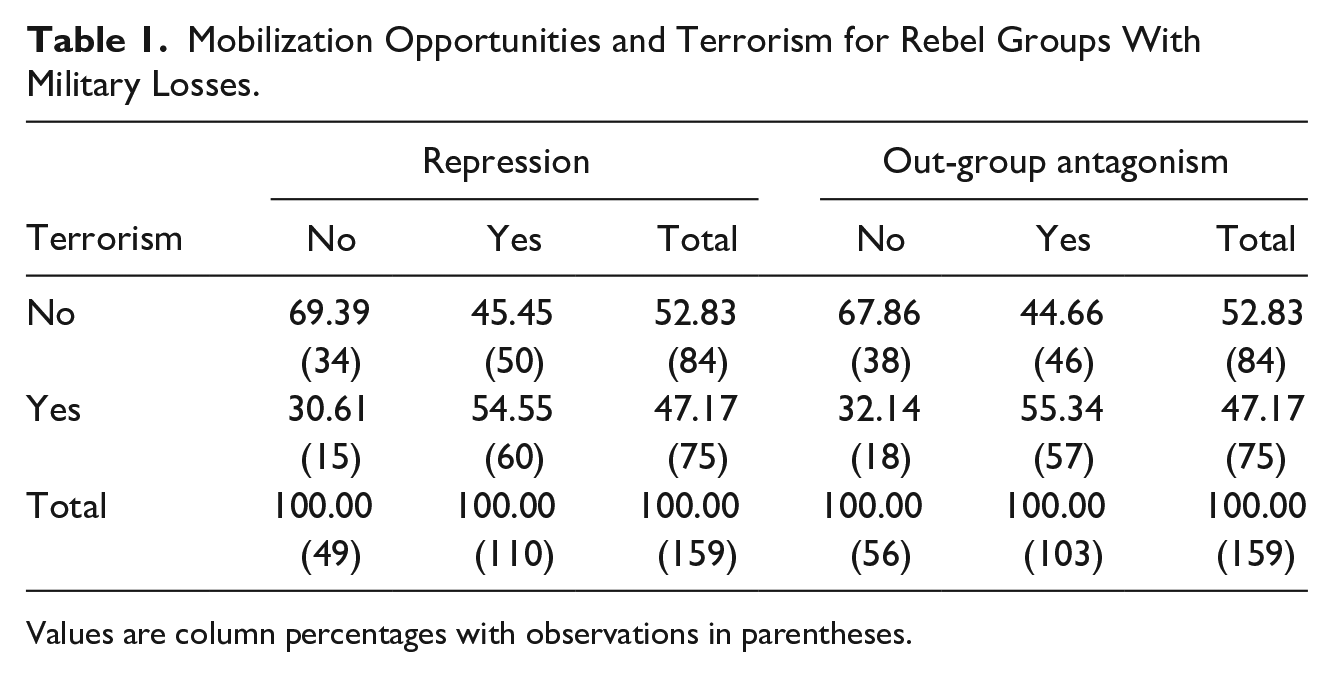
Values are column percentages with observations in parentheses.
Table 2 presents the results for the first hypothesis. We include an interaction term between the continuous variables repression and relative rebel losses to assess this conditional relationship. The coefficient for the interaction term is positive and statistically significant across all terrorism outcomes. 15 On average, rebel groups are more likely to adopt terrorism, and to conduct a greater number of attacks, when fighting against a government with repressive tendencies and when they have experienced severe losses in the previous month. In contrast, when considered independently, neither repression nor relative rebel losses can consistently explain insurgents’ adoption of terrorism. Importantly, in the absence of prior repression, relative rebel losses has a negative effect on all terrorism outcomes. This suggests that when the government is perceived as unlikely to respond to terrorism with indiscriminate repression, rebels are actually less likely to use terrorism even if they have suffered major losses in the previous month.
Empirical Results for Hypothesis 1.
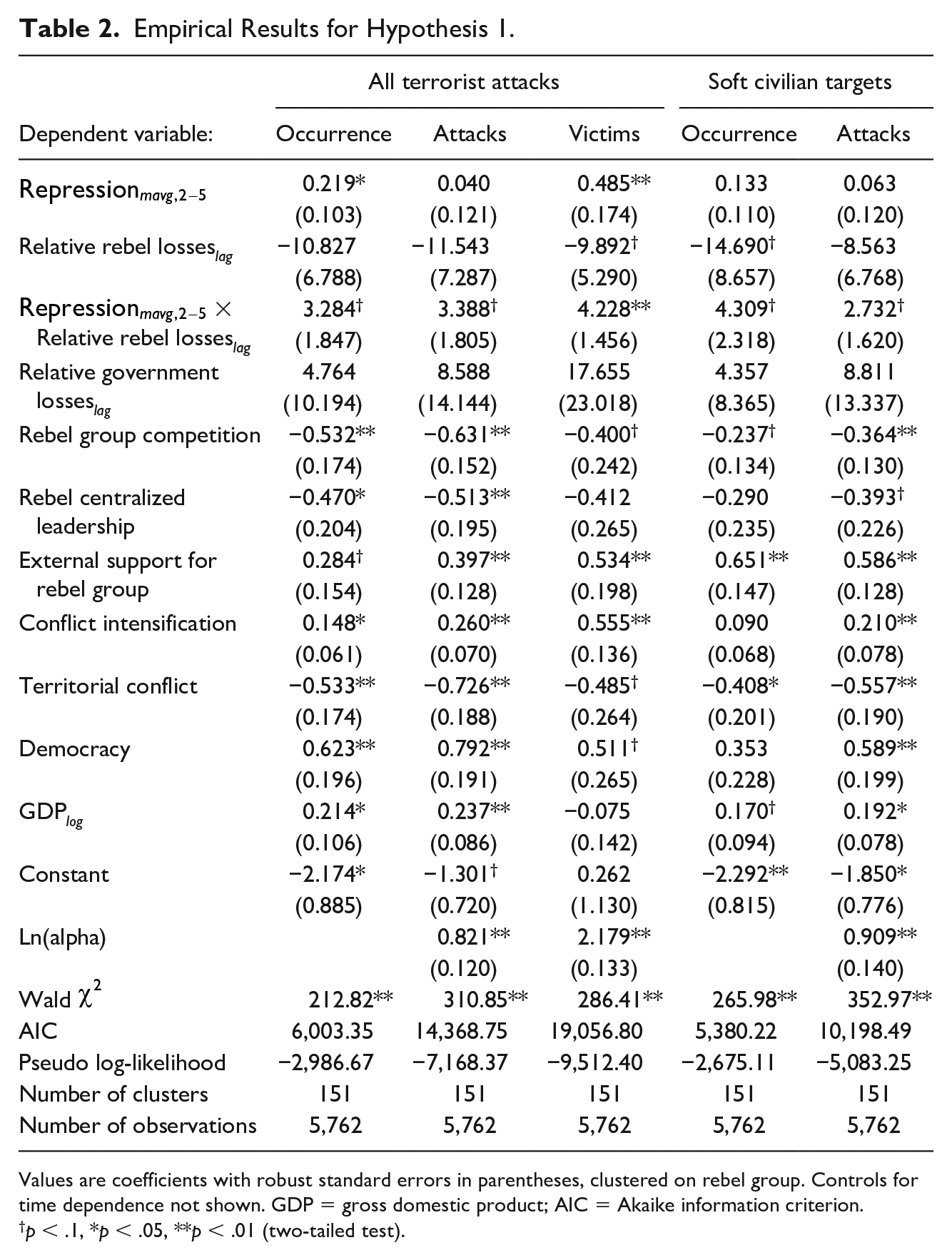
Values are coefficients with robust standard errors in parentheses, clustered on rebel group. Controls for time dependence not shown. GDP = gross domestic product; AIC = Akaike information criterion.
p < .1, *p < .05, **p < .01 (two-tailed test).
To examine the substantive effect of this interaction, we plot the marginal effects. Figure 2 illustrates these effects for the main three dependent variables. The top row presents first-difference plots for the effect of a change in past repression from minimum to maximum (i.e., to indiscriminate) over the range of meaningful values of rebel losses. The bottom row shows contour plots which visualize the effects for all combinations of repression and losses values. Across graphs, we observe that the effect of an increase in the severity of military losses on insurgent terrorism is much more pronounced when the government previously used indiscriminate repression. A change in government repression from minimum to maximum in situations where rebels have suffered substantial losses 16 yields a threefold increase in the probability of terrorism and a 22-fold increase in the severity of attacks. However, in the absence of losses, there is no significant difference in the use of terrorism between high and low levels of repression (top row). These results support our first expectation. A government’s reputation for brutality increases rebel incentives to carry out terrorism, but only when these rebels have recently suffered major battlefield losses.
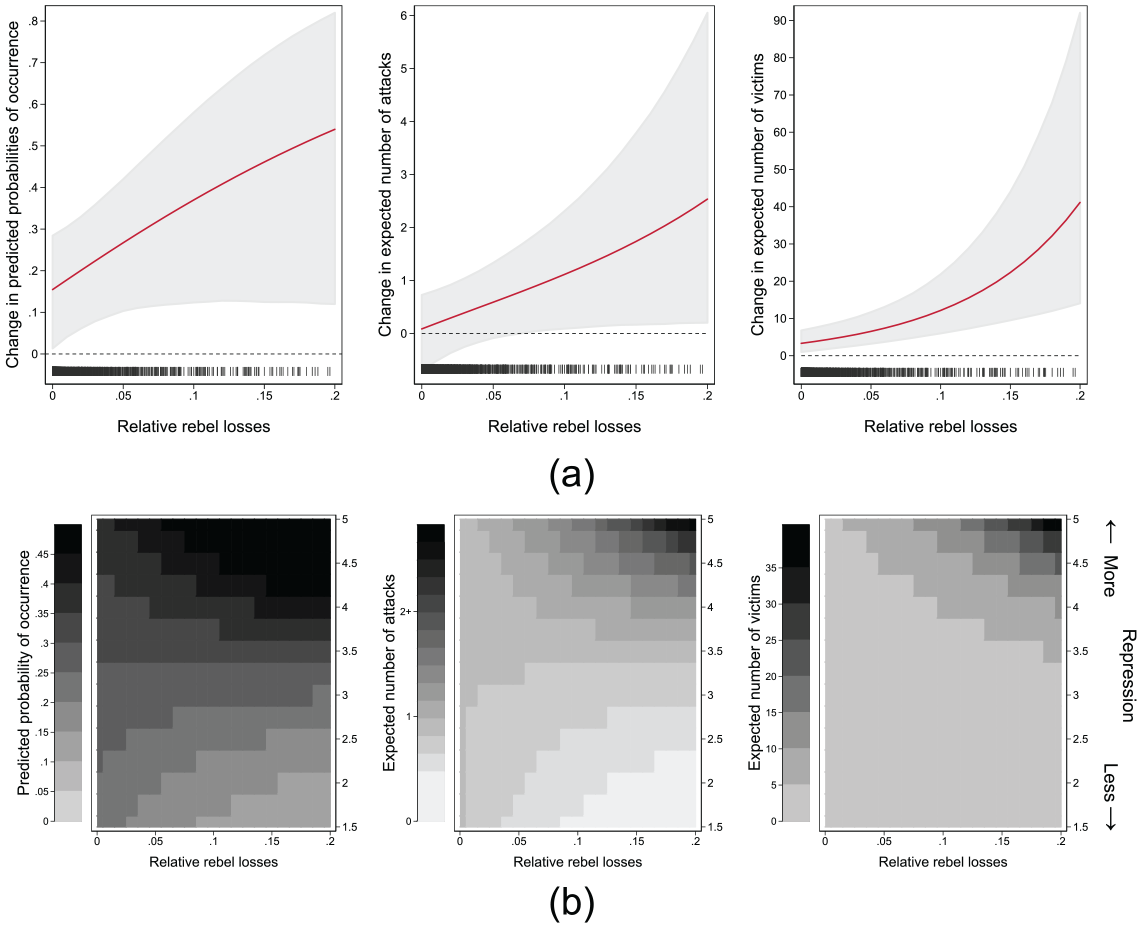
Substantive effect of repression over the range of relative rebel losses values (Hypothesis 1): (A) first-difference graphs and (B) contour graphs.
Table 3 presents the results for the second hypothesis, which focuses on the interaction between out-group antagonism and relative rebel losses. We find that neither out-group antagonism nor relative rebel losses alone can systematically explain when insurgents adopt terrorism in civil wars. Instead, the interaction term has a positive and statistically significant effect across all terrorism outcomes. This suggests that rebel groups that have strong ties with a specific ethnic or ethnoreligious group are more likely to carry out terrorism in the month following major military setbacks.
Empirical results for Hypothesis 2.
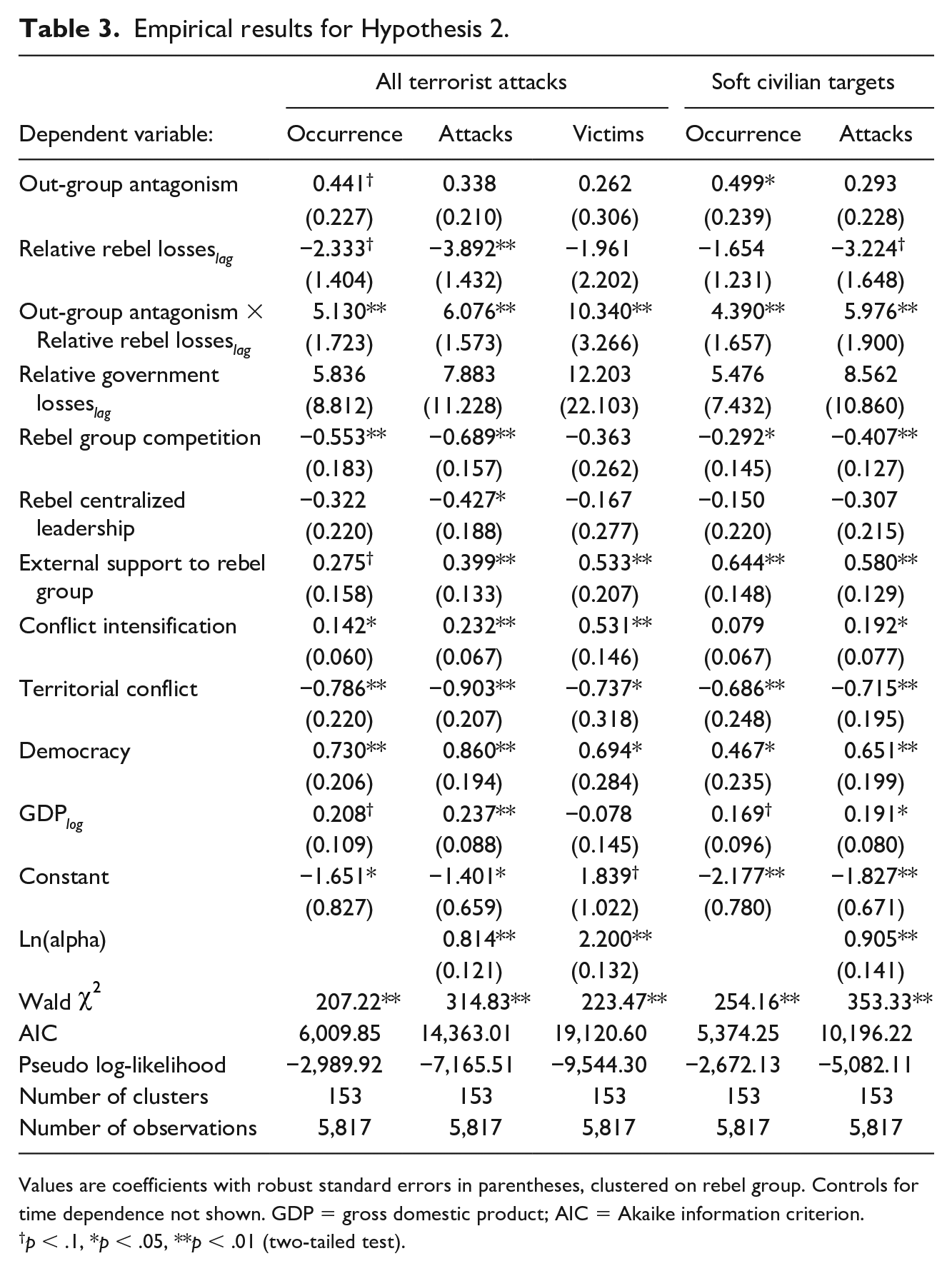
Values are coefficients with robust standard errors in parentheses, clustered on rebel group. Controls for time dependence not shown. GDP = gross domestic product; AIC = Akaike information criterion.
p < .1, *p < .05, **p < .01 (two-tailed test).
To examine the substantive effect of the interaction, we plot the marginal effects. Figure 3 visualizes these effects for the main three outcome variables. Given that out-group antagonism is a binary indicator, the graphs show the first difference in the probability and expected count and severity of terrorist attacks as out-groups antagonism increases from 0 to 1 over the range of relative rebel losses.
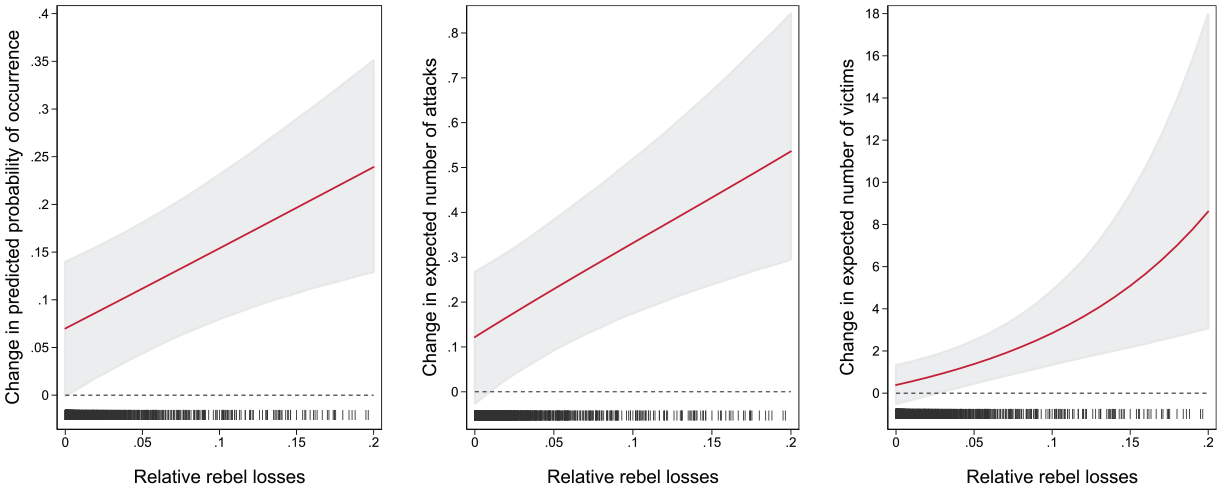
Substantive effect of out-group antagonism over the range of relative rebel losses values (Hypothesis 2).
Figure 3 shows that as insurgents’ military losses in the previous month become more pronounced, there is a significant difference in the occurrence of terrorist attacks, the number of attacks, and the number of victims of terrorism between rebel groups with constituencies characterized by out-group antagonism and those without. Groups with out-group antagonism who undergo significant military losses 17 are 110% more likely to adopt terrorism than their counterparts. The simultaneous presence of these two conditions also generates a significant increase in the number of terrorist attacks and civilian killings—156% and 261%, respectively—in the month following military losses. However, in the absence of losses, these differences are indistinguishable from zero. This corroborates our second expectation that the effect of in-group out-group hostility on rebel terrorism is conditional on battlefield dynamics.
Overall, we find considerable support for the complementarity of specific political conditions and events on the battlefield in explaining the choice and timing of rebel terrorism in civil wars. The government’s propensity to repress indiscriminately and a strong out-group antagonism within the rebels’ constituency increase the expected effectiveness of terrorist mobilization efforts. Under these permissive conditions, military losses on the battlefield provide unique windows of opportunity which increase rebels’ willingness to rally support by adopting and escalating terrorism.
Exploring the Mechanisms: The Case of ISIS Terrorism
The cross-group analysis has allowed us to provide a generalizable test of our theory. We now turn to the analysis of a specific case, where our theory is most likely to apply to examine, using more granular data, some of the implied mechanisms underlying rebels’ mobilization efforts through the (careful) use of terrorism.
ISIS is an appropriate case to examine for several reasons. The group is a direct descendant of Al-Qaida in Iraq, whose founder al-Zarqawi was the first ideologue of the use of sectarian terrorism to spur Sunni mobilization. Like its predecessor, ISIS makes explicit claims on behalf of Sunni groups, receives considerable support from Iraqi Sunnis, and has recruited also among Sunnis in Syria, while demonstrating fierce hostility toward out-groups, especially Shiites, Kurds, and Christians (e.g., Haykel, 2016; Weiss & Hassan, 2016). In addition to drawing on its strong sectarianism, the group was able to resurrect itself in 2012 partly because Iraqi prime minister Nouri al-Maliki’s policies of persecution and discrimination alienated the Sunni population, which rallied to the group (Fishman 2016b, pp. 182–197). The combination of strong sectarianism and repressive government policies against the Sunnis have allowed the organization to rely on the use of terrorism to attract a stunning number of recruits (Fishman, 2016b, pp. 216–217). In addition, over the last 4 years ISIS has experienced increasing military and territorial losses both in Iraq and Syria (Institute for the Study of War, 2017; Warrick & Mekhennet, 2016).
Based on our argument, ISIS losses should increase the group’s reliance on terrorist tactics and shape the temporal variation of attacks. At the same time, our theory also suggests that the vast majority of such terrorist attacks should be concentrated in areas populated by out-group members (i.e., non-Sunni and mixed) and not in exclusively Sunni areas. In fact, an implied mechanism of our mobilization theory is that terrorism is directed against out-groups to provoke harsh responses which radicalize in-group members and lead them to view the insurgents as their only protector. As it is not feasible to identify the ethnicity of terrorist targets for thousands of attacks and group-years, with this case study, we can directly examine our mechanism and rule out the alternative mechanism whereby groups use terrorism following losses to prey on or coerce constituents (e.g., Wood, 2014). Moreover, the Sunnis are politically excluded in both Iraq and Syria while most of their out-groups are in power (e.g., Shia and Kurds in Iraq and Alawites in Syria). In line with our first hypothesis, this situation of state-led Sunni marginalization further boosts ISIS’s optimism about its ability to provoke indiscriminate government repression.
We estimate the likely ethnicity of ISIS targets by overlaying the geo-coded locations of ISIS terrorist attacks and the settlement areas of ethnic groups in Syria and Iraq. 18 For each day, we calculate the number of ISIS attacks that take place in exclusively Sunni areas or non-Sunni and mixed areas which include localities inhabited by Shia, Kurds, Alawites, and Christians, among others.
We also gather highly disaggregated, daily data on battle-events on the ground, between ISIS and government forces, and on coalition airstrikes against ISIS in Syria and Iraq from July to December 2015. 19 We combine these into a count variable that reflects the overall intensity of military operations against ISIS each day. Focusing on the intensity of battle-events and targeted airstrikes provides a suitable approximation of the severity of ISIS military losses. It is widely recognized that the material losses experienced by the group were the product of the combined (and coordinated) effort of military operations on the ground and of targeted airstrikes against the group’s strongholds to degrade its capabilities (U.S. Department of State, 2017). 20
To assess ISIS’s use of terrorism as a function of losses and of the targets’ ethnic identity, we employ a vector autoregression model (VAR) (Brandt & Williams, 2006; Enders & Sandler, 2012). VAR allows us to examine the endogenous relationship between ISIS’s military losses—proxied by the intensity of military operations—and the group’s decision to carry out terrorist attacks against civilians in non-Sunni and mixed areas. 21 We then compare the results with a second model that focuses on ISIS attacks in exclusively Sunni areas—that is, against in-group members.
As a VAR system is an equilibrium representation, the substantive effects are calculated by examining how shocks propagate to the system. We estimate whether a positive shock to military operations influenced ISIS’s terrorist response as well as future operations, and vice versa. Figure 4a presents the results for a shock to military operations on ISIS terrorist attacks in non-Sunni and mixed areas (i.e., against out-groups). A unit shock to the overall intensity of military operations against ISIS led to an increase in ISIS terrorist attacks in the following days. The response peaked around the second day and remained positive until the fifth day. Figure 4b presents the results for our comparison test; the effect of military operations against ISIS on ISIS attacks against Sunnis (i.e., the in-group). Consistent with our theory, here we do not find evidence of a response. When we explore these results further, we find that a common feature of the locations with the highest number of ISIS terrorist attacks is that they are located at ethnic, Sunni versus non-Sunni, fault-lines. Because of the proximity of in-group and out-group, these locations are ideal to foment sectarian hostilities and mobilize in-group members. Overall, these results bolster our main findings on the relationship between rebel mobilization efforts, battlefield losses, and the use of terrorism in armed conflicts.
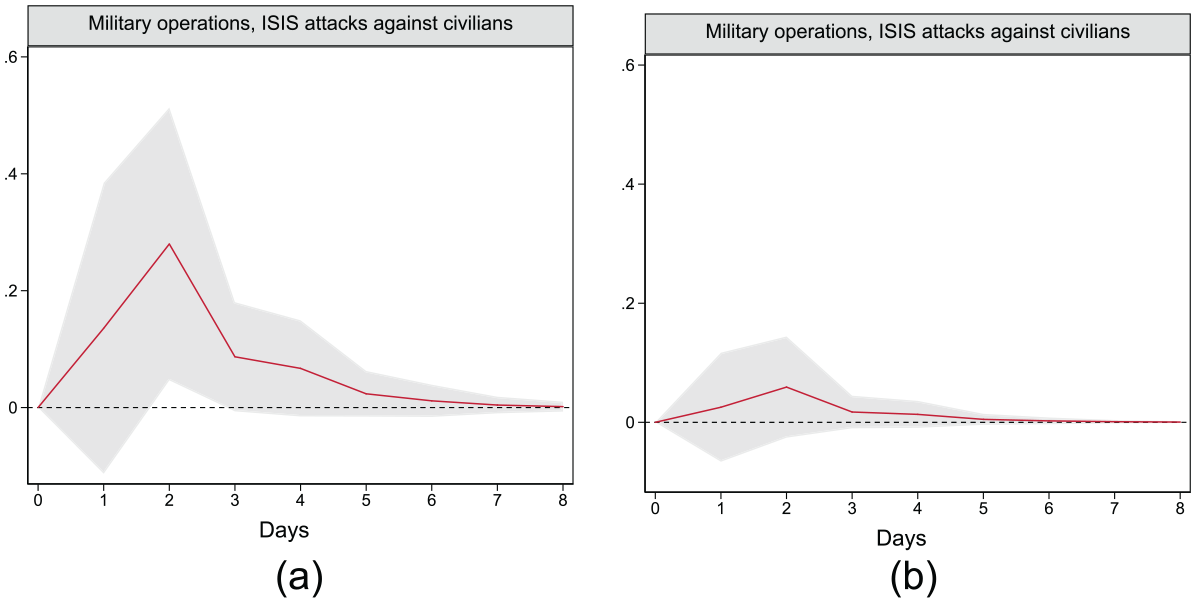
VAR orthogonalized impulse-response functions: ISIS terrorist response to a unit shock in airstrike: (A) non-Sunni and mixed constituencies and (B) Sunni constituencies.
Robustness and Alternative Explanations
In this section, we briefly discuss some of the additional analyses we conducted to check the robustness of our findings to alternative explanations and model specifications. We provide further details in the Online Appendix.
An alternative explanation for our findings may be that an increase in terrorism is due to an overall increase in insurgents’ fighting efforts. In light of this, we examine changes in the intensity of battle-events between insurgent and government forces in the aftermath of insurgents’ battle losses. Consistent with our argument, we find that major losses reduce insurgents’ reliance on battlefield engagements. Hence, the adoption of terrorism is not the result of an overall increase in rebels’ fighting efforts, but rather a way to continue fighting and mobilize support when this is needed most.
Moreover, groups might resort to terrorist attacks because of leaders’ lack of control over the rank and file (i.e., principal–agent problems). Our empirical findings, however, appear inconsistent with this explanation. If terrorism were purely a product of insurgents’ lack of discipline, then terrorism’s political costs (i.e., risk of backfiring) would be irrelevant for explaining this decision. Instead, our results show that rebel groups that suffered severe losses refrain from adopting terrorism when this is expected to be politically counterproductive and drive supporters away.
We also conduct supplemental analyses with alternative operationalizations of past repression, out-group antagonism, rebel losses, and terrorism. We vary the temporal lags of government repression and use alternative measures of repression from Fjelde and Hultman (2014) and Fariss (2014). We also restrict our coding of out-group antagonism to cases where a rebel group’s ethnoreligious constituency is politically excluded, thereby isolating cases where intergroup hostility is likely to be strongest. In addition, as the government is a primary opponent of rebel groups, we reestimate our models with a dependent variable that only captures terrorist attacks against targets directly associated with the government. We also generate a more fine-grained monthly estimate of the proportion of rebel troops lost in battle by updating the values of rebel troops at the beginning of each month based on rebel troop losses in the previous month. This allows us to more closely track short-term changes in rebel troops and refine our measure of the impact of losses in each month. All substantive conclusions remain unchanged.
We further check the robustness of our results to the inclusion of additional control variables (e.g., rebel territorial control, rebel strength, a history of rebel violence against civilians, changes in government leadership). The substantive results remain unaffected by these changes. In addition, we control for the (logged) number of government civilian killings in the previous month to account for the possibility of terrorism arising from tit-for-tat or direct retaliation strategies as opposed to long-term repressive strategies. Finally, as repression and out-group antagonism are not mutually exclusive, we reestimate the models and include a control variable for the other condition that facilitates rebel groups’ choice of terrorism as a mobilization strategy. All the main findings remain unchanged.
Conclusion
In this article, we have presented a theory of rebel groups’ use of terrorism as a strategy to mobilize support. At the same time, we have argued that not all rebel groups are able, and willing, to mobilize support using terrorism. Groups fighting a government susceptible to provocation, due to a long-term propensity to repress indiscriminately, and groups with a constituency characterized by strong out-group antagonism stand to benefit the most from terrorist tactics. When groups are generally optimistic about the effects of terrorism on support, major military losses operate as a trigger and influence the timing of terrorist attacks during conflicts.
Our results show that terrorism is not a weapon of last resort for desperate groups. When groups expect terrorism to potentially backfire and drive supporters away, they do not adopt such tactics, even if they have recently suffered major military losses on the battlefield. In other words, and in contrast to what previous studies have found, suffering major losses is insufficient, on its own, to motivate the use of terrorism. This casts doubt on a conventional wisdom according to which terrorism is a weapon of the weak. In our analysis, those insurgent groups that are truly weak—that is, those groups who suffer major losses and expect high political costs from the use of terrorism—are actually less likely to resort to this tactic. Our results are consistent across both the macro- and micro-levels of analysis and across different operationalizations of terrorism.
This study shows the advantages of combining research on terrorism and on civil war. Linking insights from both literatures improves our understanding of terrorism as a tactic in a context where rebel groups can choose among several tactical options and repertoires. It also allows us to systematically explain variation in the use of terrorism across conflicts, rebels groups, and time. Moreover, our findings on the joint effect of specific political conditions and battlefield dynamics in explaining terrorism constitute an important complement to existing studies which have overlooked such interactions.
Our findings have implications for research on counterinsurgency and on conflict duration. Previous studies have argued that rebels’ use of terrorism constitutes a signal of successful counterinsurgency (e.g., Johnson, 1962; Kilcullen, 2010). However, while this argument suggests that terrorism may stem from governments’ effectiveness at weakening rebels’ military capacity, it overlooks the competition for political support (i.e., for hearts and minds). Although rebels who use terrorism do not necessarily win conflicts, the mobilization effect of terrorism becomes a critical source of insurgents’ power to resist. This is likely to generate much longer civil wars, which can be very draining for governments. The case of ISIS (and of its predecessors) is quite telling in this regard. The organization has been able to resurrect itself several times, even after major military defeats, in part thanks to strategically orchestrated terrorist campaigns (Fishman, 2016a).
The findings in this study also have more practical implications. They can help us anticipate when, where, and against whom rebels groups are more likely to use terror tactics. Understanding the effect of battlefield losses allows us to anticipate when terrorist attacks can be expected to occur during civil war. The political conditions that we show to benefit rebel groups enable us to identify which groups are more prone to adopt terrorism, as well as the likely targets. As a result, governments can be better prepared to assess the risk of terrorist attacks and avoid counterproductive responses.
There are a number of avenues for future research. Our data set links actors in civil war and in terrorism databases to bring together information on a large set of violent tactics and targeting strategies. Future studies will be able to build on this and explore the full range of rebel groups’ strategies and tactical choices, including insurgents’ nonviolent activities (e.g., social service provision, Mampilly, 2011). A promising avenue for future research would therefore be to analyze patterns of complementarity, substitution, and temporal sequencing between different violent and nonviolent tactics in civil war. Moreover, rebel groups’ incentives to mobilize support through the use of terrorism may extend beyond the local context. As a consequence, it will be important to examine how rebel terrorist attacks can affect international audiences, external support, and the behavior of third-party actors.
Supplemental Material
Appendix – Supplemental material for The Power to Resist: Mobilization and the Logic of Terrorist Attacks in Civil War
Supplemental material, Appendix for The Power to Resist: Mobilization and the Logic of Terrorist Attacks in Civil War by Sara M. T. Polo and Belén González in Comparative Political Studies
Supplemental Material
CPS-19-0138.R2 – Supplemental material for The Power to Resist: Mobilization and the Logic of Terrorist Attacks in Civil War
Supplemental material, CPS-19-0138.R2 for The Power to Resist: Mobilization and the Logic of Terrorist Attacks in Civil War by Sara M. T. Polo and Belén González in Comparative Political Studies
Supplemental Material
RevisionMemo_Final – Supplemental material for The Power to Resist: Mobilization and the Logic of Terrorist Attacks in Civil War
Supplemental material, RevisionMemo_Final for The Power to Resist: Mobilization and the Logic of Terrorist Attacks in Civil War by Sara M. T. Polo and Belén González in Comparative Political Studies
Footnotes
Acknowledgements
The authors thank Marius Radean, Adam Scharpf, Jessica Maves Braithwaite, Sabine Carey, Scott Gates, Ashley Leeds, Kristian Gleditsch, Hyeran Jo, Nikolay Marinov, Cliff Morgan, Stephen Nemeth, Felix Haaß, Idean Saleyan, participants at the 2016 Peace Science and ISA Annual Meetings, the 2017 Texas Triangle and MPSA Conference, Rice University IR Workshop, APSA 2018, as well as the Editors and three anonymous reviewers for very helpful comments and suggestions.
Declaration of Conflicting Interests
The authors declared no potential conflicts of interest with respect to the research, authorship, and/or publication of this article.
Funding
The authors received no financial support for the research, authorship, and/or publication of this article.

Notes
Author Biographies
References
Supplementary Material
Please find the following supplemental material available below.
For Open Access articles published under a Creative Commons License, all supplemental material carries the same license as the article it is associated with.
For non-Open Access articles published, all supplemental material carries a non-exclusive license, and permission requests for re-use of supplemental material or any part of supplemental material shall be sent directly to the copyright owner as specified in the copyright notice associated with the article.
