




Abstract
Employer organizations have been presented as strong promoters of the liberalization of industrial relations in Europe. This article, in contrast, argues that the preferences of employers vis-à-vis liberalization are heterogeneous and documents how employer organizations in Spain, Italy, and Portugal have resisted state-led reforms to liberalize collective bargaining during the Euro crisis. It shows that the dominance of small firms in the economies of these countries make employer organizations supportive of selective aspects of sectoral bargaining and state regulation. Encompassing sectoral bargaining is important for small firms for three reasons: it limits industrial conflict, reduces transaction costs related to wage-bargaining, and ensures that member firms are not undercut by rivals offering lower wages and employment conditions. Furthermore, the maintenance of sectoral bargaining and its extension to whole sectors by the state is a matter of survival for employer organizations. The article presents rationales for employer opposition to liberalization that differ from the varieties of capitalism approach.
Introduction
Recent scholarship on industrial relations in European countries has pointed to a common trajectory of liberalization. According to Baccaro and Howell (2011, 2017) or Streeck (2009), even if the institutions that regulate labor markets in Europe have displayed a high degree of resilience and diversity in form (e.g., high collective bargaining coverage), their functions have considerably changed and converged in a (neo-)liberal direction. Recent developments have fostered more individualized relationships between firms and their employees, a greater role for market processes, and disinflation as an overarching economic goal. As a result, the solidaristic features of organized systems of wage bargaining have been eroded, income inequality has increased, and the power balance between capital and labor has shifted. Within this trajectory, recent labor market reforms have come to “reduce the constraints—in the form of labor law or collective regulation—acting on employers and thus on their ability to manage the workplace and their relationship with employees as they please” (Baccaro & Howell, 2011, pp. 527-528).
Employers have often been perceived as supporting this trajectory because liberalization, defined as a movement “away from centralized authoritative coordination and control towards dispersed competition, individual instead of collective action, and spontaneous market-like aggregation of preferences and decisions” (Streeck, 2009, p. 149) is thought to correspond to their primary interests. Even if their ability to effectively achieve it is constrained by the power balance with labor, they “will prefer greater discretion [towards their employees] to less” (Baccaro & Howell, 2017, p. 20). This line of analysis stands in sharp contrast with the varieties of capitalism (VoC) approach, which emphasizes not only the high degree of stability in European industrial relations but also the persisting desire of employers to support and maintain institutions of nonmarket coordination, notably as a way to ensure an adequate supply of skills (Estevez-Abe, Iversen, & Soskice, 2001; Hall & Soskice, 2001).
Using Southern Europe in the wake of the Eurozone crisis as a case study, we show in this article that employers can have heterogeneous preferences when it comes to liberalization, and document rationales of employer opposition to it that are different from those proposed by VoC. While some employers have first-order preferences for decentralized bargaining and liberalization, others oppose the decentralization of collective bargaining and the shrinkage of coverage, defending measures that limit their own discretion. Drawing on earlier analyses of collective bargaining and welfare formation in Europe and the United States (Pontusson & Swenson, 1996; Swenson, 2002), we argue that important segments within business may prefer to limit their own discretion not to preserve the skill supply, as the VoC approach argues, but for other more context-specific reasons: to limit competition by other firms, reduce industrial conflict, minimize the transaction costs associated with collective bargaining, and ensure the survival of business associations. These strategies are particularly important for small firms, who are more likely to face low-wage competition and for whom the transaction costs associated with firm-level bargaining with unions are higher.
To substantiate our argument, we look at post–Euro crisis collective bargaining reforms in Italy, Spain, and Portugal, that is, three countries that faced a tremendous amount of pressure for liberalization and where small firms play a central role in the economy. At the peak of the crisis, supranational institutions (European Commission, European Central Bank [ECB], and International Monetary Fund [IMF]) made access to financial support—either in the form of aid packages or purchase of Southern European sovereign bonds—conditional on the implementation of reforms geared toward the reduction in domestic prices and wages. When it came to labor markets, these reforms mainly centered on two objectives: loosening employment protection and making industrial relations more flexible to allow for quicker (downward) wage adjustments (Afonso, 2019). This process of flexibilization entailed the promotion of firm-level bargaining instead of agreements covering whole economic sectors, a greater level of autonomy for firms to opt out from the terms of collective agreements, and, in some cases, more restrictions on the extension of sectoral agreements to nonbargaining parties (Marginson, 2015; Meardi, 2012; Sacchi, 2015).
While these reforms could potentially further shift the power balance from labor to employers (Cioffi & Dubin, 2016, p. 424), important segments of employers in these countries opposed the flexibilization of collective bargaining. For instance, in Italy, employers’ associations signed a number of bipartite agreements with trade unions aimed at preserving the existing collective bargaining structure. In Portugal, employer organizations lobbied for reinstating the state-backed extension of collective bargaining agreements to nonbargaining parties, after the government unilaterally made criteria for these extensions more restrictive. Drawing on in-depth comparative case studies and 14 interviews, we explain this resistance to liberalization initiatives by looking at the specific power configuration within employer organizations in Southern Europe, which partly sets it apart from the countries that comparative political economy has drawn on so far in theory building.
The contribution of this article is twofold. First, we contribute to a more nuanced understanding of the role of business in liberalization processes by taking a middle way between the “liberalizers” (Baccaro & Howell, 2011, 2017) and the “coordinationists” (VoC): while we agree with the empirical assessment of greater liberalization of the former, we emphasize the internal conflicts within business against the implicit assumptions of employer homogeneity of preferences. Regarding the coordinationists, following Pontusson and Swenson (1996) and Swenson (2002), we assume employer opposition to be more driven by short-term strategies to regulate internal labor relations rather than an economy-wide functional logic. Second, the article provides a better understanding of employer preferences and liberalization mechanisms in the Southern European context. In contrast to the economies of Northern Europe, where governance mechanisms at firm level are well institutionalized (e.g., co-determination in Germany), the extreme decentralization of collective bargaining in Southern Europe would lead to the end of coordination altogether because there is minimal cooperation at lower levels, especially in small firms.
The rest of the article is organized as follows. Section “Collective Bargaining and Employer Preferences in Southern Europe” reviews the main studies on employers’ preferences and collective bargaining, showing how the opposition to collective bargaining decentralization by Southern European employers’ runs counter to influential views in the literature. Section “Cases and Methods” deals with the rationale for case study selection and outlines the categorization used to classify the collective bargaining measures implemented in Southern Europe. Sections “Italy,” “Spain,” and “Portugal” are devoted to country-based case studies covering the main collective bargaining reforms implemented in Italy, Spain, and Portugal and the reaction of employers’ associations. Section “Conclusions” concludes with some comparative reflections.
Collective Bargaining and Employer Preferences in Southern Europe
While earlier literature in comparative political economy focused essentially on trade unions and labor mobilization as drivers of labor market and welfare changes, in recent decades, there has been a renewed focus on employers and their role in shaping and even designing work and welfare institutions. Scholars have shown that employers played a prominent role in the construction of welfare states and labor market regulations in the early 20th century (Mares, 2003; Paster, 2014; Thelen, 2003) as well as in their transformation from the 1980s (Baccaro & Howell, 2011, 2017; Pontusson & Swenson, 1996). Employers have variously been portrayed as protagonists (actively promoting coordination to serve their interests), consenters (accepting coordination as part of political bargains), or antagonists (actively pushing for liberalization) of welfare and labor market coordination (Korpi, 2006). These different views on the role of employers have also been associated with different understandings of the trajectory of industrial relations in Europe in recent decades.
The “employers as protagonists” view has been associated with the early VoC approach (Hall & Soskice, 2001; Estevez-Abe et al., 2001) and has assumed a high degree of resilience in coordinated capitalist institutions (Iversen & Soskice, 2019). In this perspective, limits on pure market processes (e.g., coordinated bargaining which prevents firms from competing against each other over wages) are ultimately “beneficial constraints” for employers because they create incentives for firms to provide common goods that benefit the economy as a whole, such as a well-trained workforce. In this view, employers will support systems of welfare protection and coordinated collective bargaining even despite the processes of globalization. Thelen (2003) argues that globalization and “just in time” production processes have actually provided even further incentives for employers to accommodate labor unions through limits on market competition to ensure industrial peace. Indeed, in most European countries, core industrial relations institutions have persisted; collective bargaining coverage remains high, social dialogue still takes place, and few countries have effectively gone through a process of radical decentralization (Baccaro & Howell, 2017, Chapter 3).
However, more recent accounts have argued that behind a façade of stability, significant changes have been taking place, and employers have been an important liberalization force. In the German case, Streeck (2009, p. 50) and others find that even if the core institutions of the coordinated market economy model have been fairly resilient, their functions have been seriously altered. Employers are no longer benevolent supporters of coordination and redistribution mechanisms. For instance, the BDI (Bundersverband der Deutschen Industrie) pushed a number of radical reforms, notably an (unsuccessful) campaign to end worker co-determination on company boards. Collective bargaining coverage has only slightly declined, but collective agreements have become “thinner” and less constraining for firms, allowing them to opt out from specific collective commitments more often; employer associations still retain their membership and now provide arrangements allowing their members not to comply with negotiated agreements (Streeck, 2009, p. 48).
In a more recent analysis, Baccaro and Howell (2011, 2017) similarly see employers essentially as antagonists. Accordingly, employers will always favor measures expanding their discretion vis-a-vis their employees and the state because the post-Fordist capitalist system places a premium on their ability to rapidly respond to market impulses (Baccaro & Howell, 2017, p. 18). For this reason, Baccaro and Howell (2017) posit that in the realm of industrial relations, employers will always push for “deregulation, decentralization, individualization and the conversion of existing institutions to function in a manner that expands employer discretion.” (p. 178). Concerning the level of negotiation, employers will favor “a shift from higher levels of collective bargaining to lower ones, closer to the firm or workplace; greater recourse to individual bargaining between employee and employer or unilateral employer decision-making.” (Baccaro & Howell, 2017, p. 18). In their frontal assault against coordinated industrial relations institutions, employers’ associations are helped by both the state and the deepening of European integration. In Baccaro and Howell’s (2017) words, Employer organizations, on the other hand, have become more politicized, more self-confident, more committed to neoliberal formulations and more willing to challenge existing industrial relations institutions. In this task they have increasingly been joined by governments, including those of the center left. States have proved more interventionist in industrial relations even as they have retreated from direct regulation of the labor market. All this has taken place in the context of a reinvigorated project of European integration that has institutionalized a deflationary and deregulatory economic logic, simultaneously creating a harsh macroeconomic environment for labor while closing off opportunities to use any residual national political influence. (p. 196)
In this article, however, we show that employer preferences are much more heterogeneous and sector specific. Using case study evidence from Southern Europe, we do not find support for the functionalist logic of VoC linking collective bargaining centralization with skill formation, nor for a uniform push by employers toward liberalization. Instead, like Swenson (2002) and Swenson and Pontusson (1996), we find that the preferences of employers and their associations are more driven by sector-specific business strategies and political calculations.
For instance, studying the demise of peak-level, economy-wide wage bargaining in Sweden, Pontusson and Swenson find that large export-oriented engineering employers were the principal drivers of collective bargaining decentralization because they wanted wage differentials between export-oriented and sheltered sectors to increase to secure an adequate supply of motivated labor and needed more flexible employment conditions to remain internationally competitive in the production of “high value-added, internationally tradable consumer durables and producer goods” (Pontusson & Swenson, 1996, pp. 224-225, 236). Swedish employers were not united in calling for collective bargaining decentralization. Commercial and retail employers defended peak-level bargaining, as it allowed them to limit industrial conflict. In his comparative analysis of the development of labor market regulations and welfare systems in Sweden and the United States, Swenson also questions the then-prevailing view that business will always oppose labor decommodification (Swenson, 2002). Instead, he shows that employers’ preferences concerning collective bargaining and social legislation are contingent and derive from “strategies pursued to secure their interests in labor markets, and through labor market control, in their product markets.” (p. 21). Swenson argues that in low added-value sectors like construction, retail, and mining, employers have an incentive to favor collectively agreed wage floors to prevent cut-throat wage competition. This is especially relevant for the small firms that overwhelmingly populate these low-wage sectors.
This article argues that employer opposition to liberalization in Southern Europe can be motivated by a number of factors: the need for small firms to deter low-wage competition and to limit industrial conflict, especially at firm level, reduces the transaction costs associated with wage bargaining and ensures the organizational survival of business organizations, which depends on incentives for the collective organization of firms. These arguments are particularly relevant in the South European context because of the prevalence of small firms, both in the economy as a whole and in the membership of employer associations in particular (Figure 1). In 2016, companies with less than 10 employees accounted for 46% of total employment in Italy, 40.8% in Portugal, and 41.2% in Spain (against 20.2% in Germany and 31.9% in France) (European Commission, 2017). The pivotal role of small firms is reflected in the membership of Southern European employers’ associations. In 2003, firms with less than 250 employees constituted 97% of the membership of the Italian peak employers’ association Confindustria (Vatta, 2007, p. 219), accounting for more than 90% of the membership fees (“Fuga Da Confindustria,” 2016). In 2015, this proportion was 90% for the Confederação Empresarial de Portugal (CIP), accounting for 73% of membership fees (Deloitte, 2015). The dominance of small firms has important consequences for employer preferences in collective bargaining for a number of reasons (Afonso, 2012; Paster, 2014).
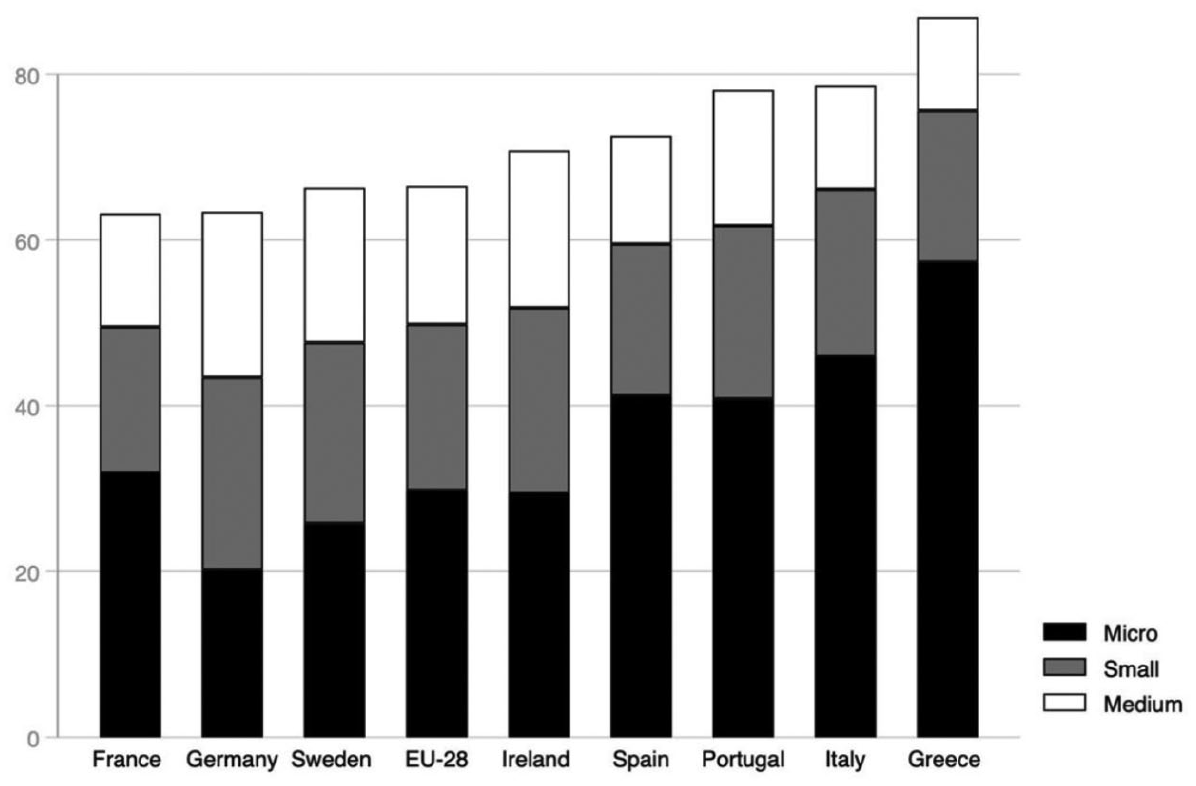
Small firms’ contribution to employment in the nonfinancial sector (2016).
First, small firms organized within employer associations may want minimum standards to be imposed on their (nonorganized) competitors to ensure a level-playing field (cartelism strategy) (Swenson, 2002). In this sense, collective bargaining is not only an instrument that regulates the relationship between workers and employers but also one that regulates competition between firms in product markets. If competing firms do not need to comply with the wage standards agreed in collective agreements, there is no longer an incentive for firms to negotiate them in the first place, as they can be undercut by unorganized firms. Extension rules are important tools to ensure compliance. They ensure that the outcomes of collective bargaining are made compulsory for nonbargaining parties, either by courts or ministries. They are common in many European countries and have been shown to be a decisive predictor of higher collective bargaining coverage (Traxler, 2004). Minimum wages are another possible instrument that has the same function, which ensure the same function. Following this logic, Bachmann, Bauer, and Frings (2014) document employer support for sector-specific minimum wages in Germany, especially from higher productivity firms (who pay higher salaries) and in sectors with low entry costs (low skills/low wages). This is especially important in Southern Europe, where low-wage competition in sectors such as construction or government contracting is rife.
Second, since most small firms do not have elected work councils, their owners view firm-level bargaining with suspicion, fearful that it might ignite social conflict, preferring instead to combine “reference to sectoral wage agreements with internal unilateral, paternalistic management.” (Meardi, 2012, p. 76). If they have to deal with militant unions, small firms may therefore prefer to keep them outside the workplace and within the framework of sectoral bargaining. More broadly, firms may object to liberalization if they think it would stir industrial conflict, especially in sectors where trade unions are better organized.
Third, and relatedly, small firms may lack the industrial relations expertise to negotiate work-related issues at firm level and may prefer to outsource this task to sectoral organizations. This can be tied to a lack of resources or the lack of a tradition of firm-level bargaining.
Finally, the maintenance of coordinated wage bargaining at the sectoral level responds as well to the primary interests of peak employer organizations themselves (organizational survival). Employer organizations have an interest in wage negotiations taking place at the sectoral level because multiemployer bargaining is their primary raison d’être (Sheldon, Nacamulli, Paoletti, & Morgan, 2016; Traxler, 2004). If bargaining is decentralized to the firm level, the incentives for firms to organize collectively decrease. Indeed, reforms that transfer regulatory functions to the firm level might turn employer associations into hollow shells, with few incentives for firms to remain in them, that is, for instance, what happened in Australia after a radical decentralization of the bargaining framework (Sheldon et al., 2016). The same reasoning applies to the extension of collective bargaining outcomes to nonbargaining parties: if nonorganized firms are not bound by the agreements made by employer organizations, there is a strong incentive for firms to leave employer organizations to free themselves from the straightjacket of collective agreements (Traxler, 2004). This would call into question the very existence of peak employers’ associations.
Cases and Methods
The analysis is based on a comparative case study of employer reactions to liberalization in Spain, Portugal, and Italy during the Eurozone crisis. The qualitative case study format is aimed at documenting expressed rationales for employer opposition to liberalization through interviews and other sources. The case selection can be justified for the following reasons. First, these three countries were confronted with similar external pressures to liberalize their collective bargaining systems during the crisis, either through direct conditionality within the framework of a Memorandum of Understanding agreed with a Troika of international lenders (Afonso, 2019) or through implicit conditionality based on severe and unsustainable conditions on the bond market (Sacchi, 2015). The countries selected share many similarities in the setup of their political economies and welfare regimes, most notably the prevalence of small firms in the economy and within employer organizations, as argued above. They also share similar growth models, namely a demand-led model relying mostly on domestic consumption. In this type of model, we expect the skill-based argument to explain the support of employers for coordination to hold. Owing to the prevalence of small firms in the economy, the three countries are therefore most-likely cases for the rationales we highlight: if the rationales for employer opposition cannot be observed in these cases, they may not be observed elsewhere (Gerring, 2006, p. 120). We do not include Greece in our analysis for two reasons. First, the amount of external pressure faced by the Greek labor market and employers, as well as the deterioration of its economic conditions, was so strong that it reduced any ability for employers to express opposition. Second, in contrast to the other countries analyzed here, Greece has never developed institutions enabling proper dialogue between employers and unions (Lavdas, 2005), which we can consider as a scope condition of our argument.
We limit the analysis to the study of wage bargaining in the private sector, thus leaving the public sector aside. Although acknowledging the important role of public sector wage bargaining as a source of competitiveness divergence within Economic and Monetary Union (EMU; Hancké, 2013; Höpner & Lutter, 2018; Johnston, Hancké, & Pant, 2014; Johnston & Regan, 2016; Scharpf, 2011), we believe that wage negotiations in the public sector follow their own logic. This is due to the fact that, when setting public wages, the government acts both as an employer and as an enforcer of the negotiating outcome. This in turn creates a specific political tension between the responsible and responsive functions of elected governments (for a detailed analysis see Di Carlo, 2018), different in nature from that between governments and domestic employers that we are exploring here. We therefore restrict our focus to the regulatory functions of the state.
The analysis is based on press reports, documents provided by employer associations, secondary literature, and 14 interviews with country experts and representatives of peak employer associations. For each case, we outline the main characteristics of the collective bargaining system, trace the reforms carried out on the brink of and during the crisis, focus on the position adopted by peak employer organizations, and explain them. We conclude with some theoretical implications. For the purpose of the analysis, we use a broad concept of liberalization, understood as a movement “away from centralized authoritative coordination and control towards dispersed competition, individual instead of collective action, and spontaneous market-like aggregation of preferences and decisions” (Streeck, 2009, p. 149). Applied to collective bargaining reforms, this concept measures both (vertical) liberalization (initiatives to shift the focus of wage setting from the central to the sectoral to the firm) and (horizontal) liberalization limiting the scope and coverage of collective bargaining. In all our cases, we find that employers were resistant to the most radical liberalizing reforms unilaterally implemented by the government, supporting a (vertical and/or horizontal) recoordination of the collective bargaining framework.
Italy
The Italian wage-setting system historically centered on two main levels: the national sectoral, which is hierarchically superior and defines industry-wide pay and conditions, and the company level for work-related issues. The two main levels are integrated by a centralized cross-sectoral agreement covering very general issues and by territorial agreements, replacing company-level bargaining for small- and medium-sized enterprises (SMEs; Colombo & Regalia, 2016a). For decades, the system remained largely voluntarist and poorly institutionalized. The two-level bargaining structure was only formalized in 1993 with a tripartite agreement sanctioning centralized sectoral bargaining that set wage increases in line with expected inflation, while firm-level (or territorial-level for small firms) bargaining determined pay scales and productivity gains (Perez, 2000). Even though the 1993 agreement aimed at favoring firm-level negotiations, sectoral agreements remained the main instrument of regulation of employment conditions (Baccaro & Howell, 2017; Simoni, 2011).
In January 2009, the collective bargaining framework was reformed through a tripartite agreement between the Center-Right government, Confindustria, and two of the three main trade unions (leaving out the most radical General Confederation of Labor [CGIL]). The 2009 agreement increased the flexibility of the system, allowing employers to suspend the standards of sectoral agreements at company level, conditional on unions’ approval, to address industrial crises or foster employment (Simoni, 2011). Although enhancing the possibility of deviating from sectoral bargaining at firm level, the 2009 tripartite agreement maintained the priority of sectoral agreements on most issues. As a consequence, it is an instance of vertical liberalization negotiated by the social partners similar to those implemented in the precrisis period in core European Union (EU) economies (Marginson, 2015). However, the new bargaining framework was soon called into question when in 2010, Fiat, the largest domestic manufacturing employer, reorganized the production of its plant in Pomigliano, near Naples. The Pomigliano plan was part of an ambitious project to reorganize Fiat’s production system inspired by the new CEO Sergio Marchionne (Interview 1). As the head of Fiat, since 2004, Marchionne had saved the carmaker from bankruptcy before engineering the acquisition of the U.S. carmaker Chrysler.
Fiat’s plan for Pomigliano involved the restructuring of the assembling techniques to achieve a leaner productive structure (Simoni, 2011). However, this reorganization required trade unions to sign firm-level agreements deviating from the national sectoral contract regarding strikes and sick leave. Crucially, Fiat asked Pomigliano workers to agree to a peace clause restricting the right to call strikes in the plant (Simoni, 2011). This clause was deemed unacceptable by FIOM, the metalworking branch of the most radical union CGIL, while it was accepted by the two other unions, Italian confederation of workers’ strade unions (CISL) and Italian Union of Labor (UIL). A referendum among the workers of the Pomigliano plant sanctioned the Fiat agreement, leading to the exclusion of FIOM from the plant. Predictably, the Center-Right government immediately showed its support for Fiat, pleading for the decentralization of collective bargaining (Rehfeldt, 2012). More puzzlingly, Confindustria openly criticized Fiat’s unilateral deviation from the national metalworking agreement (Meardi, 2012).
By signing an unprecedented first-level agreement alternative to the national metalworking agreement, Fiat was pushing for a vertical liberalization of collective bargaining to obtain more discretion vis-à-vis its employees (Baccaro & Howell, 2017; Leonardi & Pedersini, 2018). For this reason, Fiat’s behavior resembles that of Swedish engineering employers as described by Pontusson and Swenson (1996). However, unlike in Sweden where the employers’ association was dominated by large multinationals, Fiat is the only global manufacturing multinational enterprise (MNE) in Italy
1
(Simoni, 2011). Fiat aside, the Italian manufacturing sector centers on networks of SMEs—including many “pocket-sized multinationals” with a very strong export orientation (Colli, 2010)—that rely on national sectoral agreements to define their wage levels. The dominant position of small firms within Confindustria explains why the employers’ association could not accept the unilateral deviation from sectoral agreements imposed by Fiat. As an official of Confindustria’s Milan territorial association put it, In those days we were worried that other firms could deviate from the national sectoral contract and say: now I will make my own contract. Which . . . from the point of view of a firm is for sure a way to address the issue, but from the organizational point of view, it’s clear that the organization has to defend all the firms . . . and the interests of FIAT are very different from those of a small firm owner. (Interview 2)
The tensions between Confindustria and its most powerful member further increased in 2011. While Fiat progressively extended its new decentralized agreement to other plants located in Italy, Confindustria engaged in bipartite dialogue with the trade unions to preserve the two-level bargaining system. To this end, in June 2011, Confindustria signed an inter-confederal agreement with all the main trade unions, including the most radical CGIL. The June 2011 agreement established rules to measure unions’ representativeness and further increased the scope for firm-level deviations from the national sectoral agreements, under specific conditions to be established for each sector by the relevant national agreement (Colombo & Regalia, 2016b). Hence, the reform preserved the traditional hierarchy between sectoral and firm-level agreements (Marginson, 2015; Meardi, 2012).
Even though with the June tripartite agreement, Confindustria had rebuffed the endogenous pressure toward vertical liberalization coming from Fiat, since mid-2011 Italy’s growing involvement in the Eurozone crisis had led to an increase in the exogenous pressure to disarticulate the bargaining system (Marginson, 2015). In August 2011, with Italy’s borrowing costs spiraling out of control, the ECB’s incumbent President Jean-Claude Trichet and his recently elected successor Mario Draghi sent a letter to Prime Minister Berlusconi, in which they implicitly made the purchase of Italy’s sovereign bonds conditional on the implementation of a series of structural reforms (Sacchi, 2015). Concerning the wage-setting mechanism in particular, the ECB asked for a reform of the collective bargaining framework to ensure the prevalence of firm level over sectoral bargaining (Meardi, 2012).
In September, the Center-Right government passed a budget law that, along with a series of emergency austerity measures, included in Article 8 a provision allowing company-level agreements (here labeled “proximity agreements”) to deviate from national sectoral agreements on a wide range of topics, including working time and layoffs. The latitude with which firm-level agreements were allowed to deviate from national sectoral agreements effectively reversed the hierarchy between the two, thus leading to a radical (vertical) liberalization of the wage-setting framework (Baccaro & Howell, 2011; D’Amuri & Giorgiantonio, 2014; Leonardi & Pedersini, 2018). Concerning the Pomigliano issue, Article 8 retrospectively legitimized the agreement signed by Fiat’s workers, as well as similar agreements signed in its other Italian plants (Berta, 2012).
Confindustria saw the government’s unilateral intervention as an invasion of the sphere of autonomy of the social partners (Interview 3). Furthermore, within Confindustria, there were concerns that the retroactive validation of the Fiat agreements could exacerbate the relationship with the main trade unions (Interview 4). This is why in September 2011, Confindustria signed an agreement with the trade unions which confirmed the validity of the June agreement and warned the Center-Right government that “industrial relations and wage bargaining are issues regulated autonomously by the social partners” (“Lavoro, le parti sociali sconfessano la manovra,” 2011). Apart from preserving the traditional hierarchy between sectoral and firm-level bargaining (Leonardi et al. 2018), the September agreement limited the scope of Article 8 by making its applicability subject to the unions’ consent (Berta, 2012). The September 2011 bipartite agreement is an instance of “re-coordination,” as employers and trade unions limited the impact of the vertical liberalization unilaterally imposed by the Center-Right government with Article 8. The September 2011 agreement further exacerbated the already-tense relationship between Confindustria and its most prominent member Fiat, leading to Fiat’s unilateral decision to leave Confindustria. In this context, Confindustria saw the defense of centralized collective bargaining as a way to reaffirm its institutional role vis-à-vis the government and its own members, thus preventing other firms from following Fiat’s example: The breakup (with FIAT) occurred because, for its image, Confindustria had to prevent a diaspora from other firms. They could not give the impression that it was right to leave Confindustria. (Interview 4)
In November 2012, Confindustria and two of the three main trade unions signed an agreement containing measures to improve labor market productivity. This new agreement served to better specify the conditions under which company-level agreements could deviate downward from sectoral agreements, and again stressed the autonomy of the social partners in the bargaining arena, implicitly criticizing the unilateral measure of the Center-Right government (Colombo & Regalia, 2016a).
The available data on the Italian wage-setting system confirm the resilience of two-level bargaining. Collective bargaining coverage has never fallen below 80% in international sources, while according to the domestic statistical office ISTAT, it encompasses 99.4% of the labor force (Leonardi, Ambra, & Ciarini, 2018, p. 191). Between 2012 and 2013, nearly 69% of the firms with more than 10 employees relied solely on the relevant national sectoral agreement without engaging in firm-level bargaining (Istat, 2015, p. 171). Firm-level bargaining continues to be strongly related to firm size. Between 2012 and 2015, only 7.5% of firms with more than 10 and less than 50 employees engaged in firm-level bargaining, while the share increases to 66% among firms with more than 500 employees (Leonardi et al., 2018, p. 200). Firm-level bargaining is in particular prevalent among large export-led firms located in Northern Italy (D’Amuri & Nizzi, 2017, pp. 14-15). In most cases, firm-level bargaining improves employment conditions; the issues most often negotiated include salaries, working hours and, recently, supplementary welfare benefits (ADAPT University Press, 2018). Concerning the relationship between firm-level and industry-wide bargaining, in most sectors, national agreements cover a wide array of issues, leaving little scope for firm-level bargaining. That is particularly true of capital-intensive sectors like the chemical industry in which labor costs are a marginal factor, but production losses due to firm-level disputes are very costly (Sheldon et al., 2016; Interview 3). At the other extreme, labor-intensive heterogeneous sectors like metalworking and textiles opt for a “light” sectoral contract used as a reference by small firms, leaving more scope for firm-level negotiations by large firms. In quantitative terms, most sectors nevertheless still opt for a strong national sectoral contract (Interview 2).
Hence, the collective bargaining framework is still strongly centered on the national sectoral level, and the vertical liberalization Article 8 aimed to achieve did not come about. In fact, although Article 8 is still valid, it was applied in very few cases, also due to resistance from the trade unions, and thus had a negligible impact on the collective bargaining framework (Interviews 2, 3, and 4). Furthermore, while other large firms left Confindustria following Fiat’s example, none of them adopted a firm-level contract alternative to the sectoral contract. Hence, the Fiat contract remains the only instance of a firm-level agreement alternative to the national sectoral agreement (D’Amuri & Giorgiantonio, 2014).
The coming to power of the Center-Left leader Matteo Renzi again threatened the two-level collective bargaining structure. Renzi has repeatedly hinted at the possibility of replacing the wage-setting part of sectoral agreements with a statutory minimum wage (Colombo & Regalia, 2016a). The Five Star Movement also supports the introduction of a statutory minimum wage. As an employer organization, Confindustria opposes the statutory minimum wage because it perceives it as a threat to its internal stability. In fact, Confindustria’s internal organization is still shaped by its role in the industrial relations arena. Therefore, by weakening sectoral agreements, a statutory minimum wage would force a radical restructuring within the employers’ association (Interview 1). In the words of a member of the Turin Employers’ Association, The statutory minimum wage, even more than the FIAT agreement, threatens to reduce the importance of sectoral collective bargaining. This is a concern both for Confindustria and for its sectoral organizations . . . what is at stake is the political role of the sectoral organizations. (Interview 4)
All in all, it is clear that Confindustria opposed a radical liberalization of collective bargaining throughout the crisis, siding with the main trade unions in defense of a two-level bargaining system. Hence, with the exception of Fiat, we do not find Italian employers to have a “first-order preference . . . for decentralized firm-level bargaining” (Baccaro & Howell, 2017, p. 181). Instead, Confindustria defended the two-level bargaining system because of the pivotal role that small firms play in the Italian economy. In fact, strong sectoral agreements are vital for small firms for three reasons.
First, they keep the level of industrial conflict low. In a context in which work councils are found in only 8% of firms with less than 50 employees (Leonardi et al., 2018, p. 201), owners of small firms see the creation of workers’ representations inside their plant as a potential source of industrial conflict: Many entrepreneurs who don’t have to deal directly with trade unions, because they don’t have a representation in their small firms, think that it is better to keep trade unions outside the plant . . . Because they’re afraid that firm-level negotiations would be more expensive than simply abiding by the national sectoral agreement. (Interview 1)
Second, and relatedly, many small firms simply lack the expertise and time to negotiate at firm level: In Italy we won’t ever dismantle the national sectoral agreement because we have an industrial structure centering on small firms that lack the time, determination, strength and internal structure to re-negotiate everything at firm-level. They just rely on the national sectoral agreement hoping that we will tailor it according to their needs. (Interview 4)
Third, national sectoral agreements provide a wage floor to prevent wild competition and wage dumping in labor-intensive low value-added sectors. This is, for instance, the case in the food sector: In the food sector there are some big firms and a myriad of small firms. In this context the national sectoral contract sets a similar wage floor for small firms so that there is no (need for) firm-level bargaining. (Interview 3)
The importance of sectoral agreements as wage floors is confirmed by the fact that Confindustria’s main concern recently has been to limit the spread of so-called “pirate agreements,” sectoral agreements alternative to the main industry-wide agreements signed by unrepresentative bargaining units that offer inferior salary conditions. Although pirate agreements cover a negligible share of the labor force, they have proliferated since the crisis, in the retail sector in particular (Leonardi et al., 2018). Confindustria sees a threat in these contracts precisely because they lead to “wage dumping,” breaching the wage floors established in the national sectoral agreements (Interviews 2, 3, and 4). The importance of this issue for both employers and trade unions underlined by the fact that the last interconfederal agreements signed in 2014 and 2018 dealt with the definition of binding criteria for measuring the representativeness of employer associations and trade unions (Leonardi et al., 2018).
Spain
Similar to Italy, collective bargaining in Spain formally centered on two main levels: the national sectoral and firm level. This two-level architecture was defined in a tripartite agreement signed in 1997 under the rule of the right-wing Partido Popular (PP). The 1997 agreement sanctioned the exclusive competence of national sectoral agreements over issues concerning minimum employment standards, at the same time establishing guidelines and recommendations for lower-level bargaining. Along with national and firm-level agreements, provincial agreements also played a prominent role in the collective bargaining framework, progressively emerging as the main bargaining loci (Molina, 2014).
Until the recent crisis, the Spanish collective bargaining system was built around two principles: the statutory extension according to which sectoral agreements signed by the most representative organizations are automatically applied to all workers and firms who belong to the relevant geographical area or sectoral constituency, and the ultraactividad that sanctions formally expired agreements remaining in force if not renewed or renegotiated (Fernandez Rodriguez, Ibanez Rojo, & Martinez Lucio, 2016a). The principles of statutory extension and ultraactividad allowed collective agreements to cover 80% of the labor force between the 1980s and 2010 (Fernandez Rodriguez et al., 2016a, p. 270). Unlike in Italy, no reform of the wage-setting structure was implemented before the Eurozone crisis. It was only after the burst of the housing bubble and the consequent involvement of Spain in the Eurozone crisis, amid pressure from the ECB and the bond markets, the Spanish Socialist Workers’ Party (Partido Socialista Obrero Español [PSOE]) government reformed the collective bargaining structure (Meardi, 2012).
In 2010, the PSOE passed the first reform of the collective bargaining system, allowing more flexibility for firm-level agreements to opt out from sectoral agreements. The following year, the PSOE again intervened in the collective bargaining structure providing for the priority of decentralized agreements on a number of key issues, such as basic wages and supplements, overtime and shift bonuses, working time and job classification systems . . . balanced by the possibility of sectoral agreements to establish coordination rules and exclude certain topics from the negotiation entitlements of decentralized bargaining. (Leonardi & Pedersini, 2018, p. 18)
Hence, although weakening the favorability principle, the reform preserved the hierarchy between firm-level and sectoral agreements.
The unilateral reforms implemented by the PSOE did not disrupt bipartite dialogue between the trade unions and the Confederación Española de Organizaciones Empresariales (CEOE). On the contrary, in sectors like metalworking, construction, and chemicals, employers and trade unions rushed to conclude national sectoral agreements not to resort to firm-level bargaining as imposed by the reform (Cioffi & Dubin, 2016). In addition, in January 2012, the CEOE and the two main unions signed the second intersectoral agreement on collective bargaining (AENC II), in which they defined the main guidelines for collective negotiations for the period 2012 to 2014. Concerning the articulation between bargaining levels, the AENC II specifies more clearly the conditions under which firm-level agreements could deviate from higher level agreements and confirms the importance of provincial agreements as a decisive reference point for small firms (Cruz Villalon, 2015).
In early 2012, the new PP government implemented another radical reform of the labor market and collective bargaining framework without prior negotiations with the social partners and largely ignoring the AENC II agreement (Molina, 2014). On the issue of collective bargaining, the 2012 reform gave absolute priority to firm-level bargaining over industry-wide bargaining (Cruz Villalon, 2015; Molina, 2014, p. 414; Rocha, 2018, p. 231). Hence, the reform effectively reverses the hierarchy between firm-level and higher level agreements, thereby aiming at a radical vertical liberalization of the wage-bargaining system (Cruz Villalon, 2015; Molina, 2014, pp. 409-410). In the words of a Spanish Constitutional Judge, The objective is not an articulated decentralization of collective bargaining but rather, more crudely, a disaggregated and atomized decentralization. (Quoted in Cioffi & Dubin, 2016, p. 437)
The reform gives employers the possibility to deviate from sectoral agreements on salaries, working hours, tasks, and job categories (Cioffi & Dubin, 2016, pp. 433-434). The reform also led to a horizontal liberalization by limiting the ultraactividad of sectoral agreements to a maximum of 12 months (Cruz Villalon, 2015). The 2012 reform is similar in content and scope to those implemented in Portugal and Greece and went further than that implemented with Article 8 in Italy (Marginson, 2015, pp. 103-104; Leonardi & Pedersini, 2018). Strong exogenous pressure from the EU authorities and fear of an intervention by the Troika led the PP to unilaterally implement the most radical reform of the collective bargaining framework since democratization (Interviews 7 and 8). This unilateralism caught trade unions and employers by surprise, both groups only learning the details of the reform from the press (Interview 5).
The CEOE’s overall reaction to the labor market reform, and in particular to the drastic reduction of workers’ dismissal costs, was overwhelmingly positive. However, over time, employers developed divergent views on the impact on the wage-setting framework (Interviews 5-7 and Interview 9). In particular, the radical liberalization imposed by the government created a cleavage between small firms supporting the maintenance of higher level agreements and (some) large firms pushing instead for firm-level negotiations. The bone of contention was the superiority of firm-level agreements over sectoral ones (Interview 6). Many firms opposed the absolute prevalence of firm-level agreements, as they rely on higher level bargaining to keep the levels of industrial conflict low (Interview 6). In the words of an industrial relations expert, Employers are very happy if there is a strong regulation of collective bargaining because that helps them to keep conflict levels low . . . That’s for the employers the red line. That was the only tricky issue with the reform. As soon as that change in the law gave trade unions an opportunity to mobilize workers . . . that’s when the employers would say no. (Interview 5)
This is a concern shared by both large and small firms. In fact, despite the fact that small firms lack workers’ representation on site, trade unions still have the capacity to mobilize at the provincial level, thus potentially threatening firms of all sizes within a territorial unit (Interview 5).
Similar to Italy, small firms also oppose collective bargaining liberalization because they rely on higher level agreements to externalize wage-bargaining transaction costs (Cruz Villalon, 2015; Rocha, 2018; Interview 7). In the words of an industrial relations expert, For small companies it is not very easy to establish their firm-level agreement. They don’t have the know-how, they are very traditional and conservative in managing human resources and labor relations. Basically, they rely on the collective agreement provided by their sector . . . It’s the same structure of paternalistic relations we had here in Spain forty years ago. (Interview 8)
Small firms additionally use sectoral agreements as wage floors to prevent unfair wage competition and social dumping (Rocha, 2018, p. 258). In the words of a representative of CEOE’s metalworking sectoral association, Confemetal, A big issue was emerging, in the end tremendous new unfair competition between companies was arising in the sector . . . The legal attack on provincial agreements has therefore not led anywhere, because these agreements play a role, a very important role because you can’t manage an SME unless you have such an agreement. (Fernandez Rodriguez, Ibanez Rojo, & Martinez Lucio, 2016b, pp. 544-545)
Firms’ preferences are also influenced by the structure of their sector of activity. Employers welcomed the strengthening of firm-level bargaining in low added-value services like tourism and hospitality, whereas most manufacturing sectors—including metalworking, chemicals, wood, furniture, and food processing, as well as banking, retail, and construction—prefer to preserve an important role for higher level bargaining (Interviews 6-9; Martin-Artiles & Alos, 2016, p. 147). Manufacturing sectors, in general, support sectoral agreements because they are characterized by a prevalence of small firms and have a long tradition of social dialogue (Interview 6; Fernandez Rodriguez et al., 2016b). As in Italy, in capital-intensive sectors like chemicals and pharmaceuticals, sectoral agreements are very detailed, and deviations at firm level are rare (Interviews 8 and 9). In the words of an industrial relations expert, In the chemical industry employers act as if the reform didn’t exist because they think the sectoral agreement they have is a great agreement, the process of negotiation is complex but there always is an outcome . . . there is still unlimited ultraactivity and a rich content in those agreements. Employers don’t want strikes, they want stability. (Interview 7)
In construction, both large and small employers favor collective agreements at national and provincial level to avoid conflict and establish common wage floors because sectoral unions are very strong (Interview 7). Since they often work through public procurement, construction firms can then pass additional costs on to the municipality (Interview 6). This preference led to an open clash between construction employers and the government. In fact, in early 2012, the construction umbrella organization signed a bipartite wage agreement with the unions that would take precedence over firm-level agreements. Although the agreement was signed 20 days before the new labor law was passed, it was not registered by the Ministry of Labor until after the law was enacted. The Ministry of Labor challenged the bipartite agreement in court, arguing that the autonomy of social partners was not absolute, and that the agreement violated the 2012 reform (Ministerio de Trabajo, Migraciones y Seguridad Social, 2012).
The employers who took advantage of the 2012 reform to downgrade conditions at firm level operate in low value-added service sectors with weak unions such as tourism and hospitality (Interview 7). Firm-level bargaining in pejus with workers’ representatives unconnected with the unions is also widespread in the platform economy and among the so-called multiservice companies, subcontractors providing services like gardening, cleaning, and security to hotels and public buildings (Interviews 7-9). While large foreign car-makers also engage in firm-level bargaining, this is a tradition that dates back to the 1980s. Consequently, the 2012 reform had a limited impact on the wage-setting structure (Interviews 8 and 9). Overall, despite these sectoral differences, the large majority of Spanish firms are satisfied with the two-level bargaining framework. This is confirmed by a 2014 survey from the Spanish Ministry of Labor, according to which 80% of Spanish employers are satisfied with the relevant collective agreement at provincial or higher level (Martin-Artiles & Alos, 2016, pp. 140-141).
Many employers reacted to the vertical liberalization unilaterally imposed by the government signing higher level agreements that extended the ultraactividad beyond the 12 months established by the 2012 reform. According to a 2014 study by the CEOE, only 5% of collective agreements signed after the 2012 reform abide by the 12-month limit (Cruz Villalon, 2015). In addition, the third intersectoral agreement on collective bargaining (AENC III) signed in 2015 confirmed employers’ preference for a two-level bargaining framework, in which some issues should be reserved for negotiation at the provincial and sectoral level.
The available data confirms that firm-level bargaining failed to take-off despite the 2012 reform. In fact, between 2010 and 2015, the number of firm-level agreements increased by 39% and the share of workers covered decreased from 9.2% to 6.1% of the labor force (López-Andreu, 2019, p. 12). This means that the new firm-level agreements are signed prevalently in very small firms, often multiservice companies, while multiemployer agreements (sectoral, provincial, or regional) remain the dominant bargaining level covering 65% of the labor force (Leonardi & Pedersini, 2018, p. 24). Hence, the reform has not brought about the expected disarticulation of the collective bargaining architecture (Fernando Rocha, 2018, p. 236; Interview 8). Instead the reform coupled with the crisis had an impact on salaries: between 2010 and 2015, they increased only 1.4% compared to a 5% rate of inflation (Andreu, 2016, p. 191). The prevalent bargaining level seems to have an impact on wage dynamics. In fact, manufacturing and construction witnessed a 5.2% and 2.5% increase, respectively, and wages in hospitality and other low-end services salaries declined in nominal terms, aggravating income inequality (Andreu, 2016, pp. 193-194).
The fact that Spanish employers still engage in centralized bargaining means that it serves their purposes. It is highly likely that collective bargaining now takes place on advantageous terms for the employers, as trade unions are ready to accept worse labor conditions to reach an agreement (Cioffi & Dubin, 2016; Fernandez Rodriguez et al., 2016a). Nevertheless, it should be noted that, since 2015, bargaining conditions seem to have somewhat improved, as unions successfully challenged many firm-level agreements signed in plants with weak workers’ representation, rendering them invalid (Interview 8).
Like in Italy, Spanish small firms rely on national sectoral or provincial agreements to avoid social conflict (a concern shared also by large firms), to externalize the cost of wage negotiations, and to prevent uncontrolled downward wage competition. In addition, the CEOE sees the preservation of centralized bargaining as a way to defend its prerogatives as the legitimate representative of Spanish employers. In fact, the internal organization of the regional, provincial, and sectoral branches of the CEOE is still decisively shaped by the structure of the wage-bargaining system (Interviews 7-9). In the words of a representative of the metalworkers association CONFEMETAL, The fear of losing the agreement involves the fear of deconstructing the organization: if I lose the agreement what kind of service do I provide to companies because everything revolves around that; on the union side this is just the same. Nobody is interested in the decline of the agreement. (Fernandez Rodriguez et al., 2016b, p. 543)
In the Spanish case, CEOE and the territorial organization are not only interested in safeguarding their legitimacy vis-a-vis the member firms but also vis-a-vis state actors, as they rely on public subsidies for their funding (Interview 6).
Portugal
The Portuguese industrial relations system shared a number of similarities with the Spanish system: a two-tier structure favoring sector agreements and a much smaller role for company agreements (covering about 10% of the workforce), mostly in a few large firms offering better employment terms. Unlike in Italy and Spain, the focus of reform efforts was on the horizontal dimension of liberalization (coverage) rather than the vertical one (the hierarchy of bargaining levels). This allows an exploration of a slightly different set of rationales for employer opposition: as the Portuguese reform agenda derived from the Memorandum of Understanding is signed between the government and the “Troika” of international lenders, the political processes in which employer resistance was inscribed were also slightly different.
Sectoral bargaining in Portugal is fragmented because of the dispersion of authority across different organizations and the competition between them (Távora & Gonzalez, 2016a, p. 254). On the union side, there is a split between the militant CGTP (General Confederation of Portuguese Workers, traditionally close to the Communist Party) and the more moderate General Union of Workers (UGT), which leans closer to the Socialists. Employer bodies are more fragmented than in Spain, with a division of labor along sectoral lines. Four employer organizations are represented in official concertation bodies: the CIP—Confederação Empresarial de Portugal (industry and large employers); CCP—Confederação do Comércio e Serviços de Portugal (services and retail); CAP—Confederação dos Agricultores de Portugal (agriculture); and CTP—Confederação do Turismo Português (tourism).
As in Spain, the state plays an important supporting role in collective bargaining and in constraining sheer market forces in employee relations. First, sectoral agreements would routinely be extended to whole economic sectors and made enforceable by the Ministry of Labor; that is, beyond the parties who had initially negotiated them. Extension orders align the wage and employment terms of the whole sector (even of non-organized firms) with those negotiated by the members of business organizations, meaning that a subsection of firms would have to pay higher salaries than they would without state intervention. Extension orders could also be issued at the request of employer associations and unions in the sector, with a veto right granted to the parties concerned. Extension orders largely explain the high levels of coverage of collective agreements (above 80%) despite low employer density (38% in 2011) and trade union density (18% in 2012). This practice applied to almost all collective agreements: Martins (2014, p. 3) found that 90% of collective agreements negotiated between 2007 and 2011 had been extended by the Ministry of Labor.
Another important regulation—also present in Spain—was the provision for agreements to continue to apply even beyond their date of expiry (sobrevigência) (Ramalho, 2013, p. 2). These two mechanisms of regulation were criticized on a number of counts by public authorities and the Troika. Regarding extension orders, one problem was that, given the low organization rate of employers, a relatively small share of employers who would normally offer above-average wages ended up imposing extension orders on a majority of the sector in which wages would have otherwise been set at lower rates. The second issue was that the lack of an effective expiry date for collective labor agreements empowered unions, especially the CGTP, to veto a downward revision of wage and employment terms despite a deteriorating labor market situation, as refusal to negotiate would simply leave existing terms in place.
Reforms to this framework started before the crisis. The revision of the labor code adopted in 2003 under the conservative government of José Manuel Durao Barroso allowed for firm-level bargaining in peius, thus departing from the favorability principle that guided the hierarchy between the law, agreements, and individual contracts up to then. It also changed rules to allow for agreements to cease to apply if a number of conditions were met (Article 556 and 557 Labor Code). While the previous rules preserved the status quo in the absence of new agreements, the new rules provided incentives for employers to pressure unions to accept worse wage terms or let the agreements expire, leaving workers uncovered (Távora & Gonzalez, 2016b, p. 326). This led to a stalemate in bargaining and a decline in the number of agreements concluded until the rules were clarified and bargaining resumed. The favorability principle was partly reinstated in the 2009 revision of the labor code under a Socialist government. This revision also introduced measures to allow companies with more than 500 employees to negotiate company agreements with unions of worker representatives, as long as they had a union mandate (Instituto Nacional de Estatistica [INE], 2013, p. 23).
Once the crisis hits, governments, trade unions, and employers were committed to a renewed emphasis on partnership in spite of dire economic conditions and a great amount of external pressure, even after the 2011 election of a conservative government. The social pact signed in 2011 between all the employer organizations and the UGT—but not the CGTP—increased the scope of firm-level bargaining. However, the conditions and modalities of firm-level bargaining were still set at the sectoral level. The pact also lowered the threshold for firms to negotiate company agreements down to 250 employees, potentially opening more scope for company agreements (Campos Lima, 2015, p. 12). Despite the many elements of flexibility introduced, unions and employers remained generally supportive of sectoral bargaining (Távora & Gonzalez, 2016b, p. 325). In fact, employers have shown little interest in delegating wage-bargaining issues at the firm level. Besides, as workers’ committees at the firm level still need a union mandate to negotiate agreements, unions can block this possibility by withholding their mandate.
While we turn to the substantive rationales later, in terms of the political process, limiting industrial conflict was an important factor behind the reluctance of employers to push for deregulation, as outlined by a representative of employers in services and retail: We of course have proposals in the domain of fixed-term contracts and in other areas to change labor legislation. But what we have told the government is that, in this phase, we considered that the more balanced approach was not to change it. [ . . . ] It is clear that if (the government) put forward initiatives to reform it, we’ll have proposals that go in a different direction than those of trade unions, but we were ready, within our association, to keep them in standby. We preferred not to enter in this conflict. We preferred to ensure stability for companies and security in relation to foreign investment, not to create great convulsions around labor legislation. (Interview 10) From the point of view of employers, there was an effort not to be “maximalist.” This, by the way, wasn’t well understood by the Troika itself, which, a number of times, said it couldn’t understand a country with so many points of agreement between unions and employers [ . . . ] One of the questions that puzzled the Troika was that we were all defenders (of market regulations) while (they thought that) there shouldn’t be so many restrictions on the domestic market. (Interview 10)
This approach would clash with the demands of international lenders, relayed by the government, who supported a more radical approach to liberalize collective bargaining, even against the will of employers. In effect, in the MoU, the Portuguese government had committed to define clear criteria to be followed for the extension of collective agreements and commit to them. The representativeness of the negotiating organizations and the implications of the extension for the competitive position of non-affiliated firms will have to be among these criteria. (European Commission, 2011, p. 25)
In 2012, a revision of the labor code established a threshold of employer representation for these extensions, namely that collective agreements could only be extended to a whole sector if the employers negotiating the agreement represented more than 50% of employment in the sector. This measure was introduced unilaterally after consulting but not gaining support from social partners. Given the low membership in organizations and the small size of firms, this was perceived as a very restrictive criterion. The rationale for making it more difficult to issue extension orders was that the higher wage terms imposed by extension orders on nonorganized firms reduced employment; they destroyed jobs with employment conditions below the standard set by extended agreements (Martins, 2014). By restricting these extensions, the government could preserve jobs and enable a greater degree of wage adjustment, which was an overarching objective of the reform program.
In principle, these new rules would provide more freedom for firms to determine their own wage and employment conditions without having rules negotiated by third parties imposed on them. Shrinking collective bargaining coverage would also allow for wages to fall. However, both trade unions and employer organizations opposed these changes. For trade unions, the reasons were obvious: in the context of high unemployment, a lack of coverage would lead to wage decreases, which was the explicit goal of the measures. The opposition of employers was strong as well, especially from the CCP (services) and CIP (industry), and motivated by a number of reasons. As a CCP official argued, The Troika was very astonished that there was an almost unanimous position between employers and trade unions [in support of extension orders]. From the perspective of employer associations, so to say, extension orders are a factor of equilibrium in the market. [ . . . ] in the case of the CCP in particular, besides commerce, we have services, many services to companies, including cleaning and so on, that compete for public tenders. And then, extension orders, for these companies, are a factor of equilibrium, of fair competition between companies. Without these extension orders, we have a labor market that is a little wild, really wild [ . . . ]. We have many companies that are in this market for tenders to other companies and the state. Mass catering, canteens, cleaning, security services, contact centers. There is a whole range of sectors that are within our membership where extension orders limit the parameters within which companies can offer prices below the market. (Interview 10)
A connected rationale was tied to organizational survival, namely that, Extension orders create conditions for fair competition. Without this instrument, firms will tend to disaffiliate themselves from the organizations that subscribe to the agreements in order to escape rules that are less favorable from their point of view than those provided in the labor code. If this happens, there may also be an incentive to resort to illegal work. The elimination of extension orders will lead to the disappearance of collective bargaining altogether. (Official CIP, cited in “Patroes e Ugt Defendem Portarias de Extensao,” 2012)
In effect, the introduction of these more restrictive rules led to a dramatic decrease in the number of collective agreements being renewed and renegotiated, from 146 agreements covering 1.4 million workers in 2010 to only 46 agreements covering 241,000 workers in 2013 (Campos Lima, 2015, p. 14). This decrease was partially due to negotiating parties not meeting the requirements for extension but above all to employers simply not engaging in wage negotiations, as they knew that nonmember firms would not have to comply. By providing an exit option for firms, the new rules lowered incentives to negotiate and belong to employer organizations altogether. In turn, employer organizations refused to engage in negotiations and risk losing their members.
After the introduction of these new rules, the main employer organizations (CIP, CCP, CTP, and CAP) sent a letter to the IMF criticizing the reform for having led to a blockade of collective bargaining; they argued that the criteria of 50% of employees in a sector was too restrictive (“Patrões avisam FMI que contratação colectiva está paralisada,” 2012). Instead, they proposed that the threshold should be lowered to 30% if these firms are small. Hence, similarly to their Italian and Spanish counterparts, Portuguese employers pushed for some level of “re-coordination” of the collective bargaining framework. In 2014, in the face of the blockade of collective bargaining that the new rules had created, the government gave in to trade unions and employers demands, lowering the threshold necessary for extension to 30% of employees in the sector for small firms (Diario da Republica, 2014, p. 3,520; “Governo vai rever critérios que restringem portarias de extensão,” 2014).
Based on our interview material, employers in services and retail were the most agreeable to this coordination movement. These are sectors with small firms, labor-intensive market strategies and perhaps a greater need to “discipline” the market. Even if all major employer confederations signed the letter to the IMF asking to loosen the rules for extension, some sectors had more reservations. This was notably the case for agriculture, which includes micro-companies and relatively large export-oriented employers. Most importantly, employers in this sector do not face a well-organized workforce.
I sometimes asked my colleagues in other employer organizations if it really made sense [that a minority of employers would dictate wage terms to the whole sector] but they wouldn’t follow me. When the threshold of 50% of employers was adopted, we didn’t oppose it like the other organizations; our signing the letter was an act of solidarity with the other employer confederations, because our perspective was slightly different [ . . . ] We have agricultural firms with just a few workers, but also companies like [x], which has 800 workers, and [x], which has 4800 workers. (Interview 13)
Considering sectoral differences in preferences, the fact that the export sector in Portugal is small also helps explain the general skepticism of employers vis-à-vis a rapid process of internal wage devaluation in a demand-led growth model: In Portugal, there are more or less 400,000 companies; 370,000 to 380,000 . . . There are only about 22,000 to 25,000 who export, and there was an idea that—from many of the confederations—that if there was an excessive contraction of the internal market, this would provoke a rather large crisis in terms of employment and consequent social and economic costs. And even among the 22 or 25,000 companies that export, a significant part, in order to operate, have to sell part of their production on the Portuguese market. Therefore, in terms of purely exporting companies, the number was relatively low. And the employed population in these companies was also relatively low. Therefore, this defined a relational picture of the confederations with the Troika that was rather tense. (Interview 10)
Conclusions
In this article, we have shown how employers in Italy, Portugal, and Spain opposed the vertical and horizontal liberalization of the wage-setting framework unilaterally imposed by their respective governments. In all countries, peak employers’ organizations responded to the liberalizing push by implementing agreements leading to a “re-coordination” of the wage-setting framework. In Italy, Confindustria signed a bilateral agreement with the main unions to limit the scope of the decentralization of collective bargaining, while in Spain employers used both sectoral and interconfederal agreements to limit the horizontal and vertical liberalization caused by the 2012 labor market reform. In the construction sector, employers’ opposition to collective bargaining even led to a judicial confrontation between the government and the main sectoral employer organizations. In Portugal, employers sent a letter to the government (and the Troika) explicitly seeking to prevent a drastic decline in collective bargaining coverage caused by the disengagement of the state from its supporting role in collective bargaining.
We have shown how this opposition to collective bargaining liberalization is primarily motivated by the prevalence of small firms in the economies of Italy, Portugal, and Spain. Small firms support centralized bargaining because it allows them to achieve three goals vital to their production strategy: reduce the level of industrial conflict; prevent cut-throat wage competition among member firms by setting collectively agreed wage floors; and limit the transaction costs associated with wage bargaining, which are particularly burdensome for small firms. Defending centralized bargaining also responds to the organizational self-interest of peak employers’ associations, as centralized wage negotiation is the main source of legitimacy vis-à-vis their members. Although employer associations and the large majority of small firms in Portugal, Italy, and Spain opposed collective bargaining decentralization, there was a cross-country variation in the relative weight of the three factors here identified. In Italy and Spain, where unions are still relatively strong, employers were particularly concerned about industrial conflict. The desire to reduce transaction costs associated with wage bargaining, which are particularly onerous for small firms, was mentioned as an important factor in all our country case studies. In Portugal, where the large majority of small firms compete in labor-intensive low-value-added industries, sectoral agreements are vital to prevent cut-throat wage competition. This latter factor is more marginal in Spain, and only important in some low value-added sectors like retail in Italy. Finally, in all our country case studies, employers’ associations expressed concern for their organizational survival in case of a radical decentralization of the collective bargaining framework. Employers’ opposition to collective bargaining liberalization runs counter to the idea that they should always favor firm-level bargaining to gain further discretion vis-à-vis their employees (Baccaro & Howell, 2011, 2017). It is instead in line with the view that different types of employers have heterogeneous wage-bargaining preferences (Hall & Soskice, 2001; Swenson, 2002; Pontusson & Swenson, 1996). In accord with Pontusson and Swenson (1996) and Swenson (2002), we find this heterogeneity to be motivated by different short-term production strategies rather than by an economy-wide functionalist logic (as in VoC). However, while Pontusson and Swenson find that the decisive factor in determining employers’ collective bargaining preferences is their sector of activity, we find a firm’s size to be an even more important indicator. Owing to their internal structure and production strategy, most small firms still consider industry-wide centralized bargaining a vital point of reference.
This last observation allows us to situate this analysis within the debate on the drivers of collective bargaining deregulation in industrialized countries. The existing literature identifies a trend toward greater liberalization of collective bargaining dating back to the early 1980s (Baccaro & Howell, 2017; Howell, 2016; Marginson, 2015; Marginson & Welz, 2015). However, this liberalization took different forms in Northern and Southern Europe. In Northern European countries, trade unions and employer associations initiated a process of vertical and horizontal liberalization of the wage-setting framework well before the onset of the crisis (Marginson, 2015). While the state favored this decentralizing dynamic, playing an ever more active role in the disarticulation of the wage-setting framework, state intervention nevertheless came as a response to employers’ demands for more collective bargaining flexibility (Baccaro & Howell, 2017; Howell, 2016). Hence, in Northern European countries (large) employers were the decisive drivers of change. However, in the precrisis period, there were few relevant reforms of the collective bargaining framework in Southern Europe. While postcrisis Northern European employers continued to push for some form of organized decentralization, sometimes accompanied by measures reinforcing the reach of multiemployer agreements on issues like minimum wage standards, Southern Europe governments embarked in a unilateral effort of radical liberalization of the wage-setting framework that was opposed by small employers. Future research should explore the nature of the preferences of small employers in northern European countries, assessing whether they align with those of their southern counterparts.
Our work relates as well to the recent debate on the disappearance of social pacts and tripartite dialogue in the EU periphery. The 1990s saw an unexpected diffusion of tripartite multipolicy social pacts between governments, trade unions and employers across Southern Europe. According to the literature, these encompassing pacts covering issues like incomes, employment, wage setting, and social security were signed by parliamentary weak governments eager to gain support from strong unions in an effort to meet the Maastricht budgetary criteria (Avdagic, 2010; Baccaro & Lim, 2007; Hancké & Rhodes, 2005). During the Eurozone crisis, Southern states found themselves in a similar situation, with weak—grand coalition or technocratic—governments called upon to implement unpopular austerity measures (Armingeon & Baccaro, 2012). However, unlike in the 1990s, governments did not rely on tripartite dialogue to get these reforms through, instead consulting social partners in a nonbinding manner when not acting unilaterally (Culpepper & Regan, 2014; Regalia & Regini, 2018). According to Culpepper and Regan, this rejection of tripartite social dialogue is ultimately due to the fact that governments no longer consider trade unions as credible partners due to their loss of membership and legitimacy. Although we also find evidence of growing state unilateralism in the regulation of the wage-setting framework, we would like to add two caveats to Culpepper and Regan’s argument. First, in each of our country case studies, governments only once intervened unilaterally in the wage-setting realm. And these reforms were always implemented by conservative governments acting under strong market pressure (Sacchi, 2015). After these episodes, Southern European governments abstained from any other form of unilateral intervention in the wage-setting realm. This corroborates the view that the urgent need to ease pressure on bond markets, coupled with a partisan preference for decentralization by conservative parties, might be more decisive than unions’ weakness in explaining government’s unilateralism (Cioffi & Dubin, 2016; Picot & Tassinari, 2017; Regalia & Regini, 2018). Second, and relatedly, employers’ associations tried to limit the impact of these unilateral reforms by engaging in bipartite dialogue with the unions (Colombo & Regalia, 2016a). Hence, while it might be true that at the peak of the crisis, trade unions had nothing to offer to help governments in implementing unpopular austerity measures (Culpepper & Regan, 2014, p. 725), they still had much to offer to employer associations to help them in preserving sectoral wage coordination.
The findings presented here are relevant as well to the debate on the EMU crisis and the incompatibility between heterogeneous growth models within a monetary union. Within this literature, scholars usually distinguish between countries relying more on exports or domestic demand to achieve economic growth (Baccaro & Pontusson, 2016). Export-led models based on wage moderation and skills-based export competitiveness are found in Germany and in other Northern member states. In contrast, until the crisis, low interest rates and capital inflows from the North led to the development of a credit-financed demand-led growth model centering on domestic consumption and construction in Southern Europe. Although this demand-led model enabled the achievement of solid growth rates in some cases, this came at the cost of worsening export competitiveness (Hall, 2018; Scharpf, 2011). The crisis and the consequent sudden stop of the capital inflows from Northern member states called into question the foundations of the Southern demand-led model (Johnston & Regan, 2018). Faced with severe recessions and rising unemployment at home, the governments of Southern Europe are struggling to replace the demand-led model with a new growth model more compatible with the EMU constraints. In this context, the liberalization of the wage-setting framework unilaterally implemented by Southern governments, under pressure from EU authorities, should be seen as part of an effort to increase wage flexibility and lower labor costs (Afonso, 2019). Lower labor costs would in turn allow Southern member states to attract more foreign investment thus shifting toward a foreign direct investment (FDI)-dependent export-led growth model similar to those found in Ireland and the Visegrad countries (Bohle, 2018; Brazys & Regan, 2017). As this wage compression is bearing some fruits, as Spain and Portugal are attracting record levels of FDI, and Italian manufacturing is recording strong export performance (Baccaro & Howell, 2017, p. 217), 2 the state-led effort of wage-bargaining liberalization is exacerbating the divisions between large foreign-oriented multinationals like Fiat and small firms that rely on sectoral agreements (Marginson, 2015; Meardi, 2012). An interesting avenue for future research would be to study the role wage-bargaining institutions play in the transition from one growth regime to another. If centralized bargaining is a key element of wage-led growth, we would expect resistance to collective bargaining decentralization to come from those inward-looking firms that suffered the most from the exogenously induced shift toward export-led growth. Evidence in this regard is inconclusive at this stage: while Portuguese inward-looking firms seem indeed to support centralized bargaining, Italian and Spanish export-led firms active in sectors like chemicals defend an important role for sectoral agreements, while inward-looking retail firms are pushing for an atomization of wage negotiations. This calls for a more systematic analysis of the determinants of firms’ collective bargaining (and growth regimes) preferences.
Finally, although we find the preferences of most southern European employers to be inconsistent with the model presented by Baccaro and Howell (2011, 2017), the behavior of the only global manufacturing multinational in the region, Fiat, is perfectly aligned with Baccaro and Howell’s expectations. It is also aligned with the preferences, production strategies, and managerial choices of most global players in car-making and other sectors. Hence, Baccaro and Howell’s work helps in identifying an important dynamic: the growing homogeneity in the preferences of global multinationals across different countries (and “models” of capitalism). The fact that Fiat’s breakup with Confindustria, and the establishment of a new firm-level contract, was contemporary to the negotiations leading to the acquisition of Chrysler, which made Fiat a truly global player, might corroborate the claim that once a firm reaches a particularly large size, it will opt for unilateral firm-level wage bargaining. However, this unilateralism might create tensions between large multinationals and small (and medium) firms. To account for this divergence, along with sectors and countries, industrial relations scholars should also focus on firms’ size as a potential determinant of their collective bargaining preferences. Future research should explore the nature of these emerging tensions within the employers’ camp looking at the behavior of large multinationals and small firms, as well as mid-sized companies across countries and industrial sectors.
Supplemental Material
List_of_interviews_and_oral_sources – Supplemental material for Business Against Markets: Employer Resistance to Collective Bargaining Liberalization During the Eurozone Crisis
Supplemental material, List_of_interviews_and_oral_sources for Business Against Markets: Employer Resistance to Collective Bargaining Liberalization During the Eurozone Crisis by Fabio Bulfone and Alexandre Afonso in Comparative Political Studies
Footnotes
Acknowledgements
For comments on earlier drafts, the authors would like to thank Aidan Regan, Stefano Sacchi, Donato Di Carlo, Lisa Dorigatti, Marcello Natili, Arianna Tassinari, Catherine Moury and participants in the 24th International Conference of Europeanists held in Glasgow, July 12 to 14, 2017.
Declaration of Conflicting Interests
The authors declared no potential conflicts of interest with respect to the research, authorship, and/or publication of this article.
Funding
The authors disclosed receipt of the following financial support for the research, authorship, and/or publication of this article: Funding by the Fundaçao para a Ciencia e a Tecnologia (grant PTDC/IVC-CPO/2247/2014 directed by Catherine Moury) is gratefully acknowledged.

Notes
Author Biographies
References
Supplementary Material
Please find the following supplemental material available below.
For Open Access articles published under a Creative Commons License, all supplemental material carries the same license as the article it is associated with.
For non-Open Access articles published, all supplemental material carries a non-exclusive license, and permission requests for re-use of supplemental material or any part of supplemental material shall be sent directly to the copyright owner as specified in the copyright notice associated with the article.
