




Abstract
Peacebuilding is more likely to succeed in countries with higher levels of gender equality, but few studies have examined the link between subnational gender relations and local peace and, more generally, peacebuilding after communal conflict. This article addresses this gap. I examine gender relations and (non)violence in ethno-religious conflict in the city of Jos in central Nigeria. Jos and its rural surroundings have repeatedly suffered communal clashes that have killed thousands, sometimes within only days. Drawing on qualitative data collected during fieldwork, I analyze the gender dimensions of violence, nonviolence, and postviolence prevention. I argue that civilian agency is gendered. Gender relations and distinct notions of masculinity can facilitate or constrain people’s mobilization for fighting. Hence, a nuanced understanding of the gender dimensions of (non)violence has important implications for conflict prevention and local peacebuilding.
Communal conflict along overlapping ethnic and religious group boundaries has killed more than 7,000 people in the city of Jos and rural areas of Plateau State in central Nigeria since fighting first broke out in 2001. 1 The year 2010 was one of the most violent on record. In response, the federal government deployed a Special Task Force (STF) composed of military and mobile police brigades as peacekeepers who patrolled major street junctions and violence-prone areas. Clashes subsided but violence continued in the form of “silent killings”—the murders of people found in the “wrong” neighborhood after ethno-religious cleansing. Less than 2 years later, a large number of military forces stationed in Jos had moved north to fight the Islamist group Boko Haram. Even though Jos residents overwhelmingly feared renewed fighting, gang members I interviewed in 2012 stated that there would not be further clashes because the youth had decided to work toward peace. They would prove to be right: The city remained calm, at least until the end of 2018, despite the reduction in military troops, the legacies of previous clashes, high tensions during local and national elections and contested election results, and repeated bombings by Boko Haram. This unexpected absence of renewed violence in Jos deserves explanation.
This article seeks to improve understanding of the dynamics of communal violence, nonviolence, and local peacebuilding, and their respective gender dimensions. During my fieldwork (2010-2015), I questioned gang members, community leaders, and residents about the impact of local violence prevention and peace programs. Many agreed that these programs explained the lack of renewed fighting and praised community leaders’ efforts, which were often modeled after effective prevention work in Dadin Kowa, the only large ethnically and religiously mixed but nonviolent neighborhood in Jos (Krause, 2017, 2018). However, former fighters added that this nonviolent community remained volatile because men from there were often mocked for not having fought. “They are women,” these men would hear at soccer fields and marketplaces, thus being publicly feminized. Having recently established a prevention network, gang members stated that they maintained links to youth leaders from Dadin Kowa and encouraged these men “not to give in, not to give up the peace, and to just let others mock them.”
In this article, I analyze the gender dimensions of communal violence, nonviolence, and postviolence prevention in Jos. In a nutshell, I find that men who had fought in Jos credited both (a) the spatial absence of fighting in the mixed and vulnerable neighborhood of Dadin Kowa during clashes in the city and (b) the temporal absence of fighting since 2011 despite unresolved root causes to effective community prevention efforts, that is, civilian agency. Former perpetrators who had turned into “peacemakers” further noted an important gender dimension: Men from the nonviolent community were taunted as “women” outside their neighborhood and shamed. To prevent further clashes, they encouraged these men to endure the mockery and preserve peace in Dadin Kowa. I argue that civilian agency is gendered and find distinct forms of gender relations and norms of masculinity in the violence-prone neighborhoods compared with the nonviolent neighborhood and among former perpetrators who came to prevent renewed killings.
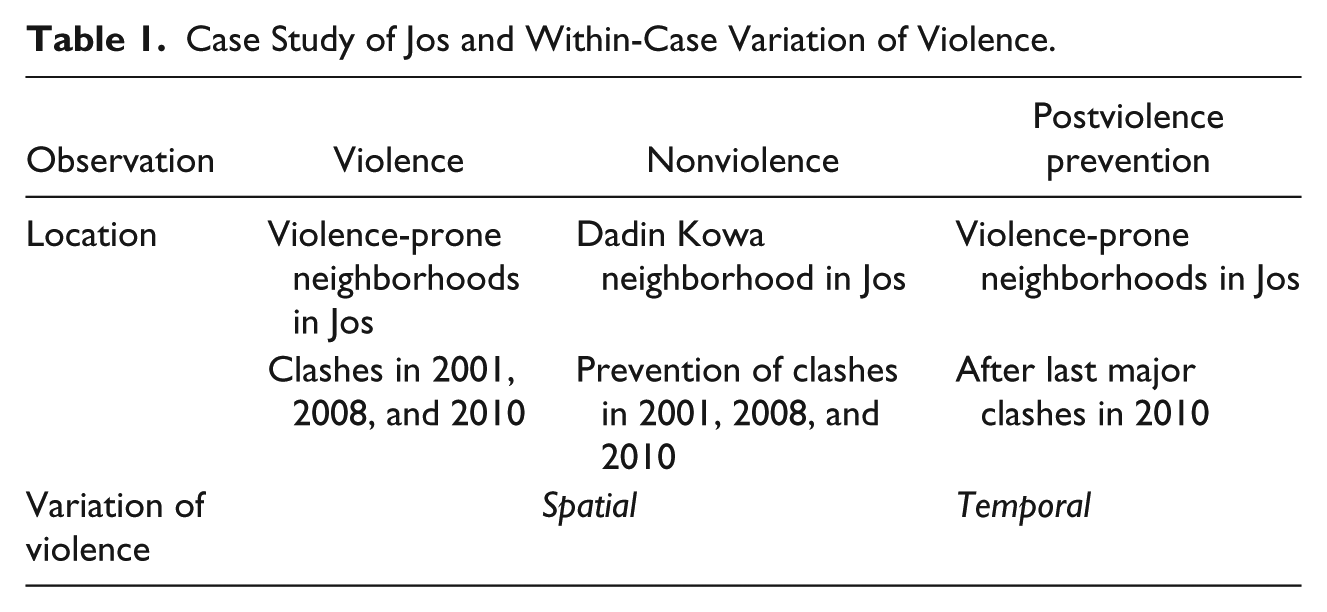
Research on the “gender equality and peace hypothesis” has found that states with high levels of gender equality are less likely to suffer armed conflict (Caprioli, 2005; Melander, 2005) and more likely to build peace after war (Gizelis, 2009; Tripp, 2015). However, mechanisms to explain this state-level correlation and implications for substate conflict dynamics deserve further investigation. I do not measure gender equality but contribute to the debate by investigating the gender dimensions of local variation in violence and peacebuilding. My analysis proceeds from the observation of variation in the spread of violence in Jos (Higazi, 2011; Krause, 2011, 2018; Madueke, 2018). By analyzing the gender dimensions of (non)violence and postviolence prevention in the context of large-scale communal conflict, this article contributes to the broader literature on political violence and gender in peacebuilding. It further addresses peacebuilding after communal conflict, a context that has hitherto been neglected in the literature (Table 1).
Case Study of Jos and Within-Case Variation of Violence.
This analysis is based on 5 months of field research in Jos in the years 2010, 2011, 2012, and 2015. I draw on 125 in-depth interviews, many of them with individuals I repeatedly met, limited immersion, and ethnographic sensibility (Schatz, 2009). Interviews were conducted with residents and community leaders of the most violent and the nonviolent neighborhood, as well as journalists, nongovernmental organization (NGO) staff, religious leaders, politicians, security officials, senior- and youth leaders of ethnic and religious organizations, and former perpetrators. To protect the identities of respondents from a volatile conflict zone, I refer only to ethnic and religious identity and social position to clarify respondents’ particular knowledge and experience (see Online Appendix I for further details).
I first review the literature on gender equality and peace, and gender relations, masculinities, and social change. I discuss links between everyday gender relations and mobilization for violence in the context of communal conflict, which is distinct from civil war. After outlining my theoretical framework, which builds on notions of violent, nonviolent, and restrained violent masculinity, I provide a brief discussion of the Jos conflict. My analysis then focuses on the gender dimension of (non)violence. I discuss women’s and men’s roles as well as narratives of conflict and victimization as feminization and their impact on mobilization for (non)violence. Finally, I focus on postviolence prevention and its gender dimensions, particularly on the role of perpetrators turned “peacemakers” based on notions of restrained violent masculinity. In the conclusions, I reflect on the implications and limitations of this analysis.
Gender, (Non)Violence, and Peacebuilding
Scholars increasingly acknowledge that armed conflict and peacebuilding have distinct gender dimensions. Armed conflict transforms gender relations in multiple and dynamic ways, often leading to enduring legacies that can empower or marginalize women after conflict (Aoláin, Haynes, & Cahn, 2011; El-Bushra 2000; Wood, 2008). Women and men are mobilized differently into armed groups and in varying numbers (Goldstein, 2001; Viterna, 2013, 2006). Women’s peace activism often takes on distinct forms of collective mobilization around the notion of motherhood and “peaceful women” (Berry, 2018; Elshtain, 1995; Goldstein, 2001). While many scholars reject the essentialist feminist perspective (Cohen, 2013; El-Bushra, 2007; Sjoberg, 2016; Skjelsbaek, 2001), which assumes women to be more peaceful than men, in conflict settings, essentialist assumptions may allow women to use social practices not equally available to men. For example, women may conduct shuttle diplomacy and fulfill informal messenger roles that de-escalate communal relations even though male leaders may not officially communicate. A gender perspective offers a more nuanced understanding of gender relations in complex, iterative, and multilayered conflicts, with important implications for peacebuilding (El-Bushra, 2017).
Gender Equality and Peace
The “gender equality and peace” hypothesis suggests that everyday gender relations have a causal effect on conflict and peacebuilding. Research has shown that states with higher levels of gender equality are less likely to experience civil war (Caprioli, 2005; Hudson, Ballif-Spanvill, Caprioli, & Emmett, 2012; Hudson, Caprioli, Ballif-Spanvill, McDermott, & Emmett, 2009; Melander, 2005) and more likely to build peace after war if women enjoy higher social status (Gizelis, 2009; Tripp, 2015). Quantitative studies have drawn on ideas developed in feminist research on the importance of everyday socialization and nonviolent forms of conflict resolution in the family and the community (Boulding, 2000; Enloe, 2005) and on psychological and evolutionary research to theoretically substantiate the argument that the male/female hierarchy indicates a lack of societal toleration for differences, with important implications for interethnic relations (Hudson et al., 2009, p. 26). Both men and women who reject gender equality have been found to also hold more hostile attitudes toward minority groups (Bjarnegård & Melander, 2017). Although recent research disaggregates measurements for gender equality (Forsberg & Olsson, 2016; Karim & Hill, 2018), the lack of specification of local level gender dimensions of conflict and peacebuilding remains an important gap in this literature. Valerie Hudson and her coauthors proposed a direct link between everyday gender relations and armed conflict: “if gendered violence can be undermined at its taproot—domestic violence within the home—the effects, as we have shown with violent patriarchy, should cascade outward to affect many social phenomena, including state security and behavior” (Hudson et al., 2009, p. 26).
This article examines everyday gender relations and mobilization for (non)violence. Studies have examined nonviolence in the context of social movements (Chenoweth, Stephan, & Stephan, 2011) and in civil war (Arjona, 2016; Chenoweth & Cunningham, 2013; Kaplan, 2017) but the gender dimension of civilian agency and nonviolence has not been systematically analyzed.
Hegemonic Masculinity, Gender Relations, and Social Change
From a feminist standpoint, the key to sustainable peacebuilding lies in changing gender relations. Scholars who study gender relations and social change have found the concept of hegemonic masculinity useful (Duncanson, 2015; Enloe, 1983; Goldstein, 2001; Tickner, 2001). Masculinities can be understood as a configuration of practice(s) within a system of gender relations (Connell, 2005). Hegemonic masculinity is a cultural ideal in relation to which men negotiate their masculinity (Duncanson, 2015; Enloe, 1983; Higate, 2003). This ideal expresses the normative understanding of the most honored way of being a man (Connell & Messerschmidt, 2005). In much of sub-Saharan Africa, and many other parts of the world, “the main requirement to become ‘a man’ is to marry and provide for a family” (Howe & Uvin, 2009, p. 123). This is problematic in the context of high unemployment rates and a lack of opportunities because the normative ideal of masculinity remains unattainable for many men in poor areas. Young men in Jos repeatedly expressed anger and frustration over the reality of their lives after high school and even university graduation. For example, according to a youth leader, “there is so much frustration because parents pay for education but ten years later the boy still has no job, and he cannot settle down and put a wife at home.” 2
Theoretically, the concept of hegemonic masculinity is not inherently opposed to changing gender relations toward more equality. Profound change in gender relations is possible if hegemonic masculinity is dismantled to such an extent that masculinity not only incorporates feminine traits but also negotiates masculine identity based on notions of equality and empathy toward both women and men (Duncanson, 2015). Empirically, such changes in notions of masculinity beyond domination have been documented in case study research. Masculinities subordinate to an unattainable ideal can either express themselves as violent masculinities through dominance, coercion, and control, or as alternative nonviolent masculinities (Groes-Green, 2009; Jensen, 2008; Myrttinen, 2003). Violent—or militarized—masculinity refers to “the fusion of certain practices and images of maleness with the use of weapons, the exercise of violence, and the performance of an aggressive and frequently misogynist masculinity” (Theidon, 2009, p. 5). Nonviolent masculinity needs “alternative identities or some other sense of self (. . .) positively valued by the young man and by those in his social setting, particularly the male peer group but also before young women” (Barker, 2005, p. 146). Women can contribute to and uphold notions of hegemonic masculinity as dominant and hierarchical in relation to femininities (Talbot & Quayle, 2010). Therefore, both men and women need to reject violent masculinity and support nonviolent alternatives, “particularly when these men have so little access to civilian symbols of masculine prestige, such as education, legal income, or decent housing” (Theidon, 2009, p. 18).
Theoretical Framework and Method
Civil war research has demonstrated that everyday gendered networks shape mobilization and recruitment of combatants and enable and sustain rebel groups (Parkinson, 2013; Tétreault, 1994; Viterna, 2013, 2006). In civil wars, which are fought by rebel groups against the state, new male or female rebel recruits tend to abandon their homes and families (or are forced to do so) and are exposed to varying extents to combatant training, hazing, and socialization (Cohen, 2013; Enloe, 2000; Goldstein, 2001; Viterna, 2006; Wood, 2008). By contrast, those who fight in communal conflicts remain embedded within their local communities. They do not spend extensive periods of time living with a rebel group but remain husbands, brothers, and sons who kill in close proximity to their communities and return home after hours or days of fighting. While many among those who eventually kill in communal conflicts may have experienced significant social pressure to participate in fighting, they are neither forcibly recruited nor previously abducted and drilled to fight as some rebel group combatants are. In civil wars, rebel group ideologies and command structures shape notions of masculinity and femininity, and demand, encourage, tolerate, or prohibit specific acts of violence. By contrast, in communal conflicts, everyday gender relations and notions of masculinity and femininity may shape mobilization for fighting more directly because armed groups have less established structures. Apart from gang and militia leaders and ideological conflict narratives, unarmed civilians, that is, family and community members, encourage or discourage mobilization for fighting. Consequently, I expect to find a strong link between everyday gender relations and mobilization for or against communal violence.
The logic of my argument builds on previous research into civilian agency and nonviolence in civil war and genocide. By nonviolence, I mean the absence of conflict-related violence in localities vulnerable to clashes. 3 Recent scholarship has demonstrated that civilian agency can be causal for nonviolence. Under the condition that armed groups need to at least partially rely on civilians, communities can refuse collaboration and prevent killings (Arjona, 2016; Kaplan, 2017; Straus, 2012). My previous research has demonstrated that community leaders in the nonviolent neighborhood of Dadin Kowa prevented internal youth mobilization for killings and refused to collaborate with external Christian armed groups that wanted to attack the Muslim population of this area (Krause, 2017, 2018). This article builds on and extends these findings by demonstrating that civilian agency is gendered, and that communal violence, nonviolence, and peacebuilding have a distinct gender dimension.
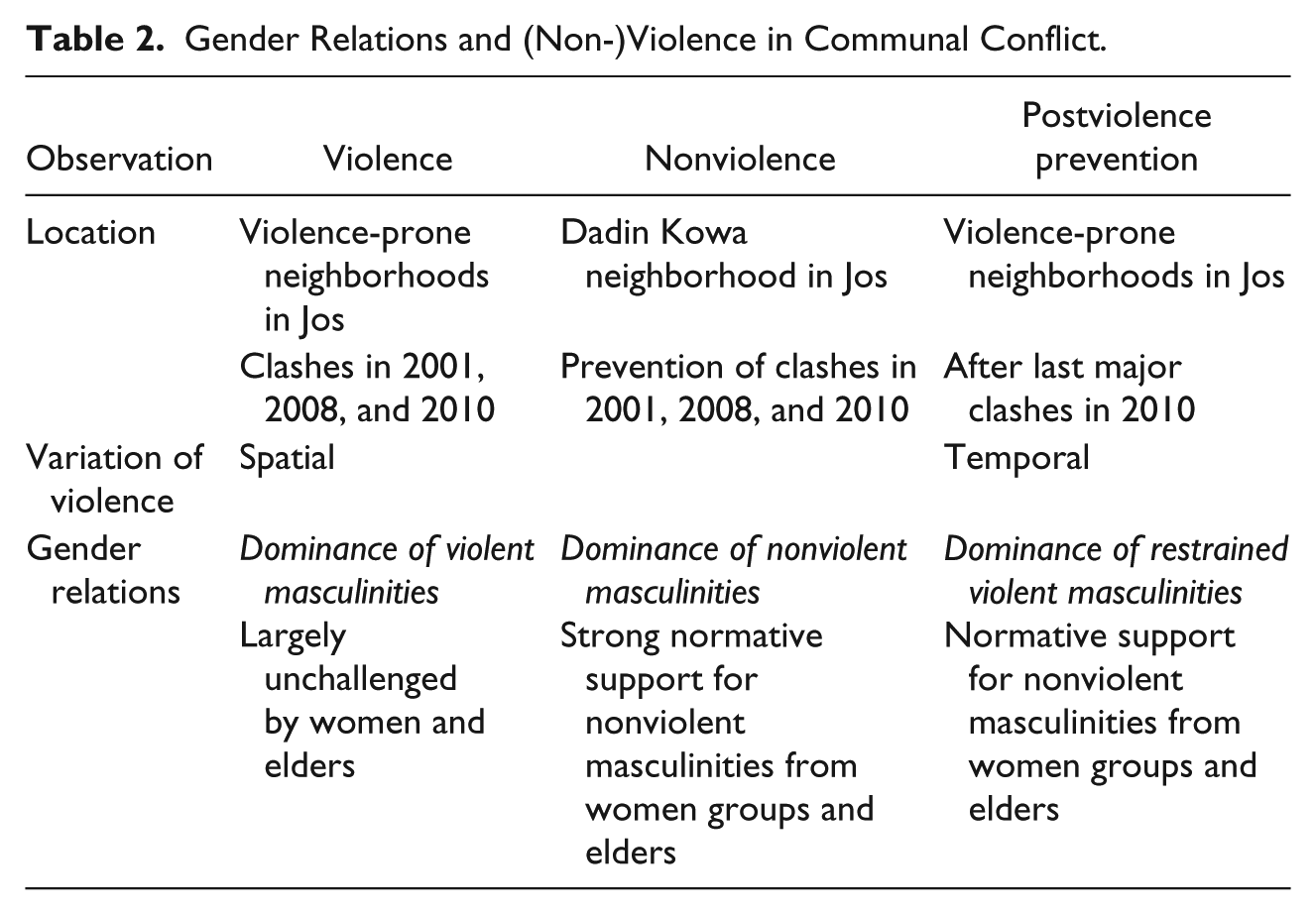
My theoretical framework builds on several concepts of masculinity that link to distinct gender relations and mobilization for/against killings. I first show that in the most violence-prone neighborhoods of Jos, significant numbers of men excluded from regular income activities used violent masculinity to access status and resources. Their mobilization provided the organizational capacity for mass killings in communal conflicts. Second, I draw on the concept of nonviolent masculinity and examine nonviolence in Dadin Kowa. I show how women’s groups and elders upheld norms of nonviolent masculinity, using practices of respect-building to support vulnerable young men and sometimes coercion to prevent killings. Third, I analyze postviolence prevention in the most violence-prone neighborhoods and demonstrate how former perpetrators developed what I term “restrained violent masculinity” while being part of a temporary citywide prevention network. Those perpetrators turned “peacemakers” used their reputations for extreme violence to advocate for an end to the killings and suppress further mobilization for fighting.
Table 2 summarizes my findings. The next three empirical sections provide evidence for the identified link between (non)violence and gender relations.
Gender Relations and (Non-)Violence in Communal Conflict.
Fieldwork
My analysis relies on extensive field research in Jos (see Online Appendix I) and on a careful reading of Nigerian newspapers, investigative reports, and secondary literature. Interviewees were selected from the most violence-prone neighborhoods in Jos (e.g., Angwan Rukuba, Angwan Rogo, Nassarawa Gwom, and Bukuru) and the nonviolent mixed neighborhood of Dadin Kowa. All violence-prone neighborhoods were mixed before the first major clashes in 2001; Nassarawa Gwom and Bukuru have remained mixed but internally segregated. I discussed neighborhood dynamics of conflict and prevention with male elders and youth leaders, religious leaders, and traditional leaders, as well as women leaders, market women, and women who were recognized within the neighborhood for their community activities. Furthermore, I interviewed senior leaders and youth leaders of ethnic and religious organizations, senior members of the local government and the military peacekeeping force, and a large number of journalists and NGO staff workers involved in grassroots peacebuilding. I also conducted group discussions with women in Dadin Kowa facilitated through a research assistant who lived in the neighborhood and worked for a local NGO that had previously supported these women in their peace activism. Finally, I interviewed former perpetrators who were active in a citywide prevention network to which I received access through a local government official and through NGO staff. These were selected according to residency to cover the most violence-prone neighborhoods: Angwan Rogo, Angwan Rukuba, Nassarawa Gwom, Kabong, Gangare, and the southern neighborhoods Tudun Wada, Hwolshe, Bukuru, and Gyel (for a city map see Figure 1).
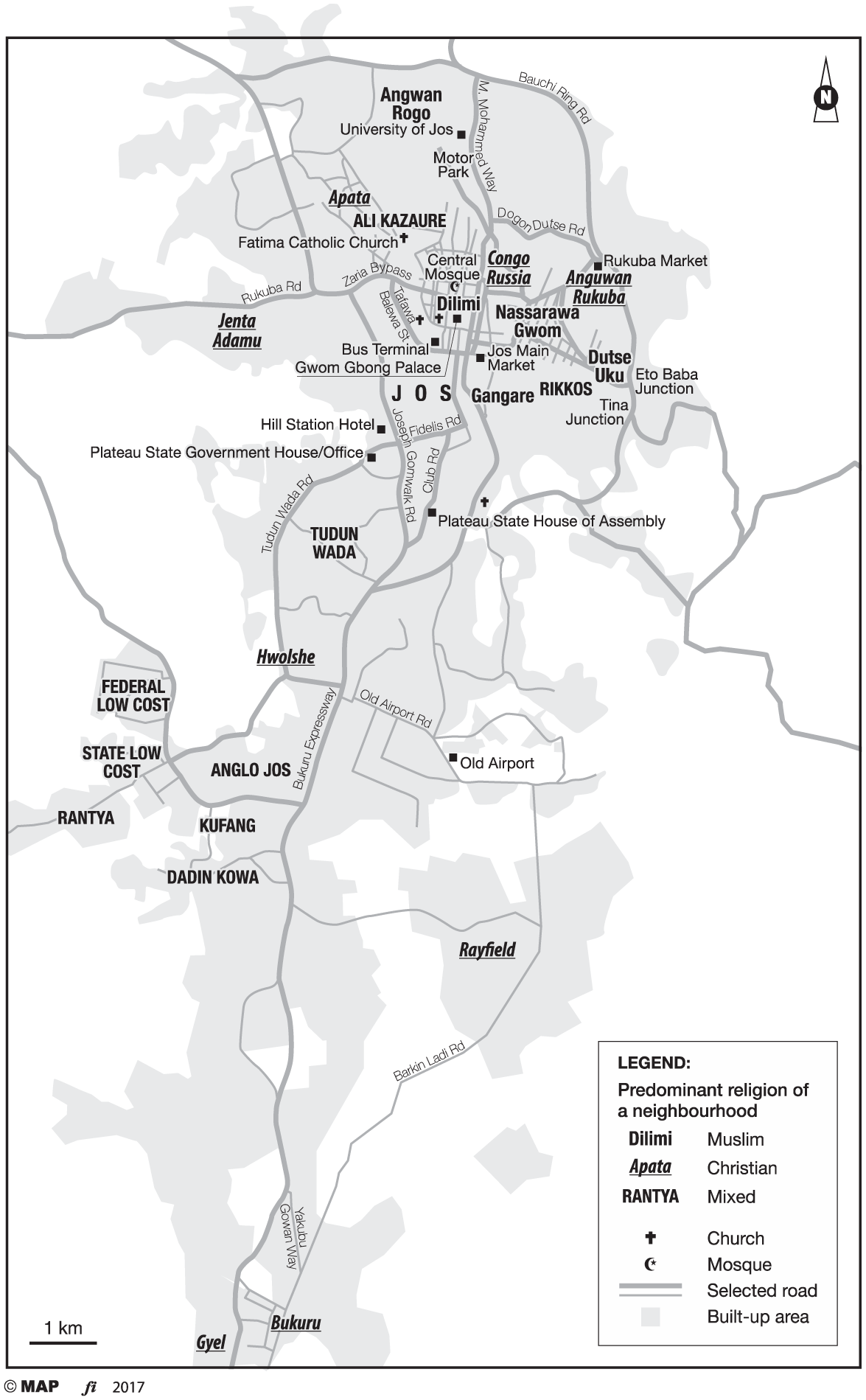
The City of Jos and religious segregation by neighborhood.
The Jos Conflict
The Jos conflict is rooted in local elite competition over who qualifies as “indigenous” and is therefore entitled to political appointments, positions in government offices, access to higher education, and land rights (Best, 2007; Danfulani & Fwatshak, 2002; Higazi, 2011; Krause, 2011; Kwaja, 2011; Madueke, 2018; Milligan, 2013; Ostien, 2009; Tertsakian & Smart, 2001; Vinson, 2017). Indigene rights link to core aspects of middle-class privileges and men’s ability to find stable employment and marry. Ethnic groups have been claiming “ownership” of Jos and indigenous rights for several decades (Plotnicov, 1972). Jos was founded in 1915 during a tin mining boom and attracted migrants from all parts of Nigeria. The local population of Berom, Anaguta, and Afizere farmed in the region, while large numbers of Hausa and Fulani migrated from northern Nigeria to work in the mines and constituted the most numerous groups within nascent Jos (Plotnicov, 1967). The Berom, Anaguta, and Afizere insist they are the rightful owners of the land, while the Hausa and Fulani argue that they founded Jos and nurtured it into a city (Best, 2008).
Ethnic and religious identities reinforce the local political cleavage between the predominantly Muslim Hausa and Fulani and the mostly Christian Berom, Anaguta, Afizere, and other ethnic groups. Tensions turned violent with the end of military rule. In the 1999 local government elections for Jos North local government area (LGA; the city center), the Hausa and Fulani won six of the 14 electoral wards, which was the highest number won by any one ethnic group (Danfulani & Fwatshak, 2002). However, a coalition of predominantly Christian ethnic groups elected a Christian chairman to the local government, and the Hausa and Fulani were denied indigene rights. They strongly protested the loss of their privileges.
In Jos and Plateau State, urban and rural dynamics of violence have interlinked (Figure 2). In 2001, the appointment of a Hausa man to political office by the federal government sparked major protests from mainly Christian ethnic groups in Jos, escalating into 5 days of mass violence that killed over 1,000. In 2002, long-standing tensions over land rights and political disputes turned violent in some rural areas. Overlapping urban and rural ethnic and religious networks were seen to have ignited tensions in small towns and villages when details of the atrocities in Jos reached the family and kin of the victims. 4 “Guerrilla warfare” between well-armed militias destroyed more than 100 villages and killed more than 1,200 people until a state of emergency in spring 2004 brought fighting to a halt (Higazi, 2008, p. 109). A heavy military presence, the suspension of the Plateau State civilian administration, and a disarmament program for the militias brought the situation under control, but the political conflict over indigene rights remained unaddressed. 5 In late 2008, a local government election in Jos reignited the conflict. Within only two days, more than 700 people were killed in what residents referred to as a “fight to the finish.” 6
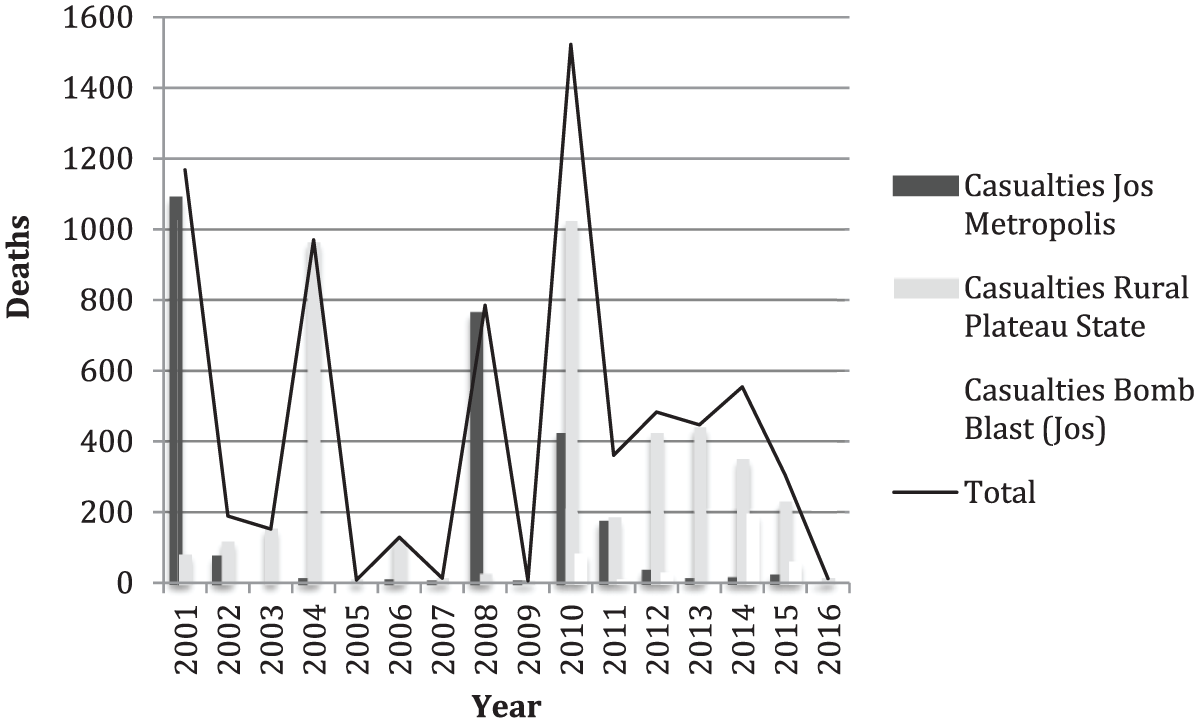
Urban and rural communal violence in Jos and Plateau State.
Further fighting in Jos in January 2010 did not follow the direct trigger of political appointments or local government elections. Instead, violence broke out over the rebuilding of a house destroyed during the 2008 violence in a contested border area in the center of Jos (Higazi, 2011). In 2011, violence killed an estimated 175 people in Jos. The 2010 urban clashes again triggered massive violence in rural areas between the predominantly Muslim Fulani cattle herders and the mostly Christian Berom farmers, including massacres of entire village populations, despite a local state of emergency and the presence of the STF. While a heavy military presence inhibited armed-group mobility within Jos by enforcing curfews and shoot-on-sight orders, controlling the movement of armed groups in rural areas proved more difficult (Higazi, 2016).
Once neighborhoods became ethnically cleansed, armed groups sought to continue fighting in other areas of Jos. They would coordinate attacks with youth leaders from the targeted area to minimize their risks of being killed in battle or shot by security forces on the way. Such coordination included the marking of neighbors’ houses to not only ensure correct targeting along the ethno-religious cleavage in mixed settlements but also provide information about the strategies of security forces and opposing armed groups. 7 Former perpetrators admitted that the heavy military presence meant that they faced great risks of being caught with a weapon and ending up in prison, or being shot if moving outside their neighborhood for attacks. The STF temporarily suppressed fighting but according to a senior officer, its mandate was not to restore “peace” but “law and order.” 8 A long and heavy military deployment was neither financially feasible nor desirable because civilians increasingly suffered abuse and sexual harassment from soldiers. With the escalation of the Boko Haram insurgency, the number of soldiers in Jos was greatly reduced. In late 2013, the Center for Humanitarian Dialogue based in Geneva commenced mediation and facilitated peace talks among all major ethnic groups. However, no political agreement or power-sharing arrangement was secured. In 2015, a report on preventing election-related violence during the presidential and state government elections described the situation in Jos and Plateau State as continually volatile (Afolabi & Avasiloae, 2015).
Gender Dimensions of Violence in Communal Conflict
When communal conflicts become so intense that their death toll surpasses the civil war threshold, at times within only days, then killings are not only carried out by thugs mobilized by elites but also rely on widespread civilian mobilization for violence (Krause, 2018). Such mobilization builds on the existence of what I term everyday violence networks. These networks include vigilante groups that use violent means for community protection, gangs involved in crime, and thugs hiring out their muscle power. They are “specialists in violence” (Tilly, 2003) and their mobilization for political purposes is a regular feature of many democratizing states (Staniland, 2014), as riot researchers have long noted (Berenschot, 2011; Brass, 2003; Wilkinson, 2009). Neighborhoods in Jos that suffered from poor policing have had particularly violent vigilantes who executed “jungle justice” against thieves and individuals allegedly disturbing local order. They would regulate social relations through violence with very limited police involvement. 9
Nigeria generally witnessed a proliferation of vigilantism with the return to civilian rule in 1999 (Agbu, 2004; Pratten, 2008). Most urban neighborhoods would host groups of adolescents performing social and public services such as protecting against thieves. Vigilantes spearheaded political contests between the politics of identity and citizenship and became synonymous with Nigeria’s fractured and violence-ridden image (Ya’u, 2000). In Jos, many violence-prone neighborhoods include major slum settlements behind main market streets, with narrow pathways accessible only by foot. Police stations are too small and too scattered to attend to the social problems associated with these often drug-ridden areas and the number of youth at risk. Vigilante groups were not initially formed to fight communal clashes but to protect against crime. However, since the 1980s, when vigilante groups became prominent in Jos, they have also been terrorizing the community, collecting “taxes” and using extreme forms of violent interrogation and punishment against suspects (Lar, 2015). Hence, everyday violence networks of varying configurations of thugs, vigilantes, and gangs embed violence in people’s daily lives.
The main ethnic groups in Jos, the Berom and the Jasawa (“Hausa of Jos”), have maintained strong and well-organized associations, respectively, the Berom Educational and Cultural Organization (BECO) and the Jasawa Development Association (JDA). Because they provide leadership, social services, economic networks, and political organization, both have strong links to religious institutions in Jos and penetrate neighborhoods deeply. When politicians well linked to such associations aim to incite clashes, these youth groups are mobilized for an ethno-political agenda. Everyday violence networks form the organizational backbone of large-scale political violence. When they align with ethnic and religious organizations and their youth networks, the organizational structure for mass killings emerges.
Violent Masculinity and Everyday Violence Networks
Everyday violence networks are built on the poverty and vulnerability of poor young men, who use violent masculinity and the strategic public display of violence when alternative pathways to income, power, and respect seem unavailable (Bourgois, 1995; Wilson, 2010). The leader of the “area boys” is the man who is most “stubborn” and feared by residents and community leaders. Women from violence-prone neighborhoods confirmed that their elders feared dealing with these men who maintained a reputation for irrational violent outbursts. One male neighborhood leader explained, Nobody appoints him. If you have the power and the influence, you can appoint yourself as a leader in the community because you are a terror, you are a hard man, you don’t fear anybody. People will tolerate anything you do because of fear.
10
Violence networks control and exploit territories such as the neighborhood, the market, or local transportation networks. Securing and advancing turf, status, and income is achieved by developing a reputation for masculine strength displayed through the use of violence and by earning and maintaining a reputation for getting things done (Berenschot, 2011; Wilson, 2010). Violent masculinity and notions of masculinity as virility and honor are constitutive for such networks. Whether as vigilantes who police the neighborhood or as small-scale criminals and thugs, the (potential) display of violent masculine strength is a means of making a living from the margins of society. Policing the neighborhood conveys a sense of authority and respect. In contrast to poor men who earn their living through nonviolent menial work, such as in agriculture or petty trade, a career within violence networks can offer higher income and respect within the community. Rank-and-file vigilantes tend to be single young men from poor urban backgrounds, angered and frustrated over the lack of economic opportunities (Smith, 2007, p. 169).
Women may contribute to upholding norms of violent masculinity (Goldstein, 2001; Theidon, 2009). In my interviews in violence-prone neighborhoods, some women characterized the experience of victimization of their ethnic or religious community as feminization. For example, some Christian women recounted that they felt belittled because Christians had sold land to Hausa Muslims in the past, allowing the Hausa to then settle in and around Jos. They described such Christian leaders as “lenient,” in stark contrast to the virile young men who opposed further Muslim domination. Within churches, some youth argued that Christians needed to be “more militant,” and that “turning the other cheek was for fools,” 11 while female religious leaders who insisted on nonviolence were ignored or intimidated. In these areas, norms of violent masculinity were tolerated or even upheld while networks of violent men exploited communities.
Gender Relations and Civilian Mobilization for Violence
When clashes break out, state security forces provide limited to no protection against killings, and poor people will be particularly vulnerable to attack (Scacco, 2018). Many ordinary people turn to vigilantes and gangs for protection. Seeking community protection, religious leaders often explicitly align with those men who command respect by maintaining a reputation for violence. 12 Gangs and vigilantes mobilized for protection may further entrench themselves within the neighborhood and consolidate social control. As noted previously, the dynamics of communal violence in Jos involved some gangs and vigilante groups not only in protecting their own area, but also actively organizing attacks against other areas, thus feeding the escalation spiral. Poor people may be more willing to riot to defend their property, families, and themselves, and may recruit men to join into fighting through their neighborhood-based social networks (Scacco, 2018).
Women play a pivotal role in community mobilization for violence. They often have a good awareness of organizational preparations for fighting. Civil war research has demonstrated that women, even if their combatant numbers are small, provide crucial support to the logistics (Parkinson, 2013). Around Jos, women’s logistical work enabled some of the deadliest massacres because women organized the cooking for hundreds of men when they assembled from different villages for coordinated attacks (Dinshak, 2008; Human Rights Watch, 2013). Women also supported the fighters by taking in men who had fought when they needed to hide from security forces. Some women and girls “were helping the men with bullets, with stones, with machetes.”
13
Female perpetrators were already noted in the 2001 clashes (Ettang & Okem, 2016; Higazi, 2008). A woman community leader admitted that the participation of women in fighting was often downplayed while the notion of women as victims and peaceful mothers prevailed (see Note 13). According to a male former perpetrator, women sometimes engineered fighting driven as much by fear and desire for self-protection, revenge-seeking, and greed as the men who went out to attack: Some of the women really have no influence on their husbands but they can still have influence on their sons. If I have a wife and I say, “They have started, I’m going to kill them,” then what? I don’t want her advice; my mind is made up. But still, when it comes to conflict, women are very strong. They can really change the way men think. Some women support the fighting because they benefit from it. They may get some goods or clothing from looting, or their sons come back with money.
14
According to female residents, the culture of impunity in Jos, and the fact that women who lost husbands and sons would see perpetrators walk around freely, exacerbated a sense of trauma, helplessness, and rage (Ettang & Okem, 2016, p. 7357). A former male perpetrator explained that women tended to be as enraged by a sense of victimization of their ethno-religious group as men, and would therefore engineer further fighting to restore pride in their community: Women are always around in the community and talk to each other. When they hear rumors of killing and burning, they are outraged: “Let my husband come back home and I will tell him that they burned the church, or that they burned the mosque. I cannot take that. Let my husband come home and do something.” So, women sometimes engineer fighting. They forget that they may lose their husbands or their sons. (see Note 14)
He further emphasized the importance of community support for violence, without which no one would go out to kill: The thing is, I cannot go and fight if I have no community support. If I leave my house to fight but I have no support, I will think again about it. But if people say yes, go and fight, then automatically you go ahead. (see Note 14)
While women may encourage and participate in fighting, the prevalence of violent masculinity prior to fighting also leaves limited space for female leadership and alternative masculinities. Women activists who worked with local women in violence-prone communities lamented that they did not engage with community leaders for prevention efforts, and that no strong women groups for peace work had been established. In a conversation between a female and a male community leader in a violence-affected area, the male leader explained that, apart from his female colleague, very few women felt responsible for speaking out against violence, let alone had the confidence to do so publically. 15 Thus, women may not actively oppose the mobilization of their men for fighting because they may not know how to organize resistance collectively, may be too intimidated to publicly speak out, may not feel responsible for violence prevention, or may actively encourage fighting.
In sum, large-scale communal violence is rooted in everyday violence networks that exist in various configurations of thugs, gangs, and vigilantes. These networks precede communal clashes and are formed by men who use violent masculinity to access respect, resources, and status. Many women and men in violence-prone neighborhoods tolerate these men for fear as much as for the practical need of protection in the context of poor policing. During clashes, these networks are aligned with ethnic and religious organizations and their youth groups, resulting in large numbers of violence specialists and ordinary men turning into “combatants.” When norms of violent masculinity prevail, limited space remains for nonviolent masculinities and female leadership for peace. Moreover, women also tend to be strongly affected by fear, anger, and trauma. They may seek protection as much as revenge and profit by engineering fighting. Community leaders and former fighters agreed that it was crucial to not only address the problem of “young and idle men” who can be mobilized to fight but also to understand these men’s choices in the context of the community and the norms women upheld. One former perpetrator argued that “violence prevention efforts need to start with the women,” 16 because it would be vital that women ceased shaming men into further fighting and instead actively supported peace.
Gender Dimensions of Nonviolence in Communal Conflict
This section examines the gender dimensions of nonviolence and focuses on the Dadin Kowa neighborhood, the city’s largest ethnically and religiously mixed area that prevented killings. Dadin Kowa had an almost equal number of Christian and Muslim residents and was threatened by armed groups from neighboring areas. The socioeconomic characteristics of this neighborhood and its layout resembled many other violence-affected areas of Jos. It included middle-class compounds and sizable poor areas with high housing density and limited street infrastructure. According to both Christian and Muslim youth leaders, tensions were high and youth unemployment was a serious problem. Unemployed men would congregate at street junctions and residents worried that these men could be mobilized to start killings. Community leaders explained that they had “learned to deal with the idleness of some youth because they have nothing to do and use drugs.” 17
However, in contrast to the most violence-prone neighborhoods, no strong gangs and violent vigilante groups operated in Dadin Kowa. After the first Jos clashes in 2001, community leaders did not allow vigilante groups to police harshly or control the neighborhood. This greatly helped keep at-risk youth under control. Thus, community leaders did not need to first dismantle violence networks to prevent clashes.
Leaders established social control over the youth and refused to collaborate with external armed groups. Strong Christian armed groups that in 2010 had carried out killings nearby, in Anglo Jos and in Bukuru (see Figure 1), surrounded Dadin Kowa. According to my interviews, these groups repeatedly tried to attack Dadin Kowa but lacked support from Christian residents to do so. In January 2010, a Christian armed group from Gyel attacked Anglo Jos, apparently because it had no support to go into Dadin Kowa, which is located closer to Gyel. 18 External armed groups required support from within Dadin Kowa for information about settlement patterns, the strength of Muslim groups, and the strategies of security forces (Krause, 2018). They also needed protection when returning to their own areas with looted goods while the military deployed on the streets to stop fighting. Consequently, by maintaining internal social control and not supporting external armed groups, community leaders prevented fighting in Dadin Kowa.
Nonviolent Masculinity and Respect-Building
Community leaders persuaded the youth not to fight and used respect-building
19
to prevent vulnerable men from responding to provocations. Women and men upheld alternative nonviolent masculinities for low-status young men as desirable notions of masculinity. Elders and leaders publicly praised and supported those men who promoted nonviolence for community protection and kept at-risk youth under control.
20
Given the absence of gangs and thugs, being a respected man was not linked to a reputation for violence. When prevention work started, being a respected man and becoming a community protector was associated with choosing nonviolence and following the leadership rather than mobilizing to fight and take revenge. Respect-building supported vulnerable young men in exercising self-control and allowed community leaders to consolidate their authority over those who could terrorize the neighborhood. The elders’ prevention work also included active engagement in resolving everyday social conflicts without relying on the police or a violent vigilante group. One senior community leader reflected, What we do is limited because we use persuasion to call them [the youth at risk] to order. But I wonder how much persuasion you can use on an alcoholic. Be that as it may, persuasion is what we are using. Take, for instance, somebody who is drunk and needs money to drink, so he steals. When we catch him and say, “Why did you steal?” He said he was hungry. So, you give him food first to come to his senses. Then you can talk and say, “Look, this attitude is not good.” You see him respecting you. It does not deliver him from alcoholism, but at least if he sees you, he tells you he respects you. Hoping that when there is a problem and there are more people, perpetrators of this problem, if you come around, they will say, “Oh, we’ll respect this person.”
21
This practice of engaging vulnerable men and taking responsibility for social problems stands in stark contrast with the reality in violence-prone neighborhoods, where someone caught stealing would be handed over to a vigilante group for violent punishment. As a vigilante leader from a violence-prone neighborhood summarized, “If you mess up, we bring you out of the area and flog you before the eyes of the world.” 22 Upholding respect for nonviolent masculinity extended to everyday community engagement and the management of conflicts without vigilante violence. When community leaders addressed social problems in the neighborhood, they established authority and control over youth who were vulnerable to incitement for fighting and repeatedly persuaded them not to go out and kill.
Women’s Violence Prevention Work
Neighborhood women contributed to prevention efforts. They maintained communication networks among community and youth leaders and persuaded the youth not to fight, appealing to them as being “strong men who could resist provocation.” For example, market women played a key role in maintaining close communication and rumor-control across the religious divide. Their activism initially started over concerns about losing customers and livelihoods when market patrons increasingly started shopping exclusively with vendors of their own religion. In Jos, markets are important social spaces of interethnic and interreligious collaboration; if ties break down, the loss of income can be devastating for entire communities (Bonkat, 2014). Some market women established women’s groups and met regularly to maintain a common sense of identity and empathy across the religious divide. Their efforts maintained an inclusive identity as “people of Dadin Kowa.”
This maintenance of a common identity countered narratives of victimized religious groups as disrespected, mocked, or feminized—discourses that prevailed in violence-prone neighborhoods. The women neither upheld violent masculinity as a desirable form of masculinity nor interpreted the killings of family and friends in other neighborhoods as a form of social group shaming. Instead, they took responsibility for security by reporting men who did not comply with prevention efforts to elders and youth leaders. Through organized women groups, they lobbied male leaders for credible prevention efforts when they sensed that meetings were not happening often enough or that tensions remained unaddressed.
Individual women also served as messengers between community leaders unwilling to meet each other officially and display unity across the religious divide. Such work was crucial in the most vulnerable part of the neighborhood. In this relatively poor area with a sizable Berom Christian population, the Christian youth leader conceded that he was under pressure from Berom youth not to visibly collaborate with Muslim leaders. As a result, he did not acknowledge the existence of the area’s Muslim youth leader with whom he was meant to meet regularly. This Christian youth leader acknowledged that despite the lack of official meetings, communication did take place because market women stepped in and provided information that quelled rumors and maintained trust in the sincerity of prevention.
23
In his uneasy position, he continued trying to maintain control over men who wanted to fight: You might have a relative in town who lost his life due to the crisis and your grievances begin to build. So, when it keeps building, our leaders, they try to calm the youth. And it has gotten to a stage that the youth don’t listen anymore because they feel the elders are not leading them properly. Every time they tamper with you, you’ve been slapped, you complain, the traditional leader tries to calm you down, and then tomorrow you’ve been slapped again; they begin to withdraw from the traditional leaders. For me, I’ve been trying to protect the trust because once you try to calm them down, and they don’t see a positive result coming, the violence keeps escalating. They begin to stop trusting you. (see Note 23)
This youth leader, who was under too much pressure from fellow Christian youth to publicly meet with the Muslim youth leaders, again referred to strong tensions among the men of the neighborhood, their sense of being shamed and provoked (“you have been slapped”; “you have been slapped again”), and the difficulties of community leaders to “calm” the youth and to persuade them to stick to peace.
Supporting Nonviolent Masculinity
Not having acted violently on their anger and resentment over the killings of family and friends in other parts of Jos, and not having “proven” themselves as “men” through fighting, contributed to tensions in Dadin Kowa. Men regularly met with youth from violence-prone neighborhoods and were mocked for never having fought. One woman from Dadin Kowa stated, People laugh at the men from Dadin Kowa. Because they have never fought, they say, “They are women,” they are this, they are that; trying to mock them. The youth always feel that they should fight.
24
After the 2010 Jos clashes, when the city and the Dadin Kowa neighborhood remained tense, elders and community leaders found unlikely allies for their prevention work among youth and gang members from violence-prone neighborhoods who had attended peace programs and stopped fighting. NGOs that organized peace networks invited both youth from Dadin Kowa and men from violence-prone areas to facilitate dialogue. Although the Dadin Kowa men took part as those who had successfully kept peace, the exchange also supported them by increasing their awareness of the consequences of fighting, of which they had no direct experience. One former fighter who lived in a violence-prone area close to Dadin Kowa explained, Some of us encouraged the men from Dadin Kowa in their efforts. We told them, “Look, you better stay like this than also have a crisis. It’s better to stay like this and maintain trust, and be very careful about it. No matter how bad the tensions and the accusations, you better stay like this [rather] than start killing each other.” It is important that we share our experience with the men of Dadin Kowa and educate them so that they don’t give in and lose the peace. We encourage them and we advise them.
25
To conclude, Dadin Kowa included many unemployed young men at risk of mobilizing for violence but did not have consolidated gangs or vigilante groups. Community leaders and women groups upheld norms of nonviolent masculinity. Publicly violent men could not control the neighborhood and were given little space to mobilize for killings in the name of community protection and ethnic group dominance. Norms of nonviolent masculinity were promoted through respect-building aimed at youth for whom common attributes of respect and social status remained out of reach. Women actively contributed to violence prevention by taking over responsibility for community security, maintaining a discourse of “people of Dadin Kowa” rather than a victimized ethno-religious community, and engaged men for prevention. Some of the men who were mocked for refraining from killings sought respect in their role as nonviolent community protectors while residents collectively monitored those who wanted to fight.
Gender Dimensions of Postviolence Prevention in Communal Conflict
This section analyzes the gender dimension of postviolence prevention. After the 2010 Jos clashes, the Nigerian military deployed the STF in numbers that inhibited the movement of armed civilians for attacks but no disarmament of communities took place. Despite mediation, the root causes of the conflict remained unresolved. Local government elections have not taken place in Jos North LGA, the most contested LGA at the heart of the Jos conflict, since postelection violence in 2008 for fear of renewed clashes.
Since 2010, numerous NGO-led peace programs have taken place. Many brought together men and women from violence-affected areas in workshops where participants listened to one another’s stories of suffering. Peacebuilding programs addressed the youth and former perpetrators, and women from the most violence-prone communities. One initiative, coordinated through the National Council of Women’s Societies, organized meetings of Muslim and Christian women and facilitated dialogue for conflict resolution of everyday issues. According to the coordinator, these meetings helped women to hold each other accountable. Women were taught to reject looted goods that their husbands brought home from fighting and to feel responsible for engaging their husbands and sons to stop organizing further attacks. The coordinator stated, “we encourage the women not to turn a blind eye on this, to monitor their sons and husbands, and to talk them out of violence.” 26
Jos residents, and in particular men who had previously fought, gave much credit to NGO programs for preventing renewed fighting. One Muslim participant from the city center explained, We depend on the NGOs for peacebuilding work. We came to know each other. We learned that we are facing the same problems: The government is not doing anything in the Christian area, it is as poor as our area. We came together and we know that this time around there is not any government official or any politician that can come and divide us for him to achieve his special interest.
27
In 2015, political mobilization for the gubernatorial elections operated once again along strongly polarized ethno-religious lines (Afolabi & Avasiloae, 2015). According to respondents who had attended peace programs, one important result was building resistance against further incitement of violence, drawing on the example of leaders in Dadin Kowa.
28
One Muslim youth leader from Nassarawa Gwom, a large violence-prone central area, explained, I was lucky to be able to build a house for my family, but in 2008 my house was burned down and we lost all our property. In 2010, I narrowly escaped death in my car. I thought that if we continue to take revenge, we will all be finished eventually. Then an NGO came with a peace project. They recruited youth from my neighborhood and I joined. I thought it would be good for me to go there, to receive some counseling after all the pain I went through. They took us out to a hotel for seven days, both Muslims and Christians. I identified some of the perpetrators who burned houses in my community. The first day, I was just looking at them. But soon, I felt at home with them. I listened to their story and came to understand them. Gradually, our communities changed. Ninety per cent of the peace that we are having comes from the work of the NGOs. But the youth are still unemployed, still on drugs.
29
Senior military and government advisors shared this understanding of effective grassroots peacebuilding. They conceded that military forces could only suppress large-scale fighting. Engaging communities to stop further mobilization required different approaches, but community disarmament programs were not considered because people feared that peace would only be temporary. 30 Without the engagement of perpetrators, violence networks would remain intact and available for renewed clashes.
Perpetrators into “Peacemakers”
The engagement of gang and vigilante leaders and their transformation into “peacemakers” was key for preventing renewed clashes.
31
A network of former fighters that called itself the Flashpoint Youth came into being through the initiative of a senior government advisor and former businessman, whom I call Anthony, who understood the limitations of military peacekeeping in Jos: The modus operandi of the government is heavy security deployment to suppress the violence. The government would call this situation peace, but there was no peace. I decided for a practical approach, and what is returning slowly is a positive peace because the people on their own are the ones that are responding. They are not compelled by security forces. We try to enlighten people, to overcome the sense of fighting for one’s religion. People should not be used as instruments for some people who make money.
32
Anthony further recounted how he identified former perpetrators by contacting community and religious leaders: At the end of 2011, I identified one active fighter from the Muslim side, and one Reverend from the Christian side, and asked them to gather youth leaders from the violence-prone communities and put names and telephone numbers together. I held meetings with these youth leaders and told them that they were being used as foot soldiers, that some people are making money out of this, and that violence as a method has to come to an end. Out of that group emerged a group that named itself Flashpoint Youth for Peace, and they help us prevent further crisis in Jos.
Q: Why do you think these youth will prevent further fighting?
Because they are the middlemen. The older ones with their contacts make money when they plan attacks, and the crisis continues because they ignite the younger ones. The younger ones will go and the town is on fire. (see Note 32)
Restrained Violent Masculinity and Postviolence Prevention
Within the Flashpoint Youth initiative, former fighters established truces. Before this citywide network came into being, other gang leaders had already established a truce within the contested border area between the neighboring settlements of Congo-Russia (Christian) and Bulbula (Muslim) that proved successful when fighting broke out again in 2010 nearby. When I interviewed two gang leaders from Congo-Russia and Bulbula in 2011, they walked me through the area, where much of the destruction remained visible, explaining that people could not bear further fighting. An NGO staff member told me that both were greeted with much respect on the street, having an occasional “hey boss” directed at them. Violent masculinity is also a “technique du corps,” a way of carrying one’s body and posture that remains visible long after fighting has taken place (Theidon, 2009, p. 5). The two of them visibly embodied a past history of fighting; they displayed restrained violent masculinity.
Flashpoint Youth members established trust and collaboration across the religious divide but perceived themselves as semi-independent from the local government and local politicians. One of them, I will call him Mark, explained his version of how the Flashpoint Youth for Peace network emerged: The flashpoints of Jos are the no-go areas. Our network came into being when we, the young men, decided among ourselves to achieve peace. We went to all corners of Jos to preach peace and to sensitize people for peace because we are the people who have been worst affected.
Q: How did you know whom to talk to from other neighborhoods?
We know each other, we know who we are, and that’s why peace has been achieved, not because the government decided for peace. If we hear that you are a hard man in your community, we come to you, because we heard of your reputation, and you have heard of my reputation. Only a ninja knows a ninja, so we were able to decide to stop this.
33
Mark referred to reputations for violent masculinity to identify those he had engaged to establish a prevention network. When asked why he and others remained confident that they were able to prevent further fighting in Jos, he stated, Either they join us or we make them uncomfortable in town. We know where to fish you. There is some support for peace in the current government, so we can report you. We don’t get much from [the] government and financially we are very handicapped. Peace is not achieved easily. But thanks to our efforts, there will be no more crises in Jos, because we know each other.
Q: And politicians are in support of peace?
Some people are still instigating other people, but we don’t really know what happens, and we don’t care. (see Note 33)
Young men who take part in clashes are often referred to as foot soldiers, an expression that hints at political actors behind the incitement of violence and emphasizes the vulnerability of those who fight. When being reframed as used and abused foot soldiers for the purposes of out-of-reach elites and shadowy big men (whom no one had identified by name), fighters lost a sense of agency, purpose, and choice in exercising violence. Mark’s narrative demonstrates acceptance of this reinterpretation of fighters as victims: “We are the suffering class, we go out and fight while all these big men are drinking and dining together, but we at the grassroots have no such opportunities (see Note 33).”
The Flashpoint Youth remained an all-male network. “Choosing peace” and publicly reinventing themselves as “peacemakers” was presented as voluntary and provided these men with impunity while maintaining respect and social status in the community. When they realigned themselves with elders and religious leaders who supported peace, violence networks were reconfigured for prevention. The intervention of a senior government advisor and support for the prevention network provided some former fighters with opportunities to redefine their position and leave violence networks with impunity.
The “peacemakers” acted upon a sense of restrained violent masculinity, having previously established their status and reputation through violence, and using the threat of renewed violence to control those who wanted to continue fighting. Restrained violent masculinity allowed for maintaining status and respect as a community protector, while representing an alternative to violent masculinity. Those who subscribed to restrained violent masculinity, though, endured mockery for not continuing to fight, and took on menial work as full-time employment and middle-class salaries often remained unavailable. Some of these men received small funds and opened little stores, while others received automatic tricycles from the local government to make a living. However, according to the youth, many did not receive any financial benefits.
This youth network regularly met with security officials to discuss rumors and provide information that supported prevention of mobilization and better policing of the most violence-prone neighborhoods. When I was in Jos during Ramadan in July 2015, Boko Haram targeted many Nigerian cities with bombings, and twin bombings took place in Jos. Subsequently, a church was burned and looted, which could have triggered renewed clashes. Several Flashpoint Youth members stated that they attended briefings with security forces through the network that Anthony, the former government official, had initiated, to verify information and judge the security situation. 34
In sum, NGO peacebuilding efforts were widely credited for contributing to postviolence prevention in the shadow of a temporary military peacekeeping force and the absence of a political settlement. Furthermore, a citywide network of former fighters established a fragile peace in Jos based on their previous reputation for extreme violence and their ability to control other men. Although Anthony understood this development as a “positive peace,” former perpetrators rather spoke of a momentary end to fighting without any guarantees. According to one member of the network, theirs was “a peace agreement for the moment,” a truce based on trust among those who knew each other. However, he added, “we don’t know if in the future others may emerge behind those whom we trust, people whom we don’t know, we cannot tell.” 35
Conclusion
This article has analyzed the gender dimensions of communal violence, nonviolence, and postviolence prevention. A gender perspective on civilian agency and (non)violence first demonstrates that violent masculinity is a prerequisite for everyday violence networks that often entrench themselves in poor neighborhoods and remain available for mobilization in large-scale clashes. Vigilantes predated the conflict and embedded often extreme violent punishments and exploitation in people’s daily lives. When such networks of thugs, gangs, and vigilantes align with ordinary youth mobilized through ethnic and religious groups, the organizational capacity for mass killings emerges. Furthermore, women in violence-prone neighborhoods may contribute to tolerating or even upholding norms of violent masculinity by encouraging or shaming men into (renewed) fighting. Second, within the nonviolent community, such violence networks did not establish social control. Community leaders addressed social conflicts and left no space for violent vigilante groups. Leaders and women groups supported norms of nonviolent masculinity and built respect for vulnerable men, framing violence prevention, rather than preparations for attack or revenge, as the respected male role of community protector. They appealed to men’s moral strength and self-control to withstand fear and provocation. Women groups embraced responsibility for prevention and supported male elders in peace efforts. Even though it was widely known that women also participated in killings during the Jos clashes, in the nonviolent community, they were able to use common perceptions of being “non-threatening” to serve as messengers across the ethno-religious divide and uphold communication between male youth leaders who were under pressure from their peers to not officially meet for conflict prevention. Outside their neighborhood, men from the nonviolent community were mocked as “women” for not having fought.
Third, postviolence prevention efforts in Jos also included a distinct gender dimension. Female peace activists encouraged and trained women to speak out against further clashes. A crucial prevention initiative relied on a network of former perpetrators from the worst-affected areas who collaborated with individual government officials and members of the security forces. Violent masculinity became restrained violent masculinity when members of the network built on their well-established reputation for violence to identify each other, agree on a truce, and deter youth in their area from renewed fighting. Restrained violent masculinity allowed for impunity and a consolidation of social status within the community. According to the former perpetrators, however, this informal prevention network was fragile and temporary because the next generation of young men may again rely on violent masculinity to access status and resources, form new violence networks, and mobilize for clashes. In sum, gender relations shape communal violence, nonviolence, and postviolence prevention because civilian agency is gendered. Gender relations facilitate or constrain people’s mobilization for or against killings.
Do factors other than gendered civilian agency explain nonviolence and postviolence prevention? With regard to Dadin Kowa, community leaders and former fighters agreed that neither a timely intervention by security forces nor geographic location or demographic composition would have prevented clashes (see also Krause, 2017, 2018). On the contrary, as one former gang leader stated, during every Jos crisis, “Dadin Kowa was sitting on gunpowder.” 36 Furthermore, a heavy military deployment may explain postviolence prevention in Jos until 2012, when security forces were moved north in the fight against Boko Haram. However, it is unlikely that the (reduced) military presence explains the absence of renewed fighting. If military capacity, conflict resolution, or ethno-religious cleansing could explain the lack of fresh fighting, then local government elections for the contested Jos North LGA would have taken place. Instead, elections for this LGA have remained suspended for fear of killings since 2008. Given that the 2010 Jos clashes were not directly triggered by elections or political appointments, it is likely that even without Jos North LGA elections, renewed clashes would have taken place if it were not for effective local peace and prevention programs.
This analysis demonstrates that the gender equality and peace hypothesis has important implications for building local peace. Violence prevention in Jos required changes in gender relations that diminished support for violent masculinity and increased space for women’s public influence and community leadership, and respected forms of nonviolent masculinity. Although community peace programs have only established a temporary and fragile peace, even this achievement required changes toward more equal gender relations, which have been shown to increase tolerance toward other groups (Bjarnegård & Melander, 2017). However, my analysis also emphasizes the limitations of a local peace that relies in part on restrained violent masculinity. Building sustainable peace would require a political settlement of the conflict and the dismantling of violence networks that shape everyday social order. Unfortunately, the organizational capacity for renewed mass killings has not been undone.
Supplemental Material
Appendices – Supplemental material for Gender Dimensions of (Non)Violence in Communal Conflict: The Case of Jos, Nigeria
Supplemental material, Appendices for Gender Dimensions of (Non)Violence in Communal Conflict: The Case of Jos, Nigeria by Jana Krause in Comparative Political Studies
Footnotes
Acknowledgements
For their helpful comments, I thank the participants of the 2016 Folke Bernadotte Academy workshop on United Nations Security Council Resolution (UNSCR) 1325 and the 2017 Order, Conflict, and Violence (OCV) Spring Speaker Series at Yale University, and Mimidoo Achakpa, Mayesha Alam, Ursula Daxecker, Scott Gates, Corinna Jentzsch, Romain Malejacq, Zoe Marks, Sr. Helena McEvilly, Henri Myrttinen, Maji Peterx, Abbey Steele, Elisabeth Wood, and the three anonymous reviewers.
Declaration of Conflicting Interests
The author declared no potential conflicts of interest with respect to the research, authorship, and/or publication of this article.
Funding
The author disclosed receipt of the following financial support for the research, authorship, and/or publication of this article: The author acknowledges funding from the Swiss Program for Research on Global Issues for Development [Grant Number 146777], the Swiss National Science Foundation [PBGEP1_145599], and the Geneva Declaration Secretariat based at the Small Arms Survey.

Notes
Author Biography
References
Supplementary Material
Please find the following supplemental material available below.
For Open Access articles published under a Creative Commons License, all supplemental material carries the same license as the article it is associated with.
For non-Open Access articles published, all supplemental material carries a non-exclusive license, and permission requests for re-use of supplemental material or any part of supplemental material shall be sent directly to the copyright owner as specified in the copyright notice associated with the article.
