



Abstract
Current literature on political marketing seldom investigates elections in non-Western regions or countries. The analysis of the Taipei mayoral elections (TMEs) can fill this academic vacuum. This article studies the election campaigns for the TMEs between 1994 and 2018 to understand and analyse the political marketing strategies used by candidates and political parties in Taiwan, an East Asian democracy. While the New Party (NP) stuck to a product-oriented strategy, the Kuomintang (KMT) and the Democratic Progressive Party (DPP) employed sales-oriented strategies in most TMEs. This article argues that political parties with strong ideologies find it hard to use the market-oriented electoral strategy. The victory of Ko Wen-je in 2014 and 2018 TMEs can be analysed in terms of the successful employment of a market-oriented strategy. However, given the changing environment of local politics, Ko and his party, the Taiwan People’s Party (TPP), may not follow market-oriented strategies in future TMEs.
Keywords
INTRODUCTION
Political marketing—the adaptation of marketing ideas and concepts in politics, in particular for election campaigns—has been widely used around the world for decades. Political parties have relied on marketing to adapt to the changes in environment, including the rise of new media, the decline of party identification and voters’ indifference to political ideologies (Sparrow and Turner 2001). Related studies on political marketing became popular around the 1990s when political parties noticed the importance of voter behaviour and had more marketing tools to reach their target voters. For example, O’Cass (1996) examines the extent to which a party adopts the philosophy of marketing to make decisions and manage campaigns; and Newman (1994) connects the party concept with marketing elements and notes that the core of market orientation is to produce targeted voter satisfaction. The voter market, which is a concept transferred from the discipline of economics, is then used to analyze voter behaviour drawing on elements of the economic market, such as cost and benefit, demand and supply, information availability, and so on. The electoral exchange between voters and politicians is based on cost and benefits transactions, in which the voters grant mandates to the latter for policy products (Peltzman 1990; Scammell 1999). While their relationship is similar to buyers and sellers, customer orientation is usually viewed as the cornerstone of marketing in a voter market (Jaworski and Kohli 1996; Kennedy, Goolsby, and Arnould 2003; Rindfleisch and Moor 2003). Information related to politicians and their policies is an important factor in voters’ decisions, as if customers purchase products from sellers in a market with limited information (Lafferty and Hult 2001). As such, political marketing can be simply related to the techniques of providing information to target voters in exchange for their support inside a voter market.
Empirically, there are several well-known examples representing the adoption of marketing techniques in modern political campaigns in the United Kingdom, the United States, Australia and Canada. Political parties process researching, promoting, selling and providing services to their customers. For example, the micro-targeting technique was used by Donald Trump in the 2016 United States presidential election; the Tory Party largely employed a digital campaign for Brexit in 2016; and the Australian Labor Party in 2010 as well as the Canadian Liberal Party in 2015 also used their party leader image-building to win voters over. While political marketing can be seen as a holistic, permanent, theoretical and international phenomenon (Henneberg 2002), there have been few studies on the utilization of political marketing in East Asian countries due to the variance across different electoral systems, media environments, professionalization of parties and political culture. Current political marketing studies on East Asian democracies mainly focus on the style of ad tools. For instance, scholars in South Korea suggest that the Korean major parties have used multiple types of advertisements to present party candidates’ backgrounds and policy views since the 1992 presidential election (Lee and Moon 2017). In the 2005 Japanese general election, Junichiro Koizumi adopted ‘Koizumi-style’ marketing instead of a traditional ‘Japanese-style’ campaign by highlighting effective political communication and the party leader’s characteristics (Asano and Wakefield 2010).
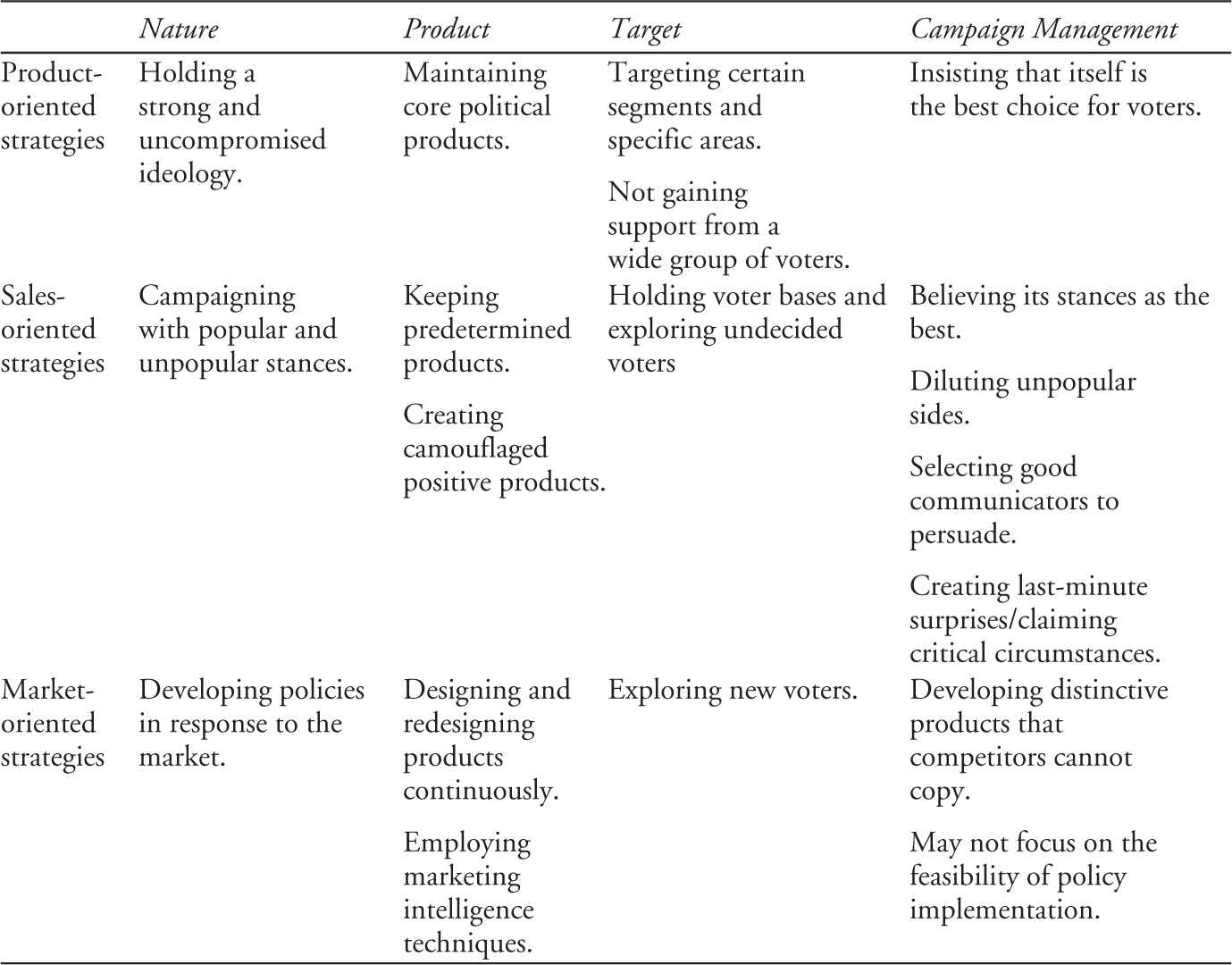
To determine what extent to a political party responds to public opinions in a voter market is significant in the analysis of political marketing. Lees-Marshment (2003) offers a party-based framework, which consists of a product-oriented party (POP), a sales-oriented party (SOP) and market-oriented party (MOP), for the empirical analysis of party behaviour in electoral campaigns. As for the product-oriented strategy, a party employing this method adheres to a strong ideology and believes that voters would support it due to the product it is selling. Employing a sales-oriented strategy means that a party seeks to sell itself by arguing its products/candidates give voters what they want. A market-oriented form of political marketing means party designs and redesigns its products/candidates to respond to voters’ demands and provide satisfaction to voters instead of selling its existing products (Lees-Marshment 2001).
This article synthesizes these political marketing concepts, which are most pertinent to Taiwan politics, to generate a set of political marketing strategies (Table 1). There are two reasons for selecting the TME as a case: (a) there has been little discussion on the TMEs, let alone in relation to political marketing in particular; (b) the market-oriented strategy employed by a non-partisan figure like Ko Wen-je in the 2014 and 2018 TMEs successfully challenges the traditional bipartisan system in the context of East Asia. Even though a causal link between the market-oriented strategy and election success has not been made, Ko’s campaigns in 2014 and 2018 provide the ground for observing the adaption of a market-oriented strategy in the context of Taiwan’s politics. This article also argues that the KMT and the DPP could not effectively employ the market-oriented strategy due to their lines tied to a particular ideology. What the two parties did in the elections was to persuade voters to accept their products with the outward-facing packaging of attractive policies. This article will present the above three Lees-Marshment strategies used in the TMEs one by one. It will first investigate how the product-oriented strategy was maintained by the NP, then analyze the sales-oriented strategy employed by the KMT and the DPP, and finally study the case of how Ko Wen-je adopted the market-oriented strategy. This article predicts that the utilization of a market-oriented strategy may not occur in future TMEs due to the changing environment and the inherent weaknesses of the strategy.
Three Strategies of Political Marketing.
PRODUCT-ORIENTED STRATEGIES AND THE NEW PARTY
A political party employing the product-oriented strategy believes that its political products naturally appeal to most of the voters. As long as the party demonstrates what it stands for, the voters would agree with the party’s products, including ideologies, beliefs, values, and policies. Hence, it would be unnecessary to make an effort to persuade the voters. Since the party embracing the product-oriented strategy adopts limited marketing ideas and techniques in election campaigns, most resources would be used to identify its voter base and the potential voters who may concur with its ideology.
Looking at the 1994 TME, the NP can be considered one such example. As a party that separated from the KMT in 1993, the NP was considered a new force in the Pan-Blue spectrum. 1 Yet, unlike the KMT under Lee Teng-hui who had ambiguous viewpoints on national unification, the NP regarded itself as the genuine protector of the Republic of China (ROC) by promising to uphold the complete sovereignty of greater China. The party deliberately aroused the issue of national sovereignty, the party ideologies or simply put, the products, as its electoral agenda when the party leader Jaw Shaw-kong contested for the TME in 1994. As demonstrated during the 1992 Legislative Yuan election campaign, Jaw was a rising star inside the KMT as well as an energetic campaigner. Jaw and the NP attracted large crowds from the traditional Pan-Blue supporters, particularly the military dependents’ villagers and the non-Taiwanese mainlanders who shared a very close connection with the mainland due to their past family ties and would not accept the ROC being separated from the mainland. The people became the NP target voters for the NP in the 1994 TME.
For the campaign management, the conservative stance on national identity facilitated the rise of Jaw inside the Pan-Blue bloc, but it also became a fatal weakness in the election. The communist threat was still haunting Taiwan from across the Taiwan Strait in the 1990s, especially after the 1989 Tiananmen Square incident. In addition to Hong Kong’s instability during the transitional period, most people who settled in Taiwan were concerned about local security and Taiwan’s future. Against this background, the moderate KMT voters tended not to support Jaw. Despite this, the NP did not adjust its positions and policies. In his image as the ROC protector, Jaw campaigned with the slogan—‘the best choice in the worst time’ (zuiluande shidai zuihaode xuanze). Jaw criticized the KMT for corruption on the one hand and accused the DPP of promoting violence and separation on the other. On 20 November 1992, 13 days before polling day, he also advocated the ‘One China Policy’ while revealing the NP vision in three points: (a) no second term for President Lee; (b) no plebiscite on the future of Taiwan, and (c) no declaration of independence (Copper, 1995).
Though the NP canvassed support from the Pan-Blue supporters by sticking to the principle of national unification, Jaw could not win the 1994 TMB. Under the bipartisan system, it proved hard for a party like the NP to win an election by employing a product-oriented strategy. With a strong ideology, the NP could not gain a majority by itself and it became impossible to cooperate with other parties as well. Being aware of that, the NP decided to abandon the electoral campaign to guarantee Ma Ying-jeou who was the KMT candidate in the 1998 TME. 2 In the rallies organized for Ma’s campaign in 1998, there was joint participation by the KMT and the NP followers. Hence, both the conservative and moderate voters in the Pan-Blue bloc switched their preferences to Ma, resulting in unprecedented solidarity between them. The NP demonstrated a tendency to utilize the product-oriented strategy in election campaigns.
SALES-ORIENTED STRATEGIES UNDER THE BIPARTISAN SYSTEM
There are several main circumstances that may provide incentives for a party to employ the sales-oriented strategy: (a) when a party has to campaign with its unpopular products that cannot be changed within a short period; (b) when the party’s core ideology cannot fit into the current political environment; and (c) if the party candidate’s approval rating sinks before the polling day.
NATURE, PRODUCTS AND TARGETS
Although the party realizes that its products may not be demanded by voters, it uses marketing skills including advertising and communication techniques to sell the existing products in order to persuade its voters to accept the party’s arguments. To achieve that, the party usually highlights its popular products and downplays the unpopular ones. Compared with the product-oriented strategy, the sales-oriented strategy offers wider appeal—not only to the existing supporters but also to the swing voters. There are two important aspects to the successful utilization of the sales-oriented strategy in an electoral campaign. First and foremost, since the sales-oriented strategy focuses on communication, it is necessary to have an effective communicator as the party leader or electoral candidate, because through powerful persuasion an effective communicator could forcefully advocate what the party considers as being in the best interests of the voters. Second, a party needs to promptly identify its popular and unpopular products while formulating its strategy to emphasize the former and tone down the latter.
When Taiwan embraced competitive elections in the late 1980s, both the KMT and the DPP introduced their political products following the sales-oriented strategy. On the one hand, the two parties were required to persuade the public and even follow public opinions instead of simply imposing their policies. On the other hand, the sales-oriented strategy matched the circumstances under the bipartisan system of Taiwan where most political actors could not evade the issues of unification and separation. The ideological and national identity debates have always been a permanent feature in Taiwanese elections, and these debates also marked the dividing line between the Pan-Blue and Pan-Green supporters. Even though the social and economic policies of various parties have also influenced voters’ choices significantly, ethnoterritorial stances had been the primary ideological determinant (Dupre and Medeiros 2018). Both the KMT and the DPP had to campaign in line with their positions on anti-independence or pro-independence ideologies, leading to limited space for the party products to adjust. In the 1986 legislative election, the KMT and the DPP offered opposite products in this first two-party election. During the campaign, the DPP built itself as an anti-KMT party and called for greater democratization as well as economic equality. However, the KMT, which had taken credit for the Taiwan economic miracle in the 1970s, promoted gradual changes in political and social structures. Even though the electoral agenda focused on various issues, the DPP still employed ideological issues to gain public attention by criticizing the outdated stance of the KMT on the issue of national sovereignty.
As targets, the DPP paid more attention to the local Taiwanese population while the KMT focused more on the people who had come from the mainland. The latter also took advantage of its factional organizations present in the rural areas and the state establishments that had emerged during the military ruling between 20 May 1949 and 14 July 1987. With the development of communication techniques, the DPP and the KMT had widely utilized media platforms to target their voters in the post-1990s elections. The first television debate was introduced in the 1994 TME. It attracted immense public attention and was viewed by 40% of the Taiwanese population in the 1998 TME; while the DPP spent US$1.88 million on newspaper and television ads, the KMT spent US$3.2 million (Chang 2003). With the advent of social media, almost all the candidates had started using Facebook as a standard campaigning tool by the turn of the 2010s. Even though some of the 11 mayoral candidates in the 2010 elections were not personally active on the internet, they still opened their own Facebook fan pages (Wen 2014).
Unlike most other countries where municipal issues dominate the mayoral elections, the TMEs reflected the higher political status of Taipei due to the prominence of national political issues of unification and independence than the local affairs. It is no wonder that the TMEs have been variously considered as a ‘dress rehearsal’ for the presidential elections in Taiwan (Tan and Yu 2000). As a result, given the high level of politicization, the sales-oriented strategy had been employed by the political parties in the TME campaigns. Both the KMT and the DPP could not escape the political issues and had to campaign with strong party features including ideological image, values, policies, history, and particularly the positions on the issues of unification and independence.
KMT CAMPAIGN MANAGEMENT—DOWNPLAYING THE UNPOPULAR BLUE PRODUCTS
Taipei had long been a pro-KMT territory, where the Pan-Blue establishments have enjoyed strong voting bases ensuring the KMT’s success in every TME from 1998 to 2010. One of the reasons behind the KMT’s success was the fact that the city was home to the largest core voter group of the mainland population. This also meant that ethnic politics also played an important role in the elections before the 2010s, albeit indirectly. On the contrary, since its founding in 1986, the DPP claimed itself as the true representative of the local Taiwanese people and gained a reputation for striving for more rights and freedoms.
Interestingly, the KMT candidate Huang Ta-chou could not win the 1994 TME due to several factors. Even though the party adopted the sales-oriented strategy of exploring the swing voters, it did not successfully downplay its unpopular products. Huang was the last Taipei mayor appointed directly by the president of Taiwan, Lee Teng-hui, in October 1990. When the office of the Taipei mayor became directly elected in 1994, the KMT nominated Huang in his capacity as the then-appointed Taipei mayor to run for the election. The KMT worked to improve Huang’s image as a hard-working and Taiwan-born politician who had a pragmatic approach to social policies. However, rival candidates disapproved of Huang using harsh terms, such as ‘the nincompoop mayor’ and ‘the dishonest mayor incapable of telling residents the real problems’; on the other hand, the KMT also suffered from its internal conflicts. 3 With the NP becoming a new force within the Pan-Blue bloc, the KMT adopted a moderate strategy for Taiwan’s independence. Nonetheless, Huang had to amplify his party ideology to obtain support from KMT’s traditional voters. Largely restricted by the party line, Huang claimed that neither independence nor unification would do good for Taiwan. This was perhaps the most sensible position for the majority of the KMT voters, but Huang marketed such an emotionally laden question in such a poor way that some voters shifted their preference to the DPP. The Mainstream Fraction inside the KMT even supported the agenda of ‘abandoning Huang to save Chen (Shui-bian)’ in a low-profile way (Hsieh, Niou, and Paolino 1997), eventually leading to the KMT’s defeat in the TME in 1994.
Understanding the importance of having an effective communicator as the candidate, the KMT nominated Ma Ying-jeou, a new face who would not be considered as outmoded and corrupt, to contest the 1998 TME. In the 1990s, the KMT was one of the richest political parties in the world and was able to outspend its rivals on television and newspaper advertisements (Fell and Cheng 2010). Ma had high media exposure in front of the Taipei citizens as the deputy secretary-general of the KMT from 1984 to 1988 and as the ROC justice minister. His public image was that of a clean and honest politician. However, Ma was considered an outsider by many local Taiwanese due to the controversy surrounding his birthplace and his identity as a mainlander. 4 Hence, Ma chose to downplay the negative image by adopting the concept of being the ‘new Taiwanese’. During the final phase of the campaign, Ma highlighted that he was a new Taiwanese raised by local food and water (Chu and Diamond 1999). Ma’s strategy gained widespread support and he was elected with over 50% of the votes. With the presence and support of the traditional Pan-Blue stronghold in Taipei, the KMT ensured three consecutive victories in 2002, 2006 and 2010 elections. The party continued to hold a conservative stance on the cross-strait relationship and nominated candidates with strong communication skills. Ma’s charisma and popularity did not diminish after assuming the mayoral office in 1998. Given his background in the legal profession, Ma maintained and strengthened his image as a credible and honest politician who was fighting against the corruptive practice in municipal services. In 2002, Ma won the TME in a landslide victory against the DPP candidate Lee Ying-yuan with 64% of the votes.
Hau Lung-pin won the TME as the KMT candidate in 2006 and 2010. He was a former NP leader endorsed by the deep Blue voters and held a moderate position in the debate on the issue of independence. Before polling day of the 2006 election, many Taiwanese newspapers reported that Hau would win the election without doing anything (Shin Sheng Daily News 2006) 5 . During the Hau administration, the city government implemented more environmentally friendly policies, such as improving the quality of drinking water and revitalizing the Tamsui River waterfront along the Tamsui River. When Hau sought a second term in 2010, he continued to tone down the cross-strait issue and focused on promoting his visions for the future development of the city with the slogan ‘Taipei, Fly High (Taibei Qifei)’. He finally won the city’s top job with 10% more votes than the DPP candidate.
DPP CAMPAIGN MANAGEMENT—PERSUADING VOTERS WITH TRAGIC PRODUCTS
The DPP demonstrated a desire to follow the sales-oriented strategy since its loss in the 1991 National Assembly election. Domes (1992) suggested that the failure was partly due to the wrong decision of putting the issue of independence into its electoral platform. Since the DPP realized that a radical party line could not persuade the majority voters, it, therefore, chose a more moderate position to market its position by way of two actions: (a) replacing the term ‘independence’ with ‘self-determination’, and (b) eschewing ideologically oriented candidates to build up a more rational image. Particularly in the 1994 TME, the party candidate Chen Shui-bian utilized the sales-oriented strategy to a significant extent. As Yu (2004) noted, if the DPP wished to have a greater influence on cross-strait affairs in the future, it should avoid any violent ways of operating against the KMT and past authoritarian features. Chen insisted on not using any radical practices while striving for the DPP vision and promised that the status quo would be maintained in the constitutional matters of the ROC. This strategy was reflected in his campaign slogan—‘Hope, Happiness, Chen Shui-bian’, which provided a positive image and deliberately diluted the ‘Tragic Taiwanese Appeal 6 ’ (Fell and Cheng 2010). Chen’s campaign managed to attract both the deep Green voters and moderate voters successfully ensuring his success in 1994.
However, the DPP’s positioning in the 1998 TME became confusing. On the one hand, Chen Shui-bian emphasized his achievements and better governance for Taipei as the incumbent mayor. Chen also created a fashionable identity to attract young voters. He named his campaign headquarters as ‘Chen Shui-bian’s Hat Factory’ (Chen’s followers wore the same type of woolly hats designed by his team), in which interior decoration was stylish and post-modern like a pub. The peripheral products for the campaign, such as mouse pads, mugs, notebooks, and so on, were also popular among his supporters as well as young people. However, on the other hand, the DPP also started highlighting the communist threat from the mainland, thereby putting the issue of national security front and centre in its campaign. Chen started emphasizing the ‘Tragic Taiwanese Appeal’ to arouse strong feelings against the mainland from the local Taiwanese people. Chen’s strategy to attack his KMT rival Ma Ying-jeou as the ‘New Taiwanese Traitor’ also proved counterproductive because Ma enjoyed very high popularity among Taipei citizens (Economist 1998). As a result, Chen lost the 1998 election to Ma, but the setback in the 1998 election possibly gave a lesson to Chen how to manage the party competition and campaign in a more sophisticated manner, thus paving the way to his victory in the presidential election in 2000.
The DPP response to the KMT in the post-2000 TMEs had focused on its party line of Taiwan independence while exaggerating the tragic future created by the Pan-Blue bloc. 7 In the 2002 TME, the DPP candidate Lee Ying-yuan worked under the shadow of Chen Shui-bian who was also the ROC president. As such, Lee strictly followed the DPP line throughout the whole campaign. Chen attempted to use his influence and criticize Ma in the electoral campaign. As a result, Lee just became a communicator to sell Chen and the DPP line on Taiwan’s future. Voters considered President Chen and the DPP while casting their votes instead of Lee himself. The DPP candidate Lee could not bring his characteristics into play during the elections and was finally defeated by Ma Ying-jeou.
In 2006, the DPP was facing infighting as the former DPP chairperson Shih Ming-teh led a large mass campaign entitled the ‘Million Voices against Corruption’ demanding Chen Shui-bian’s resignation from the post of the ROC president. Given the prevailing anti-DPP sentiment, the Pan-Blue bloc enjoyed an advantageous position in the TME. Facing an internal crisis, the DPP assigned a heavy-weight political figure, Frank Hsieh, who was the former elected Kaohsiung mayor and the former premier of the Executive Yuan, to stand in the election. Hsieh was a prominent figure in the DPP and had been well-known by the public since the 1970s. He emphasized the ‘Tragic Taiwanese Appeal’ again to persuade the DPP supporters to safeguard the sovereignty of Taiwan and the DPP administrations to prevent a tragic future brought about by the KMT. 8 Although Hsieh finally lost the election to the KMT candidate Hau Lung-pin, he managed to gain over 40% of the votes in Taipei, long considered a KMT stronghold.
The second decade of the present century witnessed a rapid rise in the number of internet and smartphone users and the influence of social media. In the elections, an ever-increasing number of marketing products, designed by commercial advertising companies, were distributed among the voters through social media channels. Su Tseng-chang, who was the DPP candidate in the 2010 TME, placed more focus on promoting the future vision for Taipei. He set the electoral slogan as ‘Taipei Surpasses Taipei (Taibei Chaoyue Taibei)’ and spent a large budget to produce a series of high-quality platform videos (Liberty Times Net 2010). However, since Su had a stereotyped DPP image, there was minimal room for him to modify his stance. Even though he did so, this did not largely benefit him to canvass more moderate voters. In order to maintain his core supporters, Su was also required to stick with the sale-oriented strategy. Under such circumstances, Su lost the 2010 TME to the KMT candidate with a margin of over 10% of votes.
RISE OF KO WEN-JE WITH MARKET-ORIENTED STRATEGIES
In the two-decade bipartisan system that has been established since 1994, the people in Taipei found that there was very limited discussion about municipal deve- lopment in the mayoral elections. A sizeable number of Taipei citizens were dissatisfied with the ideological conflict between the KMT and DPP, which was often on display during the elections (Muyard 2015). This was demonstrated during the 2014 Sunflower Student Movement. Spearheaded by young students, the movement undermined the KMT stronghold in Taipei. One of the factors behind the movement was growing proximity with the mainland under ROC President Ma. Taiwan signed the Cross-Straits Economic Cooperation Framework Agreement (ECFA) and the Cross-Strait Service Trade Agreement (CSSTA) with the mainland in June 2010 and June 2013, respectively, despite strong opposition by the DPP and pro- independence groups who saw the two agreements as a threat to Taiwan’s economy and independence. The conflicts and debate on the two agreements inside the Legislative Yuan eventually developed into the Sunflower Student Movement in March–April 2014, when students occupied both the Legislative Yuan and later the Executive Yuan of Taiwan. Given the intensity of ideological division and growing distrust for the KMT, Taipei voters looked for a change in the 2014 TME.
MARKETING PRODUCTS CREATED BY KO
Ko Wen-je fought and won the TMEs twice in 2014 and 2018. From the outset, Ko advocated that he would be the mayoral candidate who did not belong to any political parties and who would attempt to meet the citizens’ demands. Although Ko was one of the medical doctors who performed emergency medical service on Sean Lien, who was shot in the face during a campaign rally in 2010 in New Taipei City, and endorsed that Lien was not shot by mistake as claimed officially (Apple Daily 2010), he was considered a deep Green supporter for a long period. However, when Ko announced his candidacy in the 2014 TME, he forsook his deep Green identity and claimed that he would break through the Blue-Green gridlock in the city and even the whole island. After winning the TME in 2014, Ko claimed that the ideological wall would collapse and the era in which the people would become the master of the city was coming (News Lens 2014).
Ko’s election policies were based on market intelligence. His campaign policies were designed and redesigned continuously according to the changes in public opinion, fulfilling the criterion of the market-oriented strategies mentioned previously. Since the rise of social media in the mid-2000s, Ko was the first politician in Taiwan to promptly used social media to build up his image and achieved great outcomes in the TMEs. Ko established a team of five members to monitor and trace around 14 million Facebook accounts with big data techniques. This five-member team analysed 600 million ‘Likes’ on those 14 million Facebook accounts and came up with the issues of greatest concern in Taiwan’s political market (Tian and Yan 2014). The large bundle of data helped Ko in deciding the policies that would ensure wider public support from different sectors.
Ko’s campaign theme of ‘Opening Government, All People Participating (Kaifang Zhengfu Quanmin Canyu)’ reflected that as a candidate, Ko was responding to the expectations of the Taipei public. He promised that except for sensitive information pertaining to local security, all data of municipal services would be made public through big data means for enhancing transparency. Following the analysis of public opinions, Ko also proposed various municipal policies that kept track of people’s daily lives. He promised that the old urban areas would be revitalized by the public authorities who would purchase worn-out apartments and lease them after refurbishment; the municipal government would implement a nursery scheme to provide trained babysitters and would financially encourage NGOs to provide after-school tutorial classes during the school semester as well as summer vacations; and the municipal government would work to promote in-depth local cultural tours to develop a sightseeing mobile application for integrating information including but not limited to food, accommodation, night markets, and historic places. Ko also proposed a deliberative budget scheme, in which people would largely participate in the deliberation of the municipal budget and would be provided with an amount of US$10 billion for discussion. After being reviewed by professional administrators, the final options would be decided by an online referendum. These products reflected Ko’s market-oriented stances and flexibility in formulating policies to respond to the mass voters.
TARGETING NEW VOTERS
As for target voters, Ko believed that the proportion of people in Taipei who did not consider themselves KMT or DPP supporters had increased since the 2000s (Jhou 2019). Hence, Ko strived to establish a new bloc called the ‘White Power’, which was neither KMT Blue nor DPP Green and provided room for people who did not support any political party.
Ko managed to successfully explore new voters that had been ignored by the two parties in previous elections. Ko cleverly ascertained that even though people cast votes for a political party in elections, they were also likely to change their preferences if the ruling party failed to meet their expectations. Moreover, given that the presidential administration in Taiwan exercised an overarching influence in Taipei as the key political figures worked and resided in the city, Taipei citizens were also likely to oppose a mayoral candidate from the political party whose president had performed poorly at the national level. In 2014, the then-ROC president, Ma, came under severe criticism after the eruption of the Sunflower Student Movement, which benefited Ko’s campaign. In 2018, the fall in approval ratings of President Tsai Ing-wen also affected the prospects of the DPP candidate in the TME. Since the swing voters tended to vote for a candidate deemed politically neutral, Ko managed to win the TMEs in 2014 and 2018 by successfully gaining the support of swing voters for ‘White Power’.
Apart from political neutrality, Ko also successfully explored new voters—the youth who reached voting age after the 2010s and had become used to receiving information from the internet. After the Sunflower Student Movement in 2014, the youth and first-time voters in Taiwan became more politically sensitive. Some of them believed that something should be done to withstand further encroachment on Taiwan from the mainland, especially when the KMT and DPP had failed to break through the gridlock for many years. Under such circumstances, Ko’s strategy of targeting these groups of youngsters through social media and the internet paid rich dividends.
OUTSTANDING POLITICAL NEUTRALITY IN THE WHOLE ELECTORAL CAMPAIGN PROCESS
As mentioned previously, Ko strictly adhered to political neutrality and avoided politically sensitive issues from the outset. Before running for the election in 2014, he was the director of the traumatology department at the National University of Taiwan and a practising physician in the hospital affiliated with the university. Ko built a clean and professional image of ‘Ko P’ (Professor Ko). He emphasized that the management practices used in the medical profession would be applied to municipal affairs with stringent and professional standards. Since he did not belong to any political party and was not supported by KMT or DPP media outlets, it was hard for Ko to get wider media coverage initially. But he eventually managed to get broader media coverage due to his political neutrality. Over a short period, he started appearing on the front pages of newspapers and in prime-time television programmes. Soon Ko’s media popularity became a phenomenon known as the ‘Ko P Effect’.
During the 2014 electoral campaign, Ko’s team closely monitored social media with big data techniques and regularly proposed policies which were responsive to the voters’ concerns. As Lee-Marshment (2010) suggests, market-oriented strategies not only focus on what voters demand but also follow how to fulfil the promises made during an electoral campaign. Since Ko was not hampered by the burdens of previous administrations and ideological baggage, he enjoyed more flexibility to achieve what he had designed to do in his municipal position. For example, Ko could propose aggressive measures against corruptive practices without pressure from the vested interest groups that were the supporters of the two dominant parties (Wang 2014). Moreover, although the KMT and the DPP attempted to downplay their ideologies in elections, only Ko could manage to achieve this ideological neutrality in his mayoral campaign and focus on local municipal issues in his agenda. Given Ko’s management experience in the health sector as a doctor, he also appeared capable of handling the deep-rooted and long-standing problems in the public sector. Thus, Ko easily defeated the KMT candidate in the 2014 TME.
During Ko’s first term as Taipei mayor, the KMT controlled the majority of the Taipei City Council. Ko worked to garner support from the Pan-Blue bloc in order to maintain executive–legislative cooperation for implementing municipal policies in Taipei. Meanwhile, Ko’s relationship with the DPP underwent a drastic change on the issue of Taiwan’s sovereignty. While the DPP evaded the recognition of the ‘1992 Consensus’, 9 Ko proposed the ‘2015 New Perspective’ aiming at achieving a breakthrough in the cross-strait relationship. He mentioned the spirit of ‘being one family for the mainlander and Taiwanese (liangan yijia qin)’ in the 2016 Taipei-Shanghai Forum in order to bypass the ideological discussion. Having said that, Ko still maintained political neutrality and did not go beyond this line to elaborate his stance on the issue of Taiwan’s sovereignty.
In the 2018 TME, the DPP was put into an embarrassing position. On the one hand, Ko could not be deemed as a political ally by the DPP due to his position on various policy stances; on the other, there was a high overlap between the voter bases of Ko and the DPP. Although DPP central finally approved its party member Yao Wen-Chih to stand in the election, it did not provide much support. Yao repeatedly blamed party central for forsaking him in order to ensure KMT’s defeat in the election (Jhou 2018). Ko managed to win by a narrow margin of around 3,000 votes over the KMT in the hotly contested 2018 TME.
CONCLUDING REMARKS
This article supplements Lee-Marshment’s classification of political marketing (POP, SOP and MOP) and argues that political parties with strong ideologies have difficulties in employing the market-oriented strategy in electoral campaigns. The study of the electoral campaigns of the NP, the KMT, the DPP and Ko Wen-je in the TMEs shows how product-oriented, sales-oriented and market-oriented strategies are used as campaign strategies, respectively. While the NP held a conservative stance and ran their campaigns with product-oriented strategies, the KMT and the DPP preferred the sale-oriented strategies due to their ideological position on the issue of Taiwan’s sovereignty. Being different from Western political parties, which swing between left and right in terms of economic or social policies, the two major parties in Taiwan are required to persuade voters to accept their positions on the sovereignty issue with packages of social policies and candidates with charisma. No matter how the two parties sell their products, their motives for gaining power and winning elections are intended to safeguard their ideological position on issues of unification and independence. The adoption of market-oriented strategies in the TMEs required prerequisites like a popular neutral candidate who has not taken sides in the sovereignty debate, the rise of new voters, and the capability of using big data techniques to collect public opinions. Such prerequisites were also the reasons behind Ko’s success.
With the political momentum accumulated in recent years, Ko established the TPP in 2019 and sent representatives to stand in the 2020 Legislative Yuan election. By taking five seats, the TPP became the third-largest party in the legislature. Once the party structure develops further, it would become impossible for the TPP to hold a neutral position for a long. The current and potential party supporters are keen to know what the party can deliver and what direction it will make. Moreover, the disadvantage of the market-oriented strategy is that the party tends to raise unrealistic expectations among its supporters, which it finds hard to deliver later on. The longer the TPP members hold the seats in Taipei or the Legislative Yuan, the more it is likely that the people will start requesting the party to offer a vision for Taiwan’s future. As such, Ko was also criticized that he failed to live up to his policy promises made in the electoral campaign. For example, he claimed that the construction of Taipei Dome, a multi-purpose stadium, would not be disrupted by any scandals and would be accelerated, but the project was still under construction long after he assumed the mayoral office (Lee 2019). His charisma, which is essential for maintaining the market-oriented strategy, gradually faded with time.
Indeed, TMEs create space for candidates to focus on non-sovereignty issues and this is the reason why Ko could survive between the two blocs in the 2014 and 2018 elections. Looking at the experience, frequently emphasizing ideological stances in local elections was deemed risky and unwise, and therefore, both the KMT and the DPP attempted to turn the electoral agenda into municipal affairs. Still, since the core values of the two parties cannot be forsaken, what strategy they could employ in the elections is only the sales-oriented strategy and not that of the market-oriented strategy. Without the ideological burdens bore by the KMT and the DPP, Ko could run in the TMEs with market-oriented strategies. Having said that, the mainland authorities have turned their policy from moderate to authoritarian since the breakout of Hong Kong’s Anti-Extradition Protests in 2019. The people in Taiwan witnessed the new National Security Law implemented and the pro-democracy figures were marginalized in Hong Kong (Chan 2022). Although the state-run media in mainland China attempted to defend the new policy towards Hong Kong to resist outside hostility (Yu 2021), the events have aroused a new round of anti-communist fear in Taiwan. The DPP utilized such sentiment to win a landslide victory in the 2020 presidential election and kept spreading the message of ‘Today, Hong Kong; Tomorrow, Taiwan’ (Horton 2019). Under such circumstances, the political sphere in Taiwan has become much more polarized and the sovereignty issue might become an agenda that cannot be escaped by any candidates in the upcoming 2022 TME. The room for employing market-oriented strategies is getting smaller and smaller.
In addition to the changing proportion of swing voters from time to time, the middle line together with the market-oriented strategies held by Ko meant it became more difficult to arouse support for the TPP. In order to have further development, a party should ensure its local networks establish voter bases for elections. Due to the rise of anti-communist sentiment in recent years, the KMT’s popularity maintained low-level support. With the upcoming 2022 local elections, the TPP attempted to encroach on the KMT zones by sending more party officers to establish new networks in those local communities. The TPP has been found to draw closer to the Blue side in order to strengthen and expand its voter bases (Chin 2021). Under such circumstances, there will be less flexibility for the TPP to maintain the middle line and less room for employing market-oriented strategies. In the upcoming elections, the TPP is predicted to follow sale-oriented strategies, in which the TPP may provide light Blue products in order to persuade voters that the party has a chance to replace the KMT to become the largest opposition party. Although Ko could win the TMEs in 2014 and 2018 with market-oriented strategies, it is predicted that such strategies cannot be maintained for a long period due to inherent weaknesses. Our research also leaves much rooms open for future studies of the TMEs in the post-Ko period and the future developments of the TPP.
Footnotes
Declaration of conflicting interests
The authors declared no potential conflicts of interest with respect to the research, authorship and/or publication of this article.
Funding
The authors received no financial support for the research, authorship and/or publication of this article.