



Abstract
Monastic life is based on tradition and rules. It produces a homogeneous and disciplined community. But with the ageing that has been affecting them for several decades, monastic communities are relaxing their rules and rhythms, to allow their elderly to continue to participate in common life (prayer, work, meals, etc.). At the same time, they must maintain a certain rigour, as much to remain attractive to young postulants as to present their guests the asceticism that characterises their tradition. The authors went to different monastic communities in Switzerland and France to carry out an ethnographic research. Using extracts from their field journal, they highlight how monks and nuns manage their lives and invent pragmatic solutions in order to redefine every day what it means and implies ‘to be a monk or nun’.
A close anthropological study of monastic life
The present article is based on anthropological study of monastic life. 1 We have spent several years investigating how religious orders in Switzerland and France adapt to their members ageing. We initially spent three years studying convents for apostolic nuns that had been converted into homes 2 for the elderly. 3 We subsequently decided to enter another world: communities of contemplative monks and nuns.
We aimed to see how, as these reputedly enclosed and self-sufficient places managed the health issues associated with their members ageing, new ways of viewing community life and relations with the outside world would emerge. We focused in particular on ‘prayer’, ‘work’, ‘enclosure’ and ‘silence’, all emblematic of the ‘practised utopia’ (see Séguy, 1972: 330) lived by these religious virtuosos 4 .
In conducting our research, we favoured an anthropological approach which immersed us in monastic life. We focused on a cross-border area encompassing francophone Switzerland and the Bourgogne Franche-Comté region in eastern France. Having defined our area, we conducted ethnographic observations in 16 monastic communities that were open to our investigations. We spoke to the superiors, negotiating permission to attend and be fully integrated into their communities for two periods of between several days and a week. We would live and sleep there, eat our meals with the members of these communities, take part in all the Offices and prayers 5 which structure their days, attend community meetings and recreation periods wherever possible, and take part in communal activities such as work and domestic duties.
Thus in the course of each period of ethnography, we had the option to meet and interview some of the monks and nuns during the very limited times when they were not busy with their various tasks and responsibilities. We discussed their backgrounds and daily lives, their relationship with their community and the ways of handling their ageing brothers or sisters. 6
Observing everyday life
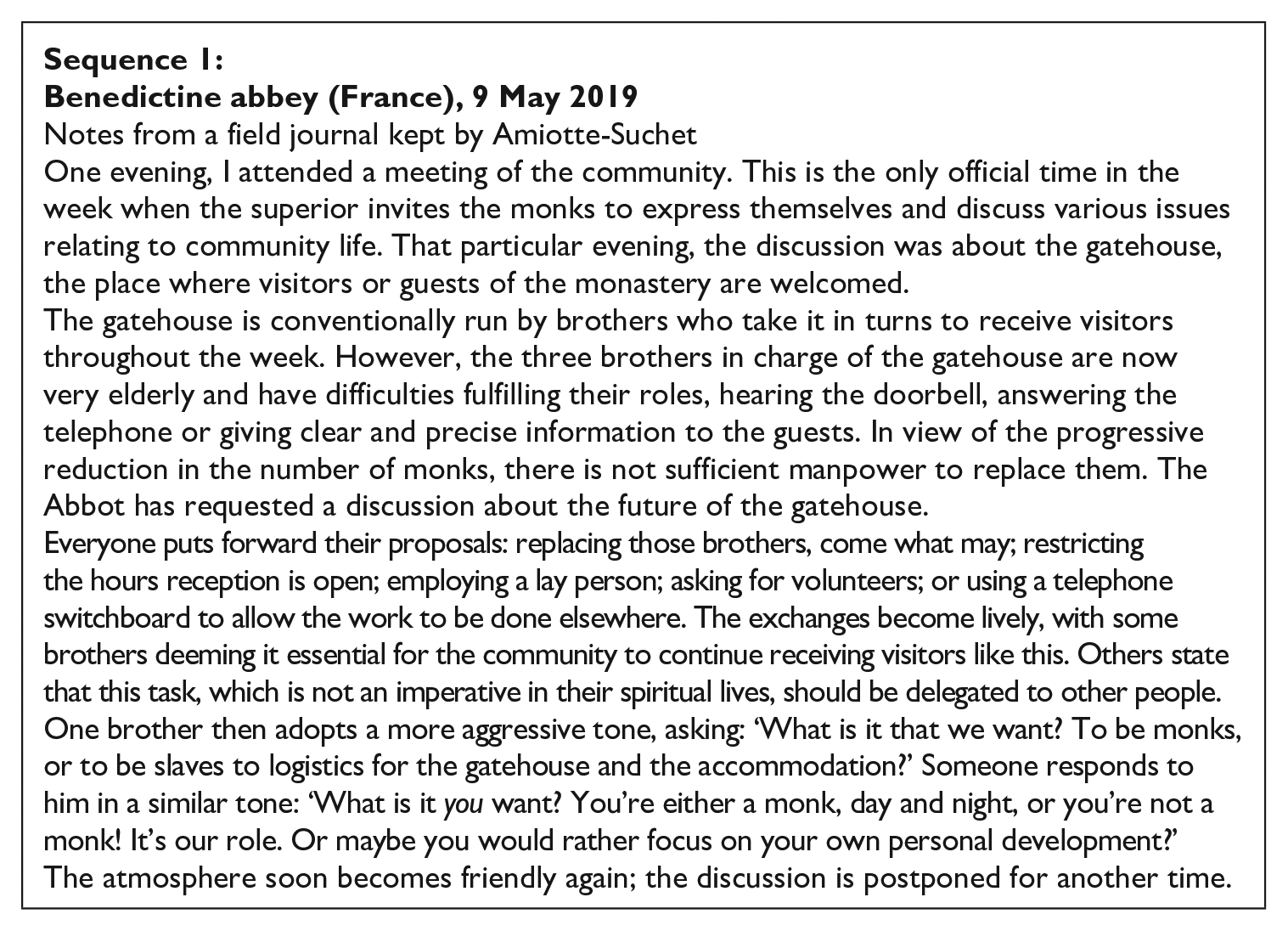
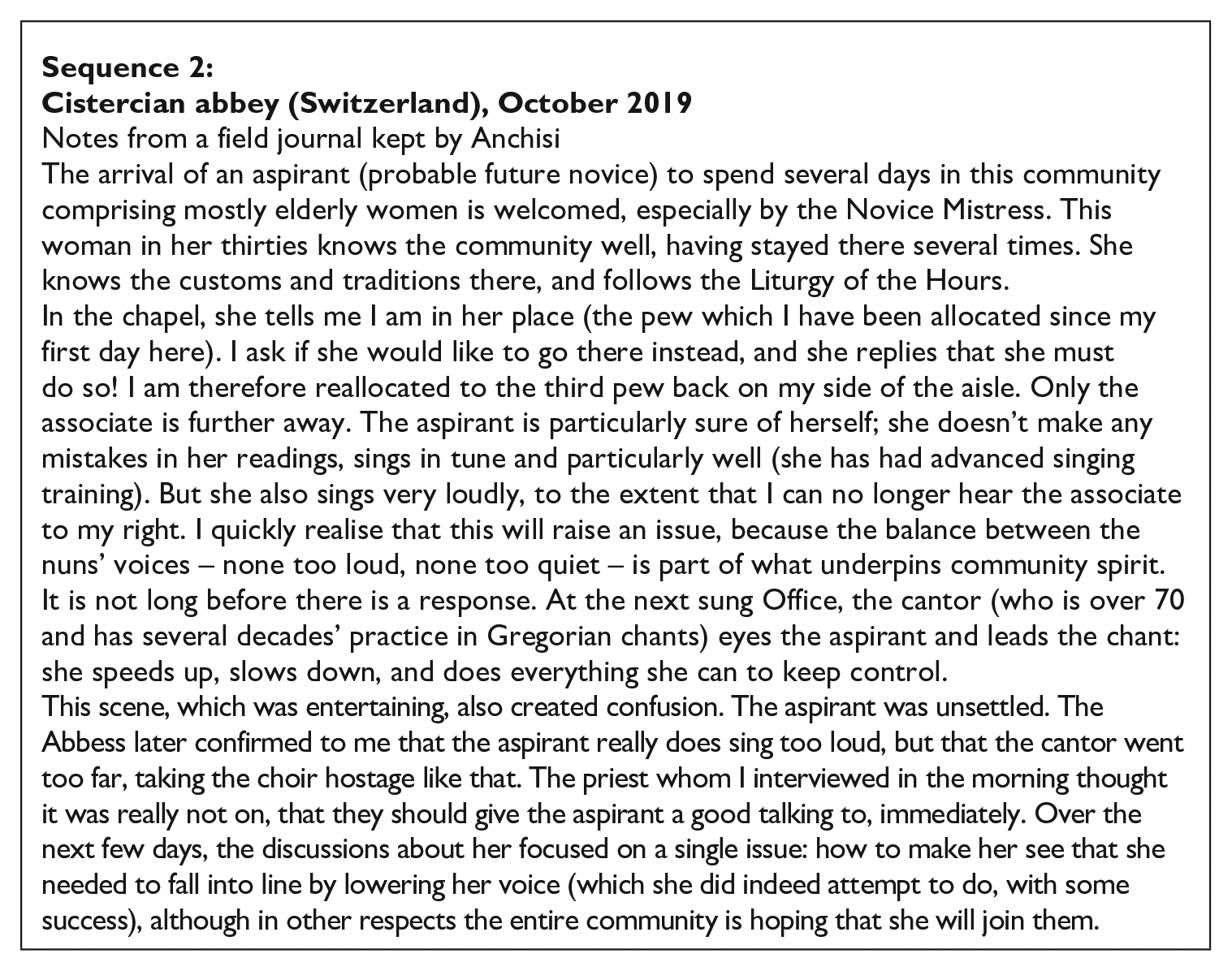
From these two field journal extracts, the same key question emerges to focus the discussion: what lies at the heart of monastic life? Which lines may (or may not) be crossed? In both case studies, the emphasis falls on the ageing of contemplative communities. The monks want to know if being a monk ‘through and through’, 24 hours a day, can accommodate age-related frailties. The nuns, living in a small, ageing community, see the aspirant’s arrival as a hopeful sign that a succession can take place – but not at any price. They are not prepared for one woman to distinguish herself as an individual to the detriment of the community as a whole. There is a cost involved in upholding the rules, come what may: in the first case, excluding the older monks; in the second, losing a rare potential novice. Both instances bear out our hypothesis that the contemplative life is changing under pressure from demographics.
By beginning our article with these ethnographic sequences from our field journals, we are in a sense following the approach to contemporary religious ‘facts’ which Albert Piette has been advocating for decades. This is based primarily on empirical materials and ordinary micro-situations, describing precisely how these situated interactions unfold. In Piette’s case, the attention to detail and emphasis on describing the interaction are not the result of salvage ethnography – attempting to archive authentic cultural practices that are condemned to extinction. Instead, while at that time the sociology of religion was focusing on theories of secularisation and their limitations (Tschannen, 1992), in La religion de près Albert Piette (1999) supplied a detailed account of a parish priest’s routine. Every day, the priest is obliged to negotiate with his parishioners both to establish and to exercise his authority. This account, while it may at first appear unusual, is nevertheless highly significant because of the empirical account it gives of the transformations which religious institutions and their representatives are undergoing in increasingly secular societies. Albert Piette’s work opens up the ‘black box’ of parish life to reveal the subtleties it contains. Piette describes the religious ‘creating itself’ through constant alliances and compromises. He documents the major sociological trends empirically, while simultaneously revealing the limits on analysing them. He also shows that statistically significant trends may mask more complex empirical realities in which individuals conduct ongoing discussions and debates. They try to reach agreement so they can reorganise matters and move forward, at least temporarily, together.
Hence we have learned lessons about methodology from Albert Piette’s work. Firstly, in basing our analysis on empirical situations we were able to fine-tune the macro-sociological approaches which tend to homogenise their actors, neglecting the internal diversity of collectives under tension. Thus we hope to avoid the worst excesses of community studies which have ‘naturalised’ subcultures by identifying collective representations and figuring out their actions on the basis of these. 7 We have also learned to consider individuals routinely as actors in situations who constantly adapt their attitudes to the situations in which they are obliged to operate.
While it is conducted with scientific rigour and method, the sociological interview remains a particular type of social interaction. It does not allow the interviewer to ‘fix’ the interviewee in a stable, sustained intellectual position which characterises them now and in the future (Amiotte-Suchet, 2011). The way researchers perceive the social world (associated with their own backgrounds) and the way their informants perceive them (associated with their status) should both be taken into account (Cefaï, 2010; Amiotte-Suchet, 2021; Anchisi and Perrenoud, 2020).
Finally, individuals’ attitudes to religious activities – or at least to what Durkheim called ‘sacred things’ (1912) – are normally ambivalent and must be understood as such. Empirically speaking, discussions about religious matters are characterised by cognitive hesitation coloured simultaneously by respect, seriousness, irony, scepticism and the metaphorisation inherent in the act of belief (Piette, 2003b; Amiotte-Suchet, 2018). Albert Piette set out this type of approach in 1996 in Ethnographie de l’action and practised it very appropriately in La religion de près (1999); he then explored it more deeply in Le fait religieux (2003a).
The question of definition
We began with two ethnographic sequences which reveal the everyday tensions characteristic of this communal form-of-life. 8 Whether monks are discussing how the gatehouse is organised (Sequence 1) or nuns are trying to regulate their choir (Sequence 2), the question is how to define what the characteristics of the collective should be. From our point of view, which aligns with Weber’s, a monastic community is a practised utopia (Seguy, 1971). The collective project is in a constant state of becoming: it is moving towards a perfect homogeneity based on agreement around common values and, by extension, (constitutionally established) ways of being and of acting. Thus the community is a performative idea constantly seeking to become reality, redefining its boundaries all the time, feeding into the ideal that there is an ‘us’ which we can contrast with ‘them’ – from whom we try to stay separate (Amiotte-Suchet, 2010).
In the first ethnographic sequence, the ordinary task under discussion – managing the gatehouse – is something which some of the monks deem essential, but others deem to be restrictive and unfulfilling. These two points of view differ, without truly being in opposition. On one side stands the ideal of the monks themselves extending an unconditional welcome to the monastery, which they must preserve. On the other side is the ideal of a contemplative life which takes time, calm and silence – something disrupted by administrative tasks. It seems that each participant in the discussion emphasises a particular aspect of what ‘being a monk’ means and involves.
The monks’ discussion, which calms down quickly, is indeed about establishing priorities. The two different visions are not incompatible. But the registers of argumentation which either side uses show that this is a question of balance between the individual and the collective. Thus the community is constantly working to identify the various constituent parts of an equation which must be brought back into balance, generation after generation. While one side evokes the tradition of hospitality since the Order’s inception, the other points out that no material task may take precedence over seeking God. While one side emphasises the need for silence and solitude to find God, the other underlines that community is a brotherly existence in which everyone plays their part.
In the second ethnographic sequence, the focus is on the relationship between nuns, specifically on an aspirant who is showing her individuality and skills too ostentatiously. She sings especially well, and that has been picked up both by the faithful during worship and by some attentive visitors, who responded to her (the new virtuoso in Gregorian chants has in a way acted as ‘marketing’). But once again, as with the above example, it is a question of definitions, and of control exercised by the collective. Should a prospective nun freely express her own personal talents? To what extent should each individual’s charisma be used to serve the community? At what point does personal gratification take precedence over the interests of life in the community?
A balance must be struck between the skills of each individual (not everyone can sing well) and the homogeneous image of itself which the community wants to project. Thus the outline of that image must be maintained, while conditions on entry are offered to the rare, treasured potential novice, which do not compromise the common Rule. The tension arising between the cantor, who holds authority due to her role, and the aspirant, who claims personal charisma and authority based on her experience and training, shows that regimes of justification 9 differ and overlap. The constant aim is to redefine what ‘being a monk or nun’ means and involves.
When it comes to understanding monastic life, its current status and the transformations it is undergoing, there are limits to the usefulness of formal interviews with superiors in communities. The superiors often present developments in monastic life as being embedded in a coherent, reasoned strategy. Yet these changes sometimes result from tentative moves and unusual experiments. Thus from our focus on ageing and its consequences, we have come to understand that the rules governing life may be adjusted to situations regularly, as with the nuns in our study who were obliged to push back the timings for the earliest Offices in their Liturgy when an outbreak of flu caused lasting exhaustion in their elderly community.
Researchers often analyse the way communities define, in real time, what must remain unchanged and what may, or must, be adjusted to the status quo, from the perspective of a monastic counter-culture seeking to adapt its individuality to an ever-changing world (Hervieu-Léger, 2017). Yet there is evidence that some of the adjustments arise less out of choice and more out of constraint. We discuss below how, in many areas, it is primarily ageing in the community and the consequences of this for health which are overturning customs and forcing the rules of life to be redefined. We therefore follow Albert Piette in seeking to document and analyse all the everyday sequences in which nuns and monks discuss what they would ideally like to be, so they can define together in concrete terms what they need to do to achieve this. Monastic life and its characteristic asceticism are redefined on a daily basis, wherever members of these communities meet and talk – at mealtimes, in the corridors – and in the attitudes they display during the Offices, as well as the minor deviations which they sometimes allow themselves from the Rule.
Negotiating aspects of monastic asceticism
Monastic communities are ranked high on the list of collectives regularly subjected to all-encompassing analysis which denies their members’ individuality while aiming to identify (supposedly shared) representations as being performative. Nuns and monks voluntarily subject themselves to a way of life and belief viewed as coercive, and this is often deemed to justify analysing them in terms of a subculture, with a focus on the homogeneous representation and beliefs of the collective and the general asceticism of daily life. 10 Indeed, monastic communities are keen to project themselves as a group of people with a homogeneous world view and rigorous practices, and as such deny their members’ individuality.
However, observing their daily life unearths a dynamic body of situated commitments, a way of living according to the Rule in which collective imperatives are constantly renegotiated by each individual, measured against wider changes affecting society and against pragmatic situations which the collective is experiencing on a daily basis. 11 A community, whether it is religious, ethnic, scholarly, anarchic, rural, homosexual, national, international, university-based or other, is not a state of affairs: it is a collective project which is constantly actualising itself (Sainsaulieu et al., 2010).
Contemplative religious life is organised around three main imperatives:
To pray at different, set times throughout the day, some of which may be in the early morning or at night.
To live communally, removed from the world, in relative self-sufficiency. This involves managing economic activity, domestic duties and care of the elderly collectively.
To maintain a calm, silent environment conducive to prayer and solitary contemplation, but also to restrict the intemperance of language (Gabriel, 2012), to manage conflicts and challenges 12 and to optimise work.
Alongside the solemn vows of chastity, poverty, obedience and stability, 13 the above imperatives are among the most demanding aspects of this ascetic religious form-of-life, as characterised by constraints and privations. 14 Although ‘being a monk or a nun’ does indeed mean praying every day, at one remove from the world, in silent surroundings, these three aspects of contemplative life do seem to be called into question constantly: especially in terms of adapting to the reality of the community’s health and demographics.
Daily prayer: Renegotiating the Liturgy of the Hours
Nuns and monks define themselves first and foremost as religious virtuosos who devote a significant proportion of their days to prayer, meditation on the Word, the study of religious texts and contemplation/adoration. In most monastic communities, these activities occupy between five and eight hours a day, from the first Office at Vigil between 2 and 4 a.m. and the last, Compline, at around 9 p.m. Members of the community pause in their routine tasks approximately every three hours to gather in the chapel and pray, or to shut themselves away in their cells and meditate.
This rigorous rhythm, the Liturgy of the Hours as rung out by the bell, is part of the meritorious aspect of monastic life. The monks and nuns must demonstrate resilience so they can remain constant in prayer as well as performing their routine tasks. Postulants and novices, and even anthropologists, are measured by their physical capacity to face up to this pace of life. Thus at a Chapter on 9 May 2019, 15 the Abbot of a Benedictine order announced to the monks there that the young boy who had recently arrived for a two-week experience of monastic life had just decided to leave, because ‘he simply realised that the bar was too high for him’.
This rigorous rhythm, with its everyday timelessness (Herrou, 2018), generation after generation, impresses and attracts visitors and postulants seeking a life – or a one-off experience of life – outside of a world seen as stressful, alienating and competitive. Monasteries that live in part off income from their accommodation know that their temporary guests come to try out this time-bound rigour. They come to discover these places of communal living, where the imperative of the schedule of Offices and the rule of silence create space and time conducive to introspection.
Yet with communities ageing, their pace and schedules are often adjusted. Some elderly monks and nuns’ health is no longer good enough for them to get up in the middle of the night for Vigil or participate in all the Offices in the day. Some communities have therefore reduced the number and duration of their Offices, which does not always meet with unanimous approval, especially among young novices seeking to excel in contemplative practices. Where the superior agrees that a particular nun or monk need not attend all the Offices for health and/or age-related reasons, this is not always readily accepted by the whole community, nor is this agreement granted indefinitely.
That brother doesn’t even come to night offices! Well. . . I suppose he’s tired [laughs]. . . . So [one day] Night Office might be postponed until five or six in the morning . . . . But that really would mean we were losing something. It’s not normal! . . . He comes to the Night Office on Sundays and holidays because people are there from the accommodation. So he comes because people are there, but that’s not the reason we come, we come primarily for God’s sake, not for people, wherever we can [laughs]. (Monk, aged 83, interviewed 27 March 2019) It a struggle now, because I’m tired in the evening. I’m tired so I put that to our Mother Superior. I said: ‘You know that I’m struggling now, I realise that . . .’ And then she said to me: ‘Of course, you’re getting on a bit, dear’ [laughs]. So I said: ‘I’m struggling, I would be glad to retire in the evenings.’ . . . Then I said: ‘But I could take one evening more than the others for a while?’ She said: ‘Yes for a while, but we must not make it absolute, on evenings when you feel well enough you should stay.’ (Nun, aged 79, interviewed 16 October 2018)
The ability to attend all the Offices in the Liturgy of the Hours, and in particular to get up for Vigil in the early morning or take part in Compline in the evening, is a mark of belonging which leads some members to negotiate their participation in collective prayers (Anchisi and Amiotte-Suchet, 2020a), balancing effort against renunciation. Yet some communities we studied apparently go to great lengths to keep up the pace. There are difficult choices to be made between the rigour which visitors and postulants expect and the health of elderly community members.
Community life: Enclosure becomes more porous
Monastic life is collective (cenobitic monasticism). Monasteries are restricted by enclosure, which is a means of regulating relations with the outside world. Members of monastic communities live, pray and work together every day without interruption and – in principle – without exception. Monasteries are not just accessible to anyone. These are private, regulated spaces which have become more open with the passage of time, especially in response to the current needs of both visitors and community members.
Physical enclosure has a purpose: to create an area in which the community feels at home, like a family, like you do in your home. It’s very much comparable. As such we let in people who we deem . . . either that it’s useful, or that it almost adds to the conviviality. For example when a brother solemnly professes his faith, arrangements might be made for the meal so that close friends, close family . . . can enter. . . . And in principle we don’t just leave our enclosure for no reason but. . . there’s also a specific, practical or human sense or . . . something. . . . And so . . . we try to . . . well to come out of our enclosure [these days]. Because we’ve realised that people these days have a greater need for closeness to other humans. Even though 40 years ago, this issue . . . it wasn’t . . . really . . . a desperate need if you like. But now if we closed ourselves off suddenly, people wouldn’t understand. (Monk, aged 66, interviewed 4 April 2019) ‘Yes, sisters go out more than they did, and we now no longer have gatekeepers [soeurs tourières – who were in charge with contact with outside] to buy things in the outside world, when I entered they were still buying our shoes for us, but now that’s not on.’ Have I understood, you came to request shoes and then they bought them for you? ‘Yes, or sometimes they had a stock of sandals or something, we submitted to a lot of things then but there comes a time where things change, it’s true we go out more.’ Right, so now if you need clothing or something like that you go and buy it one afternoon, you go into town? ‘Yes, or if you need to go to the dentist you make the most of it and there you have it, then for the older sisters Jeanne often goes, and when I’m in town myself it’s true, I have an eye for it so I can quickly find appropriate things, that suits some of the sisters: “Well you’d be doing me a favour if you could get me a jacket, stockings” etc.’ (Nun, aged 61, interviewed 16 October 2018)
As these extracts illustrate, although enclosure was often especially strict in the past, 16 it has now become much less so (Hervieu-Léger, 2017; Jonveaux, 2016; Amiotte-Suchet and Anchisi, 2020). Specific people may be admitted into the enclosure for a variety of reasons: tradespeople for work or preparation meal, an event or a specific requirement such as a meeting, vocational discernment or even a sociological study. On a case-by-case basis, nuns and monks may request special dispensation to visit their family, take a few days’ holiday or live alone for some time outside the community. Many such dispensations are made today, but they remain exceptions and subject to authorisation by the superior and their council who are responsible for ensuring the Rule is applied.
. . . brother Edmund experimented with solitude for a year. He very much wanted to keep something of that. It was essential to him, even in terms of balance in his life. And that’s how we came to envisage him having a place outside . . . outside our four walls, which he arranged so he could achieve this seclusion. . . . So we heard him, and we agreed . . . It’s based on the Constitutions, once the community has agreed, he will have a special status, not taking part in certain prayers . . . . That was to take into account different sensibilities instead of . . . but it’s pretty circumscribed. (Monk, aged 74, superior, interviewed 28 March 2019) Recently, this summer, I had a brother who was at the end of his life . . . . The superior said to me: ‘Listen, it would be good if you could visit your brother, he’s not in a good way.’ I had passed on my news, okay I did it, I took the car, I went to visit him, we had a really good talk, everything was settled between he and I, and when I said goodbye to him he told me: ‘Listen, I wanted to tell you – this is the text I’ve chosen for the funeral ceremony’; it was settled, and I said to him: ‘Listen, I want you to know that I really, really am here for you’; We embraced and said farewell. (Nun, aged 71, interviewed 18 October 2018)
This softening of enclosure is part of the developments in religious life following the Second Vatican Council. The hierarchy is becoming less authoritarian. The rules governing life are becoming more adaptable. Superiors in communities have adopted more of a pedagogical role, just like the priest whom Albert Piette followed in his ethnography (1999). They seek to consider individual expectations so as not to extinguish new vocations. 17 But above all it is members’ health in contemplative communities which compels them to open their enclosure. As monks and nuns become fewer in number and increasingly elderly, they have been obliged to turn to either volunteers or employees outside their orders to take on some domestic duties which have become too onerous. These include preparing meals, maintaining buildings, laundry and housework. The main duties have been in personal care such as washing and dressing, giving injections and applying bandages for elderly sisters and brothers in the community’s infirmary. Thus in some communities we studied, carers move around the buildings on a daily basis.
This presence of outsiders in single-gender communities, which has now been accepted, does of course raise certain questions. Yet it has nevertheless become widespread in the early 21st century due to these communities ageing 18 and the resulting imbalance in their members’ strength and activity levels.
Well at the beginning it shocked the brothers a little to see women coming into the monastery. But then – they went via the outside, they went directly into the garden through the little gate which opens behind the infirmary. In fact, they weren’t bothering anyone! . . . So they were coming directly from there, passing through the little garden and entering via the gate which opens directly into the infirmary. It was perfect! No contact with the enclosure or with the monks. Yes, it was well thought out. (Monk, aged 69, interviewed 27 March 2019) ‘We needed a care assistant and we kept her afterwards, actually her hours increased from year to year. Although we now have only one dependent nun, she still comes regularly.’ But you still aren’t free from some of the caring? ‘That’s right, because between the two of us well I’ve got other responsibilities in the community, so now I look after the sister’s needs during the day, but for the most part it’s not me who does the work, I’m supervising.’ Yes, you have the care assistant now? ‘That’s it, but shared between two, since I’ve other tasks to do in the community, that’s another reason, but if one day I say: “Argh, it’s time for me to stop now” then I speak to the Mother Superior and go away for two days and then it’s fine again afterwards, I recharge my batteries.’ Does the care assistant take care of hygiene and everything? ‘Yes that’s the care assistant, that’s right.’ (Nun, aged 62, interviewed 18 October 2018)
Maintaining silence through exclusion
Besides enclosure, the rule of silence is one of the aspects that best exemplifies monastic life. It always makes an impression on temporary visitors, who find it hard to believe that entire lives can be spent in silence. Yet although the rule of silence is generally presented to visitors as a key, essential aspect of a contemplative approach (keeping silent so one can hear God), among themselves monks and nuns apply it in a relative and situational way:
19
And then sometimes I get annoyed too. Like just now, I got annoyed coming out of mass, ‘Hey, no need to speak you know!’ . . . Yes because a member of the public asked me something but I was in church and a brother said to me: ‘No need to speak you know!’ Pfft! I should have gone somewhere else to talk. I mean, it’s . . . It’s the same, there are places where you don’t talk and places where you do talk. . . . And then there’s also the fact that there are people who don’t want us to talk, but I say: ‘Just leave it, there’s no need!’ I understand that they want to stay silent, keep their interior life, but there’s no need to go over the top. . .’ (Monk, aged 79, interviewed 28 March 2019) And anyway the rule of silence has changed a lot too, since you entered the convent? ‘Yes, but it is maintained nevertheless, the Mother Superior tries to say, sometimes she also needs to bring us back into line because sometimes people let things slide, they talk anywhere, at any time, me included. I’m not a big chatterbox but sometimes I do too and I let myself be . . . by the others. So sometimes she has made us more attentive to silence, to not saying things that we can save for later – because there are times for it, they are called information sessions: I think we’ve explained it to you, after recreation there is a time when we can go and talk to our Mother Superior and request permission at that time, but we can’t go and see her during the silence. And that’s the time to say it: “Well I would like this, I would like that.” Not blah blah blah all over the place, we stay silent.’ (Nun, aged 79, interviewed 16 October 2018)
The rule of silence is not equally rigorous in all religious orders. It does not apply everywhere at all times of the daily routine such as during meals, at work and on walks. However, it is still a particular presence, especially in churches and chapels – except during Offices which involve singing. In the visitors’ accommodation at several monastic communities, we can confirm that silence was the norm for visitors during meals and washing up, in corridors and in the rest areas. Monasteries offer their visitors the chance to live in a quiet environment, cut off from the news, to take time at a distance from their everyday lives to regain their strength, forget their problems and try to enter into a relationship with God.
In a postmodern world that has lost its bearings, monks and nuns want to build a model within their traditions of a successful, considered spiritual and communal life (Anchisi and Amiotte-Suchet, 2020b). This ideal of a silent life faces a challenge from the current ageing of these communities. As we have seen, the health of their members now requires outsiders to be present within their walls. Men and women in charge of elderly sisters and brothers enter and leave, cross corridors, ask questions or make suggestions: they disturb the tranquillity of the place. For community members with cognitive impairments such as dementia, the situation is especially sensitive. They are no longer fully in control of their own silence and may involuntarily interrupt the Offices or the silence in the cloisters. These situations may become a problem for their communities. On one hand, some members are so dependent that their care would need to be handled outside, in a specialist care institution. On the other hand, the vows which members make when they enter the religious community commit them to caring for their elderly members until the very end. Will the community be compelled to renounce the tradition of an unconditional welcome, or the tradition of silence that is essential to contemplation? This is another difficult choice, which may be painful where a member is moved to a nursing home outside.
The monastery has no right to throw someone out. So when people are ill, we need to adjust to their illness, to how they are. And that’s that . . . and especially with ageing, there were some illnesses that we had very, very rarely. Now there will be more and more monks who have Alzheimer’s, because we’re living longer and longer. . . . But we can’t always keep them, well it depends how they are. We put some into a care home because . . . We couldn’t look after them. We would have needed someone with them morning, noon and night. . . . One wandered anywhere and everywhere, he was completely lost, it took a lot of work. . . . Sixty years ago, the Order would have obliged us to keep him, they would have said: ‘You have no right to put him somewhere else!’ It was our obligation to look after him. (Monk, aged 72, interviewed 8 May 2019) Because it’s true, with an elderly brother, that’s always what you ask yourself. What are the limits of illness with regard to monastic life? I mean you can be in a wheelchair and then you can come to the Offices, that’s not a problem. Now when your condition is cognitive and you can no longer keep silent here, it doesn’t work any more! . . . From the time when the brother needs too much care, the burden becomes too heavy for the community in terms of this Alzheimer’s disease. There was no longer . . . at a certain point, it no longer represented, for that person, because he was doing none of . . . it no longer had any meaning. (Monk, aged 66, interviewed 5 April 2019)
Conclusion
In conclusion, to paraphrase the title of Albert Piette’s book, we have seen ‘up close’ what communities look like when they are ‘in the making’. By this we mean that these collectives build, stabilise and adapt themselves on an ongoing basis. This ensures they can uphold their traditions while still adjusting to the demographic upheavals they face. The main pillars of ascetic life for nuns and monks today – prayer, enclosure and silence – are being adjusted in real, practical ways associated with the consequences of ageing for communal life.
Socio-anthropological approaches to contemporary monasticism investigate both its peculiarities and its developments, in conjunction with how it fits into ‘modernity’. Several studies focus on the way monastic communities have redoubled their investment in the practices of hospitality and economic independence to give their atypical form-of-life new meaning. Thus spiritual virtuosity can be seen becoming a new type of protest in postmodern societies which find themselves unable to posit new utopias (Hervieu-Léger, 2017). Monasteries have reorganised themselves with reference to new concerns in society: environmentalism, unconditional solidarity, local and ethical food production, and holistic personal development. Hence within our (post-)secular societies, analysis of the current vitality of both traditional orders and new monastic communities has focused on innovations in these communities and in their spirituality (Jonveaux and Palmisano, 2016; Palmisano, 2016).
Yet this sort of approach, while being especially relevant to thinking about both the permanent and evolving features of monasticism, takes little account of the effects of ageing. This factor undeniably affects all religious communities, whether apostolic or contemplative. As our study confirms, contemporary monasticism is undergoing a transformation not only in terms of its strategy but also in its aim to promote the singular position it occupies in our postmodern societies. It is also – perhaps primarily – transforming in the face of major, potentially worrying, social and health issues.
In other words, although today’s religious communities are able to innovate, this is not only something they do to remain an attractive prospect in a changing world. Indeed, their innovation is also quite simply a means of ensuring they can take care of their older members without completely compromising their own futures by using up all their resources.
Footnotes
Declaration of conflicting interests
The author declared no potential conflicts of interest with respect to the research, authorship and/or publication of this article.
Funding
The author received no financial support for the research, authorship and/or publication of this article.
