



Abstract
This essay analyses settler colonialism’s impact on religious settler identity through one community’s perceptions and interactions with Indigenous peoples. It combines a normative commitment to Indigenous self-determination with an empirical study of Mennonite settlement narratives by drawing on Indigenous sources to interpret Mennonite descriptions of Indigenous communities between 1880 and 1939. Specifically, using two central characteristics of Indigenous religion and politics to frame the analysis – relationality and self-determination – reveals how Mennonites narrated Indigenous presence to establish their own self-determination. The study identifies the evaluative categories that Mennonites used to narrate Indigenous communities and then uses those categories with a focus on relationality and self-determination to assess North American Mennonite religious history in the same period. It demonstrates how Mennonites’ arguments for Indigenous peoples’ assimilation to settler society were motivated not just by Christian conviction but also by their desire to secure their own sovereignty. Mennonites’ interest in assimilation has at least as much to do with their relation to place as it does with their religious claims.
In this essay, we analyse one religious settler community’s perceptions and interactions with Indigenous peoples to see how colonialism shapes these perceptions and interactions, as well as religious settler identity. We draw on Indigenous scholars for the theoretical underpinnings of our approach, which is therefore geared towards advocating land rights and Indigenous sovereignty. More specifically, we focus on two central characteristics of Indigenous religion and politics to interpret religious identity: relationality and self-determination. Using this interpretive framework to analyse an example of Christian colonialism – Mennonite settlement in North America – reveals the complexity and character of what is at stake in the religious accounts of Indigenous people. It is not simply that it could have been otherwise if Christian adherents had admitted the contestability of their convictions, because the force of Christian claims in this case study is generated from the mechanisms of settler colonialism. The upshot is that religious assimilation absorbs Indigenous sovereignty and denies relationality as the basis for religion and politics in North America.
What follows is, first, an outline of the central concepts from Indigenous scholarship that we draw on to interpret our study. The purpose is not only to foreground Indigenous voices for our understanding and analysis of settler religion in the colonial context but also to show allyship with their political aims. The attempt here, therefore, is not to extract these concepts but to ‘stand with’ them to broaden the conceptual field of religious studies while acknowledging our inability to perfectly represent them and being open to correction (see TallBear, 2017). The second section summarizes an empirical study of how North American Mennonite communities saw Indigenous people between 1880 and 1939. It reveals the evaluative categories that Mennonites used to describe and assess Indigenous communities in North America. The third section uses these evaluative categories to narrate the Mennonites’ own settlement process, but it is analysed through the emphasis on relationality and self-determination discovered in the first section. Our interest is not to look for the interest in assimilation as the marker of religious settler colonialism per se but how a settler connection between religion and land facilitates self-determination. Our conclusion from the study is that Mennonites talked about Indigenous communities in their settlement narratives not merely to identify the need to spread Christianity but also to claim their own counter-sovereignty. In other words, when Mennonites as a settler Christian religion condescend, patronize and marginalize Indigenous people, they are not just expressing their sense of settler society’s religious superiority but also securing their own self-determination.
Indigenous theory
While there are many examples documenting Christianity’s role in settler colonialism (Christie and Gauvreau, 2010; Hayes, 2010; Ishiguro, 2016; Mar and Edmonds, 2010; Veracini, 2010), as well as attempts at recuperating connections between Christianity and Indigeneity in settler colonialism (Bradford and Horton, 2016; Charleston and Robinson, 2015; Smith, 2008; Treat, 1996; Vilaça and Wright, 2009), we want to contribute to the conversation about religious pluralism by not only documenting Christian perceptions of Indigenous people but also affirming Indigenous values. Affirming Indigenous religion requires including not only Indigenous religious practices within the scope of diversity but also their cultural and political conditions of intelligibility. Vine Deloria Jr (2003: 38) says that the reason why Christianity and Indigenous religions have stood at odds with one another is an example of how Christians and wider civil society in settler colonialism have construed pluralism as a problem: ‘Indian cultural traditions provided an easy explanation for certain kinds of religious acts whereas Christian religious acts depended primarily upon the acceptance of Western culture’. Deloria Jr notes that secularism affirms the same western culture, so it is not a helpful replacement for Christianity when it comes to increasing the influence and acceptance of Indigenous culture. Central to Indigenous culture are relationality, land rights and sovereignty, all of which need to be affirmed to accept and understand Indigenous religion (Deloria, 2003: 295). Sacredness, for example, is not bound by a dichotomy between transcendence and immanence but refers more to a habitus of kinship relations with humans and non-humans in place (see Little Bear, 1998, 2000; Moreton-Robinson, 2016; Sarmiento and Hitchner, 2017). Furthermore, both place and Indigenous sovereignty are not amplitudes of a religious dimension but are themselves understood religiously; place is not merely where religion is tracked, and sovereignty is not solely how a community asserts their rights over that place, but rather both constitute religion (see Alfred, 2009; Altamirano-Jiménez, 2013; Borrows, 2010; Corntassel, 2008; Oakes et al., 1998). Thus, the values we foreground and affirm in our analysis of Mennonite perceptions of Indigenous people are relationality and self-determination.
It is not that the underlying web of culture, politics and peoplehood is the same for all Indigenous nations, even when the outward forms of religious ceremony appear similar. We risk searching for similarity as the basis for connection without recognizing the significance of these underlying dimensions of intelligibility. Deloria Jr’s (2003) assessment of culture and the lack of difference between secularism and Christianity as the framework for recognizing and acknowledging Indigenous religion reveals how a space of similarity can continue to be a neocolonial space, characterized as it is without any decolonial framing. While relationality and self-determination are central values for many, if not all, Indigenous nations in North America, it is not the case that they are indicative of a pan-Indigeneity – an essentialist Indigenous culture.
Chris Andersen (2009) uses the concept of ‘density’ to address the issue of univocal Indigenous culture and identity, which we draw on in our analysis. Arguing against the tendency of both Indigenous and settler academics to invoke Indigenous examples as simply ‘different’ from Christian or hegemonic powers in western political economy, Andersen suggests focusing on the density of Indigenous relationality, which both affirms and makes space for Indigenous particularity, as well as engages those hegemonic powers. The problem with asserting Indigenous religion as something that is essentially different and marginalized in a social order characterized by a dominant religion such as Christianity in North America is that it ‘produces an emphasis on Indigenous difference which vastly oversimplifies the complex set of relations within and through which contemporary Indigenous collectivities and their histories are represented’ (Andersen, 2009: 88). Density is a way to affirm Indigenous particularities in order to both challenge ingrained habits of thought (e.g. false dichotomies like spirituality and religion, Indigenous and Christian), however well intentioned they may be, and address the ways Indigenous scholars are pushed outside of discourses on whiteness. When Indigenous studies is viewed as removed from whiteness as either a mode of knowledge production or an object of study, the complexity of Indigenous relations, as well as the particularities of Indigenous philosophies, epistemologies, temporalities, modes of governance, gender and sexualities, and economies, is understood as essentially distinct from whiteness, colonialism and apparatuses of white knowledge production, rather than part of the materiality through which those powers flow. White knowledge production is a mode of making space for Indigenous voices rather than navigating how Indigenous voices could both create and constitute the parameters and characteristics of that space. In our study, we therefore do not presume that Christianity and Indigeneity are essentially different, or that the connection is based on sharing a space of similarity, but rather that the basis for analysing diversity within Indigenous traditions can inform a study on how one Christian settler community perceived and performed their religious identity to both distinguish themselves from their Indigenous neighbours and delineate the conditions for Indigenous assimilation.
With this notion of density in mind, we turn back to the key values that we affirm in this study: relationality and self-determination. Aileen Moreton-Robinson succinctly defines relationality as follows: Relationality is grounded in a holistic conception of the inter-connectedness and inter-substantiation between and among all living things and the earth, which is inhabited by a world of ancestors and creator beings. It informs our epistemological and ethical premise that social research should begin with an awareness of our proper relationships with the world we inhabit, and is conducted with respect, responsibility, generosity, obligation, and reciprocity. (Moreton-Robinson, 2016: 71)
The conceptual function of relationality disrupts the hegemonic structural and epistemic norms that the dominant religion and settler society reproduce, as well as asserts Indigenous epistemology and ontology.
These social relations are further enacted in self-determination. Generally speaking, self-determination is a political right for a people to control their own destiny (see Anaya, 1996). As James Sákéj Youngblood Henderson (2008: 71) puts it, self-determination is a prerequisite ‘for the exercise of spiritual, territorial, social, cultural, economic, and political rights, as well as for practical survival’. Indigenous nations in North America have not envisioned the necessary goal for self-determination to be secession per se, but rather see it as part of relationality, envisioning ‘self-determination as a right to fulfill political desires that promote formal partnerships with non-Aboriginal peoples and governments; an orientation that is guided by the spirit of historic and contemporary treaty relationships, continuing group rights, and existing constitutional arrangements’ (Belanger, 2011: 138; see also Henderson, 2006; Macklem, 2001). Settlers often view Indigenous sovereignty and land rights as the barrier to non-colonial relations, seeing Indigenous demands as ‘unreasonable’ and thereby construing the difficulty for reconciliation – religious or otherwise – as an ‘Indian problem’. Centring relationality in self-determination exposes the real difficulty as a ‘settler problem’ of making unreasonable demands on Indigenous people to both ‘accept and forget’ the past and relinquish sovereignty as a constitutive for peoplehood and religious identity (Epp, 2008: 126). The issue, therefore, is not about secession but about treaty relations. Leanne Simpson (2013: 50n4) reminds us that Indigenous nations signed treaties with the expectation that ‘each nation would respect the self-determination and sovereignty of the other’, which was not imagined but based on the political understanding that treaties ‘affirmed and protected [their] way of life, and promoted the idea of separate jurisdictions over a shared territory’. Sovereignty and land are crucial since so many aspects of Indigenous life are tied to territory: ‘governance, ceremonies, healthcare, education, philosophies, and language’ (Simpson, 2013: 54). Loss of land is the loss of these systems.
Self-determination and relationality form the locus for analysing what is at stake in the exchanges and accounts of Christian settler groups of Indigenous people. We use these values as the basis for interpreting Christian accounts of Indigenous people – the roles they gave themselves and their Indigenous neighbours – not only to see how their desire for assimilation is based on religious and cultural conceits, but also to see the extent to which these conceits are more determined by land acquisition and settler futurity than by conceptions of truth and transcendence (for good examples of the latter, see Beaman, 2017; Beyer and Beaman, 2019). The goal is to see what is revealed about settler Christianity when we focus on land as the broker between settler and Indigenous relations, and when religion is used as a means for an agricultural, immigrant, Christian collective to acquire land for settlement and cultural adaptation.
The study
Our case study analysing the impact of settler colonialism on religious identity through an anti-colonial framework examines Mennonite perceptions of Indigenous people during their migration and settlement in North America. Mennonites – an agricultural, settler, Christian collective – were neither Catholic nor Protestant, with idiosyncratic religious practices that government agencies and other settlers saw as evidence of both model immigrants and obstacles to social cohesion. Mennonites insisted on protecting their self-determination with respect to politics, education and religious practices during government negotiations over land acquisition and immigration. They also claim, in general, that their kinship networks are a central embodiment of their religious identity: relations and peoplehood constitute the parameters of self-determination. While we assumed that their perspectives of Indigenous people would be dominated by a perceived need for assimilation and civilization, we wanted to see the extent to which their own sense of self-determination and peoplehood was either asserted or reflected on in those narratives. By foregrounding collective religious embodiment, we did not look to see how individuals as social actors could be vehicles for change or resistance through their stories, but rather how narratives reveal something about understanding settler peoplehood and their perceptions of Indigenous agency within, and in dynamic response to, settler colonialism.
Research design and materials
The study employed an archival research design using primary sources from 1880–1939. The primary sources used in the study were collected from the Mennonitische Rundschau, which was the longest-running German-language newspaper in North America, founded and published by Mennonites who immigrated to North America from Russia (Loewen and Urry, 2012). The newspaper was previously known as the Nebraska Ansieder but became the Rundschau in 1878 and was known as the newspaper of Russian Mennonites (Bender and Thiessen, 2007). In 1945, the Rundschau was taken over by a company associated with the Mennonite Brethren Church and became the official publication of the Canadian Conference of Mennonite Brethren Churches to connect family members, communities and congregations (Center for Mennonite Brethren Studies, 2020). The final printing year of the newspaper was 2007, and it has since become a significant tool in the understanding and research of early Mennonite settlement in western Canada and the USA. For the purposes of our research, we were only interested in the entries that contained information regarding the relationships or perceptions of Mennonite settlers and Indigenous peoples in North America. Information regarding the breakdown of the entries included in our research into years of publication is provided in Figure 1.
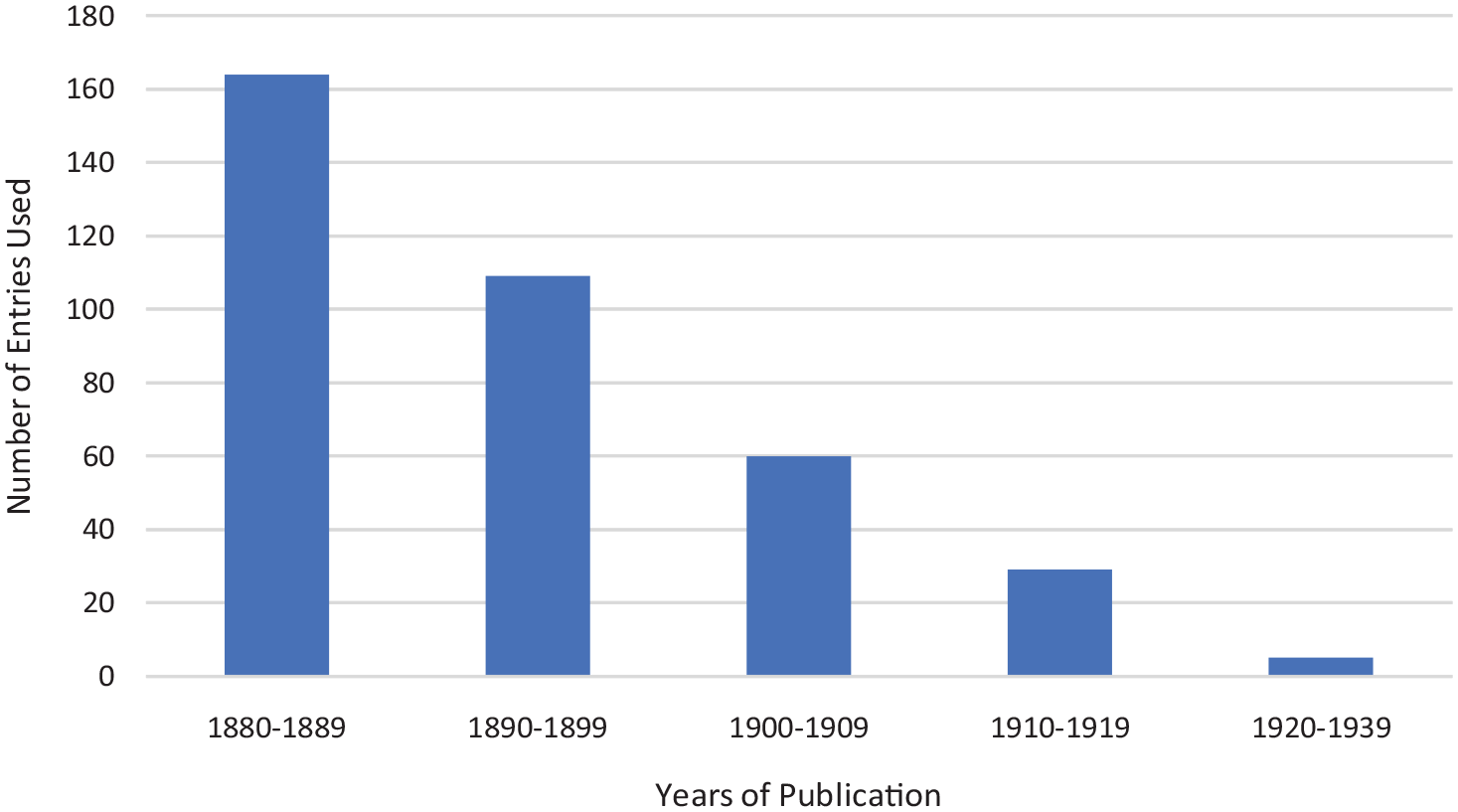
Number of references to Indigenous content by year.
Procedure and data analysis
The principle investigator travelled to Winnipeg, Manitoba, on several occasions between 2015 and 2018 to make digital copies of the Rundschau from the Center for Mennonite Brethren Studies. The Rundschau was then transcribed from gothic to Latin script and subsequently translated from German to English by three translators. The translators removed entries from the Rundschau that did not include information regarding Mennonite perceptions of or connections with Indigenous people in North America, which left us with 367 entries to use in our analysis. The research assistant began the coding process using Auerbach and Silverstein’s (2003) recommended process and managing the data with NVivo 12 software. When analysing the data, we were interested in understanding the meaning of what was said, rather than the number of times something (e.g. themes, words) was mentioned. To accomplish this, we engaged in an interpretive relationship with the data, focusing on what was said instead of how it was said.
Results
The results reveal a wide array of themes and subthemes that appeared in the Rundschau to describe the relationship between Mennonite settlers and Indigenous people in the 19th and 20th centuries in North America. More specifically, eight themes emerged that speak to the nature of the relationship: education, census data, government spending, Indigenous peoples’ immorality, Indigenous religion, distinction between Mennonite and Indigenous characteristics, relationships and role portrayal. The themes and subthemes associated with each topic are described below and presented with representative examples from the Rundschau, cited by date parenthetically in the text. The subsequent sections provides more interpretive analysis to understand why the results are significantly and co-constitutively an outcome of Mennonite settler colonialism rather than the status of their religious claims understood separately from their relation to place.
Education
The entries from the Rundschau commonly involve the topic of education. The schools that are referenced often in the entries include the Carlisle Indian Industrial School, Darlington Mission School, Cantonment Indian Boarding School, Fiscal School in Albuquerque, Haskell Indian Industrial Training School and Lincoln Institution of Philadelphia, as well as St Joseph’s Boarding School in Oklahoma. 1 Of these, Mennonites ran Darlington from 1881 to 1902 and Cantonment from September 1882 to July 1901 in Indian territory (Juhnke, 1980; Petter, 1953; Thiesen, 2006).
In general, the entries discuss the education available to Mennonite and Indigenous children; however, the authors of the Rundschau were also interested in the success or progress of Indigenous children in the schooling system. Letters’ descriptions emphasize Indigenous students’ successful completion of their education and adherence to or participation in ‘white’ ways of life. For example, many entries are dedicated to the explanation of the positive influences of education on the lives of Indigenous peoples. One entry, by Heinrich R Voth, describes the experience of a Mennonite pastor-teacher in the successful conversion of an Indigenous student at Carlisle: He [the Indigenous student] had attended the school on the reserve and then for about five years the famous Indian school in Carlisle, Pa. There, he had converted and joined the Presbyterian Church. He had also been active for the Y.M.C.A. in the city mission. When he returned from there, he became my interpreter and language teacher. He served me well and loyally during assemblies in the camps and beyond. (27 September 1922)
Throughout the Rundschau, many entries suggest that the purpose of the education system is to civilize Indigenous peoples to the white settlers’ ways of life or to convert Indigenous peoples to Christianity. M Baumfeld expresses the importance of educating Indigenous girls to promote the spread of American ways of life within different tribes: The results of the education of Indian girls have been extremely favourable so far . . . These future mothers of the different tribes who went through the American school may be expected that they, carried by the position of power attributed to the woman in the entire country voluntarily, will break with those traditions that could retain up until now at least a certain reflection of the old Indian glory. (9 July 1919)
Census data
Many entries in the Rundschau include census data that educated readers about important changes in their community. In general, census data was collected on the following topics: land, Indigenous peoples, reservations and Indian schools. Throughout the Rundschau, a few entries include census data about the land in North America. More specifically, the entries list the amount of land owned by Indigenous peoples, the government or settlers. Mennonites tracked land availability as the Canadian and American governments dissolved Indigenous sovereignty through containing Indigenous populations in reserves and residential schools. As one entry puts it at the end of summarizing the Commissioner of Indian Affairs’ annual report: ‘How long will it be until the last “Redskin” is sent to the grave?’ (18 March 1885). The numbers of Indigenous reserves and populations anticipate a decline; when census numbers indicate an increase, the authors register surprise. They also comment on Indigenous participation in census-taking: ‘It is a known fact that Indians have as much distaste for being counted as the children of Israel at the time of King David’ (17 December 1890). Contributor JH notes the ‘peculiar census report’ that the Piute chief submitted, using a ‘primitive’ method involving visual depictions and rods, while also informing the reader that it provided an exact survey (31 January 1883).
Government spending
Government spending is closely scrutinized in many of the entries. The Mennonite authors seem to have been particularly interested in how and on what the government was spending its money. The common areas of government funding include religious institutions, Indigenous peoples, land, reservations, schools and war. For example, one entry discusses the total sum allocated to Indigenous peoples by the government between 1789 and 1890: The Census Bureau in Washington has just published a comprehensive report regarding the Indians of this country, in which, for the first time, the attempt is made to calculate the sum the red wards of the nation have cost the federal government since its founding in 1789. The result of this calculation states that, by the year 1890, i.e. within a hundred years, the government has spent for and because of the Indians, directly and indirectly, the enormous sum of $1,105,219,372. (21 August 1895)
Another entry in 1898 lists the money the government has spent on wars with Indigenous peoples since 1830: ‘The Indian fights have cost an incalculable sum in their entirety; but since 1830 alone, even just the federal government has used more than 100 million dollars on them after all’ (16 November 1898). The judgements for the spending are based on efficiency, which is articulated as misallocated beneficence. One entry asks rhetorically: ‘How many hungry Indians could have been sated with this enormous sum?’ (25 February 1891). Another lists the number of lives and amount of money that the Indian wars have cost, only to find that funding residential schools is the best way that ‘the wild sons of the jungle could be turned into decent American citizens, and the never resting Indian question could be solved in a manner worthy of humanity!’ (21 August 1895). In all cases, the authors assume Indigenous dependence on government funds for survival, as well as that the purpose of government spending is to fund Indigenous dispossession, containment and assimilation.
Indigenous peoples’ immorality
A large number of the Rundschau entries discuss the perceived immorality of the Indigenous peoples and their negative impact on the lives of the settlers. Indigenous peoples are commonly framed as antagonists or enemies of the settlers; however, a few entries are empathetic towards the actions of the Indians, acknowledging the circumstances that may have led to their immorality (i.e. starvation, retaliation, fear or anger). For example, one entry explains that their actions were a result of starvation: ‘About 30 starving Yaqui Indians, among them a number of women, raided the Carmen Ranch’ (6 August 1902). In general, immorality was classified into two categories: theft and violence and uprising.
Many entries in the Rundschau discuss the thefts by Indigenous peoples, portraying them as a hindrance or menace to the settlers. The common possessions stolen by the Indigenous peoples include livestock, crops, money and tools. For example, one entry describes a situation where Apaches killed and robbed settlers while destroying their property: ‘Apachean raids that happen every year in Arizona. Last April, a band of these Indians, which had escaped from the San Carlos reservation in April 1882, butchered several white residents of that territory and robbed and destroyed their property’ (12 December 1883).
The majority of the entries discussing the wrongdoings of the Indigenous people describe situations of violence or uprising. Political tensions provoked Indigenous peoples into acting in these situations, which included Indian wars, law violations, attacks on settlers and murders. For example, one entry identifies the source of Indigenous frustration and violence as a lack of government support: ‘The Department of War has informed the Ministry of the Interior that the Apache Indians on the San Carlos reserve are threatening with insurrections, because after July 1st, their meat and other rations are supposed to be cut off’ (25 June 1902).
These reports predominantly come from news sources. The Mennonites blame the government for treating Indigenous communities so poorly that these conditions not only cause stealing and violence but also make it difficult for Indigenous people to accept the gospel (20 September 1905). One Mennonite writer in 1916 claims that ‘both the evil and the useful and good about the white man’s culture confuses the Indian’s soul’ (19 July 1916). He goes on to say that the conditions of Indigenous communities in North America (their mistreatment by the government, changed livelihoods, economic disparity and loss of land) have given Indigenous people money and alcohol with no guidance on either, meaning that they are unable to accept what the writer sees as the good white culture. The non-spiritual benefits of conversion are good health and learning how to spend money wisely.
Indigenous religion
The Rundschau frequently speaks about the religion of the Indigenous peoples, often comparing it to paganism and referring to Indigenous peoples as ‘heathens’ or ‘pagans’. In general, the entries discuss and describe Indigenous religious practices, beliefs and traditions as bizarre, foolish or primitive: So, they are collectively of the opinion that angry spirits temporarily take possession of people and the werewolves, obsessed in this way – Wehtigos – transform, which grants them a special pleasure to kill members of its own tribe or even its own family and to consume the meat of those same individuals. (4 April 1888)
The authors of the Rundschau view Indigenous religion as inferior to Christianity and see it as harmful to Indigenous peoples. However, they also highlight the benefits of a pre-existing Indigenous religion, claiming that it may ease the process of converting Indigenous peoples to Christianity: Morally, he is above most of the coloured and savage races. It is not a very difficult task to lead him from a ‘big spirit’ to the true God. The Indian, just like the Negro, is spiritual and religiously inclined and there is no more promising environment for Christian endeavours than among red inhabitants of our country. (7 November 1887)
Distinction between Mennonite and Indigenous characteristics
The results from the study reveal a sharp distinction between the characteristics attributed to Mennonite settlers and Indigenous peoples in the Rundschau. We coded 172 entries that use descriptive terms for Indigenous peoples – not just ‘Indians’ generically or of a particular reservation – and categorized them as positive, neutral, or negative. These categories were based on how we interpreted the authors’ intent. For example, a very common descriptive term is ‘redskin’, which is used as a neutral term, whereas ‘red devils’ functions pejoratively and ‘copper sons of America’ is meant as a positive portrayal. Only a handful of the entries are positive accounts. Of the positive accounts, while the authors mention how Indigenous people are ‘peaceful’ or ‘good natured’, like in the neutral and negative categories, they focus on racial descriptions. Indigenous people are ‘red warriors’, ‘red brothers’ or ‘red gentlemen’ at best.
One of the most noticeable aspects of the neutral accounts is their variety. The vast majority of negative and neutral accounts are racial descriptions (e.g. ‘copper’, ‘auburn’, ‘coloured’). Compared to the settler characteristics from the same set – looking at how settlers are portrayed when also talking about Indigenous people – there are 109 references that are almost entirely neutral. Settlers are frequently attributed with many more positive (e.g. ‘hard-working’) or neutral characteristics (‘paleface’, ‘whites’) than negative characteristics (e.g. ‘premature invaders’). There is a very narrow range of terms for settlers, including Mennonites, but here too the vast majority are racial descriptions (‘white’ and sometimes ‘paleface’). The few positive or negative characteristics are telling: either ‘pioneers of civilization’ and ‘white conquerors’ (positive) or ‘hated palefaces’ and ‘frontiersmen worse than redskins who want to steal land’ (negative).
Relationships
The data from the Rundschau often frames the relationship between settlers and Indigenous peoples in one of three categories: coexisting, conflicting/competing or helping. In general, a coexisting relationship is characterized by neutral feelings and actions between the settlers and Indigenous peoples. For example, one entry explains a peaceful relationship between the two groups: The Indians will now return home and hold peace, if the whites treat them justly, and this is likely, since the whites have now come to respect the Indians’ attitude. In that regard, the uprising has taught them a lesson. (16 November 1898)
A conflicting/competing relationship is identified by the presence of hatred or resentment between the two groups: ‘The Indians had to suffer much injustice from the hands of the government and government officials and whites in general, so it cannot come as a surprise that they harbour a deep hate for the whites’ (20 September 1905). Moreover, feelings of hatred often led to violent and provocative actions between the settlers and Indigenous peoples: ‘The pioneers of civilization were not safe for a moment in their lives, and many of them were killed in terrible agony, and their scalp decorated the belt of the cruel redskins’ (1 May 1901). Lastly, a helping relationship is determined by the settlers’ belief that they were helping the Indigenous peoples by introducing them to Christianity, teaching them medical or agricultural skills, or offering them food and shelter. Overall, most of the relationships between the settlers and Indigenous peoples were conflicting/competing, followed by coexisting relationships. The least common type of relationship between the settlers and Indigenous peoples was benevolent.
Portrayal of Indigenous peoples: dependent
Indigenous peoples were often thought of as needing the government’s help and protection. For example, the authors of the Rundschau commonly view Indigenous peoples as dependent on the government for their basic needs (e.g. food, water, clothing, shelter) and often refer to Indigenous peoples as ‘red wards of the state’ or ‘red foster-children’. One entry specifically addresses the reliance of Indigenous peoples on the government: When the Indian is drunk, he complains that he, the native of this land, does not even enjoy the same rights as the Negro. When he is sober, on the other hand, he values the rations, blankets and monetary compensation given to him by the government much higher than freedom. He also cannot acquire a taste for microeconomics and private property, since he would have to farm his own land, in other words, work. (21 March 1894)
Another entry discusses the consequences of the government ending its support for Indigenous peoples: The tribe of the Navajo Indians in Arizona, counting about 20,000 men, women and children, is approaching starvation, and if the government or the audience do not offer immediate help, there will be a terrible hardship that will result in the loss of human lives. (24 September 1902)
Many entries in the Rundschau portray Indigenous peoples as primitive or lesser than the Mennonite settlers. More specifically, Indigenous peoples are often referred to as uncivilized, wild or lost: ‘The Indians, particularly our Cheyenne, are a wild, heathen primitive people, which at this time has not adopted to the new circumstances and the new way of civilized life’ (21 February 1894). The distinction between the Indigenous and settler ways of living is often used to highlight the need for change in Indigenous culture: Civilization and savageness cannot coexist. The Indian cannot live next to his white neighbour in a state of half civilization or savageness. He has to adopt the white man’s way of life or he will be eradicated by the vices of his savage life. (5 December 1883)
Portrayal of Mennonites: saviours
Throughout the Rundschau, Indigenous peoples and Mennonite settlers are portrayed in very different ways. Indigenous peoples are often given the role of ‘wards of the state’, lost or misguided, and needing help. More specifically, they are seen as a population that needs to be civilized or converted to Christianity. Consequently, the role of the Mennonite settlers is often portrayed as that of a saviour or civilizer, seeing themselves as the people who are responsible for saving the Indigenous peoples from their primitive, sinful ways of living. While settler civilization is viewed as a cure for the ‘vices’ of traditional Indigenous life, Indigenous peoples will also need to be saved from the vices of settler culture. The Mennonites saw themselves as responsible not so much for turning Indigenous peoples from their ‘primitive ways’ towards a more civilized life, but more for helping shape them to mirror the traditions, customs and religious beliefs of the settlers. As the missionary Rudolphe Petter summarizes the religious work of Mennonites among Indigenous nations: ‘Therefore, our work does not consist in shoving Christianity into the old religious views, but uprooting them with Christianity instead’ (12 June 1895).
Civilizing and converting work are distinct but related. The Mennonites are dubious that Indigenous people have the capacity to use money and the benefits that come from education – namely, gainful employment in settler society – without first becoming morally formed by Christianity. Moreover, the wars bring out and hone the violent nature of Indigenous peoples, which needs to be controlled or else the evils of settler culture will take hold. In other words, while Indigenous people need to be assimilated into settler society, they first need to be shaped by Christian morals so that they are not corrupted by the deleterious characteristics of the society they purportedly need: The Indian is lacking education and acclimatization to civilization; he does not know to appreciate its goods and shapes, to avoid its dangers . . . the gospel is the only power that can save the Indian from this danger and can elevate him safely to his new and better lifestyle. (19 July 1916)
Narrative summary
In sum, the narrative of the results is that Mennonites can save Indigenous peoples from the threats to their existence that will inevitably arise because of government failures and settler society’s wickedness by developing their agency through Christianity. Residential schools and reserves are the best way to make this change possible – to answer the ‘Indian Question’. Education is good for employment, participation in settler cultural institutions and conversion. Containing older generations on reserves and putting their children in schools is an effective way of changing Indigenous communities’ comportment. The census data indicates both the progress of this change and how much land was made available through the process. Government funding is required for the process but it is more efficient spending than warfare, and fits within Mennonite pacifist convictions, while maintaining the same rationale and goal: Indigenous people cannot take care of themselves and, if left to their own devices, are a threat to themselves and others. Indigenous immorality accounts for these threats. Without proper support, Indigenous peoples will steal from settlers and fight the government. The problem and cause of Indigenous immorality is less their religion and ways of life than government failures and the temptations of settler society, which Indigenous people are incapable of addressing on their own.
The solution is for Indigenous people to be able not to be so dependent on government spending in order to alleviate their vulnerability to those failures as well as resist settler temptations. Christianity is the only way to achieve this insofar as it can develop Indigenous agency properly, the measure of which will be becoming enculturated in what the Mennonites see as the good aspects of white society. Christianity is therefore central for giving Indigenous people the agency – the self-determination – they lack in the New World. Indigenous customs and religion are benighted mistakes, either benignly entertaining at best or indicative of diminished cognitive capacity at worst. Yet customs and religion are not exactly the source of Indigenous immorality and therefore not tied to economic and political conditions. They are only harmful insofar as they prevent Indigenous people from navigating settler society well. Indigenous religion primes them for conversion to Christianity, even though the spiritual practices that make them conducive for conversion need to be supplanted altogether. Vices and immorality threaten the Indigenous future in a world where the government and settler society do not treat them well and they do not have the ability to navigate themselves. Agency, self-determination and overcoming dependence depend on Christianity. The Mennonites are in a unique position to help solve this ‘Indian Question’ about how to acclimate Indigenous communities to settler society, ensure their submission to colonial policies, and maintain a non-threatening self-sufficiency within these social and political conditions. They are white settlers who help Indigenous peoples by introducing them to Christianity, teaching them medical or agricultural skills, and offering them food and shelter. In other words, their relationship with Indigenous neighbours facilitates self-determination within settler colonialism.
Mennonite settler colonialism and religion
This section puts the study’s results in the context of the Mennonites’ focus on maintaining self-determination, which was also in question during this time. What we see is how the Mennonites secured their ties to land through the evaluative categories by which Indigenous people were seen to be unfit for maintaining sovereignty over their land. Studying the Rundschau reveals a story about how settlers saw Indigenous people as incapable of self-sufficiency and what they could do to overcome this deficiency. Indigenous relationality – Indigenous peoples’ connection with land, interactions with government officials and policy, cultural institutions, health systems and local economies – needed to be supplanted with Christianity for them to survive and live well.
This story is shaped at the same time as Mennonites were particularly interested in maintaining their own self-determination. Mennonites used their religion to assert their own self-determination when they came to engaging with the government and other settlers. Mennonites see their own negotiations with the government as demonstrating autonomy while Indigenous instances that resemble these discussions, are narrated as examples of Indigenous dependence. The point here is to show that animating Mennonite concerns for Indigenous conversion was the status of their own ability to determine their relation to place. What follows is an account of how Mennonites secured not only land, but also their self-determination through some of the themes with which we have organized their perceptions of Indigenous people – namely, engagement in government projects and how they differentiated themselves from Indigenous people as settlers.
Simply put, Mennonites were players in settler colonialism globally throughout the 19th and 20th centuries. As one historian puts it: ‘Mennonites routinely sought out states with weak or amorphous borders where they could establish agrarian communities that were relatively free from state control’ (Eicher, 2019: 16). Yet, because of their ethnoreligious particularities – living in closed communities, internal governance structures, refusal to swear oaths, traditionally pacifist – they had to prove their ties and commitment to governments offering land opportunities. They did this through establishing agrarian citizenship: they articulated and performed their status in countries through narratives that their agriculture fed the nation, made previously underutilized land more productive, and laid claim to land through this work. Mennonites were not the only ones establishing ties to land through agrarian citizenship, but this highlights how they were able to find new homelands because of how they adapted their mobility to the agricultural vision of the host country (Nobbs-Thiessen, 2020: 12). Mennonites have shown a remarkable adaptability in this regard, fitting what appears to be strict religious and agrarian practices into diverse political contexts in order to secure land for their future – contexts that range from revolutionary Bolivia to Nazi Germany (see Goossen, 2017; Nobbs-Thiessen, 2020). In order to maintain their religious particularities, they needed land, which they procured by making themselves useful for national settler-colonial projects.
The Mennonites’ relations with the government are as important for understanding their perceptions of Indigenous people as their religious claims. Beginning with education, for example, the function of residential schools both resembled and diverged from the role of education in Mennonite communities. Schools were the institutions that taught Mennonite children how to be in the world, but not of it – how to have the skills to navigate through the world and negotiate with outside society without becoming a part of it. Mennonites were anxious about relinquishing control over their schools in Canada not just because they might lose their language or religious education but also because ‘they were simply opposed to the British and Canadian nationalisms that were embedded in a public-school curriculum’ (Eicher, 2019: 49; see also Epp, 1982: 105).
The Mennonites were right to be wary because government officials did, in fact, want them to assimilate into Canadian society, and used public schooling to this end. Once the Mennonite agricultural communities had helped secure settler possession of land from Indigenous nations for the government, the state viewed them suspiciously. Canadian school promoters were inclined to see ‘the community as a dangerous or unsuitable environment for the child’ (Prentice, 1977: 20). Mennonites were seen as such, as one newspaper editor put it, because preserving these communities of ‘alien people of foreign customs, language, and institutions’ without proper integration in wider society would obstruct the ‘homogeneity of nationality’ (Eyford, 2016: 63). While Mennonite communities were divided over the question of public education in their communities, the Rundschau reveals that the Mennonites wanted Indigenous people to be changed into something they were trying to protect themselves from becoming. Mennonite schools were the institutions of resistance against the nationalism that was coercing and exploiting Indigenous children. The cultural and religious formation of residential schools that Mennonites lauded for Indigenous children was feared for their own.
At the same time, the Mennonites were watching Indigenous people being pushed onto reserves and into residential schools to free up land, and commenting on local governance methods. They were also preoccupied with maintaining sovereignty over their own governance structures and reserved land. Mennonites in both Canada and the USA wanted blocks of land to settle as communities, which was only legislated in Canada (see Esau, 2005). Yet nationalism and coveted real estate drove the pressure in Canada to break up the Mennonite reserves. Some Mennonite communities in Manitoba, for example, refused the newly legislated municipal government in 1880 because they were afraid that outside government officials would interfere with their local authority structure (Warkentin, 2000: 59). Again, this suspicion was not unwarranted; one of the privileges for Mennonites to settle in communities rather than homesteads was abolished through an Order-in-Council in 1885, with some officials divulging a desire to see the villages moved altogether (Warkentin, 2000: 60). Non-Mennonite settlers put pressure on the government to open up Mennonite reserves for land purchase, of which these legislations and desires were likely the result. Mennonites managed to successfully protest and lobby local officials to retain their reserves.
Mennonites were interested in government interference in Indigenous governance and spatial containment when it increased land availability, yet at the same time resisted the government doing the exact same thing to their communities. Animating this double standard were visions of their own future, their self-determination, which are charted in the census data concerning Indigenous populations. Mennonites were interested in Indigenous assimilation into civilization and Christianity not just for cultural and religious reasons, but also for how it secured their own future.
When it came to financial support for securing that future, whether or not government aid was seen to facilitate or hamper self-determination was a racial judgment. Mennonites arriving in Canada in the 1870s received an interest-free loan to establish their settlements on the prairies. Backed by Ontario Mennonites, Manitoba Mennonites received $100,000 from the federal government to purchase seeds and other agricultural provisions (Epp, 1982: 216). They received an additional $70,000 ‘for transporting Mennonites and $190,000 toward assisting immigration and meeting immigration expenses’ (Epp, 1982: 216; see Correll, 1946). Government spending on Mennonite settlement in Canada was essential to weathering the first precarious years of crop failure due to the vagaries of nature, including drought and grasshoppers. While government financial assistance was received by both Indigenous and Mennonite communities, the latter saw it as essential to establishing their agricultural and communal foundation for their independent, ongoing perseverance on the prairies, and simultaneously as part and parcel of eroding Indigenous self-sufficiency.
To ensure that the government would facilitate their independent perseverance, Mennonites had to allay any doubts that they were desirable settlers. Despite their white bodies, Mennonites were not always seen as good settlers. While Mennonites were originally sought after as ideal immigrants, who would not only transform the landscape and produce food but also be model communities for other settlers, their ethnoreligious particularities and desire to be distinct from the wider society quickly became problematic. Mennonites began as positive because of their Germanness, agricultural practices and settler characteristics as ‘hard-working and frugal’. But accounts of Mennonites quickly became ambivalent when their idiosyncrasies became apparent. Their desire to settle in block communities, administer their own education and live in housebarns raised the suspicions of neighbours and government officials alike. Mennonite ethnicity was a barrier to their status as white settlers, which was of particular importance to Canadian officials, who were concerned with establishing a homogenous and identifiable liberal social order to unify the nation.
Mennonites were unconcerned with fitting into that narrow range of settler identity until it became apparent that being outside of it limited their self-determination. Whiteness was not just a marker of religion and civilization, indicative of the ‘burden’ to assimilate all others; it also identified a relation to the land – one embodied by the settler. Mennonite ethnoreligious identity needed to be shaped to fit into that mould according to wider society. In the USA, Mennonites became white through missions and urbanization, when they shrugged off the ethnoreligious particulars that marginalized them in the eyes of white Anglo-Saxon Protestants by helping to homogenize new immigrants (Gollner, 2016). But in Canada, Mennonites started doing this before missions were developed. Governor General Lord Dufferin began this in 1877, inviting Mennonites to renarrate their pacifism to fit within national objectives. Mennonites could protect their religious identity by joining Canada and the USA in their ‘war waged against the brute forces of nature’ to advance ‘the standards of civilization westwards’ (Wiebe, 2017: 111). Mennonite agricultural practices maintained religious convictions because they were part of North American settler colonialism. In Canada, they could use the privileges of their white bodies to both secure ties to land and make that land produce for the nation.
Dufferin’s comments became a reference point for Mennonites that external threats to establishing secure, peaceable agricultural communities were issues for the government to solve. The numerous Rundschau entries on Indigenous theft, violence and uprisings indicate that Mennonites were notably concerned about them but in a way that was somewhat distinct from their spiritual concerns for Indigenous people. Mennonites wanted to maintain their own separateness from the world but the material conditions for this maintenance were premised on land secured through the government – a security that Indigenous resistance threatened, based as it was on their own sovereignty. Mennonites kept track of Indigenous actions that challenged state authority, the function of which delegitimized Indigenous claims to land in their narrative. By withdrawing comment on the economic and political conditions precipitating Indigenous resistance while simultaneously participating in residential schools and mission projects, Mennonites aligned their religion with state politics without having to declare it. Here, religion did not unquestioningly support government policies, which were at times criticized; it also did not support resistance. Its attempted neutrality – railing against government failures and settler vices while simultaneously emphasizing Indigenous dependence – tacitly consented to colonial diminishment of Indigenous self-determination in the name of social order, which benefitted Mennonite land tenure.
Conclusion: assessing Mennonite counter-sovereignty
The grounds for religious assimilation are refusing relationality as the basis for religion and politics in North America, and the concomitant denial of Indigenous sovereignty. Colonialism and whiteness have exercised, and continue to exercise, their power through apparatuses and mechanisms of inclusion through expansion and to absorb various cultural, political, social and economic structures. What we have attempted here is neither to include Indigenous theory as completely different such that it bears no meaning or has nothing to offer how we understand Christianity, nor to consume it by reconfiguring what we see to fit within pre-established categories for understanding – digesting what is recognizable and excreting what is deemed dispensable. We begin with the Indigenous claim that relationality is what makes Indigenous communities diverse, as well as what settler-colonial mechanisms attempt to disfigure when extending power over Indigenous people. It is colonialism that posits Christianity and Indigenous relationality as essentially different and opposed to one another because of how colonial apparatuses allow for self-determination under one structure and not the other.
What we see through the Mennonite narrative is how Christianity changes self-determination through settler colonialism so that it cannot be a political, social and cultural embodiment of Indigenous relationality, which is disruptive, but is instead contained by settler-colonial relations to space and land. Mennonites, like other Christian and non-religious settlers, render Indigenous people as dependent to make them consumable by colonizing forces – subjects who can be assimilated into western civilization. But Mennonites also position their Christianity as distinct from Indigenous ways of life to benefit their own land claims and relations with the government. Mennonites construe Christianity as opposed to Indigenous relationality in their articulation of the need to fix Indigenous dependence; however, what is more determinatively opposed is their relations to land. Indigenous interconnectedness – their communities of kinship that establish education, health, culture, and politics on territory and land-use practices – is what encapsulates their sovereignty and distinction from settler society. Mennonites observe all of this in their perception of Indigenous peoples’ education, customs, religion, resistance, government relations and settler relations. Instead of identifying points of connection for their own interests in maintaining a self-determined community relatively free from state control, Mennonites form a narrative that categorizes Indigenous interconnectedness as ‘non-Christian’ in their imagination.
Christianity, for Mennonites, is not just how they identify themselves religiously but also how they navigate their place in society and secure land tenure. Christianity is therefore Indigenous peoples’ passageway into settler society, which, the Mennonite case study reveals, is what enables land-based community and self-determination. Positioned in opposition to Indigenous relationality in this way, Christianity becomes a mode of settler connections between land, politics and social life. The basis for dependence is thus being outside of these settler relational structures, hence the racist stereotypes Mennonites parrot in their narratives – Indigenous people as lazy, bad farmers and primitive, needing to be contained and have their children taken away from them, and so on. Thus, what needs to change is these relations. For Mennonites, settler relations to place are about establishing their own self-determination – their futurity in a new land, innocence (or ‘separateness’, as they articulate it) from political violence, agroeconomic production and land acquisition. These are the things that need to be suspended for an anti-colonial, settler, Christian relationality and engagement with Indigenous people.
At the heart of both taking responsibility and exploring an expanded range of religious identities is replacing a performance of self-determination that is mutually exclusive or parasitic with one that is co-constitutive or collaborative. For scholars of religion studying Indigenous religion, the implication is that Indigenous scholars should be able to talk about how and why Indigenous individuals and communities participate in Christian practices and worship without it being an example of false consciousness. Focusing on relations to place more than the status of religious claims will make it more possible to see how Indigenous people adopt, transform and modulate aspects of Christianity without limiting interpretations to the pragmatic strategies of the colonized. For those studying settler religions, settler scholars should be able to renegotiate religious identity through Indigenous concepts and theory without suspending theology – adherents’ self-articulation of Christian practices and worship – both to take responsibility for their part in colonialism and to analyse current religious intersections as widening pluralism and diversity in potentially beneficial ways. The upshot is that the possibilities in the capaciousness and integration of diversity and social imagination are in the suspension of settler futurity, not transcendence. What settler religious adherents need to see as contestable is not the truth of their claims but their claims on the land – how their social networks and self-determination are performed within a political arrangement that maintains settler colonialism.
Footnotes
Declaration of conflicting interests
The authors declared no potential conflicts of interest with respect to the research, authorship and/or publication of this article.
Funding
The authors received no financial support for the research, authorship and/or publication of this article.
