




Abstract
Warlpiri women from the Tanami Desert of Central Australia have across generations passed on their yawulyu ceremonies, which nurture kin, country and cosmological connections. Dussart has previously shown distinct shifts in purpose in the 1990s, as Warlpiri women first began to perform yawulyu for non-Indigenous audiences. In the past decade, a further shift has occurred, with yawulyu being held predominantly as part of community-development arts initiatives. These opportunities are now the primary contexts in which yawulyu are held, while redefining the values, power relations and types of capital central to these performances, be they surrounding prestige, monetary payment or cultural recognition, as well as providing ambiguous and elusive communitas of ‘contentment’ for the performers as they engage with their audiences. In this article, the authors present case studies that span from the 1980s, when Warlpiri women first considered how to present yawulyu to non-Indigenous audiences, through to the pan-Aboriginal Women’s Law and Culture meetings of the 1990s and 2000s, and the Warlpiri-led Southern Ngaliya dance camps of the 2010s, and up to the present day, where they are being invited to perform yawulyu as part of larger theatrical events. As the authors examine performative events during different periods in Australia since colonisation, they draw on Thomas Turino’s definitions of participatory and presentational genres of musical performances to analyse how and why the reasons to perform have shifted. The authors conclude by highlighting that such shifts shed light on how entangled politics of relatedness are also changing.
Aboriginal women from across Central Australia have for generations sung, danced and painted their chests with ochred ceremonial designs in a genre of public ritual known in Warlpiri as yawulyu. Yawulyu are performed as part of ceremonial events that nurture kinship connections and links to named places and the Ancestral Beings who created the world in the timeless moment known as Jukurrpa, which is intrinsic to Warlpiri identity and group interrelationships. 1 Yet yawulyu are not mere referents linking ancestors, land and human beings, but dynamic events within which meanings can shift. (Re)presentations of yawulyu in public contexts reveal how performers shift configurations of local and global power relations, and how stories, resistance and relatedness are enacted. In this article, we examine yawulyu events from the past five decades, including the large-scale Women’s Law and Culture meetings that have been held since the early 1990s, the Southern Ngaliya dance camps that began in 2010, and the rise of staged performances of yawulyu. Through our respective ethnographic participation and documentation of these performances across a five-decade period (1980s–2020s), we illustrate how Warlpiri women as emissaries of Warlpiri culture aspire to represent themselves and be recognised as the proud bearers of Warlpiri cultural legacy in spite of colonial and post-colonial disenfranchising policies. 2 In this article, we concentrate exclusively on ethnographic materials from a large community called Yuendumu, where we have both worked for decades, although realignments in ceremonial performances enacted by women from Yuendumu have been also influenced by shifts in other communities throughout Central Australia. It is difficult at times to pinpoint the creative aspects from other Central Australian Indigenous communities as people from these communities have performed together for a long time and have, so to speak, become consumers of one another’s representations in their communities and beyond. There is no space here to discuss such forms of entanglement further, or the differences amongst communities in their engagements with the world beyond, however they tell powerful stories of identity-reckoning in post-colonial Australia.
If performances of the past were pivotal events during which both Indigenous performers and their kin exchanged ritual knowledge and realigned kinship alliances, as well as asserted their performative rights over territories and myths, recent performances seem to concentrate more on the ‘showing off’ and proffering, rather than the exchange, of ceremonial knowledge. In these kinds of realignments, yawulyu are not only ‘participatory’ events but have also become ‘presentational’, to use Turino’s (2008) terms with respect to musical performances. In Turino’s words: Briefly defined, participatory performance is a special type of artistic practice in which there are no artist–audience distinctions, only participants and potential participants performing different roles, and the primary goal is to involve the maximum number of people in some performance role. Presentational performance, in contrast, refers to situations where one group of people, the artists, prepare and provide music for another group, the audience, who do not participate in making the music or dancing. (Turino, 2008: 26)
Here, Turino points out some key differences in participatory and presentational performance, which we will use to frame our understanding of the stylistic shifts that have occurred as the purposes for performance have changed. 3
For the Warlpiri yawulyu performers of Yuendumu, the participatory and more presentational modes overlap and are framed by the performance contexts. Until very recently, participatory modes of yawulyu performance were the most common, with frequent exchange events in Yuendumu held by Warlpiri women in their own private spaces, especially nyurnu-kurlangu ‘for healing’ and to ‘finish’ particular ceremonies after the deaths of loved yawulyu singers so that they could be reopened and performed again in other contexts (see Curran, 2020b: 76; Dussart, 2000: 73–74). Similarly, yawulyu held prior to the annual Kurdiji (‘initiation’) ceremonies have in recent decades been primarily participatory contexts in which senior women can assert their social connections to boys – grandsons or nephews (see Curran, 2020b: 87–90). These events had features of ‘participatory performance’ as outlined by Turino, with all of the participants having a role and ‘no artist–audience distinctions, only participants and potential participants’. These events are no longer regularly held by the few senior women still alive, signalling other shifts in what is sung, danced and transmitted (Curran and Yeoh, 2021). Opportunities to perform ‘presentational’ forms of yawulyu as part of other organised events have become more common, highlighting new forms of identity politics. These are framed within the cultural, economic and political pressures that dominate Indigenous Australian lives today. Warlpiri women have been able to travel and perform within their own communities, for other communities, and outside Indigenous worlds in the larger Australian towns and cities. It is this history that we track in this article, from the initial shift in the 1980s, in which women first considered performing yawulyu to others outside of their own kin groups, to the beginnings of Warlpiri involvement in the pan-Indigenous Kimberley and Central Australian Women’s Law and Culture meetings, the ongoing Southern Ngaliya dance camps beginning formally in 2010, and recent opportunities to perform yawulyu for broader intercultural festivals, as well as theatrical and other staged events for mainly non-Indigenous audiences. We illustrate how each of these events installs a sense of joy and happiness in the female participants and, in doing so, promotes Warlpiri pride in their cultural identity and a degree of agency to project these positive elements to a broader world.
Today, a key focus of the senior Warlpiri women driving yawulyu events is on making these spaces joyful and exciting, allowing participants and audiences to enter what Csikszentmihalyi (1990) has described as the optimal state of ‘flow’. As they say themselves, these events ‘make their bellies happy’ (Dussart, 2004: 261). Such emotions are tethered to the ‘success’ of the performances – in other words, the audience needs to be enthusiastically appreciative and respectful, and the performers need to feel that they have provided a flawless celebration of ancestral events while fulfilling kinship obligations (see also Heil, 2010). Such moments are perceived by performers as events where they create bonds with all present, with all constituencies respecting one another (Turner, 2012). Such temporal intimacy can be achieved at yawulyu events, whether they be small-scale gatherings in private spaces near Yuendumu or performances for intercultural audiences in larger Australian cities. For brief moments, all is well in all worlds.
We conclude by considering how this temporary and ambiguous state of ‘happiness’ is itself a motive for yawulyu performances and a form of political resistance that counters and contrasts with negative governmental and popular representations of Indigenous Australians. With this motive at the forefront, Warlpiri women are ‘decolonising’ these performance spaces and positioning their own humanity within post-colonial Australia. 4 Performance here reflects a Warlpiri effort to gravitate towards events that produce positive feelings and associations, promote well-being in intercultural spaces, and are not bound up in the negative associations of colonial trauma (Robbins, 2013). Monetary payments for these performances are important to cement alliances between the performers and the audience, acknowledge the prestige of the performers, recognise the Warlpiri cultural legacy, and provide a much-needed source of cash in the lives of poor Indigenous Australians. As Warlpiri man Lindsay Jampijinpa proclaimed to the audience of a yawulyu event in Adelaide in 1983, repeating what one of the senior female performers had told him: ‘We don’t show our women’s breasts for nothing’. 5
The post-settlement ritual history of Yuendumu
Yuendumu is today the largest Warlpiri settlement in Central Australia, with a population of around 800 people, including over 100 non-Warlpiri service workers. Only a 300-kilometre drive from Alice Springs and with ongoing road upgrades, Warlpiri people living in Yuendumu travel easily and frequently into this larger town, as well as more widely around the Tanami Desert region to other, more remote Aboriginal communities and beyond (see Figure 1). Yuendumu was established as a government reserve in 1946 and, in the following years, many Warlpiri people who were previously living in smaller family groups across the Tanami Desert came to live in this centralised location. With the establishment of centralised settlements came significant changes to Warlpiri ritual life. More people living in one location resulted in greater restrictions to movement as more people were implicated by avoidance relationships between men and their mothers-in-law, and also the ceremonial calendar had to adapt to the demands placed by workday routines enforced by the church, schools and other community institutions. Reflecting residential sedentarisation, larger-scale incorporative ceremonies came to dominate ritual life in Yuendumu, with a decline in smaller-scale ceremonies that required detailed knowledge of places, landscape and Jukurrpa (Curran, 2020b: 40–41).
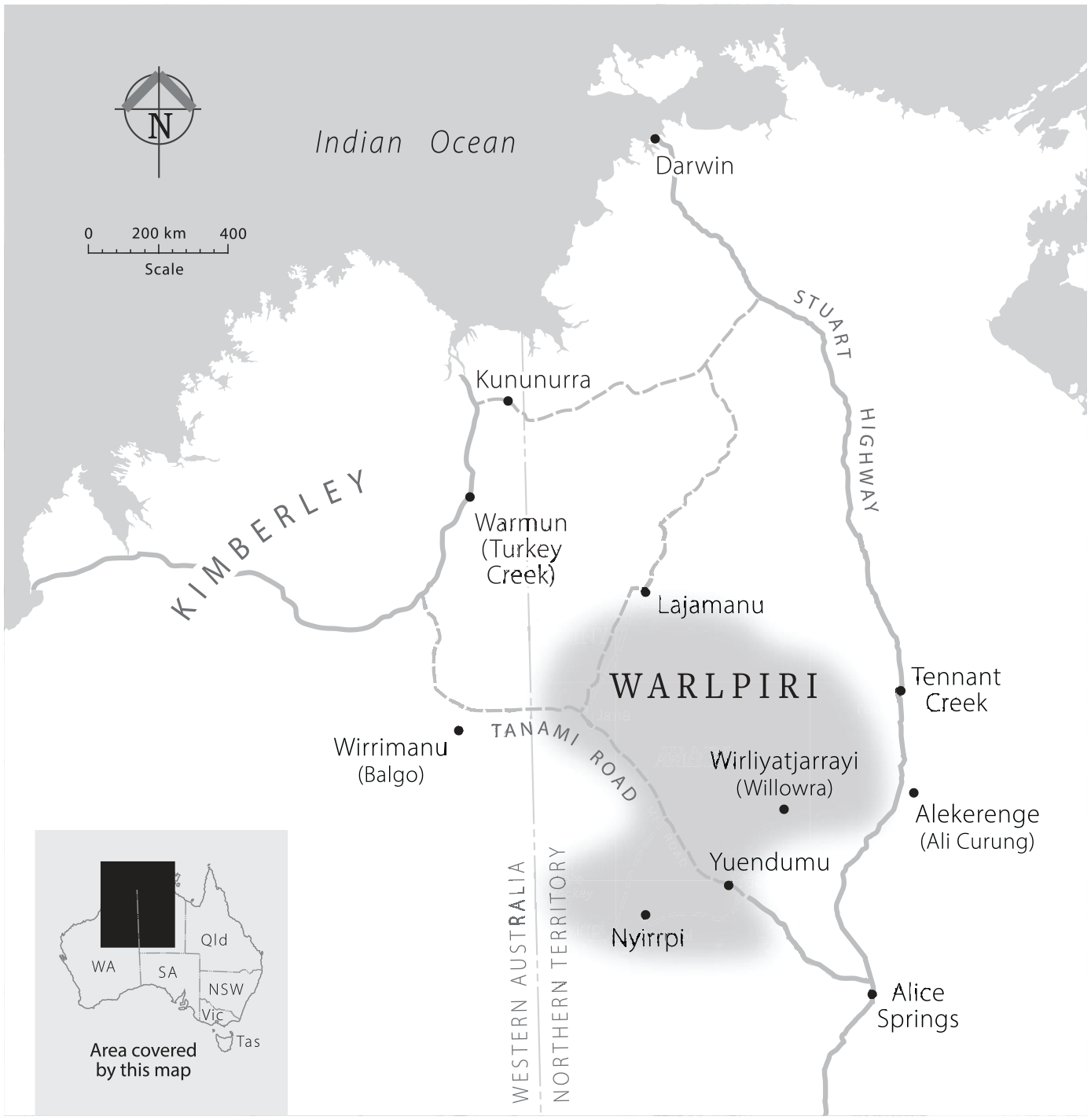
Warlpiri settlements within the Central Australia and Kimberley region.
In 1976, the Aboriginal Land Rights (Northern Territory) Act was passed by the Australian federal government. This was the first legislation to allow Aboriginal people to claim rights to their country where traditional ownership could be proved. Following this Act, much of the 1980s saw land claims across a broad portion of Central Australia, as traditional patrilineal ownership connections could be proved through songs and ritual, as well as other means. During the 1970s and 1980s, public ceremonies called purlapa were performed by men and women together, and were frequently held in Yuendumu (Curran and Sims, 2021; Dussart, 2000; Wild, 1975). These entertaining public ceremonies nurtured important connections to country and Jukurrpa. They were also used as ‘evidence’ for land claims as they illustrated the patrilineal connections of Warlpiri people to particular tracts of land. When Dussart started her fieldwork at Yuendumu in 1983, senior Warlpiri men and women recalled a specific event that took place in 1971 after tests confirmed the presence of uranium on very important cosmological Warlpiri territories. To convince the miners that they should not disturb their lands, the Warlpiri men and women decided that a purlapa should be performed (see Dussart, 2000). Following this event, the mining company ended its search. Even though the cessation of the geological testing was due to other factors than the ritual, it established a correlation between performance and territorial politics that would prove increasingly useful as a medium for cross-cultural advocacy.
The rise of global interest in Australian Aboriginal art throughout the 1980s also afforded Warlpiri artists opportunities to travel and perform at national and international exhibition openings. Senior Warlpiri women from Yuendumu have since this period had many opportunities not only to understand better how their performances are received but also to negotiate amongst themselves what should and should not be performed. By the end of the 1980s, Yuendumu female ritual performers increasingly used their rituals as occasions to cement pan-Indigenous alliances at what Hughes-d’Aeth (1999) calls the ‘margins of colonial space’. They also insisted on clear contractual relationships if they were to perform for non-Indigenous audiences (see also Dussart, 2003, 2006). Monetary payments for these performances have been part of a traditional practice when showing rituals to kin and non-kin (for a broader discussion, see Holcombe, 1997; Peterson, 1993). As Yuendumu’s female performers redeployed and revalued the currency of ritual, they came to realise that it was for the wider recognition of the importance of Indigenous knowledges, land ownership and, more generally, Indigenous ways of life. While the 1980s was a decade of experimentation with presentational forms for male and female performers, by the early 1990s, Warlpiri women had established modes for the presentation of their rituals and regularly sought out opportunities, while the men withdrew from public events. 6 Women have come to represent the public and performative face of Warlpiri cosmological knowledge (Dussart, 1999, 2000, 2004).
Women’s Law and Culture meetings, 1990s–2010s: inter-Indigenous exchange
Beginning in the mid 1980s, women in the Kimberley region to the north-west of Warlpiri country began to organise large-scale women-only events in which they presented songs and ceremonial materials to each other. With the assistance of the Kimberley Land Council, a meeting was held in Warmun/Turkey Creek in 1983, which was ‘the first time that such a group of Aboriginal women, with such diverse backgrounds and coming together from such geographically distant areas, had the opportunity to meet together’ (Dé Ishtar, 2005: 160). Dé Ishtar (2005: 160) states that 350 women and 50 children from 30 different communities and 8 organisations attended. Over the following years, these intracultural women-only meetings continued to be organised with the assistance of land councils and extended to locations in other areas across the Kimberley region. By the 1990s, women from Yuendumu, as well as other Warlpiri communities, had a keen interest in participating. The then coordinator of the Yuendumu Women’s Centre, Anne Mosey, has stated that, during this time, senior Warlpiri women focused their efforts on applying for funding to support their travel to these meetings, which involved the purchase of a bus and other costs, including fuel and food (personal communication, 2019). These efforts to attend these pan-Aboriginal events show that Warlpiri women had a clear desire to have representation beyond their own community and sought this in a space to which they were historically connected, and thus one in which there was appreciation of their rituals. Women from Yuendumu attended meetings in Balgo and Kununurra in the early 1990s, which involved travel across significant distances. These events were open for filming and Mosey, alongside Lorraine Nungarrayi Granites, then a young participant but now a senior singer, created many hours of video footage of these events, mostly focused on the Yuendumu women’s performances of their yawulyu repertories. In this period, the meetings involved hundreds of women from many different Aboriginal groups from across the Kimberley and Central Australia region, all taking turns in showcasing their ritual songs and dances. As Dussart (2004) has shown, in these gatherings, it was acknowledged for the first time that ritual material was not open for exchange, and other women were not able to incorporate these dances into their own repertories, nor were women from Yuendumu able to incorporate ritual elements that they had viewed from the other groups.
At some point around the mid 1990s, possibly as the closest service centre in the town of Alice Springs began to increase in size, Warlpiri women’s attention shifted to involve more interactions with their eastern and southern neighbours. The first Women’s Law and Culture meeting, supported by the Central Land Council (based in Alice Springs), was held in March 1993 and hosted by Alyawarra women from the Utopia community. The meetings since that time have been hosted by Aboriginal women from various communities across Central Australia (Cox and McCarthy, 1999). This annual event throughout the 1990s and 2000s, and more sporadically into the 2010s, was eagerly anticipated by senior groups of Warlpiri women, who would spend a significant amount of time in preparation – negotiating with the coordinators of Yuendumu-based organisations to use buses and other vehicles for transport and ensure money for fuel, as well as making sure that they were able to acquire the necessary ritual paraphernalia for their performances. These Central Land Council-organised meetings were strictly for women only, with lockdowns imposed to prevent women from coming and going during the week-long period during which they took place. The secrecy rules around these meetings are not reflective of the practices in Yuendumu amongst Warlpiri women prior to their involvement in these meetings. Warlpiri women cooperated and even revelled in these rules, possibly as they positioned yawulyu performances in a prestigious and special way that was respected by others across Central Australia, and likely due to the attitudes of Aboriginal women attending from communities in South Australia where there were stricter male–female divides in ritual activity. From this time, filming, audio-recording and photography were no longer allowed at these events. Myers (1986: 252) has pointed out how regional interrelatedness has been the main motivation for participating in large-scale gatherings (see also Holcombe, 1997: 36).
These events began to drive what public performance means today, emphasising gendered restrictions and performances for other Central Australian Indigenous groups as the earlier Women’s Law and Culture meetings in the Kimberley region had also done. Dussart (2004) has described how ‘[t]his yearly meeting brought . . . together Aboriginal ritual performers for ceremonial displays that carried little or no performative rights or obligations, according to Warlpiri participants, for the viewers’ (261). But she goes on to note that, in around 1996, ‘the Warlpiri yampurru [senior performers] extended their performative repertories to include certain non-public (i.e. ‘restricted’) women’s-only versions of their Dreaming stories for an audience of initiated Aboriginal women’ (261). Holcombe (1997: 36) indicates that, by the late 1990s, these meetings had already ‘[m]ore than anything else in Central Australia . . . broadened and politicised Aboriginal women’s motivations for conducting ritual’. However, these events have not been held since 2016. Although it is difficult to be certain why participants have redirected their energy towards other types of events, the lack of resources and the dwindling health and old age of many of the key participants have been major factors in the demise of such large pan-Indigenous female-only events. However, it was through such events that both performers and audiences became consumers of one another’s yawulyu as presentational modes of performance across Central Australia. Whilst there was a high level of excitement surrounding participation in these large events, there was also a certain level of stress associated with the pressures to present themselves correctly to other Aboriginal groups.
Legacies rearticulated: the Southern Ngaliya dance camps
Whilst adult education programs have been provided in Central Australian schools since the 1950s, 7 intensified efforts to involve Aboriginal educators began in earnest in the mid 1970s (Disbray and Bauer, 2016). At the Yuendumu school, this led over the following decades to regular school-based events in which yawulyu and purlapa dances were held, and to the painting of the famous Yuendumu Doors – a project in which the doors of the school buildings were all painted with important ceremonial designs by several leading community artists (Warlukurlangu Artists, 1987). Senior women became involved as teachers and would sing and paint ochred designs on the children whilst showing them how to dance (see Figure 2). In this way, senior women were becoming involved in the larger project of passing on their knowledge – a project deeply interconnected with non-Indigenous worries about cultural preservation. 8 These ideas frame the school’s ‘country visits’, which have been held each term up to the present day. During such visits, families set up camp at outstations surrounding the larger communities for a week and perform yawulyu and purlapa with children. 9
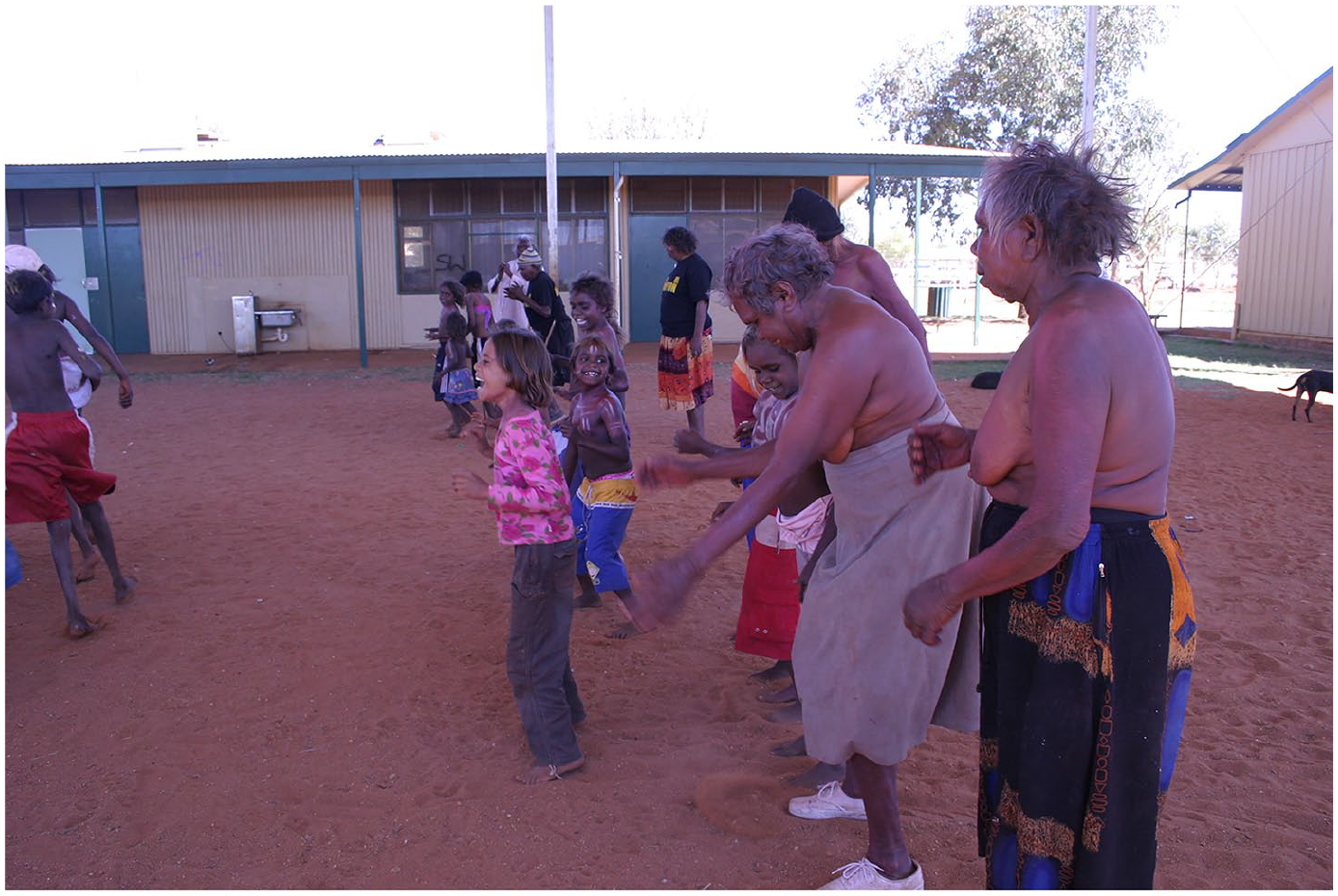
Warlpiri schoolchildren being taught by elders to dance yawulyu on the Yuendumu school’s basketball court. Photograph by Georgia Curran, 2006.
Since 2010, the Southern Ngaliya dance camps have been held biannually at different outstations on Warlpiri country. Drawing on the efforts of the Yuendumu school to engage families in specific cultural activities, these camps focus on the performance of Warlpiri women’s yawulyu as gendered and multigenerational learning spaces (for further details, see Curran, 2020a). Originally, these camps were conceptualised during conversations in 2008 between senior Warlpiri women, a youth worker (Natalie O’Connor) and a dance researcher (Gretel Taylor), in which concerns were raised about young women not knowing or learning Warlpiri dances (Taylor, 2009). These concerns grew into a community-development initiative to support these camps, driven largely by senior Warlpiri women – in particular, Enid Nangala Gallagher, who has ensured the ongoing success of this initiative through her roles within the Warlpiri Youth Development Aboriginal Corporation (a community youth program) and Incite Arts (a community arts organisation based in Alice Springs). 10 The attendance of women from other major Warlpiri communities at Lajamanu, Willowra and Nyirrpi depends on whether they have support for transport from their own community organisations. Women from Yuendumu are, however, always present, and most often dominate these events, though this dynamic does shift when the camps are located on sites closer to the other communities. The Southern Ngaliya dance camps are, however, intended to be inter-community gatherings involving Warlpiri women, and do not extend to other groups in Central Australia or beyond, as the Women’s Law and Culture meetings did. These events have been specifically set up to ease pressures on the older Warlpiri women – the cooking of food, setting up of bedding and childcare are undertaken by staff employed by community organisations to ensure that the older women performers can focus primarily on organising their yawulyu events.
The Southern Ngaliya dance camps are run in the school holiday periods beginning in April and September each year. The intent is that school-aged girls can finish school for the term and then spend the first weekend of their holidays at this event. As with the larger-scale Women’s Law and Culture meetings supported by the Central Land Council, these camps are supported spaces where transport, camping equipment and food are supplied for the participants. Significantly, Gallagher also ensures that funding is sought to be able to make payments to the adult participants as teachers; it is normally a relatively low figure but nonetheless one that is shared out amongst the attendees. Being paid for their attendance at these camps is important for Warlpiri women, who see it as recognition of the value of yawulyu and their important role as cultural teachers. Additionally, senior women feel that this payment will assist with the intergenerational transfer of songs by encouraging younger women in their thirties and forties to participate.
The camps usually last three to four days, with the setting up of the camp and ceremonial space on the first day, bush trips to nearby sites during the cooler mornings, a restful period in the middle of the day, the beginning of painting up after lunch in the late afternoon, and dancing starting just before sunset and continuing until after dark. In recent years, the Warlpiri women have requested that a large screen be brought to these events so that the evenings can be spent viewing older footage of dancing from archival collections and other relevant material. Generally, there are two afternoon/evenings of yawulyu in which everyone participates. Others arrive to attend who do not stay at the camp, and there is thus a large audience, including non-Indigenous workers who have been hired to assist with the set-up of the space, collection of firewood, transport and cooking. In many instances, the senior women devote one of the days to ‘proper’ yawulyu and the other to the involvement of children and younger girls. The photographs and video footage are sometimes taken by one delegated person for the whole event, to reduce the intrusive nature of too much filming while still maintaining an official record for everyone to access should they wish. The presence of other cameras seems pervasive. Many non-Warlpiri working staff involved in local organisations often come along to enjoy the festivities. Their presence as an audience is understood as a mark of appreciation and respect for Warlpiri performances. In the end, what counts the most for the dancers and their relatives is detailed video documentation, even after dark, requiring the presence of many vehicles to shine their headlights on the performances.
These events represent a convergence of complex Indigenous, non-Indigenous, intergenerational and intragenerational ideas and strategies for preserving and passing on cultural knowledge. The two organisations that support these camps each get their funding from broader Australian bodies that have specific guidelines to support ‘cultural heritage’ and well-being. Cultural preservation as a state initiative drives these events, resulting in a fraught terrain where different agendas converge and may not necessarily reflect the desires of the senior Warlpiri women or the young women and girls. In efforts to engage with these community-development initiatives, yawulyu in these spaces have become ‘presentational’ performances, with an emphasis on an end product of a performance for younger Warlpiri girls and women, as well as non-Warlpiri supporters, who have the power to argue and gain funding for the continuation of these dance camps. Whilst at these dance camps there is a focus on painting women in the correct patrilineal relationships with kuruwarri ‘Dreaming’ designs and singing the songs associated with their patrilineally inherited Jukurrpa, the emphasis is much more on the act of performing than detailed symbolic understandings (Schieffelin, 1985). Nowadays, rather than the frustrations outlined above that were felt by Warlpiri women in the 1980s when the audience had no engagement with and understanding of the symbolic power of the songs and dances, yawulyu are taking on a new form of power as performance – performance that can be wielded in its presentational form to gain monetary support and cultural recognition for an increasingly endangered genre of song and important aspect of Warlpiri religious identity.
Despite these conceptual and practical challenges, the Southern Ngaliya dance camps are for Warlpiri women key opportunities to perform songs, dances, body painting and stories, as well as facilitate visits to important sites in country, and remain one of the only consistent contemporary spaces for nurturing yawulyu. While Indigenous performers see these programmatic events as ways to project themselves into the future and a changing world, they also recognise how difficult they are to organise and sustain within a fraught intercultural and intergenerational environment. Although beyond the scope of this article, we should not underestimate how complicated cultural maintenance is for Indigenous people and how such initiatives are entangled with their own colonial and post-colonial western educational experiences and projections.
The rise in frequency of staged performances of yawulyu
Performance opportunities have multiplied significantly and, in the last decade, there has been an explosion of interest by Warlpiri people to travel widely to perform at festivals and other events across Australia. Additionally, there is a strong demand from festival organisers for these kinds of community-group performances within larger events. In these instances, as is also the case at the Southern Ngaliya dance camps, the details of the religious significance of the songs and dances are not necessarily explained to or understood by the audience but overridden by the spectacle of the performance, which, in itself, has powerful social purpose. The audiences do, however, engage with the performances on their own terms because they value Indigenous Australian culture and its important role in a broader Australian identity. For Warlpiri singers and dancers, these opportunities and the payment and prestige that they bring have meant that there is less enthusiasm around the participatory yawulyu events within communities.
The last five years have highlighted some important shifts as Warlpiri women have adjusted their performances of yawulyu to take on many more of the features of ‘presentational performance’ (Turino, 2008) that are necessary for them to be appreciated by these broader global audiences. In the two years prior to COVID-19-related restrictions, Warlpiri women were invited or put themselves forward to perform as part of six different events (see Table 1). 11
Performance events outside of Warlpiri communities from 2017 to 2018.
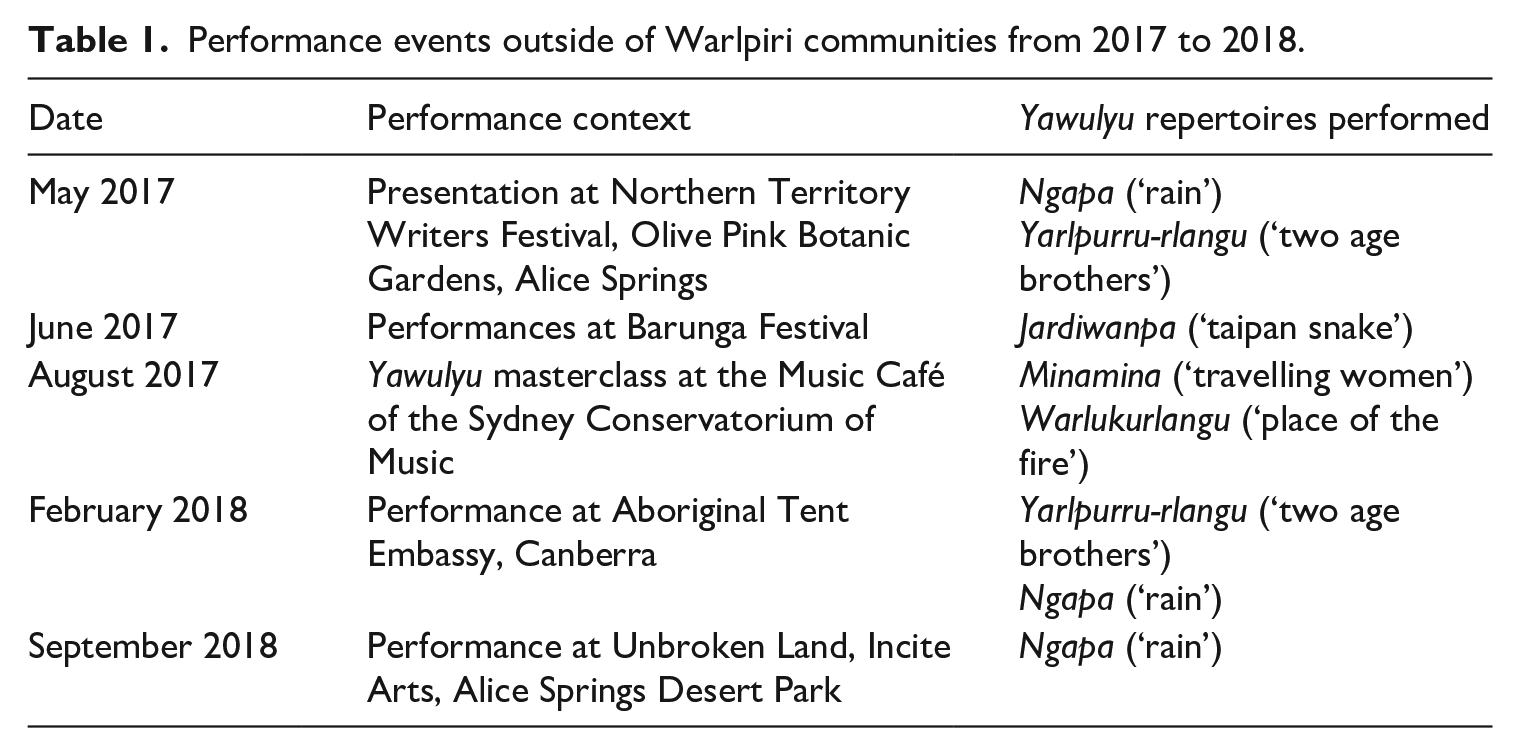
These events again required Warlpiri women to rethink the ways in which they were performing yawulyu and the purposes for doing so. The boundaries between the audience and participants are distinct in these instances, and the performers are on a stage, whether it be an actual stage or a sectioned-off area (a ceremonial ground in festival instances). The audience sits at an established distance from the singers and dancers to mark them as viewers – a spatial definition of these roles that has been refined since these modes of presentational performance began with yawulyu events surrounding art exhibition openings. Additionally, these performances are marked by a set time slot that has a clear and pre-established beginning and end. Warlpiri women have adapted yawulyu so that they can be more easily performed in these intercultural spaces. The performers often gauge the success of these performances based on the applause and enthusiasm of the audience, which are seen as markers of connectedness and recognition of Warlpiri culture. Such realisation makes the performers ‘happy in their bellies’ (Dussart, 2004: 261), as they have properly used the performance space to re-enact the journeys of their ancestors and the life forces evoked during the performances, bringing joy to all, as well as greater connections.
At the Northern Territory Writers Festival in 2017, Warlpiri women were scheduled to perform at 9 a.m. on a cool winter morning – a very different context to the regular warm afternoons in which yawulyu are traditionally held. An additional live stream of the event meant that the scheduled time slot needed to be followed closely. The normally flexible schedule that surrounds events with a predominantly Indigenous audience needed to be adjusted significantly in this context. Amidst the organisers’ pressure to adhere to a start time – one of the inflexible aspects of presentational modes of performance – the Warlpiri performers remained confident. This was encouraged by a growing crowd that continued to gather to watch as they got ready just outside a building, many enthusiastically taking photographs and making encouraging comments. Once the dancers had been painted up and prepared with feathered head and arm bands, the group moved into the indoor space, with the crowded audience that had gathered having to shift to form a path for them to dance through.
At these kinds of performative events, Warlpiri women are also required to adjust the spatial modes of their performances. On a ceremonial ground, dancers re-enacting Jukurrpa align themselves following the cardinal positions of the specific countries of the celebrated Ancestral Beings. On smaller, fixed stages, such alignments are not always possible. At the masterclass presentation held at the Sydney Conservatorium of Music’s Music Café, the group of six singers and dancers had planned to perform Minamina (‘travelling women’) yawulyu as one of the main able-bodied dancers was an owner of this Jukurrpa. Once standing on the stage, however, the singers and dancers had to do a rapid rethink of how to perform this dance, as it recounts the travels of a group of ancestral women across Warlpiri country from west to east. This would have been impossible due to the position of a large grand piano on the stage, and it would also not have amounted to good stage presence to dance away from the audience towards the back of the stage. This kind of rethinking of the ways in which yawulyu can be performed has been evident since the beginnings of these presentational modes of performing yawulyu in the 1970s (see Dussart, forthcoming).
As growing opportunities have emerged, Warlpiri performers have often discussed how to engage with their audiences. At some more recent events, in-the-moment innovation has become a feature of yawulyu performed on a stage. In 2018, a group of Warlpiri women were invited to participate in a broader event called Unbroken Land, a promenade performance in which an audience walked through a number of stages set up throughout the Alice Springs Desert Park. Warlpiri performers had an allocated space in one area to get ready and where they also danced, backed by a screen with printed photographs of a related Warlpiri site known as Jukajuka (see Figure 3). The audience would view a different performance at each stage set up around the park, and therefore a warning would come through on a walkie-talkie that the audience was about to arrive. As the Warlpiri women were asked to sing the same two verses of the Ngapa (‘rain’) yawulyu for two audiences over three consecutive nights, by the final night they had honed the mode in which they presented these songs. With this ‘scripted, rehearsed and tight’ (Turino, 2008: 80) performance, which was also ‘known to the performers in advance’ , the lead dancer, Nellie Nangala Wayne, saw it as an opportunity for innovation. She finished on the final night with a mimetic dance of kirrkilanji, the name of the eagle central to the Ngapa Jukurrpa stories, ‘flying’ close to the audience to finish by making direct eye contact. It is unusual to see this kind of mimetic dance in Warlpiri women’s yawulyu, which more typically involve actions that depict the travels of Ancestral Beings in a rhythmically repetitive style. This innovative element being incorporated by this individual dancer (who was also a senior owner and therefore in a position of authority to make these shifts) established direct engagement with the audience.
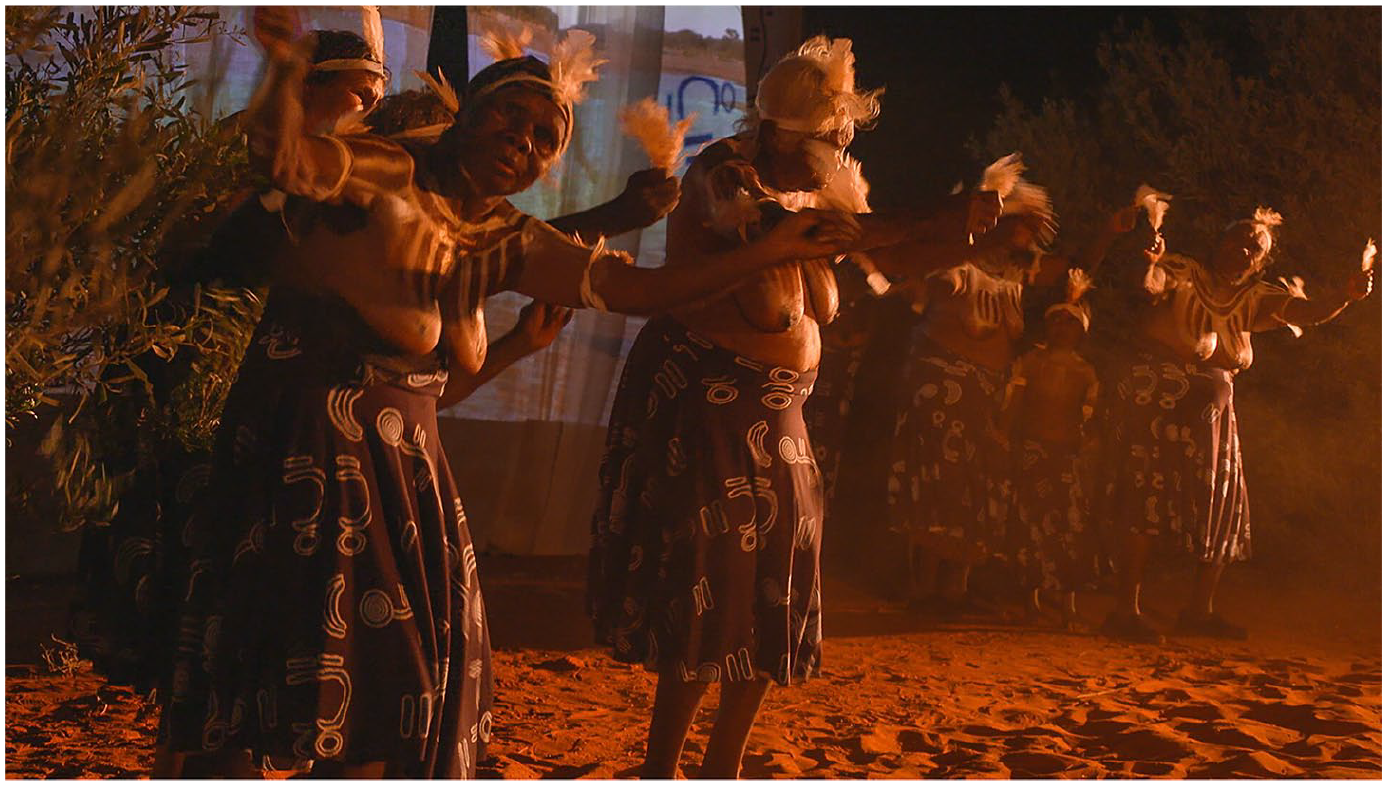
Warlpiri women dance the Ngapa yawulyu as part of Unbroken Land, Alice Springs Desert Park, 2018. Photograph courtesy of Incite Arts.
With these kinds of opportunities to perform as part of staged events, another reconceptualisation of the modes of traditional yawulyu performance has occurred to incorporate many more of the features of presentational modes. These years of performing on stages in public contexts have seen Warlpiri women formulate adaptations to yawulyu that adhere to these new performance contexts. With the focus taken away from the sonic and kinesic social interactions amongst the women, the emphasis is on the performers presenting themselves as cultural experts. Whilst in the participatory yawulyu events held in Yuendumu, and in broader intra-Indigenous events such as the Women’s Law and Culture meetings, the singers and dancers do not consider themselves to be ‘artists’ or ‘musicians’ as such, during the staged contexts we have evoked here, they have come to understand that this is how they are viewed by their audience, and often adopt such titles. They see in them a recognition of their status as cultural experts. As Barbara Napanangka Martin, one of the female Warlpiri dancers who travelled to Canberra explained to a friend who asked her why they performed at the Aboriginal Tent Embassy: ‘We were really just showing off!’ – emphasising motivations to display this prestigious component of their cultural identity. Such productive outlets provide a window into how performances can be understood as what Chalfen and Rich (2004) call ‘cultural brokerage’, as the women refashion themselves in highlighting the dynamic nature of Indigenous cultural performances within a marginalising society (Langton, 2003).
Decolonising intercultural spaces: ‘making our bellies happy’ (Dussart, 2004: 261)
Across the five-decade history that we have tracked in this article, clear shifts from participatory to presentational modes of performing yawulyu are paralleling the overarching political aspirations of Warlpiri women as they receive and accept invitations to perform in widespread locations across Australia. The presentational modes established in the 1980s have now become of increasing importance as the staged contexts are some of the only opportunities for Warlpiri women to ensure the continuation of this valued aspect of their cultural identity in these intercultural performance contexts. In the mid 1980s, Hamilton (1986: 13) observed: ‘Women’s ritual performances have undergone dramatic change in terms of their “significance” in recent years, because they now signify financial reward, new experience and enhanced self-esteem for women . . . [They are] a particular form of commodity relation’.
Following from Dussart’s earlier observations in the 1980s, 1990s and early 2000s, these shifting contexts for ritual enactment can be understood as further ‘broaden[ing] the contexts in which the “traditional” can be performed’ (Dussart, 2004: 262; Myers, 1994) and solidifying a space for a Warlpiri-specific version of Aboriginality to form part of the broader Australian desire to define an intercultural national identity. As Magowan (2000: 310) has explained: ‘The contemporary nature of public sites is part of the process of generating national sentiment and expectation about Aboriginality and, in turn, Aboriginal performers are taking the opportunity to engage in these sites to convey identities in specific ways’. More than anything, these events are spaces in which Warlpiri culture is held high, predominantly on Warlpiri terms, and is recognised for its unique heritage in a broader global sense.
The recognition and revering of Aboriginal performance steadily grew into the turn of the 21st century. 12 The Warlpiri lands on which yawulyu singers and dancers live are, however, in a remote area of Australia where the lived trauma of colonial encounter is within the living memory of some elders. 13 Indigenous people living in remote Warlpiri communities are today often faced with the injustices of new government policies, with many living in contexts of poverty marked by overcrowded housing, poor nutrition and inadequate health services. Warlpiri women’s interest in public performance of their yawulyu has a political dimension and can be considered as a decolonising effort in which they actively choose to engage in intercultural worlds in positive ways that culminate in making performers and audiences ‘happy’ and ‘proud’ to engage with one another, albeit temporarily (Myers, 2011). These heightened emotive states created by participating in yawulyu across the Women’s Law and Culture meetings, Southern Ngaliya dance camps and staged performances of recent years evidence moments of connectedness amongst Indigenous and non-Indigenous participants/audiences, despite the palpable, ongoing unequal relationships in society at large.
Footnotes
Declaration of conflicting interests
The authors declared no potential conflicts of interest with respect to the research, authorship and/or publication of this article.
Funding
The author(s) disclosed receipt of the following financial support for the research, authorship, and/or publication of this article: Georgia Curran received funding from the Australian Research Council to undertake this research (DE200100120).
